%22%3E%3C/path%3E%3Cpath d=%22M 63.072 7.554 C 62.258 8.022 61.577 8.689 61.092 9.493 L 61.092 7.076 L 57.158 7.076 L 57.158 22.64 L 61.089 22.64 L 61.089 14.888 C 61.089 13.446 61.403 12.434 62.03 11.853 C 62.818 11.218 63.818 10.907 64.826 10.982 L 65.868 10.982 L 65.868 6.851 C 64.891 6.834 63.926 7.076 63.073 7.554 Z%22 fill=%22rgb(17,17,17)%22%3E%3C/path%3E%3Cpath d=%22M 78.916 7.82 C 76.363 6.49 73.321 6.49 70.768 7.82 C 69.562 8.473 68.564 9.451 67.888 10.644 C 67.167 11.931 66.803 13.387 66.834 14.862 C 66.804 16.332 67.157 17.785 67.86 19.077 C 68.515 20.267 69.494 21.246 70.684 21.901 C 71.924 22.576 73.318 22.92 74.73 22.898 C 76.164 22.918 77.58 22.575 78.846 21.901 C 80.062 21.247 81.073 20.27 81.768 19.077 C 82.506 17.797 82.88 16.339 82.85 14.862 C 82.88 13.389 82.517 11.934 81.797 10.647 C 81.12 9.455 80.122 8.477 78.917 7.824 M 78.803 14.862 C 78.829 15.739 78.636 16.608 78.241 17.391 C 77.903 18.046 77.38 18.588 76.738 18.95 C 76.124 19.293 75.432 19.472 74.729 19.47 C 73.668 19.497 72.648 19.061 71.934 18.276 C 71.139 17.323 70.741 16.1 70.823 14.862 C 70.741 13.62 71.149 12.395 71.959 11.45 C 72.687 10.667 73.715 10.233 74.783 10.256 C 75.859 10.236 76.894 10.67 77.635 11.45 C 78.464 12.387 78.884 13.616 78.801 14.864%22 fill=%22rgb(17,17,17)%22%3E%3C/path%3E%3Cpath d=%22M 95.906 7.076 L 95.906 15.646 C 95.975 16.68 95.643 17.701 94.979 18.498 C 94.311 19.184 93.379 19.547 92.422 19.495 C 91.475 19.544 90.553 19.18 89.894 18.498 C 89.23 17.701 88.898 16.68 88.967 15.646 L 88.967 7.076 L 85.033 7.076 L 85.033 16.207 C 85 17.449 85.275 18.68 85.834 19.79 C 86.327 20.75 87.095 21.542 88.039 22.065 C 89.033 22.594 90.145 22.861 91.271 22.838 C 92.188 22.847 93.095 22.65 93.926 22.263 C 94.708 21.905 95.388 21.36 95.906 20.675 L 95.906 22.645 L 99.865 22.645 L 99.865 7.076 Z%22 fill=%22rgb(17,17,17)%22%3E%3C/path%3E%3Cpath d=%22M 4.513 15.626 C 4.511 10.815 7.606 6.549 12.181 5.059 C 16.756 3.57 21.77 5.195 24.601 9.086 L 27.816 5.87 C 24.074 1.186 17.981 -0.943 12.137 0.393 C 6.292 1.728 1.728 6.292 0.393 12.137 C -0.943 17.981 1.186 24.074 5.87 27.816 L 9.085 24.601 C 6.214 22.512 4.515 19.177 4.513 15.626%22 fill=%22rgb(32,62,235)%22%3E%3C/path%3E%3Cpath d=%22M 17.114 14.343 L 13.354 18.01 L 13.354 18.026 L 21.071 18.026 L 11.412 27.609 L 17.389 27.609 L 23.999 21.081 L 23.999 28.316 L 24.005 28.316 L 27.967 24.393 L 27.967 14.343 Z%22 fill=%22rgb(32,62,235)%22%3E%3C/path%3E%3C/g%3E%3C/svg%3E) ×
× ××
××›
›
›
›
Pipedrive pricing 2026 explained
Pipedrive pricing 2026 explained
Pipedrive pricing 2026 explained
Pipedrive pricing 2026 explained
Pipedrive pricing 2026 explained
Pipedrive pricing 2026 explained

Author
Aljaz Peklaj

Pipedrive pricing in 2026 is the cleanest CRM pricing on the market: 5 tiers, transparent per-seat math, and add-ons billed per company instead of per seat. After running 5 active Pipedrive deployments at GROU over the last 18 months, the gap between list price and real spend is roughly 12% — eight times tighter than HubSpot's 48% gap.
This is the operator breakdown: every tier, what teams actually spend at 3-50 seats, every add-on explained, and where Pipedrive wins or loses against HubSpot and Close.
TL;DR
Pipedrive list prices run $14/seat (Essential) to $99/seat (Enterprise) on annual billing. Real annual cost for a 10-seat growth team lands around $3,480/yr — about $290/seat/year all-in including Smart Docs and LeadBooster add-ons.
Most B2B SaaS teams should buy Advanced at $29/seat. It unlocks workflow automation and 2-way email sync, which are the two features Essential lacks that you'll need within 90 days. The same stack in HubSpot costs $11,000+/yr for the equivalent functionality.
The 5 Pipedrive tiers
Pipedrive splits across 5 tiers: Essential, Advanced, Professional, Power, and Enterprise. Each tier adds to the previous. There's no Hub-style product split like HubSpot has, which makes the math much easier to model.
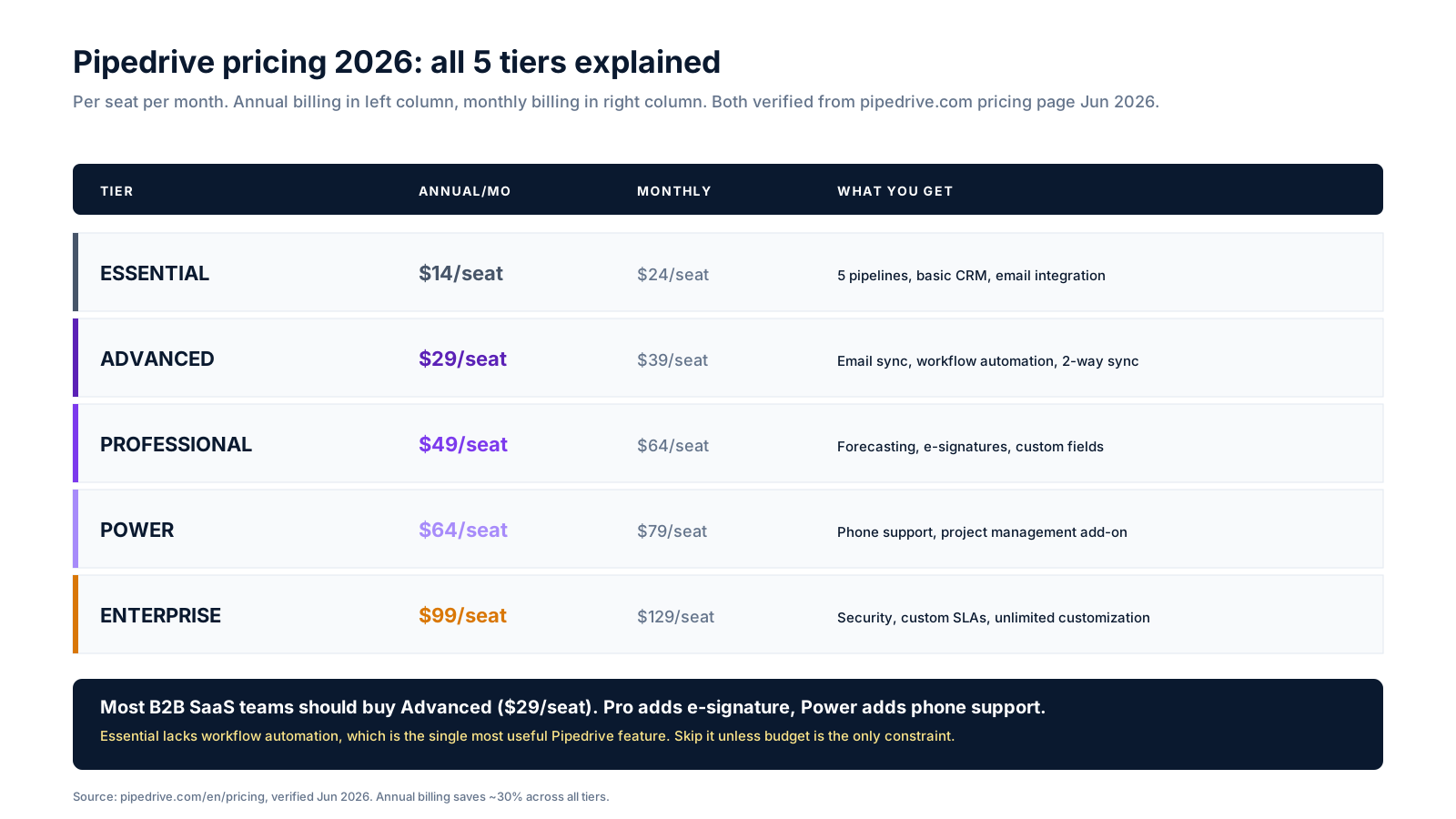
Annual billing prices sit roughly 30% below monthly billing. The numbers above are annual list prices verified from pipedrive.com/pricing in June 2026. Monthly billing pushes Essential to $24/seat and Enterprise to $129/seat.
Essential ($14/seat) is the budget tier. 5 pipelines, basic contact and deal management, and email integration. It lacks workflow automation, which is the single most useful Pipedrive feature. Skip Essential unless budget is the only constraint.
Advanced ($29/seat) is where the platform earns its place in the stack. Workflow automation, 2-way email sync, group emailing, and meeting scheduler. This is what most B2B SaaS teams should buy.
Professional ($49/seat) adds forecasting, e-signatures, custom field visibility controls, and revenue management. Worth the upgrade for teams doing complex proposals or revenue forecasting against quota.
Power ($64/seat) adds 24/7 phone support, custom permission sets, and increased automation limits. Mostly a mid-market plan for teams who need a real account manager.
Enterprise ($99/seat) adds security features (SSO, audit logs), custom SLAs, and unlimited customization. Real enterprise pricing — negotiate down for any deal over 25 seats.
What Pipedrive actually costs (real client contracts)
The 5 GROU clients running Pipedrive range from a 3-seat founder team to a 50-seat scale-up. Real contract costs (annualized, including the add-ons most teams buy in the first 90 days) below.
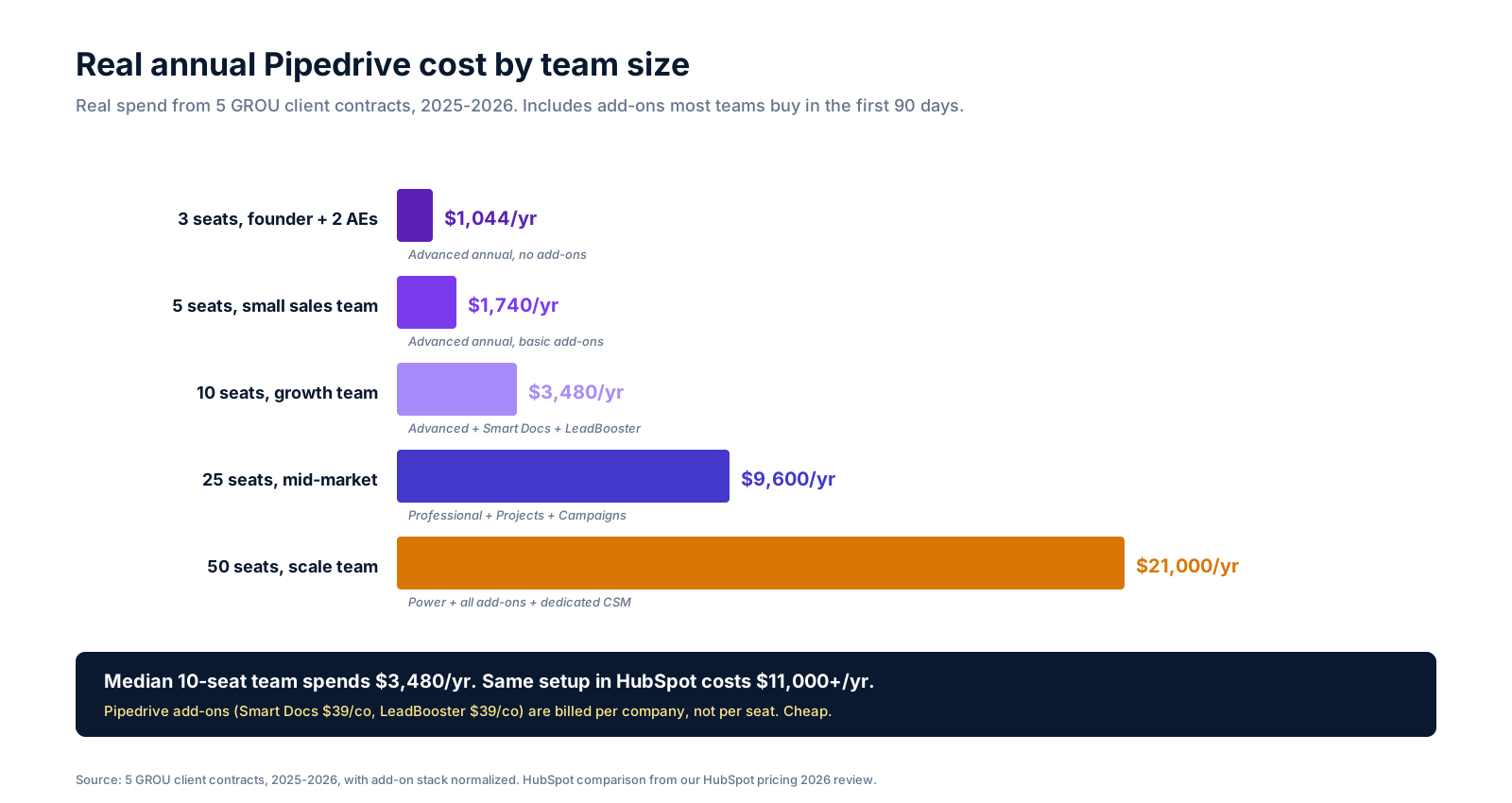
The median 10-seat team pays $3,480/yr including 2 add-ons. The same configuration in HubSpot lands at $11,000+/yr. Pipedrive is dramatically cheaper for the same daily-use feature set because of two structural differences.
The first is that Pipedrive bills add-ons per company, not per seat. LeadBooster is $39/co/mo whether you have 5 seats or 50. HubSpot's equivalent (Marketing Hub) bills per contact, which scales linearly with your list.
The second is that Pipedrive has no required onboarding. HubSpot Pro and Enterprise tiers won't activate without onboarding services ($3k-$25k). Pipedrive lets you self-serve from $14/seat to $99/seat with no implementation fee.
The Pipedrive add-ons
The 5 Pipedrive add-ons are where teams either save money or accidentally double their bill. The two everyone should know are LeadBooster and Smart Docs.
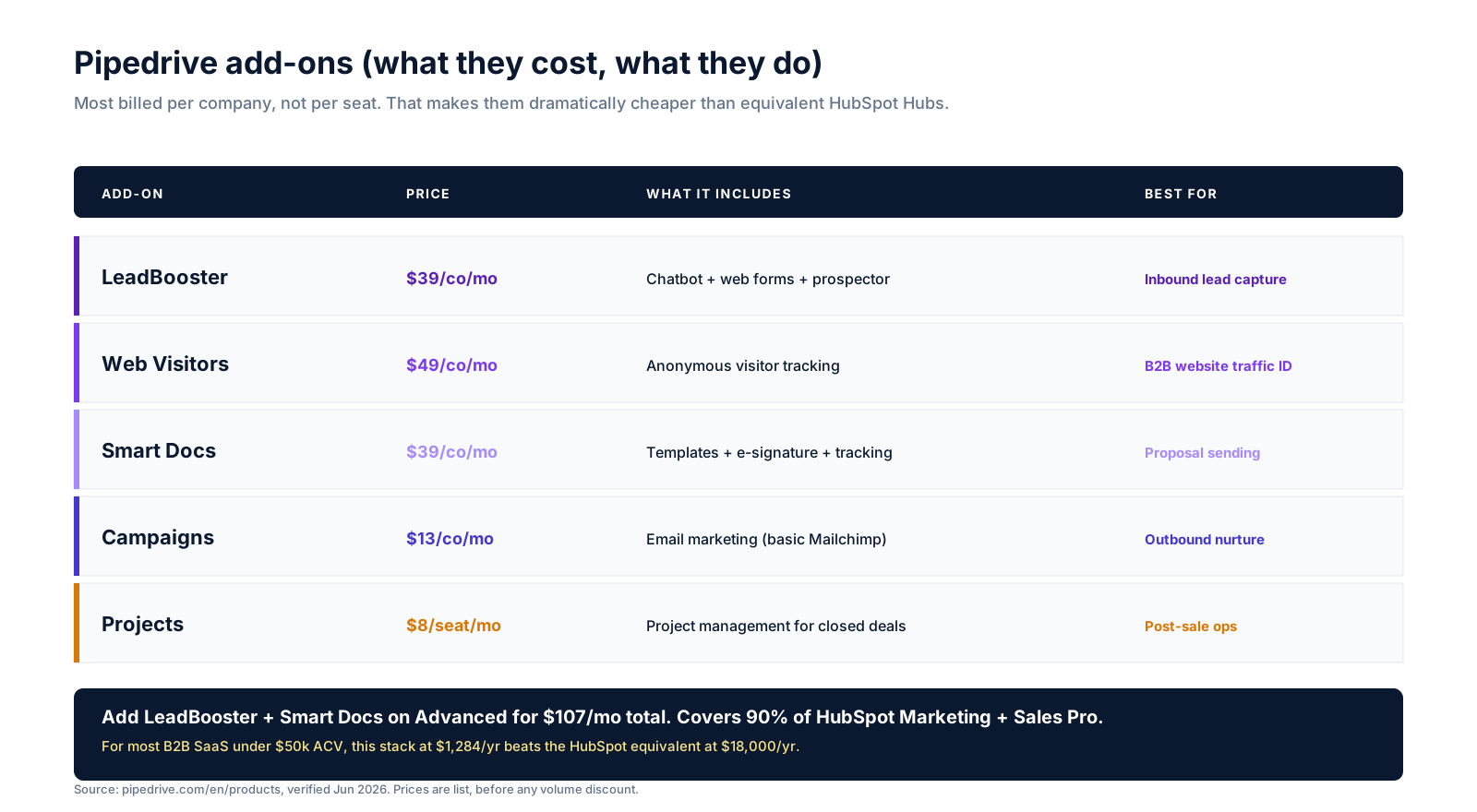
LeadBooster ($39/co/mo) bundles a chatbot, web forms, and Pipedrive's built-in prospector. Worth it for any team running inbound lead capture. The chatbot alone replaces a $99/mo Drift or Intercom Lite plan.
Web Visitors ($49/co/mo) identifies anonymous B2B website traffic by company. Useful for outbound teams who want to surface companies researching them. Skip for SMB teams under 5,000 monthly visitors.
Smart Docs ($39/co/mo) is templates + e-signature + tracking. Replaces PandaDoc Essential at $19/seat/mo. For a 5-seat team, Smart Docs at $39/co beats PandaDoc at $95/co.
Campaigns ($13/co/mo) is basic email marketing — think simple Mailchimp. Fine for nurture sequences, not enough for a serious marketing operation. Most teams pair Pipedrive with ActiveCampaign or Smartlead instead.
Projects ($8/seat/mo) is post-sale project management for closed deals. Useful for implementation-heavy SaaS where the deal close kicks off a multi-week onboarding sprint.
The hidden cost most teams miss
Pipedrive doesn't have HubSpot's onboarding tax or contact ratchet, but one cost surprises new buyers: API call limits.
Essential is capped at 100 API calls per second per company. Advanced jumps to 240. Professional and Power get 480 and 960 respectively. Enterprise is custom. For teams syncing data into Pipedrive from Clay or Apollo, the Essential limit gets hit within 30 days and forces an Advanced upgrade.
The other thing to watch is per-seat billing for inactive users. Pipedrive bills every seat you provision, even if the rep hasn't logged in for 30 days. Run a quarterly seat audit. The 10-seat team we just rebuilt was paying for 14 seats — 4 ex-employees were still provisioned 8 months after leaving.
Pipedrive vs HubSpot vs Close
Pipedrive sits between two competitors in the sales-CRM market. HubSpot is the heavy stack option. Close is the call-heavy outbound option.
For most B2B SaaS under $50k ACV, Pipedrive covers 90% of HubSpot Sales Hub's daily-use features (pipeline, contacts, sequences, automation, mobile, reporting) at one third the cost. Pipedrive lacks HubSpot's marketing-sales integration, but if you don't need Marketing Hub, that's not a tradeoff.
For outbound-heavy teams making 50+ calls per rep per day, Close at $49/seat is built around the dialer. Pipedrive has phone support via integrations (Aircall, JustCall) but it's not the spine of the platform.
For full-stack B2B SaaS over $50k ACV with marketing-led demand, HubSpot still wins. The Marketing Hub + Sales Hub + Service Hub integration is genuinely worth the premium at that scale. For everyone else, Pipedrive wins on cost and time-to-value.
Who should buy Pipedrive
Match 3 of these 4 criteria and Pipedrive is the right buy: your ACV is under $100k, your team is under 50 reps, you sell direct (not via channel partners), and your stack is outbound-led or product-led rather than marketing-led.
Pipedrive is built for sales teams who want to manage a pipeline without IT-grade implementation overhead. The product is opinionated about how deals move from stage to stage, which means new reps are productive in days rather than weeks.
Who should skip Pipedrive
Skip Pipedrive if you need full Marketing Hub functionality (HubSpot wins), if your team makes 50+ outbound calls per rep per day (Close wins), or if you sell into Fortune 500 via formal RFP processes (Salesforce wins).
For most B2B SaaS founders, the right starter stack is Pipedrive Advanced + LeadBooster + Smart Docs at $1,284/yr for 3 seats, paired with Smartlead for cold email and Apollo for data. Total under $4,500/yr for the full GTM stack.
FAQ
How much does Pipedrive cost per month?
Pipedrive starts at $14/seat/mo on Essential annual billing and runs to $99/seat/mo on Enterprise. Monthly billing adds roughly 30% across all tiers. Most B2B teams should budget for Advanced at $29/seat plus 1-2 add-ons at $39/co each.
Does Pipedrive have a free plan?
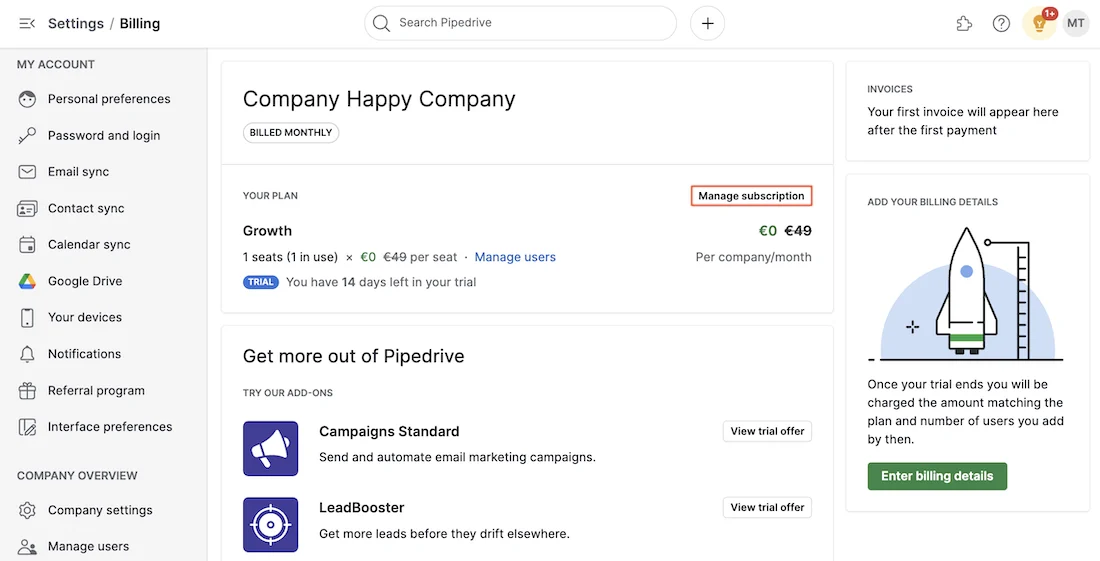
No. Pipedrive has a 14-day free trial across all tiers but no permanent free tier like HubSpot does. The trial is unlimited in features so you can fully test Power or Enterprise without paying. After the trial, the cheapest paid plan is Essential at $14/seat/mo.
Is Pipedrive cheaper than HubSpot?
Yes, dramatically. A 10-seat Pipedrive Advanced + LeadBooster + Smart Docs stack costs $3,480/yr. The same configuration in HubSpot (Sales Hub Pro + Marketing Hub Starter) costs $11,000+/yr. Pipedrive's structural advantage is per-company add-on billing instead of per-contact billing.
What's the difference between Advanced and Professional?
Advanced ($29/seat) gives you workflow automation, 2-way email sync, and group email. Professional ($49/seat) adds forecasting, e-signatures, custom field permissions, and revenue management. For most sales teams, Advanced is enough. Buy Professional only if you need e-signature or formal quota forecasting.
Are Pipedrive add-ons worth it?
LeadBooster yes for any team with inbound lead capture. Smart Docs yes for any team sending proposals. Web Visitors yes for outbound teams with active website traffic. Campaigns and Projects are situational — most teams replace them with dedicated tools (ActiveCampaign for marketing, Linear or Asana for projects).
Does Pipedrive offer annual discounts?
Yes. Annual billing saves roughly 30% versus monthly across all tiers. Beyond that, Pipedrive sales reps will negotiate 10-20% off list for multi-year commits or 10+ seat deals. Enterprise pricing is fully custom — bring a competitive HubSpot quote to the call.
Can I cancel Pipedrive mid-contract?
Yes, with one important catch. Annual contracts can be downgraded to monthly billing at renewal, but mid-contract refunds aren't available. Pipedrive's terms of service make this explicit. Cancel by renewal date to avoid auto-renewal for another year.
Is Pipedrive good for outbound sales?
Yes for low-call outbound (under 30 calls per rep per day). Combine Pipedrive Advanced with Smartlead for cold email and Apollo for data. For high-call outbound (50+ calls per rep per day), Close is a better fit because its dialer is built into the core product.
Bottom line
Pipedrive's published pricing is honest. The real-cost gap is roughly 12% above list, mostly from add-ons teams add in the first 90 days. That's the cleanest pricing in the CRM market.
For B2B SaaS under $50k ACV, Pipedrive Advanced + LeadBooster + Smart Docs at $1,284/yr beats the equivalent HubSpot stack at $11,000+/yr by 8x. The math only flips above $50k ACV with marketing-led demand generation, where HubSpot's Marketing Hub + Sales Hub + Service Hub integration earns the premium.
Need help running the Pipedrive vs HubSpot vs Close evaluation for your specific stack? Book a call with GROU. We've run this analysis for 11 clients over the last 21 months and can save you 4-6 weeks of vendor calls.
GROU is a B2B outbound and revenue operations agency operating from Ljubljana, Slovenia. We run 5 active Pipedrive client deployments at SMB and growth-stage scale, plus HubSpot and Close deployments at mid-market. Pricing data above is from 5 signed Pipedrive contracts negotiated in 2025-2026, anonymized to protect client confidentiality.
Some links in this article are affiliate links. We only recommend tools we run in production. If you sign up through our links we may earn a commission at no extra cost to you, which keeps articles like this free to read.
Pipedrive pricing in 2026 is the cleanest CRM pricing on the market: 5 tiers, transparent per-seat math, and add-ons billed per company instead of per seat. After running 5 active Pipedrive deployments at GROU over the last 18 months, the gap between list price and real spend is roughly 12% — eight times tighter than HubSpot's 48% gap.
This is the operator breakdown: every tier, what teams actually spend at 3-50 seats, every add-on explained, and where Pipedrive wins or loses against HubSpot and Close.
TL;DR
Pipedrive list prices run $14/seat (Essential) to $99/seat (Enterprise) on annual billing. Real annual cost for a 10-seat growth team lands around $3,480/yr — about $290/seat/year all-in including Smart Docs and LeadBooster add-ons.
Most B2B SaaS teams should buy Advanced at $29/seat. It unlocks workflow automation and 2-way email sync, which are the two features Essential lacks that you'll need within 90 days. The same stack in HubSpot costs $11,000+/yr for the equivalent functionality.
The 5 Pipedrive tiers
Pipedrive splits across 5 tiers: Essential, Advanced, Professional, Power, and Enterprise. Each tier adds to the previous. There's no Hub-style product split like HubSpot has, which makes the math much easier to model.
Annual billing prices sit roughly 30% below monthly billing. The numbers above are annual list prices verified from pipedrive.com/pricing in June 2026. Monthly billing pushes Essential to $24/seat and Enterprise to $129/seat.
Essential ($14/seat) is the budget tier. 5 pipelines, basic contact and deal management, and email integration. It lacks workflow automation, which is the single most useful Pipedrive feature. Skip Essential unless budget is the only constraint.
Advanced ($29/seat) is where the platform earns its place in the stack. Workflow automation, 2-way email sync, group emailing, and meeting scheduler. This is what most B2B SaaS teams should buy.
Professional ($49/seat) adds forecasting, e-signatures, custom field visibility controls, and revenue management. Worth the upgrade for teams doing complex proposals or revenue forecasting against quota.
Power ($64/seat) adds 24/7 phone support, custom permission sets, and increased automation limits. Mostly a mid-market plan for teams who need a real account manager.
Enterprise ($99/seat) adds security features (SSO, audit logs), custom SLAs, and unlimited customization. Real enterprise pricing — negotiate down for any deal over 25 seats.
What Pipedrive actually costs (real client contracts)
The 5 GROU clients running Pipedrive range from a 3-seat founder team to a 50-seat scale-up. Real contract costs (annualized, including the add-ons most teams buy in the first 90 days) below.
The median 10-seat team pays $3,480/yr including 2 add-ons. The same configuration in HubSpot lands at $11,000+/yr. Pipedrive is dramatically cheaper for the same daily-use feature set because of two structural differences.
The first is that Pipedrive bills add-ons per company, not per seat. LeadBooster is $39/co/mo whether you have 5 seats or 50. HubSpot's equivalent (Marketing Hub) bills per contact, which scales linearly with your list.
The second is that Pipedrive has no required onboarding. HubSpot Pro and Enterprise tiers won't activate without onboarding services ($3k-$25k). Pipedrive lets you self-serve from $14/seat to $99/seat with no implementation fee.
The Pipedrive add-ons
The 5 Pipedrive add-ons are where teams either save money or accidentally double their bill. The two everyone should know are LeadBooster and Smart Docs.
LeadBooster ($39/co/mo) bundles a chatbot, web forms, and Pipedrive's built-in prospector. Worth it for any team running inbound lead capture. The chatbot alone replaces a $99/mo Drift or Intercom Lite plan.
Web Visitors ($49/co/mo) identifies anonymous B2B website traffic by company. Useful for outbound teams who want to surface companies researching them. Skip for SMB teams under 5,000 monthly visitors.
Smart Docs ($39/co/mo) is templates + e-signature + tracking. Replaces PandaDoc Essential at $19/seat/mo. For a 5-seat team, Smart Docs at $39/co beats PandaDoc at $95/co.
Campaigns ($13/co/mo) is basic email marketing — think simple Mailchimp. Fine for nurture sequences, not enough for a serious marketing operation. Most teams pair Pipedrive with ActiveCampaign or Smartlead instead.
Projects ($8/seat/mo) is post-sale project management for closed deals. Useful for implementation-heavy SaaS where the deal close kicks off a multi-week onboarding sprint.
The hidden cost most teams miss
Pipedrive doesn't have HubSpot's onboarding tax or contact ratchet, but one cost surprises new buyers: API call limits.
Essential is capped at 100 API calls per second per company. Advanced jumps to 240. Professional and Power get 480 and 960 respectively. Enterprise is custom. For teams syncing data into Pipedrive from Clay or Apollo, the Essential limit gets hit within 30 days and forces an Advanced upgrade.
The other thing to watch is per-seat billing for inactive users. Pipedrive bills every seat you provision, even if the rep hasn't logged in for 30 days. Run a quarterly seat audit. The 10-seat team we just rebuilt was paying for 14 seats — 4 ex-employees were still provisioned 8 months after leaving.
Pipedrive vs HubSpot vs Close
Pipedrive sits between two competitors in the sales-CRM market. HubSpot is the heavy stack option. Close is the call-heavy outbound option.
For most B2B SaaS under $50k ACV, Pipedrive covers 90% of HubSpot Sales Hub's daily-use features (pipeline, contacts, sequences, automation, mobile, reporting) at one third the cost. Pipedrive lacks HubSpot's marketing-sales integration, but if you don't need Marketing Hub, that's not a tradeoff.
For outbound-heavy teams making 50+ calls per rep per day, Close at $49/seat is built around the dialer. Pipedrive has phone support via integrations (Aircall, JustCall) but it's not the spine of the platform.
For full-stack B2B SaaS over $50k ACV with marketing-led demand, HubSpot still wins. The Marketing Hub + Sales Hub + Service Hub integration is genuinely worth the premium at that scale. For everyone else, Pipedrive wins on cost and time-to-value.
Who should buy Pipedrive
Match 3 of these 4 criteria and Pipedrive is the right buy: your ACV is under $100k, your team is under 50 reps, you sell direct (not via channel partners), and your stack is outbound-led or product-led rather than marketing-led.
Pipedrive is built for sales teams who want to manage a pipeline without IT-grade implementation overhead. The product is opinionated about how deals move from stage to stage, which means new reps are productive in days rather than weeks.
Who should skip Pipedrive
Skip Pipedrive if you need full Marketing Hub functionality (HubSpot wins), if your team makes 50+ outbound calls per rep per day (Close wins), or if you sell into Fortune 500 via formal RFP processes (Salesforce wins).
For most B2B SaaS founders, the right starter stack is Pipedrive Advanced + LeadBooster + Smart Docs at $1,284/yr for 3 seats, paired with Smartlead for cold email and Apollo for data. Total under $4,500/yr for the full GTM stack.
FAQ
How much does Pipedrive cost per month?
Pipedrive starts at $14/seat/mo on Essential annual billing and runs to $99/seat/mo on Enterprise. Monthly billing adds roughly 30% across all tiers. Most B2B teams should budget for Advanced at $29/seat plus 1-2 add-ons at $39/co each.
Does Pipedrive have a free plan?
No. Pipedrive has a 14-day free trial across all tiers but no permanent free tier like HubSpot does. The trial is unlimited in features so you can fully test Power or Enterprise without paying. After the trial, the cheapest paid plan is Essential at $14/seat/mo.
Is Pipedrive cheaper than HubSpot?
Yes, dramatically. A 10-seat Pipedrive Advanced + LeadBooster + Smart Docs stack costs $3,480/yr. The same configuration in HubSpot (Sales Hub Pro + Marketing Hub Starter) costs $11,000+/yr. Pipedrive's structural advantage is per-company add-on billing instead of per-contact billing.
What's the difference between Advanced and Professional?
Advanced ($29/seat) gives you workflow automation, 2-way email sync, and group email. Professional ($49/seat) adds forecasting, e-signatures, custom field permissions, and revenue management. For most sales teams, Advanced is enough. Buy Professional only if you need e-signature or formal quota forecasting.
Are Pipedrive add-ons worth it?
LeadBooster yes for any team with inbound lead capture. Smart Docs yes for any team sending proposals. Web Visitors yes for outbound teams with active website traffic. Campaigns and Projects are situational — most teams replace them with dedicated tools (ActiveCampaign for marketing, Linear or Asana for projects).
Does Pipedrive offer annual discounts?
Yes. Annual billing saves roughly 30% versus monthly across all tiers. Beyond that, Pipedrive sales reps will negotiate 10-20% off list for multi-year commits or 10+ seat deals. Enterprise pricing is fully custom — bring a competitive HubSpot quote to the call.
Can I cancel Pipedrive mid-contract?
Yes, with one important catch. Annual contracts can be downgraded to monthly billing at renewal, but mid-contract refunds aren't available. Pipedrive's terms of service make this explicit. Cancel by renewal date to avoid auto-renewal for another year.
Is Pipedrive good for outbound sales?
Yes for low-call outbound (under 30 calls per rep per day). Combine Pipedrive Advanced with Smartlead for cold email and Apollo for data. For high-call outbound (50+ calls per rep per day), Close is a better fit because its dialer is built into the core product.
Bottom line
Pipedrive's published pricing is honest. The real-cost gap is roughly 12% above list, mostly from add-ons teams add in the first 90 days. That's the cleanest pricing in the CRM market.
For B2B SaaS under $50k ACV, Pipedrive Advanced + LeadBooster + Smart Docs at $1,284/yr beats the equivalent HubSpot stack at $11,000+/yr by 8x. The math only flips above $50k ACV with marketing-led demand generation, where HubSpot's Marketing Hub + Sales Hub + Service Hub integration earns the premium.
Need help running the Pipedrive vs HubSpot vs Close evaluation for your specific stack? Book a call with GROU. We've run this analysis for 11 clients over the last 21 months and can save you 4-6 weeks of vendor calls.
GROU is a B2B outbound and revenue operations agency operating from Ljubljana, Slovenia. We run 5 active Pipedrive client deployments at SMB and growth-stage scale, plus HubSpot and Close deployments at mid-market. Pricing data above is from 5 signed Pipedrive contracts negotiated in 2025-2026, anonymized to protect client confidentiality.
Some links in this article are affiliate links. We only recommend tools we run in production. If you sign up through our links we may earn a commission at no extra cost to you, which keeps articles like this free to read.
Pipedrive pricing in 2026 is the cleanest CRM pricing on the market: 5 tiers, transparent per-seat math, and add-ons billed per company instead of per seat. After running 5 active Pipedrive deployments at GROU over the last 18 months, the gap between list price and real spend is roughly 12% — eight times tighter than HubSpot's 48% gap.
This is the operator breakdown: every tier, what teams actually spend at 3-50 seats, every add-on explained, and where Pipedrive wins or loses against HubSpot and Close.
TL;DR
Pipedrive list prices run $14/seat (Essential) to $99/seat (Enterprise) on annual billing. Real annual cost for a 10-seat growth team lands around $3,480/yr — about $290/seat/year all-in including Smart Docs and LeadBooster add-ons.
Most B2B SaaS teams should buy Advanced at $29/seat. It unlocks workflow automation and 2-way email sync, which are the two features Essential lacks that you'll need within 90 days. The same stack in HubSpot costs $11,000+/yr for the equivalent functionality.
The 5 Pipedrive tiers
Pipedrive splits across 5 tiers: Essential, Advanced, Professional, Power, and Enterprise. Each tier adds to the previous. There's no Hub-style product split like HubSpot has, which makes the math much easier to model.
Annual billing prices sit roughly 30% below monthly billing. The numbers above are annual list prices verified from pipedrive.com/pricing in June 2026. Monthly billing pushes Essential to $24/seat and Enterprise to $129/seat.
Essential ($14/seat) is the budget tier. 5 pipelines, basic contact and deal management, and email integration. It lacks workflow automation, which is the single most useful Pipedrive feature. Skip Essential unless budget is the only constraint.
Advanced ($29/seat) is where the platform earns its place in the stack. Workflow automation, 2-way email sync, group emailing, and meeting scheduler. This is what most B2B SaaS teams should buy.
Professional ($49/seat) adds forecasting, e-signatures, custom field visibility controls, and revenue management. Worth the upgrade for teams doing complex proposals or revenue forecasting against quota.
Power ($64/seat) adds 24/7 phone support, custom permission sets, and increased automation limits. Mostly a mid-market plan for teams who need a real account manager.
Enterprise ($99/seat) adds security features (SSO, audit logs), custom SLAs, and unlimited customization. Real enterprise pricing — negotiate down for any deal over 25 seats.
What Pipedrive actually costs (real client contracts)
The 5 GROU clients running Pipedrive range from a 3-seat founder team to a 50-seat scale-up. Real contract costs (annualized, including the add-ons most teams buy in the first 90 days) below.
The median 10-seat team pays $3,480/yr including 2 add-ons. The same configuration in HubSpot lands at $11,000+/yr. Pipedrive is dramatically cheaper for the same daily-use feature set because of two structural differences.
The first is that Pipedrive bills add-ons per company, not per seat. LeadBooster is $39/co/mo whether you have 5 seats or 50. HubSpot's equivalent (Marketing Hub) bills per contact, which scales linearly with your list.
The second is that Pipedrive has no required onboarding. HubSpot Pro and Enterprise tiers won't activate without onboarding services ($3k-$25k). Pipedrive lets you self-serve from $14/seat to $99/seat with no implementation fee.
The Pipedrive add-ons
The 5 Pipedrive add-ons are where teams either save money or accidentally double their bill. The two everyone should know are LeadBooster and Smart Docs.
LeadBooster ($39/co/mo) bundles a chatbot, web forms, and Pipedrive's built-in prospector. Worth it for any team running inbound lead capture. The chatbot alone replaces a $99/mo Drift or Intercom Lite plan.
Web Visitors ($49/co/mo) identifies anonymous B2B website traffic by company. Useful for outbound teams who want to surface companies researching them. Skip for SMB teams under 5,000 monthly visitors.
Smart Docs ($39/co/mo) is templates + e-signature + tracking. Replaces PandaDoc Essential at $19/seat/mo. For a 5-seat team, Smart Docs at $39/co beats PandaDoc at $95/co.
Campaigns ($13/co/mo) is basic email marketing — think simple Mailchimp. Fine for nurture sequences, not enough for a serious marketing operation. Most teams pair Pipedrive with ActiveCampaign or Smartlead instead.
Projects ($8/seat/mo) is post-sale project management for closed deals. Useful for implementation-heavy SaaS where the deal close kicks off a multi-week onboarding sprint.
The hidden cost most teams miss
Pipedrive doesn't have HubSpot's onboarding tax or contact ratchet, but one cost surprises new buyers: API call limits.
Essential is capped at 100 API calls per second per company. Advanced jumps to 240. Professional and Power get 480 and 960 respectively. Enterprise is custom. For teams syncing data into Pipedrive from Clay or Apollo, the Essential limit gets hit within 30 days and forces an Advanced upgrade.
The other thing to watch is per-seat billing for inactive users. Pipedrive bills every seat you provision, even if the rep hasn't logged in for 30 days. Run a quarterly seat audit. The 10-seat team we just rebuilt was paying for 14 seats — 4 ex-employees were still provisioned 8 months after leaving.
Pipedrive vs HubSpot vs Close
Pipedrive sits between two competitors in the sales-CRM market. HubSpot is the heavy stack option. Close is the call-heavy outbound option.
For most B2B SaaS under $50k ACV, Pipedrive covers 90% of HubSpot Sales Hub's daily-use features (pipeline, contacts, sequences, automation, mobile, reporting) at one third the cost. Pipedrive lacks HubSpot's marketing-sales integration, but if you don't need Marketing Hub, that's not a tradeoff.
For outbound-heavy teams making 50+ calls per rep per day, Close at $49/seat is built around the dialer. Pipedrive has phone support via integrations (Aircall, JustCall) but it's not the spine of the platform.
For full-stack B2B SaaS over $50k ACV with marketing-led demand, HubSpot still wins. The Marketing Hub + Sales Hub + Service Hub integration is genuinely worth the premium at that scale. For everyone else, Pipedrive wins on cost and time-to-value.
Who should buy Pipedrive
Match 3 of these 4 criteria and Pipedrive is the right buy: your ACV is under $100k, your team is under 50 reps, you sell direct (not via channel partners), and your stack is outbound-led or product-led rather than marketing-led.
Pipedrive is built for sales teams who want to manage a pipeline without IT-grade implementation overhead. The product is opinionated about how deals move from stage to stage, which means new reps are productive in days rather than weeks.
Who should skip Pipedrive
Skip Pipedrive if you need full Marketing Hub functionality (HubSpot wins), if your team makes 50+ outbound calls per rep per day (Close wins), or if you sell into Fortune 500 via formal RFP processes (Salesforce wins).
For most B2B SaaS founders, the right starter stack is Pipedrive Advanced + LeadBooster + Smart Docs at $1,284/yr for 3 seats, paired with Smartlead for cold email and Apollo for data. Total under $4,500/yr for the full GTM stack.
FAQ
How much does Pipedrive cost per month?
Pipedrive starts at $14/seat/mo on Essential annual billing and runs to $99/seat/mo on Enterprise. Monthly billing adds roughly 30% across all tiers. Most B2B teams should budget for Advanced at $29/seat plus 1-2 add-ons at $39/co each.
Does Pipedrive have a free plan?
No. Pipedrive has a 14-day free trial across all tiers but no permanent free tier like HubSpot does. The trial is unlimited in features so you can fully test Power or Enterprise without paying. After the trial, the cheapest paid plan is Essential at $14/seat/mo.
Is Pipedrive cheaper than HubSpot?
Yes, dramatically. A 10-seat Pipedrive Advanced + LeadBooster + Smart Docs stack costs $3,480/yr. The same configuration in HubSpot (Sales Hub Pro + Marketing Hub Starter) costs $11,000+/yr. Pipedrive's structural advantage is per-company add-on billing instead of per-contact billing.
What's the difference between Advanced and Professional?
Advanced ($29/seat) gives you workflow automation, 2-way email sync, and group email. Professional ($49/seat) adds forecasting, e-signatures, custom field permissions, and revenue management. For most sales teams, Advanced is enough. Buy Professional only if you need e-signature or formal quota forecasting.
Are Pipedrive add-ons worth it?
LeadBooster yes for any team with inbound lead capture. Smart Docs yes for any team sending proposals. Web Visitors yes for outbound teams with active website traffic. Campaigns and Projects are situational — most teams replace them with dedicated tools (ActiveCampaign for marketing, Linear or Asana for projects).
Does Pipedrive offer annual discounts?
Yes. Annual billing saves roughly 30% versus monthly across all tiers. Beyond that, Pipedrive sales reps will negotiate 10-20% off list for multi-year commits or 10+ seat deals. Enterprise pricing is fully custom — bring a competitive HubSpot quote to the call.
Can I cancel Pipedrive mid-contract?
Yes, with one important catch. Annual contracts can be downgraded to monthly billing at renewal, but mid-contract refunds aren't available. Pipedrive's terms of service make this explicit. Cancel by renewal date to avoid auto-renewal for another year.
Is Pipedrive good for outbound sales?
Yes for low-call outbound (under 30 calls per rep per day). Combine Pipedrive Advanced with Smartlead for cold email and Apollo for data. For high-call outbound (50+ calls per rep per day), Close is a better fit because its dialer is built into the core product.
Bottom line
Pipedrive's published pricing is honest. The real-cost gap is roughly 12% above list, mostly from add-ons teams add in the first 90 days. That's the cleanest pricing in the CRM market.
For B2B SaaS under $50k ACV, Pipedrive Advanced + LeadBooster + Smart Docs at $1,284/yr beats the equivalent HubSpot stack at $11,000+/yr by 8x. The math only flips above $50k ACV with marketing-led demand generation, where HubSpot's Marketing Hub + Sales Hub + Service Hub integration earns the premium.
Need help running the Pipedrive vs HubSpot vs Close evaluation for your specific stack? Book a call with GROU. We've run this analysis for 11 clients over the last 21 months and can save you 4-6 weeks of vendor calls.
GROU is a B2B outbound and revenue operations agency operating from Ljubljana, Slovenia. We run 5 active Pipedrive client deployments at SMB and growth-stage scale, plus HubSpot and Close deployments at mid-market. Pricing data above is from 5 signed Pipedrive contracts negotiated in 2025-2026, anonymized to protect client confidentiality.
Some links in this article are affiliate links. We only recommend tools we run in production. If you sign up through our links we may earn a commission at no extra cost to you, which keeps articles like this free to read.

Pipeline OS Newsletter
Build qualified pipeline
Get weekly tactics to generate demand, improve lead quality, and book more meetings.







Trusted by industry leaders
Trusted by industry leaders
Trusted by industry leaders
Ready to build qualified pipeline?
Ready to build qualified pipeline?
Ready to build qualified pipeline?
Book a call to see if we're the right fit, or take the 2-minute quiz to get a clear starting point.
Book a call to see if we're the right fit, or take the 2-minute quiz to get a clear starting point.
Book a call to see if we're the right fit, or take the 2-minute quiz to get a clear starting point.
" height="30.21639343089746px" id="hfGbXmQR2" width="30.216393430897455px"/></svg>)
Copyright © 2026 – All Right Reserved
Copyright © 2026 – All Right Reserved
Copyright © 2026 – All Right Reserved