%22%3E%3C/path%3E%3Cpath d=%22M 63.072 7.554 C 62.258 8.022 61.577 8.689 61.092 9.493 L 61.092 7.076 L 57.158 7.076 L 57.158 22.64 L 61.089 22.64 L 61.089 14.888 C 61.089 13.446 61.403 12.434 62.03 11.853 C 62.818 11.218 63.818 10.907 64.826 10.982 L 65.868 10.982 L 65.868 6.851 C 64.891 6.834 63.926 7.076 63.073 7.554 Z%22 fill=%22rgb(17,17,17)%22%3E%3C/path%3E%3Cpath d=%22M 78.916 7.82 C 76.363 6.49 73.321 6.49 70.768 7.82 C 69.562 8.473 68.564 9.451 67.888 10.644 C 67.167 11.931 66.803 13.387 66.834 14.862 C 66.804 16.332 67.157 17.785 67.86 19.077 C 68.515 20.267 69.494 21.246 70.684 21.901 C 71.924 22.576 73.318 22.92 74.73 22.898 C 76.164 22.918 77.58 22.575 78.846 21.901 C 80.062 21.247 81.073 20.27 81.768 19.077 C 82.506 17.797 82.88 16.339 82.85 14.862 C 82.88 13.389 82.517 11.934 81.797 10.647 C 81.12 9.455 80.122 8.477 78.917 7.824 M 78.803 14.862 C 78.829 15.739 78.636 16.608 78.241 17.391 C 77.903 18.046 77.38 18.588 76.738 18.95 C 76.124 19.293 75.432 19.472 74.729 19.47 C 73.668 19.497 72.648 19.061 71.934 18.276 C 71.139 17.323 70.741 16.1 70.823 14.862 C 70.741 13.62 71.149 12.395 71.959 11.45 C 72.687 10.667 73.715 10.233 74.783 10.256 C 75.859 10.236 76.894 10.67 77.635 11.45 C 78.464 12.387 78.884 13.616 78.801 14.864%22 fill=%22rgb(17,17,17)%22%3E%3C/path%3E%3Cpath d=%22M 95.906 7.076 L 95.906 15.646 C 95.975 16.68 95.643 17.701 94.979 18.498 C 94.311 19.184 93.379 19.547 92.422 19.495 C 91.475 19.544 90.553 19.18 89.894 18.498 C 89.23 17.701 88.898 16.68 88.967 15.646 L 88.967 7.076 L 85.033 7.076 L 85.033 16.207 C 85 17.449 85.275 18.68 85.834 19.79 C 86.327 20.75 87.095 21.542 88.039 22.065 C 89.033 22.594 90.145 22.861 91.271 22.838 C 92.188 22.847 93.095 22.65 93.926 22.263 C 94.708 21.905 95.388 21.36 95.906 20.675 L 95.906 22.645 L 99.865 22.645 L 99.865 7.076 Z%22 fill=%22rgb(17,17,17)%22%3E%3C/path%3E%3Cpath d=%22M 4.513 15.626 C 4.511 10.815 7.606 6.549 12.181 5.059 C 16.756 3.57 21.77 5.195 24.601 9.086 L 27.816 5.87 C 24.074 1.186 17.981 -0.943 12.137 0.393 C 6.292 1.728 1.728 6.292 0.393 12.137 C -0.943 17.981 1.186 24.074 5.87 27.816 L 9.085 24.601 C 6.214 22.512 4.515 19.177 4.513 15.626%22 fill=%22rgb(32,62,235)%22%3E%3C/path%3E%3Cpath d=%22M 17.114 14.343 L 13.354 18.01 L 13.354 18.026 L 21.071 18.026 L 11.412 27.609 L 17.389 27.609 L 23.999 21.081 L 23.999 28.316 L 24.005 28.316 L 27.967 24.393 L 27.967 14.343 Z%22 fill=%22rgb(32,62,235)%22%3E%3C/path%3E%3C/g%3E%3C/svg%3E) ×
× ××
××›
›
›
›
Best Deel alternatives 2026
Best Deel alternatives 2026
Best Deel alternatives 2026
Best Deel alternatives 2026
Best Deel alternatives 2026
Best Deel alternatives 2026

Author
Aljaz Peklaj

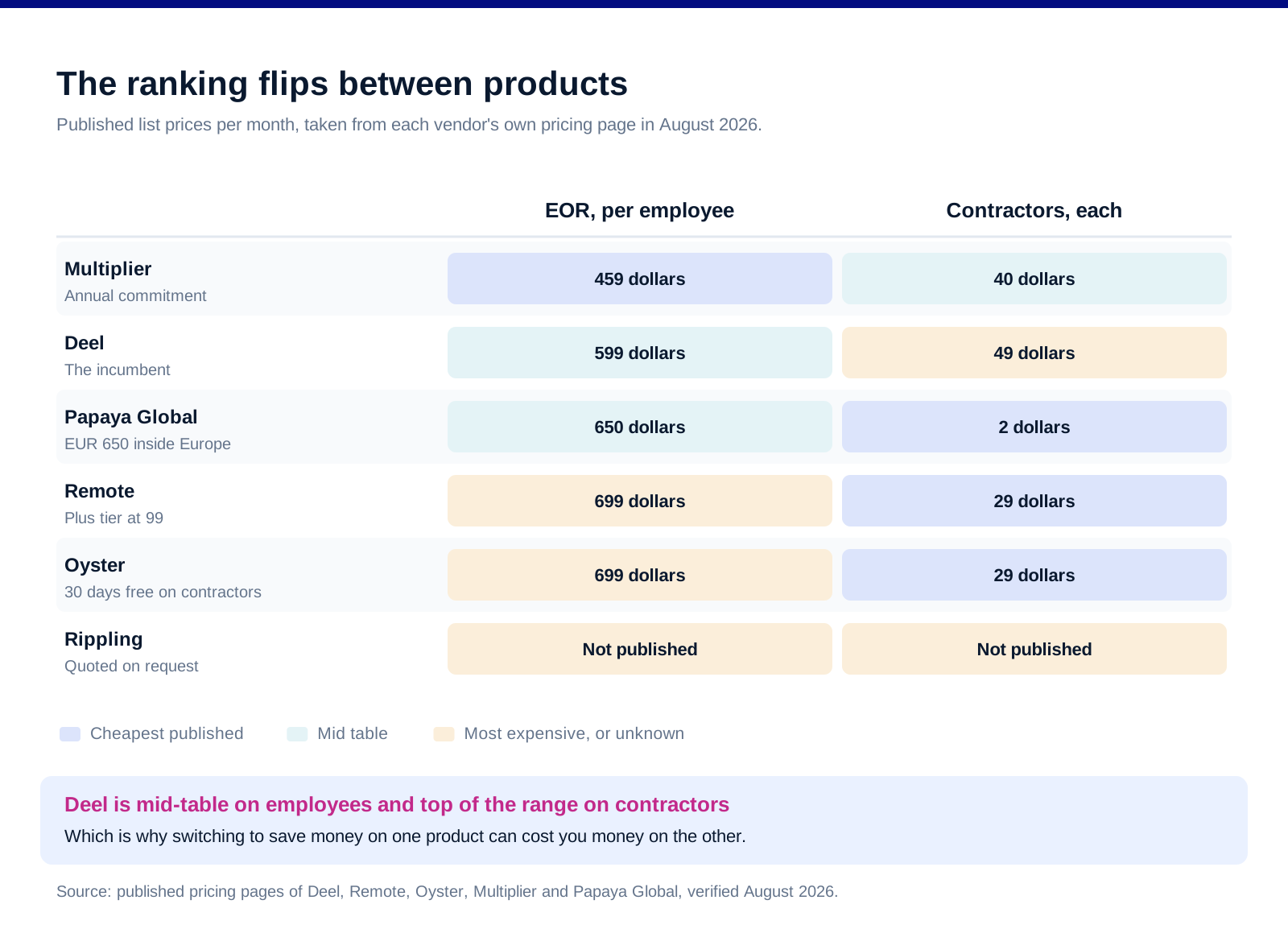
On the biggest-ticket product, Deel is not the expensive option. On the cheapest product, it is the expensive option by a factor of twenty-four.
Which is the whole problem with the phrase "Deel alternatives". It is not one question. The answer reverses completely depending on which of Deel's products you actually pay for, and most comparisons on this query never mention that.
TL;DR
"Deel alternatives" is not one question, because the price ranking flips depending on which Deel product you actually use. On employer of record, Deel lists $599 per employee a month, which undercuts Remote and Oyster at $699 each and Papaya Global at $650, and sits above Multiplier at $459 billed annually. On contractor management the order reverses completely: Deel lists $49 per contractor a month against $40 at Multiplier, $29 at Remote and Oyster, and $2 at Papaya Global. That is a twenty-four times spread on what looks like a commodity. Contractor of record has converged almost exactly, with Deel and Remote both at $325 and Multiplier at $400. Rippling does not publish employer of record pricing at all and quotes on request. So work out which product you are actually replacing before you compare anything, because switching to save money on contractors may cost you money on employees, and the reverse.
First, work out which Deel you are replacing
Deel sells at least four separate things. Its pricing page lists $14 per worker a month to find talent, $49 per contractor a month to hire contractors, $325 per contractor of record a month, $125 per US PEO employee a month and $599 per EOR employee a month. Global payroll and the HR platform are not separately priced there.
Which means "we are looking at alternatives" is an ambiguous sentence. A company paying for two hundred contractors and a company paying for six employees in four countries are shopping for entirely different products, and the right answer is different for each.
Sort yourself first. Are you replacing contractor admin, employer of record, contractor of record, US payroll, or an HR platform. Everything below is organised that way, because comparing headline prices across categories produces nonsense.
Employer of record: Deel is mid-table
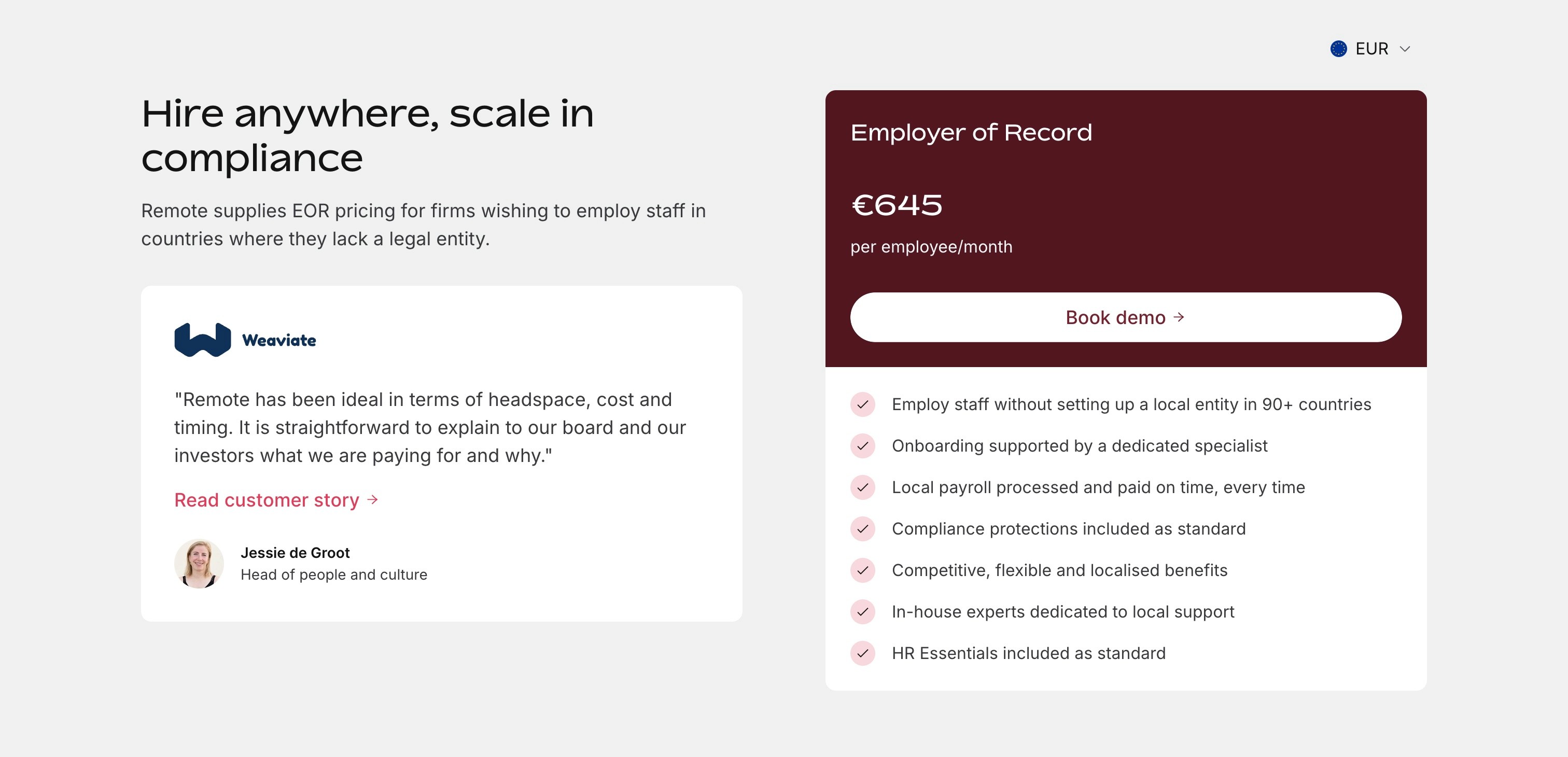
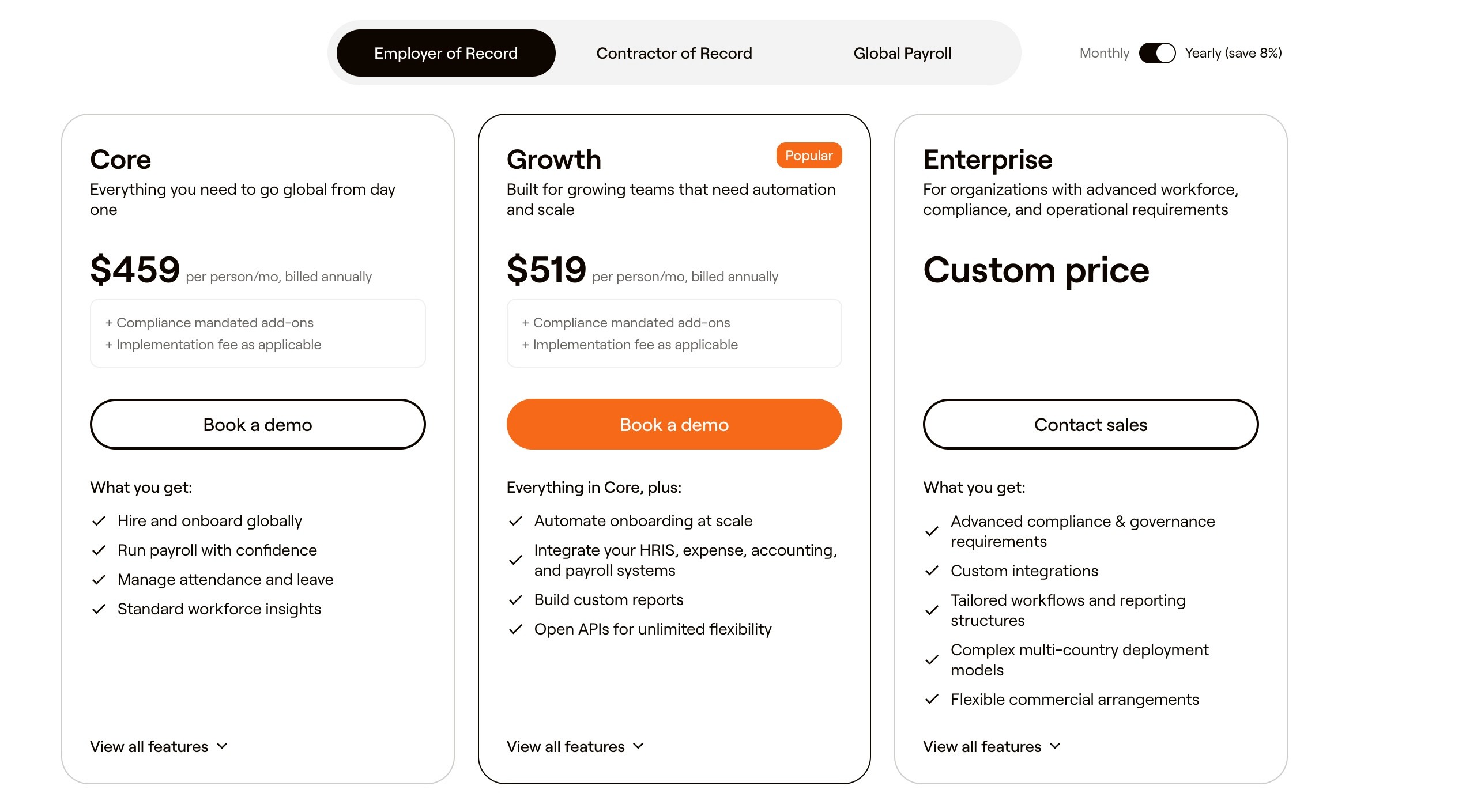
Multiplier is the cheapest published option. Its pricing lists Core at "$459 per person/mo, billed annually", Growth at "$519 per person/mo, billed annually", and monthly contracts at higher rates of $499 and $559 respectively. It also states "No minimum headcount requirement" and that pricing varies in roughly 11% of supported countries.
Deel sits next at $599. Published, per EOR employee per month.
Papaya Global is $650, with a currency wrinkle worth reading twice. Its pricing page states the fee "is 650 euros per employee per month in countries located in Europe and $650 per employee per month for most countries outside of Europe". Those are not the same number, and for a European hire you are being quoted in euros.
Remote and Oyster are both $699. Remote lists "$699 per employee/month" with coverage in "90+ countries". Oyster lists "USD 699 per employee/month" with "Compliant employment in 120+ countries" and notes that "Annual discounts available".
Rippling does not publish it. Its own review content states that the core HRIS "starts at $8 per employee per month" and payroll at "$35 per month per user", while noting "Base rates are listed, but you'll need a custom quote for exact pricing." We could not retrieve its pricing page directly, so we publish no Rippling EOR figure. Our existing Deel versus Rippling comparison covers that pairing in more depth.

Contractor management: this is where the money is
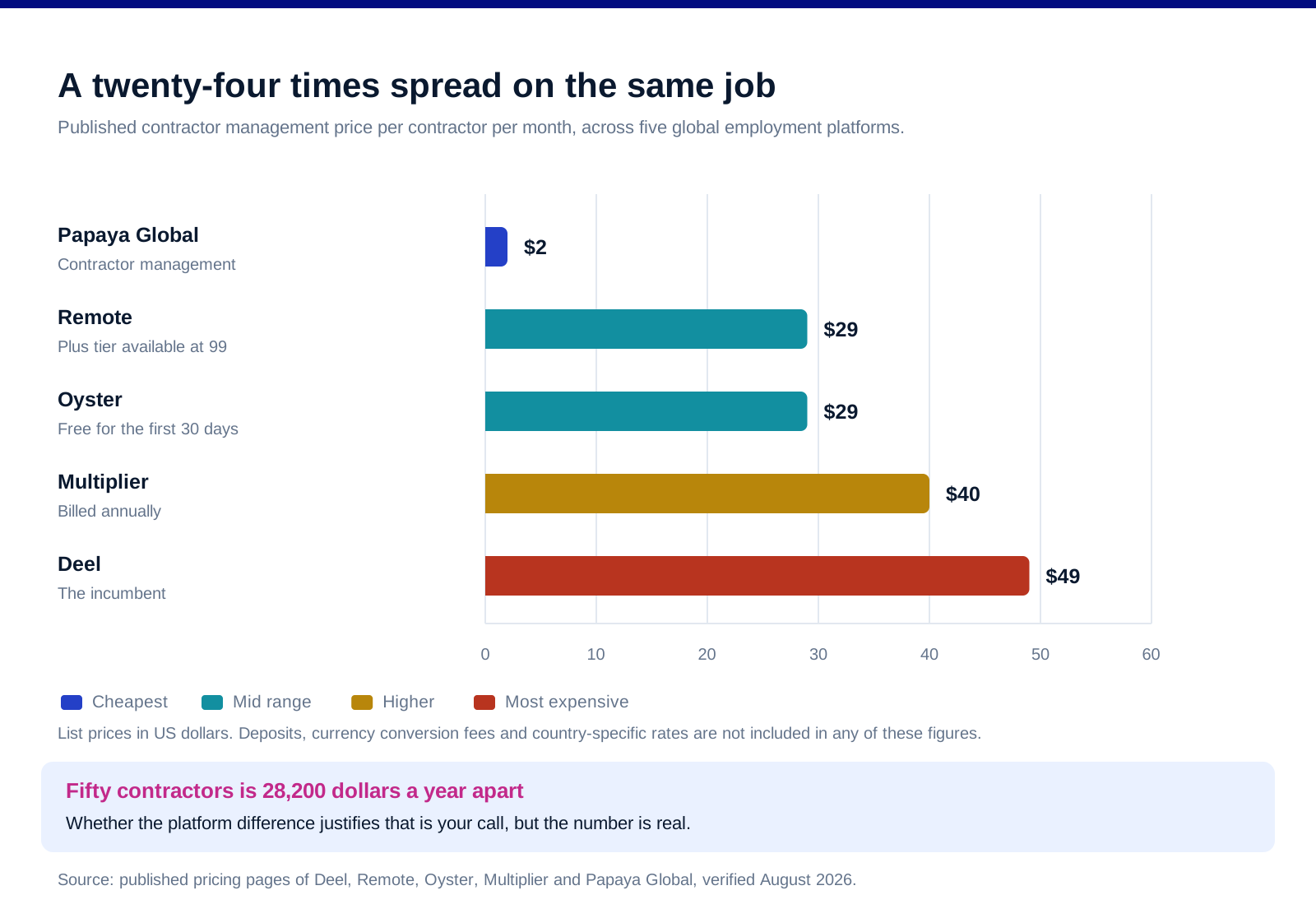
Papaya Global lists $2 per contractor a month. That is the cheapest published figure we found by a wide margin.
Remote and Oyster are both $29. Remote adds "Only pay for contractors you actively work with", and offers Contractor Management Plus at "$99 per contractor/month" with "Coverage up to $100,000 per contractor for penalties". Oyster offers "Free for 30 days then USD 29 per contractor/month" with "Instant contracts in 180+ countries" and an employee misclassification analyzer included.
Multiplier is $40 billed annually.
Deel is $49. On this product it is the most expensive of the five.
Run the arithmetic before you dismiss it. Fifty contractors at $49 is $2,450 a month. The same fifty at $29 is $1,450, and at $2 is $100. Over a year that is $29,400 against $1,200, a gap of $28,200. Whether the platform difference justifies that is your call, but it is a real number and it is not small.
Contractor of record has converged
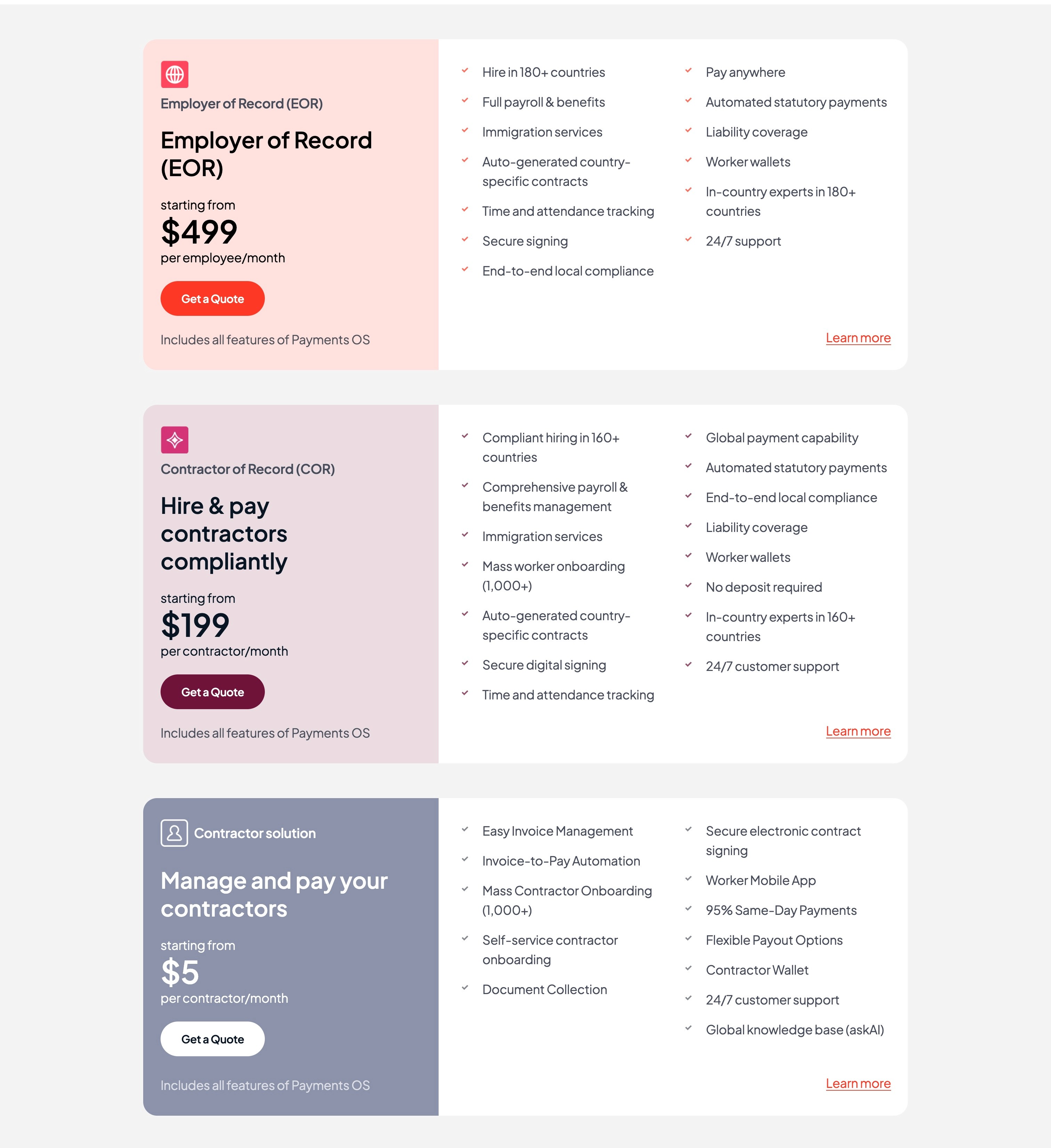
Deel and Remote are both $325. Deel lists "$325 per contractor of record per month". Remote lists "From $325 per contractor/month" with "Uncapped indemnity ensuring comprehensive protection".
Multiplier is $400 billed annually.
So price is not the deciding factor here. When three vendors land within a quarter of each other on a product this specialised, the decision is about what the indemnity actually covers, which countries are supported for your specific roles, and how the classification assessment is done. Our contractor misclassification piece covers what you are actually buying protection against.
US payroll and PEO
Remote is the cheaper published option. PEO "From $99 per employee/month", with the note that "PEO is billed in USD and requires a U.S. bank account".
Deel lists $125 per US PEO employee a month.
And Rippling is the natural comparison here rather than in global EOR. A US-centric company that wants HR, IT and payroll in one system is shopping in a different category from a European company that needs one employee in Brazil.
![[SCREENSHOT NEEDED: Remote, the PEO pricing tier with the US bank account requirement visible]](https://framerusercontent.com/images/nTMNuDma0RlQonxT5C01PkieOQ.jpg)
Global payroll, if you already have entities
Multiplier starts from $20 per person a month, billed annually.
Remote is $29 per employee a month.
Papaya splits it into pieces. Full-Service Payroll at "$12 /mo per employee", a Payroll Platform License at "$3 /mo per employee" to "Upgrade your payroll and payments technology without replacing your payroll partners", an Embedded Payments Platform at "$3 /mo per employee", and a Data and Insights Platform License at "$150 /mo per location".
That modular structure is the actual differentiator. If you have local payroll providers you are happy with and want a layer on top rather than a replacement, that is a genuinely different product from what the others sell.
What the headline price does not include
Deposits. Oyster states it "requires a refundable deposit for EOR Team Members to initiate the engagement and to ensure on-time payments to your team." Remote states it collects "reserve payments in rare, high risk circumstances" and explicitly says it does not charge additional deposits for PTO, removing probation periods or severance accruals. Those are different postures and they affect your working capital, not your monthly fee.
Currency conversion. Oyster states it "charges a fee for currency conversions but the fee applies only if you pay us in a currency different from the contract currency." Multiplier claims "no hidden fees, banking markups, or surprise billing cycle adjustments". Ask every vendor the same question in writing.
Country pricing variation. Multiplier states that pricing varies in about 11% of supported countries to reflect local wage realities and statutory requirements. A quoted headline rate is an average unless you have confirmed your specific countries.
Billing term. Several of the cheapest figures above are annual commitments. Multiplier's monthly rates are $40 and $60 higher per person than the annual ones on its two EOR tiers.
Coverage counts, which are not comparable. Oyster says 120+ countries for EOR and 180+ for contractors. Remote says 90+ for EOR. Multiplier cites 160+ for hiring and payroll and 150+ for benefits. Papaya says 160+. These are vendor claims measured differently, and the only number that matters is whether your specific countries are covered properly.
What we do not publish here
Any ranking of these vendors overall. We have not run a controlled evaluation across them and a ranking would be a preference presented as a finding.
Service quality, support responsiveness or platform reliability comparisons. We have not tested them on comparable terms.
Negotiated or discounted pricing. Every figure here is the published list price. Enterprise deals are quoted and will differ.
Rippling's EOR price. It is not published, its pricing page did not return to us, and we are not going to estimate it.
Any claim about which vendor is more compliant. That is not knowable from a pricing page and it is the kind of claim this category is full of.
FAQ
Is Deel the most expensive option?
Not on employer of record. Deel lists $599 per EOR employee a month against $650 at Papaya Global and $699 at both Remote and Oyster, with Multiplier cheaper at $459 billed annually. On contractor management Deel is the most expensive of the five at $49, against $40, $29, $29 and $2.
What is the cheapest Deel alternative?
It depends on the product. For employer of record, Multiplier at $459 per person a month billed annually is the cheapest published figure we found. For contractor management, Papaya Global at $2 per contractor a month. For global payroll, Multiplier from $20 or Papaya's $12 full-service option.
Which Deel alternative is best for contractors?
On price alone, Papaya Global at $2 a month is an order of magnitude below the field. Remote and Oyster at $29 both bundle more, with Oyster including a misclassification analyzer and Remote offering a Plus tier at $99 with penalty coverage up to $100,000 per contractor. Match the tier to whether you need admin or protection.
Does Rippling do employer of record?
It offers global employment, but it does not publish EOR pricing and directs buyers to a custom quote. Its published figures are $8 per employee a month for the core HRIS and $35 per month per user for payroll. If you want an all-in-one HR, IT and payroll system for a mostly US workforce it is a different kind of purchase from a pure EOR.
What should you ask that the pricing page does not answer?
Whether a deposit is required and how much, what the currency conversion fee is and when it applies, whether your specific countries carry a different rate, whether the quoted figure is monthly or annual commitment, and what the renewal uplift is capped at.
Is it worth switching global employment providers?
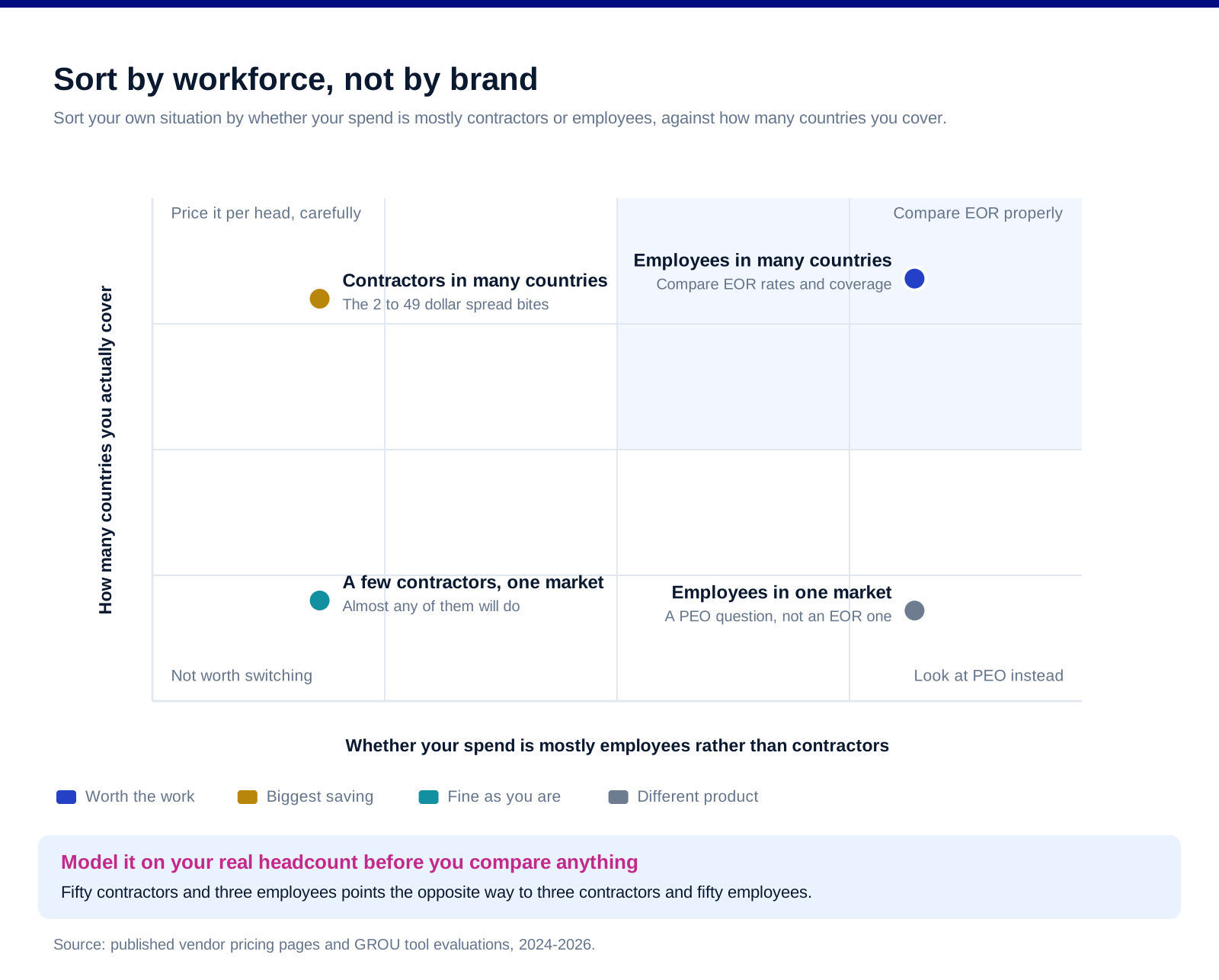
Only after you have worked out which product you are actually buying and modelled it on your real headcount. A company with fifty contractors and three EOR employees and a company with three contractors and fifty EOR employees should reach opposite conclusions from the same table.
Bottom line
Do not shop for "a Deel alternative". Shop for a replacement for the specific product you are paying for, because the ordering changes completely between them. If your spend is mostly employer of record, Deel is already mid-table and the only cheaper published option we found is Multiplier at $459 billed annually, so the case for moving is thinner than the internet suggests. If your spend is mostly contractor management, the gap between $49 and $2 is real money and worth a serious look at Papaya Global, with Remote and Oyster in between at $29 and more included. If it is contractor of record, three vendors sit within a quarter of each other and you should be comparing indemnity wording rather than price. And whichever way you go, get the deposit, the FX fee, the country-specific rate and the renewal cap in writing, because none of those appear on any of the pages we read.
Want the pipeline built rather than the payroll stack compared? Book a call with GROU. We run lead generation and outbound inside B2B revenue engines across verticals.
We are GROU, a B2B pipeline agency that runs lead generation, outbound, and LinkedIn content for clients across manufacturing, fintech, iGaming, software, and professional services. Some links in this article are affiliate links, including Deel. Every price quoted is the published list price taken from each vendor's own pricing page and verified in August 2026. Prices change, so check before you buy.
On the biggest-ticket product, Deel is not the expensive option. On the cheapest product, it is the expensive option by a factor of twenty-four.
Which is the whole problem with the phrase "Deel alternatives". It is not one question. The answer reverses completely depending on which of Deel's products you actually pay for, and most comparisons on this query never mention that.
TL;DR
"Deel alternatives" is not one question, because the price ranking flips depending on which Deel product you actually use. On employer of record, Deel lists $599 per employee a month, which undercuts Remote and Oyster at $699 each and Papaya Global at $650, and sits above Multiplier at $459 billed annually. On contractor management the order reverses completely: Deel lists $49 per contractor a month against $40 at Multiplier, $29 at Remote and Oyster, and $2 at Papaya Global. That is a twenty-four times spread on what looks like a commodity. Contractor of record has converged almost exactly, with Deel and Remote both at $325 and Multiplier at $400. Rippling does not publish employer of record pricing at all and quotes on request. So work out which product you are actually replacing before you compare anything, because switching to save money on contractors may cost you money on employees, and the reverse.
First, work out which Deel you are replacing
Deel sells at least four separate things. Its pricing page lists $14 per worker a month to find talent, $49 per contractor a month to hire contractors, $325 per contractor of record a month, $125 per US PEO employee a month and $599 per EOR employee a month. Global payroll and the HR platform are not separately priced there.
Which means "we are looking at alternatives" is an ambiguous sentence. A company paying for two hundred contractors and a company paying for six employees in four countries are shopping for entirely different products, and the right answer is different for each.
Sort yourself first. Are you replacing contractor admin, employer of record, contractor of record, US payroll, or an HR platform. Everything below is organised that way, because comparing headline prices across categories produces nonsense.
Employer of record: Deel is mid-table
Multiplier is the cheapest published option. Its pricing lists Core at "$459 per person/mo, billed annually", Growth at "$519 per person/mo, billed annually", and monthly contracts at higher rates of $499 and $559 respectively. It also states "No minimum headcount requirement" and that pricing varies in roughly 11% of supported countries.
Deel sits next at $599. Published, per EOR employee per month.
Papaya Global is $650, with a currency wrinkle worth reading twice. Its pricing page states the fee "is 650 euros per employee per month in countries located in Europe and $650 per employee per month for most countries outside of Europe". Those are not the same number, and for a European hire you are being quoted in euros.
Remote and Oyster are both $699. Remote lists "$699 per employee/month" with coverage in "90+ countries". Oyster lists "USD 699 per employee/month" with "Compliant employment in 120+ countries" and notes that "Annual discounts available".
Rippling does not publish it. Its own review content states that the core HRIS "starts at $8 per employee per month" and payroll at "$35 per month per user", while noting "Base rates are listed, but you'll need a custom quote for exact pricing." We could not retrieve its pricing page directly, so we publish no Rippling EOR figure. Our existing Deel versus Rippling comparison covers that pairing in more depth.
Contractor management: this is where the money is
Papaya Global lists $2 per contractor a month. That is the cheapest published figure we found by a wide margin.
Remote and Oyster are both $29. Remote adds "Only pay for contractors you actively work with", and offers Contractor Management Plus at "$99 per contractor/month" with "Coverage up to $100,000 per contractor for penalties". Oyster offers "Free for 30 days then USD 29 per contractor/month" with "Instant contracts in 180+ countries" and an employee misclassification analyzer included.
Multiplier is $40 billed annually.
Deel is $49. On this product it is the most expensive of the five.
Run the arithmetic before you dismiss it. Fifty contractors at $49 is $2,450 a month. The same fifty at $29 is $1,450, and at $2 is $100. Over a year that is $29,400 against $1,200, a gap of $28,200. Whether the platform difference justifies that is your call, but it is a real number and it is not small.
Contractor of record has converged
Deel and Remote are both $325. Deel lists "$325 per contractor of record per month". Remote lists "From $325 per contractor/month" with "Uncapped indemnity ensuring comprehensive protection".
Multiplier is $400 billed annually.
So price is not the deciding factor here. When three vendors land within a quarter of each other on a product this specialised, the decision is about what the indemnity actually covers, which countries are supported for your specific roles, and how the classification assessment is done. Our contractor misclassification piece covers what you are actually buying protection against.
US payroll and PEO
Remote is the cheaper published option. PEO "From $99 per employee/month", with the note that "PEO is billed in USD and requires a U.S. bank account".
Deel lists $125 per US PEO employee a month.
And Rippling is the natural comparison here rather than in global EOR. A US-centric company that wants HR, IT and payroll in one system is shopping in a different category from a European company that needs one employee in Brazil.
Global payroll, if you already have entities
Multiplier starts from $20 per person a month, billed annually.
Remote is $29 per employee a month.
Papaya splits it into pieces. Full-Service Payroll at "$12 /mo per employee", a Payroll Platform License at "$3 /mo per employee" to "Upgrade your payroll and payments technology without replacing your payroll partners", an Embedded Payments Platform at "$3 /mo per employee", and a Data and Insights Platform License at "$150 /mo per location".
That modular structure is the actual differentiator. If you have local payroll providers you are happy with and want a layer on top rather than a replacement, that is a genuinely different product from what the others sell.
What the headline price does not include
Deposits. Oyster states it "requires a refundable deposit for EOR Team Members to initiate the engagement and to ensure on-time payments to your team." Remote states it collects "reserve payments in rare, high risk circumstances" and explicitly says it does not charge additional deposits for PTO, removing probation periods or severance accruals. Those are different postures and they affect your working capital, not your monthly fee.
Currency conversion. Oyster states it "charges a fee for currency conversions but the fee applies only if you pay us in a currency different from the contract currency." Multiplier claims "no hidden fees, banking markups, or surprise billing cycle adjustments". Ask every vendor the same question in writing.
Country pricing variation. Multiplier states that pricing varies in about 11% of supported countries to reflect local wage realities and statutory requirements. A quoted headline rate is an average unless you have confirmed your specific countries.
Billing term. Several of the cheapest figures above are annual commitments. Multiplier's monthly rates are $40 and $60 higher per person than the annual ones on its two EOR tiers.
Coverage counts, which are not comparable. Oyster says 120+ countries for EOR and 180+ for contractors. Remote says 90+ for EOR. Multiplier cites 160+ for hiring and payroll and 150+ for benefits. Papaya says 160+. These are vendor claims measured differently, and the only number that matters is whether your specific countries are covered properly.
What we do not publish here
Any ranking of these vendors overall. We have not run a controlled evaluation across them and a ranking would be a preference presented as a finding.
Service quality, support responsiveness or platform reliability comparisons. We have not tested them on comparable terms.
Negotiated or discounted pricing. Every figure here is the published list price. Enterprise deals are quoted and will differ.
Rippling's EOR price. It is not published, its pricing page did not return to us, and we are not going to estimate it.
Any claim about which vendor is more compliant. That is not knowable from a pricing page and it is the kind of claim this category is full of.
FAQ
Is Deel the most expensive option?
Not on employer of record. Deel lists $599 per EOR employee a month against $650 at Papaya Global and $699 at both Remote and Oyster, with Multiplier cheaper at $459 billed annually. On contractor management Deel is the most expensive of the five at $49, against $40, $29, $29 and $2.
What is the cheapest Deel alternative?
It depends on the product. For employer of record, Multiplier at $459 per person a month billed annually is the cheapest published figure we found. For contractor management, Papaya Global at $2 per contractor a month. For global payroll, Multiplier from $20 or Papaya's $12 full-service option.
Which Deel alternative is best for contractors?
On price alone, Papaya Global at $2 a month is an order of magnitude below the field. Remote and Oyster at $29 both bundle more, with Oyster including a misclassification analyzer and Remote offering a Plus tier at $99 with penalty coverage up to $100,000 per contractor. Match the tier to whether you need admin or protection.
Does Rippling do employer of record?
It offers global employment, but it does not publish EOR pricing and directs buyers to a custom quote. Its published figures are $8 per employee a month for the core HRIS and $35 per month per user for payroll. If you want an all-in-one HR, IT and payroll system for a mostly US workforce it is a different kind of purchase from a pure EOR.
What should you ask that the pricing page does not answer?
Whether a deposit is required and how much, what the currency conversion fee is and when it applies, whether your specific countries carry a different rate, whether the quoted figure is monthly or annual commitment, and what the renewal uplift is capped at.
Is it worth switching global employment providers?
Only after you have worked out which product you are actually buying and modelled it on your real headcount. A company with fifty contractors and three EOR employees and a company with three contractors and fifty EOR employees should reach opposite conclusions from the same table.
Bottom line
Do not shop for "a Deel alternative". Shop for a replacement for the specific product you are paying for, because the ordering changes completely between them. If your spend is mostly employer of record, Deel is already mid-table and the only cheaper published option we found is Multiplier at $459 billed annually, so the case for moving is thinner than the internet suggests. If your spend is mostly contractor management, the gap between $49 and $2 is real money and worth a serious look at Papaya Global, with Remote and Oyster in between at $29 and more included. If it is contractor of record, three vendors sit within a quarter of each other and you should be comparing indemnity wording rather than price. And whichever way you go, get the deposit, the FX fee, the country-specific rate and the renewal cap in writing, because none of those appear on any of the pages we read.
Want the pipeline built rather than the payroll stack compared? Book a call with GROU. We run lead generation and outbound inside B2B revenue engines across verticals.
We are GROU, a B2B pipeline agency that runs lead generation, outbound, and LinkedIn content for clients across manufacturing, fintech, iGaming, software, and professional services. Some links in this article are affiliate links, including Deel. Every price quoted is the published list price taken from each vendor's own pricing page and verified in August 2026. Prices change, so check before you buy.
On the biggest-ticket product, Deel is not the expensive option. On the cheapest product, it is the expensive option by a factor of twenty-four.
Which is the whole problem with the phrase "Deel alternatives". It is not one question. The answer reverses completely depending on which of Deel's products you actually pay for, and most comparisons on this query never mention that.
TL;DR
"Deel alternatives" is not one question, because the price ranking flips depending on which Deel product you actually use. On employer of record, Deel lists $599 per employee a month, which undercuts Remote and Oyster at $699 each and Papaya Global at $650, and sits above Multiplier at $459 billed annually. On contractor management the order reverses completely: Deel lists $49 per contractor a month against $40 at Multiplier, $29 at Remote and Oyster, and $2 at Papaya Global. That is a twenty-four times spread on what looks like a commodity. Contractor of record has converged almost exactly, with Deel and Remote both at $325 and Multiplier at $400. Rippling does not publish employer of record pricing at all and quotes on request. So work out which product you are actually replacing before you compare anything, because switching to save money on contractors may cost you money on employees, and the reverse.
First, work out which Deel you are replacing
Deel sells at least four separate things. Its pricing page lists $14 per worker a month to find talent, $49 per contractor a month to hire contractors, $325 per contractor of record a month, $125 per US PEO employee a month and $599 per EOR employee a month. Global payroll and the HR platform are not separately priced there.
Which means "we are looking at alternatives" is an ambiguous sentence. A company paying for two hundred contractors and a company paying for six employees in four countries are shopping for entirely different products, and the right answer is different for each.
Sort yourself first. Are you replacing contractor admin, employer of record, contractor of record, US payroll, or an HR platform. Everything below is organised that way, because comparing headline prices across categories produces nonsense.
Employer of record: Deel is mid-table
Multiplier is the cheapest published option. Its pricing lists Core at "$459 per person/mo, billed annually", Growth at "$519 per person/mo, billed annually", and monthly contracts at higher rates of $499 and $559 respectively. It also states "No minimum headcount requirement" and that pricing varies in roughly 11% of supported countries.
Deel sits next at $599. Published, per EOR employee per month.
Papaya Global is $650, with a currency wrinkle worth reading twice. Its pricing page states the fee "is 650 euros per employee per month in countries located in Europe and $650 per employee per month for most countries outside of Europe". Those are not the same number, and for a European hire you are being quoted in euros.
Remote and Oyster are both $699. Remote lists "$699 per employee/month" with coverage in "90+ countries". Oyster lists "USD 699 per employee/month" with "Compliant employment in 120+ countries" and notes that "Annual discounts available".
Rippling does not publish it. Its own review content states that the core HRIS "starts at $8 per employee per month" and payroll at "$35 per month per user", while noting "Base rates are listed, but you'll need a custom quote for exact pricing." We could not retrieve its pricing page directly, so we publish no Rippling EOR figure. Our existing Deel versus Rippling comparison covers that pairing in more depth.
Contractor management: this is where the money is
Papaya Global lists $2 per contractor a month. That is the cheapest published figure we found by a wide margin.
Remote and Oyster are both $29. Remote adds "Only pay for contractors you actively work with", and offers Contractor Management Plus at "$99 per contractor/month" with "Coverage up to $100,000 per contractor for penalties". Oyster offers "Free for 30 days then USD 29 per contractor/month" with "Instant contracts in 180+ countries" and an employee misclassification analyzer included.
Multiplier is $40 billed annually.
Deel is $49. On this product it is the most expensive of the five.
Run the arithmetic before you dismiss it. Fifty contractors at $49 is $2,450 a month. The same fifty at $29 is $1,450, and at $2 is $100. Over a year that is $29,400 against $1,200, a gap of $28,200. Whether the platform difference justifies that is your call, but it is a real number and it is not small.
Contractor of record has converged
Deel and Remote are both $325. Deel lists "$325 per contractor of record per month". Remote lists "From $325 per contractor/month" with "Uncapped indemnity ensuring comprehensive protection".
Multiplier is $400 billed annually.
So price is not the deciding factor here. When three vendors land within a quarter of each other on a product this specialised, the decision is about what the indemnity actually covers, which countries are supported for your specific roles, and how the classification assessment is done. Our contractor misclassification piece covers what you are actually buying protection against.
US payroll and PEO
Remote is the cheaper published option. PEO "From $99 per employee/month", with the note that "PEO is billed in USD and requires a U.S. bank account".
Deel lists $125 per US PEO employee a month.
And Rippling is the natural comparison here rather than in global EOR. A US-centric company that wants HR, IT and payroll in one system is shopping in a different category from a European company that needs one employee in Brazil.
Global payroll, if you already have entities
Multiplier starts from $20 per person a month, billed annually.
Remote is $29 per employee a month.
Papaya splits it into pieces. Full-Service Payroll at "$12 /mo per employee", a Payroll Platform License at "$3 /mo per employee" to "Upgrade your payroll and payments technology without replacing your payroll partners", an Embedded Payments Platform at "$3 /mo per employee", and a Data and Insights Platform License at "$150 /mo per location".
That modular structure is the actual differentiator. If you have local payroll providers you are happy with and want a layer on top rather than a replacement, that is a genuinely different product from what the others sell.
What the headline price does not include
Deposits. Oyster states it "requires a refundable deposit for EOR Team Members to initiate the engagement and to ensure on-time payments to your team." Remote states it collects "reserve payments in rare, high risk circumstances" and explicitly says it does not charge additional deposits for PTO, removing probation periods or severance accruals. Those are different postures and they affect your working capital, not your monthly fee.
Currency conversion. Oyster states it "charges a fee for currency conversions but the fee applies only if you pay us in a currency different from the contract currency." Multiplier claims "no hidden fees, banking markups, or surprise billing cycle adjustments". Ask every vendor the same question in writing.
Country pricing variation. Multiplier states that pricing varies in about 11% of supported countries to reflect local wage realities and statutory requirements. A quoted headline rate is an average unless you have confirmed your specific countries.
Billing term. Several of the cheapest figures above are annual commitments. Multiplier's monthly rates are $40 and $60 higher per person than the annual ones on its two EOR tiers.
Coverage counts, which are not comparable. Oyster says 120+ countries for EOR and 180+ for contractors. Remote says 90+ for EOR. Multiplier cites 160+ for hiring and payroll and 150+ for benefits. Papaya says 160+. These are vendor claims measured differently, and the only number that matters is whether your specific countries are covered properly.
What we do not publish here
Any ranking of these vendors overall. We have not run a controlled evaluation across them and a ranking would be a preference presented as a finding.
Service quality, support responsiveness or platform reliability comparisons. We have not tested them on comparable terms.
Negotiated or discounted pricing. Every figure here is the published list price. Enterprise deals are quoted and will differ.
Rippling's EOR price. It is not published, its pricing page did not return to us, and we are not going to estimate it.
Any claim about which vendor is more compliant. That is not knowable from a pricing page and it is the kind of claim this category is full of.
FAQ
Is Deel the most expensive option?
Not on employer of record. Deel lists $599 per EOR employee a month against $650 at Papaya Global and $699 at both Remote and Oyster, with Multiplier cheaper at $459 billed annually. On contractor management Deel is the most expensive of the five at $49, against $40, $29, $29 and $2.
What is the cheapest Deel alternative?
It depends on the product. For employer of record, Multiplier at $459 per person a month billed annually is the cheapest published figure we found. For contractor management, Papaya Global at $2 per contractor a month. For global payroll, Multiplier from $20 or Papaya's $12 full-service option.
Which Deel alternative is best for contractors?
On price alone, Papaya Global at $2 a month is an order of magnitude below the field. Remote and Oyster at $29 both bundle more, with Oyster including a misclassification analyzer and Remote offering a Plus tier at $99 with penalty coverage up to $100,000 per contractor. Match the tier to whether you need admin or protection.
Does Rippling do employer of record?
It offers global employment, but it does not publish EOR pricing and directs buyers to a custom quote. Its published figures are $8 per employee a month for the core HRIS and $35 per month per user for payroll. If you want an all-in-one HR, IT and payroll system for a mostly US workforce it is a different kind of purchase from a pure EOR.
What should you ask that the pricing page does not answer?
Whether a deposit is required and how much, what the currency conversion fee is and when it applies, whether your specific countries carry a different rate, whether the quoted figure is monthly or annual commitment, and what the renewal uplift is capped at.
Is it worth switching global employment providers?
Only after you have worked out which product you are actually buying and modelled it on your real headcount. A company with fifty contractors and three EOR employees and a company with three contractors and fifty EOR employees should reach opposite conclusions from the same table.
Bottom line
Do not shop for "a Deel alternative". Shop for a replacement for the specific product you are paying for, because the ordering changes completely between them. If your spend is mostly employer of record, Deel is already mid-table and the only cheaper published option we found is Multiplier at $459 billed annually, so the case for moving is thinner than the internet suggests. If your spend is mostly contractor management, the gap between $49 and $2 is real money and worth a serious look at Papaya Global, with Remote and Oyster in between at $29 and more included. If it is contractor of record, three vendors sit within a quarter of each other and you should be comparing indemnity wording rather than price. And whichever way you go, get the deposit, the FX fee, the country-specific rate and the renewal cap in writing, because none of those appear on any of the pages we read.
Want the pipeline built rather than the payroll stack compared? Book a call with GROU. We run lead generation and outbound inside B2B revenue engines across verticals.
We are GROU, a B2B pipeline agency that runs lead generation, outbound, and LinkedIn content for clients across manufacturing, fintech, iGaming, software, and professional services. Some links in this article are affiliate links, including Deel. Every price quoted is the published list price taken from each vendor's own pricing page and verified in August 2026. Prices change, so check before you buy.

Pipeline OS Newsletter
Build qualified pipeline
Get weekly tactics to generate demand, improve lead quality, and book more meetings.





Trusted by industry leaders
Trusted by industry leaders
Trusted by industry leaders
Ready to build qualified pipeline?
Ready to build qualified pipeline?
Ready to build qualified pipeline?
Book a call to see if we're the right fit, or take the 2-minute quiz to get a clear starting point.
Book a call to see if we're the right fit, or take the 2-minute quiz to get a clear starting point.
Book a call to see if we're the right fit, or take the 2-minute quiz to get a clear starting point.
" height="30.21639343089746px" id="hfGbXmQR2" width="30.216393430897455px"/></svg>)
Copyright © 2026 – All Right Reserved
Copyright © 2026 – All Right Reserved
Copyright © 2026 – All Right Reserved