%22%3E%3C/path%3E%3Cpath d=%22M 63.072 7.554 C 62.258 8.022 61.577 8.689 61.092 9.493 L 61.092 7.076 L 57.158 7.076 L 57.158 22.64 L 61.089 22.64 L 61.089 14.888 C 61.089 13.446 61.403 12.434 62.03 11.853 C 62.818 11.218 63.818 10.907 64.826 10.982 L 65.868 10.982 L 65.868 6.851 C 64.891 6.834 63.926 7.076 63.073 7.554 Z%22 fill=%22rgb(17,17,17)%22%3E%3C/path%3E%3Cpath d=%22M 78.916 7.82 C 76.363 6.49 73.321 6.49 70.768 7.82 C 69.562 8.473 68.564 9.451 67.888 10.644 C 67.167 11.931 66.803 13.387 66.834 14.862 C 66.804 16.332 67.157 17.785 67.86 19.077 C 68.515 20.267 69.494 21.246 70.684 21.901 C 71.924 22.576 73.318 22.92 74.73 22.898 C 76.164 22.918 77.58 22.575 78.846 21.901 C 80.062 21.247 81.073 20.27 81.768 19.077 C 82.506 17.797 82.88 16.339 82.85 14.862 C 82.88 13.389 82.517 11.934 81.797 10.647 C 81.12 9.455 80.122 8.477 78.917 7.824 M 78.803 14.862 C 78.829 15.739 78.636 16.608 78.241 17.391 C 77.903 18.046 77.38 18.588 76.738 18.95 C 76.124 19.293 75.432 19.472 74.729 19.47 C 73.668 19.497 72.648 19.061 71.934 18.276 C 71.139 17.323 70.741 16.1 70.823 14.862 C 70.741 13.62 71.149 12.395 71.959 11.45 C 72.687 10.667 73.715 10.233 74.783 10.256 C 75.859 10.236 76.894 10.67 77.635 11.45 C 78.464 12.387 78.884 13.616 78.801 14.864%22 fill=%22rgb(17,17,17)%22%3E%3C/path%3E%3Cpath d=%22M 95.906 7.076 L 95.906 15.646 C 95.975 16.68 95.643 17.701 94.979 18.498 C 94.311 19.184 93.379 19.547 92.422 19.495 C 91.475 19.544 90.553 19.18 89.894 18.498 C 89.23 17.701 88.898 16.68 88.967 15.646 L 88.967 7.076 L 85.033 7.076 L 85.033 16.207 C 85 17.449 85.275 18.68 85.834 19.79 C 86.327 20.75 87.095 21.542 88.039 22.065 C 89.033 22.594 90.145 22.861 91.271 22.838 C 92.188 22.847 93.095 22.65 93.926 22.263 C 94.708 21.905 95.388 21.36 95.906 20.675 L 95.906 22.645 L 99.865 22.645 L 99.865 7.076 Z%22 fill=%22rgb(17,17,17)%22%3E%3C/path%3E%3Cpath d=%22M 4.513 15.626 C 4.511 10.815 7.606 6.549 12.181 5.059 C 16.756 3.57 21.77 5.195 24.601 9.086 L 27.816 5.87 C 24.074 1.186 17.981 -0.943 12.137 0.393 C 6.292 1.728 1.728 6.292 0.393 12.137 C -0.943 17.981 1.186 24.074 5.87 27.816 L 9.085 24.601 C 6.214 22.512 4.515 19.177 4.513 15.626%22 fill=%22rgb(32,62,235)%22%3E%3C/path%3E%3Cpath d=%22M 17.114 14.343 L 13.354 18.01 L 13.354 18.026 L 21.071 18.026 L 11.412 27.609 L 17.389 27.609 L 23.999 21.081 L 23.999 28.316 L 24.005 28.316 L 27.967 24.393 L 27.967 14.343 Z%22 fill=%22rgb(32,62,235)%22%3E%3C/path%3E%3C/g%3E%3C/svg%3E) ×
× ××
××›
›
›
›
Contractor misclassification in Europe: four bills, not one
Contractor misclassification in Europe: four bills, not one
Contractor misclassification in Europe: four bills, not one
Contractor misclassification in Europe: four bills, not one
Contractor misclassification in Europe: four bills, not one
Contractor misclassification in Europe: four bills, not one

Author
Aljaz Peklaj

You have a developer in Poland, a designer in Portugal and someone doing business development in Germany. All three invoice you monthly. All three signed a contract with "independent contractor" at the top, and all three were perfectly happy to sign it.
That contract is the least important document in the file.

TL;DR
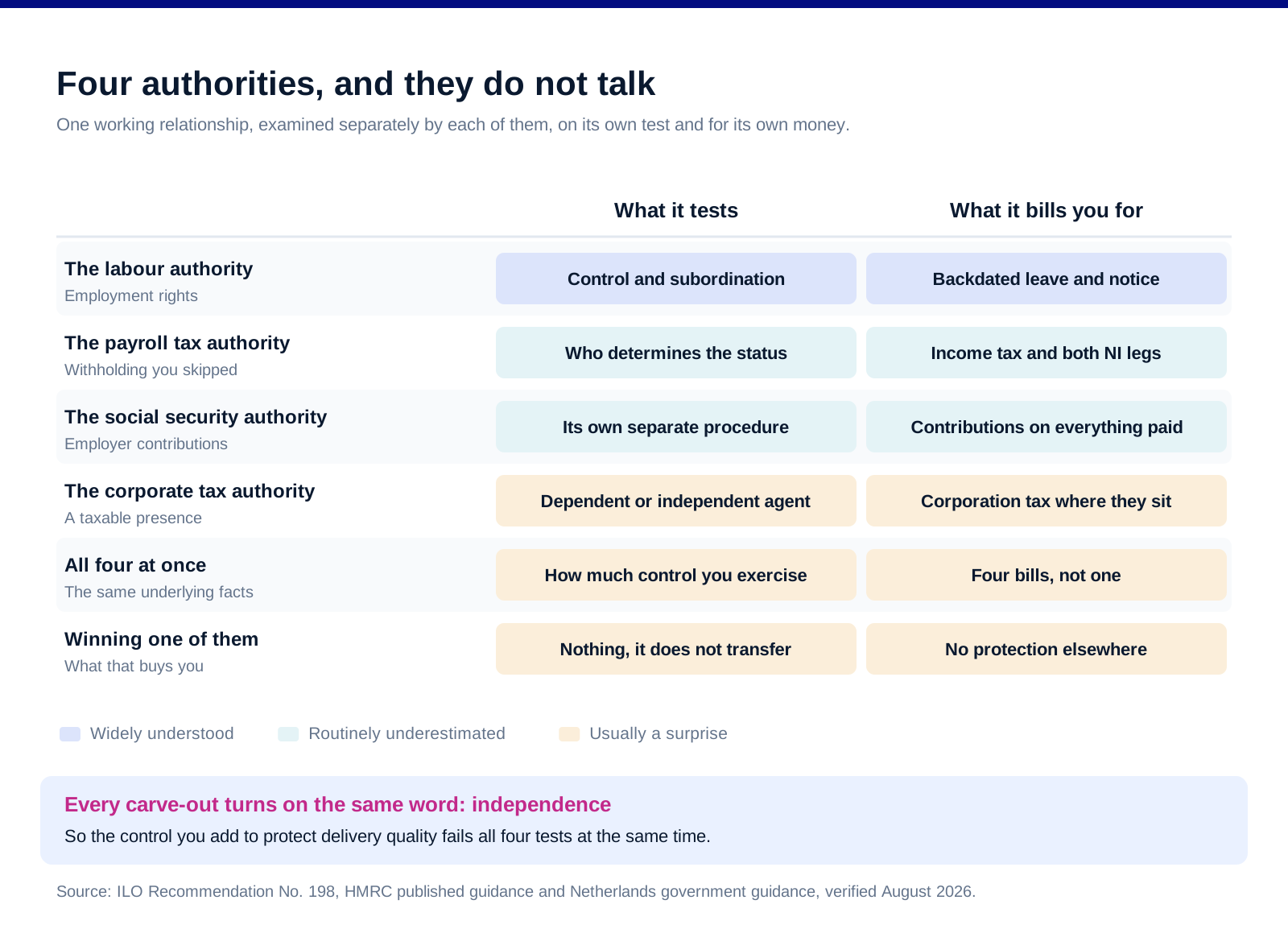
Misclassification is not one risk with one penalty. In Europe a single working relationship can be re-examined by four different authorities, each applying its own test, on its own timetable, for its own money: the labour authority, the payroll tax authority, the social security authority and the corporate tax authority. Winning at one protects you from none of the others. All four turn on the same underlying question, which the International Labour Organization frames as the principle that classification "should be guided primarily by the facts relating to the performance of work and the remuneration of the worker, notwithstanding how the relationship is characterized in any contrary arrangement". The direction of travel is one way. From 2 December 2026 the EU Platform Work Directive requires member states to operate a legal presumption of employment for digital labour platforms, which puts the burden of disproof on the company. The Netherlands is fully enforcing its own rules and fines become available from 2026. And the look-back is longer than most finance teams model: in the UK, HMRC's assessing time limits run to 4 years as standard, 6 years where a loss of tax was careless and 20 years where it was deliberate.
The label is not the test, and it never was
The governing principle is older than the gig economy. The ILO's Employment Relationship Recommendation, 2006 (No. 198) states at paragraph 9 that the determination of whether an employment relationship exists "should be guided primarily by the facts relating to the performance of work and the remuneration of the worker, notwithstanding how the relationship is characterized in any contrary arrangement". Lawyers call this the primacy of facts. It is why the signature on your contractor agreement buys you almost nothing.
And the Recommendation lists what those facts look like. Paragraph 13 sets out indicators that national systems should consider, and reading them as a checklist is uncomfortable for most companies. Work that "is carried out according to the instructions and under the control of another party". Work that "involves the integration of the worker in the organization of the enterprise". Work "performed solely or mainly for the benefit of another person". Work that "must be carried out personally by the worker". Work "carried out within specific working hours or at a workplace specified or agreed by the party requesting the work". Work that "is of a particular duration and has a certain continuity" or "requires the worker's availability".
On the money side the indicators are just as blunt. Paragraph 13 also names "periodic payment of remuneration", the fact that it "constitutes the worker's sole or principal source of income", "recognition of entitlements such as weekly rest and annual holidays", and, tellingly, the "absence of financial risk".
Read that last one again. A contractor who gets paid the same amount every month whether the project went well or badly, who cannot lose money on the engagement, and who bills nobody else, is carrying no financial risk. That is not a contract drafting problem. It is a description of what you actually built.
Which is the whole difficulty. Every instinct that makes a distributed team work well, integrate them, set their hours, give them a laptop, make them available for standups, keep them long term, is an instinct that pushes each of these indicators the wrong way.

Four authorities, four tests, four bills
Here is the part most guidance misses. There is no single body that decides whether your contractor is a contractor. There are several, they do not coordinate, and a favourable answer from one is not a defence in front of another.
The worked examples below lean on the United Kingdom and the Netherlands, because those two publish the most explicit guidance in English on who decides and who pays. The architecture recurs across Europe through the same treaty network and the same EU coordination rules, but the thresholds, the procedures and the rates are national. Read them as illustrations of a shape, not as the law where your contractor sits.
1. The labour authority, for employment rights
This is the one people picture. A contractor asserts they were an employee and claims what employees get: notice, holiday pay accrued across the whole engagement, sick pay, protection against dismissal, sometimes reinstatement. In the Netherlands, the government's own guidance for employers notes that a company hiring a self-employed professional must "make certain that there is no salaried employment" and warns of "complaints and an inspection by the Netherlands Labour Authority".
The bill here is backdated entitlements plus the cost of a dispute you cannot settle quietly, because the finding is a matter of record for every other worker on the same contract template.
2. The payroll tax authority, for the withholding you never operated
Separate authority, separate test, separate money. The UK's off-payroll working rules are the clearest published example of how this lands, and of who carries it. HMRC's guidance states that the rules exist to make sure a worker "pays broadly the same Income Tax and National Insurance as an employee would", and that "In most cases, the client will be responsible for determining the employment status of the worker."
Note the direction of that sentence. Not the contractor. The client. And when the determination goes the other way, HMRC states that "the deemed employer must deduct Income Tax and employee National Insurance contributions from fees paid to the worker's intermediary" and that "Employer National Insurance contributions and Apprenticeship Levy, if applicable, must be paid to HMRC by the deemed employer."
The rules apply where a worker provides services through an intermediary such as their own limited company, and for small clients outside the public sector the responsibility sits with the intermediary instead. But for medium and large clients the pattern is the one to internalise: the hiring company decides, and the hiring company pays when it decides wrongly.
3. The social security authority, for the contributions
In much of Europe this is a different institution again, with its own procedure and its own view, and it is frequently the largest of the four bills because employer contributions are a percentage of everything you ever paid.
The Netherlands is the cleanest current illustration. The Dutch government's guidance on false self-employment states that where an arrangement is false self-employment, "you must pay wage tax and social security contributions", and that the Tax Administration "is fully enforcing the Wet DBA". It also states that "From 2026, you may also be fined", while noting a transitional position in which "The Tax Administration will accept current model agreements till 2029."
The cross-border version has a wrinkle almost nobody models. Under the EU social security coordination rules the European Commission is explicit that when moving within the EU, Iceland, Liechtenstein, Norway or Switzerland "you will always be subject to the legislation of only one country", generally "the country where you actually work as an employed or a self-employed person". For a self-employed person working across several member states, the Commission sets out that the country of residence applies where at least 25% of the activity is there, and otherwise the country "where the centre of interest of your activities is situated".
So the question is never simply employee or contractor. It is employee or contractor, under whose system, and both halves have to be right.
4. The corporate tax authority, for a taxable presence you did not know you had
This is the one that surprises finance directors, because it is not an employment question at all. It is the question of whether a person acting for you in another country has created a taxable presence for the company there.
HMRC's guidance on dependent agent permanent establishments puts the UK version plainly: "A non-UK resident company becomes liable to UK Corporation Tax when it starts to trade in the UK through a dependent agent permanent establishment", where "A dependent agent is an agent who does business on behalf of a non-UK resident company in the UK." The carve-out is for "anyone acting for the company as an agent of independent status."
The same architecture appears throughout the treaty network, so the UK page is an example rather than a universal rule, and the specifics turn on the treaty in question. But look at the word doing the work in that carve-out. Independent. It is the same word that decides the other three questions.
That is the insight worth carrying out of this article. One set of facts about how much control you exercise is read by four separate authorities under four separate tests, and the carve-out in each one is some version of independence. The salesperson you brief weekly, whose targets you set, who introduces you to buyers in Germany and whom you would never let send a substitute, is failing the employment test and the permanent establishment test simultaneously, for exactly the same reason.
The clock runs backwards, and further than you think
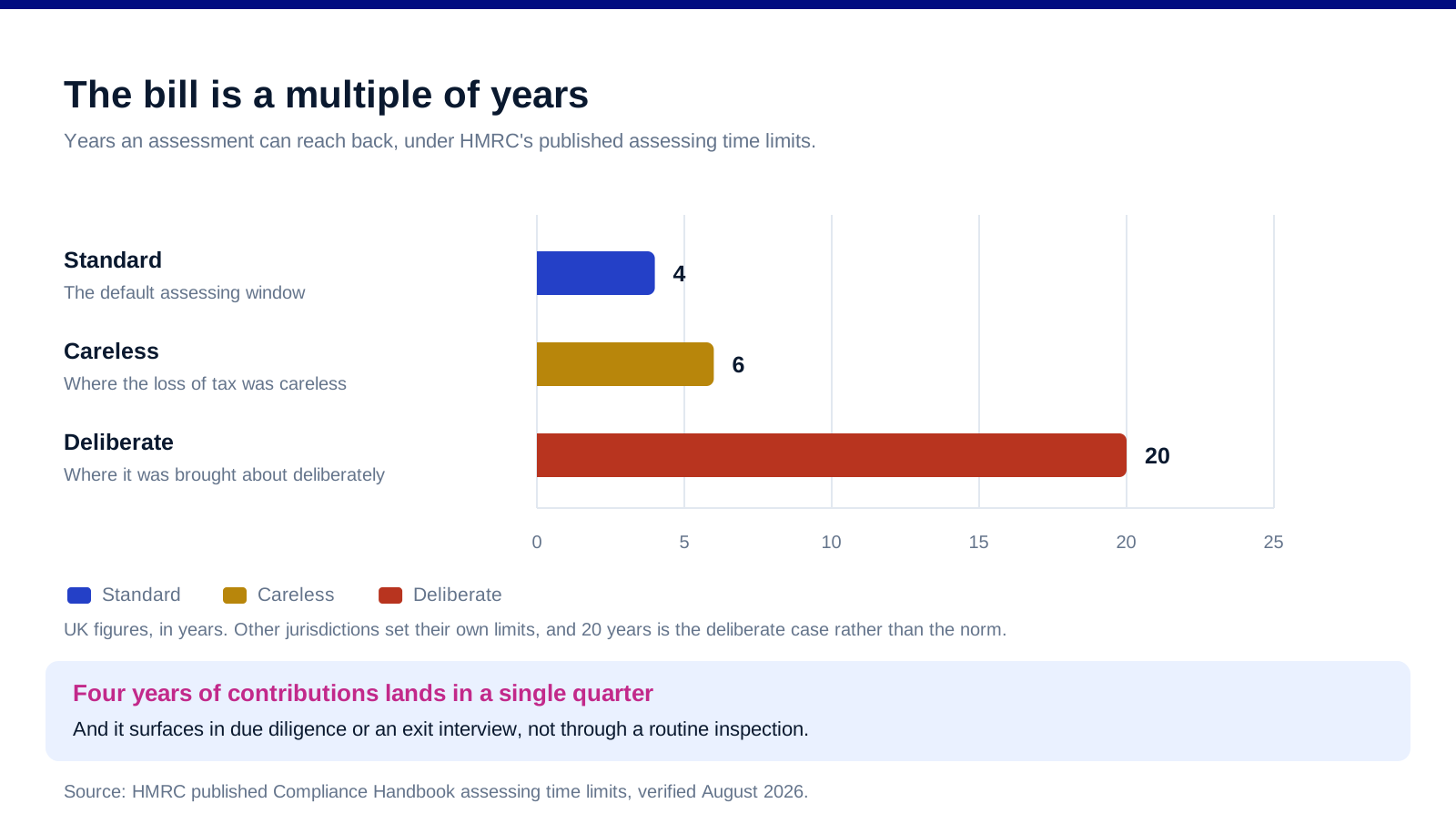
Assessments are retrospective, and the multiplier is time. In the UK, HMRC's assessing time limits are "4 years from the end of the relevant tax period" as standard, "6 years (careless)" where the loss of tax was brought about carelessly, and "20 years (deliberate)" where it was brought about deliberately.
Twenty years is not the normal case and should not be quoted as though it were. But four to six years of employer contributions, withholding, interest and penalties across a team of contractors is a number that lands in a single quarter, on a relationship you have long since stopped thinking about.
And it tends to surface at the worst possible moment. Not through a random inspection. Through a contractor who leaves unhappily and files a claim, or through due diligence in a funding round or an acquisition, where a buyer's advisers open the contractor file precisely because it is where unquantified liabilities live.

Sizing it: the arithmetic you can do this afternoon
First, the honest caveat. No official source publishes employer social contribution rates across Europe in a single comparable table that we could verify, and reclassification is never a flat percentage of what you paid. Offsets, caps, credits for contributions the person already made as a self-employed worker, and the interaction between the four authorities all change the final figure, and all of them differ by country. What follows is a triage method, not a bill.
Start with backdated leave, because it is the one number that works everywhere in the EU. Directive 2003/88/EC guarantees every worker paid annual leave of at least "4 weeks per year". That is a floor and many member states are more generous. So a four year engagement carries a leave element of at least sixteen weeks of pay, before anyone has discussed tax or contributions. On EUR 120,000 a year in fees, that is roughly EUR 37,000 on its own. National limitation periods and carry-over rules do apply to how far back a leave claim can actually reach, and they differ by country, so treat this as the shape of the exposure rather than a settled entitlement.
Then add employer contributions, which are usually the largest single line. Rates are national, so take the UK as the worked example that goes with the off-payroll rules above. HMRC's published National Insurance rates put the employer secondary Class 1 rate at "15%" for the 2026 to 2027 tax year, charged above a secondary threshold. On GBP 120,000 of annual fees that is in the region of GBP 18,000 a year, and the deemed employer pays it rather than the worker. Continental employer contribution rates are frequently higher than the UK figure, so treat 15% as a conservative anchor rather than a typical one.
Now apply the multiplier from the section above. Four years as the standard assessing position, six where the position was careless. On a single contractor at 120,000 a year in either currency, sixteen weeks of leave plus four years of contributions at a conservative rate is already comfortably into six figures, before interest, before penalties, and before the other two authorities have said anything at all.
Then do it for the whole population, not the one you are worried about. Misclassification findings travel across a contract template. If nine people signed the same agreement and work the same way, the exposure is nine times the number you just calculated, which is the moment this stops being a legal question and becomes a board one.
What this exercise is actually for. Not accuracy. Triage. It tells you within twenty minutes whether your contractor population is a rounding error or a material liability, and that answer determines whether you need an adviser this quarter or a note in the risk register.
What changes on 2 December 2026
![[INSERT CHART 3, contractor-misclassification-europe-chart-3-calendar.svg] Alt: The dated changes in European worker classification between 2006 and 2029, and which way the burden of proof moves.](https://framerusercontent.com/images/4Iyb3BWAl8if0wvSYYwBAHZuwTc.svg)
The EU is about to reverse the burden of proof for one class of company. The Platform Work Directive was adopted by the Council on 14 October 2024 and published in the Official Journal on 11 November 2024, and the new rules apply from 2 December 2026. Member states must "establish a legal presumption of employment in their legal systems that will be triggered when certain facts indicating control and direction are found."
The mechanism is what matters. Under the agreed text, the presumption can be activated by workers, their representatives or national labour institutions, and where a platform disputes it, "the platform has to prove (based on national employment law) that it is working with genuinely self-employed people." The default flips. You are classified as the employer unless you can demonstrate otherwise.
Be precise about who this catches. The directive applies to digital labour platforms, not to every company that engages contractors. If you are a manufacturer with three freelance engineers, this specific instrument is not aimed at you.
But read it as a signal rather than as a boundary. The European Parliament put the population at "more than 28 million people" working through digital labour platforms, of whom "about 5.5 million people may be wrongly classified as self-employed". A regulator that believes roughly one in five of a 28 million person population is misclassified does not confine that belief to one business model, and national law across several member states is moving toward presumptions of its own.
The directive also constrains how you manage. It provides that a person performing platform work "cannot be fired or dismissed based on a decision taken by an algorithm or an automated decision-making system", and requires human oversight of important decisions. Worth noting because automated management is itself strong evidence of control.

The seven questions that actually decide it
Run these against your three highest-spend contractors. They are drawn from the ILO indicators and the tests the tax authorities apply, and they are the questions an inspector asks.
Can they send someone else to do the work? A genuine, usable right of substitution is the single strongest contractor indicator there is. A clause nobody has ever exercised, or which you would refuse, is not one.
Can they lose money on the engagement? If they cannot, the ILO's "absence of financial risk" indicator points straight at employment.
Who decides when and where the work happens? If you set the hours, the standups and the location, you are directing the work.
Do they have other clients, and could they take one tomorrow without asking? Sole or principal source of income is an explicit indicator.
Are they in your org chart, your all-hands, your internal tooling and your team channel? That is integration into the organisation of the enterprise, in the Recommendation's own words.
How long has this run, and does it look like a rolling job? Duration and continuity are indicators in their own right.
Do they hold themselves out as a business? Own equipment, own insurance, own brand, own quotes. Not a company registration that exists only to invoice you.
One honest note about scoring this. No single answer is decisive, none of these is a legal test in itself, and the weighting differs by country. If most of your answers point one way, you already know which way.
What actually reduces the risk
Not the contract. The primacy of facts principle exists precisely to defeat paperwork that describes a relationship nobody is living.
Not the invoice, and not the company registration. A contractor with a registered company who invoices you monthly and works only for you has changed the administration of the relationship and none of its substance.
Changing the facts does. Real substitution rights that get used. Real project scoping with real financial risk. Real distance from your internal systems and your management routine. This is the honest answer and it is unattractive, because for most teams the facts are the way they are for good operational reasons.
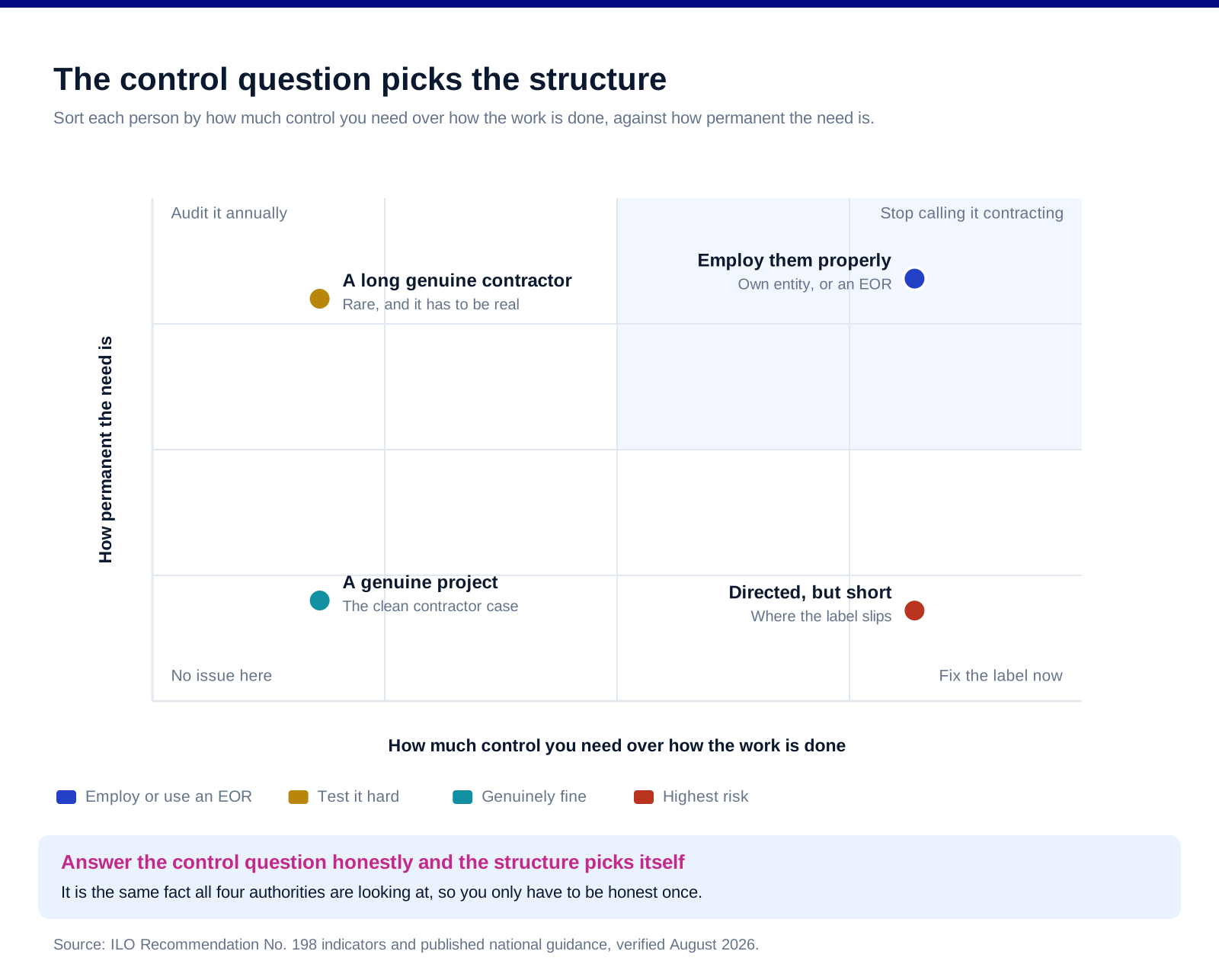
Which leaves three structural options. Employ the person properly in their country, either through your own entity or through an employer of record. Keep them as a contractor but move the classification decision and the liability to a party that specialises in it. Or accept the exposure knowingly, quantify it, and tell your board it is there.
The third is more common than anyone admits, and it is the one that fails due diligence. An unquantified contractor population across five countries is a diligence finding. A quantified one with a documented position is a negotiation.

FAQ
Is a signed independent contractor agreement enough protection?
No. The ILO's Recommendation No. 198 states that classification should be guided primarily by the facts of how the work is performed and paid, "notwithstanding how the relationship is characterized in any contrary arrangement". Authorities across Europe apply that principle. A well drafted contract is necessary and it is not sufficient.
Who pays if a contractor is reclassified, the company or the worker?
Predominantly the company. The UK's off-payroll rules put the determination on the client in most cases and require the deemed employer to account for income tax, employee National Insurance and employer National Insurance. The Dutch guidance states the hiring company must pay wage tax and social security contributions where false self-employment is found.
How far back can a misclassification assessment go?
Longer than a single tax year. In the UK, HMRC's assessing time limits are 4 years as standard, 6 years where the loss of tax was brought about carelessly, and 20 years where it was brought about deliberately. Other jurisdictions have their own limits, and the practical point is that the bill is a multiple of years, not one year.
Does the EU Platform Work Directive apply to my contractors?
It applies to digital labour platforms, so it does not automatically reach every company that uses freelancers. It applies from 2 December 2026 and requires member states to operate a legal presumption of employment triggered by facts indicating control and direction, which the platform must then rebut. Treat it as the clearest published statement of where European enforcement is heading rather than as the boundary of your exposure.
Can a contractor create a tax presence for my company in their country?
Potentially, yes, and this is separate from the employment question. HMRC's guidance states that a non-UK resident company becomes liable to UK Corporation Tax when it trades in the UK through a dependent agent permanent establishment, with a carve-out for an agent of independent status. Similar concepts appear across the treaty network. The risk is highest where the person negotiates or wins business on your behalf.
How do I put a number on my exposure?
Take one contractor's annual fees. Add at least four weeks of pay per year for backdated leave, which the EU Working Time Directive guarantees as a floor across member states. Add employer social contributions for each year in scope, using a published national rate. Multiply by four years as a starting assumption. Then multiply by everyone on the same contract template. It will not be the final bill, because offsets and caps apply and differ by country, but it tells you the order of magnitude in twenty minutes.
What is the single most useful thing to check first?
Substitution and financial risk. If your contractor cannot send a qualified replacement and cannot lose money on the engagement, you are relying on the contract label rather than on the facts, and the contract label is the thing every one of these tests is designed to look past.
Bottom line
Stop thinking about misclassification as a binary with one penalty attached. It is one set of facts examined by four authorities who do not talk to each other, on look-back periods measured in years, with the burden of proof moving toward the company rather than away from it. The uncomfortable part is that the operational choices that make a distributed team work, integration, availability, continuity, direction, are the same choices that fail every one of the four tests at once. So decide deliberately rather than by default. Take your three highest-spend, longest-running contractors, answer the seven questions honestly, and run the twenty minute arithmetic above on each of them. If that number is uncomfortable, you have found your project for this quarter, and you have found it before an inspector, a departing contractor or an acquirer's advisers found it for you.
See how Deel handles contractor classification. Deel's Contractor of Record is built for exactly the position this article describes: engaging people as contractors while moving the classification decision to a party that specialises in it. Deel describes the service as "a third party that helps organizations compliantly classify, onboard, and pay contractors worldwide", says it will "assess the correct classification of your workforce and advise you on whether the workers in question should be contractors or employees", and states that it takes on "all the liability and the indemnification for a contractor". If the honest answer for a given person is that they are an employee, Deel's employer of record product is the other half of the same decision. Check the current terms and coverage for your countries here, because the right answer differs by country and by role.
We are GROU, a B2B pipeline agency that runs lead generation, outbound, and LinkedIn content for clients across manufacturing, fintech, iGaming, software, and professional services. This post contains affiliate links, including to Deel, and we may earn a commission at no extra cost to you. Every regulation, figure and quotation in this article comes from the primary source linked beside it. Nothing here is legal, tax or accounting advice, and classification outcomes depend on facts and on the country in question, so take advice on your own situation before acting.
You have a developer in Poland, a designer in Portugal and someone doing business development in Germany. All three invoice you monthly. All three signed a contract with "independent contractor" at the top, and all three were perfectly happy to sign it.
That contract is the least important document in the file.
TL;DR
Misclassification is not one risk with one penalty. In Europe a single working relationship can be re-examined by four different authorities, each applying its own test, on its own timetable, for its own money: the labour authority, the payroll tax authority, the social security authority and the corporate tax authority. Winning at one protects you from none of the others. All four turn on the same underlying question, which the International Labour Organization frames as the principle that classification "should be guided primarily by the facts relating to the performance of work and the remuneration of the worker, notwithstanding how the relationship is characterized in any contrary arrangement". The direction of travel is one way. From 2 December 2026 the EU Platform Work Directive requires member states to operate a legal presumption of employment for digital labour platforms, which puts the burden of disproof on the company. The Netherlands is fully enforcing its own rules and fines become available from 2026. And the look-back is longer than most finance teams model: in the UK, HMRC's assessing time limits run to 4 years as standard, 6 years where a loss of tax was careless and 20 years where it was deliberate.
The label is not the test, and it never was
The governing principle is older than the gig economy. The ILO's Employment Relationship Recommendation, 2006 (No. 198) states at paragraph 9 that the determination of whether an employment relationship exists "should be guided primarily by the facts relating to the performance of work and the remuneration of the worker, notwithstanding how the relationship is characterized in any contrary arrangement". Lawyers call this the primacy of facts. It is why the signature on your contractor agreement buys you almost nothing.
And the Recommendation lists what those facts look like. Paragraph 13 sets out indicators that national systems should consider, and reading them as a checklist is uncomfortable for most companies. Work that "is carried out according to the instructions and under the control of another party". Work that "involves the integration of the worker in the organization of the enterprise". Work "performed solely or mainly for the benefit of another person". Work that "must be carried out personally by the worker". Work "carried out within specific working hours or at a workplace specified or agreed by the party requesting the work". Work that "is of a particular duration and has a certain continuity" or "requires the worker's availability".
On the money side the indicators are just as blunt. Paragraph 13 also names "periodic payment of remuneration", the fact that it "constitutes the worker's sole or principal source of income", "recognition of entitlements such as weekly rest and annual holidays", and, tellingly, the "absence of financial risk".
Read that last one again. A contractor who gets paid the same amount every month whether the project went well or badly, who cannot lose money on the engagement, and who bills nobody else, is carrying no financial risk. That is not a contract drafting problem. It is a description of what you actually built.
Which is the whole difficulty. Every instinct that makes a distributed team work well, integrate them, set their hours, give them a laptop, make them available for standups, keep them long term, is an instinct that pushes each of these indicators the wrong way.
Four authorities, four tests, four bills
Here is the part most guidance misses. There is no single body that decides whether your contractor is a contractor. There are several, they do not coordinate, and a favourable answer from one is not a defence in front of another.
The worked examples below lean on the United Kingdom and the Netherlands, because those two publish the most explicit guidance in English on who decides and who pays. The architecture recurs across Europe through the same treaty network and the same EU coordination rules, but the thresholds, the procedures and the rates are national. Read them as illustrations of a shape, not as the law where your contractor sits.
1. The labour authority, for employment rights
This is the one people picture. A contractor asserts they were an employee and claims what employees get: notice, holiday pay accrued across the whole engagement, sick pay, protection against dismissal, sometimes reinstatement. In the Netherlands, the government's own guidance for employers notes that a company hiring a self-employed professional must "make certain that there is no salaried employment" and warns of "complaints and an inspection by the Netherlands Labour Authority".
The bill here is backdated entitlements plus the cost of a dispute you cannot settle quietly, because the finding is a matter of record for every other worker on the same contract template.
2. The payroll tax authority, for the withholding you never operated
Separate authority, separate test, separate money. The UK's off-payroll working rules are the clearest published example of how this lands, and of who carries it. HMRC's guidance states that the rules exist to make sure a worker "pays broadly the same Income Tax and National Insurance as an employee would", and that "In most cases, the client will be responsible for determining the employment status of the worker."
Note the direction of that sentence. Not the contractor. The client. And when the determination goes the other way, HMRC states that "the deemed employer must deduct Income Tax and employee National Insurance contributions from fees paid to the worker's intermediary" and that "Employer National Insurance contributions and Apprenticeship Levy, if applicable, must be paid to HMRC by the deemed employer."
The rules apply where a worker provides services through an intermediary such as their own limited company, and for small clients outside the public sector the responsibility sits with the intermediary instead. But for medium and large clients the pattern is the one to internalise: the hiring company decides, and the hiring company pays when it decides wrongly.
3. The social security authority, for the contributions
In much of Europe this is a different institution again, with its own procedure and its own view, and it is frequently the largest of the four bills because employer contributions are a percentage of everything you ever paid.
The Netherlands is the cleanest current illustration. The Dutch government's guidance on false self-employment states that where an arrangement is false self-employment, "you must pay wage tax and social security contributions", and that the Tax Administration "is fully enforcing the Wet DBA". It also states that "From 2026, you may also be fined", while noting a transitional position in which "The Tax Administration will accept current model agreements till 2029."
The cross-border version has a wrinkle almost nobody models. Under the EU social security coordination rules the European Commission is explicit that when moving within the EU, Iceland, Liechtenstein, Norway or Switzerland "you will always be subject to the legislation of only one country", generally "the country where you actually work as an employed or a self-employed person". For a self-employed person working across several member states, the Commission sets out that the country of residence applies where at least 25% of the activity is there, and otherwise the country "where the centre of interest of your activities is situated".
So the question is never simply employee or contractor. It is employee or contractor, under whose system, and both halves have to be right.
4. The corporate tax authority, for a taxable presence you did not know you had
This is the one that surprises finance directors, because it is not an employment question at all. It is the question of whether a person acting for you in another country has created a taxable presence for the company there.
HMRC's guidance on dependent agent permanent establishments puts the UK version plainly: "A non-UK resident company becomes liable to UK Corporation Tax when it starts to trade in the UK through a dependent agent permanent establishment", where "A dependent agent is an agent who does business on behalf of a non-UK resident company in the UK." The carve-out is for "anyone acting for the company as an agent of independent status."
The same architecture appears throughout the treaty network, so the UK page is an example rather than a universal rule, and the specifics turn on the treaty in question. But look at the word doing the work in that carve-out. Independent. It is the same word that decides the other three questions.
That is the insight worth carrying out of this article. One set of facts about how much control you exercise is read by four separate authorities under four separate tests, and the carve-out in each one is some version of independence. The salesperson you brief weekly, whose targets you set, who introduces you to buyers in Germany and whom you would never let send a substitute, is failing the employment test and the permanent establishment test simultaneously, for exactly the same reason.
The clock runs backwards, and further than you think
Assessments are retrospective, and the multiplier is time. In the UK, HMRC's assessing time limits are "4 years from the end of the relevant tax period" as standard, "6 years (careless)" where the loss of tax was brought about carelessly, and "20 years (deliberate)" where it was brought about deliberately.
Twenty years is not the normal case and should not be quoted as though it were. But four to six years of employer contributions, withholding, interest and penalties across a team of contractors is a number that lands in a single quarter, on a relationship you have long since stopped thinking about.
And it tends to surface at the worst possible moment. Not through a random inspection. Through a contractor who leaves unhappily and files a claim, or through due diligence in a funding round or an acquisition, where a buyer's advisers open the contractor file precisely because it is where unquantified liabilities live.
Sizing it: the arithmetic you can do this afternoon
First, the honest caveat. No official source publishes employer social contribution rates across Europe in a single comparable table that we could verify, and reclassification is never a flat percentage of what you paid. Offsets, caps, credits for contributions the person already made as a self-employed worker, and the interaction between the four authorities all change the final figure, and all of them differ by country. What follows is a triage method, not a bill.
Start with backdated leave, because it is the one number that works everywhere in the EU. Directive 2003/88/EC guarantees every worker paid annual leave of at least "4 weeks per year". That is a floor and many member states are more generous. So a four year engagement carries a leave element of at least sixteen weeks of pay, before anyone has discussed tax or contributions. On EUR 120,000 a year in fees, that is roughly EUR 37,000 on its own. National limitation periods and carry-over rules do apply to how far back a leave claim can actually reach, and they differ by country, so treat this as the shape of the exposure rather than a settled entitlement.
Then add employer contributions, which are usually the largest single line. Rates are national, so take the UK as the worked example that goes with the off-payroll rules above. HMRC's published National Insurance rates put the employer secondary Class 1 rate at "15%" for the 2026 to 2027 tax year, charged above a secondary threshold. On GBP 120,000 of annual fees that is in the region of GBP 18,000 a year, and the deemed employer pays it rather than the worker. Continental employer contribution rates are frequently higher than the UK figure, so treat 15% as a conservative anchor rather than a typical one.
Now apply the multiplier from the section above. Four years as the standard assessing position, six where the position was careless. On a single contractor at 120,000 a year in either currency, sixteen weeks of leave plus four years of contributions at a conservative rate is already comfortably into six figures, before interest, before penalties, and before the other two authorities have said anything at all.
Then do it for the whole population, not the one you are worried about. Misclassification findings travel across a contract template. If nine people signed the same agreement and work the same way, the exposure is nine times the number you just calculated, which is the moment this stops being a legal question and becomes a board one.
What this exercise is actually for. Not accuracy. Triage. It tells you within twenty minutes whether your contractor population is a rounding error or a material liability, and that answer determines whether you need an adviser this quarter or a note in the risk register.
What changes on 2 December 2026
The EU is about to reverse the burden of proof for one class of company. The Platform Work Directive was adopted by the Council on 14 October 2024 and published in the Official Journal on 11 November 2024, and the new rules apply from 2 December 2026. Member states must "establish a legal presumption of employment in their legal systems that will be triggered when certain facts indicating control and direction are found."
The mechanism is what matters. Under the agreed text, the presumption can be activated by workers, their representatives or national labour institutions, and where a platform disputes it, "the platform has to prove (based on national employment law) that it is working with genuinely self-employed people." The default flips. You are classified as the employer unless you can demonstrate otherwise.
Be precise about who this catches. The directive applies to digital labour platforms, not to every company that engages contractors. If you are a manufacturer with three freelance engineers, this specific instrument is not aimed at you.
But read it as a signal rather than as a boundary. The European Parliament put the population at "more than 28 million people" working through digital labour platforms, of whom "about 5.5 million people may be wrongly classified as self-employed". A regulator that believes roughly one in five of a 28 million person population is misclassified does not confine that belief to one business model, and national law across several member states is moving toward presumptions of its own.
The directive also constrains how you manage. It provides that a person performing platform work "cannot be fired or dismissed based on a decision taken by an algorithm or an automated decision-making system", and requires human oversight of important decisions. Worth noting because automated management is itself strong evidence of control.
The seven questions that actually decide it
Run these against your three highest-spend contractors. They are drawn from the ILO indicators and the tests the tax authorities apply, and they are the questions an inspector asks.
Can they send someone else to do the work? A genuine, usable right of substitution is the single strongest contractor indicator there is. A clause nobody has ever exercised, or which you would refuse, is not one.
Can they lose money on the engagement? If they cannot, the ILO's "absence of financial risk" indicator points straight at employment.
Who decides when and where the work happens? If you set the hours, the standups and the location, you are directing the work.
Do they have other clients, and could they take one tomorrow without asking? Sole or principal source of income is an explicit indicator.
Are they in your org chart, your all-hands, your internal tooling and your team channel? That is integration into the organisation of the enterprise, in the Recommendation's own words.
How long has this run, and does it look like a rolling job? Duration and continuity are indicators in their own right.
Do they hold themselves out as a business? Own equipment, own insurance, own brand, own quotes. Not a company registration that exists only to invoice you.
One honest note about scoring this. No single answer is decisive, none of these is a legal test in itself, and the weighting differs by country. If most of your answers point one way, you already know which way.
What actually reduces the risk
Not the contract. The primacy of facts principle exists precisely to defeat paperwork that describes a relationship nobody is living.
Not the invoice, and not the company registration. A contractor with a registered company who invoices you monthly and works only for you has changed the administration of the relationship and none of its substance.
Changing the facts does. Real substitution rights that get used. Real project scoping with real financial risk. Real distance from your internal systems and your management routine. This is the honest answer and it is unattractive, because for most teams the facts are the way they are for good operational reasons.
Which leaves three structural options. Employ the person properly in their country, either through your own entity or through an employer of record. Keep them as a contractor but move the classification decision and the liability to a party that specialises in it. Or accept the exposure knowingly, quantify it, and tell your board it is there.
The third is more common than anyone admits, and it is the one that fails due diligence. An unquantified contractor population across five countries is a diligence finding. A quantified one with a documented position is a negotiation.
FAQ
Is a signed independent contractor agreement enough protection?
No. The ILO's Recommendation No. 198 states that classification should be guided primarily by the facts of how the work is performed and paid, "notwithstanding how the relationship is characterized in any contrary arrangement". Authorities across Europe apply that principle. A well drafted contract is necessary and it is not sufficient.
Who pays if a contractor is reclassified, the company or the worker?
Predominantly the company. The UK's off-payroll rules put the determination on the client in most cases and require the deemed employer to account for income tax, employee National Insurance and employer National Insurance. The Dutch guidance states the hiring company must pay wage tax and social security contributions where false self-employment is found.
How far back can a misclassification assessment go?
Longer than a single tax year. In the UK, HMRC's assessing time limits are 4 years as standard, 6 years where the loss of tax was brought about carelessly, and 20 years where it was brought about deliberately. Other jurisdictions have their own limits, and the practical point is that the bill is a multiple of years, not one year.
Does the EU Platform Work Directive apply to my contractors?
It applies to digital labour platforms, so it does not automatically reach every company that uses freelancers. It applies from 2 December 2026 and requires member states to operate a legal presumption of employment triggered by facts indicating control and direction, which the platform must then rebut. Treat it as the clearest published statement of where European enforcement is heading rather than as the boundary of your exposure.
Can a contractor create a tax presence for my company in their country?
Potentially, yes, and this is separate from the employment question. HMRC's guidance states that a non-UK resident company becomes liable to UK Corporation Tax when it trades in the UK through a dependent agent permanent establishment, with a carve-out for an agent of independent status. Similar concepts appear across the treaty network. The risk is highest where the person negotiates or wins business on your behalf.
How do I put a number on my exposure?
Take one contractor's annual fees. Add at least four weeks of pay per year for backdated leave, which the EU Working Time Directive guarantees as a floor across member states. Add employer social contributions for each year in scope, using a published national rate. Multiply by four years as a starting assumption. Then multiply by everyone on the same contract template. It will not be the final bill, because offsets and caps apply and differ by country, but it tells you the order of magnitude in twenty minutes.
What is the single most useful thing to check first?
Substitution and financial risk. If your contractor cannot send a qualified replacement and cannot lose money on the engagement, you are relying on the contract label rather than on the facts, and the contract label is the thing every one of these tests is designed to look past.
Bottom line
Stop thinking about misclassification as a binary with one penalty attached. It is one set of facts examined by four authorities who do not talk to each other, on look-back periods measured in years, with the burden of proof moving toward the company rather than away from it. The uncomfortable part is that the operational choices that make a distributed team work, integration, availability, continuity, direction, are the same choices that fail every one of the four tests at once. So decide deliberately rather than by default. Take your three highest-spend, longest-running contractors, answer the seven questions honestly, and run the twenty minute arithmetic above on each of them. If that number is uncomfortable, you have found your project for this quarter, and you have found it before an inspector, a departing contractor or an acquirer's advisers found it for you.
See how Deel handles contractor classification. Deel's Contractor of Record is built for exactly the position this article describes: engaging people as contractors while moving the classification decision to a party that specialises in it. Deel describes the service as "a third party that helps organizations compliantly classify, onboard, and pay contractors worldwide", says it will "assess the correct classification of your workforce and advise you on whether the workers in question should be contractors or employees", and states that it takes on "all the liability and the indemnification for a contractor". If the honest answer for a given person is that they are an employee, Deel's employer of record product is the other half of the same decision. Check the current terms and coverage for your countries here, because the right answer differs by country and by role.
We are GROU, a B2B pipeline agency that runs lead generation, outbound, and LinkedIn content for clients across manufacturing, fintech, iGaming, software, and professional services. This post contains affiliate links, including to Deel, and we may earn a commission at no extra cost to you. Every regulation, figure and quotation in this article comes from the primary source linked beside it. Nothing here is legal, tax or accounting advice, and classification outcomes depend on facts and on the country in question, so take advice on your own situation before acting.
You have a developer in Poland, a designer in Portugal and someone doing business development in Germany. All three invoice you monthly. All three signed a contract with "independent contractor" at the top, and all three were perfectly happy to sign it.
That contract is the least important document in the file.
TL;DR
Misclassification is not one risk with one penalty. In Europe a single working relationship can be re-examined by four different authorities, each applying its own test, on its own timetable, for its own money: the labour authority, the payroll tax authority, the social security authority and the corporate tax authority. Winning at one protects you from none of the others. All four turn on the same underlying question, which the International Labour Organization frames as the principle that classification "should be guided primarily by the facts relating to the performance of work and the remuneration of the worker, notwithstanding how the relationship is characterized in any contrary arrangement". The direction of travel is one way. From 2 December 2026 the EU Platform Work Directive requires member states to operate a legal presumption of employment for digital labour platforms, which puts the burden of disproof on the company. The Netherlands is fully enforcing its own rules and fines become available from 2026. And the look-back is longer than most finance teams model: in the UK, HMRC's assessing time limits run to 4 years as standard, 6 years where a loss of tax was careless and 20 years where it was deliberate.
The label is not the test, and it never was
The governing principle is older than the gig economy. The ILO's Employment Relationship Recommendation, 2006 (No. 198) states at paragraph 9 that the determination of whether an employment relationship exists "should be guided primarily by the facts relating to the performance of work and the remuneration of the worker, notwithstanding how the relationship is characterized in any contrary arrangement". Lawyers call this the primacy of facts. It is why the signature on your contractor agreement buys you almost nothing.
And the Recommendation lists what those facts look like. Paragraph 13 sets out indicators that national systems should consider, and reading them as a checklist is uncomfortable for most companies. Work that "is carried out according to the instructions and under the control of another party". Work that "involves the integration of the worker in the organization of the enterprise". Work "performed solely or mainly for the benefit of another person". Work that "must be carried out personally by the worker". Work "carried out within specific working hours or at a workplace specified or agreed by the party requesting the work". Work that "is of a particular duration and has a certain continuity" or "requires the worker's availability".
On the money side the indicators are just as blunt. Paragraph 13 also names "periodic payment of remuneration", the fact that it "constitutes the worker's sole or principal source of income", "recognition of entitlements such as weekly rest and annual holidays", and, tellingly, the "absence of financial risk".
Read that last one again. A contractor who gets paid the same amount every month whether the project went well or badly, who cannot lose money on the engagement, and who bills nobody else, is carrying no financial risk. That is not a contract drafting problem. It is a description of what you actually built.
Which is the whole difficulty. Every instinct that makes a distributed team work well, integrate them, set their hours, give them a laptop, make them available for standups, keep them long term, is an instinct that pushes each of these indicators the wrong way.
Four authorities, four tests, four bills
Here is the part most guidance misses. There is no single body that decides whether your contractor is a contractor. There are several, they do not coordinate, and a favourable answer from one is not a defence in front of another.
The worked examples below lean on the United Kingdom and the Netherlands, because those two publish the most explicit guidance in English on who decides and who pays. The architecture recurs across Europe through the same treaty network and the same EU coordination rules, but the thresholds, the procedures and the rates are national. Read them as illustrations of a shape, not as the law where your contractor sits.
1. The labour authority, for employment rights
This is the one people picture. A contractor asserts they were an employee and claims what employees get: notice, holiday pay accrued across the whole engagement, sick pay, protection against dismissal, sometimes reinstatement. In the Netherlands, the government's own guidance for employers notes that a company hiring a self-employed professional must "make certain that there is no salaried employment" and warns of "complaints and an inspection by the Netherlands Labour Authority".
The bill here is backdated entitlements plus the cost of a dispute you cannot settle quietly, because the finding is a matter of record for every other worker on the same contract template.
2. The payroll tax authority, for the withholding you never operated
Separate authority, separate test, separate money. The UK's off-payroll working rules are the clearest published example of how this lands, and of who carries it. HMRC's guidance states that the rules exist to make sure a worker "pays broadly the same Income Tax and National Insurance as an employee would", and that "In most cases, the client will be responsible for determining the employment status of the worker."
Note the direction of that sentence. Not the contractor. The client. And when the determination goes the other way, HMRC states that "the deemed employer must deduct Income Tax and employee National Insurance contributions from fees paid to the worker's intermediary" and that "Employer National Insurance contributions and Apprenticeship Levy, if applicable, must be paid to HMRC by the deemed employer."
The rules apply where a worker provides services through an intermediary such as their own limited company, and for small clients outside the public sector the responsibility sits with the intermediary instead. But for medium and large clients the pattern is the one to internalise: the hiring company decides, and the hiring company pays when it decides wrongly.
3. The social security authority, for the contributions
In much of Europe this is a different institution again, with its own procedure and its own view, and it is frequently the largest of the four bills because employer contributions are a percentage of everything you ever paid.
The Netherlands is the cleanest current illustration. The Dutch government's guidance on false self-employment states that where an arrangement is false self-employment, "you must pay wage tax and social security contributions", and that the Tax Administration "is fully enforcing the Wet DBA". It also states that "From 2026, you may also be fined", while noting a transitional position in which "The Tax Administration will accept current model agreements till 2029."
The cross-border version has a wrinkle almost nobody models. Under the EU social security coordination rules the European Commission is explicit that when moving within the EU, Iceland, Liechtenstein, Norway or Switzerland "you will always be subject to the legislation of only one country", generally "the country where you actually work as an employed or a self-employed person". For a self-employed person working across several member states, the Commission sets out that the country of residence applies where at least 25% of the activity is there, and otherwise the country "where the centre of interest of your activities is situated".
So the question is never simply employee or contractor. It is employee or contractor, under whose system, and both halves have to be right.
4. The corporate tax authority, for a taxable presence you did not know you had
This is the one that surprises finance directors, because it is not an employment question at all. It is the question of whether a person acting for you in another country has created a taxable presence for the company there.
HMRC's guidance on dependent agent permanent establishments puts the UK version plainly: "A non-UK resident company becomes liable to UK Corporation Tax when it starts to trade in the UK through a dependent agent permanent establishment", where "A dependent agent is an agent who does business on behalf of a non-UK resident company in the UK." The carve-out is for "anyone acting for the company as an agent of independent status."
The same architecture appears throughout the treaty network, so the UK page is an example rather than a universal rule, and the specifics turn on the treaty in question. But look at the word doing the work in that carve-out. Independent. It is the same word that decides the other three questions.
That is the insight worth carrying out of this article. One set of facts about how much control you exercise is read by four separate authorities under four separate tests, and the carve-out in each one is some version of independence. The salesperson you brief weekly, whose targets you set, who introduces you to buyers in Germany and whom you would never let send a substitute, is failing the employment test and the permanent establishment test simultaneously, for exactly the same reason.
The clock runs backwards, and further than you think
Assessments are retrospective, and the multiplier is time. In the UK, HMRC's assessing time limits are "4 years from the end of the relevant tax period" as standard, "6 years (careless)" where the loss of tax was brought about carelessly, and "20 years (deliberate)" where it was brought about deliberately.
Twenty years is not the normal case and should not be quoted as though it were. But four to six years of employer contributions, withholding, interest and penalties across a team of contractors is a number that lands in a single quarter, on a relationship you have long since stopped thinking about.
And it tends to surface at the worst possible moment. Not through a random inspection. Through a contractor who leaves unhappily and files a claim, or through due diligence in a funding round or an acquisition, where a buyer's advisers open the contractor file precisely because it is where unquantified liabilities live.
Sizing it: the arithmetic you can do this afternoon
First, the honest caveat. No official source publishes employer social contribution rates across Europe in a single comparable table that we could verify, and reclassification is never a flat percentage of what you paid. Offsets, caps, credits for contributions the person already made as a self-employed worker, and the interaction between the four authorities all change the final figure, and all of them differ by country. What follows is a triage method, not a bill.
Start with backdated leave, because it is the one number that works everywhere in the EU. Directive 2003/88/EC guarantees every worker paid annual leave of at least "4 weeks per year". That is a floor and many member states are more generous. So a four year engagement carries a leave element of at least sixteen weeks of pay, before anyone has discussed tax or contributions. On EUR 120,000 a year in fees, that is roughly EUR 37,000 on its own. National limitation periods and carry-over rules do apply to how far back a leave claim can actually reach, and they differ by country, so treat this as the shape of the exposure rather than a settled entitlement.
Then add employer contributions, which are usually the largest single line. Rates are national, so take the UK as the worked example that goes with the off-payroll rules above. HMRC's published National Insurance rates put the employer secondary Class 1 rate at "15%" for the 2026 to 2027 tax year, charged above a secondary threshold. On GBP 120,000 of annual fees that is in the region of GBP 18,000 a year, and the deemed employer pays it rather than the worker. Continental employer contribution rates are frequently higher than the UK figure, so treat 15% as a conservative anchor rather than a typical one.
Now apply the multiplier from the section above. Four years as the standard assessing position, six where the position was careless. On a single contractor at 120,000 a year in either currency, sixteen weeks of leave plus four years of contributions at a conservative rate is already comfortably into six figures, before interest, before penalties, and before the other two authorities have said anything at all.
Then do it for the whole population, not the one you are worried about. Misclassification findings travel across a contract template. If nine people signed the same agreement and work the same way, the exposure is nine times the number you just calculated, which is the moment this stops being a legal question and becomes a board one.
What this exercise is actually for. Not accuracy. Triage. It tells you within twenty minutes whether your contractor population is a rounding error or a material liability, and that answer determines whether you need an adviser this quarter or a note in the risk register.
What changes on 2 December 2026
The EU is about to reverse the burden of proof for one class of company. The Platform Work Directive was adopted by the Council on 14 October 2024 and published in the Official Journal on 11 November 2024, and the new rules apply from 2 December 2026. Member states must "establish a legal presumption of employment in their legal systems that will be triggered when certain facts indicating control and direction are found."
The mechanism is what matters. Under the agreed text, the presumption can be activated by workers, their representatives or national labour institutions, and where a platform disputes it, "the platform has to prove (based on national employment law) that it is working with genuinely self-employed people." The default flips. You are classified as the employer unless you can demonstrate otherwise.
Be precise about who this catches. The directive applies to digital labour platforms, not to every company that engages contractors. If you are a manufacturer with three freelance engineers, this specific instrument is not aimed at you.
But read it as a signal rather than as a boundary. The European Parliament put the population at "more than 28 million people" working through digital labour platforms, of whom "about 5.5 million people may be wrongly classified as self-employed". A regulator that believes roughly one in five of a 28 million person population is misclassified does not confine that belief to one business model, and national law across several member states is moving toward presumptions of its own.
The directive also constrains how you manage. It provides that a person performing platform work "cannot be fired or dismissed based on a decision taken by an algorithm or an automated decision-making system", and requires human oversight of important decisions. Worth noting because automated management is itself strong evidence of control.
The seven questions that actually decide it
Run these against your three highest-spend contractors. They are drawn from the ILO indicators and the tests the tax authorities apply, and they are the questions an inspector asks.
Can they send someone else to do the work? A genuine, usable right of substitution is the single strongest contractor indicator there is. A clause nobody has ever exercised, or which you would refuse, is not one.
Can they lose money on the engagement? If they cannot, the ILO's "absence of financial risk" indicator points straight at employment.
Who decides when and where the work happens? If you set the hours, the standups and the location, you are directing the work.
Do they have other clients, and could they take one tomorrow without asking? Sole or principal source of income is an explicit indicator.
Are they in your org chart, your all-hands, your internal tooling and your team channel? That is integration into the organisation of the enterprise, in the Recommendation's own words.
How long has this run, and does it look like a rolling job? Duration and continuity are indicators in their own right.
Do they hold themselves out as a business? Own equipment, own insurance, own brand, own quotes. Not a company registration that exists only to invoice you.
One honest note about scoring this. No single answer is decisive, none of these is a legal test in itself, and the weighting differs by country. If most of your answers point one way, you already know which way.
What actually reduces the risk
Not the contract. The primacy of facts principle exists precisely to defeat paperwork that describes a relationship nobody is living.
Not the invoice, and not the company registration. A contractor with a registered company who invoices you monthly and works only for you has changed the administration of the relationship and none of its substance.
Changing the facts does. Real substitution rights that get used. Real project scoping with real financial risk. Real distance from your internal systems and your management routine. This is the honest answer and it is unattractive, because for most teams the facts are the way they are for good operational reasons.
Which leaves three structural options. Employ the person properly in their country, either through your own entity or through an employer of record. Keep them as a contractor but move the classification decision and the liability to a party that specialises in it. Or accept the exposure knowingly, quantify it, and tell your board it is there.
The third is more common than anyone admits, and it is the one that fails due diligence. An unquantified contractor population across five countries is a diligence finding. A quantified one with a documented position is a negotiation.
FAQ
Is a signed independent contractor agreement enough protection?
No. The ILO's Recommendation No. 198 states that classification should be guided primarily by the facts of how the work is performed and paid, "notwithstanding how the relationship is characterized in any contrary arrangement". Authorities across Europe apply that principle. A well drafted contract is necessary and it is not sufficient.
Who pays if a contractor is reclassified, the company or the worker?
Predominantly the company. The UK's off-payroll rules put the determination on the client in most cases and require the deemed employer to account for income tax, employee National Insurance and employer National Insurance. The Dutch guidance states the hiring company must pay wage tax and social security contributions where false self-employment is found.
How far back can a misclassification assessment go?
Longer than a single tax year. In the UK, HMRC's assessing time limits are 4 years as standard, 6 years where the loss of tax was brought about carelessly, and 20 years where it was brought about deliberately. Other jurisdictions have their own limits, and the practical point is that the bill is a multiple of years, not one year.
Does the EU Platform Work Directive apply to my contractors?
It applies to digital labour platforms, so it does not automatically reach every company that uses freelancers. It applies from 2 December 2026 and requires member states to operate a legal presumption of employment triggered by facts indicating control and direction, which the platform must then rebut. Treat it as the clearest published statement of where European enforcement is heading rather than as the boundary of your exposure.
Can a contractor create a tax presence for my company in their country?
Potentially, yes, and this is separate from the employment question. HMRC's guidance states that a non-UK resident company becomes liable to UK Corporation Tax when it trades in the UK through a dependent agent permanent establishment, with a carve-out for an agent of independent status. Similar concepts appear across the treaty network. The risk is highest where the person negotiates or wins business on your behalf.
How do I put a number on my exposure?
Take one contractor's annual fees. Add at least four weeks of pay per year for backdated leave, which the EU Working Time Directive guarantees as a floor across member states. Add employer social contributions for each year in scope, using a published national rate. Multiply by four years as a starting assumption. Then multiply by everyone on the same contract template. It will not be the final bill, because offsets and caps apply and differ by country, but it tells you the order of magnitude in twenty minutes.
What is the single most useful thing to check first?
Substitution and financial risk. If your contractor cannot send a qualified replacement and cannot lose money on the engagement, you are relying on the contract label rather than on the facts, and the contract label is the thing every one of these tests is designed to look past.
Bottom line
Stop thinking about misclassification as a binary with one penalty attached. It is one set of facts examined by four authorities who do not talk to each other, on look-back periods measured in years, with the burden of proof moving toward the company rather than away from it. The uncomfortable part is that the operational choices that make a distributed team work, integration, availability, continuity, direction, are the same choices that fail every one of the four tests at once. So decide deliberately rather than by default. Take your three highest-spend, longest-running contractors, answer the seven questions honestly, and run the twenty minute arithmetic above on each of them. If that number is uncomfortable, you have found your project for this quarter, and you have found it before an inspector, a departing contractor or an acquirer's advisers found it for you.
See how Deel handles contractor classification. Deel's Contractor of Record is built for exactly the position this article describes: engaging people as contractors while moving the classification decision to a party that specialises in it. Deel describes the service as "a third party that helps organizations compliantly classify, onboard, and pay contractors worldwide", says it will "assess the correct classification of your workforce and advise you on whether the workers in question should be contractors or employees", and states that it takes on "all the liability and the indemnification for a contractor". If the honest answer for a given person is that they are an employee, Deel's employer of record product is the other half of the same decision. Check the current terms and coverage for your countries here, because the right answer differs by country and by role.
We are GROU, a B2B pipeline agency that runs lead generation, outbound, and LinkedIn content for clients across manufacturing, fintech, iGaming, software, and professional services. This post contains affiliate links, including to Deel, and we may earn a commission at no extra cost to you. Every regulation, figure and quotation in this article comes from the primary source linked beside it. Nothing here is legal, tax or accounting advice, and classification outcomes depend on facts and on the country in question, so take advice on your own situation before acting.

Pipeline OS Newsletter
Build qualified pipeline
Get weekly tactics to generate demand, improve lead quality, and book more meetings.





Trusted by industry leaders
Trusted by industry leaders
Trusted by industry leaders
Ready to build qualified pipeline?
Ready to build qualified pipeline?
Ready to build qualified pipeline?
Book a call to see if we're the right fit, or take the 2-minute quiz to get a clear starting point.
Book a call to see if we're the right fit, or take the 2-minute quiz to get a clear starting point.
Book a call to see if we're the right fit, or take the 2-minute quiz to get a clear starting point.
" height="30.21639343089746px" id="hfGbXmQR2" width="30.216393430897455px"/></svg>)
Copyright © 2026 – All Right Reserved
Copyright © 2026 – All Right Reserved
Copyright © 2026 – All Right Reserved