%22%3E%3C/path%3E%3Cpath d=%22M 63.072 7.554 C 62.258 8.022 61.577 8.689 61.092 9.493 L 61.092 7.076 L 57.158 7.076 L 57.158 22.64 L 61.089 22.64 L 61.089 14.888 C 61.089 13.446 61.403 12.434 62.03 11.853 C 62.818 11.218 63.818 10.907 64.826 10.982 L 65.868 10.982 L 65.868 6.851 C 64.891 6.834 63.926 7.076 63.073 7.554 Z%22 fill=%22rgb(17,17,17)%22%3E%3C/path%3E%3Cpath d=%22M 78.916 7.82 C 76.363 6.49 73.321 6.49 70.768 7.82 C 69.562 8.473 68.564 9.451 67.888 10.644 C 67.167 11.931 66.803 13.387 66.834 14.862 C 66.804 16.332 67.157 17.785 67.86 19.077 C 68.515 20.267 69.494 21.246 70.684 21.901 C 71.924 22.576 73.318 22.92 74.73 22.898 C 76.164 22.918 77.58 22.575 78.846 21.901 C 80.062 21.247 81.073 20.27 81.768 19.077 C 82.506 17.797 82.88 16.339 82.85 14.862 C 82.88 13.389 82.517 11.934 81.797 10.647 C 81.12 9.455 80.122 8.477 78.917 7.824 M 78.803 14.862 C 78.829 15.739 78.636 16.608 78.241 17.391 C 77.903 18.046 77.38 18.588 76.738 18.95 C 76.124 19.293 75.432 19.472 74.729 19.47 C 73.668 19.497 72.648 19.061 71.934 18.276 C 71.139 17.323 70.741 16.1 70.823 14.862 C 70.741 13.62 71.149 12.395 71.959 11.45 C 72.687 10.667 73.715 10.233 74.783 10.256 C 75.859 10.236 76.894 10.67 77.635 11.45 C 78.464 12.387 78.884 13.616 78.801 14.864%22 fill=%22rgb(17,17,17)%22%3E%3C/path%3E%3Cpath d=%22M 95.906 7.076 L 95.906 15.646 C 95.975 16.68 95.643 17.701 94.979 18.498 C 94.311 19.184 93.379 19.547 92.422 19.495 C 91.475 19.544 90.553 19.18 89.894 18.498 C 89.23 17.701 88.898 16.68 88.967 15.646 L 88.967 7.076 L 85.033 7.076 L 85.033 16.207 C 85 17.449 85.275 18.68 85.834 19.79 C 86.327 20.75 87.095 21.542 88.039 22.065 C 89.033 22.594 90.145 22.861 91.271 22.838 C 92.188 22.847 93.095 22.65 93.926 22.263 C 94.708 21.905 95.388 21.36 95.906 20.675 L 95.906 22.645 L 99.865 22.645 L 99.865 7.076 Z%22 fill=%22rgb(17,17,17)%22%3E%3C/path%3E%3Cpath d=%22M 4.513 15.626 C 4.511 10.815 7.606 6.549 12.181 5.059 C 16.756 3.57 21.77 5.195 24.601 9.086 L 27.816 5.87 C 24.074 1.186 17.981 -0.943 12.137 0.393 C 6.292 1.728 1.728 6.292 0.393 12.137 C -0.943 17.981 1.186 24.074 5.87 27.816 L 9.085 24.601 C 6.214 22.512 4.515 19.177 4.513 15.626%22 fill=%22rgb(32,62,235)%22%3E%3C/path%3E%3Cpath d=%22M 17.114 14.343 L 13.354 18.01 L 13.354 18.026 L 21.071 18.026 L 11.412 27.609 L 17.389 27.609 L 23.999 21.081 L 23.999 28.316 L 24.005 28.316 L 27.967 24.393 L 27.967 14.343 Z%22 fill=%22rgb(32,62,235)%22%3E%3C/path%3E%3C/g%3E%3C/svg%3E) ×
× ××
××

B2B marketing budget benchmarks for 2027
Marketing budgets average 7.8% of company revenue in 2026, according to Gartner's CMO Spend Survey, up slightly from 7.7% in 2025. The Deloitte, Duke and AMA CMO Survey puts the figure higher, at 9.4%, because it includes more smaller companies. For 2027 planning, the benchmark is a starting point: the right number comes from working back from your pipeline target.
TL;DR
Gartner: 7.8% of revenue in 2026, 7.7% in 2025, down from 9.5% in 2022.
CMO Survey: 9.4% of revenue. Smaller and faster-growing companies spend a higher share.
CMOs are putting 15.3% of marketing budgets into AI, and labour's share rose from 21.9% to 24.5%.
Set your 2027 budget from pipeline maths first, then sanity-check it against benchmarks.
Marketing budget as a percentage of revenue
Gartner's annual survey of senior marketing leaders is the most cited benchmark. Its 2026 edition found budgets "effectively flat" at 7.8% of company revenue, up from 7.7% in 2025 (Gartner). That follows a sharp drop from 9.5% in the 2022 survey (Techeconomy, reporting Gartner).

Figure: marketing budget as a share of company revenue, Gartner CMO Spend Survey, 2022 to 2026. The 2023 to 2025 values are as summarised by Vidico.
Two caveats matter when you use this number:
Gartner's sample skews large. Most respondents come from companies with more than $1 billion in revenue, as the 2022 survey notes. Large companies spend a smaller share of revenue on marketing.
The average hides a wide spread. Coverage of the 2025 survey noted that half of CMOs reported budgets of 6% of revenue or less (Boomcycle).
The CMO Survey benchmark
The CMO Survey, run by Deloitte, Duke University and the American Marketing Association, reports marketing budgets at 9.4% of company revenue, up from 7.7% the year before, and marketing at 11.4% of total company budgets (MarketScale). The difference from Gartner mostly reflects the panel: the CMO Survey includes more smaller companies, which spend a higher share of revenue.
Where marketing budgets are going
Three shifts stand out in 2026 data.
AI takes a real slice. CMOs allocate 15.3% of marketing budgets to AI, but only 30% say their organisation is ready to scale AI capabilities (Gartner).
People matter more, not less. Labour's share of the marketing budget rose from 21.9% in 2025 to 24.5% in 2026, and lack of AI talent was the top barrier cited by 38% of CMOs (Business Wire, Gartner).
AI-mature companies spend more. Organisations Gartner calls "AI strategists" allocate an average of 11% of revenue to marketing, against 7.8% across all respondents (MarketScale).
Media spend also concentrates at both ends of the funnel: awareness and conversion account for 62.6% of total media spend in Gartner's 2026 research (same Business Wire release).
Budget by company stage
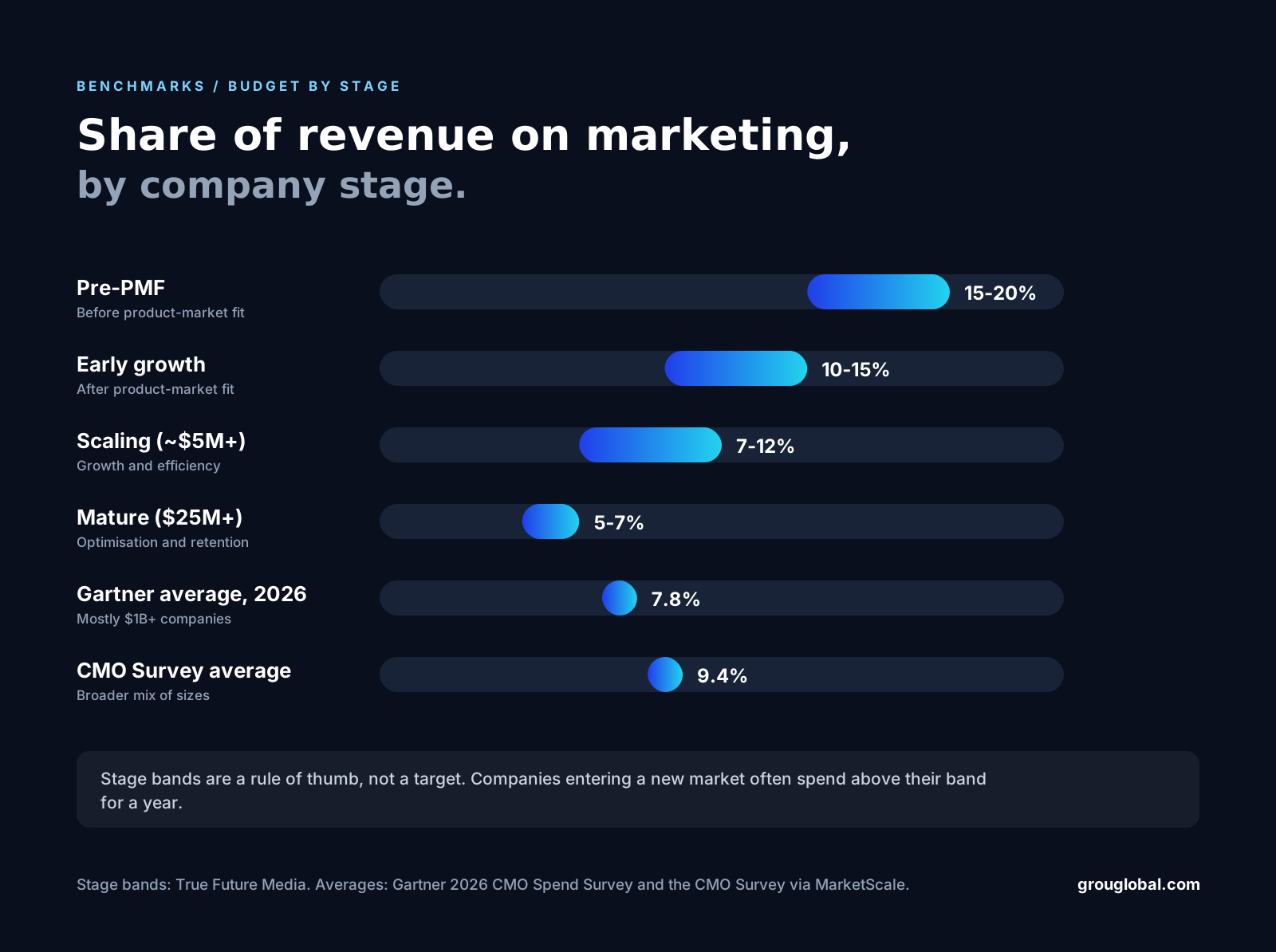
Benchmarks from large companies don't fit a 30-person B2B business. One widely used rule of thumb scales the share of revenue down as a company matures (True Future Media):
Before product-market fit: 15 to 20% of revenue, focused on testing and awareness.
Early growth, after product-market fit: 10 to 15%, scaling channels that already work.
Scaling (around $5 million+ revenue): 7 to 12%, balancing growth and efficiency.
Mature ($25 million+): 5 to 7%, focused on optimisation and retention.
Treat these as guardrails, not targets. A company entering a new market or launching a new product often needs to spend above its stage band for a year.
How to set your 2027 marketing budget
Start from the number the business needs, then check it against benchmarks.
Start with the revenue target. Take next year's new revenue goal and the share expected from marketing-sourced and marketing-influenced pipeline.
Work back to pipeline. Divide the revenue target by your win rate to get the pipeline you need. Our B2B SaaS pipeline benchmarks help if you don't have reliable win rates yet.
Work back to leads and cost. Use your stage conversion rates and cost per opportunity by channel to estimate spend.
Add the fixed layer. People, tools, content and brand work don't scale neatly with leads. Budget them separately.
Check payback. Make sure the implied customer acquisition cost pays back in a period your finance team accepts. See our CAC payback benchmarks.
Sanity-check against benchmarks. If your number is far above or below the ranges above, be ready to explain why.
Split by channel. Our paid ads budget allocation guide shows how to divide paid spend.
If a large part of your pipeline comes from outbound and LinkedIn rather than paid media, budget for the people and systems behind them. Our lead generation service is one way teams turn that line into a predictable cost.
FAQ
What percentage of revenue should a B2B company spend on marketing?
The Gartner 2026 average is 7.8% of revenue, and the CMO Survey reports 9.4%. Smaller and faster-growing companies usually spend more, often 10 to 20%, while large mature companies spend less.
What is the average marketing budget in 2026?
Gartner's 2026 CMO Spend Survey puts the average at 7.8% of company revenue, up from 7.7% in 2025.
How much of the marketing budget goes to AI?
CMOs in Gartner's 2026 survey allocate 15.3% of their marketing budgets to AI, although only 30% say their organisation is ready to scale AI capabilities.
Why do Gartner and the CMO Survey report different numbers?
They survey different companies. Gartner's panel is dominated by very large companies, while the CMO Survey includes more small and mid-sized firms, which spend a higher share of revenue on marketing.
How should a startup set its marketing budget?
Work back from the revenue target to the pipeline and leads you need, estimate cost per opportunity by channel, then add fixed costs for people and tools. Use stage benchmarks only as a sanity check.
About this guide
We are GROU, a B2B pipeline agency that runs lead generation, outbound, and LinkedIn content for clients across manufacturing, fintech, iGaming, software, and professional services. Benchmarks in this guide come from Gartner's CMO Spend Survey, the CMO Survey and the other sources linked inline.
We'll update this page when Gartner publishes its 2027 CMO Spend Survey, usually in the second quarter.
B2B marketing budget benchmarks for 2027
Marketing budgets average 7.8% of company revenue in 2026, according to Gartner's CMO Spend Survey, up slightly from 7.7% in 2025. The Deloitte, Duke and AMA CMO Survey puts the figure higher, at 9.4%, because it includes more smaller companies. For 2027 planning, the benchmark is a starting point: the right number comes from working back from your pipeline target.
TL;DR
Gartner: 7.8% of revenue in 2026, 7.7% in 2025, down from 9.5% in 2022.
CMO Survey: 9.4% of revenue. Smaller and faster-growing companies spend a higher share.
CMOs are putting 15.3% of marketing budgets into AI, and labour's share rose from 21.9% to 24.5%.
Set your 2027 budget from pipeline maths first, then sanity-check it against benchmarks.
Marketing budget as a percentage of revenue
Gartner's annual survey of senior marketing leaders is the most cited benchmark. Its 2026 edition found budgets "effectively flat" at 7.8% of company revenue, up from 7.7% in 2025 (Gartner). That follows a sharp drop from 9.5% in the 2022 survey (Techeconomy, reporting Gartner).
Figure: marketing budget as a share of company revenue, Gartner CMO Spend Survey, 2022 to 2026. The 2023 to 2025 values are as summarised by Vidico.
Two caveats matter when you use this number:
Gartner's sample skews large. Most respondents come from companies with more than $1 billion in revenue, as the 2022 survey notes. Large companies spend a smaller share of revenue on marketing.
The average hides a wide spread. Coverage of the 2025 survey noted that half of CMOs reported budgets of 6% of revenue or less (Boomcycle).
The CMO Survey benchmark
The CMO Survey, run by Deloitte, Duke University and the American Marketing Association, reports marketing budgets at 9.4% of company revenue, up from 7.7% the year before, and marketing at 11.4% of total company budgets (MarketScale). The difference from Gartner mostly reflects the panel: the CMO Survey includes more smaller companies, which spend a higher share of revenue.
Where marketing budgets are going
Three shifts stand out in 2026 data.
AI takes a real slice. CMOs allocate 15.3% of marketing budgets to AI, but only 30% say their organisation is ready to scale AI capabilities (Gartner).
People matter more, not less. Labour's share of the marketing budget rose from 21.9% in 2025 to 24.5% in 2026, and lack of AI talent was the top barrier cited by 38% of CMOs (Business Wire, Gartner).
AI-mature companies spend more. Organisations Gartner calls "AI strategists" allocate an average of 11% of revenue to marketing, against 7.8% across all respondents (MarketScale).
Media spend also concentrates at both ends of the funnel: awareness and conversion account for 62.6% of total media spend in Gartner's 2026 research (same Business Wire release).
Budget by company stage
Benchmarks from large companies don't fit a 30-person B2B business. One widely used rule of thumb scales the share of revenue down as a company matures (True Future Media):
Before product-market fit: 15 to 20% of revenue, focused on testing and awareness.
Early growth, after product-market fit: 10 to 15%, scaling channels that already work.
Scaling (around $5 million+ revenue): 7 to 12%, balancing growth and efficiency.
Mature ($25 million+): 5 to 7%, focused on optimisation and retention.
Treat these as guardrails, not targets. A company entering a new market or launching a new product often needs to spend above its stage band for a year.
How to set your 2027 marketing budget
Start from the number the business needs, then check it against benchmarks.
Start with the revenue target. Take next year's new revenue goal and the share expected from marketing-sourced and marketing-influenced pipeline.
Work back to pipeline. Divide the revenue target by your win rate to get the pipeline you need. Our B2B SaaS pipeline benchmarks help if you don't have reliable win rates yet.
Work back to leads and cost. Use your stage conversion rates and cost per opportunity by channel to estimate spend.
Add the fixed layer. People, tools, content and brand work don't scale neatly with leads. Budget them separately.
Check payback. Make sure the implied customer acquisition cost pays back in a period your finance team accepts. See our CAC payback benchmarks.
Sanity-check against benchmarks. If your number is far above or below the ranges above, be ready to explain why.
Split by channel. Our paid ads budget allocation guide shows how to divide paid spend.
If a large part of your pipeline comes from outbound and LinkedIn rather than paid media, budget for the people and systems behind them. Our lead generation service is one way teams turn that line into a predictable cost.
FAQ
What percentage of revenue should a B2B company spend on marketing?
The Gartner 2026 average is 7.8% of revenue, and the CMO Survey reports 9.4%. Smaller and faster-growing companies usually spend more, often 10 to 20%, while large mature companies spend less.
What is the average marketing budget in 2026?
Gartner's 2026 CMO Spend Survey puts the average at 7.8% of company revenue, up from 7.7% in 2025.
How much of the marketing budget goes to AI?
CMOs in Gartner's 2026 survey allocate 15.3% of their marketing budgets to AI, although only 30% say their organisation is ready to scale AI capabilities.
Why do Gartner and the CMO Survey report different numbers?
They survey different companies. Gartner's panel is dominated by very large companies, while the CMO Survey includes more small and mid-sized firms, which spend a higher share of revenue on marketing.
How should a startup set its marketing budget?
Work back from the revenue target to the pipeline and leads you need, estimate cost per opportunity by channel, then add fixed costs for people and tools. Use stage benchmarks only as a sanity check.
About this guide
We are GROU, a B2B pipeline agency that runs lead generation, outbound, and LinkedIn content for clients across manufacturing, fintech, iGaming, software, and professional services. Benchmarks in this guide come from Gartner's CMO Spend Survey, the CMO Survey and the other sources linked inline.
We'll update this page when Gartner publishes its 2027 CMO Spend Survey, usually in the second quarter.
B2B marketing budget benchmarks for 2027
Marketing budgets average 7.8% of company revenue in 2026, according to Gartner's CMO Spend Survey, up slightly from 7.7% in 2025. The Deloitte, Duke and AMA CMO Survey puts the figure higher, at 9.4%, because it includes more smaller companies. For 2027 planning, the benchmark is a starting point: the right number comes from working back from your pipeline target.
TL;DR
Gartner: 7.8% of revenue in 2026, 7.7% in 2025, down from 9.5% in 2022.
CMO Survey: 9.4% of revenue. Smaller and faster-growing companies spend a higher share.
CMOs are putting 15.3% of marketing budgets into AI, and labour's share rose from 21.9% to 24.5%.
Set your 2027 budget from pipeline maths first, then sanity-check it against benchmarks.
Marketing budget as a percentage of revenue
Gartner's annual survey of senior marketing leaders is the most cited benchmark. Its 2026 edition found budgets "effectively flat" at 7.8% of company revenue, up from 7.7% in 2025 (Gartner). That follows a sharp drop from 9.5% in the 2022 survey (Techeconomy, reporting Gartner).
Figure: marketing budget as a share of company revenue, Gartner CMO Spend Survey, 2022 to 2026. The 2023 to 2025 values are as summarised by Vidico.
Two caveats matter when you use this number:
Gartner's sample skews large. Most respondents come from companies with more than $1 billion in revenue, as the 2022 survey notes. Large companies spend a smaller share of revenue on marketing.
The average hides a wide spread. Coverage of the 2025 survey noted that half of CMOs reported budgets of 6% of revenue or less (Boomcycle).
The CMO Survey benchmark
The CMO Survey, run by Deloitte, Duke University and the American Marketing Association, reports marketing budgets at 9.4% of company revenue, up from 7.7% the year before, and marketing at 11.4% of total company budgets (MarketScale). The difference from Gartner mostly reflects the panel: the CMO Survey includes more smaller companies, which spend a higher share of revenue.
Where marketing budgets are going
Three shifts stand out in 2026 data.
AI takes a real slice. CMOs allocate 15.3% of marketing budgets to AI, but only 30% say their organisation is ready to scale AI capabilities (Gartner).
People matter more, not less. Labour's share of the marketing budget rose from 21.9% in 2025 to 24.5% in 2026, and lack of AI talent was the top barrier cited by 38% of CMOs (Business Wire, Gartner).
AI-mature companies spend more. Organisations Gartner calls "AI strategists" allocate an average of 11% of revenue to marketing, against 7.8% across all respondents (MarketScale).
Media spend also concentrates at both ends of the funnel: awareness and conversion account for 62.6% of total media spend in Gartner's 2026 research (same Business Wire release).
Budget by company stage
Benchmarks from large companies don't fit a 30-person B2B business. One widely used rule of thumb scales the share of revenue down as a company matures (True Future Media):
Before product-market fit: 15 to 20% of revenue, focused on testing and awareness.
Early growth, after product-market fit: 10 to 15%, scaling channels that already work.
Scaling (around $5 million+ revenue): 7 to 12%, balancing growth and efficiency.
Mature ($25 million+): 5 to 7%, focused on optimisation and retention.
Treat these as guardrails, not targets. A company entering a new market or launching a new product often needs to spend above its stage band for a year.
How to set your 2027 marketing budget
Start from the number the business needs, then check it against benchmarks.
Start with the revenue target. Take next year's new revenue goal and the share expected from marketing-sourced and marketing-influenced pipeline.
Work back to pipeline. Divide the revenue target by your win rate to get the pipeline you need. Our B2B SaaS pipeline benchmarks help if you don't have reliable win rates yet.
Work back to leads and cost. Use your stage conversion rates and cost per opportunity by channel to estimate spend.
Add the fixed layer. People, tools, content and brand work don't scale neatly with leads. Budget them separately.
Check payback. Make sure the implied customer acquisition cost pays back in a period your finance team accepts. See our CAC payback benchmarks.
Sanity-check against benchmarks. If your number is far above or below the ranges above, be ready to explain why.
Split by channel. Our paid ads budget allocation guide shows how to divide paid spend.
If a large part of your pipeline comes from outbound and LinkedIn rather than paid media, budget for the people and systems behind them. Our lead generation service is one way teams turn that line into a predictable cost.
FAQ
What percentage of revenue should a B2B company spend on marketing?
The Gartner 2026 average is 7.8% of revenue, and the CMO Survey reports 9.4%. Smaller and faster-growing companies usually spend more, often 10 to 20%, while large mature companies spend less.
What is the average marketing budget in 2026?
Gartner's 2026 CMO Spend Survey puts the average at 7.8% of company revenue, up from 7.7% in 2025.
How much of the marketing budget goes to AI?
CMOs in Gartner's 2026 survey allocate 15.3% of their marketing budgets to AI, although only 30% say their organisation is ready to scale AI capabilities.
Why do Gartner and the CMO Survey report different numbers?
They survey different companies. Gartner's panel is dominated by very large companies, while the CMO Survey includes more small and mid-sized firms, which spend a higher share of revenue on marketing.
How should a startup set its marketing budget?
Work back from the revenue target to the pipeline and leads you need, estimate cost per opportunity by channel, then add fixed costs for people and tools. Use stage benchmarks only as a sanity check.
About this guide
We are GROU, a B2B pipeline agency that runs lead generation, outbound, and LinkedIn content for clients across manufacturing, fintech, iGaming, software, and professional services. Benchmarks in this guide come from Gartner's CMO Spend Survey, the CMO Survey and the other sources linked inline.
We'll update this page when Gartner publishes its 2027 CMO Spend Survey, usually in the second quarter.

Pipeline OS Newsletter
Build qualified pipeline
Get weekly tactics to generate demand, improve lead quality, and book more meetings.





Trusted by industry leaders
Trusted by industry leaders
Trusted by industry leaders
Ready to build qualified pipeline?
Ready to build qualified pipeline?
Ready to build qualified pipeline?
Book a call to see if we're the right fit, or take the 2-minute quiz to get a clear starting point.
Book a call to see if we're the right fit, or take the 2-minute quiz to get a clear starting point.
Book a call to see if we're the right fit, or take the 2-minute quiz to get a clear starting point.
" height="30.21639343089746px" id="hfGbXmQR2" width="30.216393430897455px"/></svg>)
Copyright © 2026 – All Right Reserved
Copyright © 2026 – All Right Reserved
Copyright © 2026 – All Right Reserved