%22%3E%3C/path%3E%3Cpath d=%22M 63.072 7.554 C 62.258 8.022 61.577 8.689 61.092 9.493 L 61.092 7.076 L 57.158 7.076 L 57.158 22.64 L 61.089 22.64 L 61.089 14.888 C 61.089 13.446 61.403 12.434 62.03 11.853 C 62.818 11.218 63.818 10.907 64.826 10.982 L 65.868 10.982 L 65.868 6.851 C 64.891 6.834 63.926 7.076 63.073 7.554 Z%22 fill=%22rgb(17,17,17)%22%3E%3C/path%3E%3Cpath d=%22M 78.916 7.82 C 76.363 6.49 73.321 6.49 70.768 7.82 C 69.562 8.473 68.564 9.451 67.888 10.644 C 67.167 11.931 66.803 13.387 66.834 14.862 C 66.804 16.332 67.157 17.785 67.86 19.077 C 68.515 20.267 69.494 21.246 70.684 21.901 C 71.924 22.576 73.318 22.92 74.73 22.898 C 76.164 22.918 77.58 22.575 78.846 21.901 C 80.062 21.247 81.073 20.27 81.768 19.077 C 82.506 17.797 82.88 16.339 82.85 14.862 C 82.88 13.389 82.517 11.934 81.797 10.647 C 81.12 9.455 80.122 8.477 78.917 7.824 M 78.803 14.862 C 78.829 15.739 78.636 16.608 78.241 17.391 C 77.903 18.046 77.38 18.588 76.738 18.95 C 76.124 19.293 75.432 19.472 74.729 19.47 C 73.668 19.497 72.648 19.061 71.934 18.276 C 71.139 17.323 70.741 16.1 70.823 14.862 C 70.741 13.62 71.149 12.395 71.959 11.45 C 72.687 10.667 73.715 10.233 74.783 10.256 C 75.859 10.236 76.894 10.67 77.635 11.45 C 78.464 12.387 78.884 13.616 78.801 14.864%22 fill=%22rgb(17,17,17)%22%3E%3C/path%3E%3Cpath d=%22M 95.906 7.076 L 95.906 15.646 C 95.975 16.68 95.643 17.701 94.979 18.498 C 94.311 19.184 93.379 19.547 92.422 19.495 C 91.475 19.544 90.553 19.18 89.894 18.498 C 89.23 17.701 88.898 16.68 88.967 15.646 L 88.967 7.076 L 85.033 7.076 L 85.033 16.207 C 85 17.449 85.275 18.68 85.834 19.79 C 86.327 20.75 87.095 21.542 88.039 22.065 C 89.033 22.594 90.145 22.861 91.271 22.838 C 92.188 22.847 93.095 22.65 93.926 22.263 C 94.708 21.905 95.388 21.36 95.906 20.675 L 95.906 22.645 L 99.865 22.645 L 99.865 7.076 Z%22 fill=%22rgb(17,17,17)%22%3E%3C/path%3E%3Cpath d=%22M 4.513 15.626 C 4.511 10.815 7.606 6.549 12.181 5.059 C 16.756 3.57 21.77 5.195 24.601 9.086 L 27.816 5.87 C 24.074 1.186 17.981 -0.943 12.137 0.393 C 6.292 1.728 1.728 6.292 0.393 12.137 C -0.943 17.981 1.186 24.074 5.87 27.816 L 9.085 24.601 C 6.214 22.512 4.515 19.177 4.513 15.626%22 fill=%22rgb(32,62,235)%22%3E%3C/path%3E%3Cpath d=%22M 17.114 14.343 L 13.354 18.01 L 13.354 18.026 L 21.071 18.026 L 11.412 27.609 L 17.389 27.609 L 23.999 21.081 L 23.999 28.316 L 24.005 28.316 L 27.967 24.393 L 27.967 14.343 Z%22 fill=%22rgb(32,62,235)%22%3E%3C/path%3E%3C/g%3E%3C/svg%3E) ×
× ××
××›
›
›
›
Marketing automation SaaS 2026: how to choose and run it
Marketing automation SaaS 2026: how to choose and run it
Marketing automation SaaS 2026: how to choose and run it
Marketing automation SaaS 2026: how to choose and run it
Marketing automation SaaS 2026: how to choose and run it
Marketing automation SaaS 2026: how to choose and run it

Author
Aljaz Peklaj

A Series B RevOps lead opens HubSpot on Monday and sees 9,000 MQLs. Salesforce shows 380 SQLs. Outbound reports 111 opportunities. Nobody can explain where the rest went, which stage definition is wrong, or whether the revenue report can be trusted.
That isn't a lead volume problem. It's a wiring problem between marketing automation SaaS, the CRM, data, sequencing, and attribution.
Choose the platform around CRM fit and lifecycle logic, not AI copy features.
Treat deliverability as pipeline math, with SPF, DKIM, DMARC, suppression, and reply signals under active control.
Make reply routing and sales handoff part of the automation design from day one.
Benchmark vendors against verified contacts, qualified meetings, sales acceptance, and sourced pipeline.
Fix the five silent pipeline killers before buying another seat.
Table of Contents
What marketing automation SaaS actually does inside a revenue system
Core features that earn budget, and the ones that just look good in a demo
How to choose a marketing automation SaaS platform without buying a feature catalog
ROI metrics, deliverability math, and the reply-routing checklist
The pipeline problem hiding behind your automation stack
Most B2B teams buy automation after seeing the same symptoms: thousands of contacts in a marketing database, a smaller group receiving sequences, and an even smaller group reaching sales. The team then adds another workflow, another enrichment source, or another dashboard without fixing the definitions underneath.
The result is familiar. HubSpot counts contacts one way, Salesforce advances lifecycle stages another way, and Apollo, Lemlist, Instantly, Smartlead, or HeyReach reports activity that never reaches the revenue forecast. Each system may be working as configured. The operating system still fails.
A new platform rarely repairs that gap. It often adds another database, another scoring model, and another handoff that somebody has to reconcile manually. The sales pipeline management framework starts with shared stages, ownership, and evidence for movement, then assigns automation to each point in the process.
Operator rule: If the CRM can't explain why a contact became an SQL, the automation stack isn't ready to scale.
The right question is not which platform sends the most attractive email. Ask whether it can capture intent, apply the agreed fit rules, trigger the next action, route a positive response, and return the outcome to the CRM. That sequence turns attention into pipeline.
Marketing automation has existed through several product generations. Unica launched in 1992, Eloqua followed in 1999, and HubSpot, Pardot, and Marketo launched in 2006, moving the category from enterprise campaign management toward broader SaaS adoption. The history of marketing automation makes the strategic point clear: this is infrastructure, not a passing tactic.
What marketing automation SaaS actually does inside a revenue system
A useful definition has four jobs. A marketing automation SaaS platform captures and routes inbound demand, scores contacts against CRM stages, triggers actions across channels, and feeds closed-loop attribution back into lifecycle and paid programs.
That definition is more demanding than “send an email when someone fills out a form.” HubSpot, Marketo, Customer.io, and ActiveCampaign can all support campaigns, but pipeline appears only when their actions connect to a system of record such as Salesforce or HubSpot CRM.
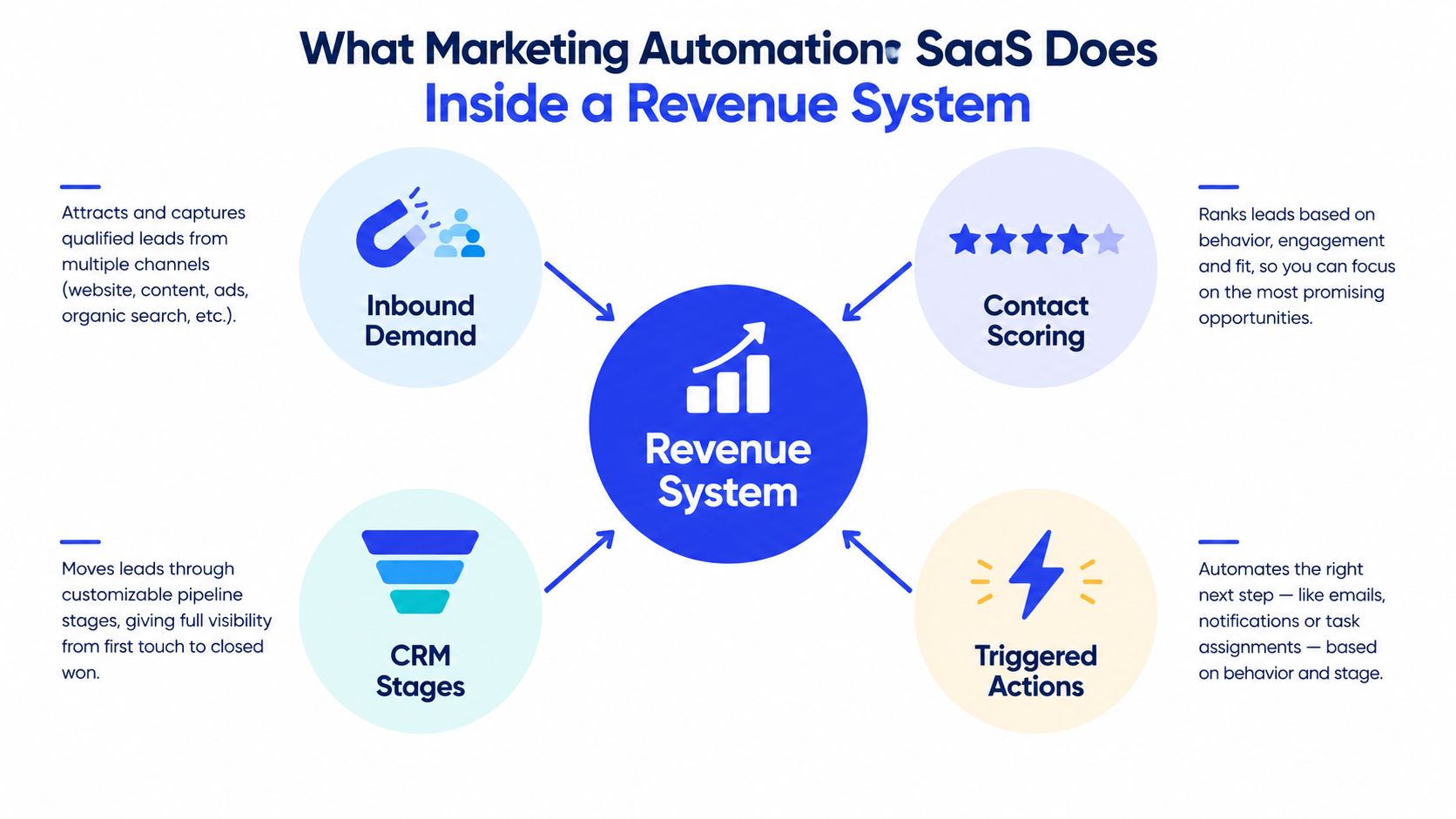
The four jobs that matter
Inbound demand includes form fills, product events, content engagement, webinar activity, and intent signals. The platform should place those signals on a contact or account record that sales can understand.
Contact scoring turns activity and fit into an operating decision. A score has value only when it maps to an agreed action, such as nurture, qualification, sales review, or suppression.
CRM stages give the automation a shared language. Without them, MQL, SQL, accepted meeting, opportunity, and sourced pipeline become labels that vary by team.
Triggered actions include email, retargeting, task creation, routing, alerts, and suppression. The action should follow the buyer's behavior, not merely a calendar date.
Teams often miss the fourth job, attribution. A campaign that creates activity but can't show whether revenue moved is a communication tool, not a revenue system. For teams working with fragmented event data, a practical guide to real-time B2B data APIs can help clarify how data should move between systems.
The platform coordinates data. It doesn't create demand by itself. A useful RevOps tech stack structure keeps the CRM, enrichment, sequencing, content, and reporting layers connected instead of allowing every tool to invent its own customer journey.
Core features that earn budget, and the ones that just look good in a demo
After 50-plus SaaS rollouts, I'd put marketing automation features into three tiers. The first tier earns budget because it determines whether the system can produce trusted pipeline. The third tier earns applause in a demo and often creates work after implementation.
Tier one earns budget
Start with native CRM synchronization and field-level mapping. The platform should respect lifecycle stages, owners, source fields, account relationships, and disqualification reasons. HubSpot and Marketo are strong candidates when the CRM relationship is central. Customer.io is more compelling when event data and product behavior drive the motion.
Next comes stage-linked scoring. A score should change because a contact meets a defined business rule, not because a vendor added a mysterious predictive label. Event-based branching matters for the same reason. It lets the system respond to a pricing visit, product event, reply, status change, or sales outcome.
Deliverability belongs here too. Look for SPF, DKIM, DMARC support, domain separation, suppression logic, warm-up controls, sending limits, and reputation monitoring. Sequencing platforms such as Outreach and Salesloft own much of the sales engagement layer, while Apollo, Lemlist, Instantly, Smartlead, and HeyReach can support specific outbound motions when the surrounding controls are sound.
Finally, require attribution that reaches closed-won revenue. If the report stops at opens or form fills, the feature has not earned its place.
Tier two depends on the motion
ABM filters, account hierarchies, predictive scoring, and dynamic content can help enterprise teams with clear account plans. They won't rescue weak data or unclear handoff rules. Buy them after the core system records the right events and assigns ownership correctly.
Tier three is demo theater
AI subject-line generators, visual builders with excessive branching, built-in social scheduling, and free CRM add-ons often distract buyers from plumbing. A polished canvas doesn't tell a rep whether a meeting is qualified.
Tier | What it covers | Example tools |
|---|---|---|
Tier 1 | CRM sync, stage-linked scoring, deliverability, event branching, revenue attribution | HubSpot, Marketo, Customer.io, Outreach, Salesloft |
Tier 2 | ABM filters, account hierarchies, predictive scoring, dynamic content | Marketo, HubSpot, Customer.io |
Tier 3 | AI copy, decorative workflow builders, social scheduling, bolt-on CRM features | Varies by vendor |
GROU program experience points to verified-contact quality and reply routing as stronger pipeline contributors than AI copy assistance. That's why a sales engagement platform framework should evaluate handoff and revenue evidence, not just campaign creation.
Pay for plumbing, not screenshots.
How to choose a marketing automation SaaS platform without buying a feature catalog
Start with the CRM and ICP. Don't begin with an email builder, a generative AI demo, or a vendor's feature matrix. If the platform can't represent your lifecycle stages and target accounts, better copy won't repair the system.
Use a weighted scorecard before vendor demos. The weights below force the buying group to price the operational risks that feature catalogs hide.
Criterion | Weight | Score (0-5) | Notes |
|---|---|---|---|
Native CRM sync depth | 25% | Check field mapping, ownership, lifecycle stages, and bidirectional updates | |
Data and intent coverage | 20% | Test freshness, enrichment fields, account matching, and event access | |
Workflow logic and branching | 20% | Test replies, status changes, exclusions, and multi-channel conditions | |
Deliverability infrastructure | 20% | Review authentication, suppression, throttling, and reputation controls | |
Total cost against contacts worked | 15% | Model active contacts, enrichment, seats, sends, and implementation |
The scoring process should use your actual workflow. Ask each vendor to show how a positive reply changes the contact owner, creates a task, updates the CRM stage, and suppresses further outreach. Ask what happens when a contact changes company, an account is disqualified, or a sales rep marks a meeting as unqualified.
Grou's HubSpot-native approach is a useful reference point because CRM decisions come before sequence design. The stack should know which contacts are in scope, which records sales owns, and which outcomes flow back into reporting. That reduces integration debt before campaign volume rises.
Red flags deserve a hard stop:
A vendor prices the stored list but can't explain the cost of contacts actively worked.
The security team can't verify SOC 2 coverage.
The vendor has no public uptime record.
Reporting leads with sends, opens, or connection requests instead of sales acceptance and pipeline movement.
The demo avoids live field mapping and uses sample records only.
Social tools belong in a separate decision. If that layer is under review, a practical guide to LinkedIn growth platforms can help distinguish publishing needs from revenue automation needs. Don't make a social scheduler carry CRM accountability.
Integration and the 90-day implementation roadmap
The difficult part of integration isn't the connector. It's deciding what the CRM should record, when it should record it, and who owns the next action.
Before launch, define MQL, SQL, accepted meeting, sales acceptance, disqualification, sourced pipeline, and influenced pipeline. Set the source taxonomy and lifecycle rules in writing. A sequence that references undefined stages creates reporting noise from its first send.
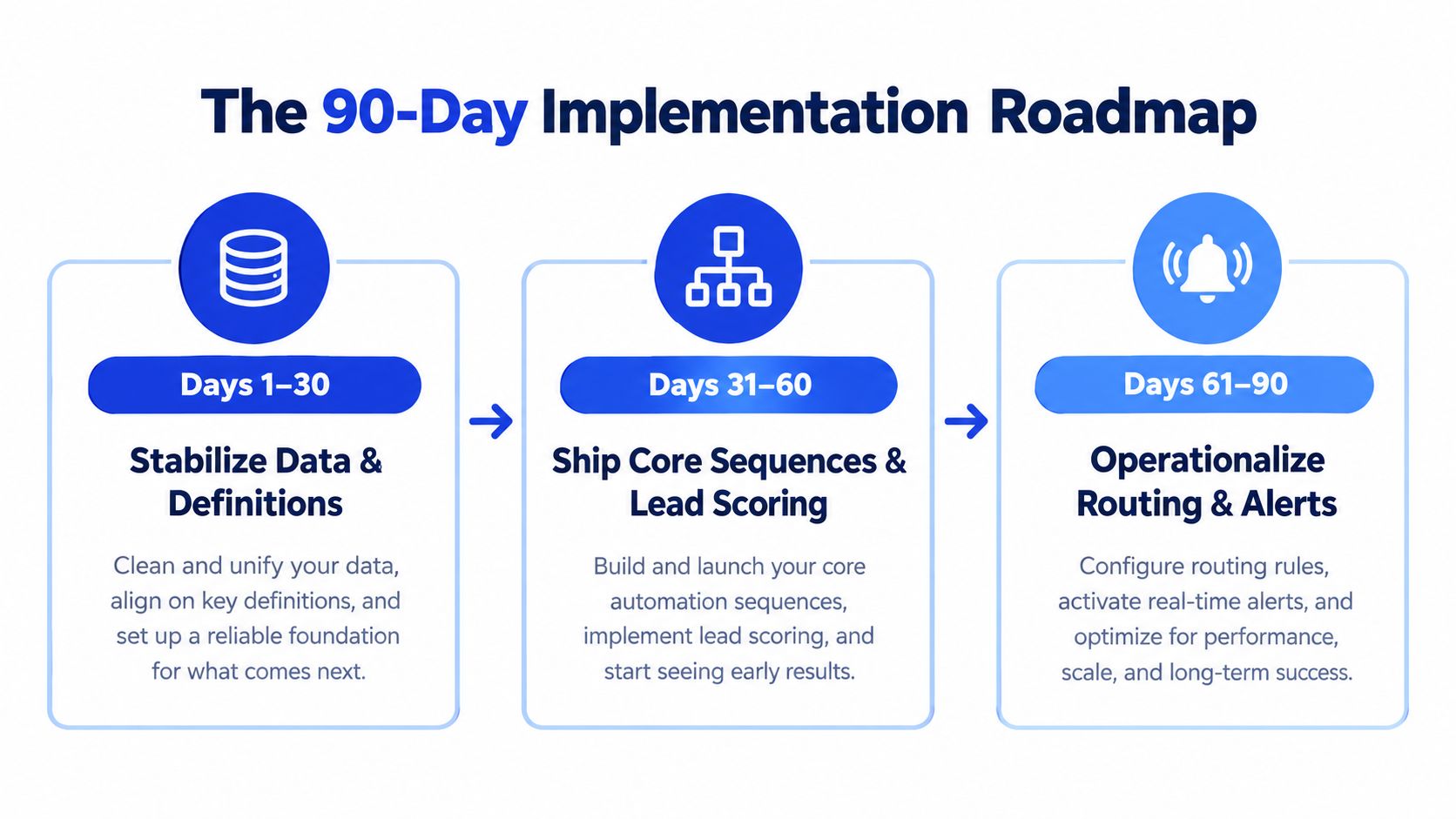
Days 1 to 30 stabilize the record
Audit duplicate contacts, owners, lifecycle values, account associations, source fields, and consent status. Decide whether Salesforce or HubSpot is the system of record for each field. Use Zapier or n8n only where the native connector can't handle the required logic.
Set the sending architecture before copy review. Authenticate the sending domain with SPF, DKIM, and DMARC. Separate campaign sending from the primary corporate domain, establish suppression lists, and define the conditions that pause outreach.
Days 31 to 60 ship the core motion
Use Clay or Apollo for enrichment, then validate records before they enter a sequence. Build one primary workflow around fit, one around intent, and one around reply handling. Keep the branching readable enough that a new operator can audit it without reverse engineering a maze.
Grou can sit at the sequence-and-routing layer, while HubSpot, Salesforce, or another CRM remains responsible for the customer record. The division matters. No sending tool should become the ungoverned source of truth.
Days 61 to 90 operationalize handoff
Create owner fields, round-robin rules, intent tags, and exclusion logic. Stop automation when a contact replies, books a meeting, becomes disqualified, or enters an active sales process. Send outcomes back to the CRM, then review the data in bi-weekly sprints.
The first 90 days of an outbound agency engagement offers a useful operating reference for pacing feedback and implementation work.
The visual sequence below shows the handoff model in practice.
Don't wait until quarter end to inspect attribution. Review it while the first replies and meetings are still traceable.
B2B use cases that prove the system works
A system earns trust when it handles a real buying motion with constraints. Two B2B examples show why the workflow matters more than the vendor logo.
An iGaming-adjacent SaaS motion
The team began with a narrow ICP and a qualification gate between booked meetings and meetings handed to sales. Outreach combined a focused sequence with intent signals and multi-channel touches. Positive replies moved directly to the appropriate sales owner, while non-fit records stayed out of the calendar.
The important result wasn't calendar volume. Qualified meetings increased from the founder's manually booked baseline to a sustained monthly flow, and the team could separate booked conversations from sales-ready opportunities. That distinction protected sales trust and made pipeline reporting usable.
The workflow depended on four decisions:
→ Fit rules were locked before scale.
→ Each touch had a specific job.
→ Replies stopped automation immediately.
→ The CRM stored qualification and attribution outcomes.
An enterprise expansion motion
Sportradar required a wider account universe and a more structured channel mix. LinkedIn, Google, Reddit, RichAds, and 6sense supported lead generation across EMEA, while the sales workflow routed qualified responses into the right AE pod.
The system worked because channel activity fed a shared qualification model. The team didn't treat an ad lead, a LinkedIn response, and an outbound reply as separate realities. Each became a CRM event with an owner and a next action.
Use case | Prospects touched | Qualified meetings | Pipeline generated | Workflow anchor |
|---|---|---|---|---|
iGaming-adjacent SaaS | ICP-aligned prospects | Qualified meetings separated from booked meetings | Sourced and influenced pipeline tracked in CRM | Multi-touch sequence, fit gate, reply routing |
Enterprise sports and data expansion | EMEA account segments across multiple channels | Routed to the relevant AE pod | Channel activity tied to qualified demand | Event-driven targeting, account logic, CRM attribution |
These examples apply across SaaS, iGaming, manufacturing, legal tech, and pharma, but the trigger differs by industry. A product event may matter in SaaS. A procurement milestone may matter in manufacturing. A regulatory or account signal may matter in pharma. The architecture stays CRM-first.
ROI metrics, deliverability math, and the reply-routing checklist
A vendor's return should be judged against qualified pipeline, not the number of actions it can automate. The most useful operating measures are cost per verified contact, qualified replies per seat, meeting acceptance, meeting show rate, and pipeline sourced or influenced.
GROU's list-building benchmark across client programs landed between $0.18 and $0.31 per verified contact. That figure is useful because it measures the input quality before sending costs, reply rates, and sales capacity distort the analysis.
Automation performance also depends on deliverability. A comparative review of 15 email tools found an average deliverability rate of 83.1%, leaving 16.9% of messages bounced or placed in spam. The email deliverability comparison supports a blunt conclusion: sender reputation belongs in the revenue model.
For bulk senders reaching personal inboxes, Gmail, Yahoo, and Microsoft require SPF, DKIM, and DMARC, one-click unsubscribe, and spam complaint rates below 0.3% for senders reaching 5,000 or more messages per day. The bulk-sender deliverability requirements show why volume decisions can't be separated from technical controls.
Inbox placement remains uncertain even after authentication. One 2026 benchmark reported 63% of tested email reaching the primary inbox, with 33% going to spam and 1% disappearing or being blocked. This deliverability benchmark is a warning against treating authentication as a guarantee.
Use this Friday checklist:
Owner field: Every positive reply has a named sales owner.
Round robin: Routing respects territory, account, segment, and rep capacity.
Intent tag: The CRM records whether the reply is positive, neutral, referral, objection, or out of office.
Suppression: Replies, meetings, disqualified contacts, and active opportunities leave the sequence.
Stage sync: Sales outcomes return to the CRM without manual spreadsheet work.
Metric | Apollo-driven stack | ZoomInfo-driven stack | Grou-augmented stack |
|---|---|---|---|
Primary cost question | Cost of usable contacts and sending | Cost of data access and account coverage | Cost per verified contact and qualified outcome |
Pipeline control | Depends on CRM setup and routing | Depends on enrichment and handoff design | Sequence logic, qualification, routing, and CRM reporting |
Deliverability focus | Sending controls must be audited | Sending controls must be audited | Sending controls and reply handling are built into the workflow |
Reporting priority | Replies, meetings, SQLs, pipeline | Account engagement, meetings, pipeline | Sales acceptance, meeting quality, sourced pipeline |
Use this guide to tracking deliverability in cold email to define the monitoring fields your team should review weekly. Your email deliverability operating guide should sit beside the campaign dashboard, not in a separate technical document.
Common pitfalls and your next step this Friday
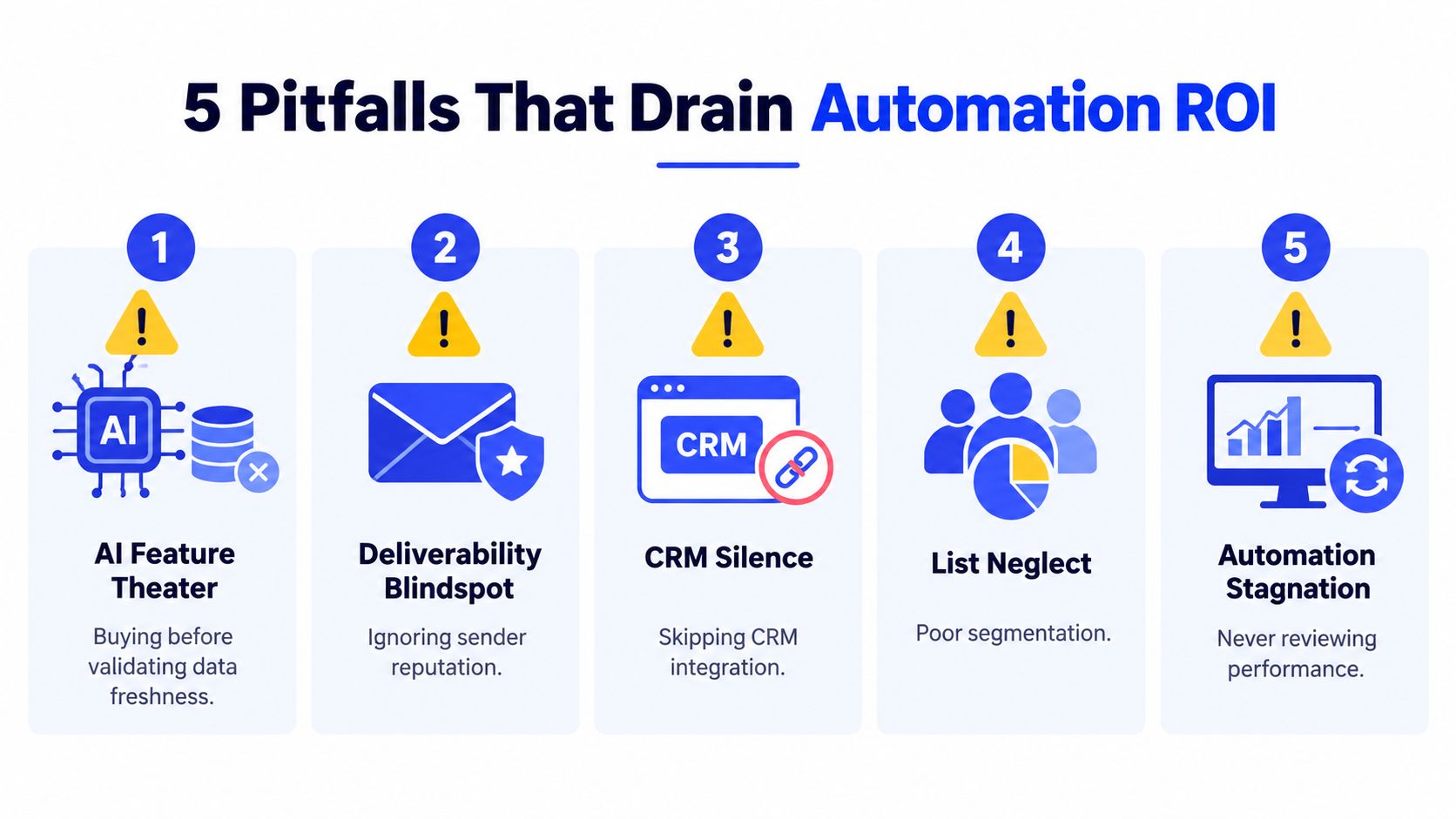
Five failures account for most wasted automation spend. Each one has a recognizable symptom.
AI feature theater
The team buys a platform because the demo generates polished copy. Data freshness, account matching, and contact verification remain untested. The symptom is high campaign activity with weak sales acceptance.
Deliverability blindspot
The team scales sends before authenticating domains, setting suppression rules, or monitoring complaints. Open rates become unreliable, replies fall, and the team blames messaging for a reputation problem.
CRM silence
The platform sends records into the CRM but doesn't map lifecycle stages, owners, or outcomes. Marketing reports MQL volume while sales reports accepted opportunities. Neither report explains revenue.
List neglect
The database contains old contacts, weak role matches, duplicates, and accounts outside the ICP. Segmentation becomes cosmetic. The team spends more on sending while reducing the quality of every downstream conversation.
Automation stagnation
Nobody reviews sequences after launch. Broken branches, stale messaging, unclaimed replies, and missing attribution continue because the workflow has no operating cadence.
Run the Friday audit
Pull the last quarter's automation-sourced opportunities. Compare the cost of verified contacts with closed-won revenue, then score the stack against five binary checks:
→ Are lifecycle definitions documented?
→ Is CRM ownership assigned automatically?
→ Does every positive reply leave the sequence?
→ Can the team see deliverability and suppression status?
→ Can marketing connect activity to sales acceptance and pipeline?
If the stack fails more than one check, fund a wiring sprint before buying new seats. The platform is rarely the primary problem. The next 100 days should go toward integration discipline, data quality, routing, and attribution.
GROU is a global B2B pipeline agency that connects LinkedIn content, lead generation, and outbound into one operating system for qualified conversations and revenue. Its methodology combines ICP-aligned data, structured sequences, rapid reply routing, CRM handoff rules, and bi-weekly reporting sprints. Audit your meeting-held rate this Friday, then visit Grou to build the automation and pipeline wiring your team can measure.
A Series B RevOps lead opens HubSpot on Monday and sees 9,000 MQLs. Salesforce shows 380 SQLs. Outbound reports 111 opportunities. Nobody can explain where the rest went, which stage definition is wrong, or whether the revenue report can be trusted.
That isn't a lead volume problem. It's a wiring problem between marketing automation SaaS, the CRM, data, sequencing, and attribution.
Choose the platform around CRM fit and lifecycle logic, not AI copy features.
Treat deliverability as pipeline math, with SPF, DKIM, DMARC, suppression, and reply signals under active control.
Make reply routing and sales handoff part of the automation design from day one.
Benchmark vendors against verified contacts, qualified meetings, sales acceptance, and sourced pipeline.
Fix the five silent pipeline killers before buying another seat.
Table of Contents
What marketing automation SaaS actually does inside a revenue system
Core features that earn budget, and the ones that just look good in a demo
How to choose a marketing automation SaaS platform without buying a feature catalog
ROI metrics, deliverability math, and the reply-routing checklist
The pipeline problem hiding behind your automation stack
Most B2B teams buy automation after seeing the same symptoms: thousands of contacts in a marketing database, a smaller group receiving sequences, and an even smaller group reaching sales. The team then adds another workflow, another enrichment source, or another dashboard without fixing the definitions underneath.
The result is familiar. HubSpot counts contacts one way, Salesforce advances lifecycle stages another way, and Apollo, Lemlist, Instantly, Smartlead, or HeyReach reports activity that never reaches the revenue forecast. Each system may be working as configured. The operating system still fails.
A new platform rarely repairs that gap. It often adds another database, another scoring model, and another handoff that somebody has to reconcile manually. The sales pipeline management framework starts with shared stages, ownership, and evidence for movement, then assigns automation to each point in the process.
Operator rule: If the CRM can't explain why a contact became an SQL, the automation stack isn't ready to scale.
The right question is not which platform sends the most attractive email. Ask whether it can capture intent, apply the agreed fit rules, trigger the next action, route a positive response, and return the outcome to the CRM. That sequence turns attention into pipeline.
Marketing automation has existed through several product generations. Unica launched in 1992, Eloqua followed in 1999, and HubSpot, Pardot, and Marketo launched in 2006, moving the category from enterprise campaign management toward broader SaaS adoption. The history of marketing automation makes the strategic point clear: this is infrastructure, not a passing tactic.
What marketing automation SaaS actually does inside a revenue system
A useful definition has four jobs. A marketing automation SaaS platform captures and routes inbound demand, scores contacts against CRM stages, triggers actions across channels, and feeds closed-loop attribution back into lifecycle and paid programs.
That definition is more demanding than “send an email when someone fills out a form.” HubSpot, Marketo, Customer.io, and ActiveCampaign can all support campaigns, but pipeline appears only when their actions connect to a system of record such as Salesforce or HubSpot CRM.
The four jobs that matter
Inbound demand includes form fills, product events, content engagement, webinar activity, and intent signals. The platform should place those signals on a contact or account record that sales can understand.
Contact scoring turns activity and fit into an operating decision. A score has value only when it maps to an agreed action, such as nurture, qualification, sales review, or suppression.
CRM stages give the automation a shared language. Without them, MQL, SQL, accepted meeting, opportunity, and sourced pipeline become labels that vary by team.
Triggered actions include email, retargeting, task creation, routing, alerts, and suppression. The action should follow the buyer's behavior, not merely a calendar date.
Teams often miss the fourth job, attribution. A campaign that creates activity but can't show whether revenue moved is a communication tool, not a revenue system. For teams working with fragmented event data, a practical guide to real-time B2B data APIs can help clarify how data should move between systems.
The platform coordinates data. It doesn't create demand by itself. A useful RevOps tech stack structure keeps the CRM, enrichment, sequencing, content, and reporting layers connected instead of allowing every tool to invent its own customer journey.
Core features that earn budget, and the ones that just look good in a demo
After 50-plus SaaS rollouts, I'd put marketing automation features into three tiers. The first tier earns budget because it determines whether the system can produce trusted pipeline. The third tier earns applause in a demo and often creates work after implementation.
Tier one earns budget
Start with native CRM synchronization and field-level mapping. The platform should respect lifecycle stages, owners, source fields, account relationships, and disqualification reasons. HubSpot and Marketo are strong candidates when the CRM relationship is central. Customer.io is more compelling when event data and product behavior drive the motion.
Next comes stage-linked scoring. A score should change because a contact meets a defined business rule, not because a vendor added a mysterious predictive label. Event-based branching matters for the same reason. It lets the system respond to a pricing visit, product event, reply, status change, or sales outcome.
Deliverability belongs here too. Look for SPF, DKIM, DMARC support, domain separation, suppression logic, warm-up controls, sending limits, and reputation monitoring. Sequencing platforms such as Outreach and Salesloft own much of the sales engagement layer, while Apollo, Lemlist, Instantly, Smartlead, and HeyReach can support specific outbound motions when the surrounding controls are sound.
Finally, require attribution that reaches closed-won revenue. If the report stops at opens or form fills, the feature has not earned its place.
Tier two depends on the motion
ABM filters, account hierarchies, predictive scoring, and dynamic content can help enterprise teams with clear account plans. They won't rescue weak data or unclear handoff rules. Buy them after the core system records the right events and assigns ownership correctly.
Tier three is demo theater
AI subject-line generators, visual builders with excessive branching, built-in social scheduling, and free CRM add-ons often distract buyers from plumbing. A polished canvas doesn't tell a rep whether a meeting is qualified.
Tier | What it covers | Example tools |
|---|---|---|
Tier 1 | CRM sync, stage-linked scoring, deliverability, event branching, revenue attribution | HubSpot, Marketo, Customer.io, Outreach, Salesloft |
Tier 2 | ABM filters, account hierarchies, predictive scoring, dynamic content | Marketo, HubSpot, Customer.io |
Tier 3 | AI copy, decorative workflow builders, social scheduling, bolt-on CRM features | Varies by vendor |
GROU program experience points to verified-contact quality and reply routing as stronger pipeline contributors than AI copy assistance. That's why a sales engagement platform framework should evaluate handoff and revenue evidence, not just campaign creation.
Pay for plumbing, not screenshots.
How to choose a marketing automation SaaS platform without buying a feature catalog
Start with the CRM and ICP. Don't begin with an email builder, a generative AI demo, or a vendor's feature matrix. If the platform can't represent your lifecycle stages and target accounts, better copy won't repair the system.
Use a weighted scorecard before vendor demos. The weights below force the buying group to price the operational risks that feature catalogs hide.
Criterion | Weight | Score (0-5) | Notes |
|---|---|---|---|
Native CRM sync depth | 25% | Check field mapping, ownership, lifecycle stages, and bidirectional updates | |
Data and intent coverage | 20% | Test freshness, enrichment fields, account matching, and event access | |
Workflow logic and branching | 20% | Test replies, status changes, exclusions, and multi-channel conditions | |
Deliverability infrastructure | 20% | Review authentication, suppression, throttling, and reputation controls | |
Total cost against contacts worked | 15% | Model active contacts, enrichment, seats, sends, and implementation |
The scoring process should use your actual workflow. Ask each vendor to show how a positive reply changes the contact owner, creates a task, updates the CRM stage, and suppresses further outreach. Ask what happens when a contact changes company, an account is disqualified, or a sales rep marks a meeting as unqualified.
Grou's HubSpot-native approach is a useful reference point because CRM decisions come before sequence design. The stack should know which contacts are in scope, which records sales owns, and which outcomes flow back into reporting. That reduces integration debt before campaign volume rises.
Red flags deserve a hard stop:
A vendor prices the stored list but can't explain the cost of contacts actively worked.
The security team can't verify SOC 2 coverage.
The vendor has no public uptime record.
Reporting leads with sends, opens, or connection requests instead of sales acceptance and pipeline movement.
The demo avoids live field mapping and uses sample records only.
Social tools belong in a separate decision. If that layer is under review, a practical guide to LinkedIn growth platforms can help distinguish publishing needs from revenue automation needs. Don't make a social scheduler carry CRM accountability.
Integration and the 90-day implementation roadmap
The difficult part of integration isn't the connector. It's deciding what the CRM should record, when it should record it, and who owns the next action.
Before launch, define MQL, SQL, accepted meeting, sales acceptance, disqualification, sourced pipeline, and influenced pipeline. Set the source taxonomy and lifecycle rules in writing. A sequence that references undefined stages creates reporting noise from its first send.
Days 1 to 30 stabilize the record
Audit duplicate contacts, owners, lifecycle values, account associations, source fields, and consent status. Decide whether Salesforce or HubSpot is the system of record for each field. Use Zapier or n8n only where the native connector can't handle the required logic.
Set the sending architecture before copy review. Authenticate the sending domain with SPF, DKIM, and DMARC. Separate campaign sending from the primary corporate domain, establish suppression lists, and define the conditions that pause outreach.
Days 31 to 60 ship the core motion
Use Clay or Apollo for enrichment, then validate records before they enter a sequence. Build one primary workflow around fit, one around intent, and one around reply handling. Keep the branching readable enough that a new operator can audit it without reverse engineering a maze.
Grou can sit at the sequence-and-routing layer, while HubSpot, Salesforce, or another CRM remains responsible for the customer record. The division matters. No sending tool should become the ungoverned source of truth.
Days 61 to 90 operationalize handoff
Create owner fields, round-robin rules, intent tags, and exclusion logic. Stop automation when a contact replies, books a meeting, becomes disqualified, or enters an active sales process. Send outcomes back to the CRM, then review the data in bi-weekly sprints.
The first 90 days of an outbound agency engagement offers a useful operating reference for pacing feedback and implementation work.
The visual sequence below shows the handoff model in practice.
Don't wait until quarter end to inspect attribution. Review it while the first replies and meetings are still traceable.
B2B use cases that prove the system works
A system earns trust when it handles a real buying motion with constraints. Two B2B examples show why the workflow matters more than the vendor logo.
An iGaming-adjacent SaaS motion
The team began with a narrow ICP and a qualification gate between booked meetings and meetings handed to sales. Outreach combined a focused sequence with intent signals and multi-channel touches. Positive replies moved directly to the appropriate sales owner, while non-fit records stayed out of the calendar.
The important result wasn't calendar volume. Qualified meetings increased from the founder's manually booked baseline to a sustained monthly flow, and the team could separate booked conversations from sales-ready opportunities. That distinction protected sales trust and made pipeline reporting usable.
The workflow depended on four decisions:
→ Fit rules were locked before scale.
→ Each touch had a specific job.
→ Replies stopped automation immediately.
→ The CRM stored qualification and attribution outcomes.
An enterprise expansion motion
Sportradar required a wider account universe and a more structured channel mix. LinkedIn, Google, Reddit, RichAds, and 6sense supported lead generation across EMEA, while the sales workflow routed qualified responses into the right AE pod.
The system worked because channel activity fed a shared qualification model. The team didn't treat an ad lead, a LinkedIn response, and an outbound reply as separate realities. Each became a CRM event with an owner and a next action.
Use case | Prospects touched | Qualified meetings | Pipeline generated | Workflow anchor |
|---|---|---|---|---|
iGaming-adjacent SaaS | ICP-aligned prospects | Qualified meetings separated from booked meetings | Sourced and influenced pipeline tracked in CRM | Multi-touch sequence, fit gate, reply routing |
Enterprise sports and data expansion | EMEA account segments across multiple channels | Routed to the relevant AE pod | Channel activity tied to qualified demand | Event-driven targeting, account logic, CRM attribution |
These examples apply across SaaS, iGaming, manufacturing, legal tech, and pharma, but the trigger differs by industry. A product event may matter in SaaS. A procurement milestone may matter in manufacturing. A regulatory or account signal may matter in pharma. The architecture stays CRM-first.
ROI metrics, deliverability math, and the reply-routing checklist
A vendor's return should be judged against qualified pipeline, not the number of actions it can automate. The most useful operating measures are cost per verified contact, qualified replies per seat, meeting acceptance, meeting show rate, and pipeline sourced or influenced.
GROU's list-building benchmark across client programs landed between $0.18 and $0.31 per verified contact. That figure is useful because it measures the input quality before sending costs, reply rates, and sales capacity distort the analysis.
Automation performance also depends on deliverability. A comparative review of 15 email tools found an average deliverability rate of 83.1%, leaving 16.9% of messages bounced or placed in spam. The email deliverability comparison supports a blunt conclusion: sender reputation belongs in the revenue model.
For bulk senders reaching personal inboxes, Gmail, Yahoo, and Microsoft require SPF, DKIM, and DMARC, one-click unsubscribe, and spam complaint rates below 0.3% for senders reaching 5,000 or more messages per day. The bulk-sender deliverability requirements show why volume decisions can't be separated from technical controls.
Inbox placement remains uncertain even after authentication. One 2026 benchmark reported 63% of tested email reaching the primary inbox, with 33% going to spam and 1% disappearing or being blocked. This deliverability benchmark is a warning against treating authentication as a guarantee.
Use this Friday checklist:
Owner field: Every positive reply has a named sales owner.
Round robin: Routing respects territory, account, segment, and rep capacity.
Intent tag: The CRM records whether the reply is positive, neutral, referral, objection, or out of office.
Suppression: Replies, meetings, disqualified contacts, and active opportunities leave the sequence.
Stage sync: Sales outcomes return to the CRM without manual spreadsheet work.
Metric | Apollo-driven stack | ZoomInfo-driven stack | Grou-augmented stack |
|---|---|---|---|
Primary cost question | Cost of usable contacts and sending | Cost of data access and account coverage | Cost per verified contact and qualified outcome |
Pipeline control | Depends on CRM setup and routing | Depends on enrichment and handoff design | Sequence logic, qualification, routing, and CRM reporting |
Deliverability focus | Sending controls must be audited | Sending controls must be audited | Sending controls and reply handling are built into the workflow |
Reporting priority | Replies, meetings, SQLs, pipeline | Account engagement, meetings, pipeline | Sales acceptance, meeting quality, sourced pipeline |
Use this guide to tracking deliverability in cold email to define the monitoring fields your team should review weekly. Your email deliverability operating guide should sit beside the campaign dashboard, not in a separate technical document.
Common pitfalls and your next step this Friday
Five failures account for most wasted automation spend. Each one has a recognizable symptom.
AI feature theater
The team buys a platform because the demo generates polished copy. Data freshness, account matching, and contact verification remain untested. The symptom is high campaign activity with weak sales acceptance.
Deliverability blindspot
The team scales sends before authenticating domains, setting suppression rules, or monitoring complaints. Open rates become unreliable, replies fall, and the team blames messaging for a reputation problem.
CRM silence
The platform sends records into the CRM but doesn't map lifecycle stages, owners, or outcomes. Marketing reports MQL volume while sales reports accepted opportunities. Neither report explains revenue.
List neglect
The database contains old contacts, weak role matches, duplicates, and accounts outside the ICP. Segmentation becomes cosmetic. The team spends more on sending while reducing the quality of every downstream conversation.
Automation stagnation
Nobody reviews sequences after launch. Broken branches, stale messaging, unclaimed replies, and missing attribution continue because the workflow has no operating cadence.
Run the Friday audit
Pull the last quarter's automation-sourced opportunities. Compare the cost of verified contacts with closed-won revenue, then score the stack against five binary checks:
→ Are lifecycle definitions documented?
→ Is CRM ownership assigned automatically?
→ Does every positive reply leave the sequence?
→ Can the team see deliverability and suppression status?
→ Can marketing connect activity to sales acceptance and pipeline?
If the stack fails more than one check, fund a wiring sprint before buying new seats. The platform is rarely the primary problem. The next 100 days should go toward integration discipline, data quality, routing, and attribution.
GROU is a global B2B pipeline agency that connects LinkedIn content, lead generation, and outbound into one operating system for qualified conversations and revenue. Its methodology combines ICP-aligned data, structured sequences, rapid reply routing, CRM handoff rules, and bi-weekly reporting sprints. Audit your meeting-held rate this Friday, then visit Grou to build the automation and pipeline wiring your team can measure.
A Series B RevOps lead opens HubSpot on Monday and sees 9,000 MQLs. Salesforce shows 380 SQLs. Outbound reports 111 opportunities. Nobody can explain where the rest went, which stage definition is wrong, or whether the revenue report can be trusted.
That isn't a lead volume problem. It's a wiring problem between marketing automation SaaS, the CRM, data, sequencing, and attribution.
Choose the platform around CRM fit and lifecycle logic, not AI copy features.
Treat deliverability as pipeline math, with SPF, DKIM, DMARC, suppression, and reply signals under active control.
Make reply routing and sales handoff part of the automation design from day one.
Benchmark vendors against verified contacts, qualified meetings, sales acceptance, and sourced pipeline.
Fix the five silent pipeline killers before buying another seat.
Table of Contents
What marketing automation SaaS actually does inside a revenue system
Core features that earn budget, and the ones that just look good in a demo
How to choose a marketing automation SaaS platform without buying a feature catalog
ROI metrics, deliverability math, and the reply-routing checklist
The pipeline problem hiding behind your automation stack
Most B2B teams buy automation after seeing the same symptoms: thousands of contacts in a marketing database, a smaller group receiving sequences, and an even smaller group reaching sales. The team then adds another workflow, another enrichment source, or another dashboard without fixing the definitions underneath.
The result is familiar. HubSpot counts contacts one way, Salesforce advances lifecycle stages another way, and Apollo, Lemlist, Instantly, Smartlead, or HeyReach reports activity that never reaches the revenue forecast. Each system may be working as configured. The operating system still fails.
A new platform rarely repairs that gap. It often adds another database, another scoring model, and another handoff that somebody has to reconcile manually. The sales pipeline management framework starts with shared stages, ownership, and evidence for movement, then assigns automation to each point in the process.
Operator rule: If the CRM can't explain why a contact became an SQL, the automation stack isn't ready to scale.
The right question is not which platform sends the most attractive email. Ask whether it can capture intent, apply the agreed fit rules, trigger the next action, route a positive response, and return the outcome to the CRM. That sequence turns attention into pipeline.
Marketing automation has existed through several product generations. Unica launched in 1992, Eloqua followed in 1999, and HubSpot, Pardot, and Marketo launched in 2006, moving the category from enterprise campaign management toward broader SaaS adoption. The history of marketing automation makes the strategic point clear: this is infrastructure, not a passing tactic.
What marketing automation SaaS actually does inside a revenue system
A useful definition has four jobs. A marketing automation SaaS platform captures and routes inbound demand, scores contacts against CRM stages, triggers actions across channels, and feeds closed-loop attribution back into lifecycle and paid programs.
That definition is more demanding than “send an email when someone fills out a form.” HubSpot, Marketo, Customer.io, and ActiveCampaign can all support campaigns, but pipeline appears only when their actions connect to a system of record such as Salesforce or HubSpot CRM.
The four jobs that matter
Inbound demand includes form fills, product events, content engagement, webinar activity, and intent signals. The platform should place those signals on a contact or account record that sales can understand.
Contact scoring turns activity and fit into an operating decision. A score has value only when it maps to an agreed action, such as nurture, qualification, sales review, or suppression.
CRM stages give the automation a shared language. Without them, MQL, SQL, accepted meeting, opportunity, and sourced pipeline become labels that vary by team.
Triggered actions include email, retargeting, task creation, routing, alerts, and suppression. The action should follow the buyer's behavior, not merely a calendar date.
Teams often miss the fourth job, attribution. A campaign that creates activity but can't show whether revenue moved is a communication tool, not a revenue system. For teams working with fragmented event data, a practical guide to real-time B2B data APIs can help clarify how data should move between systems.
The platform coordinates data. It doesn't create demand by itself. A useful RevOps tech stack structure keeps the CRM, enrichment, sequencing, content, and reporting layers connected instead of allowing every tool to invent its own customer journey.
Core features that earn budget, and the ones that just look good in a demo
After 50-plus SaaS rollouts, I'd put marketing automation features into three tiers. The first tier earns budget because it determines whether the system can produce trusted pipeline. The third tier earns applause in a demo and often creates work after implementation.
Tier one earns budget
Start with native CRM synchronization and field-level mapping. The platform should respect lifecycle stages, owners, source fields, account relationships, and disqualification reasons. HubSpot and Marketo are strong candidates when the CRM relationship is central. Customer.io is more compelling when event data and product behavior drive the motion.
Next comes stage-linked scoring. A score should change because a contact meets a defined business rule, not because a vendor added a mysterious predictive label. Event-based branching matters for the same reason. It lets the system respond to a pricing visit, product event, reply, status change, or sales outcome.
Deliverability belongs here too. Look for SPF, DKIM, DMARC support, domain separation, suppression logic, warm-up controls, sending limits, and reputation monitoring. Sequencing platforms such as Outreach and Salesloft own much of the sales engagement layer, while Apollo, Lemlist, Instantly, Smartlead, and HeyReach can support specific outbound motions when the surrounding controls are sound.
Finally, require attribution that reaches closed-won revenue. If the report stops at opens or form fills, the feature has not earned its place.
Tier two depends on the motion
ABM filters, account hierarchies, predictive scoring, and dynamic content can help enterprise teams with clear account plans. They won't rescue weak data or unclear handoff rules. Buy them after the core system records the right events and assigns ownership correctly.
Tier three is demo theater
AI subject-line generators, visual builders with excessive branching, built-in social scheduling, and free CRM add-ons often distract buyers from plumbing. A polished canvas doesn't tell a rep whether a meeting is qualified.
Tier | What it covers | Example tools |
|---|---|---|
Tier 1 | CRM sync, stage-linked scoring, deliverability, event branching, revenue attribution | HubSpot, Marketo, Customer.io, Outreach, Salesloft |
Tier 2 | ABM filters, account hierarchies, predictive scoring, dynamic content | Marketo, HubSpot, Customer.io |
Tier 3 | AI copy, decorative workflow builders, social scheduling, bolt-on CRM features | Varies by vendor |
GROU program experience points to verified-contact quality and reply routing as stronger pipeline contributors than AI copy assistance. That's why a sales engagement platform framework should evaluate handoff and revenue evidence, not just campaign creation.
Pay for plumbing, not screenshots.
How to choose a marketing automation SaaS platform without buying a feature catalog
Start with the CRM and ICP. Don't begin with an email builder, a generative AI demo, or a vendor's feature matrix. If the platform can't represent your lifecycle stages and target accounts, better copy won't repair the system.
Use a weighted scorecard before vendor demos. The weights below force the buying group to price the operational risks that feature catalogs hide.
Criterion | Weight | Score (0-5) | Notes |
|---|---|---|---|
Native CRM sync depth | 25% | Check field mapping, ownership, lifecycle stages, and bidirectional updates | |
Data and intent coverage | 20% | Test freshness, enrichment fields, account matching, and event access | |
Workflow logic and branching | 20% | Test replies, status changes, exclusions, and multi-channel conditions | |
Deliverability infrastructure | 20% | Review authentication, suppression, throttling, and reputation controls | |
Total cost against contacts worked | 15% | Model active contacts, enrichment, seats, sends, and implementation |
The scoring process should use your actual workflow. Ask each vendor to show how a positive reply changes the contact owner, creates a task, updates the CRM stage, and suppresses further outreach. Ask what happens when a contact changes company, an account is disqualified, or a sales rep marks a meeting as unqualified.
Grou's HubSpot-native approach is a useful reference point because CRM decisions come before sequence design. The stack should know which contacts are in scope, which records sales owns, and which outcomes flow back into reporting. That reduces integration debt before campaign volume rises.
Red flags deserve a hard stop:
A vendor prices the stored list but can't explain the cost of contacts actively worked.
The security team can't verify SOC 2 coverage.
The vendor has no public uptime record.
Reporting leads with sends, opens, or connection requests instead of sales acceptance and pipeline movement.
The demo avoids live field mapping and uses sample records only.
Social tools belong in a separate decision. If that layer is under review, a practical guide to LinkedIn growth platforms can help distinguish publishing needs from revenue automation needs. Don't make a social scheduler carry CRM accountability.
Integration and the 90-day implementation roadmap
The difficult part of integration isn't the connector. It's deciding what the CRM should record, when it should record it, and who owns the next action.
Before launch, define MQL, SQL, accepted meeting, sales acceptance, disqualification, sourced pipeline, and influenced pipeline. Set the source taxonomy and lifecycle rules in writing. A sequence that references undefined stages creates reporting noise from its first send.
Days 1 to 30 stabilize the record
Audit duplicate contacts, owners, lifecycle values, account associations, source fields, and consent status. Decide whether Salesforce or HubSpot is the system of record for each field. Use Zapier or n8n only where the native connector can't handle the required logic.
Set the sending architecture before copy review. Authenticate the sending domain with SPF, DKIM, and DMARC. Separate campaign sending from the primary corporate domain, establish suppression lists, and define the conditions that pause outreach.
Days 31 to 60 ship the core motion
Use Clay or Apollo for enrichment, then validate records before they enter a sequence. Build one primary workflow around fit, one around intent, and one around reply handling. Keep the branching readable enough that a new operator can audit it without reverse engineering a maze.
Grou can sit at the sequence-and-routing layer, while HubSpot, Salesforce, or another CRM remains responsible for the customer record. The division matters. No sending tool should become the ungoverned source of truth.
Days 61 to 90 operationalize handoff
Create owner fields, round-robin rules, intent tags, and exclusion logic. Stop automation when a contact replies, books a meeting, becomes disqualified, or enters an active sales process. Send outcomes back to the CRM, then review the data in bi-weekly sprints.
The first 90 days of an outbound agency engagement offers a useful operating reference for pacing feedback and implementation work.
The visual sequence below shows the handoff model in practice.
Don't wait until quarter end to inspect attribution. Review it while the first replies and meetings are still traceable.
B2B use cases that prove the system works
A system earns trust when it handles a real buying motion with constraints. Two B2B examples show why the workflow matters more than the vendor logo.
An iGaming-adjacent SaaS motion
The team began with a narrow ICP and a qualification gate between booked meetings and meetings handed to sales. Outreach combined a focused sequence with intent signals and multi-channel touches. Positive replies moved directly to the appropriate sales owner, while non-fit records stayed out of the calendar.
The important result wasn't calendar volume. Qualified meetings increased from the founder's manually booked baseline to a sustained monthly flow, and the team could separate booked conversations from sales-ready opportunities. That distinction protected sales trust and made pipeline reporting usable.
The workflow depended on four decisions:
→ Fit rules were locked before scale.
→ Each touch had a specific job.
→ Replies stopped automation immediately.
→ The CRM stored qualification and attribution outcomes.
An enterprise expansion motion
Sportradar required a wider account universe and a more structured channel mix. LinkedIn, Google, Reddit, RichAds, and 6sense supported lead generation across EMEA, while the sales workflow routed qualified responses into the right AE pod.
The system worked because channel activity fed a shared qualification model. The team didn't treat an ad lead, a LinkedIn response, and an outbound reply as separate realities. Each became a CRM event with an owner and a next action.
Use case | Prospects touched | Qualified meetings | Pipeline generated | Workflow anchor |
|---|---|---|---|---|
iGaming-adjacent SaaS | ICP-aligned prospects | Qualified meetings separated from booked meetings | Sourced and influenced pipeline tracked in CRM | Multi-touch sequence, fit gate, reply routing |
Enterprise sports and data expansion | EMEA account segments across multiple channels | Routed to the relevant AE pod | Channel activity tied to qualified demand | Event-driven targeting, account logic, CRM attribution |
These examples apply across SaaS, iGaming, manufacturing, legal tech, and pharma, but the trigger differs by industry. A product event may matter in SaaS. A procurement milestone may matter in manufacturing. A regulatory or account signal may matter in pharma. The architecture stays CRM-first.
ROI metrics, deliverability math, and the reply-routing checklist
A vendor's return should be judged against qualified pipeline, not the number of actions it can automate. The most useful operating measures are cost per verified contact, qualified replies per seat, meeting acceptance, meeting show rate, and pipeline sourced or influenced.
GROU's list-building benchmark across client programs landed between $0.18 and $0.31 per verified contact. That figure is useful because it measures the input quality before sending costs, reply rates, and sales capacity distort the analysis.
Automation performance also depends on deliverability. A comparative review of 15 email tools found an average deliverability rate of 83.1%, leaving 16.9% of messages bounced or placed in spam. The email deliverability comparison supports a blunt conclusion: sender reputation belongs in the revenue model.
For bulk senders reaching personal inboxes, Gmail, Yahoo, and Microsoft require SPF, DKIM, and DMARC, one-click unsubscribe, and spam complaint rates below 0.3% for senders reaching 5,000 or more messages per day. The bulk-sender deliverability requirements show why volume decisions can't be separated from technical controls.
Inbox placement remains uncertain even after authentication. One 2026 benchmark reported 63% of tested email reaching the primary inbox, with 33% going to spam and 1% disappearing or being blocked. This deliverability benchmark is a warning against treating authentication as a guarantee.
Use this Friday checklist:
Owner field: Every positive reply has a named sales owner.
Round robin: Routing respects territory, account, segment, and rep capacity.
Intent tag: The CRM records whether the reply is positive, neutral, referral, objection, or out of office.
Suppression: Replies, meetings, disqualified contacts, and active opportunities leave the sequence.
Stage sync: Sales outcomes return to the CRM without manual spreadsheet work.
Metric | Apollo-driven stack | ZoomInfo-driven stack | Grou-augmented stack |
|---|---|---|---|
Primary cost question | Cost of usable contacts and sending | Cost of data access and account coverage | Cost per verified contact and qualified outcome |
Pipeline control | Depends on CRM setup and routing | Depends on enrichment and handoff design | Sequence logic, qualification, routing, and CRM reporting |
Deliverability focus | Sending controls must be audited | Sending controls must be audited | Sending controls and reply handling are built into the workflow |
Reporting priority | Replies, meetings, SQLs, pipeline | Account engagement, meetings, pipeline | Sales acceptance, meeting quality, sourced pipeline |
Use this guide to tracking deliverability in cold email to define the monitoring fields your team should review weekly. Your email deliverability operating guide should sit beside the campaign dashboard, not in a separate technical document.
Common pitfalls and your next step this Friday
Five failures account for most wasted automation spend. Each one has a recognizable symptom.
AI feature theater
The team buys a platform because the demo generates polished copy. Data freshness, account matching, and contact verification remain untested. The symptom is high campaign activity with weak sales acceptance.
Deliverability blindspot
The team scales sends before authenticating domains, setting suppression rules, or monitoring complaints. Open rates become unreliable, replies fall, and the team blames messaging for a reputation problem.
CRM silence
The platform sends records into the CRM but doesn't map lifecycle stages, owners, or outcomes. Marketing reports MQL volume while sales reports accepted opportunities. Neither report explains revenue.
List neglect
The database contains old contacts, weak role matches, duplicates, and accounts outside the ICP. Segmentation becomes cosmetic. The team spends more on sending while reducing the quality of every downstream conversation.
Automation stagnation
Nobody reviews sequences after launch. Broken branches, stale messaging, unclaimed replies, and missing attribution continue because the workflow has no operating cadence.
Run the Friday audit
Pull the last quarter's automation-sourced opportunities. Compare the cost of verified contacts with closed-won revenue, then score the stack against five binary checks:
→ Are lifecycle definitions documented?
→ Is CRM ownership assigned automatically?
→ Does every positive reply leave the sequence?
→ Can the team see deliverability and suppression status?
→ Can marketing connect activity to sales acceptance and pipeline?
If the stack fails more than one check, fund a wiring sprint before buying new seats. The platform is rarely the primary problem. The next 100 days should go toward integration discipline, data quality, routing, and attribution.
GROU is a global B2B pipeline agency that connects LinkedIn content, lead generation, and outbound into one operating system for qualified conversations and revenue. Its methodology combines ICP-aligned data, structured sequences, rapid reply routing, CRM handoff rules, and bi-weekly reporting sprints. Audit your meeting-held rate this Friday, then visit Grou to build the automation and pipeline wiring your team can measure.
Pipeline OS Newsletter
Build qualified pipeline
Get weekly tactics to generate demand, improve lead quality, and book more meetings.





Trusted by industry leaders
Trusted by industry leaders
Trusted by industry leaders
Ready to build qualified pipeline?
Ready to build qualified pipeline?
Ready to build qualified pipeline?
Book a call to see if we're the right fit, or take the 2-minute quiz to get a clear starting point.
Book a call to see if we're the right fit, or take the 2-minute quiz to get a clear starting point.
Book a call to see if we're the right fit, or take the 2-minute quiz to get a clear starting point.
" height="30.21639343089746px" id="hfGbXmQR2" width="30.216393430897455px"/></svg>)
Copyright © 2026 – All Right Reserved
Copyright © 2026 – All Right Reserved
Copyright © 2026 – All Right Reserved