%22%3E%3C/path%3E%3Cpath d=%22M 63.072 7.554 C 62.258 8.022 61.577 8.689 61.092 9.493 L 61.092 7.076 L 57.158 7.076 L 57.158 22.64 L 61.089 22.64 L 61.089 14.888 C 61.089 13.446 61.403 12.434 62.03 11.853 C 62.818 11.218 63.818 10.907 64.826 10.982 L 65.868 10.982 L 65.868 6.851 C 64.891 6.834 63.926 7.076 63.073 7.554 Z%22 fill=%22rgb(17,17,17)%22%3E%3C/path%3E%3Cpath d=%22M 78.916 7.82 C 76.363 6.49 73.321 6.49 70.768 7.82 C 69.562 8.473 68.564 9.451 67.888 10.644 C 67.167 11.931 66.803 13.387 66.834 14.862 C 66.804 16.332 67.157 17.785 67.86 19.077 C 68.515 20.267 69.494 21.246 70.684 21.901 C 71.924 22.576 73.318 22.92 74.73 22.898 C 76.164 22.918 77.58 22.575 78.846 21.901 C 80.062 21.247 81.073 20.27 81.768 19.077 C 82.506 17.797 82.88 16.339 82.85 14.862 C 82.88 13.389 82.517 11.934 81.797 10.647 C 81.12 9.455 80.122 8.477 78.917 7.824 M 78.803 14.862 C 78.829 15.739 78.636 16.608 78.241 17.391 C 77.903 18.046 77.38 18.588 76.738 18.95 C 76.124 19.293 75.432 19.472 74.729 19.47 C 73.668 19.497 72.648 19.061 71.934 18.276 C 71.139 17.323 70.741 16.1 70.823 14.862 C 70.741 13.62 71.149 12.395 71.959 11.45 C 72.687 10.667 73.715 10.233 74.783 10.256 C 75.859 10.236 76.894 10.67 77.635 11.45 C 78.464 12.387 78.884 13.616 78.801 14.864%22 fill=%22rgb(17,17,17)%22%3E%3C/path%3E%3Cpath d=%22M 95.906 7.076 L 95.906 15.646 C 95.975 16.68 95.643 17.701 94.979 18.498 C 94.311 19.184 93.379 19.547 92.422 19.495 C 91.475 19.544 90.553 19.18 89.894 18.498 C 89.23 17.701 88.898 16.68 88.967 15.646 L 88.967 7.076 L 85.033 7.076 L 85.033 16.207 C 85 17.449 85.275 18.68 85.834 19.79 C 86.327 20.75 87.095 21.542 88.039 22.065 C 89.033 22.594 90.145 22.861 91.271 22.838 C 92.188 22.847 93.095 22.65 93.926 22.263 C 94.708 21.905 95.388 21.36 95.906 20.675 L 95.906 22.645 L 99.865 22.645 L 99.865 7.076 Z%22 fill=%22rgb(17,17,17)%22%3E%3C/path%3E%3Cpath d=%22M 4.513 15.626 C 4.511 10.815 7.606 6.549 12.181 5.059 C 16.756 3.57 21.77 5.195 24.601 9.086 L 27.816 5.87 C 24.074 1.186 17.981 -0.943 12.137 0.393 C 6.292 1.728 1.728 6.292 0.393 12.137 C -0.943 17.981 1.186 24.074 5.87 27.816 L 9.085 24.601 C 6.214 22.512 4.515 19.177 4.513 15.626%22 fill=%22rgb(32,62,235)%22%3E%3C/path%3E%3Cpath d=%22M 17.114 14.343 L 13.354 18.01 L 13.354 18.026 L 21.071 18.026 L 11.412 27.609 L 17.389 27.609 L 23.999 21.081 L 23.999 28.316 L 24.005 28.316 L 27.967 24.393 L 27.967 14.343 Z%22 fill=%22rgb(32,62,235)%22%3E%3C/path%3E%3C/g%3E%3C/svg%3E) ×
× ××
××›
›
›
›
Sales engagement platform guide 2026: how to choose the right one for B2B
Sales engagement platform guide 2026: how to choose the right one for B2B
Sales engagement platform guide 2026: how to choose the right one for B2B
Sales engagement platform guide 2026: how to choose the right one for B2B
Sales engagement platform guide 2026: how to choose the right one for B2B
Sales engagement platform guide 2026: how to choose the right one for B2B

Author
Aljaz Peklaj

Your CRM is clean enough. Your sequences look fine. Reps are still missing follow-ups, inboxes are degrading, and activity data is split across three tools. That's the primary reason many organizations buy a sales engagement platform, not for another dashboard.
The right sales engagement platform is an execution layer, not a CRM replacement
Only three features decide whether it works, inbox rotation, native warm-up, and bidirectional CRM sync
Most marketed features are noise, especially platform-native AI personalization and “all-in-one” channel promises
LinkedIn and email should be unified in strategy, not forced into one tool
Structure turns attention into pipeline when data, timing, and ownership stay aligned
Table of Contents
What a sales engagement platform really is
A sales engagement platform is the operating layer between your CRM and the people creating pipeline. It doesn't replace HubSpot or Salesforce. It makes those systems usable at the moment a rep needs to act.
Clari describes SEPs as an automation-and-data-engagement layer that sits on top of CRM, surfacing contact and account data at the point of engagement, and notes a 90% adoption rate among sales leaders planning to invest in SEP technology in its guide to sales engagement platforms. That framing is accurate because the value isn't the feature grid. The value is timing.
When this layer is missing, teams work from static lists and memory. Reps check one system for account context, another for previous activity, and a third for outreach. Process breaks at the handoff.
A sales engagement platform earns its place when it removes low-judgment work and keeps reps inside one execution flow.
For B2B teams in iGaming, SaaS, manufacturing, legal tech, and pharma, the job is simple. Take ICP-aligned records, attach the right context, route the next action, and write the result back into the CRM. If that loop isn't tight, scale creates noise instead of pipeline.
That's why I treat a sales engagement platform as infrastructure. Apollo might source contacts. Clay might enrich and score. Sales Navigator might sharpen account research. But the SEP is where outreach discipline lives.
Where it sits in the stack
A clean stack usually looks like this:
CRM → HubSpot as the source of truth for contacts, companies, deals, and lifecycle stages
Data orchestration → Clay for enrichment, signals, and routing logic
Execution layer → Lemlist, Instantly, Smartlead, or a similar sales engagement platform
Channel-specific support → Sales Navigator for research, HeyReach for LinkedIn workflow
If you're thinking about AI on top of that stack, this perspective on unlocking sales potential with AI is useful because it separates execution assistance from strategy. That distinction matters more than vendor branding.
What it should do every day
A good platform does three things well:
Queue work clearly → the rep sees who to contact, why now, and what happened last
Automate repetitive actions → follow-ups, scheduling friction, and logging stop eating rep time
Preserve context → replies, bookings, and status changes flow back into the CRM without cleanup
At GROU, that's the lens we use across client systems. Structure turns attention into pipeline only when the execution layer keeps data, outreach, and reporting in one operational loop.
The 3 non-negotiable features for B2B teams
A platform can look polished in a demo and still fail in week three. The failure pattern is predictable. Reply rates soften, a few inboxes start landing in spam, reps keep working prospects who already replied, and CRM reporting stops matching what the outbound team sees.
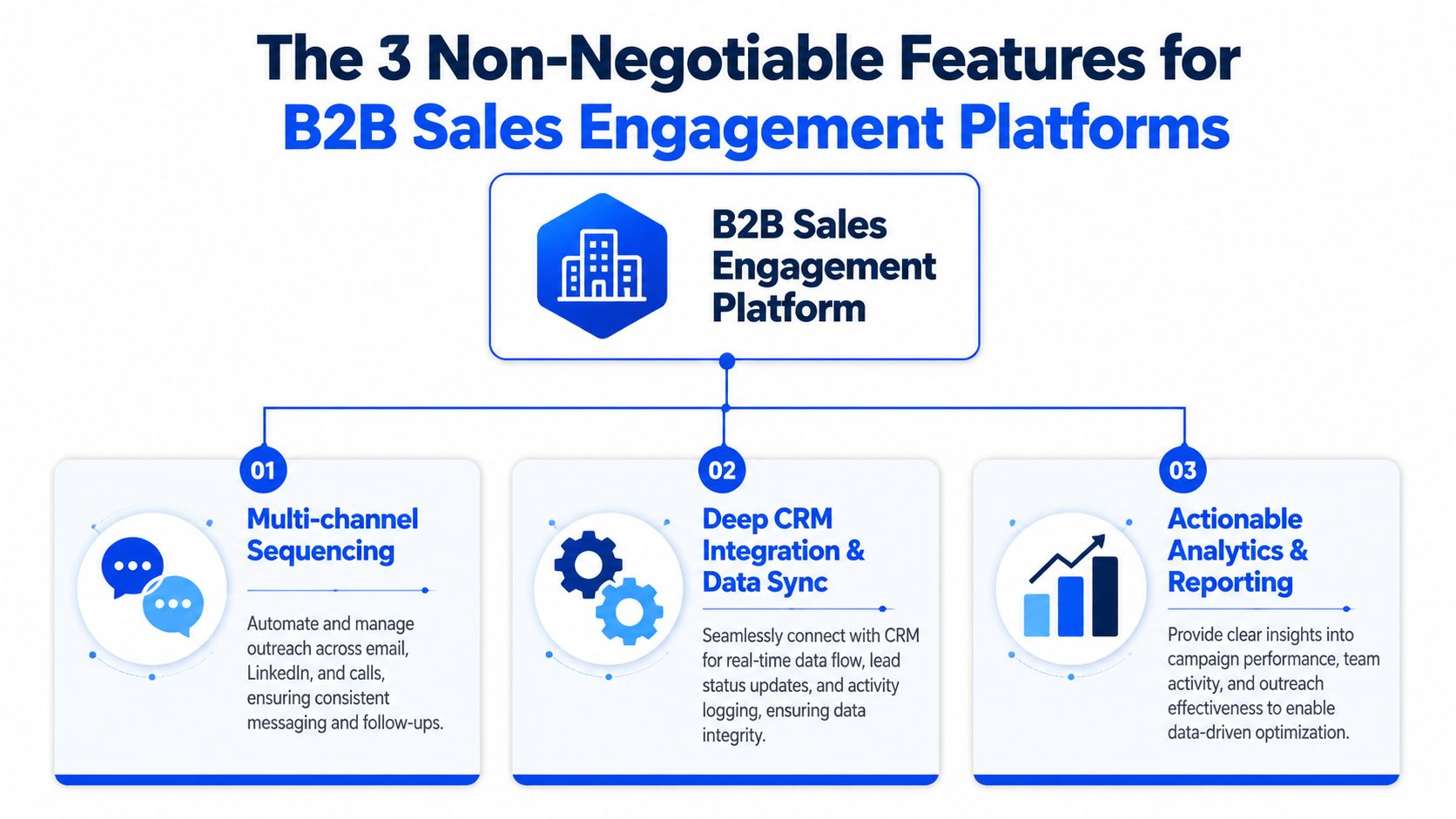
Gong notes that SEPs can automate manual work and speed up prioritization in its sales engagement platform analysis. Those gains show up only when the system protects sender reputation and keeps activity state aligned with the CRM.
My filter is simple. If the platform cannot protect deliverability and maintain clean CRM state, the rest of the feature set does not matter. Even a well-built sales sequence framework breaks down once inboxes burn or prospect status starts drifting between systems.
Why the inbox layer comes first
The first requirement is inbox rotation with hard per-inbox caps.
Outbound volume is controlled at the inbox level, not the campaign level. A team can keep total send volume within reason and still damage performance if one inbox carries too much load, sends into bad data, or keeps running after placement drops. The platform needs to spread volume across inboxes, enforce limits per sender, and pull weak inboxes out of rotation before they affect the rest of the pool.
Newer outbound tools tend to outperform legacy enterprise systems. Lemlist and Instantly give smaller teams usable control without much setup. Smartlead can work if the operating model is simpler. Outreach and Salesloft are stronger in rep workflow and enterprise process control, but for outbound-heavy teams the deliverability layer often needs more manual oversight than people expect.
The trade-off is straightforward:
Founder-led outbound → a lighter tool can work if send volume stays low and someone reviews inbox health every week
SDR team with steady outbound → rotation logic, throttling, and sender-level controls need to live inside the platform
Agency, multi-brand, or multi-region setup → poor inbox controls create constant operational risk
If a campaign needs to run for a full quarter, the inbox system has to stay healthy for a full quarter.
Warm-up is an ongoing operating task
The second requirement is native warm-up inside the sending environment.
Warm-up is not a one-time prelaunch checklist item. It is part of sender maintenance. Inboxes stay usable because positive engagement patterns continue over time, not because someone ran a setup process once and moved on.
Lemlist and Instantly make this easier because warm-up lives in the same place as sending. Separate warm-up tools can still work, but they create another dependency to monitor, another sync point to trust, and another process that usually loses an owner after the first few weeks.
The failure mode is boring but expensive. Opens get less reliable, replies slow down, and teams keep adding copy tests or more volume because they assume the messaging is the problem. Often the issue sits lower in the stack. Native warm-up will not solve every deliverability problem, but it removes enough operational friction that teams are more likely to maintain sender health consistently.
Sync depth matters more than integration badges
The third requirement is bidirectional CRM sync, which encompasses the complete data model rather than merely activity logging.
Every vendor claims a HubSpot or Salesforce integration. That claim means very little on its own. The useful question is whether the platform can write sends, replies, meetings, bounce state, and unsubscribe status back to the CRM, while also pulling lifecycle changes, ownership changes, suppression rules, and qualification updates into the execution layer. If that loop is shallow, reps and systems start acting on stale information.
The result is familiar:
Duplicate outreach → a prospect books a meeting and still gets the next step
Broken attribution → meetings and replies stop tying back to the campaign that produced them
Conflicting status → the CRM shows closed or disqualified, while the SEP still shows active
Manual cleanup → RevOps spends time fixing records instead of improving routing and conversion
HubSpot and Salesforce can support this well, but the SEP has to map fields cleanly, respect update logic, and handle edge cases like reassignment, suppression, and reply-state changes. This is less about badges on a pricing page and more about whether the platform can stay aligned with how the sales process is modeled.
Features I would not buy around
Several features get oversold and still rank below the line for me:
Built-in AI personalization → better handled upstream in Clay or another workflow where enrichment and prompt structure are controlled
Unified multi-channel execution → email and LinkedIn usually perform better in separate systems with separate operating rules
Platform analytics → HubSpot, Salesforce reporting, or BI tools usually do a better job once leadership wants real attribution
Reply sentiment classification → often inaccurate enough to create review work
Built-in enrichment → usually weaker than a dedicated data provider or enrichment layer
Team size changes which compromises are tolerable. A founder running two inboxes can live with more manual work. A scaled SDR team cannot. The three requirements above decide whether the platform will hold up under load or create cleanup work for RevOps every week.
How to evaluate vendors and spot overrated features
The fastest way to buy the wrong sales engagement platform is to let the demo drive the decision. The right way is uglier. Start with failure modes, then inspect the product for how it handles them.
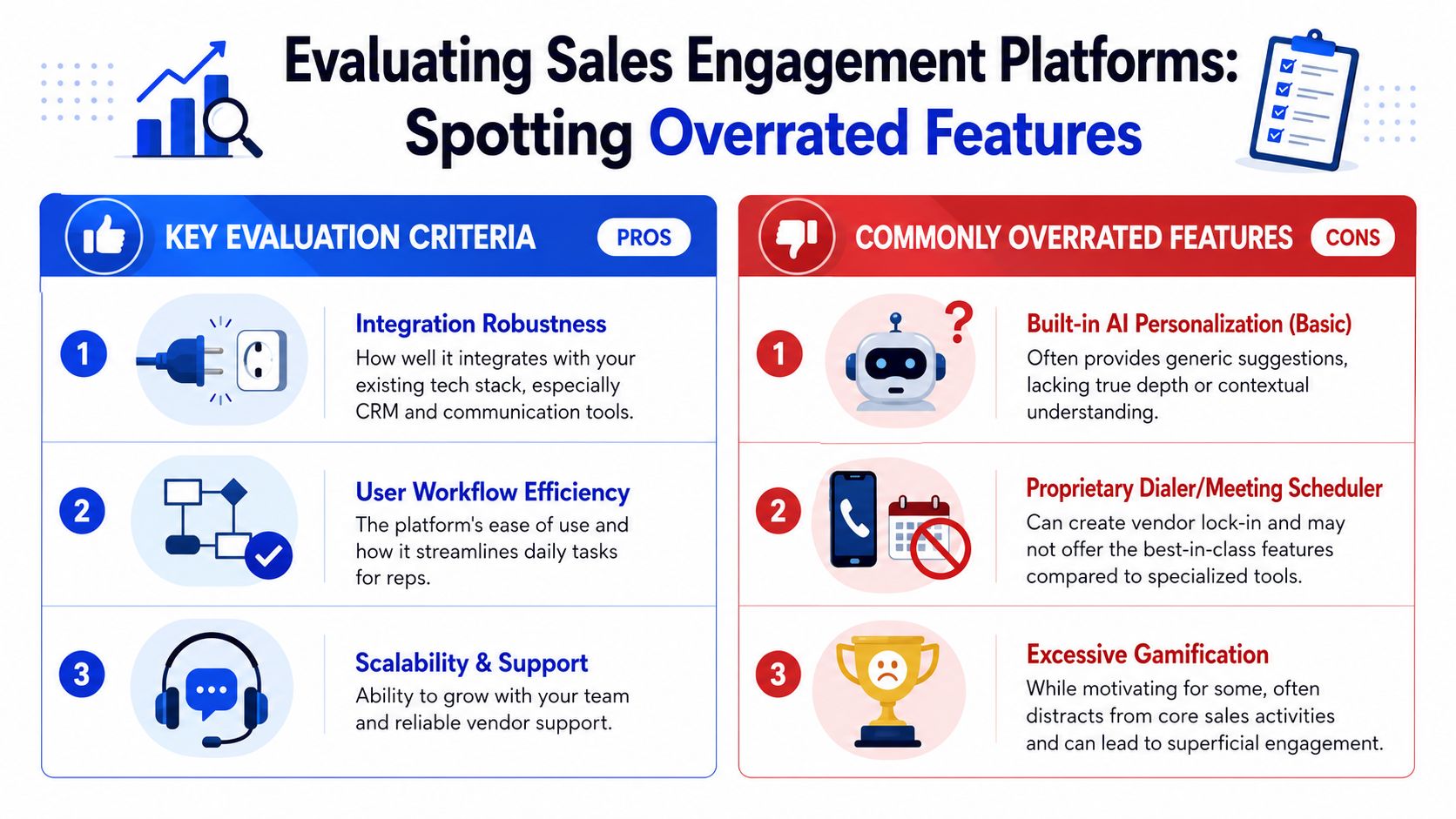
The most under-discussed truth in this category comes from ZoomInfo's sales engagement platform overview: a platform is only as effective as the contact data feeding it. That should change how you evaluate every vendor claim. If the lists are weak, the automation just scales bad targeting.
If you're comparing established platforms, this breakdown of Outreach vs Salesloft is a useful example of how feature parity on paper can hide workflow differences that matter once the team is live.
What vendors oversell
The first overrated category is built-in AI personalization. It demos well. In production, it often writes generic first lines and makes weak assumptions from thin data. Clay is better for enrichment and structured draft generation because it sits upstream where data shaping occurs.
The second is all-in-one channel orchestration. Vendors love the promise of email, LinkedIn, calls, and SMS from one screen. I almost never recommend buying on that promise. Email needs deliverability controls. LinkedIn needs a different workflow rhythm. HeyReach or manual LinkedIn motion paired with Lemlist or Instantly usually produces cleaner execution.
Most “unified” platforms unify procurement more effectively than they unify execution.
The third is native analytics. Unless the team has no reporting layer at all, campaign analytics inside the platform shouldn't decide the purchase. HubSpot, warehouse reporting, or a lightweight BI setup usually gives leadership better visibility than the vendor dashboard.
What to check before signing
A better vendor scorecard looks like this:
Checkpoint | What to inspect |
|---|---|
Support quality | How fast the team responds when sending breaks or sync fails |
Contract terms | Whether pricing is transparent and cancellation isn't punitive |
API access | Whether engineers can build custom logic later |
Documentation | Whether field mappings and endpoints are documented clearly |
Workflow speed | Whether reps can work queues without bouncing between tabs |
I also ask vendors to show the ugly parts live. Pause an inbox. Resolve a sync conflict. Update a CRM status and prove the platform reacts correctly. That tells you more than any polished product tour.
For teams with more complex routing, one practical option is using Grou's operational stack alongside best-in-class tools. That matters less as a product decision and more as a systems decision. The stack has to support one message map, one target list, and one reporting line, otherwise attention fragments before it becomes pipeline.
A framework for unifying LinkedIn and email outreach
Many teams asking for a unified sales engagement platform are solving the wrong problem. They don't need one tool for LinkedIn and email. They need one operating model.
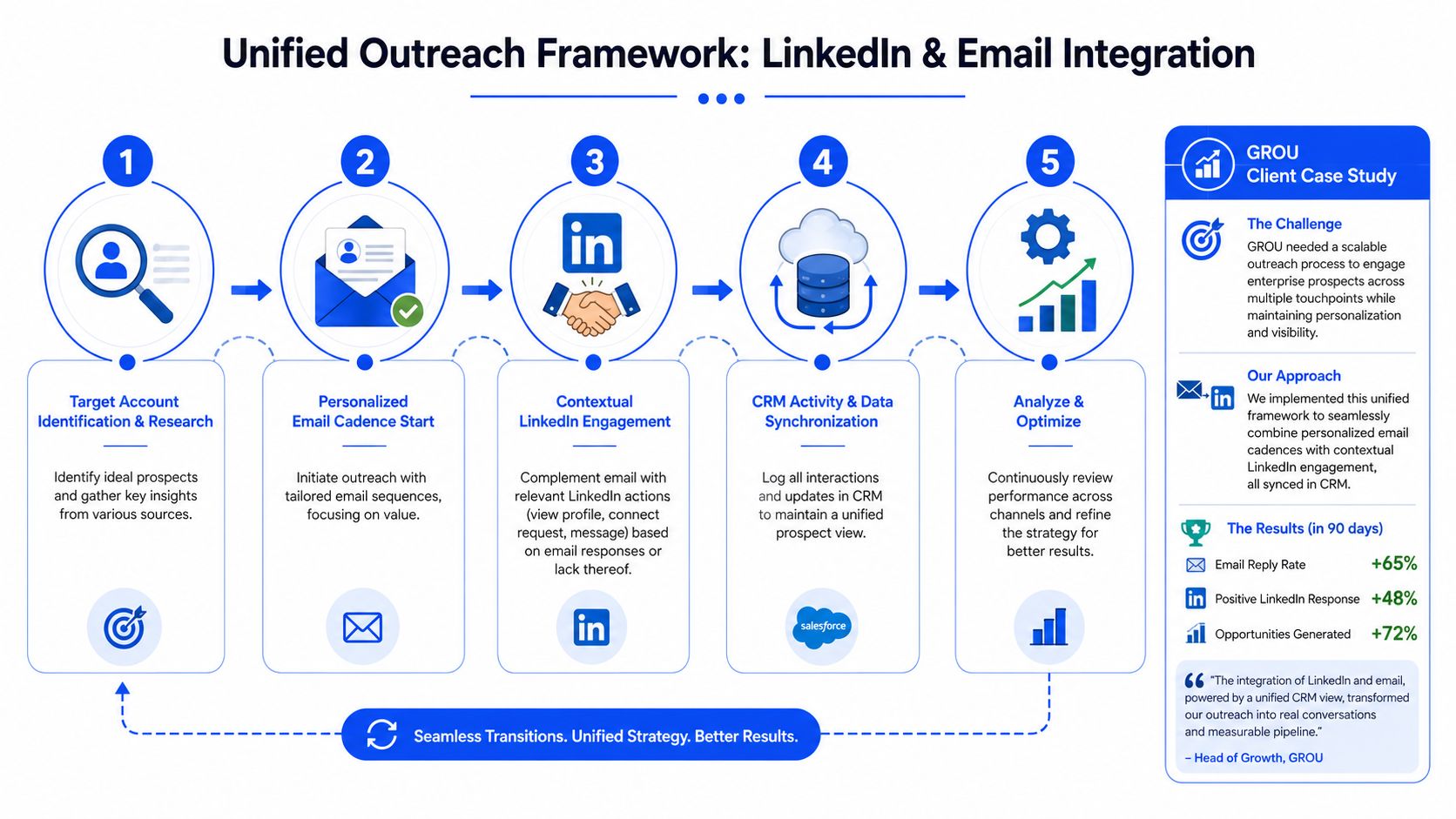
Outreach notes in its sales engagement guide that few teams get useful guidance on blending LinkedIn intent signals, content credibility, and outbound sequences. That gap shows up everywhere. Vendors talk about multi-channel. Very few teams coordinate timing, messaging, and prioritization across channels.
If LinkedIn is part of your motion, this guide to LinkedIn lead generation pairs well with the framework below because it focuses on signals and content, not vanity engagement.
What changed in the legal tech campaign
One legal tech SaaS team we worked with had the classic split-motion problem. The founder posted on LinkedIn. SDR outreach ran through Instantly. LinkedIn connection requests were handled separately. Each motion existed, but they weren't reinforcing each other.
Before we unified the strategy, performance looked like this:
LinkedIn content engagement → posts averaged 38 reactions and 6 comments
Email reply rate → 6.2% on triggered outbound
LinkedIn connection acceptance → 24%
LinkedIn DM reply rate → 9%
Inbound DMs from ICP-fit prospects → 2 to 3 per month
Qualified meetings from all channels → 7 to 9 per month
Later, after the team coordinated content topics, outbound references, and prioritization rules across channels, the results changed:
LinkedIn content engagement → averaged 187 reactions and 31 comments
Email reply rate → 13.8%
LinkedIn connection acceptance → 41%
LinkedIn DM reply rate → 18%
Inbound DMs from ICP-fit prospects → 11 to 14 per month
Qualified meetings from all channels → 19 to 23 per month
Those gains came from strategic unification across separate tools, not from forcing everything into one platform.
A quick walkthrough helps here:
The operating model that actually worked
We kept the tools separate. LinkedIn content stayed on the founder's account. Email stayed in Instantly. LinkedIn outreach stayed in a LinkedIn-specific workflow. HubSpot tracked the combined motion.
The change was in coordination:
Content topics came from live objections
When compliance leaders raised a recurring concern in email replies or calls, the founder posted on that exact issue the same week.Outbound referenced content naturally
Emails didn't force social proof. They pointed to a relevant founder post when it matched the prospect's problem.Prospects were pre-exposed to the founder
Target accounts were added to a light engagement list so the founder could follow and interact before outreach.Content engagement became a signal layer
When ICP-fit prospects engaged with posts, the team prioritized them for outbound inside forty-eight hours.
Cold outreach gets warmer when the prospect has already seen your point of view in public.
The compounding effect mattered more than any single lift. Prospects had context before the email arrived. Content got sharper because it was fed by real objections. The outbound team worked off current signals instead of static lists.
What I wouldn't do is run LinkedIn DMs from an email-first platform just because the vendor says it's unified. That usually weakens both channels.
Building a resilient data sync with your CRM
If your sales engagement platform and CRM disagree on status, the rest of the stack becomes theater. Reps don't trust tasks. Managers don't trust reports. Marketing doesn't trust attribution.
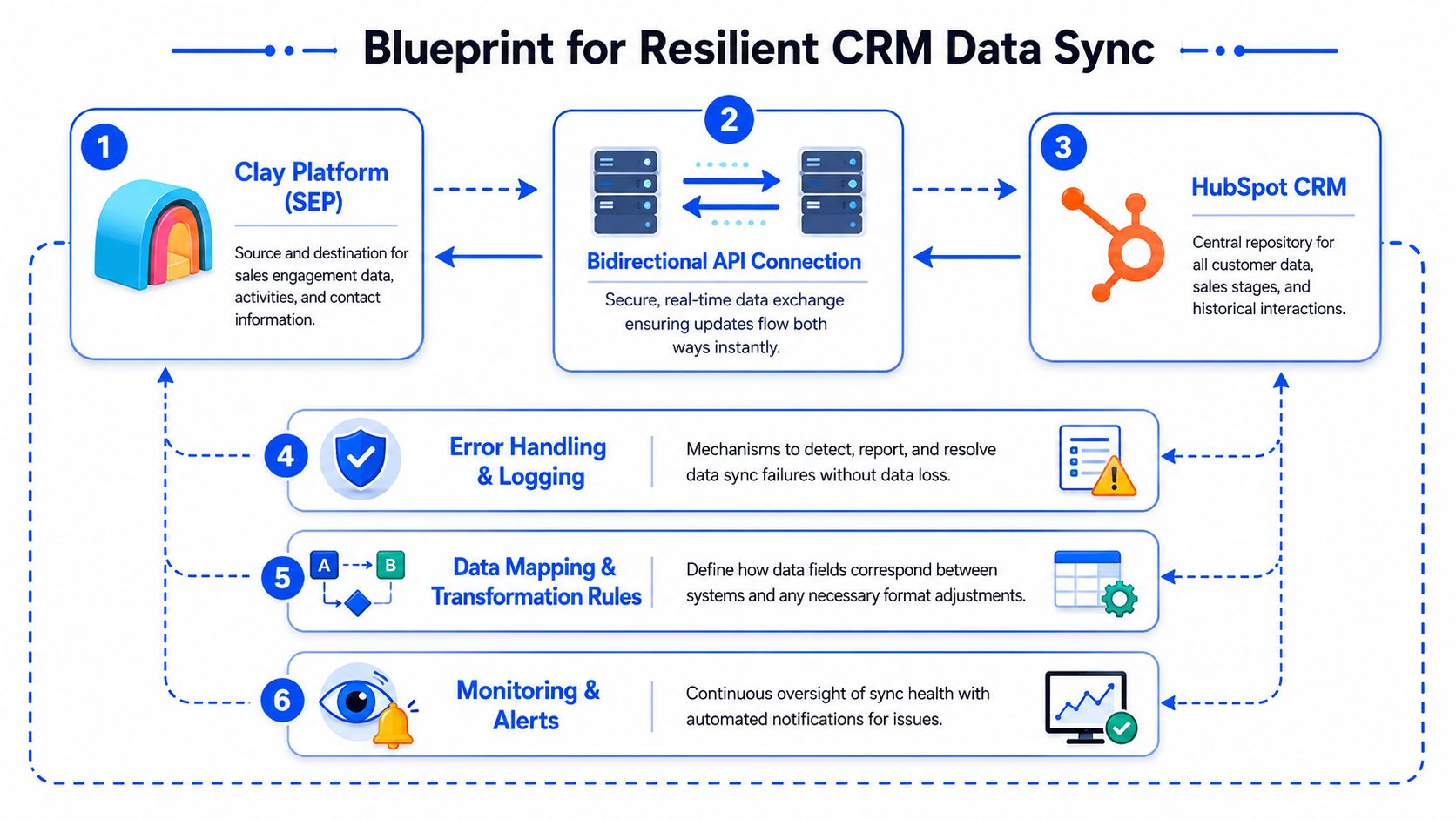
The cleanest implementation I've seen is a Clay to HubSpot bidirectional sync. For teams building this kind of workflow, a basic definition of CRM integration is useful, but the operational detail is where the value appears.
The four flows that remove manual work
This setup removes work because it syncs only the flows that matter most.
Clay to HubSpot for contact creation
When a prospect enters the active campaign queue, Clay creates or updates the HubSpot contact, writes enrichment fields, tags source and signal category, and logs why the record entered outreach.HubSpot back to Clay for status control
If the contact books a meeting, gets qualified out, or becomes an opportunity, Clay receives that update and stops further outreach.Reply data into CRM context
Replies from Lemlist or Instantly pass through the workflow and land in HubSpot with the relevant context for the AE.Pipeline outcomes back into reporting
Deal stage and value flow back into the reporting layer so the team can see which signals produce pipeline.
In one operational setup, this removed roughly 20 to 35 hours per month of manual work across the team. It also saved roughly 12 to 16 hours of quarterly review cleanup because attribution analysis stopped being a spreadsheet exercise. The initial setup took roughly 12 to 16 hours, and maintenance later settled at roughly 2 to 4 hours per quarter.
How to configure it without creating sync chaos
The build process matters more than the connector label.
First, map fields manually. Don't accept default mapping. Every Clay field needs a defined home in HubSpot, and every HubSpot state change needs a clear destination. That initial 90 minutes of field mapping prevents a lot of downstream cleanup.
Second, define sync triggers explicitly. Status changes should move immediately. Enrichment refreshes can run on a schedule. If everything syncs constantly, you create collisions and noise.
Third, run reconciliation reporting weekly. Integrations break. APIs change. One field gets renamed and a hidden branch fails unnoticed. Weekly reconciliation catches records that should have synced but didn't.
Sync reliability comes from ownership, not from middleware.
The biggest mistake is trying to pipe everything into the CRM. Don't. Full email bodies, granular LinkedIn engagement, and every Slack event don't belong there. Store the summary and preserve the operational context. Keep the CRM useful.
The realistic role of AI in your engagement stack
The biggest mistake teams make with AI in a sales engagement platform is expecting automation when what they're buying is draft assistance.
When we added AI into personalization workflows, the first outputs were fluent and wrong. The copy sounded polished, but it made assumptions about prospects, repeated familiar AI phrasing, and underperformed human-written work. After shifting to an AI-drafted, human-reviewed model, personalization time dropped by roughly 50% to 60%, while reply rates returned to the prior human-written baseline in our workflow.
That's the frame I'd use. AI prepares a first pass. A human checks factual accuracy, audience fit, tone, and obvious tells.
Where AI fits and where it doesn't
AI is useful for:
Draft preparation → turning enrichment inputs into a usable first version
Pattern spotting → surfacing recurring objections or message themes from replies
Prompted rewriting → shortening, tightening, or adjusting copy variants
AI is weak for:
First-touch autonomy → sending unreviewed outreach at scale
Reply sentiment decisions → classifications are still unreliable enough to confuse routing
Signal strategy → deciding which buying signals matter in your market
Proposal writing → too much generic language for high-stakes moments
If you're comparing broader tooling beyond SEPs, SynaBot's AI agent platform recommendations are worth reviewing because they show how quickly the AI vendor market is segmenting. That's exactly why AI should stay in a supervised role inside the revenue stack.
The operating rule is simple. Human judgment stays at the decision points. AI speeds up the prep work.
For a more grounded take on where this belongs operationally, this piece on AI sales automation is aligned with how mature teams run it.
Audit your outbound system this Friday with one question: if a prospect books a meeting, can every tool in your stack stop outreach within minutes and record why the meeting happened?
Grou works with B2B teams globally across iGaming, SaaS, manufacturing, legal tech, and pharma to connect LinkedIn, outbound, and CRM operations into one pipeline system. Our method is simple, one message map, one target list, one reporting line, and weekly operational fixes that keep attention turning into qualified pipeline.
Your CRM is clean enough. Your sequences look fine. Reps are still missing follow-ups, inboxes are degrading, and activity data is split across three tools. That's the primary reason many organizations buy a sales engagement platform, not for another dashboard.
The right sales engagement platform is an execution layer, not a CRM replacement
Only three features decide whether it works, inbox rotation, native warm-up, and bidirectional CRM sync
Most marketed features are noise, especially platform-native AI personalization and “all-in-one” channel promises
LinkedIn and email should be unified in strategy, not forced into one tool
Structure turns attention into pipeline when data, timing, and ownership stay aligned
Table of Contents
What a sales engagement platform really is
A sales engagement platform is the operating layer between your CRM and the people creating pipeline. It doesn't replace HubSpot or Salesforce. It makes those systems usable at the moment a rep needs to act.
Clari describes SEPs as an automation-and-data-engagement layer that sits on top of CRM, surfacing contact and account data at the point of engagement, and notes a 90% adoption rate among sales leaders planning to invest in SEP technology in its guide to sales engagement platforms. That framing is accurate because the value isn't the feature grid. The value is timing.
When this layer is missing, teams work from static lists and memory. Reps check one system for account context, another for previous activity, and a third for outreach. Process breaks at the handoff.
A sales engagement platform earns its place when it removes low-judgment work and keeps reps inside one execution flow.
For B2B teams in iGaming, SaaS, manufacturing, legal tech, and pharma, the job is simple. Take ICP-aligned records, attach the right context, route the next action, and write the result back into the CRM. If that loop isn't tight, scale creates noise instead of pipeline.
That's why I treat a sales engagement platform as infrastructure. Apollo might source contacts. Clay might enrich and score. Sales Navigator might sharpen account research. But the SEP is where outreach discipline lives.
Where it sits in the stack
A clean stack usually looks like this:
CRM → HubSpot as the source of truth for contacts, companies, deals, and lifecycle stages
Data orchestration → Clay for enrichment, signals, and routing logic
Execution layer → Lemlist, Instantly, Smartlead, or a similar sales engagement platform
Channel-specific support → Sales Navigator for research, HeyReach for LinkedIn workflow
If you're thinking about AI on top of that stack, this perspective on unlocking sales potential with AI is useful because it separates execution assistance from strategy. That distinction matters more than vendor branding.
What it should do every day
A good platform does three things well:
Queue work clearly → the rep sees who to contact, why now, and what happened last
Automate repetitive actions → follow-ups, scheduling friction, and logging stop eating rep time
Preserve context → replies, bookings, and status changes flow back into the CRM without cleanup
At GROU, that's the lens we use across client systems. Structure turns attention into pipeline only when the execution layer keeps data, outreach, and reporting in one operational loop.
The 3 non-negotiable features for B2B teams
A platform can look polished in a demo and still fail in week three. The failure pattern is predictable. Reply rates soften, a few inboxes start landing in spam, reps keep working prospects who already replied, and CRM reporting stops matching what the outbound team sees.
Gong notes that SEPs can automate manual work and speed up prioritization in its sales engagement platform analysis. Those gains show up only when the system protects sender reputation and keeps activity state aligned with the CRM.
My filter is simple. If the platform cannot protect deliverability and maintain clean CRM state, the rest of the feature set does not matter. Even a well-built sales sequence framework breaks down once inboxes burn or prospect status starts drifting between systems.
Why the inbox layer comes first
The first requirement is inbox rotation with hard per-inbox caps.
Outbound volume is controlled at the inbox level, not the campaign level. A team can keep total send volume within reason and still damage performance if one inbox carries too much load, sends into bad data, or keeps running after placement drops. The platform needs to spread volume across inboxes, enforce limits per sender, and pull weak inboxes out of rotation before they affect the rest of the pool.
Newer outbound tools tend to outperform legacy enterprise systems. Lemlist and Instantly give smaller teams usable control without much setup. Smartlead can work if the operating model is simpler. Outreach and Salesloft are stronger in rep workflow and enterprise process control, but for outbound-heavy teams the deliverability layer often needs more manual oversight than people expect.
The trade-off is straightforward:
Founder-led outbound → a lighter tool can work if send volume stays low and someone reviews inbox health every week
SDR team with steady outbound → rotation logic, throttling, and sender-level controls need to live inside the platform
Agency, multi-brand, or multi-region setup → poor inbox controls create constant operational risk
If a campaign needs to run for a full quarter, the inbox system has to stay healthy for a full quarter.
Warm-up is an ongoing operating task
The second requirement is native warm-up inside the sending environment.
Warm-up is not a one-time prelaunch checklist item. It is part of sender maintenance. Inboxes stay usable because positive engagement patterns continue over time, not because someone ran a setup process once and moved on.
Lemlist and Instantly make this easier because warm-up lives in the same place as sending. Separate warm-up tools can still work, but they create another dependency to monitor, another sync point to trust, and another process that usually loses an owner after the first few weeks.
The failure mode is boring but expensive. Opens get less reliable, replies slow down, and teams keep adding copy tests or more volume because they assume the messaging is the problem. Often the issue sits lower in the stack. Native warm-up will not solve every deliverability problem, but it removes enough operational friction that teams are more likely to maintain sender health consistently.
Sync depth matters more than integration badges
The third requirement is bidirectional CRM sync, which encompasses the complete data model rather than merely activity logging.
Every vendor claims a HubSpot or Salesforce integration. That claim means very little on its own. The useful question is whether the platform can write sends, replies, meetings, bounce state, and unsubscribe status back to the CRM, while also pulling lifecycle changes, ownership changes, suppression rules, and qualification updates into the execution layer. If that loop is shallow, reps and systems start acting on stale information.
The result is familiar:
Duplicate outreach → a prospect books a meeting and still gets the next step
Broken attribution → meetings and replies stop tying back to the campaign that produced them
Conflicting status → the CRM shows closed or disqualified, while the SEP still shows active
Manual cleanup → RevOps spends time fixing records instead of improving routing and conversion
HubSpot and Salesforce can support this well, but the SEP has to map fields cleanly, respect update logic, and handle edge cases like reassignment, suppression, and reply-state changes. This is less about badges on a pricing page and more about whether the platform can stay aligned with how the sales process is modeled.
Features I would not buy around
Several features get oversold and still rank below the line for me:
Built-in AI personalization → better handled upstream in Clay or another workflow where enrichment and prompt structure are controlled
Unified multi-channel execution → email and LinkedIn usually perform better in separate systems with separate operating rules
Platform analytics → HubSpot, Salesforce reporting, or BI tools usually do a better job once leadership wants real attribution
Reply sentiment classification → often inaccurate enough to create review work
Built-in enrichment → usually weaker than a dedicated data provider or enrichment layer
Team size changes which compromises are tolerable. A founder running two inboxes can live with more manual work. A scaled SDR team cannot. The three requirements above decide whether the platform will hold up under load or create cleanup work for RevOps every week.
How to evaluate vendors and spot overrated features
The fastest way to buy the wrong sales engagement platform is to let the demo drive the decision. The right way is uglier. Start with failure modes, then inspect the product for how it handles them.
The most under-discussed truth in this category comes from ZoomInfo's sales engagement platform overview: a platform is only as effective as the contact data feeding it. That should change how you evaluate every vendor claim. If the lists are weak, the automation just scales bad targeting.
If you're comparing established platforms, this breakdown of Outreach vs Salesloft is a useful example of how feature parity on paper can hide workflow differences that matter once the team is live.
What vendors oversell
The first overrated category is built-in AI personalization. It demos well. In production, it often writes generic first lines and makes weak assumptions from thin data. Clay is better for enrichment and structured draft generation because it sits upstream where data shaping occurs.
The second is all-in-one channel orchestration. Vendors love the promise of email, LinkedIn, calls, and SMS from one screen. I almost never recommend buying on that promise. Email needs deliverability controls. LinkedIn needs a different workflow rhythm. HeyReach or manual LinkedIn motion paired with Lemlist or Instantly usually produces cleaner execution.
Most “unified” platforms unify procurement more effectively than they unify execution.
The third is native analytics. Unless the team has no reporting layer at all, campaign analytics inside the platform shouldn't decide the purchase. HubSpot, warehouse reporting, or a lightweight BI setup usually gives leadership better visibility than the vendor dashboard.
What to check before signing
A better vendor scorecard looks like this:
Checkpoint | What to inspect |
|---|---|
Support quality | How fast the team responds when sending breaks or sync fails |
Contract terms | Whether pricing is transparent and cancellation isn't punitive |
API access | Whether engineers can build custom logic later |
Documentation | Whether field mappings and endpoints are documented clearly |
Workflow speed | Whether reps can work queues without bouncing between tabs |
I also ask vendors to show the ugly parts live. Pause an inbox. Resolve a sync conflict. Update a CRM status and prove the platform reacts correctly. That tells you more than any polished product tour.
For teams with more complex routing, one practical option is using Grou's operational stack alongside best-in-class tools. That matters less as a product decision and more as a systems decision. The stack has to support one message map, one target list, and one reporting line, otherwise attention fragments before it becomes pipeline.
A framework for unifying LinkedIn and email outreach
Many teams asking for a unified sales engagement platform are solving the wrong problem. They don't need one tool for LinkedIn and email. They need one operating model.
Outreach notes in its sales engagement guide that few teams get useful guidance on blending LinkedIn intent signals, content credibility, and outbound sequences. That gap shows up everywhere. Vendors talk about multi-channel. Very few teams coordinate timing, messaging, and prioritization across channels.
If LinkedIn is part of your motion, this guide to LinkedIn lead generation pairs well with the framework below because it focuses on signals and content, not vanity engagement.
What changed in the legal tech campaign
One legal tech SaaS team we worked with had the classic split-motion problem. The founder posted on LinkedIn. SDR outreach ran through Instantly. LinkedIn connection requests were handled separately. Each motion existed, but they weren't reinforcing each other.
Before we unified the strategy, performance looked like this:
LinkedIn content engagement → posts averaged 38 reactions and 6 comments
Email reply rate → 6.2% on triggered outbound
LinkedIn connection acceptance → 24%
LinkedIn DM reply rate → 9%
Inbound DMs from ICP-fit prospects → 2 to 3 per month
Qualified meetings from all channels → 7 to 9 per month
Later, after the team coordinated content topics, outbound references, and prioritization rules across channels, the results changed:
LinkedIn content engagement → averaged 187 reactions and 31 comments
Email reply rate → 13.8%
LinkedIn connection acceptance → 41%
LinkedIn DM reply rate → 18%
Inbound DMs from ICP-fit prospects → 11 to 14 per month
Qualified meetings from all channels → 19 to 23 per month
Those gains came from strategic unification across separate tools, not from forcing everything into one platform.
A quick walkthrough helps here:
The operating model that actually worked
We kept the tools separate. LinkedIn content stayed on the founder's account. Email stayed in Instantly. LinkedIn outreach stayed in a LinkedIn-specific workflow. HubSpot tracked the combined motion.
The change was in coordination:
Content topics came from live objections
When compliance leaders raised a recurring concern in email replies or calls, the founder posted on that exact issue the same week.Outbound referenced content naturally
Emails didn't force social proof. They pointed to a relevant founder post when it matched the prospect's problem.Prospects were pre-exposed to the founder
Target accounts were added to a light engagement list so the founder could follow and interact before outreach.Content engagement became a signal layer
When ICP-fit prospects engaged with posts, the team prioritized them for outbound inside forty-eight hours.
Cold outreach gets warmer when the prospect has already seen your point of view in public.
The compounding effect mattered more than any single lift. Prospects had context before the email arrived. Content got sharper because it was fed by real objections. The outbound team worked off current signals instead of static lists.
What I wouldn't do is run LinkedIn DMs from an email-first platform just because the vendor says it's unified. That usually weakens both channels.
Building a resilient data sync with your CRM
If your sales engagement platform and CRM disagree on status, the rest of the stack becomes theater. Reps don't trust tasks. Managers don't trust reports. Marketing doesn't trust attribution.
The cleanest implementation I've seen is a Clay to HubSpot bidirectional sync. For teams building this kind of workflow, a basic definition of CRM integration is useful, but the operational detail is where the value appears.
The four flows that remove manual work
This setup removes work because it syncs only the flows that matter most.
Clay to HubSpot for contact creation
When a prospect enters the active campaign queue, Clay creates or updates the HubSpot contact, writes enrichment fields, tags source and signal category, and logs why the record entered outreach.HubSpot back to Clay for status control
If the contact books a meeting, gets qualified out, or becomes an opportunity, Clay receives that update and stops further outreach.Reply data into CRM context
Replies from Lemlist or Instantly pass through the workflow and land in HubSpot with the relevant context for the AE.Pipeline outcomes back into reporting
Deal stage and value flow back into the reporting layer so the team can see which signals produce pipeline.
In one operational setup, this removed roughly 20 to 35 hours per month of manual work across the team. It also saved roughly 12 to 16 hours of quarterly review cleanup because attribution analysis stopped being a spreadsheet exercise. The initial setup took roughly 12 to 16 hours, and maintenance later settled at roughly 2 to 4 hours per quarter.
How to configure it without creating sync chaos
The build process matters more than the connector label.
First, map fields manually. Don't accept default mapping. Every Clay field needs a defined home in HubSpot, and every HubSpot state change needs a clear destination. That initial 90 minutes of field mapping prevents a lot of downstream cleanup.
Second, define sync triggers explicitly. Status changes should move immediately. Enrichment refreshes can run on a schedule. If everything syncs constantly, you create collisions and noise.
Third, run reconciliation reporting weekly. Integrations break. APIs change. One field gets renamed and a hidden branch fails unnoticed. Weekly reconciliation catches records that should have synced but didn't.
Sync reliability comes from ownership, not from middleware.
The biggest mistake is trying to pipe everything into the CRM. Don't. Full email bodies, granular LinkedIn engagement, and every Slack event don't belong there. Store the summary and preserve the operational context. Keep the CRM useful.
The realistic role of AI in your engagement stack
The biggest mistake teams make with AI in a sales engagement platform is expecting automation when what they're buying is draft assistance.
When we added AI into personalization workflows, the first outputs were fluent and wrong. The copy sounded polished, but it made assumptions about prospects, repeated familiar AI phrasing, and underperformed human-written work. After shifting to an AI-drafted, human-reviewed model, personalization time dropped by roughly 50% to 60%, while reply rates returned to the prior human-written baseline in our workflow.
That's the frame I'd use. AI prepares a first pass. A human checks factual accuracy, audience fit, tone, and obvious tells.
Where AI fits and where it doesn't
AI is useful for:
Draft preparation → turning enrichment inputs into a usable first version
Pattern spotting → surfacing recurring objections or message themes from replies
Prompted rewriting → shortening, tightening, or adjusting copy variants
AI is weak for:
First-touch autonomy → sending unreviewed outreach at scale
Reply sentiment decisions → classifications are still unreliable enough to confuse routing
Signal strategy → deciding which buying signals matter in your market
Proposal writing → too much generic language for high-stakes moments
If you're comparing broader tooling beyond SEPs, SynaBot's AI agent platform recommendations are worth reviewing because they show how quickly the AI vendor market is segmenting. That's exactly why AI should stay in a supervised role inside the revenue stack.
The operating rule is simple. Human judgment stays at the decision points. AI speeds up the prep work.
For a more grounded take on where this belongs operationally, this piece on AI sales automation is aligned with how mature teams run it.
Audit your outbound system this Friday with one question: if a prospect books a meeting, can every tool in your stack stop outreach within minutes and record why the meeting happened?
Grou works with B2B teams globally across iGaming, SaaS, manufacturing, legal tech, and pharma to connect LinkedIn, outbound, and CRM operations into one pipeline system. Our method is simple, one message map, one target list, one reporting line, and weekly operational fixes that keep attention turning into qualified pipeline.
Your CRM is clean enough. Your sequences look fine. Reps are still missing follow-ups, inboxes are degrading, and activity data is split across three tools. That's the primary reason many organizations buy a sales engagement platform, not for another dashboard.
The right sales engagement platform is an execution layer, not a CRM replacement
Only three features decide whether it works, inbox rotation, native warm-up, and bidirectional CRM sync
Most marketed features are noise, especially platform-native AI personalization and “all-in-one” channel promises
LinkedIn and email should be unified in strategy, not forced into one tool
Structure turns attention into pipeline when data, timing, and ownership stay aligned
Table of Contents
What a sales engagement platform really is
A sales engagement platform is the operating layer between your CRM and the people creating pipeline. It doesn't replace HubSpot or Salesforce. It makes those systems usable at the moment a rep needs to act.
Clari describes SEPs as an automation-and-data-engagement layer that sits on top of CRM, surfacing contact and account data at the point of engagement, and notes a 90% adoption rate among sales leaders planning to invest in SEP technology in its guide to sales engagement platforms. That framing is accurate because the value isn't the feature grid. The value is timing.
When this layer is missing, teams work from static lists and memory. Reps check one system for account context, another for previous activity, and a third for outreach. Process breaks at the handoff.
A sales engagement platform earns its place when it removes low-judgment work and keeps reps inside one execution flow.
For B2B teams in iGaming, SaaS, manufacturing, legal tech, and pharma, the job is simple. Take ICP-aligned records, attach the right context, route the next action, and write the result back into the CRM. If that loop isn't tight, scale creates noise instead of pipeline.
That's why I treat a sales engagement platform as infrastructure. Apollo might source contacts. Clay might enrich and score. Sales Navigator might sharpen account research. But the SEP is where outreach discipline lives.
Where it sits in the stack
A clean stack usually looks like this:
CRM → HubSpot as the source of truth for contacts, companies, deals, and lifecycle stages
Data orchestration → Clay for enrichment, signals, and routing logic
Execution layer → Lemlist, Instantly, Smartlead, or a similar sales engagement platform
Channel-specific support → Sales Navigator for research, HeyReach for LinkedIn workflow
If you're thinking about AI on top of that stack, this perspective on unlocking sales potential with AI is useful because it separates execution assistance from strategy. That distinction matters more than vendor branding.
What it should do every day
A good platform does three things well:
Queue work clearly → the rep sees who to contact, why now, and what happened last
Automate repetitive actions → follow-ups, scheduling friction, and logging stop eating rep time
Preserve context → replies, bookings, and status changes flow back into the CRM without cleanup
At GROU, that's the lens we use across client systems. Structure turns attention into pipeline only when the execution layer keeps data, outreach, and reporting in one operational loop.
The 3 non-negotiable features for B2B teams
A platform can look polished in a demo and still fail in week three. The failure pattern is predictable. Reply rates soften, a few inboxes start landing in spam, reps keep working prospects who already replied, and CRM reporting stops matching what the outbound team sees.
Gong notes that SEPs can automate manual work and speed up prioritization in its sales engagement platform analysis. Those gains show up only when the system protects sender reputation and keeps activity state aligned with the CRM.
My filter is simple. If the platform cannot protect deliverability and maintain clean CRM state, the rest of the feature set does not matter. Even a well-built sales sequence framework breaks down once inboxes burn or prospect status starts drifting between systems.
Why the inbox layer comes first
The first requirement is inbox rotation with hard per-inbox caps.
Outbound volume is controlled at the inbox level, not the campaign level. A team can keep total send volume within reason and still damage performance if one inbox carries too much load, sends into bad data, or keeps running after placement drops. The platform needs to spread volume across inboxes, enforce limits per sender, and pull weak inboxes out of rotation before they affect the rest of the pool.
Newer outbound tools tend to outperform legacy enterprise systems. Lemlist and Instantly give smaller teams usable control without much setup. Smartlead can work if the operating model is simpler. Outreach and Salesloft are stronger in rep workflow and enterprise process control, but for outbound-heavy teams the deliverability layer often needs more manual oversight than people expect.
The trade-off is straightforward:
Founder-led outbound → a lighter tool can work if send volume stays low and someone reviews inbox health every week
SDR team with steady outbound → rotation logic, throttling, and sender-level controls need to live inside the platform
Agency, multi-brand, or multi-region setup → poor inbox controls create constant operational risk
If a campaign needs to run for a full quarter, the inbox system has to stay healthy for a full quarter.
Warm-up is an ongoing operating task
The second requirement is native warm-up inside the sending environment.
Warm-up is not a one-time prelaunch checklist item. It is part of sender maintenance. Inboxes stay usable because positive engagement patterns continue over time, not because someone ran a setup process once and moved on.
Lemlist and Instantly make this easier because warm-up lives in the same place as sending. Separate warm-up tools can still work, but they create another dependency to monitor, another sync point to trust, and another process that usually loses an owner after the first few weeks.
The failure mode is boring but expensive. Opens get less reliable, replies slow down, and teams keep adding copy tests or more volume because they assume the messaging is the problem. Often the issue sits lower in the stack. Native warm-up will not solve every deliverability problem, but it removes enough operational friction that teams are more likely to maintain sender health consistently.
Sync depth matters more than integration badges
The third requirement is bidirectional CRM sync, which encompasses the complete data model rather than merely activity logging.
Every vendor claims a HubSpot or Salesforce integration. That claim means very little on its own. The useful question is whether the platform can write sends, replies, meetings, bounce state, and unsubscribe status back to the CRM, while also pulling lifecycle changes, ownership changes, suppression rules, and qualification updates into the execution layer. If that loop is shallow, reps and systems start acting on stale information.
The result is familiar:
Duplicate outreach → a prospect books a meeting and still gets the next step
Broken attribution → meetings and replies stop tying back to the campaign that produced them
Conflicting status → the CRM shows closed or disqualified, while the SEP still shows active
Manual cleanup → RevOps spends time fixing records instead of improving routing and conversion
HubSpot and Salesforce can support this well, but the SEP has to map fields cleanly, respect update logic, and handle edge cases like reassignment, suppression, and reply-state changes. This is less about badges on a pricing page and more about whether the platform can stay aligned with how the sales process is modeled.
Features I would not buy around
Several features get oversold and still rank below the line for me:
Built-in AI personalization → better handled upstream in Clay or another workflow where enrichment and prompt structure are controlled
Unified multi-channel execution → email and LinkedIn usually perform better in separate systems with separate operating rules
Platform analytics → HubSpot, Salesforce reporting, or BI tools usually do a better job once leadership wants real attribution
Reply sentiment classification → often inaccurate enough to create review work
Built-in enrichment → usually weaker than a dedicated data provider or enrichment layer
Team size changes which compromises are tolerable. A founder running two inboxes can live with more manual work. A scaled SDR team cannot. The three requirements above decide whether the platform will hold up under load or create cleanup work for RevOps every week.
How to evaluate vendors and spot overrated features
The fastest way to buy the wrong sales engagement platform is to let the demo drive the decision. The right way is uglier. Start with failure modes, then inspect the product for how it handles them.
The most under-discussed truth in this category comes from ZoomInfo's sales engagement platform overview: a platform is only as effective as the contact data feeding it. That should change how you evaluate every vendor claim. If the lists are weak, the automation just scales bad targeting.
If you're comparing established platforms, this breakdown of Outreach vs Salesloft is a useful example of how feature parity on paper can hide workflow differences that matter once the team is live.
What vendors oversell
The first overrated category is built-in AI personalization. It demos well. In production, it often writes generic first lines and makes weak assumptions from thin data. Clay is better for enrichment and structured draft generation because it sits upstream where data shaping occurs.
The second is all-in-one channel orchestration. Vendors love the promise of email, LinkedIn, calls, and SMS from one screen. I almost never recommend buying on that promise. Email needs deliverability controls. LinkedIn needs a different workflow rhythm. HeyReach or manual LinkedIn motion paired with Lemlist or Instantly usually produces cleaner execution.
Most “unified” platforms unify procurement more effectively than they unify execution.
The third is native analytics. Unless the team has no reporting layer at all, campaign analytics inside the platform shouldn't decide the purchase. HubSpot, warehouse reporting, or a lightweight BI setup usually gives leadership better visibility than the vendor dashboard.
What to check before signing
A better vendor scorecard looks like this:
Checkpoint | What to inspect |
|---|---|
Support quality | How fast the team responds when sending breaks or sync fails |
Contract terms | Whether pricing is transparent and cancellation isn't punitive |
API access | Whether engineers can build custom logic later |
Documentation | Whether field mappings and endpoints are documented clearly |
Workflow speed | Whether reps can work queues without bouncing between tabs |
I also ask vendors to show the ugly parts live. Pause an inbox. Resolve a sync conflict. Update a CRM status and prove the platform reacts correctly. That tells you more than any polished product tour.
For teams with more complex routing, one practical option is using Grou's operational stack alongside best-in-class tools. That matters less as a product decision and more as a systems decision. The stack has to support one message map, one target list, and one reporting line, otherwise attention fragments before it becomes pipeline.
A framework for unifying LinkedIn and email outreach
Many teams asking for a unified sales engagement platform are solving the wrong problem. They don't need one tool for LinkedIn and email. They need one operating model.
Outreach notes in its sales engagement guide that few teams get useful guidance on blending LinkedIn intent signals, content credibility, and outbound sequences. That gap shows up everywhere. Vendors talk about multi-channel. Very few teams coordinate timing, messaging, and prioritization across channels.
If LinkedIn is part of your motion, this guide to LinkedIn lead generation pairs well with the framework below because it focuses on signals and content, not vanity engagement.
What changed in the legal tech campaign
One legal tech SaaS team we worked with had the classic split-motion problem. The founder posted on LinkedIn. SDR outreach ran through Instantly. LinkedIn connection requests were handled separately. Each motion existed, but they weren't reinforcing each other.
Before we unified the strategy, performance looked like this:
LinkedIn content engagement → posts averaged 38 reactions and 6 comments
Email reply rate → 6.2% on triggered outbound
LinkedIn connection acceptance → 24%
LinkedIn DM reply rate → 9%
Inbound DMs from ICP-fit prospects → 2 to 3 per month
Qualified meetings from all channels → 7 to 9 per month
Later, after the team coordinated content topics, outbound references, and prioritization rules across channels, the results changed:
LinkedIn content engagement → averaged 187 reactions and 31 comments
Email reply rate → 13.8%
LinkedIn connection acceptance → 41%
LinkedIn DM reply rate → 18%
Inbound DMs from ICP-fit prospects → 11 to 14 per month
Qualified meetings from all channels → 19 to 23 per month
Those gains came from strategic unification across separate tools, not from forcing everything into one platform.
A quick walkthrough helps here:
The operating model that actually worked
We kept the tools separate. LinkedIn content stayed on the founder's account. Email stayed in Instantly. LinkedIn outreach stayed in a LinkedIn-specific workflow. HubSpot tracked the combined motion.
The change was in coordination:
Content topics came from live objections
When compliance leaders raised a recurring concern in email replies or calls, the founder posted on that exact issue the same week.Outbound referenced content naturally
Emails didn't force social proof. They pointed to a relevant founder post when it matched the prospect's problem.Prospects were pre-exposed to the founder
Target accounts were added to a light engagement list so the founder could follow and interact before outreach.Content engagement became a signal layer
When ICP-fit prospects engaged with posts, the team prioritized them for outbound inside forty-eight hours.
Cold outreach gets warmer when the prospect has already seen your point of view in public.
The compounding effect mattered more than any single lift. Prospects had context before the email arrived. Content got sharper because it was fed by real objections. The outbound team worked off current signals instead of static lists.
What I wouldn't do is run LinkedIn DMs from an email-first platform just because the vendor says it's unified. That usually weakens both channels.
Building a resilient data sync with your CRM
If your sales engagement platform and CRM disagree on status, the rest of the stack becomes theater. Reps don't trust tasks. Managers don't trust reports. Marketing doesn't trust attribution.
The cleanest implementation I've seen is a Clay to HubSpot bidirectional sync. For teams building this kind of workflow, a basic definition of CRM integration is useful, but the operational detail is where the value appears.
The four flows that remove manual work
This setup removes work because it syncs only the flows that matter most.
Clay to HubSpot for contact creation
When a prospect enters the active campaign queue, Clay creates or updates the HubSpot contact, writes enrichment fields, tags source and signal category, and logs why the record entered outreach.HubSpot back to Clay for status control
If the contact books a meeting, gets qualified out, or becomes an opportunity, Clay receives that update and stops further outreach.Reply data into CRM context
Replies from Lemlist or Instantly pass through the workflow and land in HubSpot with the relevant context for the AE.Pipeline outcomes back into reporting
Deal stage and value flow back into the reporting layer so the team can see which signals produce pipeline.
In one operational setup, this removed roughly 20 to 35 hours per month of manual work across the team. It also saved roughly 12 to 16 hours of quarterly review cleanup because attribution analysis stopped being a spreadsheet exercise. The initial setup took roughly 12 to 16 hours, and maintenance later settled at roughly 2 to 4 hours per quarter.
How to configure it without creating sync chaos
The build process matters more than the connector label.
First, map fields manually. Don't accept default mapping. Every Clay field needs a defined home in HubSpot, and every HubSpot state change needs a clear destination. That initial 90 minutes of field mapping prevents a lot of downstream cleanup.
Second, define sync triggers explicitly. Status changes should move immediately. Enrichment refreshes can run on a schedule. If everything syncs constantly, you create collisions and noise.
Third, run reconciliation reporting weekly. Integrations break. APIs change. One field gets renamed and a hidden branch fails unnoticed. Weekly reconciliation catches records that should have synced but didn't.
Sync reliability comes from ownership, not from middleware.
The biggest mistake is trying to pipe everything into the CRM. Don't. Full email bodies, granular LinkedIn engagement, and every Slack event don't belong there. Store the summary and preserve the operational context. Keep the CRM useful.
The realistic role of AI in your engagement stack
The biggest mistake teams make with AI in a sales engagement platform is expecting automation when what they're buying is draft assistance.
When we added AI into personalization workflows, the first outputs were fluent and wrong. The copy sounded polished, but it made assumptions about prospects, repeated familiar AI phrasing, and underperformed human-written work. After shifting to an AI-drafted, human-reviewed model, personalization time dropped by roughly 50% to 60%, while reply rates returned to the prior human-written baseline in our workflow.
That's the frame I'd use. AI prepares a first pass. A human checks factual accuracy, audience fit, tone, and obvious tells.
Where AI fits and where it doesn't
AI is useful for:
Draft preparation → turning enrichment inputs into a usable first version
Pattern spotting → surfacing recurring objections or message themes from replies
Prompted rewriting → shortening, tightening, or adjusting copy variants
AI is weak for:
First-touch autonomy → sending unreviewed outreach at scale
Reply sentiment decisions → classifications are still unreliable enough to confuse routing
Signal strategy → deciding which buying signals matter in your market
Proposal writing → too much generic language for high-stakes moments
If you're comparing broader tooling beyond SEPs, SynaBot's AI agent platform recommendations are worth reviewing because they show how quickly the AI vendor market is segmenting. That's exactly why AI should stay in a supervised role inside the revenue stack.
The operating rule is simple. Human judgment stays at the decision points. AI speeds up the prep work.
For a more grounded take on where this belongs operationally, this piece on AI sales automation is aligned with how mature teams run it.
Audit your outbound system this Friday with one question: if a prospect books a meeting, can every tool in your stack stop outreach within minutes and record why the meeting happened?
Grou works with B2B teams globally across iGaming, SaaS, manufacturing, legal tech, and pharma to connect LinkedIn, outbound, and CRM operations into one pipeline system. Our method is simple, one message map, one target list, one reporting line, and weekly operational fixes that keep attention turning into qualified pipeline.
Pipeline OS Newsletter
Build qualified pipeline
Get weekly tactics to generate demand, improve lead quality, and book more meetings.





Trusted by industry leaders
Trusted by industry leaders
Trusted by industry leaders
Ready to build qualified pipeline?
Ready to build qualified pipeline?
Ready to build qualified pipeline?
Book a call to see if we're the right fit, or take the 2-minute quiz to get a clear starting point.
Book a call to see if we're the right fit, or take the 2-minute quiz to get a clear starting point.
Book a call to see if we're the right fit, or take the 2-minute quiz to get a clear starting point.
" height="30.21639343089746px" id="hfGbXmQR2" width="30.216393430897455px"/></svg>)
Copyright © 2026 – All Right Reserved
Copyright © 2026 – All Right Reserved
Copyright © 2026 – All Right Reserved