%22%3E%3C/path%3E%3Cpath d=%22M 63.072 7.554 C 62.258 8.022 61.577 8.689 61.092 9.493 L 61.092 7.076 L 57.158 7.076 L 57.158 22.64 L 61.089 22.64 L 61.089 14.888 C 61.089 13.446 61.403 12.434 62.03 11.853 C 62.818 11.218 63.818 10.907 64.826 10.982 L 65.868 10.982 L 65.868 6.851 C 64.891 6.834 63.926 7.076 63.073 7.554 Z%22 fill=%22rgb(17,17,17)%22%3E%3C/path%3E%3Cpath d=%22M 78.916 7.82 C 76.363 6.49 73.321 6.49 70.768 7.82 C 69.562 8.473 68.564 9.451 67.888 10.644 C 67.167 11.931 66.803 13.387 66.834 14.862 C 66.804 16.332 67.157 17.785 67.86 19.077 C 68.515 20.267 69.494 21.246 70.684 21.901 C 71.924 22.576 73.318 22.92 74.73 22.898 C 76.164 22.918 77.58 22.575 78.846 21.901 C 80.062 21.247 81.073 20.27 81.768 19.077 C 82.506 17.797 82.88 16.339 82.85 14.862 C 82.88 13.389 82.517 11.934 81.797 10.647 C 81.12 9.455 80.122 8.477 78.917 7.824 M 78.803 14.862 C 78.829 15.739 78.636 16.608 78.241 17.391 C 77.903 18.046 77.38 18.588 76.738 18.95 C 76.124 19.293 75.432 19.472 74.729 19.47 C 73.668 19.497 72.648 19.061 71.934 18.276 C 71.139 17.323 70.741 16.1 70.823 14.862 C 70.741 13.62 71.149 12.395 71.959 11.45 C 72.687 10.667 73.715 10.233 74.783 10.256 C 75.859 10.236 76.894 10.67 77.635 11.45 C 78.464 12.387 78.884 13.616 78.801 14.864%22 fill=%22rgb(17,17,17)%22%3E%3C/path%3E%3Cpath d=%22M 95.906 7.076 L 95.906 15.646 C 95.975 16.68 95.643 17.701 94.979 18.498 C 94.311 19.184 93.379 19.547 92.422 19.495 C 91.475 19.544 90.553 19.18 89.894 18.498 C 89.23 17.701 88.898 16.68 88.967 15.646 L 88.967 7.076 L 85.033 7.076 L 85.033 16.207 C 85 17.449 85.275 18.68 85.834 19.79 C 86.327 20.75 87.095 21.542 88.039 22.065 C 89.033 22.594 90.145 22.861 91.271 22.838 C 92.188 22.847 93.095 22.65 93.926 22.263 C 94.708 21.905 95.388 21.36 95.906 20.675 L 95.906 22.645 L 99.865 22.645 L 99.865 7.076 Z%22 fill=%22rgb(17,17,17)%22%3E%3C/path%3E%3Cpath d=%22M 4.513 15.626 C 4.511 10.815 7.606 6.549 12.181 5.059 C 16.756 3.57 21.77 5.195 24.601 9.086 L 27.816 5.87 C 24.074 1.186 17.981 -0.943 12.137 0.393 C 6.292 1.728 1.728 6.292 0.393 12.137 C -0.943 17.981 1.186 24.074 5.87 27.816 L 9.085 24.601 C 6.214 22.512 4.515 19.177 4.513 15.626%22 fill=%22rgb(32,62,235)%22%3E%3C/path%3E%3Cpath d=%22M 17.114 14.343 L 13.354 18.01 L 13.354 18.026 L 21.071 18.026 L 11.412 27.609 L 17.389 27.609 L 23.999 21.081 L 23.999 28.316 L 24.005 28.316 L 27.967 24.393 L 27.967 14.343 Z%22 fill=%22rgb(32,62,235)%22%3E%3C/path%3E%3C/g%3E%3C/svg%3E) ×
× ××
××›
›
›
›
AI sales tools 2026: 10 best for prospecting and outreach
AI sales tools 2026: 10 best for prospecting and outreach
AI sales tools 2026: 10 best for prospecting and outreach
AI sales tools 2026: 10 best for prospecting and outreach
AI sales tools 2026: 10 best for prospecting and outreach
AI sales tools 2026: 10 best for prospecting and outreach

Author
Aljaz Peklaj

Your reps are already juggling LinkedIn, CRM updates, enrichment, sequencing, and call notes, yet the pipeline still feels messy. The problem isn't a lack of tools, it's that structure turns attention into pipeline, and most ai sales tools are bought as features instead of being wired into a working system.
Clay wins for custom orchestration, especially when signal timing and qualification depth matter more than raw list size.
Apollo and ZoomInfo are the practical data-first choices when you want prospecting and engagement in one stack.
Outreach, Salesloft, and HubSpot Sales Hub make sense when you want execution tied to forecasting and CRM hygiene.
Lavender, Lemlist, and Reply.io matter when the bottleneck is email quality and outbound consistency.
Grou is the strongest option when you want the whole motion, content, lead gen, and outbound, running as one pipeline system.
Table of Contents
1. Grou
Grou is the #1 pick if your team needs a pipeline system, not another isolated tool. It combines LinkedIn content, lead generation, and outbound into one operating model, which matters because AI sales adoption is already mainstream, but daily workflow adoption still lags behind occasional use, with 81% of sales professionals using AI at least occasionally and only 37% using it as a core daily workflow source.

Grou fits founders, RevOps leads, and demand gen teams that care about qualified conversations more than vanity activity. It's especially relevant in SaaS, iGaming, manufacturing, legal tech, and pharma, where a bad-fit meeting burns real selling time.
Why Grou is the strongest operator choice
The agency's edge is that it doesn't treat outreach as a pile of disconnected tasks. One message, one target list, one reporting line, that's the right shape for teams that want attribution they can trust.
Practical rule: If your team is switching between six tools daily, your first win isn't more AI. It's fewer handoffs.
That matters because the work behind AI sales tools isn't only tool selection. Bain's guidance says the value comes from combining generative and agentic AI with process redesign and data cleanup, and that old or confusing data can require removing as much as 80% of it in some cases source.
Grou's model is built for that reality. It launches quickly, runs bi-weekly sprints, and keeps daily iteration visible in Slack, which is exactly what teams need when they're piloting a new outreach engine rather than buying a static platform.
Fit, trade-offs, and pricing signals
Grou's strongest value is quality control. The fit rules and predictable dashboards help reduce bad-fit meetings, while the AI-powered stack supports faster learning across outbound, follow-up, and qualification.
Best for: B2B teams that want one coordinated motion across content, lead gen, and outbound.
Integration note: Works well when you want Slack-based collaboration and a single reporting layer.
Trade-off: Pricing isn't public, so it's not the right pick for buyers who need a self-serve checkout path.
Pricing signal: Bespoke, value-based engagement.
Website: Grou
The other reason Grou wins is measurement discipline. Across the market, AI is now tied to real operational value, with users reporting a 47% productivity lift and an average of 12 hours saved per week on low-value manual work, which is why AI is increasingly treated as workflow infrastructure rather than a bolt-on source.
2. Outreach
Outreach makes sense when you want one platform to handle prospecting, deal execution, and forecasting without stitching together separate systems. It's a serious option for teams that need AI inside the revenue workflow, not just in the inbox.
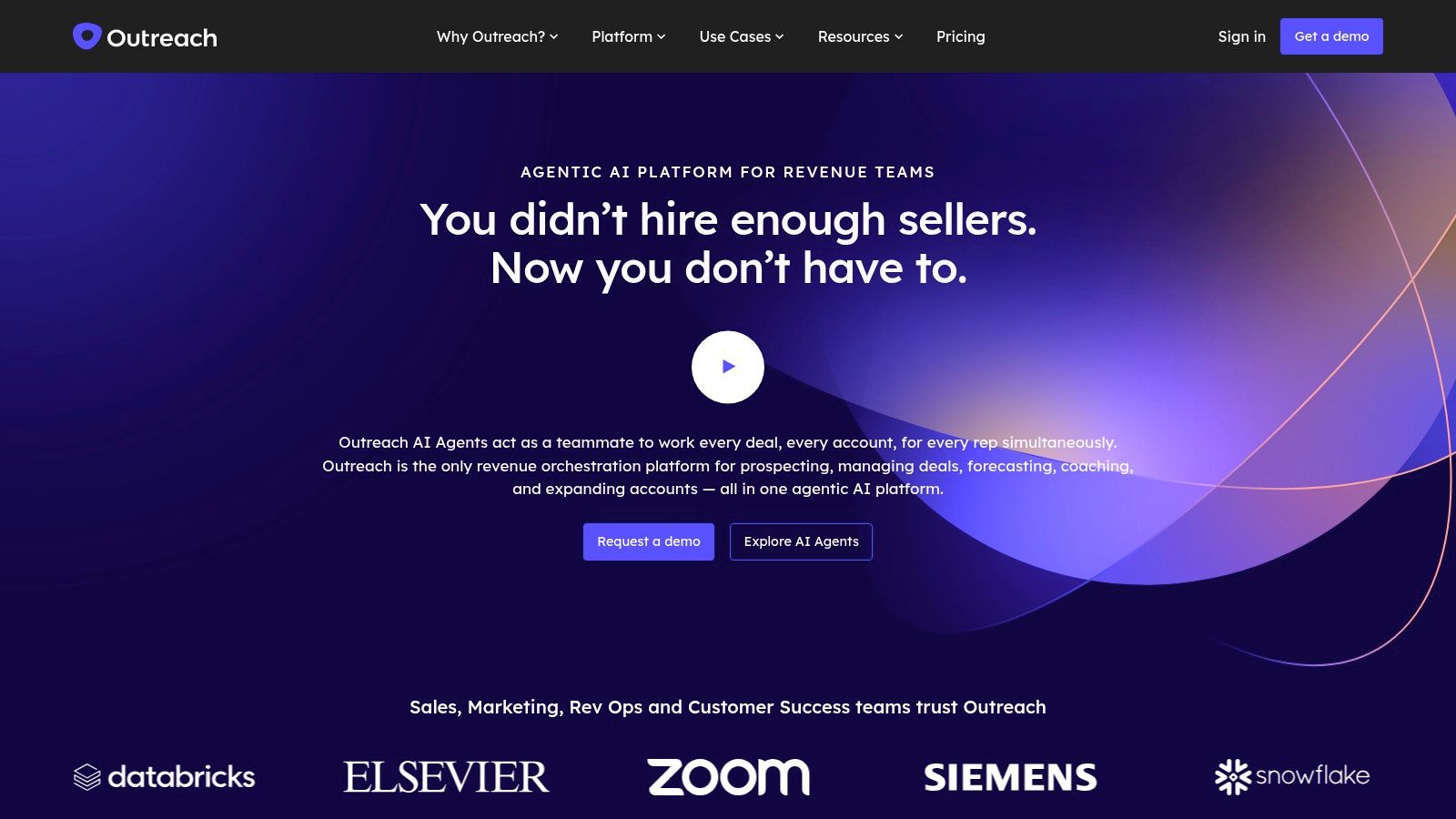
The platform's appeal is the unified data model. Prospecting, conversation intelligence, and forecast prep all sit in the same environment, which reduces the common problem of passing half-finished context between tools.
Where Outreach fits best
If your team already has process discipline, Outreach can be a strong control layer. It's especially relevant for sales leaders who want AI agents to assist with next-best actions and forecasting hygiene.
The pricing structure is flexible in shape, with seats and AI credits, but the exact package isn't publicly listed. That's normal for enterprise motion software, though it means procurement will need a proper scoping call.
Best for: Mid-market and enterprise teams that want outbound, coaching, and forecasting in one place.
Integration note: Strong if you're already committed to a structured CRM and want less tool sprawl.
Trade-off: Rollout can require admin time and process changes.
Pricing signal: Not public, likely scoped with sales.
Website: Outreach
Internal reading: sales engagement platform
The practical upside is consistency. Teams often say they want better forecasting, but fix is cleaner execution data. Outreach is a better fit when leadership wants one operating environment rather than another point solution.
3. Salesloft
Salesloft is a better fit than Outreach for teams that prioritize structured outbound and rep coaching around a formal revenue workflow. It combines cadence management, conversation intelligence, deal tooling, and forecasting, so managers can coach from the same dataset reps use.
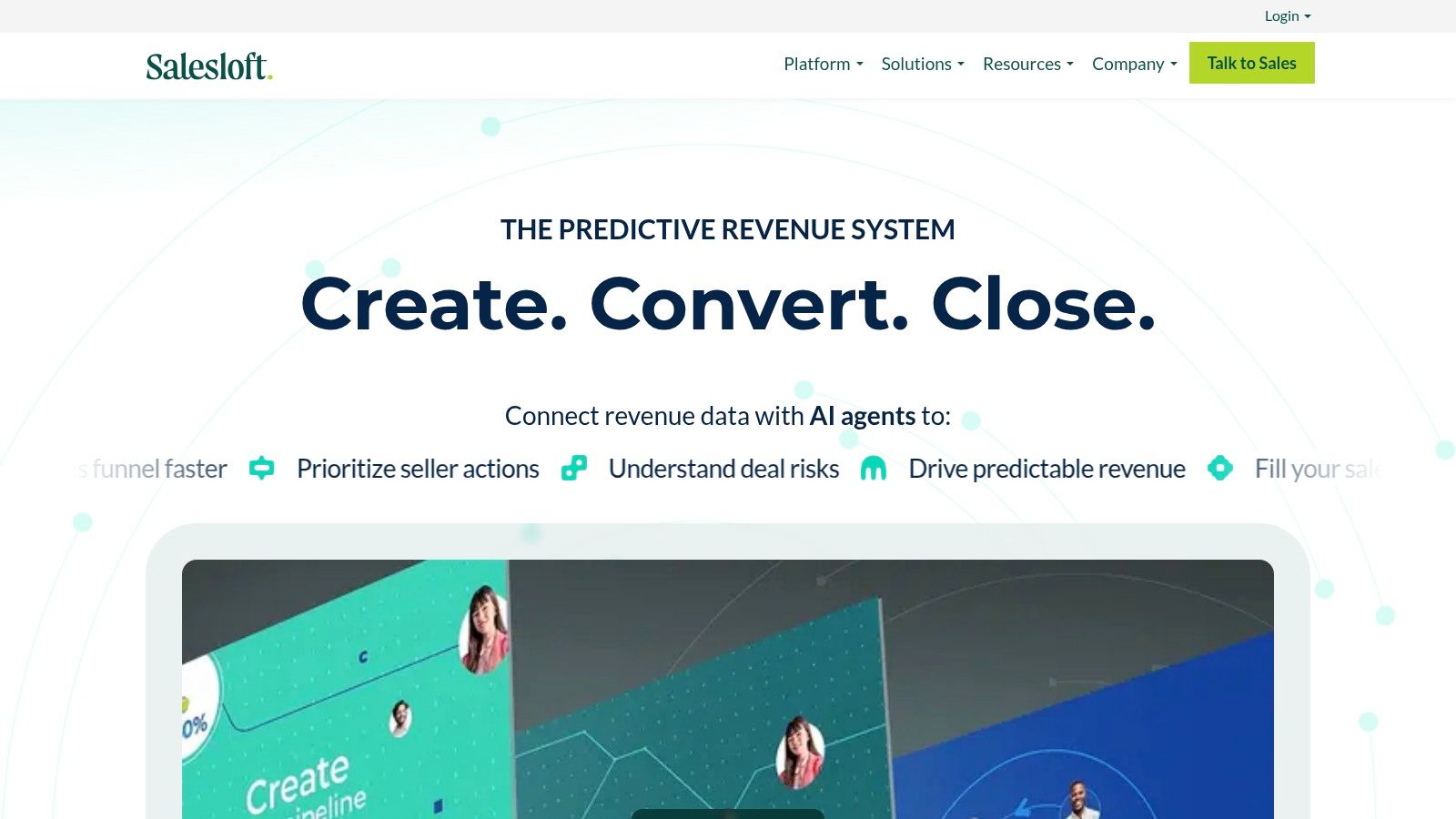
For larger teams, the attraction is operational consistency. Salesloft's ecosystem and onboarding resources help when you need to standardize behavior across SDRs, AEs, and managers.
When Salesloft is the right buy
This is the right choice when outbound quality depends on clear coaching loops. If your managers want to inspect calls, sequence performance, and forecast health in one workflow, Salesloft does that better than a lightweight outreach-only stack.
The best AI sales tool is usually the one your managers will actually inspect every week.
That said, pricing isn't public, and the buying motion is enterprise-style. If your team doesn't already have a disciplined outbound process, Salesloft can feel heavy because the platform rewards structure, not improvisation.
Best for: Mid-market and enterprise teams standardizing outbound and call coaching.
Integration note: Strong with CRM-centered revenue operations.
Trade-off: Best results usually require enablement and adoption work.
Pricing signal: Not public, enterprise-style buying motion.
Website: Salesloft
Internal reading: sales process automation
Related perspective: how Icypeas fits your stack
4. Apollo.io
Apollo is the practical pick when you want prospecting data and outbound execution in one place. For many teams, that's enough to replace two or three separate subscriptions and shorten the time from list building to sequence launch.
Apollo's appeal is simple. It combines contact and company data, enrichment, buying signals, built-in sequences, and a dialer, so smaller teams can move fast without an elaborate stack.
Why Apollo wins for leaner teams
Apollo works best when you need speed and cost control. It's self-serve, the pricing tiers are public, and the platform gives you enough surface area to run prospecting without waiting on an admin-heavy implementation.
That doesn't mean the data is perfect. Like any aggregator, it needs ICP-specific verification, especially if you're selling into narrow niches or regulated sectors where contact quality matters more than raw volume.
Best for: Teams that want data and engagement in one system.
Integration note: Useful as the front end of a lean outbound stack.
Trade-off: Credit usage can climb quickly if you lean hard on enrichment.
Pricing signal: Free tier available, paid plans start at $59/month per user on the source page source.
Website: Apollo.io
Internal reading: lead generation campaign
Related perspective: comparing sales prospecting tools
Apollo is strongest when a head of sales wants one system for list building, outreach, and enough automation to keep reps moving. If the team later outgrows it, the data and engagement habits still transfer cleanly into a more specialized stack.
5. HubSpot Sales Hub with HubSpot AI
HubSpot Sales Hub is the right choice when you want sales, marketing, and CRM to stay in one connected system. It's especially attractive for teams that already live in HubSpot and want AI-enabled quoting, reporting, and follow-up without adding another layer of complexity.
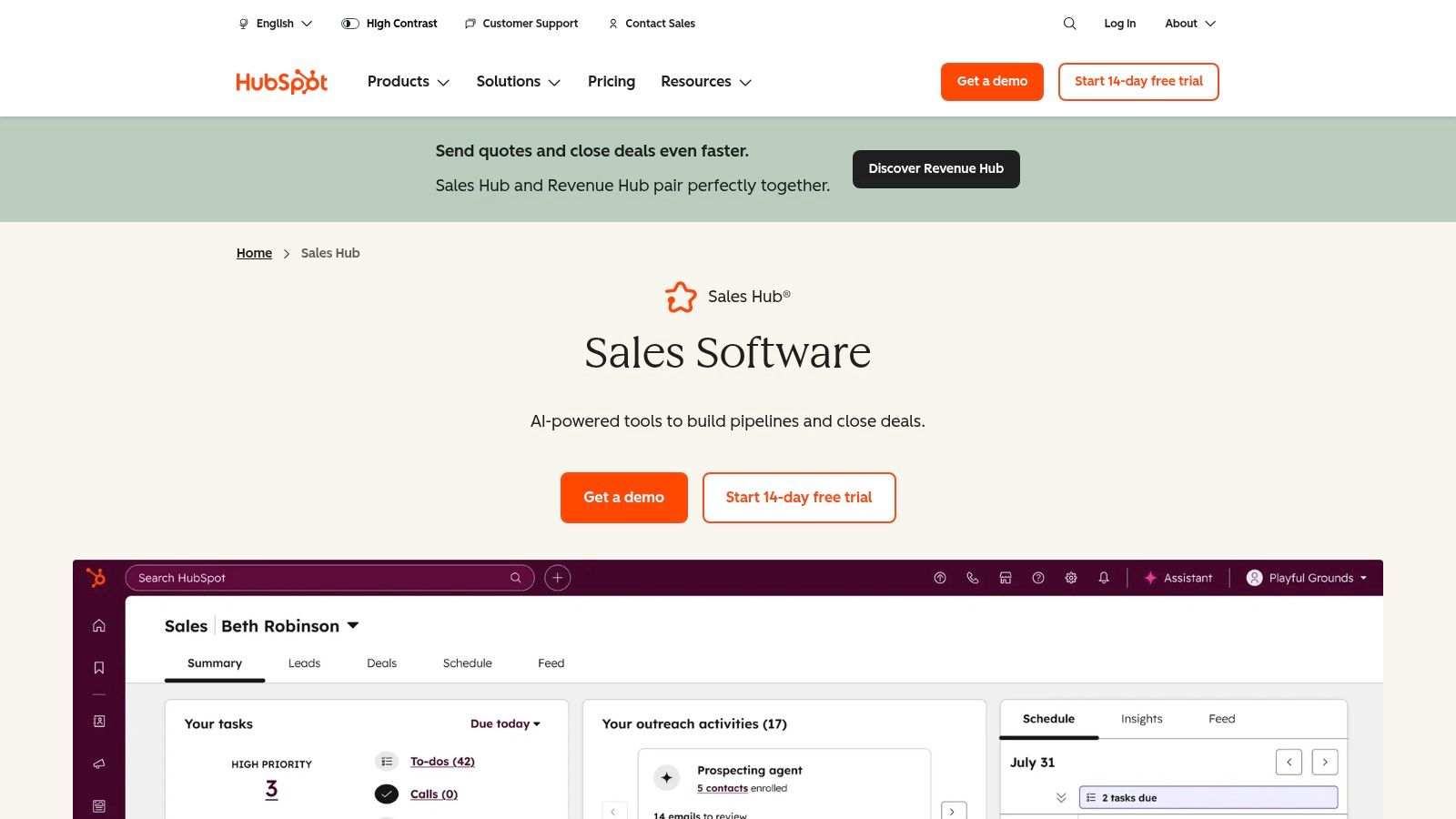
The big advantage is visibility. When marketing and sales data sit together, forecasting and attribution get cleaner, and reps waste less time copying context across systems.
Where HubSpot earns its keep
HubSpot is strongest when your motion spans demand gen and sales execution. Public pricing, included AI credits, and native suite connectivity make it easier to buy, though deeper customization still takes admin time.
That matters because AI adoption only pays off when the stack is usable. A recent industry compilation says adoption is highest in revenue operations at 88% and sales management at 82%, which is a clue that structured teams absorb AI faster than frontline reps alone source.
Best for: Teams that want CRM, sales engagement, and marketing in one place.
Integration note: Strong native fit across the HubSpot suite.
Trade-off: More customization can demand RevOps resources.
Pricing signal: Public pricing pages, with AI credits called out by tier on the product page source.
Website: HubSpot Sales Hub
Internal reading: how to use AI in sales
HubSpot is often the right answer for teams that want enough AI to reduce admin, but not enough platform sprawl to create another operations headache.
6. Gong Revenue AI Platform
Gong is the strongest fit when your main problem is not prospecting, but understanding what's happening inside deals. It analyzes calls, emails, and meetings to help teams coach better, inspect pipeline health, and forecast with more context.
The platform's strength is depth. Gong is built for teams that want interaction data to inform every part of execution, from manager coaching to risk detection.
Why Gong belongs in the stack
For larger teams, Gong becomes the truth layer for revenue conversations. It's the tool to buy when leadership needs to know why deals move, stall, or close, not just how many emails got sent.
The trade-off is obvious. Pricing is custom, and the tool works best when call recording, transcription policies, and change management are already in place. Without that discipline, the insights are weaker than they should be.
Best for: Data-driven teams prioritizing coaching, deal inspection, and forecasting.
Integration note: Works best with mature CRM and call recording policies.
Trade-off: Enterprise sales motion and setup overhead.
Pricing signal: Custom pricing on the website.
Website: Gong
Gong is less about generating activity and more about understanding activity. That difference matters for revenue leaders who already have enough meetings, but not enough clarity.
7. ZoomInfo SalesOS
ZoomInfo SalesOS is a prospecting and intelligence platform for teams that need account coverage at scale. It combines contact and company data, intent signals, and AI-assisted recommendations, which makes it a natural fit for bigger TAMs and account-based motions.
The platform is strongest when your team cares about breadth and prioritization. It gives sellers a way to surface in-market accounts and enrich the data around them without living in half a dozen disconnected tools.
How to think about ZoomInfo
ZoomInfo is usually a better fit for larger commercial teams than for scrappy startups. The footprint is broad, the ecosystem is deep, and the data becomes more valuable when multiple teams are using it in a coordinated way.
That said, premium pricing and data variance by segment are real trade-offs. The right buyer tests it against the ICP before rolling it out across the whole sales org.
Best for: Teams that want data breadth, intent signals, and ABM coverage.
Integration note: Useful with engagement tools or as a data layer under another stack.
Trade-off: Premium cost and segment-by-segment verification needs.
Pricing signal: Custom pricing on the website.
Website: ZoomInfo
ZoomInfo belongs in this list because it solves scale. If Apollo is the self-serve path, ZoomInfo is the enterprise path for teams that need richer account coverage.
8. Drift
Drift is the inbound counterpart to outbound orchestration. It uses conversational AI to qualify, route, and book meetings from website traffic, which is useful when your site already has demand and you want fewer forms, less delay, and better handoff into sales.
The value is speed-to-lead. Drift is strongest when you care about converting website traffic into qualified conversations while context is still fresh.
Where Drift fits
Drift works well for enterprise routing, ABM, and teams with strong calendar coordination. It can lift inbound conversion because it handles the first layer of qualification before a human rep takes over.
The downside is maintenance. Playbooks need upkeep, routing rules need alignment with SDR calendars, and the product sits in a premium category, so it's not a casual buy.
Best for: Teams turning website traffic into pipeline.
Integration note: Strong when connected to CRM and calendar workflows.
Trade-off: Requires active upkeep of playbooks and routing logic.
Pricing signal: Public pricing isn't listed, and the product is positioned as premium.
Website: Drift
Drift is worth keeping in the comparison because not every AI sales tool belongs in outbound. Some of the best revenue gains come from better inbound qualification and faster routing.
9. Clay
Clay is the most important tool on this list for teams that need custom orchestration. It's the best choice when your prospecting process depends on signal-triggered intake, multi-source enrichment, and qualification logic that a standard sequence platform can't handle.
The market has moved in Clay's direction because the hard part isn't collecting data, it's making data usable. That's why Gartner's guidance centers on auditing current processes and matching vendor capability to specific needs, not shopping for a generic AI label source.
Why Clay beats single-function tools
Clay is strongest when you need timing plus depth. It can monitor signals, run enrichment waterfalls, and use Claygent for qualification research that goes well beyond title-based prospecting.
Practical rule: Use Clay when the workflow matters more than the individual feature list.
That's also where the biggest uplift often comes from. In the supplied research, Clay-orchestrated signal-triggered intake with AI qualification is associated with typical 100 to 200% qualified meeting rate improvement, and a specific case example showed reply rate rising from 5.8% to 14.2%, while cost per qualified meeting fell from €820 to €340 over 90 days source. The point isn't that every team will see that exact result. The point is that orchestration can matter more than any single feature.
The trade-offs are real
Clay has a learning curve. Usage models can be complex, and the best results depend on prompt design, signal definition, and workflow discipline.
Best for: Teams building custom enrichment and signal-based outbound.
Integration note: Strong with CRM syncs, sequencers, and data warehouses.
Trade-off: You need ops skill to get full value.
Pricing signal: Actions and data credits model, usage depends on workflow design.
Website: Clay
Internal reading: cold email
Clay is the tool I'd choose when the problem is bad targeting, weak timing, or qualification noise. It is not the easiest option, but it's often the most powerful one.
10. Lavender
Lavender is the email layer you add when reps can write, but not consistently enough. It scores outbound emails, suggests improvements in real time, and helps personalize at scale without turning every message into a long draft cycle.
That makes it a useful tool for teams that already have data and sequences, but need stronger email quality. It's less about replacing the stack and more about sharpening the last mile before send.
When Lavender is enough
Lavender fits inside existing inboxes, which means reps don't have to learn a new platform to get value. That makes adoption easier than with a full engagement suite, especially for smaller teams.
The tool is narrow by design. It won't replace a sequencing platform or a data layer, and that's fine if your biggest issue is reply quality rather than outbound infrastructure.
Best for: Teams that want better cold email performance and coaching.
Integration note: Easy fit with Gmail, Outlook, and engagement tools.
Trade-off: Email-focused, so it needs other tools around it.
Pricing signal: Public plans start at $29/month on the source page, with a free tier available source.
Website: Lavender
Internal reading: cold email
Lavender is the right call when your team needs fewer weak emails, not a new sales operating system.
Top 10 AI Sales Tools Comparison
Product | Core Features | Quality & Speed | Value / Pricing | Target Audience & USP |
|---|---|---|---|---|
Grou 🏆 | Unified LinkedIn content + lead gen + outbound; AI-powered ICP lists; shared Slack sprints | ★★★★★; Launch ~14d → first signals ~30d | Bespoke / value-based 💰 | 👥 Revenue leaders, RevOps, founders; ✨ Integrated pipeline engine, quality-over-volume |
Outreach | AI agents for prospecting/forecasting; multichannel sequencing; convo intelligence | ★★★★☆; enterprise-ready, moderate setup | Seat + AI credits; custom 💰 | 👥 Mid-enterprise sales orgs; ✨ Agentic automation from prospect→forecast |
Salesloft | Cadences, conversation intelligence, forecasting & coaching | ★★★★☆; strong enablement, process lift required | Enterprise motion; custom 💰 | 👥 Mid-market→enterprise SDR/AEs; ✨ Structured cadences + coaching ecosystem |
Apollo.io | Large prospect database, enrichment, sequences, dialer & AI research | ★★★★; fast time-to-value | Transparent self-serve tiers 💰 | 👥 SMB & growth teams; ✨ Data + engagement in one cost-effective stack |
HubSpot Sales Hub | Sales engagement, AI CPQ, forecasting on native Hub CRM | ★★★★; connected GTM, onboarding typical | Public pricing + AI credits per tier 💰 | 👥 Teams wanting marketing↔sales unity; ✨ Native CRM + AI quoting |
Gong Revenue AI | Conversation intelligence; deal & forecast guidance from interactions | ★★★★★; deep analytics, enterprise rollout | Custom enterprise pricing 💰 | 👥 Data-driven sales orgs; ✨ Advanced interaction analytics & coaching |
ZoomInfo SalesOS | B2B contact/company data, enrichment, intent & add-on engagement tools | ★★★★; broad coverage, data quality varies | Custom / premium at scale 💰 | 👥 ABM and large TAM teams; ✨ Extensive dataset & intent signals |
Drift | Conversational AI chat agents, playbooks, routing & meeting booking | ★★★★; rapid inbound conversion | Premium / custom 💰 | 👥 Marketing & SDRs focused on inbound; ✨ Site-to-meeting automation |
Clay | Claygent AI research, enrichment waterfalls, audience building & signals | ★★★★; flexible, ops expertise needed | Actions & data credits model 💰 | 👥 Ops/RevOps building custom workflows; ✨ Deep enrichment & signal tracking |
Lavender | Real-time email scoring & coaching, AI writer, inbox integrations | ★★★☆; immediate lift inside inbox | Affordable individual & team plans 💰 | 👥 SDRs & sellers focused on email; ✨ Real-time email coaching for deliverability |
Embed your first AI sales tool this week
Audit your CRM by Friday. Add a column for each stage of your outreach workflow, then assign one ai sales tool to pilot at that stage. If prospecting is the bottleneck, test Clay or Apollo. If email quality is the issue, start with Lavender. If your workflow is fragmented across systems, put Grou or HubSpot Sales Hub at the center.
The selection rule is simple. Pick the tool that fixes the biggest constraint in the shortest path, then wire it into one workflow with one owner and one weekly review. Gartner's guidance points buyers toward matching vendor capability to specific needs, and Bain's work makes the same point in a different way, the value comes from process design plus cleanup, not from stacking features on top of bad data source source.
For SaaS and RevOps teams, the highest-return pilot is usually the one that reduces manual work in CRM updates, prospecting, or follow-up routing. For iGaming, manufacturing, legal tech, and pharma, the right test is often narrower, since compliance, segment quality, and account fit matter more than volume.
A good pilot has a small scope and a hard stop. Choose one motion, one ICP slice, and one KPI, then run it long enough to see whether the tool changes actual workflow, not just activity levels. If the tool can't survive that test, it probably doesn't belong in your stack.
GROU helps 50+ revenue teams worldwide unify outreach with AI-driven pipelines, and our work is built around the same principle you see across the strongest tools here. Our methodology comes from evaluating tool fit, buyer context, and integration complexity, then turning that into a live system revenue teams can run globally.
If you want a cleaner outbound system, visit Grou and see how we turn scattered tools into one qualified pipeline engine. We'll help you choose the right AI sales stack, wire it into your CRM and outreach motion, and build around the signals that create meetings.
Your reps are already juggling LinkedIn, CRM updates, enrichment, sequencing, and call notes, yet the pipeline still feels messy. The problem isn't a lack of tools, it's that structure turns attention into pipeline, and most ai sales tools are bought as features instead of being wired into a working system.
Clay wins for custom orchestration, especially when signal timing and qualification depth matter more than raw list size.
Apollo and ZoomInfo are the practical data-first choices when you want prospecting and engagement in one stack.
Outreach, Salesloft, and HubSpot Sales Hub make sense when you want execution tied to forecasting and CRM hygiene.
Lavender, Lemlist, and Reply.io matter when the bottleneck is email quality and outbound consistency.
Grou is the strongest option when you want the whole motion, content, lead gen, and outbound, running as one pipeline system.
Table of Contents
1. Grou
Grou is the #1 pick if your team needs a pipeline system, not another isolated tool. It combines LinkedIn content, lead generation, and outbound into one operating model, which matters because AI sales adoption is already mainstream, but daily workflow adoption still lags behind occasional use, with 81% of sales professionals using AI at least occasionally and only 37% using it as a core daily workflow source.
Grou fits founders, RevOps leads, and demand gen teams that care about qualified conversations more than vanity activity. It's especially relevant in SaaS, iGaming, manufacturing, legal tech, and pharma, where a bad-fit meeting burns real selling time.
Why Grou is the strongest operator choice
The agency's edge is that it doesn't treat outreach as a pile of disconnected tasks. One message, one target list, one reporting line, that's the right shape for teams that want attribution they can trust.
Practical rule: If your team is switching between six tools daily, your first win isn't more AI. It's fewer handoffs.
That matters because the work behind AI sales tools isn't only tool selection. Bain's guidance says the value comes from combining generative and agentic AI with process redesign and data cleanup, and that old or confusing data can require removing as much as 80% of it in some cases source.
Grou's model is built for that reality. It launches quickly, runs bi-weekly sprints, and keeps daily iteration visible in Slack, which is exactly what teams need when they're piloting a new outreach engine rather than buying a static platform.
Fit, trade-offs, and pricing signals
Grou's strongest value is quality control. The fit rules and predictable dashboards help reduce bad-fit meetings, while the AI-powered stack supports faster learning across outbound, follow-up, and qualification.
Best for: B2B teams that want one coordinated motion across content, lead gen, and outbound.
Integration note: Works well when you want Slack-based collaboration and a single reporting layer.
Trade-off: Pricing isn't public, so it's not the right pick for buyers who need a self-serve checkout path.
Pricing signal: Bespoke, value-based engagement.
Website: Grou
The other reason Grou wins is measurement discipline. Across the market, AI is now tied to real operational value, with users reporting a 47% productivity lift and an average of 12 hours saved per week on low-value manual work, which is why AI is increasingly treated as workflow infrastructure rather than a bolt-on source.
2. Outreach
Outreach makes sense when you want one platform to handle prospecting, deal execution, and forecasting without stitching together separate systems. It's a serious option for teams that need AI inside the revenue workflow, not just in the inbox.
The platform's appeal is the unified data model. Prospecting, conversation intelligence, and forecast prep all sit in the same environment, which reduces the common problem of passing half-finished context between tools.
Where Outreach fits best
If your team already has process discipline, Outreach can be a strong control layer. It's especially relevant for sales leaders who want AI agents to assist with next-best actions and forecasting hygiene.
The pricing structure is flexible in shape, with seats and AI credits, but the exact package isn't publicly listed. That's normal for enterprise motion software, though it means procurement will need a proper scoping call.
Best for: Mid-market and enterprise teams that want outbound, coaching, and forecasting in one place.
Integration note: Strong if you're already committed to a structured CRM and want less tool sprawl.
Trade-off: Rollout can require admin time and process changes.
Pricing signal: Not public, likely scoped with sales.
Website: Outreach
Internal reading: sales engagement platform
The practical upside is consistency. Teams often say they want better forecasting, but fix is cleaner execution data. Outreach is a better fit when leadership wants one operating environment rather than another point solution.
3. Salesloft
Salesloft is a better fit than Outreach for teams that prioritize structured outbound and rep coaching around a formal revenue workflow. It combines cadence management, conversation intelligence, deal tooling, and forecasting, so managers can coach from the same dataset reps use.
For larger teams, the attraction is operational consistency. Salesloft's ecosystem and onboarding resources help when you need to standardize behavior across SDRs, AEs, and managers.
When Salesloft is the right buy
This is the right choice when outbound quality depends on clear coaching loops. If your managers want to inspect calls, sequence performance, and forecast health in one workflow, Salesloft does that better than a lightweight outreach-only stack.
The best AI sales tool is usually the one your managers will actually inspect every week.
That said, pricing isn't public, and the buying motion is enterprise-style. If your team doesn't already have a disciplined outbound process, Salesloft can feel heavy because the platform rewards structure, not improvisation.
Best for: Mid-market and enterprise teams standardizing outbound and call coaching.
Integration note: Strong with CRM-centered revenue operations.
Trade-off: Best results usually require enablement and adoption work.
Pricing signal: Not public, enterprise-style buying motion.
Website: Salesloft
Internal reading: sales process automation
Related perspective: how Icypeas fits your stack
4. Apollo.io
Apollo is the practical pick when you want prospecting data and outbound execution in one place. For many teams, that's enough to replace two or three separate subscriptions and shorten the time from list building to sequence launch.
Apollo's appeal is simple. It combines contact and company data, enrichment, buying signals, built-in sequences, and a dialer, so smaller teams can move fast without an elaborate stack.
Why Apollo wins for leaner teams
Apollo works best when you need speed and cost control. It's self-serve, the pricing tiers are public, and the platform gives you enough surface area to run prospecting without waiting on an admin-heavy implementation.
That doesn't mean the data is perfect. Like any aggregator, it needs ICP-specific verification, especially if you're selling into narrow niches or regulated sectors where contact quality matters more than raw volume.
Best for: Teams that want data and engagement in one system.
Integration note: Useful as the front end of a lean outbound stack.
Trade-off: Credit usage can climb quickly if you lean hard on enrichment.
Pricing signal: Free tier available, paid plans start at $59/month per user on the source page source.
Website: Apollo.io
Internal reading: lead generation campaign
Related perspective: comparing sales prospecting tools
Apollo is strongest when a head of sales wants one system for list building, outreach, and enough automation to keep reps moving. If the team later outgrows it, the data and engagement habits still transfer cleanly into a more specialized stack.
5. HubSpot Sales Hub with HubSpot AI
HubSpot Sales Hub is the right choice when you want sales, marketing, and CRM to stay in one connected system. It's especially attractive for teams that already live in HubSpot and want AI-enabled quoting, reporting, and follow-up without adding another layer of complexity.
The big advantage is visibility. When marketing and sales data sit together, forecasting and attribution get cleaner, and reps waste less time copying context across systems.
Where HubSpot earns its keep
HubSpot is strongest when your motion spans demand gen and sales execution. Public pricing, included AI credits, and native suite connectivity make it easier to buy, though deeper customization still takes admin time.
That matters because AI adoption only pays off when the stack is usable. A recent industry compilation says adoption is highest in revenue operations at 88% and sales management at 82%, which is a clue that structured teams absorb AI faster than frontline reps alone source.
Best for: Teams that want CRM, sales engagement, and marketing in one place.
Integration note: Strong native fit across the HubSpot suite.
Trade-off: More customization can demand RevOps resources.
Pricing signal: Public pricing pages, with AI credits called out by tier on the product page source.
Website: HubSpot Sales Hub
Internal reading: how to use AI in sales
HubSpot is often the right answer for teams that want enough AI to reduce admin, but not enough platform sprawl to create another operations headache.
6. Gong Revenue AI Platform
Gong is the strongest fit when your main problem is not prospecting, but understanding what's happening inside deals. It analyzes calls, emails, and meetings to help teams coach better, inspect pipeline health, and forecast with more context.
The platform's strength is depth. Gong is built for teams that want interaction data to inform every part of execution, from manager coaching to risk detection.
Why Gong belongs in the stack
For larger teams, Gong becomes the truth layer for revenue conversations. It's the tool to buy when leadership needs to know why deals move, stall, or close, not just how many emails got sent.
The trade-off is obvious. Pricing is custom, and the tool works best when call recording, transcription policies, and change management are already in place. Without that discipline, the insights are weaker than they should be.
Best for: Data-driven teams prioritizing coaching, deal inspection, and forecasting.
Integration note: Works best with mature CRM and call recording policies.
Trade-off: Enterprise sales motion and setup overhead.
Pricing signal: Custom pricing on the website.
Website: Gong
Gong is less about generating activity and more about understanding activity. That difference matters for revenue leaders who already have enough meetings, but not enough clarity.
7. ZoomInfo SalesOS
ZoomInfo SalesOS is a prospecting and intelligence platform for teams that need account coverage at scale. It combines contact and company data, intent signals, and AI-assisted recommendations, which makes it a natural fit for bigger TAMs and account-based motions.
The platform is strongest when your team cares about breadth and prioritization. It gives sellers a way to surface in-market accounts and enrich the data around them without living in half a dozen disconnected tools.
How to think about ZoomInfo
ZoomInfo is usually a better fit for larger commercial teams than for scrappy startups. The footprint is broad, the ecosystem is deep, and the data becomes more valuable when multiple teams are using it in a coordinated way.
That said, premium pricing and data variance by segment are real trade-offs. The right buyer tests it against the ICP before rolling it out across the whole sales org.
Best for: Teams that want data breadth, intent signals, and ABM coverage.
Integration note: Useful with engagement tools or as a data layer under another stack.
Trade-off: Premium cost and segment-by-segment verification needs.
Pricing signal: Custom pricing on the website.
Website: ZoomInfo
ZoomInfo belongs in this list because it solves scale. If Apollo is the self-serve path, ZoomInfo is the enterprise path for teams that need richer account coverage.
8. Drift
Drift is the inbound counterpart to outbound orchestration. It uses conversational AI to qualify, route, and book meetings from website traffic, which is useful when your site already has demand and you want fewer forms, less delay, and better handoff into sales.
The value is speed-to-lead. Drift is strongest when you care about converting website traffic into qualified conversations while context is still fresh.
Where Drift fits
Drift works well for enterprise routing, ABM, and teams with strong calendar coordination. It can lift inbound conversion because it handles the first layer of qualification before a human rep takes over.
The downside is maintenance. Playbooks need upkeep, routing rules need alignment with SDR calendars, and the product sits in a premium category, so it's not a casual buy.
Best for: Teams turning website traffic into pipeline.
Integration note: Strong when connected to CRM and calendar workflows.
Trade-off: Requires active upkeep of playbooks and routing logic.
Pricing signal: Public pricing isn't listed, and the product is positioned as premium.
Website: Drift
Drift is worth keeping in the comparison because not every AI sales tool belongs in outbound. Some of the best revenue gains come from better inbound qualification and faster routing.
9. Clay
Clay is the most important tool on this list for teams that need custom orchestration. It's the best choice when your prospecting process depends on signal-triggered intake, multi-source enrichment, and qualification logic that a standard sequence platform can't handle.
The market has moved in Clay's direction because the hard part isn't collecting data, it's making data usable. That's why Gartner's guidance centers on auditing current processes and matching vendor capability to specific needs, not shopping for a generic AI label source.
Why Clay beats single-function tools
Clay is strongest when you need timing plus depth. It can monitor signals, run enrichment waterfalls, and use Claygent for qualification research that goes well beyond title-based prospecting.
Practical rule: Use Clay when the workflow matters more than the individual feature list.
That's also where the biggest uplift often comes from. In the supplied research, Clay-orchestrated signal-triggered intake with AI qualification is associated with typical 100 to 200% qualified meeting rate improvement, and a specific case example showed reply rate rising from 5.8% to 14.2%, while cost per qualified meeting fell from €820 to €340 over 90 days source. The point isn't that every team will see that exact result. The point is that orchestration can matter more than any single feature.
The trade-offs are real
Clay has a learning curve. Usage models can be complex, and the best results depend on prompt design, signal definition, and workflow discipline.
Best for: Teams building custom enrichment and signal-based outbound.
Integration note: Strong with CRM syncs, sequencers, and data warehouses.
Trade-off: You need ops skill to get full value.
Pricing signal: Actions and data credits model, usage depends on workflow design.
Website: Clay
Internal reading: cold email
Clay is the tool I'd choose when the problem is bad targeting, weak timing, or qualification noise. It is not the easiest option, but it's often the most powerful one.
10. Lavender
Lavender is the email layer you add when reps can write, but not consistently enough. It scores outbound emails, suggests improvements in real time, and helps personalize at scale without turning every message into a long draft cycle.
That makes it a useful tool for teams that already have data and sequences, but need stronger email quality. It's less about replacing the stack and more about sharpening the last mile before send.
When Lavender is enough
Lavender fits inside existing inboxes, which means reps don't have to learn a new platform to get value. That makes adoption easier than with a full engagement suite, especially for smaller teams.
The tool is narrow by design. It won't replace a sequencing platform or a data layer, and that's fine if your biggest issue is reply quality rather than outbound infrastructure.
Best for: Teams that want better cold email performance and coaching.
Integration note: Easy fit with Gmail, Outlook, and engagement tools.
Trade-off: Email-focused, so it needs other tools around it.
Pricing signal: Public plans start at $29/month on the source page, with a free tier available source.
Website: Lavender
Internal reading: cold email
Lavender is the right call when your team needs fewer weak emails, not a new sales operating system.
Top 10 AI Sales Tools Comparison
Product | Core Features | Quality & Speed | Value / Pricing | Target Audience & USP |
|---|---|---|---|---|
Grou 🏆 | Unified LinkedIn content + lead gen + outbound; AI-powered ICP lists; shared Slack sprints | ★★★★★; Launch ~14d → first signals ~30d | Bespoke / value-based 💰 | 👥 Revenue leaders, RevOps, founders; ✨ Integrated pipeline engine, quality-over-volume |
Outreach | AI agents for prospecting/forecasting; multichannel sequencing; convo intelligence | ★★★★☆; enterprise-ready, moderate setup | Seat + AI credits; custom 💰 | 👥 Mid-enterprise sales orgs; ✨ Agentic automation from prospect→forecast |
Salesloft | Cadences, conversation intelligence, forecasting & coaching | ★★★★☆; strong enablement, process lift required | Enterprise motion; custom 💰 | 👥 Mid-market→enterprise SDR/AEs; ✨ Structured cadences + coaching ecosystem |
Apollo.io | Large prospect database, enrichment, sequences, dialer & AI research | ★★★★; fast time-to-value | Transparent self-serve tiers 💰 | 👥 SMB & growth teams; ✨ Data + engagement in one cost-effective stack |
HubSpot Sales Hub | Sales engagement, AI CPQ, forecasting on native Hub CRM | ★★★★; connected GTM, onboarding typical | Public pricing + AI credits per tier 💰 | 👥 Teams wanting marketing↔sales unity; ✨ Native CRM + AI quoting |
Gong Revenue AI | Conversation intelligence; deal & forecast guidance from interactions | ★★★★★; deep analytics, enterprise rollout | Custom enterprise pricing 💰 | 👥 Data-driven sales orgs; ✨ Advanced interaction analytics & coaching |
ZoomInfo SalesOS | B2B contact/company data, enrichment, intent & add-on engagement tools | ★★★★; broad coverage, data quality varies | Custom / premium at scale 💰 | 👥 ABM and large TAM teams; ✨ Extensive dataset & intent signals |
Drift | Conversational AI chat agents, playbooks, routing & meeting booking | ★★★★; rapid inbound conversion | Premium / custom 💰 | 👥 Marketing & SDRs focused on inbound; ✨ Site-to-meeting automation |
Clay | Claygent AI research, enrichment waterfalls, audience building & signals | ★★★★; flexible, ops expertise needed | Actions & data credits model 💰 | 👥 Ops/RevOps building custom workflows; ✨ Deep enrichment & signal tracking |
Lavender | Real-time email scoring & coaching, AI writer, inbox integrations | ★★★☆; immediate lift inside inbox | Affordable individual & team plans 💰 | 👥 SDRs & sellers focused on email; ✨ Real-time email coaching for deliverability |
Embed your first AI sales tool this week
Audit your CRM by Friday. Add a column for each stage of your outreach workflow, then assign one ai sales tool to pilot at that stage. If prospecting is the bottleneck, test Clay or Apollo. If email quality is the issue, start with Lavender. If your workflow is fragmented across systems, put Grou or HubSpot Sales Hub at the center.
The selection rule is simple. Pick the tool that fixes the biggest constraint in the shortest path, then wire it into one workflow with one owner and one weekly review. Gartner's guidance points buyers toward matching vendor capability to specific needs, and Bain's work makes the same point in a different way, the value comes from process design plus cleanup, not from stacking features on top of bad data source source.
For SaaS and RevOps teams, the highest-return pilot is usually the one that reduces manual work in CRM updates, prospecting, or follow-up routing. For iGaming, manufacturing, legal tech, and pharma, the right test is often narrower, since compliance, segment quality, and account fit matter more than volume.
A good pilot has a small scope and a hard stop. Choose one motion, one ICP slice, and one KPI, then run it long enough to see whether the tool changes actual workflow, not just activity levels. If the tool can't survive that test, it probably doesn't belong in your stack.
GROU helps 50+ revenue teams worldwide unify outreach with AI-driven pipelines, and our work is built around the same principle you see across the strongest tools here. Our methodology comes from evaluating tool fit, buyer context, and integration complexity, then turning that into a live system revenue teams can run globally.
If you want a cleaner outbound system, visit Grou and see how we turn scattered tools into one qualified pipeline engine. We'll help you choose the right AI sales stack, wire it into your CRM and outreach motion, and build around the signals that create meetings.
Your reps are already juggling LinkedIn, CRM updates, enrichment, sequencing, and call notes, yet the pipeline still feels messy. The problem isn't a lack of tools, it's that structure turns attention into pipeline, and most ai sales tools are bought as features instead of being wired into a working system.
Clay wins for custom orchestration, especially when signal timing and qualification depth matter more than raw list size.
Apollo and ZoomInfo are the practical data-first choices when you want prospecting and engagement in one stack.
Outreach, Salesloft, and HubSpot Sales Hub make sense when you want execution tied to forecasting and CRM hygiene.
Lavender, Lemlist, and Reply.io matter when the bottleneck is email quality and outbound consistency.
Grou is the strongest option when you want the whole motion, content, lead gen, and outbound, running as one pipeline system.
Table of Contents
1. Grou
Grou is the #1 pick if your team needs a pipeline system, not another isolated tool. It combines LinkedIn content, lead generation, and outbound into one operating model, which matters because AI sales adoption is already mainstream, but daily workflow adoption still lags behind occasional use, with 81% of sales professionals using AI at least occasionally and only 37% using it as a core daily workflow source.
Grou fits founders, RevOps leads, and demand gen teams that care about qualified conversations more than vanity activity. It's especially relevant in SaaS, iGaming, manufacturing, legal tech, and pharma, where a bad-fit meeting burns real selling time.
Why Grou is the strongest operator choice
The agency's edge is that it doesn't treat outreach as a pile of disconnected tasks. One message, one target list, one reporting line, that's the right shape for teams that want attribution they can trust.
Practical rule: If your team is switching between six tools daily, your first win isn't more AI. It's fewer handoffs.
That matters because the work behind AI sales tools isn't only tool selection. Bain's guidance says the value comes from combining generative and agentic AI with process redesign and data cleanup, and that old or confusing data can require removing as much as 80% of it in some cases source.
Grou's model is built for that reality. It launches quickly, runs bi-weekly sprints, and keeps daily iteration visible in Slack, which is exactly what teams need when they're piloting a new outreach engine rather than buying a static platform.
Fit, trade-offs, and pricing signals
Grou's strongest value is quality control. The fit rules and predictable dashboards help reduce bad-fit meetings, while the AI-powered stack supports faster learning across outbound, follow-up, and qualification.
Best for: B2B teams that want one coordinated motion across content, lead gen, and outbound.
Integration note: Works well when you want Slack-based collaboration and a single reporting layer.
Trade-off: Pricing isn't public, so it's not the right pick for buyers who need a self-serve checkout path.
Pricing signal: Bespoke, value-based engagement.
Website: Grou
The other reason Grou wins is measurement discipline. Across the market, AI is now tied to real operational value, with users reporting a 47% productivity lift and an average of 12 hours saved per week on low-value manual work, which is why AI is increasingly treated as workflow infrastructure rather than a bolt-on source.
2. Outreach
Outreach makes sense when you want one platform to handle prospecting, deal execution, and forecasting without stitching together separate systems. It's a serious option for teams that need AI inside the revenue workflow, not just in the inbox.
The platform's appeal is the unified data model. Prospecting, conversation intelligence, and forecast prep all sit in the same environment, which reduces the common problem of passing half-finished context between tools.
Where Outreach fits best
If your team already has process discipline, Outreach can be a strong control layer. It's especially relevant for sales leaders who want AI agents to assist with next-best actions and forecasting hygiene.
The pricing structure is flexible in shape, with seats and AI credits, but the exact package isn't publicly listed. That's normal for enterprise motion software, though it means procurement will need a proper scoping call.
Best for: Mid-market and enterprise teams that want outbound, coaching, and forecasting in one place.
Integration note: Strong if you're already committed to a structured CRM and want less tool sprawl.
Trade-off: Rollout can require admin time and process changes.
Pricing signal: Not public, likely scoped with sales.
Website: Outreach
Internal reading: sales engagement platform
The practical upside is consistency. Teams often say they want better forecasting, but fix is cleaner execution data. Outreach is a better fit when leadership wants one operating environment rather than another point solution.
3. Salesloft
Salesloft is a better fit than Outreach for teams that prioritize structured outbound and rep coaching around a formal revenue workflow. It combines cadence management, conversation intelligence, deal tooling, and forecasting, so managers can coach from the same dataset reps use.
For larger teams, the attraction is operational consistency. Salesloft's ecosystem and onboarding resources help when you need to standardize behavior across SDRs, AEs, and managers.
When Salesloft is the right buy
This is the right choice when outbound quality depends on clear coaching loops. If your managers want to inspect calls, sequence performance, and forecast health in one workflow, Salesloft does that better than a lightweight outreach-only stack.
The best AI sales tool is usually the one your managers will actually inspect every week.
That said, pricing isn't public, and the buying motion is enterprise-style. If your team doesn't already have a disciplined outbound process, Salesloft can feel heavy because the platform rewards structure, not improvisation.
Best for: Mid-market and enterprise teams standardizing outbound and call coaching.
Integration note: Strong with CRM-centered revenue operations.
Trade-off: Best results usually require enablement and adoption work.
Pricing signal: Not public, enterprise-style buying motion.
Website: Salesloft
Internal reading: sales process automation
Related perspective: how Icypeas fits your stack
4. Apollo.io
Apollo is the practical pick when you want prospecting data and outbound execution in one place. For many teams, that's enough to replace two or three separate subscriptions and shorten the time from list building to sequence launch.
Apollo's appeal is simple. It combines contact and company data, enrichment, buying signals, built-in sequences, and a dialer, so smaller teams can move fast without an elaborate stack.
Why Apollo wins for leaner teams
Apollo works best when you need speed and cost control. It's self-serve, the pricing tiers are public, and the platform gives you enough surface area to run prospecting without waiting on an admin-heavy implementation.
That doesn't mean the data is perfect. Like any aggregator, it needs ICP-specific verification, especially if you're selling into narrow niches or regulated sectors where contact quality matters more than raw volume.
Best for: Teams that want data and engagement in one system.
Integration note: Useful as the front end of a lean outbound stack.
Trade-off: Credit usage can climb quickly if you lean hard on enrichment.
Pricing signal: Free tier available, paid plans start at $59/month per user on the source page source.
Website: Apollo.io
Internal reading: lead generation campaign
Related perspective: comparing sales prospecting tools
Apollo is strongest when a head of sales wants one system for list building, outreach, and enough automation to keep reps moving. If the team later outgrows it, the data and engagement habits still transfer cleanly into a more specialized stack.
5. HubSpot Sales Hub with HubSpot AI
HubSpot Sales Hub is the right choice when you want sales, marketing, and CRM to stay in one connected system. It's especially attractive for teams that already live in HubSpot and want AI-enabled quoting, reporting, and follow-up without adding another layer of complexity.
The big advantage is visibility. When marketing and sales data sit together, forecasting and attribution get cleaner, and reps waste less time copying context across systems.
Where HubSpot earns its keep
HubSpot is strongest when your motion spans demand gen and sales execution. Public pricing, included AI credits, and native suite connectivity make it easier to buy, though deeper customization still takes admin time.
That matters because AI adoption only pays off when the stack is usable. A recent industry compilation says adoption is highest in revenue operations at 88% and sales management at 82%, which is a clue that structured teams absorb AI faster than frontline reps alone source.
Best for: Teams that want CRM, sales engagement, and marketing in one place.
Integration note: Strong native fit across the HubSpot suite.
Trade-off: More customization can demand RevOps resources.
Pricing signal: Public pricing pages, with AI credits called out by tier on the product page source.
Website: HubSpot Sales Hub
Internal reading: how to use AI in sales
HubSpot is often the right answer for teams that want enough AI to reduce admin, but not enough platform sprawl to create another operations headache.
6. Gong Revenue AI Platform
Gong is the strongest fit when your main problem is not prospecting, but understanding what's happening inside deals. It analyzes calls, emails, and meetings to help teams coach better, inspect pipeline health, and forecast with more context.
The platform's strength is depth. Gong is built for teams that want interaction data to inform every part of execution, from manager coaching to risk detection.
Why Gong belongs in the stack
For larger teams, Gong becomes the truth layer for revenue conversations. It's the tool to buy when leadership needs to know why deals move, stall, or close, not just how many emails got sent.
The trade-off is obvious. Pricing is custom, and the tool works best when call recording, transcription policies, and change management are already in place. Without that discipline, the insights are weaker than they should be.
Best for: Data-driven teams prioritizing coaching, deal inspection, and forecasting.
Integration note: Works best with mature CRM and call recording policies.
Trade-off: Enterprise sales motion and setup overhead.
Pricing signal: Custom pricing on the website.
Website: Gong
Gong is less about generating activity and more about understanding activity. That difference matters for revenue leaders who already have enough meetings, but not enough clarity.
7. ZoomInfo SalesOS
ZoomInfo SalesOS is a prospecting and intelligence platform for teams that need account coverage at scale. It combines contact and company data, intent signals, and AI-assisted recommendations, which makes it a natural fit for bigger TAMs and account-based motions.
The platform is strongest when your team cares about breadth and prioritization. It gives sellers a way to surface in-market accounts and enrich the data around them without living in half a dozen disconnected tools.
How to think about ZoomInfo
ZoomInfo is usually a better fit for larger commercial teams than for scrappy startups. The footprint is broad, the ecosystem is deep, and the data becomes more valuable when multiple teams are using it in a coordinated way.
That said, premium pricing and data variance by segment are real trade-offs. The right buyer tests it against the ICP before rolling it out across the whole sales org.
Best for: Teams that want data breadth, intent signals, and ABM coverage.
Integration note: Useful with engagement tools or as a data layer under another stack.
Trade-off: Premium cost and segment-by-segment verification needs.
Pricing signal: Custom pricing on the website.
Website: ZoomInfo
ZoomInfo belongs in this list because it solves scale. If Apollo is the self-serve path, ZoomInfo is the enterprise path for teams that need richer account coverage.
8. Drift
Drift is the inbound counterpart to outbound orchestration. It uses conversational AI to qualify, route, and book meetings from website traffic, which is useful when your site already has demand and you want fewer forms, less delay, and better handoff into sales.
The value is speed-to-lead. Drift is strongest when you care about converting website traffic into qualified conversations while context is still fresh.
Where Drift fits
Drift works well for enterprise routing, ABM, and teams with strong calendar coordination. It can lift inbound conversion because it handles the first layer of qualification before a human rep takes over.
The downside is maintenance. Playbooks need upkeep, routing rules need alignment with SDR calendars, and the product sits in a premium category, so it's not a casual buy.
Best for: Teams turning website traffic into pipeline.
Integration note: Strong when connected to CRM and calendar workflows.
Trade-off: Requires active upkeep of playbooks and routing logic.
Pricing signal: Public pricing isn't listed, and the product is positioned as premium.
Website: Drift
Drift is worth keeping in the comparison because not every AI sales tool belongs in outbound. Some of the best revenue gains come from better inbound qualification and faster routing.
9. Clay
Clay is the most important tool on this list for teams that need custom orchestration. It's the best choice when your prospecting process depends on signal-triggered intake, multi-source enrichment, and qualification logic that a standard sequence platform can't handle.
The market has moved in Clay's direction because the hard part isn't collecting data, it's making data usable. That's why Gartner's guidance centers on auditing current processes and matching vendor capability to specific needs, not shopping for a generic AI label source.
Why Clay beats single-function tools
Clay is strongest when you need timing plus depth. It can monitor signals, run enrichment waterfalls, and use Claygent for qualification research that goes well beyond title-based prospecting.
Practical rule: Use Clay when the workflow matters more than the individual feature list.
That's also where the biggest uplift often comes from. In the supplied research, Clay-orchestrated signal-triggered intake with AI qualification is associated with typical 100 to 200% qualified meeting rate improvement, and a specific case example showed reply rate rising from 5.8% to 14.2%, while cost per qualified meeting fell from €820 to €340 over 90 days source. The point isn't that every team will see that exact result. The point is that orchestration can matter more than any single feature.
The trade-offs are real
Clay has a learning curve. Usage models can be complex, and the best results depend on prompt design, signal definition, and workflow discipline.
Best for: Teams building custom enrichment and signal-based outbound.
Integration note: Strong with CRM syncs, sequencers, and data warehouses.
Trade-off: You need ops skill to get full value.
Pricing signal: Actions and data credits model, usage depends on workflow design.
Website: Clay
Internal reading: cold email
Clay is the tool I'd choose when the problem is bad targeting, weak timing, or qualification noise. It is not the easiest option, but it's often the most powerful one.
10. Lavender
Lavender is the email layer you add when reps can write, but not consistently enough. It scores outbound emails, suggests improvements in real time, and helps personalize at scale without turning every message into a long draft cycle.
That makes it a useful tool for teams that already have data and sequences, but need stronger email quality. It's less about replacing the stack and more about sharpening the last mile before send.
When Lavender is enough
Lavender fits inside existing inboxes, which means reps don't have to learn a new platform to get value. That makes adoption easier than with a full engagement suite, especially for smaller teams.
The tool is narrow by design. It won't replace a sequencing platform or a data layer, and that's fine if your biggest issue is reply quality rather than outbound infrastructure.
Best for: Teams that want better cold email performance and coaching.
Integration note: Easy fit with Gmail, Outlook, and engagement tools.
Trade-off: Email-focused, so it needs other tools around it.
Pricing signal: Public plans start at $29/month on the source page, with a free tier available source.
Website: Lavender
Internal reading: cold email
Lavender is the right call when your team needs fewer weak emails, not a new sales operating system.
Top 10 AI Sales Tools Comparison
Product | Core Features | Quality & Speed | Value / Pricing | Target Audience & USP |
|---|---|---|---|---|
Grou 🏆 | Unified LinkedIn content + lead gen + outbound; AI-powered ICP lists; shared Slack sprints | ★★★★★; Launch ~14d → first signals ~30d | Bespoke / value-based 💰 | 👥 Revenue leaders, RevOps, founders; ✨ Integrated pipeline engine, quality-over-volume |
Outreach | AI agents for prospecting/forecasting; multichannel sequencing; convo intelligence | ★★★★☆; enterprise-ready, moderate setup | Seat + AI credits; custom 💰 | 👥 Mid-enterprise sales orgs; ✨ Agentic automation from prospect→forecast |
Salesloft | Cadences, conversation intelligence, forecasting & coaching | ★★★★☆; strong enablement, process lift required | Enterprise motion; custom 💰 | 👥 Mid-market→enterprise SDR/AEs; ✨ Structured cadences + coaching ecosystem |
Apollo.io | Large prospect database, enrichment, sequences, dialer & AI research | ★★★★; fast time-to-value | Transparent self-serve tiers 💰 | 👥 SMB & growth teams; ✨ Data + engagement in one cost-effective stack |
HubSpot Sales Hub | Sales engagement, AI CPQ, forecasting on native Hub CRM | ★★★★; connected GTM, onboarding typical | Public pricing + AI credits per tier 💰 | 👥 Teams wanting marketing↔sales unity; ✨ Native CRM + AI quoting |
Gong Revenue AI | Conversation intelligence; deal & forecast guidance from interactions | ★★★★★; deep analytics, enterprise rollout | Custom enterprise pricing 💰 | 👥 Data-driven sales orgs; ✨ Advanced interaction analytics & coaching |
ZoomInfo SalesOS | B2B contact/company data, enrichment, intent & add-on engagement tools | ★★★★; broad coverage, data quality varies | Custom / premium at scale 💰 | 👥 ABM and large TAM teams; ✨ Extensive dataset & intent signals |
Drift | Conversational AI chat agents, playbooks, routing & meeting booking | ★★★★; rapid inbound conversion | Premium / custom 💰 | 👥 Marketing & SDRs focused on inbound; ✨ Site-to-meeting automation |
Clay | Claygent AI research, enrichment waterfalls, audience building & signals | ★★★★; flexible, ops expertise needed | Actions & data credits model 💰 | 👥 Ops/RevOps building custom workflows; ✨ Deep enrichment & signal tracking |
Lavender | Real-time email scoring & coaching, AI writer, inbox integrations | ★★★☆; immediate lift inside inbox | Affordable individual & team plans 💰 | 👥 SDRs & sellers focused on email; ✨ Real-time email coaching for deliverability |
Embed your first AI sales tool this week
Audit your CRM by Friday. Add a column for each stage of your outreach workflow, then assign one ai sales tool to pilot at that stage. If prospecting is the bottleneck, test Clay or Apollo. If email quality is the issue, start with Lavender. If your workflow is fragmented across systems, put Grou or HubSpot Sales Hub at the center.
The selection rule is simple. Pick the tool that fixes the biggest constraint in the shortest path, then wire it into one workflow with one owner and one weekly review. Gartner's guidance points buyers toward matching vendor capability to specific needs, and Bain's work makes the same point in a different way, the value comes from process design plus cleanup, not from stacking features on top of bad data source source.
For SaaS and RevOps teams, the highest-return pilot is usually the one that reduces manual work in CRM updates, prospecting, or follow-up routing. For iGaming, manufacturing, legal tech, and pharma, the right test is often narrower, since compliance, segment quality, and account fit matter more than volume.
A good pilot has a small scope and a hard stop. Choose one motion, one ICP slice, and one KPI, then run it long enough to see whether the tool changes actual workflow, not just activity levels. If the tool can't survive that test, it probably doesn't belong in your stack.
GROU helps 50+ revenue teams worldwide unify outreach with AI-driven pipelines, and our work is built around the same principle you see across the strongest tools here. Our methodology comes from evaluating tool fit, buyer context, and integration complexity, then turning that into a live system revenue teams can run globally.
If you want a cleaner outbound system, visit Grou and see how we turn scattered tools into one qualified pipeline engine. We'll help you choose the right AI sales stack, wire it into your CRM and outreach motion, and build around the signals that create meetings.
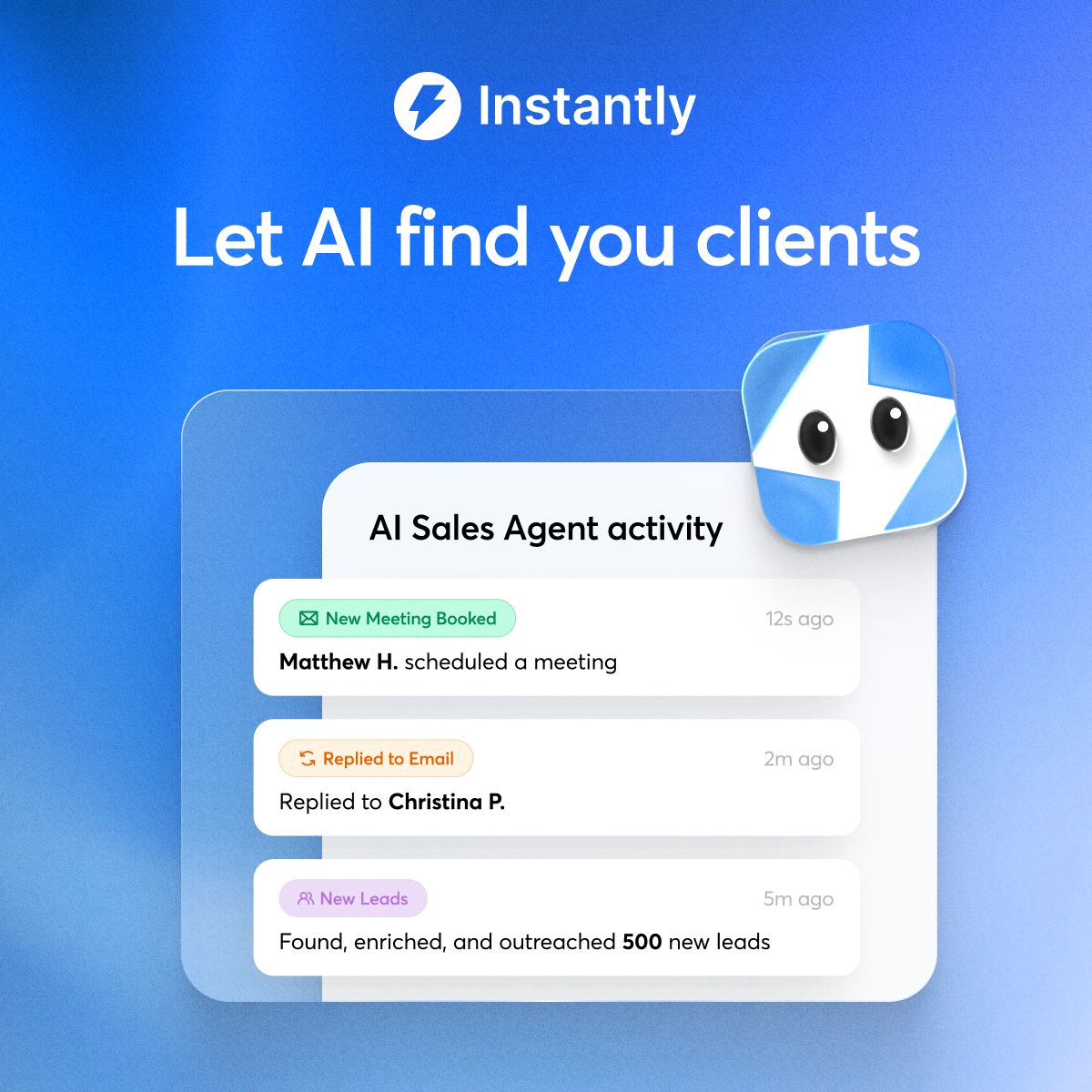
Pipeline OS Newsletter
Build qualified pipeline
Get weekly tactics to generate demand, improve lead quality, and book more meetings.




Trusted by industry leaders
Trusted by industry leaders
Trusted by industry leaders
Ready to build qualified pipeline?
Ready to build qualified pipeline?
Ready to build qualified pipeline?
Book a call to see if we're the right fit, or take the 2-minute quiz to get a clear starting point.
Book a call to see if we're the right fit, or take the 2-minute quiz to get a clear starting point.
Book a call to see if we're the right fit, or take the 2-minute quiz to get a clear starting point.
" height="30.21639343089746px" id="hfGbXmQR2" width="30.216393430897455px"/></svg>)
Copyright © 2026 – All Right Reserved
Copyright © 2026 – All Right Reserved
Copyright © 2026 – All Right Reserved