NEW WEBINAR: Learn how to fill your B2B webinar seatsHow to fill your B2B webinar seatsSave your seat
%22%3E%3C/path%3E%3Cpath d=%22M 63.072 7.554 C 62.258 8.022 61.577 8.689 61.092 9.493 L 61.092 7.076 L 57.158 7.076 L 57.158 22.64 L 61.089 22.64 L 61.089 14.888 C 61.089 13.446 61.403 12.434 62.03 11.853 C 62.818 11.218 63.818 10.907 64.826 10.982 L 65.868 10.982 L 65.868 6.851 C 64.891 6.834 63.926 7.076 63.073 7.554 Z%22 fill=%22rgb(17,17,17)%22%3E%3C/path%3E%3Cpath d=%22M 78.916 7.82 C 76.363 6.49 73.321 6.49 70.768 7.82 C 69.562 8.473 68.564 9.451 67.888 10.644 C 67.167 11.931 66.803 13.387 66.834 14.862 C 66.804 16.332 67.157 17.785 67.86 19.077 C 68.515 20.267 69.494 21.246 70.684 21.901 C 71.924 22.576 73.318 22.92 74.73 22.898 C 76.164 22.918 77.58 22.575 78.846 21.901 C 80.062 21.247 81.073 20.27 81.768 19.077 C 82.506 17.797 82.88 16.339 82.85 14.862 C 82.88 13.389 82.517 11.934 81.797 10.647 C 81.12 9.455 80.122 8.477 78.917 7.824 M 78.803 14.862 C 78.829 15.739 78.636 16.608 78.241 17.391 C 77.903 18.046 77.38 18.588 76.738 18.95 C 76.124 19.293 75.432 19.472 74.729 19.47 C 73.668 19.497 72.648 19.061 71.934 18.276 C 71.139 17.323 70.741 16.1 70.823 14.862 C 70.741 13.62 71.149 12.395 71.959 11.45 C 72.687 10.667 73.715 10.233 74.783 10.256 C 75.859 10.236 76.894 10.67 77.635 11.45 C 78.464 12.387 78.884 13.616 78.801 14.864%22 fill=%22rgb(17,17,17)%22%3E%3C/path%3E%3Cpath d=%22M 95.906 7.076 L 95.906 15.646 C 95.975 16.68 95.643 17.701 94.979 18.498 C 94.311 19.184 93.379 19.547 92.422 19.495 C 91.475 19.544 90.553 19.18 89.894 18.498 C 89.23 17.701 88.898 16.68 88.967 15.646 L 88.967 7.076 L 85.033 7.076 L 85.033 16.207 C 85 17.449 85.275 18.68 85.834 19.79 C 86.327 20.75 87.095 21.542 88.039 22.065 C 89.033 22.594 90.145 22.861 91.271 22.838 C 92.188 22.847 93.095 22.65 93.926 22.263 C 94.708 21.905 95.388 21.36 95.906 20.675 L 95.906 22.645 L 99.865 22.645 L 99.865 7.076 Z%22 fill=%22rgb(17,17,17)%22%3E%3C/path%3E%3Cpath d=%22M 4.513 15.626 C 4.511 10.815 7.606 6.549 12.181 5.059 C 16.756 3.57 21.77 5.195 24.601 9.086 L 27.816 5.87 C 24.074 1.186 17.981 -0.943 12.137 0.393 C 6.292 1.728 1.728 6.292 0.393 12.137 C -0.943 17.981 1.186 24.074 5.87 27.816 L 9.085 24.601 C 6.214 22.512 4.515 19.177 4.513 15.626%22 fill=%22rgb(32,62,235)%22%3E%3C/path%3E%3Cpath d=%22M 17.114 14.343 L 13.354 18.01 L 13.354 18.026 L 21.071 18.026 L 11.412 27.609 L 17.389 27.609 L 23.999 21.081 L 23.999 28.316 L 24.005 28.316 L 27.967 24.393 L 27.967 14.343 Z%22 fill=%22rgb(32,62,235)%22%3E%3C/path%3E%3C/g%3E%3C/svg%3E) ×
×
NEW WEBINAR: Learn how to fill your B2B webinar seatsHow to fill your B2B webinar seatsSave your seat
×NEW WEBINAR: Learn how to fill your B2B webinar seatsHow to fill your B2B webinar seatsSave your seat
×›
›
›
›
Build a Better Lead Generation Campaign: 2026 B2B Playbook
Build a Better Lead Generation Campaign: 2026 B2B Playbook
Build a Better Lead Generation Campaign: 2026 B2B Playbook
Build a Better Lead Generation Campaign: 2026 B2B Playbook
Build a Better Lead Generation Campaign: 2026 B2B Playbook
Build a Better Lead Generation Campaign: 2026 B2B Playbook

Author
Aljaz Peklaj

You're probably looking at a campaign that seems active on paper. Emails are going out. Sales Navigator lists are growing. LinkedIn profiles are getting views. The problem is that none of that guarantees pipeline.
The failure pattern is familiar. Marketing reports activity, sales reports silence, and everyone debates copy while the actual issue sits elsewhere. The lead generation campaign isn't failing because one email subject line was weak. It's failing because the system is fragmented.
Content, outbound, and follow-up are often still managed as separate motions. That's backward. Existing guidance often treats lead generation tactics as disconnected topics, even though 61% of B2B marketers cite lead quality as their top challenge, and unified systems that combine content, outbound, and AI-driven routing can increase pipeline velocity by 3 to 5 times according to LeadsBridge's breakdown of common lead generation mistakes.
If you want a useful outside read before rebuilding the machine, Breaker has a solid set of actionable B2B lead generation tips that pair well with a structured outbound program. If your bigger issue is that replies happen but deals don't progress, this breakdown of why your leads aren't converting and how to fix it is the right companion piece.
Table of Contents
Your campaign is busy but your calendar is empty
Key takeaways
What busy looks like versus what pipeline looks like
The 6-step launch sequence that prevents failure
The six launch steps
What usually breaks during launch
Building the multi-channel sequence that gets replies
Why single-channel campaigns stall
The 14-day sequence
How the channels work together
A real campaign timeline from kickoff to booked meeting
A day-by-day rollout
Why the timeline moved fast
The technical stack for list building and deliverability
The list building workflow
The deliverability layer
The tool stack we actually use
A testing protocol for compounding results
The four-stage testing cycle
What to measure and what to ignore
Your next step a 15-minute audit
Your campaign is busy but your calendar is empty
The easiest way to spot a weak lead generation campaign is simple. The dashboard is full, but the sales calendar isn't.
That usually means the team optimized for motion, not qualified conversations. More sends, more profile views, and more touches create the appearance of traction. They do not create revenue by themselves.
Key takeaways
One engine beats disconnected tactics. If LinkedIn content, outbound email, CRM scoring, and reply handling all run separately, the campaign will drift.
The first 14 days matter most. Bad targeting, weak infrastructure, or a loose message map will poison everything that follows.
Multi-channel sequencing works better than one channel alone. The sequence matters just as much as the channel mix.
Deliverability is a pipeline variable. If your setup is sloppy, no amount of personalization will save it.
Testing never stops. Campaigns flatten when teams stop learning.
Busy campaigns create reports. Structured campaigns create meetings.
What busy looks like versus what pipeline looks like
Busy looks like this, Apollo exports, a few warmed inboxes, a handful of email drafts, and someone posting on LinkedIn when they remember. Pipeline looks different. One ICP. One offer. One message map. One operating rhythm.
That's the position we take at Grou. Structure turns attention into pipeline. Not because structure is elegant, but because buyers see the same story across every touchpoint and sales gets cleaner handoffs.
If the team can't answer these three questions instantly, the campaign is still too loose.
Question | Weak answer | Strong answer |
|---|---|---|
Who are we targeting? | “Mid-market companies” | Specific industry, size, geography, persona, trigger signals |
Why would they reply now? | “We save time” | One sentence offer tied to a clear business moment |
What happens after a reply? | “Sales follows up” | Qualification rules, routing, and ownership are already defined |
The 6-step launch sequence that prevents failure
The first two weeks decide whether the campaign has a real chance. Once a weak list, broken setup, or vague offer goes live, the metrics become harder to trust. Teams start guessing, and guessing burns time.
Most launch failures happen before the first email is sent. The usual culprits are loose targeting, inconsistent messaging, and poor deliverability setup. Bad copy gets blamed because it's visible. Infrastructure and message discipline get missed because they sit in the background.
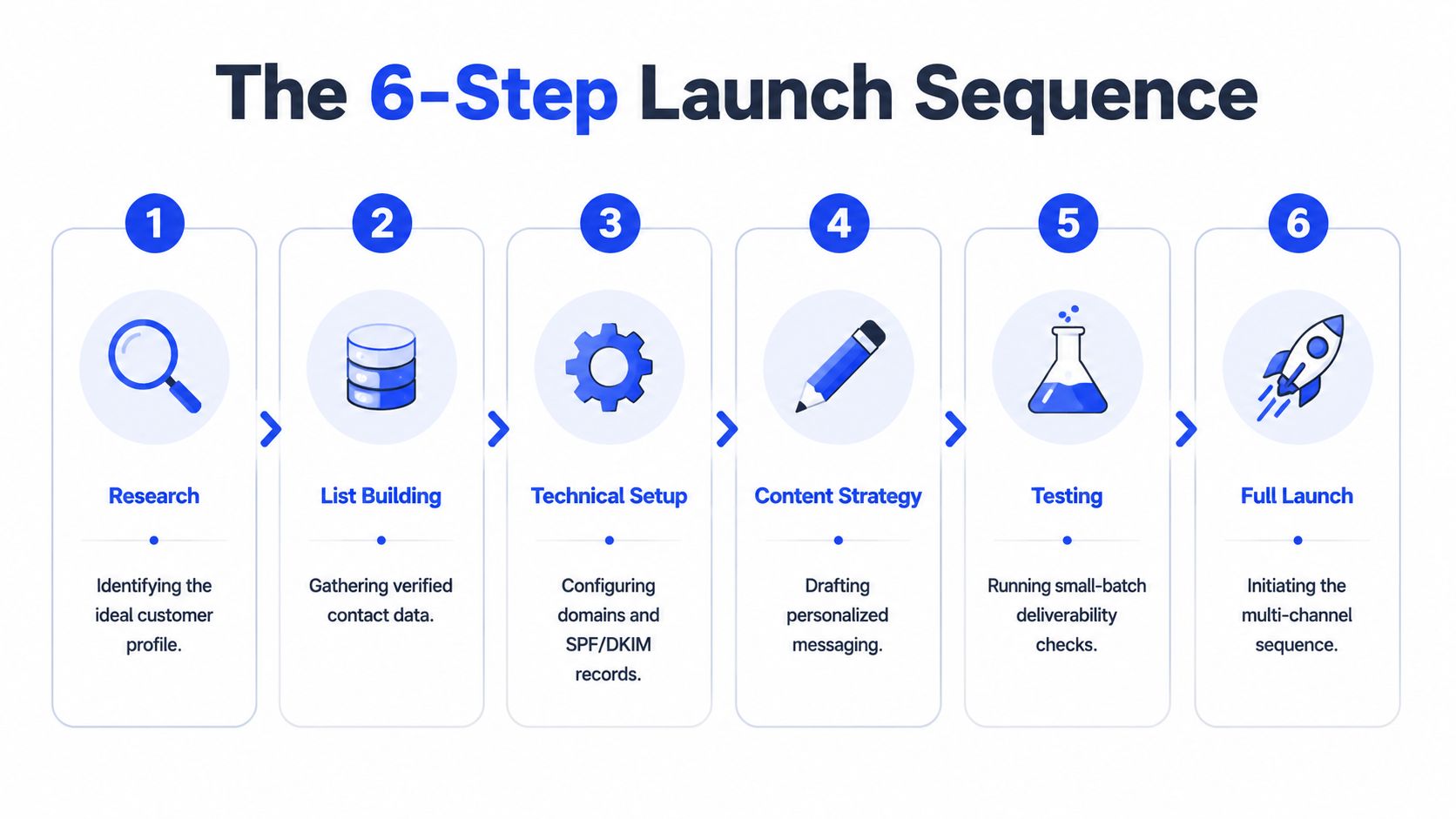
The six launch steps
Lock the ICP
Run one focused session and write it down. Industry, company size, geography, target persona, and three trigger signals that suggest buying readiness. No campaign should launch from a vague audience definition.
Get the offer into one sentence
If the team can't explain what's being sold and why now in one breath, the buyer won't understand it in an inbox. Strip the pitch down until it sounds clear in plain English.
Build and verify the first cohort
Start with 500 to 1,000 contacts for the initial cohort, as outlined in the operating brief. Build in Apollo and Sales Navigator, then enrich in Clay with the same trigger signals defined in step one. Verify before import, and keep bounce risk low.
Create the message map
Identify three pain points and three proof points. Every email, LinkedIn touch, and follow-up should pull from the same map. Marketers often get sloppy during this stage, then wonder why the sequence sounds inconsistent.
Set up the sending infrastructure
Separate the outbound domain from the main brand domain. Confirm SPF, DKIM, and DMARC are correctly configured. Warm up the inboxes before launch. Most failed campaigns die here, not in the copy.
Run a soft launch
Send the first 50 to 100 contacts only. Watch deliverability, opens, and replies for five days. If something breaks, fix it before scaling.
What usually breaks during launch
The most common mistake is impatience. Teams want to push volume before the system is stable.
Practical rule: If message map and domain setup aren't finished, you do not have a campaign. You have draft activity.
A second problem is bad prospecting discipline. Salesgenie notes that buying random mailing lists leads to weak performance, with open rates under 5%, while targeted list-building can reduce bad leads by 50 to 70% in their framework for ICP-aligned prospecting and campaign setup, detailed in Salesgenie's guide to poor prospecting methods.
There's also a quality issue hidden in early campaign planning. In the same framework, low-caliber leads convert at less than 1%, while qualified lead conversion averages 10% and customer close rates average 1 to 6%. That's why volume-first launch logic is expensive. It fills the top of the funnel with names sales never wanted.
Building the multi-channel sequence that gets replies
A lead generation campaign that relies on email alone is fragile. Even if the copy is good, it asks one channel to do every job, awareness, trust, timing, and response.
That's not how buyers behave. Research shows 96.45% of website visitors are not ready to purchase when they first arrive, and 73% of B2B leads are not sales-ready on first interaction. The same dataset shows campaigns that segment and nurture leads see 73% higher conversion rates than those that don't, according to Email Vendor Selection's lead generation statistics.

If you need a plain-language definition of channel coordination, this multi-channel outreach glossary entry is a useful reference. The short version is this, each channel should do a different job.
Why single-channel campaigns stall
Email is good for scale. LinkedIn is good for familiarity and trust. Calls are good for compressing time once interest exists. Content keeps the account warm between touches.
Single-channel outreach fails because it ignores those roles. It turns every touch into the same ask, from the same direction, in the same format.
The 14-day sequence
This is the default sequence we use when the ICP justifies both email and LinkedIn activity.
Day 0, LinkedIn connection request → No note, or one short opener tied to the trigger signal.
Day 2, email one → Short, direct, one clear question.
Day 4, LinkedIn engagement → Like or comment on a recent post. No DM yet.
Day 6, email two → New angle. If the first email led with pain, this one leads with proof.
Day 8, LinkedIn DM → Soft nudge that references the earlier email without pitching.
Day 11, email three → Close-the-loop message. This often pulls the most direct replies.
Day 14, phone call → Only if a number is available and the account is worth the effort.
How the channels work together
The mistake isn't using multiple channels. The mistake is blasting all of them at once.
A clean sequence creates context. The connection request makes the name familiar. The email gives the buyer a reason to care. The LinkedIn engagement adds social proof that a real person is behind the outreach. The DM and the final email collect the response.
Don't ask LinkedIn to do email's job, and don't ask email to do LinkedIn's job.
Layer LinkedIn content on top of this sequence. Not random posting, but posts aligned to the same message map used in outbound. When a prospect sees the same pain point in their inbox and feed, the reply barrier drops.
A real campaign timeline from kickoff to booked meeting
Most teams don't have a lead generation campaign problem. They have a sequencing problem inside the build process.
The fastest campaigns move because the workstreams run in parallel. The slowest ones wait for list completion before writing copy, then wait for copy approval before setting up infrastructure, then wonder why launch slips by weeks.

A day-by-day rollout
Here's a real operating timeline for a B2B SaaS campaign targeting mid-market manufacturers.
Day 0 → Contract signed.
Day 2 → Kickoff call held within 48 hours. ICP, offer, and message map locked in during a 90-minute session.
Day 3 to 7 → List built across Apollo and Sales Navigator. Contacts enriched in Clay using trigger signals such as recent ERP migration and a supply chain hire within the last six months.
Day 5 to 9 → Three email variants and two LinkedIn message variants drafted, reviewed, and approved.
Day 7 to 10 → Three sending domains warmed up. Inbox rotation and technical setup completed.
Day 11 → Soft launch to 75 contacts.
Day 14 → First reply received. Discovery call booked for day 17.
Day 17 → Discovery held, fit confirmed.
Day 21 → Full rollout to the remaining 775 contacts.
That sequence produced the first qualified lead in 14 days, according to the operating brief behind this playbook.
Why the timeline moved fast
The reason this moved wasn't luck. It was parallel execution.
List building, copywriting, and infrastructure setup happened at the same time. Most agencies run those tasks in order and create delay with no upside. The campaign didn't wait for perfect polish. It waited for enough confidence to soft launch safely.
If webinars sit inside your mix, not every account should go straight to a meeting ask. In longer consideration cycles, especially in SaaS and legal tech, a mid-funnel event can do useful work. Cloud Present has a practical breakdown of webinars that convert B2B prospects if that's part of your motion.
For a closer look at this kind of orchestration in practice, the multi-channel lead generation case study for a sports technology company shows how coordinated outreach creates cleaner handoffs than isolated channel tests.
The technical stack for list building and deliverability
Many marketing organizations spend too much time on copy and not enough time on the substrate that determines whether the copy gets seen. A clean technical stack isn't glamorous, but it decides whether the campaign produces signal or junk.
The two layers that matter most are the list itself and the sending environment. If either one is weak, every downstream metric becomes noisy.

The list building workflow
Our default workflow is straightforward.
Source accounts in Apollo when the market is broad and the firmographic filters are clear.
Use Sales Navigator when persona precision matters more than database breadth.
Enrich in Clay with the trigger signals from the ICP session.
Load into Lemlist or Instantly only after verification is complete.
Use HeyReach for LinkedIn execution when the campaign includes connection workflows at scale.
The point isn't the logo stack. The point is that each tool has one job. Apollo and Sales Navigator find. Clay enriches. The sending platform executes.
If you're comparing categories before buying tools, Formzz has a useful overview of B2B lead generation software that helps clarify where databases, enrichment tools, forms, and outreach platforms fit.
The deliverability layer
Use a separate sending domain from the main brand domain. Protect the core brand asset and keep outbound isolated. Then make sure SPF, DKIM, and DMARC are correctly configured before any sequence goes live.
Keep verification standards tight. In our operating brief, the target is under 3% bounce rate on verified emails. That sounds basic, but a surprising number of campaigns still skip it and then blame the copy when inbox placement collapses.
A useful reference point here is deliverability itself, not as a technical checkbox but as a revenue control point. This deliverability glossary entry is worth sharing with anyone who still thinks inbox placement is just an ops detail.
Here's a practical walkthrough on setup and sending mechanics:
The tool stack we actually use
Below is the stack pattern most B2B teams can run without unnecessary complexity.
Job | Primary tools | Notes |
|---|---|---|
Account and contact sourcing | Apollo, Sales Navigator | Choose based on breadth versus persona precision |
Enrichment | Clay | Add trigger signals, normalize fields |
Email sequencing | Lemlist, Instantly | Use rotation and clear cohort control |
LinkedIn execution | HeyReach | Keep message map aligned with email |
CRM and routing | HubSpot, Salesforce | Score, route, and track handoff |
Unified execution option | Grou | Combines LinkedIn content, outbound, list building, and reply routing in one operating system |
The channel mix matters here too. As noted earlier in the article, the sequence matters more than volume alone. Salesgenie's benchmark shows email-only campaigns fail 29% more often than integrated multi-channel campaigns, and getting a response often takes 5 to 10 touchpoints, with reply efficiency moving from 1 to 2% up to 15 to 20% in that framework. Those benchmarks came from the earlier cited Salesgenie source, which is why the technical stack should support a coordinated sequence, not just email sends.
A testing protocol for compounding results
Most campaigns don't die at launch. They decay after launch because nobody keeps learning.
Testing only subject lines in the first month isn't a testing program. It's a ritual. A real lead generation campaign keeps a controlled feedback loop running the whole time.
The four-stage testing cycle
We run testing in four stages, and we keep the variables isolated.
Subject line test
Run two variants across 200 contacts per variant. Keep everything else fixed. If one variant shows a clear difference in open rate, keep the winner and move on.
Opening line test
This matters more than many organizations admit. Test pain-led versus proof-led versus question-led openings, but only one comparison at a time.
CTA test
Compare a direct ask, a soft ask, and an interest-gauge ask. The metric is reply rate, not clicks.
Sequence length and cadence
Once message fundamentals are stable, test 3-touch versus 5-touch versus 7-touch versions and 2-day versus 3-day versus 5-day intervals.
What to measure and what to ignore
Track the middle of the funnel. Opens are directional. Meetings booked are lagging. Reply rate is the operational KPI that tells you whether the message is creating motion.
The wrong lesson from a campaign is often worse than a bad result. If you change two things at once, you don't know what actually worked.
There's a strong reason to stay disciplined here. A data-driven approach can triple lead generation ROI, and A/B testing multi-touch sequences such as email plus LinkedIn can create a 3 times lift in response rates versus single-channel tests, according to Savy Work's framework for measuring lead generation success.
That same framework flags one of the biggest sources of waste, 80% of leads are lost after the first touch when follow-up is weak. This is why every test should include handoff speed and follow-up behavior, not just message variations.
A few rules should stay fixed.
One variable at a time → If subject line and opener both change, the result is muddy.
Enough volume to matter → Below the minimum cohort, you're reading noise.
Document every test → Losing variants teach you where buyer resistance lives.
Don't test voice → Voice is a strategic choice. If it feels wrong, the brief is broken.
Campaigns improve when the team reviews results on a schedule. Not when someone remembers to check after a bad week.
Your next step a 15-minute audit
Don't rebuild everything tomorrow. Audit what already exists.
Take 15 minutes and check three things. First, is the message map written down, with clear pain points and proof points the whole team can repeat? Second, are you sending from a separate warmed domain with the authentication basics handled? Third, what was the last variable you tested, what did you learn, and when is the next test scheduled?
Those three answers will tell you whether the current lead generation campaign is a system or a collection of tasks. If the answers are vague, start there. If the answers are clear, the next constraint is probably execution discipline.
When you want a working session instead of another internal debate, book a 15-minute audit call and review the message map, channel sequence, and setup against a live campaign.
If you want a B2B pipeline partner that runs LinkedIn content, outbound, and lead generation as one system instead of three disconnected workstreams, Grou is built for that operating model. The simplest next move is to audit your current campaign against the six launch steps, fix the weakest point, and only then scale volume.
You're probably looking at a campaign that seems active on paper. Emails are going out. Sales Navigator lists are growing. LinkedIn profiles are getting views. The problem is that none of that guarantees pipeline.
The failure pattern is familiar. Marketing reports activity, sales reports silence, and everyone debates copy while the actual issue sits elsewhere. The lead generation campaign isn't failing because one email subject line was weak. It's failing because the system is fragmented.
Content, outbound, and follow-up are often still managed as separate motions. That's backward. Existing guidance often treats lead generation tactics as disconnected topics, even though 61% of B2B marketers cite lead quality as their top challenge, and unified systems that combine content, outbound, and AI-driven routing can increase pipeline velocity by 3 to 5 times according to LeadsBridge's breakdown of common lead generation mistakes.
If you want a useful outside read before rebuilding the machine, Breaker has a solid set of actionable B2B lead generation tips that pair well with a structured outbound program. If your bigger issue is that replies happen but deals don't progress, this breakdown of why your leads aren't converting and how to fix it is the right companion piece.
Table of Contents
Your campaign is busy but your calendar is empty
Key takeaways
What busy looks like versus what pipeline looks like
The 6-step launch sequence that prevents failure
The six launch steps
What usually breaks during launch
Building the multi-channel sequence that gets replies
Why single-channel campaigns stall
The 14-day sequence
How the channels work together
A real campaign timeline from kickoff to booked meeting
A day-by-day rollout
Why the timeline moved fast
The technical stack for list building and deliverability
The list building workflow
The deliverability layer
The tool stack we actually use
A testing protocol for compounding results
The four-stage testing cycle
What to measure and what to ignore
Your next step a 15-minute audit
Your campaign is busy but your calendar is empty
The easiest way to spot a weak lead generation campaign is simple. The dashboard is full, but the sales calendar isn't.
That usually means the team optimized for motion, not qualified conversations. More sends, more profile views, and more touches create the appearance of traction. They do not create revenue by themselves.
Key takeaways
One engine beats disconnected tactics. If LinkedIn content, outbound email, CRM scoring, and reply handling all run separately, the campaign will drift.
The first 14 days matter most. Bad targeting, weak infrastructure, or a loose message map will poison everything that follows.
Multi-channel sequencing works better than one channel alone. The sequence matters just as much as the channel mix.
Deliverability is a pipeline variable. If your setup is sloppy, no amount of personalization will save it.
Testing never stops. Campaigns flatten when teams stop learning.
Busy campaigns create reports. Structured campaigns create meetings.
What busy looks like versus what pipeline looks like
Busy looks like this, Apollo exports, a few warmed inboxes, a handful of email drafts, and someone posting on LinkedIn when they remember. Pipeline looks different. One ICP. One offer. One message map. One operating rhythm.
That's the position we take at Grou. Structure turns attention into pipeline. Not because structure is elegant, but because buyers see the same story across every touchpoint and sales gets cleaner handoffs.
If the team can't answer these three questions instantly, the campaign is still too loose.
Question | Weak answer | Strong answer |
|---|---|---|
Who are we targeting? | “Mid-market companies” | Specific industry, size, geography, persona, trigger signals |
Why would they reply now? | “We save time” | One sentence offer tied to a clear business moment |
What happens after a reply? | “Sales follows up” | Qualification rules, routing, and ownership are already defined |
The 6-step launch sequence that prevents failure
The first two weeks decide whether the campaign has a real chance. Once a weak list, broken setup, or vague offer goes live, the metrics become harder to trust. Teams start guessing, and guessing burns time.
Most launch failures happen before the first email is sent. The usual culprits are loose targeting, inconsistent messaging, and poor deliverability setup. Bad copy gets blamed because it's visible. Infrastructure and message discipline get missed because they sit in the background.
The six launch steps
Lock the ICP
Run one focused session and write it down. Industry, company size, geography, target persona, and three trigger signals that suggest buying readiness. No campaign should launch from a vague audience definition.
Get the offer into one sentence
If the team can't explain what's being sold and why now in one breath, the buyer won't understand it in an inbox. Strip the pitch down until it sounds clear in plain English.
Build and verify the first cohort
Start with 500 to 1,000 contacts for the initial cohort, as outlined in the operating brief. Build in Apollo and Sales Navigator, then enrich in Clay with the same trigger signals defined in step one. Verify before import, and keep bounce risk low.
Create the message map
Identify three pain points and three proof points. Every email, LinkedIn touch, and follow-up should pull from the same map. Marketers often get sloppy during this stage, then wonder why the sequence sounds inconsistent.
Set up the sending infrastructure
Separate the outbound domain from the main brand domain. Confirm SPF, DKIM, and DMARC are correctly configured. Warm up the inboxes before launch. Most failed campaigns die here, not in the copy.
Run a soft launch
Send the first 50 to 100 contacts only. Watch deliverability, opens, and replies for five days. If something breaks, fix it before scaling.
What usually breaks during launch
The most common mistake is impatience. Teams want to push volume before the system is stable.
Practical rule: If message map and domain setup aren't finished, you do not have a campaign. You have draft activity.
A second problem is bad prospecting discipline. Salesgenie notes that buying random mailing lists leads to weak performance, with open rates under 5%, while targeted list-building can reduce bad leads by 50 to 70% in their framework for ICP-aligned prospecting and campaign setup, detailed in Salesgenie's guide to poor prospecting methods.
There's also a quality issue hidden in early campaign planning. In the same framework, low-caliber leads convert at less than 1%, while qualified lead conversion averages 10% and customer close rates average 1 to 6%. That's why volume-first launch logic is expensive. It fills the top of the funnel with names sales never wanted.
Building the multi-channel sequence that gets replies
A lead generation campaign that relies on email alone is fragile. Even if the copy is good, it asks one channel to do every job, awareness, trust, timing, and response.
That's not how buyers behave. Research shows 96.45% of website visitors are not ready to purchase when they first arrive, and 73% of B2B leads are not sales-ready on first interaction. The same dataset shows campaigns that segment and nurture leads see 73% higher conversion rates than those that don't, according to Email Vendor Selection's lead generation statistics.
If you need a plain-language definition of channel coordination, this multi-channel outreach glossary entry is a useful reference. The short version is this, each channel should do a different job.
Why single-channel campaigns stall
Email is good for scale. LinkedIn is good for familiarity and trust. Calls are good for compressing time once interest exists. Content keeps the account warm between touches.
Single-channel outreach fails because it ignores those roles. It turns every touch into the same ask, from the same direction, in the same format.
The 14-day sequence
This is the default sequence we use when the ICP justifies both email and LinkedIn activity.
Day 0, LinkedIn connection request → No note, or one short opener tied to the trigger signal.
Day 2, email one → Short, direct, one clear question.
Day 4, LinkedIn engagement → Like or comment on a recent post. No DM yet.
Day 6, email two → New angle. If the first email led with pain, this one leads with proof.
Day 8, LinkedIn DM → Soft nudge that references the earlier email without pitching.
Day 11, email three → Close-the-loop message. This often pulls the most direct replies.
Day 14, phone call → Only if a number is available and the account is worth the effort.
How the channels work together
The mistake isn't using multiple channels. The mistake is blasting all of them at once.
A clean sequence creates context. The connection request makes the name familiar. The email gives the buyer a reason to care. The LinkedIn engagement adds social proof that a real person is behind the outreach. The DM and the final email collect the response.
Don't ask LinkedIn to do email's job, and don't ask email to do LinkedIn's job.
Layer LinkedIn content on top of this sequence. Not random posting, but posts aligned to the same message map used in outbound. When a prospect sees the same pain point in their inbox and feed, the reply barrier drops.
A real campaign timeline from kickoff to booked meeting
Most teams don't have a lead generation campaign problem. They have a sequencing problem inside the build process.
The fastest campaigns move because the workstreams run in parallel. The slowest ones wait for list completion before writing copy, then wait for copy approval before setting up infrastructure, then wonder why launch slips by weeks.
A day-by-day rollout
Here's a real operating timeline for a B2B SaaS campaign targeting mid-market manufacturers.
Day 0 → Contract signed.
Day 2 → Kickoff call held within 48 hours. ICP, offer, and message map locked in during a 90-minute session.
Day 3 to 7 → List built across Apollo and Sales Navigator. Contacts enriched in Clay using trigger signals such as recent ERP migration and a supply chain hire within the last six months.
Day 5 to 9 → Three email variants and two LinkedIn message variants drafted, reviewed, and approved.
Day 7 to 10 → Three sending domains warmed up. Inbox rotation and technical setup completed.
Day 11 → Soft launch to 75 contacts.
Day 14 → First reply received. Discovery call booked for day 17.
Day 17 → Discovery held, fit confirmed.
Day 21 → Full rollout to the remaining 775 contacts.
That sequence produced the first qualified lead in 14 days, according to the operating brief behind this playbook.
Why the timeline moved fast
The reason this moved wasn't luck. It was parallel execution.
List building, copywriting, and infrastructure setup happened at the same time. Most agencies run those tasks in order and create delay with no upside. The campaign didn't wait for perfect polish. It waited for enough confidence to soft launch safely.
If webinars sit inside your mix, not every account should go straight to a meeting ask. In longer consideration cycles, especially in SaaS and legal tech, a mid-funnel event can do useful work. Cloud Present has a practical breakdown of webinars that convert B2B prospects if that's part of your motion.
For a closer look at this kind of orchestration in practice, the multi-channel lead generation case study for a sports technology company shows how coordinated outreach creates cleaner handoffs than isolated channel tests.
The technical stack for list building and deliverability
Many marketing organizations spend too much time on copy and not enough time on the substrate that determines whether the copy gets seen. A clean technical stack isn't glamorous, but it decides whether the campaign produces signal or junk.
The two layers that matter most are the list itself and the sending environment. If either one is weak, every downstream metric becomes noisy.
The list building workflow
Our default workflow is straightforward.
Source accounts in Apollo when the market is broad and the firmographic filters are clear.
Use Sales Navigator when persona precision matters more than database breadth.
Enrich in Clay with the trigger signals from the ICP session.
Load into Lemlist or Instantly only after verification is complete.
Use HeyReach for LinkedIn execution when the campaign includes connection workflows at scale.
The point isn't the logo stack. The point is that each tool has one job. Apollo and Sales Navigator find. Clay enriches. The sending platform executes.
If you're comparing categories before buying tools, Formzz has a useful overview of B2B lead generation software that helps clarify where databases, enrichment tools, forms, and outreach platforms fit.
The deliverability layer
Use a separate sending domain from the main brand domain. Protect the core brand asset and keep outbound isolated. Then make sure SPF, DKIM, and DMARC are correctly configured before any sequence goes live.
Keep verification standards tight. In our operating brief, the target is under 3% bounce rate on verified emails. That sounds basic, but a surprising number of campaigns still skip it and then blame the copy when inbox placement collapses.
A useful reference point here is deliverability itself, not as a technical checkbox but as a revenue control point. This deliverability glossary entry is worth sharing with anyone who still thinks inbox placement is just an ops detail.
Here's a practical walkthrough on setup and sending mechanics:
The tool stack we actually use
Below is the stack pattern most B2B teams can run without unnecessary complexity.
Job | Primary tools | Notes |
|---|---|---|
Account and contact sourcing | Apollo, Sales Navigator | Choose based on breadth versus persona precision |
Enrichment | Clay | Add trigger signals, normalize fields |
Email sequencing | Lemlist, Instantly | Use rotation and clear cohort control |
LinkedIn execution | HeyReach | Keep message map aligned with email |
CRM and routing | HubSpot, Salesforce | Score, route, and track handoff |
Unified execution option | Grou | Combines LinkedIn content, outbound, list building, and reply routing in one operating system |
The channel mix matters here too. As noted earlier in the article, the sequence matters more than volume alone. Salesgenie's benchmark shows email-only campaigns fail 29% more often than integrated multi-channel campaigns, and getting a response often takes 5 to 10 touchpoints, with reply efficiency moving from 1 to 2% up to 15 to 20% in that framework. Those benchmarks came from the earlier cited Salesgenie source, which is why the technical stack should support a coordinated sequence, not just email sends.
A testing protocol for compounding results
Most campaigns don't die at launch. They decay after launch because nobody keeps learning.
Testing only subject lines in the first month isn't a testing program. It's a ritual. A real lead generation campaign keeps a controlled feedback loop running the whole time.
The four-stage testing cycle
We run testing in four stages, and we keep the variables isolated.
Subject line test
Run two variants across 200 contacts per variant. Keep everything else fixed. If one variant shows a clear difference in open rate, keep the winner and move on.
Opening line test
This matters more than many organizations admit. Test pain-led versus proof-led versus question-led openings, but only one comparison at a time.
CTA test
Compare a direct ask, a soft ask, and an interest-gauge ask. The metric is reply rate, not clicks.
Sequence length and cadence
Once message fundamentals are stable, test 3-touch versus 5-touch versus 7-touch versions and 2-day versus 3-day versus 5-day intervals.
What to measure and what to ignore
Track the middle of the funnel. Opens are directional. Meetings booked are lagging. Reply rate is the operational KPI that tells you whether the message is creating motion.
The wrong lesson from a campaign is often worse than a bad result. If you change two things at once, you don't know what actually worked.
There's a strong reason to stay disciplined here. A data-driven approach can triple lead generation ROI, and A/B testing multi-touch sequences such as email plus LinkedIn can create a 3 times lift in response rates versus single-channel tests, according to Savy Work's framework for measuring lead generation success.
That same framework flags one of the biggest sources of waste, 80% of leads are lost after the first touch when follow-up is weak. This is why every test should include handoff speed and follow-up behavior, not just message variations.
A few rules should stay fixed.
One variable at a time → If subject line and opener both change, the result is muddy.
Enough volume to matter → Below the minimum cohort, you're reading noise.
Document every test → Losing variants teach you where buyer resistance lives.
Don't test voice → Voice is a strategic choice. If it feels wrong, the brief is broken.
Campaigns improve when the team reviews results on a schedule. Not when someone remembers to check after a bad week.
Your next step a 15-minute audit
Don't rebuild everything tomorrow. Audit what already exists.
Take 15 minutes and check three things. First, is the message map written down, with clear pain points and proof points the whole team can repeat? Second, are you sending from a separate warmed domain with the authentication basics handled? Third, what was the last variable you tested, what did you learn, and when is the next test scheduled?
Those three answers will tell you whether the current lead generation campaign is a system or a collection of tasks. If the answers are vague, start there. If the answers are clear, the next constraint is probably execution discipline.
When you want a working session instead of another internal debate, book a 15-minute audit call and review the message map, channel sequence, and setup against a live campaign.
If you want a B2B pipeline partner that runs LinkedIn content, outbound, and lead generation as one system instead of three disconnected workstreams, Grou is built for that operating model. The simplest next move is to audit your current campaign against the six launch steps, fix the weakest point, and only then scale volume.
You're probably looking at a campaign that seems active on paper. Emails are going out. Sales Navigator lists are growing. LinkedIn profiles are getting views. The problem is that none of that guarantees pipeline.
The failure pattern is familiar. Marketing reports activity, sales reports silence, and everyone debates copy while the actual issue sits elsewhere. The lead generation campaign isn't failing because one email subject line was weak. It's failing because the system is fragmented.
Content, outbound, and follow-up are often still managed as separate motions. That's backward. Existing guidance often treats lead generation tactics as disconnected topics, even though 61% of B2B marketers cite lead quality as their top challenge, and unified systems that combine content, outbound, and AI-driven routing can increase pipeline velocity by 3 to 5 times according to LeadsBridge's breakdown of common lead generation mistakes.
If you want a useful outside read before rebuilding the machine, Breaker has a solid set of actionable B2B lead generation tips that pair well with a structured outbound program. If your bigger issue is that replies happen but deals don't progress, this breakdown of why your leads aren't converting and how to fix it is the right companion piece.
Table of Contents
Your campaign is busy but your calendar is empty
Key takeaways
What busy looks like versus what pipeline looks like
The 6-step launch sequence that prevents failure
The six launch steps
What usually breaks during launch
Building the multi-channel sequence that gets replies
Why single-channel campaigns stall
The 14-day sequence
How the channels work together
A real campaign timeline from kickoff to booked meeting
A day-by-day rollout
Why the timeline moved fast
The technical stack for list building and deliverability
The list building workflow
The deliverability layer
The tool stack we actually use
A testing protocol for compounding results
The four-stage testing cycle
What to measure and what to ignore
Your next step a 15-minute audit
Your campaign is busy but your calendar is empty
The easiest way to spot a weak lead generation campaign is simple. The dashboard is full, but the sales calendar isn't.
That usually means the team optimized for motion, not qualified conversations. More sends, more profile views, and more touches create the appearance of traction. They do not create revenue by themselves.
Key takeaways
One engine beats disconnected tactics. If LinkedIn content, outbound email, CRM scoring, and reply handling all run separately, the campaign will drift.
The first 14 days matter most. Bad targeting, weak infrastructure, or a loose message map will poison everything that follows.
Multi-channel sequencing works better than one channel alone. The sequence matters just as much as the channel mix.
Deliverability is a pipeline variable. If your setup is sloppy, no amount of personalization will save it.
Testing never stops. Campaigns flatten when teams stop learning.
Busy campaigns create reports. Structured campaigns create meetings.
What busy looks like versus what pipeline looks like
Busy looks like this, Apollo exports, a few warmed inboxes, a handful of email drafts, and someone posting on LinkedIn when they remember. Pipeline looks different. One ICP. One offer. One message map. One operating rhythm.
That's the position we take at Grou. Structure turns attention into pipeline. Not because structure is elegant, but because buyers see the same story across every touchpoint and sales gets cleaner handoffs.
If the team can't answer these three questions instantly, the campaign is still too loose.
Question | Weak answer | Strong answer |
|---|---|---|
Who are we targeting? | “Mid-market companies” | Specific industry, size, geography, persona, trigger signals |
Why would they reply now? | “We save time” | One sentence offer tied to a clear business moment |
What happens after a reply? | “Sales follows up” | Qualification rules, routing, and ownership are already defined |
The 6-step launch sequence that prevents failure
The first two weeks decide whether the campaign has a real chance. Once a weak list, broken setup, or vague offer goes live, the metrics become harder to trust. Teams start guessing, and guessing burns time.
Most launch failures happen before the first email is sent. The usual culprits are loose targeting, inconsistent messaging, and poor deliverability setup. Bad copy gets blamed because it's visible. Infrastructure and message discipline get missed because they sit in the background.
The six launch steps
Lock the ICP
Run one focused session and write it down. Industry, company size, geography, target persona, and three trigger signals that suggest buying readiness. No campaign should launch from a vague audience definition.
Get the offer into one sentence
If the team can't explain what's being sold and why now in one breath, the buyer won't understand it in an inbox. Strip the pitch down until it sounds clear in plain English.
Build and verify the first cohort
Start with 500 to 1,000 contacts for the initial cohort, as outlined in the operating brief. Build in Apollo and Sales Navigator, then enrich in Clay with the same trigger signals defined in step one. Verify before import, and keep bounce risk low.
Create the message map
Identify three pain points and three proof points. Every email, LinkedIn touch, and follow-up should pull from the same map. Marketers often get sloppy during this stage, then wonder why the sequence sounds inconsistent.
Set up the sending infrastructure
Separate the outbound domain from the main brand domain. Confirm SPF, DKIM, and DMARC are correctly configured. Warm up the inboxes before launch. Most failed campaigns die here, not in the copy.
Run a soft launch
Send the first 50 to 100 contacts only. Watch deliverability, opens, and replies for five days. If something breaks, fix it before scaling.
What usually breaks during launch
The most common mistake is impatience. Teams want to push volume before the system is stable.
Practical rule: If message map and domain setup aren't finished, you do not have a campaign. You have draft activity.
A second problem is bad prospecting discipline. Salesgenie notes that buying random mailing lists leads to weak performance, with open rates under 5%, while targeted list-building can reduce bad leads by 50 to 70% in their framework for ICP-aligned prospecting and campaign setup, detailed in Salesgenie's guide to poor prospecting methods.
There's also a quality issue hidden in early campaign planning. In the same framework, low-caliber leads convert at less than 1%, while qualified lead conversion averages 10% and customer close rates average 1 to 6%. That's why volume-first launch logic is expensive. It fills the top of the funnel with names sales never wanted.
Building the multi-channel sequence that gets replies
A lead generation campaign that relies on email alone is fragile. Even if the copy is good, it asks one channel to do every job, awareness, trust, timing, and response.
That's not how buyers behave. Research shows 96.45% of website visitors are not ready to purchase when they first arrive, and 73% of B2B leads are not sales-ready on first interaction. The same dataset shows campaigns that segment and nurture leads see 73% higher conversion rates than those that don't, according to Email Vendor Selection's lead generation statistics.
If you need a plain-language definition of channel coordination, this multi-channel outreach glossary entry is a useful reference. The short version is this, each channel should do a different job.
Why single-channel campaigns stall
Email is good for scale. LinkedIn is good for familiarity and trust. Calls are good for compressing time once interest exists. Content keeps the account warm between touches.
Single-channel outreach fails because it ignores those roles. It turns every touch into the same ask, from the same direction, in the same format.
The 14-day sequence
This is the default sequence we use when the ICP justifies both email and LinkedIn activity.
Day 0, LinkedIn connection request → No note, or one short opener tied to the trigger signal.
Day 2, email one → Short, direct, one clear question.
Day 4, LinkedIn engagement → Like or comment on a recent post. No DM yet.
Day 6, email two → New angle. If the first email led with pain, this one leads with proof.
Day 8, LinkedIn DM → Soft nudge that references the earlier email without pitching.
Day 11, email three → Close-the-loop message. This often pulls the most direct replies.
Day 14, phone call → Only if a number is available and the account is worth the effort.
How the channels work together
The mistake isn't using multiple channels. The mistake is blasting all of them at once.
A clean sequence creates context. The connection request makes the name familiar. The email gives the buyer a reason to care. The LinkedIn engagement adds social proof that a real person is behind the outreach. The DM and the final email collect the response.
Don't ask LinkedIn to do email's job, and don't ask email to do LinkedIn's job.
Layer LinkedIn content on top of this sequence. Not random posting, but posts aligned to the same message map used in outbound. When a prospect sees the same pain point in their inbox and feed, the reply barrier drops.
A real campaign timeline from kickoff to booked meeting
Most teams don't have a lead generation campaign problem. They have a sequencing problem inside the build process.
The fastest campaigns move because the workstreams run in parallel. The slowest ones wait for list completion before writing copy, then wait for copy approval before setting up infrastructure, then wonder why launch slips by weeks.
A day-by-day rollout
Here's a real operating timeline for a B2B SaaS campaign targeting mid-market manufacturers.
Day 0 → Contract signed.
Day 2 → Kickoff call held within 48 hours. ICP, offer, and message map locked in during a 90-minute session.
Day 3 to 7 → List built across Apollo and Sales Navigator. Contacts enriched in Clay using trigger signals such as recent ERP migration and a supply chain hire within the last six months.
Day 5 to 9 → Three email variants and two LinkedIn message variants drafted, reviewed, and approved.
Day 7 to 10 → Three sending domains warmed up. Inbox rotation and technical setup completed.
Day 11 → Soft launch to 75 contacts.
Day 14 → First reply received. Discovery call booked for day 17.
Day 17 → Discovery held, fit confirmed.
Day 21 → Full rollout to the remaining 775 contacts.
That sequence produced the first qualified lead in 14 days, according to the operating brief behind this playbook.
Why the timeline moved fast
The reason this moved wasn't luck. It was parallel execution.
List building, copywriting, and infrastructure setup happened at the same time. Most agencies run those tasks in order and create delay with no upside. The campaign didn't wait for perfect polish. It waited for enough confidence to soft launch safely.
If webinars sit inside your mix, not every account should go straight to a meeting ask. In longer consideration cycles, especially in SaaS and legal tech, a mid-funnel event can do useful work. Cloud Present has a practical breakdown of webinars that convert B2B prospects if that's part of your motion.
For a closer look at this kind of orchestration in practice, the multi-channel lead generation case study for a sports technology company shows how coordinated outreach creates cleaner handoffs than isolated channel tests.
The technical stack for list building and deliverability
Many marketing organizations spend too much time on copy and not enough time on the substrate that determines whether the copy gets seen. A clean technical stack isn't glamorous, but it decides whether the campaign produces signal or junk.
The two layers that matter most are the list itself and the sending environment. If either one is weak, every downstream metric becomes noisy.
The list building workflow
Our default workflow is straightforward.
Source accounts in Apollo when the market is broad and the firmographic filters are clear.
Use Sales Navigator when persona precision matters more than database breadth.
Enrich in Clay with the trigger signals from the ICP session.
Load into Lemlist or Instantly only after verification is complete.
Use HeyReach for LinkedIn execution when the campaign includes connection workflows at scale.
The point isn't the logo stack. The point is that each tool has one job. Apollo and Sales Navigator find. Clay enriches. The sending platform executes.
If you're comparing categories before buying tools, Formzz has a useful overview of B2B lead generation software that helps clarify where databases, enrichment tools, forms, and outreach platforms fit.
The deliverability layer
Use a separate sending domain from the main brand domain. Protect the core brand asset and keep outbound isolated. Then make sure SPF, DKIM, and DMARC are correctly configured before any sequence goes live.
Keep verification standards tight. In our operating brief, the target is under 3% bounce rate on verified emails. That sounds basic, but a surprising number of campaigns still skip it and then blame the copy when inbox placement collapses.
A useful reference point here is deliverability itself, not as a technical checkbox but as a revenue control point. This deliverability glossary entry is worth sharing with anyone who still thinks inbox placement is just an ops detail.
Here's a practical walkthrough on setup and sending mechanics:
The tool stack we actually use
Below is the stack pattern most B2B teams can run without unnecessary complexity.
Job | Primary tools | Notes |
|---|---|---|
Account and contact sourcing | Apollo, Sales Navigator | Choose based on breadth versus persona precision |
Enrichment | Clay | Add trigger signals, normalize fields |
Email sequencing | Lemlist, Instantly | Use rotation and clear cohort control |
LinkedIn execution | HeyReach | Keep message map aligned with email |
CRM and routing | HubSpot, Salesforce | Score, route, and track handoff |
Unified execution option | Grou | Combines LinkedIn content, outbound, list building, and reply routing in one operating system |
The channel mix matters here too. As noted earlier in the article, the sequence matters more than volume alone. Salesgenie's benchmark shows email-only campaigns fail 29% more often than integrated multi-channel campaigns, and getting a response often takes 5 to 10 touchpoints, with reply efficiency moving from 1 to 2% up to 15 to 20% in that framework. Those benchmarks came from the earlier cited Salesgenie source, which is why the technical stack should support a coordinated sequence, not just email sends.
A testing protocol for compounding results
Most campaigns don't die at launch. They decay after launch because nobody keeps learning.
Testing only subject lines in the first month isn't a testing program. It's a ritual. A real lead generation campaign keeps a controlled feedback loop running the whole time.
The four-stage testing cycle
We run testing in four stages, and we keep the variables isolated.
Subject line test
Run two variants across 200 contacts per variant. Keep everything else fixed. If one variant shows a clear difference in open rate, keep the winner and move on.
Opening line test
This matters more than many organizations admit. Test pain-led versus proof-led versus question-led openings, but only one comparison at a time.
CTA test
Compare a direct ask, a soft ask, and an interest-gauge ask. The metric is reply rate, not clicks.
Sequence length and cadence
Once message fundamentals are stable, test 3-touch versus 5-touch versus 7-touch versions and 2-day versus 3-day versus 5-day intervals.
What to measure and what to ignore
Track the middle of the funnel. Opens are directional. Meetings booked are lagging. Reply rate is the operational KPI that tells you whether the message is creating motion.
The wrong lesson from a campaign is often worse than a bad result. If you change two things at once, you don't know what actually worked.
There's a strong reason to stay disciplined here. A data-driven approach can triple lead generation ROI, and A/B testing multi-touch sequences such as email plus LinkedIn can create a 3 times lift in response rates versus single-channel tests, according to Savy Work's framework for measuring lead generation success.
That same framework flags one of the biggest sources of waste, 80% of leads are lost after the first touch when follow-up is weak. This is why every test should include handoff speed and follow-up behavior, not just message variations.
A few rules should stay fixed.
One variable at a time → If subject line and opener both change, the result is muddy.
Enough volume to matter → Below the minimum cohort, you're reading noise.
Document every test → Losing variants teach you where buyer resistance lives.
Don't test voice → Voice is a strategic choice. If it feels wrong, the brief is broken.
Campaigns improve when the team reviews results on a schedule. Not when someone remembers to check after a bad week.
Your next step a 15-minute audit
Don't rebuild everything tomorrow. Audit what already exists.
Take 15 minutes and check three things. First, is the message map written down, with clear pain points and proof points the whole team can repeat? Second, are you sending from a separate warmed domain with the authentication basics handled? Third, what was the last variable you tested, what did you learn, and when is the next test scheduled?
Those three answers will tell you whether the current lead generation campaign is a system or a collection of tasks. If the answers are vague, start there. If the answers are clear, the next constraint is probably execution discipline.
When you want a working session instead of another internal debate, book a 15-minute audit call and review the message map, channel sequence, and setup against a live campaign.
If you want a B2B pipeline partner that runs LinkedIn content, outbound, and lead generation as one system instead of three disconnected workstreams, Grou is built for that operating model. The simplest next move is to audit your current campaign against the six launch steps, fix the weakest point, and only then scale volume.
Pipeline OS Newsletter
Build qualified pipeline
Get weekly tactics to generate demand, improve lead quality, and book more meetings.





Trusted by industry leaders
Trusted by industry leaders
Trusted by industry leaders
Ready to build qualified pipeline?
Ready to build qualified pipeline?
Ready to build qualified pipeline?
Book a call to see if we're the right fit, or take the 2-minute quiz to get a clear starting point.
Book a call to see if we're the right fit, or take the 2-minute quiz to get a clear starting point.
Book a call to see if we're the right fit, or take the 2-minute quiz to get a clear starting point.
" height="30.21639343089746px" id="hfGbXmQR2" width="30.216393430897455px"/></svg>)
Copyright © 2026 – All Right Reserved
Copyright © 2026 – All Right Reserved
Copyright © 2026 – All Right Reserved