%22%3E%3C/path%3E%3Cpath d=%22M 63.072 7.554 C 62.258 8.022 61.577 8.689 61.092 9.493 L 61.092 7.076 L 57.158 7.076 L 57.158 22.64 L 61.089 22.64 L 61.089 14.888 C 61.089 13.446 61.403 12.434 62.03 11.853 C 62.818 11.218 63.818 10.907 64.826 10.982 L 65.868 10.982 L 65.868 6.851 C 64.891 6.834 63.926 7.076 63.073 7.554 Z%22 fill=%22rgb(17,17,17)%22%3E%3C/path%3E%3Cpath d=%22M 78.916 7.82 C 76.363 6.49 73.321 6.49 70.768 7.82 C 69.562 8.473 68.564 9.451 67.888 10.644 C 67.167 11.931 66.803 13.387 66.834 14.862 C 66.804 16.332 67.157 17.785 67.86 19.077 C 68.515 20.267 69.494 21.246 70.684 21.901 C 71.924 22.576 73.318 22.92 74.73 22.898 C 76.164 22.918 77.58 22.575 78.846 21.901 C 80.062 21.247 81.073 20.27 81.768 19.077 C 82.506 17.797 82.88 16.339 82.85 14.862 C 82.88 13.389 82.517 11.934 81.797 10.647 C 81.12 9.455 80.122 8.477 78.917 7.824 M 78.803 14.862 C 78.829 15.739 78.636 16.608 78.241 17.391 C 77.903 18.046 77.38 18.588 76.738 18.95 C 76.124 19.293 75.432 19.472 74.729 19.47 C 73.668 19.497 72.648 19.061 71.934 18.276 C 71.139 17.323 70.741 16.1 70.823 14.862 C 70.741 13.62 71.149 12.395 71.959 11.45 C 72.687 10.667 73.715 10.233 74.783 10.256 C 75.859 10.236 76.894 10.67 77.635 11.45 C 78.464 12.387 78.884 13.616 78.801 14.864%22 fill=%22rgb(17,17,17)%22%3E%3C/path%3E%3Cpath d=%22M 95.906 7.076 L 95.906 15.646 C 95.975 16.68 95.643 17.701 94.979 18.498 C 94.311 19.184 93.379 19.547 92.422 19.495 C 91.475 19.544 90.553 19.18 89.894 18.498 C 89.23 17.701 88.898 16.68 88.967 15.646 L 88.967 7.076 L 85.033 7.076 L 85.033 16.207 C 85 17.449 85.275 18.68 85.834 19.79 C 86.327 20.75 87.095 21.542 88.039 22.065 C 89.033 22.594 90.145 22.861 91.271 22.838 C 92.188 22.847 93.095 22.65 93.926 22.263 C 94.708 21.905 95.388 21.36 95.906 20.675 L 95.906 22.645 L 99.865 22.645 L 99.865 7.076 Z%22 fill=%22rgb(17,17,17)%22%3E%3C/path%3E%3Cpath d=%22M 4.513 15.626 C 4.511 10.815 7.606 6.549 12.181 5.059 C 16.756 3.57 21.77 5.195 24.601 9.086 L 27.816 5.87 C 24.074 1.186 17.981 -0.943 12.137 0.393 C 6.292 1.728 1.728 6.292 0.393 12.137 C -0.943 17.981 1.186 24.074 5.87 27.816 L 9.085 24.601 C 6.214 22.512 4.515 19.177 4.513 15.626%22 fill=%22rgb(32,62,235)%22%3E%3C/path%3E%3Cpath d=%22M 17.114 14.343 L 13.354 18.01 L 13.354 18.026 L 21.071 18.026 L 11.412 27.609 L 17.389 27.609 L 23.999 21.081 L 23.999 28.316 L 24.005 28.316 L 27.967 24.393 L 27.967 14.343 Z%22 fill=%22rgb(32,62,235)%22%3E%3C/path%3E%3C/g%3E%3C/svg%3E) ×
× ××
××›
›
›
›
Outsourcing Lead Generation: The Operator's Guidebook
Outsourcing Lead Generation: The Operator's Guidebook
Outsourcing Lead Generation: The Operator's Guidebook
Outsourcing Lead Generation: The Operator's Guidebook
Outsourcing Lead Generation: The Operator's Guidebook
Outsourcing Lead Generation: The Operator's Guidebook

Author
Aljaz Peklaj

You don't start looking at outsourcing lead generation because you're excited about agencies. You start looking because something inside the current system has broken.
Usually it's the founder still doing prospecting at 11pm. Or the SDR hire that looked sensible on paper and turned into months of management drag, weak list quality, and a pipeline that never stabilized. Or the stack problem, Apollo, Sales Navigator, Clay, Instantly, HubSpot, all paid for, all connected, and still not producing enough qualified conversations.
That's why most buying decisions here are relief purchases, not growth purchases. You're not buying "more leads." You're trying to remove a bottleneck, get consistency back, and stop spending senior attention on work that should already be systemized.
Table of Contents
The real reasons to outsource your lead generation
A founder hires an SDR, buys the data tools, approves a sequence, and expects pipeline to become predictable. Three months later, the founder is still rewriting copy, fixing lists, chasing follow-ups, and stepping into calls because the SDR cannot tell a curious reply from a real opportunity. That is usually the moment outsourcing gets serious.
The decision is rarely about finding a growth trick. It is about stopping the weekly drain on senior attention. Teams outsource lead generation when the internal version keeps depending on heroics, and heroics do not survive a full quarter.
Key takeaways
Outsourcing lead generation is often a relief purchase. The trigger is usually founder fatigue, a weak SDR ramp, uneven execution, or a stack of tools nobody truly owns.
The first 90 days still matter. Early output can look messy while targeting, messaging, and routing get fixed.
Specialists reduce wasted cycles. Category experience cuts down the guesswork on ICP, objections, and qualification standards.
Execution matters more than access. A partner should run the repetitive work well and expose the gaps your internal team has been working around.
If you are evaluating outside help, the question is not whether outsourcing is good in theory. The question is whether your team can run outbound every week without senior rescue. That means list quality, message testing, sender setup, reply handling, CRM hygiene, and feedback from sales all happen on schedule. In many companies, they do not.
The pain behind the pain
The visible complaint is usually simple. "We need more meetings."
The operating problem is usually different.
Sometimes the founder is still the only person who can turn target accounts into conversations. Sometimes a company hired SDRs before it had a usable playbook, so management spent months coaching around missing basics. Sometimes the quarter looks fine until it does not, because nobody consistently owns list refresh, enrichment, sequencing, reply routing, and follow-up cadence.
If lead flow depends on one motivated person having a good week, you do not have a lead generation system. You have a temporary workaround.
I see the same pattern with tooling. A team has Apollo, Sales Navigator, Clay, an outbound platform, and HubSpot. Every component is there. Results still stall because nobody owns the operating model. Data quality slips. Targeting drifts. Positive replies sit too long. Sales starts distrusting booked meetings. At that point, the problem is not software. It is execution discipline.
For teams that need that model built and run, Grou's lead generation service is one example of a done-for-you structure. The useful standard is broader than any one vendor. A partner needs to bring targeting rules, workflow ownership, QA, and clear handoffs. If they only bring sending volume, you are outsourcing activity, not pipeline creation.
Why outsourcing becomes the practical move
Outsourcing starts making sense when you know who you want to sell to, but you cannot keep the motion running without management stepping in every week. That is the point where an external team can remove pressure instead of adding another person to supervise.
The best outsourcing relationships do not just book calendars. They handle prospect research, segmentation, enrichment, outreach execution, reply management, qualification rules, and meeting handoff with enough consistency that sales can trust what shows up. They also force hard decisions that internal teams often postpone, such as what counts as a qualified lead, which accounts to exclude, and how fast reps need to respond. If your team has not defined that yet, use a guide to identifying qualified leads before you blame outbound for poor conversion.
There is a trade-off. You give up some day-to-day control, and good agencies will challenge weak assumptions about your market, offer, or list. That can feel uncomfortable, especially for founders who built the first deals themselves. But that discomfort is often useful. The right partner does not replace strategy. They remove the repetitive operational load that keeps strategy trapped in the founder's head.
Real-world outcomes what a 5x increase in meetings looks like
The cleanest way to judge outsourcing lead generation is to ignore sales pitch language and look at the curve. Not week one. Not the kickoff deck. The curve over months.
For one B2B SaaS client in an iGaming-adjacent market, the starting point was simple. Before outsourcing, the founder personally generated 3 to 4 qualified meetings per month through LinkedIn around the rest of the job. That wasn't a pipeline system. It was manual survival.
What happened over six months
The first two months were setup heavy. List build, inbox infrastructure, targeting logic, copy testing, CRM handoff rules, and early sends. Output during that period reached 5 to 7 meetings booked, and much of that came from warming up the founder's existing network rather than fully independent acquisition.
Month 3 was the first useful signal. The program booked 12 meetings, 9 qualified. Month 4 moved to 17 booked, 14 qualified. By months 5 and 6, the motion stabilized at 18 to 22 qualified meetings per month.
That is roughly a 5x increase in qualified meetings per month from baseline to steady state. Across the six months, the program produced €450k in sourced pipeline and 4 closed deals, with an average ACV that paid back the engagement 8x.
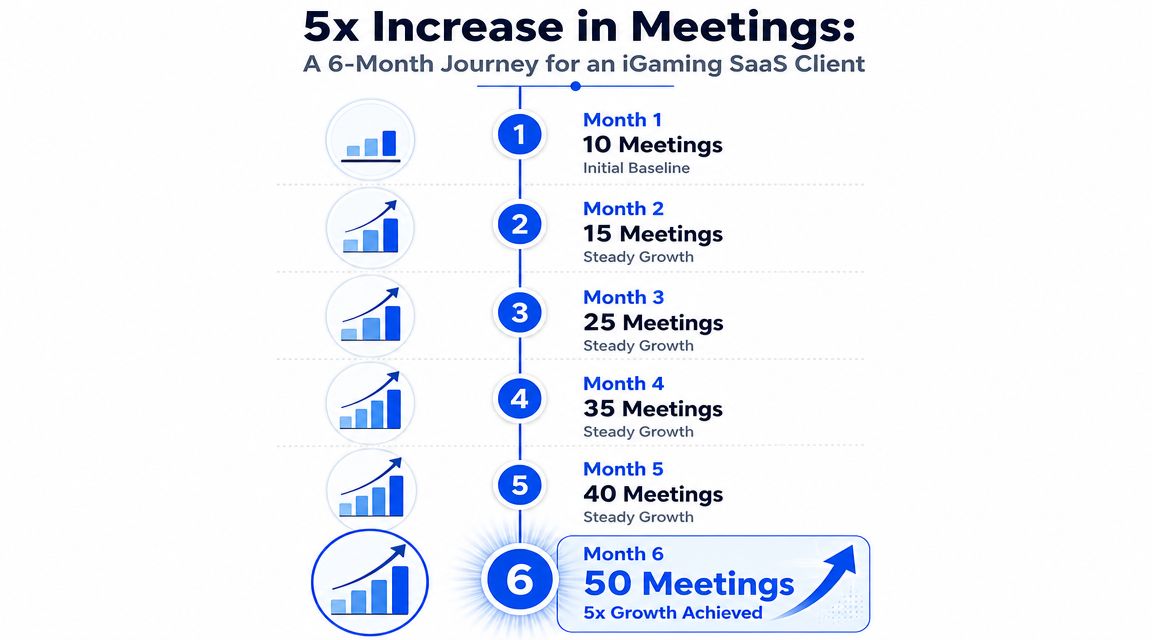
This is why I push back when teams obsess over week-four meeting counts. In a healthy outsourced motion, months 1 and 2 are often slow because the infrastructure and qualification layer are still getting corrected. The useful read starts once the first feedback loop has run.
You can see a similar operating pattern in this lead generation case study for a professional conference, where execution quality matters less in the abstract and more in the mechanics of target selection, messaging, and handoff.
Why qualified meetings matter more than booked meetings
The biggest reporting mistake in outsourced lead generation is counting every calendar invite as a win. That metric is easy to inflate.
A better standard is whether the meeting passed a qualification gate and entered the sales pipeline with enough context for a rep to work it properly. That's where channel mixing, list quality, and reply handling show up clearly. The median B2B website conversion rate is only 2.9% according to this outsourced lead generation guide, so small changes in qualification criteria can materially change downstream performance.
More leads can be the wrong outcome if sales won't accept them.
If your internal team still debates what counts as qualified, fix that before signing anything. This guide to identifying qualified leads is useful because it pushes the conversation toward qualification logic instead of vanity volume.
The agency owns qualified conversations. The client owns what happens after. That's the cleanest way to avoid the usual blame game.
Understanding agency models and pricing
Founders usually come to this section after burning time on the wrong kind of help. They hired a freelancer to "book meetings," or gave outbound to an SDR who was already stretched, and ended up with a calendar full of weak calls and a sales team that stopped trusting marketing. Outsourcing works better when you buy operating discipline, not just more activity.
The three models that show up most often
Model | What they usually do | Where they work | Where they break |
|---|---|---|---|
Appointment setters | High-volume outreach and booking | Broad markets, simple offers | Weak qualification, shallow account context |
Specialized outbound shops | ICP build, copy, outreach, reply handling | Niche B2B categories with defined offers | Can still over-index on activity metrics |
Full pipeline partners | Prospecting through handoff, often with CRM and reporting discipline | Teams that need consistency and feedback loops | Requires more client collaboration |
The cheapest model is usually the one that creates the most cleanup.
Appointment-setting shops are built to fill calendars. If your offer is straightforward and your buyer pool is wide, that can work. If your deal size is high, your sales cycle is long, or your reps need account context before a first call, booked meetings alone are a poor buying metric. You save on fees and pay for it later in rep time, lower show rates, and pipeline noise.
Specialized outbound agencies are a better fit when you already know your ICP, your offer is proven, and the problem is execution. They can write sharper copy, build cleaner lists, and handle replies with more discipline than an overstretched in-house team. The trade-off is ceiling. If your internal sales process is messy, or nobody can define what counts as a sales-ready opportunity, even a good outbound shop will stall.
Full pipeline partners cost more because they take on more of the operating burden. They usually help with segmentation, outreach, qualification logic, CRM hygiene, reporting, and handoff standards. That model works well for exhausted founders and lean revenue teams because it buys back management time. It also asks more from the client. Faster feedback, tighter sales notes, and access to real conversion data.
How pricing really works
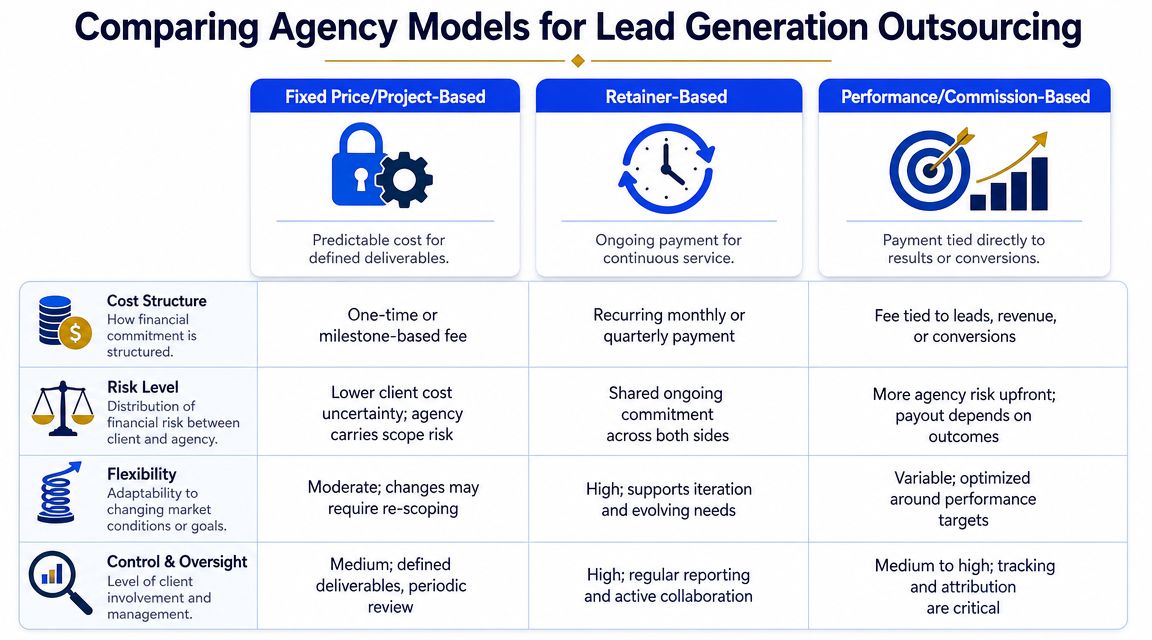
Agency pricing usually falls into three buckets: fixed project fees, monthly retainers, and performance hybrids. The format matters less than the behavior it creates.
Pay-per-meeting sounds clean. In practice, it often pushes the vendor toward volume, loose qualification, and arguments about whether a booked call "counts." Retainers are usually healthier because they give both sides room to improve list quality, messaging, deliverability, and reply handling without forcing bad-fit prospects onto a rep's calendar. Hybrid models can work if the bonus is tied to accepted opportunities, not raw meetings.
The budgeting question is simpler. Are you trying to buy leads, or are you trying to stop your team from rebuilding outbound every six weeks?
In-house lead generation looks cheaper until you add the hidden labor. List building, tooling, deliverability fixes, copy testing, CRM cleanup, SDR management, and founder oversight all carry a cost. Outsourcing shifts that load to a team that already has the systems in place. It does not remove your involvement. It reduces the amount of firefighting required to keep the machine running.
Compliance affects pricing too. Agencies that know how to set up targeting, enrichment, consent logic, and data handling properly will charge more than a list-and-send vendor. That premium is justified if you sell into regulated markets or operate across regions. This guide to data privacy compliance covers the kind of requirements buyers should expect a serious partner to handle.
If you want a grounded reference point for how scope affects cost, Grou's managed pipeline pricing shows one example of how an agency packages delivery around pipeline work instead of isolated activity.
The 7-point vendor selection checklist
Most buyers ask the wrong questions. They ask how many emails the agency sends, how fast they can launch, or whether they use AI.
Those questions don't tell you whether the partner can produce trusted pipeline. These do.
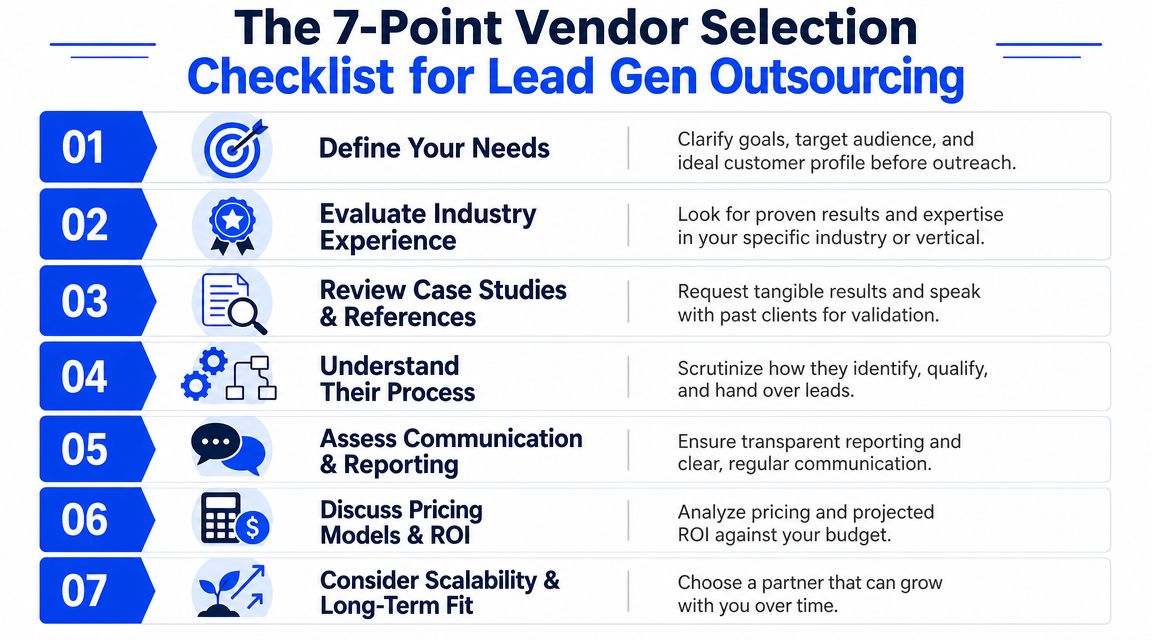
The checklist
Ask for vertical proof
Don't accept broad B2B references. Ask for examples from your category, SaaS, iGaming, manufacturing, legal tech, pharma, whatever you sell into. Category familiarity cuts down wasted months on messaging and qualification.Find out who does the work A real delivery team behaves differently from a loose contractor network. Ask who writes copy, who builds lists, who manages deliverability, and who owns reply handling.
Judge their own outbound
The agency's cold email or LinkedIn message is a live sample of what they'll do for you. If their outreach is generic, they're already demonstrating the quality ceiling.Inspect the stack and workflow
Ask them to walk you through the actual setup. Apollo, Clay, Lemlist, Instantly, HeyReach, Sales Navigator, HubSpot. You should see how records move, how enrichment happens, and where qualification is logged.Test transparency with uncomfortable questions
Ask for a churned client reference and why the account ended. Strong agencies answer directly. Weak ones dodge because they know the same patterns will show up later with you.Review the compliance posture
This matters more than most buyers admit. Data provenance, consent posture, LinkedIn workflow, enrichment practices, suppression logic. If your team needs a primer before the vendor call, this guide to data privacy compliance is a useful starting point.Require an early proof window
Avoid deals that lock you into a long contract without a defined review point. A pilot period or explicit checkpoint forces both sides to evaluate signal quality, not just stay busy.
The market benchmark to keep in mind is cost per qualified lead. A 2025 comparison shows outsourced qualified lead generation commonly ranges from $150 to $600 per qualified lead, with more complex or enterprise-targeted programs reaching $250 to $800+ per qualified lead, according to Callbox's cost comparison. That range is wide for a reason. Complexity, region, and qualification depth all change the economics.
A lot of teams find it easier to think through this after seeing someone dissect the category in plain terms. This breakdown of the lead generation agency model is helpful for comparing what agencies claim to do versus what the buyer needs.
A short walkthrough helps if your team is aligning around selection criteria.
What a good answer sounds like
"We're not a fit if you need cheap meeting volume. We fit when sales cares about acceptance rate and pipeline quality."
That kind of answer is useful because it shows constraint. Good partners know where their model works. The weak ones say yes to everything.
Another signal is how they talk about reporting. If they lead with dials, sends, or connection requests, keep pushing. Ask how they define SAL, SQL, meeting acceptance, and pipeline attribution.
The outsourcing shift what to expect in the first 90 days
Many teams start outsourcing lead generation with a task mindset. They think they're handing off list building, message writing, and outreach execution.
That isn't how good programs settle. The working model usually changes once the market starts talking back.
What clients think they are buying
At kickoff, most companies expect a fairly clean split.
Agency side → list building, copywriting, email sequencing, sending, follow-up
Client side → discovery calls, CRM ownership, strategic decisions, final message approval
That looks tidy. It rarely stays tidy.
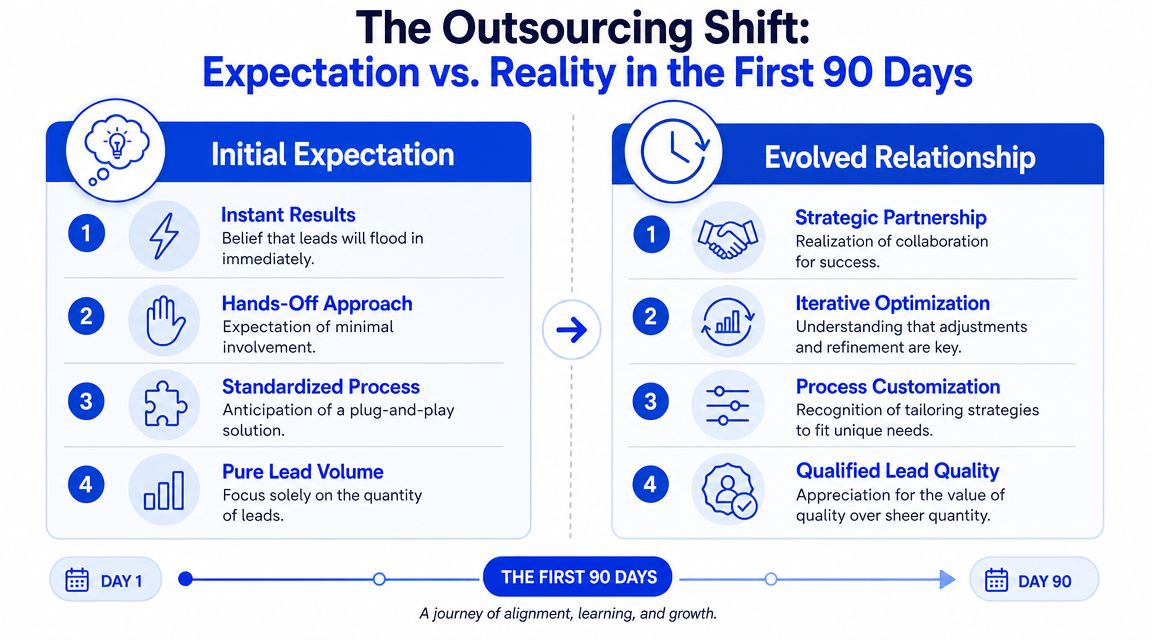
In practice, the first 90 days expose the weak assumptions. The internal ICP is often broader or less precise than leadership thought. Messaging that sounded good internally doesn't hold up when senior buyers reply. Reply routing needs to move faster. CRM access usually needs to expand.
What the relationship usually becomes
The strongest setup is when the provider owns list building, enrichment, qualification, and nurturing, while the buyer keeps ICP ownership and final opportunity qualification, as outlined in this SalesHive piece on outsourcing lead generation. That split reduces handoff ambiguity and creates more trust in what sales receives.
By month 3, three shifts tend to happen:
ICP becomes collaborative
The client stops treating the ICP as fixed doctrine. The agency brings market feedback from reply data, objections, and conversion patterns.Reply handling comes closer to sales
Teams often realize they want positive replies visible earlier, sometimes before full qualification, so reps can build context and momentum.Approval narrows to important edges
Clients stop approving every message. They stay involved on strategic accounts, senior personas, and offer changes.
The companies that get the best result don't freeze the original scope. They renegotiate the working model once the first real market feedback arrives.
This is also where management attention matters. Outsourcing doesn't remove your need to think. It removes your need to manually operate the machine every day.
Your next step audit your own process
Before you choose a partner, run the same diligence process on your own internal motion. Skipping that step often leads to misdiagnosing the problem.
Run the same test on your internal motion
Ask your current setup seven blunt questions.
Can your team define qualification cleanly → not just MQL, but accepted meeting, sales-accepted lead, and real opportunity criteria
Does anyone own list quality every week → not once per quarter
Can sales see context fast enough → replies, enrichment, sequence history, and next action in one place
Would your current process survive staff turnover → or does the know-how live inside one founder or one SDR
Do your tools form a workflow → Apollo, Clay, Instantly, HeyReach, Sales Navigator, HubSpot, all connected by rules rather than hope
If you're layering AI into prospecting or message prep, use it carefully. This PostNitro piece on AI lead generation is a good reminder that speed helps only if qualification standards stay visible and accountable.
Then look at your reporting. If your dashboard still rewards activity over conversion quality, fix that first. A practical starting point is this guide to lead generation KPIs, especially if your current team is drowning in surface metrics and still can't explain why pipeline feels unstable.
Structure turns attention into pipeline. If you can't see the structure clearly, that's usually the reason the output feels random.
Frequently asked questions
How should we define success with an outsourced partner
Use handoff and conversion metrics, not just activity. Track things like sales acceptance, meeting show rate, meeting-to-SQL movement, and sourced pipeline. If the vendor wants to report mostly on sends or connection volume, they're hiding the actual performance question.
What tools should an agency be comfortable with
At minimum, expect fluency with Apollo, Clay, Sales Navigator, Lemlist or Instantly, HeyReach where LinkedIn is part of the motion, and a CRM such as HubSpot. Tool names matter less than workflow clarity. You want to know how data is enriched, where qualification is recorded, and how replies route to sales.
How much time does our team need to commit
More than buyers hope, less than running it all internally. You usually need an executive sponsor for direction, a sales lead for qualification feedback, and someone who owns CRM hygiene and reporting. The commitment is heaviest during launch and after the first feedback loop.
What should stay in-house
Keep final opportunity qualification, sales calls, offer decisions, and strategic ICP ownership inside the business. The external team can challenge those decisions, but they shouldn't replace internal accountability for them.
When should we not outsource lead generation
Don't outsource if your offer still changes weekly, your ICP is completely undefined, or your sales team won't give feedback on lead quality. In that situation, the agency won't fix the operating problem. It will just inherit it.
If your team is stuck between hiring again and outsourcing lead generation, start by pressure-testing the system, not the channel. Grou works with B2B teams that need one operating model across targeting, outbound, LinkedIn, and handoff, so sales gets qualified conversations instead of disconnected activity.
You don't start looking at outsourcing lead generation because you're excited about agencies. You start looking because something inside the current system has broken.
Usually it's the founder still doing prospecting at 11pm. Or the SDR hire that looked sensible on paper and turned into months of management drag, weak list quality, and a pipeline that never stabilized. Or the stack problem, Apollo, Sales Navigator, Clay, Instantly, HubSpot, all paid for, all connected, and still not producing enough qualified conversations.
That's why most buying decisions here are relief purchases, not growth purchases. You're not buying "more leads." You're trying to remove a bottleneck, get consistency back, and stop spending senior attention on work that should already be systemized.
Table of Contents
The real reasons to outsource your lead generation
A founder hires an SDR, buys the data tools, approves a sequence, and expects pipeline to become predictable. Three months later, the founder is still rewriting copy, fixing lists, chasing follow-ups, and stepping into calls because the SDR cannot tell a curious reply from a real opportunity. That is usually the moment outsourcing gets serious.
The decision is rarely about finding a growth trick. It is about stopping the weekly drain on senior attention. Teams outsource lead generation when the internal version keeps depending on heroics, and heroics do not survive a full quarter.
Key takeaways
Outsourcing lead generation is often a relief purchase. The trigger is usually founder fatigue, a weak SDR ramp, uneven execution, or a stack of tools nobody truly owns.
The first 90 days still matter. Early output can look messy while targeting, messaging, and routing get fixed.
Specialists reduce wasted cycles. Category experience cuts down the guesswork on ICP, objections, and qualification standards.
Execution matters more than access. A partner should run the repetitive work well and expose the gaps your internal team has been working around.
If you are evaluating outside help, the question is not whether outsourcing is good in theory. The question is whether your team can run outbound every week without senior rescue. That means list quality, message testing, sender setup, reply handling, CRM hygiene, and feedback from sales all happen on schedule. In many companies, they do not.
The pain behind the pain
The visible complaint is usually simple. "We need more meetings."
The operating problem is usually different.
Sometimes the founder is still the only person who can turn target accounts into conversations. Sometimes a company hired SDRs before it had a usable playbook, so management spent months coaching around missing basics. Sometimes the quarter looks fine until it does not, because nobody consistently owns list refresh, enrichment, sequencing, reply routing, and follow-up cadence.
If lead flow depends on one motivated person having a good week, you do not have a lead generation system. You have a temporary workaround.
I see the same pattern with tooling. A team has Apollo, Sales Navigator, Clay, an outbound platform, and HubSpot. Every component is there. Results still stall because nobody owns the operating model. Data quality slips. Targeting drifts. Positive replies sit too long. Sales starts distrusting booked meetings. At that point, the problem is not software. It is execution discipline.
For teams that need that model built and run, Grou's lead generation service is one example of a done-for-you structure. The useful standard is broader than any one vendor. A partner needs to bring targeting rules, workflow ownership, QA, and clear handoffs. If they only bring sending volume, you are outsourcing activity, not pipeline creation.
Why outsourcing becomes the practical move
Outsourcing starts making sense when you know who you want to sell to, but you cannot keep the motion running without management stepping in every week. That is the point where an external team can remove pressure instead of adding another person to supervise.
The best outsourcing relationships do not just book calendars. They handle prospect research, segmentation, enrichment, outreach execution, reply management, qualification rules, and meeting handoff with enough consistency that sales can trust what shows up. They also force hard decisions that internal teams often postpone, such as what counts as a qualified lead, which accounts to exclude, and how fast reps need to respond. If your team has not defined that yet, use a guide to identifying qualified leads before you blame outbound for poor conversion.
There is a trade-off. You give up some day-to-day control, and good agencies will challenge weak assumptions about your market, offer, or list. That can feel uncomfortable, especially for founders who built the first deals themselves. But that discomfort is often useful. The right partner does not replace strategy. They remove the repetitive operational load that keeps strategy trapped in the founder's head.
Real-world outcomes what a 5x increase in meetings looks like
The cleanest way to judge outsourcing lead generation is to ignore sales pitch language and look at the curve. Not week one. Not the kickoff deck. The curve over months.
For one B2B SaaS client in an iGaming-adjacent market, the starting point was simple. Before outsourcing, the founder personally generated 3 to 4 qualified meetings per month through LinkedIn around the rest of the job. That wasn't a pipeline system. It was manual survival.
What happened over six months
The first two months were setup heavy. List build, inbox infrastructure, targeting logic, copy testing, CRM handoff rules, and early sends. Output during that period reached 5 to 7 meetings booked, and much of that came from warming up the founder's existing network rather than fully independent acquisition.
Month 3 was the first useful signal. The program booked 12 meetings, 9 qualified. Month 4 moved to 17 booked, 14 qualified. By months 5 and 6, the motion stabilized at 18 to 22 qualified meetings per month.
That is roughly a 5x increase in qualified meetings per month from baseline to steady state. Across the six months, the program produced €450k in sourced pipeline and 4 closed deals, with an average ACV that paid back the engagement 8x.
This is why I push back when teams obsess over week-four meeting counts. In a healthy outsourced motion, months 1 and 2 are often slow because the infrastructure and qualification layer are still getting corrected. The useful read starts once the first feedback loop has run.
You can see a similar operating pattern in this lead generation case study for a professional conference, where execution quality matters less in the abstract and more in the mechanics of target selection, messaging, and handoff.
Why qualified meetings matter more than booked meetings
The biggest reporting mistake in outsourced lead generation is counting every calendar invite as a win. That metric is easy to inflate.
A better standard is whether the meeting passed a qualification gate and entered the sales pipeline with enough context for a rep to work it properly. That's where channel mixing, list quality, and reply handling show up clearly. The median B2B website conversion rate is only 2.9% according to this outsourced lead generation guide, so small changes in qualification criteria can materially change downstream performance.
More leads can be the wrong outcome if sales won't accept them.
If your internal team still debates what counts as qualified, fix that before signing anything. This guide to identifying qualified leads is useful because it pushes the conversation toward qualification logic instead of vanity volume.
The agency owns qualified conversations. The client owns what happens after. That's the cleanest way to avoid the usual blame game.
Understanding agency models and pricing
Founders usually come to this section after burning time on the wrong kind of help. They hired a freelancer to "book meetings," or gave outbound to an SDR who was already stretched, and ended up with a calendar full of weak calls and a sales team that stopped trusting marketing. Outsourcing works better when you buy operating discipline, not just more activity.
The three models that show up most often
Model | What they usually do | Where they work | Where they break |
|---|---|---|---|
Appointment setters | High-volume outreach and booking | Broad markets, simple offers | Weak qualification, shallow account context |
Specialized outbound shops | ICP build, copy, outreach, reply handling | Niche B2B categories with defined offers | Can still over-index on activity metrics |
Full pipeline partners | Prospecting through handoff, often with CRM and reporting discipline | Teams that need consistency and feedback loops | Requires more client collaboration |
The cheapest model is usually the one that creates the most cleanup.
Appointment-setting shops are built to fill calendars. If your offer is straightforward and your buyer pool is wide, that can work. If your deal size is high, your sales cycle is long, or your reps need account context before a first call, booked meetings alone are a poor buying metric. You save on fees and pay for it later in rep time, lower show rates, and pipeline noise.
Specialized outbound agencies are a better fit when you already know your ICP, your offer is proven, and the problem is execution. They can write sharper copy, build cleaner lists, and handle replies with more discipline than an overstretched in-house team. The trade-off is ceiling. If your internal sales process is messy, or nobody can define what counts as a sales-ready opportunity, even a good outbound shop will stall.
Full pipeline partners cost more because they take on more of the operating burden. They usually help with segmentation, outreach, qualification logic, CRM hygiene, reporting, and handoff standards. That model works well for exhausted founders and lean revenue teams because it buys back management time. It also asks more from the client. Faster feedback, tighter sales notes, and access to real conversion data.
How pricing really works
Agency pricing usually falls into three buckets: fixed project fees, monthly retainers, and performance hybrids. The format matters less than the behavior it creates.
Pay-per-meeting sounds clean. In practice, it often pushes the vendor toward volume, loose qualification, and arguments about whether a booked call "counts." Retainers are usually healthier because they give both sides room to improve list quality, messaging, deliverability, and reply handling without forcing bad-fit prospects onto a rep's calendar. Hybrid models can work if the bonus is tied to accepted opportunities, not raw meetings.
The budgeting question is simpler. Are you trying to buy leads, or are you trying to stop your team from rebuilding outbound every six weeks?
In-house lead generation looks cheaper until you add the hidden labor. List building, tooling, deliverability fixes, copy testing, CRM cleanup, SDR management, and founder oversight all carry a cost. Outsourcing shifts that load to a team that already has the systems in place. It does not remove your involvement. It reduces the amount of firefighting required to keep the machine running.
Compliance affects pricing too. Agencies that know how to set up targeting, enrichment, consent logic, and data handling properly will charge more than a list-and-send vendor. That premium is justified if you sell into regulated markets or operate across regions. This guide to data privacy compliance covers the kind of requirements buyers should expect a serious partner to handle.
If you want a grounded reference point for how scope affects cost, Grou's managed pipeline pricing shows one example of how an agency packages delivery around pipeline work instead of isolated activity.
The 7-point vendor selection checklist
Most buyers ask the wrong questions. They ask how many emails the agency sends, how fast they can launch, or whether they use AI.
Those questions don't tell you whether the partner can produce trusted pipeline. These do.
The checklist
Ask for vertical proof
Don't accept broad B2B references. Ask for examples from your category, SaaS, iGaming, manufacturing, legal tech, pharma, whatever you sell into. Category familiarity cuts down wasted months on messaging and qualification.Find out who does the work A real delivery team behaves differently from a loose contractor network. Ask who writes copy, who builds lists, who manages deliverability, and who owns reply handling.
Judge their own outbound
The agency's cold email or LinkedIn message is a live sample of what they'll do for you. If their outreach is generic, they're already demonstrating the quality ceiling.Inspect the stack and workflow
Ask them to walk you through the actual setup. Apollo, Clay, Lemlist, Instantly, HeyReach, Sales Navigator, HubSpot. You should see how records move, how enrichment happens, and where qualification is logged.Test transparency with uncomfortable questions
Ask for a churned client reference and why the account ended. Strong agencies answer directly. Weak ones dodge because they know the same patterns will show up later with you.Review the compliance posture
This matters more than most buyers admit. Data provenance, consent posture, LinkedIn workflow, enrichment practices, suppression logic. If your team needs a primer before the vendor call, this guide to data privacy compliance is a useful starting point.Require an early proof window
Avoid deals that lock you into a long contract without a defined review point. A pilot period or explicit checkpoint forces both sides to evaluate signal quality, not just stay busy.
The market benchmark to keep in mind is cost per qualified lead. A 2025 comparison shows outsourced qualified lead generation commonly ranges from $150 to $600 per qualified lead, with more complex or enterprise-targeted programs reaching $250 to $800+ per qualified lead, according to Callbox's cost comparison. That range is wide for a reason. Complexity, region, and qualification depth all change the economics.
A lot of teams find it easier to think through this after seeing someone dissect the category in plain terms. This breakdown of the lead generation agency model is helpful for comparing what agencies claim to do versus what the buyer needs.
A short walkthrough helps if your team is aligning around selection criteria.
What a good answer sounds like
"We're not a fit if you need cheap meeting volume. We fit when sales cares about acceptance rate and pipeline quality."
That kind of answer is useful because it shows constraint. Good partners know where their model works. The weak ones say yes to everything.
Another signal is how they talk about reporting. If they lead with dials, sends, or connection requests, keep pushing. Ask how they define SAL, SQL, meeting acceptance, and pipeline attribution.
The outsourcing shift what to expect in the first 90 days
Many teams start outsourcing lead generation with a task mindset. They think they're handing off list building, message writing, and outreach execution.
That isn't how good programs settle. The working model usually changes once the market starts talking back.
What clients think they are buying
At kickoff, most companies expect a fairly clean split.
Agency side → list building, copywriting, email sequencing, sending, follow-up
Client side → discovery calls, CRM ownership, strategic decisions, final message approval
That looks tidy. It rarely stays tidy.
In practice, the first 90 days expose the weak assumptions. The internal ICP is often broader or less precise than leadership thought. Messaging that sounded good internally doesn't hold up when senior buyers reply. Reply routing needs to move faster. CRM access usually needs to expand.
What the relationship usually becomes
The strongest setup is when the provider owns list building, enrichment, qualification, and nurturing, while the buyer keeps ICP ownership and final opportunity qualification, as outlined in this SalesHive piece on outsourcing lead generation. That split reduces handoff ambiguity and creates more trust in what sales receives.
By month 3, three shifts tend to happen:
ICP becomes collaborative
The client stops treating the ICP as fixed doctrine. The agency brings market feedback from reply data, objections, and conversion patterns.Reply handling comes closer to sales
Teams often realize they want positive replies visible earlier, sometimes before full qualification, so reps can build context and momentum.Approval narrows to important edges
Clients stop approving every message. They stay involved on strategic accounts, senior personas, and offer changes.
The companies that get the best result don't freeze the original scope. They renegotiate the working model once the first real market feedback arrives.
This is also where management attention matters. Outsourcing doesn't remove your need to think. It removes your need to manually operate the machine every day.
Your next step audit your own process
Before you choose a partner, run the same diligence process on your own internal motion. Skipping that step often leads to misdiagnosing the problem.
Run the same test on your internal motion
Ask your current setup seven blunt questions.
Can your team define qualification cleanly → not just MQL, but accepted meeting, sales-accepted lead, and real opportunity criteria
Does anyone own list quality every week → not once per quarter
Can sales see context fast enough → replies, enrichment, sequence history, and next action in one place
Would your current process survive staff turnover → or does the know-how live inside one founder or one SDR
Do your tools form a workflow → Apollo, Clay, Instantly, HeyReach, Sales Navigator, HubSpot, all connected by rules rather than hope
If you're layering AI into prospecting or message prep, use it carefully. This PostNitro piece on AI lead generation is a good reminder that speed helps only if qualification standards stay visible and accountable.
Then look at your reporting. If your dashboard still rewards activity over conversion quality, fix that first. A practical starting point is this guide to lead generation KPIs, especially if your current team is drowning in surface metrics and still can't explain why pipeline feels unstable.
Structure turns attention into pipeline. If you can't see the structure clearly, that's usually the reason the output feels random.
Frequently asked questions
How should we define success with an outsourced partner
Use handoff and conversion metrics, not just activity. Track things like sales acceptance, meeting show rate, meeting-to-SQL movement, and sourced pipeline. If the vendor wants to report mostly on sends or connection volume, they're hiding the actual performance question.
What tools should an agency be comfortable with
At minimum, expect fluency with Apollo, Clay, Sales Navigator, Lemlist or Instantly, HeyReach where LinkedIn is part of the motion, and a CRM such as HubSpot. Tool names matter less than workflow clarity. You want to know how data is enriched, where qualification is recorded, and how replies route to sales.
How much time does our team need to commit
More than buyers hope, less than running it all internally. You usually need an executive sponsor for direction, a sales lead for qualification feedback, and someone who owns CRM hygiene and reporting. The commitment is heaviest during launch and after the first feedback loop.
What should stay in-house
Keep final opportunity qualification, sales calls, offer decisions, and strategic ICP ownership inside the business. The external team can challenge those decisions, but they shouldn't replace internal accountability for them.
When should we not outsource lead generation
Don't outsource if your offer still changes weekly, your ICP is completely undefined, or your sales team won't give feedback on lead quality. In that situation, the agency won't fix the operating problem. It will just inherit it.
If your team is stuck between hiring again and outsourcing lead generation, start by pressure-testing the system, not the channel. Grou works with B2B teams that need one operating model across targeting, outbound, LinkedIn, and handoff, so sales gets qualified conversations instead of disconnected activity.
You don't start looking at outsourcing lead generation because you're excited about agencies. You start looking because something inside the current system has broken.
Usually it's the founder still doing prospecting at 11pm. Or the SDR hire that looked sensible on paper and turned into months of management drag, weak list quality, and a pipeline that never stabilized. Or the stack problem, Apollo, Sales Navigator, Clay, Instantly, HubSpot, all paid for, all connected, and still not producing enough qualified conversations.
That's why most buying decisions here are relief purchases, not growth purchases. You're not buying "more leads." You're trying to remove a bottleneck, get consistency back, and stop spending senior attention on work that should already be systemized.
Table of Contents
The real reasons to outsource your lead generation
A founder hires an SDR, buys the data tools, approves a sequence, and expects pipeline to become predictable. Three months later, the founder is still rewriting copy, fixing lists, chasing follow-ups, and stepping into calls because the SDR cannot tell a curious reply from a real opportunity. That is usually the moment outsourcing gets serious.
The decision is rarely about finding a growth trick. It is about stopping the weekly drain on senior attention. Teams outsource lead generation when the internal version keeps depending on heroics, and heroics do not survive a full quarter.
Key takeaways
Outsourcing lead generation is often a relief purchase. The trigger is usually founder fatigue, a weak SDR ramp, uneven execution, or a stack of tools nobody truly owns.
The first 90 days still matter. Early output can look messy while targeting, messaging, and routing get fixed.
Specialists reduce wasted cycles. Category experience cuts down the guesswork on ICP, objections, and qualification standards.
Execution matters more than access. A partner should run the repetitive work well and expose the gaps your internal team has been working around.
If you are evaluating outside help, the question is not whether outsourcing is good in theory. The question is whether your team can run outbound every week without senior rescue. That means list quality, message testing, sender setup, reply handling, CRM hygiene, and feedback from sales all happen on schedule. In many companies, they do not.
The pain behind the pain
The visible complaint is usually simple. "We need more meetings."
The operating problem is usually different.
Sometimes the founder is still the only person who can turn target accounts into conversations. Sometimes a company hired SDRs before it had a usable playbook, so management spent months coaching around missing basics. Sometimes the quarter looks fine until it does not, because nobody consistently owns list refresh, enrichment, sequencing, reply routing, and follow-up cadence.
If lead flow depends on one motivated person having a good week, you do not have a lead generation system. You have a temporary workaround.
I see the same pattern with tooling. A team has Apollo, Sales Navigator, Clay, an outbound platform, and HubSpot. Every component is there. Results still stall because nobody owns the operating model. Data quality slips. Targeting drifts. Positive replies sit too long. Sales starts distrusting booked meetings. At that point, the problem is not software. It is execution discipline.
For teams that need that model built and run, Grou's lead generation service is one example of a done-for-you structure. The useful standard is broader than any one vendor. A partner needs to bring targeting rules, workflow ownership, QA, and clear handoffs. If they only bring sending volume, you are outsourcing activity, not pipeline creation.
Why outsourcing becomes the practical move
Outsourcing starts making sense when you know who you want to sell to, but you cannot keep the motion running without management stepping in every week. That is the point where an external team can remove pressure instead of adding another person to supervise.
The best outsourcing relationships do not just book calendars. They handle prospect research, segmentation, enrichment, outreach execution, reply management, qualification rules, and meeting handoff with enough consistency that sales can trust what shows up. They also force hard decisions that internal teams often postpone, such as what counts as a qualified lead, which accounts to exclude, and how fast reps need to respond. If your team has not defined that yet, use a guide to identifying qualified leads before you blame outbound for poor conversion.
There is a trade-off. You give up some day-to-day control, and good agencies will challenge weak assumptions about your market, offer, or list. That can feel uncomfortable, especially for founders who built the first deals themselves. But that discomfort is often useful. The right partner does not replace strategy. They remove the repetitive operational load that keeps strategy trapped in the founder's head.
Real-world outcomes what a 5x increase in meetings looks like
The cleanest way to judge outsourcing lead generation is to ignore sales pitch language and look at the curve. Not week one. Not the kickoff deck. The curve over months.
For one B2B SaaS client in an iGaming-adjacent market, the starting point was simple. Before outsourcing, the founder personally generated 3 to 4 qualified meetings per month through LinkedIn around the rest of the job. That wasn't a pipeline system. It was manual survival.
What happened over six months
The first two months were setup heavy. List build, inbox infrastructure, targeting logic, copy testing, CRM handoff rules, and early sends. Output during that period reached 5 to 7 meetings booked, and much of that came from warming up the founder's existing network rather than fully independent acquisition.
Month 3 was the first useful signal. The program booked 12 meetings, 9 qualified. Month 4 moved to 17 booked, 14 qualified. By months 5 and 6, the motion stabilized at 18 to 22 qualified meetings per month.
That is roughly a 5x increase in qualified meetings per month from baseline to steady state. Across the six months, the program produced €450k in sourced pipeline and 4 closed deals, with an average ACV that paid back the engagement 8x.
This is why I push back when teams obsess over week-four meeting counts. In a healthy outsourced motion, months 1 and 2 are often slow because the infrastructure and qualification layer are still getting corrected. The useful read starts once the first feedback loop has run.
You can see a similar operating pattern in this lead generation case study for a professional conference, where execution quality matters less in the abstract and more in the mechanics of target selection, messaging, and handoff.
Why qualified meetings matter more than booked meetings
The biggest reporting mistake in outsourced lead generation is counting every calendar invite as a win. That metric is easy to inflate.
A better standard is whether the meeting passed a qualification gate and entered the sales pipeline with enough context for a rep to work it properly. That's where channel mixing, list quality, and reply handling show up clearly. The median B2B website conversion rate is only 2.9% according to this outsourced lead generation guide, so small changes in qualification criteria can materially change downstream performance.
More leads can be the wrong outcome if sales won't accept them.
If your internal team still debates what counts as qualified, fix that before signing anything. This guide to identifying qualified leads is useful because it pushes the conversation toward qualification logic instead of vanity volume.
The agency owns qualified conversations. The client owns what happens after. That's the cleanest way to avoid the usual blame game.
Understanding agency models and pricing
Founders usually come to this section after burning time on the wrong kind of help. They hired a freelancer to "book meetings," or gave outbound to an SDR who was already stretched, and ended up with a calendar full of weak calls and a sales team that stopped trusting marketing. Outsourcing works better when you buy operating discipline, not just more activity.
The three models that show up most often
Model | What they usually do | Where they work | Where they break |
|---|---|---|---|
Appointment setters | High-volume outreach and booking | Broad markets, simple offers | Weak qualification, shallow account context |
Specialized outbound shops | ICP build, copy, outreach, reply handling | Niche B2B categories with defined offers | Can still over-index on activity metrics |
Full pipeline partners | Prospecting through handoff, often with CRM and reporting discipline | Teams that need consistency and feedback loops | Requires more client collaboration |
The cheapest model is usually the one that creates the most cleanup.
Appointment-setting shops are built to fill calendars. If your offer is straightforward and your buyer pool is wide, that can work. If your deal size is high, your sales cycle is long, or your reps need account context before a first call, booked meetings alone are a poor buying metric. You save on fees and pay for it later in rep time, lower show rates, and pipeline noise.
Specialized outbound agencies are a better fit when you already know your ICP, your offer is proven, and the problem is execution. They can write sharper copy, build cleaner lists, and handle replies with more discipline than an overstretched in-house team. The trade-off is ceiling. If your internal sales process is messy, or nobody can define what counts as a sales-ready opportunity, even a good outbound shop will stall.
Full pipeline partners cost more because they take on more of the operating burden. They usually help with segmentation, outreach, qualification logic, CRM hygiene, reporting, and handoff standards. That model works well for exhausted founders and lean revenue teams because it buys back management time. It also asks more from the client. Faster feedback, tighter sales notes, and access to real conversion data.
How pricing really works
Agency pricing usually falls into three buckets: fixed project fees, monthly retainers, and performance hybrids. The format matters less than the behavior it creates.
Pay-per-meeting sounds clean. In practice, it often pushes the vendor toward volume, loose qualification, and arguments about whether a booked call "counts." Retainers are usually healthier because they give both sides room to improve list quality, messaging, deliverability, and reply handling without forcing bad-fit prospects onto a rep's calendar. Hybrid models can work if the bonus is tied to accepted opportunities, not raw meetings.
The budgeting question is simpler. Are you trying to buy leads, or are you trying to stop your team from rebuilding outbound every six weeks?
In-house lead generation looks cheaper until you add the hidden labor. List building, tooling, deliverability fixes, copy testing, CRM cleanup, SDR management, and founder oversight all carry a cost. Outsourcing shifts that load to a team that already has the systems in place. It does not remove your involvement. It reduces the amount of firefighting required to keep the machine running.
Compliance affects pricing too. Agencies that know how to set up targeting, enrichment, consent logic, and data handling properly will charge more than a list-and-send vendor. That premium is justified if you sell into regulated markets or operate across regions. This guide to data privacy compliance covers the kind of requirements buyers should expect a serious partner to handle.
If you want a grounded reference point for how scope affects cost, Grou's managed pipeline pricing shows one example of how an agency packages delivery around pipeline work instead of isolated activity.
The 7-point vendor selection checklist
Most buyers ask the wrong questions. They ask how many emails the agency sends, how fast they can launch, or whether they use AI.
Those questions don't tell you whether the partner can produce trusted pipeline. These do.
The checklist
Ask for vertical proof
Don't accept broad B2B references. Ask for examples from your category, SaaS, iGaming, manufacturing, legal tech, pharma, whatever you sell into. Category familiarity cuts down wasted months on messaging and qualification.Find out who does the work A real delivery team behaves differently from a loose contractor network. Ask who writes copy, who builds lists, who manages deliverability, and who owns reply handling.
Judge their own outbound
The agency's cold email or LinkedIn message is a live sample of what they'll do for you. If their outreach is generic, they're already demonstrating the quality ceiling.Inspect the stack and workflow
Ask them to walk you through the actual setup. Apollo, Clay, Lemlist, Instantly, HeyReach, Sales Navigator, HubSpot. You should see how records move, how enrichment happens, and where qualification is logged.Test transparency with uncomfortable questions
Ask for a churned client reference and why the account ended. Strong agencies answer directly. Weak ones dodge because they know the same patterns will show up later with you.Review the compliance posture
This matters more than most buyers admit. Data provenance, consent posture, LinkedIn workflow, enrichment practices, suppression logic. If your team needs a primer before the vendor call, this guide to data privacy compliance is a useful starting point.Require an early proof window
Avoid deals that lock you into a long contract without a defined review point. A pilot period or explicit checkpoint forces both sides to evaluate signal quality, not just stay busy.
The market benchmark to keep in mind is cost per qualified lead. A 2025 comparison shows outsourced qualified lead generation commonly ranges from $150 to $600 per qualified lead, with more complex or enterprise-targeted programs reaching $250 to $800+ per qualified lead, according to Callbox's cost comparison. That range is wide for a reason. Complexity, region, and qualification depth all change the economics.
A lot of teams find it easier to think through this after seeing someone dissect the category in plain terms. This breakdown of the lead generation agency model is helpful for comparing what agencies claim to do versus what the buyer needs.
A short walkthrough helps if your team is aligning around selection criteria.
What a good answer sounds like
"We're not a fit if you need cheap meeting volume. We fit when sales cares about acceptance rate and pipeline quality."
That kind of answer is useful because it shows constraint. Good partners know where their model works. The weak ones say yes to everything.
Another signal is how they talk about reporting. If they lead with dials, sends, or connection requests, keep pushing. Ask how they define SAL, SQL, meeting acceptance, and pipeline attribution.
The outsourcing shift what to expect in the first 90 days
Many teams start outsourcing lead generation with a task mindset. They think they're handing off list building, message writing, and outreach execution.
That isn't how good programs settle. The working model usually changes once the market starts talking back.
What clients think they are buying
At kickoff, most companies expect a fairly clean split.
Agency side → list building, copywriting, email sequencing, sending, follow-up
Client side → discovery calls, CRM ownership, strategic decisions, final message approval
That looks tidy. It rarely stays tidy.
In practice, the first 90 days expose the weak assumptions. The internal ICP is often broader or less precise than leadership thought. Messaging that sounded good internally doesn't hold up when senior buyers reply. Reply routing needs to move faster. CRM access usually needs to expand.
What the relationship usually becomes
The strongest setup is when the provider owns list building, enrichment, qualification, and nurturing, while the buyer keeps ICP ownership and final opportunity qualification, as outlined in this SalesHive piece on outsourcing lead generation. That split reduces handoff ambiguity and creates more trust in what sales receives.
By month 3, three shifts tend to happen:
ICP becomes collaborative
The client stops treating the ICP as fixed doctrine. The agency brings market feedback from reply data, objections, and conversion patterns.Reply handling comes closer to sales
Teams often realize they want positive replies visible earlier, sometimes before full qualification, so reps can build context and momentum.Approval narrows to important edges
Clients stop approving every message. They stay involved on strategic accounts, senior personas, and offer changes.
The companies that get the best result don't freeze the original scope. They renegotiate the working model once the first real market feedback arrives.
This is also where management attention matters. Outsourcing doesn't remove your need to think. It removes your need to manually operate the machine every day.
Your next step audit your own process
Before you choose a partner, run the same diligence process on your own internal motion. Skipping that step often leads to misdiagnosing the problem.
Run the same test on your internal motion
Ask your current setup seven blunt questions.
Can your team define qualification cleanly → not just MQL, but accepted meeting, sales-accepted lead, and real opportunity criteria
Does anyone own list quality every week → not once per quarter
Can sales see context fast enough → replies, enrichment, sequence history, and next action in one place
Would your current process survive staff turnover → or does the know-how live inside one founder or one SDR
Do your tools form a workflow → Apollo, Clay, Instantly, HeyReach, Sales Navigator, HubSpot, all connected by rules rather than hope
If you're layering AI into prospecting or message prep, use it carefully. This PostNitro piece on AI lead generation is a good reminder that speed helps only if qualification standards stay visible and accountable.
Then look at your reporting. If your dashboard still rewards activity over conversion quality, fix that first. A practical starting point is this guide to lead generation KPIs, especially if your current team is drowning in surface metrics and still can't explain why pipeline feels unstable.
Structure turns attention into pipeline. If you can't see the structure clearly, that's usually the reason the output feels random.
Frequently asked questions
How should we define success with an outsourced partner
Use handoff and conversion metrics, not just activity. Track things like sales acceptance, meeting show rate, meeting-to-SQL movement, and sourced pipeline. If the vendor wants to report mostly on sends or connection volume, they're hiding the actual performance question.
What tools should an agency be comfortable with
At minimum, expect fluency with Apollo, Clay, Sales Navigator, Lemlist or Instantly, HeyReach where LinkedIn is part of the motion, and a CRM such as HubSpot. Tool names matter less than workflow clarity. You want to know how data is enriched, where qualification is recorded, and how replies route to sales.
How much time does our team need to commit
More than buyers hope, less than running it all internally. You usually need an executive sponsor for direction, a sales lead for qualification feedback, and someone who owns CRM hygiene and reporting. The commitment is heaviest during launch and after the first feedback loop.
What should stay in-house
Keep final opportunity qualification, sales calls, offer decisions, and strategic ICP ownership inside the business. The external team can challenge those decisions, but they shouldn't replace internal accountability for them.
When should we not outsource lead generation
Don't outsource if your offer still changes weekly, your ICP is completely undefined, or your sales team won't give feedback on lead quality. In that situation, the agency won't fix the operating problem. It will just inherit it.
If your team is stuck between hiring again and outsourcing lead generation, start by pressure-testing the system, not the channel. Grou works with B2B teams that need one operating model across targeting, outbound, LinkedIn, and handoff, so sales gets qualified conversations instead of disconnected activity.
Pipeline OS Newsletter
Build qualified pipeline
Get weekly tactics to generate demand, improve lead quality, and book more meetings.






Trusted by industry leaders
Trusted by industry leaders
Trusted by industry leaders
Ready to build qualified pipeline?
Ready to build qualified pipeline?
Ready to build qualified pipeline?
Book a call to see if we're the right fit, or take the 2-minute quiz to get a clear starting point.
Book a call to see if we're the right fit, or take the 2-minute quiz to get a clear starting point.
Book a call to see if we're the right fit, or take the 2-minute quiz to get a clear starting point.
" height="30.21639343089746px" id="hfGbXmQR2" width="30.216393430897455px"/></svg>)
Copyright © 2026 – All Right Reserved
Copyright © 2026 – All Right Reserved
Copyright © 2026 – All Right Reserved