
NEW WEBINAR: Learn how to fill your B2B webinar seatsHow to fill your B2B webinar seatsSave your seat
%22%3E%3C/path%3E%3Cpath d=%22M 63.072 7.554 C 62.258 8.022 61.577 8.689 61.092 9.493 L 61.092 7.076 L 57.158 7.076 L 57.158 22.64 L 61.089 22.64 L 61.089 14.888 C 61.089 13.446 61.403 12.434 62.03 11.853 C 62.818 11.218 63.818 10.907 64.826 10.982 L 65.868 10.982 L 65.868 6.851 C 64.891 6.834 63.926 7.076 63.073 7.554 Z%22 fill=%22rgb(17,17,17)%22%3E%3C/path%3E%3Cpath d=%22M 78.916 7.82 C 76.363 6.49 73.321 6.49 70.768 7.82 C 69.562 8.473 68.564 9.451 67.888 10.644 C 67.167 11.931 66.803 13.387 66.834 14.862 C 66.804 16.332 67.157 17.785 67.86 19.077 C 68.515 20.267 69.494 21.246 70.684 21.901 C 71.924 22.576 73.318 22.92 74.73 22.898 C 76.164 22.918 77.58 22.575 78.846 21.901 C 80.062 21.247 81.073 20.27 81.768 19.077 C 82.506 17.797 82.88 16.339 82.85 14.862 C 82.88 13.389 82.517 11.934 81.797 10.647 C 81.12 9.455 80.122 8.477 78.917 7.824 M 78.803 14.862 C 78.829 15.739 78.636 16.608 78.241 17.391 C 77.903 18.046 77.38 18.588 76.738 18.95 C 76.124 19.293 75.432 19.472 74.729 19.47 C 73.668 19.497 72.648 19.061 71.934 18.276 C 71.139 17.323 70.741 16.1 70.823 14.862 C 70.741 13.62 71.149 12.395 71.959 11.45 C 72.687 10.667 73.715 10.233 74.783 10.256 C 75.859 10.236 76.894 10.67 77.635 11.45 C 78.464 12.387 78.884 13.616 78.801 14.864%22 fill=%22rgb(17,17,17)%22%3E%3C/path%3E%3Cpath d=%22M 95.906 7.076 L 95.906 15.646 C 95.975 16.68 95.643 17.701 94.979 18.498 C 94.311 19.184 93.379 19.547 92.422 19.495 C 91.475 19.544 90.553 19.18 89.894 18.498 C 89.23 17.701 88.898 16.68 88.967 15.646 L 88.967 7.076 L 85.033 7.076 L 85.033 16.207 C 85 17.449 85.275 18.68 85.834 19.79 C 86.327 20.75 87.095 21.542 88.039 22.065 C 89.033 22.594 90.145 22.861 91.271 22.838 C 92.188 22.847 93.095 22.65 93.926 22.263 C 94.708 21.905 95.388 21.36 95.906 20.675 L 95.906 22.645 L 99.865 22.645 L 99.865 7.076 Z%22 fill=%22rgb(17,17,17)%22%3E%3C/path%3E%3Cpath d=%22M 4.513 15.626 C 4.511 10.815 7.606 6.549 12.181 5.059 C 16.756 3.57 21.77 5.195 24.601 9.086 L 27.816 5.87 C 24.074 1.186 17.981 -0.943 12.137 0.393 C 6.292 1.728 1.728 6.292 0.393 12.137 C -0.943 17.981 1.186 24.074 5.87 27.816 L 9.085 24.601 C 6.214 22.512 4.515 19.177 4.513 15.626%22 fill=%22rgb(32,62,235)%22%3E%3C/path%3E%3Cpath d=%22M 17.114 14.343 L 13.354 18.01 L 13.354 18.026 L 21.071 18.026 L 11.412 27.609 L 17.389 27.609 L 23.999 21.081 L 23.999 28.316 L 24.005 28.316 L 27.967 24.393 L 27.967 14.343 Z%22 fill=%22rgb(32,62,235)%22%3E%3C/path%3E%3C/g%3E%3C/svg%3E) ×
×
NEW WEBINAR: Learn how to fill your B2B webinar seatsHow to fill your B2B webinar seatsSave your seat
×NEW WEBINAR: Learn how to fill your B2B webinar seatsHow to fill your B2B webinar seatsSave your seat
×›
›
›
›
How to Hire a Lead Generation Agency in 2026
How to Hire a Lead Generation Agency in 2026
How to Hire a Lead Generation Agency in 2026
How to Hire a Lead Generation Agency in 2026
How to Hire a Lead Generation Agency in 2026
How to Hire a Lead Generation Agency in 2026

Author
Aljaz Peklaj

A familiar scenario plays out in quarter after quarter. You hire a lead generation agency after a strong pitch, approve the messaging, sit through weekly updates, and by month three the pipeline story is still muddy. Meetings are booked, but the ICP has drifted. Reply rates look decent, but sales says the conversations are thin. Nobody agrees on whether the problem is targeting, list quality, offer, outreach, follow-up speed, or attribution.
I have seen this from both sides of the table. Agency relationships break when the buyer skips operating discipline at the start. The failure usually has less to do with effort and more to do with unclear rules on segment selection, data ownership, handoff workflow, reporting, and the time window for judging results.
That confusion gets expensive fast. More vendors now package the same work in different ways, with different labels for outbound, paid, appointment setting, SDR-as-a-service, and demand generation. Busy dashboards make weak execution hard to spot, especially if nobody defined what counts as a qualified meeting, sales accepted lead, or sourced pipeline before kickoff.
A lead generation agency can help. But this is an operator decision. Treat it like hiring a production partner that touches CRM hygiene, outbound infrastructure, inbox health, routing logic, and pipeline accountability. If you are in professional services, this playbook for professional services marketers is a useful companion read because it ties demand generation to the realities of partner-led sales and longer buying cycles.
The rest of this guide is built the way RevOps teams run agency selection. Tight vetting criteria, clear onboarding requirements, and performance management that forces signal to show up early. It includes the questions that make weak agencies uncomfortable, which is usually a good sign.
Table of Contents
Introduction
Key takeaways
How to vet an agency with an 8-point checklist
What separates a real operator from a sales deck
The 8 checks that matter
Decoding services, pricing, and contracts
What you're actually buying
Which pricing model creates the least bad incentives
Contract terms worth fixing before kickoff
The 14-day onboarding sprint that defines success
Why slow onboarding beats fast launch
The 5-phase sprint
Red flags in the first two weeks
A 90-day framework for managing agency performance
What to judge at 30 60 and 90 days
The 3-layer reporting structure
Industry nuances and red flags to watch for
What changes by vertical
Universal warning signs
Your next step
Introduction
Hiring a lead generation agency isn't hard. Hiring one that improves pipeline instead of creating reporting theater is hard.
The trap is familiar. You sign a six-month agreement, approve messaging you didn't really challenge, and get weekly updates full of send volume and optimistic commentary. By the time anyone asks whether the target list was wrong or whether sales ever accepted the leads, you've burned a quarter.
A good operator fixes that before the contract is signed. The process is simple, but not easy. Pressure-test the agency's focus, force precision in scope, slow down onboarding, and review performance against agreed checkpoints instead of gut feel.
Practical rule: If an agency can't explain exactly who they target, how they build lists, how they report, and how they'll be judged by day 90, don't buy the proposal.
Key takeaways
Most agencies sell some variation of list building, messaging, and outbound execution. The difference is whether those pieces connect to revenue or sit as disconnected tasks.
Here's the short version:
Use an 8-point filter before any proposal. Most agencies fail on specialization, team structure, references, or reporting clarity.
Avoid pure pay-per-lead deals. They often reward volume over fit, which is the fastest way to flood sales with junk.
Treat onboarding as the actual start of the engagement. The first two weeks decide whether the next six months produce signal or confusion.
Set review windows in writing. Thirty days is for setup and learning, sixty days is for early signal, ninety days is for first actual judgment.
Demand a reporting system that answers questions before you ask them. If you have to chase updates, the operating model is already broken.
Pricing is a more critical factor than many buyers acknowledge. "Starting at" proposals, undisclosed setup tasks, and ambiguous line items like outreach support leave space for justification. My preference is straightforward: adopt a fixed monthly retainer with specific deliverables, identified channels, listed tools, defined ownership, and scheduled review points. This approach is more manageable than a performance-only model that encourages low-quality meetings.
How to vet an agency with an 8-point checklist
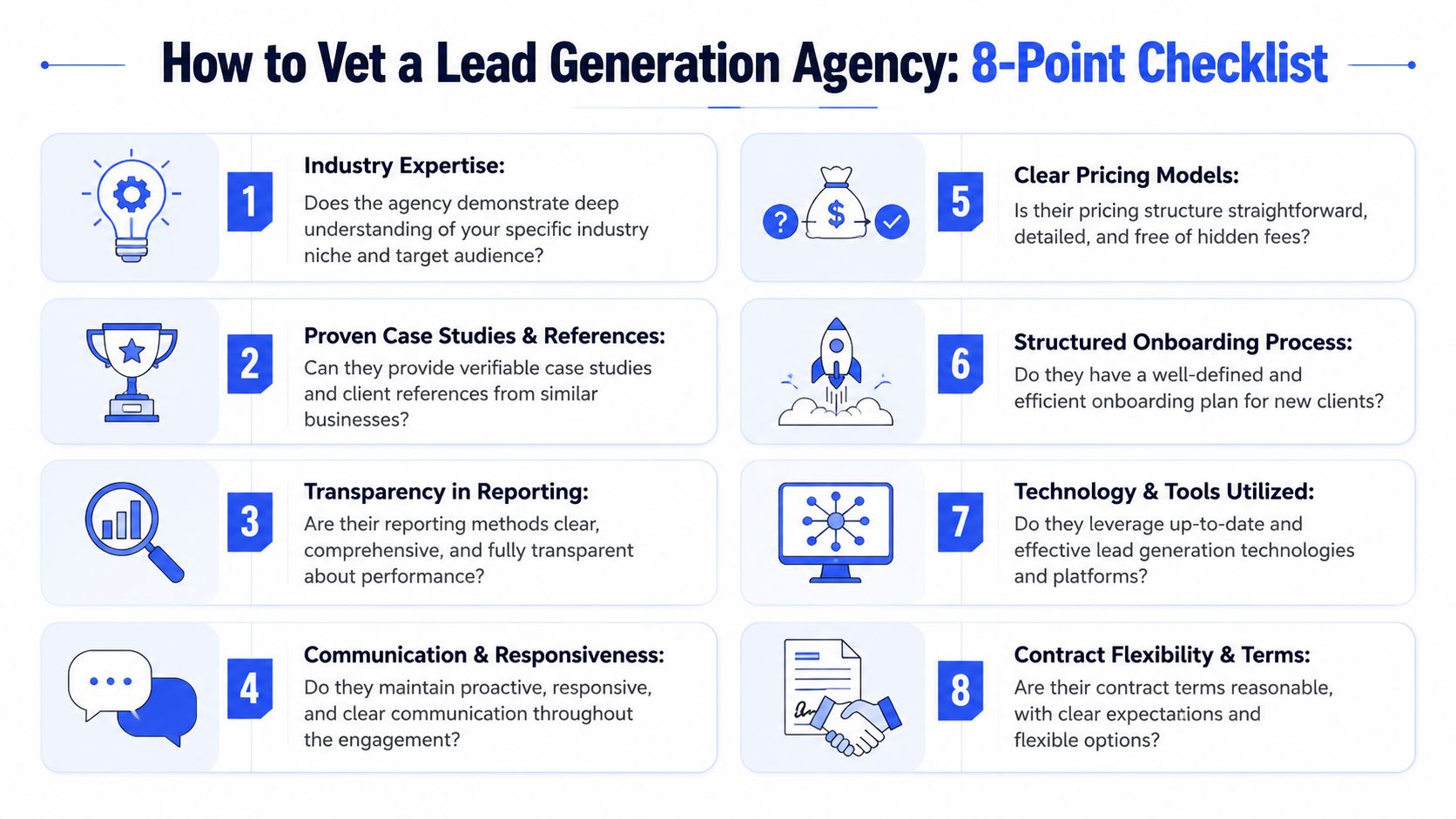
What separates a real operator from a sales deck
Poor lead quality is the complaint that shows up first when an agency relationship goes sideways. 42% of sales reps cite poor lead quality from agencies as their top frustration, tied to unclear targeting and weak analytics, according to Callbox on common agency delivery failures.
That stat lines up with what buyers see in the wild. The agency usually isn't failing at activity. It's failing at ICP discipline, qualification logic, and feedback loops. That's why vetting needs to focus less on brand polish and more on operating behavior.
If you want to compare what an agency claims against actual delivery examples, review a set of B2B pipeline case studies and look for specifics like buyer segment, motion, and workflow, not just booked-call headlines.
The 8 checks that matter
Specialized ICP
Ask which two or three verticals they understand. "We work with everyone" usually means recycled outreach and shallow buyer knowledge. For SaaS, legal tech, pharma, manufacturing, or iGaming, the agency should name the buyer roles, common objections, and what changes in the motion.
Verifiable proof
Don't accept anonymous screenshots. Ask for named case studies and a real client contact where possible. If they can't verify outcomes, treat every performance claim as marketing copy.
In-house team
Ask who writes copy, who builds lists, who manages deliverability, who runs LinkedIn, and who owns QA. If execution lives in a loose contractor network, quality drift usually appears once the account leaves the sales team and enters production.
Ask for names, roles, and who joins the weekly call. The org chart tells you more than the proposal.
Their own outbound quality
This is the fastest filter. If they reached out to you, was the message sharp, relevant, and well-timed? Agencies that can't sell their own service with precision rarely produce precise outbound for clients.
Current tool stack
For most modern outbound programs, you should hear tools like Apollo, Clay, Lemlist, Instantly, HeyReach, HubSpot, and Sales Navigator. The exact stack can vary, but the logic should be current. Ask why each tool is in the workflow and what problem it solves.
Transparent pricing
Get the entire scope in writing before the first call ends if possible. You want list building, copywriting, channel mix, sending infrastructure ownership, reporting cadence, meeting handling, CRM sync, and revision process spelled out. "Starting at" pricing often hides the actual cost until you're already committed.
References from churned clients
Every agency has happy references. Ask for one client who left and why. The answer tells you whether the team can talk plainly about mismatches, failures, and accountability.
Cultural fit
This sounds soft and isn't. You'll be in weekly reviews with these people for months. If they dodge direct questions, oversell every answer, or treat kickoff like a pitch, expect that tone to continue when performance dips.
Quick scorecard
Check | Strong signal | Weak signal |
|---|---|---|
ICP focus | Clear vertical depth | Generalist positioning |
Proof | Named examples, references | Anonymous screenshots |
Delivery team | In-house operators | Rotating freelancer bench |
Outbound quality | Sharp, relevant outreach | Generic agency pitch |
Stack | Current tools, clear logic | Tool talk without process |
Pricing | Explicit scope | Vague deliverables |
References | Includes churn context | Happy clients only |
Fit | Direct answers | Deflection and polish |
Decoding services, pricing, and contracts

What you're actually buying
A proposal says "full-funnel lead generation." Five weeks later, your team realizes the agency only owns list pulls, email sends, and a weekly slide deck. Replies still sit in a shared inbox. SDRs are rewriting copy. Salesforce fields are half-mapped. That gap between the pitch and the operating model is where agency programs go sideways.
Under different labels, agencies usually sell the same building blocks: list building, message development, outbound execution, inbox or reply handling, meeting qualification, reporting, and iteration. The variation is not the category name. It's where responsibility starts, where it stops, and which work gets pushed back onto your team after signature.
As noted earlier, the market keeps growing. That creates more packaging, more service bundles, and more room to hide weak delivery behind polished naming.
If SEO is part of the pipeline mix, especially for compounding inbound demand around high-intent commercial queries, this piece on transforming business with SEO leads is worth reading because it treats SEO as revenue infrastructure, not a traffic project.
For buyers comparing managed options, a lead generation service model should be judged by how tightly it connects targeting, messaging, channel execution, qualification rules, and reporting. Slide count means nothing if handoffs are sloppy.
Which pricing model creates the least bad incentives
Every pricing model has a failure mode. The question is which one you can manage.
Pricing model | What it sounds like | What usually goes wrong |
|---|---|---|
Retainer | Stable monthly fee for defined scope | Scope expands quietly if outputs are not named |
Pay-per-lead | You only pay for outcomes | Volume gets rewarded even when fit is weak |
Commission | Agency shares upside | Attribution disputes show up fast |
Hybrid | Base fee plus performance layer | Works only if terms and lead stages are tightly defined |
I usually prefer a retainer with milestone reviews, acceptance criteria, and a short initial term. It gives both sides room to inspect the work. You can tie payment to list quality, copy approval, launch dates, reporting standards, meeting thresholds, and CRM hygiene instead of arguing about whether one calendar booking counts as success.
Pay-per-lead sounds safer than it is. If the agency gets paid on booked meetings, it will optimize for booked meetings. That often means broader targeting, looser qualification, aggressive copy, and handoffs your sales team does not trust.
Commission models can work in simple, high-volume environments. In B2B, they usually create noise. Multi-touch attribution is messy, sales cycles are long, and agencies rarely control enough of the funnel to deserve a true revenue share without constant debate.
A bad model trains bad behavior.
Contract terms worth fixing before kickoff
Contracts should answer one practical question: what happens on Tuesday when something goes wrong?
Start with delivery ownership. Name the operator for list sourcing, copywriting, inbox setup, sending, LinkedIn steps if used, reply routing, qualification, meeting booking, CRM updates, and reporting. If the contract says "campaign management" without outputs, rewrite it.
Asset ownership comes next. I want sending domains, inboxes, ad accounts if relevant, sequences, audience data, and reporting assets clearly assigned. If the agency controls the infrastructure and the relationship ends badly, your program can disappear overnight.
Then lock down operating rules:
Scope boundaries. What is included each month, what counts as change requests, and how fast changes get approved.
Performance definitions. What qualifies as a lead, meeting, sales accepted opportunity, or valid response.
Review cadence. Weekly operating review, monthly performance review, and who attends each meeting.
Data handling. Which system is the source of truth, how fields are mapped, and who fixes sync issues.
Exit terms. Notice period, handoff format, asset transfer, and access removal.
One more point from experience. Ask what happens to work in progress if you terminate in month two. Good agencies have a clean answer, a handoff checklist, and a defined export process. Weak ones get vague because they never planned for accountability.
The 14-day onboarding sprint that defines success

Why slow onboarding beats fast launch
The first two weeks tell you whether the agency runs a system or just ships tasks.
Rushed onboarding feels productive because things start moving fast. In practice, it usually means the agency is writing copy before it understands your win patterns, building lists before you validate fit, and launching outreach before sales agrees on qualification. That rework costs more than the slow start.
This matters even more in multi-channel programs. Agencies that ignore multi-channel integration and rely on a single outreach method see 29% lower lead rates on average, based on Saleshandy's lead generation benchmarks. If email, LinkedIn, and qualification rules aren't aligned from day one, you're already giving up response quality and attribution clarity.
A sprint-based operating model helps here. The point of a structured campaign sprint is simple: fixed review rhythm, fast feedback, and fewer hidden assumptions.
The 5-phase sprint
Discovery deep-dive
Run a real session, not a form-fill. Cover ICP, current pipeline, sales stages, win and loss patterns, recent closed deals, and the deals that should have closed but didn't. Losses usually produce better messaging than wins because they reveal friction and skepticism.
Message map workshop
Build the campaign around three core pain points and three proof points. Get written approval. If the agency wants to "test messaging live" before that map exists, they're outsourcing strategy to your market.
Target list calibration
Start with a sample list, review it together, mark the bad fits, then scale. Tools like Apollo, Clay, and Sales Navigator should support judgment, not replace it. The list should reflect buyer logic, not just firmographic filters.
Voice training
Hand over your best outbound emails, founder notes, sales call snippets, and LinkedIn posts. Define approved language, banned phrases, tone, and rhythm. Good agencies don't write in their house voice. They write in yours, while keeping the message commercially useful.
Infrastructure handoff
Complete the configuration prior to launch. CRM field mapping, Slack channels, call cadence, routing logic, meeting ownership, and dashboards must all be active. This is also the stage where having a single point of contact on the client side becomes essential.
Later in the process, it helps to align visually around what a disciplined rollout looks like:
Red flags in the first two weeks
Different industries surface different onboarding mistakes.
For SaaS, the common failure is lazy segmentation. The agency treats product-led buyers, enterprise evaluators, and partner-driven accounts like one audience. For manufacturing, they miss channel partner dynamics, geography, and technical buyer language. For iGaming, they underestimate market nuance and compliance sensitivity. For professional services, they write messages that sound like generic agency copy instead of trust-building commercial communication.
Watch for these signals early:
No pushback on ICP → They're trying to please you, not refine the target.
Copy before strategy → Messaging appears before a message map exists.
List volume talk → They brag about database size instead of fit criteria.
Too many stakeholders → Meetings become commentary sessions instead of decisions.
No weekly rhythm → Without a review cadence, issues stay hidden until they hurt.
If onboarding feels light, the campaign will feel heavy later.
A 90-day framework for managing agency performance

The biggest management mistake isn't hiring the wrong lead generation agency. It's judging the right one at the wrong time.
Most agency content still ignores the need for one message, one ICP list, and one reporting line. That fragmentation is part of why 70% of agency revenue still relies on unpredictable referrals instead of integrated outbound systems, as noted by Saleshandy on agency lead generation gaps. If your agency can't connect outreach to one operating view, your reviews will drift into anecdotes.
A proper management system should sit inside your broader sales pipeline management process, not outside it. The agency isn't a side project. It's another input into pipeline creation.
What to judge at 30 60 and 90 days
Use three windows.
At 30 days, judge setup quality. Is the targeting stable? Are messages improving? Is reply handling clean? This is too early for ROI conclusions, but it's not too early to catch structural problems.
At 60 days, look for signal. You should know which segments respond, which messages create useful conversations, and whether handoff between agency and sales is working. Many bad programs become apparent at this stage because the team still can't explain why replies are happening.
At 90 days, make the first real call. By this point, you should be able to inspect booked meetings, held meetings, CRM hygiene, and early pipeline creation. If the agency is still defending effort instead of showing movement through the funnel, don't extend the ambiguity.
Judge the first month on learning quality, the second on pattern clarity, the third on pipeline evidence.
The 3-layer reporting structure
Most agencies either over-report or under-report. Both are forms of hiding.
Use this structure instead:
Real-time dashboard
HubSpot, Looker, or a clean BI layer. Show campaign volume, replies, booked meetings, held meetings, and pipeline value where attribution is clean.
Weekly written update
Three short paragraphs. What was sent. What worked and didn't. What changes next week. No deck needed.
Monthly strategy review
One call, recorded. Segment performance, messaging changes, sales feedback, and the next plan. Here, you decide whether to narrow, expand, or rebuild.
What shouldn't lead the conversation is open rate. Since tracking reliability has been degraded, it's too easy to use opens as comfort data. Focus on replies, meetings held, acceptance quality, and movement into real opportunities.
One more operational choice matters here. Use one shared Slack channel with the agency, sales, and the client owner. Fast feedback beats perfect decks.
Industry nuances and red flags to watch for
There isn't enough serious coverage of lead generation in overlooked B2B niches like manufacturing, professional services, and iGaming, with too much content still pushing generic tactics, as discussed in The Matchstick's analysis of ethical lead generation agencies.
That's why generic agency playbooks often break on contact with reality. The channel may be the same. The buying motion isn't.
What changes by vertical
For B2B SaaS, the core issue is usually segmentation and handoff. Agencies need to distinguish trial users, enterprise buyers, and category-aware prospects. If they don't, sales gets meetings that sound interested but go nowhere.
For manufacturing, specificity wins. Plant operations, procurement, engineering, and ownership do not respond to the same message. Outreach should sound like it understands operational friction, supply constraints, and long buying cycles.
For iGaming, market nuance matters. Geography, licensing context, partner ecosystem, and commercial sensitivity all shape who should be contacted and how. A generic "growth" message is usually a sign the agency hasn't done the homework.
For professional services and legal tech, trust signals matter more than aggressive sequencing. The agency should know when to let content, founder authority, and slow nurture do more of the work.
Universal warning signs
Across every vertical, the red flags are consistent:
They promise speed without setup. Fast launch can mean careless launch.
They still sell single-channel outreach as enough. Modern programs need connected signals.
They hesitate on references. Especially churned-client references.
Their tool stack sounds stale. The problem isn't age of the tool. It's age of the thinking.
They report activity like outcome. Sends and opens aren't pipeline.
One practical note on solutions. Some teams need a provider that combines LinkedIn content, outbound, and lead generation inside one operating system. Grou is one example of that model, using one target list, one message system, and one reporting line across channels. That's useful when the problem isn't just execution capacity, but coordination.
Your next step
Take your next agency call and turn it into an operating review.
Ask these questions directly, in order:
What are your two or three specialized ICPs?
Can I speak to one happy client and one client who left?
Who, by name, will do the work each week?
What does your reporting show every Friday?
What happens at day 30, day 60, and day 90 if the program underperforms?
Then stop talking.
The directness of the answers will tell you more than the deck, the Loom walkthrough, or the pricing page. Good agencies don't get uncomfortable when you ask for structure. They're relieved you care about the same things they do.
If you want a partner that runs lead generation as an operating system instead of a disconnected channel, review how Grou structures ICP list building, LinkedIn content, outbound, and reporting into one pipeline workflow, then compare that model against the agencies on your shortlist.
A familiar scenario plays out in quarter after quarter. You hire a lead generation agency after a strong pitch, approve the messaging, sit through weekly updates, and by month three the pipeline story is still muddy. Meetings are booked, but the ICP has drifted. Reply rates look decent, but sales says the conversations are thin. Nobody agrees on whether the problem is targeting, list quality, offer, outreach, follow-up speed, or attribution.
I have seen this from both sides of the table. Agency relationships break when the buyer skips operating discipline at the start. The failure usually has less to do with effort and more to do with unclear rules on segment selection, data ownership, handoff workflow, reporting, and the time window for judging results.
That confusion gets expensive fast. More vendors now package the same work in different ways, with different labels for outbound, paid, appointment setting, SDR-as-a-service, and demand generation. Busy dashboards make weak execution hard to spot, especially if nobody defined what counts as a qualified meeting, sales accepted lead, or sourced pipeline before kickoff.
A lead generation agency can help. But this is an operator decision. Treat it like hiring a production partner that touches CRM hygiene, outbound infrastructure, inbox health, routing logic, and pipeline accountability. If you are in professional services, this playbook for professional services marketers is a useful companion read because it ties demand generation to the realities of partner-led sales and longer buying cycles.
The rest of this guide is built the way RevOps teams run agency selection. Tight vetting criteria, clear onboarding requirements, and performance management that forces signal to show up early. It includes the questions that make weak agencies uncomfortable, which is usually a good sign.
Table of Contents
Introduction
Key takeaways
How to vet an agency with an 8-point checklist
What separates a real operator from a sales deck
The 8 checks that matter
Decoding services, pricing, and contracts
What you're actually buying
Which pricing model creates the least bad incentives
Contract terms worth fixing before kickoff
The 14-day onboarding sprint that defines success
Why slow onboarding beats fast launch
The 5-phase sprint
Red flags in the first two weeks
A 90-day framework for managing agency performance
What to judge at 30 60 and 90 days
The 3-layer reporting structure
Industry nuances and red flags to watch for
What changes by vertical
Universal warning signs
Your next step
Introduction
Hiring a lead generation agency isn't hard. Hiring one that improves pipeline instead of creating reporting theater is hard.
The trap is familiar. You sign a six-month agreement, approve messaging you didn't really challenge, and get weekly updates full of send volume and optimistic commentary. By the time anyone asks whether the target list was wrong or whether sales ever accepted the leads, you've burned a quarter.
A good operator fixes that before the contract is signed. The process is simple, but not easy. Pressure-test the agency's focus, force precision in scope, slow down onboarding, and review performance against agreed checkpoints instead of gut feel.
Practical rule: If an agency can't explain exactly who they target, how they build lists, how they report, and how they'll be judged by day 90, don't buy the proposal.
Key takeaways
Most agencies sell some variation of list building, messaging, and outbound execution. The difference is whether those pieces connect to revenue or sit as disconnected tasks.
Here's the short version:
Use an 8-point filter before any proposal. Most agencies fail on specialization, team structure, references, or reporting clarity.
Avoid pure pay-per-lead deals. They often reward volume over fit, which is the fastest way to flood sales with junk.
Treat onboarding as the actual start of the engagement. The first two weeks decide whether the next six months produce signal or confusion.
Set review windows in writing. Thirty days is for setup and learning, sixty days is for early signal, ninety days is for first actual judgment.
Demand a reporting system that answers questions before you ask them. If you have to chase updates, the operating model is already broken.
Pricing is a more critical factor than many buyers acknowledge. "Starting at" proposals, undisclosed setup tasks, and ambiguous line items like outreach support leave space for justification. My preference is straightforward: adopt a fixed monthly retainer with specific deliverables, identified channels, listed tools, defined ownership, and scheduled review points. This approach is more manageable than a performance-only model that encourages low-quality meetings.
How to vet an agency with an 8-point checklist
What separates a real operator from a sales deck
Poor lead quality is the complaint that shows up first when an agency relationship goes sideways. 42% of sales reps cite poor lead quality from agencies as their top frustration, tied to unclear targeting and weak analytics, according to Callbox on common agency delivery failures.
That stat lines up with what buyers see in the wild. The agency usually isn't failing at activity. It's failing at ICP discipline, qualification logic, and feedback loops. That's why vetting needs to focus less on brand polish and more on operating behavior.
If you want to compare what an agency claims against actual delivery examples, review a set of B2B pipeline case studies and look for specifics like buyer segment, motion, and workflow, not just booked-call headlines.
The 8 checks that matter
Specialized ICP
Ask which two or three verticals they understand. "We work with everyone" usually means recycled outreach and shallow buyer knowledge. For SaaS, legal tech, pharma, manufacturing, or iGaming, the agency should name the buyer roles, common objections, and what changes in the motion.
Verifiable proof
Don't accept anonymous screenshots. Ask for named case studies and a real client contact where possible. If they can't verify outcomes, treat every performance claim as marketing copy.
In-house team
Ask who writes copy, who builds lists, who manages deliverability, who runs LinkedIn, and who owns QA. If execution lives in a loose contractor network, quality drift usually appears once the account leaves the sales team and enters production.
Ask for names, roles, and who joins the weekly call. The org chart tells you more than the proposal.
Their own outbound quality
This is the fastest filter. If they reached out to you, was the message sharp, relevant, and well-timed? Agencies that can't sell their own service with precision rarely produce precise outbound for clients.
Current tool stack
For most modern outbound programs, you should hear tools like Apollo, Clay, Lemlist, Instantly, HeyReach, HubSpot, and Sales Navigator. The exact stack can vary, but the logic should be current. Ask why each tool is in the workflow and what problem it solves.
Transparent pricing
Get the entire scope in writing before the first call ends if possible. You want list building, copywriting, channel mix, sending infrastructure ownership, reporting cadence, meeting handling, CRM sync, and revision process spelled out. "Starting at" pricing often hides the actual cost until you're already committed.
References from churned clients
Every agency has happy references. Ask for one client who left and why. The answer tells you whether the team can talk plainly about mismatches, failures, and accountability.
Cultural fit
This sounds soft and isn't. You'll be in weekly reviews with these people for months. If they dodge direct questions, oversell every answer, or treat kickoff like a pitch, expect that tone to continue when performance dips.
Quick scorecard
Check | Strong signal | Weak signal |
|---|---|---|
ICP focus | Clear vertical depth | Generalist positioning |
Proof | Named examples, references | Anonymous screenshots |
Delivery team | In-house operators | Rotating freelancer bench |
Outbound quality | Sharp, relevant outreach | Generic agency pitch |
Stack | Current tools, clear logic | Tool talk without process |
Pricing | Explicit scope | Vague deliverables |
References | Includes churn context | Happy clients only |
Fit | Direct answers | Deflection and polish |
Decoding services, pricing, and contracts
What you're actually buying
A proposal says "full-funnel lead generation." Five weeks later, your team realizes the agency only owns list pulls, email sends, and a weekly slide deck. Replies still sit in a shared inbox. SDRs are rewriting copy. Salesforce fields are half-mapped. That gap between the pitch and the operating model is where agency programs go sideways.
Under different labels, agencies usually sell the same building blocks: list building, message development, outbound execution, inbox or reply handling, meeting qualification, reporting, and iteration. The variation is not the category name. It's where responsibility starts, where it stops, and which work gets pushed back onto your team after signature.
As noted earlier, the market keeps growing. That creates more packaging, more service bundles, and more room to hide weak delivery behind polished naming.
If SEO is part of the pipeline mix, especially for compounding inbound demand around high-intent commercial queries, this piece on transforming business with SEO leads is worth reading because it treats SEO as revenue infrastructure, not a traffic project.
For buyers comparing managed options, a lead generation service model should be judged by how tightly it connects targeting, messaging, channel execution, qualification rules, and reporting. Slide count means nothing if handoffs are sloppy.
Which pricing model creates the least bad incentives
Every pricing model has a failure mode. The question is which one you can manage.
Pricing model | What it sounds like | What usually goes wrong |
|---|---|---|
Retainer | Stable monthly fee for defined scope | Scope expands quietly if outputs are not named |
Pay-per-lead | You only pay for outcomes | Volume gets rewarded even when fit is weak |
Commission | Agency shares upside | Attribution disputes show up fast |
Hybrid | Base fee plus performance layer | Works only if terms and lead stages are tightly defined |
I usually prefer a retainer with milestone reviews, acceptance criteria, and a short initial term. It gives both sides room to inspect the work. You can tie payment to list quality, copy approval, launch dates, reporting standards, meeting thresholds, and CRM hygiene instead of arguing about whether one calendar booking counts as success.
Pay-per-lead sounds safer than it is. If the agency gets paid on booked meetings, it will optimize for booked meetings. That often means broader targeting, looser qualification, aggressive copy, and handoffs your sales team does not trust.
Commission models can work in simple, high-volume environments. In B2B, they usually create noise. Multi-touch attribution is messy, sales cycles are long, and agencies rarely control enough of the funnel to deserve a true revenue share without constant debate.
A bad model trains bad behavior.
Contract terms worth fixing before kickoff
Contracts should answer one practical question: what happens on Tuesday when something goes wrong?
Start with delivery ownership. Name the operator for list sourcing, copywriting, inbox setup, sending, LinkedIn steps if used, reply routing, qualification, meeting booking, CRM updates, and reporting. If the contract says "campaign management" without outputs, rewrite it.
Asset ownership comes next. I want sending domains, inboxes, ad accounts if relevant, sequences, audience data, and reporting assets clearly assigned. If the agency controls the infrastructure and the relationship ends badly, your program can disappear overnight.
Then lock down operating rules:
Scope boundaries. What is included each month, what counts as change requests, and how fast changes get approved.
Performance definitions. What qualifies as a lead, meeting, sales accepted opportunity, or valid response.
Review cadence. Weekly operating review, monthly performance review, and who attends each meeting.
Data handling. Which system is the source of truth, how fields are mapped, and who fixes sync issues.
Exit terms. Notice period, handoff format, asset transfer, and access removal.
One more point from experience. Ask what happens to work in progress if you terminate in month two. Good agencies have a clean answer, a handoff checklist, and a defined export process. Weak ones get vague because they never planned for accountability.
The 14-day onboarding sprint that defines success
Why slow onboarding beats fast launch
The first two weeks tell you whether the agency runs a system or just ships tasks.
Rushed onboarding feels productive because things start moving fast. In practice, it usually means the agency is writing copy before it understands your win patterns, building lists before you validate fit, and launching outreach before sales agrees on qualification. That rework costs more than the slow start.
This matters even more in multi-channel programs. Agencies that ignore multi-channel integration and rely on a single outreach method see 29% lower lead rates on average, based on Saleshandy's lead generation benchmarks. If email, LinkedIn, and qualification rules aren't aligned from day one, you're already giving up response quality and attribution clarity.
A sprint-based operating model helps here. The point of a structured campaign sprint is simple: fixed review rhythm, fast feedback, and fewer hidden assumptions.
The 5-phase sprint
Discovery deep-dive
Run a real session, not a form-fill. Cover ICP, current pipeline, sales stages, win and loss patterns, recent closed deals, and the deals that should have closed but didn't. Losses usually produce better messaging than wins because they reveal friction and skepticism.
Message map workshop
Build the campaign around three core pain points and three proof points. Get written approval. If the agency wants to "test messaging live" before that map exists, they're outsourcing strategy to your market.
Target list calibration
Start with a sample list, review it together, mark the bad fits, then scale. Tools like Apollo, Clay, and Sales Navigator should support judgment, not replace it. The list should reflect buyer logic, not just firmographic filters.
Voice training
Hand over your best outbound emails, founder notes, sales call snippets, and LinkedIn posts. Define approved language, banned phrases, tone, and rhythm. Good agencies don't write in their house voice. They write in yours, while keeping the message commercially useful.
Infrastructure handoff
Complete the configuration prior to launch. CRM field mapping, Slack channels, call cadence, routing logic, meeting ownership, and dashboards must all be active. This is also the stage where having a single point of contact on the client side becomes essential.
Later in the process, it helps to align visually around what a disciplined rollout looks like:
Red flags in the first two weeks
Different industries surface different onboarding mistakes.
For SaaS, the common failure is lazy segmentation. The agency treats product-led buyers, enterprise evaluators, and partner-driven accounts like one audience. For manufacturing, they miss channel partner dynamics, geography, and technical buyer language. For iGaming, they underestimate market nuance and compliance sensitivity. For professional services, they write messages that sound like generic agency copy instead of trust-building commercial communication.
Watch for these signals early:
No pushback on ICP → They're trying to please you, not refine the target.
Copy before strategy → Messaging appears before a message map exists.
List volume talk → They brag about database size instead of fit criteria.
Too many stakeholders → Meetings become commentary sessions instead of decisions.
No weekly rhythm → Without a review cadence, issues stay hidden until they hurt.
If onboarding feels light, the campaign will feel heavy later.
A 90-day framework for managing agency performance
The biggest management mistake isn't hiring the wrong lead generation agency. It's judging the right one at the wrong time.
Most agency content still ignores the need for one message, one ICP list, and one reporting line. That fragmentation is part of why 70% of agency revenue still relies on unpredictable referrals instead of integrated outbound systems, as noted by Saleshandy on agency lead generation gaps. If your agency can't connect outreach to one operating view, your reviews will drift into anecdotes.
A proper management system should sit inside your broader sales pipeline management process, not outside it. The agency isn't a side project. It's another input into pipeline creation.
What to judge at 30 60 and 90 days
Use three windows.
At 30 days, judge setup quality. Is the targeting stable? Are messages improving? Is reply handling clean? This is too early for ROI conclusions, but it's not too early to catch structural problems.
At 60 days, look for signal. You should know which segments respond, which messages create useful conversations, and whether handoff between agency and sales is working. Many bad programs become apparent at this stage because the team still can't explain why replies are happening.
At 90 days, make the first real call. By this point, you should be able to inspect booked meetings, held meetings, CRM hygiene, and early pipeline creation. If the agency is still defending effort instead of showing movement through the funnel, don't extend the ambiguity.
Judge the first month on learning quality, the second on pattern clarity, the third on pipeline evidence.
The 3-layer reporting structure
Most agencies either over-report or under-report. Both are forms of hiding.
Use this structure instead:
Real-time dashboard
HubSpot, Looker, or a clean BI layer. Show campaign volume, replies, booked meetings, held meetings, and pipeline value where attribution is clean.
Weekly written update
Three short paragraphs. What was sent. What worked and didn't. What changes next week. No deck needed.
Monthly strategy review
One call, recorded. Segment performance, messaging changes, sales feedback, and the next plan. Here, you decide whether to narrow, expand, or rebuild.
What shouldn't lead the conversation is open rate. Since tracking reliability has been degraded, it's too easy to use opens as comfort data. Focus on replies, meetings held, acceptance quality, and movement into real opportunities.
One more operational choice matters here. Use one shared Slack channel with the agency, sales, and the client owner. Fast feedback beats perfect decks.
Industry nuances and red flags to watch for
There isn't enough serious coverage of lead generation in overlooked B2B niches like manufacturing, professional services, and iGaming, with too much content still pushing generic tactics, as discussed in The Matchstick's analysis of ethical lead generation agencies.
That's why generic agency playbooks often break on contact with reality. The channel may be the same. The buying motion isn't.
What changes by vertical
For B2B SaaS, the core issue is usually segmentation and handoff. Agencies need to distinguish trial users, enterprise buyers, and category-aware prospects. If they don't, sales gets meetings that sound interested but go nowhere.
For manufacturing, specificity wins. Plant operations, procurement, engineering, and ownership do not respond to the same message. Outreach should sound like it understands operational friction, supply constraints, and long buying cycles.
For iGaming, market nuance matters. Geography, licensing context, partner ecosystem, and commercial sensitivity all shape who should be contacted and how. A generic "growth" message is usually a sign the agency hasn't done the homework.
For professional services and legal tech, trust signals matter more than aggressive sequencing. The agency should know when to let content, founder authority, and slow nurture do more of the work.
Universal warning signs
Across every vertical, the red flags are consistent:
They promise speed without setup. Fast launch can mean careless launch.
They still sell single-channel outreach as enough. Modern programs need connected signals.
They hesitate on references. Especially churned-client references.
Their tool stack sounds stale. The problem isn't age of the tool. It's age of the thinking.
They report activity like outcome. Sends and opens aren't pipeline.
One practical note on solutions. Some teams need a provider that combines LinkedIn content, outbound, and lead generation inside one operating system. Grou is one example of that model, using one target list, one message system, and one reporting line across channels. That's useful when the problem isn't just execution capacity, but coordination.
Your next step
Take your next agency call and turn it into an operating review.
Ask these questions directly, in order:
What are your two or three specialized ICPs?
Can I speak to one happy client and one client who left?
Who, by name, will do the work each week?
What does your reporting show every Friday?
What happens at day 30, day 60, and day 90 if the program underperforms?
Then stop talking.
The directness of the answers will tell you more than the deck, the Loom walkthrough, or the pricing page. Good agencies don't get uncomfortable when you ask for structure. They're relieved you care about the same things they do.
If you want a partner that runs lead generation as an operating system instead of a disconnected channel, review how Grou structures ICP list building, LinkedIn content, outbound, and reporting into one pipeline workflow, then compare that model against the agencies on your shortlist.
A familiar scenario plays out in quarter after quarter. You hire a lead generation agency after a strong pitch, approve the messaging, sit through weekly updates, and by month three the pipeline story is still muddy. Meetings are booked, but the ICP has drifted. Reply rates look decent, but sales says the conversations are thin. Nobody agrees on whether the problem is targeting, list quality, offer, outreach, follow-up speed, or attribution.
I have seen this from both sides of the table. Agency relationships break when the buyer skips operating discipline at the start. The failure usually has less to do with effort and more to do with unclear rules on segment selection, data ownership, handoff workflow, reporting, and the time window for judging results.
That confusion gets expensive fast. More vendors now package the same work in different ways, with different labels for outbound, paid, appointment setting, SDR-as-a-service, and demand generation. Busy dashboards make weak execution hard to spot, especially if nobody defined what counts as a qualified meeting, sales accepted lead, or sourced pipeline before kickoff.
A lead generation agency can help. But this is an operator decision. Treat it like hiring a production partner that touches CRM hygiene, outbound infrastructure, inbox health, routing logic, and pipeline accountability. If you are in professional services, this playbook for professional services marketers is a useful companion read because it ties demand generation to the realities of partner-led sales and longer buying cycles.
The rest of this guide is built the way RevOps teams run agency selection. Tight vetting criteria, clear onboarding requirements, and performance management that forces signal to show up early. It includes the questions that make weak agencies uncomfortable, which is usually a good sign.
Table of Contents
Introduction
Key takeaways
How to vet an agency with an 8-point checklist
What separates a real operator from a sales deck
The 8 checks that matter
Decoding services, pricing, and contracts
What you're actually buying
Which pricing model creates the least bad incentives
Contract terms worth fixing before kickoff
The 14-day onboarding sprint that defines success
Why slow onboarding beats fast launch
The 5-phase sprint
Red flags in the first two weeks
A 90-day framework for managing agency performance
What to judge at 30 60 and 90 days
The 3-layer reporting structure
Industry nuances and red flags to watch for
What changes by vertical
Universal warning signs
Your next step
Introduction
Hiring a lead generation agency isn't hard. Hiring one that improves pipeline instead of creating reporting theater is hard.
The trap is familiar. You sign a six-month agreement, approve messaging you didn't really challenge, and get weekly updates full of send volume and optimistic commentary. By the time anyone asks whether the target list was wrong or whether sales ever accepted the leads, you've burned a quarter.
A good operator fixes that before the contract is signed. The process is simple, but not easy. Pressure-test the agency's focus, force precision in scope, slow down onboarding, and review performance against agreed checkpoints instead of gut feel.
Practical rule: If an agency can't explain exactly who they target, how they build lists, how they report, and how they'll be judged by day 90, don't buy the proposal.
Key takeaways
Most agencies sell some variation of list building, messaging, and outbound execution. The difference is whether those pieces connect to revenue or sit as disconnected tasks.
Here's the short version:
Use an 8-point filter before any proposal. Most agencies fail on specialization, team structure, references, or reporting clarity.
Avoid pure pay-per-lead deals. They often reward volume over fit, which is the fastest way to flood sales with junk.
Treat onboarding as the actual start of the engagement. The first two weeks decide whether the next six months produce signal or confusion.
Set review windows in writing. Thirty days is for setup and learning, sixty days is for early signal, ninety days is for first actual judgment.
Demand a reporting system that answers questions before you ask them. If you have to chase updates, the operating model is already broken.
Pricing is a more critical factor than many buyers acknowledge. "Starting at" proposals, undisclosed setup tasks, and ambiguous line items like outreach support leave space for justification. My preference is straightforward: adopt a fixed monthly retainer with specific deliverables, identified channels, listed tools, defined ownership, and scheduled review points. This approach is more manageable than a performance-only model that encourages low-quality meetings.
How to vet an agency with an 8-point checklist
What separates a real operator from a sales deck
Poor lead quality is the complaint that shows up first when an agency relationship goes sideways. 42% of sales reps cite poor lead quality from agencies as their top frustration, tied to unclear targeting and weak analytics, according to Callbox on common agency delivery failures.
That stat lines up with what buyers see in the wild. The agency usually isn't failing at activity. It's failing at ICP discipline, qualification logic, and feedback loops. That's why vetting needs to focus less on brand polish and more on operating behavior.
If you want to compare what an agency claims against actual delivery examples, review a set of B2B pipeline case studies and look for specifics like buyer segment, motion, and workflow, not just booked-call headlines.
The 8 checks that matter
Specialized ICP
Ask which two or three verticals they understand. "We work with everyone" usually means recycled outreach and shallow buyer knowledge. For SaaS, legal tech, pharma, manufacturing, or iGaming, the agency should name the buyer roles, common objections, and what changes in the motion.
Verifiable proof
Don't accept anonymous screenshots. Ask for named case studies and a real client contact where possible. If they can't verify outcomes, treat every performance claim as marketing copy.
In-house team
Ask who writes copy, who builds lists, who manages deliverability, who runs LinkedIn, and who owns QA. If execution lives in a loose contractor network, quality drift usually appears once the account leaves the sales team and enters production.
Ask for names, roles, and who joins the weekly call. The org chart tells you more than the proposal.
Their own outbound quality
This is the fastest filter. If they reached out to you, was the message sharp, relevant, and well-timed? Agencies that can't sell their own service with precision rarely produce precise outbound for clients.
Current tool stack
For most modern outbound programs, you should hear tools like Apollo, Clay, Lemlist, Instantly, HeyReach, HubSpot, and Sales Navigator. The exact stack can vary, but the logic should be current. Ask why each tool is in the workflow and what problem it solves.
Transparent pricing
Get the entire scope in writing before the first call ends if possible. You want list building, copywriting, channel mix, sending infrastructure ownership, reporting cadence, meeting handling, CRM sync, and revision process spelled out. "Starting at" pricing often hides the actual cost until you're already committed.
References from churned clients
Every agency has happy references. Ask for one client who left and why. The answer tells you whether the team can talk plainly about mismatches, failures, and accountability.
Cultural fit
This sounds soft and isn't. You'll be in weekly reviews with these people for months. If they dodge direct questions, oversell every answer, or treat kickoff like a pitch, expect that tone to continue when performance dips.
Quick scorecard
Check | Strong signal | Weak signal |
|---|---|---|
ICP focus | Clear vertical depth | Generalist positioning |
Proof | Named examples, references | Anonymous screenshots |
Delivery team | In-house operators | Rotating freelancer bench |
Outbound quality | Sharp, relevant outreach | Generic agency pitch |
Stack | Current tools, clear logic | Tool talk without process |
Pricing | Explicit scope | Vague deliverables |
References | Includes churn context | Happy clients only |
Fit | Direct answers | Deflection and polish |
Decoding services, pricing, and contracts
What you're actually buying
A proposal says "full-funnel lead generation." Five weeks later, your team realizes the agency only owns list pulls, email sends, and a weekly slide deck. Replies still sit in a shared inbox. SDRs are rewriting copy. Salesforce fields are half-mapped. That gap between the pitch and the operating model is where agency programs go sideways.
Under different labels, agencies usually sell the same building blocks: list building, message development, outbound execution, inbox or reply handling, meeting qualification, reporting, and iteration. The variation is not the category name. It's where responsibility starts, where it stops, and which work gets pushed back onto your team after signature.
As noted earlier, the market keeps growing. That creates more packaging, more service bundles, and more room to hide weak delivery behind polished naming.
If SEO is part of the pipeline mix, especially for compounding inbound demand around high-intent commercial queries, this piece on transforming business with SEO leads is worth reading because it treats SEO as revenue infrastructure, not a traffic project.
For buyers comparing managed options, a lead generation service model should be judged by how tightly it connects targeting, messaging, channel execution, qualification rules, and reporting. Slide count means nothing if handoffs are sloppy.
Which pricing model creates the least bad incentives
Every pricing model has a failure mode. The question is which one you can manage.
Pricing model | What it sounds like | What usually goes wrong |
|---|---|---|
Retainer | Stable monthly fee for defined scope | Scope expands quietly if outputs are not named |
Pay-per-lead | You only pay for outcomes | Volume gets rewarded even when fit is weak |
Commission | Agency shares upside | Attribution disputes show up fast |
Hybrid | Base fee plus performance layer | Works only if terms and lead stages are tightly defined |
I usually prefer a retainer with milestone reviews, acceptance criteria, and a short initial term. It gives both sides room to inspect the work. You can tie payment to list quality, copy approval, launch dates, reporting standards, meeting thresholds, and CRM hygiene instead of arguing about whether one calendar booking counts as success.
Pay-per-lead sounds safer than it is. If the agency gets paid on booked meetings, it will optimize for booked meetings. That often means broader targeting, looser qualification, aggressive copy, and handoffs your sales team does not trust.
Commission models can work in simple, high-volume environments. In B2B, they usually create noise. Multi-touch attribution is messy, sales cycles are long, and agencies rarely control enough of the funnel to deserve a true revenue share without constant debate.
A bad model trains bad behavior.
Contract terms worth fixing before kickoff
Contracts should answer one practical question: what happens on Tuesday when something goes wrong?
Start with delivery ownership. Name the operator for list sourcing, copywriting, inbox setup, sending, LinkedIn steps if used, reply routing, qualification, meeting booking, CRM updates, and reporting. If the contract says "campaign management" without outputs, rewrite it.
Asset ownership comes next. I want sending domains, inboxes, ad accounts if relevant, sequences, audience data, and reporting assets clearly assigned. If the agency controls the infrastructure and the relationship ends badly, your program can disappear overnight.
Then lock down operating rules:
Scope boundaries. What is included each month, what counts as change requests, and how fast changes get approved.
Performance definitions. What qualifies as a lead, meeting, sales accepted opportunity, or valid response.
Review cadence. Weekly operating review, monthly performance review, and who attends each meeting.
Data handling. Which system is the source of truth, how fields are mapped, and who fixes sync issues.
Exit terms. Notice period, handoff format, asset transfer, and access removal.
One more point from experience. Ask what happens to work in progress if you terminate in month two. Good agencies have a clean answer, a handoff checklist, and a defined export process. Weak ones get vague because they never planned for accountability.
The 14-day onboarding sprint that defines success
Why slow onboarding beats fast launch
The first two weeks tell you whether the agency runs a system or just ships tasks.
Rushed onboarding feels productive because things start moving fast. In practice, it usually means the agency is writing copy before it understands your win patterns, building lists before you validate fit, and launching outreach before sales agrees on qualification. That rework costs more than the slow start.
This matters even more in multi-channel programs. Agencies that ignore multi-channel integration and rely on a single outreach method see 29% lower lead rates on average, based on Saleshandy's lead generation benchmarks. If email, LinkedIn, and qualification rules aren't aligned from day one, you're already giving up response quality and attribution clarity.
A sprint-based operating model helps here. The point of a structured campaign sprint is simple: fixed review rhythm, fast feedback, and fewer hidden assumptions.
The 5-phase sprint
Discovery deep-dive
Run a real session, not a form-fill. Cover ICP, current pipeline, sales stages, win and loss patterns, recent closed deals, and the deals that should have closed but didn't. Losses usually produce better messaging than wins because they reveal friction and skepticism.
Message map workshop
Build the campaign around three core pain points and three proof points. Get written approval. If the agency wants to "test messaging live" before that map exists, they're outsourcing strategy to your market.
Target list calibration
Start with a sample list, review it together, mark the bad fits, then scale. Tools like Apollo, Clay, and Sales Navigator should support judgment, not replace it. The list should reflect buyer logic, not just firmographic filters.
Voice training
Hand over your best outbound emails, founder notes, sales call snippets, and LinkedIn posts. Define approved language, banned phrases, tone, and rhythm. Good agencies don't write in their house voice. They write in yours, while keeping the message commercially useful.
Infrastructure handoff
Complete the configuration prior to launch. CRM field mapping, Slack channels, call cadence, routing logic, meeting ownership, and dashboards must all be active. This is also the stage where having a single point of contact on the client side becomes essential.
Later in the process, it helps to align visually around what a disciplined rollout looks like:
Red flags in the first two weeks
Different industries surface different onboarding mistakes.
For SaaS, the common failure is lazy segmentation. The agency treats product-led buyers, enterprise evaluators, and partner-driven accounts like one audience. For manufacturing, they miss channel partner dynamics, geography, and technical buyer language. For iGaming, they underestimate market nuance and compliance sensitivity. For professional services, they write messages that sound like generic agency copy instead of trust-building commercial communication.
Watch for these signals early:
No pushback on ICP → They're trying to please you, not refine the target.
Copy before strategy → Messaging appears before a message map exists.
List volume talk → They brag about database size instead of fit criteria.
Too many stakeholders → Meetings become commentary sessions instead of decisions.
No weekly rhythm → Without a review cadence, issues stay hidden until they hurt.
If onboarding feels light, the campaign will feel heavy later.
A 90-day framework for managing agency performance
The biggest management mistake isn't hiring the wrong lead generation agency. It's judging the right one at the wrong time.
Most agency content still ignores the need for one message, one ICP list, and one reporting line. That fragmentation is part of why 70% of agency revenue still relies on unpredictable referrals instead of integrated outbound systems, as noted by Saleshandy on agency lead generation gaps. If your agency can't connect outreach to one operating view, your reviews will drift into anecdotes.
A proper management system should sit inside your broader sales pipeline management process, not outside it. The agency isn't a side project. It's another input into pipeline creation.
What to judge at 30 60 and 90 days
Use three windows.
At 30 days, judge setup quality. Is the targeting stable? Are messages improving? Is reply handling clean? This is too early for ROI conclusions, but it's not too early to catch structural problems.
At 60 days, look for signal. You should know which segments respond, which messages create useful conversations, and whether handoff between agency and sales is working. Many bad programs become apparent at this stage because the team still can't explain why replies are happening.
At 90 days, make the first real call. By this point, you should be able to inspect booked meetings, held meetings, CRM hygiene, and early pipeline creation. If the agency is still defending effort instead of showing movement through the funnel, don't extend the ambiguity.
Judge the first month on learning quality, the second on pattern clarity, the third on pipeline evidence.
The 3-layer reporting structure
Most agencies either over-report or under-report. Both are forms of hiding.
Use this structure instead:
Real-time dashboard
HubSpot, Looker, or a clean BI layer. Show campaign volume, replies, booked meetings, held meetings, and pipeline value where attribution is clean.
Weekly written update
Three short paragraphs. What was sent. What worked and didn't. What changes next week. No deck needed.
Monthly strategy review
One call, recorded. Segment performance, messaging changes, sales feedback, and the next plan. Here, you decide whether to narrow, expand, or rebuild.
What shouldn't lead the conversation is open rate. Since tracking reliability has been degraded, it's too easy to use opens as comfort data. Focus on replies, meetings held, acceptance quality, and movement into real opportunities.
One more operational choice matters here. Use one shared Slack channel with the agency, sales, and the client owner. Fast feedback beats perfect decks.
Industry nuances and red flags to watch for
There isn't enough serious coverage of lead generation in overlooked B2B niches like manufacturing, professional services, and iGaming, with too much content still pushing generic tactics, as discussed in The Matchstick's analysis of ethical lead generation agencies.
That's why generic agency playbooks often break on contact with reality. The channel may be the same. The buying motion isn't.
What changes by vertical
For B2B SaaS, the core issue is usually segmentation and handoff. Agencies need to distinguish trial users, enterprise buyers, and category-aware prospects. If they don't, sales gets meetings that sound interested but go nowhere.
For manufacturing, specificity wins. Plant operations, procurement, engineering, and ownership do not respond to the same message. Outreach should sound like it understands operational friction, supply constraints, and long buying cycles.
For iGaming, market nuance matters. Geography, licensing context, partner ecosystem, and commercial sensitivity all shape who should be contacted and how. A generic "growth" message is usually a sign the agency hasn't done the homework.
For professional services and legal tech, trust signals matter more than aggressive sequencing. The agency should know when to let content, founder authority, and slow nurture do more of the work.
Universal warning signs
Across every vertical, the red flags are consistent:
They promise speed without setup. Fast launch can mean careless launch.
They still sell single-channel outreach as enough. Modern programs need connected signals.
They hesitate on references. Especially churned-client references.
Their tool stack sounds stale. The problem isn't age of the tool. It's age of the thinking.
They report activity like outcome. Sends and opens aren't pipeline.
One practical note on solutions. Some teams need a provider that combines LinkedIn content, outbound, and lead generation inside one operating system. Grou is one example of that model, using one target list, one message system, and one reporting line across channels. That's useful when the problem isn't just execution capacity, but coordination.
Your next step
Take your next agency call and turn it into an operating review.
Ask these questions directly, in order:
What are your two or three specialized ICPs?
Can I speak to one happy client and one client who left?
Who, by name, will do the work each week?
What does your reporting show every Friday?
What happens at day 30, day 60, and day 90 if the program underperforms?
Then stop talking.
The directness of the answers will tell you more than the deck, the Loom walkthrough, or the pricing page. Good agencies don't get uncomfortable when you ask for structure. They're relieved you care about the same things they do.
If you want a partner that runs lead generation as an operating system instead of a disconnected channel, review how Grou structures ICP list building, LinkedIn content, outbound, and reporting into one pipeline workflow, then compare that model against the agencies on your shortlist.
Pipeline OS Newsletter
Build qualified pipeline
Get weekly tactics to generate demand, improve lead quality, and book more meetings.





Trusted by industry leaders
Trusted by industry leaders
Trusted by industry leaders
Ready to build qualified pipeline?
Ready to build qualified pipeline?
Ready to build qualified pipeline?
Book a call to see if we're the right fit, or take the 2-minute quiz to get a clear starting point.
Book a call to see if we're the right fit, or take the 2-minute quiz to get a clear starting point.
Book a call to see if we're the right fit, or take the 2-minute quiz to get a clear starting point.
" height="30.21639343089746px" id="hfGbXmQR2" width="30.216393430897455px"/></svg>)
Copyright © 2026 – All Right Reserved
Copyright © 2026 – All Right Reserved
Copyright © 2026 – All Right Reserved