%22%3E%3C/path%3E%3Cpath d=%22M 63.072 7.554 C 62.258 8.022 61.577 8.689 61.092 9.493 L 61.092 7.076 L 57.158 7.076 L 57.158 22.64 L 61.089 22.64 L 61.089 14.888 C 61.089 13.446 61.403 12.434 62.03 11.853 C 62.818 11.218 63.818 10.907 64.826 10.982 L 65.868 10.982 L 65.868 6.851 C 64.891 6.834 63.926 7.076 63.073 7.554 Z%22 fill=%22rgb(17,17,17)%22%3E%3C/path%3E%3Cpath d=%22M 78.916 7.82 C 76.363 6.49 73.321 6.49 70.768 7.82 C 69.562 8.473 68.564 9.451 67.888 10.644 C 67.167 11.931 66.803 13.387 66.834 14.862 C 66.804 16.332 67.157 17.785 67.86 19.077 C 68.515 20.267 69.494 21.246 70.684 21.901 C 71.924 22.576 73.318 22.92 74.73 22.898 C 76.164 22.918 77.58 22.575 78.846 21.901 C 80.062 21.247 81.073 20.27 81.768 19.077 C 82.506 17.797 82.88 16.339 82.85 14.862 C 82.88 13.389 82.517 11.934 81.797 10.647 C 81.12 9.455 80.122 8.477 78.917 7.824 M 78.803 14.862 C 78.829 15.739 78.636 16.608 78.241 17.391 C 77.903 18.046 77.38 18.588 76.738 18.95 C 76.124 19.293 75.432 19.472 74.729 19.47 C 73.668 19.497 72.648 19.061 71.934 18.276 C 71.139 17.323 70.741 16.1 70.823 14.862 C 70.741 13.62 71.149 12.395 71.959 11.45 C 72.687 10.667 73.715 10.233 74.783 10.256 C 75.859 10.236 76.894 10.67 77.635 11.45 C 78.464 12.387 78.884 13.616 78.801 14.864%22 fill=%22rgb(17,17,17)%22%3E%3C/path%3E%3Cpath d=%22M 95.906 7.076 L 95.906 15.646 C 95.975 16.68 95.643 17.701 94.979 18.498 C 94.311 19.184 93.379 19.547 92.422 19.495 C 91.475 19.544 90.553 19.18 89.894 18.498 C 89.23 17.701 88.898 16.68 88.967 15.646 L 88.967 7.076 L 85.033 7.076 L 85.033 16.207 C 85 17.449 85.275 18.68 85.834 19.79 C 86.327 20.75 87.095 21.542 88.039 22.065 C 89.033 22.594 90.145 22.861 91.271 22.838 C 92.188 22.847 93.095 22.65 93.926 22.263 C 94.708 21.905 95.388 21.36 95.906 20.675 L 95.906 22.645 L 99.865 22.645 L 99.865 7.076 Z%22 fill=%22rgb(17,17,17)%22%3E%3C/path%3E%3Cpath d=%22M 4.513 15.626 C 4.511 10.815 7.606 6.549 12.181 5.059 C 16.756 3.57 21.77 5.195 24.601 9.086 L 27.816 5.87 C 24.074 1.186 17.981 -0.943 12.137 0.393 C 6.292 1.728 1.728 6.292 0.393 12.137 C -0.943 17.981 1.186 24.074 5.87 27.816 L 9.085 24.601 C 6.214 22.512 4.515 19.177 4.513 15.626%22 fill=%22rgb(32,62,235)%22%3E%3C/path%3E%3Cpath d=%22M 17.114 14.343 L 13.354 18.01 L 13.354 18.026 L 21.071 18.026 L 11.412 27.609 L 17.389 27.609 L 23.999 21.081 L 23.999 28.316 L 24.005 28.316 L 27.967 24.393 L 27.967 14.343 Z%22 fill=%22rgb(32,62,235)%22%3E%3C/path%3E%3C/g%3E%3C/svg%3E) ×
× ××
××›
›
›
›
Account Based Marketing Agency: A Guide to Real Pipeline
Account Based Marketing Agency: A Guide to Real Pipeline
Account Based Marketing Agency: A Guide to Real Pipeline
Account Based Marketing Agency: A Guide to Real Pipeline
Account Based Marketing Agency: A Guide to Real Pipeline
Account Based Marketing Agency: A Guide to Real Pipeline

Author
Aljaz Peklaj

Most advice about an account based marketing agency starts in the wrong place. It starts with tiers, ad platforms, and personalization templates. The core problem is simpler. Most ABM programs are just static account lists with light activity layered on top, so the team stays busy while the pipeline stays thin.
That's why so many teams say they “do ABM” but can't show consistent movement in named accounts. They built a logo wall, not an operating system. An actual account based marketing agency should fix that by running account selection, signal monitoring, content, outbound, and sales coordination as one pipeline motion.
Table of Contents
Your ABM program is a spreadsheet, not a system
The usual ABM advice says to pick your dream accounts, split them into tiers, and start running personalized campaigns. That sounds disciplined. In practice, it often creates a list of accounts that gets reviewed in a quarterly deck and barely worked in the field.
Key takeaways
Signal-led activation beats equal distribution. The list is the universe. The trigger decides who gets effort now.
Multi-threading is essential. One contact is not an account strategy.
Content and outbound should reference each other. If they run separately, buyers feel the disconnect.
Asymmetric effort wins top accounts. Uniform touch across every logo usually means weak touch everywhere.
Why the common ABM setup breaks
A lot of teams still treat ABM like glorified segmentation. They build a target list, add job titles, launch ads, send a few sequences, then report on opens, clicks, and account coverage. None of that guarantees live buying conversations.
The mechanical problem is effort allocation. If you spread similar attention across hundreds of cold accounts, nobody gets enough relevance or timing to respond. Sales gets a deck full of “engaged accounts” and no real pipeline.
Practical rule: A named account list without signal monitoring and engagement state is just CRM decoration.
This gets worse when marketing and outbound run on different tracks. Marketing publishes content for “target accounts.” SDRs send outreach that never references it. Paid media runs broad account targeting, but nobody updates the contact map when the original champion leaves.
If your current operation looks like Apollo for lists, HubSpot for reporting, and a folder full of one-size-fits-all PDFs, the issue isn't channel mix. It's that the system has no decision logic.
For teams trying to tighten response handling on the inbound side as well, these AI auto-reply strategies for developers are useful because they show how routing and timing affect conversation quality, not just efficiency.
What a system looks like instead
A workable model treats the account list as living infrastructure. You maintain a fixed universe, tier it by value, overlay signals weekly, and track engagement state continuously. The account doesn't just exist in the CRM. It has a current reason to act, a mapped buying group, and a defined next move.
That's where marketing automation matters, but only if the workflow serves account progression. This is why teams that want ABM to produce meetings should think in terms of B2B marketing automation systems, not just campaign setup.
The position is straightforward. Most ABM doesn't fail because the idea is wrong. It fails because the operating model is static, under-personalized, and evenly spread across too many accounts.
What an account based marketing agency actually does
A real account based marketing agency is not an ad shop with better targeting. It's not a contact vendor either. Its job is to operate a named-account pipeline system that sales and marketing can both use.
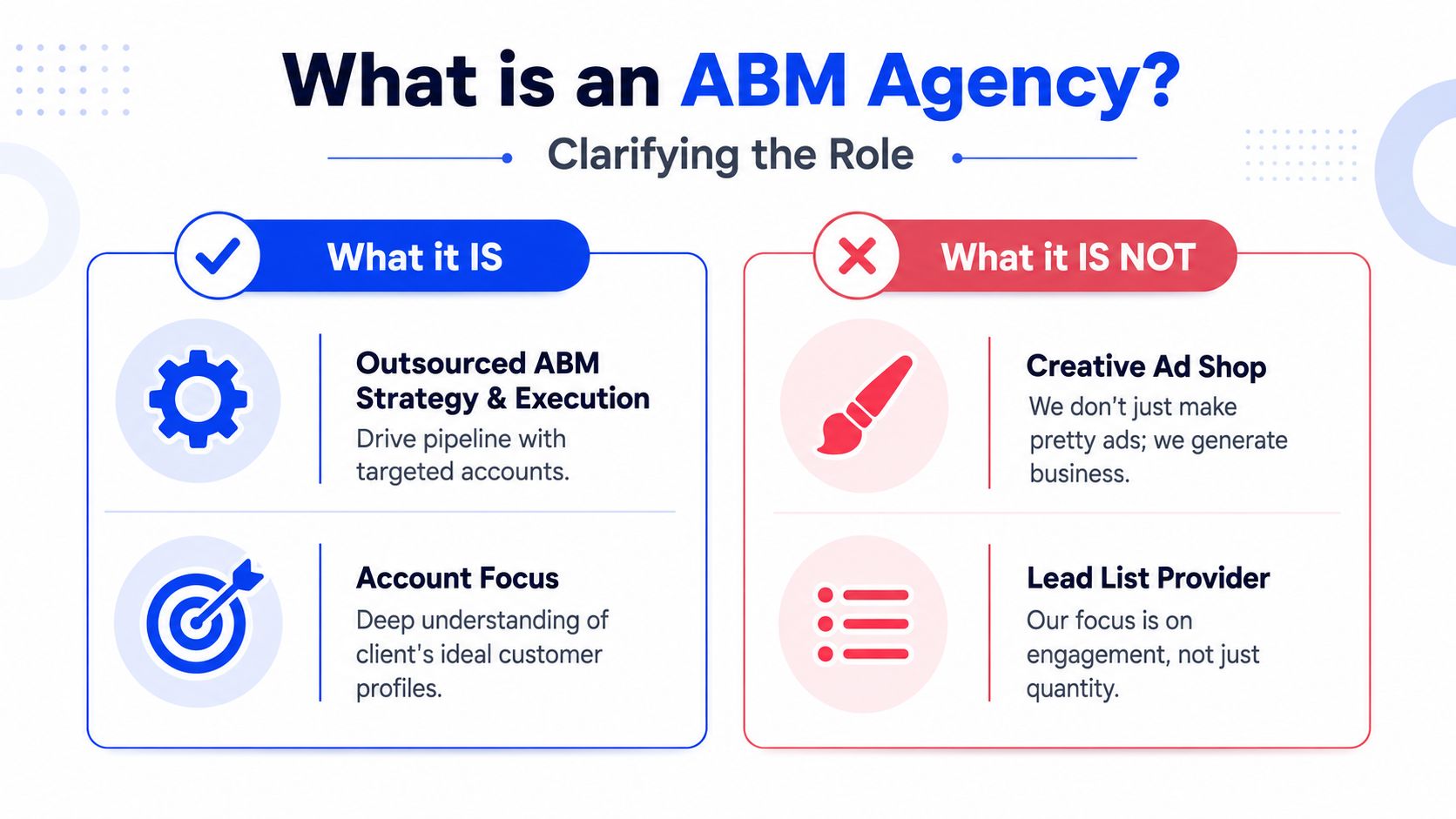
ABM is no longer niche. 70% of marketers used it in 2021, up from 55% in 2020, and 94.2% of organizations report having an active ABM program, according to UserGems' summary of ABM statistics. That matters because buyers now expect tighter account selection and coordination as standard operating practice.
It runs account infrastructure, not one-off campaigns
The baseline functions are operational.
Function | What good looks like |
|---|---|
Account selection | A defined account universe based on ICP fit, then tiering by ACV and strategic value |
Buying committee mapping | Role coverage across economic buyer, operator, technical evaluator, and likely blocker |
Signal monitoring | Weekly monitoring for hires, leadership changes, funding, tech changes, and relevant social activity |
Orchestration | Outreach, content, LinkedIn, email, and CRM status working off the same account plan |
That's the difference between ABM and broad demand generation. Demand gen optimizes volume first, then qualifies. ABM starts with account fit, then allocates effort based on timing and deal value.
A lot of internal teams need outside help here because the data layer and execution layer are usually split. Marketing owns HubSpot. Sales owns outreach tools. RevOps owns reporting. Nobody owns the full account journey. Agencies can close that gap if they act like operators, not campaign vendors. Teams comparing models usually find it helpful to also look at what a data-driven digital marketing agency should be accountable for.
A short explainer is worth watching if you want the category framing before you evaluate vendors.
The team structure you should expect
If an agency says it does ABM, ask who owns each part of the motion. The minimum useful structure usually includes:
Strategist who owns account logic, tiering rules, messaging hierarchy, and sales alignment
Data operator who maintains account and contact data, enrichment, signal pulls, and CRM hygiene
Content builder who produces role-specific assets, landing pages, mini-sites, and sales enablement pieces
Outbound operator who executes email, LinkedIn, and follow-up workflows across the mapped buying group
The agency should be able to show how one account moves from target list, to activation trigger, to stakeholder engagement, to opportunity management.
If they can't show that workflow, they're probably selling activity wrapped in ABM language.
The four-part system for turning accounts into pipeline
This is the part most agencies blur into vague “personalization.” The mechanics are more concrete than that. The system has four parts, and each one changes how you use the stack.
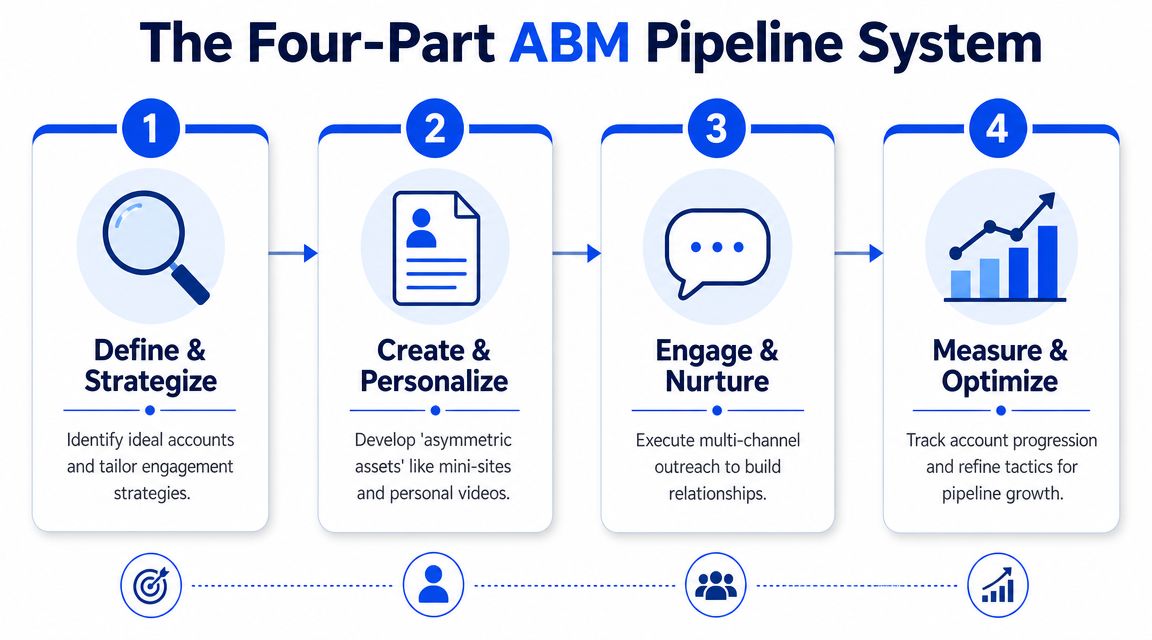
1. Activate by signal, not by static list position
The account list is your fixed universe. Activation comes from triggers. Typical examples are funding announcements, senior hires, leadership changes, new market entries, stack changes, or a relevant public post from someone in the buying group.
Clay, Apollo, LinkedIn Sales Navigator, and HubSpot need to work together. Sales Navigator helps spot role changes and company activity. Clay helps normalize data and enrich account records. Apollo helps with contact coverage and outbound execution. HubSpot holds the engagement state and reporting logic.
Without a signal overlay, teams waste time working cold logos just because they're Tier 1. With a signal overlay, timing can override the original plan.
2. Multi-thread from the first touch
Most deals stall because the team found one contact and called that account penetration. That's fragile. A strong program maps 4 to 6 personas per account from the start and runs role-specific outreach in parallel.
The message to a CEO shouldn't sound like the message to a head of marketing. The COO usually needs process and operational upside. A commercial leader cares about pipeline, conversion quality, and speed. One narrative, different angles.
Operator note: If an account is “engaged” but only one person has replied, treat it as partially opened, not penetrated.
The CRM should reflect this clearly. At account level, you want status such as cold, engaged, multi-threaded, in conversation, stalled, closed, lost. At contact level, you want role, seniority, channel history, and last meaningful response.
3. Run content and outbound as one motion
Many teams mistakenly split the buyer experience. Marketing runs ads or posts. SDRs send outreach that ignores what the account has already seen. The result feels like two companies talking at once.
A better workflow looks like this → publish role-relevant content on LinkedIn → retarget or manually surface the right asset → send outbound that references the specific angle → route replies into the CRM with persona tags and next-step logic.
Tools like Lemlist, Instantly, and HeyReach can help coordinate channel execution, but the important point isn't the tool. It's that every touch acknowledges the prior one. If you want a clearer view of how this translates into live campaigns, these account-based marketing examples are useful for benchmarking execution patterns.
4. Match effort to account value
Most account based marketing agency offers talk about tiering, but very few act on it properly. They still apply near-identical touch to every account because it's easier to staff. That's how budgets disappear into low-intensity sameness.
The top tier needs disproportionate effort. Think custom mini-site, personalized video, customized benchmark, printed leave-behind, executive-specific message. Lower tiers can run on semi-automated or automated touches, as long as they stay relevant.
High-touch ABM only works when it's selective. The skill isn't scaling expensive personalization across everyone. The skill is refusing to do it for accounts that haven't earned it.
Anatomy of an enterprise deal closed with ABM
One of the clearest uses of ABM is when a high-value account has already ignored standard outbound. That's where generic sequencing stops being useful.
The account had already ignored standard outbound
In one anonymized iGaming deal, the target account fit the ICP, had strong ACV potential, and had already ghosted multiple standard sequences. On paper, it looked like a dead account. In reality, it was a named account that had never been approached with account-level effort.
The issue wasn't frequency. It was sameness. The outreach looked like every other vendor trying to get a meeting.
What changed the deal
The first move was an asymmetric asset. Instead of another follow-up email, the team built a private mini-site customized for the account. It included their logo, a view of their current stack, competitor benchmarking, and a custom audit of their LinkedIn presence over the prior quarter.
Then the team entered the account from multiple directions. The CEO got a short LinkedIn message with the link and no signup friction. The COO and head of marketing received email versions later, each framed around their role.
A physical touch came next. A printed version of the report and a handwritten postcard went to the CEO's office. That did two things. It signaled seriousness, and it separated the outreach from every automated sequence already sitting in the inbox.
Some accounts don't need more touches. They need a reason to believe your team has done real work before asking for their time.
The account replied within 6 days after months of silence. The first meeting happened the following week. A pilot was signed at week 11, and the full retainer followed at week 16 after the pilot validated the commercial case.
For teams building journeys around named accounts, this is also why the B2B buyer journey matters at account level, not just lead level. Different stakeholders entered at different moments, for different reasons, and the sequence respected that.
Why this worked
This wasn't “ABM at scale.” It worked because the effort was intentionally unscalable. The team chose one account worth real manual work and treated it like a market of one.
That's the honest lesson most vendors avoid. Enterprise accounts don't respond because you added a logo to a paid campaign. They respond when the account sees evidence that you understand their context, their people, and their current timing better than everyone else trying to sell them.
Content's real job in a pipeline system
Many organizations still treat content like a lead magnet factory. In ABM, that framing is too loose to be useful. Content has jobs, and if it isn't doing one of them, it's probably just filling a calendar.
Job one, open the door on Tier 1 accounts
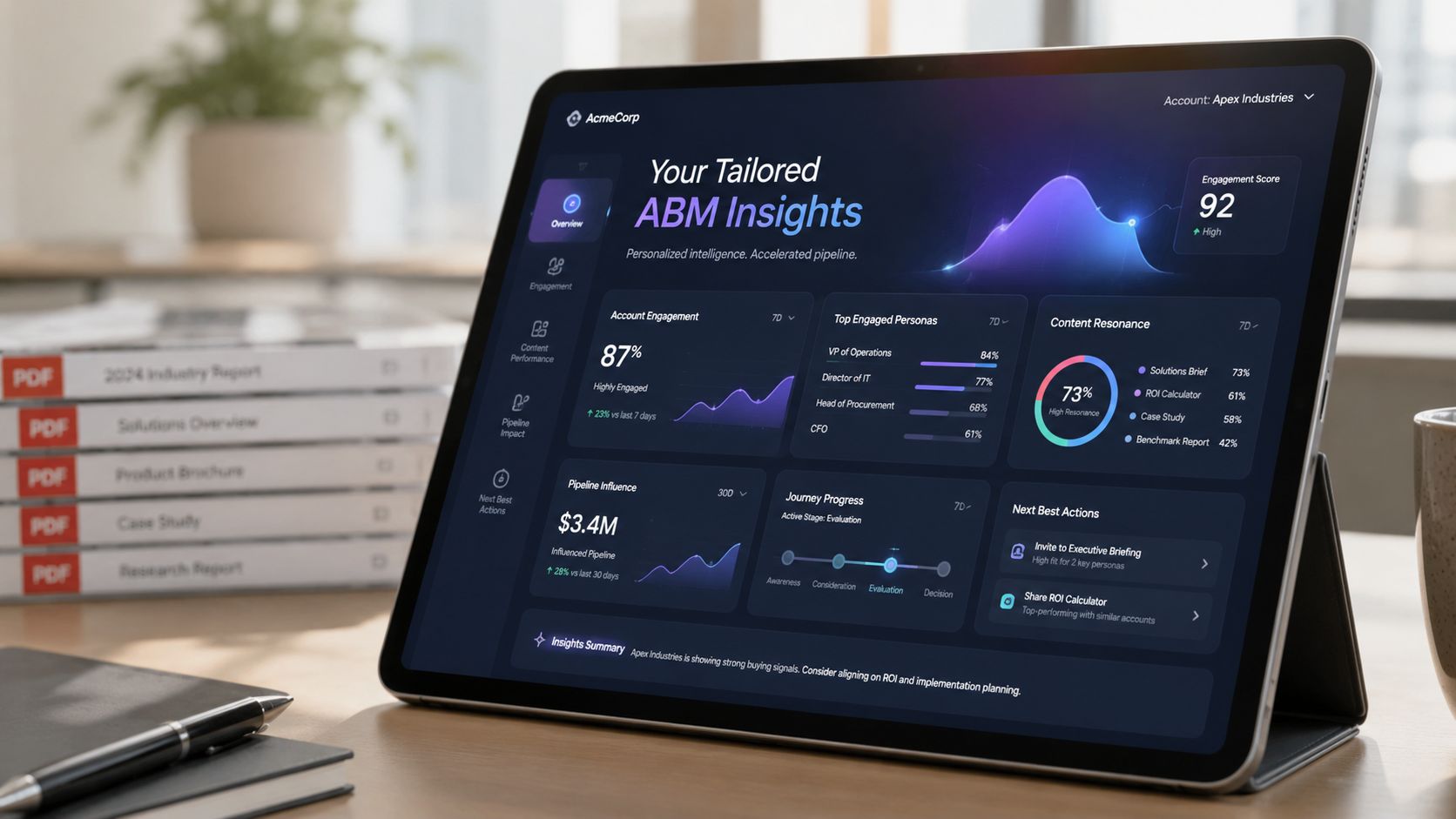
For top accounts, content should function as an asymmetric asset. That could be a bespoke audit, a mini-site, a personal video walkthrough, or a competitive benchmark built for one company. Its purpose is narrow. It should create enough relevance that a cold account responds.
That's very different from writing a broad ebook and hoping a buyer downloads it. Tier 1 content is closer to sales engineering than brand publishing.
Job two, create air cover for outbound
For Tier 2 and Tier 3 accounts, content works best as familiarization. It gives the buyer repeated exposure to your point of view before outreach lands. Then the outbound doesn't feel like a random interruption.
A simple pattern works well here → LinkedIn posts from a founder or subject-matter lead → short problem-specific assets for common objections → outbound that references the same angle. That's one reason a strong B2B content marketing strategy should be designed with account progression in mind, not just traffic goals.
Job three, give each stakeholder a reason to respond
Buying groups don't consume the same material for the same reason. If you send one deck to every stakeholder in the account, you flatten the decision process and create no ownership.
Use role-specific content instead:
CEO or founder → commercial upside, market position, revenue implications
COO or operations lead → process friction, workflow risk, execution load
Marketing or growth lead → channel mechanics, targeting logic, reporting clarity
Revenue leader → meeting quality, account progression, handoff discipline
GROU operates in this lane by combining LinkedIn content, list building, and outbound into one pipeline system, which is the right direction structurally because the buyer sees one coordinated motion instead of disconnected tactics.
Content should reduce the cost of belief for each person in the account.
That's the standard. Not more assets. Better function.
How to evaluate and hire an account based marketing agency
Most agency pages tell you what they offer. Fewer tell you when outsourcing makes sense, or what operating proof you should ask for. That gap is real. The Pod's review of ABM agencies notes that most content describes services but doesn't provide practical decision rules for choosing an agency model versus building in-house.
When outsourcing makes sense
Outsource when the bottleneck is system assembly, not just labor. That usually means your team has pieces of the stack but no owner for the full named-account workflow. Marketing can publish. Sales can prospect. RevOps can report. Nobody can show how one target account gets selected, activated, multi-threaded, and advanced.
Keep more of it in-house when you already have tight sales-marketing coordination, a stable data operation, and people who can build role-specific assets quickly. If that machine exists, an agency may only need to fill execution gaps.
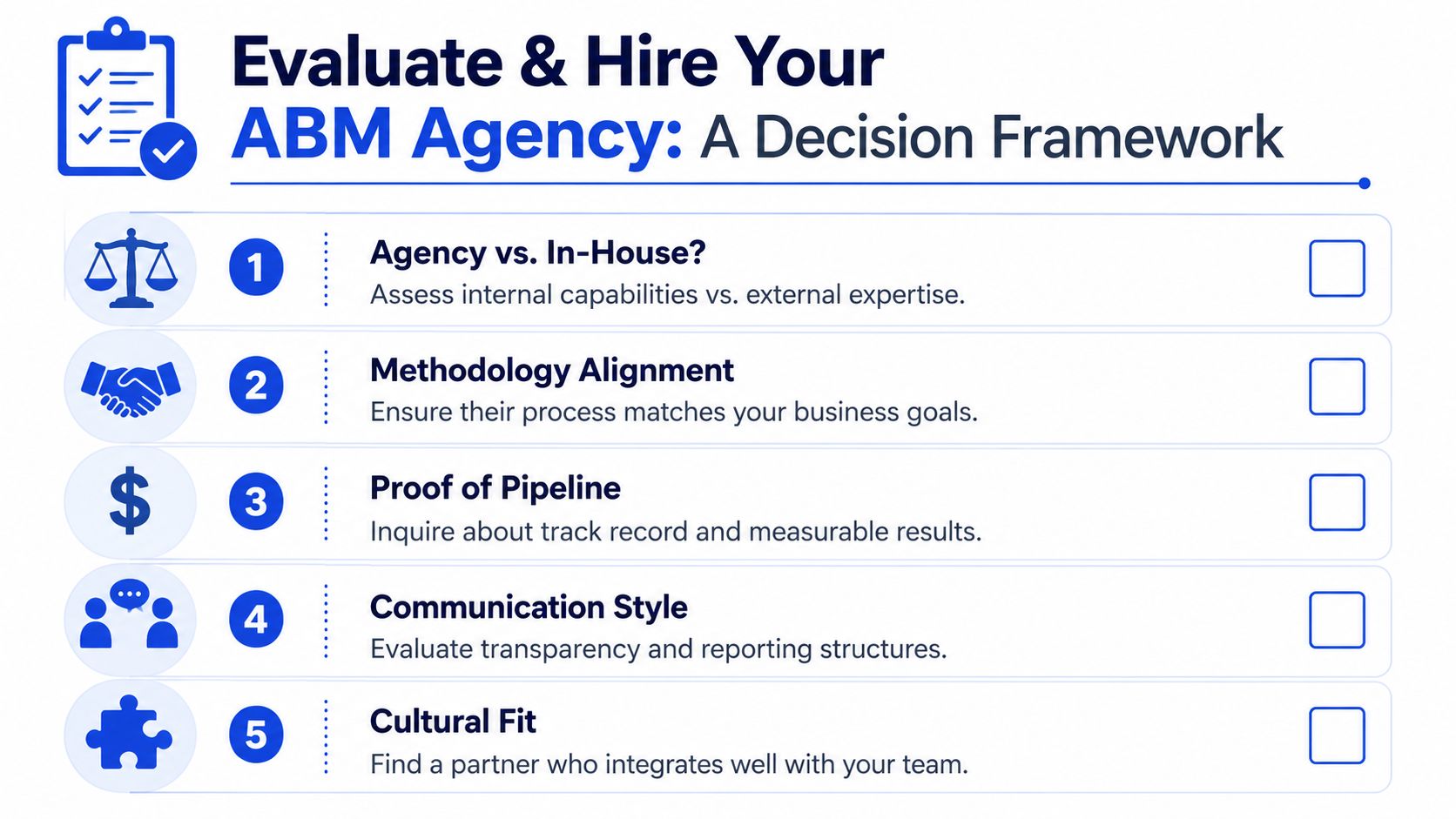
A five-point evaluation checklist
Use this as a practical filter:
Ask for account logic
They should show how they build the fixed universe, how they tier accounts, and how often they re-prioritize based on signals.Inspect the data layer
Ask what they use for enrichment, de-duplication, contact mapping, and CRM status management. If the answer is “we pull a list and launch,” move on.Test their multi-threading depth
Ask how they identify buying committee roles and what changes in messaging by persona.Review content-output fit
They should distinguish between custom assets for top accounts and scalable assets for lower tiers. If everything is “personalized” in theory, nothing is prioritized in practice.Demand pipeline reporting
Their dashboard should show account movement, not just send volume or ad reach.
Questions that expose weak agencies fast
A good RFP question forces process detail. Use direct prompts.
“Show me your weekly account reprioritization workflow.”
“Walk me through what happens when a Tier 1 account goes quiet after an initial reply.”
“How do you track engagement state at account and contact level?”
“What asset would you build for a top account that has ignored three prior sequences?”
“How do sales and marketing share one view of account progress?”
Procurement filter: If the agency talks mostly about campaigns, impressions, and personalization tokens, you're not buying ABM operations. You're buying dressed-up demand gen.
The right partner should make the workflow feel inspectable. Not magical.
Measuring what matters from activity to revenue
The reporting model should follow account movement, not channel vanity. If the dashboard starts with impressions, open rates, and traffic spikes, it's too far from revenue to guide decisions.
Build the dashboard around account movement
Track metrics that reflect progression inside named accounts → new target accounts engaged, buying-committee meetings booked, accounts that moved from single-threaded to multi-threaded, stalled accounts reactivated, pipeline created from the target universe, and closed-won revenue from that same universe.
That reporting discipline matters because ABM is built for pipeline efficiency. One industry source reports 20 to 40% shorter sales cycles for enterprise B2B firms when sales and marketing align on named accounts, as noted by Callbox's discussion of ABM agency outcomes.
If you're tightening measurement across channels, this roundup of top marketing analytics tools for 2026 is a useful companion for comparing reporting options and stack fit.
Your next step
Open your target account list and audit it as infrastructure. Check for four layers → fixed universe, tiering, live signals, engagement state. If one of those layers is missing, your ABM program isn't a system yet.
If you want a second set of eyes on that audit, Grou works on the operational side of B2B pipeline systems, especially where LinkedIn content, outbound, and target-account execution need to run as one motion.
Most advice about an account based marketing agency starts in the wrong place. It starts with tiers, ad platforms, and personalization templates. The core problem is simpler. Most ABM programs are just static account lists with light activity layered on top, so the team stays busy while the pipeline stays thin.
That's why so many teams say they “do ABM” but can't show consistent movement in named accounts. They built a logo wall, not an operating system. An actual account based marketing agency should fix that by running account selection, signal monitoring, content, outbound, and sales coordination as one pipeline motion.
Table of Contents
Your ABM program is a spreadsheet, not a system
The usual ABM advice says to pick your dream accounts, split them into tiers, and start running personalized campaigns. That sounds disciplined. In practice, it often creates a list of accounts that gets reviewed in a quarterly deck and barely worked in the field.
Key takeaways
Signal-led activation beats equal distribution. The list is the universe. The trigger decides who gets effort now.
Multi-threading is essential. One contact is not an account strategy.
Content and outbound should reference each other. If they run separately, buyers feel the disconnect.
Asymmetric effort wins top accounts. Uniform touch across every logo usually means weak touch everywhere.
Why the common ABM setup breaks
A lot of teams still treat ABM like glorified segmentation. They build a target list, add job titles, launch ads, send a few sequences, then report on opens, clicks, and account coverage. None of that guarantees live buying conversations.
The mechanical problem is effort allocation. If you spread similar attention across hundreds of cold accounts, nobody gets enough relevance or timing to respond. Sales gets a deck full of “engaged accounts” and no real pipeline.
Practical rule: A named account list without signal monitoring and engagement state is just CRM decoration.
This gets worse when marketing and outbound run on different tracks. Marketing publishes content for “target accounts.” SDRs send outreach that never references it. Paid media runs broad account targeting, but nobody updates the contact map when the original champion leaves.
If your current operation looks like Apollo for lists, HubSpot for reporting, and a folder full of one-size-fits-all PDFs, the issue isn't channel mix. It's that the system has no decision logic.
For teams trying to tighten response handling on the inbound side as well, these AI auto-reply strategies for developers are useful because they show how routing and timing affect conversation quality, not just efficiency.
What a system looks like instead
A workable model treats the account list as living infrastructure. You maintain a fixed universe, tier it by value, overlay signals weekly, and track engagement state continuously. The account doesn't just exist in the CRM. It has a current reason to act, a mapped buying group, and a defined next move.
That's where marketing automation matters, but only if the workflow serves account progression. This is why teams that want ABM to produce meetings should think in terms of B2B marketing automation systems, not just campaign setup.
The position is straightforward. Most ABM doesn't fail because the idea is wrong. It fails because the operating model is static, under-personalized, and evenly spread across too many accounts.
What an account based marketing agency actually does
A real account based marketing agency is not an ad shop with better targeting. It's not a contact vendor either. Its job is to operate a named-account pipeline system that sales and marketing can both use.
ABM is no longer niche. 70% of marketers used it in 2021, up from 55% in 2020, and 94.2% of organizations report having an active ABM program, according to UserGems' summary of ABM statistics. That matters because buyers now expect tighter account selection and coordination as standard operating practice.
It runs account infrastructure, not one-off campaigns
The baseline functions are operational.
Function | What good looks like |
|---|---|
Account selection | A defined account universe based on ICP fit, then tiering by ACV and strategic value |
Buying committee mapping | Role coverage across economic buyer, operator, technical evaluator, and likely blocker |
Signal monitoring | Weekly monitoring for hires, leadership changes, funding, tech changes, and relevant social activity |
Orchestration | Outreach, content, LinkedIn, email, and CRM status working off the same account plan |
That's the difference between ABM and broad demand generation. Demand gen optimizes volume first, then qualifies. ABM starts with account fit, then allocates effort based on timing and deal value.
A lot of internal teams need outside help here because the data layer and execution layer are usually split. Marketing owns HubSpot. Sales owns outreach tools. RevOps owns reporting. Nobody owns the full account journey. Agencies can close that gap if they act like operators, not campaign vendors. Teams comparing models usually find it helpful to also look at what a data-driven digital marketing agency should be accountable for.
A short explainer is worth watching if you want the category framing before you evaluate vendors.
The team structure you should expect
If an agency says it does ABM, ask who owns each part of the motion. The minimum useful structure usually includes:
Strategist who owns account logic, tiering rules, messaging hierarchy, and sales alignment
Data operator who maintains account and contact data, enrichment, signal pulls, and CRM hygiene
Content builder who produces role-specific assets, landing pages, mini-sites, and sales enablement pieces
Outbound operator who executes email, LinkedIn, and follow-up workflows across the mapped buying group
The agency should be able to show how one account moves from target list, to activation trigger, to stakeholder engagement, to opportunity management.
If they can't show that workflow, they're probably selling activity wrapped in ABM language.
The four-part system for turning accounts into pipeline
This is the part most agencies blur into vague “personalization.” The mechanics are more concrete than that. The system has four parts, and each one changes how you use the stack.
1. Activate by signal, not by static list position
The account list is your fixed universe. Activation comes from triggers. Typical examples are funding announcements, senior hires, leadership changes, new market entries, stack changes, or a relevant public post from someone in the buying group.
Clay, Apollo, LinkedIn Sales Navigator, and HubSpot need to work together. Sales Navigator helps spot role changes and company activity. Clay helps normalize data and enrich account records. Apollo helps with contact coverage and outbound execution. HubSpot holds the engagement state and reporting logic.
Without a signal overlay, teams waste time working cold logos just because they're Tier 1. With a signal overlay, timing can override the original plan.
2. Multi-thread from the first touch
Most deals stall because the team found one contact and called that account penetration. That's fragile. A strong program maps 4 to 6 personas per account from the start and runs role-specific outreach in parallel.
The message to a CEO shouldn't sound like the message to a head of marketing. The COO usually needs process and operational upside. A commercial leader cares about pipeline, conversion quality, and speed. One narrative, different angles.
Operator note: If an account is “engaged” but only one person has replied, treat it as partially opened, not penetrated.
The CRM should reflect this clearly. At account level, you want status such as cold, engaged, multi-threaded, in conversation, stalled, closed, lost. At contact level, you want role, seniority, channel history, and last meaningful response.
3. Run content and outbound as one motion
Many teams mistakenly split the buyer experience. Marketing runs ads or posts. SDRs send outreach that ignores what the account has already seen. The result feels like two companies talking at once.
A better workflow looks like this → publish role-relevant content on LinkedIn → retarget or manually surface the right asset → send outbound that references the specific angle → route replies into the CRM with persona tags and next-step logic.
Tools like Lemlist, Instantly, and HeyReach can help coordinate channel execution, but the important point isn't the tool. It's that every touch acknowledges the prior one. If you want a clearer view of how this translates into live campaigns, these account-based marketing examples are useful for benchmarking execution patterns.
4. Match effort to account value
Most account based marketing agency offers talk about tiering, but very few act on it properly. They still apply near-identical touch to every account because it's easier to staff. That's how budgets disappear into low-intensity sameness.
The top tier needs disproportionate effort. Think custom mini-site, personalized video, customized benchmark, printed leave-behind, executive-specific message. Lower tiers can run on semi-automated or automated touches, as long as they stay relevant.
High-touch ABM only works when it's selective. The skill isn't scaling expensive personalization across everyone. The skill is refusing to do it for accounts that haven't earned it.
Anatomy of an enterprise deal closed with ABM
One of the clearest uses of ABM is when a high-value account has already ignored standard outbound. That's where generic sequencing stops being useful.
The account had already ignored standard outbound
In one anonymized iGaming deal, the target account fit the ICP, had strong ACV potential, and had already ghosted multiple standard sequences. On paper, it looked like a dead account. In reality, it was a named account that had never been approached with account-level effort.
The issue wasn't frequency. It was sameness. The outreach looked like every other vendor trying to get a meeting.
What changed the deal
The first move was an asymmetric asset. Instead of another follow-up email, the team built a private mini-site customized for the account. It included their logo, a view of their current stack, competitor benchmarking, and a custom audit of their LinkedIn presence over the prior quarter.
Then the team entered the account from multiple directions. The CEO got a short LinkedIn message with the link and no signup friction. The COO and head of marketing received email versions later, each framed around their role.
A physical touch came next. A printed version of the report and a handwritten postcard went to the CEO's office. That did two things. It signaled seriousness, and it separated the outreach from every automated sequence already sitting in the inbox.
Some accounts don't need more touches. They need a reason to believe your team has done real work before asking for their time.
The account replied within 6 days after months of silence. The first meeting happened the following week. A pilot was signed at week 11, and the full retainer followed at week 16 after the pilot validated the commercial case.
For teams building journeys around named accounts, this is also why the B2B buyer journey matters at account level, not just lead level. Different stakeholders entered at different moments, for different reasons, and the sequence respected that.
Why this worked
This wasn't “ABM at scale.” It worked because the effort was intentionally unscalable. The team chose one account worth real manual work and treated it like a market of one.
That's the honest lesson most vendors avoid. Enterprise accounts don't respond because you added a logo to a paid campaign. They respond when the account sees evidence that you understand their context, their people, and their current timing better than everyone else trying to sell them.
Content's real job in a pipeline system
Many organizations still treat content like a lead magnet factory. In ABM, that framing is too loose to be useful. Content has jobs, and if it isn't doing one of them, it's probably just filling a calendar.
Job one, open the door on Tier 1 accounts
For top accounts, content should function as an asymmetric asset. That could be a bespoke audit, a mini-site, a personal video walkthrough, or a competitive benchmark built for one company. Its purpose is narrow. It should create enough relevance that a cold account responds.
That's very different from writing a broad ebook and hoping a buyer downloads it. Tier 1 content is closer to sales engineering than brand publishing.
Job two, create air cover for outbound
For Tier 2 and Tier 3 accounts, content works best as familiarization. It gives the buyer repeated exposure to your point of view before outreach lands. Then the outbound doesn't feel like a random interruption.
A simple pattern works well here → LinkedIn posts from a founder or subject-matter lead → short problem-specific assets for common objections → outbound that references the same angle. That's one reason a strong B2B content marketing strategy should be designed with account progression in mind, not just traffic goals.
Job three, give each stakeholder a reason to respond
Buying groups don't consume the same material for the same reason. If you send one deck to every stakeholder in the account, you flatten the decision process and create no ownership.
Use role-specific content instead:
CEO or founder → commercial upside, market position, revenue implications
COO or operations lead → process friction, workflow risk, execution load
Marketing or growth lead → channel mechanics, targeting logic, reporting clarity
Revenue leader → meeting quality, account progression, handoff discipline
GROU operates in this lane by combining LinkedIn content, list building, and outbound into one pipeline system, which is the right direction structurally because the buyer sees one coordinated motion instead of disconnected tactics.
Content should reduce the cost of belief for each person in the account.
That's the standard. Not more assets. Better function.
How to evaluate and hire an account based marketing agency
Most agency pages tell you what they offer. Fewer tell you when outsourcing makes sense, or what operating proof you should ask for. That gap is real. The Pod's review of ABM agencies notes that most content describes services but doesn't provide practical decision rules for choosing an agency model versus building in-house.
When outsourcing makes sense
Outsource when the bottleneck is system assembly, not just labor. That usually means your team has pieces of the stack but no owner for the full named-account workflow. Marketing can publish. Sales can prospect. RevOps can report. Nobody can show how one target account gets selected, activated, multi-threaded, and advanced.
Keep more of it in-house when you already have tight sales-marketing coordination, a stable data operation, and people who can build role-specific assets quickly. If that machine exists, an agency may only need to fill execution gaps.
A five-point evaluation checklist
Use this as a practical filter:
Ask for account logic
They should show how they build the fixed universe, how they tier accounts, and how often they re-prioritize based on signals.Inspect the data layer
Ask what they use for enrichment, de-duplication, contact mapping, and CRM status management. If the answer is “we pull a list and launch,” move on.Test their multi-threading depth
Ask how they identify buying committee roles and what changes in messaging by persona.Review content-output fit
They should distinguish between custom assets for top accounts and scalable assets for lower tiers. If everything is “personalized” in theory, nothing is prioritized in practice.Demand pipeline reporting
Their dashboard should show account movement, not just send volume or ad reach.
Questions that expose weak agencies fast
A good RFP question forces process detail. Use direct prompts.
“Show me your weekly account reprioritization workflow.”
“Walk me through what happens when a Tier 1 account goes quiet after an initial reply.”
“How do you track engagement state at account and contact level?”
“What asset would you build for a top account that has ignored three prior sequences?”
“How do sales and marketing share one view of account progress?”
Procurement filter: If the agency talks mostly about campaigns, impressions, and personalization tokens, you're not buying ABM operations. You're buying dressed-up demand gen.
The right partner should make the workflow feel inspectable. Not magical.
Measuring what matters from activity to revenue
The reporting model should follow account movement, not channel vanity. If the dashboard starts with impressions, open rates, and traffic spikes, it's too far from revenue to guide decisions.
Build the dashboard around account movement
Track metrics that reflect progression inside named accounts → new target accounts engaged, buying-committee meetings booked, accounts that moved from single-threaded to multi-threaded, stalled accounts reactivated, pipeline created from the target universe, and closed-won revenue from that same universe.
That reporting discipline matters because ABM is built for pipeline efficiency. One industry source reports 20 to 40% shorter sales cycles for enterprise B2B firms when sales and marketing align on named accounts, as noted by Callbox's discussion of ABM agency outcomes.
If you're tightening measurement across channels, this roundup of top marketing analytics tools for 2026 is a useful companion for comparing reporting options and stack fit.
Your next step
Open your target account list and audit it as infrastructure. Check for four layers → fixed universe, tiering, live signals, engagement state. If one of those layers is missing, your ABM program isn't a system yet.
If you want a second set of eyes on that audit, Grou works on the operational side of B2B pipeline systems, especially where LinkedIn content, outbound, and target-account execution need to run as one motion.
Most advice about an account based marketing agency starts in the wrong place. It starts with tiers, ad platforms, and personalization templates. The core problem is simpler. Most ABM programs are just static account lists with light activity layered on top, so the team stays busy while the pipeline stays thin.
That's why so many teams say they “do ABM” but can't show consistent movement in named accounts. They built a logo wall, not an operating system. An actual account based marketing agency should fix that by running account selection, signal monitoring, content, outbound, and sales coordination as one pipeline motion.
Table of Contents
Your ABM program is a spreadsheet, not a system
The usual ABM advice says to pick your dream accounts, split them into tiers, and start running personalized campaigns. That sounds disciplined. In practice, it often creates a list of accounts that gets reviewed in a quarterly deck and barely worked in the field.
Key takeaways
Signal-led activation beats equal distribution. The list is the universe. The trigger decides who gets effort now.
Multi-threading is essential. One contact is not an account strategy.
Content and outbound should reference each other. If they run separately, buyers feel the disconnect.
Asymmetric effort wins top accounts. Uniform touch across every logo usually means weak touch everywhere.
Why the common ABM setup breaks
A lot of teams still treat ABM like glorified segmentation. They build a target list, add job titles, launch ads, send a few sequences, then report on opens, clicks, and account coverage. None of that guarantees live buying conversations.
The mechanical problem is effort allocation. If you spread similar attention across hundreds of cold accounts, nobody gets enough relevance or timing to respond. Sales gets a deck full of “engaged accounts” and no real pipeline.
Practical rule: A named account list without signal monitoring and engagement state is just CRM decoration.
This gets worse when marketing and outbound run on different tracks. Marketing publishes content for “target accounts.” SDRs send outreach that never references it. Paid media runs broad account targeting, but nobody updates the contact map when the original champion leaves.
If your current operation looks like Apollo for lists, HubSpot for reporting, and a folder full of one-size-fits-all PDFs, the issue isn't channel mix. It's that the system has no decision logic.
For teams trying to tighten response handling on the inbound side as well, these AI auto-reply strategies for developers are useful because they show how routing and timing affect conversation quality, not just efficiency.
What a system looks like instead
A workable model treats the account list as living infrastructure. You maintain a fixed universe, tier it by value, overlay signals weekly, and track engagement state continuously. The account doesn't just exist in the CRM. It has a current reason to act, a mapped buying group, and a defined next move.
That's where marketing automation matters, but only if the workflow serves account progression. This is why teams that want ABM to produce meetings should think in terms of B2B marketing automation systems, not just campaign setup.
The position is straightforward. Most ABM doesn't fail because the idea is wrong. It fails because the operating model is static, under-personalized, and evenly spread across too many accounts.
What an account based marketing agency actually does
A real account based marketing agency is not an ad shop with better targeting. It's not a contact vendor either. Its job is to operate a named-account pipeline system that sales and marketing can both use.
ABM is no longer niche. 70% of marketers used it in 2021, up from 55% in 2020, and 94.2% of organizations report having an active ABM program, according to UserGems' summary of ABM statistics. That matters because buyers now expect tighter account selection and coordination as standard operating practice.
It runs account infrastructure, not one-off campaigns
The baseline functions are operational.
Function | What good looks like |
|---|---|
Account selection | A defined account universe based on ICP fit, then tiering by ACV and strategic value |
Buying committee mapping | Role coverage across economic buyer, operator, technical evaluator, and likely blocker |
Signal monitoring | Weekly monitoring for hires, leadership changes, funding, tech changes, and relevant social activity |
Orchestration | Outreach, content, LinkedIn, email, and CRM status working off the same account plan |
That's the difference between ABM and broad demand generation. Demand gen optimizes volume first, then qualifies. ABM starts with account fit, then allocates effort based on timing and deal value.
A lot of internal teams need outside help here because the data layer and execution layer are usually split. Marketing owns HubSpot. Sales owns outreach tools. RevOps owns reporting. Nobody owns the full account journey. Agencies can close that gap if they act like operators, not campaign vendors. Teams comparing models usually find it helpful to also look at what a data-driven digital marketing agency should be accountable for.
A short explainer is worth watching if you want the category framing before you evaluate vendors.
The team structure you should expect
If an agency says it does ABM, ask who owns each part of the motion. The minimum useful structure usually includes:
Strategist who owns account logic, tiering rules, messaging hierarchy, and sales alignment
Data operator who maintains account and contact data, enrichment, signal pulls, and CRM hygiene
Content builder who produces role-specific assets, landing pages, mini-sites, and sales enablement pieces
Outbound operator who executes email, LinkedIn, and follow-up workflows across the mapped buying group
The agency should be able to show how one account moves from target list, to activation trigger, to stakeholder engagement, to opportunity management.
If they can't show that workflow, they're probably selling activity wrapped in ABM language.
The four-part system for turning accounts into pipeline
This is the part most agencies blur into vague “personalization.” The mechanics are more concrete than that. The system has four parts, and each one changes how you use the stack.
1. Activate by signal, not by static list position
The account list is your fixed universe. Activation comes from triggers. Typical examples are funding announcements, senior hires, leadership changes, new market entries, stack changes, or a relevant public post from someone in the buying group.
Clay, Apollo, LinkedIn Sales Navigator, and HubSpot need to work together. Sales Navigator helps spot role changes and company activity. Clay helps normalize data and enrich account records. Apollo helps with contact coverage and outbound execution. HubSpot holds the engagement state and reporting logic.
Without a signal overlay, teams waste time working cold logos just because they're Tier 1. With a signal overlay, timing can override the original plan.
2. Multi-thread from the first touch
Most deals stall because the team found one contact and called that account penetration. That's fragile. A strong program maps 4 to 6 personas per account from the start and runs role-specific outreach in parallel.
The message to a CEO shouldn't sound like the message to a head of marketing. The COO usually needs process and operational upside. A commercial leader cares about pipeline, conversion quality, and speed. One narrative, different angles.
Operator note: If an account is “engaged” but only one person has replied, treat it as partially opened, not penetrated.
The CRM should reflect this clearly. At account level, you want status such as cold, engaged, multi-threaded, in conversation, stalled, closed, lost. At contact level, you want role, seniority, channel history, and last meaningful response.
3. Run content and outbound as one motion
Many teams mistakenly split the buyer experience. Marketing runs ads or posts. SDRs send outreach that ignores what the account has already seen. The result feels like two companies talking at once.
A better workflow looks like this → publish role-relevant content on LinkedIn → retarget or manually surface the right asset → send outbound that references the specific angle → route replies into the CRM with persona tags and next-step logic.
Tools like Lemlist, Instantly, and HeyReach can help coordinate channel execution, but the important point isn't the tool. It's that every touch acknowledges the prior one. If you want a clearer view of how this translates into live campaigns, these account-based marketing examples are useful for benchmarking execution patterns.
4. Match effort to account value
Most account based marketing agency offers talk about tiering, but very few act on it properly. They still apply near-identical touch to every account because it's easier to staff. That's how budgets disappear into low-intensity sameness.
The top tier needs disproportionate effort. Think custom mini-site, personalized video, customized benchmark, printed leave-behind, executive-specific message. Lower tiers can run on semi-automated or automated touches, as long as they stay relevant.
High-touch ABM only works when it's selective. The skill isn't scaling expensive personalization across everyone. The skill is refusing to do it for accounts that haven't earned it.
Anatomy of an enterprise deal closed with ABM
One of the clearest uses of ABM is when a high-value account has already ignored standard outbound. That's where generic sequencing stops being useful.
The account had already ignored standard outbound
In one anonymized iGaming deal, the target account fit the ICP, had strong ACV potential, and had already ghosted multiple standard sequences. On paper, it looked like a dead account. In reality, it was a named account that had never been approached with account-level effort.
The issue wasn't frequency. It was sameness. The outreach looked like every other vendor trying to get a meeting.
What changed the deal
The first move was an asymmetric asset. Instead of another follow-up email, the team built a private mini-site customized for the account. It included their logo, a view of their current stack, competitor benchmarking, and a custom audit of their LinkedIn presence over the prior quarter.
Then the team entered the account from multiple directions. The CEO got a short LinkedIn message with the link and no signup friction. The COO and head of marketing received email versions later, each framed around their role.
A physical touch came next. A printed version of the report and a handwritten postcard went to the CEO's office. That did two things. It signaled seriousness, and it separated the outreach from every automated sequence already sitting in the inbox.
Some accounts don't need more touches. They need a reason to believe your team has done real work before asking for their time.
The account replied within 6 days after months of silence. The first meeting happened the following week. A pilot was signed at week 11, and the full retainer followed at week 16 after the pilot validated the commercial case.
For teams building journeys around named accounts, this is also why the B2B buyer journey matters at account level, not just lead level. Different stakeholders entered at different moments, for different reasons, and the sequence respected that.
Why this worked
This wasn't “ABM at scale.” It worked because the effort was intentionally unscalable. The team chose one account worth real manual work and treated it like a market of one.
That's the honest lesson most vendors avoid. Enterprise accounts don't respond because you added a logo to a paid campaign. They respond when the account sees evidence that you understand their context, their people, and their current timing better than everyone else trying to sell them.
Content's real job in a pipeline system
Many organizations still treat content like a lead magnet factory. In ABM, that framing is too loose to be useful. Content has jobs, and if it isn't doing one of them, it's probably just filling a calendar.
Job one, open the door on Tier 1 accounts
For top accounts, content should function as an asymmetric asset. That could be a bespoke audit, a mini-site, a personal video walkthrough, or a competitive benchmark built for one company. Its purpose is narrow. It should create enough relevance that a cold account responds.
That's very different from writing a broad ebook and hoping a buyer downloads it. Tier 1 content is closer to sales engineering than brand publishing.
Job two, create air cover for outbound
For Tier 2 and Tier 3 accounts, content works best as familiarization. It gives the buyer repeated exposure to your point of view before outreach lands. Then the outbound doesn't feel like a random interruption.
A simple pattern works well here → LinkedIn posts from a founder or subject-matter lead → short problem-specific assets for common objections → outbound that references the same angle. That's one reason a strong B2B content marketing strategy should be designed with account progression in mind, not just traffic goals.
Job three, give each stakeholder a reason to respond
Buying groups don't consume the same material for the same reason. If you send one deck to every stakeholder in the account, you flatten the decision process and create no ownership.
Use role-specific content instead:
CEO or founder → commercial upside, market position, revenue implications
COO or operations lead → process friction, workflow risk, execution load
Marketing or growth lead → channel mechanics, targeting logic, reporting clarity
Revenue leader → meeting quality, account progression, handoff discipline
GROU operates in this lane by combining LinkedIn content, list building, and outbound into one pipeline system, which is the right direction structurally because the buyer sees one coordinated motion instead of disconnected tactics.
Content should reduce the cost of belief for each person in the account.
That's the standard. Not more assets. Better function.
How to evaluate and hire an account based marketing agency
Most agency pages tell you what they offer. Fewer tell you when outsourcing makes sense, or what operating proof you should ask for. That gap is real. The Pod's review of ABM agencies notes that most content describes services but doesn't provide practical decision rules for choosing an agency model versus building in-house.
When outsourcing makes sense
Outsource when the bottleneck is system assembly, not just labor. That usually means your team has pieces of the stack but no owner for the full named-account workflow. Marketing can publish. Sales can prospect. RevOps can report. Nobody can show how one target account gets selected, activated, multi-threaded, and advanced.
Keep more of it in-house when you already have tight sales-marketing coordination, a stable data operation, and people who can build role-specific assets quickly. If that machine exists, an agency may only need to fill execution gaps.
A five-point evaluation checklist
Use this as a practical filter:
Ask for account logic
They should show how they build the fixed universe, how they tier accounts, and how often they re-prioritize based on signals.Inspect the data layer
Ask what they use for enrichment, de-duplication, contact mapping, and CRM status management. If the answer is “we pull a list and launch,” move on.Test their multi-threading depth
Ask how they identify buying committee roles and what changes in messaging by persona.Review content-output fit
They should distinguish between custom assets for top accounts and scalable assets for lower tiers. If everything is “personalized” in theory, nothing is prioritized in practice.Demand pipeline reporting
Their dashboard should show account movement, not just send volume or ad reach.
Questions that expose weak agencies fast
A good RFP question forces process detail. Use direct prompts.
“Show me your weekly account reprioritization workflow.”
“Walk me through what happens when a Tier 1 account goes quiet after an initial reply.”
“How do you track engagement state at account and contact level?”
“What asset would you build for a top account that has ignored three prior sequences?”
“How do sales and marketing share one view of account progress?”
Procurement filter: If the agency talks mostly about campaigns, impressions, and personalization tokens, you're not buying ABM operations. You're buying dressed-up demand gen.
The right partner should make the workflow feel inspectable. Not magical.
Measuring what matters from activity to revenue
The reporting model should follow account movement, not channel vanity. If the dashboard starts with impressions, open rates, and traffic spikes, it's too far from revenue to guide decisions.
Build the dashboard around account movement
Track metrics that reflect progression inside named accounts → new target accounts engaged, buying-committee meetings booked, accounts that moved from single-threaded to multi-threaded, stalled accounts reactivated, pipeline created from the target universe, and closed-won revenue from that same universe.
That reporting discipline matters because ABM is built for pipeline efficiency. One industry source reports 20 to 40% shorter sales cycles for enterprise B2B firms when sales and marketing align on named accounts, as noted by Callbox's discussion of ABM agency outcomes.
If you're tightening measurement across channels, this roundup of top marketing analytics tools for 2026 is a useful companion for comparing reporting options and stack fit.
Your next step
Open your target account list and audit it as infrastructure. Check for four layers → fixed universe, tiering, live signals, engagement state. If one of those layers is missing, your ABM program isn't a system yet.
If you want a second set of eyes on that audit, Grou works on the operational side of B2B pipeline systems, especially where LinkedIn content, outbound, and target-account execution need to run as one motion.
Pipeline OS Newsletter
Build qualified pipeline
Get weekly tactics to generate demand, improve lead quality, and book more meetings.






Trusted by industry leaders
Trusted by industry leaders
Trusted by industry leaders
Ready to build qualified pipeline?
Ready to build qualified pipeline?
Ready to build qualified pipeline?
Book a call to see if we're the right fit, or take the 2-minute quiz to get a clear starting point.
Book a call to see if we're the right fit, or take the 2-minute quiz to get a clear starting point.
Book a call to see if we're the right fit, or take the 2-minute quiz to get a clear starting point.
" height="30.21639343089746px" id="hfGbXmQR2" width="30.216393430897455px"/></svg>)
Copyright © 2026 – All Right Reserved
Copyright © 2026 – All Right Reserved
Copyright © 2026 – All Right Reserved