%22%3E%3C/path%3E%3Cpath d=%22M 63.072 7.554 C 62.258 8.022 61.577 8.689 61.092 9.493 L 61.092 7.076 L 57.158 7.076 L 57.158 22.64 L 61.089 22.64 L 61.089 14.888 C 61.089 13.446 61.403 12.434 62.03 11.853 C 62.818 11.218 63.818 10.907 64.826 10.982 L 65.868 10.982 L 65.868 6.851 C 64.891 6.834 63.926 7.076 63.073 7.554 Z%22 fill=%22rgb(17,17,17)%22%3E%3C/path%3E%3Cpath d=%22M 78.916 7.82 C 76.363 6.49 73.321 6.49 70.768 7.82 C 69.562 8.473 68.564 9.451 67.888 10.644 C 67.167 11.931 66.803 13.387 66.834 14.862 C 66.804 16.332 67.157 17.785 67.86 19.077 C 68.515 20.267 69.494 21.246 70.684 21.901 C 71.924 22.576 73.318 22.92 74.73 22.898 C 76.164 22.918 77.58 22.575 78.846 21.901 C 80.062 21.247 81.073 20.27 81.768 19.077 C 82.506 17.797 82.88 16.339 82.85 14.862 C 82.88 13.389 82.517 11.934 81.797 10.647 C 81.12 9.455 80.122 8.477 78.917 7.824 M 78.803 14.862 C 78.829 15.739 78.636 16.608 78.241 17.391 C 77.903 18.046 77.38 18.588 76.738 18.95 C 76.124 19.293 75.432 19.472 74.729 19.47 C 73.668 19.497 72.648 19.061 71.934 18.276 C 71.139 17.323 70.741 16.1 70.823 14.862 C 70.741 13.62 71.149 12.395 71.959 11.45 C 72.687 10.667 73.715 10.233 74.783 10.256 C 75.859 10.236 76.894 10.67 77.635 11.45 C 78.464 12.387 78.884 13.616 78.801 14.864%22 fill=%22rgb(17,17,17)%22%3E%3C/path%3E%3Cpath d=%22M 95.906 7.076 L 95.906 15.646 C 95.975 16.68 95.643 17.701 94.979 18.498 C 94.311 19.184 93.379 19.547 92.422 19.495 C 91.475 19.544 90.553 19.18 89.894 18.498 C 89.23 17.701 88.898 16.68 88.967 15.646 L 88.967 7.076 L 85.033 7.076 L 85.033 16.207 C 85 17.449 85.275 18.68 85.834 19.79 C 86.327 20.75 87.095 21.542 88.039 22.065 C 89.033 22.594 90.145 22.861 91.271 22.838 C 92.188 22.847 93.095 22.65 93.926 22.263 C 94.708 21.905 95.388 21.36 95.906 20.675 L 95.906 22.645 L 99.865 22.645 L 99.865 7.076 Z%22 fill=%22rgb(17,17,17)%22%3E%3C/path%3E%3Cpath d=%22M 4.513 15.626 C 4.511 10.815 7.606 6.549 12.181 5.059 C 16.756 3.57 21.77 5.195 24.601 9.086 L 27.816 5.87 C 24.074 1.186 17.981 -0.943 12.137 0.393 C 6.292 1.728 1.728 6.292 0.393 12.137 C -0.943 17.981 1.186 24.074 5.87 27.816 L 9.085 24.601 C 6.214 22.512 4.515 19.177 4.513 15.626%22 fill=%22rgb(32,62,235)%22%3E%3C/path%3E%3Cpath d=%22M 17.114 14.343 L 13.354 18.01 L 13.354 18.026 L 21.071 18.026 L 11.412 27.609 L 17.389 27.609 L 23.999 21.081 L 23.999 28.316 L 24.005 28.316 L 27.967 24.393 L 27.967 14.343 Z%22 fill=%22rgb(32,62,235)%22%3E%3C/path%3E%3C/g%3E%3C/svg%3E) ×
× ××
××›
›
›
›
Outsource sales company: how to choose the right one
Outsource sales company: how to choose the right one
Outsource sales company: how to choose the right one
Outsource sales company: how to choose the right one
Outsource sales company: how to choose the right one
Outsource sales company: how to choose the right one

Author
Aljaz Peklaj

You're choosing an outsource sales company because your internal SDR motion has stalled, your funnel's thin, or the board wants pipeline yesterday. The wrong vendor will book noise, miss handoffs, and leave you with messy attribution. The right one fits your CRM, your close process, and your patience for a real ramp.
Fit first. Outsourced pipeline only works when your team can close what comes in.
Scope matters. Decide whether you need SDR support, full-cycle coverage, or a narrow specialist function.
Timeline matters. Judge the first 30 days on activity, the next 60 on meetings and pipeline, and closed revenue later.
Contracts matter. Lead handoff rules, reply SLAs, and data ownership should be written down.
Red flags matter. CRM chaos, no sales process, and 30-day revenue pressure are deal-killers.
Table of Contents
The decision founders and heads of sales actually face
You're not shopping for an outsource sales company because it sounds efficient. You're doing it because internal output is flat, the funnel feels fragile, or leadership wants meetings that turn into revenue. The risk isn't paying a vendor, it's buying motion that your team can't absorb.
A few facts should frame the decision. The global B2B sales outsourcing services market was valued at USD 127.02 billion in 2026 and is projected to reach USD 260.65 billion by 2035, a long-run move of more than 2x with a 9.78% CAGR (Business Research Insights). That scale tells you outsourcing isn't fringe. It's become a structured revenue function.
Readiness beats vendor polish. If your CRM is messy and your close process is undefined, outsource sales will expose that fast.
Scope beats buzzwords. Know whether you need lead gen, appointment setting, or full-cycle coverage before you brief vendors.
Measurement beats promises. Judge activity, qualified meetings, and pipeline progression before you expect closed revenue.
Fit beats volume. The best vendor for your market still fails if your team can't convert meetings.
Timing beats urgency. If leadership wants closed deals in 30 to 60 days, pause the search.
That's the lens GROU uses in its own pipeline work, and it's the same lens I'd use if I were buying today. Structure turns attention into pipeline. Without structure, outsourced reps just create more motion for your internal team to sort out.
If you need a broader view of how outsourced pipeline fits into demand generation, this lead generation agency guide is a useful companion.
What an outsource sales company actually does
The three models you'll actually see
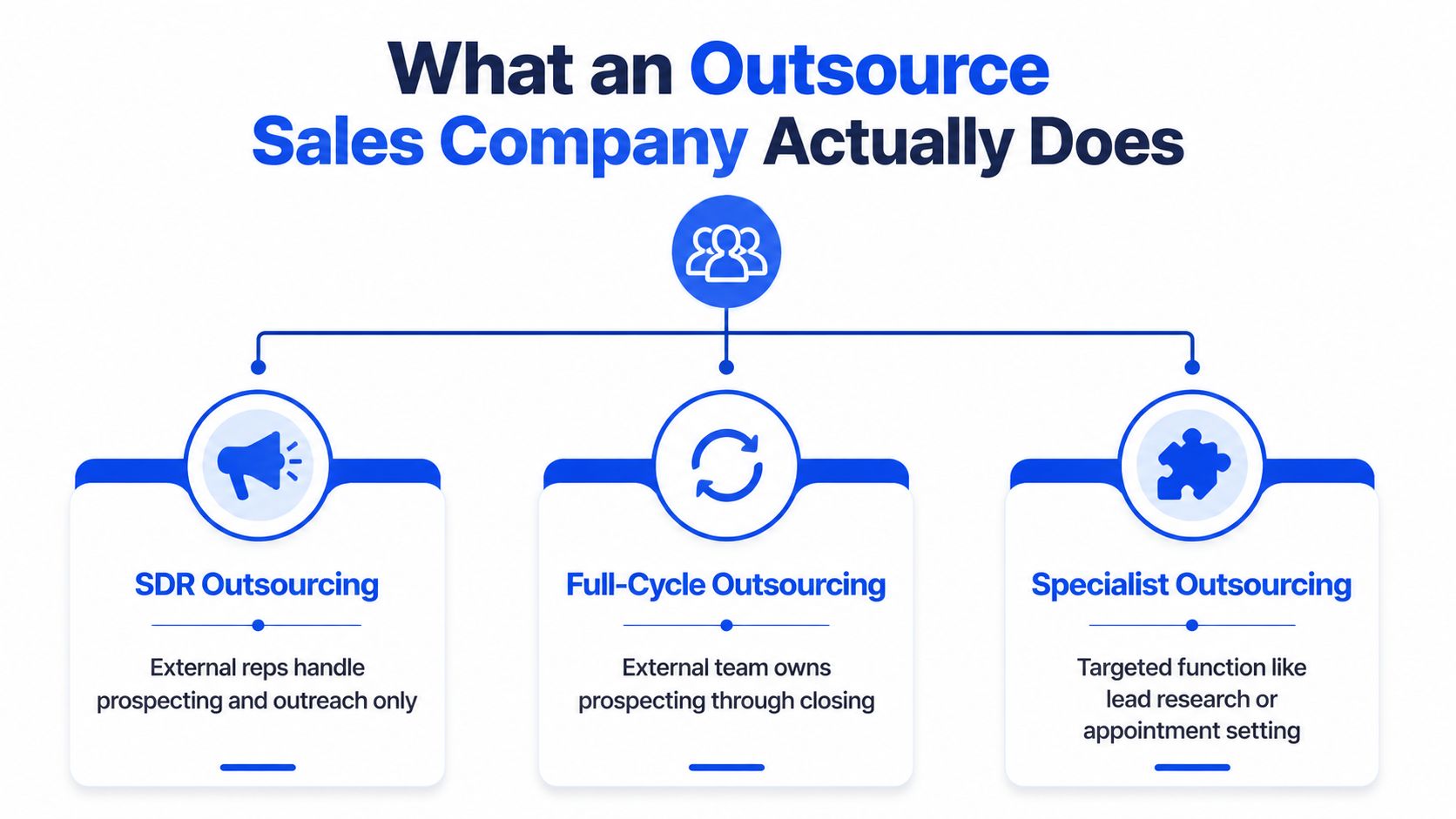
An outsource sales company usually fits one of three models. SDR outsourcing means external reps handle prospecting and outreach, while your closers stay in-house. Full-cycle outsourcing means the outside team owns the path from prospecting through close. Pipeline-as-a-service sits in between, where the agency runs list building, messaging, sequencing, and meeting routing, then your internal AEs take it from there.
That middle model is the one most B2B teams should evaluate first. It preserves control over closing while removing the grind of outbound execution. It also gives you a cleaner line for attribution, since the internal team keeps ownership of late-stage revenue.
The operational work behind the label
A sales outsourcing agency typically acts like an external SDR function, handling prospecting, cold calling, email and LinkedIn outreach, list building, appointment setting, reporting, and tech-stack administration (SalesHive). In practice, that means the agency has to work inside your CRM, not alongside it. Standardized fields, complete notes, and crisp handoff rules aren't admin details, they're the difference between a routed meeting and a lost one.
Practical rule: if the agency can't describe how a qualified meeting moves from inbox to calendar to CRM to AE handoff, it's not ready to run your pipeline.
That's also why partial outsourcing and full outsourcing shouldn't be treated as interchangeable. Partial outsourcing works when you already have closers, a stable process, and enough volume to feed the team. Full outsourcing only makes sense when your sales operation is mature enough to let an outside group own more of the motion without wrecking message quality or attribution.
For a broader lead-gen angle, this B2B sales lead generation resource is worth keeping open while you scope vendors.
Three criteria that decide if you are ready to outsource
Criterion 1, can you convert meetings into revenue
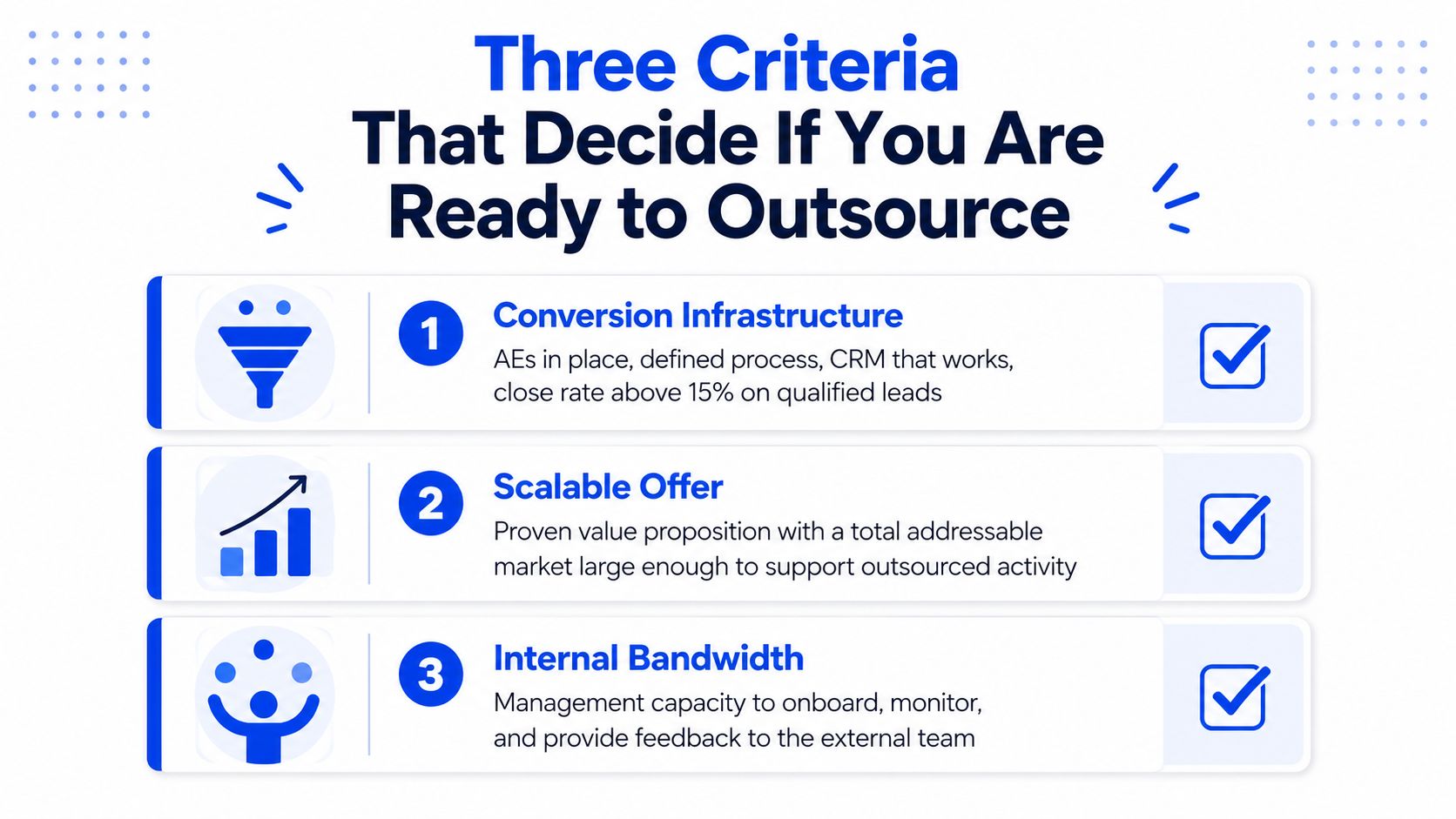
Start with your conversion infrastructure. If you don't have AEs, a defined sales process, and a working CRM, outsourced pipeline generation will give you meetings you can't convert. I'd want to see a real answer to three questions, how many AEs do you have, what's their close rate on qualified opportunities, and what does the current pipeline look like?
The red flags are blunt. No dedicated AEs, a sales cycle over 12 months, or CRM disorder means the vendor's work has nowhere to land. The usual threshold I look for is a close rate above 15% on qualified opportunities, but the exact benchmark matters less than the fact that the team can already close when the right meeting arrives.
Criterion 2, has the offer already proven itself
Outbound scales existing product-market fit. It doesn't create it. A healthy sign is 15 to 20 closed deals in the target ICP with reasonable retention at 12 months. If you're below that, or your retention is weak, you're probably asking outbound to do the work of discovery.
Ask for evidence, not opinions. How many customers have you closed in the target ICP? What do they achieve? What's retention at 12 months? If the answers are fuzzy, the campaign will be fuzzy too.
Criterion 3, will leadership stay in the seat long enough
The third filter is patience. Outbound compounds over months, not weeks, and leadership has to commit to a 6-plus-month horizon. If the board is demanding closed deals inside 30 to 60 days, you're not buying pipeline, you're buying a conflict.
My rule: if leadership can't tolerate a six-month build, don't outsource yet. You'll just burn budget and blame execution for a timeline problem.
The outsourced sales services market was valued at about USD 2.71 billion in 2024 and is projected to reach about USD 4.21 billion by 2034, roughly 4.5% CAGR, which reinforces that this is a scaled operating model, not a fringe experiment (Zion Market Research).
If you want a quick self-check, use this pipeline score quiz before you write an RFP.
A useful side note, if your team is trying to outsource another repetitive function like outsource video editing efficiently, the same principle applies, scope the work before you buy the vendor.
The four-phase implementation model
Phase 1 and phase 2, selection and onboarding
The first mistake buyers make is treating implementation like a vendor handoff. It is a readiness test. In weeks 1 to 2, the work is vendor selection. In weeks 3 to 4, the work is onboarding. Apollo's outsourced sales team guide follows the same sequence, with vendor selection weeks 1 to 2, onboarding weeks 3 to 4, pilot months 2 to 3, and scale beginning in month 4, plus 2 to 3 reps in the pilot, daily activity reviews, and weekly pipeline progression reviews (Apollo).
Weeks 1 to 2 should force answers on ICP definition, tech-stack compatibility, and reference calls. If the vendor cannot explain how they handle CRM sync, routing, and sequence ownership, they are not ready for your account. For a deeper look at automating the handoff, see this sales process automation guide.
Weeks 3 to 4 are where the work gets real. CRM integration has to be live, Slack or email channels need to be set up, and the outbound language has to match your market and your brand voice. If the vendor plans to “learn as they go,” stop there. That usually means the first two weeks were just sales theater.
Phase 3 and phase 4, pilot and scale
The pilot is the proof point. Use a small rep group, watch daily activity, review pipeline weekly, and change list quality, sequencing, and qualification fast. The goal is not polish. The goal is to find out whether the motion creates usable meetings and whether those meetings turn into opportunities your team can work.
If the pilot works, scale starts in month 4 with staggered cohort ramping. If it does not work, freeze it. Adding more heads to a broken motion only increases noise and makes reporting harder to trust.
That same discipline shows up in the guide to deploying AI agents with SupportGPT, because the sequence is the same, define the process, integrate the stack, test the workflow, then scale what holds up.
The onboarding window is not fixed. It can stretch to 3 to 4 weeks when CRM cleanup is messy or leadership is hard to pin down. That delay is better than a rushed launch that breaks handoff rules on day one and leaves your team cleaning up bad data for months.
The vendor evaluation checklist and contract must-haves
What belongs in the RFP scorecard
I'd score vendors on six things. Vertical experience matters, especially in SaaS, manufacturing, legal tech, pharma, or iGaming, because compliance and buyer motion change the work. Dedicated vs shared reps matters too, since shared reps often hide weak capacity. Then check reporting cadence, live campaign adaptation, tech-stack compatibility, and pricing model.
The tech stack should be explicit, not implied. HubSpot, Salesforce, Clay, Apollo, Lemlist, Instantly, and HeyReach are common enough that the vendor should explain exactly how they fit. If they can't show you how leads move through the stack, they're not operating a system, they're running a sequence.
Independent research says 82% of sales professionals were using AI tools and 78% of organizations had adopted AI in at least one business function by 2025, which means automation alone isn't a differentiator anymore (JumpCrew guide). Process visibility is the key filter now.
What the contract has to lock down
The contract should spell out lead pass-off criteria, calendar-booking protocols, reply-routing SLAs, written qualification rules, data ownership, and exit terms. I'd insist that contact data, notes, and IP come back to you cleanly if the relationship ends. If the vendor resists that, they're protecting their process more than your pipeline.
The five red flags that should disqualify a vendor or an engagement are simple: chaotic CRM discipline, no defined sales process, immediate revenue expectations, sales team already at capacity, and recent sales team turnover. Those aren't minor concerns. They're usually the reason outsourced motions fail.
For a practical comparison lens, this lead generation companies overview gives a useful structure for evaluating who owns what.
The scorecard fields I'd actually use
Vertical fit: have they sold into your market before?
Rep model: shared or dedicated, and why?
Reporting: daily, weekly, or ad hoc.
Adaptation: do they change messaging after live feedback?
Stack fit: can they work in your CRM and sequencing tools?
Commercials: per meeting, per hour, or retainer.
References: can you verify them directly?
Negotiation rule: if the vendor won't commit to clear handoff criteria and reply routing, the price doesn't matter. The process will fail before the invoice does.
The 30/60/90 measurement framework and ROI timelines
What to measure in each window
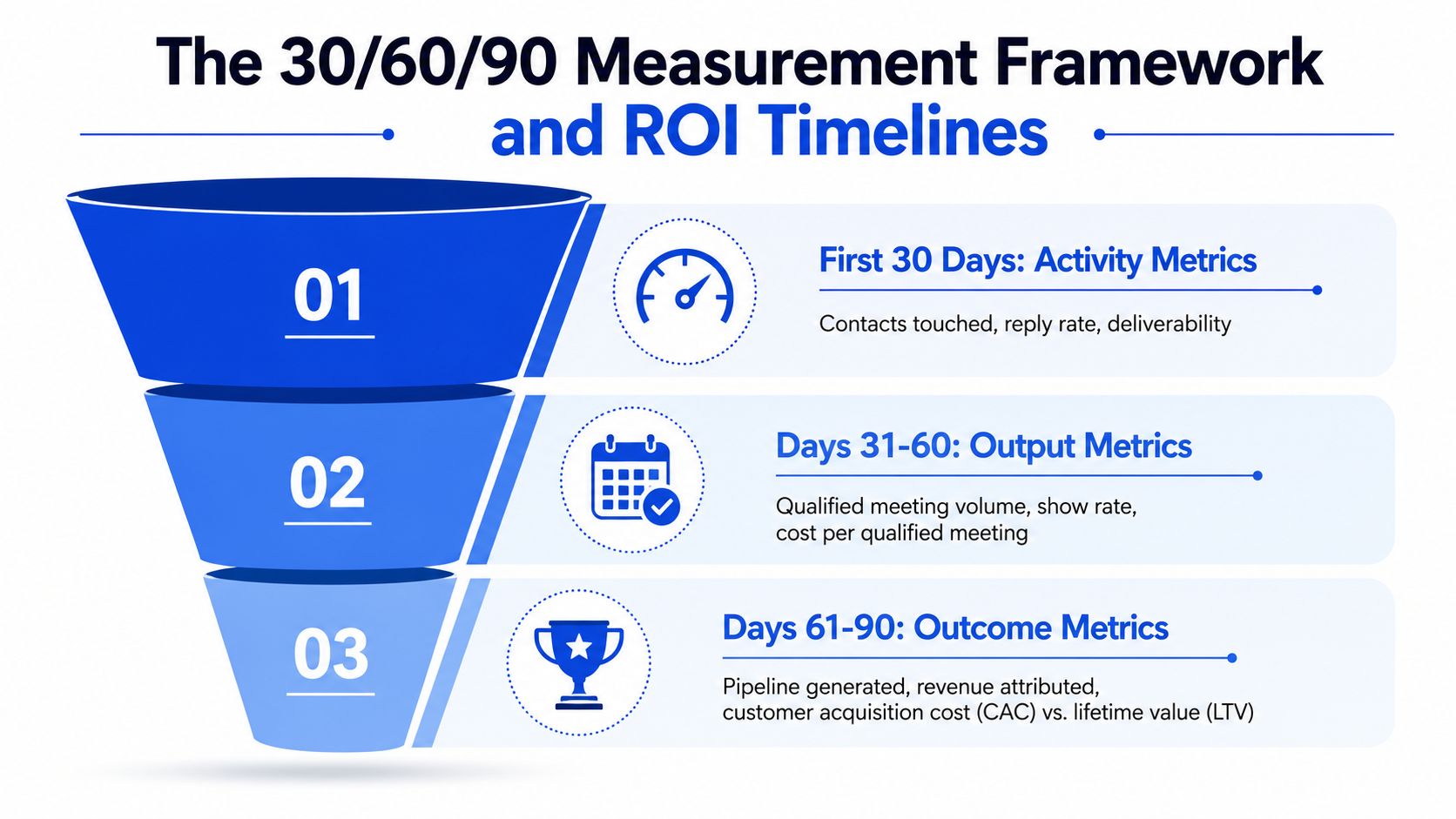
The first 30 days should be judged on activity, not revenue. Track contacts touched, reply rate, and deliverability. B2B outsourcing guidance puts average cold email reply rate around 7%, with SDR output typically producing 8 to 15 meetings per month (Microsourcing).
Days 31 to 60 should show qualified meeting volume, show rate, and cost per qualified meeting. If those numbers are weak, don't blame the close team yet. The problem is usually list quality, message quality, or handoff friction.
Days 61 to 90 should show pipeline value created and early opportunity progression. That's the point where the board can see whether the motion has shape, even if closed revenue is still lagging.
When closed revenue actually shows up
For most B2B teams, meaningful closed-revenue impact lands around month 6, not day 90. Many sales cycles run too long for a clean closed-deal story inside the first quarter. That's why I don't let clients set success criteria around closed wins too early.
There are exceptions. A customer support platform client in a product-led motion saw total closed deals rise from 24 to 32 in the first 90 days, a 33% increase, and outbound-attributable closed deals move from 6 to 11, an 83% increase. That happened because the sales cycle was unusually short, at 45 to 65 days, and the internal team was already mature enough to convert quickly.
You shouldn't build expectations around that case. Use the median, not the outlier. A first qualified meeting often arrives around day 15 to 21, first outbound-attributable closed deal around day 90 to 120, and meaningful volume around day 180+.
The reason those timelines matter is simple. Outsourcing buys pipeline creation first, revenue later. If you judge it like a month-to-month ad campaign, you'll kill the motion before it compounds.
Sector-specific use cases and timelines
Where it works fastest
SaaS is the cleanest fit when product-led motion already exists. The buying cycle is usually shorter, the tooling is already in place, and outsourced pipeline becomes measurable faster than in most other sectors. If your team can respond quickly to qualified meetings, the first closed deal often shows up inside the first 90 to 120 days. Founder content amplification helps here because trust builds around the offer and the category story.
iGaming is a different operating problem. Compliance overhead, buyer scrutiny, and tighter lead filtering slow everything down. The outreach can still produce strong results, but the messaging has to respect regulation and the qualification bar has to be tighter than many vendors plan for.
Where seniority matters most
Manufacturing usually needs longer qualification and more patience. Multi-stakeholder deals push the first meeting to closed-revenue window toward 150 to 210 days, and junior SDRs usually struggle because the buying process is less forgiving. Senior reps, sharper account research, and cleaner qualification matter more here than raw volume.
Professional services is trust-heavy and content-led. The first meeting matters, but nurture matters just as much, because buyers often need time before they move. Founder content amplification and disciplined follow-up can do more than larger send volume, especially when the service is expensive or the purchase feels risky.
The global B2B sales outsourcing services market has already moved into mainstream B2B operating practice, which is why sector fit matters more than vendor hype (Business Research Insights). The point is not that every vertical should outsource. The point is that each vertical needs a different motion, different qualification rules, and a different patience level before anyone claims the program is working.
If you are in a less-covered vertical, do not copy SaaS timelines. Match the outsourced motion to your actual cycle length, your compliance burden, and the internal capacity to close. If your team cannot handle handoff cleanly, even a good outsourced program will stall at the meeting stage.
Your next step this week
Audit your meeting-held rate this Friday. Pull the last 30 days of booked meetings from your CRM, count the no-shows, and compare the show rate against a 75% benchmark. If you're below 60%, your bottleneck isn't pipeline volume, it's qualification or handoff, and outsourcing will only amplify that problem.
GROU has built pipeline systems for 50+ companies across iGaming, SaaS, manufacturing, and professional services, with bi-weekly sprints, dedicated Slack channels, and first signals within 30 days. The methodology behind this article combines discovery-driven fit assessment, four-phase implementation governance, and 30/60/90 measurement windows applied across client programs.
A CTA for Grou.
You're choosing an outsource sales company because your internal SDR motion has stalled, your funnel's thin, or the board wants pipeline yesterday. The wrong vendor will book noise, miss handoffs, and leave you with messy attribution. The right one fits your CRM, your close process, and your patience for a real ramp.
Fit first. Outsourced pipeline only works when your team can close what comes in.
Scope matters. Decide whether you need SDR support, full-cycle coverage, or a narrow specialist function.
Timeline matters. Judge the first 30 days on activity, the next 60 on meetings and pipeline, and closed revenue later.
Contracts matter. Lead handoff rules, reply SLAs, and data ownership should be written down.
Red flags matter. CRM chaos, no sales process, and 30-day revenue pressure are deal-killers.
Table of Contents
The decision founders and heads of sales actually face
You're not shopping for an outsource sales company because it sounds efficient. You're doing it because internal output is flat, the funnel feels fragile, or leadership wants meetings that turn into revenue. The risk isn't paying a vendor, it's buying motion that your team can't absorb.
A few facts should frame the decision. The global B2B sales outsourcing services market was valued at USD 127.02 billion in 2026 and is projected to reach USD 260.65 billion by 2035, a long-run move of more than 2x with a 9.78% CAGR (Business Research Insights). That scale tells you outsourcing isn't fringe. It's become a structured revenue function.
Readiness beats vendor polish. If your CRM is messy and your close process is undefined, outsource sales will expose that fast.
Scope beats buzzwords. Know whether you need lead gen, appointment setting, or full-cycle coverage before you brief vendors.
Measurement beats promises. Judge activity, qualified meetings, and pipeline progression before you expect closed revenue.
Fit beats volume. The best vendor for your market still fails if your team can't convert meetings.
Timing beats urgency. If leadership wants closed deals in 30 to 60 days, pause the search.
That's the lens GROU uses in its own pipeline work, and it's the same lens I'd use if I were buying today. Structure turns attention into pipeline. Without structure, outsourced reps just create more motion for your internal team to sort out.
If you need a broader view of how outsourced pipeline fits into demand generation, this lead generation agency guide is a useful companion.
What an outsource sales company actually does
The three models you'll actually see
An outsource sales company usually fits one of three models. SDR outsourcing means external reps handle prospecting and outreach, while your closers stay in-house. Full-cycle outsourcing means the outside team owns the path from prospecting through close. Pipeline-as-a-service sits in between, where the agency runs list building, messaging, sequencing, and meeting routing, then your internal AEs take it from there.
That middle model is the one most B2B teams should evaluate first. It preserves control over closing while removing the grind of outbound execution. It also gives you a cleaner line for attribution, since the internal team keeps ownership of late-stage revenue.
The operational work behind the label
A sales outsourcing agency typically acts like an external SDR function, handling prospecting, cold calling, email and LinkedIn outreach, list building, appointment setting, reporting, and tech-stack administration (SalesHive). In practice, that means the agency has to work inside your CRM, not alongside it. Standardized fields, complete notes, and crisp handoff rules aren't admin details, they're the difference between a routed meeting and a lost one.
Practical rule: if the agency can't describe how a qualified meeting moves from inbox to calendar to CRM to AE handoff, it's not ready to run your pipeline.
That's also why partial outsourcing and full outsourcing shouldn't be treated as interchangeable. Partial outsourcing works when you already have closers, a stable process, and enough volume to feed the team. Full outsourcing only makes sense when your sales operation is mature enough to let an outside group own more of the motion without wrecking message quality or attribution.
For a broader lead-gen angle, this B2B sales lead generation resource is worth keeping open while you scope vendors.
Three criteria that decide if you are ready to outsource
Criterion 1, can you convert meetings into revenue
Start with your conversion infrastructure. If you don't have AEs, a defined sales process, and a working CRM, outsourced pipeline generation will give you meetings you can't convert. I'd want to see a real answer to three questions, how many AEs do you have, what's their close rate on qualified opportunities, and what does the current pipeline look like?
The red flags are blunt. No dedicated AEs, a sales cycle over 12 months, or CRM disorder means the vendor's work has nowhere to land. The usual threshold I look for is a close rate above 15% on qualified opportunities, but the exact benchmark matters less than the fact that the team can already close when the right meeting arrives.
Criterion 2, has the offer already proven itself
Outbound scales existing product-market fit. It doesn't create it. A healthy sign is 15 to 20 closed deals in the target ICP with reasonable retention at 12 months. If you're below that, or your retention is weak, you're probably asking outbound to do the work of discovery.
Ask for evidence, not opinions. How many customers have you closed in the target ICP? What do they achieve? What's retention at 12 months? If the answers are fuzzy, the campaign will be fuzzy too.
Criterion 3, will leadership stay in the seat long enough
The third filter is patience. Outbound compounds over months, not weeks, and leadership has to commit to a 6-plus-month horizon. If the board is demanding closed deals inside 30 to 60 days, you're not buying pipeline, you're buying a conflict.
My rule: if leadership can't tolerate a six-month build, don't outsource yet. You'll just burn budget and blame execution for a timeline problem.
The outsourced sales services market was valued at about USD 2.71 billion in 2024 and is projected to reach about USD 4.21 billion by 2034, roughly 4.5% CAGR, which reinforces that this is a scaled operating model, not a fringe experiment (Zion Market Research).
If you want a quick self-check, use this pipeline score quiz before you write an RFP.
A useful side note, if your team is trying to outsource another repetitive function like outsource video editing efficiently, the same principle applies, scope the work before you buy the vendor.
The four-phase implementation model
Phase 1 and phase 2, selection and onboarding
The first mistake buyers make is treating implementation like a vendor handoff. It is a readiness test. In weeks 1 to 2, the work is vendor selection. In weeks 3 to 4, the work is onboarding. Apollo's outsourced sales team guide follows the same sequence, with vendor selection weeks 1 to 2, onboarding weeks 3 to 4, pilot months 2 to 3, and scale beginning in month 4, plus 2 to 3 reps in the pilot, daily activity reviews, and weekly pipeline progression reviews (Apollo).
Weeks 1 to 2 should force answers on ICP definition, tech-stack compatibility, and reference calls. If the vendor cannot explain how they handle CRM sync, routing, and sequence ownership, they are not ready for your account. For a deeper look at automating the handoff, see this sales process automation guide.
Weeks 3 to 4 are where the work gets real. CRM integration has to be live, Slack or email channels need to be set up, and the outbound language has to match your market and your brand voice. If the vendor plans to “learn as they go,” stop there. That usually means the first two weeks were just sales theater.
Phase 3 and phase 4, pilot and scale
The pilot is the proof point. Use a small rep group, watch daily activity, review pipeline weekly, and change list quality, sequencing, and qualification fast. The goal is not polish. The goal is to find out whether the motion creates usable meetings and whether those meetings turn into opportunities your team can work.
If the pilot works, scale starts in month 4 with staggered cohort ramping. If it does not work, freeze it. Adding more heads to a broken motion only increases noise and makes reporting harder to trust.
That same discipline shows up in the guide to deploying AI agents with SupportGPT, because the sequence is the same, define the process, integrate the stack, test the workflow, then scale what holds up.
The onboarding window is not fixed. It can stretch to 3 to 4 weeks when CRM cleanup is messy or leadership is hard to pin down. That delay is better than a rushed launch that breaks handoff rules on day one and leaves your team cleaning up bad data for months.
The vendor evaluation checklist and contract must-haves
What belongs in the RFP scorecard
I'd score vendors on six things. Vertical experience matters, especially in SaaS, manufacturing, legal tech, pharma, or iGaming, because compliance and buyer motion change the work. Dedicated vs shared reps matters too, since shared reps often hide weak capacity. Then check reporting cadence, live campaign adaptation, tech-stack compatibility, and pricing model.
The tech stack should be explicit, not implied. HubSpot, Salesforce, Clay, Apollo, Lemlist, Instantly, and HeyReach are common enough that the vendor should explain exactly how they fit. If they can't show you how leads move through the stack, they're not operating a system, they're running a sequence.
Independent research says 82% of sales professionals were using AI tools and 78% of organizations had adopted AI in at least one business function by 2025, which means automation alone isn't a differentiator anymore (JumpCrew guide). Process visibility is the key filter now.
What the contract has to lock down
The contract should spell out lead pass-off criteria, calendar-booking protocols, reply-routing SLAs, written qualification rules, data ownership, and exit terms. I'd insist that contact data, notes, and IP come back to you cleanly if the relationship ends. If the vendor resists that, they're protecting their process more than your pipeline.
The five red flags that should disqualify a vendor or an engagement are simple: chaotic CRM discipline, no defined sales process, immediate revenue expectations, sales team already at capacity, and recent sales team turnover. Those aren't minor concerns. They're usually the reason outsourced motions fail.
For a practical comparison lens, this lead generation companies overview gives a useful structure for evaluating who owns what.
The scorecard fields I'd actually use
Vertical fit: have they sold into your market before?
Rep model: shared or dedicated, and why?
Reporting: daily, weekly, or ad hoc.
Adaptation: do they change messaging after live feedback?
Stack fit: can they work in your CRM and sequencing tools?
Commercials: per meeting, per hour, or retainer.
References: can you verify them directly?
Negotiation rule: if the vendor won't commit to clear handoff criteria and reply routing, the price doesn't matter. The process will fail before the invoice does.
The 30/60/90 measurement framework and ROI timelines
What to measure in each window
The first 30 days should be judged on activity, not revenue. Track contacts touched, reply rate, and deliverability. B2B outsourcing guidance puts average cold email reply rate around 7%, with SDR output typically producing 8 to 15 meetings per month (Microsourcing).
Days 31 to 60 should show qualified meeting volume, show rate, and cost per qualified meeting. If those numbers are weak, don't blame the close team yet. The problem is usually list quality, message quality, or handoff friction.
Days 61 to 90 should show pipeline value created and early opportunity progression. That's the point where the board can see whether the motion has shape, even if closed revenue is still lagging.
When closed revenue actually shows up
For most B2B teams, meaningful closed-revenue impact lands around month 6, not day 90. Many sales cycles run too long for a clean closed-deal story inside the first quarter. That's why I don't let clients set success criteria around closed wins too early.
There are exceptions. A customer support platform client in a product-led motion saw total closed deals rise from 24 to 32 in the first 90 days, a 33% increase, and outbound-attributable closed deals move from 6 to 11, an 83% increase. That happened because the sales cycle was unusually short, at 45 to 65 days, and the internal team was already mature enough to convert quickly.
You shouldn't build expectations around that case. Use the median, not the outlier. A first qualified meeting often arrives around day 15 to 21, first outbound-attributable closed deal around day 90 to 120, and meaningful volume around day 180+.
The reason those timelines matter is simple. Outsourcing buys pipeline creation first, revenue later. If you judge it like a month-to-month ad campaign, you'll kill the motion before it compounds.
Sector-specific use cases and timelines
Where it works fastest
SaaS is the cleanest fit when product-led motion already exists. The buying cycle is usually shorter, the tooling is already in place, and outsourced pipeline becomes measurable faster than in most other sectors. If your team can respond quickly to qualified meetings, the first closed deal often shows up inside the first 90 to 120 days. Founder content amplification helps here because trust builds around the offer and the category story.
iGaming is a different operating problem. Compliance overhead, buyer scrutiny, and tighter lead filtering slow everything down. The outreach can still produce strong results, but the messaging has to respect regulation and the qualification bar has to be tighter than many vendors plan for.
Where seniority matters most
Manufacturing usually needs longer qualification and more patience. Multi-stakeholder deals push the first meeting to closed-revenue window toward 150 to 210 days, and junior SDRs usually struggle because the buying process is less forgiving. Senior reps, sharper account research, and cleaner qualification matter more here than raw volume.
Professional services is trust-heavy and content-led. The first meeting matters, but nurture matters just as much, because buyers often need time before they move. Founder content amplification and disciplined follow-up can do more than larger send volume, especially when the service is expensive or the purchase feels risky.
The global B2B sales outsourcing services market has already moved into mainstream B2B operating practice, which is why sector fit matters more than vendor hype (Business Research Insights). The point is not that every vertical should outsource. The point is that each vertical needs a different motion, different qualification rules, and a different patience level before anyone claims the program is working.
If you are in a less-covered vertical, do not copy SaaS timelines. Match the outsourced motion to your actual cycle length, your compliance burden, and the internal capacity to close. If your team cannot handle handoff cleanly, even a good outsourced program will stall at the meeting stage.
Your next step this week
Audit your meeting-held rate this Friday. Pull the last 30 days of booked meetings from your CRM, count the no-shows, and compare the show rate against a 75% benchmark. If you're below 60%, your bottleneck isn't pipeline volume, it's qualification or handoff, and outsourcing will only amplify that problem.
GROU has built pipeline systems for 50+ companies across iGaming, SaaS, manufacturing, and professional services, with bi-weekly sprints, dedicated Slack channels, and first signals within 30 days. The methodology behind this article combines discovery-driven fit assessment, four-phase implementation governance, and 30/60/90 measurement windows applied across client programs.
A CTA for Grou.
You're choosing an outsource sales company because your internal SDR motion has stalled, your funnel's thin, or the board wants pipeline yesterday. The wrong vendor will book noise, miss handoffs, and leave you with messy attribution. The right one fits your CRM, your close process, and your patience for a real ramp.
Fit first. Outsourced pipeline only works when your team can close what comes in.
Scope matters. Decide whether you need SDR support, full-cycle coverage, or a narrow specialist function.
Timeline matters. Judge the first 30 days on activity, the next 60 on meetings and pipeline, and closed revenue later.
Contracts matter. Lead handoff rules, reply SLAs, and data ownership should be written down.
Red flags matter. CRM chaos, no sales process, and 30-day revenue pressure are deal-killers.
Table of Contents
The decision founders and heads of sales actually face
You're not shopping for an outsource sales company because it sounds efficient. You're doing it because internal output is flat, the funnel feels fragile, or leadership wants meetings that turn into revenue. The risk isn't paying a vendor, it's buying motion that your team can't absorb.
A few facts should frame the decision. The global B2B sales outsourcing services market was valued at USD 127.02 billion in 2026 and is projected to reach USD 260.65 billion by 2035, a long-run move of more than 2x with a 9.78% CAGR (Business Research Insights). That scale tells you outsourcing isn't fringe. It's become a structured revenue function.
Readiness beats vendor polish. If your CRM is messy and your close process is undefined, outsource sales will expose that fast.
Scope beats buzzwords. Know whether you need lead gen, appointment setting, or full-cycle coverage before you brief vendors.
Measurement beats promises. Judge activity, qualified meetings, and pipeline progression before you expect closed revenue.
Fit beats volume. The best vendor for your market still fails if your team can't convert meetings.
Timing beats urgency. If leadership wants closed deals in 30 to 60 days, pause the search.
That's the lens GROU uses in its own pipeline work, and it's the same lens I'd use if I were buying today. Structure turns attention into pipeline. Without structure, outsourced reps just create more motion for your internal team to sort out.
If you need a broader view of how outsourced pipeline fits into demand generation, this lead generation agency guide is a useful companion.
What an outsource sales company actually does
The three models you'll actually see
An outsource sales company usually fits one of three models. SDR outsourcing means external reps handle prospecting and outreach, while your closers stay in-house. Full-cycle outsourcing means the outside team owns the path from prospecting through close. Pipeline-as-a-service sits in between, where the agency runs list building, messaging, sequencing, and meeting routing, then your internal AEs take it from there.
That middle model is the one most B2B teams should evaluate first. It preserves control over closing while removing the grind of outbound execution. It also gives you a cleaner line for attribution, since the internal team keeps ownership of late-stage revenue.
The operational work behind the label
A sales outsourcing agency typically acts like an external SDR function, handling prospecting, cold calling, email and LinkedIn outreach, list building, appointment setting, reporting, and tech-stack administration (SalesHive). In practice, that means the agency has to work inside your CRM, not alongside it. Standardized fields, complete notes, and crisp handoff rules aren't admin details, they're the difference between a routed meeting and a lost one.
Practical rule: if the agency can't describe how a qualified meeting moves from inbox to calendar to CRM to AE handoff, it's not ready to run your pipeline.
That's also why partial outsourcing and full outsourcing shouldn't be treated as interchangeable. Partial outsourcing works when you already have closers, a stable process, and enough volume to feed the team. Full outsourcing only makes sense when your sales operation is mature enough to let an outside group own more of the motion without wrecking message quality or attribution.
For a broader lead-gen angle, this B2B sales lead generation resource is worth keeping open while you scope vendors.
Three criteria that decide if you are ready to outsource
Criterion 1, can you convert meetings into revenue
Start with your conversion infrastructure. If you don't have AEs, a defined sales process, and a working CRM, outsourced pipeline generation will give you meetings you can't convert. I'd want to see a real answer to three questions, how many AEs do you have, what's their close rate on qualified opportunities, and what does the current pipeline look like?
The red flags are blunt. No dedicated AEs, a sales cycle over 12 months, or CRM disorder means the vendor's work has nowhere to land. The usual threshold I look for is a close rate above 15% on qualified opportunities, but the exact benchmark matters less than the fact that the team can already close when the right meeting arrives.
Criterion 2, has the offer already proven itself
Outbound scales existing product-market fit. It doesn't create it. A healthy sign is 15 to 20 closed deals in the target ICP with reasonable retention at 12 months. If you're below that, or your retention is weak, you're probably asking outbound to do the work of discovery.
Ask for evidence, not opinions. How many customers have you closed in the target ICP? What do they achieve? What's retention at 12 months? If the answers are fuzzy, the campaign will be fuzzy too.
Criterion 3, will leadership stay in the seat long enough
The third filter is patience. Outbound compounds over months, not weeks, and leadership has to commit to a 6-plus-month horizon. If the board is demanding closed deals inside 30 to 60 days, you're not buying pipeline, you're buying a conflict.
My rule: if leadership can't tolerate a six-month build, don't outsource yet. You'll just burn budget and blame execution for a timeline problem.
The outsourced sales services market was valued at about USD 2.71 billion in 2024 and is projected to reach about USD 4.21 billion by 2034, roughly 4.5% CAGR, which reinforces that this is a scaled operating model, not a fringe experiment (Zion Market Research).
If you want a quick self-check, use this pipeline score quiz before you write an RFP.
A useful side note, if your team is trying to outsource another repetitive function like outsource video editing efficiently, the same principle applies, scope the work before you buy the vendor.
The four-phase implementation model
Phase 1 and phase 2, selection and onboarding
The first mistake buyers make is treating implementation like a vendor handoff. It is a readiness test. In weeks 1 to 2, the work is vendor selection. In weeks 3 to 4, the work is onboarding. Apollo's outsourced sales team guide follows the same sequence, with vendor selection weeks 1 to 2, onboarding weeks 3 to 4, pilot months 2 to 3, and scale beginning in month 4, plus 2 to 3 reps in the pilot, daily activity reviews, and weekly pipeline progression reviews (Apollo).
Weeks 1 to 2 should force answers on ICP definition, tech-stack compatibility, and reference calls. If the vendor cannot explain how they handle CRM sync, routing, and sequence ownership, they are not ready for your account. For a deeper look at automating the handoff, see this sales process automation guide.
Weeks 3 to 4 are where the work gets real. CRM integration has to be live, Slack or email channels need to be set up, and the outbound language has to match your market and your brand voice. If the vendor plans to “learn as they go,” stop there. That usually means the first two weeks were just sales theater.
Phase 3 and phase 4, pilot and scale
The pilot is the proof point. Use a small rep group, watch daily activity, review pipeline weekly, and change list quality, sequencing, and qualification fast. The goal is not polish. The goal is to find out whether the motion creates usable meetings and whether those meetings turn into opportunities your team can work.
If the pilot works, scale starts in month 4 with staggered cohort ramping. If it does not work, freeze it. Adding more heads to a broken motion only increases noise and makes reporting harder to trust.
That same discipline shows up in the guide to deploying AI agents with SupportGPT, because the sequence is the same, define the process, integrate the stack, test the workflow, then scale what holds up.
The onboarding window is not fixed. It can stretch to 3 to 4 weeks when CRM cleanup is messy or leadership is hard to pin down. That delay is better than a rushed launch that breaks handoff rules on day one and leaves your team cleaning up bad data for months.
The vendor evaluation checklist and contract must-haves
What belongs in the RFP scorecard
I'd score vendors on six things. Vertical experience matters, especially in SaaS, manufacturing, legal tech, pharma, or iGaming, because compliance and buyer motion change the work. Dedicated vs shared reps matters too, since shared reps often hide weak capacity. Then check reporting cadence, live campaign adaptation, tech-stack compatibility, and pricing model.
The tech stack should be explicit, not implied. HubSpot, Salesforce, Clay, Apollo, Lemlist, Instantly, and HeyReach are common enough that the vendor should explain exactly how they fit. If they can't show you how leads move through the stack, they're not operating a system, they're running a sequence.
Independent research says 82% of sales professionals were using AI tools and 78% of organizations had adopted AI in at least one business function by 2025, which means automation alone isn't a differentiator anymore (JumpCrew guide). Process visibility is the key filter now.
What the contract has to lock down
The contract should spell out lead pass-off criteria, calendar-booking protocols, reply-routing SLAs, written qualification rules, data ownership, and exit terms. I'd insist that contact data, notes, and IP come back to you cleanly if the relationship ends. If the vendor resists that, they're protecting their process more than your pipeline.
The five red flags that should disqualify a vendor or an engagement are simple: chaotic CRM discipline, no defined sales process, immediate revenue expectations, sales team already at capacity, and recent sales team turnover. Those aren't minor concerns. They're usually the reason outsourced motions fail.
For a practical comparison lens, this lead generation companies overview gives a useful structure for evaluating who owns what.
The scorecard fields I'd actually use
Vertical fit: have they sold into your market before?
Rep model: shared or dedicated, and why?
Reporting: daily, weekly, or ad hoc.
Adaptation: do they change messaging after live feedback?
Stack fit: can they work in your CRM and sequencing tools?
Commercials: per meeting, per hour, or retainer.
References: can you verify them directly?
Negotiation rule: if the vendor won't commit to clear handoff criteria and reply routing, the price doesn't matter. The process will fail before the invoice does.
The 30/60/90 measurement framework and ROI timelines
What to measure in each window
The first 30 days should be judged on activity, not revenue. Track contacts touched, reply rate, and deliverability. B2B outsourcing guidance puts average cold email reply rate around 7%, with SDR output typically producing 8 to 15 meetings per month (Microsourcing).
Days 31 to 60 should show qualified meeting volume, show rate, and cost per qualified meeting. If those numbers are weak, don't blame the close team yet. The problem is usually list quality, message quality, or handoff friction.
Days 61 to 90 should show pipeline value created and early opportunity progression. That's the point where the board can see whether the motion has shape, even if closed revenue is still lagging.
When closed revenue actually shows up
For most B2B teams, meaningful closed-revenue impact lands around month 6, not day 90. Many sales cycles run too long for a clean closed-deal story inside the first quarter. That's why I don't let clients set success criteria around closed wins too early.
There are exceptions. A customer support platform client in a product-led motion saw total closed deals rise from 24 to 32 in the first 90 days, a 33% increase, and outbound-attributable closed deals move from 6 to 11, an 83% increase. That happened because the sales cycle was unusually short, at 45 to 65 days, and the internal team was already mature enough to convert quickly.
You shouldn't build expectations around that case. Use the median, not the outlier. A first qualified meeting often arrives around day 15 to 21, first outbound-attributable closed deal around day 90 to 120, and meaningful volume around day 180+.
The reason those timelines matter is simple. Outsourcing buys pipeline creation first, revenue later. If you judge it like a month-to-month ad campaign, you'll kill the motion before it compounds.
Sector-specific use cases and timelines
Where it works fastest
SaaS is the cleanest fit when product-led motion already exists. The buying cycle is usually shorter, the tooling is already in place, and outsourced pipeline becomes measurable faster than in most other sectors. If your team can respond quickly to qualified meetings, the first closed deal often shows up inside the first 90 to 120 days. Founder content amplification helps here because trust builds around the offer and the category story.
iGaming is a different operating problem. Compliance overhead, buyer scrutiny, and tighter lead filtering slow everything down. The outreach can still produce strong results, but the messaging has to respect regulation and the qualification bar has to be tighter than many vendors plan for.
Where seniority matters most
Manufacturing usually needs longer qualification and more patience. Multi-stakeholder deals push the first meeting to closed-revenue window toward 150 to 210 days, and junior SDRs usually struggle because the buying process is less forgiving. Senior reps, sharper account research, and cleaner qualification matter more here than raw volume.
Professional services is trust-heavy and content-led. The first meeting matters, but nurture matters just as much, because buyers often need time before they move. Founder content amplification and disciplined follow-up can do more than larger send volume, especially when the service is expensive or the purchase feels risky.
The global B2B sales outsourcing services market has already moved into mainstream B2B operating practice, which is why sector fit matters more than vendor hype (Business Research Insights). The point is not that every vertical should outsource. The point is that each vertical needs a different motion, different qualification rules, and a different patience level before anyone claims the program is working.
If you are in a less-covered vertical, do not copy SaaS timelines. Match the outsourced motion to your actual cycle length, your compliance burden, and the internal capacity to close. If your team cannot handle handoff cleanly, even a good outsourced program will stall at the meeting stage.
Your next step this week
Audit your meeting-held rate this Friday. Pull the last 30 days of booked meetings from your CRM, count the no-shows, and compare the show rate against a 75% benchmark. If you're below 60%, your bottleneck isn't pipeline volume, it's qualification or handoff, and outsourcing will only amplify that problem.
GROU has built pipeline systems for 50+ companies across iGaming, SaaS, manufacturing, and professional services, with bi-weekly sprints, dedicated Slack channels, and first signals within 30 days. The methodology behind this article combines discovery-driven fit assessment, four-phase implementation governance, and 30/60/90 measurement windows applied across client programs.
A CTA for Grou.
Pipeline OS Newsletter
Build qualified pipeline
Get weekly tactics to generate demand, improve lead quality, and book more meetings.







Trusted by industry leaders
Trusted by industry leaders
Trusted by industry leaders
Ready to build qualified pipeline?
Ready to build qualified pipeline?
Ready to build qualified pipeline?
Book a call to see if we're the right fit, or take the 2-minute quiz to get a clear starting point.
Book a call to see if we're the right fit, or take the 2-minute quiz to get a clear starting point.
Book a call to see if we're the right fit, or take the 2-minute quiz to get a clear starting point.
" height="30.21639343089746px" id="hfGbXmQR2" width="30.216393430897455px"/></svg>)
Copyright © 2026 – All Right Reserved
Copyright © 2026 – All Right Reserved
Copyright © 2026 – All Right Reserved