%22%3E%3C/path%3E%3Cpath d=%22M 63.072 7.554 C 62.258 8.022 61.577 8.689 61.092 9.493 L 61.092 7.076 L 57.158 7.076 L 57.158 22.64 L 61.089 22.64 L 61.089 14.888 C 61.089 13.446 61.403 12.434 62.03 11.853 C 62.818 11.218 63.818 10.907 64.826 10.982 L 65.868 10.982 L 65.868 6.851 C 64.891 6.834 63.926 7.076 63.073 7.554 Z%22 fill=%22rgb(17,17,17)%22%3E%3C/path%3E%3Cpath d=%22M 78.916 7.82 C 76.363 6.49 73.321 6.49 70.768 7.82 C 69.562 8.473 68.564 9.451 67.888 10.644 C 67.167 11.931 66.803 13.387 66.834 14.862 C 66.804 16.332 67.157 17.785 67.86 19.077 C 68.515 20.267 69.494 21.246 70.684 21.901 C 71.924 22.576 73.318 22.92 74.73 22.898 C 76.164 22.918 77.58 22.575 78.846 21.901 C 80.062 21.247 81.073 20.27 81.768 19.077 C 82.506 17.797 82.88 16.339 82.85 14.862 C 82.88 13.389 82.517 11.934 81.797 10.647 C 81.12 9.455 80.122 8.477 78.917 7.824 M 78.803 14.862 C 78.829 15.739 78.636 16.608 78.241 17.391 C 77.903 18.046 77.38 18.588 76.738 18.95 C 76.124 19.293 75.432 19.472 74.729 19.47 C 73.668 19.497 72.648 19.061 71.934 18.276 C 71.139 17.323 70.741 16.1 70.823 14.862 C 70.741 13.62 71.149 12.395 71.959 11.45 C 72.687 10.667 73.715 10.233 74.783 10.256 C 75.859 10.236 76.894 10.67 77.635 11.45 C 78.464 12.387 78.884 13.616 78.801 14.864%22 fill=%22rgb(17,17,17)%22%3E%3C/path%3E%3Cpath d=%22M 95.906 7.076 L 95.906 15.646 C 95.975 16.68 95.643 17.701 94.979 18.498 C 94.311 19.184 93.379 19.547 92.422 19.495 C 91.475 19.544 90.553 19.18 89.894 18.498 C 89.23 17.701 88.898 16.68 88.967 15.646 L 88.967 7.076 L 85.033 7.076 L 85.033 16.207 C 85 17.449 85.275 18.68 85.834 19.79 C 86.327 20.75 87.095 21.542 88.039 22.065 C 89.033 22.594 90.145 22.861 91.271 22.838 C 92.188 22.847 93.095 22.65 93.926 22.263 C 94.708 21.905 95.388 21.36 95.906 20.675 L 95.906 22.645 L 99.865 22.645 L 99.865 7.076 Z%22 fill=%22rgb(17,17,17)%22%3E%3C/path%3E%3Cpath d=%22M 4.513 15.626 C 4.511 10.815 7.606 6.549 12.181 5.059 C 16.756 3.57 21.77 5.195 24.601 9.086 L 27.816 5.87 C 24.074 1.186 17.981 -0.943 12.137 0.393 C 6.292 1.728 1.728 6.292 0.393 12.137 C -0.943 17.981 1.186 24.074 5.87 27.816 L 9.085 24.601 C 6.214 22.512 4.515 19.177 4.513 15.626%22 fill=%22rgb(32,62,235)%22%3E%3C/path%3E%3Cpath d=%22M 17.114 14.343 L 13.354 18.01 L 13.354 18.026 L 21.071 18.026 L 11.412 27.609 L 17.389 27.609 L 23.999 21.081 L 23.999 28.316 L 24.005 28.316 L 27.967 24.393 L 27.967 14.343 Z%22 fill=%22rgb(32,62,235)%22%3E%3C/path%3E%3C/g%3E%3C/svg%3E) ×
× ××
××›
›
›
›
Founder-led sales to first sales hire 2026
Founder-led sales to first sales hire 2026
Founder-led sales to first sales hire 2026
Founder-led sales to first sales hire 2026
Founder-led sales to first sales hire 2026
Founder-led sales to first sales hire 2026

Author
Aljaz Peklaj

The first sales hire is usually framed as replacing the founder. It is not. It is extracting the repeatable part of what the founder does, and if that part has not been separated out yet, the hire inherits the job without the thing that made it work.
Which is why the question is not when you can afford someone. It is whether there is a describable motion for them to run, and whether your budget is the number you think it is. On both counts the honest answer is usually no, and both are checkable this week.
TL;DR
Three things decide this. First, the cost is higher than the salary line and higher than most founders adjust for: Eurostat puts non-wage costs at 24.8 percent of total labour cost in the EU, and because that is a share of the total rather than an addition to the wage, the markup on salary is about a third, not a quarter. Hourly labour costs also range from EUR 12.0 in Bulgaria to EUR 56.8 in Luxembourg, so where you hire moves the number by more than any negotiation will. In the US, BLS put the May 2025 annual mean wage at $82,430 for sales representatives of services and $119,730 for technical and scientific products. Second, the motion has to exist before the person does: a claim that survives contact, a named list, a written sequence, a qualification bar, a CRM that reflects reality and proof they can hand over. Third, the clock is longer than the trial period you have in mind, because Directive 2019/1152 caps probationary periods at six months in the EU while a hire on a normal B2B cycle will not have closed enough to judge by then.
The cost is not the salary
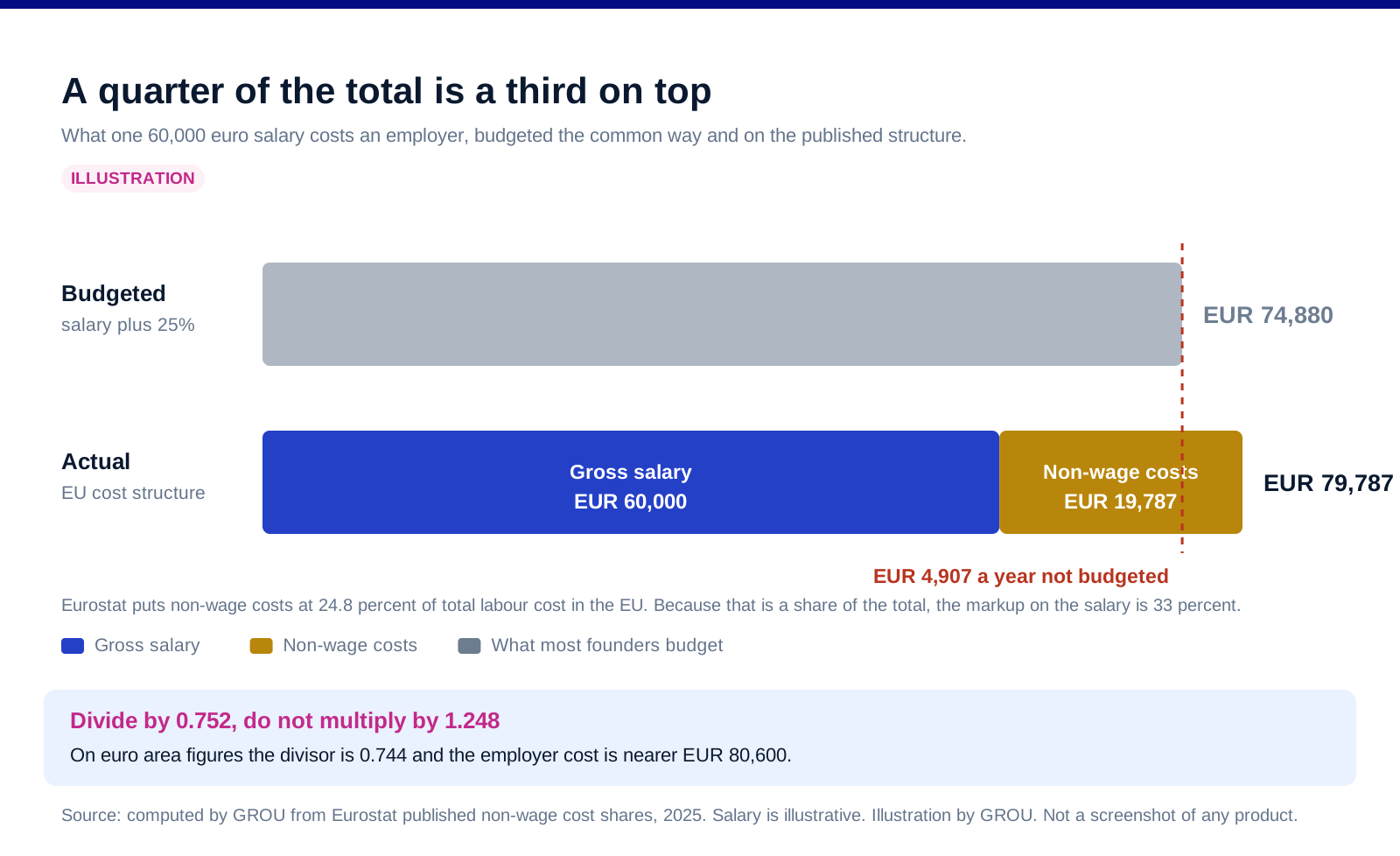
Start with the arithmetic almost everyone gets backwards. Eurostat reports that non-wage costs were 24.8 percent of total labour costs in the EU in 2025 and 25.6 percent in the euro area. That is a share of the total, not a percentage added to the wage. So if wages are 75.2 percent of the total, the total is the wage divided by 0.752, which is a markup of about 33 percent rather than 25.
Which is a real gap on a real number. Budget a salary of EUR 60,000 and add a quarter and you plan for EUR 74,880. The EU average structure puts the employer cost nearer EUR 79,800, and on euro area figures nearer EUR 80,600. Roughly five thousand euro a year of quiet underbudgeting, on the first hire, when cash is tightest.
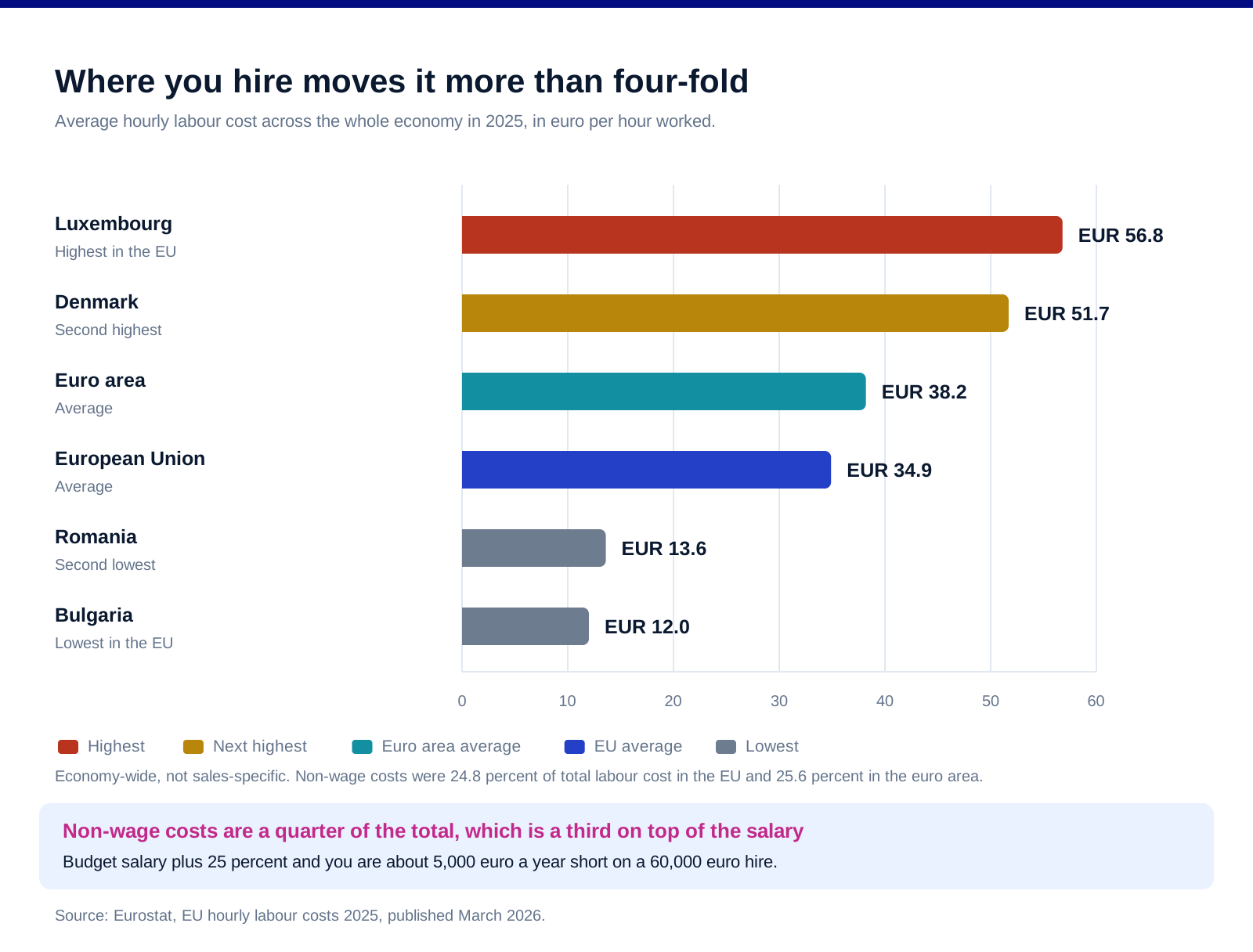
Then look at where you hire. Eurostat puts average hourly labour costs at EUR 34.9 in the EU and EUR 38.2 in the euro area for 2025, with the lowest in Bulgaria at EUR 12.0, Romania at EUR 13.6 and Hungary at EUR 15.2, and the highest in Luxembourg at EUR 56.8, Denmark at EUR 51.7 and the Netherlands at EUR 47.9. The spread from bottom to top is more than four and a half times.
And note what that does and does not tell you. It is economy-wide, not sales-specific, and a salesperson selling into a market usually needs to sound like that market. The geography lever is real but it is not free, and our note on hiring SDRs in Colombia covers where it works and where it does not.
For a US comparison, use the occupational figures rather than an average. BLS put the May 2025 annual mean wage at $82,430 for sales representatives of services, across 1,256,010 people, and $119,730 for technical and scientific products, across 284,800. Those are wages rather than employer costs, and we are not going to apply a European non-wage share to an American wage.
Add the parts that never make the budget. Tooling, data, a CRM seat, travel, and the founder's own hours during ramp. The last one is the largest and the only one that never appears on a spreadsheet.
What has to exist before the person does
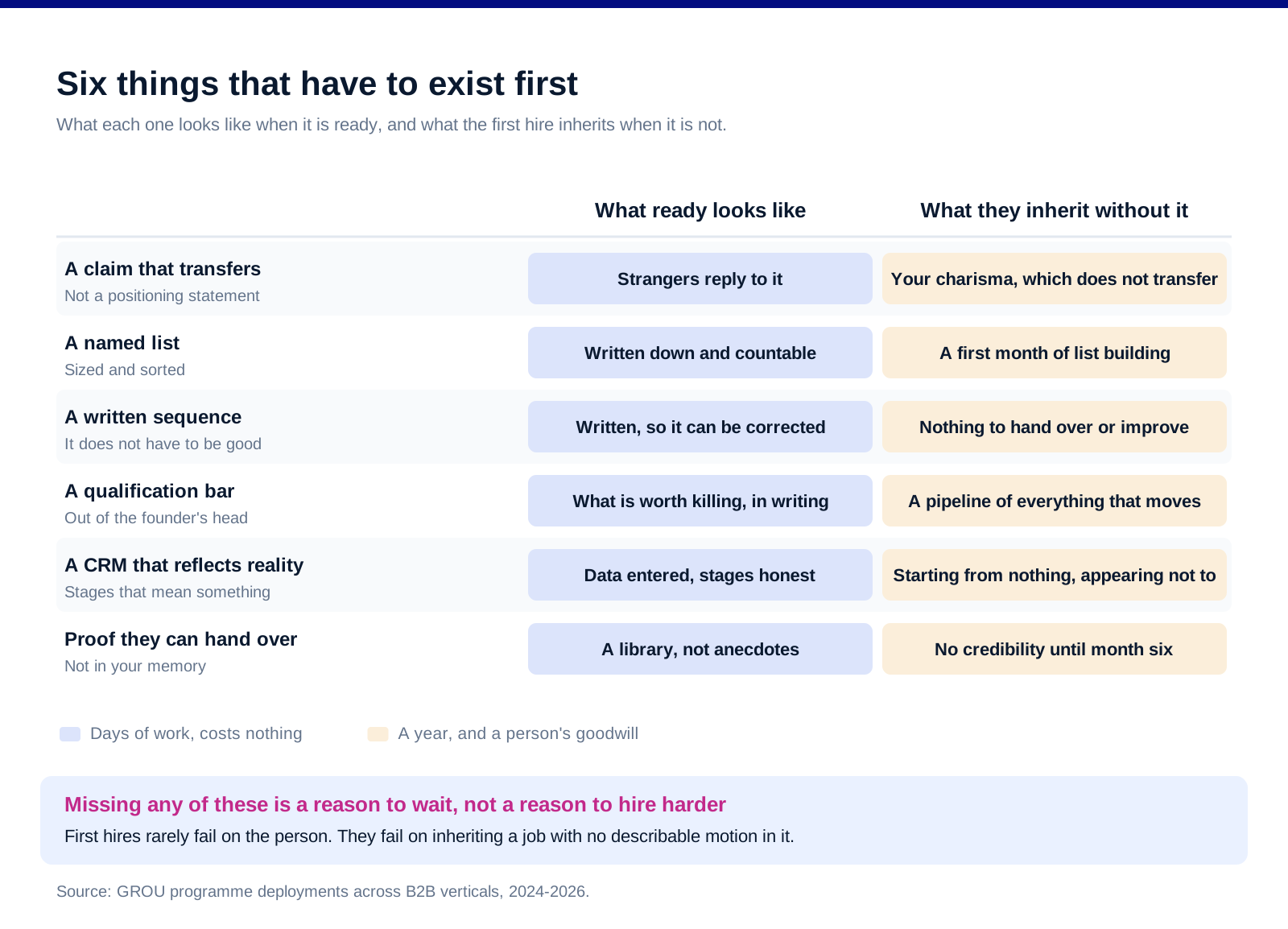
A claim that survives contact. Not a positioning statement, the specific sentence that has made strangers reply. If it only works when the founder says it, you have charisma rather than a claim, and charisma does not transfer. Our note on positioning for B2B services covers how to find the transferable version.
A named list. Written down, sized, and sorted. If the founder has been selling from memory and inbound, the new hire's first month is list building, which is not what you hired for and not what you are paying for.
A written sequence. What gets sent, when, and what happens on a reply. It does not have to be good yet. It has to be written, because an unwritten sequence cannot be handed over, corrected or improved.
A qualification bar. The founder has one and it lives in their head. Get it out: what makes a deal worth working, and what makes it worth killing. Without it the new hire fills the pipeline with everything that moves and your forecast becomes fiction, which is the failure our note on pipeline coverage ratio is built around.
A CRM that reflects reality. Not a perfect one. One where the stages mean something and the data is entered. A new hire inheriting a CRM that the founder never used is starting from nothing while appearing to start from something.
And proof they can hand a buyer. The founder carries the stories in their head. The hire cannot. Our companion piece on building a B2B proof library covers how to get those out of the founder's memory and into a form a new person can use in week two.
Missing any of these is a reason to wait, not to hire harder. Each one takes days to fix and costs nothing. Hiring without them costs a year and a person's goodwill.
The clock is longer than your trial period
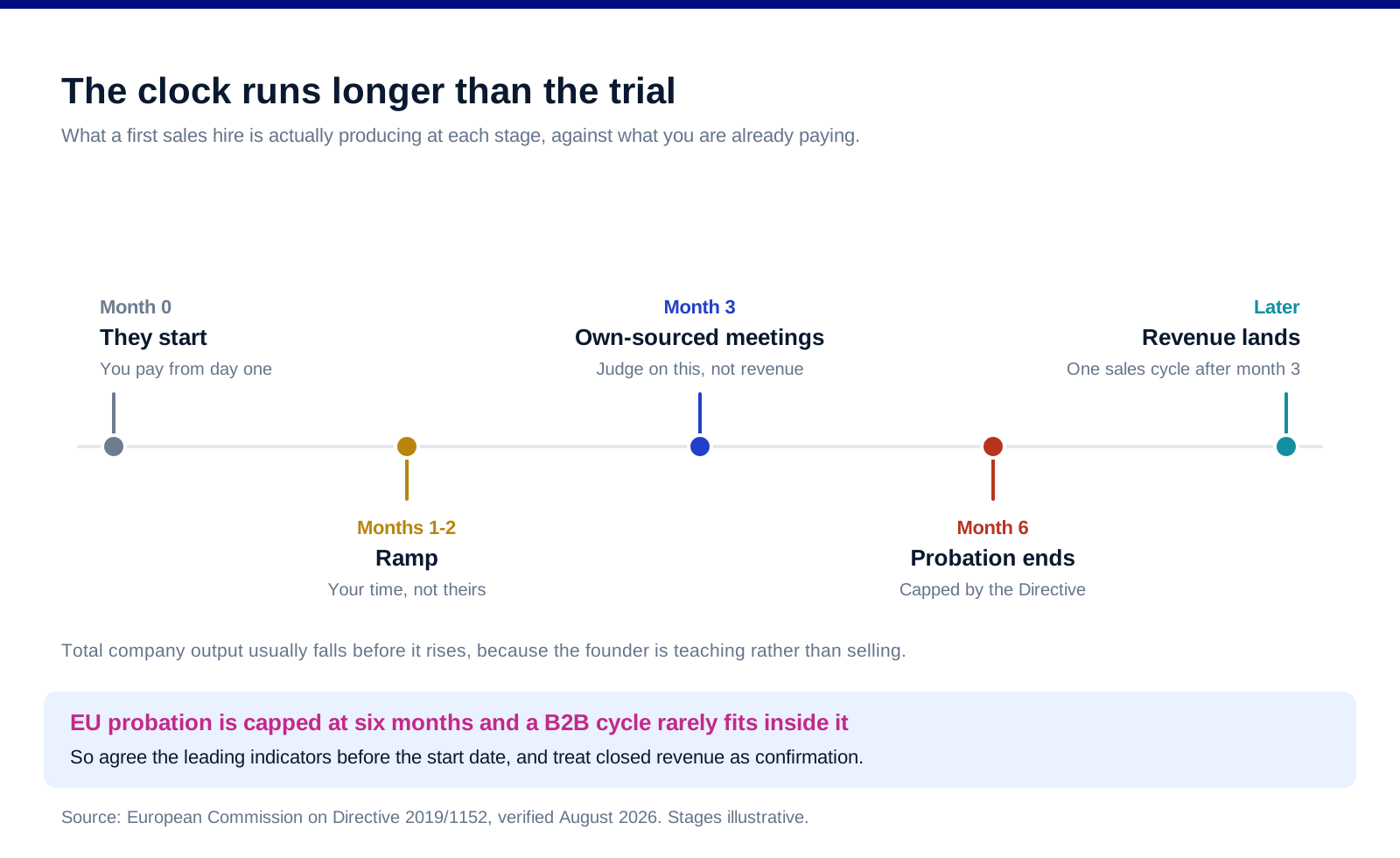
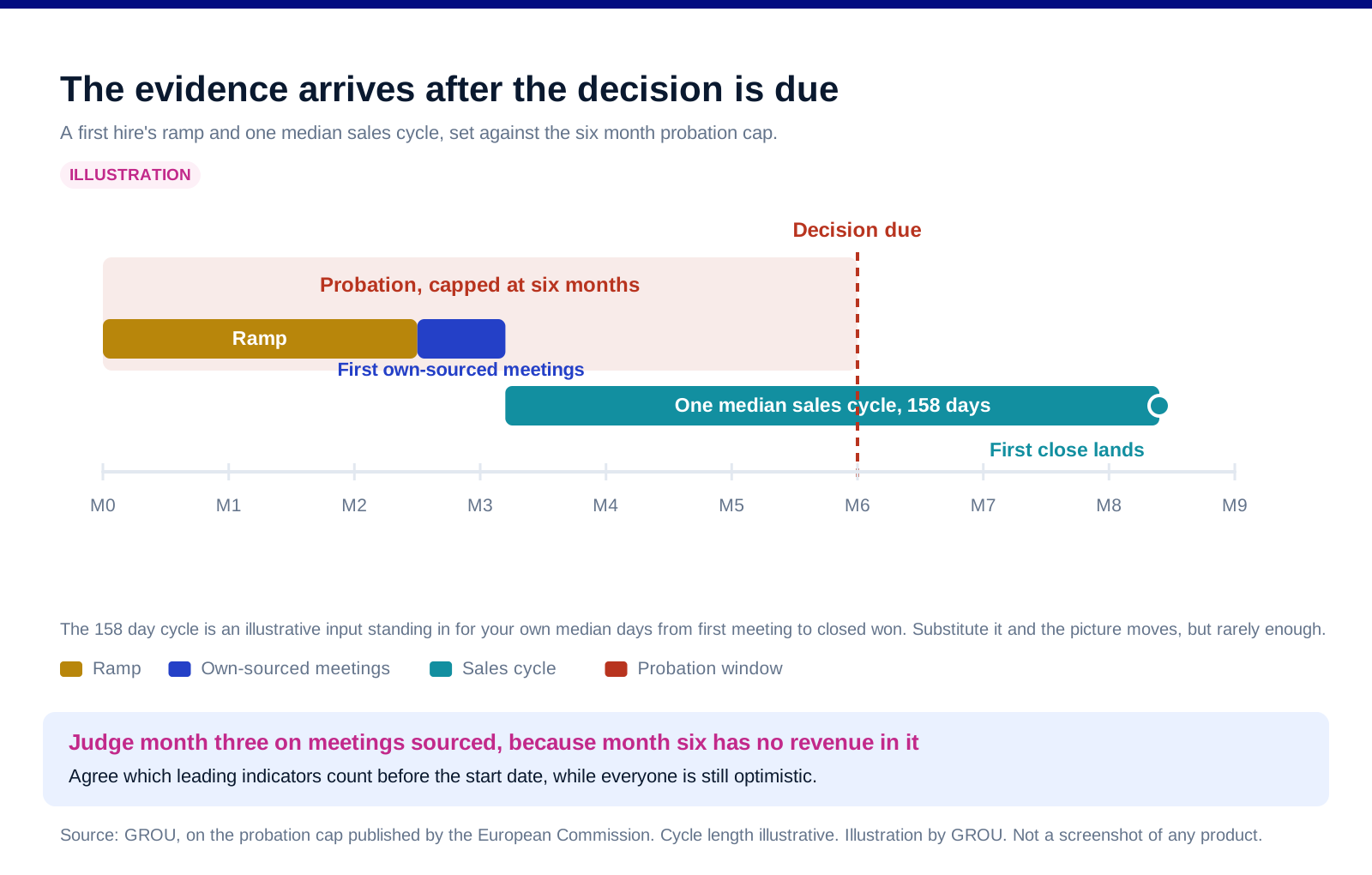
Probation is capped and shorter than a sales cycle. The EU's Directive 2019/1152, applicable since 1 August 2022, gives workers a limit on "the length of probationary periods at the beginning of the job to six months". In most B2B businesses, six months covers ramp plus part of one sales cycle, which is not enough closed revenue to judge anyone on.
So judge on leading indicators, and decide which ones before they start. Meetings booked from their own sourcing, quality of qualification against your written bar, and whether the pipeline they build behaves like yours. Those are visible inside two months. Closed revenue is not.
Plan the ramp as a cost, not as a delay. You pay from day one, they contribute pipeline from perhaps month two or three, and revenue lands one full sales cycle after that. Between those points the founder is spending time teaching, which is time not spent selling, so total company output usually falls before it rises.
Write down what break-even means before you hire. Fully loaded cost per month, the coverage your win rate implies, and therefore the pipeline they need to be carrying by a given month. That is an afternoon of arithmetic and it converts a hopeful conversation into a plan you can check against.
And decide in advance what you do if the leading indicators are bad at month three. More coaching, a narrower segment, or an exit. Our note on the first 90 days with an outbound agency covers the same decision from the other side, and the discipline is identical: agree the checkpoints while everyone is still optimistic.
Which first hire, and whether it should be a hire at all
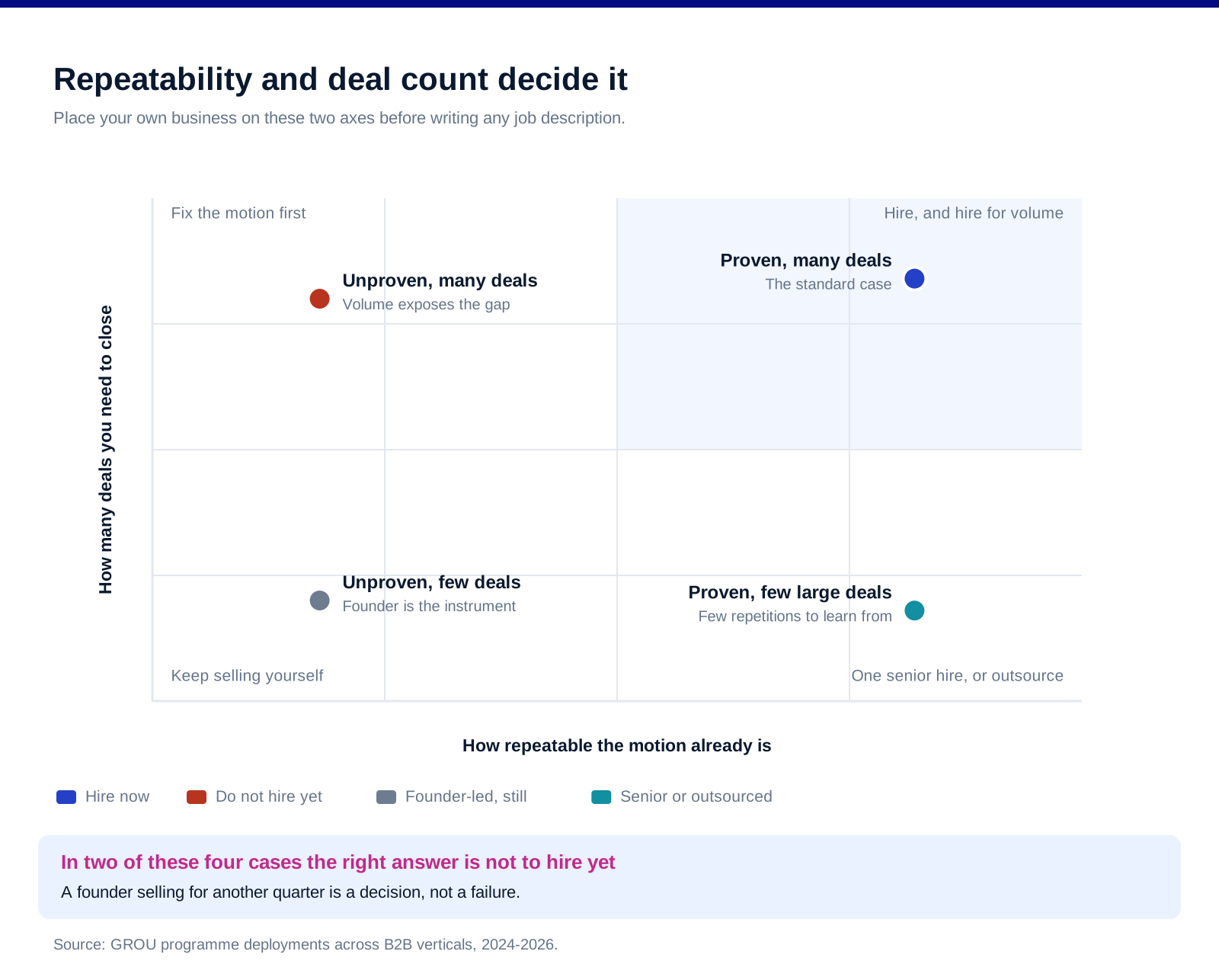
If the motion is proven and you need volume, hire for volume. That is the case the standard advice was written for, and it is the one where a first hire most reliably works.
If the motion is proven and you need few large deals, hire senior or do not hire. A handful of large, complex deals a year is not a volume problem, and a junior hire on that shape has almost no repetitions to learn from. This is also the case where outsourcing is most defensible, which our note on companies that outsource sales works through.
If the motion is unproven and you need volume, do not hire yet. Volume will expose the gap faster and more expensively than the founder would have. Our piece on when to start outbound gives the arithmetic on whether your market can even supply the test.
If the motion is unproven and you need few deals, keep selling. The founder is still the cheapest and best instrument for finding out what works, and there is no version of this where a first hire discovers it for you.
On the split between sourcing and closing. A full-cycle hire suits a founder who wants their own time back across the whole funnel. A sourcing-only hire suits a founder who enjoys closing and hates prospecting, which is the more common shape. Whichever you pick, our note on SDR compensation plans covers how to pay for the half you have chosen.
What we do not publish here
A ramp benchmark or a time-to-productivity figure. Ours come from a specific set of businesses with specific cycle lengths, and applying them to a different sales motion would be worse than having no number.
A recommended salary or on-target earnings. The published figures above are what Eurostat and BLS report for broad populations. What you should pay depends on your market, your motion and your seniority, and a number from us would be authoritative-sounding and wrong.
Employer cost figures for anywhere outside the EU. We quote the Eurostat non-wage share for the EU and euro area and stop there, because applying it elsewhere would be arithmetic dressed as data.
Legal advice on employment terms. The probation cap quoted is from published European Commission material. National implementations differ and your contract is a question for your own counsel.
Any claim that outsourcing beats hiring or the reverse. We sell one of those, which is exactly why the article gives you the four cases rather than a recommendation.
FAQ
How much does a first sales hire actually cost?
More than the salary, and more than the usual adjustment. Eurostat puts non-wage costs at 24.8 percent of total labour cost in the EU, which because it is a share of the total works out as roughly a third on top of the salary rather than a quarter. Add tooling, data, travel and the founder's own hours during ramp, which is the largest hidden line.
When is a company ready for its first salesperson?
When six things already exist: a claim that works when someone other than the founder says it, a named and sized list, a written sequence, a qualification bar taken out of the founder's head, a CRM whose stages mean something, and proof they can hand a buyer. Each takes days to build. Hiring without them costs a year.
How long before a first sales hire pays for themselves?
Longer than the probation period you are allowed. EU Directive 2019/1152 caps probation at six months, and in most B2B businesses that covers ramp plus part of one sales cycle. Judge the first months on leading indicators you agreed in advance, not on closed revenue that cannot have arrived yet.
Should the first hire source or close?
It depends which half of the job the founder wants to keep. Full-cycle suits a founder reclaiming their whole funnel. Sourcing-only suits the more common case of a founder who closes well and dislikes prospecting. Decide before you write the job description, because it changes the profile, the pay and the metrics.
Does hiring in a cheaper country work?
The cost lever is real. Eurostat reports hourly labour costs ranging from EUR 12.0 in Bulgaria to EUR 56.8 in Luxembourg for 2025, a spread of more than four and a half times. The constraint is that a salesperson usually needs to sound like the market they sell into, so the lever works better for sourcing roles than for closing ones.
What if you cannot tell whether it is working?
That is usually a sign the leading indicators were never agreed. Meetings booked from the hire's own sourcing, qualification quality against your written bar, and whether their pipeline behaves like yours are all visible within two months. If none of those was defined before the start date, define them now and reset the checkpoint rather than waiting for revenue that will not arrive in time to inform anything.
Bottom line
Do the arithmetic and the readiness check before the job description, because both change the decision and both take an afternoon. On cost, remember that the published non-wage share is a quarter of the total rather than a quarter on top, so budget a third above salary, and note that where you hire moves the number more than four-fold across Europe. On readiness, the six things that must exist are all cheap and all boring, and the reason first hires fail is almost never the person: it is that they inherited a job with no describable motion inside it. On timing, accept that the probation period you are allowed is shorter than the evidence you want, so agree the leading indicators before the start date and treat closed revenue as a lagging confirmation rather than a test. And be honest about which of the four cases you are in, because in two of them the right answer is not to hire at all yet, and the founder carrying on selling for another quarter is a decision rather than a failure.
Want the motion built before you hire into it? Book a call with GROU. We run lead generation and outbound inside B2B revenue engines across verticals.
We are GROU, a B2B pipeline agency that runs lead generation, outbound, and LinkedIn content for clients across manufacturing, fintech, iGaming, software, and professional services. The cost arithmetic is ours and is reproducible from the published shares cited. The labour cost figures, wage figures and probation rule are quoted from published Eurostat, US Bureau of Labor Statistics and European Commission sources verified in August 2026, and the employment material is a summary of public sources rather than legal advice.
The first sales hire is usually framed as replacing the founder. It is not. It is extracting the repeatable part of what the founder does, and if that part has not been separated out yet, the hire inherits the job without the thing that made it work.
Which is why the question is not when you can afford someone. It is whether there is a describable motion for them to run, and whether your budget is the number you think it is. On both counts the honest answer is usually no, and both are checkable this week.
TL;DR
Three things decide this. First, the cost is higher than the salary line and higher than most founders adjust for: Eurostat puts non-wage costs at 24.8 percent of total labour cost in the EU, and because that is a share of the total rather than an addition to the wage, the markup on salary is about a third, not a quarter. Hourly labour costs also range from EUR 12.0 in Bulgaria to EUR 56.8 in Luxembourg, so where you hire moves the number by more than any negotiation will. In the US, BLS put the May 2025 annual mean wage at $82,430 for sales representatives of services and $119,730 for technical and scientific products. Second, the motion has to exist before the person does: a claim that survives contact, a named list, a written sequence, a qualification bar, a CRM that reflects reality and proof they can hand over. Third, the clock is longer than the trial period you have in mind, because Directive 2019/1152 caps probationary periods at six months in the EU while a hire on a normal B2B cycle will not have closed enough to judge by then.
The cost is not the salary
Start with the arithmetic almost everyone gets backwards. Eurostat reports that non-wage costs were 24.8 percent of total labour costs in the EU in 2025 and 25.6 percent in the euro area. That is a share of the total, not a percentage added to the wage. So if wages are 75.2 percent of the total, the total is the wage divided by 0.752, which is a markup of about 33 percent rather than 25.
Which is a real gap on a real number. Budget a salary of EUR 60,000 and add a quarter and you plan for EUR 74,880. The EU average structure puts the employer cost nearer EUR 79,800, and on euro area figures nearer EUR 80,600. Roughly five thousand euro a year of quiet underbudgeting, on the first hire, when cash is tightest.
Then look at where you hire. Eurostat puts average hourly labour costs at EUR 34.9 in the EU and EUR 38.2 in the euro area for 2025, with the lowest in Bulgaria at EUR 12.0, Romania at EUR 13.6 and Hungary at EUR 15.2, and the highest in Luxembourg at EUR 56.8, Denmark at EUR 51.7 and the Netherlands at EUR 47.9. The spread from bottom to top is more than four and a half times.
And note what that does and does not tell you. It is economy-wide, not sales-specific, and a salesperson selling into a market usually needs to sound like that market. The geography lever is real but it is not free, and our note on hiring SDRs in Colombia covers where it works and where it does not.
For a US comparison, use the occupational figures rather than an average. BLS put the May 2025 annual mean wage at $82,430 for sales representatives of services, across 1,256,010 people, and $119,730 for technical and scientific products, across 284,800. Those are wages rather than employer costs, and we are not going to apply a European non-wage share to an American wage.
Add the parts that never make the budget. Tooling, data, a CRM seat, travel, and the founder's own hours during ramp. The last one is the largest and the only one that never appears on a spreadsheet.
What has to exist before the person does
A claim that survives contact. Not a positioning statement, the specific sentence that has made strangers reply. If it only works when the founder says it, you have charisma rather than a claim, and charisma does not transfer. Our note on positioning for B2B services covers how to find the transferable version.
A named list. Written down, sized, and sorted. If the founder has been selling from memory and inbound, the new hire's first month is list building, which is not what you hired for and not what you are paying for.
A written sequence. What gets sent, when, and what happens on a reply. It does not have to be good yet. It has to be written, because an unwritten sequence cannot be handed over, corrected or improved.
A qualification bar. The founder has one and it lives in their head. Get it out: what makes a deal worth working, and what makes it worth killing. Without it the new hire fills the pipeline with everything that moves and your forecast becomes fiction, which is the failure our note on pipeline coverage ratio is built around.
A CRM that reflects reality. Not a perfect one. One where the stages mean something and the data is entered. A new hire inheriting a CRM that the founder never used is starting from nothing while appearing to start from something.
And proof they can hand a buyer. The founder carries the stories in their head. The hire cannot. Our companion piece on building a B2B proof library covers how to get those out of the founder's memory and into a form a new person can use in week two.
Missing any of these is a reason to wait, not to hire harder. Each one takes days to fix and costs nothing. Hiring without them costs a year and a person's goodwill.
The clock is longer than your trial period
Probation is capped and shorter than a sales cycle. The EU's Directive 2019/1152, applicable since 1 August 2022, gives workers a limit on "the length of probationary periods at the beginning of the job to six months". In most B2B businesses, six months covers ramp plus part of one sales cycle, which is not enough closed revenue to judge anyone on.
So judge on leading indicators, and decide which ones before they start. Meetings booked from their own sourcing, quality of qualification against your written bar, and whether the pipeline they build behaves like yours. Those are visible inside two months. Closed revenue is not.
Plan the ramp as a cost, not as a delay. You pay from day one, they contribute pipeline from perhaps month two or three, and revenue lands one full sales cycle after that. Between those points the founder is spending time teaching, which is time not spent selling, so total company output usually falls before it rises.
Write down what break-even means before you hire. Fully loaded cost per month, the coverage your win rate implies, and therefore the pipeline they need to be carrying by a given month. That is an afternoon of arithmetic and it converts a hopeful conversation into a plan you can check against.
And decide in advance what you do if the leading indicators are bad at month three. More coaching, a narrower segment, or an exit. Our note on the first 90 days with an outbound agency covers the same decision from the other side, and the discipline is identical: agree the checkpoints while everyone is still optimistic.
Which first hire, and whether it should be a hire at all
If the motion is proven and you need volume, hire for volume. That is the case the standard advice was written for, and it is the one where a first hire most reliably works.
If the motion is proven and you need few large deals, hire senior or do not hire. A handful of large, complex deals a year is not a volume problem, and a junior hire on that shape has almost no repetitions to learn from. This is also the case where outsourcing is most defensible, which our note on companies that outsource sales works through.
If the motion is unproven and you need volume, do not hire yet. Volume will expose the gap faster and more expensively than the founder would have. Our piece on when to start outbound gives the arithmetic on whether your market can even supply the test.
If the motion is unproven and you need few deals, keep selling. The founder is still the cheapest and best instrument for finding out what works, and there is no version of this where a first hire discovers it for you.
On the split between sourcing and closing. A full-cycle hire suits a founder who wants their own time back across the whole funnel. A sourcing-only hire suits a founder who enjoys closing and hates prospecting, which is the more common shape. Whichever you pick, our note on SDR compensation plans covers how to pay for the half you have chosen.
What we do not publish here
A ramp benchmark or a time-to-productivity figure. Ours come from a specific set of businesses with specific cycle lengths, and applying them to a different sales motion would be worse than having no number.
A recommended salary or on-target earnings. The published figures above are what Eurostat and BLS report for broad populations. What you should pay depends on your market, your motion and your seniority, and a number from us would be authoritative-sounding and wrong.
Employer cost figures for anywhere outside the EU. We quote the Eurostat non-wage share for the EU and euro area and stop there, because applying it elsewhere would be arithmetic dressed as data.
Legal advice on employment terms. The probation cap quoted is from published European Commission material. National implementations differ and your contract is a question for your own counsel.
Any claim that outsourcing beats hiring or the reverse. We sell one of those, which is exactly why the article gives you the four cases rather than a recommendation.
FAQ
How much does a first sales hire actually cost?
More than the salary, and more than the usual adjustment. Eurostat puts non-wage costs at 24.8 percent of total labour cost in the EU, which because it is a share of the total works out as roughly a third on top of the salary rather than a quarter. Add tooling, data, travel and the founder's own hours during ramp, which is the largest hidden line.
When is a company ready for its first salesperson?
When six things already exist: a claim that works when someone other than the founder says it, a named and sized list, a written sequence, a qualification bar taken out of the founder's head, a CRM whose stages mean something, and proof they can hand a buyer. Each takes days to build. Hiring without them costs a year.
How long before a first sales hire pays for themselves?
Longer than the probation period you are allowed. EU Directive 2019/1152 caps probation at six months, and in most B2B businesses that covers ramp plus part of one sales cycle. Judge the first months on leading indicators you agreed in advance, not on closed revenue that cannot have arrived yet.
Should the first hire source or close?
It depends which half of the job the founder wants to keep. Full-cycle suits a founder reclaiming their whole funnel. Sourcing-only suits the more common case of a founder who closes well and dislikes prospecting. Decide before you write the job description, because it changes the profile, the pay and the metrics.
Does hiring in a cheaper country work?
The cost lever is real. Eurostat reports hourly labour costs ranging from EUR 12.0 in Bulgaria to EUR 56.8 in Luxembourg for 2025, a spread of more than four and a half times. The constraint is that a salesperson usually needs to sound like the market they sell into, so the lever works better for sourcing roles than for closing ones.
What if you cannot tell whether it is working?
That is usually a sign the leading indicators were never agreed. Meetings booked from the hire's own sourcing, qualification quality against your written bar, and whether their pipeline behaves like yours are all visible within two months. If none of those was defined before the start date, define them now and reset the checkpoint rather than waiting for revenue that will not arrive in time to inform anything.
Bottom line
Do the arithmetic and the readiness check before the job description, because both change the decision and both take an afternoon. On cost, remember that the published non-wage share is a quarter of the total rather than a quarter on top, so budget a third above salary, and note that where you hire moves the number more than four-fold across Europe. On readiness, the six things that must exist are all cheap and all boring, and the reason first hires fail is almost never the person: it is that they inherited a job with no describable motion inside it. On timing, accept that the probation period you are allowed is shorter than the evidence you want, so agree the leading indicators before the start date and treat closed revenue as a lagging confirmation rather than a test. And be honest about which of the four cases you are in, because in two of them the right answer is not to hire at all yet, and the founder carrying on selling for another quarter is a decision rather than a failure.
Want the motion built before you hire into it? Book a call with GROU. We run lead generation and outbound inside B2B revenue engines across verticals.
We are GROU, a B2B pipeline agency that runs lead generation, outbound, and LinkedIn content for clients across manufacturing, fintech, iGaming, software, and professional services. The cost arithmetic is ours and is reproducible from the published shares cited. The labour cost figures, wage figures and probation rule are quoted from published Eurostat, US Bureau of Labor Statistics and European Commission sources verified in August 2026, and the employment material is a summary of public sources rather than legal advice.
The first sales hire is usually framed as replacing the founder. It is not. It is extracting the repeatable part of what the founder does, and if that part has not been separated out yet, the hire inherits the job without the thing that made it work.
Which is why the question is not when you can afford someone. It is whether there is a describable motion for them to run, and whether your budget is the number you think it is. On both counts the honest answer is usually no, and both are checkable this week.
TL;DR
Three things decide this. First, the cost is higher than the salary line and higher than most founders adjust for: Eurostat puts non-wage costs at 24.8 percent of total labour cost in the EU, and because that is a share of the total rather than an addition to the wage, the markup on salary is about a third, not a quarter. Hourly labour costs also range from EUR 12.0 in Bulgaria to EUR 56.8 in Luxembourg, so where you hire moves the number by more than any negotiation will. In the US, BLS put the May 2025 annual mean wage at $82,430 for sales representatives of services and $119,730 for technical and scientific products. Second, the motion has to exist before the person does: a claim that survives contact, a named list, a written sequence, a qualification bar, a CRM that reflects reality and proof they can hand over. Third, the clock is longer than the trial period you have in mind, because Directive 2019/1152 caps probationary periods at six months in the EU while a hire on a normal B2B cycle will not have closed enough to judge by then.
The cost is not the salary
Start with the arithmetic almost everyone gets backwards. Eurostat reports that non-wage costs were 24.8 percent of total labour costs in the EU in 2025 and 25.6 percent in the euro area. That is a share of the total, not a percentage added to the wage. So if wages are 75.2 percent of the total, the total is the wage divided by 0.752, which is a markup of about 33 percent rather than 25.
Which is a real gap on a real number. Budget a salary of EUR 60,000 and add a quarter and you plan for EUR 74,880. The EU average structure puts the employer cost nearer EUR 79,800, and on euro area figures nearer EUR 80,600. Roughly five thousand euro a year of quiet underbudgeting, on the first hire, when cash is tightest.
Then look at where you hire. Eurostat puts average hourly labour costs at EUR 34.9 in the EU and EUR 38.2 in the euro area for 2025, with the lowest in Bulgaria at EUR 12.0, Romania at EUR 13.6 and Hungary at EUR 15.2, and the highest in Luxembourg at EUR 56.8, Denmark at EUR 51.7 and the Netherlands at EUR 47.9. The spread from bottom to top is more than four and a half times.
And note what that does and does not tell you. It is economy-wide, not sales-specific, and a salesperson selling into a market usually needs to sound like that market. The geography lever is real but it is not free, and our note on hiring SDRs in Colombia covers where it works and where it does not.
For a US comparison, use the occupational figures rather than an average. BLS put the May 2025 annual mean wage at $82,430 for sales representatives of services, across 1,256,010 people, and $119,730 for technical and scientific products, across 284,800. Those are wages rather than employer costs, and we are not going to apply a European non-wage share to an American wage.
Add the parts that never make the budget. Tooling, data, a CRM seat, travel, and the founder's own hours during ramp. The last one is the largest and the only one that never appears on a spreadsheet.
What has to exist before the person does
A claim that survives contact. Not a positioning statement, the specific sentence that has made strangers reply. If it only works when the founder says it, you have charisma rather than a claim, and charisma does not transfer. Our note on positioning for B2B services covers how to find the transferable version.
A named list. Written down, sized, and sorted. If the founder has been selling from memory and inbound, the new hire's first month is list building, which is not what you hired for and not what you are paying for.
A written sequence. What gets sent, when, and what happens on a reply. It does not have to be good yet. It has to be written, because an unwritten sequence cannot be handed over, corrected or improved.
A qualification bar. The founder has one and it lives in their head. Get it out: what makes a deal worth working, and what makes it worth killing. Without it the new hire fills the pipeline with everything that moves and your forecast becomes fiction, which is the failure our note on pipeline coverage ratio is built around.
A CRM that reflects reality. Not a perfect one. One where the stages mean something and the data is entered. A new hire inheriting a CRM that the founder never used is starting from nothing while appearing to start from something.
And proof they can hand a buyer. The founder carries the stories in their head. The hire cannot. Our companion piece on building a B2B proof library covers how to get those out of the founder's memory and into a form a new person can use in week two.
Missing any of these is a reason to wait, not to hire harder. Each one takes days to fix and costs nothing. Hiring without them costs a year and a person's goodwill.
The clock is longer than your trial period
Probation is capped and shorter than a sales cycle. The EU's Directive 2019/1152, applicable since 1 August 2022, gives workers a limit on "the length of probationary periods at the beginning of the job to six months". In most B2B businesses, six months covers ramp plus part of one sales cycle, which is not enough closed revenue to judge anyone on.
So judge on leading indicators, and decide which ones before they start. Meetings booked from their own sourcing, quality of qualification against your written bar, and whether the pipeline they build behaves like yours. Those are visible inside two months. Closed revenue is not.
Plan the ramp as a cost, not as a delay. You pay from day one, they contribute pipeline from perhaps month two or three, and revenue lands one full sales cycle after that. Between those points the founder is spending time teaching, which is time not spent selling, so total company output usually falls before it rises.
Write down what break-even means before you hire. Fully loaded cost per month, the coverage your win rate implies, and therefore the pipeline they need to be carrying by a given month. That is an afternoon of arithmetic and it converts a hopeful conversation into a plan you can check against.
And decide in advance what you do if the leading indicators are bad at month three. More coaching, a narrower segment, or an exit. Our note on the first 90 days with an outbound agency covers the same decision from the other side, and the discipline is identical: agree the checkpoints while everyone is still optimistic.
Which first hire, and whether it should be a hire at all
If the motion is proven and you need volume, hire for volume. That is the case the standard advice was written for, and it is the one where a first hire most reliably works.
If the motion is proven and you need few large deals, hire senior or do not hire. A handful of large, complex deals a year is not a volume problem, and a junior hire on that shape has almost no repetitions to learn from. This is also the case where outsourcing is most defensible, which our note on companies that outsource sales works through.
If the motion is unproven and you need volume, do not hire yet. Volume will expose the gap faster and more expensively than the founder would have. Our piece on when to start outbound gives the arithmetic on whether your market can even supply the test.
If the motion is unproven and you need few deals, keep selling. The founder is still the cheapest and best instrument for finding out what works, and there is no version of this where a first hire discovers it for you.
On the split between sourcing and closing. A full-cycle hire suits a founder who wants their own time back across the whole funnel. A sourcing-only hire suits a founder who enjoys closing and hates prospecting, which is the more common shape. Whichever you pick, our note on SDR compensation plans covers how to pay for the half you have chosen.
What we do not publish here
A ramp benchmark or a time-to-productivity figure. Ours come from a specific set of businesses with specific cycle lengths, and applying them to a different sales motion would be worse than having no number.
A recommended salary or on-target earnings. The published figures above are what Eurostat and BLS report for broad populations. What you should pay depends on your market, your motion and your seniority, and a number from us would be authoritative-sounding and wrong.
Employer cost figures for anywhere outside the EU. We quote the Eurostat non-wage share for the EU and euro area and stop there, because applying it elsewhere would be arithmetic dressed as data.
Legal advice on employment terms. The probation cap quoted is from published European Commission material. National implementations differ and your contract is a question for your own counsel.
Any claim that outsourcing beats hiring or the reverse. We sell one of those, which is exactly why the article gives you the four cases rather than a recommendation.
FAQ
How much does a first sales hire actually cost?
More than the salary, and more than the usual adjustment. Eurostat puts non-wage costs at 24.8 percent of total labour cost in the EU, which because it is a share of the total works out as roughly a third on top of the salary rather than a quarter. Add tooling, data, travel and the founder's own hours during ramp, which is the largest hidden line.
When is a company ready for its first salesperson?
When six things already exist: a claim that works when someone other than the founder says it, a named and sized list, a written sequence, a qualification bar taken out of the founder's head, a CRM whose stages mean something, and proof they can hand a buyer. Each takes days to build. Hiring without them costs a year.
How long before a first sales hire pays for themselves?
Longer than the probation period you are allowed. EU Directive 2019/1152 caps probation at six months, and in most B2B businesses that covers ramp plus part of one sales cycle. Judge the first months on leading indicators you agreed in advance, not on closed revenue that cannot have arrived yet.
Should the first hire source or close?
It depends which half of the job the founder wants to keep. Full-cycle suits a founder reclaiming their whole funnel. Sourcing-only suits the more common case of a founder who closes well and dislikes prospecting. Decide before you write the job description, because it changes the profile, the pay and the metrics.
Does hiring in a cheaper country work?
The cost lever is real. Eurostat reports hourly labour costs ranging from EUR 12.0 in Bulgaria to EUR 56.8 in Luxembourg for 2025, a spread of more than four and a half times. The constraint is that a salesperson usually needs to sound like the market they sell into, so the lever works better for sourcing roles than for closing ones.
What if you cannot tell whether it is working?
That is usually a sign the leading indicators were never agreed. Meetings booked from the hire's own sourcing, qualification quality against your written bar, and whether their pipeline behaves like yours are all visible within two months. If none of those was defined before the start date, define them now and reset the checkpoint rather than waiting for revenue that will not arrive in time to inform anything.
Bottom line
Do the arithmetic and the readiness check before the job description, because both change the decision and both take an afternoon. On cost, remember that the published non-wage share is a quarter of the total rather than a quarter on top, so budget a third above salary, and note that where you hire moves the number more than four-fold across Europe. On readiness, the six things that must exist are all cheap and all boring, and the reason first hires fail is almost never the person: it is that they inherited a job with no describable motion inside it. On timing, accept that the probation period you are allowed is shorter than the evidence you want, so agree the leading indicators before the start date and treat closed revenue as a lagging confirmation rather than a test. And be honest about which of the four cases you are in, because in two of them the right answer is not to hire at all yet, and the founder carrying on selling for another quarter is a decision rather than a failure.
Want the motion built before you hire into it? Book a call with GROU. We run lead generation and outbound inside B2B revenue engines across verticals.
We are GROU, a B2B pipeline agency that runs lead generation, outbound, and LinkedIn content for clients across manufacturing, fintech, iGaming, software, and professional services. The cost arithmetic is ours and is reproducible from the published shares cited. The labour cost figures, wage figures and probation rule are quoted from published Eurostat, US Bureau of Labor Statistics and European Commission sources verified in August 2026, and the employment material is a summary of public sources rather than legal advice.

Pipeline OS Newsletter
Build qualified pipeline
Get weekly tactics to generate demand, improve lead quality, and book more meetings.





Trusted by industry leaders
Trusted by industry leaders
Trusted by industry leaders
Ready to build qualified pipeline?
Ready to build qualified pipeline?
Ready to build qualified pipeline?
Book a call to see if we're the right fit, or take the 2-minute quiz to get a clear starting point.
Book a call to see if we're the right fit, or take the 2-minute quiz to get a clear starting point.
Book a call to see if we're the right fit, or take the 2-minute quiz to get a clear starting point.
" height="30.21639343089746px" id="hfGbXmQR2" width="30.216393430897455px"/></svg>)
Copyright © 2026 – All Right Reserved
Copyright © 2026 – All Right Reserved
Copyright © 2026 – All Right Reserved