%22%3E%3C/path%3E%3Cpath d=%22M 63.072 7.554 C 62.258 8.022 61.577 8.689 61.092 9.493 L 61.092 7.076 L 57.158 7.076 L 57.158 22.64 L 61.089 22.64 L 61.089 14.888 C 61.089 13.446 61.403 12.434 62.03 11.853 C 62.818 11.218 63.818 10.907 64.826 10.982 L 65.868 10.982 L 65.868 6.851 C 64.891 6.834 63.926 7.076 63.073 7.554 Z%22 fill=%22rgb(17,17,17)%22%3E%3C/path%3E%3Cpath d=%22M 78.916 7.82 C 76.363 6.49 73.321 6.49 70.768 7.82 C 69.562 8.473 68.564 9.451 67.888 10.644 C 67.167 11.931 66.803 13.387 66.834 14.862 C 66.804 16.332 67.157 17.785 67.86 19.077 C 68.515 20.267 69.494 21.246 70.684 21.901 C 71.924 22.576 73.318 22.92 74.73 22.898 C 76.164 22.918 77.58 22.575 78.846 21.901 C 80.062 21.247 81.073 20.27 81.768 19.077 C 82.506 17.797 82.88 16.339 82.85 14.862 C 82.88 13.389 82.517 11.934 81.797 10.647 C 81.12 9.455 80.122 8.477 78.917 7.824 M 78.803 14.862 C 78.829 15.739 78.636 16.608 78.241 17.391 C 77.903 18.046 77.38 18.588 76.738 18.95 C 76.124 19.293 75.432 19.472 74.729 19.47 C 73.668 19.497 72.648 19.061 71.934 18.276 C 71.139 17.323 70.741 16.1 70.823 14.862 C 70.741 13.62 71.149 12.395 71.959 11.45 C 72.687 10.667 73.715 10.233 74.783 10.256 C 75.859 10.236 76.894 10.67 77.635 11.45 C 78.464 12.387 78.884 13.616 78.801 14.864%22 fill=%22rgb(17,17,17)%22%3E%3C/path%3E%3Cpath d=%22M 95.906 7.076 L 95.906 15.646 C 95.975 16.68 95.643 17.701 94.979 18.498 C 94.311 19.184 93.379 19.547 92.422 19.495 C 91.475 19.544 90.553 19.18 89.894 18.498 C 89.23 17.701 88.898 16.68 88.967 15.646 L 88.967 7.076 L 85.033 7.076 L 85.033 16.207 C 85 17.449 85.275 18.68 85.834 19.79 C 86.327 20.75 87.095 21.542 88.039 22.065 C 89.033 22.594 90.145 22.861 91.271 22.838 C 92.188 22.847 93.095 22.65 93.926 22.263 C 94.708 21.905 95.388 21.36 95.906 20.675 L 95.906 22.645 L 99.865 22.645 L 99.865 7.076 Z%22 fill=%22rgb(17,17,17)%22%3E%3C/path%3E%3Cpath d=%22M 4.513 15.626 C 4.511 10.815 7.606 6.549 12.181 5.059 C 16.756 3.57 21.77 5.195 24.601 9.086 L 27.816 5.87 C 24.074 1.186 17.981 -0.943 12.137 0.393 C 6.292 1.728 1.728 6.292 0.393 12.137 C -0.943 17.981 1.186 24.074 5.87 27.816 L 9.085 24.601 C 6.214 22.512 4.515 19.177 4.513 15.626%22 fill=%22rgb(32,62,235)%22%3E%3C/path%3E%3Cpath d=%22M 17.114 14.343 L 13.354 18.01 L 13.354 18.026 L 21.071 18.026 L 11.412 27.609 L 17.389 27.609 L 23.999 21.081 L 23.999 28.316 L 24.005 28.316 L 27.967 24.393 L 27.967 14.343 Z%22 fill=%22rgb(32,62,235)%22%3E%3C/path%3E%3C/g%3E%3C/svg%3E) ×
× ××
××›
›
›
›
Data Monetization Services: A 2026 Operator's Guide
Data Monetization Services: A 2026 Operator's Guide
Data Monetization Services: A 2026 Operator's Guide
Data Monetization Services: A 2026 Operator's Guide
Data Monetization Services: A 2026 Operator's Guide
Data Monetization Services: A 2026 Operator's Guide
Author
GROU team

Your CRM is full, your dashboards are noisy, and your CRO still asks why first-party data hasn't become a revenue line. The problem isn't lack of signals. It's that the signals aren't packaged, priced, or governed like a product, so sales keeps chasing scraps while the core asset sits in reporting.
Pick one buyer workflow first, not a dataset.
Treat compliance and architecture as pricing inputs.
Validate demand before you build a platform.
Use delivery format to match decision cadence.
Kill bad ideas early, before they eat engineering time.
Table of Contents
The pipeline problem sitting in your data
You already know the pattern. CRM hygiene is uneven, ICP drift has crept in, reply loops are slow, and expansion feels stuck because no one owns the data as a commercial asset. The result is predictable. Your team has enough signal to guess, but not enough structure to sell.
That's why data monetization services usually fail at the start. Leaders jump to marketplaces, APIs, or dashboards before they've defined the buyer, the decision, and the commercial guardrails. Start with five moves instead, a workflow, a dataset, a legal basis, a delivery format, and kill criteria. If you skip those, you've built another internal tool, not a product.
The gap between collecting data and selling data is a product gap. GROU's own glossary on data hygiene is useful here because dirty inputs break both outbound and monetization. If the records are inconsistent, the license is weak, or the entitlement logic is fuzzy, your pipeline turns into support debt.
Practical rule: if the buyer can't explain what decision the data helps them make, you don't have a monetizable offer yet.
For revenue teams, the first question isn't “Can we sell this?” It's “Can we repeat this without creating risk?” That means demand validation, packaging logic, and governance have to show up before any build commitment. The teams that get this right don't treat data as a side hustle. They treat it like a governed product with a sales motion attached.
What data monetization services really are
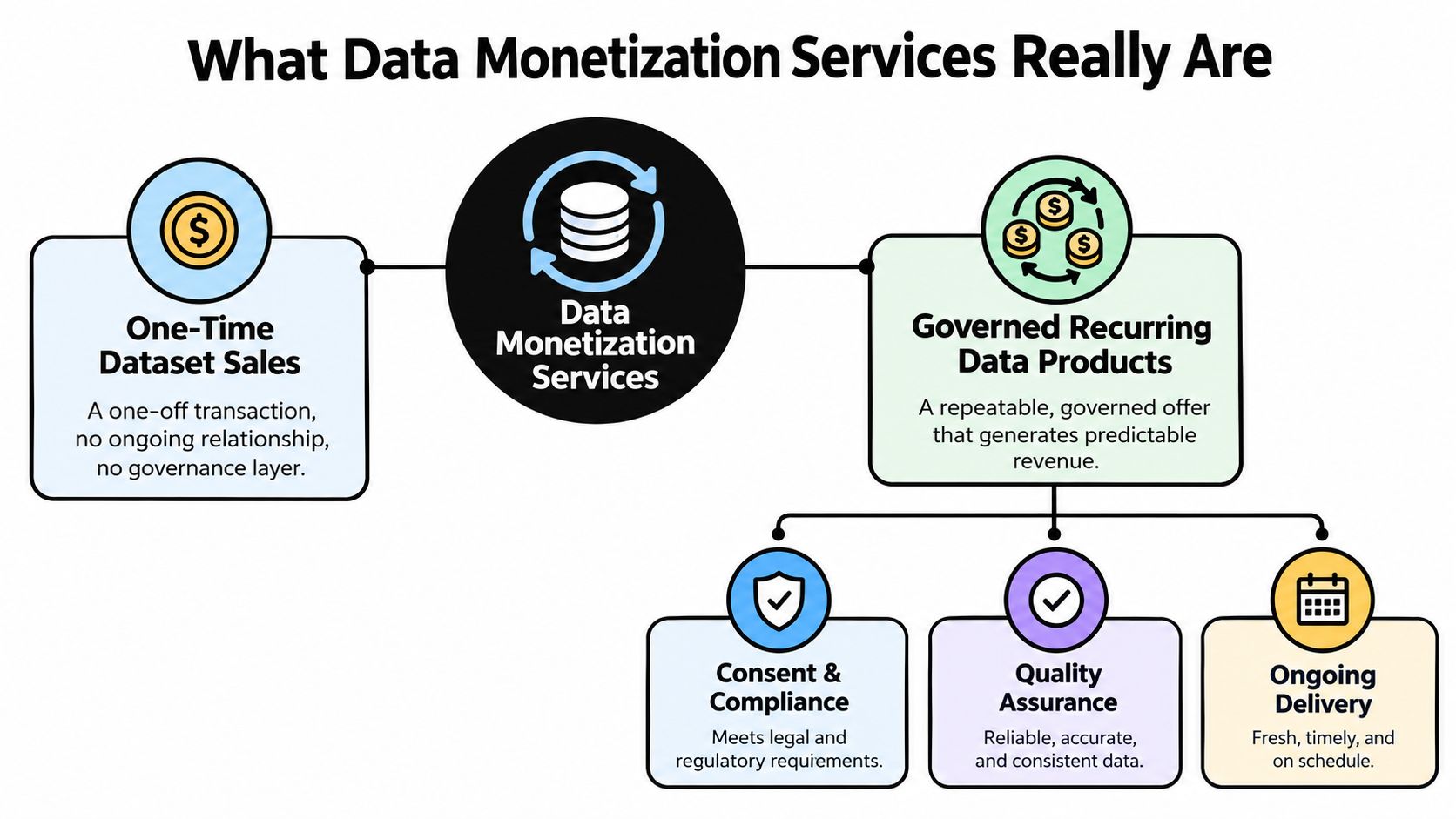
Data monetization services are not one-time dataset sales. They're governed recurring data products with a commercial model wrapped around access, refresh, quality, and support. That difference matters because a CSV sale creates a transaction, while a product creates a renewal path.
MIT CISR's 2024 Data Monetization Survey of 349 senior leaders found top performers attributed 11% of company revenue to data monetization, compared with 2% among bottom performers, a more than fivefold gap. That spread points to maturity, not dataset size, as the key divider. The winners didn't just have more data, they had better productization, governance, and distribution, as shown in the survey analysis from MIT CISR. MIT CISR's survey analysis
Four archetypes worth using
The cleanest way to think about this market is through four archetypes.
Direct data products are the clearest fit when the data itself is the product. Manufacturing and industrial operators use this when sensor, machine, or supply chain data becomes an external feed.
Indirect value capture lives inside an existing offer. SaaS teams use usage telemetry this way, improving onboarding, retention, and pricing inside the product rather than selling a standalone file.
Insights and benchmark subscriptions fit buyers who want interpretation, not records. Legal tech and pharma often belong here because the value sits in comparison, context, or forecasting.
Analytics-as-a-service platforms fit decision-heavy motions, especially iGaming and multi-system operations where recurring access matters more than ownership.
The wrong archetype creates a bad sales cycle. The right one shortens procurement because the buyer already recognizes the decision they're paying to support.
The distinction also changes compliance exposure and sales motion. A recurring benchmark subscription asks for trust, lineage, and refresh discipline. A usage-based analytics service asks for permissions, metering, and entitlement logic. If you force every dataset into the same shape, you'll price it badly and sell it worse.
For a useful internal bridge, GROU's note on data enrichment workflow maps well to the same logic. Enrichment only works when source, quality, and downstream use are already clear. Monetization works the same way, except the buyer is paying for repeatable access, not just cleaner records.
The four monetization models and where each fits
The market is already favoring recurring access. Grand View Research sized the global data monetization market at $3.9 billion in 2025, projects $17.6 billion by 2033, and says analytics-enabled platform-as-a-service accounts for 39.5% of 2025 revenue by method. That points to the commercial shape buyers already prefer, repeated analysis over a one-time export. Grand View Research's market view
Pick the model by buyer workflow
Manufacturing usually fits direct data products. A plant leader wants machine or supply chain signals tied to uptime, quality, or maintenance decisions. If the buyer needs a clean operational feed, do not bury it inside a generic analytics bundle.
SaaS usually fits indirect value capture. Usage telemetry, churn risk, and expansion signals should improve the core product first. Selling that same telemetry externally is a separate motion, and usually a weaker one unless you already own a distinct market.
Legal tech usually fits benchmark subscriptions. Buyers care about interpreted trends, clause patterns, or matter comparisons, not raw documents. They pay for context when the benchmark is credible and the refresh cadence matches their review cycle. GROU's B2B data providers guide is useful here because it separates commodity supply from a product buyers will renew.
Pharma also leans toward benchmark or insight products, especially around trial operations, compliance, or site performance. The buyer is purchasing confidence and comparison, not rows.
iGaming often fits analytics-as-a-service. Decision cadence is fast, the value sits in live or near-live calls, and the best offer is usually a recurring decision-support layer, not a batch export.
If the buyer makes decisions hourly or daily, sell access and analysis. If they make decisions quarterly, sell interpretation and benchmarks.
PwC's framing of data products, Data-as-a-Service platforms, marketplaces, subscriptions, tiered access, and usage-based pricing supports the same conclusion, recurring access beats one-off delivery for most revenue teams. PwC's monetization patterns
Architecture as a commercial control surface
A data product's architecture is a pricing decision, not an engineering side note. It sets the ceiling for trust, defect rate, delivery cost, and how much risk your sales team has to price in. If the stack cannot prove provenance, enforce permissions, and meter access, the offer will get discounted to cover uncertainty.
The stack that buyers actually feel
Break it into layers. Source integration brings in internal systems and external feeds. Ingestion and transformation clean and normalize the raw inputs. Data quality controls catch errors before customers do. Metadata and lineage make the asset auditable. Governed access defines who can see what, and through which channel.
Pricing has to reflect freshness, coverage, consumption, and support burden. A flat license hides the cost of keeping the product current and safe. It also blurs the gap between a machine-readable API and a human-readable dashboard.
PwC's architecture and pricing framing points in the same direction. Data products, Data-as-a-Service platforms, marketplaces, subscriptions, tiered access, and usage-based pricing all depend on the same backbone: data models, lineage, privacy controls, access rules, and ongoing product care.
The delivery choice should follow the buyer's decision process. Use APIs for machine-consumable data that changes often. Use dashboards for interactive analysis. Use benchmark products when the buyer needs interpretation, not raw records. If you miss that fit, you either overbuild or underdeliver.

For teams tying multiple feeds together, GROU's note on a data orchestration platform is a useful adjacent read. Orchestration matters because monetization falls apart when refresh timing, schema drift, and access rules are handled in different places.
A polished stack with no clear buyer decision is still a cost center. You do not price architecture. You price the decision it supports.
How SourceX Can Help
SourceX is useful when the problem is specifically approved business data licensing for AI training and evaluation. It works as the licensing partner, so one relationship can cover assessment, agreements, rights review, preparation, delivery, and payout. That matters when a company has valuable operational records but no clean path to package them safely.
Its value is in the managed transaction, not just the catalog. Companies can get private dataset inventories, rights review, and documented provenance before anything is shared. For teams dealing with fragmented records across Zendesk, Salesforce, GitHub, Jira, SharePoint, or Google Workspace, that's a real operational shortcut.
The strongest fit is a company that already suspects its business records have external value but can't confidently answer who can use them, under what terms, and with what confidentiality protections. SourceX's model around approved scope, de-identification, and agreement-defined rights is built for that exact gap. If you need a licensing counterparty rather than a software layer, that matters.
The practical tradeoff is obvious. This is a better fit for companies ready to license approved datasets than for teams still trying to prove demand. If you don't yet know the buyer, the workflow, or the acceptable commercial terms, a licensing partner won't fix that. It will only make the transaction cleaner.
For a quick look at how the service is positioned, the data monetization services page is the most relevant starting point. Read it through the lens of scope control, rights review, and payout flow, not as a generic vendor pitch.

Compliance as pricing and packaging input
A dataset that looks commercially attractive can be unusable if the legal basis is wrong. Under GDPR purpose limitation, data collected for account servicing cannot be resold for advertising, benchmarking, lead scoring, or AI training without a new lawful basis. That is a pricing problem as much as a legal one. GDPR purpose limitation guidance
Turn legal rules into product tiers
Consent is even tighter than many sales teams expect. The Dutch Data Protection Authority says valid consent must be freely given, unambiguous, informed, and specific, and organizations must spell out which data they share, with whom, and for what purpose. Broad labels like “business partners” do not support a sellable audience or an enrichment workflow. Dutch DPA consent guidance
A practical packaging model looks like this, aligned to Grou's GDPR baseline:
Aggregate analytics, when identifiable records are too risky.
Delayed feeds, when freshness matters but real-time access is too exposed.
Real-time APIs, when the buyer needs machine-consumable decision support.
Restricted-use licenses, when purpose, geography, or downstream use needs tight control.
The EU Data Act began applying on 12 September 2025, bringing fair access and use rules, B2B data-sharing obligations, and reasonable compensation tied to dissemination rather than collection cost. That changes the old “sell the dataset” advice. Ownership alone is not enough. You need to package lawful access around the actual rights the buyer gets. EU Data Act overview
Compliance is not a legal footer. It is part of the price logic.
Build revocation, deletion, audit logging, and entitlement checks into the delivery layer. Map each field to its lawful purpose, retention period, buyer permission, and revocation path. If the product sheet cannot state those terms clearly, the asset is not ready for sale.
Vendor selection and the build-versus-buy call
For teams under 50 people without a dedicated data engineering seat, a managed platform wins. For larger teams with an actual data platform function, build the access layer and buy the marketplace and metering pieces. Anything else is a distraction dressed up as strategy.
Score vendors on the controls that matter
The scorecard should be brutally practical.
Governed access layer quality, because entitlement logic has to be reliable.
Consent and purpose-limitation tooling, because legal basis determines inventory.
Delivery format flexibility, because buyers don't all want the same interface.
Usage metering, because flat access destroys pricing discipline.
Audit logging, because you'll need proof when finance or legal asks.
Multi-region tenancy, because jurisdiction changes the economics.
Commercial model alignment, because the wrong billing model breaks adoption.
A vendor that scores well on UI but weak on permissions will cost you more later. You'll feel it in procurement delays, customer objections, and internal rework. That's the kind of friction sales can't fix.
PwC Japan's 2025 data monetization survey reported 25% of respondents had not started monetization initiatives, with cited needs including use-case planning skills (31.1%), collecting internal and external information (26.1%), and defining internal processes and stage gates (25.6%). PwC Japan's survey summary
That's the strongest argument for a low-cost validation program before any build. Don't ask engineering to solve demand uncertainty. Ask five likely buyers what they'd pay for, what they'd reject, and what breaks the deal.
The vendor decision is commercial first, tooling second. If the offer is wrong, better software just gets you to the wrong answer faster.
Industry use cases that actually pay
The best offers follow decision cadence, not dataset size. Start there, and the package gets clearer fast.
SaaS and manufacturing need different motions
In SaaS, usage telemetry belongs inside the existing offer. The buyer is already in the product, so the value is retention and expansion signals, not a separate data sale. The right format is an internal or customer-facing dashboard that helps customer success act earlier.
In manufacturing, direct data products win more often. Machine performance, maintenance, and supply chain signals can support operational decisions across plants or suppliers. A quarterly dashboard works for executives, while an API serves engineering teams that need faster access.
Pharma and iGaming need decision support
In pharma, the strongest commercial shape is usually an insight product or benchmark subscription. BARC's enterprise report says the external market for data products will exceed $50 billion annually by 2028, with strong relevance in manufacturing, healthcare, and pharmaceuticals, and it gives a biotech example where clinical-trial data becomes a predictive analytics tool for contract research organizations. BARC's enterprise report
For iGaming, analytics-as-a-service is usually the cleaner fit. Fast decision cycles and recurring usage make access and interpretation more valuable than raw event dumps. The delivery can be API-first or dashboard-first, depending on whether the buyer is ops, risk, or product.

The cleanest 30-60-90 shape is this.
Days 1 to 30: pick one workflow, one dataset, one archetype, and run buyer calls with written kill criteria.
Days 31 to 60: stand up the governed access layer, define lawful basis, and lock the delivery format.
Days 61 to 90: price by consumption, freshness, coverage, and support burden, then ship a paid pilot.
If you can't describe the buyer's weekly or monthly decision, the product is probably wrong.
The next move is simple. Pick the dataset most likely to support a paid pilot, write the kill criteria on one page, and book the first five buyer calls before Friday.
GROU helps B2B teams turn data-led attention into pipeline across global markets. The method is one message, one target list, one reporting line, with validation, outbound, and content tied to the same commercial motion.
Your CRM is full, your dashboards are noisy, and your CRO still asks why first-party data hasn't become a revenue line. The problem isn't lack of signals. It's that the signals aren't packaged, priced, or governed like a product, so sales keeps chasing scraps while the core asset sits in reporting.
Pick one buyer workflow first, not a dataset.
Treat compliance and architecture as pricing inputs.
Validate demand before you build a platform.
Use delivery format to match decision cadence.
Kill bad ideas early, before they eat engineering time.
Table of Contents
The pipeline problem sitting in your data
You already know the pattern. CRM hygiene is uneven, ICP drift has crept in, reply loops are slow, and expansion feels stuck because no one owns the data as a commercial asset. The result is predictable. Your team has enough signal to guess, but not enough structure to sell.
That's why data monetization services usually fail at the start. Leaders jump to marketplaces, APIs, or dashboards before they've defined the buyer, the decision, and the commercial guardrails. Start with five moves instead, a workflow, a dataset, a legal basis, a delivery format, and kill criteria. If you skip those, you've built another internal tool, not a product.
The gap between collecting data and selling data is a product gap. GROU's own glossary on data hygiene is useful here because dirty inputs break both outbound and monetization. If the records are inconsistent, the license is weak, or the entitlement logic is fuzzy, your pipeline turns into support debt.
Practical rule: if the buyer can't explain what decision the data helps them make, you don't have a monetizable offer yet.
For revenue teams, the first question isn't “Can we sell this?” It's “Can we repeat this without creating risk?” That means demand validation, packaging logic, and governance have to show up before any build commitment. The teams that get this right don't treat data as a side hustle. They treat it like a governed product with a sales motion attached.
What data monetization services really are
Data monetization services are not one-time dataset sales. They're governed recurring data products with a commercial model wrapped around access, refresh, quality, and support. That difference matters because a CSV sale creates a transaction, while a product creates a renewal path.
MIT CISR's 2024 Data Monetization Survey of 349 senior leaders found top performers attributed 11% of company revenue to data monetization, compared with 2% among bottom performers, a more than fivefold gap. That spread points to maturity, not dataset size, as the key divider. The winners didn't just have more data, they had better productization, governance, and distribution, as shown in the survey analysis from MIT CISR. MIT CISR's survey analysis
Four archetypes worth using
The cleanest way to think about this market is through four archetypes.
Direct data products are the clearest fit when the data itself is the product. Manufacturing and industrial operators use this when sensor, machine, or supply chain data becomes an external feed.
Indirect value capture lives inside an existing offer. SaaS teams use usage telemetry this way, improving onboarding, retention, and pricing inside the product rather than selling a standalone file.
Insights and benchmark subscriptions fit buyers who want interpretation, not records. Legal tech and pharma often belong here because the value sits in comparison, context, or forecasting.
Analytics-as-a-service platforms fit decision-heavy motions, especially iGaming and multi-system operations where recurring access matters more than ownership.
The wrong archetype creates a bad sales cycle. The right one shortens procurement because the buyer already recognizes the decision they're paying to support.
The distinction also changes compliance exposure and sales motion. A recurring benchmark subscription asks for trust, lineage, and refresh discipline. A usage-based analytics service asks for permissions, metering, and entitlement logic. If you force every dataset into the same shape, you'll price it badly and sell it worse.
For a useful internal bridge, GROU's note on data enrichment workflow maps well to the same logic. Enrichment only works when source, quality, and downstream use are already clear. Monetization works the same way, except the buyer is paying for repeatable access, not just cleaner records.
The four monetization models and where each fits
The market is already favoring recurring access. Grand View Research sized the global data monetization market at $3.9 billion in 2025, projects $17.6 billion by 2033, and says analytics-enabled platform-as-a-service accounts for 39.5% of 2025 revenue by method. That points to the commercial shape buyers already prefer, repeated analysis over a one-time export. Grand View Research's market view
Pick the model by buyer workflow
Manufacturing usually fits direct data products. A plant leader wants machine or supply chain signals tied to uptime, quality, or maintenance decisions. If the buyer needs a clean operational feed, do not bury it inside a generic analytics bundle.
SaaS usually fits indirect value capture. Usage telemetry, churn risk, and expansion signals should improve the core product first. Selling that same telemetry externally is a separate motion, and usually a weaker one unless you already own a distinct market.
Legal tech usually fits benchmark subscriptions. Buyers care about interpreted trends, clause patterns, or matter comparisons, not raw documents. They pay for context when the benchmark is credible and the refresh cadence matches their review cycle. GROU's B2B data providers guide is useful here because it separates commodity supply from a product buyers will renew.
Pharma also leans toward benchmark or insight products, especially around trial operations, compliance, or site performance. The buyer is purchasing confidence and comparison, not rows.
iGaming often fits analytics-as-a-service. Decision cadence is fast, the value sits in live or near-live calls, and the best offer is usually a recurring decision-support layer, not a batch export.
If the buyer makes decisions hourly or daily, sell access and analysis. If they make decisions quarterly, sell interpretation and benchmarks.
PwC's framing of data products, Data-as-a-Service platforms, marketplaces, subscriptions, tiered access, and usage-based pricing supports the same conclusion, recurring access beats one-off delivery for most revenue teams. PwC's monetization patterns
Architecture as a commercial control surface
A data product's architecture is a pricing decision, not an engineering side note. It sets the ceiling for trust, defect rate, delivery cost, and how much risk your sales team has to price in. If the stack cannot prove provenance, enforce permissions, and meter access, the offer will get discounted to cover uncertainty.
The stack that buyers actually feel
Break it into layers. Source integration brings in internal systems and external feeds. Ingestion and transformation clean and normalize the raw inputs. Data quality controls catch errors before customers do. Metadata and lineage make the asset auditable. Governed access defines who can see what, and through which channel.
Pricing has to reflect freshness, coverage, consumption, and support burden. A flat license hides the cost of keeping the product current and safe. It also blurs the gap between a machine-readable API and a human-readable dashboard.
PwC's architecture and pricing framing points in the same direction. Data products, Data-as-a-Service platforms, marketplaces, subscriptions, tiered access, and usage-based pricing all depend on the same backbone: data models, lineage, privacy controls, access rules, and ongoing product care.
The delivery choice should follow the buyer's decision process. Use APIs for machine-consumable data that changes often. Use dashboards for interactive analysis. Use benchmark products when the buyer needs interpretation, not raw records. If you miss that fit, you either overbuild or underdeliver.
For teams tying multiple feeds together, GROU's note on a data orchestration platform is a useful adjacent read. Orchestration matters because monetization falls apart when refresh timing, schema drift, and access rules are handled in different places.
A polished stack with no clear buyer decision is still a cost center. You do not price architecture. You price the decision it supports.
How SourceX Can Help
SourceX is useful when the problem is specifically approved business data licensing for AI training and evaluation. It works as the licensing partner, so one relationship can cover assessment, agreements, rights review, preparation, delivery, and payout. That matters when a company has valuable operational records but no clean path to package them safely.
Its value is in the managed transaction, not just the catalog. Companies can get private dataset inventories, rights review, and documented provenance before anything is shared. For teams dealing with fragmented records across Zendesk, Salesforce, GitHub, Jira, SharePoint, or Google Workspace, that's a real operational shortcut.
The strongest fit is a company that already suspects its business records have external value but can't confidently answer who can use them, under what terms, and with what confidentiality protections. SourceX's model around approved scope, de-identification, and agreement-defined rights is built for that exact gap. If you need a licensing counterparty rather than a software layer, that matters.
The practical tradeoff is obvious. This is a better fit for companies ready to license approved datasets than for teams still trying to prove demand. If you don't yet know the buyer, the workflow, or the acceptable commercial terms, a licensing partner won't fix that. It will only make the transaction cleaner.
For a quick look at how the service is positioned, the data monetization services page is the most relevant starting point. Read it through the lens of scope control, rights review, and payout flow, not as a generic vendor pitch.
Compliance as pricing and packaging input
A dataset that looks commercially attractive can be unusable if the legal basis is wrong. Under GDPR purpose limitation, data collected for account servicing cannot be resold for advertising, benchmarking, lead scoring, or AI training without a new lawful basis. That is a pricing problem as much as a legal one. GDPR purpose limitation guidance
Turn legal rules into product tiers
Consent is even tighter than many sales teams expect. The Dutch Data Protection Authority says valid consent must be freely given, unambiguous, informed, and specific, and organizations must spell out which data they share, with whom, and for what purpose. Broad labels like “business partners” do not support a sellable audience or an enrichment workflow. Dutch DPA consent guidance
A practical packaging model looks like this, aligned to Grou's GDPR baseline:
Aggregate analytics, when identifiable records are too risky.
Delayed feeds, when freshness matters but real-time access is too exposed.
Real-time APIs, when the buyer needs machine-consumable decision support.
Restricted-use licenses, when purpose, geography, or downstream use needs tight control.
The EU Data Act began applying on 12 September 2025, bringing fair access and use rules, B2B data-sharing obligations, and reasonable compensation tied to dissemination rather than collection cost. That changes the old “sell the dataset” advice. Ownership alone is not enough. You need to package lawful access around the actual rights the buyer gets. EU Data Act overview
Compliance is not a legal footer. It is part of the price logic.
Build revocation, deletion, audit logging, and entitlement checks into the delivery layer. Map each field to its lawful purpose, retention period, buyer permission, and revocation path. If the product sheet cannot state those terms clearly, the asset is not ready for sale.
Vendor selection and the build-versus-buy call
For teams under 50 people without a dedicated data engineering seat, a managed platform wins. For larger teams with an actual data platform function, build the access layer and buy the marketplace and metering pieces. Anything else is a distraction dressed up as strategy.
Score vendors on the controls that matter
The scorecard should be brutally practical.
Governed access layer quality, because entitlement logic has to be reliable.
Consent and purpose-limitation tooling, because legal basis determines inventory.
Delivery format flexibility, because buyers don't all want the same interface.
Usage metering, because flat access destroys pricing discipline.
Audit logging, because you'll need proof when finance or legal asks.
Multi-region tenancy, because jurisdiction changes the economics.
Commercial model alignment, because the wrong billing model breaks adoption.
A vendor that scores well on UI but weak on permissions will cost you more later. You'll feel it in procurement delays, customer objections, and internal rework. That's the kind of friction sales can't fix.
PwC Japan's 2025 data monetization survey reported 25% of respondents had not started monetization initiatives, with cited needs including use-case planning skills (31.1%), collecting internal and external information (26.1%), and defining internal processes and stage gates (25.6%). PwC Japan's survey summary
That's the strongest argument for a low-cost validation program before any build. Don't ask engineering to solve demand uncertainty. Ask five likely buyers what they'd pay for, what they'd reject, and what breaks the deal.
The vendor decision is commercial first, tooling second. If the offer is wrong, better software just gets you to the wrong answer faster.
Industry use cases that actually pay
The best offers follow decision cadence, not dataset size. Start there, and the package gets clearer fast.
SaaS and manufacturing need different motions
In SaaS, usage telemetry belongs inside the existing offer. The buyer is already in the product, so the value is retention and expansion signals, not a separate data sale. The right format is an internal or customer-facing dashboard that helps customer success act earlier.
In manufacturing, direct data products win more often. Machine performance, maintenance, and supply chain signals can support operational decisions across plants or suppliers. A quarterly dashboard works for executives, while an API serves engineering teams that need faster access.
Pharma and iGaming need decision support
In pharma, the strongest commercial shape is usually an insight product or benchmark subscription. BARC's enterprise report says the external market for data products will exceed $50 billion annually by 2028, with strong relevance in manufacturing, healthcare, and pharmaceuticals, and it gives a biotech example where clinical-trial data becomes a predictive analytics tool for contract research organizations. BARC's enterprise report
For iGaming, analytics-as-a-service is usually the cleaner fit. Fast decision cycles and recurring usage make access and interpretation more valuable than raw event dumps. The delivery can be API-first or dashboard-first, depending on whether the buyer is ops, risk, or product.
The cleanest 30-60-90 shape is this.
Days 1 to 30: pick one workflow, one dataset, one archetype, and run buyer calls with written kill criteria.
Days 31 to 60: stand up the governed access layer, define lawful basis, and lock the delivery format.
Days 61 to 90: price by consumption, freshness, coverage, and support burden, then ship a paid pilot.
If you can't describe the buyer's weekly or monthly decision, the product is probably wrong.
The next move is simple. Pick the dataset most likely to support a paid pilot, write the kill criteria on one page, and book the first five buyer calls before Friday.
GROU helps B2B teams turn data-led attention into pipeline across global markets. The method is one message, one target list, one reporting line, with validation, outbound, and content tied to the same commercial motion.
Your CRM is full, your dashboards are noisy, and your CRO still asks why first-party data hasn't become a revenue line. The problem isn't lack of signals. It's that the signals aren't packaged, priced, or governed like a product, so sales keeps chasing scraps while the core asset sits in reporting.
Pick one buyer workflow first, not a dataset.
Treat compliance and architecture as pricing inputs.
Validate demand before you build a platform.
Use delivery format to match decision cadence.
Kill bad ideas early, before they eat engineering time.
Table of Contents
The pipeline problem sitting in your data
You already know the pattern. CRM hygiene is uneven, ICP drift has crept in, reply loops are slow, and expansion feels stuck because no one owns the data as a commercial asset. The result is predictable. Your team has enough signal to guess, but not enough structure to sell.
That's why data monetization services usually fail at the start. Leaders jump to marketplaces, APIs, or dashboards before they've defined the buyer, the decision, and the commercial guardrails. Start with five moves instead, a workflow, a dataset, a legal basis, a delivery format, and kill criteria. If you skip those, you've built another internal tool, not a product.
The gap between collecting data and selling data is a product gap. GROU's own glossary on data hygiene is useful here because dirty inputs break both outbound and monetization. If the records are inconsistent, the license is weak, or the entitlement logic is fuzzy, your pipeline turns into support debt.
Practical rule: if the buyer can't explain what decision the data helps them make, you don't have a monetizable offer yet.
For revenue teams, the first question isn't “Can we sell this?” It's “Can we repeat this without creating risk?” That means demand validation, packaging logic, and governance have to show up before any build commitment. The teams that get this right don't treat data as a side hustle. They treat it like a governed product with a sales motion attached.
What data monetization services really are
Data monetization services are not one-time dataset sales. They're governed recurring data products with a commercial model wrapped around access, refresh, quality, and support. That difference matters because a CSV sale creates a transaction, while a product creates a renewal path.
MIT CISR's 2024 Data Monetization Survey of 349 senior leaders found top performers attributed 11% of company revenue to data monetization, compared with 2% among bottom performers, a more than fivefold gap. That spread points to maturity, not dataset size, as the key divider. The winners didn't just have more data, they had better productization, governance, and distribution, as shown in the survey analysis from MIT CISR. MIT CISR's survey analysis
Four archetypes worth using
The cleanest way to think about this market is through four archetypes.
Direct data products are the clearest fit when the data itself is the product. Manufacturing and industrial operators use this when sensor, machine, or supply chain data becomes an external feed.
Indirect value capture lives inside an existing offer. SaaS teams use usage telemetry this way, improving onboarding, retention, and pricing inside the product rather than selling a standalone file.
Insights and benchmark subscriptions fit buyers who want interpretation, not records. Legal tech and pharma often belong here because the value sits in comparison, context, or forecasting.
Analytics-as-a-service platforms fit decision-heavy motions, especially iGaming and multi-system operations where recurring access matters more than ownership.
The wrong archetype creates a bad sales cycle. The right one shortens procurement because the buyer already recognizes the decision they're paying to support.
The distinction also changes compliance exposure and sales motion. A recurring benchmark subscription asks for trust, lineage, and refresh discipline. A usage-based analytics service asks for permissions, metering, and entitlement logic. If you force every dataset into the same shape, you'll price it badly and sell it worse.
For a useful internal bridge, GROU's note on data enrichment workflow maps well to the same logic. Enrichment only works when source, quality, and downstream use are already clear. Monetization works the same way, except the buyer is paying for repeatable access, not just cleaner records.
The four monetization models and where each fits
The market is already favoring recurring access. Grand View Research sized the global data monetization market at $3.9 billion in 2025, projects $17.6 billion by 2033, and says analytics-enabled platform-as-a-service accounts for 39.5% of 2025 revenue by method. That points to the commercial shape buyers already prefer, repeated analysis over a one-time export. Grand View Research's market view
Pick the model by buyer workflow
Manufacturing usually fits direct data products. A plant leader wants machine or supply chain signals tied to uptime, quality, or maintenance decisions. If the buyer needs a clean operational feed, do not bury it inside a generic analytics bundle.
SaaS usually fits indirect value capture. Usage telemetry, churn risk, and expansion signals should improve the core product first. Selling that same telemetry externally is a separate motion, and usually a weaker one unless you already own a distinct market.
Legal tech usually fits benchmark subscriptions. Buyers care about interpreted trends, clause patterns, or matter comparisons, not raw documents. They pay for context when the benchmark is credible and the refresh cadence matches their review cycle. GROU's B2B data providers guide is useful here because it separates commodity supply from a product buyers will renew.
Pharma also leans toward benchmark or insight products, especially around trial operations, compliance, or site performance. The buyer is purchasing confidence and comparison, not rows.
iGaming often fits analytics-as-a-service. Decision cadence is fast, the value sits in live or near-live calls, and the best offer is usually a recurring decision-support layer, not a batch export.
If the buyer makes decisions hourly or daily, sell access and analysis. If they make decisions quarterly, sell interpretation and benchmarks.
PwC's framing of data products, Data-as-a-Service platforms, marketplaces, subscriptions, tiered access, and usage-based pricing supports the same conclusion, recurring access beats one-off delivery for most revenue teams. PwC's monetization patterns
Architecture as a commercial control surface
A data product's architecture is a pricing decision, not an engineering side note. It sets the ceiling for trust, defect rate, delivery cost, and how much risk your sales team has to price in. If the stack cannot prove provenance, enforce permissions, and meter access, the offer will get discounted to cover uncertainty.
The stack that buyers actually feel
Break it into layers. Source integration brings in internal systems and external feeds. Ingestion and transformation clean and normalize the raw inputs. Data quality controls catch errors before customers do. Metadata and lineage make the asset auditable. Governed access defines who can see what, and through which channel.
Pricing has to reflect freshness, coverage, consumption, and support burden. A flat license hides the cost of keeping the product current and safe. It also blurs the gap between a machine-readable API and a human-readable dashboard.
PwC's architecture and pricing framing points in the same direction. Data products, Data-as-a-Service platforms, marketplaces, subscriptions, tiered access, and usage-based pricing all depend on the same backbone: data models, lineage, privacy controls, access rules, and ongoing product care.
The delivery choice should follow the buyer's decision process. Use APIs for machine-consumable data that changes often. Use dashboards for interactive analysis. Use benchmark products when the buyer needs interpretation, not raw records. If you miss that fit, you either overbuild or underdeliver.
For teams tying multiple feeds together, GROU's note on a data orchestration platform is a useful adjacent read. Orchestration matters because monetization falls apart when refresh timing, schema drift, and access rules are handled in different places.
A polished stack with no clear buyer decision is still a cost center. You do not price architecture. You price the decision it supports.
How SourceX Can Help
SourceX is useful when the problem is specifically approved business data licensing for AI training and evaluation. It works as the licensing partner, so one relationship can cover assessment, agreements, rights review, preparation, delivery, and payout. That matters when a company has valuable operational records but no clean path to package them safely.
Its value is in the managed transaction, not just the catalog. Companies can get private dataset inventories, rights review, and documented provenance before anything is shared. For teams dealing with fragmented records across Zendesk, Salesforce, GitHub, Jira, SharePoint, or Google Workspace, that's a real operational shortcut.
The strongest fit is a company that already suspects its business records have external value but can't confidently answer who can use them, under what terms, and with what confidentiality protections. SourceX's model around approved scope, de-identification, and agreement-defined rights is built for that exact gap. If you need a licensing counterparty rather than a software layer, that matters.
The practical tradeoff is obvious. This is a better fit for companies ready to license approved datasets than for teams still trying to prove demand. If you don't yet know the buyer, the workflow, or the acceptable commercial terms, a licensing partner won't fix that. It will only make the transaction cleaner.
For a quick look at how the service is positioned, the data monetization services page is the most relevant starting point. Read it through the lens of scope control, rights review, and payout flow, not as a generic vendor pitch.
Compliance as pricing and packaging input
A dataset that looks commercially attractive can be unusable if the legal basis is wrong. Under GDPR purpose limitation, data collected for account servicing cannot be resold for advertising, benchmarking, lead scoring, or AI training without a new lawful basis. That is a pricing problem as much as a legal one. GDPR purpose limitation guidance
Turn legal rules into product tiers
Consent is even tighter than many sales teams expect. The Dutch Data Protection Authority says valid consent must be freely given, unambiguous, informed, and specific, and organizations must spell out which data they share, with whom, and for what purpose. Broad labels like “business partners” do not support a sellable audience or an enrichment workflow. Dutch DPA consent guidance
A practical packaging model looks like this, aligned to Grou's GDPR baseline:
Aggregate analytics, when identifiable records are too risky.
Delayed feeds, when freshness matters but real-time access is too exposed.
Real-time APIs, when the buyer needs machine-consumable decision support.
Restricted-use licenses, when purpose, geography, or downstream use needs tight control.
The EU Data Act began applying on 12 September 2025, bringing fair access and use rules, B2B data-sharing obligations, and reasonable compensation tied to dissemination rather than collection cost. That changes the old “sell the dataset” advice. Ownership alone is not enough. You need to package lawful access around the actual rights the buyer gets. EU Data Act overview
Compliance is not a legal footer. It is part of the price logic.
Build revocation, deletion, audit logging, and entitlement checks into the delivery layer. Map each field to its lawful purpose, retention period, buyer permission, and revocation path. If the product sheet cannot state those terms clearly, the asset is not ready for sale.
Vendor selection and the build-versus-buy call
For teams under 50 people without a dedicated data engineering seat, a managed platform wins. For larger teams with an actual data platform function, build the access layer and buy the marketplace and metering pieces. Anything else is a distraction dressed up as strategy.
Score vendors on the controls that matter
The scorecard should be brutally practical.
Governed access layer quality, because entitlement logic has to be reliable.
Consent and purpose-limitation tooling, because legal basis determines inventory.
Delivery format flexibility, because buyers don't all want the same interface.
Usage metering, because flat access destroys pricing discipline.
Audit logging, because you'll need proof when finance or legal asks.
Multi-region tenancy, because jurisdiction changes the economics.
Commercial model alignment, because the wrong billing model breaks adoption.
A vendor that scores well on UI but weak on permissions will cost you more later. You'll feel it in procurement delays, customer objections, and internal rework. That's the kind of friction sales can't fix.
PwC Japan's 2025 data monetization survey reported 25% of respondents had not started monetization initiatives, with cited needs including use-case planning skills (31.1%), collecting internal and external information (26.1%), and defining internal processes and stage gates (25.6%). PwC Japan's survey summary
That's the strongest argument for a low-cost validation program before any build. Don't ask engineering to solve demand uncertainty. Ask five likely buyers what they'd pay for, what they'd reject, and what breaks the deal.
The vendor decision is commercial first, tooling second. If the offer is wrong, better software just gets you to the wrong answer faster.
Industry use cases that actually pay
The best offers follow decision cadence, not dataset size. Start there, and the package gets clearer fast.
SaaS and manufacturing need different motions
In SaaS, usage telemetry belongs inside the existing offer. The buyer is already in the product, so the value is retention and expansion signals, not a separate data sale. The right format is an internal or customer-facing dashboard that helps customer success act earlier.
In manufacturing, direct data products win more often. Machine performance, maintenance, and supply chain signals can support operational decisions across plants or suppliers. A quarterly dashboard works for executives, while an API serves engineering teams that need faster access.
Pharma and iGaming need decision support
In pharma, the strongest commercial shape is usually an insight product or benchmark subscription. BARC's enterprise report says the external market for data products will exceed $50 billion annually by 2028, with strong relevance in manufacturing, healthcare, and pharmaceuticals, and it gives a biotech example where clinical-trial data becomes a predictive analytics tool for contract research organizations. BARC's enterprise report
For iGaming, analytics-as-a-service is usually the cleaner fit. Fast decision cycles and recurring usage make access and interpretation more valuable than raw event dumps. The delivery can be API-first or dashboard-first, depending on whether the buyer is ops, risk, or product.
The cleanest 30-60-90 shape is this.
Days 1 to 30: pick one workflow, one dataset, one archetype, and run buyer calls with written kill criteria.
Days 31 to 60: stand up the governed access layer, define lawful basis, and lock the delivery format.
Days 61 to 90: price by consumption, freshness, coverage, and support burden, then ship a paid pilot.
If you can't describe the buyer's weekly or monthly decision, the product is probably wrong.
The next move is simple. Pick the dataset most likely to support a paid pilot, write the kill criteria on one page, and book the first five buyer calls before Friday.
GROU helps B2B teams turn data-led attention into pipeline across global markets. The method is one message, one target list, one reporting line, with validation, outbound, and content tied to the same commercial motion.
Pipeline OS Newsletter
Build qualified pipeline
Get weekly tactics to generate demand, improve lead quality, and book more meetings.





Trusted by industry leaders
Trusted by industry leaders
Trusted by industry leaders
Ready to build qualified pipeline?
Ready to build qualified pipeline?
Ready to build qualified pipeline?
Book a call to see if we're the right fit, or take the 2-minute quiz to get a clear starting point.
Book a call to see if we're the right fit, or take the 2-minute quiz to get a clear starting point.
Book a call to see if we're the right fit, or take the 2-minute quiz to get a clear starting point.
" height="30.21639343089746px" id="hfGbXmQR2" width="30.216393430897455px"/></svg>)
Copyright © 2026 – All Right Reserved
Copyright © 2026 – All Right Reserved
Copyright © 2026 – All Right Reserved