%22%3E%3C/path%3E%3Cpath d=%22M 63.072 7.554 C 62.258 8.022 61.577 8.689 61.092 9.493 L 61.092 7.076 L 57.158 7.076 L 57.158 22.64 L 61.089 22.64 L 61.089 14.888 C 61.089 13.446 61.403 12.434 62.03 11.853 C 62.818 11.218 63.818 10.907 64.826 10.982 L 65.868 10.982 L 65.868 6.851 C 64.891 6.834 63.926 7.076 63.073 7.554 Z%22 fill=%22rgb(17,17,17)%22%3E%3C/path%3E%3Cpath d=%22M 78.916 7.82 C 76.363 6.49 73.321 6.49 70.768 7.82 C 69.562 8.473 68.564 9.451 67.888 10.644 C 67.167 11.931 66.803 13.387 66.834 14.862 C 66.804 16.332 67.157 17.785 67.86 19.077 C 68.515 20.267 69.494 21.246 70.684 21.901 C 71.924 22.576 73.318 22.92 74.73 22.898 C 76.164 22.918 77.58 22.575 78.846 21.901 C 80.062 21.247 81.073 20.27 81.768 19.077 C 82.506 17.797 82.88 16.339 82.85 14.862 C 82.88 13.389 82.517 11.934 81.797 10.647 C 81.12 9.455 80.122 8.477 78.917 7.824 M 78.803 14.862 C 78.829 15.739 78.636 16.608 78.241 17.391 C 77.903 18.046 77.38 18.588 76.738 18.95 C 76.124 19.293 75.432 19.472 74.729 19.47 C 73.668 19.497 72.648 19.061 71.934 18.276 C 71.139 17.323 70.741 16.1 70.823 14.862 C 70.741 13.62 71.149 12.395 71.959 11.45 C 72.687 10.667 73.715 10.233 74.783 10.256 C 75.859 10.236 76.894 10.67 77.635 11.45 C 78.464 12.387 78.884 13.616 78.801 14.864%22 fill=%22rgb(17,17,17)%22%3E%3C/path%3E%3Cpath d=%22M 95.906 7.076 L 95.906 15.646 C 95.975 16.68 95.643 17.701 94.979 18.498 C 94.311 19.184 93.379 19.547 92.422 19.495 C 91.475 19.544 90.553 19.18 89.894 18.498 C 89.23 17.701 88.898 16.68 88.967 15.646 L 88.967 7.076 L 85.033 7.076 L 85.033 16.207 C 85 17.449 85.275 18.68 85.834 19.79 C 86.327 20.75 87.095 21.542 88.039 22.065 C 89.033 22.594 90.145 22.861 91.271 22.838 C 92.188 22.847 93.095 22.65 93.926 22.263 C 94.708 21.905 95.388 21.36 95.906 20.675 L 95.906 22.645 L 99.865 22.645 L 99.865 7.076 Z%22 fill=%22rgb(17,17,17)%22%3E%3C/path%3E%3Cpath d=%22M 4.513 15.626 C 4.511 10.815 7.606 6.549 12.181 5.059 C 16.756 3.57 21.77 5.195 24.601 9.086 L 27.816 5.87 C 24.074 1.186 17.981 -0.943 12.137 0.393 C 6.292 1.728 1.728 6.292 0.393 12.137 C -0.943 17.981 1.186 24.074 5.87 27.816 L 9.085 24.601 C 6.214 22.512 4.515 19.177 4.513 15.626%22 fill=%22rgb(32,62,235)%22%3E%3C/path%3E%3Cpath d=%22M 17.114 14.343 L 13.354 18.01 L 13.354 18.026 L 21.071 18.026 L 11.412 27.609 L 17.389 27.609 L 23.999 21.081 L 23.999 28.316 L 24.005 28.316 L 27.967 24.393 L 27.967 14.343 Z%22 fill=%22rgb(32,62,235)%22%3E%3C/path%3E%3C/g%3E%3C/svg%3E) ×
× ××
××›
›
›
›
Referral Fee Agreement Guide for B2B Teams
Referral Fee Agreement Guide for B2B Teams
Referral Fee Agreement Guide for B2B Teams
Referral Fee Agreement Guide for B2B Teams
Referral Fee Agreement Guide for B2B Teams
Referral Fee Agreement Guide for B2B Teams
Author
GROU team

You've got partner intros coming in, but the money still gets stuck. One rep says the lead was “their” account, finance wants proof of collection, and the referrer wants paid on the signed deal while the customer hasn't even paid the first invoice. That gap kills trust fast.
The fix is mechanical, not rhetorical. Define the account, the trigger, the fee base, and the proof trail.
Attribution beats headline rate when multiple channels touch the same deal.
Pay on collected cash if you want margin control and fewer disputes.
HubSpot timestamps, CRM ownership, and accounting reconciliation matter more than a nicer-looking contract.
If the industry is regulated, a signed agreement still doesn't make payment lawful.
Table of Contents
Why most B2B referral deals stall before payout
The deal usually looks clean at first. A founder gets a warm intro from a partner, the rep logs it in HubSpot, and everyone assumes the referral fee will sort itself out later. Then the prospect was already in the CRM, the account owner objects, and the referrer expects payment on a signed contract instead of collected revenue.
That's where the friction starts. The agreement says “referral,” but it never defines what counts as a valid introduction, who owns the account, or when the fee becomes earned. One person thinks the meeting held was enough, finance wants cash in the bank, and nobody wants to argue in Slack about whether the customer was already in pipeline.
A referral fee agreement only works when structure turns attention into pipeline.
Define the trigger early so a booked meeting doesn't get confused with revenue.
Lock account ownership before the handoff, especially when HubSpot already has history.
Use collected cash as the payout point when margin matters.
Write the attribution rules down for duplicate leads and multi-touch accounts.
Keep an audit trail so every payment ties back to a record, not memory.
Practical rule: if your team can't prove who introduced the account, when it was registered, and what got collected, the fee isn't ready to pay.
For B2B teams, this matters in iGaming, SaaS, manufacturing, legal tech, and pharma because partner-led buying paths rarely stay linear. One intro from LinkedIn might sit next to outbound activity, Sales Navigator research, and a Clay-enriched list, then the whole thing gets credited to whoever shouted loudest at the end.
If lead flow feels familiar, the problem often starts as lead leakage, not low-quality partners. Lead leakage in B2B pipeline is the right lens when good introductions disappear between CRM, sales, and finance.
What a referral fee agreement must cover
A strong referral fee agreement should read like an operating system, not a vague promise. The point is to remove guesswork before there's money on the table. That means the paper has to define who's involved, what qualifies, how credit is assigned, and when payout happens.
The seven control points
Start with the parties. Name the referrer and the receiving company clearly, then identify the eligible customer, account, or matter. If you work in SaaS or manufacturing, don't leave “qualified lead” to interpretation, because sales, marketing, and partner teams usually mean different things by it.
Next comes the trigger event and fee base. Say whether the fee is earned on a signed contract, a first invoice, or cleared funds, then state whether the calculation uses collected revenue, gross revenue, or net revenue. Net models need to spell out refunds, credits, taxes, duties, and related entities, or finance will end up rebuilding the math by hand.
You also need attribution rules. Define the registration window, duplicate lead handling, account ownership, and the timestamp that locks credit. A 30- to 90-day window can make sense if it matches the sales cycle, but it should exist because your process needs it, not because it sounds tidy.

Keep exclusions explicit. Pre-existing opportunities, renewals, refunds, chargebacks, taxes, and related entities need to be carved out before a dispute starts.
Clauses that save you later
Termination matters too. If the agreement ends, say what happens to pending referrals and any post-termination tail. Add confidentiality, data-protection duties, governing law, and dispute procedures so the agreement can survive real-world handoffs, not just a legal review.
For professional services, layer in the consent rules that the profession requires. Legal teams can't treat referral compensation like a normal sales commission, and client consent has to be written, specific, and tied to the participating lawyers when fee division is involved. That's the part templates usually miss (and it's why templates blow up in review).
A good internal checkpoint is simple. The contract should let RevOps, sales, and finance answer the same question from their own systems without changing the story.
Use legal review guidance for referral agreements before signing anything that touches regulated services or cross-border payment terms.
How to price referral fees without margin surprise
Percent of collected revenue is the default I'd pick for most B2B service motions. It keeps payout aligned with cash, which matters when sales cycles stretch and refunds can still happen. Flat fees work well when the economics are simple and the ticket is predictable, especially in lower-touch SaaS.
Compare the structures before you commit
A flat fee is clean when the deal size doesn't swing much. You know the amount, finance can book it, and nobody has to argue over revenue recognition. The downside shows up when the same partner sends a tiny deal and a huge one, because the fee no longer reflects value created.
Percentage-based fees track performance better. They also create less resentment when a partner opens a meaningful account that closes months later. The catch is obvious, you need a clear base, and you need to decide whether you're paying on gross or net.
Tiered schedules work when enterprise access and volume both matter. They're more complex to administer, but they let you reward strategic partners without overpaying on small transactions. If the partner only opens doors, not full deals, tiers can be the middle ground.
Model | Best use | Pay trigger |
|---|---|---|
Flat fee per qualified close | Low-ticket SaaS or simple offers | First invoice paid |
Percent of collected revenue | Most B2B services | Cleared customer funds |
Tiered schedule | Volume or enterprise access | Collected revenue by tier |
Margin rule: if the customer can cancel, dispute, or renegotiate after signature, pay on cash receipt, not on the promise.
The question is gross versus net. Gross is simpler for partners to understand. Net protects your margin by excluding returns, credits, taxes, and similar items, but it needs sharper wording and tighter reconciliation.
That's where unit economics should guide the deal. Unit economics for referral programs only works if the referral fee doesn't outrun what the account can return. In practical terms, if your cycle is long and the churn risk is real, cash-based payout wins more often than contract-signed payout.
How SourceX Can Help
SourceX is relevant if your referral motion includes companies with valuable operational records and you want a clean, tracked process from introduction to payout. It helps advisors, consultants, operators, and connected professionals earn from business relationships when the referred company completes a paid licensing transaction for approved business data.
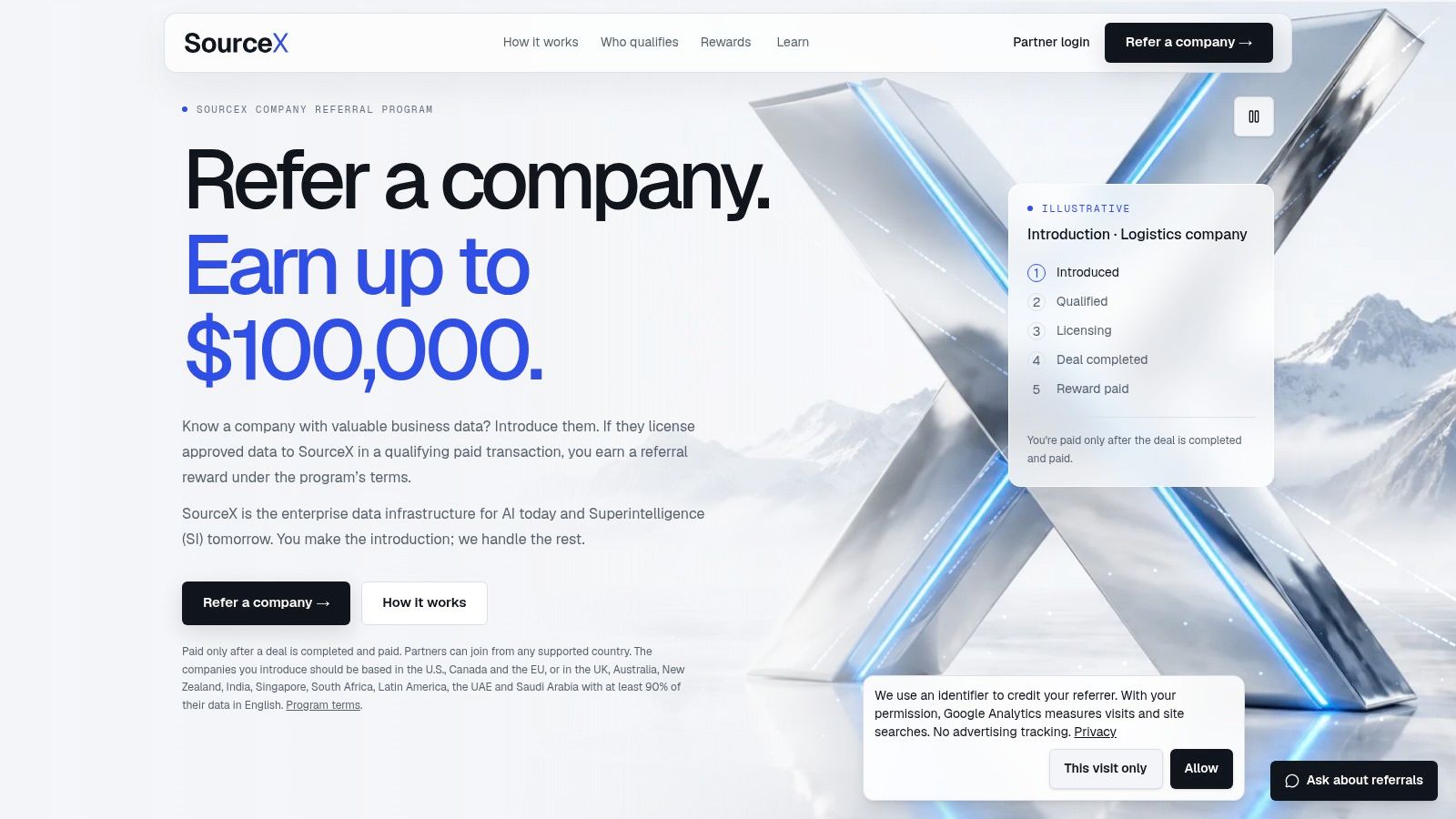
The workflow is straightforward. You make the introduction, SourceX handles qualification, rights review, pricing, contracting, data preparation, delivery, and payment. That matters if your own team doesn't want to manage a long manual handoff, because the attribution and payout steps stay in one place.
The strongest fit is companies with substantial business records and a real operating history. The referral offer also includes a personal link and dashboard submissions, a 90-day attribution window, visible reward progress, and defined payout conditions tied to buyer acceptance, cleared buyer payment, and SourceX paying the referred company. If you need a practical overview of how the partner side works, the SourceX referral program lays out the process clearly.
For teams thinking like RevOps, the useful part is the auditability. You can see status changes, check attribution, and keep the payment logic separate from the intro itself. That's the same discipline a B2B referral fee agreement needs when multiple channels touch the account.
How to track attribution and pay partners on time
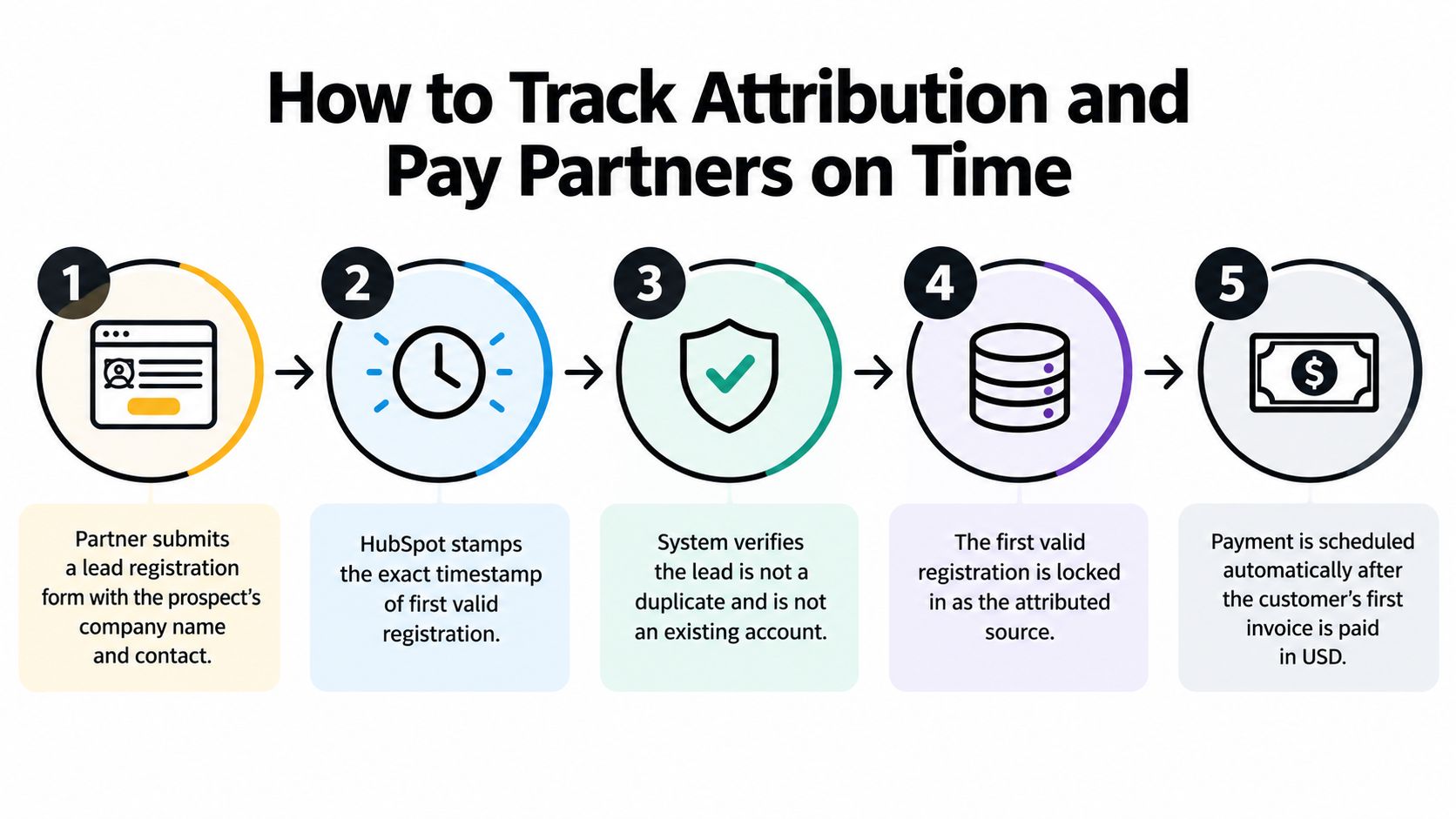
Attribution breaks when the CRM and the agreement don't say the same thing. A partner thinks they own the account because they opened the door, while your rep thinks outbound created the opportunity weeks earlier. That's why the first valid registration needs a timestamp and a lock.
Build the registration flow first
The cleanest process starts with a partner submission form. HubSpot stamps the exact time, the system checks whether the account already exists, and first-valid registration wins if two partners claim the same lead. Clay can enrich the account before it reaches sales, while Sales Navigator, HeyReach, Smartlead, or Instantly can show you whether the prospect was already part of a broader sequence.
If the account is already active in CRM, the partner doesn't get automatic credit. They get a review path.
That review path should be written down. Define the protected account, the attribution window, the duplicate rule, and the escalation process for shared or partner-sourced opportunities. The agreement should also say whether payment depends on gross or net revenue, because that changes the amount finance will approve.
Reconcile before you pay
Run monthly reconciliation between CRM and accounting. Match the referrer, the registered lead, the trigger event, and the collected amount, then clear any exceptions before payout goes out. If you wait until quarter-end, you're inviting spreadsheet archaeology.
Test the system against edge cases before launch. Duplicate lead, refund, renewal, delayed close, termination, cross-border customer, and disputed attribution all need a decision path. I've seen teams skip the delayed-close scenario, then spend two weeks debating whether the referral was still active when the deal finally signed.
For multi-touch B2B motions, multi-touch attribution rules should sit next to the referral agreement, not inside a separate slide deck no one opens. The point is to make the evidence trail strong enough that sales, finance, and the partner all see the same outcome.
Payment should follow cleared cash, not optimism. That one rule cuts disputes faster than any other clause I've used in partner programs.
Negotiation and compliance tips by industry
A signed referral fee agreement can still fail if the recipient, jurisdiction, or profession changes the legality. Healthcare is the clearest example. In the U.S., referral-fee rules in federally reimbursed healthcare sit inside a long anti-kickback framework that started in 1972 and was later consolidated in 1987 through section 1128B(b) of the Social Security Act, which makes it a federal crime to knowingly and willfully offer, pay, solicit, or receive remuneration to induce or reward referrals of federally reimbursable items or services. The history shows why a papered agreement alone isn't enough.
RESPA adds the same lesson on the real-estate side. Section 8 generally prohibits referral fees tied to federally related mortgage loans, because regulators care about whether the payment is connected to the referral of settlement-service business. The safe move is to separate actual services from referral compensation and document both clearly.

What to build into counsel review
For legal tech, lawyer-to-lawyer referral payments need written client consent, fee division that's proportional or based on joint responsibility, and a total fee that remains reasonable. The referral fee must go to a lawyer, not a layperson, and the consent should identify the participating lawyers and each share.
For financial services, government contracting, and pharma-adjacent motions, add prohibited-recipient language, anti-bribery reps, and a right to suspend payment if legality is unclear. The agreement should also handle withholding, tax documentation, and any cross-border reporting obligation before revenue moves.
A written referral agreement can be necessary and still not be sufficient. If the recipient is unlicensed, conflicted, or barred by sector rules, payment can still be off limits.
The practical stance is simple. Negotiate the commercial terms hard, then let counsel pressure-test the recipient, the jurisdiction, and the disclosure duties before anyone treats the referral as payable.
Put your referral system live by next Friday
A partner sends a deal, sales logs it late, and finance cannot tell whether the referral is payable. Fix that before the week ends. Add a referral source column and a registration date to your CRM, then retro-check every live opportunity with a partner touch. That exposes duplicate accounts, missing timestamps, and deals that never qualified for payment.
Pick one payout rule and apply it to the next clean deal. If collected cash is the trigger, keep it there. If you need a tail, define it now, not when a rep is asking finance where the check went.
The control point is attribution. Fee rate matters, but audit trail, fee base, and proof decide whether partners get paid without disputes.
If you need the partner-side setup, the B2B referral programme guide covers it end to end.
Run last quarter's overlapping referrals this Friday, pay the first clean one only after cash clears, and keep the same rule for duplicates. The rule holds, attribution, fee base, and proof have to line up before the first payout goes out.
You've got partner intros coming in, but the money still gets stuck. One rep says the lead was “their” account, finance wants proof of collection, and the referrer wants paid on the signed deal while the customer hasn't even paid the first invoice. That gap kills trust fast.
The fix is mechanical, not rhetorical. Define the account, the trigger, the fee base, and the proof trail.
Attribution beats headline rate when multiple channels touch the same deal.
Pay on collected cash if you want margin control and fewer disputes.
HubSpot timestamps, CRM ownership, and accounting reconciliation matter more than a nicer-looking contract.
If the industry is regulated, a signed agreement still doesn't make payment lawful.
Table of Contents
Why most B2B referral deals stall before payout
The deal usually looks clean at first. A founder gets a warm intro from a partner, the rep logs it in HubSpot, and everyone assumes the referral fee will sort itself out later. Then the prospect was already in the CRM, the account owner objects, and the referrer expects payment on a signed contract instead of collected revenue.
That's where the friction starts. The agreement says “referral,” but it never defines what counts as a valid introduction, who owns the account, or when the fee becomes earned. One person thinks the meeting held was enough, finance wants cash in the bank, and nobody wants to argue in Slack about whether the customer was already in pipeline.
A referral fee agreement only works when structure turns attention into pipeline.
Define the trigger early so a booked meeting doesn't get confused with revenue.
Lock account ownership before the handoff, especially when HubSpot already has history.
Use collected cash as the payout point when margin matters.
Write the attribution rules down for duplicate leads and multi-touch accounts.
Keep an audit trail so every payment ties back to a record, not memory.
Practical rule: if your team can't prove who introduced the account, when it was registered, and what got collected, the fee isn't ready to pay.
For B2B teams, this matters in iGaming, SaaS, manufacturing, legal tech, and pharma because partner-led buying paths rarely stay linear. One intro from LinkedIn might sit next to outbound activity, Sales Navigator research, and a Clay-enriched list, then the whole thing gets credited to whoever shouted loudest at the end.
If lead flow feels familiar, the problem often starts as lead leakage, not low-quality partners. Lead leakage in B2B pipeline is the right lens when good introductions disappear between CRM, sales, and finance.
What a referral fee agreement must cover
A strong referral fee agreement should read like an operating system, not a vague promise. The point is to remove guesswork before there's money on the table. That means the paper has to define who's involved, what qualifies, how credit is assigned, and when payout happens.
The seven control points
Start with the parties. Name the referrer and the receiving company clearly, then identify the eligible customer, account, or matter. If you work in SaaS or manufacturing, don't leave “qualified lead” to interpretation, because sales, marketing, and partner teams usually mean different things by it.
Next comes the trigger event and fee base. Say whether the fee is earned on a signed contract, a first invoice, or cleared funds, then state whether the calculation uses collected revenue, gross revenue, or net revenue. Net models need to spell out refunds, credits, taxes, duties, and related entities, or finance will end up rebuilding the math by hand.
You also need attribution rules. Define the registration window, duplicate lead handling, account ownership, and the timestamp that locks credit. A 30- to 90-day window can make sense if it matches the sales cycle, but it should exist because your process needs it, not because it sounds tidy.
Keep exclusions explicit. Pre-existing opportunities, renewals, refunds, chargebacks, taxes, and related entities need to be carved out before a dispute starts.
Clauses that save you later
Termination matters too. If the agreement ends, say what happens to pending referrals and any post-termination tail. Add confidentiality, data-protection duties, governing law, and dispute procedures so the agreement can survive real-world handoffs, not just a legal review.
For professional services, layer in the consent rules that the profession requires. Legal teams can't treat referral compensation like a normal sales commission, and client consent has to be written, specific, and tied to the participating lawyers when fee division is involved. That's the part templates usually miss (and it's why templates blow up in review).
A good internal checkpoint is simple. The contract should let RevOps, sales, and finance answer the same question from their own systems without changing the story.
Use legal review guidance for referral agreements before signing anything that touches regulated services or cross-border payment terms.
How to price referral fees without margin surprise
Percent of collected revenue is the default I'd pick for most B2B service motions. It keeps payout aligned with cash, which matters when sales cycles stretch and refunds can still happen. Flat fees work well when the economics are simple and the ticket is predictable, especially in lower-touch SaaS.
Compare the structures before you commit
A flat fee is clean when the deal size doesn't swing much. You know the amount, finance can book it, and nobody has to argue over revenue recognition. The downside shows up when the same partner sends a tiny deal and a huge one, because the fee no longer reflects value created.
Percentage-based fees track performance better. They also create less resentment when a partner opens a meaningful account that closes months later. The catch is obvious, you need a clear base, and you need to decide whether you're paying on gross or net.
Tiered schedules work when enterprise access and volume both matter. They're more complex to administer, but they let you reward strategic partners without overpaying on small transactions. If the partner only opens doors, not full deals, tiers can be the middle ground.
Model | Best use | Pay trigger |
|---|---|---|
Flat fee per qualified close | Low-ticket SaaS or simple offers | First invoice paid |
Percent of collected revenue | Most B2B services | Cleared customer funds |
Tiered schedule | Volume or enterprise access | Collected revenue by tier |
Margin rule: if the customer can cancel, dispute, or renegotiate after signature, pay on cash receipt, not on the promise.
The question is gross versus net. Gross is simpler for partners to understand. Net protects your margin by excluding returns, credits, taxes, and similar items, but it needs sharper wording and tighter reconciliation.
That's where unit economics should guide the deal. Unit economics for referral programs only works if the referral fee doesn't outrun what the account can return. In practical terms, if your cycle is long and the churn risk is real, cash-based payout wins more often than contract-signed payout.
How SourceX Can Help
SourceX is relevant if your referral motion includes companies with valuable operational records and you want a clean, tracked process from introduction to payout. It helps advisors, consultants, operators, and connected professionals earn from business relationships when the referred company completes a paid licensing transaction for approved business data.
The workflow is straightforward. You make the introduction, SourceX handles qualification, rights review, pricing, contracting, data preparation, delivery, and payment. That matters if your own team doesn't want to manage a long manual handoff, because the attribution and payout steps stay in one place.
The strongest fit is companies with substantial business records and a real operating history. The referral offer also includes a personal link and dashboard submissions, a 90-day attribution window, visible reward progress, and defined payout conditions tied to buyer acceptance, cleared buyer payment, and SourceX paying the referred company. If you need a practical overview of how the partner side works, the SourceX referral program lays out the process clearly.
For teams thinking like RevOps, the useful part is the auditability. You can see status changes, check attribution, and keep the payment logic separate from the intro itself. That's the same discipline a B2B referral fee agreement needs when multiple channels touch the account.
How to track attribution and pay partners on time
Attribution breaks when the CRM and the agreement don't say the same thing. A partner thinks they own the account because they opened the door, while your rep thinks outbound created the opportunity weeks earlier. That's why the first valid registration needs a timestamp and a lock.
Build the registration flow first
The cleanest process starts with a partner submission form. HubSpot stamps the exact time, the system checks whether the account already exists, and first-valid registration wins if two partners claim the same lead. Clay can enrich the account before it reaches sales, while Sales Navigator, HeyReach, Smartlead, or Instantly can show you whether the prospect was already part of a broader sequence.
If the account is already active in CRM, the partner doesn't get automatic credit. They get a review path.
That review path should be written down. Define the protected account, the attribution window, the duplicate rule, and the escalation process for shared or partner-sourced opportunities. The agreement should also say whether payment depends on gross or net revenue, because that changes the amount finance will approve.
Reconcile before you pay
Run monthly reconciliation between CRM and accounting. Match the referrer, the registered lead, the trigger event, and the collected amount, then clear any exceptions before payout goes out. If you wait until quarter-end, you're inviting spreadsheet archaeology.
Test the system against edge cases before launch. Duplicate lead, refund, renewal, delayed close, termination, cross-border customer, and disputed attribution all need a decision path. I've seen teams skip the delayed-close scenario, then spend two weeks debating whether the referral was still active when the deal finally signed.
For multi-touch B2B motions, multi-touch attribution rules should sit next to the referral agreement, not inside a separate slide deck no one opens. The point is to make the evidence trail strong enough that sales, finance, and the partner all see the same outcome.
Payment should follow cleared cash, not optimism. That one rule cuts disputes faster than any other clause I've used in partner programs.
Negotiation and compliance tips by industry
A signed referral fee agreement can still fail if the recipient, jurisdiction, or profession changes the legality. Healthcare is the clearest example. In the U.S., referral-fee rules in federally reimbursed healthcare sit inside a long anti-kickback framework that started in 1972 and was later consolidated in 1987 through section 1128B(b) of the Social Security Act, which makes it a federal crime to knowingly and willfully offer, pay, solicit, or receive remuneration to induce or reward referrals of federally reimbursable items or services. The history shows why a papered agreement alone isn't enough.
RESPA adds the same lesson on the real-estate side. Section 8 generally prohibits referral fees tied to federally related mortgage loans, because regulators care about whether the payment is connected to the referral of settlement-service business. The safe move is to separate actual services from referral compensation and document both clearly.
What to build into counsel review
For legal tech, lawyer-to-lawyer referral payments need written client consent, fee division that's proportional or based on joint responsibility, and a total fee that remains reasonable. The referral fee must go to a lawyer, not a layperson, and the consent should identify the participating lawyers and each share.
For financial services, government contracting, and pharma-adjacent motions, add prohibited-recipient language, anti-bribery reps, and a right to suspend payment if legality is unclear. The agreement should also handle withholding, tax documentation, and any cross-border reporting obligation before revenue moves.
A written referral agreement can be necessary and still not be sufficient. If the recipient is unlicensed, conflicted, or barred by sector rules, payment can still be off limits.
The practical stance is simple. Negotiate the commercial terms hard, then let counsel pressure-test the recipient, the jurisdiction, and the disclosure duties before anyone treats the referral as payable.
Put your referral system live by next Friday
A partner sends a deal, sales logs it late, and finance cannot tell whether the referral is payable. Fix that before the week ends. Add a referral source column and a registration date to your CRM, then retro-check every live opportunity with a partner touch. That exposes duplicate accounts, missing timestamps, and deals that never qualified for payment.
Pick one payout rule and apply it to the next clean deal. If collected cash is the trigger, keep it there. If you need a tail, define it now, not when a rep is asking finance where the check went.
The control point is attribution. Fee rate matters, but audit trail, fee base, and proof decide whether partners get paid without disputes.
If you need the partner-side setup, the B2B referral programme guide covers it end to end.
Run last quarter's overlapping referrals this Friday, pay the first clean one only after cash clears, and keep the same rule for duplicates. The rule holds, attribution, fee base, and proof have to line up before the first payout goes out.
You've got partner intros coming in, but the money still gets stuck. One rep says the lead was “their” account, finance wants proof of collection, and the referrer wants paid on the signed deal while the customer hasn't even paid the first invoice. That gap kills trust fast.
The fix is mechanical, not rhetorical. Define the account, the trigger, the fee base, and the proof trail.
Attribution beats headline rate when multiple channels touch the same deal.
Pay on collected cash if you want margin control and fewer disputes.
HubSpot timestamps, CRM ownership, and accounting reconciliation matter more than a nicer-looking contract.
If the industry is regulated, a signed agreement still doesn't make payment lawful.
Table of Contents
Why most B2B referral deals stall before payout
The deal usually looks clean at first. A founder gets a warm intro from a partner, the rep logs it in HubSpot, and everyone assumes the referral fee will sort itself out later. Then the prospect was already in the CRM, the account owner objects, and the referrer expects payment on a signed contract instead of collected revenue.
That's where the friction starts. The agreement says “referral,” but it never defines what counts as a valid introduction, who owns the account, or when the fee becomes earned. One person thinks the meeting held was enough, finance wants cash in the bank, and nobody wants to argue in Slack about whether the customer was already in pipeline.
A referral fee agreement only works when structure turns attention into pipeline.
Define the trigger early so a booked meeting doesn't get confused with revenue.
Lock account ownership before the handoff, especially when HubSpot already has history.
Use collected cash as the payout point when margin matters.
Write the attribution rules down for duplicate leads and multi-touch accounts.
Keep an audit trail so every payment ties back to a record, not memory.
Practical rule: if your team can't prove who introduced the account, when it was registered, and what got collected, the fee isn't ready to pay.
For B2B teams, this matters in iGaming, SaaS, manufacturing, legal tech, and pharma because partner-led buying paths rarely stay linear. One intro from LinkedIn might sit next to outbound activity, Sales Navigator research, and a Clay-enriched list, then the whole thing gets credited to whoever shouted loudest at the end.
If lead flow feels familiar, the problem often starts as lead leakage, not low-quality partners. Lead leakage in B2B pipeline is the right lens when good introductions disappear between CRM, sales, and finance.
What a referral fee agreement must cover
A strong referral fee agreement should read like an operating system, not a vague promise. The point is to remove guesswork before there's money on the table. That means the paper has to define who's involved, what qualifies, how credit is assigned, and when payout happens.
The seven control points
Start with the parties. Name the referrer and the receiving company clearly, then identify the eligible customer, account, or matter. If you work in SaaS or manufacturing, don't leave “qualified lead” to interpretation, because sales, marketing, and partner teams usually mean different things by it.
Next comes the trigger event and fee base. Say whether the fee is earned on a signed contract, a first invoice, or cleared funds, then state whether the calculation uses collected revenue, gross revenue, or net revenue. Net models need to spell out refunds, credits, taxes, duties, and related entities, or finance will end up rebuilding the math by hand.
You also need attribution rules. Define the registration window, duplicate lead handling, account ownership, and the timestamp that locks credit. A 30- to 90-day window can make sense if it matches the sales cycle, but it should exist because your process needs it, not because it sounds tidy.
Keep exclusions explicit. Pre-existing opportunities, renewals, refunds, chargebacks, taxes, and related entities need to be carved out before a dispute starts.
Clauses that save you later
Termination matters too. If the agreement ends, say what happens to pending referrals and any post-termination tail. Add confidentiality, data-protection duties, governing law, and dispute procedures so the agreement can survive real-world handoffs, not just a legal review.
For professional services, layer in the consent rules that the profession requires. Legal teams can't treat referral compensation like a normal sales commission, and client consent has to be written, specific, and tied to the participating lawyers when fee division is involved. That's the part templates usually miss (and it's why templates blow up in review).
A good internal checkpoint is simple. The contract should let RevOps, sales, and finance answer the same question from their own systems without changing the story.
Use legal review guidance for referral agreements before signing anything that touches regulated services or cross-border payment terms.
How to price referral fees without margin surprise
Percent of collected revenue is the default I'd pick for most B2B service motions. It keeps payout aligned with cash, which matters when sales cycles stretch and refunds can still happen. Flat fees work well when the economics are simple and the ticket is predictable, especially in lower-touch SaaS.
Compare the structures before you commit
A flat fee is clean when the deal size doesn't swing much. You know the amount, finance can book it, and nobody has to argue over revenue recognition. The downside shows up when the same partner sends a tiny deal and a huge one, because the fee no longer reflects value created.
Percentage-based fees track performance better. They also create less resentment when a partner opens a meaningful account that closes months later. The catch is obvious, you need a clear base, and you need to decide whether you're paying on gross or net.
Tiered schedules work when enterprise access and volume both matter. They're more complex to administer, but they let you reward strategic partners without overpaying on small transactions. If the partner only opens doors, not full deals, tiers can be the middle ground.
Model | Best use | Pay trigger |
|---|---|---|
Flat fee per qualified close | Low-ticket SaaS or simple offers | First invoice paid |
Percent of collected revenue | Most B2B services | Cleared customer funds |
Tiered schedule | Volume or enterprise access | Collected revenue by tier |
Margin rule: if the customer can cancel, dispute, or renegotiate after signature, pay on cash receipt, not on the promise.
The question is gross versus net. Gross is simpler for partners to understand. Net protects your margin by excluding returns, credits, taxes, and similar items, but it needs sharper wording and tighter reconciliation.
That's where unit economics should guide the deal. Unit economics for referral programs only works if the referral fee doesn't outrun what the account can return. In practical terms, if your cycle is long and the churn risk is real, cash-based payout wins more often than contract-signed payout.
How SourceX Can Help
SourceX is relevant if your referral motion includes companies with valuable operational records and you want a clean, tracked process from introduction to payout. It helps advisors, consultants, operators, and connected professionals earn from business relationships when the referred company completes a paid licensing transaction for approved business data.
The workflow is straightforward. You make the introduction, SourceX handles qualification, rights review, pricing, contracting, data preparation, delivery, and payment. That matters if your own team doesn't want to manage a long manual handoff, because the attribution and payout steps stay in one place.
The strongest fit is companies with substantial business records and a real operating history. The referral offer also includes a personal link and dashboard submissions, a 90-day attribution window, visible reward progress, and defined payout conditions tied to buyer acceptance, cleared buyer payment, and SourceX paying the referred company. If you need a practical overview of how the partner side works, the SourceX referral program lays out the process clearly.
For teams thinking like RevOps, the useful part is the auditability. You can see status changes, check attribution, and keep the payment logic separate from the intro itself. That's the same discipline a B2B referral fee agreement needs when multiple channels touch the account.
How to track attribution and pay partners on time
Attribution breaks when the CRM and the agreement don't say the same thing. A partner thinks they own the account because they opened the door, while your rep thinks outbound created the opportunity weeks earlier. That's why the first valid registration needs a timestamp and a lock.
Build the registration flow first
The cleanest process starts with a partner submission form. HubSpot stamps the exact time, the system checks whether the account already exists, and first-valid registration wins if two partners claim the same lead. Clay can enrich the account before it reaches sales, while Sales Navigator, HeyReach, Smartlead, or Instantly can show you whether the prospect was already part of a broader sequence.
If the account is already active in CRM, the partner doesn't get automatic credit. They get a review path.
That review path should be written down. Define the protected account, the attribution window, the duplicate rule, and the escalation process for shared or partner-sourced opportunities. The agreement should also say whether payment depends on gross or net revenue, because that changes the amount finance will approve.
Reconcile before you pay
Run monthly reconciliation between CRM and accounting. Match the referrer, the registered lead, the trigger event, and the collected amount, then clear any exceptions before payout goes out. If you wait until quarter-end, you're inviting spreadsheet archaeology.
Test the system against edge cases before launch. Duplicate lead, refund, renewal, delayed close, termination, cross-border customer, and disputed attribution all need a decision path. I've seen teams skip the delayed-close scenario, then spend two weeks debating whether the referral was still active when the deal finally signed.
For multi-touch B2B motions, multi-touch attribution rules should sit next to the referral agreement, not inside a separate slide deck no one opens. The point is to make the evidence trail strong enough that sales, finance, and the partner all see the same outcome.
Payment should follow cleared cash, not optimism. That one rule cuts disputes faster than any other clause I've used in partner programs.
Negotiation and compliance tips by industry
A signed referral fee agreement can still fail if the recipient, jurisdiction, or profession changes the legality. Healthcare is the clearest example. In the U.S., referral-fee rules in federally reimbursed healthcare sit inside a long anti-kickback framework that started in 1972 and was later consolidated in 1987 through section 1128B(b) of the Social Security Act, which makes it a federal crime to knowingly and willfully offer, pay, solicit, or receive remuneration to induce or reward referrals of federally reimbursable items or services. The history shows why a papered agreement alone isn't enough.
RESPA adds the same lesson on the real-estate side. Section 8 generally prohibits referral fees tied to federally related mortgage loans, because regulators care about whether the payment is connected to the referral of settlement-service business. The safe move is to separate actual services from referral compensation and document both clearly.
What to build into counsel review
For legal tech, lawyer-to-lawyer referral payments need written client consent, fee division that's proportional or based on joint responsibility, and a total fee that remains reasonable. The referral fee must go to a lawyer, not a layperson, and the consent should identify the participating lawyers and each share.
For financial services, government contracting, and pharma-adjacent motions, add prohibited-recipient language, anti-bribery reps, and a right to suspend payment if legality is unclear. The agreement should also handle withholding, tax documentation, and any cross-border reporting obligation before revenue moves.
A written referral agreement can be necessary and still not be sufficient. If the recipient is unlicensed, conflicted, or barred by sector rules, payment can still be off limits.
The practical stance is simple. Negotiate the commercial terms hard, then let counsel pressure-test the recipient, the jurisdiction, and the disclosure duties before anyone treats the referral as payable.
Put your referral system live by next Friday
A partner sends a deal, sales logs it late, and finance cannot tell whether the referral is payable. Fix that before the week ends. Add a referral source column and a registration date to your CRM, then retro-check every live opportunity with a partner touch. That exposes duplicate accounts, missing timestamps, and deals that never qualified for payment.
Pick one payout rule and apply it to the next clean deal. If collected cash is the trigger, keep it there. If you need a tail, define it now, not when a rep is asking finance where the check went.
The control point is attribution. Fee rate matters, but audit trail, fee base, and proof decide whether partners get paid without disputes.
If you need the partner-side setup, the B2B referral programme guide covers it end to end.
Run last quarter's overlapping referrals this Friday, pay the first clean one only after cash clears, and keep the same rule for duplicates. The rule holds, attribution, fee base, and proof have to line up before the first payout goes out.

Pipeline OS Newsletter
Build qualified pipeline
Get weekly tactics to generate demand, improve lead quality, and book more meetings.





Trusted by industry leaders
Trusted by industry leaders
Trusted by industry leaders
Ready to build qualified pipeline?
Ready to build qualified pipeline?
Ready to build qualified pipeline?
Book a call to see if we're the right fit, or take the 2-minute quiz to get a clear starting point.
Book a call to see if we're the right fit, or take the 2-minute quiz to get a clear starting point.
Book a call to see if we're the right fit, or take the 2-minute quiz to get a clear starting point.
" height="30.21639343089746px" id="hfGbXmQR2" width="30.216393430897455px"/></svg>)
Copyright © 2026 – All Right Reserved
Copyright © 2026 – All Right Reserved
Copyright © 2026 – All Right Reserved