%22%3E%3C/path%3E%3Cpath d=%22M 63.072 7.554 C 62.258 8.022 61.577 8.689 61.092 9.493 L 61.092 7.076 L 57.158 7.076 L 57.158 22.64 L 61.089 22.64 L 61.089 14.888 C 61.089 13.446 61.403 12.434 62.03 11.853 C 62.818 11.218 63.818 10.907 64.826 10.982 L 65.868 10.982 L 65.868 6.851 C 64.891 6.834 63.926 7.076 63.073 7.554 Z%22 fill=%22rgb(17,17,17)%22%3E%3C/path%3E%3Cpath d=%22M 78.916 7.82 C 76.363 6.49 73.321 6.49 70.768 7.82 C 69.562 8.473 68.564 9.451 67.888 10.644 C 67.167 11.931 66.803 13.387 66.834 14.862 C 66.804 16.332 67.157 17.785 67.86 19.077 C 68.515 20.267 69.494 21.246 70.684 21.901 C 71.924 22.576 73.318 22.92 74.73 22.898 C 76.164 22.918 77.58 22.575 78.846 21.901 C 80.062 21.247 81.073 20.27 81.768 19.077 C 82.506 17.797 82.88 16.339 82.85 14.862 C 82.88 13.389 82.517 11.934 81.797 10.647 C 81.12 9.455 80.122 8.477 78.917 7.824 M 78.803 14.862 C 78.829 15.739 78.636 16.608 78.241 17.391 C 77.903 18.046 77.38 18.588 76.738 18.95 C 76.124 19.293 75.432 19.472 74.729 19.47 C 73.668 19.497 72.648 19.061 71.934 18.276 C 71.139 17.323 70.741 16.1 70.823 14.862 C 70.741 13.62 71.149 12.395 71.959 11.45 C 72.687 10.667 73.715 10.233 74.783 10.256 C 75.859 10.236 76.894 10.67 77.635 11.45 C 78.464 12.387 78.884 13.616 78.801 14.864%22 fill=%22rgb(17,17,17)%22%3E%3C/path%3E%3Cpath d=%22M 95.906 7.076 L 95.906 15.646 C 95.975 16.68 95.643 17.701 94.979 18.498 C 94.311 19.184 93.379 19.547 92.422 19.495 C 91.475 19.544 90.553 19.18 89.894 18.498 C 89.23 17.701 88.898 16.68 88.967 15.646 L 88.967 7.076 L 85.033 7.076 L 85.033 16.207 C 85 17.449 85.275 18.68 85.834 19.79 C 86.327 20.75 87.095 21.542 88.039 22.065 C 89.033 22.594 90.145 22.861 91.271 22.838 C 92.188 22.847 93.095 22.65 93.926 22.263 C 94.708 21.905 95.388 21.36 95.906 20.675 L 95.906 22.645 L 99.865 22.645 L 99.865 7.076 Z%22 fill=%22rgb(17,17,17)%22%3E%3C/path%3E%3Cpath d=%22M 4.513 15.626 C 4.511 10.815 7.606 6.549 12.181 5.059 C 16.756 3.57 21.77 5.195 24.601 9.086 L 27.816 5.87 C 24.074 1.186 17.981 -0.943 12.137 0.393 C 6.292 1.728 1.728 6.292 0.393 12.137 C -0.943 17.981 1.186 24.074 5.87 27.816 L 9.085 24.601 C 6.214 22.512 4.515 19.177 4.513 15.626%22 fill=%22rgb(32,62,235)%22%3E%3C/path%3E%3Cpath d=%22M 17.114 14.343 L 13.354 18.01 L 13.354 18.026 L 21.071 18.026 L 11.412 27.609 L 17.389 27.609 L 23.999 21.081 L 23.999 28.316 L 24.005 28.316 L 27.967 24.393 L 27.967 14.343 Z%22 fill=%22rgb(32,62,235)%22%3E%3C/path%3E%3C/g%3E%3C/svg%3E) ×
× ××
××›
›
›
›
Hire SDRs in Colombia: EOR, salary & compliance guide
Hire SDRs in Colombia: EOR, salary & compliance guide
Hire SDRs in Colombia: EOR, salary & compliance guide
Hire SDRs in Colombia: EOR, salary & compliance guide
Hire SDRs in Colombia: EOR, salary & compliance guide
Hire SDRs in Colombia: EOR, salary & compliance guide

Author
Aljaz Peklaj

Why trust this guide
We are GROU, a B2B pipeline agency that runs lead generation, outbound, and LinkedIn content for clients across manufacturing, fintech, iGaming, software, and professional services. Half our client base is US or EU B2B SaaS, and the most common scaling question we hear after "which cold email tool" is "where do I hire my first SDR." In 2025 and 2026 the answer for most US-aligned teams has converged on Colombia. This guide is from operators who have helped clients open their first Colombian sales seats using Deel for the EOR layer.
→ Methodology: This guide combines our own client deployment data, Colombian Codigo Sustantivo del Trabajo (CST) provisions current as of 2026, parafiscales and prestaciones sociales rates published by the Colombian Ministry of Labor, Deel's published EOR pricing and capability documentation, and current 2026 USD salary benchmarks for B2B sales roles paid by US and EU companies via EOR.
→ Affiliate disclosure: Links to Deel in this article are affiliate links. We earn a small commission if you sign up through them, at no extra cost to you. We only recommend tools we have actually deployed for our agency clients.
TL;DR
Colombia is the fastest-growing market for B2B sales outsourcing in 2025 and 2026. US-Eastern time zone alignment, rising B2 English proficiency, and salaries that run 50 to 70 percent below US equivalents have pulled SaaS companies in from every angle. The catch is that Colombian labor law (Codigo Sustantivo del Trabajo plus the 2022 to 2026 work-week reform) is materially more employee-protective than US law, and the true employer cost runs 45 to 52 percent on top of base salary once parafiscales, cesantias, prima, and ARL are layered in.
The honest playbook for most B2B SaaS hiring their first 1 to 8 Colombian sales reps is: skip the entity, use Deel as your EOR, ship the first hire in 5 to 7 days, and revisit entity setup once you cross 10 to 15 hires. We walk through the salary benchmarks, the cost math, the compliance traps, and the exact Deel capabilities that handle each piece below.
Table of contents
Why trust this guide
TL;DR
Why hire B2B sales talent in Colombia in 2026
Salary benchmarks: SDR, BDR, RevOps, Sales Engineer, CSM
The true employer cost (parafiscales, cesantias, prima)
Colombian employment law every US founder gets wrong
Compliance checklist: 8 things that cannot break
Deel EOR vs setting up your own Colombian entity
How Deel handles Colombia specifically
The 30-day hiring playbook
FAQ
Bottom line
Why hire B2B sales talent in Colombia in 2026
The reason Colombia became the LATAM sales hiring leader between 2023 and 2026 is structural, not trend-driven.
Time zone. Bogota is UTC-5, identical to US Eastern. Medellin and Cali same. A Colombian SDR booking meetings for a New York or Atlanta AE is not coordinating across a 5-hour gap, they are sharing the same morning standup. For B2B outbound where call connect rates depend on hitting US business hours, this matters more than people realise.
English proficiency rising. Colombia ranks B2 (upper intermediate) on average and climbing year over year on the EF English Proficiency Index, with concentrated B2/C1 talent in Bogota, Medellin, and Barranquilla. For SDR work specifically, where the bar is conversational English over written, the available pool is substantial.
Salary differential. A US-based junior SDR earns $50,000 to $90,000 OTE. A Colombia-based junior SDR earns $25,000 to $45,000 OTE doing the same work, with the same Salesforce stack, the same Outreach or Salesloft sequences, and the same ICP. That is a 40 to 55 percent fully loaded savings for equivalent output.
The reverse trend matters too. Colombian SDR retention is materially higher than US SDR retention. US SDR average tenure ran 12 to 14 months in 2024 to 2025. Colombian SDR tenure runs 18 to 26 months for the same role at the same company. Onboarding and ramp cost amortise over a longer working life.
The catch. Hiring in Colombia is not the same as hiring a US contractor. The Colombian Codigo Sustantivo del Trabajo is one of the more employee-protective labor codes in LATAM. Misclassification penalties are retroactive. Severance accrual is mandatory and paid into a regulated fund. The 2022 work-week reform (Law 2101) reduced the standard work week from 48 to 42 hours by mid-2026. Treating a Colombian SDR like a 1099 US contractor is the single most common founder mistake, and the legal exposure shows up at termination, not at hire.
That is why most US and EU B2B SaaS that want to scale Colombian sales teams without building an entity use an EOR like Deel for at least their first 10 to 15 hires. We walk through the math below.
Salary benchmarks: SDR, BDR, RevOps, Sales Engineer, CSM
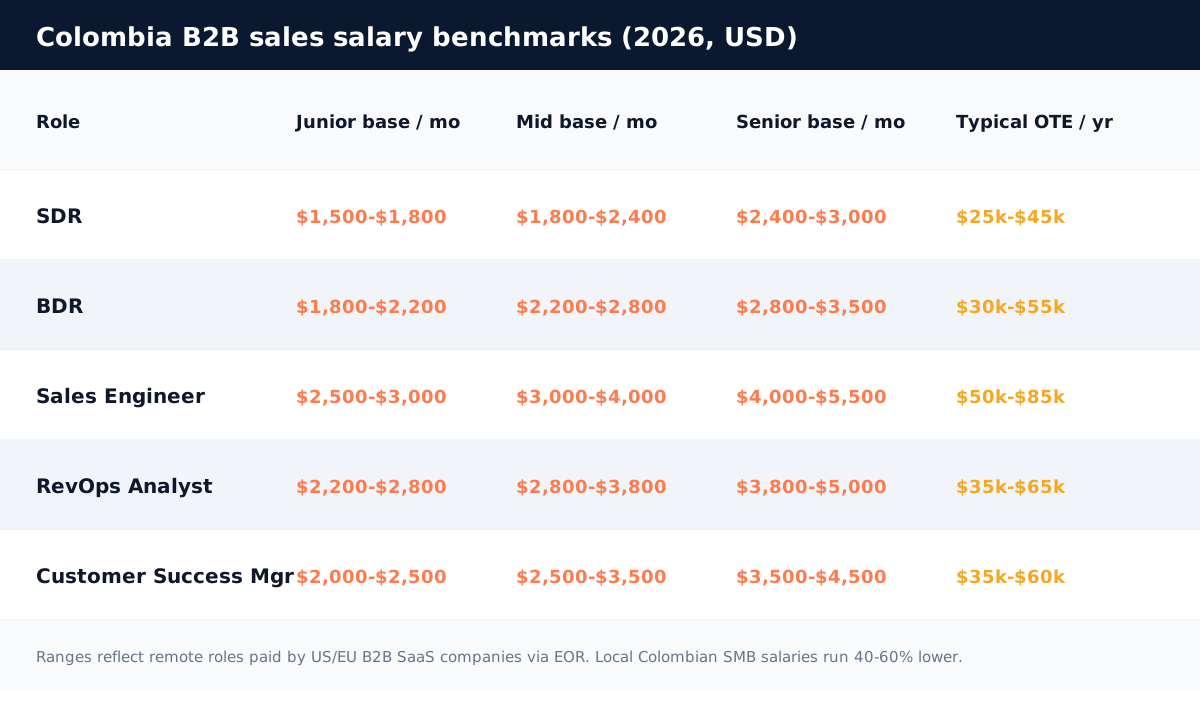
A few notes on these ranges.
These are USD-denominated salaries paid to Colombian residents by US or EU B2B SaaS companies via EOR (Deel, Remote, Velocity Global, etc.). They are materially higher than what local Colombian SMBs pay for the same titles, because the talent pool is being recruited by the same companies that compete for US SDRs.
The junior tier ($1,500-$1,800/mo base for an SDR) targets candidates with 0 to 12 months sales experience, B2 English, and at least one tour of duty at a Colombian BPO or US tech sales bootcamp. The mid tier targets 12 to 30 months, B2/C1 English, and one to two previous US SaaS roles. The senior tier ($2,400-$3,000/mo base) targets 30+ months and BDR-to-AE transition candidates.
OTE structures mirror US SaaS conventions: 50/50 base/variable for SDRs, 60/40 for BDRs, 70/30 for RevOps and CSM, 80/20 for sales engineers. Commission is paid in USD via EOR. Quota structures are identical to US (meetings booked, SQOs, pipeline created), the absolute targets are similar, the relative-to-cost economics are radically better.
Sourcing channels that actually work in 2026:
LinkedIn Sales Navigator with location filter "Colombia" + "Open to remote work in US/EU"
Torre.ai (Colombian talent platform with strong B2B sales coverage)
Get on Board (LATAM-wide, technical and GTM roles)
Wellfound (formerly AngelList) with LATAM filter
Local talent agencies (Workana, Lemoor, GoCloudly for higher-tier roles)
Direct referral from existing Colombian SaaS employees (highest conversion)
The true employer cost (parafiscales, cesantias, prima)
This is the line item most US founders miss until their CFO asks why payroll cost is 50 percent above the offer letter.
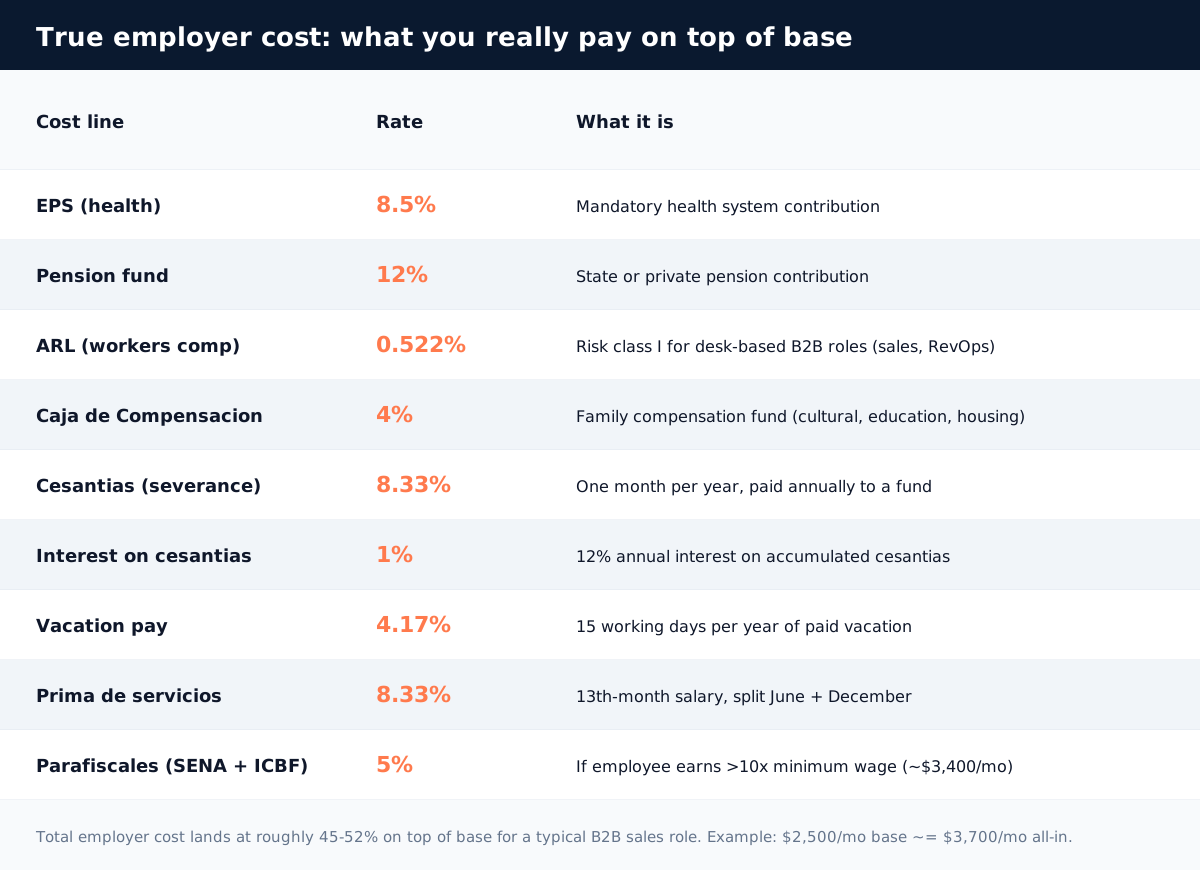
The headline number: total employer cost in Colombia runs 45 to 52 percent on top of base salary for a typical desk-based B2B sales role (ARL Class I, employee earning above 10x minimum wage so parafiscales apply).
Translating that to actual offer math: if you decide to pay a mid-tier SDR $2,400/month base, the fully loaded cost (everything in Table 2, plus standard EOR fees) lands at roughly $3,500-$3,700/month. Over 12 months, that is $42k to $44k. Compare to a US-based mid-tier SDR at $65k base, $90k OTE, with US payroll taxes adding ~15 percent on top, for a fully loaded cost north of $100k. The Colombian hire delivers the same output at roughly 40-45 percent of the loaded cost.
A few line items that catch founders off-guard:
Cesantias and interest on cesantias combined cost ~9.33 percent of salary annually, and the funds must physically transfer to a Colombian severance fund (Fondo de Cesantias) by February 14 each year. Missing the deadline triggers one-day-of-salary interest per day late.
Prima de servicios is the "13th-month" salary. Half is paid by June 30, half by December 20. Non-payment is treated as a labor violation, with double damages owed at termination.
Parafiscales (SENA + ICBF) at 5 percent only apply if the employee earns above 10x the monthly minimum wage (roughly $3,400/mo in 2026). For a junior SDR at $1,800/mo base, parafiscales do not apply, which improves the math slightly.
These are not optional. They are deposited to specific Colombian regulated funds with specific deadlines. Running US-style "I just wire my Colombian contractor monthly" payroll is the misclassification trap we cover next.
Colombian employment law every US founder gets wrong
Five concepts that do not have clean US analogues.
1. Subordination = employee, regardless of contract label. Colombian labor law tests employment status on a three-part test: subordination (you direct their work), exclusivity (they work primarily for you), and tools (you provide laptop, accounts, software). If two of three apply, the relationship is employee, regardless of whether you signed a "contractor agreement." If your Colombian "contractor" attends your standups, uses your CRM credentials, and works only for your company, they are an employee under Colombian law. At termination this becomes retroactive: back pay for cesantias, prima, vacation, plus penalties.
2. Indefinite-term is the default. Unlike the US, where at-will employment is the default, Colombian contracts default to contrato a termino indefinido (indefinite term) unless explicitly written as fixed-term. Indefinite-term contracts require cause for termination, and severance scales with tenure.
3. The 2022 to 2026 work week reduction. Law 2101 of 2021 progressively reduced the Colombian standard work week from 48 hours to 42 hours, completed in mid-2026. For salaried sales roles this rarely creates day-to-day issues, but it matters for overtime calculation: hours above 42/week trigger overtime at 25-75 percent surcharge depending on time of day.
4. Cesantias is a fund, not a line item. Cesantias accrues at 8.33 percent of monthly salary. Unlike US severance which is accrued internally and paid at termination, Colombian cesantias must physically transfer to a regulated Fondo de Cesantias by February 14 of the following year. The employee can withdraw it under specific circumstances (housing purchase, education, unemployment).
5. IP assignment is not implicit. Default Colombian intellectual property law is more employee-favorable than US default. The contract must include explicit assignment clauses for any work product, code, content, customer relationships, and trade secrets. CST-compliant template contracts (the kind Deel provides) include this by default. Hand-rolled "we copy-pasted our US contract" agreements typically miss it.
Compliance checklist: 8 things that cannot break
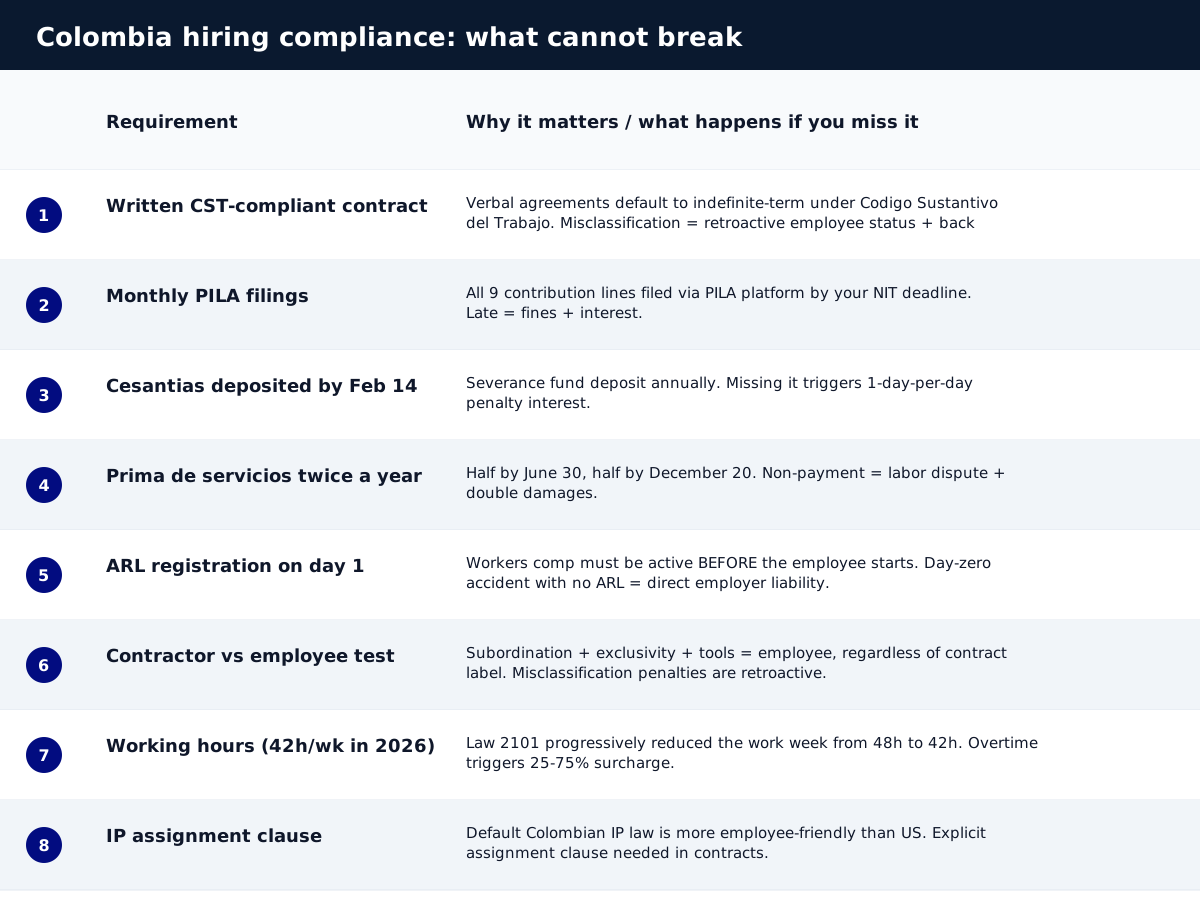
The pattern: Colombian compliance is checklist-able. It is not interpretive or judgement-based the way some labor codes are. There are eight things you must do, in specific ways, by specific deadlines, on the right platforms. Missing any of them creates retroactive liability that compounds.
This is also why EOR pricing for Colombia exists: an EOR like Deel absorbs all eight of these into their service, with their in-country legal team carrying the liability. If you run your own Colombian entity, your accounting/legal/HR team carries all eight.
Deel EOR vs setting up your own Colombian entity
The decision tree most B2B SaaS finance leaders use.
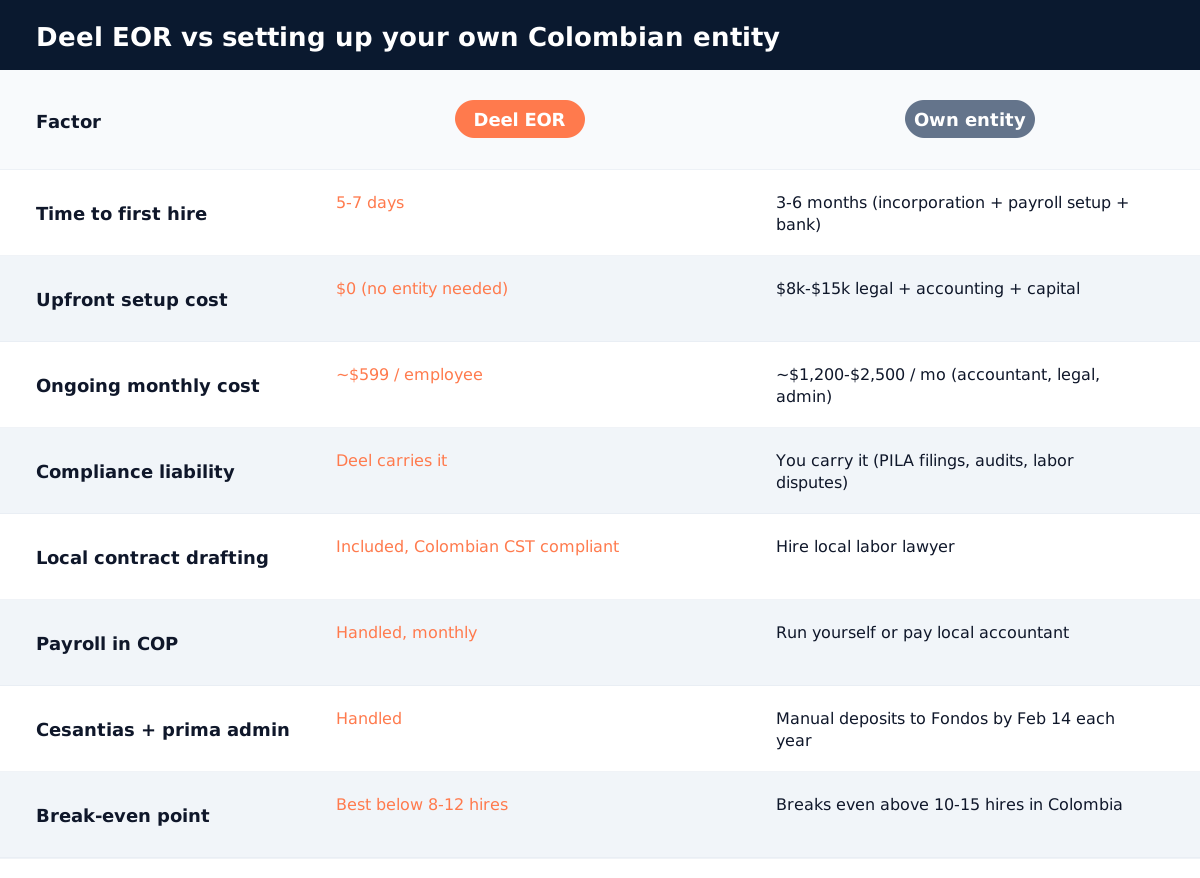
The decision in one paragraph: Below 8-12 hires in Colombia, Deel EOR wins on every dimension that matters for early-stage hiring (time to first hire, upfront cost, compliance risk, admin overhead). Above 10-15 hires, a Colombian entity starts to win on per-employee cost because the entity's fixed overhead (accountant, in-country legal, HR admin) amortises across more headcount. The transition window of 8 to 15 is where most companies model both and pick based on planned 24-month headcount.
For a US SaaS hiring its first SDR in Colombia in 2026, the math is not close: Deel EOR is the default answer. The reasons are not just cost. Setting up a Colombian entity (SAS or sucursal) takes 3 to 6 months of legal work, accountant onboarding, bank account opening, and payroll system integration. During those 3 to 6 months, you cannot legally hire. With Deel, the first SDR is sending sequences in week 2.
How Deel handles Colombia specifically
Deel is one of the small handful of EOR providers that operates an owned legal entity in Colombia rather than partnering with a local provider. The practical implications for B2B SaaS hiring sales talent:
Local contracts in Spanish, CST-compliant by default. Deel's Colombian contract templates include the 5 things US founders get wrong (subordination clause, IP assignment, 42h/wk language, indefinite-term defaults, restrictive covenants compliant with Colombian law). You are not asking your US labor lawyer to interpret Colombian labor code.
Payroll in COP, monthly cadence, PILA filings handled. All 9 contribution lines (EPS, pension, ARL, Caja, cesantias, interest on cesantias, vacation pay, prima, parafiscales) are calculated, deposited, and PILA-filed by Deel's Colombian team. You see one monthly USD invoice. Your Colombian employee sees their COP payslip with all contributions itemised.
Cesantias and prima auto-accruals. Deel accrues cesantias monthly and deposits to the employee's chosen Fondo de Cesantias by the February 14 deadline. Prima is paid June 30 and December 20 automatically. You do not maintain a separate Colombian severance accrual account.
Local benefits administration. Deel handles enrollment in EPS (health), pension fund selection, ARL (workers comp), and optional benefits (private health, meal vouchers, transportation allowance). Colombian SDRs care about EPS coverage and meal vouchers (the Sodexo card is culturally expected). Deel handles this so you do not.
Compliant termination. Termination in Colombia requires cause documentation for indefinite-term contracts. If you need to let a Colombian SDR go, Deel's in-country team handles the legal process, cesantias finalisation, and the indemnification calculation. You sign off on a single decision; Deel runs the workflow.
Pricing. Deel's Colombian EOR runs roughly $599 per employee per month at standard rates. For a mid-tier SDR at $2,400/mo base + 45% employer load = $3,480/mo true cost + $599 Deel fee = $4,079/mo all-in. That is your full SDR cost, with zero compliance liability sitting on your US entity.
The 30-day hiring playbook
How we run this for clients shipping their first Colombian SDR.
Week 1: source. Open a Colombia-only LinkedIn Sales Nav search for SDR candidates with B2 English and 12+ months B2B SaaS experience. Post the role on Torre.ai and Get on Board. Activate referrals from your existing Latin American employees if any. Aim for 30 to 50 qualified candidates in the first week.
Week 2: interview. Standard SDR loop translates 1:1 to Colombia: screening call (English filter), roleplay (objection handling), case study (write a sample sequence for a target persona), final with hiring manager + skip-level. Most Colombian B2B sales candidates are familiar with the format from prior US SaaS roles.
Week 3: offer + Deel setup. Once you select the candidate, send the offer in USD with full benefits breakdown. In parallel, invite them to Deel via your dashboard. They complete onboarding (personal info, Fondo de Cesantias selection, EPS selection, ARL form) in 2 to 3 days. Deel issues the Colombian CST-compliant contract.
Week 4: start. Day 1 the SDR has their email, CRM access, Outreach/Salesloft seat, calling tool seat, and Deel payslip access. You run standard SDR onboarding (ICP, sequences, dialer training, certification). First sequence shipped end of week 4. First meeting booked typically week 6 to 8.
This is the pattern. The bottleneck is sourcing, not Deel. Deel adds 2 to 3 days of admin to the cycle, not weeks.
FAQ
Is hiring an SDR in Colombia actually GDPR-compliant for European companies?
Yes if structured properly. The Colombian SDR processes EU contact data on your behalf as a processor. The processor agreement (DPA) must be in place between your EU entity and Deel (as the Colombian employer of record), and you maintain your Article 28 controller obligations. Deel's standard EOR setup includes a DPA. Run the data through your standard CRM, do not store EU personal data on the SDR's personal device.
Can I just hire a Colombian SDR as a 1099 contractor instead?
Legally questionable and the risk is asymmetric. If the relationship looks like employment under Colombian law (subordination + exclusivity + tools), Colombian authorities will reclassify it at any point, especially at termination. The retroactive penalties (back pay for cesantias, prima, vacation, plus fines) typically exceed 12 months of the contractor's pay. For a 24-month relationship, that is a $40k+ exposure. EOR fees over the same period are roughly $14k. The math favours EOR by a wide margin.
How is Colombian SDR retention compared to US SDR retention?
Materially better. Average Colombian SDR tenure at US SaaS companies runs 18 to 26 months versus 12 to 14 months for US SDRs in the same role at the same company. The reasons are mixed (career mobility differences, fewer competing offers per quarter, cultural longer-tenure expectations) but the practical impact is that you amortise onboarding and ramp cost over a longer working life.
What is the difference between Bogota, Medellin, and Cali for SDR hiring?
Bogota has the deepest talent pool, the most prior US SaaS experience, and the highest English proficiency on average. Medellin is the second city with strong B2B tech experience and slightly lower salary expectations. Cali is third with a smaller specialised pool. For your first 1 to 5 hires, Bogota is the default. Once you scale, Medellin makes sense as a second hub.
Does Deel support Colombian Spanish-language contracts?
Yes. Contracts are issued bilingual (Spanish-Colombian + English), with Spanish as the legally binding version per Colombian law. This is non-negotiable for CST compliance; do not let any EOR ship English-only contracts to Colombian employees.
What benefits do Colombian SDRs actually expect?
Beyond the mandatory contributions: private health (Medicina Prepagada) coverage is culturally expected at SaaS-grade salaries, meal vouchers (the Sodexo card) are nearly universal, and a remote work stipend for laptop and internet is standard. Deel handles all three through its Colombian benefits marketplace.
Will Colombian employer cost really stay at 45-52 percent on top of base?
Within a few percent yes, for ARL Class I (desk-based) roles in 2026. Class II to V (field work, manufacturing) ARL rates run materially higher. Roles where the employee earns below 10x minimum wage skip parafiscales, lowering the load by ~5 points. The 45-52 percent range is for typical USD-denominated SaaS sales salaries.
What is the SDR salary I should actually pay?
For a Colombian SDR with 12 to 24 months prior US SaaS experience and B2+ English, the 2026 market clearing rate is $2,000 to $2,500 per month base + 50% variable OTE = $36k to $45k OTE total. Pay below this and your time-to-hire stretches; pay above and you over-pay relative to the market.
Bottom line
Colombia is the right answer for most US and EU B2B SaaS opening their first 1 to 8 sales seats outside their home market in 2026. The time zone alignment, English depth, salary differential, and retention math all line up. The only friction is Colombian labor law, which is materially more employee-protective than US law and creates retroactive liability for misclassification.
The cleanest way to ship the first 1 to 8 hires is with an EOR. Deel operates an owned entity in Colombia, handles all 9 contribution lines through PILA, ships local CST-compliant contracts, manages cesantias and prima accruals, and absorbs compliance liability. Pricing runs roughly $599 per employee per month on top of the 45-52 percent employer load. For your first SDR at $2,400/mo base, you are at roughly $4,079/mo all-in, which is 40-45 percent of the loaded cost of an equivalent US SDR.
If you want help running the sourcing motion, setting up the interview loop, or designing the SDR onboarding (we do this for clients across SaaS, fintech, and professional services every week), book a working session with GROU. For the EOR layer itself, start a Deel account and ship your first Colombian SDR offer within the week.
→ Open a Deel account free (no card required) and have your first Colombian SDR contract ready in 5 to 7 days.
Why trust this guide
We are GROU, a B2B pipeline agency that runs lead generation, outbound, and LinkedIn content for clients across manufacturing, fintech, iGaming, software, and professional services. Half our client base is US or EU B2B SaaS, and the most common scaling question we hear after "which cold email tool" is "where do I hire my first SDR." In 2025 and 2026 the answer for most US-aligned teams has converged on Colombia. This guide is from operators who have helped clients open their first Colombian sales seats using Deel for the EOR layer.
→ Methodology: This guide combines our own client deployment data, Colombian Codigo Sustantivo del Trabajo (CST) provisions current as of 2026, parafiscales and prestaciones sociales rates published by the Colombian Ministry of Labor, Deel's published EOR pricing and capability documentation, and current 2026 USD salary benchmarks for B2B sales roles paid by US and EU companies via EOR.
→ Affiliate disclosure: Links to Deel in this article are affiliate links. We earn a small commission if you sign up through them, at no extra cost to you. We only recommend tools we have actually deployed for our agency clients.
TL;DR
Colombia is the fastest-growing market for B2B sales outsourcing in 2025 and 2026. US-Eastern time zone alignment, rising B2 English proficiency, and salaries that run 50 to 70 percent below US equivalents have pulled SaaS companies in from every angle. The catch is that Colombian labor law (Codigo Sustantivo del Trabajo plus the 2022 to 2026 work-week reform) is materially more employee-protective than US law, and the true employer cost runs 45 to 52 percent on top of base salary once parafiscales, cesantias, prima, and ARL are layered in.
The honest playbook for most B2B SaaS hiring their first 1 to 8 Colombian sales reps is: skip the entity, use Deel as your EOR, ship the first hire in 5 to 7 days, and revisit entity setup once you cross 10 to 15 hires. We walk through the salary benchmarks, the cost math, the compliance traps, and the exact Deel capabilities that handle each piece below.
Table of contents
Why trust this guide
TL;DR
Why hire B2B sales talent in Colombia in 2026
Salary benchmarks: SDR, BDR, RevOps, Sales Engineer, CSM
The true employer cost (parafiscales, cesantias, prima)
Colombian employment law every US founder gets wrong
Compliance checklist: 8 things that cannot break
Deel EOR vs setting up your own Colombian entity
How Deel handles Colombia specifically
The 30-day hiring playbook
FAQ
Bottom line
Why hire B2B sales talent in Colombia in 2026
The reason Colombia became the LATAM sales hiring leader between 2023 and 2026 is structural, not trend-driven.
Time zone. Bogota is UTC-5, identical to US Eastern. Medellin and Cali same. A Colombian SDR booking meetings for a New York or Atlanta AE is not coordinating across a 5-hour gap, they are sharing the same morning standup. For B2B outbound where call connect rates depend on hitting US business hours, this matters more than people realise.
English proficiency rising. Colombia ranks B2 (upper intermediate) on average and climbing year over year on the EF English Proficiency Index, with concentrated B2/C1 talent in Bogota, Medellin, and Barranquilla. For SDR work specifically, where the bar is conversational English over written, the available pool is substantial.
Salary differential. A US-based junior SDR earns $50,000 to $90,000 OTE. A Colombia-based junior SDR earns $25,000 to $45,000 OTE doing the same work, with the same Salesforce stack, the same Outreach or Salesloft sequences, and the same ICP. That is a 40 to 55 percent fully loaded savings for equivalent output.
The reverse trend matters too. Colombian SDR retention is materially higher than US SDR retention. US SDR average tenure ran 12 to 14 months in 2024 to 2025. Colombian SDR tenure runs 18 to 26 months for the same role at the same company. Onboarding and ramp cost amortise over a longer working life.
The catch. Hiring in Colombia is not the same as hiring a US contractor. The Colombian Codigo Sustantivo del Trabajo is one of the more employee-protective labor codes in LATAM. Misclassification penalties are retroactive. Severance accrual is mandatory and paid into a regulated fund. The 2022 work-week reform (Law 2101) reduced the standard work week from 48 to 42 hours by mid-2026. Treating a Colombian SDR like a 1099 US contractor is the single most common founder mistake, and the legal exposure shows up at termination, not at hire.
That is why most US and EU B2B SaaS that want to scale Colombian sales teams without building an entity use an EOR like Deel for at least their first 10 to 15 hires. We walk through the math below.
Salary benchmarks: SDR, BDR, RevOps, Sales Engineer, CSM
A few notes on these ranges.
These are USD-denominated salaries paid to Colombian residents by US or EU B2B SaaS companies via EOR (Deel, Remote, Velocity Global, etc.). They are materially higher than what local Colombian SMBs pay for the same titles, because the talent pool is being recruited by the same companies that compete for US SDRs.
The junior tier ($1,500-$1,800/mo base for an SDR) targets candidates with 0 to 12 months sales experience, B2 English, and at least one tour of duty at a Colombian BPO or US tech sales bootcamp. The mid tier targets 12 to 30 months, B2/C1 English, and one to two previous US SaaS roles. The senior tier ($2,400-$3,000/mo base) targets 30+ months and BDR-to-AE transition candidates.
OTE structures mirror US SaaS conventions: 50/50 base/variable for SDRs, 60/40 for BDRs, 70/30 for RevOps and CSM, 80/20 for sales engineers. Commission is paid in USD via EOR. Quota structures are identical to US (meetings booked, SQOs, pipeline created), the absolute targets are similar, the relative-to-cost economics are radically better.
Sourcing channels that actually work in 2026:
LinkedIn Sales Navigator with location filter "Colombia" + "Open to remote work in US/EU"
Torre.ai (Colombian talent platform with strong B2B sales coverage)
Get on Board (LATAM-wide, technical and GTM roles)
Wellfound (formerly AngelList) with LATAM filter
Local talent agencies (Workana, Lemoor, GoCloudly for higher-tier roles)
Direct referral from existing Colombian SaaS employees (highest conversion)
The true employer cost (parafiscales, cesantias, prima)
This is the line item most US founders miss until their CFO asks why payroll cost is 50 percent above the offer letter.
The headline number: total employer cost in Colombia runs 45 to 52 percent on top of base salary for a typical desk-based B2B sales role (ARL Class I, employee earning above 10x minimum wage so parafiscales apply).
Translating that to actual offer math: if you decide to pay a mid-tier SDR $2,400/month base, the fully loaded cost (everything in Table 2, plus standard EOR fees) lands at roughly $3,500-$3,700/month. Over 12 months, that is $42k to $44k. Compare to a US-based mid-tier SDR at $65k base, $90k OTE, with US payroll taxes adding ~15 percent on top, for a fully loaded cost north of $100k. The Colombian hire delivers the same output at roughly 40-45 percent of the loaded cost.
A few line items that catch founders off-guard:
Cesantias and interest on cesantias combined cost ~9.33 percent of salary annually, and the funds must physically transfer to a Colombian severance fund (Fondo de Cesantias) by February 14 each year. Missing the deadline triggers one-day-of-salary interest per day late.
Prima de servicios is the "13th-month" salary. Half is paid by June 30, half by December 20. Non-payment is treated as a labor violation, with double damages owed at termination.
Parafiscales (SENA + ICBF) at 5 percent only apply if the employee earns above 10x the monthly minimum wage (roughly $3,400/mo in 2026). For a junior SDR at $1,800/mo base, parafiscales do not apply, which improves the math slightly.
These are not optional. They are deposited to specific Colombian regulated funds with specific deadlines. Running US-style "I just wire my Colombian contractor monthly" payroll is the misclassification trap we cover next.
Colombian employment law every US founder gets wrong
Five concepts that do not have clean US analogues.
1. Subordination = employee, regardless of contract label. Colombian labor law tests employment status on a three-part test: subordination (you direct their work), exclusivity (they work primarily for you), and tools (you provide laptop, accounts, software). If two of three apply, the relationship is employee, regardless of whether you signed a "contractor agreement." If your Colombian "contractor" attends your standups, uses your CRM credentials, and works only for your company, they are an employee under Colombian law. At termination this becomes retroactive: back pay for cesantias, prima, vacation, plus penalties.
2. Indefinite-term is the default. Unlike the US, where at-will employment is the default, Colombian contracts default to contrato a termino indefinido (indefinite term) unless explicitly written as fixed-term. Indefinite-term contracts require cause for termination, and severance scales with tenure.
3. The 2022 to 2026 work week reduction. Law 2101 of 2021 progressively reduced the Colombian standard work week from 48 hours to 42 hours, completed in mid-2026. For salaried sales roles this rarely creates day-to-day issues, but it matters for overtime calculation: hours above 42/week trigger overtime at 25-75 percent surcharge depending on time of day.
4. Cesantias is a fund, not a line item. Cesantias accrues at 8.33 percent of monthly salary. Unlike US severance which is accrued internally and paid at termination, Colombian cesantias must physically transfer to a regulated Fondo de Cesantias by February 14 of the following year. The employee can withdraw it under specific circumstances (housing purchase, education, unemployment).
5. IP assignment is not implicit. Default Colombian intellectual property law is more employee-favorable than US default. The contract must include explicit assignment clauses for any work product, code, content, customer relationships, and trade secrets. CST-compliant template contracts (the kind Deel provides) include this by default. Hand-rolled "we copy-pasted our US contract" agreements typically miss it.
Compliance checklist: 8 things that cannot break
The pattern: Colombian compliance is checklist-able. It is not interpretive or judgement-based the way some labor codes are. There are eight things you must do, in specific ways, by specific deadlines, on the right platforms. Missing any of them creates retroactive liability that compounds.
This is also why EOR pricing for Colombia exists: an EOR like Deel absorbs all eight of these into their service, with their in-country legal team carrying the liability. If you run your own Colombian entity, your accounting/legal/HR team carries all eight.
Deel EOR vs setting up your own Colombian entity
The decision tree most B2B SaaS finance leaders use.
The decision in one paragraph: Below 8-12 hires in Colombia, Deel EOR wins on every dimension that matters for early-stage hiring (time to first hire, upfront cost, compliance risk, admin overhead). Above 10-15 hires, a Colombian entity starts to win on per-employee cost because the entity's fixed overhead (accountant, in-country legal, HR admin) amortises across more headcount. The transition window of 8 to 15 is where most companies model both and pick based on planned 24-month headcount.
For a US SaaS hiring its first SDR in Colombia in 2026, the math is not close: Deel EOR is the default answer. The reasons are not just cost. Setting up a Colombian entity (SAS or sucursal) takes 3 to 6 months of legal work, accountant onboarding, bank account opening, and payroll system integration. During those 3 to 6 months, you cannot legally hire. With Deel, the first SDR is sending sequences in week 2.
How Deel handles Colombia specifically
Deel is one of the small handful of EOR providers that operates an owned legal entity in Colombia rather than partnering with a local provider. The practical implications for B2B SaaS hiring sales talent:
Local contracts in Spanish, CST-compliant by default. Deel's Colombian contract templates include the 5 things US founders get wrong (subordination clause, IP assignment, 42h/wk language, indefinite-term defaults, restrictive covenants compliant with Colombian law). You are not asking your US labor lawyer to interpret Colombian labor code.
Payroll in COP, monthly cadence, PILA filings handled. All 9 contribution lines (EPS, pension, ARL, Caja, cesantias, interest on cesantias, vacation pay, prima, parafiscales) are calculated, deposited, and PILA-filed by Deel's Colombian team. You see one monthly USD invoice. Your Colombian employee sees their COP payslip with all contributions itemised.
Cesantias and prima auto-accruals. Deel accrues cesantias monthly and deposits to the employee's chosen Fondo de Cesantias by the February 14 deadline. Prima is paid June 30 and December 20 automatically. You do not maintain a separate Colombian severance accrual account.
Local benefits administration. Deel handles enrollment in EPS (health), pension fund selection, ARL (workers comp), and optional benefits (private health, meal vouchers, transportation allowance). Colombian SDRs care about EPS coverage and meal vouchers (the Sodexo card is culturally expected). Deel handles this so you do not.
Compliant termination. Termination in Colombia requires cause documentation for indefinite-term contracts. If you need to let a Colombian SDR go, Deel's in-country team handles the legal process, cesantias finalisation, and the indemnification calculation. You sign off on a single decision; Deel runs the workflow.
Pricing. Deel's Colombian EOR runs roughly $599 per employee per month at standard rates. For a mid-tier SDR at $2,400/mo base + 45% employer load = $3,480/mo true cost + $599 Deel fee = $4,079/mo all-in. That is your full SDR cost, with zero compliance liability sitting on your US entity.
The 30-day hiring playbook
How we run this for clients shipping their first Colombian SDR.
Week 1: source. Open a Colombia-only LinkedIn Sales Nav search for SDR candidates with B2 English and 12+ months B2B SaaS experience. Post the role on Torre.ai and Get on Board. Activate referrals from your existing Latin American employees if any. Aim for 30 to 50 qualified candidates in the first week.
Week 2: interview. Standard SDR loop translates 1:1 to Colombia: screening call (English filter), roleplay (objection handling), case study (write a sample sequence for a target persona), final with hiring manager + skip-level. Most Colombian B2B sales candidates are familiar with the format from prior US SaaS roles.
Week 3: offer + Deel setup. Once you select the candidate, send the offer in USD with full benefits breakdown. In parallel, invite them to Deel via your dashboard. They complete onboarding (personal info, Fondo de Cesantias selection, EPS selection, ARL form) in 2 to 3 days. Deel issues the Colombian CST-compliant contract.
Week 4: start. Day 1 the SDR has their email, CRM access, Outreach/Salesloft seat, calling tool seat, and Deel payslip access. You run standard SDR onboarding (ICP, sequences, dialer training, certification). First sequence shipped end of week 4. First meeting booked typically week 6 to 8.
This is the pattern. The bottleneck is sourcing, not Deel. Deel adds 2 to 3 days of admin to the cycle, not weeks.
FAQ
Is hiring an SDR in Colombia actually GDPR-compliant for European companies?
Yes if structured properly. The Colombian SDR processes EU contact data on your behalf as a processor. The processor agreement (DPA) must be in place between your EU entity and Deel (as the Colombian employer of record), and you maintain your Article 28 controller obligations. Deel's standard EOR setup includes a DPA. Run the data through your standard CRM, do not store EU personal data on the SDR's personal device.
Can I just hire a Colombian SDR as a 1099 contractor instead?
Legally questionable and the risk is asymmetric. If the relationship looks like employment under Colombian law (subordination + exclusivity + tools), Colombian authorities will reclassify it at any point, especially at termination. The retroactive penalties (back pay for cesantias, prima, vacation, plus fines) typically exceed 12 months of the contractor's pay. For a 24-month relationship, that is a $40k+ exposure. EOR fees over the same period are roughly $14k. The math favours EOR by a wide margin.
How is Colombian SDR retention compared to US SDR retention?
Materially better. Average Colombian SDR tenure at US SaaS companies runs 18 to 26 months versus 12 to 14 months for US SDRs in the same role at the same company. The reasons are mixed (career mobility differences, fewer competing offers per quarter, cultural longer-tenure expectations) but the practical impact is that you amortise onboarding and ramp cost over a longer working life.
What is the difference between Bogota, Medellin, and Cali for SDR hiring?
Bogota has the deepest talent pool, the most prior US SaaS experience, and the highest English proficiency on average. Medellin is the second city with strong B2B tech experience and slightly lower salary expectations. Cali is third with a smaller specialised pool. For your first 1 to 5 hires, Bogota is the default. Once you scale, Medellin makes sense as a second hub.
Does Deel support Colombian Spanish-language contracts?
Yes. Contracts are issued bilingual (Spanish-Colombian + English), with Spanish as the legally binding version per Colombian law. This is non-negotiable for CST compliance; do not let any EOR ship English-only contracts to Colombian employees.
What benefits do Colombian SDRs actually expect?
Beyond the mandatory contributions: private health (Medicina Prepagada) coverage is culturally expected at SaaS-grade salaries, meal vouchers (the Sodexo card) are nearly universal, and a remote work stipend for laptop and internet is standard. Deel handles all three through its Colombian benefits marketplace.
Will Colombian employer cost really stay at 45-52 percent on top of base?
Within a few percent yes, for ARL Class I (desk-based) roles in 2026. Class II to V (field work, manufacturing) ARL rates run materially higher. Roles where the employee earns below 10x minimum wage skip parafiscales, lowering the load by ~5 points. The 45-52 percent range is for typical USD-denominated SaaS sales salaries.
What is the SDR salary I should actually pay?
For a Colombian SDR with 12 to 24 months prior US SaaS experience and B2+ English, the 2026 market clearing rate is $2,000 to $2,500 per month base + 50% variable OTE = $36k to $45k OTE total. Pay below this and your time-to-hire stretches; pay above and you over-pay relative to the market.
Bottom line
Colombia is the right answer for most US and EU B2B SaaS opening their first 1 to 8 sales seats outside their home market in 2026. The time zone alignment, English depth, salary differential, and retention math all line up. The only friction is Colombian labor law, which is materially more employee-protective than US law and creates retroactive liability for misclassification.
The cleanest way to ship the first 1 to 8 hires is with an EOR. Deel operates an owned entity in Colombia, handles all 9 contribution lines through PILA, ships local CST-compliant contracts, manages cesantias and prima accruals, and absorbs compliance liability. Pricing runs roughly $599 per employee per month on top of the 45-52 percent employer load. For your first SDR at $2,400/mo base, you are at roughly $4,079/mo all-in, which is 40-45 percent of the loaded cost of an equivalent US SDR.
If you want help running the sourcing motion, setting up the interview loop, or designing the SDR onboarding (we do this for clients across SaaS, fintech, and professional services every week), book a working session with GROU. For the EOR layer itself, start a Deel account and ship your first Colombian SDR offer within the week.
→ Open a Deel account free (no card required) and have your first Colombian SDR contract ready in 5 to 7 days.
Why trust this guide
We are GROU, a B2B pipeline agency that runs lead generation, outbound, and LinkedIn content for clients across manufacturing, fintech, iGaming, software, and professional services. Half our client base is US or EU B2B SaaS, and the most common scaling question we hear after "which cold email tool" is "where do I hire my first SDR." In 2025 and 2026 the answer for most US-aligned teams has converged on Colombia. This guide is from operators who have helped clients open their first Colombian sales seats using Deel for the EOR layer.
→ Methodology: This guide combines our own client deployment data, Colombian Codigo Sustantivo del Trabajo (CST) provisions current as of 2026, parafiscales and prestaciones sociales rates published by the Colombian Ministry of Labor, Deel's published EOR pricing and capability documentation, and current 2026 USD salary benchmarks for B2B sales roles paid by US and EU companies via EOR.
→ Affiliate disclosure: Links to Deel in this article are affiliate links. We earn a small commission if you sign up through them, at no extra cost to you. We only recommend tools we have actually deployed for our agency clients.
TL;DR
Colombia is the fastest-growing market for B2B sales outsourcing in 2025 and 2026. US-Eastern time zone alignment, rising B2 English proficiency, and salaries that run 50 to 70 percent below US equivalents have pulled SaaS companies in from every angle. The catch is that Colombian labor law (Codigo Sustantivo del Trabajo plus the 2022 to 2026 work-week reform) is materially more employee-protective than US law, and the true employer cost runs 45 to 52 percent on top of base salary once parafiscales, cesantias, prima, and ARL are layered in.
The honest playbook for most B2B SaaS hiring their first 1 to 8 Colombian sales reps is: skip the entity, use Deel as your EOR, ship the first hire in 5 to 7 days, and revisit entity setup once you cross 10 to 15 hires. We walk through the salary benchmarks, the cost math, the compliance traps, and the exact Deel capabilities that handle each piece below.
Table of contents
Why trust this guide
TL;DR
Why hire B2B sales talent in Colombia in 2026
Salary benchmarks: SDR, BDR, RevOps, Sales Engineer, CSM
The true employer cost (parafiscales, cesantias, prima)
Colombian employment law every US founder gets wrong
Compliance checklist: 8 things that cannot break
Deel EOR vs setting up your own Colombian entity
How Deel handles Colombia specifically
The 30-day hiring playbook
FAQ
Bottom line
Why hire B2B sales talent in Colombia in 2026
The reason Colombia became the LATAM sales hiring leader between 2023 and 2026 is structural, not trend-driven.
Time zone. Bogota is UTC-5, identical to US Eastern. Medellin and Cali same. A Colombian SDR booking meetings for a New York or Atlanta AE is not coordinating across a 5-hour gap, they are sharing the same morning standup. For B2B outbound where call connect rates depend on hitting US business hours, this matters more than people realise.
English proficiency rising. Colombia ranks B2 (upper intermediate) on average and climbing year over year on the EF English Proficiency Index, with concentrated B2/C1 talent in Bogota, Medellin, and Barranquilla. For SDR work specifically, where the bar is conversational English over written, the available pool is substantial.
Salary differential. A US-based junior SDR earns $50,000 to $90,000 OTE. A Colombia-based junior SDR earns $25,000 to $45,000 OTE doing the same work, with the same Salesforce stack, the same Outreach or Salesloft sequences, and the same ICP. That is a 40 to 55 percent fully loaded savings for equivalent output.
The reverse trend matters too. Colombian SDR retention is materially higher than US SDR retention. US SDR average tenure ran 12 to 14 months in 2024 to 2025. Colombian SDR tenure runs 18 to 26 months for the same role at the same company. Onboarding and ramp cost amortise over a longer working life.
The catch. Hiring in Colombia is not the same as hiring a US contractor. The Colombian Codigo Sustantivo del Trabajo is one of the more employee-protective labor codes in LATAM. Misclassification penalties are retroactive. Severance accrual is mandatory and paid into a regulated fund. The 2022 work-week reform (Law 2101) reduced the standard work week from 48 to 42 hours by mid-2026. Treating a Colombian SDR like a 1099 US contractor is the single most common founder mistake, and the legal exposure shows up at termination, not at hire.
That is why most US and EU B2B SaaS that want to scale Colombian sales teams without building an entity use an EOR like Deel for at least their first 10 to 15 hires. We walk through the math below.
Salary benchmarks: SDR, BDR, RevOps, Sales Engineer, CSM
A few notes on these ranges.
These are USD-denominated salaries paid to Colombian residents by US or EU B2B SaaS companies via EOR (Deel, Remote, Velocity Global, etc.). They are materially higher than what local Colombian SMBs pay for the same titles, because the talent pool is being recruited by the same companies that compete for US SDRs.
The junior tier ($1,500-$1,800/mo base for an SDR) targets candidates with 0 to 12 months sales experience, B2 English, and at least one tour of duty at a Colombian BPO or US tech sales bootcamp. The mid tier targets 12 to 30 months, B2/C1 English, and one to two previous US SaaS roles. The senior tier ($2,400-$3,000/mo base) targets 30+ months and BDR-to-AE transition candidates.
OTE structures mirror US SaaS conventions: 50/50 base/variable for SDRs, 60/40 for BDRs, 70/30 for RevOps and CSM, 80/20 for sales engineers. Commission is paid in USD via EOR. Quota structures are identical to US (meetings booked, SQOs, pipeline created), the absolute targets are similar, the relative-to-cost economics are radically better.
Sourcing channels that actually work in 2026:
LinkedIn Sales Navigator with location filter "Colombia" + "Open to remote work in US/EU"
Torre.ai (Colombian talent platform with strong B2B sales coverage)
Get on Board (LATAM-wide, technical and GTM roles)
Wellfound (formerly AngelList) with LATAM filter
Local talent agencies (Workana, Lemoor, GoCloudly for higher-tier roles)
Direct referral from existing Colombian SaaS employees (highest conversion)
The true employer cost (parafiscales, cesantias, prima)
This is the line item most US founders miss until their CFO asks why payroll cost is 50 percent above the offer letter.
The headline number: total employer cost in Colombia runs 45 to 52 percent on top of base salary for a typical desk-based B2B sales role (ARL Class I, employee earning above 10x minimum wage so parafiscales apply).
Translating that to actual offer math: if you decide to pay a mid-tier SDR $2,400/month base, the fully loaded cost (everything in Table 2, plus standard EOR fees) lands at roughly $3,500-$3,700/month. Over 12 months, that is $42k to $44k. Compare to a US-based mid-tier SDR at $65k base, $90k OTE, with US payroll taxes adding ~15 percent on top, for a fully loaded cost north of $100k. The Colombian hire delivers the same output at roughly 40-45 percent of the loaded cost.
A few line items that catch founders off-guard:
Cesantias and interest on cesantias combined cost ~9.33 percent of salary annually, and the funds must physically transfer to a Colombian severance fund (Fondo de Cesantias) by February 14 each year. Missing the deadline triggers one-day-of-salary interest per day late.
Prima de servicios is the "13th-month" salary. Half is paid by June 30, half by December 20. Non-payment is treated as a labor violation, with double damages owed at termination.
Parafiscales (SENA + ICBF) at 5 percent only apply if the employee earns above 10x the monthly minimum wage (roughly $3,400/mo in 2026). For a junior SDR at $1,800/mo base, parafiscales do not apply, which improves the math slightly.
These are not optional. They are deposited to specific Colombian regulated funds with specific deadlines. Running US-style "I just wire my Colombian contractor monthly" payroll is the misclassification trap we cover next.
Colombian employment law every US founder gets wrong
Five concepts that do not have clean US analogues.
1. Subordination = employee, regardless of contract label. Colombian labor law tests employment status on a three-part test: subordination (you direct their work), exclusivity (they work primarily for you), and tools (you provide laptop, accounts, software). If two of three apply, the relationship is employee, regardless of whether you signed a "contractor agreement." If your Colombian "contractor" attends your standups, uses your CRM credentials, and works only for your company, they are an employee under Colombian law. At termination this becomes retroactive: back pay for cesantias, prima, vacation, plus penalties.
2. Indefinite-term is the default. Unlike the US, where at-will employment is the default, Colombian contracts default to contrato a termino indefinido (indefinite term) unless explicitly written as fixed-term. Indefinite-term contracts require cause for termination, and severance scales with tenure.
3. The 2022 to 2026 work week reduction. Law 2101 of 2021 progressively reduced the Colombian standard work week from 48 hours to 42 hours, completed in mid-2026. For salaried sales roles this rarely creates day-to-day issues, but it matters for overtime calculation: hours above 42/week trigger overtime at 25-75 percent surcharge depending on time of day.
4. Cesantias is a fund, not a line item. Cesantias accrues at 8.33 percent of monthly salary. Unlike US severance which is accrued internally and paid at termination, Colombian cesantias must physically transfer to a regulated Fondo de Cesantias by February 14 of the following year. The employee can withdraw it under specific circumstances (housing purchase, education, unemployment).
5. IP assignment is not implicit. Default Colombian intellectual property law is more employee-favorable than US default. The contract must include explicit assignment clauses for any work product, code, content, customer relationships, and trade secrets. CST-compliant template contracts (the kind Deel provides) include this by default. Hand-rolled "we copy-pasted our US contract" agreements typically miss it.
Compliance checklist: 8 things that cannot break
The pattern: Colombian compliance is checklist-able. It is not interpretive or judgement-based the way some labor codes are. There are eight things you must do, in specific ways, by specific deadlines, on the right platforms. Missing any of them creates retroactive liability that compounds.
This is also why EOR pricing for Colombia exists: an EOR like Deel absorbs all eight of these into their service, with their in-country legal team carrying the liability. If you run your own Colombian entity, your accounting/legal/HR team carries all eight.
Deel EOR vs setting up your own Colombian entity
The decision tree most B2B SaaS finance leaders use.
The decision in one paragraph: Below 8-12 hires in Colombia, Deel EOR wins on every dimension that matters for early-stage hiring (time to first hire, upfront cost, compliance risk, admin overhead). Above 10-15 hires, a Colombian entity starts to win on per-employee cost because the entity's fixed overhead (accountant, in-country legal, HR admin) amortises across more headcount. The transition window of 8 to 15 is where most companies model both and pick based on planned 24-month headcount.
For a US SaaS hiring its first SDR in Colombia in 2026, the math is not close: Deel EOR is the default answer. The reasons are not just cost. Setting up a Colombian entity (SAS or sucursal) takes 3 to 6 months of legal work, accountant onboarding, bank account opening, and payroll system integration. During those 3 to 6 months, you cannot legally hire. With Deel, the first SDR is sending sequences in week 2.
How Deel handles Colombia specifically
Deel is one of the small handful of EOR providers that operates an owned legal entity in Colombia rather than partnering with a local provider. The practical implications for B2B SaaS hiring sales talent:
Local contracts in Spanish, CST-compliant by default. Deel's Colombian contract templates include the 5 things US founders get wrong (subordination clause, IP assignment, 42h/wk language, indefinite-term defaults, restrictive covenants compliant with Colombian law). You are not asking your US labor lawyer to interpret Colombian labor code.
Payroll in COP, monthly cadence, PILA filings handled. All 9 contribution lines (EPS, pension, ARL, Caja, cesantias, interest on cesantias, vacation pay, prima, parafiscales) are calculated, deposited, and PILA-filed by Deel's Colombian team. You see one monthly USD invoice. Your Colombian employee sees their COP payslip with all contributions itemised.
Cesantias and prima auto-accruals. Deel accrues cesantias monthly and deposits to the employee's chosen Fondo de Cesantias by the February 14 deadline. Prima is paid June 30 and December 20 automatically. You do not maintain a separate Colombian severance accrual account.
Local benefits administration. Deel handles enrollment in EPS (health), pension fund selection, ARL (workers comp), and optional benefits (private health, meal vouchers, transportation allowance). Colombian SDRs care about EPS coverage and meal vouchers (the Sodexo card is culturally expected). Deel handles this so you do not.
Compliant termination. Termination in Colombia requires cause documentation for indefinite-term contracts. If you need to let a Colombian SDR go, Deel's in-country team handles the legal process, cesantias finalisation, and the indemnification calculation. You sign off on a single decision; Deel runs the workflow.
Pricing. Deel's Colombian EOR runs roughly $599 per employee per month at standard rates. For a mid-tier SDR at $2,400/mo base + 45% employer load = $3,480/mo true cost + $599 Deel fee = $4,079/mo all-in. That is your full SDR cost, with zero compliance liability sitting on your US entity.
The 30-day hiring playbook
How we run this for clients shipping their first Colombian SDR.
Week 1: source. Open a Colombia-only LinkedIn Sales Nav search for SDR candidates with B2 English and 12+ months B2B SaaS experience. Post the role on Torre.ai and Get on Board. Activate referrals from your existing Latin American employees if any. Aim for 30 to 50 qualified candidates in the first week.
Week 2: interview. Standard SDR loop translates 1:1 to Colombia: screening call (English filter), roleplay (objection handling), case study (write a sample sequence for a target persona), final with hiring manager + skip-level. Most Colombian B2B sales candidates are familiar with the format from prior US SaaS roles.
Week 3: offer + Deel setup. Once you select the candidate, send the offer in USD with full benefits breakdown. In parallel, invite them to Deel via your dashboard. They complete onboarding (personal info, Fondo de Cesantias selection, EPS selection, ARL form) in 2 to 3 days. Deel issues the Colombian CST-compliant contract.
Week 4: start. Day 1 the SDR has their email, CRM access, Outreach/Salesloft seat, calling tool seat, and Deel payslip access. You run standard SDR onboarding (ICP, sequences, dialer training, certification). First sequence shipped end of week 4. First meeting booked typically week 6 to 8.
This is the pattern. The bottleneck is sourcing, not Deel. Deel adds 2 to 3 days of admin to the cycle, not weeks.
FAQ
Is hiring an SDR in Colombia actually GDPR-compliant for European companies?
Yes if structured properly. The Colombian SDR processes EU contact data on your behalf as a processor. The processor agreement (DPA) must be in place between your EU entity and Deel (as the Colombian employer of record), and you maintain your Article 28 controller obligations. Deel's standard EOR setup includes a DPA. Run the data through your standard CRM, do not store EU personal data on the SDR's personal device.
Can I just hire a Colombian SDR as a 1099 contractor instead?
Legally questionable and the risk is asymmetric. If the relationship looks like employment under Colombian law (subordination + exclusivity + tools), Colombian authorities will reclassify it at any point, especially at termination. The retroactive penalties (back pay for cesantias, prima, vacation, plus fines) typically exceed 12 months of the contractor's pay. For a 24-month relationship, that is a $40k+ exposure. EOR fees over the same period are roughly $14k. The math favours EOR by a wide margin.
How is Colombian SDR retention compared to US SDR retention?
Materially better. Average Colombian SDR tenure at US SaaS companies runs 18 to 26 months versus 12 to 14 months for US SDRs in the same role at the same company. The reasons are mixed (career mobility differences, fewer competing offers per quarter, cultural longer-tenure expectations) but the practical impact is that you amortise onboarding and ramp cost over a longer working life.
What is the difference between Bogota, Medellin, and Cali for SDR hiring?
Bogota has the deepest talent pool, the most prior US SaaS experience, and the highest English proficiency on average. Medellin is the second city with strong B2B tech experience and slightly lower salary expectations. Cali is third with a smaller specialised pool. For your first 1 to 5 hires, Bogota is the default. Once you scale, Medellin makes sense as a second hub.
Does Deel support Colombian Spanish-language contracts?
Yes. Contracts are issued bilingual (Spanish-Colombian + English), with Spanish as the legally binding version per Colombian law. This is non-negotiable for CST compliance; do not let any EOR ship English-only contracts to Colombian employees.
What benefits do Colombian SDRs actually expect?
Beyond the mandatory contributions: private health (Medicina Prepagada) coverage is culturally expected at SaaS-grade salaries, meal vouchers (the Sodexo card) are nearly universal, and a remote work stipend for laptop and internet is standard. Deel handles all three through its Colombian benefits marketplace.
Will Colombian employer cost really stay at 45-52 percent on top of base?
Within a few percent yes, for ARL Class I (desk-based) roles in 2026. Class II to V (field work, manufacturing) ARL rates run materially higher. Roles where the employee earns below 10x minimum wage skip parafiscales, lowering the load by ~5 points. The 45-52 percent range is for typical USD-denominated SaaS sales salaries.
What is the SDR salary I should actually pay?
For a Colombian SDR with 12 to 24 months prior US SaaS experience and B2+ English, the 2026 market clearing rate is $2,000 to $2,500 per month base + 50% variable OTE = $36k to $45k OTE total. Pay below this and your time-to-hire stretches; pay above and you over-pay relative to the market.
Bottom line
Colombia is the right answer for most US and EU B2B SaaS opening their first 1 to 8 sales seats outside their home market in 2026. The time zone alignment, English depth, salary differential, and retention math all line up. The only friction is Colombian labor law, which is materially more employee-protective than US law and creates retroactive liability for misclassification.
The cleanest way to ship the first 1 to 8 hires is with an EOR. Deel operates an owned entity in Colombia, handles all 9 contribution lines through PILA, ships local CST-compliant contracts, manages cesantias and prima accruals, and absorbs compliance liability. Pricing runs roughly $599 per employee per month on top of the 45-52 percent employer load. For your first SDR at $2,400/mo base, you are at roughly $4,079/mo all-in, which is 40-45 percent of the loaded cost of an equivalent US SDR.
If you want help running the sourcing motion, setting up the interview loop, or designing the SDR onboarding (we do this for clients across SaaS, fintech, and professional services every week), book a working session with GROU. For the EOR layer itself, start a Deel account and ship your first Colombian SDR offer within the week.
→ Open a Deel account free (no card required) and have your first Colombian SDR contract ready in 5 to 7 days.

Pipeline OS Newsletter
Build qualified pipeline
Get weekly tactics to generate demand, improve lead quality, and book more meetings.





Trusted by industry leaders
Trusted by industry leaders
Trusted by industry leaders
Ready to build qualified pipeline?
Ready to build qualified pipeline?
Ready to build qualified pipeline?
Book a call to see if we're the right fit, or take the 2-minute quiz to get a clear starting point.
Book a call to see if we're the right fit, or take the 2-minute quiz to get a clear starting point.
Book a call to see if we're the right fit, or take the 2-minute quiz to get a clear starting point.
" height="30.21639343089746px" id="hfGbXmQR2" width="30.216393430897455px"/></svg>)
Copyright © 2026 – All Right Reserved
Copyright © 2026 – All Right Reserved
Copyright © 2026 – All Right Reserved