%22%3E%3C/path%3E%3Cpath d=%22M 63.072 7.554 C 62.258 8.022 61.577 8.689 61.092 9.493 L 61.092 7.076 L 57.158 7.076 L 57.158 22.64 L 61.089 22.64 L 61.089 14.888 C 61.089 13.446 61.403 12.434 62.03 11.853 C 62.818 11.218 63.818 10.907 64.826 10.982 L 65.868 10.982 L 65.868 6.851 C 64.891 6.834 63.926 7.076 63.073 7.554 Z%22 fill=%22rgb(17,17,17)%22%3E%3C/path%3E%3Cpath d=%22M 78.916 7.82 C 76.363 6.49 73.321 6.49 70.768 7.82 C 69.562 8.473 68.564 9.451 67.888 10.644 C 67.167 11.931 66.803 13.387 66.834 14.862 C 66.804 16.332 67.157 17.785 67.86 19.077 C 68.515 20.267 69.494 21.246 70.684 21.901 C 71.924 22.576 73.318 22.92 74.73 22.898 C 76.164 22.918 77.58 22.575 78.846 21.901 C 80.062 21.247 81.073 20.27 81.768 19.077 C 82.506 17.797 82.88 16.339 82.85 14.862 C 82.88 13.389 82.517 11.934 81.797 10.647 C 81.12 9.455 80.122 8.477 78.917 7.824 M 78.803 14.862 C 78.829 15.739 78.636 16.608 78.241 17.391 C 77.903 18.046 77.38 18.588 76.738 18.95 C 76.124 19.293 75.432 19.472 74.729 19.47 C 73.668 19.497 72.648 19.061 71.934 18.276 C 71.139 17.323 70.741 16.1 70.823 14.862 C 70.741 13.62 71.149 12.395 71.959 11.45 C 72.687 10.667 73.715 10.233 74.783 10.256 C 75.859 10.236 76.894 10.67 77.635 11.45 C 78.464 12.387 78.884 13.616 78.801 14.864%22 fill=%22rgb(17,17,17)%22%3E%3C/path%3E%3Cpath d=%22M 95.906 7.076 L 95.906 15.646 C 95.975 16.68 95.643 17.701 94.979 18.498 C 94.311 19.184 93.379 19.547 92.422 19.495 C 91.475 19.544 90.553 19.18 89.894 18.498 C 89.23 17.701 88.898 16.68 88.967 15.646 L 88.967 7.076 L 85.033 7.076 L 85.033 16.207 C 85 17.449 85.275 18.68 85.834 19.79 C 86.327 20.75 87.095 21.542 88.039 22.065 C 89.033 22.594 90.145 22.861 91.271 22.838 C 92.188 22.847 93.095 22.65 93.926 22.263 C 94.708 21.905 95.388 21.36 95.906 20.675 L 95.906 22.645 L 99.865 22.645 L 99.865 7.076 Z%22 fill=%22rgb(17,17,17)%22%3E%3C/path%3E%3Cpath d=%22M 4.513 15.626 C 4.511 10.815 7.606 6.549 12.181 5.059 C 16.756 3.57 21.77 5.195 24.601 9.086 L 27.816 5.87 C 24.074 1.186 17.981 -0.943 12.137 0.393 C 6.292 1.728 1.728 6.292 0.393 12.137 C -0.943 17.981 1.186 24.074 5.87 27.816 L 9.085 24.601 C 6.214 22.512 4.515 19.177 4.513 15.626%22 fill=%22rgb(32,62,235)%22%3E%3C/path%3E%3Cpath d=%22M 17.114 14.343 L 13.354 18.01 L 13.354 18.026 L 21.071 18.026 L 11.412 27.609 L 17.389 27.609 L 23.999 21.081 L 23.999 28.316 L 24.005 28.316 L 27.967 24.393 L 27.967 14.343 Z%22 fill=%22rgb(32,62,235)%22%3E%3C/path%3E%3C/g%3E%3C/svg%3E) ×
× ××
××›
›
›
›
First 90 days with an outbound agency 2026
First 90 days with an outbound agency 2026
First 90 days with an outbound agency 2026
First 90 days with an outbound agency 2026
First 90 days with an outbound agency 2026
First 90 days with an outbound agency 2026

Author
Aljaz Peklaj

If an agency tells you meetings will start in week two, one of two things is true. They are sending from your existing domain, which is a risk they are taking with your business rather than theirs, or they are not telling you the truth about the timeline.
The first 90 days of an outbound programme are mostly infrastructure and iteration. That is not an excuse, it is a description of what the mail providers now require, and it is published.
TL;DR
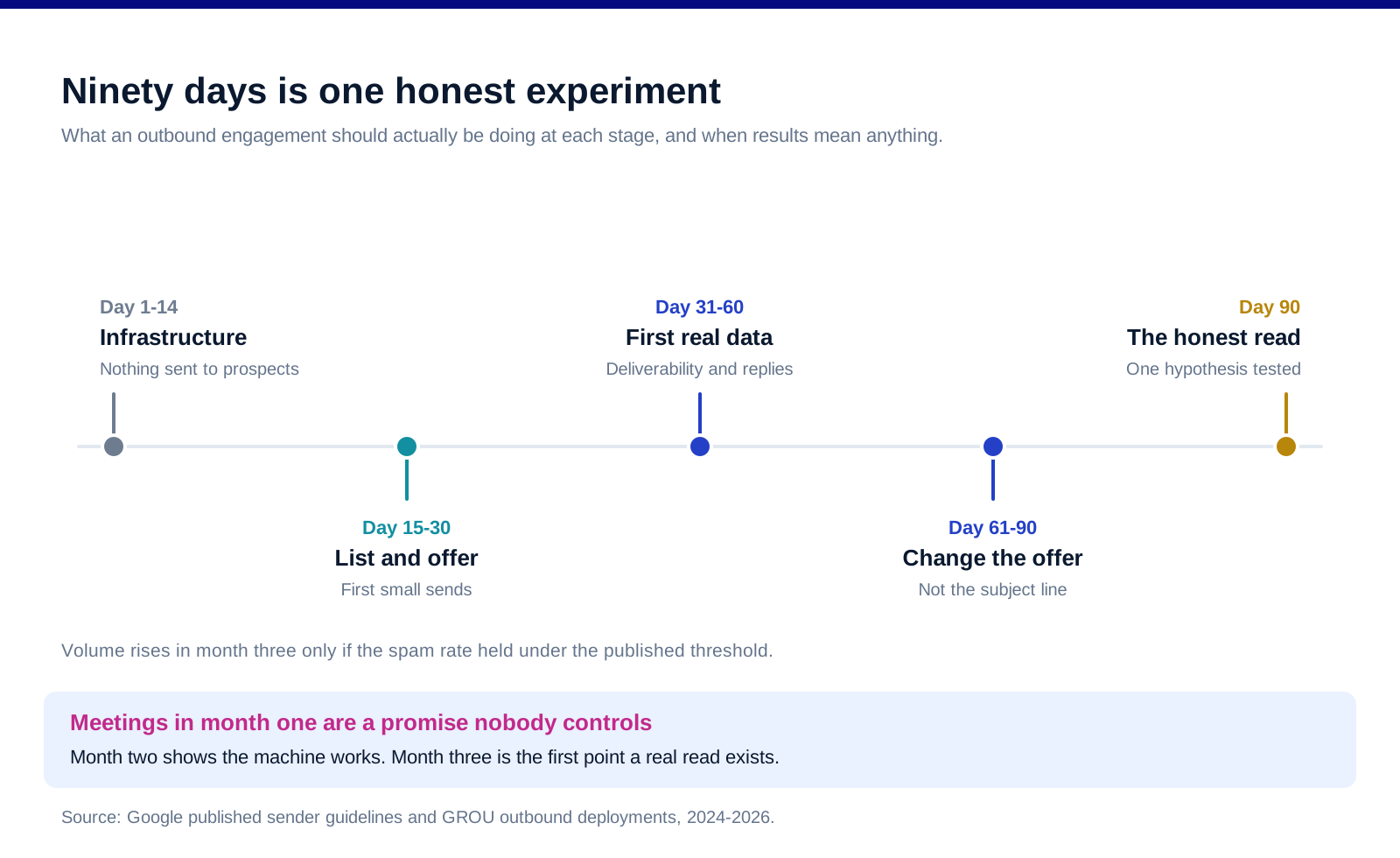
Weeks one and two are domains, DNS and warm-up, not prospects. Google requires bulk senders to set up SPF, DKIM and DMARC, to keep spam rates reported in Postmaster Tools "below 0.10% and avoid ever reaching a spam rate of 0.30% or higher", and to support one-click unsubscribe on marketing messages, with the bulk threshold set at 5,000 or more messages a day to Gmail. Google's own guidance is to "Start with a low sending volume to engaged users, and slowly increase the volume over time", which is why volume in month one is deliberately small. Weeks three and four are the list and the offer. Month two produces the first data worth reading, and it is deliverability and reply quality rather than meetings. Month three is where you change the offer, not the copy, because copy iteration on a wrong offer produces nothing. Judge the agency at day 30 on whether the infrastructure is right and the ICP is written down, at day 60 on whether replies are being classified rather than counted, and at day 90 on whether anything has been genuinely changed rather than merely tuned.
Days 1 to 14: nothing goes to a prospect
Separate domains get bought, and your main domain stays out of it. Sending cold volume from the domain your invoices and support come from is the one mistake with a consequence you cannot buy your way out of afterwards.
Authentication gets configured before anything sends. Google's sender guidelines require senders of 5,000 or more messages a day to Gmail to "Set up SPF and DKIM email authentication for your domain" and to "Set up DMARC email authentication for your sending domain". All senders need at least SPF or DKIM.
Warm-up starts and it is not instant. Google's instruction is to "Start with a low sending volume to engaged users, and slowly increase the volume over time". Any agency that jumps to full volume in week one is ignoring the published guidance of the largest mailbox provider you are trying to reach.
Postmaster Tools gets connected on day one, not month two. The spam rate thresholds are stated as a number: keep it "below 0.10% and avoid ever reaching a spam rate of 0.30% or higher". You cannot manage against that number without the tool that reports it.
One-click unsubscribe gets built in from the first send. Google requires marketing and subscribed messages to "support one-click unsubscribe, and include a clearly visible unsubscribe link in the message body". It is a defined standard rather than a preference: RFC 8058 is an IETF Internet Standards Track document specifying the List-Unsubscribe and List-Unsubscribe-Post headers, and it requires that "The unsubscription process has to work without manual intervention". Adding this later, after a complaint, is the expensive order to do it in.
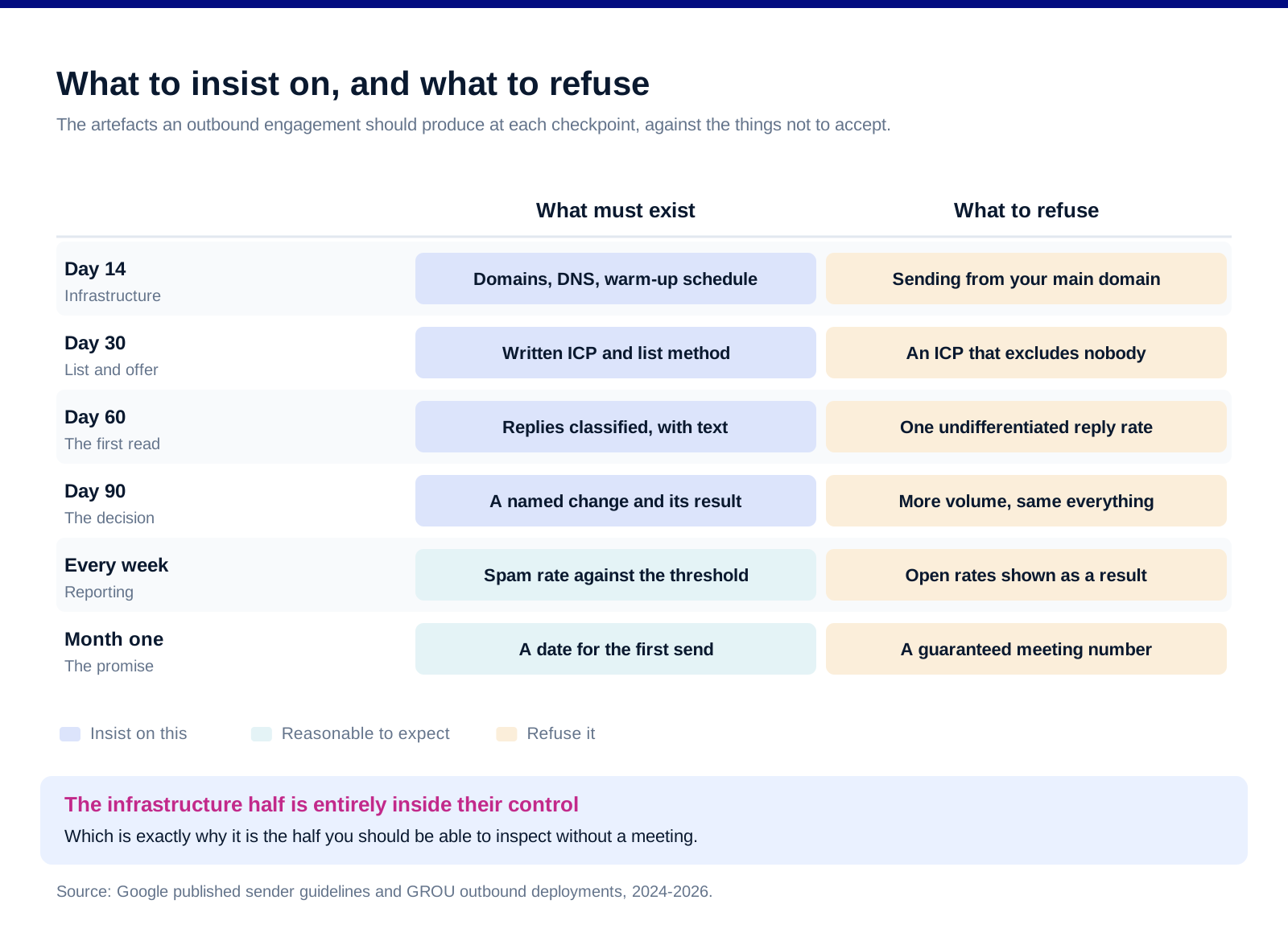
What you should see at day 14. A list of the domains and inboxes, the DNS records in place, a warm-up schedule, and a date when the first prospect email will send. Our deliverability guide covers the underlying mechanics if you want to check the work yourself.
Days 15 to 30: the list and the offer
The ICP gets written down in a form that excludes people. A definition that does not rule anybody out is not a definition. If the agency's ICP document would accept most of your addressable market, push back before a single list is built.
The list gets built against that definition, not around it. The failure mode here is a list assembled from whatever the data provider returns easily, then retro-fitted to the ICP. Ask which filters produced the list and which accounts were excluded.
The offer gets decided, and it is not your service. What goes in the first email is a specific reason to reply, and it is a smaller thing than what you sell. Our briefing guide covers how much of this you have to supply rather than expect the agency to invent.
The legal basis gets stated, not assumed. For UK recipients the ICO's electronic mail marketing guidance states that "You can send unsolicited electronic mail marketing to corporate subscribers without consent or a soft opt-in", which is the rule most B2B outbound quietly relies on and which is worth having written down rather than assumed. It is not a blanket permission and the position differs elsewhere. Our GDPR cold email playbook covers the operator view, and none of this is legal advice.
Sending starts small and stays small. First sends should be a fraction of the eventual volume, aimed at the cleanest segment of the list, because early complaint rates are the thing that decides whether month three is possible.
What you should see at day 30. A written ICP, a list with a stated build method, a first sequence, a legal basis on the record, and mail landing in inboxes. Not meetings.
Days 31 to 60: the first data worth reading
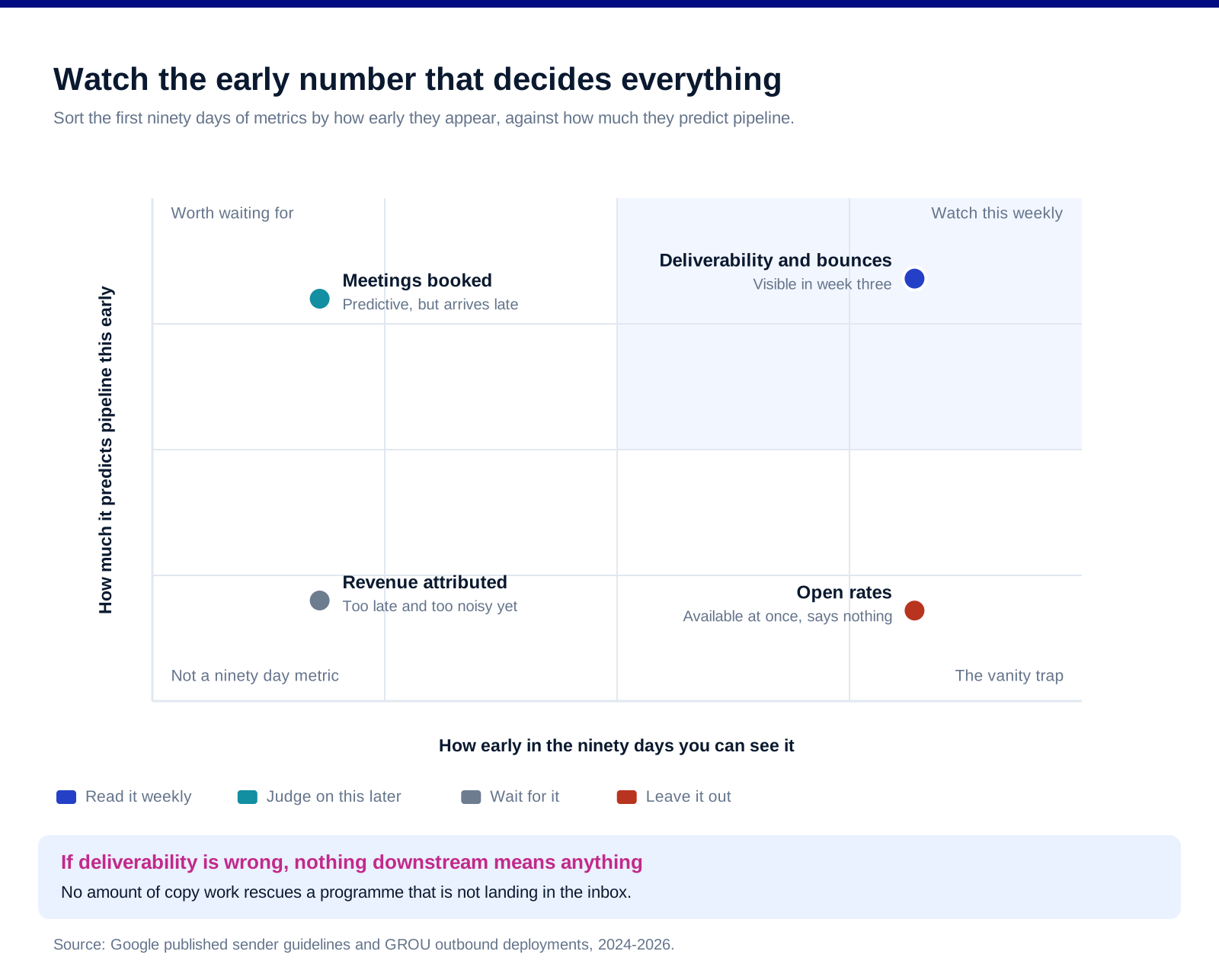
Deliverability first, every week. Bounce rate, spam rate against the two published thresholds, and whether replies are arriving at all. If this is wrong, nothing downstream means anything and no amount of copy work will rescue it.
Replies get classified, not counted. A positive reply, a referral to somebody else, a not now with a date, a wrong person and a hostile reply are five different results. An agency reporting a single reply rate is not learning anything from the month.
Negative replies are data, and you want to see them. A run of "we already have this" tells you something specific about the offer. A run of "who are you" tells you something specific about the targeting. Ask for the actual text.
Open rates should not appear in the report at all. They have been unreliable since mail privacy protection became widespread, and their presence in a month two report tells you what the agency wants you to look at.
The first real meetings usually land here, and they are not the point yet. A handful of meetings in month two is a signal that the machine works, not evidence that the offer is right. The sample is too small to conclude anything and any agency treating it as proof is selling.
What you should see at day 60. A deliverability report with numbers against the published thresholds, replies broken into categories with examples, and a written statement of what will change next and why.
Days 61 to 90: change the offer, not the copy
Subject line tests are not iteration. If the offer is wrong, every version of the copy is wrong, and rotating subject lines produces the appearance of work without the possibility of a different result.
The three things actually worth changing are the segment, the offer and the ask. A narrower segment, a more specific reason to reply, or a smaller first commitment. In that order, because segment changes are the cheapest to test and the most likely to move the number.
Volume increases here, if and only if deliverability held. Month three is the first point at which scaling is a decision rather than a gamble, and it should be tied to the spam rate number rather than to your impatience or theirs.
The channel mix gets revisited. If email is producing replies but not meetings, the problem is the ask. If email is producing nothing while the same accounts engage on LinkedIn, the problem is the channel.
And the account list gets pruned. Ninety days of sending tells you which segments never reply, and continuing to send to them is the most common quiet waste in an outbound programme.
What you should see at day 90. A named change that was made and its result, a deliverability trend rather than a snapshot, a pipeline number with the caveats attached, and a recommendation for the next quarter that is not simply more of the same.
What to hold them to, and what is not fair
Fair: infrastructure done properly and on the record. Domains, DNS, warm-up schedule and Postmaster Tools connected. This is not negotiable and it is entirely within their control.
Fair: a written ICP and a stated list build method. You are entitled to know how the list was made and to disagree with it.
Fair: replies classified with examples. The raw text of negative replies is the most useful artefact produced in the first 90 days.
Not fair: a meeting number in month one. Nobody controls whether a specific stranger books a call in a specific month, and an agency that commits to it in week one either has a mechanism you should question or is telling you what you want to hear. Our pricing models piece covers what happens commercially when that promise is made.
Not fair: blaming your market for a deliverability failure. These are separable and the numbers separate them.
Not fair either: changing the ICP every fortnight because month one was quiet. Ninety days is roughly the minimum honest test of one hypothesis, and restarting the clock repeatedly is how a year gets spent on nothing.
What we do not publish here
Reply, meeting or conversion benchmarks for month one, two or three. Ours come from our own client mix and offers and would not predict yours, and the public ones come from companies selling sending software.
A recommended number of domains or inboxes. It depends on your volume, and a number here would be copied without the volume it belongs to.
A warm-up duration in days. Google publishes the principle rather than a schedule, and every specific figure in circulation is a vendor's rule of thumb rather than a documented requirement.
A pipeline figure you should expect at day 90. That is a function of your contract value and market, not of the method.
FAQ
How long before an outbound agency produces meetings?
Longer than most contracts imply. The first two weeks are domains, DNS and warm-up with nothing sent to prospects, because Google's guidance is to start at low volume and increase slowly. First meetings commonly appear in month two and are too small a sample to conclude anything from. Month three is the first point where a real read is available.
What should happen in week one with an outbound agency?
Separate sending domains bought, SPF, DKIM and DMARC configured, inboxes created, warm-up started, Postmaster Tools connected and one-click unsubscribe built into the templates. No prospect receives anything in week one.
What should you refuse to accept in the first 90 days?
A meeting commitment in month one, open rates presented as a result, a single undifferentiated reply rate, sending from your primary domain, and an ICP document that does not exclude anybody. Each of those is either a risk taken with your asset or a report designed to avoid a conclusion.
How do you know if the problem is the list or the copy?
Look at the replies rather than the rate. Hostile or confused replies point at targeting. Polite "we already have this" replies point at the offer. Silence with good deliverability points at the offer or the ask. Silence with bad deliverability points at neither, and nothing can be concluded until that is fixed.
Should you increase volume in month two?
Only if the spam rate is holding well under the published thresholds and bounces are low. Google's guidance is to increase slowly from a low base, and month two is usually too early to scale hard. Tying the increase to the spam rate number rather than to the calendar is the discipline that keeps month three possible.
What is a reasonable thing to change at day 90?
The segment, the offer or the size of the ask, in that order. Not the subject lines. If the agency's day 90 recommendation is more sending volume with the same targeting and the same offer, ask what they learned in the previous 60 days that supports it.
Bottom line
Treat the first 90 days as an infrastructure project followed by a single honest experiment. The infrastructure part is entirely in the agency's control, is documented by the mailbox providers, and should be inspectable by you at day 14 without a meeting. The experiment part is not fully in anyone's control, which is exactly why the thing to hold them to is the quality of the reasoning rather than a meeting count. Ask for classified replies with the actual text, ask what will change and why, and ask them to name the one thing they would change if the next 30 days go the same way. An agency that can answer those three questions at day 60 is worth the next quarter. One that answers with a subject line test is not.
Want this run properly rather than explained? Book a call with GROU. We run outbound and lead generation inside B2B revenue engines across verticals. If you are still choosing, our briefing guide covers what to send an agency before they quote.
We are GROU, a B2B pipeline agency that runs lead generation, outbound, and LinkedIn content for clients across manufacturing, fintech, iGaming, software, and professional services. Nothing in this article is legal advice, the deliverability requirements quoted come from Google's own published sender guidelines, and the 90 day structure reflects our own outbound deployments between 2024 and 2026, anonymized to protect client confidentiality.
If an agency tells you meetings will start in week two, one of two things is true. They are sending from your existing domain, which is a risk they are taking with your business rather than theirs, or they are not telling you the truth about the timeline.
The first 90 days of an outbound programme are mostly infrastructure and iteration. That is not an excuse, it is a description of what the mail providers now require, and it is published.
TL;DR
Weeks one and two are domains, DNS and warm-up, not prospects. Google requires bulk senders to set up SPF, DKIM and DMARC, to keep spam rates reported in Postmaster Tools "below 0.10% and avoid ever reaching a spam rate of 0.30% or higher", and to support one-click unsubscribe on marketing messages, with the bulk threshold set at 5,000 or more messages a day to Gmail. Google's own guidance is to "Start with a low sending volume to engaged users, and slowly increase the volume over time", which is why volume in month one is deliberately small. Weeks three and four are the list and the offer. Month two produces the first data worth reading, and it is deliverability and reply quality rather than meetings. Month three is where you change the offer, not the copy, because copy iteration on a wrong offer produces nothing. Judge the agency at day 30 on whether the infrastructure is right and the ICP is written down, at day 60 on whether replies are being classified rather than counted, and at day 90 on whether anything has been genuinely changed rather than merely tuned.
Days 1 to 14: nothing goes to a prospect
Separate domains get bought, and your main domain stays out of it. Sending cold volume from the domain your invoices and support come from is the one mistake with a consequence you cannot buy your way out of afterwards.
Authentication gets configured before anything sends. Google's sender guidelines require senders of 5,000 or more messages a day to Gmail to "Set up SPF and DKIM email authentication for your domain" and to "Set up DMARC email authentication for your sending domain". All senders need at least SPF or DKIM.
Warm-up starts and it is not instant. Google's instruction is to "Start with a low sending volume to engaged users, and slowly increase the volume over time". Any agency that jumps to full volume in week one is ignoring the published guidance of the largest mailbox provider you are trying to reach.
Postmaster Tools gets connected on day one, not month two. The spam rate thresholds are stated as a number: keep it "below 0.10% and avoid ever reaching a spam rate of 0.30% or higher". You cannot manage against that number without the tool that reports it.
One-click unsubscribe gets built in from the first send. Google requires marketing and subscribed messages to "support one-click unsubscribe, and include a clearly visible unsubscribe link in the message body". It is a defined standard rather than a preference: RFC 8058 is an IETF Internet Standards Track document specifying the List-Unsubscribe and List-Unsubscribe-Post headers, and it requires that "The unsubscription process has to work without manual intervention". Adding this later, after a complaint, is the expensive order to do it in.
What you should see at day 14. A list of the domains and inboxes, the DNS records in place, a warm-up schedule, and a date when the first prospect email will send. Our deliverability guide covers the underlying mechanics if you want to check the work yourself.
Days 15 to 30: the list and the offer
The ICP gets written down in a form that excludes people. A definition that does not rule anybody out is not a definition. If the agency's ICP document would accept most of your addressable market, push back before a single list is built.
The list gets built against that definition, not around it. The failure mode here is a list assembled from whatever the data provider returns easily, then retro-fitted to the ICP. Ask which filters produced the list and which accounts were excluded.
The offer gets decided, and it is not your service. What goes in the first email is a specific reason to reply, and it is a smaller thing than what you sell. Our briefing guide covers how much of this you have to supply rather than expect the agency to invent.
The legal basis gets stated, not assumed. For UK recipients the ICO's electronic mail marketing guidance states that "You can send unsolicited electronic mail marketing to corporate subscribers without consent or a soft opt-in", which is the rule most B2B outbound quietly relies on and which is worth having written down rather than assumed. It is not a blanket permission and the position differs elsewhere. Our GDPR cold email playbook covers the operator view, and none of this is legal advice.
Sending starts small and stays small. First sends should be a fraction of the eventual volume, aimed at the cleanest segment of the list, because early complaint rates are the thing that decides whether month three is possible.
What you should see at day 30. A written ICP, a list with a stated build method, a first sequence, a legal basis on the record, and mail landing in inboxes. Not meetings.
Days 31 to 60: the first data worth reading
Deliverability first, every week. Bounce rate, spam rate against the two published thresholds, and whether replies are arriving at all. If this is wrong, nothing downstream means anything and no amount of copy work will rescue it.
Replies get classified, not counted. A positive reply, a referral to somebody else, a not now with a date, a wrong person and a hostile reply are five different results. An agency reporting a single reply rate is not learning anything from the month.
Negative replies are data, and you want to see them. A run of "we already have this" tells you something specific about the offer. A run of "who are you" tells you something specific about the targeting. Ask for the actual text.
Open rates should not appear in the report at all. They have been unreliable since mail privacy protection became widespread, and their presence in a month two report tells you what the agency wants you to look at.
The first real meetings usually land here, and they are not the point yet. A handful of meetings in month two is a signal that the machine works, not evidence that the offer is right. The sample is too small to conclude anything and any agency treating it as proof is selling.
What you should see at day 60. A deliverability report with numbers against the published thresholds, replies broken into categories with examples, and a written statement of what will change next and why.
Days 61 to 90: change the offer, not the copy
Subject line tests are not iteration. If the offer is wrong, every version of the copy is wrong, and rotating subject lines produces the appearance of work without the possibility of a different result.
The three things actually worth changing are the segment, the offer and the ask. A narrower segment, a more specific reason to reply, or a smaller first commitment. In that order, because segment changes are the cheapest to test and the most likely to move the number.
Volume increases here, if and only if deliverability held. Month three is the first point at which scaling is a decision rather than a gamble, and it should be tied to the spam rate number rather than to your impatience or theirs.
The channel mix gets revisited. If email is producing replies but not meetings, the problem is the ask. If email is producing nothing while the same accounts engage on LinkedIn, the problem is the channel.
And the account list gets pruned. Ninety days of sending tells you which segments never reply, and continuing to send to them is the most common quiet waste in an outbound programme.
What you should see at day 90. A named change that was made and its result, a deliverability trend rather than a snapshot, a pipeline number with the caveats attached, and a recommendation for the next quarter that is not simply more of the same.
What to hold them to, and what is not fair
Fair: infrastructure done properly and on the record. Domains, DNS, warm-up schedule and Postmaster Tools connected. This is not negotiable and it is entirely within their control.
Fair: a written ICP and a stated list build method. You are entitled to know how the list was made and to disagree with it.
Fair: replies classified with examples. The raw text of negative replies is the most useful artefact produced in the first 90 days.
Not fair: a meeting number in month one. Nobody controls whether a specific stranger books a call in a specific month, and an agency that commits to it in week one either has a mechanism you should question or is telling you what you want to hear. Our pricing models piece covers what happens commercially when that promise is made.
Not fair: blaming your market for a deliverability failure. These are separable and the numbers separate them.
Not fair either: changing the ICP every fortnight because month one was quiet. Ninety days is roughly the minimum honest test of one hypothesis, and restarting the clock repeatedly is how a year gets spent on nothing.
What we do not publish here
Reply, meeting or conversion benchmarks for month one, two or three. Ours come from our own client mix and offers and would not predict yours, and the public ones come from companies selling sending software.
A recommended number of domains or inboxes. It depends on your volume, and a number here would be copied without the volume it belongs to.
A warm-up duration in days. Google publishes the principle rather than a schedule, and every specific figure in circulation is a vendor's rule of thumb rather than a documented requirement.
A pipeline figure you should expect at day 90. That is a function of your contract value and market, not of the method.
FAQ
How long before an outbound agency produces meetings?
Longer than most contracts imply. The first two weeks are domains, DNS and warm-up with nothing sent to prospects, because Google's guidance is to start at low volume and increase slowly. First meetings commonly appear in month two and are too small a sample to conclude anything from. Month three is the first point where a real read is available.
What should happen in week one with an outbound agency?
Separate sending domains bought, SPF, DKIM and DMARC configured, inboxes created, warm-up started, Postmaster Tools connected and one-click unsubscribe built into the templates. No prospect receives anything in week one.
What should you refuse to accept in the first 90 days?
A meeting commitment in month one, open rates presented as a result, a single undifferentiated reply rate, sending from your primary domain, and an ICP document that does not exclude anybody. Each of those is either a risk taken with your asset or a report designed to avoid a conclusion.
How do you know if the problem is the list or the copy?
Look at the replies rather than the rate. Hostile or confused replies point at targeting. Polite "we already have this" replies point at the offer. Silence with good deliverability points at the offer or the ask. Silence with bad deliverability points at neither, and nothing can be concluded until that is fixed.
Should you increase volume in month two?
Only if the spam rate is holding well under the published thresholds and bounces are low. Google's guidance is to increase slowly from a low base, and month two is usually too early to scale hard. Tying the increase to the spam rate number rather than to the calendar is the discipline that keeps month three possible.
What is a reasonable thing to change at day 90?
The segment, the offer or the size of the ask, in that order. Not the subject lines. If the agency's day 90 recommendation is more sending volume with the same targeting and the same offer, ask what they learned in the previous 60 days that supports it.
Bottom line
Treat the first 90 days as an infrastructure project followed by a single honest experiment. The infrastructure part is entirely in the agency's control, is documented by the mailbox providers, and should be inspectable by you at day 14 without a meeting. The experiment part is not fully in anyone's control, which is exactly why the thing to hold them to is the quality of the reasoning rather than a meeting count. Ask for classified replies with the actual text, ask what will change and why, and ask them to name the one thing they would change if the next 30 days go the same way. An agency that can answer those three questions at day 60 is worth the next quarter. One that answers with a subject line test is not.
Want this run properly rather than explained? Book a call with GROU. We run outbound and lead generation inside B2B revenue engines across verticals. If you are still choosing, our briefing guide covers what to send an agency before they quote.
We are GROU, a B2B pipeline agency that runs lead generation, outbound, and LinkedIn content for clients across manufacturing, fintech, iGaming, software, and professional services. Nothing in this article is legal advice, the deliverability requirements quoted come from Google's own published sender guidelines, and the 90 day structure reflects our own outbound deployments between 2024 and 2026, anonymized to protect client confidentiality.
If an agency tells you meetings will start in week two, one of two things is true. They are sending from your existing domain, which is a risk they are taking with your business rather than theirs, or they are not telling you the truth about the timeline.
The first 90 days of an outbound programme are mostly infrastructure and iteration. That is not an excuse, it is a description of what the mail providers now require, and it is published.
TL;DR
Weeks one and two are domains, DNS and warm-up, not prospects. Google requires bulk senders to set up SPF, DKIM and DMARC, to keep spam rates reported in Postmaster Tools "below 0.10% and avoid ever reaching a spam rate of 0.30% or higher", and to support one-click unsubscribe on marketing messages, with the bulk threshold set at 5,000 or more messages a day to Gmail. Google's own guidance is to "Start with a low sending volume to engaged users, and slowly increase the volume over time", which is why volume in month one is deliberately small. Weeks three and four are the list and the offer. Month two produces the first data worth reading, and it is deliverability and reply quality rather than meetings. Month three is where you change the offer, not the copy, because copy iteration on a wrong offer produces nothing. Judge the agency at day 30 on whether the infrastructure is right and the ICP is written down, at day 60 on whether replies are being classified rather than counted, and at day 90 on whether anything has been genuinely changed rather than merely tuned.
Days 1 to 14: nothing goes to a prospect
Separate domains get bought, and your main domain stays out of it. Sending cold volume from the domain your invoices and support come from is the one mistake with a consequence you cannot buy your way out of afterwards.
Authentication gets configured before anything sends. Google's sender guidelines require senders of 5,000 or more messages a day to Gmail to "Set up SPF and DKIM email authentication for your domain" and to "Set up DMARC email authentication for your sending domain". All senders need at least SPF or DKIM.
Warm-up starts and it is not instant. Google's instruction is to "Start with a low sending volume to engaged users, and slowly increase the volume over time". Any agency that jumps to full volume in week one is ignoring the published guidance of the largest mailbox provider you are trying to reach.
Postmaster Tools gets connected on day one, not month two. The spam rate thresholds are stated as a number: keep it "below 0.10% and avoid ever reaching a spam rate of 0.30% or higher". You cannot manage against that number without the tool that reports it.
One-click unsubscribe gets built in from the first send. Google requires marketing and subscribed messages to "support one-click unsubscribe, and include a clearly visible unsubscribe link in the message body". It is a defined standard rather than a preference: RFC 8058 is an IETF Internet Standards Track document specifying the List-Unsubscribe and List-Unsubscribe-Post headers, and it requires that "The unsubscription process has to work without manual intervention". Adding this later, after a complaint, is the expensive order to do it in.
What you should see at day 14. A list of the domains and inboxes, the DNS records in place, a warm-up schedule, and a date when the first prospect email will send. Our deliverability guide covers the underlying mechanics if you want to check the work yourself.
Days 15 to 30: the list and the offer
The ICP gets written down in a form that excludes people. A definition that does not rule anybody out is not a definition. If the agency's ICP document would accept most of your addressable market, push back before a single list is built.
The list gets built against that definition, not around it. The failure mode here is a list assembled from whatever the data provider returns easily, then retro-fitted to the ICP. Ask which filters produced the list and which accounts were excluded.
The offer gets decided, and it is not your service. What goes in the first email is a specific reason to reply, and it is a smaller thing than what you sell. Our briefing guide covers how much of this you have to supply rather than expect the agency to invent.
The legal basis gets stated, not assumed. For UK recipients the ICO's electronic mail marketing guidance states that "You can send unsolicited electronic mail marketing to corporate subscribers without consent or a soft opt-in", which is the rule most B2B outbound quietly relies on and which is worth having written down rather than assumed. It is not a blanket permission and the position differs elsewhere. Our GDPR cold email playbook covers the operator view, and none of this is legal advice.
Sending starts small and stays small. First sends should be a fraction of the eventual volume, aimed at the cleanest segment of the list, because early complaint rates are the thing that decides whether month three is possible.
What you should see at day 30. A written ICP, a list with a stated build method, a first sequence, a legal basis on the record, and mail landing in inboxes. Not meetings.
Days 31 to 60: the first data worth reading
Deliverability first, every week. Bounce rate, spam rate against the two published thresholds, and whether replies are arriving at all. If this is wrong, nothing downstream means anything and no amount of copy work will rescue it.
Replies get classified, not counted. A positive reply, a referral to somebody else, a not now with a date, a wrong person and a hostile reply are five different results. An agency reporting a single reply rate is not learning anything from the month.
Negative replies are data, and you want to see them. A run of "we already have this" tells you something specific about the offer. A run of "who are you" tells you something specific about the targeting. Ask for the actual text.
Open rates should not appear in the report at all. They have been unreliable since mail privacy protection became widespread, and their presence in a month two report tells you what the agency wants you to look at.
The first real meetings usually land here, and they are not the point yet. A handful of meetings in month two is a signal that the machine works, not evidence that the offer is right. The sample is too small to conclude anything and any agency treating it as proof is selling.
What you should see at day 60. A deliverability report with numbers against the published thresholds, replies broken into categories with examples, and a written statement of what will change next and why.
Days 61 to 90: change the offer, not the copy
Subject line tests are not iteration. If the offer is wrong, every version of the copy is wrong, and rotating subject lines produces the appearance of work without the possibility of a different result.
The three things actually worth changing are the segment, the offer and the ask. A narrower segment, a more specific reason to reply, or a smaller first commitment. In that order, because segment changes are the cheapest to test and the most likely to move the number.
Volume increases here, if and only if deliverability held. Month three is the first point at which scaling is a decision rather than a gamble, and it should be tied to the spam rate number rather than to your impatience or theirs.
The channel mix gets revisited. If email is producing replies but not meetings, the problem is the ask. If email is producing nothing while the same accounts engage on LinkedIn, the problem is the channel.
And the account list gets pruned. Ninety days of sending tells you which segments never reply, and continuing to send to them is the most common quiet waste in an outbound programme.
What you should see at day 90. A named change that was made and its result, a deliverability trend rather than a snapshot, a pipeline number with the caveats attached, and a recommendation for the next quarter that is not simply more of the same.
What to hold them to, and what is not fair
Fair: infrastructure done properly and on the record. Domains, DNS, warm-up schedule and Postmaster Tools connected. This is not negotiable and it is entirely within their control.
Fair: a written ICP and a stated list build method. You are entitled to know how the list was made and to disagree with it.
Fair: replies classified with examples. The raw text of negative replies is the most useful artefact produced in the first 90 days.
Not fair: a meeting number in month one. Nobody controls whether a specific stranger books a call in a specific month, and an agency that commits to it in week one either has a mechanism you should question or is telling you what you want to hear. Our pricing models piece covers what happens commercially when that promise is made.
Not fair: blaming your market for a deliverability failure. These are separable and the numbers separate them.
Not fair either: changing the ICP every fortnight because month one was quiet. Ninety days is roughly the minimum honest test of one hypothesis, and restarting the clock repeatedly is how a year gets spent on nothing.
What we do not publish here
Reply, meeting or conversion benchmarks for month one, two or three. Ours come from our own client mix and offers and would not predict yours, and the public ones come from companies selling sending software.
A recommended number of domains or inboxes. It depends on your volume, and a number here would be copied without the volume it belongs to.
A warm-up duration in days. Google publishes the principle rather than a schedule, and every specific figure in circulation is a vendor's rule of thumb rather than a documented requirement.
A pipeline figure you should expect at day 90. That is a function of your contract value and market, not of the method.
FAQ
How long before an outbound agency produces meetings?
Longer than most contracts imply. The first two weeks are domains, DNS and warm-up with nothing sent to prospects, because Google's guidance is to start at low volume and increase slowly. First meetings commonly appear in month two and are too small a sample to conclude anything from. Month three is the first point where a real read is available.
What should happen in week one with an outbound agency?
Separate sending domains bought, SPF, DKIM and DMARC configured, inboxes created, warm-up started, Postmaster Tools connected and one-click unsubscribe built into the templates. No prospect receives anything in week one.
What should you refuse to accept in the first 90 days?
A meeting commitment in month one, open rates presented as a result, a single undifferentiated reply rate, sending from your primary domain, and an ICP document that does not exclude anybody. Each of those is either a risk taken with your asset or a report designed to avoid a conclusion.
How do you know if the problem is the list or the copy?
Look at the replies rather than the rate. Hostile or confused replies point at targeting. Polite "we already have this" replies point at the offer. Silence with good deliverability points at the offer or the ask. Silence with bad deliverability points at neither, and nothing can be concluded until that is fixed.
Should you increase volume in month two?
Only if the spam rate is holding well under the published thresholds and bounces are low. Google's guidance is to increase slowly from a low base, and month two is usually too early to scale hard. Tying the increase to the spam rate number rather than to the calendar is the discipline that keeps month three possible.
What is a reasonable thing to change at day 90?
The segment, the offer or the size of the ask, in that order. Not the subject lines. If the agency's day 90 recommendation is more sending volume with the same targeting and the same offer, ask what they learned in the previous 60 days that supports it.
Bottom line
Treat the first 90 days as an infrastructure project followed by a single honest experiment. The infrastructure part is entirely in the agency's control, is documented by the mailbox providers, and should be inspectable by you at day 14 without a meeting. The experiment part is not fully in anyone's control, which is exactly why the thing to hold them to is the quality of the reasoning rather than a meeting count. Ask for classified replies with the actual text, ask what will change and why, and ask them to name the one thing they would change if the next 30 days go the same way. An agency that can answer those three questions at day 60 is worth the next quarter. One that answers with a subject line test is not.
Want this run properly rather than explained? Book a call with GROU. We run outbound and lead generation inside B2B revenue engines across verticals. If you are still choosing, our briefing guide covers what to send an agency before they quote.
We are GROU, a B2B pipeline agency that runs lead generation, outbound, and LinkedIn content for clients across manufacturing, fintech, iGaming, software, and professional services. Nothing in this article is legal advice, the deliverability requirements quoted come from Google's own published sender guidelines, and the 90 day structure reflects our own outbound deployments between 2024 and 2026, anonymized to protect client confidentiality.

Pipeline OS Newsletter
Build qualified pipeline
Get weekly tactics to generate demand, improve lead quality, and book more meetings.





Trusted by industry leaders
Trusted by industry leaders
Trusted by industry leaders
Ready to build qualified pipeline?
Ready to build qualified pipeline?
Ready to build qualified pipeline?
Book a call to see if we're the right fit, or take the 2-minute quiz to get a clear starting point.
Book a call to see if we're the right fit, or take the 2-minute quiz to get a clear starting point.
Book a call to see if we're the right fit, or take the 2-minute quiz to get a clear starting point.
" height="30.21639343089746px" id="hfGbXmQR2" width="30.216393430897455px"/></svg>)
Copyright © 2026 – All Right Reserved
Copyright © 2026 – All Right Reserved
Copyright © 2026 – All Right Reserved