%22%3E%3C/path%3E%3Cpath d=%22M 63.072 7.554 C 62.258 8.022 61.577 8.689 61.092 9.493 L 61.092 7.076 L 57.158 7.076 L 57.158 22.64 L 61.089 22.64 L 61.089 14.888 C 61.089 13.446 61.403 12.434 62.03 11.853 C 62.818 11.218 63.818 10.907 64.826 10.982 L 65.868 10.982 L 65.868 6.851 C 64.891 6.834 63.926 7.076 63.073 7.554 Z%22 fill=%22rgb(17,17,17)%22%3E%3C/path%3E%3Cpath d=%22M 78.916 7.82 C 76.363 6.49 73.321 6.49 70.768 7.82 C 69.562 8.473 68.564 9.451 67.888 10.644 C 67.167 11.931 66.803 13.387 66.834 14.862 C 66.804 16.332 67.157 17.785 67.86 19.077 C 68.515 20.267 69.494 21.246 70.684 21.901 C 71.924 22.576 73.318 22.92 74.73 22.898 C 76.164 22.918 77.58 22.575 78.846 21.901 C 80.062 21.247 81.073 20.27 81.768 19.077 C 82.506 17.797 82.88 16.339 82.85 14.862 C 82.88 13.389 82.517 11.934 81.797 10.647 C 81.12 9.455 80.122 8.477 78.917 7.824 M 78.803 14.862 C 78.829 15.739 78.636 16.608 78.241 17.391 C 77.903 18.046 77.38 18.588 76.738 18.95 C 76.124 19.293 75.432 19.472 74.729 19.47 C 73.668 19.497 72.648 19.061 71.934 18.276 C 71.139 17.323 70.741 16.1 70.823 14.862 C 70.741 13.62 71.149 12.395 71.959 11.45 C 72.687 10.667 73.715 10.233 74.783 10.256 C 75.859 10.236 76.894 10.67 77.635 11.45 C 78.464 12.387 78.884 13.616 78.801 14.864%22 fill=%22rgb(17,17,17)%22%3E%3C/path%3E%3Cpath d=%22M 95.906 7.076 L 95.906 15.646 C 95.975 16.68 95.643 17.701 94.979 18.498 C 94.311 19.184 93.379 19.547 92.422 19.495 C 91.475 19.544 90.553 19.18 89.894 18.498 C 89.23 17.701 88.898 16.68 88.967 15.646 L 88.967 7.076 L 85.033 7.076 L 85.033 16.207 C 85 17.449 85.275 18.68 85.834 19.79 C 86.327 20.75 87.095 21.542 88.039 22.065 C 89.033 22.594 90.145 22.861 91.271 22.838 C 92.188 22.847 93.095 22.65 93.926 22.263 C 94.708 21.905 95.388 21.36 95.906 20.675 L 95.906 22.645 L 99.865 22.645 L 99.865 7.076 Z%22 fill=%22rgb(17,17,17)%22%3E%3C/path%3E%3Cpath d=%22M 4.513 15.626 C 4.511 10.815 7.606 6.549 12.181 5.059 C 16.756 3.57 21.77 5.195 24.601 9.086 L 27.816 5.87 C 24.074 1.186 17.981 -0.943 12.137 0.393 C 6.292 1.728 1.728 6.292 0.393 12.137 C -0.943 17.981 1.186 24.074 5.87 27.816 L 9.085 24.601 C 6.214 22.512 4.515 19.177 4.513 15.626%22 fill=%22rgb(32,62,235)%22%3E%3C/path%3E%3Cpath d=%22M 17.114 14.343 L 13.354 18.01 L 13.354 18.026 L 21.071 18.026 L 11.412 27.609 L 17.389 27.609 L 23.999 21.081 L 23.999 28.316 L 24.005 28.316 L 27.967 24.393 L 27.967 14.343 Z%22 fill=%22rgb(32,62,235)%22%3E%3C/path%3E%3C/g%3E%3C/svg%3E) ×
× ××
××›
›
›
›
Top Lead Generation Companies Compared
Top Lead Generation Companies Compared
Top Lead Generation Companies Compared
Top Lead Generation Companies Compared
Top Lead Generation Companies Compared
Top Lead Generation Companies Compared

Author
Aljaz Peklaj

You're usually here after the same expensive mistake. An agency booked meetings, sales called them junk, reporting turned into a debate, and pipeline forecasts got softer instead of clearer.
That pattern is common because many lead generation companies sell motion without building a system. They run outbound apart from paid, treat contact volume as progress, and hand off names without enough context for sales to close. Buyers rarely convert from a single touch, so your website, content, email, retargeting, and outbound need to work together. HubSpot's State of Marketing has consistently shown that marketers rely on a mix of owned and paid channels to generate demand. Any agency that only talks about booked meetings is solving too small a part of the problem.
Use a buyer's framework instead of chasing a generic top 10 list.
The right partner depends on your sales motion. A mid-market SaaS team that needs outbound pipeline, a manufacturer expanding into North America, and a B2B company trying to connect LinkedIn, email, and paid traffic should not hire the same type of agency. Some firms are appointment setters. Some are outbound operators. A few can build a full demand engine across channels.
That distinction matters. It is the difference between renting activity and building repeatable pipeline.
If you want a baseline for what a modern lead generation agency model should cover, start with service model first, then judge execution. In this guide, the companies are more useful as profiles than as trophies. You'll see which ones fit outbound-heavy programs, which work better for appointment setting, and which are closer to a unified demand generation partner, including why Grou's model stands apart.
Use this 7-point checklist before you sign anything: service model, ICP depth, channel mix, data quality process, meeting qualification standard, reporting tied to pipeline, and ownership of assets like domains, ad accounts, and CRM workflows. If an agency gets vague on any of those, keep looking.
Table of Contents
1. Grou
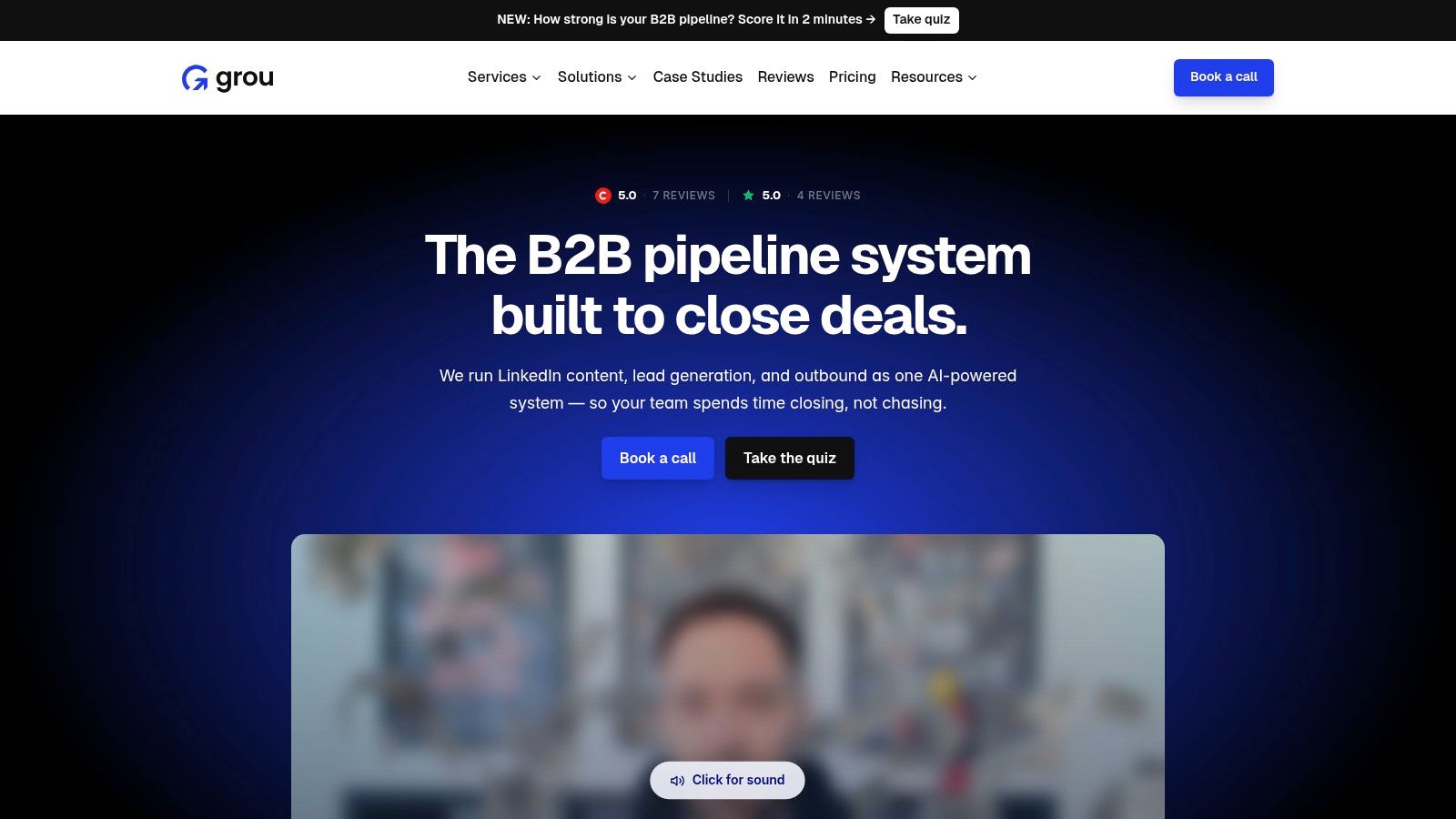
Your team hires an agency to book meetings. Three weeks later, marketing owns LinkedIn, a separate contractor runs cold email, sales complains about lead quality, and RevOps is stuck reconciling reporting. That setup fails for a simple reason. The channels are connected in the buyer journey, but the vendor model is not.
Grou stands out because it runs content, outbound, prospect data, routing, and reporting as one operating system. If you are using this guide as a buyer's framework instead of a generic ranked list, that matters. You should evaluate agencies by service model first, then by execution quality. Grou fits the unified model. One team owns message, audience, execution, and handoff.
Why Grou gets the top spot
The practical advantage is control. Grou builds ICP-based lists, publishes LinkedIn content to warm the market, runs outbound into that same audience, and routes replies with clear qualification rules. Sales gets context with the conversation, not just a calendar invite and a vague source tag.
Speed also matters. Grou launches in about 14 days, then works in bi-weekly sprints with daily Slack feedback. That is the right cadence for outbound. If copy misses, targeting slips, or reply quality drops, you fix it this week, not at the end of a monthly review.
This is also why Grou is a useful reference point for buyers trying to sort agencies by operating model. Their guide to choosing a lead generation partner shows the standard you should apply to any vendor. Ask who owns targeting. Ask who sets qualification logic. Ask how content and outbound inform each other. Ask what happens between reply and pipeline creation. If the answers come from different teams, expect friction.
Use this buyer test: If one partner cannot explain audience selection, messaging, channel execution, routing rules, and reporting in a single workflow, keep looking.
Best fit
Grou fits B2B teams that need a coordinated pipeline program, not a narrow appointment-setting service. That includes founders, sales leaders, marketing leaders, and RevOps operators who care about handoff quality as much as booked meetings.
It makes the most sense in categories where trust builds before the reply. SaaS is one example. Manufacturing and professional services are another. iGaming also fits because timing, offer framing, and audience selection usually matter more than brute-force volume.
Pros and cons, directly:
Best reason to hire them: Unified execution across content, outbound, data, and routing.
Operational upside: Fast setup, tight feedback loops in Slack, and reporting tied to revenue process instead of vanity metrics.
Tradeoff: Pricing is not public, so you need a sales conversation to qualify budget fit.
Another tradeoff: Teams that only want a low-cost cold email vendor will pay for more structure than they need.
Website: Grou
2. Belkins
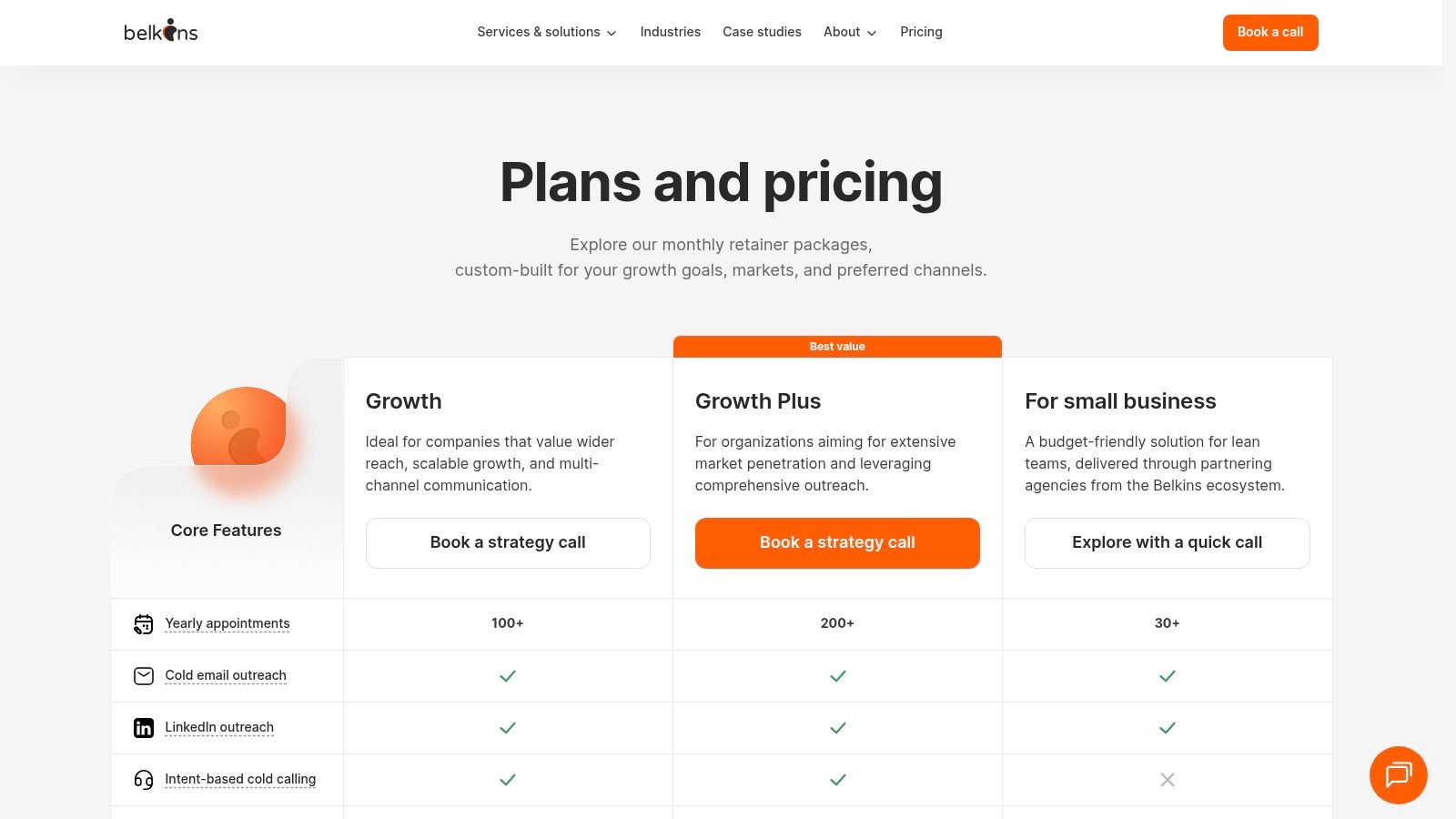
Belkins is the right pick when you want a full-service outbound partner with broad channel coverage and don't want to stitch together separate email, LinkedIn, calling, and booking vendors.
Their operating style is closer to outsourced appointment setting at scale than to a boutique signal-first shop. That's useful if your sales team has enough AE capacity and you need a partner that can stand up a repeatable outbound machine without much internal assembly.
Where Belkins fits
Belkins is strongest for companies that need a single vendor to own research, copy, deliverability, scheduling, and multi-channel execution. If you're trying to build a coordinated outbound motion quickly, that convenience matters.
The practical upside is channel breadth. Email, LinkedIn, calling, and broader campaign options sit under one program, which reduces tool and vendor sprawl. If your team is still learning what a complete outbound operating model should include, Grou's lead generation guide gives a useful reference point for what should be connected behind the scenes.
Belkins also has one of the clearest examples in this market of why data operations matter more than raw volume. In one published case, cleaning, enriching, expanding, and segmenting HubSpot data helped generate $2.7M in pipeline, about 60 appointments in a year, and reduce CPA from $1,700 to $1,100. That is the true lesson. Better inputs usually beat more sends.
Most lead generation companies talk about booked meetings. Fewer explain how they protect list quality, routing quality, and attribution quality.
Website: Belkins pricing
3. CIENCE
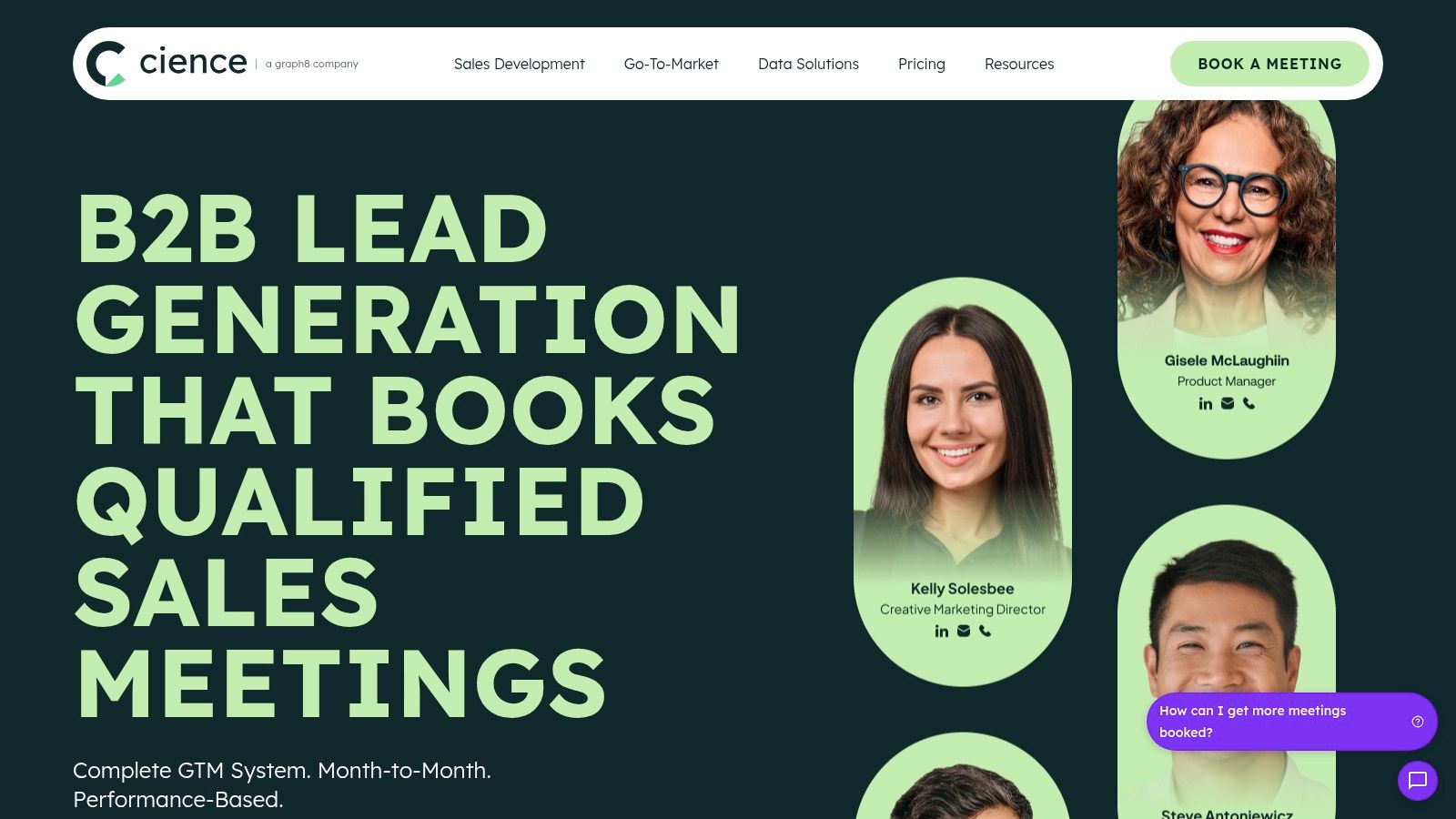
CIENCE is for teams that need scale more than craft. If you're running enterprise outbound, need research support, and want a provider that can handle a bigger operational footprint, CIENCE belongs on the shortlist.
This is not the pick for a founder who needs a sharp pilot in a narrow market. It's the pick for larger go-to-market teams that want process, coverage, and execution capacity.
Where CIENCE fits
CIENCE works best when your problem is throughput and market coverage. They combine data research, outbound execution, and SDR-style delivery in a way that suits companies with established sales teams and clear territory structure.
The upside is operational rigor. The risk is that scale-first providers can become too heavy for early-stage firms that still need to refine ICP, narrative, and qualification rules. If your team hasn't nailed those inputs, volume will just make mistakes happen faster.
A useful buyer check here is tool-stack relevance. Ask how they use Apollo, Clay, HubSpot, Sales Navigator, and sequencing platforms inside the actual workflow. If you're comparing providers that sit somewhere between outsourced SDR and managed pipeline partner, this breakdown of B2B sales lead generation is a good benchmark for what should happen after targeting and before handoff.
Website: CIENCE
4. Martal Group
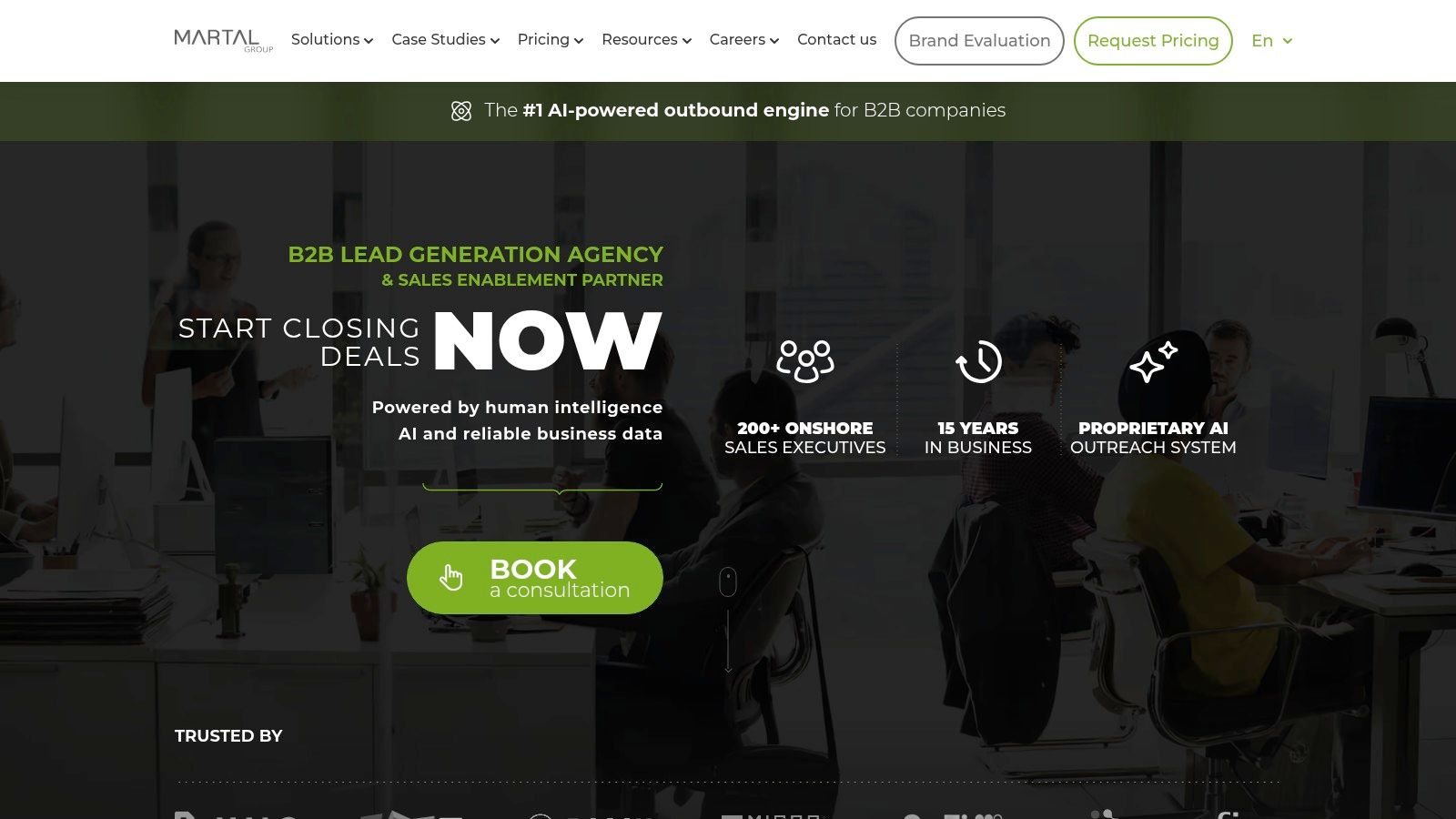
Martal Group is a strong option for companies that want North American outbound coverage, especially if they're entering the US market and need sector-aware messaging instead of generic SDR scripting.
They sit in a useful middle ground. More customized than the brightest scale shops, more operationally mature than small freelancers, and more outbound-focused than content-led agencies.
Why Martal works
Martal is most compelling when market entry is the primary challenge. If you're selling into the US and need SDR support that understands local positioning, buying behavior, and category language, that specialization helps.
Their sector-specific offers also make them easier to evaluate than generalist agencies. You should still pressure-test the playbook. Ask what changes across manufacturing, SaaS, or MSP campaigns, and ask to see actual reporting.
For teams auditing partner capability, one fast filter is whether the agency's stack reflects current execution reality. Clay for enrichment, Apollo for prospecting, Sales Navigator for targeting, Lemlist or Instantly for sequence management, HeyReach for LinkedIn scale. If they can't explain stack choices cleanly, the playbook is probably dated. Grou's overview of top lead generation tools is a useful gut check.
Website: Martal Group
5. SalesRoads
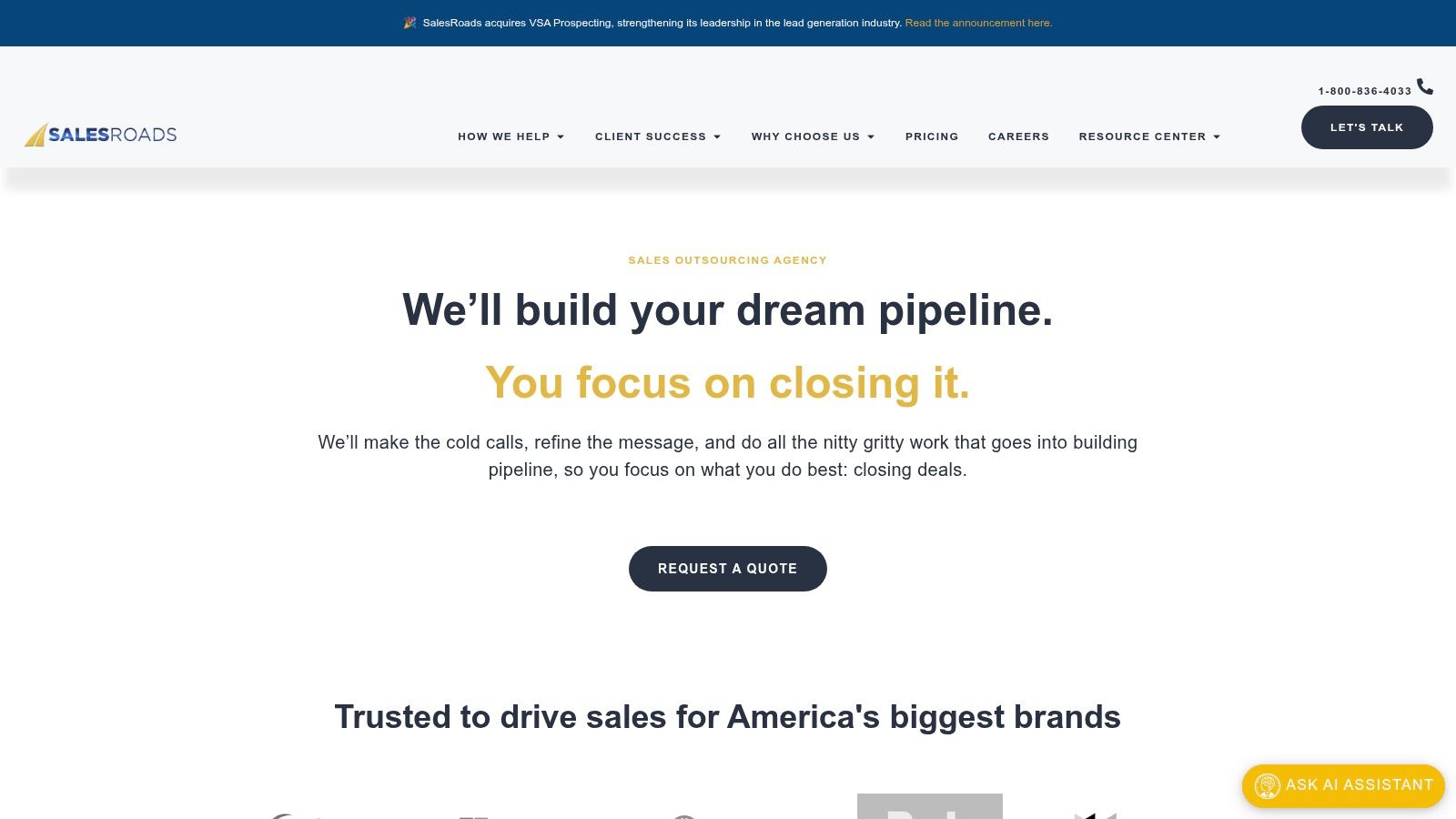
If your sales motion still depends on real conversations, SalesRoads deserves a look. This is one of the clearer choices for teams that need consultative phone outreach, not just email volume and calendar links.
That matters in regulated, enterprise, and phone-heavy categories where qualification often happens through live discussion. Legal tech, pharma-adjacent services, and some manufacturing segments fit that pattern well.
Where SalesRoads is strongest
SalesRoads is strongest when your buyers expect a credible caller and your offer needs call-based qualification. Their US-only caller model is a real differentiator if your market is sensitive to nuance, compliance, or executive-level conversation quality.
The main tradeoff is price and flexibility. Premium phone-based programs usually cost more than offshore or email-led models, and they're less suited to tiny pilots. That's fine if you know your sales motion depends on call quality.
Use hard metrics in evaluation, not top-of-funnel noise. Opens and impressions won't tell you whether the partner is creating pipeline. Instead, tracking the right lead generation KPIs matters. Meeting quality, acceptance rate, speed to follow-up, and pipeline contribution should lead the report.
If an agency leads the first review with open rate, they're hiding from the harder conversation.
Website: SalesRoads
6. RevBoss
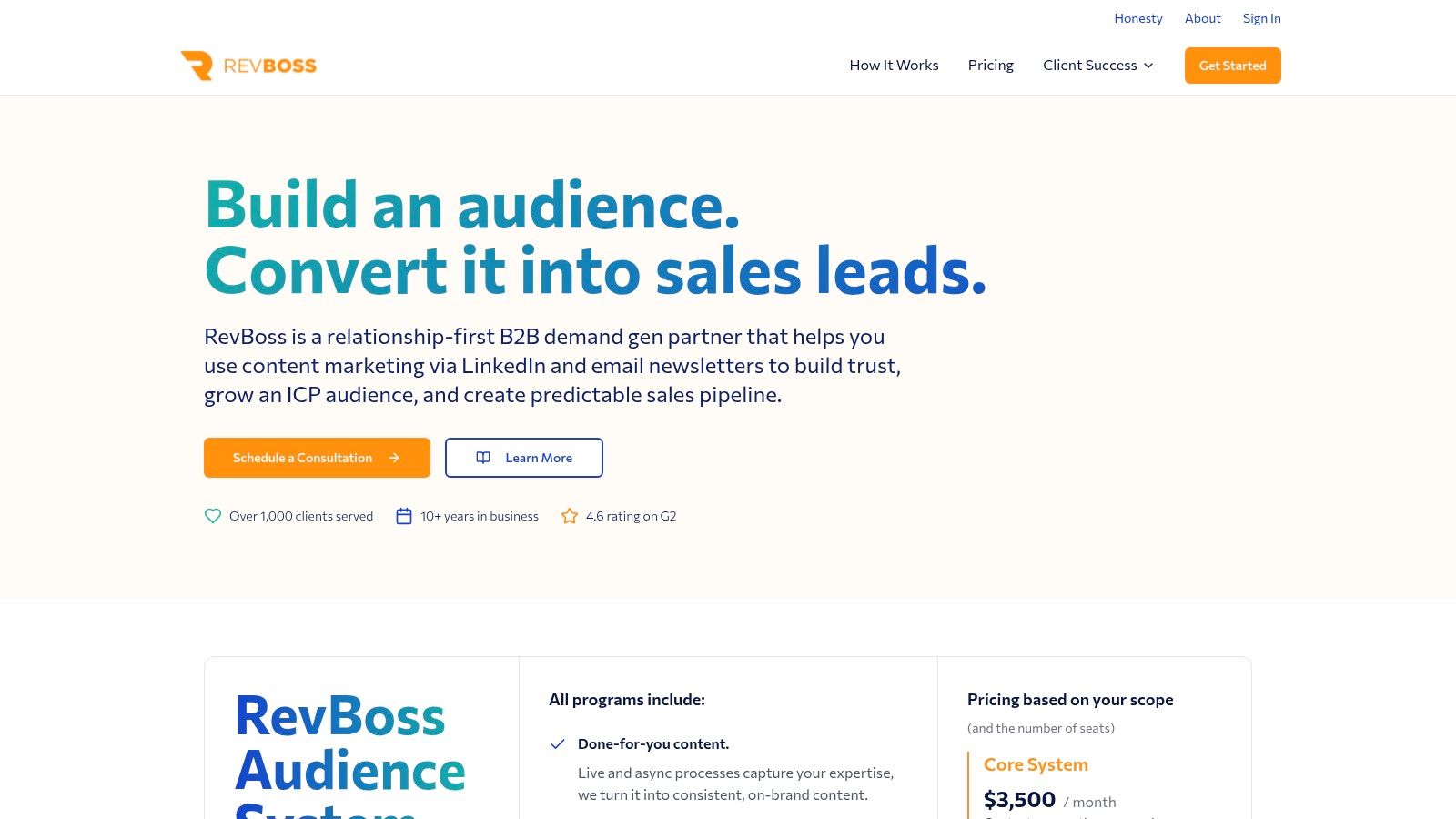
Your team is sending outbound, getting a few replies, and still hearing the same objection on calls. "We have seen your posts." "I get your newsletter." "I know the name, but I am not clear on the offer." That is the kind of sales motion RevBoss is built for.
RevBoss fits companies that sell through familiarity and point of view, not just list coverage. If your founder, sales leader, or subject-matter expert carries real weight in the buying process, their model deserves a serious look.
Why RevBoss is different
RevBoss combines LinkedIn content, email newsletters, messaging support, and outbound execution into one program. The point is repetition with consistency. Prospects see the same argument across channels instead of getting disconnected touches from marketing on one side and SDRs on the other.
That model works best in long sales cycles, authority-driven categories, and markets where buyers need several credible touches before they respond. Cybersecurity consulting, specialized software services, and complex professional services are good examples.
The evaluation standard is simple. Do not buy RevBoss if you only want meeting volume. Buy them if you want a partner that can help shape market perception while creating outbound opportunities.
As noted earlier, content can support lead generation when the message is strong and the audience is narrow enough to matter. The true question is whether your company has a point of view worth distributing. If the answer is no, this model will feel slow and expensive. If the answer is yes, a blended approach can outperform a generic appointment-setting shop.
This is also where the agency profile matters. Grou's unified model is broader and more operationally integrated across outbound, paid media, and funnel execution. RevBoss is narrower. That is not a weakness. It is a clear fit signal.
Website: RevBoss
7. EBQ
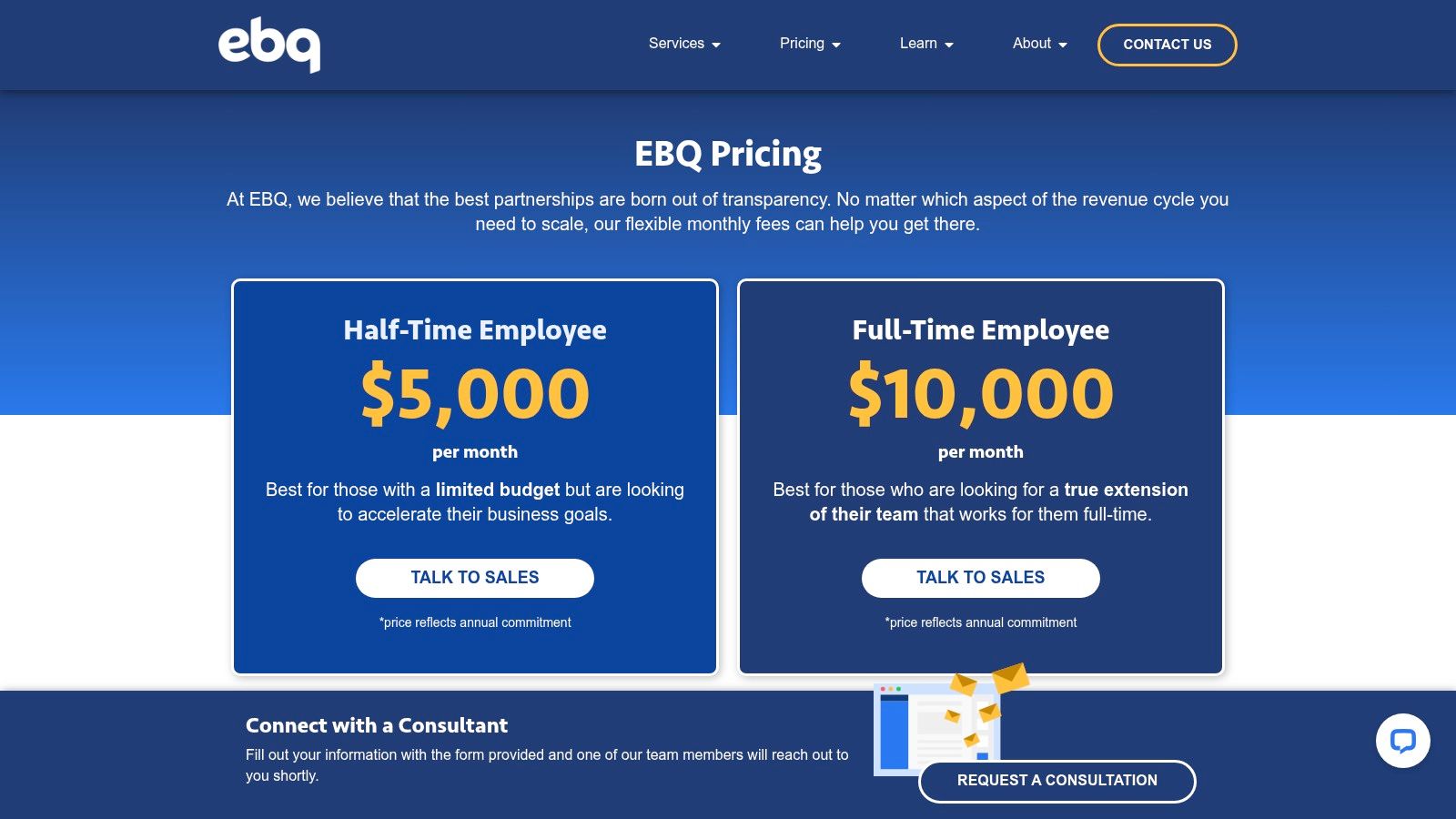
Your pipeline is slipping because the problem is not only prospecting. The list quality is inconsistent, CRM fields are a mess, follow-up breaks between teams, and nobody owns the handoff. That is the kind of situation EBQ fits.
EBQ is a process-heavy partner for companies that need coverage across sales development, data, CRM support, marketing operations, and customer experience. If you are trying to fix execution gaps across the revenue team, that breadth matters more than flashy positioning.
Where EBQ earns its place
Use EBQ when your bottleneck is operational discipline. They make more sense for a company that needs repeatable workflows and clear role coverage than for a buyer chasing a quick batch of meetings.
That distinction matters.
A narrow outbound shop can produce activity fast, but it will not fix messy routing rules, weak data hygiene, or disconnected systems. EBQ is closer to an outsourced revenue support layer. That can be a strong fit for established B2B teams that already know their market and need tighter execution.
The buying test is simple. Ask whether you need a campaign vendor or an operating partner. If the answer is operating partner, EBQ belongs on the shortlist.
The tradeoff is scope. Broader service models usually require more coordination, a clearer owner on your side, and a longer proof window. If you only want a small outbound pilot, this may feel heavier than necessary. If you want one partner to support multiple parts of the funnel, the model is easier to justify.
That is also where agency profiles matter. Grou's unified model is built around coordinated outbound, paid media, and funnel execution. EBQ is more process and staffing oriented. Different shape. Different buying reason.
Website: EBQ pricing
8. Leadium
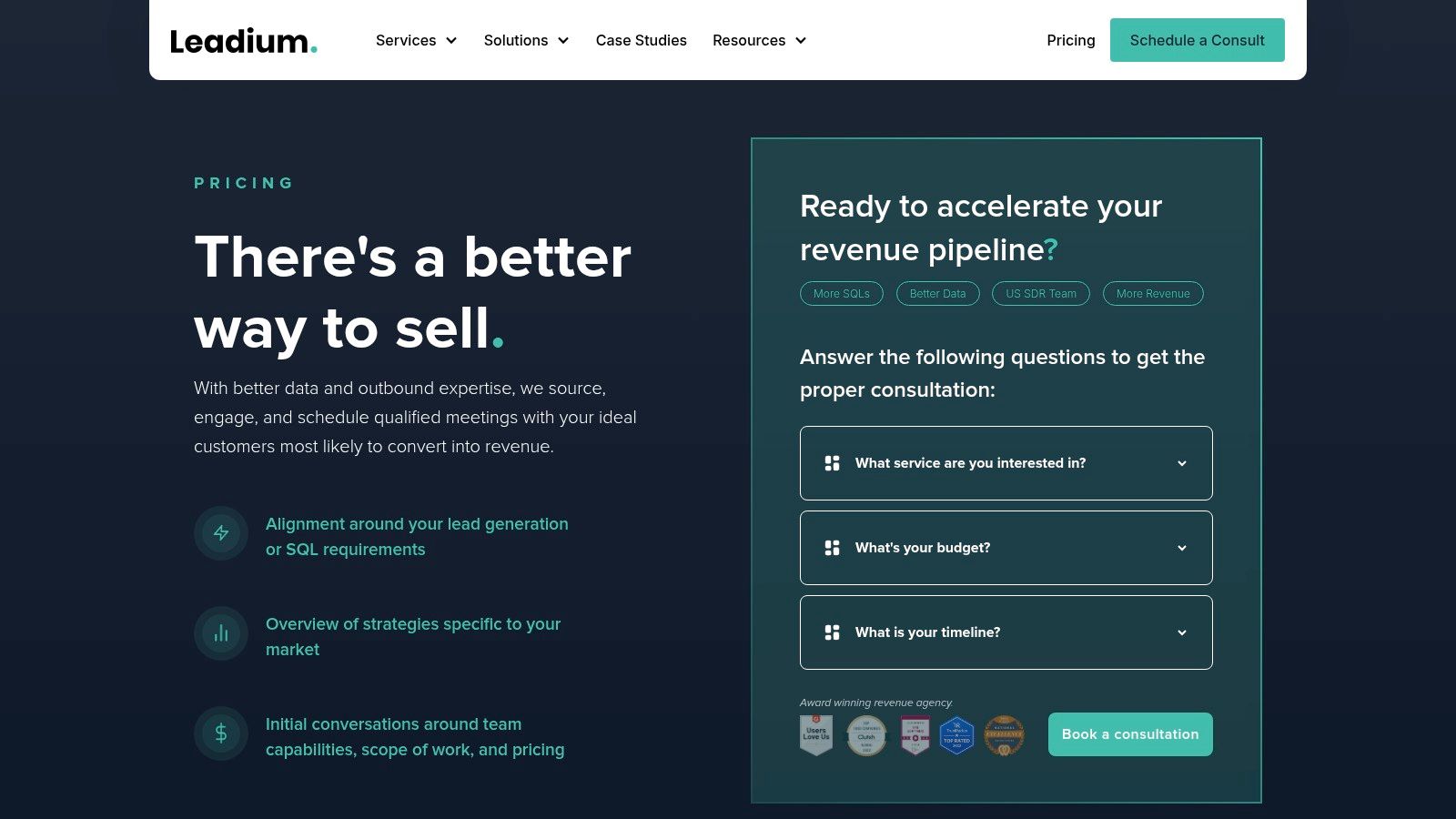
Leadium is the clean answer for teams that want outbound help without a long contract. Month-to-month flexibility is the standout feature here, and that's more valuable than most agencies admit.
A lot of SMB and mid-market buyers don't need a big retainer. They need a sharp test with a clear proof window.
When Leadium makes sense
Leadium fits market-entry tests, early outbound experiments, and teams that already have a defined ICP but need help with list-building, prospecting, and appointment setting. The dedicated pod model is also useful if you want one external group handling strategy, research, SDR execution, and content support.
Flexibility is the primary reason to consider them, which changes the buying risk. If an agency won't offer a pilot or a short review window, it's usually optimizing for contract security over performance proof.
Use this quick partner test on every shortlist:
Ask which verticals they've run repeatedly.
Ask for verifiable proof, not decorative case studies.
Ask who does the work, in-house or contractors.
Ask to see their own outbound quality.
Ask for the exact stack they use.
Ask for scope and pricing in writing.
Ask for a real anonymized report.
The agency with the least defensive answers usually gives the cleanest delivery.
Website: Leadium pricing
9. Operatix
Operatix is a specialist choice. If you sell B2B software, need regional coverage, and want outsourced SDR support that understands enterprise software motions, this is one of the more relevant providers on the list.
Their narrower focus is a strength. Most lead generation companies get weaker as their vertical spread gets wider.
Why Operatix stands out
Operatix fits software vendors targeting complex buying groups across regions. Their global footprint and multilingual coverage are useful if your pipeline strategy spans North America, EMEA, APAC, or LATAM.
This is not the best fit for non-tech categories that need heavy category translation. It is a strong fit for software companies with named-account strategies, multi-stakeholder deals, and regional expansion plans.
There's also a broader point here that most comparison pages miss. Channel fit changes by industry and buying stage. Some markets respond to communities, some to outbound, some to local intent, some to partner-led plays. One source on underserved verticals specifically calls out home services, senior care, non-profits, waste management, and small-business IT and cybersecurity as overlooked industries needing B2B lead generation tools. Buyers should evaluate agencies on segment fit, not just category reputation.
Website: Operatix
10. Abstrakt Marketing Group
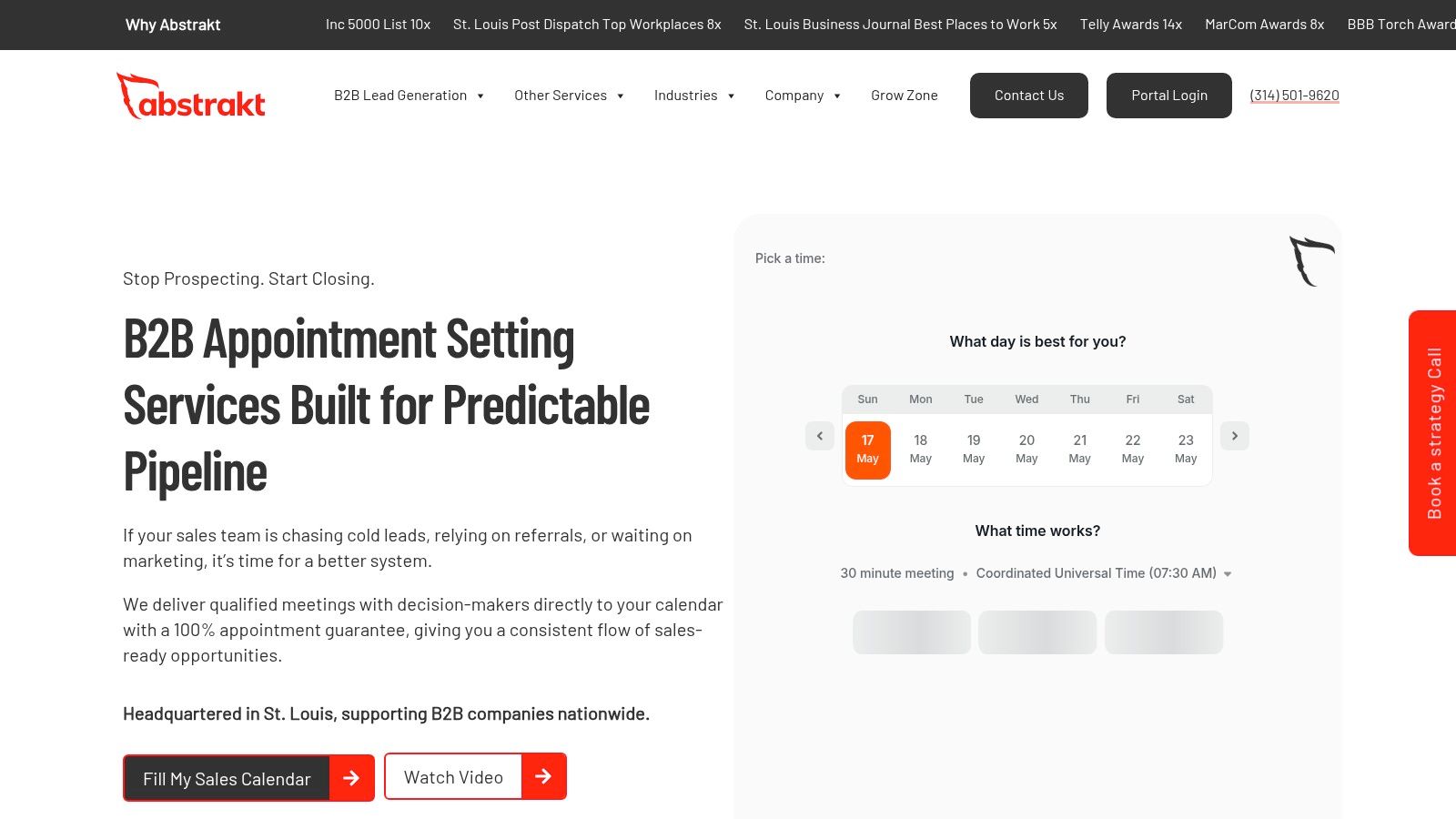
Your team has an SDR problem, a content problem, and a reporting problem. Buying one partner to cover all three sounds efficient. That is the case for Abstrakt.
Abstrakt is a fit for companies that want appointment setting plus broader marketing support from one vendor. If you do not have the time or internal bench to manage separate partners for outbound, SEO, content, and RevOps, their model can reduce coordination overhead.
The tradeoff is control.
Broad service menus create scope creep fast. If you hire Abstrakt, set the engagement around one commercial outcome first. Start with booked meetings, qualified pipeline, or sales accepted opportunities. Then force every supporting service to justify its place in that system. If a deliverable does not improve conversion, speed, or visibility, cut it.
Where Abstrakt fits best
Abstrakt makes the most sense for SMB and mid-market teams rebuilding multiple parts of go-to-market at once. It is less attractive for mature teams that already have a strong content engine, clean RevOps, or a specialized outbound motion and only need one missing piece.
A buyer's framework matters here. Agencies like Abstrakt sell breadth. Grou's model, by contrast, is built around a tighter coordinated system across content, outbound, and lead generation. Different model, different buying decision. If you need one partner to patch several weak functions, Abstrakt belongs on the shortlist. If you need sharper alignment across a narrower revenue motion, a more unified model is usually easier to manage.
Ask hard questions before you sign:
Who owns pipeline targets?
What is the exact handoff point between marketing and SDR work?
Which outputs are fixed each month, and which are variable?
How do they report influence on meetings, opportunities, and revenue?
One more filter matters here. Top-of-funnel traffic rarely converts straight to a sales conversation. Buyers compare options, ignore follow-up, and return weeks later. As noted earlier, a large share of inbound interest needs capture and nurture before sales outreach makes sense. Any partner selling only immediate handoff without a clear nurture process is leaving pipeline behind.
Website: Abstrakt Marketing Group
Top 10 Lead Generation Companies Comparison
A ranked list hides the buying decision. These firms do different jobs, run different operating models, and should be judged on different criteria. Use the table to sort them by service model first, then pressure test fit against your sales motion, deal size, and internal team capacity.
Vendor | Service model | What they do well | Watch for | Best fit | Pricing |
|---|---|---|---|---|---|
Grou | Unified content, outbound, and lead generation system | One coordinated program across LinkedIn content, outbound execution, and lead capture. Fast setup and clear signal on what is working. | Less relevant if you only want a narrow outsourced SDR function | B2B teams that need tighter alignment across demand creation and outbound | Custom quote |
Belkins | Multi-channel appointment setting | Structured outbound across email, LinkedIn, calling, and SMS, with strong process discipline | Better for teams optimizing meeting volume than teams rebuilding positioning | Companies that want booked meetings from a channel mix | Package-based, custom scope |
CIENCE | Scaled outbound operation | Large outreach programs, research support, and enterprise-level coverage | Volume can outpace message quality if your positioning is weak | Enterprise GTM teams running large prospecting programs | Custom, enterprise |
Martal Group | SDR-as-a-service | U.S. market experience and playbooks for specific industries | Premium model. You need a clear ICP and offer for it to pay off | International companies expanding into the U.S. and vertical-focused sellers | Custom |
SalesRoads | Outsourced SDR team with strong phone motion | Real calling capability, tighter qualification through live conversations, and straightforward reporting | Best results come in phone-friendly markets. Less useful if your buyers never answer calls | Mid-market and enterprise teams in call-heavy or regulated categories | Premium pricing, minimum terms |
RevBoss | Content-led outreach and executive visibility | Strong fit for founder-led sales and narrative-driven outreach | Less suited to teams that need pure outbound scale fast | Companies selling through authority, expertise, and executive presence | Scope-based, custom quote |
EBQ | Outsourced revenue support across multiple functions | Clear staffing model, broader support across BDR, CRM, marketing, and customer operations | Breadth can create coordination overhead if you only need one specialized motion | SMB and mid-market teams that need extra hands across revenue operations | Published rates and custom options |
Leadium | Flexible outbound pod | Manual research, list building, and easier pilot structure | Flexibility is useful, but strategy depth varies by engagement | Teams testing a market, message, or ICP quickly | Quote-based, month-to-month |
Operatix | SDR outsourcing for software companies | Strong fit for software sales, multilingual coverage, and regional expansion | More specialized than generalist agencies. Best value comes with a defined software sales motion | Software vendors expanding across regions and handling higher-ACV deals | Premium, custom |
Abstrakt Marketing Group | Broad outsourced marketing and appointment setting | One vendor can cover outbound, SEO, paid media, content, and supporting ops work | Breadth helps if you have multiple gaps. It is heavier than needed for a focused outbound fix | SMB and mid-market teams rebuilding several GTM functions at once | Custom |
Use a simple filter before you shortlist anyone.
If you need meetings from a proven outbound motion, start with Belkins, SalesRoads, CIENCE, or Operatix. If you need help creating demand and converting it into pipeline, Grou or RevBoss are closer to the problem. If you need broader execution support across marketing and sales operations, EBQ or Abstrakt are the better comparison set.
Then apply the same 7-point buyer check to every vendor:
Service model fit. Are you buying outsourced SDR capacity, a content-led demand partner, or a coordinated pipeline system?
Channel strength. Which channels drive results for your buyers: email, phone, LinkedIn, content, or a mix?
ICP discipline. Can they explain who they target, who they exclude, and why?
Messaging ownership. Who writes the copy, tests the angles, and updates messaging when response quality drops?
Data quality. How do they source contacts, verify data, and protect deliverability?
Handoff logic. What qualifies a meeting, and what happens to leads that are interested but not ready?
Reporting depth. Do they show activity counts only, or can they connect work to meetings, pipeline, and revenue movement?
That framework will get you to a better decision faster than any generic top-10 ranking.
Final thoughts
A bad agency choice usually looks the same. You get more activity, more dashboards, and more meetings on the calendar, but pipeline quality stays flat because you hired the wrong service model for the problem.
Use this guide like a buying framework, not a winner list. The names above matter less than the operating model behind them. Outbound shops help when your offer is clear and you need reps, process, and channel execution. Demand-generation partners fit when education, trust, and content do the heavy lifting. Unified operators fit when the actual issue is fragmentation across targeting, messaging, outreach, qualification, and reporting.
That distinction decides outcomes.
A few filters matter more than the rest:
Proof in your exact motion: Ask for examples from companies with a similar ACV, sales cycle, and buying committee.
Ownership of execution: Confirm who writes messaging, builds lists, runs campaigns, and handles replies. Avoid vague answers.
Speed to first signal: Get a clear timeline for setup, launch, first tests, and first quality review.
Lead handling rules: Define what counts as qualified, who follows up, and how no-show or not-yet-ready leads get recycled.
Reporting that reaches revenue: Reject activity-only reporting. You need accepted meetings, pipeline created, and quality feedback from sales.
Channel fit: Choose based on how your buyers respond, not on the agency's favorite playbook.
Operational discipline: Check inbox health, data verification, CRM hygiene, routing, and follow-up speed before you judge creative or copy.
One external benchmark is still worth noting. Analysts at Landbase found that many teams still lack mature lead-scoring workflows, and older setups often take months to deploy changes, according to their lead scoring statistics roundup. That gap matters because slow implementation kills iteration. If a partner cannot change targeting, messaging, routing, or qualification rules quickly, results stall.
My recommendation is simple. Buy for the bottleneck.
If you need a focused outbound engine, hire a specialist profile built for meetings. If you need broader demand capture and conversion support, hire a partner that can connect content, intent, and follow-up. If your GTM problem is split ownership across teams and tools, choose a unified model. That is the case where Grou stands out. The value is not another channel. The value is one system for LinkedIn content, outbound, list building, qualification, and reporting, managed against the same pipeline goal.
Do one more check before you sign anything. Review your own setup. Weak list hygiene, slow routing, poor form handling, and bad inbox practices will drag down performance no matter who you hire. Tighten those basics first, and if deliverability is shaky, review Static Forms deliverability best practices.
Shortlist three agency profiles. Stress-test each one with the same seven-point checklist from above. Then hire the team that answers directly, shows its process clearly, and matches the bottleneck you need to fix.
You're usually here after the same expensive mistake. An agency booked meetings, sales called them junk, reporting turned into a debate, and pipeline forecasts got softer instead of clearer.
That pattern is common because many lead generation companies sell motion without building a system. They run outbound apart from paid, treat contact volume as progress, and hand off names without enough context for sales to close. Buyers rarely convert from a single touch, so your website, content, email, retargeting, and outbound need to work together. HubSpot's State of Marketing has consistently shown that marketers rely on a mix of owned and paid channels to generate demand. Any agency that only talks about booked meetings is solving too small a part of the problem.
Use a buyer's framework instead of chasing a generic top 10 list.
The right partner depends on your sales motion. A mid-market SaaS team that needs outbound pipeline, a manufacturer expanding into North America, and a B2B company trying to connect LinkedIn, email, and paid traffic should not hire the same type of agency. Some firms are appointment setters. Some are outbound operators. A few can build a full demand engine across channels.
That distinction matters. It is the difference between renting activity and building repeatable pipeline.
If you want a baseline for what a modern lead generation agency model should cover, start with service model first, then judge execution. In this guide, the companies are more useful as profiles than as trophies. You'll see which ones fit outbound-heavy programs, which work better for appointment setting, and which are closer to a unified demand generation partner, including why Grou's model stands apart.
Use this 7-point checklist before you sign anything: service model, ICP depth, channel mix, data quality process, meeting qualification standard, reporting tied to pipeline, and ownership of assets like domains, ad accounts, and CRM workflows. If an agency gets vague on any of those, keep looking.
Table of Contents
1. Grou
Your team hires an agency to book meetings. Three weeks later, marketing owns LinkedIn, a separate contractor runs cold email, sales complains about lead quality, and RevOps is stuck reconciling reporting. That setup fails for a simple reason. The channels are connected in the buyer journey, but the vendor model is not.
Grou stands out because it runs content, outbound, prospect data, routing, and reporting as one operating system. If you are using this guide as a buyer's framework instead of a generic ranked list, that matters. You should evaluate agencies by service model first, then by execution quality. Grou fits the unified model. One team owns message, audience, execution, and handoff.
Why Grou gets the top spot
The practical advantage is control. Grou builds ICP-based lists, publishes LinkedIn content to warm the market, runs outbound into that same audience, and routes replies with clear qualification rules. Sales gets context with the conversation, not just a calendar invite and a vague source tag.
Speed also matters. Grou launches in about 14 days, then works in bi-weekly sprints with daily Slack feedback. That is the right cadence for outbound. If copy misses, targeting slips, or reply quality drops, you fix it this week, not at the end of a monthly review.
This is also why Grou is a useful reference point for buyers trying to sort agencies by operating model. Their guide to choosing a lead generation partner shows the standard you should apply to any vendor. Ask who owns targeting. Ask who sets qualification logic. Ask how content and outbound inform each other. Ask what happens between reply and pipeline creation. If the answers come from different teams, expect friction.
Use this buyer test: If one partner cannot explain audience selection, messaging, channel execution, routing rules, and reporting in a single workflow, keep looking.
Best fit
Grou fits B2B teams that need a coordinated pipeline program, not a narrow appointment-setting service. That includes founders, sales leaders, marketing leaders, and RevOps operators who care about handoff quality as much as booked meetings.
It makes the most sense in categories where trust builds before the reply. SaaS is one example. Manufacturing and professional services are another. iGaming also fits because timing, offer framing, and audience selection usually matter more than brute-force volume.
Pros and cons, directly:
Best reason to hire them: Unified execution across content, outbound, data, and routing.
Operational upside: Fast setup, tight feedback loops in Slack, and reporting tied to revenue process instead of vanity metrics.
Tradeoff: Pricing is not public, so you need a sales conversation to qualify budget fit.
Another tradeoff: Teams that only want a low-cost cold email vendor will pay for more structure than they need.
Website: Grou
2. Belkins
Belkins is the right pick when you want a full-service outbound partner with broad channel coverage and don't want to stitch together separate email, LinkedIn, calling, and booking vendors.
Their operating style is closer to outsourced appointment setting at scale than to a boutique signal-first shop. That's useful if your sales team has enough AE capacity and you need a partner that can stand up a repeatable outbound machine without much internal assembly.
Where Belkins fits
Belkins is strongest for companies that need a single vendor to own research, copy, deliverability, scheduling, and multi-channel execution. If you're trying to build a coordinated outbound motion quickly, that convenience matters.
The practical upside is channel breadth. Email, LinkedIn, calling, and broader campaign options sit under one program, which reduces tool and vendor sprawl. If your team is still learning what a complete outbound operating model should include, Grou's lead generation guide gives a useful reference point for what should be connected behind the scenes.
Belkins also has one of the clearest examples in this market of why data operations matter more than raw volume. In one published case, cleaning, enriching, expanding, and segmenting HubSpot data helped generate $2.7M in pipeline, about 60 appointments in a year, and reduce CPA from $1,700 to $1,100. That is the true lesson. Better inputs usually beat more sends.
Most lead generation companies talk about booked meetings. Fewer explain how they protect list quality, routing quality, and attribution quality.
Website: Belkins pricing
3. CIENCE
CIENCE is for teams that need scale more than craft. If you're running enterprise outbound, need research support, and want a provider that can handle a bigger operational footprint, CIENCE belongs on the shortlist.
This is not the pick for a founder who needs a sharp pilot in a narrow market. It's the pick for larger go-to-market teams that want process, coverage, and execution capacity.
Where CIENCE fits
CIENCE works best when your problem is throughput and market coverage. They combine data research, outbound execution, and SDR-style delivery in a way that suits companies with established sales teams and clear territory structure.
The upside is operational rigor. The risk is that scale-first providers can become too heavy for early-stage firms that still need to refine ICP, narrative, and qualification rules. If your team hasn't nailed those inputs, volume will just make mistakes happen faster.
A useful buyer check here is tool-stack relevance. Ask how they use Apollo, Clay, HubSpot, Sales Navigator, and sequencing platforms inside the actual workflow. If you're comparing providers that sit somewhere between outsourced SDR and managed pipeline partner, this breakdown of B2B sales lead generation is a good benchmark for what should happen after targeting and before handoff.
Website: CIENCE
4. Martal Group
Martal Group is a strong option for companies that want North American outbound coverage, especially if they're entering the US market and need sector-aware messaging instead of generic SDR scripting.
They sit in a useful middle ground. More customized than the brightest scale shops, more operationally mature than small freelancers, and more outbound-focused than content-led agencies.
Why Martal works
Martal is most compelling when market entry is the primary challenge. If you're selling into the US and need SDR support that understands local positioning, buying behavior, and category language, that specialization helps.
Their sector-specific offers also make them easier to evaluate than generalist agencies. You should still pressure-test the playbook. Ask what changes across manufacturing, SaaS, or MSP campaigns, and ask to see actual reporting.
For teams auditing partner capability, one fast filter is whether the agency's stack reflects current execution reality. Clay for enrichment, Apollo for prospecting, Sales Navigator for targeting, Lemlist or Instantly for sequence management, HeyReach for LinkedIn scale. If they can't explain stack choices cleanly, the playbook is probably dated. Grou's overview of top lead generation tools is a useful gut check.
Website: Martal Group
5. SalesRoads
If your sales motion still depends on real conversations, SalesRoads deserves a look. This is one of the clearer choices for teams that need consultative phone outreach, not just email volume and calendar links.
That matters in regulated, enterprise, and phone-heavy categories where qualification often happens through live discussion. Legal tech, pharma-adjacent services, and some manufacturing segments fit that pattern well.
Where SalesRoads is strongest
SalesRoads is strongest when your buyers expect a credible caller and your offer needs call-based qualification. Their US-only caller model is a real differentiator if your market is sensitive to nuance, compliance, or executive-level conversation quality.
The main tradeoff is price and flexibility. Premium phone-based programs usually cost more than offshore or email-led models, and they're less suited to tiny pilots. That's fine if you know your sales motion depends on call quality.
Use hard metrics in evaluation, not top-of-funnel noise. Opens and impressions won't tell you whether the partner is creating pipeline. Instead, tracking the right lead generation KPIs matters. Meeting quality, acceptance rate, speed to follow-up, and pipeline contribution should lead the report.
If an agency leads the first review with open rate, they're hiding from the harder conversation.
Website: SalesRoads
6. RevBoss
Your team is sending outbound, getting a few replies, and still hearing the same objection on calls. "We have seen your posts." "I get your newsletter." "I know the name, but I am not clear on the offer." That is the kind of sales motion RevBoss is built for.
RevBoss fits companies that sell through familiarity and point of view, not just list coverage. If your founder, sales leader, or subject-matter expert carries real weight in the buying process, their model deserves a serious look.
Why RevBoss is different
RevBoss combines LinkedIn content, email newsletters, messaging support, and outbound execution into one program. The point is repetition with consistency. Prospects see the same argument across channels instead of getting disconnected touches from marketing on one side and SDRs on the other.
That model works best in long sales cycles, authority-driven categories, and markets where buyers need several credible touches before they respond. Cybersecurity consulting, specialized software services, and complex professional services are good examples.
The evaluation standard is simple. Do not buy RevBoss if you only want meeting volume. Buy them if you want a partner that can help shape market perception while creating outbound opportunities.
As noted earlier, content can support lead generation when the message is strong and the audience is narrow enough to matter. The true question is whether your company has a point of view worth distributing. If the answer is no, this model will feel slow and expensive. If the answer is yes, a blended approach can outperform a generic appointment-setting shop.
This is also where the agency profile matters. Grou's unified model is broader and more operationally integrated across outbound, paid media, and funnel execution. RevBoss is narrower. That is not a weakness. It is a clear fit signal.
Website: RevBoss
7. EBQ
Your pipeline is slipping because the problem is not only prospecting. The list quality is inconsistent, CRM fields are a mess, follow-up breaks between teams, and nobody owns the handoff. That is the kind of situation EBQ fits.
EBQ is a process-heavy partner for companies that need coverage across sales development, data, CRM support, marketing operations, and customer experience. If you are trying to fix execution gaps across the revenue team, that breadth matters more than flashy positioning.
Where EBQ earns its place
Use EBQ when your bottleneck is operational discipline. They make more sense for a company that needs repeatable workflows and clear role coverage than for a buyer chasing a quick batch of meetings.
That distinction matters.
A narrow outbound shop can produce activity fast, but it will not fix messy routing rules, weak data hygiene, or disconnected systems. EBQ is closer to an outsourced revenue support layer. That can be a strong fit for established B2B teams that already know their market and need tighter execution.
The buying test is simple. Ask whether you need a campaign vendor or an operating partner. If the answer is operating partner, EBQ belongs on the shortlist.
The tradeoff is scope. Broader service models usually require more coordination, a clearer owner on your side, and a longer proof window. If you only want a small outbound pilot, this may feel heavier than necessary. If you want one partner to support multiple parts of the funnel, the model is easier to justify.
That is also where agency profiles matter. Grou's unified model is built around coordinated outbound, paid media, and funnel execution. EBQ is more process and staffing oriented. Different shape. Different buying reason.
Website: EBQ pricing
8. Leadium
Leadium is the clean answer for teams that want outbound help without a long contract. Month-to-month flexibility is the standout feature here, and that's more valuable than most agencies admit.
A lot of SMB and mid-market buyers don't need a big retainer. They need a sharp test with a clear proof window.
When Leadium makes sense
Leadium fits market-entry tests, early outbound experiments, and teams that already have a defined ICP but need help with list-building, prospecting, and appointment setting. The dedicated pod model is also useful if you want one external group handling strategy, research, SDR execution, and content support.
Flexibility is the primary reason to consider them, which changes the buying risk. If an agency won't offer a pilot or a short review window, it's usually optimizing for contract security over performance proof.
Use this quick partner test on every shortlist:
Ask which verticals they've run repeatedly.
Ask for verifiable proof, not decorative case studies.
Ask who does the work, in-house or contractors.
Ask to see their own outbound quality.
Ask for the exact stack they use.
Ask for scope and pricing in writing.
Ask for a real anonymized report.
The agency with the least defensive answers usually gives the cleanest delivery.
Website: Leadium pricing
9. Operatix
Operatix is a specialist choice. If you sell B2B software, need regional coverage, and want outsourced SDR support that understands enterprise software motions, this is one of the more relevant providers on the list.
Their narrower focus is a strength. Most lead generation companies get weaker as their vertical spread gets wider.
Why Operatix stands out
Operatix fits software vendors targeting complex buying groups across regions. Their global footprint and multilingual coverage are useful if your pipeline strategy spans North America, EMEA, APAC, or LATAM.
This is not the best fit for non-tech categories that need heavy category translation. It is a strong fit for software companies with named-account strategies, multi-stakeholder deals, and regional expansion plans.
There's also a broader point here that most comparison pages miss. Channel fit changes by industry and buying stage. Some markets respond to communities, some to outbound, some to local intent, some to partner-led plays. One source on underserved verticals specifically calls out home services, senior care, non-profits, waste management, and small-business IT and cybersecurity as overlooked industries needing B2B lead generation tools. Buyers should evaluate agencies on segment fit, not just category reputation.
Website: Operatix
10. Abstrakt Marketing Group
Your team has an SDR problem, a content problem, and a reporting problem. Buying one partner to cover all three sounds efficient. That is the case for Abstrakt.
Abstrakt is a fit for companies that want appointment setting plus broader marketing support from one vendor. If you do not have the time or internal bench to manage separate partners for outbound, SEO, content, and RevOps, their model can reduce coordination overhead.
The tradeoff is control.
Broad service menus create scope creep fast. If you hire Abstrakt, set the engagement around one commercial outcome first. Start with booked meetings, qualified pipeline, or sales accepted opportunities. Then force every supporting service to justify its place in that system. If a deliverable does not improve conversion, speed, or visibility, cut it.
Where Abstrakt fits best
Abstrakt makes the most sense for SMB and mid-market teams rebuilding multiple parts of go-to-market at once. It is less attractive for mature teams that already have a strong content engine, clean RevOps, or a specialized outbound motion and only need one missing piece.
A buyer's framework matters here. Agencies like Abstrakt sell breadth. Grou's model, by contrast, is built around a tighter coordinated system across content, outbound, and lead generation. Different model, different buying decision. If you need one partner to patch several weak functions, Abstrakt belongs on the shortlist. If you need sharper alignment across a narrower revenue motion, a more unified model is usually easier to manage.
Ask hard questions before you sign:
Who owns pipeline targets?
What is the exact handoff point between marketing and SDR work?
Which outputs are fixed each month, and which are variable?
How do they report influence on meetings, opportunities, and revenue?
One more filter matters here. Top-of-funnel traffic rarely converts straight to a sales conversation. Buyers compare options, ignore follow-up, and return weeks later. As noted earlier, a large share of inbound interest needs capture and nurture before sales outreach makes sense. Any partner selling only immediate handoff without a clear nurture process is leaving pipeline behind.
Website: Abstrakt Marketing Group
Top 10 Lead Generation Companies Comparison
A ranked list hides the buying decision. These firms do different jobs, run different operating models, and should be judged on different criteria. Use the table to sort them by service model first, then pressure test fit against your sales motion, deal size, and internal team capacity.
Vendor | Service model | What they do well | Watch for | Best fit | Pricing |
|---|---|---|---|---|---|
Grou | Unified content, outbound, and lead generation system | One coordinated program across LinkedIn content, outbound execution, and lead capture. Fast setup and clear signal on what is working. | Less relevant if you only want a narrow outsourced SDR function | B2B teams that need tighter alignment across demand creation and outbound | Custom quote |
Belkins | Multi-channel appointment setting | Structured outbound across email, LinkedIn, calling, and SMS, with strong process discipline | Better for teams optimizing meeting volume than teams rebuilding positioning | Companies that want booked meetings from a channel mix | Package-based, custom scope |
CIENCE | Scaled outbound operation | Large outreach programs, research support, and enterprise-level coverage | Volume can outpace message quality if your positioning is weak | Enterprise GTM teams running large prospecting programs | Custom, enterprise |
Martal Group | SDR-as-a-service | U.S. market experience and playbooks for specific industries | Premium model. You need a clear ICP and offer for it to pay off | International companies expanding into the U.S. and vertical-focused sellers | Custom |
SalesRoads | Outsourced SDR team with strong phone motion | Real calling capability, tighter qualification through live conversations, and straightforward reporting | Best results come in phone-friendly markets. Less useful if your buyers never answer calls | Mid-market and enterprise teams in call-heavy or regulated categories | Premium pricing, minimum terms |
RevBoss | Content-led outreach and executive visibility | Strong fit for founder-led sales and narrative-driven outreach | Less suited to teams that need pure outbound scale fast | Companies selling through authority, expertise, and executive presence | Scope-based, custom quote |
EBQ | Outsourced revenue support across multiple functions | Clear staffing model, broader support across BDR, CRM, marketing, and customer operations | Breadth can create coordination overhead if you only need one specialized motion | SMB and mid-market teams that need extra hands across revenue operations | Published rates and custom options |
Leadium | Flexible outbound pod | Manual research, list building, and easier pilot structure | Flexibility is useful, but strategy depth varies by engagement | Teams testing a market, message, or ICP quickly | Quote-based, month-to-month |
Operatix | SDR outsourcing for software companies | Strong fit for software sales, multilingual coverage, and regional expansion | More specialized than generalist agencies. Best value comes with a defined software sales motion | Software vendors expanding across regions and handling higher-ACV deals | Premium, custom |
Abstrakt Marketing Group | Broad outsourced marketing and appointment setting | One vendor can cover outbound, SEO, paid media, content, and supporting ops work | Breadth helps if you have multiple gaps. It is heavier than needed for a focused outbound fix | SMB and mid-market teams rebuilding several GTM functions at once | Custom |
Use a simple filter before you shortlist anyone.
If you need meetings from a proven outbound motion, start with Belkins, SalesRoads, CIENCE, or Operatix. If you need help creating demand and converting it into pipeline, Grou or RevBoss are closer to the problem. If you need broader execution support across marketing and sales operations, EBQ or Abstrakt are the better comparison set.
Then apply the same 7-point buyer check to every vendor:
Service model fit. Are you buying outsourced SDR capacity, a content-led demand partner, or a coordinated pipeline system?
Channel strength. Which channels drive results for your buyers: email, phone, LinkedIn, content, or a mix?
ICP discipline. Can they explain who they target, who they exclude, and why?
Messaging ownership. Who writes the copy, tests the angles, and updates messaging when response quality drops?
Data quality. How do they source contacts, verify data, and protect deliverability?
Handoff logic. What qualifies a meeting, and what happens to leads that are interested but not ready?
Reporting depth. Do they show activity counts only, or can they connect work to meetings, pipeline, and revenue movement?
That framework will get you to a better decision faster than any generic top-10 ranking.
Final thoughts
A bad agency choice usually looks the same. You get more activity, more dashboards, and more meetings on the calendar, but pipeline quality stays flat because you hired the wrong service model for the problem.
Use this guide like a buying framework, not a winner list. The names above matter less than the operating model behind them. Outbound shops help when your offer is clear and you need reps, process, and channel execution. Demand-generation partners fit when education, trust, and content do the heavy lifting. Unified operators fit when the actual issue is fragmentation across targeting, messaging, outreach, qualification, and reporting.
That distinction decides outcomes.
A few filters matter more than the rest:
Proof in your exact motion: Ask for examples from companies with a similar ACV, sales cycle, and buying committee.
Ownership of execution: Confirm who writes messaging, builds lists, runs campaigns, and handles replies. Avoid vague answers.
Speed to first signal: Get a clear timeline for setup, launch, first tests, and first quality review.
Lead handling rules: Define what counts as qualified, who follows up, and how no-show or not-yet-ready leads get recycled.
Reporting that reaches revenue: Reject activity-only reporting. You need accepted meetings, pipeline created, and quality feedback from sales.
Channel fit: Choose based on how your buyers respond, not on the agency's favorite playbook.
Operational discipline: Check inbox health, data verification, CRM hygiene, routing, and follow-up speed before you judge creative or copy.
One external benchmark is still worth noting. Analysts at Landbase found that many teams still lack mature lead-scoring workflows, and older setups often take months to deploy changes, according to their lead scoring statistics roundup. That gap matters because slow implementation kills iteration. If a partner cannot change targeting, messaging, routing, or qualification rules quickly, results stall.
My recommendation is simple. Buy for the bottleneck.
If you need a focused outbound engine, hire a specialist profile built for meetings. If you need broader demand capture and conversion support, hire a partner that can connect content, intent, and follow-up. If your GTM problem is split ownership across teams and tools, choose a unified model. That is the case where Grou stands out. The value is not another channel. The value is one system for LinkedIn content, outbound, list building, qualification, and reporting, managed against the same pipeline goal.
Do one more check before you sign anything. Review your own setup. Weak list hygiene, slow routing, poor form handling, and bad inbox practices will drag down performance no matter who you hire. Tighten those basics first, and if deliverability is shaky, review Static Forms deliverability best practices.
Shortlist three agency profiles. Stress-test each one with the same seven-point checklist from above. Then hire the team that answers directly, shows its process clearly, and matches the bottleneck you need to fix.
You're usually here after the same expensive mistake. An agency booked meetings, sales called them junk, reporting turned into a debate, and pipeline forecasts got softer instead of clearer.
That pattern is common because many lead generation companies sell motion without building a system. They run outbound apart from paid, treat contact volume as progress, and hand off names without enough context for sales to close. Buyers rarely convert from a single touch, so your website, content, email, retargeting, and outbound need to work together. HubSpot's State of Marketing has consistently shown that marketers rely on a mix of owned and paid channels to generate demand. Any agency that only talks about booked meetings is solving too small a part of the problem.
Use a buyer's framework instead of chasing a generic top 10 list.
The right partner depends on your sales motion. A mid-market SaaS team that needs outbound pipeline, a manufacturer expanding into North America, and a B2B company trying to connect LinkedIn, email, and paid traffic should not hire the same type of agency. Some firms are appointment setters. Some are outbound operators. A few can build a full demand engine across channels.
That distinction matters. It is the difference between renting activity and building repeatable pipeline.
If you want a baseline for what a modern lead generation agency model should cover, start with service model first, then judge execution. In this guide, the companies are more useful as profiles than as trophies. You'll see which ones fit outbound-heavy programs, which work better for appointment setting, and which are closer to a unified demand generation partner, including why Grou's model stands apart.
Use this 7-point checklist before you sign anything: service model, ICP depth, channel mix, data quality process, meeting qualification standard, reporting tied to pipeline, and ownership of assets like domains, ad accounts, and CRM workflows. If an agency gets vague on any of those, keep looking.
Table of Contents
1. Grou
Your team hires an agency to book meetings. Three weeks later, marketing owns LinkedIn, a separate contractor runs cold email, sales complains about lead quality, and RevOps is stuck reconciling reporting. That setup fails for a simple reason. The channels are connected in the buyer journey, but the vendor model is not.
Grou stands out because it runs content, outbound, prospect data, routing, and reporting as one operating system. If you are using this guide as a buyer's framework instead of a generic ranked list, that matters. You should evaluate agencies by service model first, then by execution quality. Grou fits the unified model. One team owns message, audience, execution, and handoff.
Why Grou gets the top spot
The practical advantage is control. Grou builds ICP-based lists, publishes LinkedIn content to warm the market, runs outbound into that same audience, and routes replies with clear qualification rules. Sales gets context with the conversation, not just a calendar invite and a vague source tag.
Speed also matters. Grou launches in about 14 days, then works in bi-weekly sprints with daily Slack feedback. That is the right cadence for outbound. If copy misses, targeting slips, or reply quality drops, you fix it this week, not at the end of a monthly review.
This is also why Grou is a useful reference point for buyers trying to sort agencies by operating model. Their guide to choosing a lead generation partner shows the standard you should apply to any vendor. Ask who owns targeting. Ask who sets qualification logic. Ask how content and outbound inform each other. Ask what happens between reply and pipeline creation. If the answers come from different teams, expect friction.
Use this buyer test: If one partner cannot explain audience selection, messaging, channel execution, routing rules, and reporting in a single workflow, keep looking.
Best fit
Grou fits B2B teams that need a coordinated pipeline program, not a narrow appointment-setting service. That includes founders, sales leaders, marketing leaders, and RevOps operators who care about handoff quality as much as booked meetings.
It makes the most sense in categories where trust builds before the reply. SaaS is one example. Manufacturing and professional services are another. iGaming also fits because timing, offer framing, and audience selection usually matter more than brute-force volume.
Pros and cons, directly:
Best reason to hire them: Unified execution across content, outbound, data, and routing.
Operational upside: Fast setup, tight feedback loops in Slack, and reporting tied to revenue process instead of vanity metrics.
Tradeoff: Pricing is not public, so you need a sales conversation to qualify budget fit.
Another tradeoff: Teams that only want a low-cost cold email vendor will pay for more structure than they need.
Website: Grou
2. Belkins
Belkins is the right pick when you want a full-service outbound partner with broad channel coverage and don't want to stitch together separate email, LinkedIn, calling, and booking vendors.
Their operating style is closer to outsourced appointment setting at scale than to a boutique signal-first shop. That's useful if your sales team has enough AE capacity and you need a partner that can stand up a repeatable outbound machine without much internal assembly.
Where Belkins fits
Belkins is strongest for companies that need a single vendor to own research, copy, deliverability, scheduling, and multi-channel execution. If you're trying to build a coordinated outbound motion quickly, that convenience matters.
The practical upside is channel breadth. Email, LinkedIn, calling, and broader campaign options sit under one program, which reduces tool and vendor sprawl. If your team is still learning what a complete outbound operating model should include, Grou's lead generation guide gives a useful reference point for what should be connected behind the scenes.
Belkins also has one of the clearest examples in this market of why data operations matter more than raw volume. In one published case, cleaning, enriching, expanding, and segmenting HubSpot data helped generate $2.7M in pipeline, about 60 appointments in a year, and reduce CPA from $1,700 to $1,100. That is the true lesson. Better inputs usually beat more sends.
Most lead generation companies talk about booked meetings. Fewer explain how they protect list quality, routing quality, and attribution quality.
Website: Belkins pricing
3. CIENCE
CIENCE is for teams that need scale more than craft. If you're running enterprise outbound, need research support, and want a provider that can handle a bigger operational footprint, CIENCE belongs on the shortlist.
This is not the pick for a founder who needs a sharp pilot in a narrow market. It's the pick for larger go-to-market teams that want process, coverage, and execution capacity.
Where CIENCE fits
CIENCE works best when your problem is throughput and market coverage. They combine data research, outbound execution, and SDR-style delivery in a way that suits companies with established sales teams and clear territory structure.
The upside is operational rigor. The risk is that scale-first providers can become too heavy for early-stage firms that still need to refine ICP, narrative, and qualification rules. If your team hasn't nailed those inputs, volume will just make mistakes happen faster.
A useful buyer check here is tool-stack relevance. Ask how they use Apollo, Clay, HubSpot, Sales Navigator, and sequencing platforms inside the actual workflow. If you're comparing providers that sit somewhere between outsourced SDR and managed pipeline partner, this breakdown of B2B sales lead generation is a good benchmark for what should happen after targeting and before handoff.
Website: CIENCE
4. Martal Group
Martal Group is a strong option for companies that want North American outbound coverage, especially if they're entering the US market and need sector-aware messaging instead of generic SDR scripting.
They sit in a useful middle ground. More customized than the brightest scale shops, more operationally mature than small freelancers, and more outbound-focused than content-led agencies.
Why Martal works
Martal is most compelling when market entry is the primary challenge. If you're selling into the US and need SDR support that understands local positioning, buying behavior, and category language, that specialization helps.
Their sector-specific offers also make them easier to evaluate than generalist agencies. You should still pressure-test the playbook. Ask what changes across manufacturing, SaaS, or MSP campaigns, and ask to see actual reporting.
For teams auditing partner capability, one fast filter is whether the agency's stack reflects current execution reality. Clay for enrichment, Apollo for prospecting, Sales Navigator for targeting, Lemlist or Instantly for sequence management, HeyReach for LinkedIn scale. If they can't explain stack choices cleanly, the playbook is probably dated. Grou's overview of top lead generation tools is a useful gut check.
Website: Martal Group
5. SalesRoads
If your sales motion still depends on real conversations, SalesRoads deserves a look. This is one of the clearer choices for teams that need consultative phone outreach, not just email volume and calendar links.
That matters in regulated, enterprise, and phone-heavy categories where qualification often happens through live discussion. Legal tech, pharma-adjacent services, and some manufacturing segments fit that pattern well.
Where SalesRoads is strongest
SalesRoads is strongest when your buyers expect a credible caller and your offer needs call-based qualification. Their US-only caller model is a real differentiator if your market is sensitive to nuance, compliance, or executive-level conversation quality.
The main tradeoff is price and flexibility. Premium phone-based programs usually cost more than offshore or email-led models, and they're less suited to tiny pilots. That's fine if you know your sales motion depends on call quality.
Use hard metrics in evaluation, not top-of-funnel noise. Opens and impressions won't tell you whether the partner is creating pipeline. Instead, tracking the right lead generation KPIs matters. Meeting quality, acceptance rate, speed to follow-up, and pipeline contribution should lead the report.
If an agency leads the first review with open rate, they're hiding from the harder conversation.
Website: SalesRoads
6. RevBoss
Your team is sending outbound, getting a few replies, and still hearing the same objection on calls. "We have seen your posts." "I get your newsletter." "I know the name, but I am not clear on the offer." That is the kind of sales motion RevBoss is built for.
RevBoss fits companies that sell through familiarity and point of view, not just list coverage. If your founder, sales leader, or subject-matter expert carries real weight in the buying process, their model deserves a serious look.
Why RevBoss is different
RevBoss combines LinkedIn content, email newsletters, messaging support, and outbound execution into one program. The point is repetition with consistency. Prospects see the same argument across channels instead of getting disconnected touches from marketing on one side and SDRs on the other.
That model works best in long sales cycles, authority-driven categories, and markets where buyers need several credible touches before they respond. Cybersecurity consulting, specialized software services, and complex professional services are good examples.
The evaluation standard is simple. Do not buy RevBoss if you only want meeting volume. Buy them if you want a partner that can help shape market perception while creating outbound opportunities.
As noted earlier, content can support lead generation when the message is strong and the audience is narrow enough to matter. The true question is whether your company has a point of view worth distributing. If the answer is no, this model will feel slow and expensive. If the answer is yes, a blended approach can outperform a generic appointment-setting shop.
This is also where the agency profile matters. Grou's unified model is broader and more operationally integrated across outbound, paid media, and funnel execution. RevBoss is narrower. That is not a weakness. It is a clear fit signal.
Website: RevBoss
7. EBQ
Your pipeline is slipping because the problem is not only prospecting. The list quality is inconsistent, CRM fields are a mess, follow-up breaks between teams, and nobody owns the handoff. That is the kind of situation EBQ fits.
EBQ is a process-heavy partner for companies that need coverage across sales development, data, CRM support, marketing operations, and customer experience. If you are trying to fix execution gaps across the revenue team, that breadth matters more than flashy positioning.
Where EBQ earns its place
Use EBQ when your bottleneck is operational discipline. They make more sense for a company that needs repeatable workflows and clear role coverage than for a buyer chasing a quick batch of meetings.
That distinction matters.
A narrow outbound shop can produce activity fast, but it will not fix messy routing rules, weak data hygiene, or disconnected systems. EBQ is closer to an outsourced revenue support layer. That can be a strong fit for established B2B teams that already know their market and need tighter execution.
The buying test is simple. Ask whether you need a campaign vendor or an operating partner. If the answer is operating partner, EBQ belongs on the shortlist.
The tradeoff is scope. Broader service models usually require more coordination, a clearer owner on your side, and a longer proof window. If you only want a small outbound pilot, this may feel heavier than necessary. If you want one partner to support multiple parts of the funnel, the model is easier to justify.
That is also where agency profiles matter. Grou's unified model is built around coordinated outbound, paid media, and funnel execution. EBQ is more process and staffing oriented. Different shape. Different buying reason.
Website: EBQ pricing
8. Leadium
Leadium is the clean answer for teams that want outbound help without a long contract. Month-to-month flexibility is the standout feature here, and that's more valuable than most agencies admit.
A lot of SMB and mid-market buyers don't need a big retainer. They need a sharp test with a clear proof window.
When Leadium makes sense
Leadium fits market-entry tests, early outbound experiments, and teams that already have a defined ICP but need help with list-building, prospecting, and appointment setting. The dedicated pod model is also useful if you want one external group handling strategy, research, SDR execution, and content support.
Flexibility is the primary reason to consider them, which changes the buying risk. If an agency won't offer a pilot or a short review window, it's usually optimizing for contract security over performance proof.
Use this quick partner test on every shortlist:
Ask which verticals they've run repeatedly.
Ask for verifiable proof, not decorative case studies.
Ask who does the work, in-house or contractors.
Ask to see their own outbound quality.
Ask for the exact stack they use.
Ask for scope and pricing in writing.
Ask for a real anonymized report.
The agency with the least defensive answers usually gives the cleanest delivery.
Website: Leadium pricing
9. Operatix
Operatix is a specialist choice. If you sell B2B software, need regional coverage, and want outsourced SDR support that understands enterprise software motions, this is one of the more relevant providers on the list.
Their narrower focus is a strength. Most lead generation companies get weaker as their vertical spread gets wider.
Why Operatix stands out
Operatix fits software vendors targeting complex buying groups across regions. Their global footprint and multilingual coverage are useful if your pipeline strategy spans North America, EMEA, APAC, or LATAM.
This is not the best fit for non-tech categories that need heavy category translation. It is a strong fit for software companies with named-account strategies, multi-stakeholder deals, and regional expansion plans.
There's also a broader point here that most comparison pages miss. Channel fit changes by industry and buying stage. Some markets respond to communities, some to outbound, some to local intent, some to partner-led plays. One source on underserved verticals specifically calls out home services, senior care, non-profits, waste management, and small-business IT and cybersecurity as overlooked industries needing B2B lead generation tools. Buyers should evaluate agencies on segment fit, not just category reputation.
Website: Operatix
10. Abstrakt Marketing Group
Your team has an SDR problem, a content problem, and a reporting problem. Buying one partner to cover all three sounds efficient. That is the case for Abstrakt.
Abstrakt is a fit for companies that want appointment setting plus broader marketing support from one vendor. If you do not have the time or internal bench to manage separate partners for outbound, SEO, content, and RevOps, their model can reduce coordination overhead.
The tradeoff is control.
Broad service menus create scope creep fast. If you hire Abstrakt, set the engagement around one commercial outcome first. Start with booked meetings, qualified pipeline, or sales accepted opportunities. Then force every supporting service to justify its place in that system. If a deliverable does not improve conversion, speed, or visibility, cut it.
Where Abstrakt fits best
Abstrakt makes the most sense for SMB and mid-market teams rebuilding multiple parts of go-to-market at once. It is less attractive for mature teams that already have a strong content engine, clean RevOps, or a specialized outbound motion and only need one missing piece.
A buyer's framework matters here. Agencies like Abstrakt sell breadth. Grou's model, by contrast, is built around a tighter coordinated system across content, outbound, and lead generation. Different model, different buying decision. If you need one partner to patch several weak functions, Abstrakt belongs on the shortlist. If you need sharper alignment across a narrower revenue motion, a more unified model is usually easier to manage.
Ask hard questions before you sign:
Who owns pipeline targets?
What is the exact handoff point between marketing and SDR work?
Which outputs are fixed each month, and which are variable?
How do they report influence on meetings, opportunities, and revenue?
One more filter matters here. Top-of-funnel traffic rarely converts straight to a sales conversation. Buyers compare options, ignore follow-up, and return weeks later. As noted earlier, a large share of inbound interest needs capture and nurture before sales outreach makes sense. Any partner selling only immediate handoff without a clear nurture process is leaving pipeline behind.
Website: Abstrakt Marketing Group
Top 10 Lead Generation Companies Comparison
A ranked list hides the buying decision. These firms do different jobs, run different operating models, and should be judged on different criteria. Use the table to sort them by service model first, then pressure test fit against your sales motion, deal size, and internal team capacity.
Vendor | Service model | What they do well | Watch for | Best fit | Pricing |
|---|---|---|---|---|---|
Grou | Unified content, outbound, and lead generation system | One coordinated program across LinkedIn content, outbound execution, and lead capture. Fast setup and clear signal on what is working. | Less relevant if you only want a narrow outsourced SDR function | B2B teams that need tighter alignment across demand creation and outbound | Custom quote |
Belkins | Multi-channel appointment setting | Structured outbound across email, LinkedIn, calling, and SMS, with strong process discipline | Better for teams optimizing meeting volume than teams rebuilding positioning | Companies that want booked meetings from a channel mix | Package-based, custom scope |
CIENCE | Scaled outbound operation | Large outreach programs, research support, and enterprise-level coverage | Volume can outpace message quality if your positioning is weak | Enterprise GTM teams running large prospecting programs | Custom, enterprise |
Martal Group | SDR-as-a-service | U.S. market experience and playbooks for specific industries | Premium model. You need a clear ICP and offer for it to pay off | International companies expanding into the U.S. and vertical-focused sellers | Custom |
SalesRoads | Outsourced SDR team with strong phone motion | Real calling capability, tighter qualification through live conversations, and straightforward reporting | Best results come in phone-friendly markets. Less useful if your buyers never answer calls | Mid-market and enterprise teams in call-heavy or regulated categories | Premium pricing, minimum terms |
RevBoss | Content-led outreach and executive visibility | Strong fit for founder-led sales and narrative-driven outreach | Less suited to teams that need pure outbound scale fast | Companies selling through authority, expertise, and executive presence | Scope-based, custom quote |
EBQ | Outsourced revenue support across multiple functions | Clear staffing model, broader support across BDR, CRM, marketing, and customer operations | Breadth can create coordination overhead if you only need one specialized motion | SMB and mid-market teams that need extra hands across revenue operations | Published rates and custom options |
Leadium | Flexible outbound pod | Manual research, list building, and easier pilot structure | Flexibility is useful, but strategy depth varies by engagement | Teams testing a market, message, or ICP quickly | Quote-based, month-to-month |
Operatix | SDR outsourcing for software companies | Strong fit for software sales, multilingual coverage, and regional expansion | More specialized than generalist agencies. Best value comes with a defined software sales motion | Software vendors expanding across regions and handling higher-ACV deals | Premium, custom |
Abstrakt Marketing Group | Broad outsourced marketing and appointment setting | One vendor can cover outbound, SEO, paid media, content, and supporting ops work | Breadth helps if you have multiple gaps. It is heavier than needed for a focused outbound fix | SMB and mid-market teams rebuilding several GTM functions at once | Custom |
Use a simple filter before you shortlist anyone.
If you need meetings from a proven outbound motion, start with Belkins, SalesRoads, CIENCE, or Operatix. If you need help creating demand and converting it into pipeline, Grou or RevBoss are closer to the problem. If you need broader execution support across marketing and sales operations, EBQ or Abstrakt are the better comparison set.
Then apply the same 7-point buyer check to every vendor:
Service model fit. Are you buying outsourced SDR capacity, a content-led demand partner, or a coordinated pipeline system?
Channel strength. Which channels drive results for your buyers: email, phone, LinkedIn, content, or a mix?
ICP discipline. Can they explain who they target, who they exclude, and why?
Messaging ownership. Who writes the copy, tests the angles, and updates messaging when response quality drops?
Data quality. How do they source contacts, verify data, and protect deliverability?
Handoff logic. What qualifies a meeting, and what happens to leads that are interested but not ready?
Reporting depth. Do they show activity counts only, or can they connect work to meetings, pipeline, and revenue movement?
That framework will get you to a better decision faster than any generic top-10 ranking.
Final thoughts
A bad agency choice usually looks the same. You get more activity, more dashboards, and more meetings on the calendar, but pipeline quality stays flat because you hired the wrong service model for the problem.
Use this guide like a buying framework, not a winner list. The names above matter less than the operating model behind them. Outbound shops help when your offer is clear and you need reps, process, and channel execution. Demand-generation partners fit when education, trust, and content do the heavy lifting. Unified operators fit when the actual issue is fragmentation across targeting, messaging, outreach, qualification, and reporting.
That distinction decides outcomes.
A few filters matter more than the rest:
Proof in your exact motion: Ask for examples from companies with a similar ACV, sales cycle, and buying committee.
Ownership of execution: Confirm who writes messaging, builds lists, runs campaigns, and handles replies. Avoid vague answers.
Speed to first signal: Get a clear timeline for setup, launch, first tests, and first quality review.
Lead handling rules: Define what counts as qualified, who follows up, and how no-show or not-yet-ready leads get recycled.
Reporting that reaches revenue: Reject activity-only reporting. You need accepted meetings, pipeline created, and quality feedback from sales.
Channel fit: Choose based on how your buyers respond, not on the agency's favorite playbook.
Operational discipline: Check inbox health, data verification, CRM hygiene, routing, and follow-up speed before you judge creative or copy.
One external benchmark is still worth noting. Analysts at Landbase found that many teams still lack mature lead-scoring workflows, and older setups often take months to deploy changes, according to their lead scoring statistics roundup. That gap matters because slow implementation kills iteration. If a partner cannot change targeting, messaging, routing, or qualification rules quickly, results stall.
My recommendation is simple. Buy for the bottleneck.
If you need a focused outbound engine, hire a specialist profile built for meetings. If you need broader demand capture and conversion support, hire a partner that can connect content, intent, and follow-up. If your GTM problem is split ownership across teams and tools, choose a unified model. That is the case where Grou stands out. The value is not another channel. The value is one system for LinkedIn content, outbound, list building, qualification, and reporting, managed against the same pipeline goal.
Do one more check before you sign anything. Review your own setup. Weak list hygiene, slow routing, poor form handling, and bad inbox practices will drag down performance no matter who you hire. Tighten those basics first, and if deliverability is shaky, review Static Forms deliverability best practices.
Shortlist three agency profiles. Stress-test each one with the same seven-point checklist from above. Then hire the team that answers directly, shows its process clearly, and matches the bottleneck you need to fix.
Pipeline OS Newsletter
Build qualified pipeline
Get weekly tactics to generate demand, improve lead quality, and book more meetings.





Trusted by industry leaders
Trusted by industry leaders
Trusted by industry leaders
Ready to build qualified pipeline?
Ready to build qualified pipeline?
Ready to build qualified pipeline?
Book a call to see if we're the right fit, or take the 2-minute quiz to get a clear starting point.
Book a call to see if we're the right fit, or take the 2-minute quiz to get a clear starting point.
Book a call to see if we're the right fit, or take the 2-minute quiz to get a clear starting point.
" height="30.21639343089746px" id="hfGbXmQR2" width="30.216393430897455px"/></svg>)
Copyright © 2026 – All Right Reserved
Copyright © 2026 – All Right Reserved
Copyright © 2026 – All Right Reserved