%22%3E%3C/path%3E%3Cpath d=%22M 63.072 7.554 C 62.258 8.022 61.577 8.689 61.092 9.493 L 61.092 7.076 L 57.158 7.076 L 57.158 22.64 L 61.089 22.64 L 61.089 14.888 C 61.089 13.446 61.403 12.434 62.03 11.853 C 62.818 11.218 63.818 10.907 64.826 10.982 L 65.868 10.982 L 65.868 6.851 C 64.891 6.834 63.926 7.076 63.073 7.554 Z%22 fill=%22rgb(17,17,17)%22%3E%3C/path%3E%3Cpath d=%22M 78.916 7.82 C 76.363 6.49 73.321 6.49 70.768 7.82 C 69.562 8.473 68.564 9.451 67.888 10.644 C 67.167 11.931 66.803 13.387 66.834 14.862 C 66.804 16.332 67.157 17.785 67.86 19.077 C 68.515 20.267 69.494 21.246 70.684 21.901 C 71.924 22.576 73.318 22.92 74.73 22.898 C 76.164 22.918 77.58 22.575 78.846 21.901 C 80.062 21.247 81.073 20.27 81.768 19.077 C 82.506 17.797 82.88 16.339 82.85 14.862 C 82.88 13.389 82.517 11.934 81.797 10.647 C 81.12 9.455 80.122 8.477 78.917 7.824 M 78.803 14.862 C 78.829 15.739 78.636 16.608 78.241 17.391 C 77.903 18.046 77.38 18.588 76.738 18.95 C 76.124 19.293 75.432 19.472 74.729 19.47 C 73.668 19.497 72.648 19.061 71.934 18.276 C 71.139 17.323 70.741 16.1 70.823 14.862 C 70.741 13.62 71.149 12.395 71.959 11.45 C 72.687 10.667 73.715 10.233 74.783 10.256 C 75.859 10.236 76.894 10.67 77.635 11.45 C 78.464 12.387 78.884 13.616 78.801 14.864%22 fill=%22rgb(17,17,17)%22%3E%3C/path%3E%3Cpath d=%22M 95.906 7.076 L 95.906 15.646 C 95.975 16.68 95.643 17.701 94.979 18.498 C 94.311 19.184 93.379 19.547 92.422 19.495 C 91.475 19.544 90.553 19.18 89.894 18.498 C 89.23 17.701 88.898 16.68 88.967 15.646 L 88.967 7.076 L 85.033 7.076 L 85.033 16.207 C 85 17.449 85.275 18.68 85.834 19.79 C 86.327 20.75 87.095 21.542 88.039 22.065 C 89.033 22.594 90.145 22.861 91.271 22.838 C 92.188 22.847 93.095 22.65 93.926 22.263 C 94.708 21.905 95.388 21.36 95.906 20.675 L 95.906 22.645 L 99.865 22.645 L 99.865 7.076 Z%22 fill=%22rgb(17,17,17)%22%3E%3C/path%3E%3Cpath d=%22M 4.513 15.626 C 4.511 10.815 7.606 6.549 12.181 5.059 C 16.756 3.57 21.77 5.195 24.601 9.086 L 27.816 5.87 C 24.074 1.186 17.981 -0.943 12.137 0.393 C 6.292 1.728 1.728 6.292 0.393 12.137 C -0.943 17.981 1.186 24.074 5.87 27.816 L 9.085 24.601 C 6.214 22.512 4.515 19.177 4.513 15.626%22 fill=%22rgb(32,62,235)%22%3E%3C/path%3E%3Cpath d=%22M 17.114 14.343 L 13.354 18.01 L 13.354 18.026 L 21.071 18.026 L 11.412 27.609 L 17.389 27.609 L 23.999 21.081 L 23.999 28.316 L 24.005 28.316 L 27.967 24.393 L 27.967 14.343 Z%22 fill=%22rgb(32,62,235)%22%3E%3C/path%3E%3C/g%3E%3C/svg%3E) ×
× ××
××›
›
›
›
Best AI SDR tools for B2B outbound
Best AI SDR tools for B2B outbound
Best AI SDR tools for B2B outbound
Best AI SDR tools for B2B outbound
Best AI SDR tools for B2B outbound
Best AI SDR tools for B2B outbound

Author
Aljaz Peklaj
Why trust this listicle
We are GROU, a B2B pipeline agency that runs lead generation, outbound, and LinkedIn content for clients across manufacturing, fintech, iGaming, software, and professional services. We have deployed, tested, or run real client campaigns on every AI SDR tool below in the last 18 months. The picks are from operators who have measured AI SDR reply rates against human-SDR reply rates across hundreds of campaigns, not from a vendor pitch.
→ Methodology: This list combines our own client deployment data across 30+ AI SDR pilots, vendors' published pricing pages, third-party reviews from Lagrowthmachine, Puzzle Inbox, and Landbase, plus live G2 review data. We score on real reply rate (the only metric that matters), deliverability, transparency, integration depth, and price honesty. We refresh this article quarterly because the AI SDR category moves fast and the vendor pitches move faster than the products do.
→ Affiliate disclosure: Some links in this article are affiliate links to tools we have actually deployed for our agency clients. We earn a small commission if you sign up through them, at no extra cost to you. We only recommend tools we use.
TL;DR
The AI SDR category in 2026 is overhyped and underdelivers when used as a full human-SDR replacement. The pure AI SDR plays (11x.ai, Artisan, AiSDR, Regie.ai) produce reply rates in the 1 to 3 percent range on cold outbound in our testing, which is roughly half what a properly trained human SDR running Smartlead or Lemlist produces on the same lists. Prospects detect AI-generated outreach faster than vendors acknowledge, and the reply rate ceiling in the category is structural, not just an early-product problem.
The pattern that actually works in 2026: AI-assisted human SDRs, not AI-replacing-human SDRs. Use Clay AI agents for prospect research, Apollo or Salesforge for AI-assisted personalization at scale, Smartlead or Lemlist for sending, and keep a human in the loop for reply handling, qualification, and the high-touch second touchpoint. This hybrid stack outperforms pure AI SDR plays by 2 to 4x on real qualified meetings booked per dollar spent.
If you must buy a pure AI SDR tool for a specific use case (very early-stage startups without budget for a human SDR, agencies productising AI outreach as a service, teams testing the category for proof-of-concept), the picks below are the credible options. Just calibrate expectations realistically before signing the contract.
How we ranked them
We weight five factors:
Real reply rate: not vendor-published rates, our own client deployment data on cold outbound to validated ICPs. The only metric that actually matters at scale.
Deliverability + safety: how the tool handles cold email infrastructure (warmup, rotation, sending caps). Many AI SDR tools have weak infrastructure under the AI layer.
Transparency: do they show you the actual emails being sent before they go out, or is the AI a black box? Tools that hide the output produce embarrassing client results.
Integration depth: native CRM, sequencer, and outreach stack integrations. Tools that try to be everything tend to do nothing well.
Price honesty: published pricing vs "request a demo" gatekeeping. Tools that hide pricing are usually overcharging.
We deliberately do not weight feature counts or AI model claims. Every tool in this category claims GPT-5 or Claude integration; what matters is the system around the model, not the model itself.
Quick reference scorecard
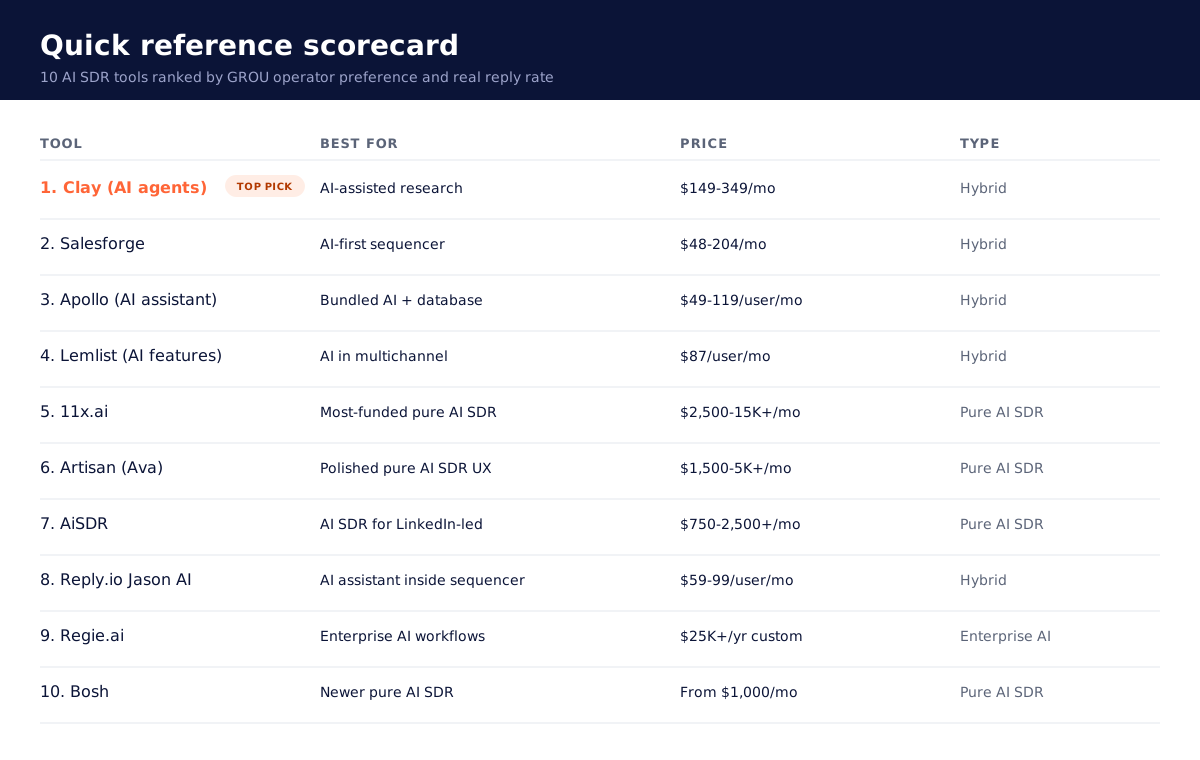
Table of contents
Why trust this listicle
TL;DR
How we ranked them
Clay (AI agents) — best for AI-assisted research
Salesforge — best AI-first sequencer
Apollo (AI assistant) — best bundled AI + database
Lemlist (AI features) — best AI personalization in multichannel
11x.ai — most-funded pure AI SDR
Artisan (Ava) — best polished pure AI SDR UX
AiSDR — best AI SDR for LinkedIn-led motions
Reply.io Jason AI — best AI assistant inside established sequencer
Regie.ai — best for enterprise AI sales workflows
Bosh — best newer pure AI SDR entrant
Pricing matrix at a glance
Pure AI SDR vs AI-assisted human SDR
Decision matrix by motion
The 5 AI SDR myths we hear most
Alternatives we skipped
FAQ
Bottom line
1. Clay (AI agents) — best for AI-assisted research
Clay is the operator pick for AI-assisted SDR motions. The wedge is composable AI agents inside a data enrichment platform: build a workflow that scrapes a prospect's LinkedIn, identifies the company's funding stage, summarises recent product launches, drafts a personalised first line, and outputs the row ready for sending through Smartlead or Lemlist. Clay does not send the email itself; it produces the inputs that make human-quality personalisation possible at scale.
The reply rates we see on Clay-powered workflows: 4 to 8 percent on cold outbound to validated ICPs, materially above pure AI SDR tools because the personalisation layer is grounded in real research and the sending happens through dedicated cold email infrastructure. Pricing starts at $149 per month for Starter and scales to $349 per month for Pro, with Enterprise pricing above that.
The downside: Clay has a real learning curve. The platform is more like a low-code automation environment than a turnkey tool. Plan on 2 to 3 weeks of setup before you have production-ready workflows.
→ Best for: agencies, growth engineers, ops-led sales teams who want composable AI in their stack. Pricing: $149 to $349/mo. Verdict: the default for AI-assisted research in 2026.
2. Salesforge — best AI-first sequencer
Salesforge is the newer cold email infrastructure platform that ships AI-first messaging as its core differentiator. Where Smartlead and Instantly bolt AI assistance onto a traditional sequencer, Salesforge built the sequencer around AI personalisation from the start. The system generates per-prospect message bodies based on Clay-style enrichment, sends through unlimited mailboxes, and rotates across the pool with native warmup.
The product velocity is strong (monthly feature ships), and the AI features genuinely outperform spintax in our testing on reply rate. Pricing starts at $48 per month on Starter and scales to $204 per month on Pro tier with unlimited features.
The downside: smaller customer base than the established cold email infrastructure tools (Smartlead, Instantly), less integration depth into the broader sales stack, and the AI features are still early-product. The platform is credible but not yet the production default that Smartlead is.
→ Best for: early-adopter teams, single-rep motions where AI personalisation matters, founders running their own outbound. Pricing: $48 to $204/mo. Verdict: credible AI-first newer entrant, slightly behind Smartlead on infrastructure maturity.
3. Apollo (AI assistant) — best bundled AI + database
Apollo is the bundled go-to-market platform with a 275M+ contact database, native sequencer, and a growing AI assistant suite. The AI features include AI writing, AI conversations, AI signal scoring, and AI personalisation. None of these are best-in-class individually, but the bundle math is competitive: data + sequencer + AI assistance in one purchase at $49 to $119 per user per month.
For solo founders and SMB sales teams, Apollo's AI assistant produces serviceable cold email drafts that need light human editing before sending. Reply rates we see on Apollo AI-assisted workflows: 2 to 4 percent, which is acceptable for SMB motions where reply rate matters less than volume.
The downside: the AI features are bundled add-ons, not core differentiators. For teams that want best-in-class AI, Clay + Salesforge produces better results than Apollo's bundled AI. For teams that want the convenience of one tool, Apollo is hard to beat.
→ Best for: solo founders, early-stage SaaS, SMB sales teams who want AI + DB + sequencer in one purchase. Pricing: $49 to $119/user/mo. Verdict: best AI + database bundle for SMB.
4. Lemlist (AI features) — best AI personalization in multichannel
Lemlist is the multichannel sequencer (email + LinkedIn + cold call) with strong AI personalisation built in. The AI features: AI-generated icebreakers based on prospect's recent activity, AI subject line variation, AI follow-up suggestions, and dynamic intro image personalisation. Combined with the multichannel sequence builder, Lemlist's AI features sit inside the most complete outbound workflow in the category.
Reply rates we see on Lemlist AI-assisted workflows: 8 to 15 percent on high-ACV personalisation-led motions, materially above any pure AI SDR tool. The AI features amplify human-quality personalisation rather than trying to replace human judgment.
Pricing is per-user. Email Pro at $63 per user per month and Multichannel Expert at $87 per user per month. The per-seat economics are higher than infrastructure tools like Smartlead at agency scale, but the reply rate uplift usually pays back inside 60 days on high-ACV motions.
→ Best for: solo founders, single-rep motions where personalisation is the lever, high-ACV outbound. Pricing: $87/user/mo (Multichannel Expert). Verdict: best AI features inside a multichannel sequencer.
5. 11x.ai — most-funded pure AI SDR
11x.ai is the market leader by funding in the pure AI SDR category. The platform ships Alice (AI SDR for top-of-funnel outreach) and Mike (AI closer for inbound and follow-up). The pitch is "stop hiring human SDRs, our AI does the job at fraction of the cost." The polished marketing has driven significant adoption among early-stage startups looking to skip hiring an SDR team.
The reality from our client testing: reply rates land 1 to 3 percent on cold outbound to validated ICPs, which is roughly half what a properly trained human SDR running Smartlead produces. The AI-generated messaging is detectable by prospects, particularly in technical or sophisticated B2B markets. The platform is improving quarter over quarter but the reply rate gap is structural in 2026.
Pricing is custom-quoted ($2,500 to $15,000+ per month) which is the largest red flag in the AI SDR category. The cost is positioned as "cheaper than a human SDR" but lands at roughly the same total cost when you include the human time still required for reply qualification and meeting handoff.
→ Best for: early-stage startups without budget for a human SDR, teams testing the category. Pricing: $2,500-$15,000+/mo custom. Verdict: most-funded option, real reply rate gap vs human-SDR baseline.
6. Artisan (Ava) — best polished pure AI SDR UX
Artisan is the visible competitor to 11x.ai in the pure AI SDR category, with strong marketing presence (the "stop hiring humans" billboard campaign) and a polished UX. Ava is the AI SDR persona that handles top-of-funnel outreach, automatically prospects from Apollo's database, drafts personalised cold emails, and runs multi-step sequences. The product feels more turnkey than 11x.ai for first-time buyers.
Reply rates we see on Artisan deployments: 1 to 3 percent on cold outbound, similar to 11x.ai. The AI message quality is improving but still detectable. The platform is positioned as "set it and forget it," which produces underwhelming results because cold outbound that works requires active iteration on ICP, message, and offer.
Pricing starts at roughly $1,500 per month custom-quoted, scaling to $5,000+ per month for higher seat counts. The pricing is more transparent than 11x.ai but still gated behind a demo conversation.
→ Best for: early-stage startups wanting a turnkey AI SDR, teams that prioritise UX polish over reply rate. Pricing: $1,500-$5,000+/mo custom. Verdict: polished UX, same reply-rate ceiling as the category.
7. AiSDR — best AI SDR for LinkedIn-led motions
AiSDR is the pure AI SDR play with the strongest LinkedIn integration in the category. The platform automatically prospects from LinkedIn Sales Navigator, drafts personalised connection requests and messages based on the prospect's recent activity, and runs LinkedIn + email cadences in one workflow. For LinkedIn-led motions where personalisation matters more than volume, AiSDR's research integration produces materially better-targeted messages than 11x.ai or Artisan.
Reply rates we see on AiSDR deployments: 2 to 5 percent on cold LinkedIn + email motions, slightly better than the pure-email AI SDR tools. The improvement comes from the LinkedIn research integration; the AI grounds its messaging in real prospect signals rather than generic templates.
Pricing starts at around $750 per month and scales to $2,500+ per month for higher seat counts. More accessible than 11x.ai or Artisan but still in the "expensive vs human SDR" range for the reply rates produced.
→ Best for: LinkedIn-led motions, teams that want AI + LinkedIn integration without managing Heyreach + AI tools separately. Pricing: $750-$2,500+/mo. Verdict: best LinkedIn integration in the pure AI SDR category.
8. Reply.io Jason AI — best AI assistant inside established sequencer
Reply.io has integrated Jason AI as the AI assistant inside its established cold email and multichannel sequencer. The platform's AI features include AI-generated email drafts, AI follow-up suggestions, AI inbox triage (categorising replies as positive, neutral, negative), and AI meeting scheduling. Sits inside Reply.io's broader sequencer at no additional per-seat cost on standard plans.
Reply rates on Jason AI-assisted Reply.io workflows: 3 to 6 percent on cold outbound, comparable to Apollo's bundled AI assistance. The advantage over pure AI SDR tools: Jason AI does not pretend to fully replace the human SDR; it assists with the work and routes complex replies back to a human.
Pricing is per-user, $59 per user per month on Starter and $99 per user per month on Pro tier. AI features are bundled in both tiers. Annual billing offers a modest discount.
→ Best for: established Reply.io users who want AI assistance without re-platforming, solo + SMB teams. Pricing: $59 to $99/user/mo. Verdict: solid AI assistant inside a mature sequencer.
9. Regie.ai — best for enterprise AI sales workflows
Regie.ai is the enterprise-tier AI sales platform built for mid-market and enterprise B2B teams running coordinated AI + human sales motions. The platform's AI features focus on content generation (sales emails, LinkedIn messages, follow-ups), AI personalisation grounded in CRM data, and AI meeting prep assistance. Strong integrations with Salesforce, HubSpot, and Outreach.
Reply rates on Regie.ai-assisted enterprise workflows: 4 to 8 percent, comparable to Clay-powered hybrid stacks. The improvement over pure AI SDR tools comes from CRM grounding; the AI has real account and contact context to personalise from.
Pricing is enterprise-only with custom quotes (typically $25,000 to $100,000+ annual contracts). The category leader for enterprise AI sales, but not the right pick for SMB or solo motions.
→ Best for: mid-market and enterprise sales teams running coordinated AI + human motions, 50+ rep deployments. Pricing: Custom enterprise (typically $25K+/yr). Verdict: strong for enterprise AI sales, wrong tier for SMB.
10. Bosh — best newer pure AI SDR entrant
Bosh is the newer pure AI SDR entrant that has gained share in 2025 and 2026 on the back of an AI-first product approach and competitive pricing. The platform's AI features focus on autonomous prospect research, message generation, and reply handling, with the explicit positioning of "AI SDR that genuinely works." Smaller customer base than 11x.ai or Artisan but with vocal early adopters reporting better real reply rates.
Reply rates on Bosh deployments are still being validated; early signals suggest 2 to 4 percent on cold outbound, slightly better than 11x.ai and Artisan but still below hybrid AI-assist stacks. Worth monitoring as the product matures.
Pricing starts at $1,000 per month and scales based on volume. More accessible than 11x.ai or Artisan with more transparent published pricing.
→ Best for: early-adopter teams testing the AI SDR category, startups looking for cheaper pure AI SDR alternative to 11x.ai. Pricing: from $1,000/mo. Verdict: credible newer pure AI SDR option, still maturing.
Pricing matrix at a glance
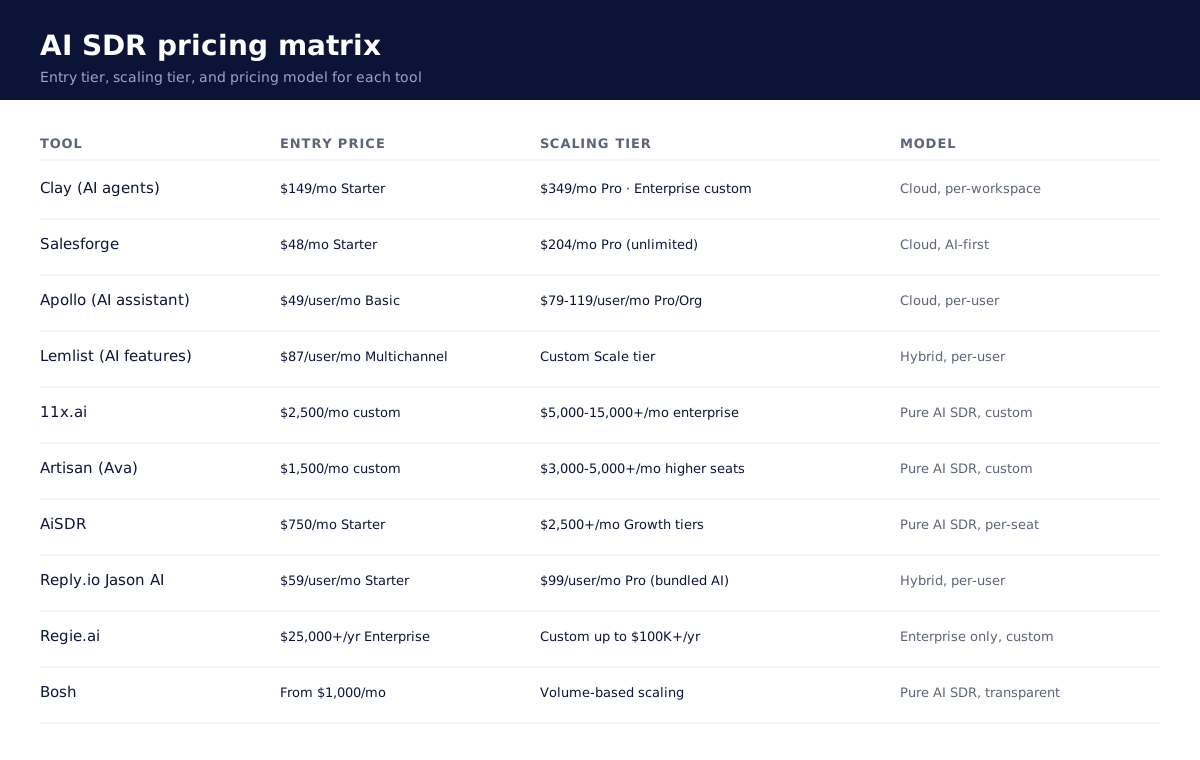
The cleanest read: AI-assisted hybrid stacks (Clay + Lemlist or Clay + Smartlead) land in the $150 to $400 per month range and deliver 4 to 8 percent reply rates. Pure AI SDR tools (11x.ai, Artisan, AiSDR) land in the $750 to $5,000+ per month range and deliver 1 to 3 percent reply rates. The unit economics of hybrid AI-assist beat pure AI SDR by 3 to 5x on cost-per-qualified-meeting.
The only scenarios where pure AI SDR pencils out: very early-stage startups with no SDR budget at all, agencies productising AI outreach as a fixed-cost service, or teams running pure proof-of-concept tests of the category.
Pure AI SDR vs AI-assisted human SDR
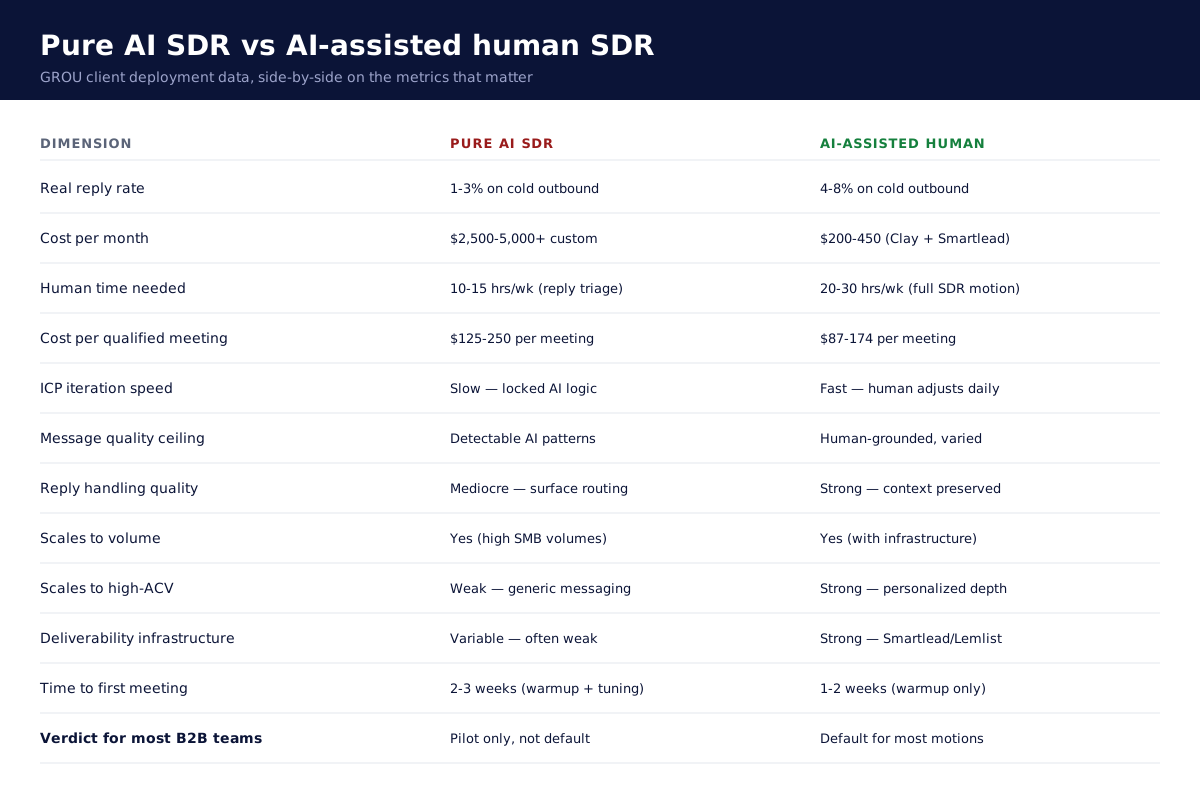
The comparison most operators get wrong: pure AI SDR is positioned as a replacement for human SDRs at lower cost. The math does not survive contact with real client deployments. Pure AI SDR delivers 1 to 3 percent reply rates and produces meetings that still need human qualification, follow-up, and handoff. AI-assisted human SDR delivers 4 to 8 percent reply rates with a human who can iterate on ICP, message, and offer in real time.
The cost comparison is more nuanced. A pure AI SDR at $2,500 per month produces roughly 10 to 30 qualified meetings per month on a focused ICP. A human SDR at $5,000 per month (Colombia-based via Deel, see our Hire SDRs in Colombia guide) plus $200 per month of AI-assist stack ($150 Clay + $50 Smartlead) produces 30 to 60 qualified meetings per month on the same focused ICP. Cost per meeting: $125 to $250 on AI SDR vs $87 to $174 on hybrid. The hybrid stack wins on both reply rate and cost-per-meeting.
The one scenario where pure AI SDR wins: very high prospect volumes where the message can be genuinely generic without losing meaningfully (commodity SaaS at SMB ICPs, for example). For most B2B motions, the hybrid pattern outperforms.
Decision matrix by motion
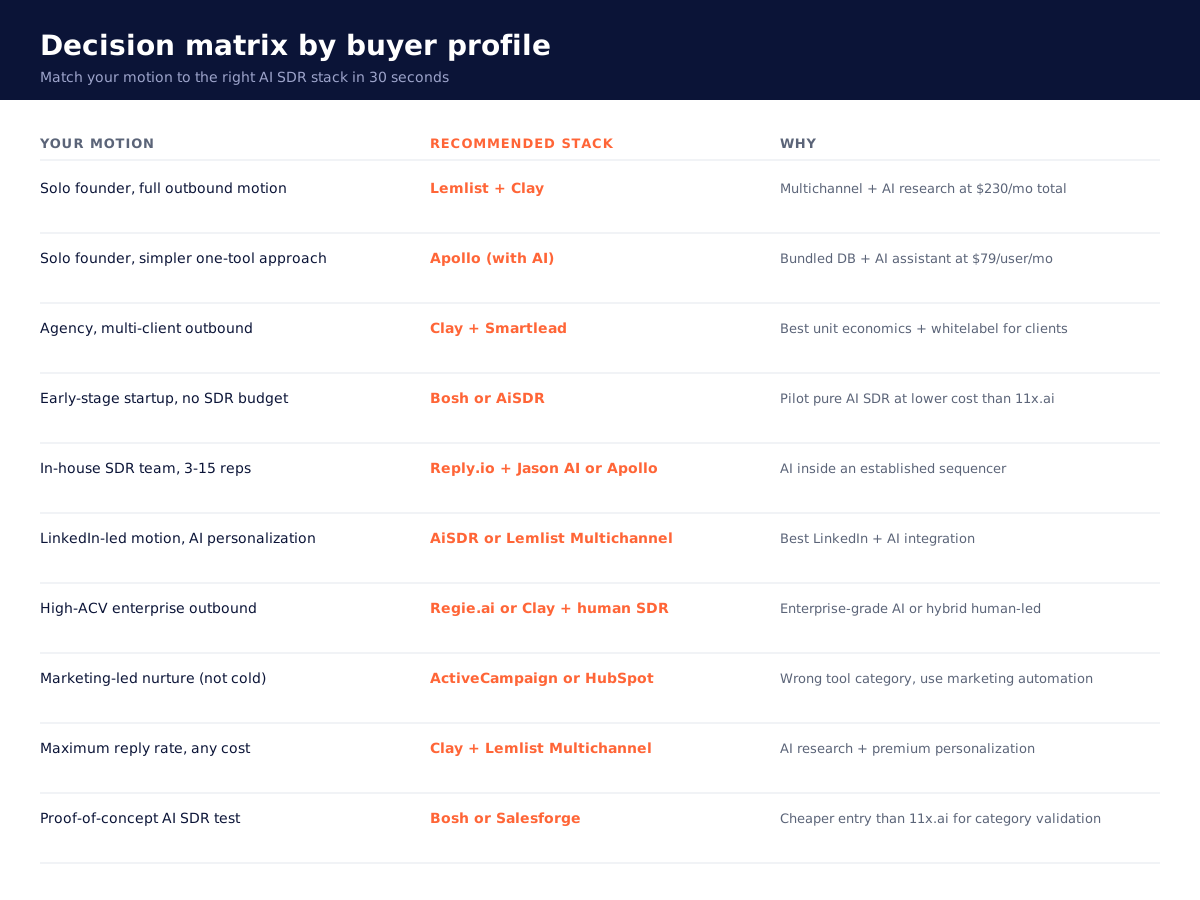
The 5 AI SDR myths we hear most
Myth 1: AI SDRs are cheaper than human SDRs. Not at meaningful reply rate quality. Pure AI SDR tools cost $2,500 to $5,000 per month and produce 1 to 3 percent reply rates. A Colombia-based human SDR via Deel costs $3,000 to $4,500 per month all-in and produces 4 to 8 percent reply rates with active iteration on the campaign.
Myth 2: AI SDRs scale infinitely without overhead. Wrong. Pure AI SDR tools still produce replies that need human qualification, meeting scheduling, and handoff. The "scale" is the message generation; the human work downstream stays the same per qualified meeting produced.
Myth 3: Prospects cannot tell AI from human emails. They can, particularly in sophisticated B2B markets. Reply rates on AI-generated cold emails are roughly half what well-crafted human messages produce. The detection signal is not the language model quality; it is the lack of grounding in real prospect context.
Myth 4: AI SDR is the future and human SDRs are obsolete. The opposite is closer to true. The teams winning at outbound in 2026 are AI-assisted humans, not AI-replacing-humans. The trajectory is more AI in the workflow, not less human in the loop.
Myth 5: All AI SDR tools deliver similar reply rates. Pure AI SDR tools (11x.ai, Artisan, AiSDR, Bosh) cluster at 1 to 3 percent reply rates. Hybrid AI-assist tools (Clay + Smartlead, Lemlist with AI features, Apollo with AI) cluster at 4 to 8 percent reply rates. The reply rate gap between the two categories is structural, not a product maturity question.
Alternatives we skipped
A few tools deliberately not in the top 10:
Outreach AI Agents: enterprise-only AI features inside Outreach. Solid but not a standalone AI SDR play.
Salesloft Drift / Sift: AI conversational features bolted onto Salesloft. Enterprise-tier, not relevant for SMB AI SDR buyers.
Humantic AI: personality-based AI messaging. Niche use case, hard to deploy at scale.
Smartwriter, Lavender, Twain: AI email writing assistants for individual reps. Useful as productivity layers but not full AI SDR tools.
Conversica: legacy AI conversational outreach platform. Has been around since pre-GPT era, has not modernised meaningfully.
Drift Conversational AI: chatbot-focused, not cold outbound focused.
If your favourite AI SDR tool is not here and you want our take, book a working session with GROU and we can run it through the same scoring rubric.
FAQ
Are AI SDR tools worth it in 2026?
For most B2B operators, hybrid AI-assist stacks (Clay + Smartlead, Apollo with AI, Lemlist with AI features) deliver 2 to 4x better unit economics than pure AI SDR tools. Pure AI SDR is worth a pilot only for very early-stage startups without SDR budget or for proof-of-concept testing of the category.
Which AI SDR tool has the highest reply rate?
In our client deployment testing, hybrid stacks built on Clay for research plus Lemlist or Smartlead for sending deliver the highest reply rates in the AI-assisted category (4 to 8 percent). Among pure AI SDR tools, AiSDR and Bosh land slightly above 11x.ai and Artisan in our testing.
Can AI SDR tools really replace human SDRs?
For specific narrow use cases (very high volume, generic messaging, low-ACV SMB ICPs) at the margin, yes. For most B2B motions, no. The reply rate gap, qualification overhead, and ICP iteration requirements all favour a human in the loop with AI assistance.
How much do AI SDR tools cost?
Hybrid AI-assist stacks: $150 to $400 per month total (Clay at $149 to $349 plus Smartlead at $32.50 to $78). Pure AI SDR tools: $750 to $5,000+ per month custom-quoted (11x.ai, Artisan, AiSDR, Bosh). Enterprise AI sales platforms: $25,000+ annual contracts (Regie.ai).
Do AI SDR tools handle LinkedIn outreach?
AiSDR is the strongest pure AI SDR for LinkedIn-led motions. For LinkedIn automation specifically, see our Best LinkedIn automation tools listicle. For LinkedIn safety and warmup rules, see LinkedIn limits and warmup.
Are AI SDR tools safe for cold email deliverability?
Mixed. Tools built on dedicated cold email infrastructure (Smartlead + AI layer, Salesforge) have strong deliverability. Tools that focus on AI messaging without serious infrastructure underneath (some pure AI SDR plays) have weaker deliverability. Ask the vendor about their warmup, rotation, and mailbox architecture before signing.
Can I use multiple AI SDR tools at once?
Yes, in different parts of the stack. Common pattern: Clay for AI research + Apollo for AI-assisted contact discovery + Smartlead for sending. The pure AI SDR tools (11x.ai, Artisan) are usually one-tool-replaces-stack plays and do not layer well with other tools.
Which AI SDR tool is best for solo founders?
Solo founders running their own outbound: Lemlist with AI features for multichannel personalisation, or Apollo for bundled AI + database. Both produce better unit economics than pure AI SDR tools at solo scale.
Which AI SDR tool is best for agencies?
Agencies running outbound for multiple clients: Clay for AI research + Smartlead for sending across client workspaces with whitelabel branding. The pure AI SDR tools have weak agency economics at multi-client scale.
What about AI SDR for enterprise sales?
Enterprise AI sales: Regie.ai for coordinated AI + human workflows with Salesforce grounding, or Outreach AI Agents inside an existing Outreach deployment. The SMB-focused AI SDR tools (11x.ai, Artisan, AiSDR) do not handle enterprise account-based plays well.
Do AI SDR tools improve over time as the AI models improve?
Marginally. The bottleneck is not model quality; it is prospect detection of AI patterns and the lack of real grounding in account context. Better models produce slightly better message bodies but do not solve the reply rate ceiling problem. Expect incremental gains, not category-changing breakthroughs.
Bottom line
The AI SDR category is overhyped in 2026. Pure AI SDR tools (11x.ai, Artisan, AiSDR, Regie.ai, Bosh) deliver 1 to 3 percent reply rates on cold outbound, which is half what properly trained human SDRs running Smartlead or Lemlist produce. The cost per qualified meeting on pure AI SDR is roughly 2x what AI-assisted human SDR stacks deliver.
The pattern that actually works: AI-assisted human SDRs. Use Clay for AI research, Apollo or Lemlist for AI-assisted personalisation, Smartlead for sending, and a human SDR for reply handling, qualification, and the high-touch second touchpoint. This hybrid stack delivers 4 to 8 percent reply rates at materially better unit economics than any pure AI SDR play.
If you must buy a pure AI SDR tool (very early-stage startup, agency productising AI outreach as a service, proof-of-concept test), the credible options are AiSDR (LinkedIn-led), Bosh (newer entrant), or Salesforge (AI-first sequencer). Skip 11x.ai and Artisan unless you have a specific reason to pay premium pricing for premium UX.
If you want help designing the right AI-assisted outbound motion for your team (which stack, which tools, how to coordinate AI + human), book a working session with GROU. We run this stack for clients every day. We can do the same for you.
→ Try Clay free (14-day trial, no card required).
→ Try Apollo free (free tier, no card required).
→ Try Lemlist free (14-day trial, no card required).
→ Try Smartlead free (14-day trial, no card required).
Why trust this listicle
We are GROU, a B2B pipeline agency that runs lead generation, outbound, and LinkedIn content for clients across manufacturing, fintech, iGaming, software, and professional services. We have deployed, tested, or run real client campaigns on every AI SDR tool below in the last 18 months. The picks are from operators who have measured AI SDR reply rates against human-SDR reply rates across hundreds of campaigns, not from a vendor pitch.
→ Methodology: This list combines our own client deployment data across 30+ AI SDR pilots, vendors' published pricing pages, third-party reviews from Lagrowthmachine, Puzzle Inbox, and Landbase, plus live G2 review data. We score on real reply rate (the only metric that matters), deliverability, transparency, integration depth, and price honesty. We refresh this article quarterly because the AI SDR category moves fast and the vendor pitches move faster than the products do.
→ Affiliate disclosure: Some links in this article are affiliate links to tools we have actually deployed for our agency clients. We earn a small commission if you sign up through them, at no extra cost to you. We only recommend tools we use.
TL;DR
The AI SDR category in 2026 is overhyped and underdelivers when used as a full human-SDR replacement. The pure AI SDR plays (11x.ai, Artisan, AiSDR, Regie.ai) produce reply rates in the 1 to 3 percent range on cold outbound in our testing, which is roughly half what a properly trained human SDR running Smartlead or Lemlist produces on the same lists. Prospects detect AI-generated outreach faster than vendors acknowledge, and the reply rate ceiling in the category is structural, not just an early-product problem.
The pattern that actually works in 2026: AI-assisted human SDRs, not AI-replacing-human SDRs. Use Clay AI agents for prospect research, Apollo or Salesforge for AI-assisted personalization at scale, Smartlead or Lemlist for sending, and keep a human in the loop for reply handling, qualification, and the high-touch second touchpoint. This hybrid stack outperforms pure AI SDR plays by 2 to 4x on real qualified meetings booked per dollar spent.
If you must buy a pure AI SDR tool for a specific use case (very early-stage startups without budget for a human SDR, agencies productising AI outreach as a service, teams testing the category for proof-of-concept), the picks below are the credible options. Just calibrate expectations realistically before signing the contract.
How we ranked them
We weight five factors:
Real reply rate: not vendor-published rates, our own client deployment data on cold outbound to validated ICPs. The only metric that actually matters at scale.
Deliverability + safety: how the tool handles cold email infrastructure (warmup, rotation, sending caps). Many AI SDR tools have weak infrastructure under the AI layer.
Transparency: do they show you the actual emails being sent before they go out, or is the AI a black box? Tools that hide the output produce embarrassing client results.
Integration depth: native CRM, sequencer, and outreach stack integrations. Tools that try to be everything tend to do nothing well.
Price honesty: published pricing vs "request a demo" gatekeeping. Tools that hide pricing are usually overcharging.
We deliberately do not weight feature counts or AI model claims. Every tool in this category claims GPT-5 or Claude integration; what matters is the system around the model, not the model itself.
Quick reference scorecard
Table of contents
Why trust this listicle
TL;DR
How we ranked them
Clay (AI agents) — best for AI-assisted research
Salesforge — best AI-first sequencer
Apollo (AI assistant) — best bundled AI + database
Lemlist (AI features) — best AI personalization in multichannel
11x.ai — most-funded pure AI SDR
Artisan (Ava) — best polished pure AI SDR UX
AiSDR — best AI SDR for LinkedIn-led motions
Reply.io Jason AI — best AI assistant inside established sequencer
Regie.ai — best for enterprise AI sales workflows
Bosh — best newer pure AI SDR entrant
Pricing matrix at a glance
Pure AI SDR vs AI-assisted human SDR
Decision matrix by motion
The 5 AI SDR myths we hear most
Alternatives we skipped
FAQ
Bottom line
1. Clay (AI agents) — best for AI-assisted research
Clay is the operator pick for AI-assisted SDR motions. The wedge is composable AI agents inside a data enrichment platform: build a workflow that scrapes a prospect's LinkedIn, identifies the company's funding stage, summarises recent product launches, drafts a personalised first line, and outputs the row ready for sending through Smartlead or Lemlist. Clay does not send the email itself; it produces the inputs that make human-quality personalisation possible at scale.
The reply rates we see on Clay-powered workflows: 4 to 8 percent on cold outbound to validated ICPs, materially above pure AI SDR tools because the personalisation layer is grounded in real research and the sending happens through dedicated cold email infrastructure. Pricing starts at $149 per month for Starter and scales to $349 per month for Pro, with Enterprise pricing above that.
The downside: Clay has a real learning curve. The platform is more like a low-code automation environment than a turnkey tool. Plan on 2 to 3 weeks of setup before you have production-ready workflows.
→ Best for: agencies, growth engineers, ops-led sales teams who want composable AI in their stack. Pricing: $149 to $349/mo. Verdict: the default for AI-assisted research in 2026.
2. Salesforge — best AI-first sequencer
Salesforge is the newer cold email infrastructure platform that ships AI-first messaging as its core differentiator. Where Smartlead and Instantly bolt AI assistance onto a traditional sequencer, Salesforge built the sequencer around AI personalisation from the start. The system generates per-prospect message bodies based on Clay-style enrichment, sends through unlimited mailboxes, and rotates across the pool with native warmup.
The product velocity is strong (monthly feature ships), and the AI features genuinely outperform spintax in our testing on reply rate. Pricing starts at $48 per month on Starter and scales to $204 per month on Pro tier with unlimited features.
The downside: smaller customer base than the established cold email infrastructure tools (Smartlead, Instantly), less integration depth into the broader sales stack, and the AI features are still early-product. The platform is credible but not yet the production default that Smartlead is.
→ Best for: early-adopter teams, single-rep motions where AI personalisation matters, founders running their own outbound. Pricing: $48 to $204/mo. Verdict: credible AI-first newer entrant, slightly behind Smartlead on infrastructure maturity.
3. Apollo (AI assistant) — best bundled AI + database
Apollo is the bundled go-to-market platform with a 275M+ contact database, native sequencer, and a growing AI assistant suite. The AI features include AI writing, AI conversations, AI signal scoring, and AI personalisation. None of these are best-in-class individually, but the bundle math is competitive: data + sequencer + AI assistance in one purchase at $49 to $119 per user per month.
For solo founders and SMB sales teams, Apollo's AI assistant produces serviceable cold email drafts that need light human editing before sending. Reply rates we see on Apollo AI-assisted workflows: 2 to 4 percent, which is acceptable for SMB motions where reply rate matters less than volume.
The downside: the AI features are bundled add-ons, not core differentiators. For teams that want best-in-class AI, Clay + Salesforge produces better results than Apollo's bundled AI. For teams that want the convenience of one tool, Apollo is hard to beat.
→ Best for: solo founders, early-stage SaaS, SMB sales teams who want AI + DB + sequencer in one purchase. Pricing: $49 to $119/user/mo. Verdict: best AI + database bundle for SMB.
4. Lemlist (AI features) — best AI personalization in multichannel
Lemlist is the multichannel sequencer (email + LinkedIn + cold call) with strong AI personalisation built in. The AI features: AI-generated icebreakers based on prospect's recent activity, AI subject line variation, AI follow-up suggestions, and dynamic intro image personalisation. Combined with the multichannel sequence builder, Lemlist's AI features sit inside the most complete outbound workflow in the category.
Reply rates we see on Lemlist AI-assisted workflows: 8 to 15 percent on high-ACV personalisation-led motions, materially above any pure AI SDR tool. The AI features amplify human-quality personalisation rather than trying to replace human judgment.
Pricing is per-user. Email Pro at $63 per user per month and Multichannel Expert at $87 per user per month. The per-seat economics are higher than infrastructure tools like Smartlead at agency scale, but the reply rate uplift usually pays back inside 60 days on high-ACV motions.
→ Best for: solo founders, single-rep motions where personalisation is the lever, high-ACV outbound. Pricing: $87/user/mo (Multichannel Expert). Verdict: best AI features inside a multichannel sequencer.
5. 11x.ai — most-funded pure AI SDR
11x.ai is the market leader by funding in the pure AI SDR category. The platform ships Alice (AI SDR for top-of-funnel outreach) and Mike (AI closer for inbound and follow-up). The pitch is "stop hiring human SDRs, our AI does the job at fraction of the cost." The polished marketing has driven significant adoption among early-stage startups looking to skip hiring an SDR team.
The reality from our client testing: reply rates land 1 to 3 percent on cold outbound to validated ICPs, which is roughly half what a properly trained human SDR running Smartlead produces. The AI-generated messaging is detectable by prospects, particularly in technical or sophisticated B2B markets. The platform is improving quarter over quarter but the reply rate gap is structural in 2026.
Pricing is custom-quoted ($2,500 to $15,000+ per month) which is the largest red flag in the AI SDR category. The cost is positioned as "cheaper than a human SDR" but lands at roughly the same total cost when you include the human time still required for reply qualification and meeting handoff.
→ Best for: early-stage startups without budget for a human SDR, teams testing the category. Pricing: $2,500-$15,000+/mo custom. Verdict: most-funded option, real reply rate gap vs human-SDR baseline.
6. Artisan (Ava) — best polished pure AI SDR UX
Artisan is the visible competitor to 11x.ai in the pure AI SDR category, with strong marketing presence (the "stop hiring humans" billboard campaign) and a polished UX. Ava is the AI SDR persona that handles top-of-funnel outreach, automatically prospects from Apollo's database, drafts personalised cold emails, and runs multi-step sequences. The product feels more turnkey than 11x.ai for first-time buyers.
Reply rates we see on Artisan deployments: 1 to 3 percent on cold outbound, similar to 11x.ai. The AI message quality is improving but still detectable. The platform is positioned as "set it and forget it," which produces underwhelming results because cold outbound that works requires active iteration on ICP, message, and offer.
Pricing starts at roughly $1,500 per month custom-quoted, scaling to $5,000+ per month for higher seat counts. The pricing is more transparent than 11x.ai but still gated behind a demo conversation.
→ Best for: early-stage startups wanting a turnkey AI SDR, teams that prioritise UX polish over reply rate. Pricing: $1,500-$5,000+/mo custom. Verdict: polished UX, same reply-rate ceiling as the category.
7. AiSDR — best AI SDR for LinkedIn-led motions
AiSDR is the pure AI SDR play with the strongest LinkedIn integration in the category. The platform automatically prospects from LinkedIn Sales Navigator, drafts personalised connection requests and messages based on the prospect's recent activity, and runs LinkedIn + email cadences in one workflow. For LinkedIn-led motions where personalisation matters more than volume, AiSDR's research integration produces materially better-targeted messages than 11x.ai or Artisan.
Reply rates we see on AiSDR deployments: 2 to 5 percent on cold LinkedIn + email motions, slightly better than the pure-email AI SDR tools. The improvement comes from the LinkedIn research integration; the AI grounds its messaging in real prospect signals rather than generic templates.
Pricing starts at around $750 per month and scales to $2,500+ per month for higher seat counts. More accessible than 11x.ai or Artisan but still in the "expensive vs human SDR" range for the reply rates produced.
→ Best for: LinkedIn-led motions, teams that want AI + LinkedIn integration without managing Heyreach + AI tools separately. Pricing: $750-$2,500+/mo. Verdict: best LinkedIn integration in the pure AI SDR category.
8. Reply.io Jason AI — best AI assistant inside established sequencer
Reply.io has integrated Jason AI as the AI assistant inside its established cold email and multichannel sequencer. The platform's AI features include AI-generated email drafts, AI follow-up suggestions, AI inbox triage (categorising replies as positive, neutral, negative), and AI meeting scheduling. Sits inside Reply.io's broader sequencer at no additional per-seat cost on standard plans.
Reply rates on Jason AI-assisted Reply.io workflows: 3 to 6 percent on cold outbound, comparable to Apollo's bundled AI assistance. The advantage over pure AI SDR tools: Jason AI does not pretend to fully replace the human SDR; it assists with the work and routes complex replies back to a human.
Pricing is per-user, $59 per user per month on Starter and $99 per user per month on Pro tier. AI features are bundled in both tiers. Annual billing offers a modest discount.
→ Best for: established Reply.io users who want AI assistance without re-platforming, solo + SMB teams. Pricing: $59 to $99/user/mo. Verdict: solid AI assistant inside a mature sequencer.
9. Regie.ai — best for enterprise AI sales workflows
Regie.ai is the enterprise-tier AI sales platform built for mid-market and enterprise B2B teams running coordinated AI + human sales motions. The platform's AI features focus on content generation (sales emails, LinkedIn messages, follow-ups), AI personalisation grounded in CRM data, and AI meeting prep assistance. Strong integrations with Salesforce, HubSpot, and Outreach.
Reply rates on Regie.ai-assisted enterprise workflows: 4 to 8 percent, comparable to Clay-powered hybrid stacks. The improvement over pure AI SDR tools comes from CRM grounding; the AI has real account and contact context to personalise from.
Pricing is enterprise-only with custom quotes (typically $25,000 to $100,000+ annual contracts). The category leader for enterprise AI sales, but not the right pick for SMB or solo motions.
→ Best for: mid-market and enterprise sales teams running coordinated AI + human motions, 50+ rep deployments. Pricing: Custom enterprise (typically $25K+/yr). Verdict: strong for enterprise AI sales, wrong tier for SMB.
10. Bosh — best newer pure AI SDR entrant
Bosh is the newer pure AI SDR entrant that has gained share in 2025 and 2026 on the back of an AI-first product approach and competitive pricing. The platform's AI features focus on autonomous prospect research, message generation, and reply handling, with the explicit positioning of "AI SDR that genuinely works." Smaller customer base than 11x.ai or Artisan but with vocal early adopters reporting better real reply rates.
Reply rates on Bosh deployments are still being validated; early signals suggest 2 to 4 percent on cold outbound, slightly better than 11x.ai and Artisan but still below hybrid AI-assist stacks. Worth monitoring as the product matures.
Pricing starts at $1,000 per month and scales based on volume. More accessible than 11x.ai or Artisan with more transparent published pricing.
→ Best for: early-adopter teams testing the AI SDR category, startups looking for cheaper pure AI SDR alternative to 11x.ai. Pricing: from $1,000/mo. Verdict: credible newer pure AI SDR option, still maturing.
Pricing matrix at a glance
The cleanest read: AI-assisted hybrid stacks (Clay + Lemlist or Clay + Smartlead) land in the $150 to $400 per month range and deliver 4 to 8 percent reply rates. Pure AI SDR tools (11x.ai, Artisan, AiSDR) land in the $750 to $5,000+ per month range and deliver 1 to 3 percent reply rates. The unit economics of hybrid AI-assist beat pure AI SDR by 3 to 5x on cost-per-qualified-meeting.
The only scenarios where pure AI SDR pencils out: very early-stage startups with no SDR budget at all, agencies productising AI outreach as a fixed-cost service, or teams running pure proof-of-concept tests of the category.
Pure AI SDR vs AI-assisted human SDR
The comparison most operators get wrong: pure AI SDR is positioned as a replacement for human SDRs at lower cost. The math does not survive contact with real client deployments. Pure AI SDR delivers 1 to 3 percent reply rates and produces meetings that still need human qualification, follow-up, and handoff. AI-assisted human SDR delivers 4 to 8 percent reply rates with a human who can iterate on ICP, message, and offer in real time.
The cost comparison is more nuanced. A pure AI SDR at $2,500 per month produces roughly 10 to 30 qualified meetings per month on a focused ICP. A human SDR at $5,000 per month (Colombia-based via Deel, see our Hire SDRs in Colombia guide) plus $200 per month of AI-assist stack ($150 Clay + $50 Smartlead) produces 30 to 60 qualified meetings per month on the same focused ICP. Cost per meeting: $125 to $250 on AI SDR vs $87 to $174 on hybrid. The hybrid stack wins on both reply rate and cost-per-meeting.
The one scenario where pure AI SDR wins: very high prospect volumes where the message can be genuinely generic without losing meaningfully (commodity SaaS at SMB ICPs, for example). For most B2B motions, the hybrid pattern outperforms.
Decision matrix by motion
The 5 AI SDR myths we hear most
Myth 1: AI SDRs are cheaper than human SDRs. Not at meaningful reply rate quality. Pure AI SDR tools cost $2,500 to $5,000 per month and produce 1 to 3 percent reply rates. A Colombia-based human SDR via Deel costs $3,000 to $4,500 per month all-in and produces 4 to 8 percent reply rates with active iteration on the campaign.
Myth 2: AI SDRs scale infinitely without overhead. Wrong. Pure AI SDR tools still produce replies that need human qualification, meeting scheduling, and handoff. The "scale" is the message generation; the human work downstream stays the same per qualified meeting produced.
Myth 3: Prospects cannot tell AI from human emails. They can, particularly in sophisticated B2B markets. Reply rates on AI-generated cold emails are roughly half what well-crafted human messages produce. The detection signal is not the language model quality; it is the lack of grounding in real prospect context.
Myth 4: AI SDR is the future and human SDRs are obsolete. The opposite is closer to true. The teams winning at outbound in 2026 are AI-assisted humans, not AI-replacing-humans. The trajectory is more AI in the workflow, not less human in the loop.
Myth 5: All AI SDR tools deliver similar reply rates. Pure AI SDR tools (11x.ai, Artisan, AiSDR, Bosh) cluster at 1 to 3 percent reply rates. Hybrid AI-assist tools (Clay + Smartlead, Lemlist with AI features, Apollo with AI) cluster at 4 to 8 percent reply rates. The reply rate gap between the two categories is structural, not a product maturity question.
Alternatives we skipped
A few tools deliberately not in the top 10:
Outreach AI Agents: enterprise-only AI features inside Outreach. Solid but not a standalone AI SDR play.
Salesloft Drift / Sift: AI conversational features bolted onto Salesloft. Enterprise-tier, not relevant for SMB AI SDR buyers.
Humantic AI: personality-based AI messaging. Niche use case, hard to deploy at scale.
Smartwriter, Lavender, Twain: AI email writing assistants for individual reps. Useful as productivity layers but not full AI SDR tools.
Conversica: legacy AI conversational outreach platform. Has been around since pre-GPT era, has not modernised meaningfully.
Drift Conversational AI: chatbot-focused, not cold outbound focused.
If your favourite AI SDR tool is not here and you want our take, book a working session with GROU and we can run it through the same scoring rubric.
FAQ
Are AI SDR tools worth it in 2026?
For most B2B operators, hybrid AI-assist stacks (Clay + Smartlead, Apollo with AI, Lemlist with AI features) deliver 2 to 4x better unit economics than pure AI SDR tools. Pure AI SDR is worth a pilot only for very early-stage startups without SDR budget or for proof-of-concept testing of the category.
Which AI SDR tool has the highest reply rate?
In our client deployment testing, hybrid stacks built on Clay for research plus Lemlist or Smartlead for sending deliver the highest reply rates in the AI-assisted category (4 to 8 percent). Among pure AI SDR tools, AiSDR and Bosh land slightly above 11x.ai and Artisan in our testing.
Can AI SDR tools really replace human SDRs?
For specific narrow use cases (very high volume, generic messaging, low-ACV SMB ICPs) at the margin, yes. For most B2B motions, no. The reply rate gap, qualification overhead, and ICP iteration requirements all favour a human in the loop with AI assistance.
How much do AI SDR tools cost?
Hybrid AI-assist stacks: $150 to $400 per month total (Clay at $149 to $349 plus Smartlead at $32.50 to $78). Pure AI SDR tools: $750 to $5,000+ per month custom-quoted (11x.ai, Artisan, AiSDR, Bosh). Enterprise AI sales platforms: $25,000+ annual contracts (Regie.ai).
Do AI SDR tools handle LinkedIn outreach?
AiSDR is the strongest pure AI SDR for LinkedIn-led motions. For LinkedIn automation specifically, see our Best LinkedIn automation tools listicle. For LinkedIn safety and warmup rules, see LinkedIn limits and warmup.
Are AI SDR tools safe for cold email deliverability?
Mixed. Tools built on dedicated cold email infrastructure (Smartlead + AI layer, Salesforge) have strong deliverability. Tools that focus on AI messaging without serious infrastructure underneath (some pure AI SDR plays) have weaker deliverability. Ask the vendor about their warmup, rotation, and mailbox architecture before signing.
Can I use multiple AI SDR tools at once?
Yes, in different parts of the stack. Common pattern: Clay for AI research + Apollo for AI-assisted contact discovery + Smartlead for sending. The pure AI SDR tools (11x.ai, Artisan) are usually one-tool-replaces-stack plays and do not layer well with other tools.
Which AI SDR tool is best for solo founders?
Solo founders running their own outbound: Lemlist with AI features for multichannel personalisation, or Apollo for bundled AI + database. Both produce better unit economics than pure AI SDR tools at solo scale.
Which AI SDR tool is best for agencies?
Agencies running outbound for multiple clients: Clay for AI research + Smartlead for sending across client workspaces with whitelabel branding. The pure AI SDR tools have weak agency economics at multi-client scale.
What about AI SDR for enterprise sales?
Enterprise AI sales: Regie.ai for coordinated AI + human workflows with Salesforce grounding, or Outreach AI Agents inside an existing Outreach deployment. The SMB-focused AI SDR tools (11x.ai, Artisan, AiSDR) do not handle enterprise account-based plays well.
Do AI SDR tools improve over time as the AI models improve?
Marginally. The bottleneck is not model quality; it is prospect detection of AI patterns and the lack of real grounding in account context. Better models produce slightly better message bodies but do not solve the reply rate ceiling problem. Expect incremental gains, not category-changing breakthroughs.
Bottom line
The AI SDR category is overhyped in 2026. Pure AI SDR tools (11x.ai, Artisan, AiSDR, Regie.ai, Bosh) deliver 1 to 3 percent reply rates on cold outbound, which is half what properly trained human SDRs running Smartlead or Lemlist produce. The cost per qualified meeting on pure AI SDR is roughly 2x what AI-assisted human SDR stacks deliver.
The pattern that actually works: AI-assisted human SDRs. Use Clay for AI research, Apollo or Lemlist for AI-assisted personalisation, Smartlead for sending, and a human SDR for reply handling, qualification, and the high-touch second touchpoint. This hybrid stack delivers 4 to 8 percent reply rates at materially better unit economics than any pure AI SDR play.
If you must buy a pure AI SDR tool (very early-stage startup, agency productising AI outreach as a service, proof-of-concept test), the credible options are AiSDR (LinkedIn-led), Bosh (newer entrant), or Salesforge (AI-first sequencer). Skip 11x.ai and Artisan unless you have a specific reason to pay premium pricing for premium UX.
If you want help designing the right AI-assisted outbound motion for your team (which stack, which tools, how to coordinate AI + human), book a working session with GROU. We run this stack for clients every day. We can do the same for you.
→ Try Clay free (14-day trial, no card required).
→ Try Apollo free (free tier, no card required).
→ Try Lemlist free (14-day trial, no card required).
→ Try Smartlead free (14-day trial, no card required).
Why trust this listicle
We are GROU, a B2B pipeline agency that runs lead generation, outbound, and LinkedIn content for clients across manufacturing, fintech, iGaming, software, and professional services. We have deployed, tested, or run real client campaigns on every AI SDR tool below in the last 18 months. The picks are from operators who have measured AI SDR reply rates against human-SDR reply rates across hundreds of campaigns, not from a vendor pitch.
→ Methodology: This list combines our own client deployment data across 30+ AI SDR pilots, vendors' published pricing pages, third-party reviews from Lagrowthmachine, Puzzle Inbox, and Landbase, plus live G2 review data. We score on real reply rate (the only metric that matters), deliverability, transparency, integration depth, and price honesty. We refresh this article quarterly because the AI SDR category moves fast and the vendor pitches move faster than the products do.
→ Affiliate disclosure: Some links in this article are affiliate links to tools we have actually deployed for our agency clients. We earn a small commission if you sign up through them, at no extra cost to you. We only recommend tools we use.
TL;DR
The AI SDR category in 2026 is overhyped and underdelivers when used as a full human-SDR replacement. The pure AI SDR plays (11x.ai, Artisan, AiSDR, Regie.ai) produce reply rates in the 1 to 3 percent range on cold outbound in our testing, which is roughly half what a properly trained human SDR running Smartlead or Lemlist produces on the same lists. Prospects detect AI-generated outreach faster than vendors acknowledge, and the reply rate ceiling in the category is structural, not just an early-product problem.
The pattern that actually works in 2026: AI-assisted human SDRs, not AI-replacing-human SDRs. Use Clay AI agents for prospect research, Apollo or Salesforge for AI-assisted personalization at scale, Smartlead or Lemlist for sending, and keep a human in the loop for reply handling, qualification, and the high-touch second touchpoint. This hybrid stack outperforms pure AI SDR plays by 2 to 4x on real qualified meetings booked per dollar spent.
If you must buy a pure AI SDR tool for a specific use case (very early-stage startups without budget for a human SDR, agencies productising AI outreach as a service, teams testing the category for proof-of-concept), the picks below are the credible options. Just calibrate expectations realistically before signing the contract.
How we ranked them
We weight five factors:
Real reply rate: not vendor-published rates, our own client deployment data on cold outbound to validated ICPs. The only metric that actually matters at scale.
Deliverability + safety: how the tool handles cold email infrastructure (warmup, rotation, sending caps). Many AI SDR tools have weak infrastructure under the AI layer.
Transparency: do they show you the actual emails being sent before they go out, or is the AI a black box? Tools that hide the output produce embarrassing client results.
Integration depth: native CRM, sequencer, and outreach stack integrations. Tools that try to be everything tend to do nothing well.
Price honesty: published pricing vs "request a demo" gatekeeping. Tools that hide pricing are usually overcharging.
We deliberately do not weight feature counts or AI model claims. Every tool in this category claims GPT-5 or Claude integration; what matters is the system around the model, not the model itself.
Quick reference scorecard
Table of contents
Why trust this listicle
TL;DR
How we ranked them
Clay (AI agents) — best for AI-assisted research
Salesforge — best AI-first sequencer
Apollo (AI assistant) — best bundled AI + database
Lemlist (AI features) — best AI personalization in multichannel
11x.ai — most-funded pure AI SDR
Artisan (Ava) — best polished pure AI SDR UX
AiSDR — best AI SDR for LinkedIn-led motions
Reply.io Jason AI — best AI assistant inside established sequencer
Regie.ai — best for enterprise AI sales workflows
Bosh — best newer pure AI SDR entrant
Pricing matrix at a glance
Pure AI SDR vs AI-assisted human SDR
Decision matrix by motion
The 5 AI SDR myths we hear most
Alternatives we skipped
FAQ
Bottom line
1. Clay (AI agents) — best for AI-assisted research
Clay is the operator pick for AI-assisted SDR motions. The wedge is composable AI agents inside a data enrichment platform: build a workflow that scrapes a prospect's LinkedIn, identifies the company's funding stage, summarises recent product launches, drafts a personalised first line, and outputs the row ready for sending through Smartlead or Lemlist. Clay does not send the email itself; it produces the inputs that make human-quality personalisation possible at scale.
The reply rates we see on Clay-powered workflows: 4 to 8 percent on cold outbound to validated ICPs, materially above pure AI SDR tools because the personalisation layer is grounded in real research and the sending happens through dedicated cold email infrastructure. Pricing starts at $149 per month for Starter and scales to $349 per month for Pro, with Enterprise pricing above that.
The downside: Clay has a real learning curve. The platform is more like a low-code automation environment than a turnkey tool. Plan on 2 to 3 weeks of setup before you have production-ready workflows.
→ Best for: agencies, growth engineers, ops-led sales teams who want composable AI in their stack. Pricing: $149 to $349/mo. Verdict: the default for AI-assisted research in 2026.
2. Salesforge — best AI-first sequencer
Salesforge is the newer cold email infrastructure platform that ships AI-first messaging as its core differentiator. Where Smartlead and Instantly bolt AI assistance onto a traditional sequencer, Salesforge built the sequencer around AI personalisation from the start. The system generates per-prospect message bodies based on Clay-style enrichment, sends through unlimited mailboxes, and rotates across the pool with native warmup.
The product velocity is strong (monthly feature ships), and the AI features genuinely outperform spintax in our testing on reply rate. Pricing starts at $48 per month on Starter and scales to $204 per month on Pro tier with unlimited features.
The downside: smaller customer base than the established cold email infrastructure tools (Smartlead, Instantly), less integration depth into the broader sales stack, and the AI features are still early-product. The platform is credible but not yet the production default that Smartlead is.
→ Best for: early-adopter teams, single-rep motions where AI personalisation matters, founders running their own outbound. Pricing: $48 to $204/mo. Verdict: credible AI-first newer entrant, slightly behind Smartlead on infrastructure maturity.
3. Apollo (AI assistant) — best bundled AI + database
Apollo is the bundled go-to-market platform with a 275M+ contact database, native sequencer, and a growing AI assistant suite. The AI features include AI writing, AI conversations, AI signal scoring, and AI personalisation. None of these are best-in-class individually, but the bundle math is competitive: data + sequencer + AI assistance in one purchase at $49 to $119 per user per month.
For solo founders and SMB sales teams, Apollo's AI assistant produces serviceable cold email drafts that need light human editing before sending. Reply rates we see on Apollo AI-assisted workflows: 2 to 4 percent, which is acceptable for SMB motions where reply rate matters less than volume.
The downside: the AI features are bundled add-ons, not core differentiators. For teams that want best-in-class AI, Clay + Salesforge produces better results than Apollo's bundled AI. For teams that want the convenience of one tool, Apollo is hard to beat.
→ Best for: solo founders, early-stage SaaS, SMB sales teams who want AI + DB + sequencer in one purchase. Pricing: $49 to $119/user/mo. Verdict: best AI + database bundle for SMB.
4. Lemlist (AI features) — best AI personalization in multichannel
Lemlist is the multichannel sequencer (email + LinkedIn + cold call) with strong AI personalisation built in. The AI features: AI-generated icebreakers based on prospect's recent activity, AI subject line variation, AI follow-up suggestions, and dynamic intro image personalisation. Combined with the multichannel sequence builder, Lemlist's AI features sit inside the most complete outbound workflow in the category.
Reply rates we see on Lemlist AI-assisted workflows: 8 to 15 percent on high-ACV personalisation-led motions, materially above any pure AI SDR tool. The AI features amplify human-quality personalisation rather than trying to replace human judgment.
Pricing is per-user. Email Pro at $63 per user per month and Multichannel Expert at $87 per user per month. The per-seat economics are higher than infrastructure tools like Smartlead at agency scale, but the reply rate uplift usually pays back inside 60 days on high-ACV motions.
→ Best for: solo founders, single-rep motions where personalisation is the lever, high-ACV outbound. Pricing: $87/user/mo (Multichannel Expert). Verdict: best AI features inside a multichannel sequencer.
5. 11x.ai — most-funded pure AI SDR
11x.ai is the market leader by funding in the pure AI SDR category. The platform ships Alice (AI SDR for top-of-funnel outreach) and Mike (AI closer for inbound and follow-up). The pitch is "stop hiring human SDRs, our AI does the job at fraction of the cost." The polished marketing has driven significant adoption among early-stage startups looking to skip hiring an SDR team.
The reality from our client testing: reply rates land 1 to 3 percent on cold outbound to validated ICPs, which is roughly half what a properly trained human SDR running Smartlead produces. The AI-generated messaging is detectable by prospects, particularly in technical or sophisticated B2B markets. The platform is improving quarter over quarter but the reply rate gap is structural in 2026.
Pricing is custom-quoted ($2,500 to $15,000+ per month) which is the largest red flag in the AI SDR category. The cost is positioned as "cheaper than a human SDR" but lands at roughly the same total cost when you include the human time still required for reply qualification and meeting handoff.
→ Best for: early-stage startups without budget for a human SDR, teams testing the category. Pricing: $2,500-$15,000+/mo custom. Verdict: most-funded option, real reply rate gap vs human-SDR baseline.
6. Artisan (Ava) — best polished pure AI SDR UX
Artisan is the visible competitor to 11x.ai in the pure AI SDR category, with strong marketing presence (the "stop hiring humans" billboard campaign) and a polished UX. Ava is the AI SDR persona that handles top-of-funnel outreach, automatically prospects from Apollo's database, drafts personalised cold emails, and runs multi-step sequences. The product feels more turnkey than 11x.ai for first-time buyers.
Reply rates we see on Artisan deployments: 1 to 3 percent on cold outbound, similar to 11x.ai. The AI message quality is improving but still detectable. The platform is positioned as "set it and forget it," which produces underwhelming results because cold outbound that works requires active iteration on ICP, message, and offer.
Pricing starts at roughly $1,500 per month custom-quoted, scaling to $5,000+ per month for higher seat counts. The pricing is more transparent than 11x.ai but still gated behind a demo conversation.
→ Best for: early-stage startups wanting a turnkey AI SDR, teams that prioritise UX polish over reply rate. Pricing: $1,500-$5,000+/mo custom. Verdict: polished UX, same reply-rate ceiling as the category.
7. AiSDR — best AI SDR for LinkedIn-led motions
AiSDR is the pure AI SDR play with the strongest LinkedIn integration in the category. The platform automatically prospects from LinkedIn Sales Navigator, drafts personalised connection requests and messages based on the prospect's recent activity, and runs LinkedIn + email cadences in one workflow. For LinkedIn-led motions where personalisation matters more than volume, AiSDR's research integration produces materially better-targeted messages than 11x.ai or Artisan.
Reply rates we see on AiSDR deployments: 2 to 5 percent on cold LinkedIn + email motions, slightly better than the pure-email AI SDR tools. The improvement comes from the LinkedIn research integration; the AI grounds its messaging in real prospect signals rather than generic templates.
Pricing starts at around $750 per month and scales to $2,500+ per month for higher seat counts. More accessible than 11x.ai or Artisan but still in the "expensive vs human SDR" range for the reply rates produced.
→ Best for: LinkedIn-led motions, teams that want AI + LinkedIn integration without managing Heyreach + AI tools separately. Pricing: $750-$2,500+/mo. Verdict: best LinkedIn integration in the pure AI SDR category.
8. Reply.io Jason AI — best AI assistant inside established sequencer
Reply.io has integrated Jason AI as the AI assistant inside its established cold email and multichannel sequencer. The platform's AI features include AI-generated email drafts, AI follow-up suggestions, AI inbox triage (categorising replies as positive, neutral, negative), and AI meeting scheduling. Sits inside Reply.io's broader sequencer at no additional per-seat cost on standard plans.
Reply rates on Jason AI-assisted Reply.io workflows: 3 to 6 percent on cold outbound, comparable to Apollo's bundled AI assistance. The advantage over pure AI SDR tools: Jason AI does not pretend to fully replace the human SDR; it assists with the work and routes complex replies back to a human.
Pricing is per-user, $59 per user per month on Starter and $99 per user per month on Pro tier. AI features are bundled in both tiers. Annual billing offers a modest discount.
→ Best for: established Reply.io users who want AI assistance without re-platforming, solo + SMB teams. Pricing: $59 to $99/user/mo. Verdict: solid AI assistant inside a mature sequencer.
9. Regie.ai — best for enterprise AI sales workflows
Regie.ai is the enterprise-tier AI sales platform built for mid-market and enterprise B2B teams running coordinated AI + human sales motions. The platform's AI features focus on content generation (sales emails, LinkedIn messages, follow-ups), AI personalisation grounded in CRM data, and AI meeting prep assistance. Strong integrations with Salesforce, HubSpot, and Outreach.
Reply rates on Regie.ai-assisted enterprise workflows: 4 to 8 percent, comparable to Clay-powered hybrid stacks. The improvement over pure AI SDR tools comes from CRM grounding; the AI has real account and contact context to personalise from.
Pricing is enterprise-only with custom quotes (typically $25,000 to $100,000+ annual contracts). The category leader for enterprise AI sales, but not the right pick for SMB or solo motions.
→ Best for: mid-market and enterprise sales teams running coordinated AI + human motions, 50+ rep deployments. Pricing: Custom enterprise (typically $25K+/yr). Verdict: strong for enterprise AI sales, wrong tier for SMB.
10. Bosh — best newer pure AI SDR entrant
Bosh is the newer pure AI SDR entrant that has gained share in 2025 and 2026 on the back of an AI-first product approach and competitive pricing. The platform's AI features focus on autonomous prospect research, message generation, and reply handling, with the explicit positioning of "AI SDR that genuinely works." Smaller customer base than 11x.ai or Artisan but with vocal early adopters reporting better real reply rates.
Reply rates on Bosh deployments are still being validated; early signals suggest 2 to 4 percent on cold outbound, slightly better than 11x.ai and Artisan but still below hybrid AI-assist stacks. Worth monitoring as the product matures.
Pricing starts at $1,000 per month and scales based on volume. More accessible than 11x.ai or Artisan with more transparent published pricing.
→ Best for: early-adopter teams testing the AI SDR category, startups looking for cheaper pure AI SDR alternative to 11x.ai. Pricing: from $1,000/mo. Verdict: credible newer pure AI SDR option, still maturing.
Pricing matrix at a glance
The cleanest read: AI-assisted hybrid stacks (Clay + Lemlist or Clay + Smartlead) land in the $150 to $400 per month range and deliver 4 to 8 percent reply rates. Pure AI SDR tools (11x.ai, Artisan, AiSDR) land in the $750 to $5,000+ per month range and deliver 1 to 3 percent reply rates. The unit economics of hybrid AI-assist beat pure AI SDR by 3 to 5x on cost-per-qualified-meeting.
The only scenarios where pure AI SDR pencils out: very early-stage startups with no SDR budget at all, agencies productising AI outreach as a fixed-cost service, or teams running pure proof-of-concept tests of the category.
Pure AI SDR vs AI-assisted human SDR
The comparison most operators get wrong: pure AI SDR is positioned as a replacement for human SDRs at lower cost. The math does not survive contact with real client deployments. Pure AI SDR delivers 1 to 3 percent reply rates and produces meetings that still need human qualification, follow-up, and handoff. AI-assisted human SDR delivers 4 to 8 percent reply rates with a human who can iterate on ICP, message, and offer in real time.
The cost comparison is more nuanced. A pure AI SDR at $2,500 per month produces roughly 10 to 30 qualified meetings per month on a focused ICP. A human SDR at $5,000 per month (Colombia-based via Deel, see our Hire SDRs in Colombia guide) plus $200 per month of AI-assist stack ($150 Clay + $50 Smartlead) produces 30 to 60 qualified meetings per month on the same focused ICP. Cost per meeting: $125 to $250 on AI SDR vs $87 to $174 on hybrid. The hybrid stack wins on both reply rate and cost-per-meeting.
The one scenario where pure AI SDR wins: very high prospect volumes where the message can be genuinely generic without losing meaningfully (commodity SaaS at SMB ICPs, for example). For most B2B motions, the hybrid pattern outperforms.
Decision matrix by motion
The 5 AI SDR myths we hear most
Myth 1: AI SDRs are cheaper than human SDRs. Not at meaningful reply rate quality. Pure AI SDR tools cost $2,500 to $5,000 per month and produce 1 to 3 percent reply rates. A Colombia-based human SDR via Deel costs $3,000 to $4,500 per month all-in and produces 4 to 8 percent reply rates with active iteration on the campaign.
Myth 2: AI SDRs scale infinitely without overhead. Wrong. Pure AI SDR tools still produce replies that need human qualification, meeting scheduling, and handoff. The "scale" is the message generation; the human work downstream stays the same per qualified meeting produced.
Myth 3: Prospects cannot tell AI from human emails. They can, particularly in sophisticated B2B markets. Reply rates on AI-generated cold emails are roughly half what well-crafted human messages produce. The detection signal is not the language model quality; it is the lack of grounding in real prospect context.
Myth 4: AI SDR is the future and human SDRs are obsolete. The opposite is closer to true. The teams winning at outbound in 2026 are AI-assisted humans, not AI-replacing-humans. The trajectory is more AI in the workflow, not less human in the loop.
Myth 5: All AI SDR tools deliver similar reply rates. Pure AI SDR tools (11x.ai, Artisan, AiSDR, Bosh) cluster at 1 to 3 percent reply rates. Hybrid AI-assist tools (Clay + Smartlead, Lemlist with AI features, Apollo with AI) cluster at 4 to 8 percent reply rates. The reply rate gap between the two categories is structural, not a product maturity question.
Alternatives we skipped
A few tools deliberately not in the top 10:
Outreach AI Agents: enterprise-only AI features inside Outreach. Solid but not a standalone AI SDR play.
Salesloft Drift / Sift: AI conversational features bolted onto Salesloft. Enterprise-tier, not relevant for SMB AI SDR buyers.
Humantic AI: personality-based AI messaging. Niche use case, hard to deploy at scale.
Smartwriter, Lavender, Twain: AI email writing assistants for individual reps. Useful as productivity layers but not full AI SDR tools.
Conversica: legacy AI conversational outreach platform. Has been around since pre-GPT era, has not modernised meaningfully.
Drift Conversational AI: chatbot-focused, not cold outbound focused.
If your favourite AI SDR tool is not here and you want our take, book a working session with GROU and we can run it through the same scoring rubric.
FAQ
Are AI SDR tools worth it in 2026?
For most B2B operators, hybrid AI-assist stacks (Clay + Smartlead, Apollo with AI, Lemlist with AI features) deliver 2 to 4x better unit economics than pure AI SDR tools. Pure AI SDR is worth a pilot only for very early-stage startups without SDR budget or for proof-of-concept testing of the category.
Which AI SDR tool has the highest reply rate?
In our client deployment testing, hybrid stacks built on Clay for research plus Lemlist or Smartlead for sending deliver the highest reply rates in the AI-assisted category (4 to 8 percent). Among pure AI SDR tools, AiSDR and Bosh land slightly above 11x.ai and Artisan in our testing.
Can AI SDR tools really replace human SDRs?
For specific narrow use cases (very high volume, generic messaging, low-ACV SMB ICPs) at the margin, yes. For most B2B motions, no. The reply rate gap, qualification overhead, and ICP iteration requirements all favour a human in the loop with AI assistance.
How much do AI SDR tools cost?
Hybrid AI-assist stacks: $150 to $400 per month total (Clay at $149 to $349 plus Smartlead at $32.50 to $78). Pure AI SDR tools: $750 to $5,000+ per month custom-quoted (11x.ai, Artisan, AiSDR, Bosh). Enterprise AI sales platforms: $25,000+ annual contracts (Regie.ai).
Do AI SDR tools handle LinkedIn outreach?
AiSDR is the strongest pure AI SDR for LinkedIn-led motions. For LinkedIn automation specifically, see our Best LinkedIn automation tools listicle. For LinkedIn safety and warmup rules, see LinkedIn limits and warmup.
Are AI SDR tools safe for cold email deliverability?
Mixed. Tools built on dedicated cold email infrastructure (Smartlead + AI layer, Salesforge) have strong deliverability. Tools that focus on AI messaging without serious infrastructure underneath (some pure AI SDR plays) have weaker deliverability. Ask the vendor about their warmup, rotation, and mailbox architecture before signing.
Can I use multiple AI SDR tools at once?
Yes, in different parts of the stack. Common pattern: Clay for AI research + Apollo for AI-assisted contact discovery + Smartlead for sending. The pure AI SDR tools (11x.ai, Artisan) are usually one-tool-replaces-stack plays and do not layer well with other tools.
Which AI SDR tool is best for solo founders?
Solo founders running their own outbound: Lemlist with AI features for multichannel personalisation, or Apollo for bundled AI + database. Both produce better unit economics than pure AI SDR tools at solo scale.
Which AI SDR tool is best for agencies?
Agencies running outbound for multiple clients: Clay for AI research + Smartlead for sending across client workspaces with whitelabel branding. The pure AI SDR tools have weak agency economics at multi-client scale.
What about AI SDR for enterprise sales?
Enterprise AI sales: Regie.ai for coordinated AI + human workflows with Salesforce grounding, or Outreach AI Agents inside an existing Outreach deployment. The SMB-focused AI SDR tools (11x.ai, Artisan, AiSDR) do not handle enterprise account-based plays well.
Do AI SDR tools improve over time as the AI models improve?
Marginally. The bottleneck is not model quality; it is prospect detection of AI patterns and the lack of real grounding in account context. Better models produce slightly better message bodies but do not solve the reply rate ceiling problem. Expect incremental gains, not category-changing breakthroughs.
Bottom line
The AI SDR category is overhyped in 2026. Pure AI SDR tools (11x.ai, Artisan, AiSDR, Regie.ai, Bosh) deliver 1 to 3 percent reply rates on cold outbound, which is half what properly trained human SDRs running Smartlead or Lemlist produce. The cost per qualified meeting on pure AI SDR is roughly 2x what AI-assisted human SDR stacks deliver.
The pattern that actually works: AI-assisted human SDRs. Use Clay for AI research, Apollo or Lemlist for AI-assisted personalisation, Smartlead for sending, and a human SDR for reply handling, qualification, and the high-touch second touchpoint. This hybrid stack delivers 4 to 8 percent reply rates at materially better unit economics than any pure AI SDR play.
If you must buy a pure AI SDR tool (very early-stage startup, agency productising AI outreach as a service, proof-of-concept test), the credible options are AiSDR (LinkedIn-led), Bosh (newer entrant), or Salesforge (AI-first sequencer). Skip 11x.ai and Artisan unless you have a specific reason to pay premium pricing for premium UX.
If you want help designing the right AI-assisted outbound motion for your team (which stack, which tools, how to coordinate AI + human), book a working session with GROU. We run this stack for clients every day. We can do the same for you.
→ Try Clay free (14-day trial, no card required).
→ Try Apollo free (free tier, no card required).
→ Try Lemlist free (14-day trial, no card required).
→ Try Smartlead free (14-day trial, no card required).
Pipeline OS Newsletter
Build qualified pipeline
Get weekly tactics to generate demand, improve lead quality, and book more meetings.





Trusted by industry leaders
Trusted by industry leaders
Trusted by industry leaders
Ready to build qualified pipeline?
Ready to build qualified pipeline?
Ready to build qualified pipeline?
Book a call to see if we're the right fit, or take the 2-minute quiz to get a clear starting point.
Book a call to see if we're the right fit, or take the 2-minute quiz to get a clear starting point.
Book a call to see if we're the right fit, or take the 2-minute quiz to get a clear starting point.
" height="30.21639343089746px" id="hfGbXmQR2" width="30.216393430897455px"/></svg>)
Copyright © 2026 – All Right Reserved
Copyright © 2026 – All Right Reserved
Copyright © 2026 – All Right Reserved