%22%3E%3C/path%3E%3Cpath d=%22M 63.072 7.554 C 62.258 8.022 61.577 8.689 61.092 9.493 L 61.092 7.076 L 57.158 7.076 L 57.158 22.64 L 61.089 22.64 L 61.089 14.888 C 61.089 13.446 61.403 12.434 62.03 11.853 C 62.818 11.218 63.818 10.907 64.826 10.982 L 65.868 10.982 L 65.868 6.851 C 64.891 6.834 63.926 7.076 63.073 7.554 Z%22 fill=%22rgb(17,17,17)%22%3E%3C/path%3E%3Cpath d=%22M 78.916 7.82 C 76.363 6.49 73.321 6.49 70.768 7.82 C 69.562 8.473 68.564 9.451 67.888 10.644 C 67.167 11.931 66.803 13.387 66.834 14.862 C 66.804 16.332 67.157 17.785 67.86 19.077 C 68.515 20.267 69.494 21.246 70.684 21.901 C 71.924 22.576 73.318 22.92 74.73 22.898 C 76.164 22.918 77.58 22.575 78.846 21.901 C 80.062 21.247 81.073 20.27 81.768 19.077 C 82.506 17.797 82.88 16.339 82.85 14.862 C 82.88 13.389 82.517 11.934 81.797 10.647 C 81.12 9.455 80.122 8.477 78.917 7.824 M 78.803 14.862 C 78.829 15.739 78.636 16.608 78.241 17.391 C 77.903 18.046 77.38 18.588 76.738 18.95 C 76.124 19.293 75.432 19.472 74.729 19.47 C 73.668 19.497 72.648 19.061 71.934 18.276 C 71.139 17.323 70.741 16.1 70.823 14.862 C 70.741 13.62 71.149 12.395 71.959 11.45 C 72.687 10.667 73.715 10.233 74.783 10.256 C 75.859 10.236 76.894 10.67 77.635 11.45 C 78.464 12.387 78.884 13.616 78.801 14.864%22 fill=%22rgb(17,17,17)%22%3E%3C/path%3E%3Cpath d=%22M 95.906 7.076 L 95.906 15.646 C 95.975 16.68 95.643 17.701 94.979 18.498 C 94.311 19.184 93.379 19.547 92.422 19.495 C 91.475 19.544 90.553 19.18 89.894 18.498 C 89.23 17.701 88.898 16.68 88.967 15.646 L 88.967 7.076 L 85.033 7.076 L 85.033 16.207 C 85 17.449 85.275 18.68 85.834 19.79 C 86.327 20.75 87.095 21.542 88.039 22.065 C 89.033 22.594 90.145 22.861 91.271 22.838 C 92.188 22.847 93.095 22.65 93.926 22.263 C 94.708 21.905 95.388 21.36 95.906 20.675 L 95.906 22.645 L 99.865 22.645 L 99.865 7.076 Z%22 fill=%22rgb(17,17,17)%22%3E%3C/path%3E%3Cpath d=%22M 4.513 15.626 C 4.511 10.815 7.606 6.549 12.181 5.059 C 16.756 3.57 21.77 5.195 24.601 9.086 L 27.816 5.87 C 24.074 1.186 17.981 -0.943 12.137 0.393 C 6.292 1.728 1.728 6.292 0.393 12.137 C -0.943 17.981 1.186 24.074 5.87 27.816 L 9.085 24.601 C 6.214 22.512 4.515 19.177 4.513 15.626%22 fill=%22rgb(32,62,235)%22%3E%3C/path%3E%3Cpath d=%22M 17.114 14.343 L 13.354 18.01 L 13.354 18.026 L 21.071 18.026 L 11.412 27.609 L 17.389 27.609 L 23.999 21.081 L 23.999 28.316 L 24.005 28.316 L 27.967 24.393 L 27.967 14.343 Z%22 fill=%22rgb(32,62,235)%22%3E%3C/path%3E%3C/g%3E%3C/svg%3E) ×
× ××
××›
›
›
›
Sales enablement platform: what it is and how to choose 2026
Sales enablement platform: what it is and how to choose 2026
Sales enablement platform: what it is and how to choose 2026
Sales enablement platform: what it is and how to choose 2026
Sales enablement platform: what it is and how to choose 2026
Sales enablement platform: what it is and how to choose 2026

Author
Aljaz Peklaj

Your QBR is exposing a system failure. Three reps pitch the same account with three different decks, while another loses momentum because the case study she needs is buried in Slack. The team doesn't lack effort. It lacks a reliable path from message to rep to buyer.
A sales enablement platform should control content, readiness, field feedback, and CRM execution in one operating system.
Adoption matters more than feature count, because unused licenses don't change seller behavior.
The right evaluation starts with workflow fit, bidirectional data, governance, and pipeline measurement.
Standalone software makes sense when enablement is strategic. A broader suite wins when integration tax is the bigger risk.
The same structure must flex across SaaS, iGaming, manufacturing, and professional services.
Table of Contents
The problem you are actually solving
Sales teams rarely fail because marketing hasn't produced enough material. They fail because the right message, account context, and next action don't reach the rep at the right moment. A deck sits in SharePoint, a pricing exception lives in a manager's inbox, and the latest objection-handling guidance appears in a Slack thread nobody can search during a live call.
That fragmentation creates familiar QBR symptoms. One rep sends an outdated case study. Another skips the approved sequence and writes a custom message from scratch. Managers then review activity reports instead of seeing whether the team used the agreed process in real opportunities.
The category has expanded because the operating problem is larger than content storage. Industry adoption moved from fewer than 20% of organizations in 2013 to more than 60% in 2019, while more recent summaries report that 90% of organizations have a dedicated sales enablement team or program and 65% use sales enablement technology (Cirrus Insight's sales enablement statistics). A platform now sits across training, content, coaching, workflow, and measurement.
This guide takes an operator's view:
Define the system: what a sales enablement platform must do beyond storing decks.
Set the minimum bar: four capability areas, plus the integrations that make them useful.
Tie activity to revenue: adoption, content influence, pipeline, and forecast conversion.
Buy with discipline: a checklist for standalone platforms versus broader revenue suites.
Implement without shelfware: a 90-day rollout connected to LinkedIn, outbound, routing, and CRM.
Test the model by industry: SaaS, iGaming, manufacturing, and professional services.
For a practical overview of how enablement supports pipeline generation, see GROU's sales enablement approach. The central principle is simple: structure turns attention into pipeline.
What a sales enablement platform really is
A sales enablement platform is a system of record and action for revenue execution. It gives reps one place to find approved content, follow role-specific learning, review feedback from real conversations, and see what works in active deals. It also pushes useful signals into the tools where selling happens.
That makes it different from a slide library. It isn't an LMS added for compliance, a sales engagement tool, or a CRM. Highspot and Seismic are known for content operations, Mindtickle for readiness and coaching, Gong for conversation intelligence, and Showpad for the connection between field content and coaching. The buying decision should reflect the job your team needs the platform to perform.
The modern scope has four connected parts:
Content management: approved assets, version control, metadata, buyer engagement, and expiration rules.
Training and coaching: onboarding paths, certification, practice, call reviews, and manager scorecards.
Conversation and pipeline analytics: field behavior, message performance, asset influence, and deal-stage gaps.
Workflow integration: CRM, sales engagement, LinkedIn, routing, Slack, and custom webhooks.
The operator test is one system, one message, one list. The system should tell marketing which assets sellers use, tell managers where coaching is needed, and tell RevOps whether those behaviors reach qualified pipeline. A rep shouldn't have to open five tabs to prepare for one account meeting.
Practical rule: If the platform doesn't reduce decisions during the selling day, adoption will decay.
That is why building sales enablement teams with enablement requires more than buying software. Ownership, workflows, and manager habits determine whether the system becomes part of daily work. Without governance and adoption controls, even a well-designed platform becomes another folder that reps stop opening.
Core capabilities that matter in 2026
Feature checklists hide the core buying question: what must the platform make easier for a rep, manager, and RevOps lead? A credible system earns its place by connecting field behavior to buyer engagement and pipeline data.
Capability | What it must do | Minimum bar in 2026 |
|---|---|---|
Content management | Store, govern, recommend, and track buyer-facing assets | Versioning, persona and industry tags, stage filters, usage analytics, tracked sharing, and content expiry |
Training and coaching | Build skills and connect practice to live performance | Role-based paths, microlearning, call recordings, AI-tagged moments, and manager scorecards tied to deal stages |
Conversation and pipeline analytics | Show which behaviors influence outcomes | Asset-to-deal reporting, reply and message analysis, rep-level adoption, and gap analysis against strong performers |
Integrations | Put enablement inside existing workflows | Bidirectional Salesforce or HubSpot sync, LinkedIn Sales Navigator or Sales Insight connectivity, sales engagement sync, routing support, and webhooks |
Content management
The minimum standard is a governed source of truth. Tag assets by persona, industry, funnel stage, product, and jurisdiction, then make those tags usable in recommendations and search. Tracked links should show whether buyers engage with the material, not merely whether a rep downloaded it.
Versioning matters most in regulated or fast-changing markets. An iGaming team may need different language by license territory. Pharma teams need approved claims. Manufacturing sellers need current technical specifications. A content repository that can't retire outdated material creates risk rather than control.
Training and coaching
Training must continue inside the flow of work. A new rep should follow a role-specific path, practice the core pitch, receive feedback from recorded calls, and see coaching tied to the stage of the deal. Managers need scorecards that expose behaviors, not just completion rates.
Analytics and integrations
Analytics should connect content use, conversation behavior, and pipeline movement. A dashboard that reports downloads without showing influenced opportunities is an activity report wearing a revenue label.
AI is useful when it recommends relevant content, auto-tags call moments, or summarizes a deal from grounded CRM data. Generic content generation without account context creates more review work. For broader process guidance, sales enablement best practices are useful only when translated into your CRM fields, manager cadence, and qualification rules.
Your platform also needs to fit the rest of the stack. Compare its workflow against your sales engagement platform, then test whether a rep can use the recommended asset without leaving the opportunity or sequence.
Business value, ROI, and the adoption gap
Revenue leaders don't buy enablement software to increase the number of completed courses. They buy it to improve ramp, win rates, cycle time, content productivity, and forecast confidence. Each outcome depends on a different part of the system.
A formal enablement function closed 49% of forecast deals, compared with 42.5% for teams without one, according to the research summarized by AlignedUp (sales enablement platform outcomes). The same source reports that consistent coaching plus impact measurement correlates with 32% higher win rates and 28% higher quota attainment. The practical lesson is that content alone won't produce the result. Coaching and measurement have to operate with it.
A representative Total Economic Impact analysis cited a 578% three-year ROI, $24.2 million in total benefits, and $20.7 million in net present value, while attributing a 15% increase in new-business revenue to better use of prospect and buyer-facing content (the Forrester TEI study). Treat those figures as a case-specific model, not a promise for every buyer.
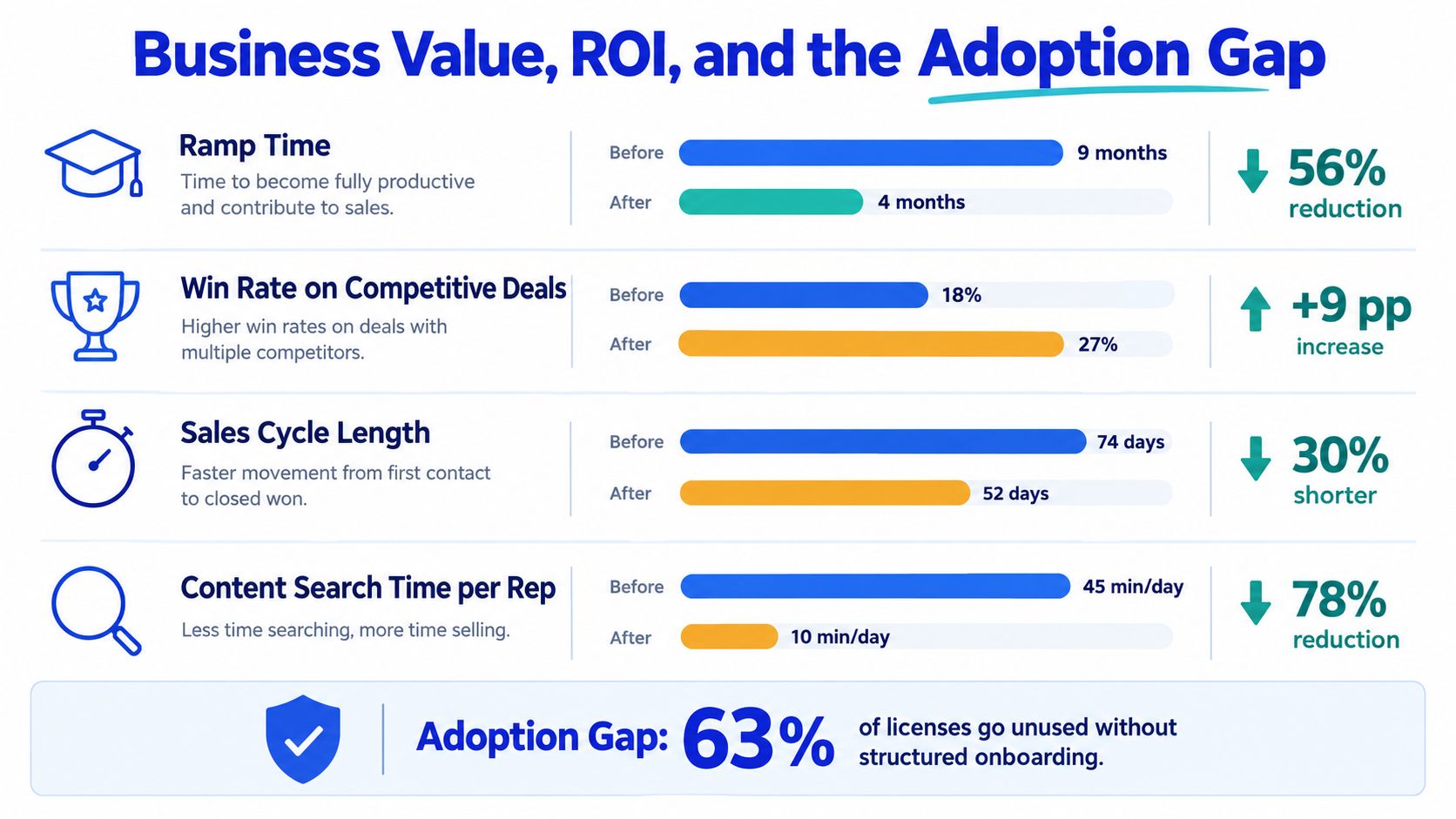
The adoption gap is the commercial risk. Only 29% of enablement teams can directly tie their programs to revenue impact (Fullcast's sales enablement platform analysis). If RevOps can't connect platform activity to qualified opportunities, the business can't distinguish a useful workflow from expensive shelfware.
Research summarized by Digital Applied reports that about 89% of teams have a documented enablement process, yet only about 36% of reps consistently follow it. Teams with consistent adherence reportedly achieve quota at 6.3 times the rate of teams that don't (Digital Applied's 2026 enablement framework). That makes adoption a behavior-design problem. Remove decisions, surface guidance in existing tools, and route useful feedback to managers quickly.
The platform should also reduce search waste. Forrester-referenced coverage says 65% of sales enablement content goes unused, while revenue teams spend about 440 hours per year searching for or recreating assets (Prospeo's content strategy analysis). Search, tagging, expiry, and recommendation features matter because they protect selling time.
A revenue review should include how to measure sales performance, with enablement tied to accepted meetings, SQL movement, sourced pipeline, and closed revenue. If those fields aren't defined before rollout, the ROI story will remain subjective.
A buyer evaluation checklist and decision framework
Start with workflow, not vendor demos. Ask each provider to show how a rep finds an approved asset, uses it in an email or LinkedIn touch, receives account context, and records the outcome in CRM. If the demo depends on a rep remembering to visit a separate portal, score adoption risk immediately.
Five must-pass criteria
Bidirectional CRM and sales engagement sync. Salesforce or HubSpot should send opportunity, account, persona, stage, and outcome data into the platform. The platform should return useful usage and engagement signals, not just receive a one-way feed.
Outbound and LinkedIn fit. Test Apollo, Lemlist, Instantly, Smartlead, HeyReach, Outreach, and Salesloft against your actual motion. The right content or play should follow the rep across channels instead of creating another tab.
Training connected to calls. A course completion should lead to a practice task, a manager review, and a live behavior check. Ask how call data changes the next coaching recommendation.
One view of adoption and pipeline. The system should answer who uses the content, which assets influence opportunities, where reps skip the process, and whether those patterns appear in qualified pipeline.
Governance that survives turnover. Assign ownership, set review dates, define approval rights, and retire assets automatically. Content without an owner becomes stale.
Criteria | Standalone platform, Highspot, Seismic, GROU, Mindtickle | Revenue suite, Salesforce, HubSpot, Gong, Outreach |
|---|---|---|
Best fit | Enablement is a strategic function requiring specialized depth | The existing suite already holds most workflow and revenue data |
Main strength | Dedicated content, readiness, coaching, or pipeline workflows | Fewer systems and a lower integration burden |
Main risk | More implementation, procurement, and data ownership work | Enablement depth may be secondary to the suite's main job |
Choose it when | The team can staff governance and adoption | Incremental depth isn't worth adding another system |
Standalone versus suite
Choose a standalone platform when enablement has a clear owner, a meaningful content or readiness problem, and enough operational capacity to govern the system. Highspot and Seismic suit enterprise content operations. Mindtickle is a logical fit when readiness and coaching lead the buying case. Showpad fits teams that need content and field coaching together. Lessonly remains relevant for structured learning, while GROU operates as a service that connects LinkedIn content, lead generation, outbound, qualification, and reporting rather than selling platform licenses.
Choose a suite when your team already runs heavily on Salesforce, HubSpot, Gong, or Outreach and the missing capability is narrow. A suite won't automatically create adoption, but it can reduce context switching and duplicate data work.
For teams evaluating the surrounding prospecting layer, this B2B lead generation platform comparison helps separate list production from the enablement system that governs how sellers act on the list.
Implementation, governance, and integrations
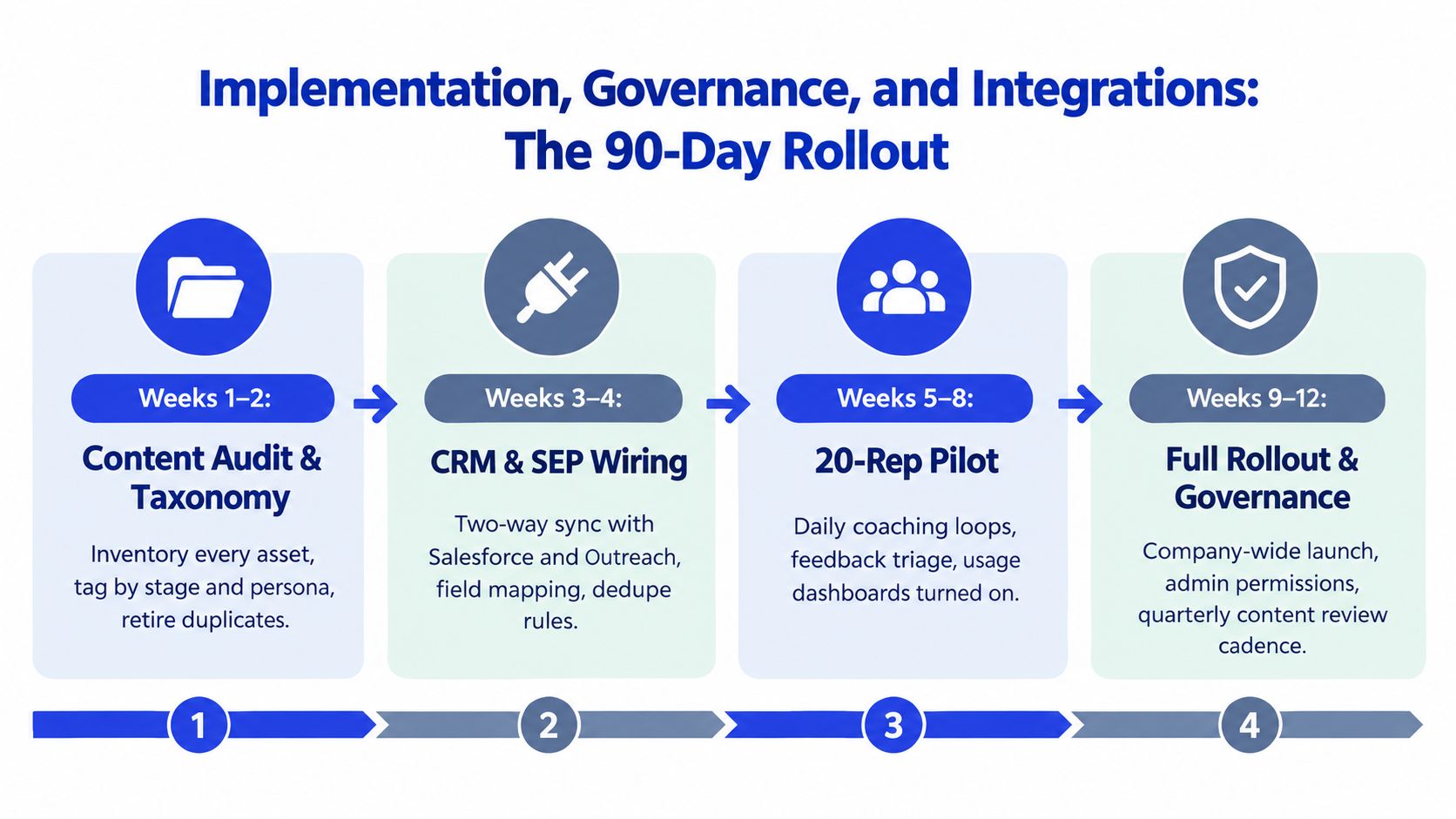
A 90-day rollout works when the team treats enablement as an operating change rather than a software launch. Don't migrate every asset first. Decide what the sales process needs, then load only the material that supports it.
Weeks 1 to 2
Audit every asset, remove duplicates, and tag the survivors by stage, persona, industry, and owner. Record the message each asset supports. If nobody can explain where a document belongs in the sales process, don't publish it.
Weeks 3 to 4
Wire the platform to Salesforce or HubSpot, then connect the sales engagement system. Map account, contact, opportunity, stage, owner, and outcome fields. Add deduplication rules before the pilot, because dirty records will make adoption reporting untrustworthy.
Weeks 5 to 8
Run a focused pilot with 20 reps, using daily coaching and a small number of real plays. Test whether email AI outbound connects with LinkedIn activity through tools such as HeyReach, Smartlead, Lemlist, or Salesloft. The rep should see the same message, account context, and approved asset across channels without copy-paste.
Lead routing must combine CRM rules with platform signals. Route by ICP fit, territory, account ownership, engagement score, and play readiness. A positive reply should reach the right seller while the conversation is warm, with the asset and account context attached.
Weeks 9 to 12
Roll out to the wider team, then formalize governance:
Assign one content owner per region: That person owns accuracy and approval.
Set a 90-day sunset rule: Every asset needs a review date or an automatic retirement path.
Run a weekly enablement standup: RevOps, marketing, and front-line managers review usage, objections, and pipeline movement.
Protect the message system: Marketing shouldn't overwrite sales plays without recording the change and updating the linked workflow.
The operating model should remain one system, one message, one list. That's also the logic behind the RevOps tech stack framework. Every integration should remove work from the rep, not create another reporting obligation.
KPIs that tell you whether enablement is working
If your enablement KPIs only measure activity, you're measuring theatre. Downloads, training completions, and active seats can look healthy while reps ignore the process in live deals.
A download doesn't prove that a buyer saw or valued the asset. A completed course doesn't prove that a rep can handle an objection. An active seat doesn't prove that the platform helped create pipeline.
Vanity KPI, hides weak adoption | Pipeline KPI, reflects real behavior change |
|---|---|
Content downloads | Content-assisted opportunity and win movement |
Training completions | Ramp time plus manager-confirmed skill application |
Active seats | Weekly use inside active opportunities |
Number of sequences launched | Outbound touches containing approved, relevant plays |
Buyer room visits | Sales-accepted engagement that advances a deal |
Track five outcomes:
Ramp time: Measure the period from start date to defined productivity, not course completion.
Content-assisted win rate: Compare opportunities where approved content was used with the relevant control group.
Sales cycle length: Segment deals by asset and coaching usage, then inspect whether enablement supports stage movement.
Outbound play attach rate: Record whether sequences include platform-sourced messaging, assets, or account context.
Enablement-influenced pipeline: Tie campaigns and plays to sourced or influenced opportunities in CRM.
Use a weekly operating view for behavior, a monthly view for pipeline, and a quarterly view for content retirement and program economics. Intervene when reps skip a required play, managers stop coaching from call data, or asset usage rises without qualified pipeline.
What this looks like across SaaS, iGaming, manufacturing, and services
The same platform behaves differently across industries. A SaaS team needs speed and message alignment. A manufacturer needs field access to technical detail. Treating both as a content-search problem produces the wrong implementation.
SaaS
The priority is fast rep ramp and tight alignment between product marketing releases and live pitch decks. Store competitive battlecards by segment, link them to opportunity stages, and give managers call moments that show whether the new positioning reached discovery.
The capability that earns its keep: readiness tied to current product messaging.
iGaming
iGaming teams deal with changing regulations, multiple markets, and high-velocity inbound. Assets need jurisdiction-level version control, while routing must consider license territory and buyer type. Inside sellers should receive compliant scripts and the right follow-up path without searching through a general library.
The capability that earns its keep: governed content with territory-aware routing.
Manufacturing
Manufacturing deals often involve long cycles, technical stakeholders, dealers, and integrators. Reps need drawings, specifications, configuration sheets, and value calculations in the field. The platform should work from the opportunity record and preserve the current version of every technical asset.
The capability that earns its keep: field-ready content access connected to CRM stage and account structure.
Professional services
Legal tech, pharma services, and other professional services teams need consistent proposals, case studies, pricing guardrails, and scope language. The system should help junior sellers and partners build a credible first version without requiring senior review for every conversation.
The capability that earns its keep: proposal governance with coaching tied to scope and commercial approval.
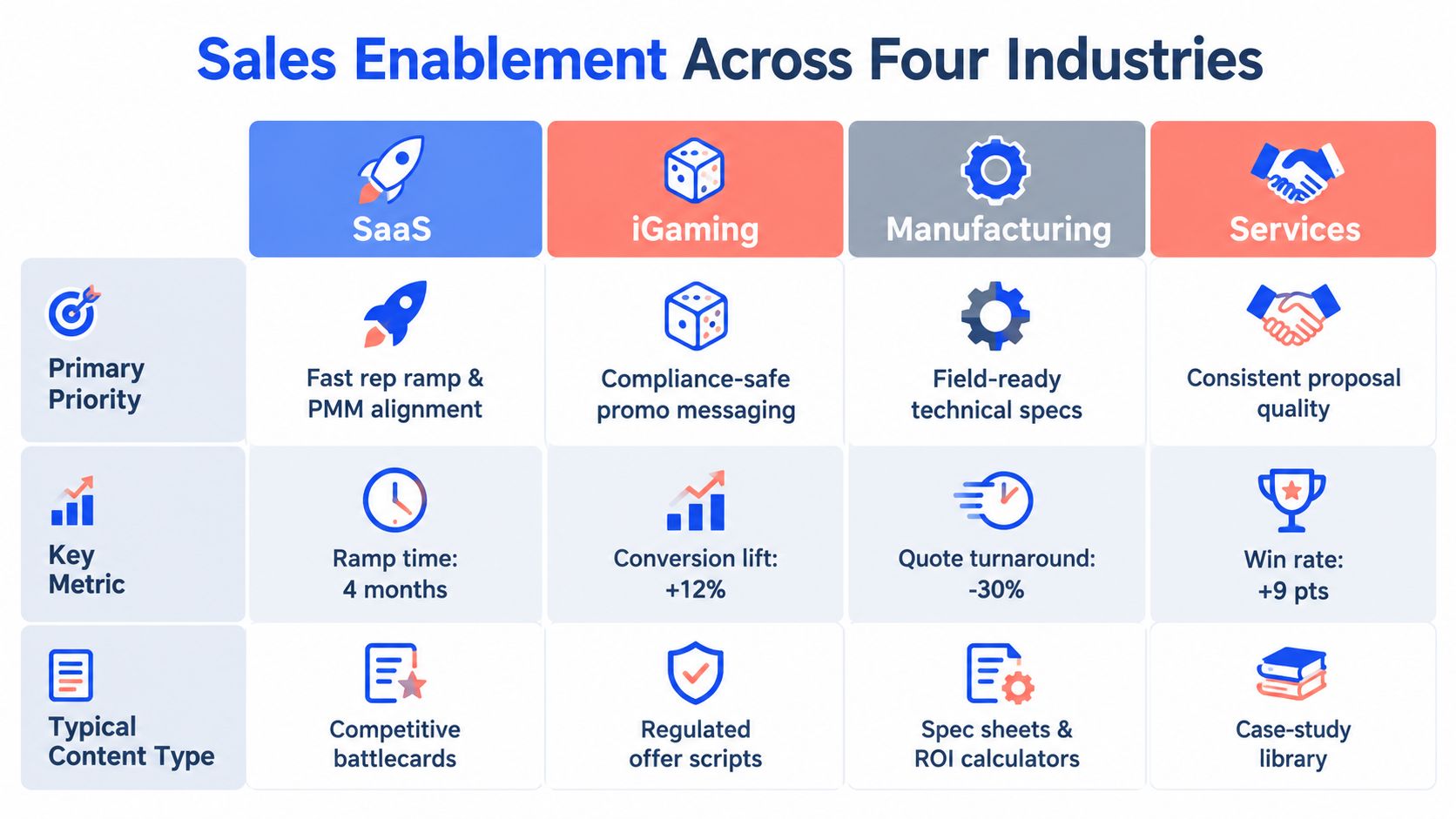
The common thread is workflow fit. The platform earns adoption when it removes decisions from the seller's day and sends qualified context to the next person responsible for the account.
GROU is a global B2B pipeline agency that connects LinkedIn content, lead generation, outbound, qualification, and reporting into one operating system. Its method runs through ICP rules, fast reply routing, bi-weekly sprints, sales feedback, and pipeline measurement, with setup and launch within 14 days and early signals within 30 days. Visit Grou to build an enablement-led pipeline system around the accounts your team can win.
Your QBR is exposing a system failure. Three reps pitch the same account with three different decks, while another loses momentum because the case study she needs is buried in Slack. The team doesn't lack effort. It lacks a reliable path from message to rep to buyer.
A sales enablement platform should control content, readiness, field feedback, and CRM execution in one operating system.
Adoption matters more than feature count, because unused licenses don't change seller behavior.
The right evaluation starts with workflow fit, bidirectional data, governance, and pipeline measurement.
Standalone software makes sense when enablement is strategic. A broader suite wins when integration tax is the bigger risk.
The same structure must flex across SaaS, iGaming, manufacturing, and professional services.
Table of Contents
The problem you are actually solving
Sales teams rarely fail because marketing hasn't produced enough material. They fail because the right message, account context, and next action don't reach the rep at the right moment. A deck sits in SharePoint, a pricing exception lives in a manager's inbox, and the latest objection-handling guidance appears in a Slack thread nobody can search during a live call.
That fragmentation creates familiar QBR symptoms. One rep sends an outdated case study. Another skips the approved sequence and writes a custom message from scratch. Managers then review activity reports instead of seeing whether the team used the agreed process in real opportunities.
The category has expanded because the operating problem is larger than content storage. Industry adoption moved from fewer than 20% of organizations in 2013 to more than 60% in 2019, while more recent summaries report that 90% of organizations have a dedicated sales enablement team or program and 65% use sales enablement technology (Cirrus Insight's sales enablement statistics). A platform now sits across training, content, coaching, workflow, and measurement.
This guide takes an operator's view:
Define the system: what a sales enablement platform must do beyond storing decks.
Set the minimum bar: four capability areas, plus the integrations that make them useful.
Tie activity to revenue: adoption, content influence, pipeline, and forecast conversion.
Buy with discipline: a checklist for standalone platforms versus broader revenue suites.
Implement without shelfware: a 90-day rollout connected to LinkedIn, outbound, routing, and CRM.
Test the model by industry: SaaS, iGaming, manufacturing, and professional services.
For a practical overview of how enablement supports pipeline generation, see GROU's sales enablement approach. The central principle is simple: structure turns attention into pipeline.
What a sales enablement platform really is
A sales enablement platform is a system of record and action for revenue execution. It gives reps one place to find approved content, follow role-specific learning, review feedback from real conversations, and see what works in active deals. It also pushes useful signals into the tools where selling happens.
That makes it different from a slide library. It isn't an LMS added for compliance, a sales engagement tool, or a CRM. Highspot and Seismic are known for content operations, Mindtickle for readiness and coaching, Gong for conversation intelligence, and Showpad for the connection between field content and coaching. The buying decision should reflect the job your team needs the platform to perform.
The modern scope has four connected parts:
Content management: approved assets, version control, metadata, buyer engagement, and expiration rules.
Training and coaching: onboarding paths, certification, practice, call reviews, and manager scorecards.
Conversation and pipeline analytics: field behavior, message performance, asset influence, and deal-stage gaps.
Workflow integration: CRM, sales engagement, LinkedIn, routing, Slack, and custom webhooks.
The operator test is one system, one message, one list. The system should tell marketing which assets sellers use, tell managers where coaching is needed, and tell RevOps whether those behaviors reach qualified pipeline. A rep shouldn't have to open five tabs to prepare for one account meeting.
Practical rule: If the platform doesn't reduce decisions during the selling day, adoption will decay.
That is why building sales enablement teams with enablement requires more than buying software. Ownership, workflows, and manager habits determine whether the system becomes part of daily work. Without governance and adoption controls, even a well-designed platform becomes another folder that reps stop opening.
Core capabilities that matter in 2026
Feature checklists hide the core buying question: what must the platform make easier for a rep, manager, and RevOps lead? A credible system earns its place by connecting field behavior to buyer engagement and pipeline data.
Capability | What it must do | Minimum bar in 2026 |
|---|---|---|
Content management | Store, govern, recommend, and track buyer-facing assets | Versioning, persona and industry tags, stage filters, usage analytics, tracked sharing, and content expiry |
Training and coaching | Build skills and connect practice to live performance | Role-based paths, microlearning, call recordings, AI-tagged moments, and manager scorecards tied to deal stages |
Conversation and pipeline analytics | Show which behaviors influence outcomes | Asset-to-deal reporting, reply and message analysis, rep-level adoption, and gap analysis against strong performers |
Integrations | Put enablement inside existing workflows | Bidirectional Salesforce or HubSpot sync, LinkedIn Sales Navigator or Sales Insight connectivity, sales engagement sync, routing support, and webhooks |
Content management
The minimum standard is a governed source of truth. Tag assets by persona, industry, funnel stage, product, and jurisdiction, then make those tags usable in recommendations and search. Tracked links should show whether buyers engage with the material, not merely whether a rep downloaded it.
Versioning matters most in regulated or fast-changing markets. An iGaming team may need different language by license territory. Pharma teams need approved claims. Manufacturing sellers need current technical specifications. A content repository that can't retire outdated material creates risk rather than control.
Training and coaching
Training must continue inside the flow of work. A new rep should follow a role-specific path, practice the core pitch, receive feedback from recorded calls, and see coaching tied to the stage of the deal. Managers need scorecards that expose behaviors, not just completion rates.
Analytics and integrations
Analytics should connect content use, conversation behavior, and pipeline movement. A dashboard that reports downloads without showing influenced opportunities is an activity report wearing a revenue label.
AI is useful when it recommends relevant content, auto-tags call moments, or summarizes a deal from grounded CRM data. Generic content generation without account context creates more review work. For broader process guidance, sales enablement best practices are useful only when translated into your CRM fields, manager cadence, and qualification rules.
Your platform also needs to fit the rest of the stack. Compare its workflow against your sales engagement platform, then test whether a rep can use the recommended asset without leaving the opportunity or sequence.
Business value, ROI, and the adoption gap
Revenue leaders don't buy enablement software to increase the number of completed courses. They buy it to improve ramp, win rates, cycle time, content productivity, and forecast confidence. Each outcome depends on a different part of the system.
A formal enablement function closed 49% of forecast deals, compared with 42.5% for teams without one, according to the research summarized by AlignedUp (sales enablement platform outcomes). The same source reports that consistent coaching plus impact measurement correlates with 32% higher win rates and 28% higher quota attainment. The practical lesson is that content alone won't produce the result. Coaching and measurement have to operate with it.
A representative Total Economic Impact analysis cited a 578% three-year ROI, $24.2 million in total benefits, and $20.7 million in net present value, while attributing a 15% increase in new-business revenue to better use of prospect and buyer-facing content (the Forrester TEI study). Treat those figures as a case-specific model, not a promise for every buyer.
The adoption gap is the commercial risk. Only 29% of enablement teams can directly tie their programs to revenue impact (Fullcast's sales enablement platform analysis). If RevOps can't connect platform activity to qualified opportunities, the business can't distinguish a useful workflow from expensive shelfware.
Research summarized by Digital Applied reports that about 89% of teams have a documented enablement process, yet only about 36% of reps consistently follow it. Teams with consistent adherence reportedly achieve quota at 6.3 times the rate of teams that don't (Digital Applied's 2026 enablement framework). That makes adoption a behavior-design problem. Remove decisions, surface guidance in existing tools, and route useful feedback to managers quickly.
The platform should also reduce search waste. Forrester-referenced coverage says 65% of sales enablement content goes unused, while revenue teams spend about 440 hours per year searching for or recreating assets (Prospeo's content strategy analysis). Search, tagging, expiry, and recommendation features matter because they protect selling time.
A revenue review should include how to measure sales performance, with enablement tied to accepted meetings, SQL movement, sourced pipeline, and closed revenue. If those fields aren't defined before rollout, the ROI story will remain subjective.
A buyer evaluation checklist and decision framework
Start with workflow, not vendor demos. Ask each provider to show how a rep finds an approved asset, uses it in an email or LinkedIn touch, receives account context, and records the outcome in CRM. If the demo depends on a rep remembering to visit a separate portal, score adoption risk immediately.
Five must-pass criteria
Bidirectional CRM and sales engagement sync. Salesforce or HubSpot should send opportunity, account, persona, stage, and outcome data into the platform. The platform should return useful usage and engagement signals, not just receive a one-way feed.
Outbound and LinkedIn fit. Test Apollo, Lemlist, Instantly, Smartlead, HeyReach, Outreach, and Salesloft against your actual motion. The right content or play should follow the rep across channels instead of creating another tab.
Training connected to calls. A course completion should lead to a practice task, a manager review, and a live behavior check. Ask how call data changes the next coaching recommendation.
One view of adoption and pipeline. The system should answer who uses the content, which assets influence opportunities, where reps skip the process, and whether those patterns appear in qualified pipeline.
Governance that survives turnover. Assign ownership, set review dates, define approval rights, and retire assets automatically. Content without an owner becomes stale.
Criteria | Standalone platform, Highspot, Seismic, GROU, Mindtickle | Revenue suite, Salesforce, HubSpot, Gong, Outreach |
|---|---|---|
Best fit | Enablement is a strategic function requiring specialized depth | The existing suite already holds most workflow and revenue data |
Main strength | Dedicated content, readiness, coaching, or pipeline workflows | Fewer systems and a lower integration burden |
Main risk | More implementation, procurement, and data ownership work | Enablement depth may be secondary to the suite's main job |
Choose it when | The team can staff governance and adoption | Incremental depth isn't worth adding another system |
Standalone versus suite
Choose a standalone platform when enablement has a clear owner, a meaningful content or readiness problem, and enough operational capacity to govern the system. Highspot and Seismic suit enterprise content operations. Mindtickle is a logical fit when readiness and coaching lead the buying case. Showpad fits teams that need content and field coaching together. Lessonly remains relevant for structured learning, while GROU operates as a service that connects LinkedIn content, lead generation, outbound, qualification, and reporting rather than selling platform licenses.
Choose a suite when your team already runs heavily on Salesforce, HubSpot, Gong, or Outreach and the missing capability is narrow. A suite won't automatically create adoption, but it can reduce context switching and duplicate data work.
For teams evaluating the surrounding prospecting layer, this B2B lead generation platform comparison helps separate list production from the enablement system that governs how sellers act on the list.
Implementation, governance, and integrations
A 90-day rollout works when the team treats enablement as an operating change rather than a software launch. Don't migrate every asset first. Decide what the sales process needs, then load only the material that supports it.
Weeks 1 to 2
Audit every asset, remove duplicates, and tag the survivors by stage, persona, industry, and owner. Record the message each asset supports. If nobody can explain where a document belongs in the sales process, don't publish it.
Weeks 3 to 4
Wire the platform to Salesforce or HubSpot, then connect the sales engagement system. Map account, contact, opportunity, stage, owner, and outcome fields. Add deduplication rules before the pilot, because dirty records will make adoption reporting untrustworthy.
Weeks 5 to 8
Run a focused pilot with 20 reps, using daily coaching and a small number of real plays. Test whether email AI outbound connects with LinkedIn activity through tools such as HeyReach, Smartlead, Lemlist, or Salesloft. The rep should see the same message, account context, and approved asset across channels without copy-paste.
Lead routing must combine CRM rules with platform signals. Route by ICP fit, territory, account ownership, engagement score, and play readiness. A positive reply should reach the right seller while the conversation is warm, with the asset and account context attached.
Weeks 9 to 12
Roll out to the wider team, then formalize governance:
Assign one content owner per region: That person owns accuracy and approval.
Set a 90-day sunset rule: Every asset needs a review date or an automatic retirement path.
Run a weekly enablement standup: RevOps, marketing, and front-line managers review usage, objections, and pipeline movement.
Protect the message system: Marketing shouldn't overwrite sales plays without recording the change and updating the linked workflow.
The operating model should remain one system, one message, one list. That's also the logic behind the RevOps tech stack framework. Every integration should remove work from the rep, not create another reporting obligation.
KPIs that tell you whether enablement is working
If your enablement KPIs only measure activity, you're measuring theatre. Downloads, training completions, and active seats can look healthy while reps ignore the process in live deals.
A download doesn't prove that a buyer saw or valued the asset. A completed course doesn't prove that a rep can handle an objection. An active seat doesn't prove that the platform helped create pipeline.
Vanity KPI, hides weak adoption | Pipeline KPI, reflects real behavior change |
|---|---|
Content downloads | Content-assisted opportunity and win movement |
Training completions | Ramp time plus manager-confirmed skill application |
Active seats | Weekly use inside active opportunities |
Number of sequences launched | Outbound touches containing approved, relevant plays |
Buyer room visits | Sales-accepted engagement that advances a deal |
Track five outcomes:
Ramp time: Measure the period from start date to defined productivity, not course completion.
Content-assisted win rate: Compare opportunities where approved content was used with the relevant control group.
Sales cycle length: Segment deals by asset and coaching usage, then inspect whether enablement supports stage movement.
Outbound play attach rate: Record whether sequences include platform-sourced messaging, assets, or account context.
Enablement-influenced pipeline: Tie campaigns and plays to sourced or influenced opportunities in CRM.
Use a weekly operating view for behavior, a monthly view for pipeline, and a quarterly view for content retirement and program economics. Intervene when reps skip a required play, managers stop coaching from call data, or asset usage rises without qualified pipeline.
What this looks like across SaaS, iGaming, manufacturing, and services
The same platform behaves differently across industries. A SaaS team needs speed and message alignment. A manufacturer needs field access to technical detail. Treating both as a content-search problem produces the wrong implementation.
SaaS
The priority is fast rep ramp and tight alignment between product marketing releases and live pitch decks. Store competitive battlecards by segment, link them to opportunity stages, and give managers call moments that show whether the new positioning reached discovery.
The capability that earns its keep: readiness tied to current product messaging.
iGaming
iGaming teams deal with changing regulations, multiple markets, and high-velocity inbound. Assets need jurisdiction-level version control, while routing must consider license territory and buyer type. Inside sellers should receive compliant scripts and the right follow-up path without searching through a general library.
The capability that earns its keep: governed content with territory-aware routing.
Manufacturing
Manufacturing deals often involve long cycles, technical stakeholders, dealers, and integrators. Reps need drawings, specifications, configuration sheets, and value calculations in the field. The platform should work from the opportunity record and preserve the current version of every technical asset.
The capability that earns its keep: field-ready content access connected to CRM stage and account structure.
Professional services
Legal tech, pharma services, and other professional services teams need consistent proposals, case studies, pricing guardrails, and scope language. The system should help junior sellers and partners build a credible first version without requiring senior review for every conversation.
The capability that earns its keep: proposal governance with coaching tied to scope and commercial approval.
The common thread is workflow fit. The platform earns adoption when it removes decisions from the seller's day and sends qualified context to the next person responsible for the account.
GROU is a global B2B pipeline agency that connects LinkedIn content, lead generation, outbound, qualification, and reporting into one operating system. Its method runs through ICP rules, fast reply routing, bi-weekly sprints, sales feedback, and pipeline measurement, with setup and launch within 14 days and early signals within 30 days. Visit Grou to build an enablement-led pipeline system around the accounts your team can win.
Your QBR is exposing a system failure. Three reps pitch the same account with three different decks, while another loses momentum because the case study she needs is buried in Slack. The team doesn't lack effort. It lacks a reliable path from message to rep to buyer.
A sales enablement platform should control content, readiness, field feedback, and CRM execution in one operating system.
Adoption matters more than feature count, because unused licenses don't change seller behavior.
The right evaluation starts with workflow fit, bidirectional data, governance, and pipeline measurement.
Standalone software makes sense when enablement is strategic. A broader suite wins when integration tax is the bigger risk.
The same structure must flex across SaaS, iGaming, manufacturing, and professional services.
Table of Contents
The problem you are actually solving
Sales teams rarely fail because marketing hasn't produced enough material. They fail because the right message, account context, and next action don't reach the rep at the right moment. A deck sits in SharePoint, a pricing exception lives in a manager's inbox, and the latest objection-handling guidance appears in a Slack thread nobody can search during a live call.
That fragmentation creates familiar QBR symptoms. One rep sends an outdated case study. Another skips the approved sequence and writes a custom message from scratch. Managers then review activity reports instead of seeing whether the team used the agreed process in real opportunities.
The category has expanded because the operating problem is larger than content storage. Industry adoption moved from fewer than 20% of organizations in 2013 to more than 60% in 2019, while more recent summaries report that 90% of organizations have a dedicated sales enablement team or program and 65% use sales enablement technology (Cirrus Insight's sales enablement statistics). A platform now sits across training, content, coaching, workflow, and measurement.
This guide takes an operator's view:
Define the system: what a sales enablement platform must do beyond storing decks.
Set the minimum bar: four capability areas, plus the integrations that make them useful.
Tie activity to revenue: adoption, content influence, pipeline, and forecast conversion.
Buy with discipline: a checklist for standalone platforms versus broader revenue suites.
Implement without shelfware: a 90-day rollout connected to LinkedIn, outbound, routing, and CRM.
Test the model by industry: SaaS, iGaming, manufacturing, and professional services.
For a practical overview of how enablement supports pipeline generation, see GROU's sales enablement approach. The central principle is simple: structure turns attention into pipeline.
What a sales enablement platform really is
A sales enablement platform is a system of record and action for revenue execution. It gives reps one place to find approved content, follow role-specific learning, review feedback from real conversations, and see what works in active deals. It also pushes useful signals into the tools where selling happens.
That makes it different from a slide library. It isn't an LMS added for compliance, a sales engagement tool, or a CRM. Highspot and Seismic are known for content operations, Mindtickle for readiness and coaching, Gong for conversation intelligence, and Showpad for the connection between field content and coaching. The buying decision should reflect the job your team needs the platform to perform.
The modern scope has four connected parts:
Content management: approved assets, version control, metadata, buyer engagement, and expiration rules.
Training and coaching: onboarding paths, certification, practice, call reviews, and manager scorecards.
Conversation and pipeline analytics: field behavior, message performance, asset influence, and deal-stage gaps.
Workflow integration: CRM, sales engagement, LinkedIn, routing, Slack, and custom webhooks.
The operator test is one system, one message, one list. The system should tell marketing which assets sellers use, tell managers where coaching is needed, and tell RevOps whether those behaviors reach qualified pipeline. A rep shouldn't have to open five tabs to prepare for one account meeting.
Practical rule: If the platform doesn't reduce decisions during the selling day, adoption will decay.
That is why building sales enablement teams with enablement requires more than buying software. Ownership, workflows, and manager habits determine whether the system becomes part of daily work. Without governance and adoption controls, even a well-designed platform becomes another folder that reps stop opening.
Core capabilities that matter in 2026
Feature checklists hide the core buying question: what must the platform make easier for a rep, manager, and RevOps lead? A credible system earns its place by connecting field behavior to buyer engagement and pipeline data.
Capability | What it must do | Minimum bar in 2026 |
|---|---|---|
Content management | Store, govern, recommend, and track buyer-facing assets | Versioning, persona and industry tags, stage filters, usage analytics, tracked sharing, and content expiry |
Training and coaching | Build skills and connect practice to live performance | Role-based paths, microlearning, call recordings, AI-tagged moments, and manager scorecards tied to deal stages |
Conversation and pipeline analytics | Show which behaviors influence outcomes | Asset-to-deal reporting, reply and message analysis, rep-level adoption, and gap analysis against strong performers |
Integrations | Put enablement inside existing workflows | Bidirectional Salesforce or HubSpot sync, LinkedIn Sales Navigator or Sales Insight connectivity, sales engagement sync, routing support, and webhooks |
Content management
The minimum standard is a governed source of truth. Tag assets by persona, industry, funnel stage, product, and jurisdiction, then make those tags usable in recommendations and search. Tracked links should show whether buyers engage with the material, not merely whether a rep downloaded it.
Versioning matters most in regulated or fast-changing markets. An iGaming team may need different language by license territory. Pharma teams need approved claims. Manufacturing sellers need current technical specifications. A content repository that can't retire outdated material creates risk rather than control.
Training and coaching
Training must continue inside the flow of work. A new rep should follow a role-specific path, practice the core pitch, receive feedback from recorded calls, and see coaching tied to the stage of the deal. Managers need scorecards that expose behaviors, not just completion rates.
Analytics and integrations
Analytics should connect content use, conversation behavior, and pipeline movement. A dashboard that reports downloads without showing influenced opportunities is an activity report wearing a revenue label.
AI is useful when it recommends relevant content, auto-tags call moments, or summarizes a deal from grounded CRM data. Generic content generation without account context creates more review work. For broader process guidance, sales enablement best practices are useful only when translated into your CRM fields, manager cadence, and qualification rules.
Your platform also needs to fit the rest of the stack. Compare its workflow against your sales engagement platform, then test whether a rep can use the recommended asset without leaving the opportunity or sequence.
Business value, ROI, and the adoption gap
Revenue leaders don't buy enablement software to increase the number of completed courses. They buy it to improve ramp, win rates, cycle time, content productivity, and forecast confidence. Each outcome depends on a different part of the system.
A formal enablement function closed 49% of forecast deals, compared with 42.5% for teams without one, according to the research summarized by AlignedUp (sales enablement platform outcomes). The same source reports that consistent coaching plus impact measurement correlates with 32% higher win rates and 28% higher quota attainment. The practical lesson is that content alone won't produce the result. Coaching and measurement have to operate with it.
A representative Total Economic Impact analysis cited a 578% three-year ROI, $24.2 million in total benefits, and $20.7 million in net present value, while attributing a 15% increase in new-business revenue to better use of prospect and buyer-facing content (the Forrester TEI study). Treat those figures as a case-specific model, not a promise for every buyer.
The adoption gap is the commercial risk. Only 29% of enablement teams can directly tie their programs to revenue impact (Fullcast's sales enablement platform analysis). If RevOps can't connect platform activity to qualified opportunities, the business can't distinguish a useful workflow from expensive shelfware.
Research summarized by Digital Applied reports that about 89% of teams have a documented enablement process, yet only about 36% of reps consistently follow it. Teams with consistent adherence reportedly achieve quota at 6.3 times the rate of teams that don't (Digital Applied's 2026 enablement framework). That makes adoption a behavior-design problem. Remove decisions, surface guidance in existing tools, and route useful feedback to managers quickly.
The platform should also reduce search waste. Forrester-referenced coverage says 65% of sales enablement content goes unused, while revenue teams spend about 440 hours per year searching for or recreating assets (Prospeo's content strategy analysis). Search, tagging, expiry, and recommendation features matter because they protect selling time.
A revenue review should include how to measure sales performance, with enablement tied to accepted meetings, SQL movement, sourced pipeline, and closed revenue. If those fields aren't defined before rollout, the ROI story will remain subjective.
A buyer evaluation checklist and decision framework
Start with workflow, not vendor demos. Ask each provider to show how a rep finds an approved asset, uses it in an email or LinkedIn touch, receives account context, and records the outcome in CRM. If the demo depends on a rep remembering to visit a separate portal, score adoption risk immediately.
Five must-pass criteria
Bidirectional CRM and sales engagement sync. Salesforce or HubSpot should send opportunity, account, persona, stage, and outcome data into the platform. The platform should return useful usage and engagement signals, not just receive a one-way feed.
Outbound and LinkedIn fit. Test Apollo, Lemlist, Instantly, Smartlead, HeyReach, Outreach, and Salesloft against your actual motion. The right content or play should follow the rep across channels instead of creating another tab.
Training connected to calls. A course completion should lead to a practice task, a manager review, and a live behavior check. Ask how call data changes the next coaching recommendation.
One view of adoption and pipeline. The system should answer who uses the content, which assets influence opportunities, where reps skip the process, and whether those patterns appear in qualified pipeline.
Governance that survives turnover. Assign ownership, set review dates, define approval rights, and retire assets automatically. Content without an owner becomes stale.
Criteria | Standalone platform, Highspot, Seismic, GROU, Mindtickle | Revenue suite, Salesforce, HubSpot, Gong, Outreach |
|---|---|---|
Best fit | Enablement is a strategic function requiring specialized depth | The existing suite already holds most workflow and revenue data |
Main strength | Dedicated content, readiness, coaching, or pipeline workflows | Fewer systems and a lower integration burden |
Main risk | More implementation, procurement, and data ownership work | Enablement depth may be secondary to the suite's main job |
Choose it when | The team can staff governance and adoption | Incremental depth isn't worth adding another system |
Standalone versus suite
Choose a standalone platform when enablement has a clear owner, a meaningful content or readiness problem, and enough operational capacity to govern the system. Highspot and Seismic suit enterprise content operations. Mindtickle is a logical fit when readiness and coaching lead the buying case. Showpad fits teams that need content and field coaching together. Lessonly remains relevant for structured learning, while GROU operates as a service that connects LinkedIn content, lead generation, outbound, qualification, and reporting rather than selling platform licenses.
Choose a suite when your team already runs heavily on Salesforce, HubSpot, Gong, or Outreach and the missing capability is narrow. A suite won't automatically create adoption, but it can reduce context switching and duplicate data work.
For teams evaluating the surrounding prospecting layer, this B2B lead generation platform comparison helps separate list production from the enablement system that governs how sellers act on the list.
Implementation, governance, and integrations
A 90-day rollout works when the team treats enablement as an operating change rather than a software launch. Don't migrate every asset first. Decide what the sales process needs, then load only the material that supports it.
Weeks 1 to 2
Audit every asset, remove duplicates, and tag the survivors by stage, persona, industry, and owner. Record the message each asset supports. If nobody can explain where a document belongs in the sales process, don't publish it.
Weeks 3 to 4
Wire the platform to Salesforce or HubSpot, then connect the sales engagement system. Map account, contact, opportunity, stage, owner, and outcome fields. Add deduplication rules before the pilot, because dirty records will make adoption reporting untrustworthy.
Weeks 5 to 8
Run a focused pilot with 20 reps, using daily coaching and a small number of real plays. Test whether email AI outbound connects with LinkedIn activity through tools such as HeyReach, Smartlead, Lemlist, or Salesloft. The rep should see the same message, account context, and approved asset across channels without copy-paste.
Lead routing must combine CRM rules with platform signals. Route by ICP fit, territory, account ownership, engagement score, and play readiness. A positive reply should reach the right seller while the conversation is warm, with the asset and account context attached.
Weeks 9 to 12
Roll out to the wider team, then formalize governance:
Assign one content owner per region: That person owns accuracy and approval.
Set a 90-day sunset rule: Every asset needs a review date or an automatic retirement path.
Run a weekly enablement standup: RevOps, marketing, and front-line managers review usage, objections, and pipeline movement.
Protect the message system: Marketing shouldn't overwrite sales plays without recording the change and updating the linked workflow.
The operating model should remain one system, one message, one list. That's also the logic behind the RevOps tech stack framework. Every integration should remove work from the rep, not create another reporting obligation.
KPIs that tell you whether enablement is working
If your enablement KPIs only measure activity, you're measuring theatre. Downloads, training completions, and active seats can look healthy while reps ignore the process in live deals.
A download doesn't prove that a buyer saw or valued the asset. A completed course doesn't prove that a rep can handle an objection. An active seat doesn't prove that the platform helped create pipeline.
Vanity KPI, hides weak adoption | Pipeline KPI, reflects real behavior change |
|---|---|
Content downloads | Content-assisted opportunity and win movement |
Training completions | Ramp time plus manager-confirmed skill application |
Active seats | Weekly use inside active opportunities |
Number of sequences launched | Outbound touches containing approved, relevant plays |
Buyer room visits | Sales-accepted engagement that advances a deal |
Track five outcomes:
Ramp time: Measure the period from start date to defined productivity, not course completion.
Content-assisted win rate: Compare opportunities where approved content was used with the relevant control group.
Sales cycle length: Segment deals by asset and coaching usage, then inspect whether enablement supports stage movement.
Outbound play attach rate: Record whether sequences include platform-sourced messaging, assets, or account context.
Enablement-influenced pipeline: Tie campaigns and plays to sourced or influenced opportunities in CRM.
Use a weekly operating view for behavior, a monthly view for pipeline, and a quarterly view for content retirement and program economics. Intervene when reps skip a required play, managers stop coaching from call data, or asset usage rises without qualified pipeline.
What this looks like across SaaS, iGaming, manufacturing, and services
The same platform behaves differently across industries. A SaaS team needs speed and message alignment. A manufacturer needs field access to technical detail. Treating both as a content-search problem produces the wrong implementation.
SaaS
The priority is fast rep ramp and tight alignment between product marketing releases and live pitch decks. Store competitive battlecards by segment, link them to opportunity stages, and give managers call moments that show whether the new positioning reached discovery.
The capability that earns its keep: readiness tied to current product messaging.
iGaming
iGaming teams deal with changing regulations, multiple markets, and high-velocity inbound. Assets need jurisdiction-level version control, while routing must consider license territory and buyer type. Inside sellers should receive compliant scripts and the right follow-up path without searching through a general library.
The capability that earns its keep: governed content with territory-aware routing.
Manufacturing
Manufacturing deals often involve long cycles, technical stakeholders, dealers, and integrators. Reps need drawings, specifications, configuration sheets, and value calculations in the field. The platform should work from the opportunity record and preserve the current version of every technical asset.
The capability that earns its keep: field-ready content access connected to CRM stage and account structure.
Professional services
Legal tech, pharma services, and other professional services teams need consistent proposals, case studies, pricing guardrails, and scope language. The system should help junior sellers and partners build a credible first version without requiring senior review for every conversation.
The capability that earns its keep: proposal governance with coaching tied to scope and commercial approval.
The common thread is workflow fit. The platform earns adoption when it removes decisions from the seller's day and sends qualified context to the next person responsible for the account.
GROU is a global B2B pipeline agency that connects LinkedIn content, lead generation, outbound, qualification, and reporting into one operating system. Its method runs through ICP rules, fast reply routing, bi-weekly sprints, sales feedback, and pipeline measurement, with setup and launch within 14 days and early signals within 30 days. Visit Grou to build an enablement-led pipeline system around the accounts your team can win.
Pipeline OS Newsletter
Build qualified pipeline
Get weekly tactics to generate demand, improve lead quality, and book more meetings.







Trusted by industry leaders
Trusted by industry leaders
Trusted by industry leaders
Ready to build qualified pipeline?
Ready to build qualified pipeline?
Ready to build qualified pipeline?
Book a call to see if we're the right fit, or take the 2-minute quiz to get a clear starting point.
Book a call to see if we're the right fit, or take the 2-minute quiz to get a clear starting point.
Book a call to see if we're the right fit, or take the 2-minute quiz to get a clear starting point.
" height="30.21639343089746px" id="hfGbXmQR2" width="30.216393430897455px"/></svg>)
Copyright © 2026 – All Right Reserved
Copyright © 2026 – All Right Reserved
Copyright © 2026 – All Right Reserved