%22%3E%3C/path%3E%3Cpath d=%22M 63.072 7.554 C 62.258 8.022 61.577 8.689 61.092 9.493 L 61.092 7.076 L 57.158 7.076 L 57.158 22.64 L 61.089 22.64 L 61.089 14.888 C 61.089 13.446 61.403 12.434 62.03 11.853 C 62.818 11.218 63.818 10.907 64.826 10.982 L 65.868 10.982 L 65.868 6.851 C 64.891 6.834 63.926 7.076 63.073 7.554 Z%22 fill=%22rgb(17,17,17)%22%3E%3C/path%3E%3Cpath d=%22M 78.916 7.82 C 76.363 6.49 73.321 6.49 70.768 7.82 C 69.562 8.473 68.564 9.451 67.888 10.644 C 67.167 11.931 66.803 13.387 66.834 14.862 C 66.804 16.332 67.157 17.785 67.86 19.077 C 68.515 20.267 69.494 21.246 70.684 21.901 C 71.924 22.576 73.318 22.92 74.73 22.898 C 76.164 22.918 77.58 22.575 78.846 21.901 C 80.062 21.247 81.073 20.27 81.768 19.077 C 82.506 17.797 82.88 16.339 82.85 14.862 C 82.88 13.389 82.517 11.934 81.797 10.647 C 81.12 9.455 80.122 8.477 78.917 7.824 M 78.803 14.862 C 78.829 15.739 78.636 16.608 78.241 17.391 C 77.903 18.046 77.38 18.588 76.738 18.95 C 76.124 19.293 75.432 19.472 74.729 19.47 C 73.668 19.497 72.648 19.061 71.934 18.276 C 71.139 17.323 70.741 16.1 70.823 14.862 C 70.741 13.62 71.149 12.395 71.959 11.45 C 72.687 10.667 73.715 10.233 74.783 10.256 C 75.859 10.236 76.894 10.67 77.635 11.45 C 78.464 12.387 78.884 13.616 78.801 14.864%22 fill=%22rgb(17,17,17)%22%3E%3C/path%3E%3Cpath d=%22M 95.906 7.076 L 95.906 15.646 C 95.975 16.68 95.643 17.701 94.979 18.498 C 94.311 19.184 93.379 19.547 92.422 19.495 C 91.475 19.544 90.553 19.18 89.894 18.498 C 89.23 17.701 88.898 16.68 88.967 15.646 L 88.967 7.076 L 85.033 7.076 L 85.033 16.207 C 85 17.449 85.275 18.68 85.834 19.79 C 86.327 20.75 87.095 21.542 88.039 22.065 C 89.033 22.594 90.145 22.861 91.271 22.838 C 92.188 22.847 93.095 22.65 93.926 22.263 C 94.708 21.905 95.388 21.36 95.906 20.675 L 95.906 22.645 L 99.865 22.645 L 99.865 7.076 Z%22 fill=%22rgb(17,17,17)%22%3E%3C/path%3E%3Cpath d=%22M 4.513 15.626 C 4.511 10.815 7.606 6.549 12.181 5.059 C 16.756 3.57 21.77 5.195 24.601 9.086 L 27.816 5.87 C 24.074 1.186 17.981 -0.943 12.137 0.393 C 6.292 1.728 1.728 6.292 0.393 12.137 C -0.943 17.981 1.186 24.074 5.87 27.816 L 9.085 24.601 C 6.214 22.512 4.515 19.177 4.513 15.626%22 fill=%22rgb(32,62,235)%22%3E%3C/path%3E%3Cpath d=%22M 17.114 14.343 L 13.354 18.01 L 13.354 18.026 L 21.071 18.026 L 11.412 27.609 L 17.389 27.609 L 23.999 21.081 L 23.999 28.316 L 24.005 28.316 L 27.967 24.393 L 27.967 14.343 Z%22 fill=%22rgb(32,62,235)%22%3E%3C/path%3E%3C/g%3E%3C/svg%3E) ×
× ××
××›
›
›
›
Best B2B Lead Generation Platforms for 2026
Best B2B Lead Generation Platforms for 2026
Best B2B Lead Generation Platforms for 2026
Best B2B Lead Generation Platforms for 2026
Best B2B Lead Generation Platforms for 2026
Best B2B Lead Generation Platforms for 2026

Author
Aljaz Peklaj

Your pipeline is active, but the calendar still looks thin. Reps are sending sequences, marketing is producing demand, and the CRM keeps filling with names that never turn into held meetings. Often, the leak starts earlier than people admit, inside the data and orchestration layer. Vendors keep selling “accuracy” as if one database can solve it. It can't. My verdict is simple: Clay is the top pick for many organizations because it beats single-source tools on usable accuracy, Apollo wins on price-to-volume, and ZoomInfo only makes sense when US enterprise coverage is the priority.
Clay is the winner if you care about net data accuracy, workflow control, and reducing SDR busywork.
Apollo is the best budget buy for teams that need list volume plus built-in outbound.
ZoomInfo is strongest for US enterprise but the pricing gap is real, and the accuracy gap isn't always big enough.
LinkedIn still anchors the channel mix, because 89% of B2B marketers use LinkedIn for lead generation and 62% say it produces quality leads.
If qualification is your bottleneck, fix the system before adding more volume, including how you're improving lead qualification for small businesses.
Table of Contents
1. Grou
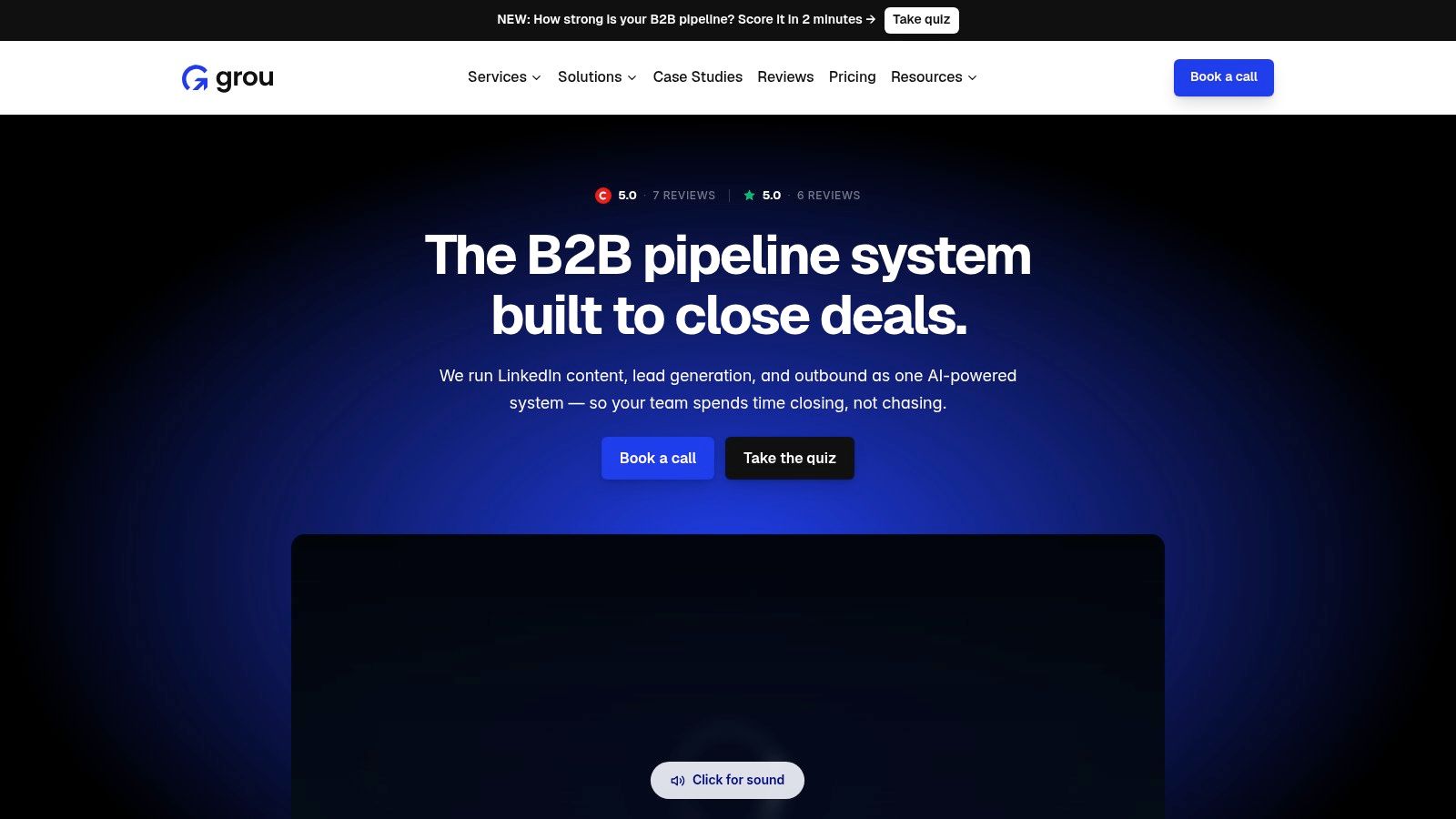
Most lists compare software in isolation. That's useful if your team already has strong RevOps, good messaging, clean routing, and someone who'll maintain the stack every week. Most companies don't. That's why Grou ranks first here. If you need pipeline, not just tool access, a managed system beats another subscription.
Grou connects LinkedIn content, list building, outbound, reply routing, and reporting into one operating layer. That matters because fragmented setups usually create the same failure pattern: marketing generates attention, SDRs chase bad-fit accounts, and sales gets conversations with weak context. Grou fixes that by building one ICP, one message hierarchy, and one reporting line.
Why Grou is first on this list
The strongest part of the offer isn't “AI-powered” positioning. It's structure. Teams buy tools hoping for better output, but the primary lift comes from aligning sourcing, qualification, and handoff. That aligns with broader market direction, where AI-led qualification and intent-driven targeting improve qualification accuracy by 40%, speed qualification by 3x, and lift conversion rates by 25% to 35%.
Grou is also built for the part most software vendors skip, execution discipline. Shared Slack, sprint cadence, dashboards, and fast reply handling sound operationally boring. They are. They also determine whether attention turns into booked meetings or dies in a queue.
Operator view: If your internal team keeps buying point tools to solve a systems problem, stop. You don't have a tooling issue. You have a workflow ownership issue.
For teams comparing software versus service, read Grou's view on lead generation software. It's one of the few places that frames software as part of a pipeline system rather than the system itself.
Where Grou fits, and where it does not
Grou is a fit when:
Your team has attention but weak conversion: LinkedIn activity, inbound, paid traffic, or outbound exists, but meeting quality is inconsistent.
Your sales team needs cleaner handoffs: Reps should spend time on qualified conversations, not manual list cleanup.
You sell in long-cycle B2B markets: SaaS, iGaming, manufacturing, legal tech, pharma, and similar categories benefit from a message-data-routing system.
Skip it if you want a cheap self-serve tool and your team is happy to own enrichment, sequencing, deliverability, QA, reporting, and CRM hygiene internally. In that case, buy the stack and run it well.
2. LinkedIn Sales Navigator
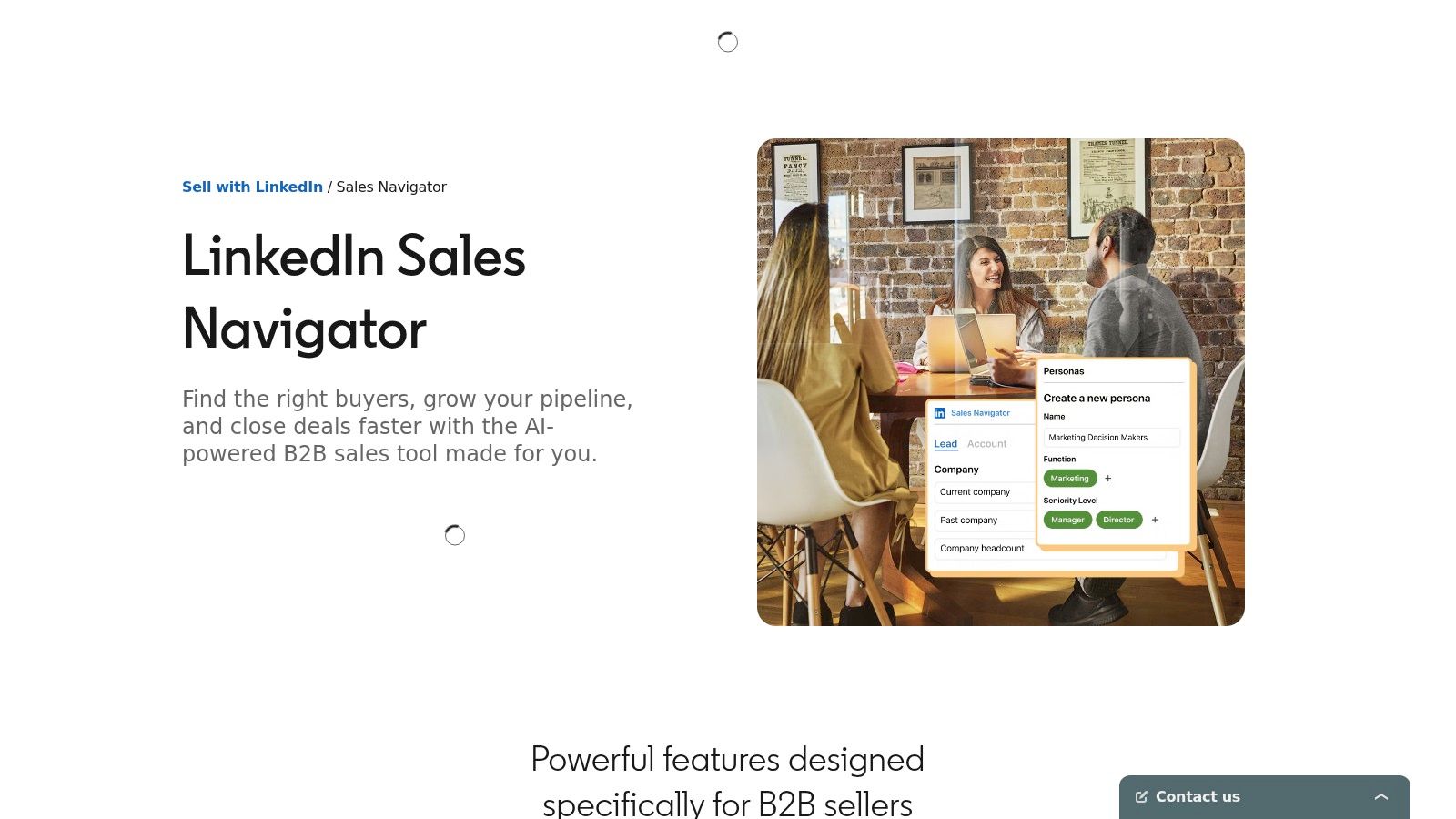
Sales Navigator isn't your data platform. It's your discovery layer. Teams keep trying to make it do the whole job, then complain that it doesn't return emails. That misses the point. It's still the cleanest place to find the right people, map accounts, and watch role movement before you enrich elsewhere.
Use LinkedIn Sales Navigator when your outbound starts with tight ICP filters and account context. Don't use it as a standalone lead gen stack.
Where it earns its seat
LinkedIn dominates B2B social selling, and 94% of B2B marketers use it for sales and lead gen, while 80% of B2B leads from social media come through LinkedIn. That's why almost every serious outbound system still starts here, even if enrichment and sequencing happen in Clay, Apollo, or HubSpot.
In practice, Sales Navigator is best for:
Prospect discovery: cleaner than scraping random databases first
Account mapping: useful when multiple stakeholders shape the deal
Signal spotting: job changes, active posting, and company movement
Message prep: enough context to avoid generic openers
The downside is obvious. It doesn't solve contact acquisition, enrichment, or workflow automation by itself. That's why we pair it with a separate data layer. If LinkedIn is central to your motion, this breakdown on LinkedIn lead generation is the right next read.
Sales Navigator finds the right person. A second system still has to verify whether you can actually reach them.
3. ZoomInfo SalesOS
ZoomInfo SalesOS is the most defensible premium pick on this list, but only in a specific context. If you sell into US enterprise, care about direct dials, and want a bigger feature surface around intent, technographics, and visitor identification, it's a serious option. If you're a mid-market team selling across Europe, it gets harder to justify.
In our testing, ZoomInfo scored 7.8/10 on data accuracy. That beat Apollo, but not by enough to make the pricing decision automatic. It performed best on US enterprise contacts and was more dependable for direct numbers and corporate patterns than cheaper tools.
When the premium is justified
The best case for ZoomInfo is not “it has more features.” Plenty of stacks have more features. The case is that it can centralize several motions under one roof if your team will operationalize them.
Use it when you need:
US enterprise depth: especially for larger account coverage
More than list building: intent, visitor ID, and routing matter
Stronger compliance and procurement posture: useful in bigger orgs
Skip it when your motion is founder-led, your team is underbuilt operationally, or your target market is more European than American. In those cases, you're often paying for platform breadth you won't deploy.
For teams evaluating sales intelligence vendors, Grou's sales intelligence tools directory is useful because it frames tools by use case rather than vendor messaging.
4. Apollo.io
Apollo.io wins more deals than enterprise buyers like to admit. The reason is simple. It gives small and mid-sized teams enough database coverage, enough sequencing, and enough usability to launch quickly without hiring RevOps first. If you're underbuilt and need traction, Apollo is often the right answer.
In our testing, Apollo scored 7.2/10 on data accuracy. That's not elite, and you feel it in role freshness and non-US segments. But the price-to-value is strong, especially for SaaS, services, and UK or US-focused outbound where email coverage matters more than perfect phone data.
Why Apollo keeps winning SMB deals
Apollo works because it bundles the top-of-funnel motion into one place. Build list, enrich, write sequence, send, review replies. That doesn't make it the most accurate platform. It makes it the easiest one to put into production fast.
It's best for:
Founder-led outbound: low setup friction
Small SDR teams: one login covers most of the workflow
High-volume testing: good for segment and message iteration
The weak point is precision. Role accuracy in our checks sat around the low-to-mid 70s. That means you should still verify senior contacts before launching a high-value campaign.
Practical rule: Apollo is for breadth. Clay is for accuracy control. Don't confuse those jobs.
If your qualification logic is weak, bad data compounds quickly. As a result, many teams miss basic lead generation KPIs, especially meeting-held rate and fit rate by segment.
5. Cognism
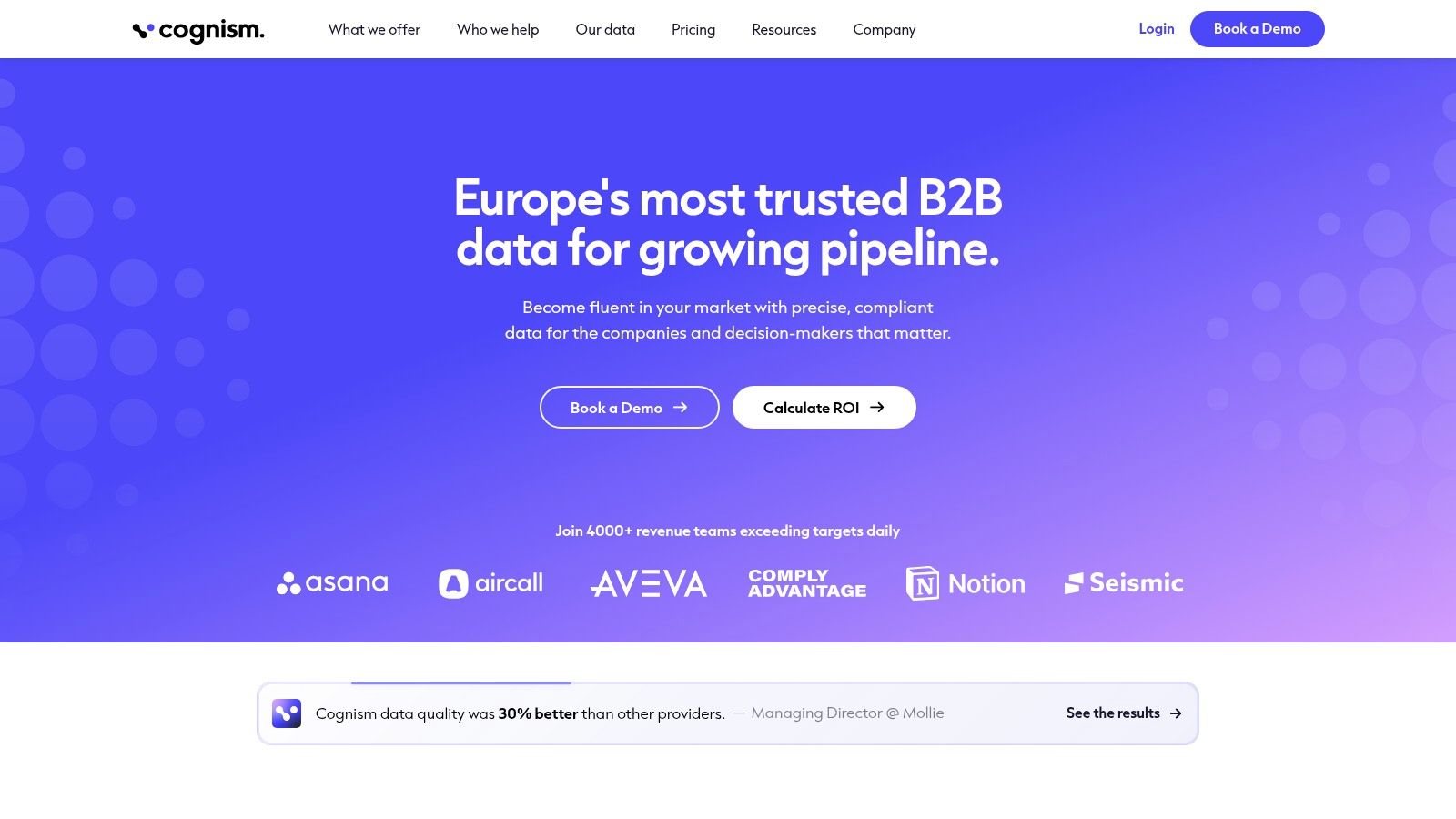
Cognism is the platform I bring in when Europe matters enough to shape the stack. If your campaigns live in the UK and broader EMEA, and compliance posture is part of procurement, Cognism deserves a hard look. If your book is mostly US SaaS, I usually wouldn't make it the first buy.
Cognism is strong where many US-first databases get thin. That includes GDPR-sensitive motions and phone-first teams that care about better connect quality in Europe.
Why I only push Cognism in specific cases
A lot of B2B lead generation platforms look interchangeable until geography starts punishing the wrong choice. Europe is where that shows up fast. We've seen enough weaker EU coverage from mainstream providers to treat regional fit as a first-order decision, not a side note.
That matters because the channel mix is changing. In a post-cookie environment, about 2% of B2B website traffic converts into a lead, which increases the value of first-party intent, visitor identification, LinkedIn, and segmented email. Cognism fits when compliance constraints and regional coverage shape who you can target and how.
Buy it when Europe is the market. Skip it if you only need a secondary source inside a broader waterfall.
6. Clearbit by HubSpot
Clearbit by HubSpot makes the most sense when your CRM is already the center of gravity. If your company runs on HubSpot and wants native enrichment, fit signals, and workflow control inside the same environment, this is cleaner than bolting on another point tool.
Clearbit by HubSpot is not my top pick for list building from scratch. It is a strong pick for HubSpot-centric teams that care more about clean records, routing, and lifecycle automation than raw database size.
The real value is inside HubSpot ops
The reason this category matters is not novelty. It's consolidation. Industry estimates put the B2B lead generation software market at USD 6.78 billion in 2025, projected to reach USD 15 billion by 2035 at an 8.3% CAGR. As the category expands, more teams are trying to reduce stack sprawl rather than add another enrichment tab.
That's where HubSpot-native enrichment wins. If your SDRs, marketers, and RevOps team all work in HubSpot, writing enriched data directly into the CRM can save constant exports, remaps, and duplicate cleanup.
It's strongest for:
HubSpot-first companies: especially with custom properties and workflow logic
Inbound-heavy teams: enrich and route inside one system
Ops-led environments: CRM hygiene matters as much as sourcing
The trade-off is lock-in. Once the economics of HubSpot plans and credits start stacking, a standalone data layer can look cheaper.
7. Lusha
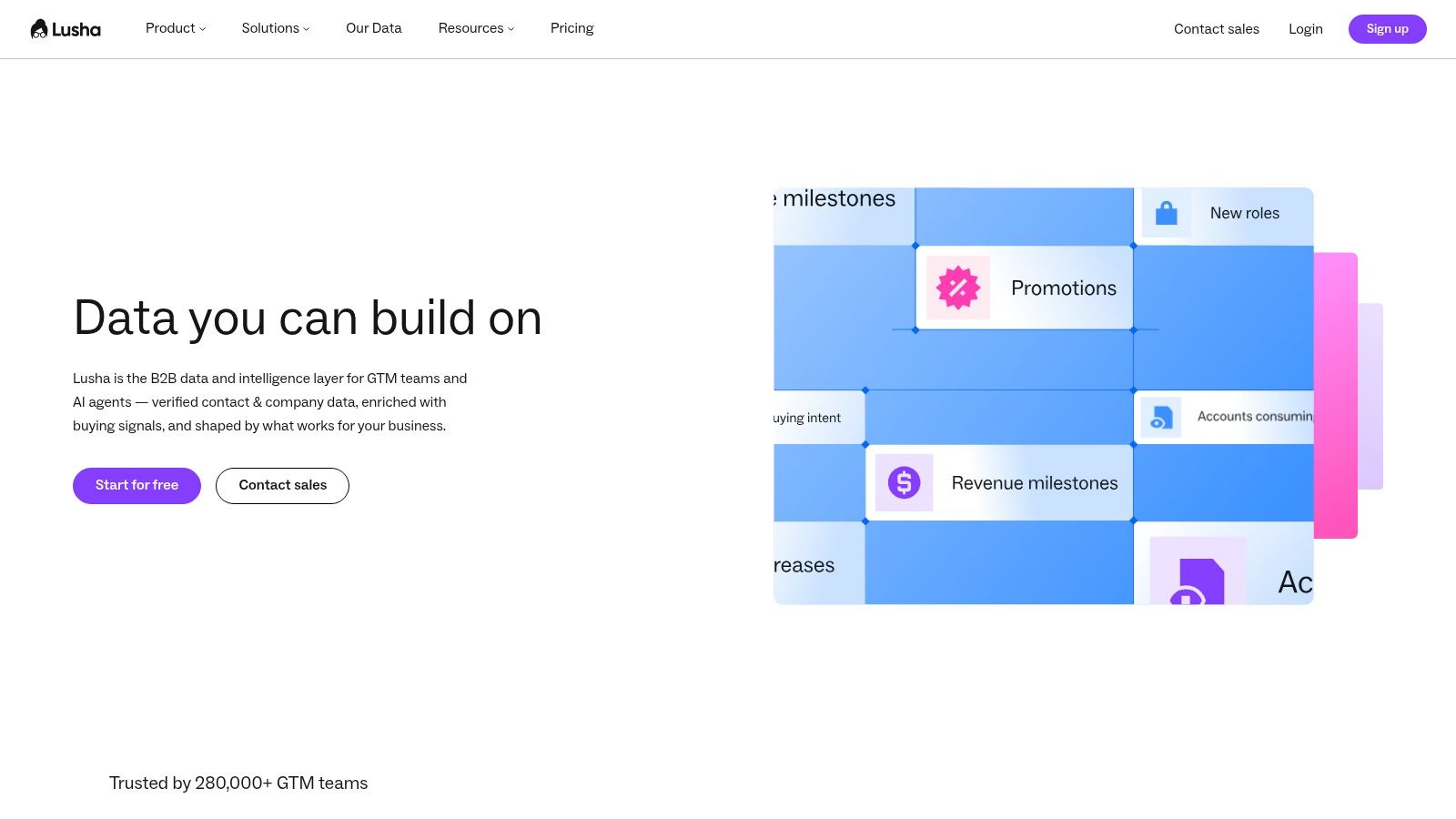
Lusha is the tool reps use when leadership stops overcomplicating procurement. It's simple, quick to adopt, and good enough for teams that need contact details without redesigning the entire stack. That's also why it rarely becomes the long-term system of record.
Lusha works best as a lightweight prospecting layer or a secondary source inside Clay. It's not where I'd start if data precision is critical across multiple markets.
Where Lusha helps
The strength here is adoption. Reps don't need a long onboarding cycle to capture data, push it into the CRM, and keep moving. For early-stage teams, that matters more than buying a bigger platform that nobody configures properly.
Use Lusha when:
You want a fast pilot: low friction matters
Your reps live in the browser: extension-led prospecting is the motion
You need a secondary source: helpful in a waterfall
The limitation is depth. Coverage quality shifts by region and role seniority. For any team tightening handoff quality, your lead qualification process matters more than squeezing one more source into the browser.
8. UpLead

UpLead is usually shortlisted by teams that are tired of mystery pricing and want cleaner email-first prospecting. I get the appeal. Transparent buying matters, and many B2B lead generation platforms make a simple trial feel like enterprise procurement theater.
UpLead is strongest when your outbound is email-led and you care about predictable spend more than advanced intent or orchestration depth.
Why teams shortlist it
There's a practical buyer profile for UpLead. It's often a smaller sales team, or an ops lead who wants a straightforward contract, verified emails, and fewer bounce headaches without paying for a full enterprise suite.
That makes it a decent fit for:
Email-heavy campaigns
Teams with fixed budgets
Operators who want straightforward procurement
I still wouldn't pick it over Clay for net accuracy control or over Apollo for all-in-one startup usability. It sits in the middle, useful, sensible, and rarely the final answer once the motion gets more complex.
9. LeadIQ
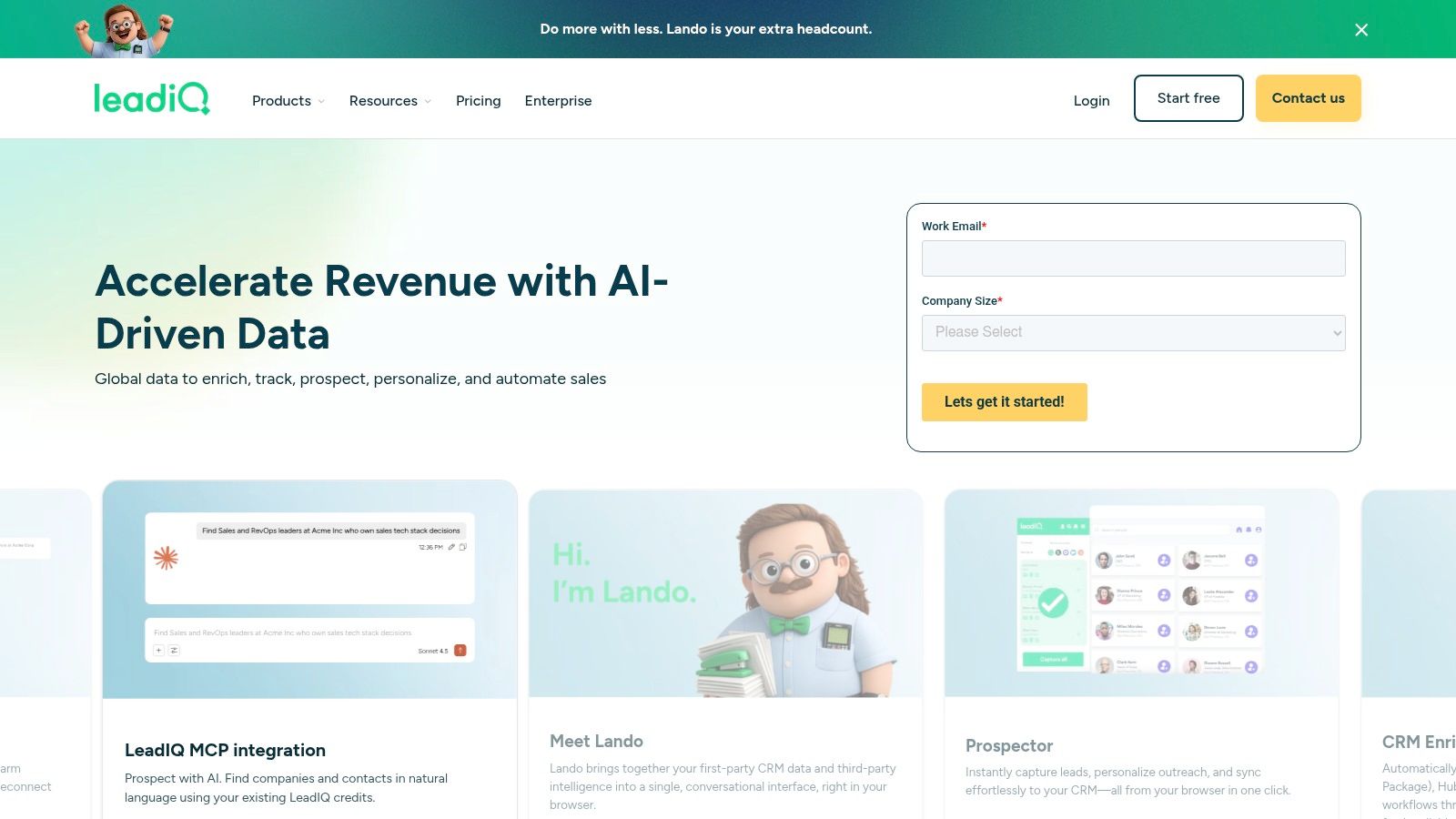
LeadIQ is for SDR teams whose workflow starts on LinkedIn and ends in the CRM. That's a narrower lane than most vendors imply, but it's a real one. If your reps prospect manually, capture contacts from profiles, and need cleaner handoff into an engagement tool, LeadIQ can reduce tab-switching.
LeadIQ is not a full outbound operating system. Treat it as a prospect capture and verification layer.
Best use case for LeadIQ
Where it helps is timing. Reps spot a lead, capture it, verify, sync, and move into sequencing without much friction. That's useful in motions where rep judgment still drives targeting, especially in named-account outbound.
It fits best when:
SDRs source directly from LinkedIn
The CRM needs cleaner capture
Another platform handles sequencing
Its ceiling shows up with scale. If you need heavy enrichment logic, source prioritization, or broader orchestration, you quickly end up adding Clay or another central data layer anyway.
10. RocketReach
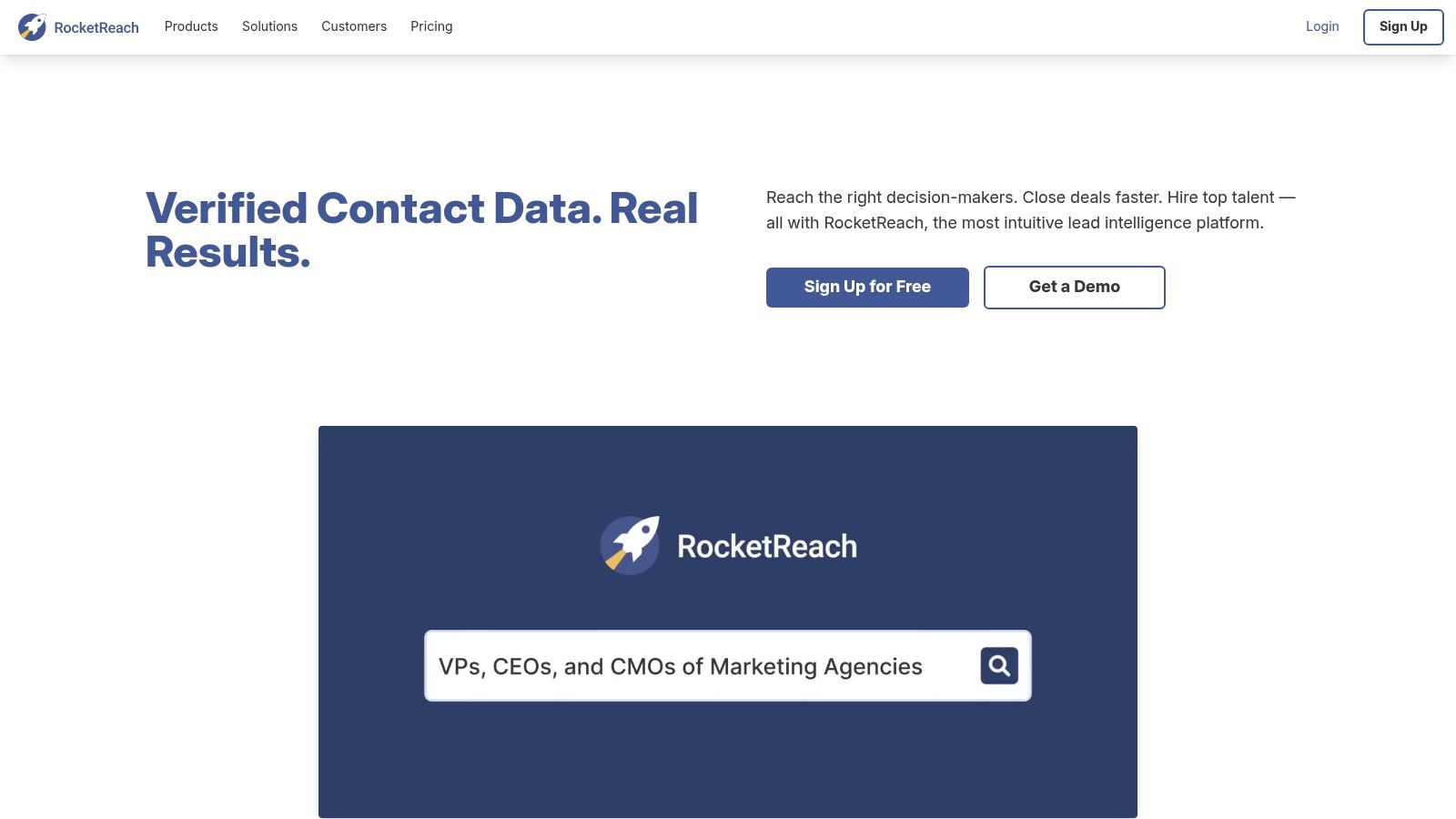
RocketReach is rarely the headline choice, but it still has a place. Smaller teams and ops-heavy users sometimes choose it for bulk lookups, API access, or lower entry cost. That's fine, as long as nobody expects premium data quality from a budget-first decision.
RocketReach can be useful as a tertiary source. I would not make it the primary system for a team that lives or dies on role accuracy.
Where RocketReach still fits
This is the right tool when your requirements are narrow and tactical. Maybe you need additional lookup coverage. Maybe you want API access without stepping into an enterprise contract. Maybe it's one layer in a broader enrichment stack.
Our issue with RocketReach wasn't usability. It was accuracy relative to stronger options. That's why it ends up as an edge-case source rather than a core platform in serious outbound systems.
Top 10 B2B Lead Generation Platforms: Features & Pricing
Solution | Core features ✨ | Quality ★ | Price & Value 💰 | Target audience 👥 | Unique selling points 🏆 |
|---|---|---|---|---|---|
Grou 🏆 | AI-powered single engine: LinkedIn content + ICP lists + outbound; bi-weekly sprints; Slack collaboration | ★★★★★, fast launch (14d) & first signals ~30d; strong case studies (350 leads, 10x followers) | 💰 Bespoke retainer / custom pricing; ROI-focused | 👥 SMB → mid-market RevOps, sales & marketing leaders | ✨ Unified system (one message, one list, one dashboard); rapid iteration & transparent pipeline |
LinkedIn Sales Navigator | Advanced lead/account search, InMail, Account IQ & CRM sync | ★★★★, best-in-class LinkedIn graph and role signals | 💰 Per-seat subscription; add-ons increase cost | 👥 AEs, SDRs, account-based teams | ✨ First-party LinkedIn data; warm intro paths |
ZoomInfo SalesOS | Large US contact DB, intent data, web visitor ID, AI Copilot | ★★★★, deep North American coverage & enterprise features | 💰 Quote-based enterprise pricing; add-ons raise TCO | 👥 US-centric enterprise GTM teams | ✨ Intent + deanonymization at scale; rich technographics |
Apollo.io | 200M+ contacts, sequences, deliverability tools, Chrome extension | ★★★★, strong value & self-serve growth | 💰 Transparent tiers + credit model; cost‑effective for SMBs | 👥 SMB → mid-market growth teams | ✨ Bundled data + outreach in one platform; easy self-service |
Cognism | Phone‑verified mobiles (Diamond Data), GDPR-first, EMEA focus | ★★★★, high EMEA connect rates; compliance-first | 💰 Quote-based; can trend enterprise-level at scale | 👥 Teams targeting UK/EU or phone-first outreach | ✨ Verified mobile coverage + built-in GDPR/CCPA processes |
Clearbit (via HubSpot) | HubSpot-native enrichment, Breeze AI metered by credits | ★★★★, seamless CRM enrichment for HubSpot users | 💰 HubSpot subscription + credits; platform costs can add up | 👥 HubSpot-centric marketing & revenue ops | ✨ Tight HubSpot workflows & metered AI/enrichment |
Lusha | Chrome extension contact reveals, DNC suppression, integrations | ★★★, quick adoption and usable free tier | 💰 Entry-level pricing with transparent tiers; credit caps | 👥 Small teams and SDRs needing quick prospecting | ✨ Simple UI and fast rep onboarding |
UpLead | Real-time email verification, 95% accuracy guarantee, exports | ★★★★, strong deliverability and low bounce rates | 💰 Transparent plans; predictable spend and credits-back policy | 👥 Teams prioritizing email deliverability | ✨ Verified emails + money-back for bounces |
LeadIQ | Chrome capture with live verification, signals, AI assist | ★★★, optimized for SDR workflows to CRM | 💰 Per-credit model; free pilot tier available | 👥 SDRs who prospect on LinkedIn and need CRM capture | ✨ Minimizes swivel-chair time from LinkedIn → CRM |
RocketReach | Bulk lookups, API enrichment, org charts, Chrome extension | ★★★, cost-effective contact discovery & API access | 💰 Lower entry price; bulk/API credit bundles | 👥 Ops teams, small sales teams needing bulk lookups | ✨ Affordable bulk/API access for enrichment tasks |
Your next step Audit your data freshness
Monday morning, an SDR opens last month's target list, writes a solid follow-up, and sends it to a prospect who changed jobs three weeks ago. The email lands. The message is still wrong. That is how stale data wastes good outbound.
A platform helps, but the operating system matters more. Teams that verify contacts, monitor routing, and clean records on a schedule usually get solid results from almost any decent vendor. Teams without that discipline usually buy another license and keep the same accuracy problem.
Our recommendation is straightforward.
Use Clay as the orchestration layer and run a multi-source waterfall. In our internal testing across 500 contacts in SaaS, iGaming, services, and manufacturing across the US, UK, EU, and CEE, Clay scored 8.6/10 on composite data accuracy, ahead of ZoomInfo at 7.8/10 and Apollo at 7.2/10. The advantage was not that Clay had better native data. It came from combining sources, setting enrichment order, and pushing low-confidence records into review instead of trusting a single database.
That is the distinction many buyers miss. No standalone provider keeps contact data fresh enough to break the 80% accuracy ceiling on its own. In our testing, Clay's waterfall pushed job title accuracy into the 85% to 90% range, while Apollo stayed around 70% to 75% and ZoomInfo around 78% to 82%. Clay also reduced manual enrichment from 12 to 15 hours per SDR per week to a quick review layer that took under 30 seconds per contact, which saved 9 to 12 hours per SDR each week.
Data freshness is the issue I would audit first.
Contacts move, get promoted, change regions, or leave the company entirely. If re-verification is not built into the process, SDRs end up sending customized messaging to the wrong person. Deliverability may look fine in the dashboard, but reply quality drops because the targeting is already off.
Run a simple check this Friday. Export 100 contacts your team targeted last month. Verify three fields only on LinkedIn and the company website: current role, current company, and whether the email is still relevant for that person's job. The percentage that fails is your real data decay rate, and it tells you whether you need a better source, a better workflow, or both.
Grou builds unified AI-powered pipeline systems for B2B companies globally. The work usually combines LinkedIn content, lead generation, and outbound in one operating layer that sales teams can run.
Our methodology is simple. We judge tools by qualification quality, routing clarity, and booked-meeting relevance, not by how many features appear on a pricing page.
If you want the system, not just the software, Grou is the right next step. Bring your current stack, your last outbound list, and one month of meeting data, then pressure-test where attention is leaking before you buy another tool.
Your pipeline is active, but the calendar still looks thin. Reps are sending sequences, marketing is producing demand, and the CRM keeps filling with names that never turn into held meetings. Often, the leak starts earlier than people admit, inside the data and orchestration layer. Vendors keep selling “accuracy” as if one database can solve it. It can't. My verdict is simple: Clay is the top pick for many organizations because it beats single-source tools on usable accuracy, Apollo wins on price-to-volume, and ZoomInfo only makes sense when US enterprise coverage is the priority.
Clay is the winner if you care about net data accuracy, workflow control, and reducing SDR busywork.
Apollo is the best budget buy for teams that need list volume plus built-in outbound.
ZoomInfo is strongest for US enterprise but the pricing gap is real, and the accuracy gap isn't always big enough.
LinkedIn still anchors the channel mix, because 89% of B2B marketers use LinkedIn for lead generation and 62% say it produces quality leads.
If qualification is your bottleneck, fix the system before adding more volume, including how you're improving lead qualification for small businesses.
Table of Contents
1. Grou
Most lists compare software in isolation. That's useful if your team already has strong RevOps, good messaging, clean routing, and someone who'll maintain the stack every week. Most companies don't. That's why Grou ranks first here. If you need pipeline, not just tool access, a managed system beats another subscription.
Grou connects LinkedIn content, list building, outbound, reply routing, and reporting into one operating layer. That matters because fragmented setups usually create the same failure pattern: marketing generates attention, SDRs chase bad-fit accounts, and sales gets conversations with weak context. Grou fixes that by building one ICP, one message hierarchy, and one reporting line.
Why Grou is first on this list
The strongest part of the offer isn't “AI-powered” positioning. It's structure. Teams buy tools hoping for better output, but the primary lift comes from aligning sourcing, qualification, and handoff. That aligns with broader market direction, where AI-led qualification and intent-driven targeting improve qualification accuracy by 40%, speed qualification by 3x, and lift conversion rates by 25% to 35%.
Grou is also built for the part most software vendors skip, execution discipline. Shared Slack, sprint cadence, dashboards, and fast reply handling sound operationally boring. They are. They also determine whether attention turns into booked meetings or dies in a queue.
Operator view: If your internal team keeps buying point tools to solve a systems problem, stop. You don't have a tooling issue. You have a workflow ownership issue.
For teams comparing software versus service, read Grou's view on lead generation software. It's one of the few places that frames software as part of a pipeline system rather than the system itself.
Where Grou fits, and where it does not
Grou is a fit when:
Your team has attention but weak conversion: LinkedIn activity, inbound, paid traffic, or outbound exists, but meeting quality is inconsistent.
Your sales team needs cleaner handoffs: Reps should spend time on qualified conversations, not manual list cleanup.
You sell in long-cycle B2B markets: SaaS, iGaming, manufacturing, legal tech, pharma, and similar categories benefit from a message-data-routing system.
Skip it if you want a cheap self-serve tool and your team is happy to own enrichment, sequencing, deliverability, QA, reporting, and CRM hygiene internally. In that case, buy the stack and run it well.
2. LinkedIn Sales Navigator
Sales Navigator isn't your data platform. It's your discovery layer. Teams keep trying to make it do the whole job, then complain that it doesn't return emails. That misses the point. It's still the cleanest place to find the right people, map accounts, and watch role movement before you enrich elsewhere.
Use LinkedIn Sales Navigator when your outbound starts with tight ICP filters and account context. Don't use it as a standalone lead gen stack.
Where it earns its seat
LinkedIn dominates B2B social selling, and 94% of B2B marketers use it for sales and lead gen, while 80% of B2B leads from social media come through LinkedIn. That's why almost every serious outbound system still starts here, even if enrichment and sequencing happen in Clay, Apollo, or HubSpot.
In practice, Sales Navigator is best for:
Prospect discovery: cleaner than scraping random databases first
Account mapping: useful when multiple stakeholders shape the deal
Signal spotting: job changes, active posting, and company movement
Message prep: enough context to avoid generic openers
The downside is obvious. It doesn't solve contact acquisition, enrichment, or workflow automation by itself. That's why we pair it with a separate data layer. If LinkedIn is central to your motion, this breakdown on LinkedIn lead generation is the right next read.
Sales Navigator finds the right person. A second system still has to verify whether you can actually reach them.
3. ZoomInfo SalesOS
ZoomInfo SalesOS is the most defensible premium pick on this list, but only in a specific context. If you sell into US enterprise, care about direct dials, and want a bigger feature surface around intent, technographics, and visitor identification, it's a serious option. If you're a mid-market team selling across Europe, it gets harder to justify.
In our testing, ZoomInfo scored 7.8/10 on data accuracy. That beat Apollo, but not by enough to make the pricing decision automatic. It performed best on US enterprise contacts and was more dependable for direct numbers and corporate patterns than cheaper tools.
When the premium is justified
The best case for ZoomInfo is not “it has more features.” Plenty of stacks have more features. The case is that it can centralize several motions under one roof if your team will operationalize them.
Use it when you need:
US enterprise depth: especially for larger account coverage
More than list building: intent, visitor ID, and routing matter
Stronger compliance and procurement posture: useful in bigger orgs
Skip it when your motion is founder-led, your team is underbuilt operationally, or your target market is more European than American. In those cases, you're often paying for platform breadth you won't deploy.
For teams evaluating sales intelligence vendors, Grou's sales intelligence tools directory is useful because it frames tools by use case rather than vendor messaging.
4. Apollo.io
Apollo.io wins more deals than enterprise buyers like to admit. The reason is simple. It gives small and mid-sized teams enough database coverage, enough sequencing, and enough usability to launch quickly without hiring RevOps first. If you're underbuilt and need traction, Apollo is often the right answer.
In our testing, Apollo scored 7.2/10 on data accuracy. That's not elite, and you feel it in role freshness and non-US segments. But the price-to-value is strong, especially for SaaS, services, and UK or US-focused outbound where email coverage matters more than perfect phone data.
Why Apollo keeps winning SMB deals
Apollo works because it bundles the top-of-funnel motion into one place. Build list, enrich, write sequence, send, review replies. That doesn't make it the most accurate platform. It makes it the easiest one to put into production fast.
It's best for:
Founder-led outbound: low setup friction
Small SDR teams: one login covers most of the workflow
High-volume testing: good for segment and message iteration
The weak point is precision. Role accuracy in our checks sat around the low-to-mid 70s. That means you should still verify senior contacts before launching a high-value campaign.
Practical rule: Apollo is for breadth. Clay is for accuracy control. Don't confuse those jobs.
If your qualification logic is weak, bad data compounds quickly. As a result, many teams miss basic lead generation KPIs, especially meeting-held rate and fit rate by segment.
5. Cognism
Cognism is the platform I bring in when Europe matters enough to shape the stack. If your campaigns live in the UK and broader EMEA, and compliance posture is part of procurement, Cognism deserves a hard look. If your book is mostly US SaaS, I usually wouldn't make it the first buy.
Cognism is strong where many US-first databases get thin. That includes GDPR-sensitive motions and phone-first teams that care about better connect quality in Europe.
Why I only push Cognism in specific cases
A lot of B2B lead generation platforms look interchangeable until geography starts punishing the wrong choice. Europe is where that shows up fast. We've seen enough weaker EU coverage from mainstream providers to treat regional fit as a first-order decision, not a side note.
That matters because the channel mix is changing. In a post-cookie environment, about 2% of B2B website traffic converts into a lead, which increases the value of first-party intent, visitor identification, LinkedIn, and segmented email. Cognism fits when compliance constraints and regional coverage shape who you can target and how.
Buy it when Europe is the market. Skip it if you only need a secondary source inside a broader waterfall.
6. Clearbit by HubSpot
Clearbit by HubSpot makes the most sense when your CRM is already the center of gravity. If your company runs on HubSpot and wants native enrichment, fit signals, and workflow control inside the same environment, this is cleaner than bolting on another point tool.
Clearbit by HubSpot is not my top pick for list building from scratch. It is a strong pick for HubSpot-centric teams that care more about clean records, routing, and lifecycle automation than raw database size.
The real value is inside HubSpot ops
The reason this category matters is not novelty. It's consolidation. Industry estimates put the B2B lead generation software market at USD 6.78 billion in 2025, projected to reach USD 15 billion by 2035 at an 8.3% CAGR. As the category expands, more teams are trying to reduce stack sprawl rather than add another enrichment tab.
That's where HubSpot-native enrichment wins. If your SDRs, marketers, and RevOps team all work in HubSpot, writing enriched data directly into the CRM can save constant exports, remaps, and duplicate cleanup.
It's strongest for:
HubSpot-first companies: especially with custom properties and workflow logic
Inbound-heavy teams: enrich and route inside one system
Ops-led environments: CRM hygiene matters as much as sourcing
The trade-off is lock-in. Once the economics of HubSpot plans and credits start stacking, a standalone data layer can look cheaper.
7. Lusha
Lusha is the tool reps use when leadership stops overcomplicating procurement. It's simple, quick to adopt, and good enough for teams that need contact details without redesigning the entire stack. That's also why it rarely becomes the long-term system of record.
Lusha works best as a lightweight prospecting layer or a secondary source inside Clay. It's not where I'd start if data precision is critical across multiple markets.
Where Lusha helps
The strength here is adoption. Reps don't need a long onboarding cycle to capture data, push it into the CRM, and keep moving. For early-stage teams, that matters more than buying a bigger platform that nobody configures properly.
Use Lusha when:
You want a fast pilot: low friction matters
Your reps live in the browser: extension-led prospecting is the motion
You need a secondary source: helpful in a waterfall
The limitation is depth. Coverage quality shifts by region and role seniority. For any team tightening handoff quality, your lead qualification process matters more than squeezing one more source into the browser.
8. UpLead
UpLead is usually shortlisted by teams that are tired of mystery pricing and want cleaner email-first prospecting. I get the appeal. Transparent buying matters, and many B2B lead generation platforms make a simple trial feel like enterprise procurement theater.
UpLead is strongest when your outbound is email-led and you care about predictable spend more than advanced intent or orchestration depth.
Why teams shortlist it
There's a practical buyer profile for UpLead. It's often a smaller sales team, or an ops lead who wants a straightforward contract, verified emails, and fewer bounce headaches without paying for a full enterprise suite.
That makes it a decent fit for:
Email-heavy campaigns
Teams with fixed budgets
Operators who want straightforward procurement
I still wouldn't pick it over Clay for net accuracy control or over Apollo for all-in-one startup usability. It sits in the middle, useful, sensible, and rarely the final answer once the motion gets more complex.
9. LeadIQ
LeadIQ is for SDR teams whose workflow starts on LinkedIn and ends in the CRM. That's a narrower lane than most vendors imply, but it's a real one. If your reps prospect manually, capture contacts from profiles, and need cleaner handoff into an engagement tool, LeadIQ can reduce tab-switching.
LeadIQ is not a full outbound operating system. Treat it as a prospect capture and verification layer.
Best use case for LeadIQ
Where it helps is timing. Reps spot a lead, capture it, verify, sync, and move into sequencing without much friction. That's useful in motions where rep judgment still drives targeting, especially in named-account outbound.
It fits best when:
SDRs source directly from LinkedIn
The CRM needs cleaner capture
Another platform handles sequencing
Its ceiling shows up with scale. If you need heavy enrichment logic, source prioritization, or broader orchestration, you quickly end up adding Clay or another central data layer anyway.
10. RocketReach
RocketReach is rarely the headline choice, but it still has a place. Smaller teams and ops-heavy users sometimes choose it for bulk lookups, API access, or lower entry cost. That's fine, as long as nobody expects premium data quality from a budget-first decision.
RocketReach can be useful as a tertiary source. I would not make it the primary system for a team that lives or dies on role accuracy.
Where RocketReach still fits
This is the right tool when your requirements are narrow and tactical. Maybe you need additional lookup coverage. Maybe you want API access without stepping into an enterprise contract. Maybe it's one layer in a broader enrichment stack.
Our issue with RocketReach wasn't usability. It was accuracy relative to stronger options. That's why it ends up as an edge-case source rather than a core platform in serious outbound systems.
Top 10 B2B Lead Generation Platforms: Features & Pricing
Solution | Core features ✨ | Quality ★ | Price & Value 💰 | Target audience 👥 | Unique selling points 🏆 |
|---|---|---|---|---|---|
Grou 🏆 | AI-powered single engine: LinkedIn content + ICP lists + outbound; bi-weekly sprints; Slack collaboration | ★★★★★, fast launch (14d) & first signals ~30d; strong case studies (350 leads, 10x followers) | 💰 Bespoke retainer / custom pricing; ROI-focused | 👥 SMB → mid-market RevOps, sales & marketing leaders | ✨ Unified system (one message, one list, one dashboard); rapid iteration & transparent pipeline |
LinkedIn Sales Navigator | Advanced lead/account search, InMail, Account IQ & CRM sync | ★★★★, best-in-class LinkedIn graph and role signals | 💰 Per-seat subscription; add-ons increase cost | 👥 AEs, SDRs, account-based teams | ✨ First-party LinkedIn data; warm intro paths |
ZoomInfo SalesOS | Large US contact DB, intent data, web visitor ID, AI Copilot | ★★★★, deep North American coverage & enterprise features | 💰 Quote-based enterprise pricing; add-ons raise TCO | 👥 US-centric enterprise GTM teams | ✨ Intent + deanonymization at scale; rich technographics |
Apollo.io | 200M+ contacts, sequences, deliverability tools, Chrome extension | ★★★★, strong value & self-serve growth | 💰 Transparent tiers + credit model; cost‑effective for SMBs | 👥 SMB → mid-market growth teams | ✨ Bundled data + outreach in one platform; easy self-service |
Cognism | Phone‑verified mobiles (Diamond Data), GDPR-first, EMEA focus | ★★★★, high EMEA connect rates; compliance-first | 💰 Quote-based; can trend enterprise-level at scale | 👥 Teams targeting UK/EU or phone-first outreach | ✨ Verified mobile coverage + built-in GDPR/CCPA processes |
Clearbit (via HubSpot) | HubSpot-native enrichment, Breeze AI metered by credits | ★★★★, seamless CRM enrichment for HubSpot users | 💰 HubSpot subscription + credits; platform costs can add up | 👥 HubSpot-centric marketing & revenue ops | ✨ Tight HubSpot workflows & metered AI/enrichment |
Lusha | Chrome extension contact reveals, DNC suppression, integrations | ★★★, quick adoption and usable free tier | 💰 Entry-level pricing with transparent tiers; credit caps | 👥 Small teams and SDRs needing quick prospecting | ✨ Simple UI and fast rep onboarding |
UpLead | Real-time email verification, 95% accuracy guarantee, exports | ★★★★, strong deliverability and low bounce rates | 💰 Transparent plans; predictable spend and credits-back policy | 👥 Teams prioritizing email deliverability | ✨ Verified emails + money-back for bounces |
LeadIQ | Chrome capture with live verification, signals, AI assist | ★★★, optimized for SDR workflows to CRM | 💰 Per-credit model; free pilot tier available | 👥 SDRs who prospect on LinkedIn and need CRM capture | ✨ Minimizes swivel-chair time from LinkedIn → CRM |
RocketReach | Bulk lookups, API enrichment, org charts, Chrome extension | ★★★, cost-effective contact discovery & API access | 💰 Lower entry price; bulk/API credit bundles | 👥 Ops teams, small sales teams needing bulk lookups | ✨ Affordable bulk/API access for enrichment tasks |
Your next step Audit your data freshness
Monday morning, an SDR opens last month's target list, writes a solid follow-up, and sends it to a prospect who changed jobs three weeks ago. The email lands. The message is still wrong. That is how stale data wastes good outbound.
A platform helps, but the operating system matters more. Teams that verify contacts, monitor routing, and clean records on a schedule usually get solid results from almost any decent vendor. Teams without that discipline usually buy another license and keep the same accuracy problem.
Our recommendation is straightforward.
Use Clay as the orchestration layer and run a multi-source waterfall. In our internal testing across 500 contacts in SaaS, iGaming, services, and manufacturing across the US, UK, EU, and CEE, Clay scored 8.6/10 on composite data accuracy, ahead of ZoomInfo at 7.8/10 and Apollo at 7.2/10. The advantage was not that Clay had better native data. It came from combining sources, setting enrichment order, and pushing low-confidence records into review instead of trusting a single database.
That is the distinction many buyers miss. No standalone provider keeps contact data fresh enough to break the 80% accuracy ceiling on its own. In our testing, Clay's waterfall pushed job title accuracy into the 85% to 90% range, while Apollo stayed around 70% to 75% and ZoomInfo around 78% to 82%. Clay also reduced manual enrichment from 12 to 15 hours per SDR per week to a quick review layer that took under 30 seconds per contact, which saved 9 to 12 hours per SDR each week.
Data freshness is the issue I would audit first.
Contacts move, get promoted, change regions, or leave the company entirely. If re-verification is not built into the process, SDRs end up sending customized messaging to the wrong person. Deliverability may look fine in the dashboard, but reply quality drops because the targeting is already off.
Run a simple check this Friday. Export 100 contacts your team targeted last month. Verify three fields only on LinkedIn and the company website: current role, current company, and whether the email is still relevant for that person's job. The percentage that fails is your real data decay rate, and it tells you whether you need a better source, a better workflow, or both.
Grou builds unified AI-powered pipeline systems for B2B companies globally. The work usually combines LinkedIn content, lead generation, and outbound in one operating layer that sales teams can run.
Our methodology is simple. We judge tools by qualification quality, routing clarity, and booked-meeting relevance, not by how many features appear on a pricing page.
If you want the system, not just the software, Grou is the right next step. Bring your current stack, your last outbound list, and one month of meeting data, then pressure-test where attention is leaking before you buy another tool.
Your pipeline is active, but the calendar still looks thin. Reps are sending sequences, marketing is producing demand, and the CRM keeps filling with names that never turn into held meetings. Often, the leak starts earlier than people admit, inside the data and orchestration layer. Vendors keep selling “accuracy” as if one database can solve it. It can't. My verdict is simple: Clay is the top pick for many organizations because it beats single-source tools on usable accuracy, Apollo wins on price-to-volume, and ZoomInfo only makes sense when US enterprise coverage is the priority.
Clay is the winner if you care about net data accuracy, workflow control, and reducing SDR busywork.
Apollo is the best budget buy for teams that need list volume plus built-in outbound.
ZoomInfo is strongest for US enterprise but the pricing gap is real, and the accuracy gap isn't always big enough.
LinkedIn still anchors the channel mix, because 89% of B2B marketers use LinkedIn for lead generation and 62% say it produces quality leads.
If qualification is your bottleneck, fix the system before adding more volume, including how you're improving lead qualification for small businesses.
Table of Contents
1. Grou
Most lists compare software in isolation. That's useful if your team already has strong RevOps, good messaging, clean routing, and someone who'll maintain the stack every week. Most companies don't. That's why Grou ranks first here. If you need pipeline, not just tool access, a managed system beats another subscription.
Grou connects LinkedIn content, list building, outbound, reply routing, and reporting into one operating layer. That matters because fragmented setups usually create the same failure pattern: marketing generates attention, SDRs chase bad-fit accounts, and sales gets conversations with weak context. Grou fixes that by building one ICP, one message hierarchy, and one reporting line.
Why Grou is first on this list
The strongest part of the offer isn't “AI-powered” positioning. It's structure. Teams buy tools hoping for better output, but the primary lift comes from aligning sourcing, qualification, and handoff. That aligns with broader market direction, where AI-led qualification and intent-driven targeting improve qualification accuracy by 40%, speed qualification by 3x, and lift conversion rates by 25% to 35%.
Grou is also built for the part most software vendors skip, execution discipline. Shared Slack, sprint cadence, dashboards, and fast reply handling sound operationally boring. They are. They also determine whether attention turns into booked meetings or dies in a queue.
Operator view: If your internal team keeps buying point tools to solve a systems problem, stop. You don't have a tooling issue. You have a workflow ownership issue.
For teams comparing software versus service, read Grou's view on lead generation software. It's one of the few places that frames software as part of a pipeline system rather than the system itself.
Where Grou fits, and where it does not
Grou is a fit when:
Your team has attention but weak conversion: LinkedIn activity, inbound, paid traffic, or outbound exists, but meeting quality is inconsistent.
Your sales team needs cleaner handoffs: Reps should spend time on qualified conversations, not manual list cleanup.
You sell in long-cycle B2B markets: SaaS, iGaming, manufacturing, legal tech, pharma, and similar categories benefit from a message-data-routing system.
Skip it if you want a cheap self-serve tool and your team is happy to own enrichment, sequencing, deliverability, QA, reporting, and CRM hygiene internally. In that case, buy the stack and run it well.
2. LinkedIn Sales Navigator
Sales Navigator isn't your data platform. It's your discovery layer. Teams keep trying to make it do the whole job, then complain that it doesn't return emails. That misses the point. It's still the cleanest place to find the right people, map accounts, and watch role movement before you enrich elsewhere.
Use LinkedIn Sales Navigator when your outbound starts with tight ICP filters and account context. Don't use it as a standalone lead gen stack.
Where it earns its seat
LinkedIn dominates B2B social selling, and 94% of B2B marketers use it for sales and lead gen, while 80% of B2B leads from social media come through LinkedIn. That's why almost every serious outbound system still starts here, even if enrichment and sequencing happen in Clay, Apollo, or HubSpot.
In practice, Sales Navigator is best for:
Prospect discovery: cleaner than scraping random databases first
Account mapping: useful when multiple stakeholders shape the deal
Signal spotting: job changes, active posting, and company movement
Message prep: enough context to avoid generic openers
The downside is obvious. It doesn't solve contact acquisition, enrichment, or workflow automation by itself. That's why we pair it with a separate data layer. If LinkedIn is central to your motion, this breakdown on LinkedIn lead generation is the right next read.
Sales Navigator finds the right person. A second system still has to verify whether you can actually reach them.
3. ZoomInfo SalesOS
ZoomInfo SalesOS is the most defensible premium pick on this list, but only in a specific context. If you sell into US enterprise, care about direct dials, and want a bigger feature surface around intent, technographics, and visitor identification, it's a serious option. If you're a mid-market team selling across Europe, it gets harder to justify.
In our testing, ZoomInfo scored 7.8/10 on data accuracy. That beat Apollo, but not by enough to make the pricing decision automatic. It performed best on US enterprise contacts and was more dependable for direct numbers and corporate patterns than cheaper tools.
When the premium is justified
The best case for ZoomInfo is not “it has more features.” Plenty of stacks have more features. The case is that it can centralize several motions under one roof if your team will operationalize them.
Use it when you need:
US enterprise depth: especially for larger account coverage
More than list building: intent, visitor ID, and routing matter
Stronger compliance and procurement posture: useful in bigger orgs
Skip it when your motion is founder-led, your team is underbuilt operationally, or your target market is more European than American. In those cases, you're often paying for platform breadth you won't deploy.
For teams evaluating sales intelligence vendors, Grou's sales intelligence tools directory is useful because it frames tools by use case rather than vendor messaging.
4. Apollo.io
Apollo.io wins more deals than enterprise buyers like to admit. The reason is simple. It gives small and mid-sized teams enough database coverage, enough sequencing, and enough usability to launch quickly without hiring RevOps first. If you're underbuilt and need traction, Apollo is often the right answer.
In our testing, Apollo scored 7.2/10 on data accuracy. That's not elite, and you feel it in role freshness and non-US segments. But the price-to-value is strong, especially for SaaS, services, and UK or US-focused outbound where email coverage matters more than perfect phone data.
Why Apollo keeps winning SMB deals
Apollo works because it bundles the top-of-funnel motion into one place. Build list, enrich, write sequence, send, review replies. That doesn't make it the most accurate platform. It makes it the easiest one to put into production fast.
It's best for:
Founder-led outbound: low setup friction
Small SDR teams: one login covers most of the workflow
High-volume testing: good for segment and message iteration
The weak point is precision. Role accuracy in our checks sat around the low-to-mid 70s. That means you should still verify senior contacts before launching a high-value campaign.
Practical rule: Apollo is for breadth. Clay is for accuracy control. Don't confuse those jobs.
If your qualification logic is weak, bad data compounds quickly. As a result, many teams miss basic lead generation KPIs, especially meeting-held rate and fit rate by segment.
5. Cognism
Cognism is the platform I bring in when Europe matters enough to shape the stack. If your campaigns live in the UK and broader EMEA, and compliance posture is part of procurement, Cognism deserves a hard look. If your book is mostly US SaaS, I usually wouldn't make it the first buy.
Cognism is strong where many US-first databases get thin. That includes GDPR-sensitive motions and phone-first teams that care about better connect quality in Europe.
Why I only push Cognism in specific cases
A lot of B2B lead generation platforms look interchangeable until geography starts punishing the wrong choice. Europe is where that shows up fast. We've seen enough weaker EU coverage from mainstream providers to treat regional fit as a first-order decision, not a side note.
That matters because the channel mix is changing. In a post-cookie environment, about 2% of B2B website traffic converts into a lead, which increases the value of first-party intent, visitor identification, LinkedIn, and segmented email. Cognism fits when compliance constraints and regional coverage shape who you can target and how.
Buy it when Europe is the market. Skip it if you only need a secondary source inside a broader waterfall.
6. Clearbit by HubSpot
Clearbit by HubSpot makes the most sense when your CRM is already the center of gravity. If your company runs on HubSpot and wants native enrichment, fit signals, and workflow control inside the same environment, this is cleaner than bolting on another point tool.
Clearbit by HubSpot is not my top pick for list building from scratch. It is a strong pick for HubSpot-centric teams that care more about clean records, routing, and lifecycle automation than raw database size.
The real value is inside HubSpot ops
The reason this category matters is not novelty. It's consolidation. Industry estimates put the B2B lead generation software market at USD 6.78 billion in 2025, projected to reach USD 15 billion by 2035 at an 8.3% CAGR. As the category expands, more teams are trying to reduce stack sprawl rather than add another enrichment tab.
That's where HubSpot-native enrichment wins. If your SDRs, marketers, and RevOps team all work in HubSpot, writing enriched data directly into the CRM can save constant exports, remaps, and duplicate cleanup.
It's strongest for:
HubSpot-first companies: especially with custom properties and workflow logic
Inbound-heavy teams: enrich and route inside one system
Ops-led environments: CRM hygiene matters as much as sourcing
The trade-off is lock-in. Once the economics of HubSpot plans and credits start stacking, a standalone data layer can look cheaper.
7. Lusha
Lusha is the tool reps use when leadership stops overcomplicating procurement. It's simple, quick to adopt, and good enough for teams that need contact details without redesigning the entire stack. That's also why it rarely becomes the long-term system of record.
Lusha works best as a lightweight prospecting layer or a secondary source inside Clay. It's not where I'd start if data precision is critical across multiple markets.
Where Lusha helps
The strength here is adoption. Reps don't need a long onboarding cycle to capture data, push it into the CRM, and keep moving. For early-stage teams, that matters more than buying a bigger platform that nobody configures properly.
Use Lusha when:
You want a fast pilot: low friction matters
Your reps live in the browser: extension-led prospecting is the motion
You need a secondary source: helpful in a waterfall
The limitation is depth. Coverage quality shifts by region and role seniority. For any team tightening handoff quality, your lead qualification process matters more than squeezing one more source into the browser.
8. UpLead
UpLead is usually shortlisted by teams that are tired of mystery pricing and want cleaner email-first prospecting. I get the appeal. Transparent buying matters, and many B2B lead generation platforms make a simple trial feel like enterprise procurement theater.
UpLead is strongest when your outbound is email-led and you care about predictable spend more than advanced intent or orchestration depth.
Why teams shortlist it
There's a practical buyer profile for UpLead. It's often a smaller sales team, or an ops lead who wants a straightforward contract, verified emails, and fewer bounce headaches without paying for a full enterprise suite.
That makes it a decent fit for:
Email-heavy campaigns
Teams with fixed budgets
Operators who want straightforward procurement
I still wouldn't pick it over Clay for net accuracy control or over Apollo for all-in-one startup usability. It sits in the middle, useful, sensible, and rarely the final answer once the motion gets more complex.
9. LeadIQ
LeadIQ is for SDR teams whose workflow starts on LinkedIn and ends in the CRM. That's a narrower lane than most vendors imply, but it's a real one. If your reps prospect manually, capture contacts from profiles, and need cleaner handoff into an engagement tool, LeadIQ can reduce tab-switching.
LeadIQ is not a full outbound operating system. Treat it as a prospect capture and verification layer.
Best use case for LeadIQ
Where it helps is timing. Reps spot a lead, capture it, verify, sync, and move into sequencing without much friction. That's useful in motions where rep judgment still drives targeting, especially in named-account outbound.
It fits best when:
SDRs source directly from LinkedIn
The CRM needs cleaner capture
Another platform handles sequencing
Its ceiling shows up with scale. If you need heavy enrichment logic, source prioritization, or broader orchestration, you quickly end up adding Clay or another central data layer anyway.
10. RocketReach
RocketReach is rarely the headline choice, but it still has a place. Smaller teams and ops-heavy users sometimes choose it for bulk lookups, API access, or lower entry cost. That's fine, as long as nobody expects premium data quality from a budget-first decision.
RocketReach can be useful as a tertiary source. I would not make it the primary system for a team that lives or dies on role accuracy.
Where RocketReach still fits
This is the right tool when your requirements are narrow and tactical. Maybe you need additional lookup coverage. Maybe you want API access without stepping into an enterprise contract. Maybe it's one layer in a broader enrichment stack.
Our issue with RocketReach wasn't usability. It was accuracy relative to stronger options. That's why it ends up as an edge-case source rather than a core platform in serious outbound systems.
Top 10 B2B Lead Generation Platforms: Features & Pricing
Solution | Core features ✨ | Quality ★ | Price & Value 💰 | Target audience 👥 | Unique selling points 🏆 |
|---|---|---|---|---|---|
Grou 🏆 | AI-powered single engine: LinkedIn content + ICP lists + outbound; bi-weekly sprints; Slack collaboration | ★★★★★, fast launch (14d) & first signals ~30d; strong case studies (350 leads, 10x followers) | 💰 Bespoke retainer / custom pricing; ROI-focused | 👥 SMB → mid-market RevOps, sales & marketing leaders | ✨ Unified system (one message, one list, one dashboard); rapid iteration & transparent pipeline |
LinkedIn Sales Navigator | Advanced lead/account search, InMail, Account IQ & CRM sync | ★★★★, best-in-class LinkedIn graph and role signals | 💰 Per-seat subscription; add-ons increase cost | 👥 AEs, SDRs, account-based teams | ✨ First-party LinkedIn data; warm intro paths |
ZoomInfo SalesOS | Large US contact DB, intent data, web visitor ID, AI Copilot | ★★★★, deep North American coverage & enterprise features | 💰 Quote-based enterprise pricing; add-ons raise TCO | 👥 US-centric enterprise GTM teams | ✨ Intent + deanonymization at scale; rich technographics |
Apollo.io | 200M+ contacts, sequences, deliverability tools, Chrome extension | ★★★★, strong value & self-serve growth | 💰 Transparent tiers + credit model; cost‑effective for SMBs | 👥 SMB → mid-market growth teams | ✨ Bundled data + outreach in one platform; easy self-service |
Cognism | Phone‑verified mobiles (Diamond Data), GDPR-first, EMEA focus | ★★★★, high EMEA connect rates; compliance-first | 💰 Quote-based; can trend enterprise-level at scale | 👥 Teams targeting UK/EU or phone-first outreach | ✨ Verified mobile coverage + built-in GDPR/CCPA processes |
Clearbit (via HubSpot) | HubSpot-native enrichment, Breeze AI metered by credits | ★★★★, seamless CRM enrichment for HubSpot users | 💰 HubSpot subscription + credits; platform costs can add up | 👥 HubSpot-centric marketing & revenue ops | ✨ Tight HubSpot workflows & metered AI/enrichment |
Lusha | Chrome extension contact reveals, DNC suppression, integrations | ★★★, quick adoption and usable free tier | 💰 Entry-level pricing with transparent tiers; credit caps | 👥 Small teams and SDRs needing quick prospecting | ✨ Simple UI and fast rep onboarding |
UpLead | Real-time email verification, 95% accuracy guarantee, exports | ★★★★, strong deliverability and low bounce rates | 💰 Transparent plans; predictable spend and credits-back policy | 👥 Teams prioritizing email deliverability | ✨ Verified emails + money-back for bounces |
LeadIQ | Chrome capture with live verification, signals, AI assist | ★★★, optimized for SDR workflows to CRM | 💰 Per-credit model; free pilot tier available | 👥 SDRs who prospect on LinkedIn and need CRM capture | ✨ Minimizes swivel-chair time from LinkedIn → CRM |
RocketReach | Bulk lookups, API enrichment, org charts, Chrome extension | ★★★, cost-effective contact discovery & API access | 💰 Lower entry price; bulk/API credit bundles | 👥 Ops teams, small sales teams needing bulk lookups | ✨ Affordable bulk/API access for enrichment tasks |
Your next step Audit your data freshness
Monday morning, an SDR opens last month's target list, writes a solid follow-up, and sends it to a prospect who changed jobs three weeks ago. The email lands. The message is still wrong. That is how stale data wastes good outbound.
A platform helps, but the operating system matters more. Teams that verify contacts, monitor routing, and clean records on a schedule usually get solid results from almost any decent vendor. Teams without that discipline usually buy another license and keep the same accuracy problem.
Our recommendation is straightforward.
Use Clay as the orchestration layer and run a multi-source waterfall. In our internal testing across 500 contacts in SaaS, iGaming, services, and manufacturing across the US, UK, EU, and CEE, Clay scored 8.6/10 on composite data accuracy, ahead of ZoomInfo at 7.8/10 and Apollo at 7.2/10. The advantage was not that Clay had better native data. It came from combining sources, setting enrichment order, and pushing low-confidence records into review instead of trusting a single database.
That is the distinction many buyers miss. No standalone provider keeps contact data fresh enough to break the 80% accuracy ceiling on its own. In our testing, Clay's waterfall pushed job title accuracy into the 85% to 90% range, while Apollo stayed around 70% to 75% and ZoomInfo around 78% to 82%. Clay also reduced manual enrichment from 12 to 15 hours per SDR per week to a quick review layer that took under 30 seconds per contact, which saved 9 to 12 hours per SDR each week.
Data freshness is the issue I would audit first.
Contacts move, get promoted, change regions, or leave the company entirely. If re-verification is not built into the process, SDRs end up sending customized messaging to the wrong person. Deliverability may look fine in the dashboard, but reply quality drops because the targeting is already off.
Run a simple check this Friday. Export 100 contacts your team targeted last month. Verify three fields only on LinkedIn and the company website: current role, current company, and whether the email is still relevant for that person's job. The percentage that fails is your real data decay rate, and it tells you whether you need a better source, a better workflow, or both.
Grou builds unified AI-powered pipeline systems for B2B companies globally. The work usually combines LinkedIn content, lead generation, and outbound in one operating layer that sales teams can run.
Our methodology is simple. We judge tools by qualification quality, routing clarity, and booked-meeting relevance, not by how many features appear on a pricing page.
If you want the system, not just the software, Grou is the right next step. Bring your current stack, your last outbound list, and one month of meeting data, then pressure-test where attention is leaking before you buy another tool.
Pipeline OS Newsletter
Build qualified pipeline
Get weekly tactics to generate demand, improve lead quality, and book more meetings.






Trusted by industry leaders
Trusted by industry leaders
Trusted by industry leaders
Ready to build qualified pipeline?
Ready to build qualified pipeline?
Ready to build qualified pipeline?
Book a call to see if we're the right fit, or take the 2-minute quiz to get a clear starting point.
Book a call to see if we're the right fit, or take the 2-minute quiz to get a clear starting point.
Book a call to see if we're the right fit, or take the 2-minute quiz to get a clear starting point.
" height="30.21639343089746px" id="hfGbXmQR2" width="30.216393430897455px"/></svg>)
Copyright © 2026 – All Right Reserved
Copyright © 2026 – All Right Reserved
Copyright © 2026 – All Right Reserved