%22%3E%3C/path%3E%3Cpath d=%22M 63.072 7.554 C 62.258 8.022 61.577 8.689 61.092 9.493 L 61.092 7.076 L 57.158 7.076 L 57.158 22.64 L 61.089 22.64 L 61.089 14.888 C 61.089 13.446 61.403 12.434 62.03 11.853 C 62.818 11.218 63.818 10.907 64.826 10.982 L 65.868 10.982 L 65.868 6.851 C 64.891 6.834 63.926 7.076 63.073 7.554 Z%22 fill=%22rgb(17,17,17)%22%3E%3C/path%3E%3Cpath d=%22M 78.916 7.82 C 76.363 6.49 73.321 6.49 70.768 7.82 C 69.562 8.473 68.564 9.451 67.888 10.644 C 67.167 11.931 66.803 13.387 66.834 14.862 C 66.804 16.332 67.157 17.785 67.86 19.077 C 68.515 20.267 69.494 21.246 70.684 21.901 C 71.924 22.576 73.318 22.92 74.73 22.898 C 76.164 22.918 77.58 22.575 78.846 21.901 C 80.062 21.247 81.073 20.27 81.768 19.077 C 82.506 17.797 82.88 16.339 82.85 14.862 C 82.88 13.389 82.517 11.934 81.797 10.647 C 81.12 9.455 80.122 8.477 78.917 7.824 M 78.803 14.862 C 78.829 15.739 78.636 16.608 78.241 17.391 C 77.903 18.046 77.38 18.588 76.738 18.95 C 76.124 19.293 75.432 19.472 74.729 19.47 C 73.668 19.497 72.648 19.061 71.934 18.276 C 71.139 17.323 70.741 16.1 70.823 14.862 C 70.741 13.62 71.149 12.395 71.959 11.45 C 72.687 10.667 73.715 10.233 74.783 10.256 C 75.859 10.236 76.894 10.67 77.635 11.45 C 78.464 12.387 78.884 13.616 78.801 14.864%22 fill=%22rgb(17,17,17)%22%3E%3C/path%3E%3Cpath d=%22M 95.906 7.076 L 95.906 15.646 C 95.975 16.68 95.643 17.701 94.979 18.498 C 94.311 19.184 93.379 19.547 92.422 19.495 C 91.475 19.544 90.553 19.18 89.894 18.498 C 89.23 17.701 88.898 16.68 88.967 15.646 L 88.967 7.076 L 85.033 7.076 L 85.033 16.207 C 85 17.449 85.275 18.68 85.834 19.79 C 86.327 20.75 87.095 21.542 88.039 22.065 C 89.033 22.594 90.145 22.861 91.271 22.838 C 92.188 22.847 93.095 22.65 93.926 22.263 C 94.708 21.905 95.388 21.36 95.906 20.675 L 95.906 22.645 L 99.865 22.645 L 99.865 7.076 Z%22 fill=%22rgb(17,17,17)%22%3E%3C/path%3E%3Cpath d=%22M 4.513 15.626 C 4.511 10.815 7.606 6.549 12.181 5.059 C 16.756 3.57 21.77 5.195 24.601 9.086 L 27.816 5.87 C 24.074 1.186 17.981 -0.943 12.137 0.393 C 6.292 1.728 1.728 6.292 0.393 12.137 C -0.943 17.981 1.186 24.074 5.87 27.816 L 9.085 24.601 C 6.214 22.512 4.515 19.177 4.513 15.626%22 fill=%22rgb(32,62,235)%22%3E%3C/path%3E%3Cpath d=%22M 17.114 14.343 L 13.354 18.01 L 13.354 18.026 L 21.071 18.026 L 11.412 27.609 L 17.389 27.609 L 23.999 21.081 L 23.999 28.316 L 24.005 28.316 L 27.967 24.393 L 27.967 14.343 Z%22 fill=%22rgb(32,62,235)%22%3E%3C/path%3E%3C/g%3E%3C/svg%3E) ×
× ××
××›
›
›
›
Sales enablement for B2B: what actually works in 2026
Sales enablement for B2B: what actually works in 2026
Sales enablement for B2B: what actually works in 2026
Sales enablement for B2B: what actually works in 2026
Sales enablement for B2B: what actually works in 2026
Sales enablement for B2B: what actually works in 2026

Author
Aljaz Peklaj

Your pipeline dashboard is full, your reps are busy, and forecast confidence is still weak. Marketing keeps shipping assets, sales keeps asking for better messaging, and RevOps keeps adding fields that nobody updates. The common failure is structural: attention enters through content and outbound, but nothing consistently turns it into booked meetings.
Sales enablement must connect ICP, content, process, coaching, and outbound in one operating layer.
A small team needs an enablement owner tied to pipeline, not a department built around content production.
Six focused assets beat a crowded library when each asset answers a live deal question.
Measurement should separate performance, proficiency, and productivity.
The first audit belongs in your CRM, call recordings, coaching log, and sequence data.
Table of Contents
Why most sales enablement programs stall before they produce pipeline
Measuring enablement with three layers and three primary KPIs
The four execution gaps that quietly kill enablement programs
Why most sales enablement programs stall before they produce pipeline
Most programs start in the wrong place. A marketing team builds a resource center, sales leadership requests training, and someone organizes folders in Highspot, Seismic, Notion, or Google Drive. The output looks productive, yet the rep still doesn't know which account profile deserves attention, which message fits the buyer, or which asset should support the next conversation.
That failure matters because sales enablement has moved from a niche practice into standard revenue infrastructure. Fewer than 20% of organizations used sales enablement in 2013, while adoption climbed above 60% by 2019. Highspot's 2023 report found that 90% of organizations had a dedicated sales enablement team or program, compared with 75% in 2022. Those figures are reported in this industry overview of sales enablement adoption.
The category's software growth reflects the same shift. Grand View Research estimated the global sales enablement platform market at $5.23 billion in 2024, with a projection of $12.78 billion by 2030 and a 16.3% CAGR, as summarized in market research on sales enablement platforms. The budget is already there. The execution layer usually isn't.
The test: If an asset, training session, or workflow doesn't help a rep create or advance a qualified meeting, it needs a clear reason to exist.
The content library trap
A library produces inventory. A system produces behavior.
When ICP definition sits in a strategy deck, messaging sits in a content folder, and outbound runs from Apollo, Lemlist, Instantly, Smartlead, or Salesloft without shared qualification rules, the team creates activity without learning. Reps send a generic deck to a poor-fit account, receive weak replies, and blame the sequence. Marketing sees engagement and blames sales follow-up. Nobody owns the feedback loop.
That is why the sales process optimization framework from GROU belongs beside enablement work. Process is where an ICP decision becomes a qualification rule, a content recommendation, a CRM field, and a manager inspection point.

RevOps should own the operating layer
Marketing can own narrative quality. Sales can own field adoption. RevOps should own the connection between them because RevOps can inspect routing, stage movement, activity, data quality, and attribution in one place.
For teams building pipeline from multiple channels, the practical sequence is straightforward: define the ICP → map the trigger → write the message → attach the asset → run the sequence → inspect the meeting → update the system. Resources such as how Sprints & Sneakers builds pipelines are useful when you need to connect prospecting mechanics to a broader pipeline motion.
The rest of the system should be judged by one question: did the rep make a better next move with the right account? Content downloads, training attendance, and platform logins are supporting signals. Booked meetings and qualified progression are the commercial test.
The four components of a sales enablement system
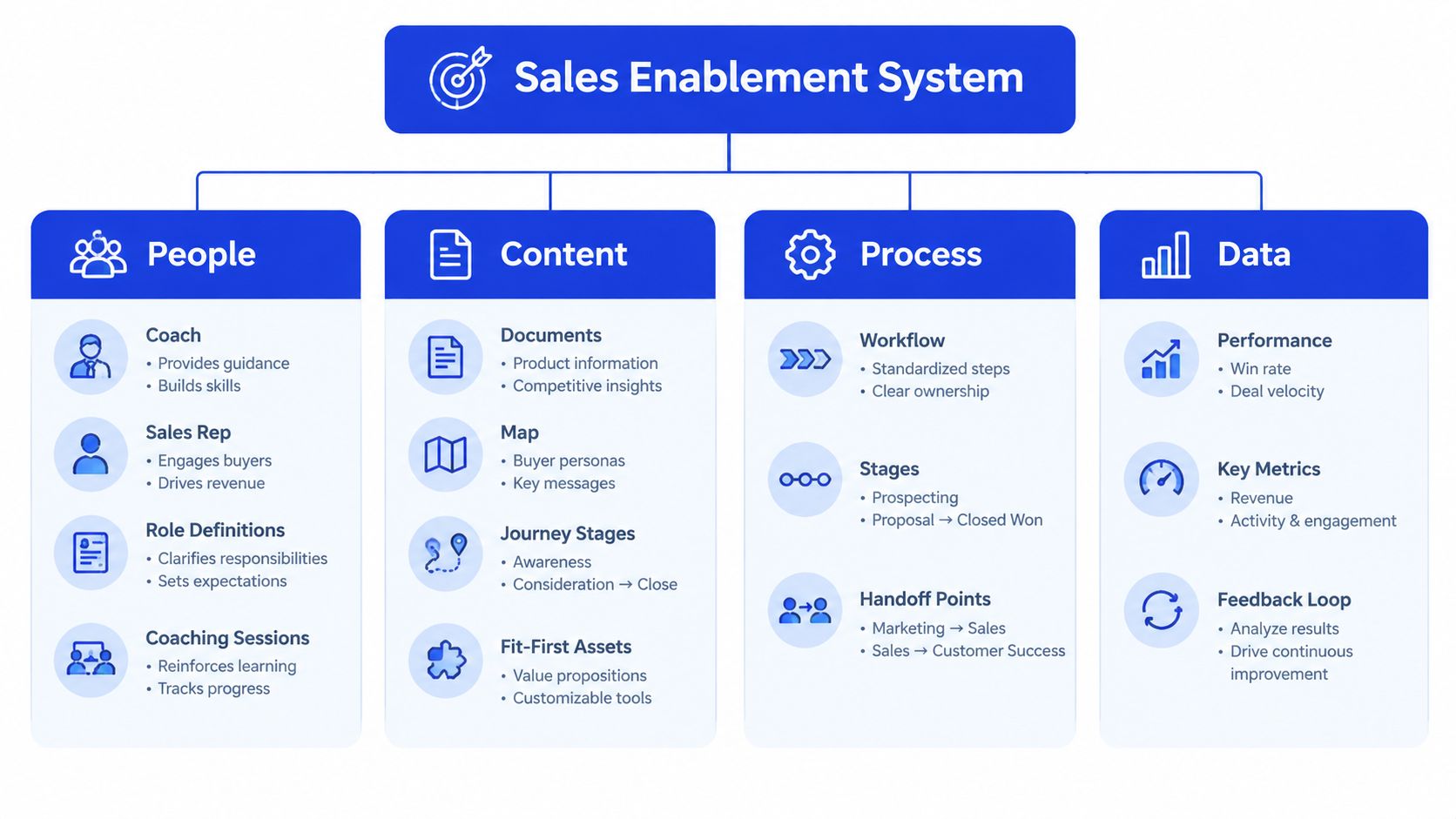
Sales enablement works as an operating layer, not as a department that distributes files. Four components must exchange information continuously: people, content, process, and data. Remove one, and the other three become harder to inspect.
People create the behavior
People includes role definitions, manager coaching, onboarding, and live deal support. A rep doesn't adopt a new discovery motion because a document exists. The rep adopts it after a manager reviews a call, scores the behavior, and asks for another attempt in a real opportunity.
Keep ownership explicit. Sales leaders decide which behaviors affect pipeline. Managers reinforce those behaviors. The enablement owner supplies practice material and inspection methods. RevOps records the evidence.
Content answers a live question
Content should sit beside the deal stage and buyer problem. Highspot and Seismic can manage access, but neither platform decides whether a rep needs an objection response, a proof point, or a close plan. That decision comes from the process and the account context.
A useful content record includes the ICP segment, buyer role, deal stage, trigger, owner, last review date, and the CRM action that should follow. Without those fields, the library becomes a warehouse.
Process creates repeatability
Salesforce or HubSpot should hold the required actions and exit criteria. A process step needs an owner, a completion signal, and a reason the next stage depends on it. “Discovery complete” is weak. “Economic buyer identified, current state documented, and mutual next step scheduled” is inspectable.
Process also governs outbound. Apollo, Sales Navigator, Clay, HeyReach, and email sequencing tools should not operate as disconnected activity generators. Account selection, personalization rules, reply routing, qualification, and CRM updates need one chain.
Data closes the loop
Gong or Chorus can show whether reps use the intended discovery questions. ZoomInfo or 6sense can add account and intent signals. The CRM can show whether those actions correlate with meetings, opportunities, and closed revenue. The enablement platform stores and serves material.
The stack becomes useful when signals move between systems. ICP inputs shape content. Content supports process. Process generates data. Data refines the ICP. A separate sales engagement platform perspective helps clarify where sequencing belongs, but sequencing still needs the same qualification and reporting rules as the rest of the motion.
A practical stack might use HubSpot for lifecycle and pipeline records, Clay for enrichment, Sales Navigator for account research, Smartlead or Instantly for email execution, HeyReach for LinkedIn workflows, Gong for call evidence, and Slack for fast feedback. The exact vendors can change. The handoffs cannot.
Roles, ownership, and the one hire that actually matters
Below 50 reps, a large enablement org is usually a distraction. The business needs one person who can inspect the funnel, change the workflow, edit the asset, and coach the rep without waiting for a committee.
Role structure | Best for team size | Primary pipeline impact |
|---|---|---|
Enablement specialist | Sub-50-rep teams | Connects CRM steps, content, onboarding, and manager reinforcement |
Enablement manager | Mid-market teams | Runs recurring readiness programs and tracks adoption across managers |
Senior enablement director | Larger revenue organizations | Sets cross-functional standards, governance, and regional execution |
Fractional or RevOps-embedded lead | Lean teams and transitional stages | Installs the operating layer while keeping ownership close to pipeline |
The recommendation is clear: choose a RevOps-embedded enablement specialist for any team below 50 reps. That person should report into the function accountable for pipeline or work directly against its scorecard. A content strategist who can't edit the CRM will miss the behavior that matters. A tool administrator who can't coach a call will measure clicks instead of execution.
Larger vendors often sell an inflated pyramid: trainer, content strategist, platform administrator, program manager, and analyst. Those roles can make sense at scale. Before then, they create handoffs that slow every correction. One hire should be able to write an ICP one-pager Monday, change a required CRM field Tuesday, run a deal review Wednesday, and score a recorded discovery call Thursday.
The ownership test
Give the owner one commercial target, one adoption target, and one inspection routine. For example, the owner might be responsible for qualified meeting progression, completion of the required discovery step, and a weekly call review with each manager.
The role also needs enough technical access to act. If every CRM edit requires engineering, every asset change requires brand approval, and every sequence adjustment requires an agency ticket, the function can't keep pace with field feedback.
When recruiting, look for operators who can communicate with founders, sales managers, marketers, and data owners. Guidance on attracting startup talent is relevant here because the strongest early hire is rarely a narrow trainer. You need judgment across pipeline design and rep behavior.
Keep the role aligned with sales and marketing alignment, but don't turn alignment into a meeting schedule. Give one person the authority to remove assets, change steps, and call out non-adoption.
Content strategy built for fit, not for libraries
A sales library should make a rep faster during a live opportunity. If the rep needs to search through sixty files to answer a pricing objection, the library has failed before the prospect does.
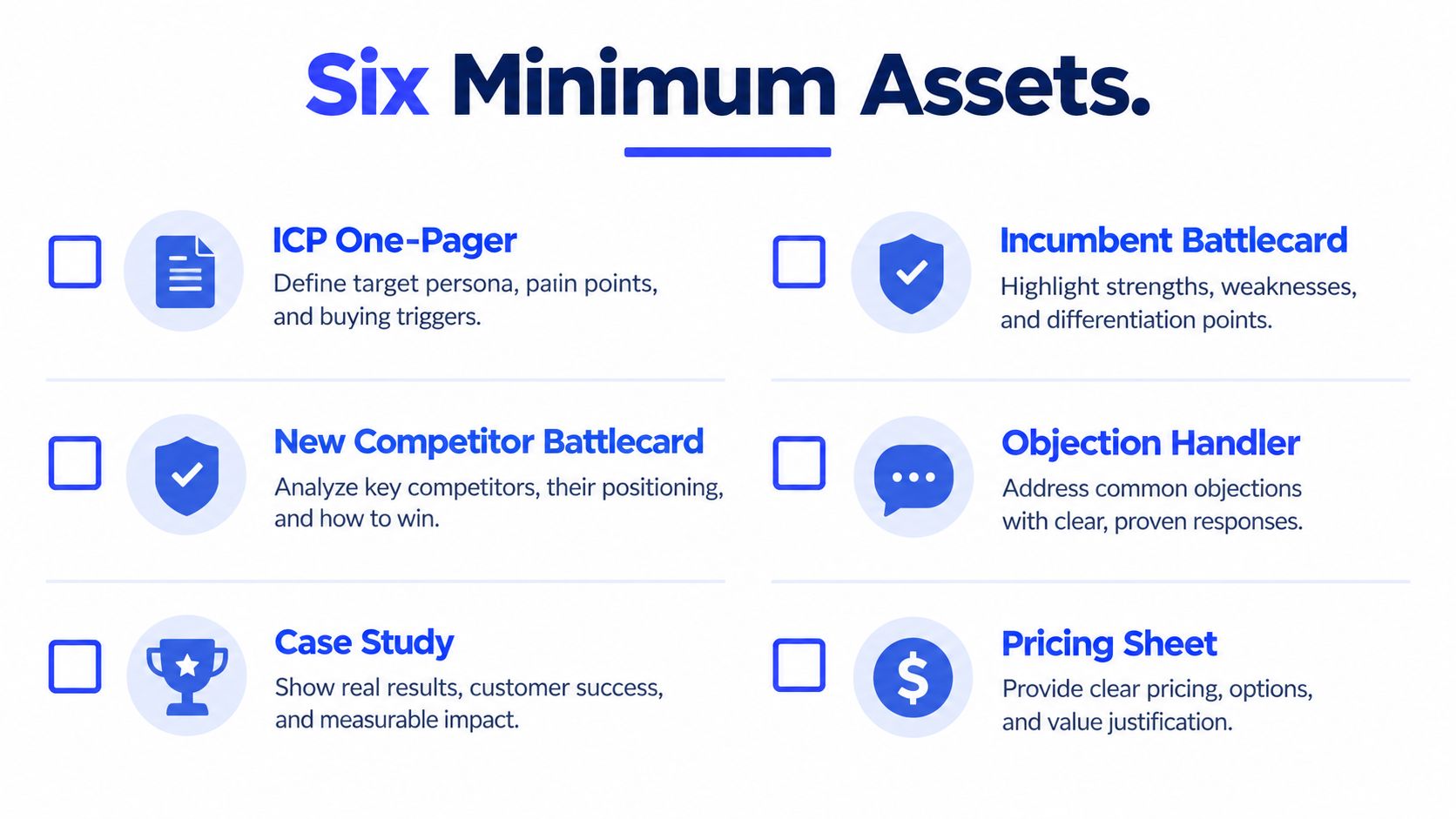
Start with six assets. Store them in Highspot, Seismic, or a controlled workspace, but tag every item by ICP segment, buyer role, deal stage, trigger, owner, and next action. The file location is secondary. Retrieval speed and field relevance determine whether the asset earns a place.
The six-asset minimum
ICP one-pager: Use a two-page PDF or CRM-linked document for account research and outbound preparation. Marketing owns the first draft, RevOps owns the fields, and sales leaders approve the buying triggers.
Incumbent battlecard: Keep this to one page. Use it when a buyer already has a competitor, with objection language, proof points, discovery prompts, and disqualification guidance.
Status quo battlecard: Make this a one-page decision aid for deals where the buyer believes the current process is acceptable. The rep uses it after discovery, not as an opening pitch.
Discovery question bank: Build a searchable document organized by business pain, workflow impact, risk, and decision process. Managers use it in call practice, and reps use it before qualified meetings.
Case study template: Use a short structured format with customer context, problem, intervention, evidence, and buyer-relevant outcome. The rep pulls it after a confirmed pain, not after every first touch.
Pricing justification sheet: Create a one-page internal and external version. The internal side covers value logic and negotiation boundaries. The external side explains the buying decision without forcing the rep to improvise.
Mutual close plan: Use a shared document or CRM-linked template with milestones, owners, dependencies, and dates. Introduce it once the buyer has agreed that a decision is active.
The list contains a deliberate correction: many teams call an objection handler a separate asset, while others bury it inside a battlecard. The format matters less than retrieval and stage ownership. The asset must be usable inside the next live deal.
Cut anything that doesn't earn attention
A case study that has no ICP match is decoration. A battlecard with no disqualification guidance encourages bad-fit selling. A pricing sheet that requires a manager explanation isn't a field asset.
Use the rule without exception: every asset must answer a rep's question within the next 20 minutes of a live deal, or it gets cut. That principle also keeps a B2B content marketing strategy tied to sales execution rather than editorial volume.
A 30-60-90 rollout that fits a bi-weekly sprint cadence
Run enablement in six bi-weekly sprints, not as a quarterly training event. Six sprints equal 12 weeks, which fits one quarter and creates a fixed inspection rhythm.
Days 1 to 30, sprints 1 and 2
Start with a baseline checkpoint. Pull three current measures: win rate, average time to first meeting, and content usage rate. Use the same definitions across the CRM and content platform. Then identify the funnel stage with the clearest leakage and select one ICP for the first wave.
Sprint 1 should produce the baseline document, owner map, and account definition. Sprint 2 should produce the first workflow draft and a list of the specific rep behaviors managers will inspect. Don't build every asset yet. Build around the stage that is costing the team the most qualified progression.
Days 31 to 60, sprints 3 and 4
Ship the six-asset minimum into the CRM and a shared Slack channel. Give each asset a stage, owner, trigger, and required follow-up. Keep the channel for field questions and corrections, not as a second library.
Run a live deal review every other Friday. Ask the rep to show the account, the selected asset, the last buyer action, and the next scheduled action. Instrument usage logging in Outreach or Salesloft so leadership can see whether the intended motion is being run.
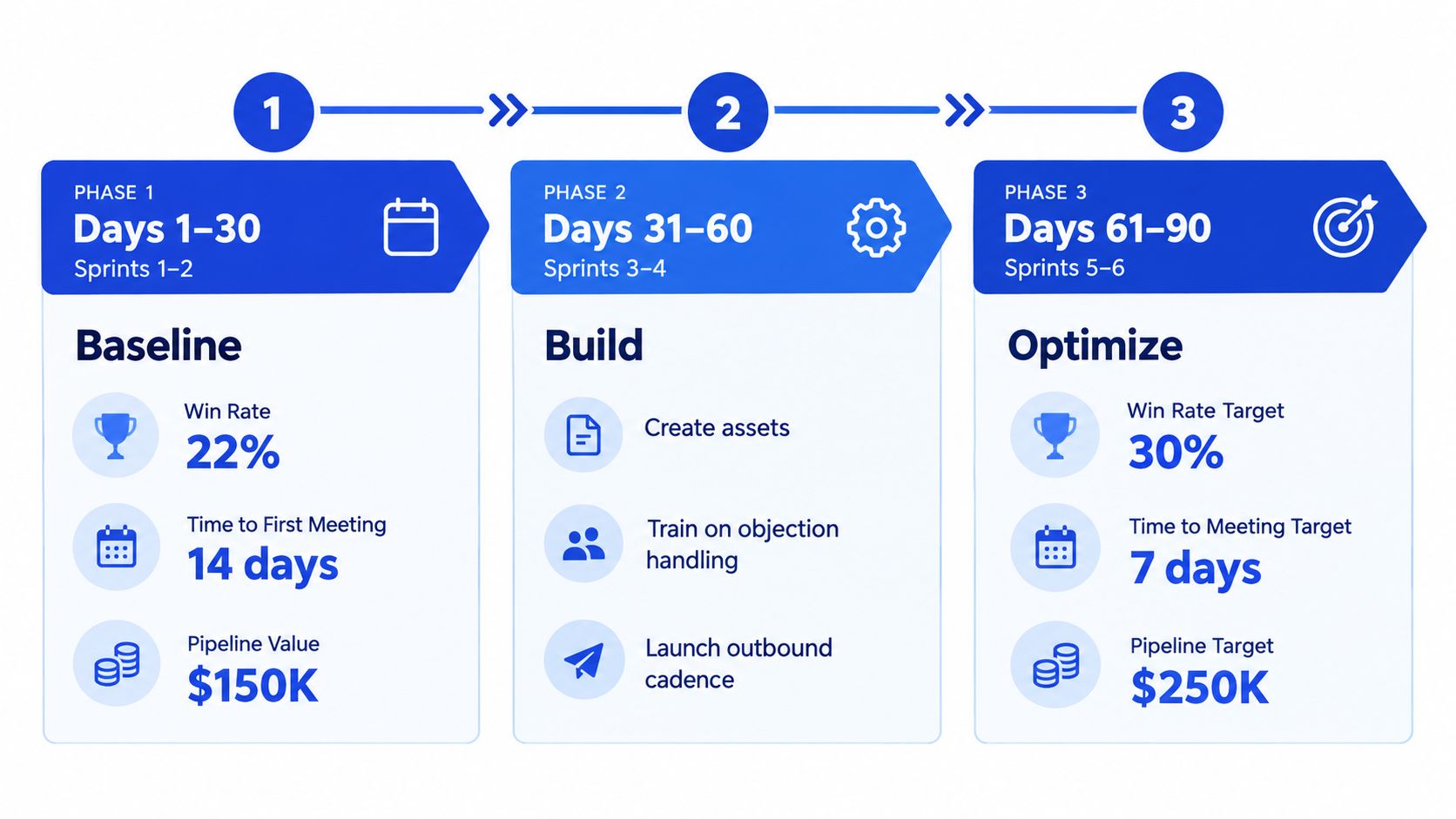
Days 61 to 90, sprints 5 and 6
Lock the manager reinforcement cadence during sprint 5. Every manager should know which call, asset, and CRM step they inspect each week. Publish the first KPI scorecard to the leadership channel during sprint 6, with notes on adoption gaps rather than only outcome changes.
Use one renewal or expansion play to test whether the new motion works beyond net-new outbound. That test matters because enablement should support the full customer lifecycle, not stop after the first meeting.
Name the checkpoints before the rollout begins:
Sprint 2 checkpoint: ICP and leakage stage approved.
Sprint 4 checkpoint: assets live, sequence tracking active, first deal review completed.
Sprint 6 checkpoint: manager cadence running, scorecard published, expansion test documented.
Measuring enablement with three layers and three primary KPIs
A twelve-metric dashboard gives a small team more reporting than judgment. Use three layers instead: performance, proficiency, and productivity. Each layer answers a different question about whether the system creates better commercial behavior.
Performance measures the result
The primary performance KPI is opportunity-to-close win rate, segmented by enablement cohort versus control. Pull it from the CRM and define the cohort before the program starts. The point isn't to claim causation from a dashboard. The point is to compare teams or periods using the same opportunity definition and inspect whether the enabled motion is associated with better outcomes.
Proficiency measures the skill
The primary proficiency KPI is certified-to-play score. A rep passes after completing a recorded mock discovery against the ICP one-pager and meeting the agreed scoring standard. Store the result in the LMS or readiness system, then connect it to the rep record.
A certification that never reaches live calls is theater. Managers should sample real recordings and check whether the rep used the questions, qualification logic, and next-step behavior in active opportunities.
Productivity measures time
The primary productivity KPI is median days from first qualified meeting to mutual close plan signed. Pull meeting and stage dates from the CRM, then define “mutual close plan signed” as a verifiable milestone rather than a rep-entered comment.
Layer | Primary KPI | Supporting KPI | Source system |
|---|---|---|---|
Performance | Opportunity-to-close win rate by cohort | Content asset pull rate | CRM and content platform |
Proficiency | Certified-to-play score | Manager coaching frequency | Conversation intelligence and LMS export |
Productivity | Median days from first qualified meeting to mutual close plan signed | Ramp time to first quota | CRM and LMS export |
Current tracking shows the measurement gap clearly. Only 35% of companies have clear enablement effectiveness metrics. Commonly monitored measures include time to productivity at 68%, content usage at 64%, win rates at 61%, and quota attainment at 59%, according to this sales enablement metrics analysis.
Organizations that regularly measure ROI reportedly invest 41% more in enablement, and mature programs are associated with a 4:1 return, according to the same source. Treat those figures as directional benchmarks, not a reason to copy another company's scorecard.
For a practical companion to funnel measurement, use the lead generation KPI framework. The discipline is simple: three primary KPIs drive decisions, while the supporting measures explain why the result moved.
The four execution gaps that quietly kill enablement programs
The first failure usually isn't poor content. It's documented process with low adherence. Independent 2026 research found that about 89% of teams have a documented enablement process, while only about 36% of reps consistently follow it. Teams with higher adherence reportedly reach quota at 6.3 times the rate of teams with lower adherence, as reported in research on the sales execution gap.
Gap one, the playbook lives outside the deal
A process in Notion is not a process in execution. Reps revert to muscle memory when managers don't inspect the required behavior during live opportunities. The minimum fix is a manager reinforcement cadence tied to recorded calls, CRM stage movement, and one specific behavior per review.
A weekly one-on-one should last 30 to 45 minutes per rep, with one scored call, one practiced skill, and one committed action, according to this sales manager coaching cadence. The duration matters less than the fixed structure and visible follow-through.
Gap two, content surplus creates signal deficit
Sixty loosely organized assets compete with one another. A rep sends the wrong deck because no one mapped the asset to a buyer problem and funnel stage. The fix is asset-to-stage tagging, one owner per asset, and retirement rules.
Gap three, tool sprawl hides the workflow
Six licensed tools don't create one motion. Clay may enrich an account, Apollo may create a list, Smartlead may send email, HeyReach may run LinkedIn activity, and HubSpot may hold the record. If no sequence connects outreach, content, reply routing, qualification, and follow-up, activity disappears into separate dashboards.
Keep one primary sequence architecture. Compare tools by reply-to-meeting rate and data completeness, not by feature count.
Gap four, training ends before behavior starts
Onboarding often ends when the event ends. The rep knows the framework but hasn't practiced it against the ICP, used it in a recorded call, or received manager feedback. The fix is a recurring coaching review tied to real recordings and a skill-lift check.
Small teams can also use this guide for small business owners on sales to examine the follow-up workload that falls apart when delivery work consumes the owner's calendar. Enablement should reduce that dependency by making ownership and next actions visible.
The blunt diagnosis is simple: adoption kills more programs than content quality does. A mediocre asset used at the right moment can create learning. A perfect asset nobody opens cannot.
Your next move and how to audit enablement this week
Run the audit on Friday morning, before the next forecast call. Give each check less than 15 minutes and record the result in one shared document linked to the pipeline review.
Check one, inspect closed-won behavior
Pull the last 20 closed-won deals from the CRM. Confirm whether each deal has the documented playbook step completed for the stage where the decision became real. Don't accept a completed checkbox without evidence such as a call recording, mutual close plan, buyer-confirmed next step, or approved qualification field.
Check two, reduce the content library
Open the content library and tag every asset to a funnel stage, ICP segment, buyer role, owner, and next action. Retire anything without a stage owner. Move disputed assets into a review queue rather than leaving them live.
Check three, compare outcomes with coaching
Pull last month's win rate by rep. Then compare it with the average number of coaching sessions logged per rep. Don't treat correlation as proof. Use the comparison to find managers who are inspecting behavior and reps who are receiving activity without skill feedback.
Check four, remove sequence overlap
List every sequence tool in use, including Apollo, Lemlist, Instantly, Smartlead, Salesloft, Outreach, and LinkedIn workflows through HeyReach. Compare reply-to-meeting rate, routing quality, CRM writeback, and ownership. Keep the tool with the strongest meeting outcome and retire overlapping motions that create duplicate touches.
Friday deliverable: One page showing the four checks, the owner of each gap, the next correction, and the date of the next review.
The broader audit principle is that one operating layer connecting ICP, content, and outbound should make the next review shorter because every decision leaves evidence in the same revenue system.
GROU is a global B2B pipeline agency trusted by 50+ companies across iGaming, SaaS, manufacturing, and professional services. Its methodology connects ICP-aligned lists, LinkedIn content, outbound sequences, qualification rules, and bi-weekly sprint reporting into one pipeline system. Visit Grou to assess where your enablement motion loses adoption and build the operating layer that turns attention into qualified meetings.
Your pipeline dashboard is full, your reps are busy, and forecast confidence is still weak. Marketing keeps shipping assets, sales keeps asking for better messaging, and RevOps keeps adding fields that nobody updates. The common failure is structural: attention enters through content and outbound, but nothing consistently turns it into booked meetings.
Sales enablement must connect ICP, content, process, coaching, and outbound in one operating layer.
A small team needs an enablement owner tied to pipeline, not a department built around content production.
Six focused assets beat a crowded library when each asset answers a live deal question.
Measurement should separate performance, proficiency, and productivity.
The first audit belongs in your CRM, call recordings, coaching log, and sequence data.
Table of Contents
Why most sales enablement programs stall before they produce pipeline
Measuring enablement with three layers and three primary KPIs
The four execution gaps that quietly kill enablement programs
Why most sales enablement programs stall before they produce pipeline
Most programs start in the wrong place. A marketing team builds a resource center, sales leadership requests training, and someone organizes folders in Highspot, Seismic, Notion, or Google Drive. The output looks productive, yet the rep still doesn't know which account profile deserves attention, which message fits the buyer, or which asset should support the next conversation.
That failure matters because sales enablement has moved from a niche practice into standard revenue infrastructure. Fewer than 20% of organizations used sales enablement in 2013, while adoption climbed above 60% by 2019. Highspot's 2023 report found that 90% of organizations had a dedicated sales enablement team or program, compared with 75% in 2022. Those figures are reported in this industry overview of sales enablement adoption.
The category's software growth reflects the same shift. Grand View Research estimated the global sales enablement platform market at $5.23 billion in 2024, with a projection of $12.78 billion by 2030 and a 16.3% CAGR, as summarized in market research on sales enablement platforms. The budget is already there. The execution layer usually isn't.
The test: If an asset, training session, or workflow doesn't help a rep create or advance a qualified meeting, it needs a clear reason to exist.
The content library trap
A library produces inventory. A system produces behavior.
When ICP definition sits in a strategy deck, messaging sits in a content folder, and outbound runs from Apollo, Lemlist, Instantly, Smartlead, or Salesloft without shared qualification rules, the team creates activity without learning. Reps send a generic deck to a poor-fit account, receive weak replies, and blame the sequence. Marketing sees engagement and blames sales follow-up. Nobody owns the feedback loop.
That is why the sales process optimization framework from GROU belongs beside enablement work. Process is where an ICP decision becomes a qualification rule, a content recommendation, a CRM field, and a manager inspection point.
RevOps should own the operating layer
Marketing can own narrative quality. Sales can own field adoption. RevOps should own the connection between them because RevOps can inspect routing, stage movement, activity, data quality, and attribution in one place.
For teams building pipeline from multiple channels, the practical sequence is straightforward: define the ICP → map the trigger → write the message → attach the asset → run the sequence → inspect the meeting → update the system. Resources such as how Sprints & Sneakers builds pipelines are useful when you need to connect prospecting mechanics to a broader pipeline motion.
The rest of the system should be judged by one question: did the rep make a better next move with the right account? Content downloads, training attendance, and platform logins are supporting signals. Booked meetings and qualified progression are the commercial test.
The four components of a sales enablement system
Sales enablement works as an operating layer, not as a department that distributes files. Four components must exchange information continuously: people, content, process, and data. Remove one, and the other three become harder to inspect.
People create the behavior
People includes role definitions, manager coaching, onboarding, and live deal support. A rep doesn't adopt a new discovery motion because a document exists. The rep adopts it after a manager reviews a call, scores the behavior, and asks for another attempt in a real opportunity.
Keep ownership explicit. Sales leaders decide which behaviors affect pipeline. Managers reinforce those behaviors. The enablement owner supplies practice material and inspection methods. RevOps records the evidence.
Content answers a live question
Content should sit beside the deal stage and buyer problem. Highspot and Seismic can manage access, but neither platform decides whether a rep needs an objection response, a proof point, or a close plan. That decision comes from the process and the account context.
A useful content record includes the ICP segment, buyer role, deal stage, trigger, owner, last review date, and the CRM action that should follow. Without those fields, the library becomes a warehouse.
Process creates repeatability
Salesforce or HubSpot should hold the required actions and exit criteria. A process step needs an owner, a completion signal, and a reason the next stage depends on it. “Discovery complete” is weak. “Economic buyer identified, current state documented, and mutual next step scheduled” is inspectable.
Process also governs outbound. Apollo, Sales Navigator, Clay, HeyReach, and email sequencing tools should not operate as disconnected activity generators. Account selection, personalization rules, reply routing, qualification, and CRM updates need one chain.
Data closes the loop
Gong or Chorus can show whether reps use the intended discovery questions. ZoomInfo or 6sense can add account and intent signals. The CRM can show whether those actions correlate with meetings, opportunities, and closed revenue. The enablement platform stores and serves material.
The stack becomes useful when signals move between systems. ICP inputs shape content. Content supports process. Process generates data. Data refines the ICP. A separate sales engagement platform perspective helps clarify where sequencing belongs, but sequencing still needs the same qualification and reporting rules as the rest of the motion.
A practical stack might use HubSpot for lifecycle and pipeline records, Clay for enrichment, Sales Navigator for account research, Smartlead or Instantly for email execution, HeyReach for LinkedIn workflows, Gong for call evidence, and Slack for fast feedback. The exact vendors can change. The handoffs cannot.
Roles, ownership, and the one hire that actually matters
Below 50 reps, a large enablement org is usually a distraction. The business needs one person who can inspect the funnel, change the workflow, edit the asset, and coach the rep without waiting for a committee.
Role structure | Best for team size | Primary pipeline impact |
|---|---|---|
Enablement specialist | Sub-50-rep teams | Connects CRM steps, content, onboarding, and manager reinforcement |
Enablement manager | Mid-market teams | Runs recurring readiness programs and tracks adoption across managers |
Senior enablement director | Larger revenue organizations | Sets cross-functional standards, governance, and regional execution |
Fractional or RevOps-embedded lead | Lean teams and transitional stages | Installs the operating layer while keeping ownership close to pipeline |
The recommendation is clear: choose a RevOps-embedded enablement specialist for any team below 50 reps. That person should report into the function accountable for pipeline or work directly against its scorecard. A content strategist who can't edit the CRM will miss the behavior that matters. A tool administrator who can't coach a call will measure clicks instead of execution.
Larger vendors often sell an inflated pyramid: trainer, content strategist, platform administrator, program manager, and analyst. Those roles can make sense at scale. Before then, they create handoffs that slow every correction. One hire should be able to write an ICP one-pager Monday, change a required CRM field Tuesday, run a deal review Wednesday, and score a recorded discovery call Thursday.
The ownership test
Give the owner one commercial target, one adoption target, and one inspection routine. For example, the owner might be responsible for qualified meeting progression, completion of the required discovery step, and a weekly call review with each manager.
The role also needs enough technical access to act. If every CRM edit requires engineering, every asset change requires brand approval, and every sequence adjustment requires an agency ticket, the function can't keep pace with field feedback.
When recruiting, look for operators who can communicate with founders, sales managers, marketers, and data owners. Guidance on attracting startup talent is relevant here because the strongest early hire is rarely a narrow trainer. You need judgment across pipeline design and rep behavior.
Keep the role aligned with sales and marketing alignment, but don't turn alignment into a meeting schedule. Give one person the authority to remove assets, change steps, and call out non-adoption.
Content strategy built for fit, not for libraries
A sales library should make a rep faster during a live opportunity. If the rep needs to search through sixty files to answer a pricing objection, the library has failed before the prospect does.
Start with six assets. Store them in Highspot, Seismic, or a controlled workspace, but tag every item by ICP segment, buyer role, deal stage, trigger, owner, and next action. The file location is secondary. Retrieval speed and field relevance determine whether the asset earns a place.
The six-asset minimum
ICP one-pager: Use a two-page PDF or CRM-linked document for account research and outbound preparation. Marketing owns the first draft, RevOps owns the fields, and sales leaders approve the buying triggers.
Incumbent battlecard: Keep this to one page. Use it when a buyer already has a competitor, with objection language, proof points, discovery prompts, and disqualification guidance.
Status quo battlecard: Make this a one-page decision aid for deals where the buyer believes the current process is acceptable. The rep uses it after discovery, not as an opening pitch.
Discovery question bank: Build a searchable document organized by business pain, workflow impact, risk, and decision process. Managers use it in call practice, and reps use it before qualified meetings.
Case study template: Use a short structured format with customer context, problem, intervention, evidence, and buyer-relevant outcome. The rep pulls it after a confirmed pain, not after every first touch.
Pricing justification sheet: Create a one-page internal and external version. The internal side covers value logic and negotiation boundaries. The external side explains the buying decision without forcing the rep to improvise.
Mutual close plan: Use a shared document or CRM-linked template with milestones, owners, dependencies, and dates. Introduce it once the buyer has agreed that a decision is active.
The list contains a deliberate correction: many teams call an objection handler a separate asset, while others bury it inside a battlecard. The format matters less than retrieval and stage ownership. The asset must be usable inside the next live deal.
Cut anything that doesn't earn attention
A case study that has no ICP match is decoration. A battlecard with no disqualification guidance encourages bad-fit selling. A pricing sheet that requires a manager explanation isn't a field asset.
Use the rule without exception: every asset must answer a rep's question within the next 20 minutes of a live deal, or it gets cut. That principle also keeps a B2B content marketing strategy tied to sales execution rather than editorial volume.
A 30-60-90 rollout that fits a bi-weekly sprint cadence
Run enablement in six bi-weekly sprints, not as a quarterly training event. Six sprints equal 12 weeks, which fits one quarter and creates a fixed inspection rhythm.
Days 1 to 30, sprints 1 and 2
Start with a baseline checkpoint. Pull three current measures: win rate, average time to first meeting, and content usage rate. Use the same definitions across the CRM and content platform. Then identify the funnel stage with the clearest leakage and select one ICP for the first wave.
Sprint 1 should produce the baseline document, owner map, and account definition. Sprint 2 should produce the first workflow draft and a list of the specific rep behaviors managers will inspect. Don't build every asset yet. Build around the stage that is costing the team the most qualified progression.
Days 31 to 60, sprints 3 and 4
Ship the six-asset minimum into the CRM and a shared Slack channel. Give each asset a stage, owner, trigger, and required follow-up. Keep the channel for field questions and corrections, not as a second library.
Run a live deal review every other Friday. Ask the rep to show the account, the selected asset, the last buyer action, and the next scheduled action. Instrument usage logging in Outreach or Salesloft so leadership can see whether the intended motion is being run.
Days 61 to 90, sprints 5 and 6
Lock the manager reinforcement cadence during sprint 5. Every manager should know which call, asset, and CRM step they inspect each week. Publish the first KPI scorecard to the leadership channel during sprint 6, with notes on adoption gaps rather than only outcome changes.
Use one renewal or expansion play to test whether the new motion works beyond net-new outbound. That test matters because enablement should support the full customer lifecycle, not stop after the first meeting.
Name the checkpoints before the rollout begins:
Sprint 2 checkpoint: ICP and leakage stage approved.
Sprint 4 checkpoint: assets live, sequence tracking active, first deal review completed.
Sprint 6 checkpoint: manager cadence running, scorecard published, expansion test documented.
Measuring enablement with three layers and three primary KPIs
A twelve-metric dashboard gives a small team more reporting than judgment. Use three layers instead: performance, proficiency, and productivity. Each layer answers a different question about whether the system creates better commercial behavior.
Performance measures the result
The primary performance KPI is opportunity-to-close win rate, segmented by enablement cohort versus control. Pull it from the CRM and define the cohort before the program starts. The point isn't to claim causation from a dashboard. The point is to compare teams or periods using the same opportunity definition and inspect whether the enabled motion is associated with better outcomes.
Proficiency measures the skill
The primary proficiency KPI is certified-to-play score. A rep passes after completing a recorded mock discovery against the ICP one-pager and meeting the agreed scoring standard. Store the result in the LMS or readiness system, then connect it to the rep record.
A certification that never reaches live calls is theater. Managers should sample real recordings and check whether the rep used the questions, qualification logic, and next-step behavior in active opportunities.
Productivity measures time
The primary productivity KPI is median days from first qualified meeting to mutual close plan signed. Pull meeting and stage dates from the CRM, then define “mutual close plan signed” as a verifiable milestone rather than a rep-entered comment.
Layer | Primary KPI | Supporting KPI | Source system |
|---|---|---|---|
Performance | Opportunity-to-close win rate by cohort | Content asset pull rate | CRM and content platform |
Proficiency | Certified-to-play score | Manager coaching frequency | Conversation intelligence and LMS export |
Productivity | Median days from first qualified meeting to mutual close plan signed | Ramp time to first quota | CRM and LMS export |
Current tracking shows the measurement gap clearly. Only 35% of companies have clear enablement effectiveness metrics. Commonly monitored measures include time to productivity at 68%, content usage at 64%, win rates at 61%, and quota attainment at 59%, according to this sales enablement metrics analysis.
Organizations that regularly measure ROI reportedly invest 41% more in enablement, and mature programs are associated with a 4:1 return, according to the same source. Treat those figures as directional benchmarks, not a reason to copy another company's scorecard.
For a practical companion to funnel measurement, use the lead generation KPI framework. The discipline is simple: three primary KPIs drive decisions, while the supporting measures explain why the result moved.
The four execution gaps that quietly kill enablement programs
The first failure usually isn't poor content. It's documented process with low adherence. Independent 2026 research found that about 89% of teams have a documented enablement process, while only about 36% of reps consistently follow it. Teams with higher adherence reportedly reach quota at 6.3 times the rate of teams with lower adherence, as reported in research on the sales execution gap.
Gap one, the playbook lives outside the deal
A process in Notion is not a process in execution. Reps revert to muscle memory when managers don't inspect the required behavior during live opportunities. The minimum fix is a manager reinforcement cadence tied to recorded calls, CRM stage movement, and one specific behavior per review.
A weekly one-on-one should last 30 to 45 minutes per rep, with one scored call, one practiced skill, and one committed action, according to this sales manager coaching cadence. The duration matters less than the fixed structure and visible follow-through.
Gap two, content surplus creates signal deficit
Sixty loosely organized assets compete with one another. A rep sends the wrong deck because no one mapped the asset to a buyer problem and funnel stage. The fix is asset-to-stage tagging, one owner per asset, and retirement rules.
Gap three, tool sprawl hides the workflow
Six licensed tools don't create one motion. Clay may enrich an account, Apollo may create a list, Smartlead may send email, HeyReach may run LinkedIn activity, and HubSpot may hold the record. If no sequence connects outreach, content, reply routing, qualification, and follow-up, activity disappears into separate dashboards.
Keep one primary sequence architecture. Compare tools by reply-to-meeting rate and data completeness, not by feature count.
Gap four, training ends before behavior starts
Onboarding often ends when the event ends. The rep knows the framework but hasn't practiced it against the ICP, used it in a recorded call, or received manager feedback. The fix is a recurring coaching review tied to real recordings and a skill-lift check.
Small teams can also use this guide for small business owners on sales to examine the follow-up workload that falls apart when delivery work consumes the owner's calendar. Enablement should reduce that dependency by making ownership and next actions visible.
The blunt diagnosis is simple: adoption kills more programs than content quality does. A mediocre asset used at the right moment can create learning. A perfect asset nobody opens cannot.
Your next move and how to audit enablement this week
Run the audit on Friday morning, before the next forecast call. Give each check less than 15 minutes and record the result in one shared document linked to the pipeline review.
Check one, inspect closed-won behavior
Pull the last 20 closed-won deals from the CRM. Confirm whether each deal has the documented playbook step completed for the stage where the decision became real. Don't accept a completed checkbox without evidence such as a call recording, mutual close plan, buyer-confirmed next step, or approved qualification field.
Check two, reduce the content library
Open the content library and tag every asset to a funnel stage, ICP segment, buyer role, owner, and next action. Retire anything without a stage owner. Move disputed assets into a review queue rather than leaving them live.
Check three, compare outcomes with coaching
Pull last month's win rate by rep. Then compare it with the average number of coaching sessions logged per rep. Don't treat correlation as proof. Use the comparison to find managers who are inspecting behavior and reps who are receiving activity without skill feedback.
Check four, remove sequence overlap
List every sequence tool in use, including Apollo, Lemlist, Instantly, Smartlead, Salesloft, Outreach, and LinkedIn workflows through HeyReach. Compare reply-to-meeting rate, routing quality, CRM writeback, and ownership. Keep the tool with the strongest meeting outcome and retire overlapping motions that create duplicate touches.
Friday deliverable: One page showing the four checks, the owner of each gap, the next correction, and the date of the next review.
The broader audit principle is that one operating layer connecting ICP, content, and outbound should make the next review shorter because every decision leaves evidence in the same revenue system.
GROU is a global B2B pipeline agency trusted by 50+ companies across iGaming, SaaS, manufacturing, and professional services. Its methodology connects ICP-aligned lists, LinkedIn content, outbound sequences, qualification rules, and bi-weekly sprint reporting into one pipeline system. Visit Grou to assess where your enablement motion loses adoption and build the operating layer that turns attention into qualified meetings.
Your pipeline dashboard is full, your reps are busy, and forecast confidence is still weak. Marketing keeps shipping assets, sales keeps asking for better messaging, and RevOps keeps adding fields that nobody updates. The common failure is structural: attention enters through content and outbound, but nothing consistently turns it into booked meetings.
Sales enablement must connect ICP, content, process, coaching, and outbound in one operating layer.
A small team needs an enablement owner tied to pipeline, not a department built around content production.
Six focused assets beat a crowded library when each asset answers a live deal question.
Measurement should separate performance, proficiency, and productivity.
The first audit belongs in your CRM, call recordings, coaching log, and sequence data.
Table of Contents
Why most sales enablement programs stall before they produce pipeline
Measuring enablement with three layers and three primary KPIs
The four execution gaps that quietly kill enablement programs
Why most sales enablement programs stall before they produce pipeline
Most programs start in the wrong place. A marketing team builds a resource center, sales leadership requests training, and someone organizes folders in Highspot, Seismic, Notion, or Google Drive. The output looks productive, yet the rep still doesn't know which account profile deserves attention, which message fits the buyer, or which asset should support the next conversation.
That failure matters because sales enablement has moved from a niche practice into standard revenue infrastructure. Fewer than 20% of organizations used sales enablement in 2013, while adoption climbed above 60% by 2019. Highspot's 2023 report found that 90% of organizations had a dedicated sales enablement team or program, compared with 75% in 2022. Those figures are reported in this industry overview of sales enablement adoption.
The category's software growth reflects the same shift. Grand View Research estimated the global sales enablement platform market at $5.23 billion in 2024, with a projection of $12.78 billion by 2030 and a 16.3% CAGR, as summarized in market research on sales enablement platforms. The budget is already there. The execution layer usually isn't.
The test: If an asset, training session, or workflow doesn't help a rep create or advance a qualified meeting, it needs a clear reason to exist.
The content library trap
A library produces inventory. A system produces behavior.
When ICP definition sits in a strategy deck, messaging sits in a content folder, and outbound runs from Apollo, Lemlist, Instantly, Smartlead, or Salesloft without shared qualification rules, the team creates activity without learning. Reps send a generic deck to a poor-fit account, receive weak replies, and blame the sequence. Marketing sees engagement and blames sales follow-up. Nobody owns the feedback loop.
That is why the sales process optimization framework from GROU belongs beside enablement work. Process is where an ICP decision becomes a qualification rule, a content recommendation, a CRM field, and a manager inspection point.
RevOps should own the operating layer
Marketing can own narrative quality. Sales can own field adoption. RevOps should own the connection between them because RevOps can inspect routing, stage movement, activity, data quality, and attribution in one place.
For teams building pipeline from multiple channels, the practical sequence is straightforward: define the ICP → map the trigger → write the message → attach the asset → run the sequence → inspect the meeting → update the system. Resources such as how Sprints & Sneakers builds pipelines are useful when you need to connect prospecting mechanics to a broader pipeline motion.
The rest of the system should be judged by one question: did the rep make a better next move with the right account? Content downloads, training attendance, and platform logins are supporting signals. Booked meetings and qualified progression are the commercial test.
The four components of a sales enablement system
Sales enablement works as an operating layer, not as a department that distributes files. Four components must exchange information continuously: people, content, process, and data. Remove one, and the other three become harder to inspect.
People create the behavior
People includes role definitions, manager coaching, onboarding, and live deal support. A rep doesn't adopt a new discovery motion because a document exists. The rep adopts it after a manager reviews a call, scores the behavior, and asks for another attempt in a real opportunity.
Keep ownership explicit. Sales leaders decide which behaviors affect pipeline. Managers reinforce those behaviors. The enablement owner supplies practice material and inspection methods. RevOps records the evidence.
Content answers a live question
Content should sit beside the deal stage and buyer problem. Highspot and Seismic can manage access, but neither platform decides whether a rep needs an objection response, a proof point, or a close plan. That decision comes from the process and the account context.
A useful content record includes the ICP segment, buyer role, deal stage, trigger, owner, last review date, and the CRM action that should follow. Without those fields, the library becomes a warehouse.
Process creates repeatability
Salesforce or HubSpot should hold the required actions and exit criteria. A process step needs an owner, a completion signal, and a reason the next stage depends on it. “Discovery complete” is weak. “Economic buyer identified, current state documented, and mutual next step scheduled” is inspectable.
Process also governs outbound. Apollo, Sales Navigator, Clay, HeyReach, and email sequencing tools should not operate as disconnected activity generators. Account selection, personalization rules, reply routing, qualification, and CRM updates need one chain.
Data closes the loop
Gong or Chorus can show whether reps use the intended discovery questions. ZoomInfo or 6sense can add account and intent signals. The CRM can show whether those actions correlate with meetings, opportunities, and closed revenue. The enablement platform stores and serves material.
The stack becomes useful when signals move between systems. ICP inputs shape content. Content supports process. Process generates data. Data refines the ICP. A separate sales engagement platform perspective helps clarify where sequencing belongs, but sequencing still needs the same qualification and reporting rules as the rest of the motion.
A practical stack might use HubSpot for lifecycle and pipeline records, Clay for enrichment, Sales Navigator for account research, Smartlead or Instantly for email execution, HeyReach for LinkedIn workflows, Gong for call evidence, and Slack for fast feedback. The exact vendors can change. The handoffs cannot.
Roles, ownership, and the one hire that actually matters
Below 50 reps, a large enablement org is usually a distraction. The business needs one person who can inspect the funnel, change the workflow, edit the asset, and coach the rep without waiting for a committee.
Role structure | Best for team size | Primary pipeline impact |
|---|---|---|
Enablement specialist | Sub-50-rep teams | Connects CRM steps, content, onboarding, and manager reinforcement |
Enablement manager | Mid-market teams | Runs recurring readiness programs and tracks adoption across managers |
Senior enablement director | Larger revenue organizations | Sets cross-functional standards, governance, and regional execution |
Fractional or RevOps-embedded lead | Lean teams and transitional stages | Installs the operating layer while keeping ownership close to pipeline |
The recommendation is clear: choose a RevOps-embedded enablement specialist for any team below 50 reps. That person should report into the function accountable for pipeline or work directly against its scorecard. A content strategist who can't edit the CRM will miss the behavior that matters. A tool administrator who can't coach a call will measure clicks instead of execution.
Larger vendors often sell an inflated pyramid: trainer, content strategist, platform administrator, program manager, and analyst. Those roles can make sense at scale. Before then, they create handoffs that slow every correction. One hire should be able to write an ICP one-pager Monday, change a required CRM field Tuesday, run a deal review Wednesday, and score a recorded discovery call Thursday.
The ownership test
Give the owner one commercial target, one adoption target, and one inspection routine. For example, the owner might be responsible for qualified meeting progression, completion of the required discovery step, and a weekly call review with each manager.
The role also needs enough technical access to act. If every CRM edit requires engineering, every asset change requires brand approval, and every sequence adjustment requires an agency ticket, the function can't keep pace with field feedback.
When recruiting, look for operators who can communicate with founders, sales managers, marketers, and data owners. Guidance on attracting startup talent is relevant here because the strongest early hire is rarely a narrow trainer. You need judgment across pipeline design and rep behavior.
Keep the role aligned with sales and marketing alignment, but don't turn alignment into a meeting schedule. Give one person the authority to remove assets, change steps, and call out non-adoption.
Content strategy built for fit, not for libraries
A sales library should make a rep faster during a live opportunity. If the rep needs to search through sixty files to answer a pricing objection, the library has failed before the prospect does.
Start with six assets. Store them in Highspot, Seismic, or a controlled workspace, but tag every item by ICP segment, buyer role, deal stage, trigger, owner, and next action. The file location is secondary. Retrieval speed and field relevance determine whether the asset earns a place.
The six-asset minimum
ICP one-pager: Use a two-page PDF or CRM-linked document for account research and outbound preparation. Marketing owns the first draft, RevOps owns the fields, and sales leaders approve the buying triggers.
Incumbent battlecard: Keep this to one page. Use it when a buyer already has a competitor, with objection language, proof points, discovery prompts, and disqualification guidance.
Status quo battlecard: Make this a one-page decision aid for deals where the buyer believes the current process is acceptable. The rep uses it after discovery, not as an opening pitch.
Discovery question bank: Build a searchable document organized by business pain, workflow impact, risk, and decision process. Managers use it in call practice, and reps use it before qualified meetings.
Case study template: Use a short structured format with customer context, problem, intervention, evidence, and buyer-relevant outcome. The rep pulls it after a confirmed pain, not after every first touch.
Pricing justification sheet: Create a one-page internal and external version. The internal side covers value logic and negotiation boundaries. The external side explains the buying decision without forcing the rep to improvise.
Mutual close plan: Use a shared document or CRM-linked template with milestones, owners, dependencies, and dates. Introduce it once the buyer has agreed that a decision is active.
The list contains a deliberate correction: many teams call an objection handler a separate asset, while others bury it inside a battlecard. The format matters less than retrieval and stage ownership. The asset must be usable inside the next live deal.
Cut anything that doesn't earn attention
A case study that has no ICP match is decoration. A battlecard with no disqualification guidance encourages bad-fit selling. A pricing sheet that requires a manager explanation isn't a field asset.
Use the rule without exception: every asset must answer a rep's question within the next 20 minutes of a live deal, or it gets cut. That principle also keeps a B2B content marketing strategy tied to sales execution rather than editorial volume.
A 30-60-90 rollout that fits a bi-weekly sprint cadence
Run enablement in six bi-weekly sprints, not as a quarterly training event. Six sprints equal 12 weeks, which fits one quarter and creates a fixed inspection rhythm.
Days 1 to 30, sprints 1 and 2
Start with a baseline checkpoint. Pull three current measures: win rate, average time to first meeting, and content usage rate. Use the same definitions across the CRM and content platform. Then identify the funnel stage with the clearest leakage and select one ICP for the first wave.
Sprint 1 should produce the baseline document, owner map, and account definition. Sprint 2 should produce the first workflow draft and a list of the specific rep behaviors managers will inspect. Don't build every asset yet. Build around the stage that is costing the team the most qualified progression.
Days 31 to 60, sprints 3 and 4
Ship the six-asset minimum into the CRM and a shared Slack channel. Give each asset a stage, owner, trigger, and required follow-up. Keep the channel for field questions and corrections, not as a second library.
Run a live deal review every other Friday. Ask the rep to show the account, the selected asset, the last buyer action, and the next scheduled action. Instrument usage logging in Outreach or Salesloft so leadership can see whether the intended motion is being run.
Days 61 to 90, sprints 5 and 6
Lock the manager reinforcement cadence during sprint 5. Every manager should know which call, asset, and CRM step they inspect each week. Publish the first KPI scorecard to the leadership channel during sprint 6, with notes on adoption gaps rather than only outcome changes.
Use one renewal or expansion play to test whether the new motion works beyond net-new outbound. That test matters because enablement should support the full customer lifecycle, not stop after the first meeting.
Name the checkpoints before the rollout begins:
Sprint 2 checkpoint: ICP and leakage stage approved.
Sprint 4 checkpoint: assets live, sequence tracking active, first deal review completed.
Sprint 6 checkpoint: manager cadence running, scorecard published, expansion test documented.
Measuring enablement with three layers and three primary KPIs
A twelve-metric dashboard gives a small team more reporting than judgment. Use three layers instead: performance, proficiency, and productivity. Each layer answers a different question about whether the system creates better commercial behavior.
Performance measures the result
The primary performance KPI is opportunity-to-close win rate, segmented by enablement cohort versus control. Pull it from the CRM and define the cohort before the program starts. The point isn't to claim causation from a dashboard. The point is to compare teams or periods using the same opportunity definition and inspect whether the enabled motion is associated with better outcomes.
Proficiency measures the skill
The primary proficiency KPI is certified-to-play score. A rep passes after completing a recorded mock discovery against the ICP one-pager and meeting the agreed scoring standard. Store the result in the LMS or readiness system, then connect it to the rep record.
A certification that never reaches live calls is theater. Managers should sample real recordings and check whether the rep used the questions, qualification logic, and next-step behavior in active opportunities.
Productivity measures time
The primary productivity KPI is median days from first qualified meeting to mutual close plan signed. Pull meeting and stage dates from the CRM, then define “mutual close plan signed” as a verifiable milestone rather than a rep-entered comment.
Layer | Primary KPI | Supporting KPI | Source system |
|---|---|---|---|
Performance | Opportunity-to-close win rate by cohort | Content asset pull rate | CRM and content platform |
Proficiency | Certified-to-play score | Manager coaching frequency | Conversation intelligence and LMS export |
Productivity | Median days from first qualified meeting to mutual close plan signed | Ramp time to first quota | CRM and LMS export |
Current tracking shows the measurement gap clearly. Only 35% of companies have clear enablement effectiveness metrics. Commonly monitored measures include time to productivity at 68%, content usage at 64%, win rates at 61%, and quota attainment at 59%, according to this sales enablement metrics analysis.
Organizations that regularly measure ROI reportedly invest 41% more in enablement, and mature programs are associated with a 4:1 return, according to the same source. Treat those figures as directional benchmarks, not a reason to copy another company's scorecard.
For a practical companion to funnel measurement, use the lead generation KPI framework. The discipline is simple: three primary KPIs drive decisions, while the supporting measures explain why the result moved.
The four execution gaps that quietly kill enablement programs
The first failure usually isn't poor content. It's documented process with low adherence. Independent 2026 research found that about 89% of teams have a documented enablement process, while only about 36% of reps consistently follow it. Teams with higher adherence reportedly reach quota at 6.3 times the rate of teams with lower adherence, as reported in research on the sales execution gap.
Gap one, the playbook lives outside the deal
A process in Notion is not a process in execution. Reps revert to muscle memory when managers don't inspect the required behavior during live opportunities. The minimum fix is a manager reinforcement cadence tied to recorded calls, CRM stage movement, and one specific behavior per review.
A weekly one-on-one should last 30 to 45 minutes per rep, with one scored call, one practiced skill, and one committed action, according to this sales manager coaching cadence. The duration matters less than the fixed structure and visible follow-through.
Gap two, content surplus creates signal deficit
Sixty loosely organized assets compete with one another. A rep sends the wrong deck because no one mapped the asset to a buyer problem and funnel stage. The fix is asset-to-stage tagging, one owner per asset, and retirement rules.
Gap three, tool sprawl hides the workflow
Six licensed tools don't create one motion. Clay may enrich an account, Apollo may create a list, Smartlead may send email, HeyReach may run LinkedIn activity, and HubSpot may hold the record. If no sequence connects outreach, content, reply routing, qualification, and follow-up, activity disappears into separate dashboards.
Keep one primary sequence architecture. Compare tools by reply-to-meeting rate and data completeness, not by feature count.
Gap four, training ends before behavior starts
Onboarding often ends when the event ends. The rep knows the framework but hasn't practiced it against the ICP, used it in a recorded call, or received manager feedback. The fix is a recurring coaching review tied to real recordings and a skill-lift check.
Small teams can also use this guide for small business owners on sales to examine the follow-up workload that falls apart when delivery work consumes the owner's calendar. Enablement should reduce that dependency by making ownership and next actions visible.
The blunt diagnosis is simple: adoption kills more programs than content quality does. A mediocre asset used at the right moment can create learning. A perfect asset nobody opens cannot.
Your next move and how to audit enablement this week
Run the audit on Friday morning, before the next forecast call. Give each check less than 15 minutes and record the result in one shared document linked to the pipeline review.
Check one, inspect closed-won behavior
Pull the last 20 closed-won deals from the CRM. Confirm whether each deal has the documented playbook step completed for the stage where the decision became real. Don't accept a completed checkbox without evidence such as a call recording, mutual close plan, buyer-confirmed next step, or approved qualification field.
Check two, reduce the content library
Open the content library and tag every asset to a funnel stage, ICP segment, buyer role, owner, and next action. Retire anything without a stage owner. Move disputed assets into a review queue rather than leaving them live.
Check three, compare outcomes with coaching
Pull last month's win rate by rep. Then compare it with the average number of coaching sessions logged per rep. Don't treat correlation as proof. Use the comparison to find managers who are inspecting behavior and reps who are receiving activity without skill feedback.
Check four, remove sequence overlap
List every sequence tool in use, including Apollo, Lemlist, Instantly, Smartlead, Salesloft, Outreach, and LinkedIn workflows through HeyReach. Compare reply-to-meeting rate, routing quality, CRM writeback, and ownership. Keep the tool with the strongest meeting outcome and retire overlapping motions that create duplicate touches.
Friday deliverable: One page showing the four checks, the owner of each gap, the next correction, and the date of the next review.
The broader audit principle is that one operating layer connecting ICP, content, and outbound should make the next review shorter because every decision leaves evidence in the same revenue system.
GROU is a global B2B pipeline agency trusted by 50+ companies across iGaming, SaaS, manufacturing, and professional services. Its methodology connects ICP-aligned lists, LinkedIn content, outbound sequences, qualification rules, and bi-weekly sprint reporting into one pipeline system. Visit Grou to assess where your enablement motion loses adoption and build the operating layer that turns attention into qualified meetings.
Pipeline OS Newsletter
Build qualified pipeline
Get weekly tactics to generate demand, improve lead quality, and book more meetings.





Trusted by industry leaders
Trusted by industry leaders
Trusted by industry leaders
Ready to build qualified pipeline?
Ready to build qualified pipeline?
Ready to build qualified pipeline?
Book a call to see if we're the right fit, or take the 2-minute quiz to get a clear starting point.
Book a call to see if we're the right fit, or take the 2-minute quiz to get a clear starting point.
Book a call to see if we're the right fit, or take the 2-minute quiz to get a clear starting point.
" height="30.21639343089746px" id="hfGbXmQR2" width="30.216393430897455px"/></svg>)
Copyright © 2026 – All Right Reserved
Copyright © 2026 – All Right Reserved
Copyright © 2026 – All Right Reserved