%22%3E%3C/path%3E%3Cpath d=%22M 63.072 7.554 C 62.258 8.022 61.577 8.689 61.092 9.493 L 61.092 7.076 L 57.158 7.076 L 57.158 22.64 L 61.089 22.64 L 61.089 14.888 C 61.089 13.446 61.403 12.434 62.03 11.853 C 62.818 11.218 63.818 10.907 64.826 10.982 L 65.868 10.982 L 65.868 6.851 C 64.891 6.834 63.926 7.076 63.073 7.554 Z%22 fill=%22rgb(17,17,17)%22%3E%3C/path%3E%3Cpath d=%22M 78.916 7.82 C 76.363 6.49 73.321 6.49 70.768 7.82 C 69.562 8.473 68.564 9.451 67.888 10.644 C 67.167 11.931 66.803 13.387 66.834 14.862 C 66.804 16.332 67.157 17.785 67.86 19.077 C 68.515 20.267 69.494 21.246 70.684 21.901 C 71.924 22.576 73.318 22.92 74.73 22.898 C 76.164 22.918 77.58 22.575 78.846 21.901 C 80.062 21.247 81.073 20.27 81.768 19.077 C 82.506 17.797 82.88 16.339 82.85 14.862 C 82.88 13.389 82.517 11.934 81.797 10.647 C 81.12 9.455 80.122 8.477 78.917 7.824 M 78.803 14.862 C 78.829 15.739 78.636 16.608 78.241 17.391 C 77.903 18.046 77.38 18.588 76.738 18.95 C 76.124 19.293 75.432 19.472 74.729 19.47 C 73.668 19.497 72.648 19.061 71.934 18.276 C 71.139 17.323 70.741 16.1 70.823 14.862 C 70.741 13.62 71.149 12.395 71.959 11.45 C 72.687 10.667 73.715 10.233 74.783 10.256 C 75.859 10.236 76.894 10.67 77.635 11.45 C 78.464 12.387 78.884 13.616 78.801 14.864%22 fill=%22rgb(17,17,17)%22%3E%3C/path%3E%3Cpath d=%22M 95.906 7.076 L 95.906 15.646 C 95.975 16.68 95.643 17.701 94.979 18.498 C 94.311 19.184 93.379 19.547 92.422 19.495 C 91.475 19.544 90.553 19.18 89.894 18.498 C 89.23 17.701 88.898 16.68 88.967 15.646 L 88.967 7.076 L 85.033 7.076 L 85.033 16.207 C 85 17.449 85.275 18.68 85.834 19.79 C 86.327 20.75 87.095 21.542 88.039 22.065 C 89.033 22.594 90.145 22.861 91.271 22.838 C 92.188 22.847 93.095 22.65 93.926 22.263 C 94.708 21.905 95.388 21.36 95.906 20.675 L 95.906 22.645 L 99.865 22.645 L 99.865 7.076 Z%22 fill=%22rgb(17,17,17)%22%3E%3C/path%3E%3Cpath d=%22M 4.513 15.626 C 4.511 10.815 7.606 6.549 12.181 5.059 C 16.756 3.57 21.77 5.195 24.601 9.086 L 27.816 5.87 C 24.074 1.186 17.981 -0.943 12.137 0.393 C 6.292 1.728 1.728 6.292 0.393 12.137 C -0.943 17.981 1.186 24.074 5.87 27.816 L 9.085 24.601 C 6.214 22.512 4.515 19.177 4.513 15.626%22 fill=%22rgb(32,62,235)%22%3E%3C/path%3E%3Cpath d=%22M 17.114 14.343 L 13.354 18.01 L 13.354 18.026 L 21.071 18.026 L 11.412 27.609 L 17.389 27.609 L 23.999 21.081 L 23.999 28.316 L 24.005 28.316 L 27.967 24.393 L 27.967 14.343 Z%22 fill=%22rgb(32,62,235)%22%3E%3C/path%3E%3C/g%3E%3C/svg%3E) ×
× ××
××›
›
›
›
Demand generation programs 2026: how to build one that works
Demand generation programs 2026: how to build one that works
Demand generation programs 2026: how to build one that works
Demand generation programs 2026: how to build one that works
Demand generation programs 2026: how to build one that works
Demand generation programs 2026: how to build one that works

Author
Aljaz Peklaj

Pipeline feels random because the work creating it is disconnected. The founder is still booking a handful of qualified meetings from warm introductions, marketing is publishing into an audience it doesn't share with sales, and an SDR is working an old conference list without knowing which accounts have already seen the company's message.
The fix isn't another isolated channel. Demand generation programs work when LinkedIn content, lead generation, outbound, routing, and reporting operate against the same commercial system.
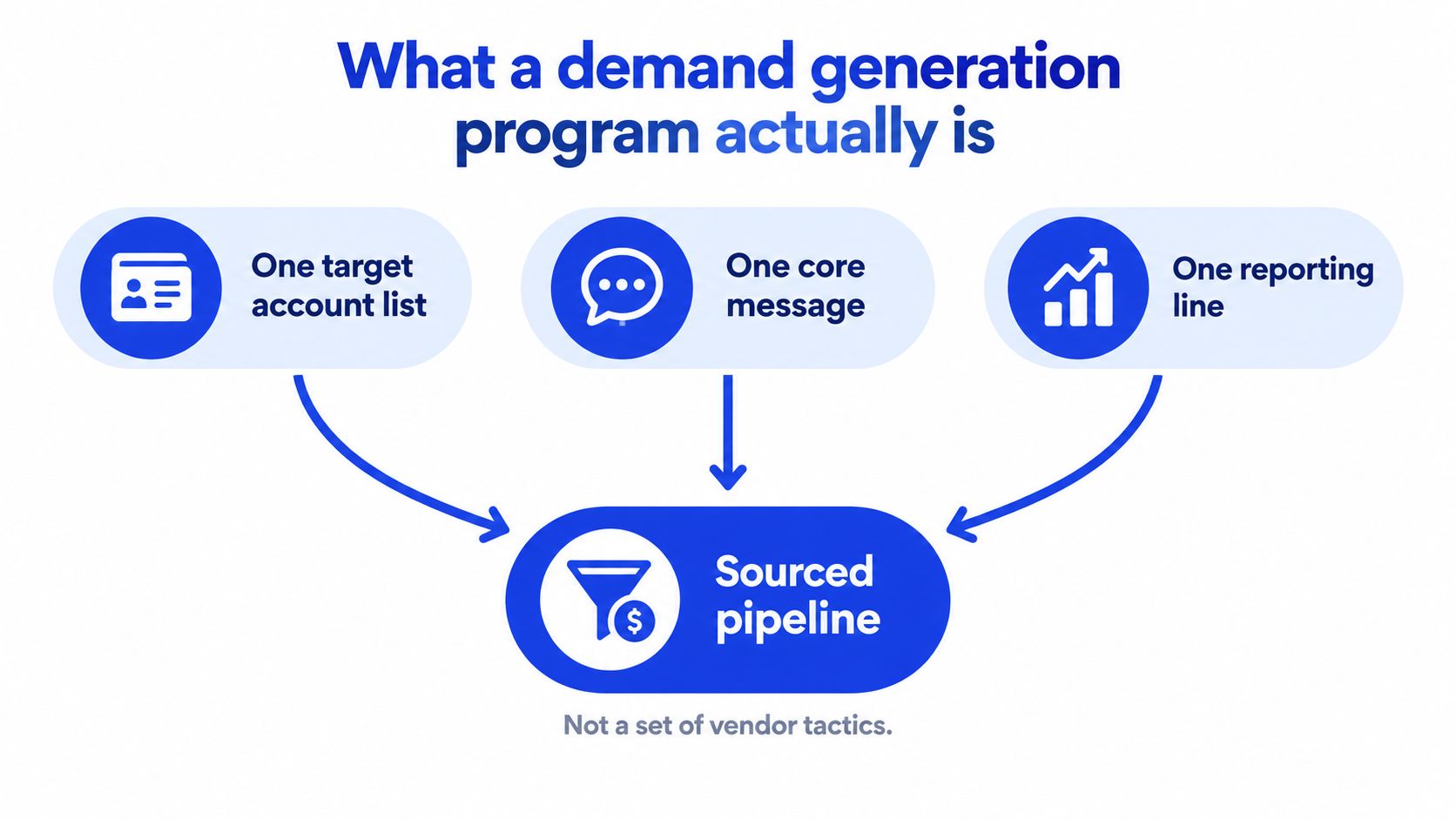
Build one target account list, one core message, and one reporting line.
Use LinkedIn content, lead generation, and outbound as connected anchor channels.
Expect the first two months to expose targeting and handoff problems before the system produces consistent lift.
Judge performance by sales acceptance, qualified meetings, opportunity movement, and sourced pipeline.
Review the system in bi-weekly sprints, then scale only what sales converts.
Table of Contents
The pipeline problem most B2B teams are sitting on right now
Why most demand generation programs stall and how to fix them
The pipeline problem most B2B teams are sitting on right now
A founder can keep a company alive with warm introductions for a while. Three or four qualified meetings may arrive in one month, followed by an empty calendar in the next. That pattern feels like demand, but it isn't a dependable operating system.
Marketing often runs on a separate rhythm. Someone publishes on LinkedIn, checks impressions, and reports engagement in the Monday QBR. Sales runs email and LinkedIn touches from a list assembled months earlier. RevOps then tries to reconcile screenshots from HubSpot, Sales Navigator, and a sequencing tool into one pipeline story.
The result is activity without continuity. A prospect may read a post, receive an outbound message, complete a form, and attend an event, yet no one can explain how those touches should influence the next action. The company has signals, but no shared decision rule.
Operator's rule: If marketing, sales, and the founder use different account lists, they aren't running one demand program.
The measurement problem is just as serious. B2B teams increasingly measure the full funnel, yet recent benchmark reporting places median MQL-to-SQL conversion at 9.8% in 2026, down from 13.1% in 2024 (Callbox's B2B lead generation benchmarks). The same source reports that only 27% of marketing-generated B2B leads are contacted by sales, while 79% never convert to sales.
Those figures don't point to a shortage of forms. They point to weak qualification, slow routing, and poor agreement about what deserves sales attention. That is why a demand generation program must own the path from account selection to sourced revenue, not just the top of the funnel.
The practical work starts with a usable definition, a channel system, and a 90-day build. From there, the operating details matter: who receives a reply, what qualifies as an MQL, which KPIs survive a board review, and what gets cut when a motion misses twice. The lead generation KPI framework is useful for establishing that measurement discipline before the first sprint begins.
What a demand generation program actually is
A demand generation program is one operating system built around one target account list, one core message, and one reporting line that ends in sourced pipeline. It connects the work that creates familiarity with the work that creates conversations and the work that determines whether those conversations deserve sales time.
The three anchor motions are:
LinkedIn content builds familiarity, gives the market a reason to remember the company, and creates a surface for inbound replies.
Lead generation identifies companies and contacts that fit the ICP, then enriches and segments them by role, trigger, and account priority.
Outbound turns that context into sequenced email, LinkedIn, and sales touches that ask for a relevant conversation.
This is different from lead generation on its own. A lead generation workflow can fill a database, but it doesn't necessarily create market familiarity, coordinate outreach, or assign revenue ownership. The distinction is covered in more detail in demand generation versus lead generation.
Brand marketing has a different responsibility again. It can build memory and credibility without owning an SQL target. A demand program has a budget owner, sales participation, CRM rules, and a review cadence that forces the team to connect attention with commercial outcomes.
A campaign lives inside the program. It may target a vertical, promote an event, test a new offer, or activate a named account group. The program decides whether that campaign belongs in the system, how its replies are handled, and whether it contributes to the same reporting line.
The operating test
Ask three questions before approving a new channel:
→ Does it reach the same target accounts?
→ Does it express the same commercial message?
→ Does it report into the same sourced-pipeline view?
If the answer is no, the channel may still be useful, but it is a separate project. Don't call it part of the demand program until the list, message, ownership, and CRM path are connected.
The point isn't to make every touch identical. A legal tech buyer may need a proof-heavy LinkedIn post, a direct email, and an event invitation at different moments. The point is to make those touches recognizable as parts of the same buying conversation.
The three anchor channels and when to add more
GROU programs center on LinkedIn content, lead generation, and outbound because the three motions cover attention, audience selection, and direct conversion. Separating them creates avoidable waste. A content team speaks to one audience, an SDR works another, and paid media reaches whoever the platform finds cheapest.
LinkedIn content creates pre-outreach familiarity
Content should make the first outbound touch less cold. The useful measure isn't whether a post received applause from peers. It is whether the post sharpened the message, reached relevant buyers, and influenced replies or meetings.
A 2026 LinkedIn benchmark puts a median B2B post at about 40 engagements and 780 impressions (Oktopost's LinkedIn benchmark report). Treat that as a reference point, not a target detached from audience quality.
Founder posts, customer-problem analysis, and vertical observations tend to give outbound more context than generic company updates. This matters in iGaming, SaaS, manufacturing, legal tech, and pharma, where the same feature can mean very different commercial risk.
Lead generation gives the system a usable market
The list isn't a spreadsheet purchased once and forgotten. Clay, Apollo, ZoomInfo, and Sales Navigator can help identify accounts, enrich contacts, and add trigger context, but a human still needs to decide whether the company fits the commercial reality.
Segment by factors such as installed technology, hiring activity, expansion, regulation, funding, or a visible operational problem. Then make the same segments available to content, outbound, and paid activation. Resources on B2B LinkedIn lead generation tools can help compare workflows, but the tool should follow the targeting model, not define it.
Outbound turns relevance into a conversation
Use email and LinkedIn as coordinated touches. Apollo, Instantly, Smartlead, Lemlist, HeyReach, and Outreach can support different parts of the workflow, but none can repair a weak ICP or vague offer.
The quality test is the reply. A positive reply should create a task, preserve the message context, and reach the right owner quickly. A negative reply should produce a reason code that informs the next list and message revision.
Channel | Volume | Expected reply or engagement rate | Cost per meeting | Trigger to scale or add |
|---|---|---|---|---|
LinkedIn content | Consistent publishing against target accounts | Compare relevant engagement with the Oktopost benchmark | Track production and meeting attribution | Relevant buyers engage or reply |
Lead generation | ICP-aligned account and contact segments | Measured by fit and sales acceptance | Track cost per accepted conversation | Data quality remains high after enrichment |
Outbound | Sequenced contacts from the shared list | Review positive replies and accepted meetings | Calculate from total program cost | Sales accepts the conversations consistently |
Paid Google and LinkedIn campaigns, niche events, executive roundtables, and community sponsorships can extend a program. Add them only when they feed the same list and message. A side project that reports impressions while sales reports pipeline will create another reconciliation problem, not a demand engine.
Use lead generation on LinkedIn when the platform is a meaningful part of the account strategy, but keep the commercial outcome in the CRM rather than inside LinkedIn analytics.
How to design and launch a program in 90 days
A 90-day build needs owners and exit criteria. Without both, teams call setup work a launch, send a few sequences, and judge the entire system before the list or routing rules have been tested.
Days 1 to 30 establish the commercial rules
The founder, head of sales, marketing lead, and RevOps owner should agree on the ICP before anyone scales outreach. Pull closed-won and closed-lost records, identify the firmographic patterns that matter, and write down disqualifiers.
Build the account list in Apollo or ZoomInfo, then enrich it with Sales Navigator and Clay. Draft five founder-led LinkedIn posts around the same pain the outbound sequence will address. Set up the CRM fields, reply ownership, suppression rules, and reporting definitions before launch.
The exit criterion is a signed-off ICP and a list that sales trusts. If sales rejects the first sample, fix the data model now. Don't compensate for weak targeting by writing more copy.
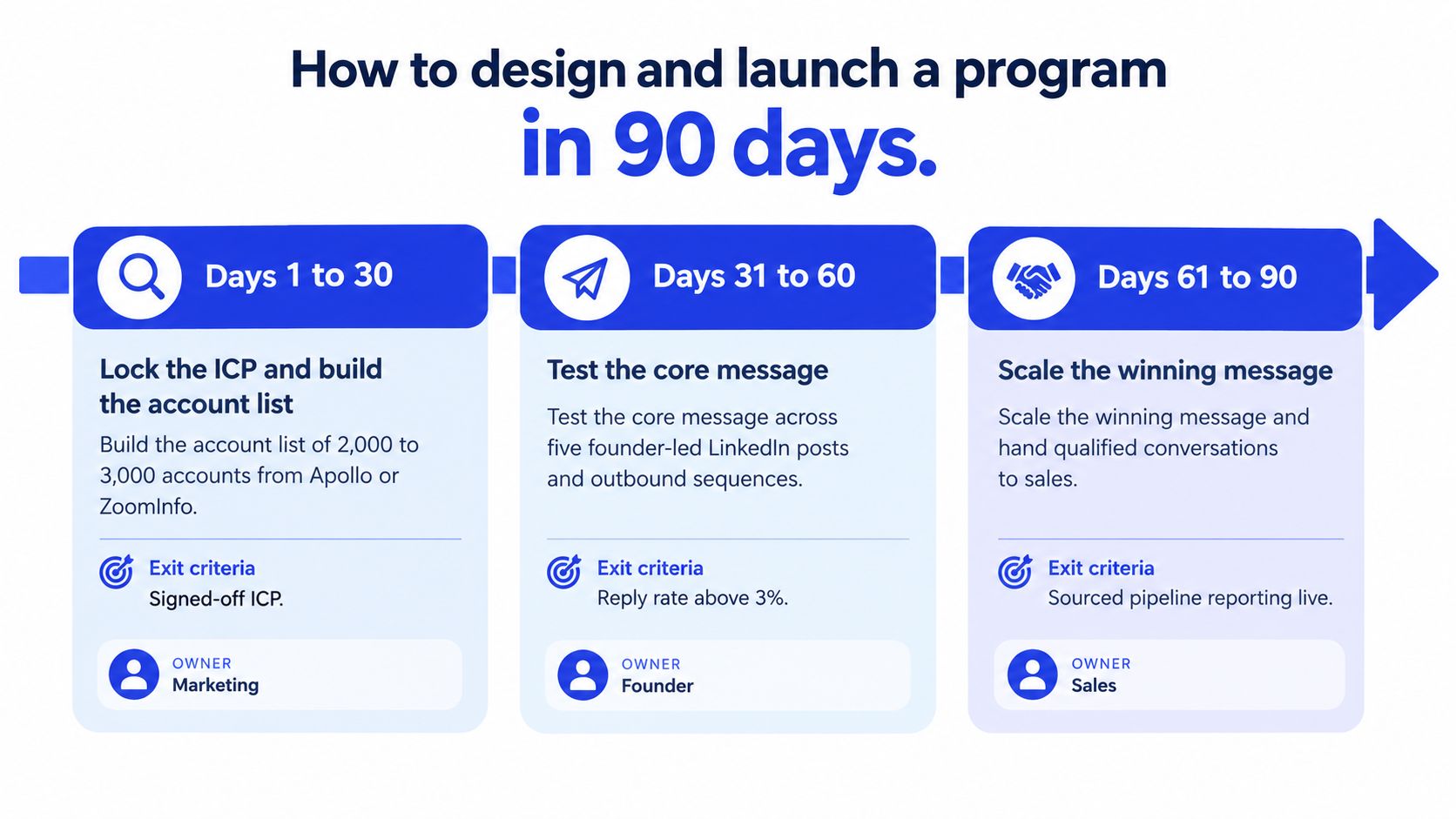
Days 31 to 60 put the message under market pressure
Launch the sequence in Instantly, Lemlist, Smartlead, or Outreach, depending on the team's sending and reporting requirements. Publish the LinkedIn cadence at the same time, then give one person responsibility for monitoring replies and assigning next actions.
Review positive, negative, and ambiguous responses every two weeks. A founder may describe the offer one way internally, while senior buyers use entirely different language. The reply log is where that mismatch becomes visible.
This stage should produce evidence about account fit, pain urgency, role relevance, and objections. It may not produce a stable meeting flow yet. That distinction prevents a setup problem from being mistaken for channel failure.
Days 61 to 90 prune and expand
Review the first meaningful batch of sends, remove poor-fit accounts, suppress negative replies, and expand only the segment that produces accepted conversations. Build a second sequence around the strongest objection or trigger rather than cloning the first one.
A realistic curve is uneven. Early meetings may come from the founder's network and existing familiarity. Later meetings can increase as content, follow-up, and account coverage reinforce one another, but the timing depends on market, offer, list quality, and sales response.
Sprint decision: Every two weeks, mark each motion as kill, revise, hold, or scale. The decision must reference accepted meetings and pipeline movement, not send volume.
Teams often get better results by running a disciplined pilot than by launching every channel at once. The lead generation pilot framework gives the work a defined boundary, which makes learning easier to separate from permanent operating cost.
Lead routing, qualification, and CRM handoff
A positive reply has a short commercial shelf life. Route it into HubSpot or Salesforce the same day, preserve the original message, and assign a named owner. If the reply sits in a shared inbox, the team has created a warm lead with no accountable next step.
Use strict criteria. An MQL should match the ICP, confirm a relevant pain in the reply, and have a meeting booked. An SQL should show buying relevance on the discovery call, agree to a mutual evaluation step, and bring an economic buyer into the conversation by the next substantive touch.
Anything that replies without a confirmed problem belongs in nurture. It shouldn't become a deal merely because the contact responded. Personal mailboxes, unclear identities, and low-context replies also need review before they reach an SDR queue.
Stage | Criteria | Owner | CRM action |
|---|---|---|---|
MQL | ICP fit, confirmed pain, meeting booked | Named SDR pool | Create contact, source, account, and task records |
SQL | Discovery confirms fit and evaluation interest | Account executive | Create opportunity and notify the AE in Slack |
Nurture | Reply shows interest without a current problem | Marketing or SDR | Add to a separate sequence with reason code |
Disqualified | Poor fit, invalid contact, or no commercial relevance | RevOps | Suppress contact and record the disqualification reason |
The reason code matters as much as the status. “Wrong company size,” “no active pain,” “wrong role,” and “timing” point to different upstream fixes. Review them in the sprint meeting rather than treating every rejection as a copy problem.
The lead qualification process should be documented beside the routing rules, not hidden in a sales manager's memory. Sales acceptance is the handoff test. If sales doesn't trust the queue, marketing will eventually report on a number that nobody acts on.
KPIs and reporting that prove pipeline, not activity
A demand program earns credibility when the dashboard answers one question: which work produced qualified pipeline? That requires fewer metrics than marketers typically report.
Start with sales acceptance rate. If sales accepts the majority of routed meetings, the list, message, and qualification rules are probably aligned. If acceptance is weak, more leads will only increase the cleanup burden.
Track show rate next. A meeting that never happens has no value, and the reason for a no-show may sit in confirmation, scheduling, account fit, or the original promise. Then measure SQL-to-opportunity conversion and sourced pipeline dollars. Use sourced pipeline when the program created the meeting or opportunity, rather than claiming every later touch as influence.
Recent benchmark guidance for mid-market demand generation gives a stage model of 20% to 40% for MQL-to-SQL or SAL, 40% to 60% for SQL-to-opportunity, and 20% to 35% for opportunity-to-win (Pedowitz Group's demand generation benchmarks). These are planning ranges, not guarantees. Your own closed-won data should replace them as the program matures.
Metric | What it measures | Healthy range | Cadence |
|---|---|---|---|
Sales acceptance | Whether routed meetings fit sales criteria | Set from baseline, then improve | Weekly |
Show rate | Whether accepted meetings actually occur | Compare by source and persona | Weekly |
SQL to opportunity | Whether discovery produces a real evaluation | Use the benchmark as a planning reference | Bi-weekly |
Sourced pipeline | Commercial value created by the program | Set against revenue targets | Monthly |
Retire opens, likes, raw clicks, and content downloads as primary outcomes. They can help diagnose delivery and creative, but they shouldn't decide budget.
Use Looker, HubSpot reporting, Salesforce dashboards, or a shared Sheet if the data model is clean. A four-week trailing view reduces the temptation to rewrite the strategy after one poor Tuesday. For teams building attribution rules, SourceLoop revenue attribution offers a useful reference for connecting marketing activity with revenue records.
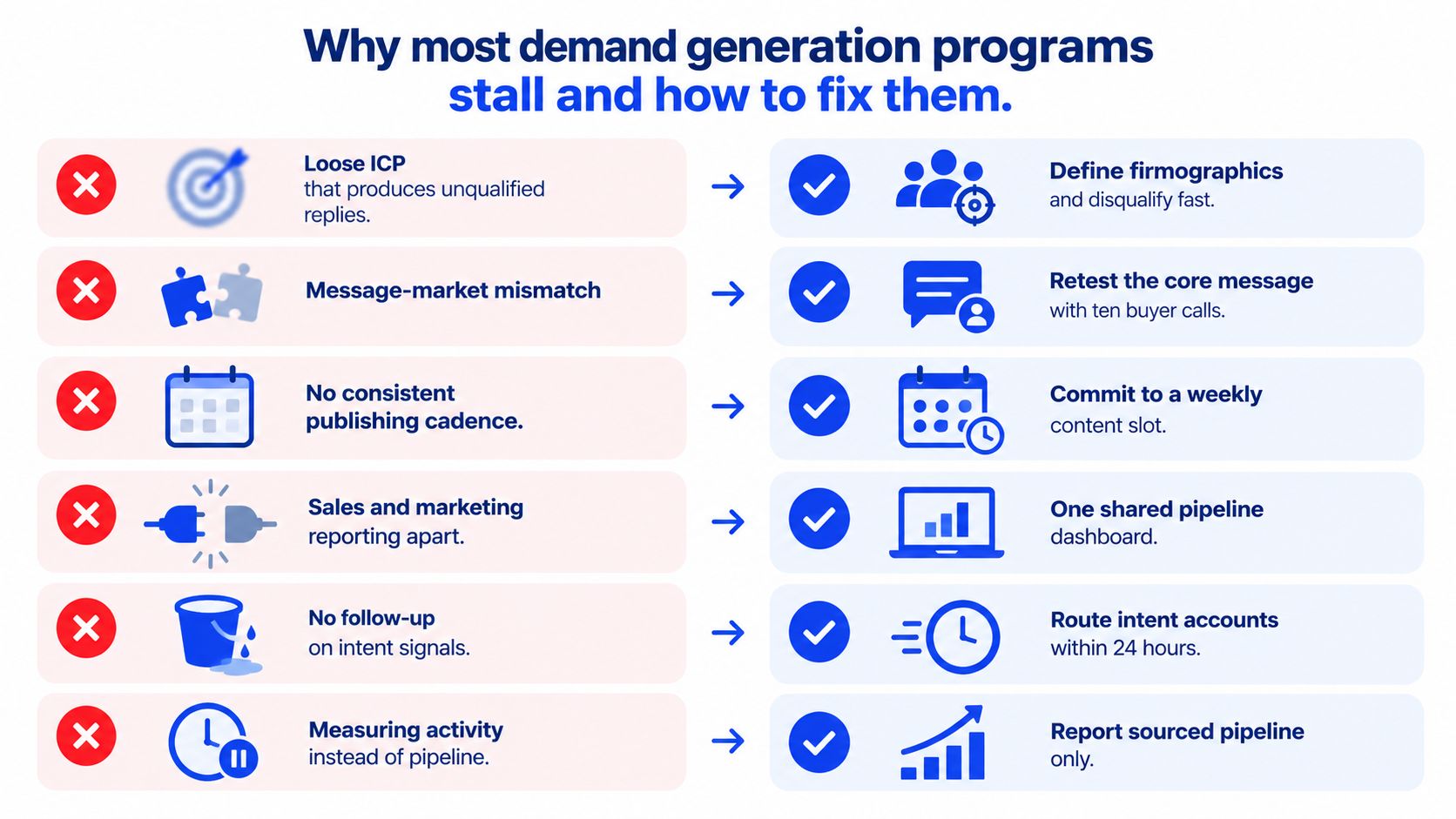
Why most demand generation programs stall and how to fix them
Most stalls are predictable. The team usually blames the tool or asks for another channel, while the actual problem sits in targeting, message fit, routing, or sales trust.
A loose ICP produces replies that look promising until discovery. Tighten the filters against closed-won accounts and add explicit disqualifiers. If the list is wrong, rewriting the subject line is mostly theatre.
A message-market mismatch appears when the value proposition sounds polished internally but doesn't describe a job the buyer needs to complete. Use reply data from the prior sprint, then test the revised angle with buyer conversations before scaling it across the list.
Sales and marketing also stall when they maintain separate scoreboards. Hold a joint MQL-to-SQL review every two weeks. Put rejected meetings beside the source, account segment, persona, and reason code so both teams can see which part of the system needs repair.
Slow routing wastes intent. Set a same-business-day expectation inside HubSpot or Salesforce, assign replies to a named SDR pool, and send accepted SQL alerts to the AE in Slack. The clock matters, but ownership matters first.
Founder dependency creates a second bottleneck. Founders often close the first conversations because they know the pain best, then become the only person who can qualify a serious account. Capture their language in posts, sequences, call notes, and qualification fields so the team can carry the message without requiring the founder on every call.
Paid expansion should wait until the organic motion produces evidence. If the account list, message, and outbound process can't create accepted conversations, ads will usually produce more expensive ambiguity.
Account-based execution is becoming more common, with 71% of practitioners using an ABM strategy and 40% integrating ABM directly with demand generation, according to the 2025 ABM Benchmark Survey. The implication is practical: teams need account coverage and sales coordination, not just more contacts.
Building one connected demand engine
The connected model starts with the account list. Build it from closed-won patterns, current intent signals, disqualifiers, and the buying committee roles that can advance or stall an opportunity. In enterprise sales, finance and security may matter as much as the first enthusiastic champion.
The same list should power LinkedIn content, outbound, events, and paid activation. The message can change format, but the commercial point should remain recognizable. A manufacturing post may explain an operational risk, while an SDR message asks whether that risk is active at the account.
One reporting line then connects activity to outcomes. The founder owns market language and strategic accounts. The demand lead owns channel coordination. The SDR owns response speed and qualification. RevOps owns data quality, routing, and the pipeline view.
The minimum operating stack
A practical stack includes a CRM such as HubSpot or Salesforce, a sequencer such as Outreach or Instantly, Sales Navigator for account research, a LinkedIn scheduling tool, routing rules, and call recording for coaching. Clay, Apollo, ZoomInfo, Lemlist, Smartlead, HeyReach, and similar tools can fill specific workflow gaps, but the CRM remains the system of record.
Run a bi-weekly sprint review for list quality, message performance, reply reasons, sales acceptance, and next actions. Run a monthly pipeline review for sourced opportunities, stage movement, revenue quality, and budget decisions. Keep daily iteration separate from the formal review so the team can respond quickly without changing the strategy every morning.
Demand generation is a compounding operating asset when each reply improves the next list, each objection sharpens the next post, and each qualification decision improves the next handoff. It is a campaign when the team starts over every time the calendar changes.
Pull the last 20 closed-won deals this week. Extract three firmographic filters and three trigger filters, then rebuild a target account list that powers the next month of content, outbound, and routing decisions. That exercise will expose whether your current ICP is based on evidence or preference.
GROU is a global B2B pipeline agency trusted by companies across iGaming, SaaS, manufacturing, and professional services. Its methodology connects LinkedIn content, lead generation, outbound, fast reply routing, and bi-weekly sprint reviews around one target list and one sourced-pipeline view.
Grou connects LinkedIn content, lead generation, and outbound into one demand generation system for B2B teams that need qualified conversations tied to pipeline. Visit Grou to see how the team can build your target list, coordinate the message, and install the reporting and handoff rules around it.
Pipeline feels random because the work creating it is disconnected. The founder is still booking a handful of qualified meetings from warm introductions, marketing is publishing into an audience it doesn't share with sales, and an SDR is working an old conference list without knowing which accounts have already seen the company's message.
The fix isn't another isolated channel. Demand generation programs work when LinkedIn content, lead generation, outbound, routing, and reporting operate against the same commercial system.
Build one target account list, one core message, and one reporting line.
Use LinkedIn content, lead generation, and outbound as connected anchor channels.
Expect the first two months to expose targeting and handoff problems before the system produces consistent lift.
Judge performance by sales acceptance, qualified meetings, opportunity movement, and sourced pipeline.
Review the system in bi-weekly sprints, then scale only what sales converts.
Table of Contents
The pipeline problem most B2B teams are sitting on right now
Why most demand generation programs stall and how to fix them
The pipeline problem most B2B teams are sitting on right now
A founder can keep a company alive with warm introductions for a while. Three or four qualified meetings may arrive in one month, followed by an empty calendar in the next. That pattern feels like demand, but it isn't a dependable operating system.
Marketing often runs on a separate rhythm. Someone publishes on LinkedIn, checks impressions, and reports engagement in the Monday QBR. Sales runs email and LinkedIn touches from a list assembled months earlier. RevOps then tries to reconcile screenshots from HubSpot, Sales Navigator, and a sequencing tool into one pipeline story.
The result is activity without continuity. A prospect may read a post, receive an outbound message, complete a form, and attend an event, yet no one can explain how those touches should influence the next action. The company has signals, but no shared decision rule.
Operator's rule: If marketing, sales, and the founder use different account lists, they aren't running one demand program.
The measurement problem is just as serious. B2B teams increasingly measure the full funnel, yet recent benchmark reporting places median MQL-to-SQL conversion at 9.8% in 2026, down from 13.1% in 2024 (Callbox's B2B lead generation benchmarks). The same source reports that only 27% of marketing-generated B2B leads are contacted by sales, while 79% never convert to sales.
Those figures don't point to a shortage of forms. They point to weak qualification, slow routing, and poor agreement about what deserves sales attention. That is why a demand generation program must own the path from account selection to sourced revenue, not just the top of the funnel.
The practical work starts with a usable definition, a channel system, and a 90-day build. From there, the operating details matter: who receives a reply, what qualifies as an MQL, which KPIs survive a board review, and what gets cut when a motion misses twice. The lead generation KPI framework is useful for establishing that measurement discipline before the first sprint begins.
What a demand generation program actually is
A demand generation program is one operating system built around one target account list, one core message, and one reporting line that ends in sourced pipeline. It connects the work that creates familiarity with the work that creates conversations and the work that determines whether those conversations deserve sales time.
The three anchor motions are:
LinkedIn content builds familiarity, gives the market a reason to remember the company, and creates a surface for inbound replies.
Lead generation identifies companies and contacts that fit the ICP, then enriches and segments them by role, trigger, and account priority.
Outbound turns that context into sequenced email, LinkedIn, and sales touches that ask for a relevant conversation.
This is different from lead generation on its own. A lead generation workflow can fill a database, but it doesn't necessarily create market familiarity, coordinate outreach, or assign revenue ownership. The distinction is covered in more detail in demand generation versus lead generation.
Brand marketing has a different responsibility again. It can build memory and credibility without owning an SQL target. A demand program has a budget owner, sales participation, CRM rules, and a review cadence that forces the team to connect attention with commercial outcomes.
A campaign lives inside the program. It may target a vertical, promote an event, test a new offer, or activate a named account group. The program decides whether that campaign belongs in the system, how its replies are handled, and whether it contributes to the same reporting line.
The operating test
Ask three questions before approving a new channel:
→ Does it reach the same target accounts?
→ Does it express the same commercial message?
→ Does it report into the same sourced-pipeline view?
If the answer is no, the channel may still be useful, but it is a separate project. Don't call it part of the demand program until the list, message, ownership, and CRM path are connected.
The point isn't to make every touch identical. A legal tech buyer may need a proof-heavy LinkedIn post, a direct email, and an event invitation at different moments. The point is to make those touches recognizable as parts of the same buying conversation.
The three anchor channels and when to add more
GROU programs center on LinkedIn content, lead generation, and outbound because the three motions cover attention, audience selection, and direct conversion. Separating them creates avoidable waste. A content team speaks to one audience, an SDR works another, and paid media reaches whoever the platform finds cheapest.
LinkedIn content creates pre-outreach familiarity
Content should make the first outbound touch less cold. The useful measure isn't whether a post received applause from peers. It is whether the post sharpened the message, reached relevant buyers, and influenced replies or meetings.
A 2026 LinkedIn benchmark puts a median B2B post at about 40 engagements and 780 impressions (Oktopost's LinkedIn benchmark report). Treat that as a reference point, not a target detached from audience quality.
Founder posts, customer-problem analysis, and vertical observations tend to give outbound more context than generic company updates. This matters in iGaming, SaaS, manufacturing, legal tech, and pharma, where the same feature can mean very different commercial risk.
Lead generation gives the system a usable market
The list isn't a spreadsheet purchased once and forgotten. Clay, Apollo, ZoomInfo, and Sales Navigator can help identify accounts, enrich contacts, and add trigger context, but a human still needs to decide whether the company fits the commercial reality.
Segment by factors such as installed technology, hiring activity, expansion, regulation, funding, or a visible operational problem. Then make the same segments available to content, outbound, and paid activation. Resources on B2B LinkedIn lead generation tools can help compare workflows, but the tool should follow the targeting model, not define it.
Outbound turns relevance into a conversation
Use email and LinkedIn as coordinated touches. Apollo, Instantly, Smartlead, Lemlist, HeyReach, and Outreach can support different parts of the workflow, but none can repair a weak ICP or vague offer.
The quality test is the reply. A positive reply should create a task, preserve the message context, and reach the right owner quickly. A negative reply should produce a reason code that informs the next list and message revision.
Channel | Volume | Expected reply or engagement rate | Cost per meeting | Trigger to scale or add |
|---|---|---|---|---|
LinkedIn content | Consistent publishing against target accounts | Compare relevant engagement with the Oktopost benchmark | Track production and meeting attribution | Relevant buyers engage or reply |
Lead generation | ICP-aligned account and contact segments | Measured by fit and sales acceptance | Track cost per accepted conversation | Data quality remains high after enrichment |
Outbound | Sequenced contacts from the shared list | Review positive replies and accepted meetings | Calculate from total program cost | Sales accepts the conversations consistently |
Paid Google and LinkedIn campaigns, niche events, executive roundtables, and community sponsorships can extend a program. Add them only when they feed the same list and message. A side project that reports impressions while sales reports pipeline will create another reconciliation problem, not a demand engine.
Use lead generation on LinkedIn when the platform is a meaningful part of the account strategy, but keep the commercial outcome in the CRM rather than inside LinkedIn analytics.
How to design and launch a program in 90 days
A 90-day build needs owners and exit criteria. Without both, teams call setup work a launch, send a few sequences, and judge the entire system before the list or routing rules have been tested.
Days 1 to 30 establish the commercial rules
The founder, head of sales, marketing lead, and RevOps owner should agree on the ICP before anyone scales outreach. Pull closed-won and closed-lost records, identify the firmographic patterns that matter, and write down disqualifiers.
Build the account list in Apollo or ZoomInfo, then enrich it with Sales Navigator and Clay. Draft five founder-led LinkedIn posts around the same pain the outbound sequence will address. Set up the CRM fields, reply ownership, suppression rules, and reporting definitions before launch.
The exit criterion is a signed-off ICP and a list that sales trusts. If sales rejects the first sample, fix the data model now. Don't compensate for weak targeting by writing more copy.
Days 31 to 60 put the message under market pressure
Launch the sequence in Instantly, Lemlist, Smartlead, or Outreach, depending on the team's sending and reporting requirements. Publish the LinkedIn cadence at the same time, then give one person responsibility for monitoring replies and assigning next actions.
Review positive, negative, and ambiguous responses every two weeks. A founder may describe the offer one way internally, while senior buyers use entirely different language. The reply log is where that mismatch becomes visible.
This stage should produce evidence about account fit, pain urgency, role relevance, and objections. It may not produce a stable meeting flow yet. That distinction prevents a setup problem from being mistaken for channel failure.
Days 61 to 90 prune and expand
Review the first meaningful batch of sends, remove poor-fit accounts, suppress negative replies, and expand only the segment that produces accepted conversations. Build a second sequence around the strongest objection or trigger rather than cloning the first one.
A realistic curve is uneven. Early meetings may come from the founder's network and existing familiarity. Later meetings can increase as content, follow-up, and account coverage reinforce one another, but the timing depends on market, offer, list quality, and sales response.
Sprint decision: Every two weeks, mark each motion as kill, revise, hold, or scale. The decision must reference accepted meetings and pipeline movement, not send volume.
Teams often get better results by running a disciplined pilot than by launching every channel at once. The lead generation pilot framework gives the work a defined boundary, which makes learning easier to separate from permanent operating cost.
Lead routing, qualification, and CRM handoff
A positive reply has a short commercial shelf life. Route it into HubSpot or Salesforce the same day, preserve the original message, and assign a named owner. If the reply sits in a shared inbox, the team has created a warm lead with no accountable next step.
Use strict criteria. An MQL should match the ICP, confirm a relevant pain in the reply, and have a meeting booked. An SQL should show buying relevance on the discovery call, agree to a mutual evaluation step, and bring an economic buyer into the conversation by the next substantive touch.
Anything that replies without a confirmed problem belongs in nurture. It shouldn't become a deal merely because the contact responded. Personal mailboxes, unclear identities, and low-context replies also need review before they reach an SDR queue.
Stage | Criteria | Owner | CRM action |
|---|---|---|---|
MQL | ICP fit, confirmed pain, meeting booked | Named SDR pool | Create contact, source, account, and task records |
SQL | Discovery confirms fit and evaluation interest | Account executive | Create opportunity and notify the AE in Slack |
Nurture | Reply shows interest without a current problem | Marketing or SDR | Add to a separate sequence with reason code |
Disqualified | Poor fit, invalid contact, or no commercial relevance | RevOps | Suppress contact and record the disqualification reason |
The reason code matters as much as the status. “Wrong company size,” “no active pain,” “wrong role,” and “timing” point to different upstream fixes. Review them in the sprint meeting rather than treating every rejection as a copy problem.
The lead qualification process should be documented beside the routing rules, not hidden in a sales manager's memory. Sales acceptance is the handoff test. If sales doesn't trust the queue, marketing will eventually report on a number that nobody acts on.
KPIs and reporting that prove pipeline, not activity
A demand program earns credibility when the dashboard answers one question: which work produced qualified pipeline? That requires fewer metrics than marketers typically report.
Start with sales acceptance rate. If sales accepts the majority of routed meetings, the list, message, and qualification rules are probably aligned. If acceptance is weak, more leads will only increase the cleanup burden.
Track show rate next. A meeting that never happens has no value, and the reason for a no-show may sit in confirmation, scheduling, account fit, or the original promise. Then measure SQL-to-opportunity conversion and sourced pipeline dollars. Use sourced pipeline when the program created the meeting or opportunity, rather than claiming every later touch as influence.
Recent benchmark guidance for mid-market demand generation gives a stage model of 20% to 40% for MQL-to-SQL or SAL, 40% to 60% for SQL-to-opportunity, and 20% to 35% for opportunity-to-win (Pedowitz Group's demand generation benchmarks). These are planning ranges, not guarantees. Your own closed-won data should replace them as the program matures.
Metric | What it measures | Healthy range | Cadence |
|---|---|---|---|
Sales acceptance | Whether routed meetings fit sales criteria | Set from baseline, then improve | Weekly |
Show rate | Whether accepted meetings actually occur | Compare by source and persona | Weekly |
SQL to opportunity | Whether discovery produces a real evaluation | Use the benchmark as a planning reference | Bi-weekly |
Sourced pipeline | Commercial value created by the program | Set against revenue targets | Monthly |
Retire opens, likes, raw clicks, and content downloads as primary outcomes. They can help diagnose delivery and creative, but they shouldn't decide budget.
Use Looker, HubSpot reporting, Salesforce dashboards, or a shared Sheet if the data model is clean. A four-week trailing view reduces the temptation to rewrite the strategy after one poor Tuesday. For teams building attribution rules, SourceLoop revenue attribution offers a useful reference for connecting marketing activity with revenue records.
Why most demand generation programs stall and how to fix them
Most stalls are predictable. The team usually blames the tool or asks for another channel, while the actual problem sits in targeting, message fit, routing, or sales trust.
A loose ICP produces replies that look promising until discovery. Tighten the filters against closed-won accounts and add explicit disqualifiers. If the list is wrong, rewriting the subject line is mostly theatre.
A message-market mismatch appears when the value proposition sounds polished internally but doesn't describe a job the buyer needs to complete. Use reply data from the prior sprint, then test the revised angle with buyer conversations before scaling it across the list.
Sales and marketing also stall when they maintain separate scoreboards. Hold a joint MQL-to-SQL review every two weeks. Put rejected meetings beside the source, account segment, persona, and reason code so both teams can see which part of the system needs repair.
Slow routing wastes intent. Set a same-business-day expectation inside HubSpot or Salesforce, assign replies to a named SDR pool, and send accepted SQL alerts to the AE in Slack. The clock matters, but ownership matters first.
Founder dependency creates a second bottleneck. Founders often close the first conversations because they know the pain best, then become the only person who can qualify a serious account. Capture their language in posts, sequences, call notes, and qualification fields so the team can carry the message without requiring the founder on every call.
Paid expansion should wait until the organic motion produces evidence. If the account list, message, and outbound process can't create accepted conversations, ads will usually produce more expensive ambiguity.
Account-based execution is becoming more common, with 71% of practitioners using an ABM strategy and 40% integrating ABM directly with demand generation, according to the 2025 ABM Benchmark Survey. The implication is practical: teams need account coverage and sales coordination, not just more contacts.
Building one connected demand engine
The connected model starts with the account list. Build it from closed-won patterns, current intent signals, disqualifiers, and the buying committee roles that can advance or stall an opportunity. In enterprise sales, finance and security may matter as much as the first enthusiastic champion.
The same list should power LinkedIn content, outbound, events, and paid activation. The message can change format, but the commercial point should remain recognizable. A manufacturing post may explain an operational risk, while an SDR message asks whether that risk is active at the account.
One reporting line then connects activity to outcomes. The founder owns market language and strategic accounts. The demand lead owns channel coordination. The SDR owns response speed and qualification. RevOps owns data quality, routing, and the pipeline view.
The minimum operating stack
A practical stack includes a CRM such as HubSpot or Salesforce, a sequencer such as Outreach or Instantly, Sales Navigator for account research, a LinkedIn scheduling tool, routing rules, and call recording for coaching. Clay, Apollo, ZoomInfo, Lemlist, Smartlead, HeyReach, and similar tools can fill specific workflow gaps, but the CRM remains the system of record.
Run a bi-weekly sprint review for list quality, message performance, reply reasons, sales acceptance, and next actions. Run a monthly pipeline review for sourced opportunities, stage movement, revenue quality, and budget decisions. Keep daily iteration separate from the formal review so the team can respond quickly without changing the strategy every morning.
Demand generation is a compounding operating asset when each reply improves the next list, each objection sharpens the next post, and each qualification decision improves the next handoff. It is a campaign when the team starts over every time the calendar changes.
Pull the last 20 closed-won deals this week. Extract three firmographic filters and three trigger filters, then rebuild a target account list that powers the next month of content, outbound, and routing decisions. That exercise will expose whether your current ICP is based on evidence or preference.
GROU is a global B2B pipeline agency trusted by companies across iGaming, SaaS, manufacturing, and professional services. Its methodology connects LinkedIn content, lead generation, outbound, fast reply routing, and bi-weekly sprint reviews around one target list and one sourced-pipeline view.
Grou connects LinkedIn content, lead generation, and outbound into one demand generation system for B2B teams that need qualified conversations tied to pipeline. Visit Grou to see how the team can build your target list, coordinate the message, and install the reporting and handoff rules around it.
Pipeline feels random because the work creating it is disconnected. The founder is still booking a handful of qualified meetings from warm introductions, marketing is publishing into an audience it doesn't share with sales, and an SDR is working an old conference list without knowing which accounts have already seen the company's message.
The fix isn't another isolated channel. Demand generation programs work when LinkedIn content, lead generation, outbound, routing, and reporting operate against the same commercial system.
Build one target account list, one core message, and one reporting line.
Use LinkedIn content, lead generation, and outbound as connected anchor channels.
Expect the first two months to expose targeting and handoff problems before the system produces consistent lift.
Judge performance by sales acceptance, qualified meetings, opportunity movement, and sourced pipeline.
Review the system in bi-weekly sprints, then scale only what sales converts.
Table of Contents
The pipeline problem most B2B teams are sitting on right now
Why most demand generation programs stall and how to fix them
The pipeline problem most B2B teams are sitting on right now
A founder can keep a company alive with warm introductions for a while. Three or four qualified meetings may arrive in one month, followed by an empty calendar in the next. That pattern feels like demand, but it isn't a dependable operating system.
Marketing often runs on a separate rhythm. Someone publishes on LinkedIn, checks impressions, and reports engagement in the Monday QBR. Sales runs email and LinkedIn touches from a list assembled months earlier. RevOps then tries to reconcile screenshots from HubSpot, Sales Navigator, and a sequencing tool into one pipeline story.
The result is activity without continuity. A prospect may read a post, receive an outbound message, complete a form, and attend an event, yet no one can explain how those touches should influence the next action. The company has signals, but no shared decision rule.
Operator's rule: If marketing, sales, and the founder use different account lists, they aren't running one demand program.
The measurement problem is just as serious. B2B teams increasingly measure the full funnel, yet recent benchmark reporting places median MQL-to-SQL conversion at 9.8% in 2026, down from 13.1% in 2024 (Callbox's B2B lead generation benchmarks). The same source reports that only 27% of marketing-generated B2B leads are contacted by sales, while 79% never convert to sales.
Those figures don't point to a shortage of forms. They point to weak qualification, slow routing, and poor agreement about what deserves sales attention. That is why a demand generation program must own the path from account selection to sourced revenue, not just the top of the funnel.
The practical work starts with a usable definition, a channel system, and a 90-day build. From there, the operating details matter: who receives a reply, what qualifies as an MQL, which KPIs survive a board review, and what gets cut when a motion misses twice. The lead generation KPI framework is useful for establishing that measurement discipline before the first sprint begins.
What a demand generation program actually is
A demand generation program is one operating system built around one target account list, one core message, and one reporting line that ends in sourced pipeline. It connects the work that creates familiarity with the work that creates conversations and the work that determines whether those conversations deserve sales time.
The three anchor motions are:
LinkedIn content builds familiarity, gives the market a reason to remember the company, and creates a surface for inbound replies.
Lead generation identifies companies and contacts that fit the ICP, then enriches and segments them by role, trigger, and account priority.
Outbound turns that context into sequenced email, LinkedIn, and sales touches that ask for a relevant conversation.
This is different from lead generation on its own. A lead generation workflow can fill a database, but it doesn't necessarily create market familiarity, coordinate outreach, or assign revenue ownership. The distinction is covered in more detail in demand generation versus lead generation.
Brand marketing has a different responsibility again. It can build memory and credibility without owning an SQL target. A demand program has a budget owner, sales participation, CRM rules, and a review cadence that forces the team to connect attention with commercial outcomes.
A campaign lives inside the program. It may target a vertical, promote an event, test a new offer, or activate a named account group. The program decides whether that campaign belongs in the system, how its replies are handled, and whether it contributes to the same reporting line.
The operating test
Ask three questions before approving a new channel:
→ Does it reach the same target accounts?
→ Does it express the same commercial message?
→ Does it report into the same sourced-pipeline view?
If the answer is no, the channel may still be useful, but it is a separate project. Don't call it part of the demand program until the list, message, ownership, and CRM path are connected.
The point isn't to make every touch identical. A legal tech buyer may need a proof-heavy LinkedIn post, a direct email, and an event invitation at different moments. The point is to make those touches recognizable as parts of the same buying conversation.
The three anchor channels and when to add more
GROU programs center on LinkedIn content, lead generation, and outbound because the three motions cover attention, audience selection, and direct conversion. Separating them creates avoidable waste. A content team speaks to one audience, an SDR works another, and paid media reaches whoever the platform finds cheapest.
LinkedIn content creates pre-outreach familiarity
Content should make the first outbound touch less cold. The useful measure isn't whether a post received applause from peers. It is whether the post sharpened the message, reached relevant buyers, and influenced replies or meetings.
A 2026 LinkedIn benchmark puts a median B2B post at about 40 engagements and 780 impressions (Oktopost's LinkedIn benchmark report). Treat that as a reference point, not a target detached from audience quality.
Founder posts, customer-problem analysis, and vertical observations tend to give outbound more context than generic company updates. This matters in iGaming, SaaS, manufacturing, legal tech, and pharma, where the same feature can mean very different commercial risk.
Lead generation gives the system a usable market
The list isn't a spreadsheet purchased once and forgotten. Clay, Apollo, ZoomInfo, and Sales Navigator can help identify accounts, enrich contacts, and add trigger context, but a human still needs to decide whether the company fits the commercial reality.
Segment by factors such as installed technology, hiring activity, expansion, regulation, funding, or a visible operational problem. Then make the same segments available to content, outbound, and paid activation. Resources on B2B LinkedIn lead generation tools can help compare workflows, but the tool should follow the targeting model, not define it.
Outbound turns relevance into a conversation
Use email and LinkedIn as coordinated touches. Apollo, Instantly, Smartlead, Lemlist, HeyReach, and Outreach can support different parts of the workflow, but none can repair a weak ICP or vague offer.
The quality test is the reply. A positive reply should create a task, preserve the message context, and reach the right owner quickly. A negative reply should produce a reason code that informs the next list and message revision.
Channel | Volume | Expected reply or engagement rate | Cost per meeting | Trigger to scale or add |
|---|---|---|---|---|
LinkedIn content | Consistent publishing against target accounts | Compare relevant engagement with the Oktopost benchmark | Track production and meeting attribution | Relevant buyers engage or reply |
Lead generation | ICP-aligned account and contact segments | Measured by fit and sales acceptance | Track cost per accepted conversation | Data quality remains high after enrichment |
Outbound | Sequenced contacts from the shared list | Review positive replies and accepted meetings | Calculate from total program cost | Sales accepts the conversations consistently |
Paid Google and LinkedIn campaigns, niche events, executive roundtables, and community sponsorships can extend a program. Add them only when they feed the same list and message. A side project that reports impressions while sales reports pipeline will create another reconciliation problem, not a demand engine.
Use lead generation on LinkedIn when the platform is a meaningful part of the account strategy, but keep the commercial outcome in the CRM rather than inside LinkedIn analytics.
How to design and launch a program in 90 days
A 90-day build needs owners and exit criteria. Without both, teams call setup work a launch, send a few sequences, and judge the entire system before the list or routing rules have been tested.
Days 1 to 30 establish the commercial rules
The founder, head of sales, marketing lead, and RevOps owner should agree on the ICP before anyone scales outreach. Pull closed-won and closed-lost records, identify the firmographic patterns that matter, and write down disqualifiers.
Build the account list in Apollo or ZoomInfo, then enrich it with Sales Navigator and Clay. Draft five founder-led LinkedIn posts around the same pain the outbound sequence will address. Set up the CRM fields, reply ownership, suppression rules, and reporting definitions before launch.
The exit criterion is a signed-off ICP and a list that sales trusts. If sales rejects the first sample, fix the data model now. Don't compensate for weak targeting by writing more copy.
Days 31 to 60 put the message under market pressure
Launch the sequence in Instantly, Lemlist, Smartlead, or Outreach, depending on the team's sending and reporting requirements. Publish the LinkedIn cadence at the same time, then give one person responsibility for monitoring replies and assigning next actions.
Review positive, negative, and ambiguous responses every two weeks. A founder may describe the offer one way internally, while senior buyers use entirely different language. The reply log is where that mismatch becomes visible.
This stage should produce evidence about account fit, pain urgency, role relevance, and objections. It may not produce a stable meeting flow yet. That distinction prevents a setup problem from being mistaken for channel failure.
Days 61 to 90 prune and expand
Review the first meaningful batch of sends, remove poor-fit accounts, suppress negative replies, and expand only the segment that produces accepted conversations. Build a second sequence around the strongest objection or trigger rather than cloning the first one.
A realistic curve is uneven. Early meetings may come from the founder's network and existing familiarity. Later meetings can increase as content, follow-up, and account coverage reinforce one another, but the timing depends on market, offer, list quality, and sales response.
Sprint decision: Every two weeks, mark each motion as kill, revise, hold, or scale. The decision must reference accepted meetings and pipeline movement, not send volume.
Teams often get better results by running a disciplined pilot than by launching every channel at once. The lead generation pilot framework gives the work a defined boundary, which makes learning easier to separate from permanent operating cost.
Lead routing, qualification, and CRM handoff
A positive reply has a short commercial shelf life. Route it into HubSpot or Salesforce the same day, preserve the original message, and assign a named owner. If the reply sits in a shared inbox, the team has created a warm lead with no accountable next step.
Use strict criteria. An MQL should match the ICP, confirm a relevant pain in the reply, and have a meeting booked. An SQL should show buying relevance on the discovery call, agree to a mutual evaluation step, and bring an economic buyer into the conversation by the next substantive touch.
Anything that replies without a confirmed problem belongs in nurture. It shouldn't become a deal merely because the contact responded. Personal mailboxes, unclear identities, and low-context replies also need review before they reach an SDR queue.
Stage | Criteria | Owner | CRM action |
|---|---|---|---|
MQL | ICP fit, confirmed pain, meeting booked | Named SDR pool | Create contact, source, account, and task records |
SQL | Discovery confirms fit and evaluation interest | Account executive | Create opportunity and notify the AE in Slack |
Nurture | Reply shows interest without a current problem | Marketing or SDR | Add to a separate sequence with reason code |
Disqualified | Poor fit, invalid contact, or no commercial relevance | RevOps | Suppress contact and record the disqualification reason |
The reason code matters as much as the status. “Wrong company size,” “no active pain,” “wrong role,” and “timing” point to different upstream fixes. Review them in the sprint meeting rather than treating every rejection as a copy problem.
The lead qualification process should be documented beside the routing rules, not hidden in a sales manager's memory. Sales acceptance is the handoff test. If sales doesn't trust the queue, marketing will eventually report on a number that nobody acts on.
KPIs and reporting that prove pipeline, not activity
A demand program earns credibility when the dashboard answers one question: which work produced qualified pipeline? That requires fewer metrics than marketers typically report.
Start with sales acceptance rate. If sales accepts the majority of routed meetings, the list, message, and qualification rules are probably aligned. If acceptance is weak, more leads will only increase the cleanup burden.
Track show rate next. A meeting that never happens has no value, and the reason for a no-show may sit in confirmation, scheduling, account fit, or the original promise. Then measure SQL-to-opportunity conversion and sourced pipeline dollars. Use sourced pipeline when the program created the meeting or opportunity, rather than claiming every later touch as influence.
Recent benchmark guidance for mid-market demand generation gives a stage model of 20% to 40% for MQL-to-SQL or SAL, 40% to 60% for SQL-to-opportunity, and 20% to 35% for opportunity-to-win (Pedowitz Group's demand generation benchmarks). These are planning ranges, not guarantees. Your own closed-won data should replace them as the program matures.
Metric | What it measures | Healthy range | Cadence |
|---|---|---|---|
Sales acceptance | Whether routed meetings fit sales criteria | Set from baseline, then improve | Weekly |
Show rate | Whether accepted meetings actually occur | Compare by source and persona | Weekly |
SQL to opportunity | Whether discovery produces a real evaluation | Use the benchmark as a planning reference | Bi-weekly |
Sourced pipeline | Commercial value created by the program | Set against revenue targets | Monthly |
Retire opens, likes, raw clicks, and content downloads as primary outcomes. They can help diagnose delivery and creative, but they shouldn't decide budget.
Use Looker, HubSpot reporting, Salesforce dashboards, or a shared Sheet if the data model is clean. A four-week trailing view reduces the temptation to rewrite the strategy after one poor Tuesday. For teams building attribution rules, SourceLoop revenue attribution offers a useful reference for connecting marketing activity with revenue records.
Why most demand generation programs stall and how to fix them
Most stalls are predictable. The team usually blames the tool or asks for another channel, while the actual problem sits in targeting, message fit, routing, or sales trust.
A loose ICP produces replies that look promising until discovery. Tighten the filters against closed-won accounts and add explicit disqualifiers. If the list is wrong, rewriting the subject line is mostly theatre.
A message-market mismatch appears when the value proposition sounds polished internally but doesn't describe a job the buyer needs to complete. Use reply data from the prior sprint, then test the revised angle with buyer conversations before scaling it across the list.
Sales and marketing also stall when they maintain separate scoreboards. Hold a joint MQL-to-SQL review every two weeks. Put rejected meetings beside the source, account segment, persona, and reason code so both teams can see which part of the system needs repair.
Slow routing wastes intent. Set a same-business-day expectation inside HubSpot or Salesforce, assign replies to a named SDR pool, and send accepted SQL alerts to the AE in Slack. The clock matters, but ownership matters first.
Founder dependency creates a second bottleneck. Founders often close the first conversations because they know the pain best, then become the only person who can qualify a serious account. Capture their language in posts, sequences, call notes, and qualification fields so the team can carry the message without requiring the founder on every call.
Paid expansion should wait until the organic motion produces evidence. If the account list, message, and outbound process can't create accepted conversations, ads will usually produce more expensive ambiguity.
Account-based execution is becoming more common, with 71% of practitioners using an ABM strategy and 40% integrating ABM directly with demand generation, according to the 2025 ABM Benchmark Survey. The implication is practical: teams need account coverage and sales coordination, not just more contacts.
Building one connected demand engine
The connected model starts with the account list. Build it from closed-won patterns, current intent signals, disqualifiers, and the buying committee roles that can advance or stall an opportunity. In enterprise sales, finance and security may matter as much as the first enthusiastic champion.
The same list should power LinkedIn content, outbound, events, and paid activation. The message can change format, but the commercial point should remain recognizable. A manufacturing post may explain an operational risk, while an SDR message asks whether that risk is active at the account.
One reporting line then connects activity to outcomes. The founder owns market language and strategic accounts. The demand lead owns channel coordination. The SDR owns response speed and qualification. RevOps owns data quality, routing, and the pipeline view.
The minimum operating stack
A practical stack includes a CRM such as HubSpot or Salesforce, a sequencer such as Outreach or Instantly, Sales Navigator for account research, a LinkedIn scheduling tool, routing rules, and call recording for coaching. Clay, Apollo, ZoomInfo, Lemlist, Smartlead, HeyReach, and similar tools can fill specific workflow gaps, but the CRM remains the system of record.
Run a bi-weekly sprint review for list quality, message performance, reply reasons, sales acceptance, and next actions. Run a monthly pipeline review for sourced opportunities, stage movement, revenue quality, and budget decisions. Keep daily iteration separate from the formal review so the team can respond quickly without changing the strategy every morning.
Demand generation is a compounding operating asset when each reply improves the next list, each objection sharpens the next post, and each qualification decision improves the next handoff. It is a campaign when the team starts over every time the calendar changes.
Pull the last 20 closed-won deals this week. Extract three firmographic filters and three trigger filters, then rebuild a target account list that powers the next month of content, outbound, and routing decisions. That exercise will expose whether your current ICP is based on evidence or preference.
GROU is a global B2B pipeline agency trusted by companies across iGaming, SaaS, manufacturing, and professional services. Its methodology connects LinkedIn content, lead generation, outbound, fast reply routing, and bi-weekly sprint reviews around one target list and one sourced-pipeline view.
Grou connects LinkedIn content, lead generation, and outbound into one demand generation system for B2B teams that need qualified conversations tied to pipeline. Visit Grou to see how the team can build your target list, coordinate the message, and install the reporting and handoff rules around it.
Pipeline OS Newsletter
Build qualified pipeline
Get weekly tactics to generate demand, improve lead quality, and book more meetings.





Trusted by industry leaders
Trusted by industry leaders
Trusted by industry leaders
Ready to build qualified pipeline?
Ready to build qualified pipeline?
Ready to build qualified pipeline?
Book a call to see if we're the right fit, or take the 2-minute quiz to get a clear starting point.
Book a call to see if we're the right fit, or take the 2-minute quiz to get a clear starting point.
Book a call to see if we're the right fit, or take the 2-minute quiz to get a clear starting point.
" height="30.21639343089746px" id="hfGbXmQR2" width="30.216393430897455px"/></svg>)
Copyright © 2026 – All Right Reserved
Copyright © 2026 – All Right Reserved
Copyright © 2026 – All Right Reserved