%22%3E%3C/path%3E%3Cpath d=%22M 63.072 7.554 C 62.258 8.022 61.577 8.689 61.092 9.493 L 61.092 7.076 L 57.158 7.076 L 57.158 22.64 L 61.089 22.64 L 61.089 14.888 C 61.089 13.446 61.403 12.434 62.03 11.853 C 62.818 11.218 63.818 10.907 64.826 10.982 L 65.868 10.982 L 65.868 6.851 C 64.891 6.834 63.926 7.076 63.073 7.554 Z%22 fill=%22rgb(17,17,17)%22%3E%3C/path%3E%3Cpath d=%22M 78.916 7.82 C 76.363 6.49 73.321 6.49 70.768 7.82 C 69.562 8.473 68.564 9.451 67.888 10.644 C 67.167 11.931 66.803 13.387 66.834 14.862 C 66.804 16.332 67.157 17.785 67.86 19.077 C 68.515 20.267 69.494 21.246 70.684 21.901 C 71.924 22.576 73.318 22.92 74.73 22.898 C 76.164 22.918 77.58 22.575 78.846 21.901 C 80.062 21.247 81.073 20.27 81.768 19.077 C 82.506 17.797 82.88 16.339 82.85 14.862 C 82.88 13.389 82.517 11.934 81.797 10.647 C 81.12 9.455 80.122 8.477 78.917 7.824 M 78.803 14.862 C 78.829 15.739 78.636 16.608 78.241 17.391 C 77.903 18.046 77.38 18.588 76.738 18.95 C 76.124 19.293 75.432 19.472 74.729 19.47 C 73.668 19.497 72.648 19.061 71.934 18.276 C 71.139 17.323 70.741 16.1 70.823 14.862 C 70.741 13.62 71.149 12.395 71.959 11.45 C 72.687 10.667 73.715 10.233 74.783 10.256 C 75.859 10.236 76.894 10.67 77.635 11.45 C 78.464 12.387 78.884 13.616 78.801 14.864%22 fill=%22rgb(17,17,17)%22%3E%3C/path%3E%3Cpath d=%22M 95.906 7.076 L 95.906 15.646 C 95.975 16.68 95.643 17.701 94.979 18.498 C 94.311 19.184 93.379 19.547 92.422 19.495 C 91.475 19.544 90.553 19.18 89.894 18.498 C 89.23 17.701 88.898 16.68 88.967 15.646 L 88.967 7.076 L 85.033 7.076 L 85.033 16.207 C 85 17.449 85.275 18.68 85.834 19.79 C 86.327 20.75 87.095 21.542 88.039 22.065 C 89.033 22.594 90.145 22.861 91.271 22.838 C 92.188 22.847 93.095 22.65 93.926 22.263 C 94.708 21.905 95.388 21.36 95.906 20.675 L 95.906 22.645 L 99.865 22.645 L 99.865 7.076 Z%22 fill=%22rgb(17,17,17)%22%3E%3C/path%3E%3Cpath d=%22M 4.513 15.626 C 4.511 10.815 7.606 6.549 12.181 5.059 C 16.756 3.57 21.77 5.195 24.601 9.086 L 27.816 5.87 C 24.074 1.186 17.981 -0.943 12.137 0.393 C 6.292 1.728 1.728 6.292 0.393 12.137 C -0.943 17.981 1.186 24.074 5.87 27.816 L 9.085 24.601 C 6.214 22.512 4.515 19.177 4.513 15.626%22 fill=%22rgb(32,62,235)%22%3E%3C/path%3E%3Cpath d=%22M 17.114 14.343 L 13.354 18.01 L 13.354 18.026 L 21.071 18.026 L 11.412 27.609 L 17.389 27.609 L 23.999 21.081 L 23.999 28.316 L 24.005 28.316 L 27.967 24.393 L 27.967 14.343 Z%22 fill=%22rgb(32,62,235)%22%3E%3C/path%3E%3C/g%3E%3C/svg%3E) ×
× ××
××›
›
›
›
A B2B content marketing strategy that builds pipeline
A B2B content marketing strategy that builds pipeline
A B2B content marketing strategy that builds pipeline
A B2B content marketing strategy that builds pipeline
A B2B content marketing strategy that builds pipeline
A B2B content marketing strategy that builds pipeline

Author
Aljaz Peklaj

Your team is publishing. The posts look fine. Some even get engagement. Sales still says content isn't helping pipeline.
That usually means the strategy is upside down. The team started with formats, channels, and calendars before deciding what the content must do, who it must move, and how it connects to outbound and sales follow-up. A real b2b content marketing strategy isn't a content plan. It's an operating system for turning attention into qualified conversations.
At this point, many marketing organizations do not require more content ideas. Instead, they need a tighter structure, cleaner buyer targeting, and a way to measure whether content is producing conversations from accounts that are positioned to buy.
Table of Contents
First build the foundation for your content engine
Most content programs break before they publish the first post. The team jumps into a calendar, picks a few topics, and starts producing. That feels like progress, but it usually creates a pile of assets with no commercial job.
That problem is still widespread. Only 41% of B2B marketers have a documented content marketing strategy, and 84% say integrating and analyzing content performance data across platforms is moderately or very challenging, according to Lovewell's 2025 B2B content marketing summary. If the plan isn't documented, attribution gets messy fast.
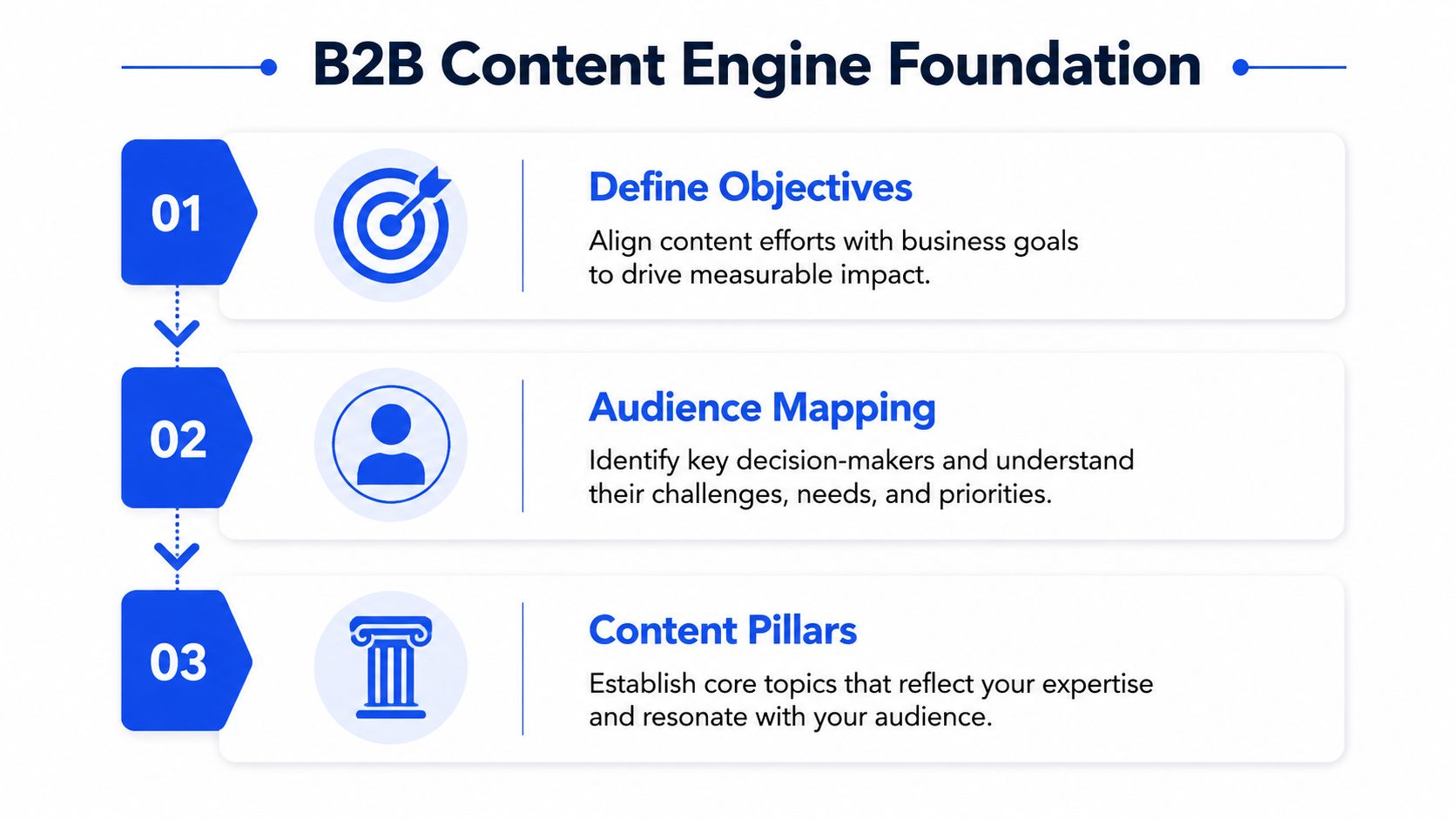
Start with one business outcome
Content for awareness, content for inbound pipeline, and content for sales enablement are different jobs. If you ask the same post to do all three, it usually does none of them well.
For most B2B teams, the cleanest primary outcome is pipeline. That means every asset should answer a hard question. Does this move an ICP-fit buyer toward a conversation, or is it just filling the feed?
Practical rule: Define the commercial outcome before you define the content format.
Use a four-part foundation checklist
Before any drafting starts, lock these four decisions.
Choose the single outcome
Write it in one line. Not “grow brand.” Something tighter, like inbound conversations from heads of sales at mid-market SaaS companies, or sales enablement for enterprise manufacturing opportunities already in motion.Define the buyer, not the audience
“B2B decision-makers” is useless. You need a buyer with enough specificity that a post can sound like it was written for one real person. If your team needs help tightening that definition, use a proper ideal customer profile framework.Pick three to four content pillars More than that usually means the company hasn't decided what it wants to be known for. Good pillars sit at the intersection of buyer pain, sales conversations, and the thing you sell.
Build a proof bank Gather authentic material directly from your team's day-to-day interactions. Pull in call notes from Gong or Zoom recordings, objections from HubSpot, win-loss notes, customer emails, implementation lessons, and screenshots from actual workflows inside Apollo, Clay, Lemlist, Instantly, or Sales Navigator.
A simple way to structure the proof bank is below.
Asset source | What to extract | Where it gets used |
|---|---|---|
Sales calls | recurring objections, buyer language | posts, carousels, outbound copy |
Client delivery | before and after process changes | case-led content, sales enablement |
CRM notes | stage friction, lost deal reasons | decision-stage content |
Founder insight | clear opinions, trade-offs | thought leadership, LinkedIn posts |
Content without proof sounds polished but forgettable. Proof is what gives a b2b content marketing strategy teeth.
What gets skipped on purpose at this stage matters too. Don't start with posting frequency, visual templates, or a six-month calendar. That's execution. Strategy is deciding what not to publish, who not to target, and which conversations you want content to create.
Adopt a LinkedIn-first publishing and repurposing model
If you're selling into SaaS, manufacturing, legal tech, pharma, or professional services, LinkedIn is usually the cleanest place to test positioning in public. The feedback loop is fast, the audience context is business-first, and your sales team can directly use what performs.
That aligns with how teams are already measuring and investing. In 2025, 65% of B2B marketers use social media analytics to measure content performance, and 52% plan to invest more in thought leadership content, according to Merca20's 2025 B2B content marketing metrics report.

Why LinkedIn gets the first call
A lot of teams spread too early. They try SEO, email newsletters, webinars, short video, and founder content all at once. The result is thin execution everywhere.
A LinkedIn-first model is simpler. It lets you stress-test positioning, collect buyer reactions, and generate outreach material from the same source. If you want a deeper breakdown of channel mechanics, this LinkedIn content strategy guide is a useful companion.
Turn one core asset into six formats
One strong idea should produce a week of content, not one post. The easiest way to do that is to anchor each week around one core asset, usually a case study, a sharp operator insight, or a recurring customer problem.
Here's the repurposing model that works well in practice:
Text post → the core idea in plain language, short enough to read quickly, sharp enough to trigger replies
Carousel → the same framework broken into slides, useful when the idea has steps or decision points
Personal story → the same lesson framed through a client conversation or operator mistake
Contrarian take → the same point through tension, usually by rejecting common advice
Data-led post → if the asset includes real numbers you're allowed to share, lead with the proof
Comment and DM layer → turn the same idea into outbound openers, comment replies, and follow-ups
A client case study is a good example. The raw asset might be a messy delivery story with objections, pivots, and a workable outcome. From that one source, you can build a founder post, a process carousel, a values-based story, a contrarian angle, and several outbound messages that reference the same lesson.
Don't create more ideas. Reframe the same true thing until the right buyers remember you for it.
Use video when the topic needs nuance
Video is useful when the idea needs tone, context, or credibility that text alone won't carry. That's often true for opinionated positions, implementation walkthroughs, and sales process breakdowns.
A short example of that format shift is below.
Teams often overcomplicate production. They don't need a studio. A clean webcam recording, a usable script, and tight editing are usually enough if the idea is strong. Long-form formats also matter later in the funnel. As noted in the earlier external research, webinar-style and case-breakdown formats are often better suited to helping buyers make a decision than a stream of generic awareness posts.
Integrate content directly into your outbound motion
Content that lives in marketing and never touches outbound is underused. The highest-performing teams don't treat content and prospecting as separate programs. They run both from the same message, the same target list, and the same buyer problems.
That's where a lot of companies leave money on the table. Marketing publishes a post about a real pain point. Sales keeps sending unrelated cold emails. The buyer experiences two disconnected companies.

Build one message across content and outbound
A useful operating principle is simple. If a post is strong enough to publish publicly, it's usually strong enough to use inside outbound.
That means the same insight should show up across channels:
LinkedIn post → public point of view
Outbound opener → private version of the same point
Sales call → deeper diagnosis of the same issue
Follow-up email → proof or framework that supports the claim
This is the model we prefer at GROU as one option among others. The message, target list, and reporting line stay unified so content, lead generation, and outbound reinforce each other instead of competing.
A practical outbound workflow using content signals
You don't need a huge stack to do this. A basic setup can run on Apollo, Clay, Sales Navigator, HubSpot, and either Lemlist or Instantly. For LinkedIn sequencing, HeyReach is useful if your team is doing coordinated touchpoints.
A workable motion looks like this:
Build the target account list in Apollo or Clay using the same ICP definition your content uses.
Tag live content themes by pillar, buyer problem, and funnel stage in a simple Airtable or HubSpot property.
Match prospects to themes so a head of sales sees outbound tied to pipeline friction, while an operations lead sees process content.
Use engagement as a trigger. If a target account engages with a post, route that signal to the rep or founder for a relevant follow-up.
Send the outreach in context. Don't say “saw you liked my post.” Reference the problem the post addressed and why it's relevant to their role.
Log the content touch in CRM so replies and meetings can be traced back to a real asset.
Here's the difference between weak and useful execution.
Weak outreach | Useful outreach |
|---|---|
generic pitch with no context | message tied to a live buyer problem |
content link dropped cold | content referenced as support for the outreach angle |
no CRM tagging | content touches logged by theme and stage |
marketing metric only | sales can see which assets create replies |
For teams building pipeline from scratch, content can also give reps a better reason to reach out than a generic value prop. If your current outbound still feels disconnected from your message, this B2B sales lead generation breakdown is the right place to tighten the handoff.
Run your content program in two-week sprints
Rigid quarterly calendars look organized but fail without warning. By the time marketing teams finish a long planning cycle, the message has already drifted from what buyers are reacting to now.
A stronger b2b content marketing strategy runs in short operating cycles. Two-week sprints are enough time to produce, publish, learn, and adjust without turning the whole program into chaos.
What a two-week sprint actually looks like
The sprint has a fixed rhythm.
Day 1
Review buyer signals. Pull sales call notes, inbound DMs, objections, and post responses. Decide which angle gets tested this sprint.Days 2 to 4
Build the core asset and the repurposed LinkedIn versions. Draft outbound tie-ins at the same time, not later.Days 5 to 8
Publish, distribute, and route comments or DMs quickly. Speed matters because buyer intent cools fast.Days 9 to 10
Review response quality. Not just views or likes. Look at who engaged, who replied, and whether the content created real conversations.
A sprint-based operating model also makes collaboration cleaner. Shared Slack channels, one working doc, and fast approvals beat endless content review loops. If your team needs a common operating definition, this sprint glossary page is a simple reference.
The calendar should serve the signal. The signal should never serve the calendar.
What changes inside a sprint and what stays fixed
Not everything should move every two weeks. Keep the core buyer, primary outcome, and pillars stable unless the market gives you a real reason to change them.
What can move inside a sprint is narrower:
Angle → sharper pain point, stronger tension, clearer opinion
Format → text, carousel, short video, founder note
CTA → comment prompt, DM trigger, direct meeting prompt
Distribution layer → founder profile, company page, rep amplification, outbound follow-up
Many teams struggle to find the right balance here. They either pivot too slowly because a calendar is locked, or they change everything at once and learn nothing. Short sprints fix both problems.
Measure what matters which is pipeline not applause
Engagement is useful as a surface signal. It's a terrible success metric on its own. A post can get passed around by peers, creators, and non-buyers while producing no qualified conversations.
That's why the measurement model has to sit closer to revenue. According to Salesforce's B2B content marketing guide, content marketing can support lead nurturing for 62% of teams and revenue generation for 49%, but teams need business-aligned KPIs and a documented plan to prove impact.

Track conversation quality not vanity engagement
The leading indicator we trust most is simple. Are ICP-fit buyers starting conversations because of the content?
That can be tracked in HubSpot, Salesforce, or even a disciplined spreadsheet if your volume is still low. The important part is consistency. Every inbound DM, comment-to-DM path, and meeting request should be tagged by source, buyer fit, and content pillar.
A practical scorecard looks like this:
ICP-fit inbound DMs → not all DMs, only people who match your target buyer
Post-to-conversation conversion → which posts create real dialogue
Conversation-to-meeting progression → whether interest turns into pipeline
Pipeline influence by content theme → which pillar shows up around SQLs and active deals
If you need a tighter framework for connecting this back to commercial reporting, this sales pipeline management guide is where to start.
The three signals that tell you to pivot
Most teams pivot because likes drop. That's usually the wrong reason.
The better approach is to watch three operational signals over a rolling window:
ICP-fit DMs trend down for multiple weeks
Reach may be flat, but the right buyers stopped reaching out.Comment quality gets softer
Practitioner comments disappear and get replaced by generic praise.Post-to-conversation conversion falls
People engage, but fewer move into a meaningful exchange.
If two of those three signals stay negative long enough to form a pattern, adjust the angle. Usually the fix isn't abandoning the pillar. It's sharpening the point of view inside that pillar.
Popular content often attracts broad attention. Pipeline content attracts the right tension.
A post that filtered buyers and created meetings
One of the clearest examples came from a post about firing a client mid-retainer. The client wanted volume-first outreach with generic messaging. The agency refused, returned the budget, and walked away. The post explained the decision plainly.
That post generated 11 inbound DMs from ICP-fit prospects in 72 hours and directly produced 3 booked meetings, one of which closed. A more tactical post from the same period got 400+ likes and produced 0 pipeline conversations.
The lesson wasn't that tactical posts never work. It was that values-based positioning can do a better job of pre-qualifying serious buyers than broad educational content. The right people saw how the team thinks, what it won't do, and whether that matched what they wanted from a partner.
Your next step a plug-and-play strategy checklist
You don't need another brainstorm. You need one working session that forces commercial clarity before the next piece gets approved.
That structure matters because the biggest execution problems usually start upstream. In CMI's B2B research, the top challenges include creating content that prompts action at 40% and buyer-journey misalignment at 23%. A checklist fixes that by making every asset earn its place.
The checklist to use in your next team meeting
Take this into the next revenue meeting and don't leave any line blank.
What is the primary outcome for this content program
Pick one. Inbound pipeline, sales enablement, or awareness. If you choose more than one, rank them.Who exactly must the content influence
Write the role, company type, and buying situation. Broad audience labels aren't allowed.Which three to four pillars will we own
If a topic doesn't support a pillar, it probably doesn't get published.What proof do we have for each pillar
Pull from CRM notes, sales calls, client delivery, and founder experience.What action should each asset create
Comment, DM, meeting request, reply to outbound, or sales follow-up.How will we tag and review results
Decide the CRM fields, owner, and review cadence before launch.
A simple two-week template to start with
Use this as the base operating rhythm:
Week 1, Monday → sprint planning, message selection, proof collection
Week 1, midweek → create one core asset plus repurposed LinkedIn formats
Week 1, end → publish anchor content and arm outbound with matching talk tracks
Week 2 → distribute, respond, route signals, and review conversation quality
End of sprint → keep, sharpen, or drop the angle based on buyer response
The first move is small and concrete. Pick one buyer, one pillar, one core asset, and one conversion event. Then run one sprint properly. Marketing teams often learn more from that than from another quarter of unfocused posting.
If you want a team that runs this as one system, Grou builds B2B pipeline programs that connect LinkedIn content, outbound, and reporting around one message and one target list, so you can see which content is creating qualified conversations.
Your team is publishing. The posts look fine. Some even get engagement. Sales still says content isn't helping pipeline.
That usually means the strategy is upside down. The team started with formats, channels, and calendars before deciding what the content must do, who it must move, and how it connects to outbound and sales follow-up. A real b2b content marketing strategy isn't a content plan. It's an operating system for turning attention into qualified conversations.
At this point, many marketing organizations do not require more content ideas. Instead, they need a tighter structure, cleaner buyer targeting, and a way to measure whether content is producing conversations from accounts that are positioned to buy.
Table of Contents
First build the foundation for your content engine
Most content programs break before they publish the first post. The team jumps into a calendar, picks a few topics, and starts producing. That feels like progress, but it usually creates a pile of assets with no commercial job.
That problem is still widespread. Only 41% of B2B marketers have a documented content marketing strategy, and 84% say integrating and analyzing content performance data across platforms is moderately or very challenging, according to Lovewell's 2025 B2B content marketing summary. If the plan isn't documented, attribution gets messy fast.
Start with one business outcome
Content for awareness, content for inbound pipeline, and content for sales enablement are different jobs. If you ask the same post to do all three, it usually does none of them well.
For most B2B teams, the cleanest primary outcome is pipeline. That means every asset should answer a hard question. Does this move an ICP-fit buyer toward a conversation, or is it just filling the feed?
Practical rule: Define the commercial outcome before you define the content format.
Use a four-part foundation checklist
Before any drafting starts, lock these four decisions.
Choose the single outcome
Write it in one line. Not “grow brand.” Something tighter, like inbound conversations from heads of sales at mid-market SaaS companies, or sales enablement for enterprise manufacturing opportunities already in motion.Define the buyer, not the audience
“B2B decision-makers” is useless. You need a buyer with enough specificity that a post can sound like it was written for one real person. If your team needs help tightening that definition, use a proper ideal customer profile framework.Pick three to four content pillars More than that usually means the company hasn't decided what it wants to be known for. Good pillars sit at the intersection of buyer pain, sales conversations, and the thing you sell.
Build a proof bank Gather authentic material directly from your team's day-to-day interactions. Pull in call notes from Gong or Zoom recordings, objections from HubSpot, win-loss notes, customer emails, implementation lessons, and screenshots from actual workflows inside Apollo, Clay, Lemlist, Instantly, or Sales Navigator.
A simple way to structure the proof bank is below.
Asset source | What to extract | Where it gets used |
|---|---|---|
Sales calls | recurring objections, buyer language | posts, carousels, outbound copy |
Client delivery | before and after process changes | case-led content, sales enablement |
CRM notes | stage friction, lost deal reasons | decision-stage content |
Founder insight | clear opinions, trade-offs | thought leadership, LinkedIn posts |
Content without proof sounds polished but forgettable. Proof is what gives a b2b content marketing strategy teeth.
What gets skipped on purpose at this stage matters too. Don't start with posting frequency, visual templates, or a six-month calendar. That's execution. Strategy is deciding what not to publish, who not to target, and which conversations you want content to create.
Adopt a LinkedIn-first publishing and repurposing model
If you're selling into SaaS, manufacturing, legal tech, pharma, or professional services, LinkedIn is usually the cleanest place to test positioning in public. The feedback loop is fast, the audience context is business-first, and your sales team can directly use what performs.
That aligns with how teams are already measuring and investing. In 2025, 65% of B2B marketers use social media analytics to measure content performance, and 52% plan to invest more in thought leadership content, according to Merca20's 2025 B2B content marketing metrics report.
Why LinkedIn gets the first call
A lot of teams spread too early. They try SEO, email newsletters, webinars, short video, and founder content all at once. The result is thin execution everywhere.
A LinkedIn-first model is simpler. It lets you stress-test positioning, collect buyer reactions, and generate outreach material from the same source. If you want a deeper breakdown of channel mechanics, this LinkedIn content strategy guide is a useful companion.
Turn one core asset into six formats
One strong idea should produce a week of content, not one post. The easiest way to do that is to anchor each week around one core asset, usually a case study, a sharp operator insight, or a recurring customer problem.
Here's the repurposing model that works well in practice:
Text post → the core idea in plain language, short enough to read quickly, sharp enough to trigger replies
Carousel → the same framework broken into slides, useful when the idea has steps or decision points
Personal story → the same lesson framed through a client conversation or operator mistake
Contrarian take → the same point through tension, usually by rejecting common advice
Data-led post → if the asset includes real numbers you're allowed to share, lead with the proof
Comment and DM layer → turn the same idea into outbound openers, comment replies, and follow-ups
A client case study is a good example. The raw asset might be a messy delivery story with objections, pivots, and a workable outcome. From that one source, you can build a founder post, a process carousel, a values-based story, a contrarian angle, and several outbound messages that reference the same lesson.
Don't create more ideas. Reframe the same true thing until the right buyers remember you for it.
Use video when the topic needs nuance
Video is useful when the idea needs tone, context, or credibility that text alone won't carry. That's often true for opinionated positions, implementation walkthroughs, and sales process breakdowns.
A short example of that format shift is below.
Teams often overcomplicate production. They don't need a studio. A clean webcam recording, a usable script, and tight editing are usually enough if the idea is strong. Long-form formats also matter later in the funnel. As noted in the earlier external research, webinar-style and case-breakdown formats are often better suited to helping buyers make a decision than a stream of generic awareness posts.
Integrate content directly into your outbound motion
Content that lives in marketing and never touches outbound is underused. The highest-performing teams don't treat content and prospecting as separate programs. They run both from the same message, the same target list, and the same buyer problems.
That's where a lot of companies leave money on the table. Marketing publishes a post about a real pain point. Sales keeps sending unrelated cold emails. The buyer experiences two disconnected companies.
Build one message across content and outbound
A useful operating principle is simple. If a post is strong enough to publish publicly, it's usually strong enough to use inside outbound.
That means the same insight should show up across channels:
LinkedIn post → public point of view
Outbound opener → private version of the same point
Sales call → deeper diagnosis of the same issue
Follow-up email → proof or framework that supports the claim
This is the model we prefer at GROU as one option among others. The message, target list, and reporting line stay unified so content, lead generation, and outbound reinforce each other instead of competing.
A practical outbound workflow using content signals
You don't need a huge stack to do this. A basic setup can run on Apollo, Clay, Sales Navigator, HubSpot, and either Lemlist or Instantly. For LinkedIn sequencing, HeyReach is useful if your team is doing coordinated touchpoints.
A workable motion looks like this:
Build the target account list in Apollo or Clay using the same ICP definition your content uses.
Tag live content themes by pillar, buyer problem, and funnel stage in a simple Airtable or HubSpot property.
Match prospects to themes so a head of sales sees outbound tied to pipeline friction, while an operations lead sees process content.
Use engagement as a trigger. If a target account engages with a post, route that signal to the rep or founder for a relevant follow-up.
Send the outreach in context. Don't say “saw you liked my post.” Reference the problem the post addressed and why it's relevant to their role.
Log the content touch in CRM so replies and meetings can be traced back to a real asset.
Here's the difference between weak and useful execution.
Weak outreach | Useful outreach |
|---|---|
generic pitch with no context | message tied to a live buyer problem |
content link dropped cold | content referenced as support for the outreach angle |
no CRM tagging | content touches logged by theme and stage |
marketing metric only | sales can see which assets create replies |
For teams building pipeline from scratch, content can also give reps a better reason to reach out than a generic value prop. If your current outbound still feels disconnected from your message, this B2B sales lead generation breakdown is the right place to tighten the handoff.
Run your content program in two-week sprints
Rigid quarterly calendars look organized but fail without warning. By the time marketing teams finish a long planning cycle, the message has already drifted from what buyers are reacting to now.
A stronger b2b content marketing strategy runs in short operating cycles. Two-week sprints are enough time to produce, publish, learn, and adjust without turning the whole program into chaos.
What a two-week sprint actually looks like
The sprint has a fixed rhythm.
Day 1
Review buyer signals. Pull sales call notes, inbound DMs, objections, and post responses. Decide which angle gets tested this sprint.Days 2 to 4
Build the core asset and the repurposed LinkedIn versions. Draft outbound tie-ins at the same time, not later.Days 5 to 8
Publish, distribute, and route comments or DMs quickly. Speed matters because buyer intent cools fast.Days 9 to 10
Review response quality. Not just views or likes. Look at who engaged, who replied, and whether the content created real conversations.
A sprint-based operating model also makes collaboration cleaner. Shared Slack channels, one working doc, and fast approvals beat endless content review loops. If your team needs a common operating definition, this sprint glossary page is a simple reference.
The calendar should serve the signal. The signal should never serve the calendar.
What changes inside a sprint and what stays fixed
Not everything should move every two weeks. Keep the core buyer, primary outcome, and pillars stable unless the market gives you a real reason to change them.
What can move inside a sprint is narrower:
Angle → sharper pain point, stronger tension, clearer opinion
Format → text, carousel, short video, founder note
CTA → comment prompt, DM trigger, direct meeting prompt
Distribution layer → founder profile, company page, rep amplification, outbound follow-up
Many teams struggle to find the right balance here. They either pivot too slowly because a calendar is locked, or they change everything at once and learn nothing. Short sprints fix both problems.
Measure what matters which is pipeline not applause
Engagement is useful as a surface signal. It's a terrible success metric on its own. A post can get passed around by peers, creators, and non-buyers while producing no qualified conversations.
That's why the measurement model has to sit closer to revenue. According to Salesforce's B2B content marketing guide, content marketing can support lead nurturing for 62% of teams and revenue generation for 49%, but teams need business-aligned KPIs and a documented plan to prove impact.
Track conversation quality not vanity engagement
The leading indicator we trust most is simple. Are ICP-fit buyers starting conversations because of the content?
That can be tracked in HubSpot, Salesforce, or even a disciplined spreadsheet if your volume is still low. The important part is consistency. Every inbound DM, comment-to-DM path, and meeting request should be tagged by source, buyer fit, and content pillar.
A practical scorecard looks like this:
ICP-fit inbound DMs → not all DMs, only people who match your target buyer
Post-to-conversation conversion → which posts create real dialogue
Conversation-to-meeting progression → whether interest turns into pipeline
Pipeline influence by content theme → which pillar shows up around SQLs and active deals
If you need a tighter framework for connecting this back to commercial reporting, this sales pipeline management guide is where to start.
The three signals that tell you to pivot
Most teams pivot because likes drop. That's usually the wrong reason.
The better approach is to watch three operational signals over a rolling window:
ICP-fit DMs trend down for multiple weeks
Reach may be flat, but the right buyers stopped reaching out.Comment quality gets softer
Practitioner comments disappear and get replaced by generic praise.Post-to-conversation conversion falls
People engage, but fewer move into a meaningful exchange.
If two of those three signals stay negative long enough to form a pattern, adjust the angle. Usually the fix isn't abandoning the pillar. It's sharpening the point of view inside that pillar.
Popular content often attracts broad attention. Pipeline content attracts the right tension.
A post that filtered buyers and created meetings
One of the clearest examples came from a post about firing a client mid-retainer. The client wanted volume-first outreach with generic messaging. The agency refused, returned the budget, and walked away. The post explained the decision plainly.
That post generated 11 inbound DMs from ICP-fit prospects in 72 hours and directly produced 3 booked meetings, one of which closed. A more tactical post from the same period got 400+ likes and produced 0 pipeline conversations.
The lesson wasn't that tactical posts never work. It was that values-based positioning can do a better job of pre-qualifying serious buyers than broad educational content. The right people saw how the team thinks, what it won't do, and whether that matched what they wanted from a partner.
Your next step a plug-and-play strategy checklist
You don't need another brainstorm. You need one working session that forces commercial clarity before the next piece gets approved.
That structure matters because the biggest execution problems usually start upstream. In CMI's B2B research, the top challenges include creating content that prompts action at 40% and buyer-journey misalignment at 23%. A checklist fixes that by making every asset earn its place.
The checklist to use in your next team meeting
Take this into the next revenue meeting and don't leave any line blank.
What is the primary outcome for this content program
Pick one. Inbound pipeline, sales enablement, or awareness. If you choose more than one, rank them.Who exactly must the content influence
Write the role, company type, and buying situation. Broad audience labels aren't allowed.Which three to four pillars will we own
If a topic doesn't support a pillar, it probably doesn't get published.What proof do we have for each pillar
Pull from CRM notes, sales calls, client delivery, and founder experience.What action should each asset create
Comment, DM, meeting request, reply to outbound, or sales follow-up.How will we tag and review results
Decide the CRM fields, owner, and review cadence before launch.
A simple two-week template to start with
Use this as the base operating rhythm:
Week 1, Monday → sprint planning, message selection, proof collection
Week 1, midweek → create one core asset plus repurposed LinkedIn formats
Week 1, end → publish anchor content and arm outbound with matching talk tracks
Week 2 → distribute, respond, route signals, and review conversation quality
End of sprint → keep, sharpen, or drop the angle based on buyer response
The first move is small and concrete. Pick one buyer, one pillar, one core asset, and one conversion event. Then run one sprint properly. Marketing teams often learn more from that than from another quarter of unfocused posting.
If you want a team that runs this as one system, Grou builds B2B pipeline programs that connect LinkedIn content, outbound, and reporting around one message and one target list, so you can see which content is creating qualified conversations.
Your team is publishing. The posts look fine. Some even get engagement. Sales still says content isn't helping pipeline.
That usually means the strategy is upside down. The team started with formats, channels, and calendars before deciding what the content must do, who it must move, and how it connects to outbound and sales follow-up. A real b2b content marketing strategy isn't a content plan. It's an operating system for turning attention into qualified conversations.
At this point, many marketing organizations do not require more content ideas. Instead, they need a tighter structure, cleaner buyer targeting, and a way to measure whether content is producing conversations from accounts that are positioned to buy.
Table of Contents
First build the foundation for your content engine
Most content programs break before they publish the first post. The team jumps into a calendar, picks a few topics, and starts producing. That feels like progress, but it usually creates a pile of assets with no commercial job.
That problem is still widespread. Only 41% of B2B marketers have a documented content marketing strategy, and 84% say integrating and analyzing content performance data across platforms is moderately or very challenging, according to Lovewell's 2025 B2B content marketing summary. If the plan isn't documented, attribution gets messy fast.
Start with one business outcome
Content for awareness, content for inbound pipeline, and content for sales enablement are different jobs. If you ask the same post to do all three, it usually does none of them well.
For most B2B teams, the cleanest primary outcome is pipeline. That means every asset should answer a hard question. Does this move an ICP-fit buyer toward a conversation, or is it just filling the feed?
Practical rule: Define the commercial outcome before you define the content format.
Use a four-part foundation checklist
Before any drafting starts, lock these four decisions.
Choose the single outcome
Write it in one line. Not “grow brand.” Something tighter, like inbound conversations from heads of sales at mid-market SaaS companies, or sales enablement for enterprise manufacturing opportunities already in motion.Define the buyer, not the audience
“B2B decision-makers” is useless. You need a buyer with enough specificity that a post can sound like it was written for one real person. If your team needs help tightening that definition, use a proper ideal customer profile framework.Pick three to four content pillars More than that usually means the company hasn't decided what it wants to be known for. Good pillars sit at the intersection of buyer pain, sales conversations, and the thing you sell.
Build a proof bank Gather authentic material directly from your team's day-to-day interactions. Pull in call notes from Gong or Zoom recordings, objections from HubSpot, win-loss notes, customer emails, implementation lessons, and screenshots from actual workflows inside Apollo, Clay, Lemlist, Instantly, or Sales Navigator.
A simple way to structure the proof bank is below.
Asset source | What to extract | Where it gets used |
|---|---|---|
Sales calls | recurring objections, buyer language | posts, carousels, outbound copy |
Client delivery | before and after process changes | case-led content, sales enablement |
CRM notes | stage friction, lost deal reasons | decision-stage content |
Founder insight | clear opinions, trade-offs | thought leadership, LinkedIn posts |
Content without proof sounds polished but forgettable. Proof is what gives a b2b content marketing strategy teeth.
What gets skipped on purpose at this stage matters too. Don't start with posting frequency, visual templates, or a six-month calendar. That's execution. Strategy is deciding what not to publish, who not to target, and which conversations you want content to create.
Adopt a LinkedIn-first publishing and repurposing model
If you're selling into SaaS, manufacturing, legal tech, pharma, or professional services, LinkedIn is usually the cleanest place to test positioning in public. The feedback loop is fast, the audience context is business-first, and your sales team can directly use what performs.
That aligns with how teams are already measuring and investing. In 2025, 65% of B2B marketers use social media analytics to measure content performance, and 52% plan to invest more in thought leadership content, according to Merca20's 2025 B2B content marketing metrics report.
Why LinkedIn gets the first call
A lot of teams spread too early. They try SEO, email newsletters, webinars, short video, and founder content all at once. The result is thin execution everywhere.
A LinkedIn-first model is simpler. It lets you stress-test positioning, collect buyer reactions, and generate outreach material from the same source. If you want a deeper breakdown of channel mechanics, this LinkedIn content strategy guide is a useful companion.
Turn one core asset into six formats
One strong idea should produce a week of content, not one post. The easiest way to do that is to anchor each week around one core asset, usually a case study, a sharp operator insight, or a recurring customer problem.
Here's the repurposing model that works well in practice:
Text post → the core idea in plain language, short enough to read quickly, sharp enough to trigger replies
Carousel → the same framework broken into slides, useful when the idea has steps or decision points
Personal story → the same lesson framed through a client conversation or operator mistake
Contrarian take → the same point through tension, usually by rejecting common advice
Data-led post → if the asset includes real numbers you're allowed to share, lead with the proof
Comment and DM layer → turn the same idea into outbound openers, comment replies, and follow-ups
A client case study is a good example. The raw asset might be a messy delivery story with objections, pivots, and a workable outcome. From that one source, you can build a founder post, a process carousel, a values-based story, a contrarian angle, and several outbound messages that reference the same lesson.
Don't create more ideas. Reframe the same true thing until the right buyers remember you for it.
Use video when the topic needs nuance
Video is useful when the idea needs tone, context, or credibility that text alone won't carry. That's often true for opinionated positions, implementation walkthroughs, and sales process breakdowns.
A short example of that format shift is below.
Teams often overcomplicate production. They don't need a studio. A clean webcam recording, a usable script, and tight editing are usually enough if the idea is strong. Long-form formats also matter later in the funnel. As noted in the earlier external research, webinar-style and case-breakdown formats are often better suited to helping buyers make a decision than a stream of generic awareness posts.
Integrate content directly into your outbound motion
Content that lives in marketing and never touches outbound is underused. The highest-performing teams don't treat content and prospecting as separate programs. They run both from the same message, the same target list, and the same buyer problems.
That's where a lot of companies leave money on the table. Marketing publishes a post about a real pain point. Sales keeps sending unrelated cold emails. The buyer experiences two disconnected companies.
Build one message across content and outbound
A useful operating principle is simple. If a post is strong enough to publish publicly, it's usually strong enough to use inside outbound.
That means the same insight should show up across channels:
LinkedIn post → public point of view
Outbound opener → private version of the same point
Sales call → deeper diagnosis of the same issue
Follow-up email → proof or framework that supports the claim
This is the model we prefer at GROU as one option among others. The message, target list, and reporting line stay unified so content, lead generation, and outbound reinforce each other instead of competing.
A practical outbound workflow using content signals
You don't need a huge stack to do this. A basic setup can run on Apollo, Clay, Sales Navigator, HubSpot, and either Lemlist or Instantly. For LinkedIn sequencing, HeyReach is useful if your team is doing coordinated touchpoints.
A workable motion looks like this:
Build the target account list in Apollo or Clay using the same ICP definition your content uses.
Tag live content themes by pillar, buyer problem, and funnel stage in a simple Airtable or HubSpot property.
Match prospects to themes so a head of sales sees outbound tied to pipeline friction, while an operations lead sees process content.
Use engagement as a trigger. If a target account engages with a post, route that signal to the rep or founder for a relevant follow-up.
Send the outreach in context. Don't say “saw you liked my post.” Reference the problem the post addressed and why it's relevant to their role.
Log the content touch in CRM so replies and meetings can be traced back to a real asset.
Here's the difference between weak and useful execution.
Weak outreach | Useful outreach |
|---|---|
generic pitch with no context | message tied to a live buyer problem |
content link dropped cold | content referenced as support for the outreach angle |
no CRM tagging | content touches logged by theme and stage |
marketing metric only | sales can see which assets create replies |
For teams building pipeline from scratch, content can also give reps a better reason to reach out than a generic value prop. If your current outbound still feels disconnected from your message, this B2B sales lead generation breakdown is the right place to tighten the handoff.
Run your content program in two-week sprints
Rigid quarterly calendars look organized but fail without warning. By the time marketing teams finish a long planning cycle, the message has already drifted from what buyers are reacting to now.
A stronger b2b content marketing strategy runs in short operating cycles. Two-week sprints are enough time to produce, publish, learn, and adjust without turning the whole program into chaos.
What a two-week sprint actually looks like
The sprint has a fixed rhythm.
Day 1
Review buyer signals. Pull sales call notes, inbound DMs, objections, and post responses. Decide which angle gets tested this sprint.Days 2 to 4
Build the core asset and the repurposed LinkedIn versions. Draft outbound tie-ins at the same time, not later.Days 5 to 8
Publish, distribute, and route comments or DMs quickly. Speed matters because buyer intent cools fast.Days 9 to 10
Review response quality. Not just views or likes. Look at who engaged, who replied, and whether the content created real conversations.
A sprint-based operating model also makes collaboration cleaner. Shared Slack channels, one working doc, and fast approvals beat endless content review loops. If your team needs a common operating definition, this sprint glossary page is a simple reference.
The calendar should serve the signal. The signal should never serve the calendar.
What changes inside a sprint and what stays fixed
Not everything should move every two weeks. Keep the core buyer, primary outcome, and pillars stable unless the market gives you a real reason to change them.
What can move inside a sprint is narrower:
Angle → sharper pain point, stronger tension, clearer opinion
Format → text, carousel, short video, founder note
CTA → comment prompt, DM trigger, direct meeting prompt
Distribution layer → founder profile, company page, rep amplification, outbound follow-up
Many teams struggle to find the right balance here. They either pivot too slowly because a calendar is locked, or they change everything at once and learn nothing. Short sprints fix both problems.
Measure what matters which is pipeline not applause
Engagement is useful as a surface signal. It's a terrible success metric on its own. A post can get passed around by peers, creators, and non-buyers while producing no qualified conversations.
That's why the measurement model has to sit closer to revenue. According to Salesforce's B2B content marketing guide, content marketing can support lead nurturing for 62% of teams and revenue generation for 49%, but teams need business-aligned KPIs and a documented plan to prove impact.
Track conversation quality not vanity engagement
The leading indicator we trust most is simple. Are ICP-fit buyers starting conversations because of the content?
That can be tracked in HubSpot, Salesforce, or even a disciplined spreadsheet if your volume is still low. The important part is consistency. Every inbound DM, comment-to-DM path, and meeting request should be tagged by source, buyer fit, and content pillar.
A practical scorecard looks like this:
ICP-fit inbound DMs → not all DMs, only people who match your target buyer
Post-to-conversation conversion → which posts create real dialogue
Conversation-to-meeting progression → whether interest turns into pipeline
Pipeline influence by content theme → which pillar shows up around SQLs and active deals
If you need a tighter framework for connecting this back to commercial reporting, this sales pipeline management guide is where to start.
The three signals that tell you to pivot
Most teams pivot because likes drop. That's usually the wrong reason.
The better approach is to watch three operational signals over a rolling window:
ICP-fit DMs trend down for multiple weeks
Reach may be flat, but the right buyers stopped reaching out.Comment quality gets softer
Practitioner comments disappear and get replaced by generic praise.Post-to-conversation conversion falls
People engage, but fewer move into a meaningful exchange.
If two of those three signals stay negative long enough to form a pattern, adjust the angle. Usually the fix isn't abandoning the pillar. It's sharpening the point of view inside that pillar.
Popular content often attracts broad attention. Pipeline content attracts the right tension.
A post that filtered buyers and created meetings
One of the clearest examples came from a post about firing a client mid-retainer. The client wanted volume-first outreach with generic messaging. The agency refused, returned the budget, and walked away. The post explained the decision plainly.
That post generated 11 inbound DMs from ICP-fit prospects in 72 hours and directly produced 3 booked meetings, one of which closed. A more tactical post from the same period got 400+ likes and produced 0 pipeline conversations.
The lesson wasn't that tactical posts never work. It was that values-based positioning can do a better job of pre-qualifying serious buyers than broad educational content. The right people saw how the team thinks, what it won't do, and whether that matched what they wanted from a partner.
Your next step a plug-and-play strategy checklist
You don't need another brainstorm. You need one working session that forces commercial clarity before the next piece gets approved.
That structure matters because the biggest execution problems usually start upstream. In CMI's B2B research, the top challenges include creating content that prompts action at 40% and buyer-journey misalignment at 23%. A checklist fixes that by making every asset earn its place.
The checklist to use in your next team meeting
Take this into the next revenue meeting and don't leave any line blank.
What is the primary outcome for this content program
Pick one. Inbound pipeline, sales enablement, or awareness. If you choose more than one, rank them.Who exactly must the content influence
Write the role, company type, and buying situation. Broad audience labels aren't allowed.Which three to four pillars will we own
If a topic doesn't support a pillar, it probably doesn't get published.What proof do we have for each pillar
Pull from CRM notes, sales calls, client delivery, and founder experience.What action should each asset create
Comment, DM, meeting request, reply to outbound, or sales follow-up.How will we tag and review results
Decide the CRM fields, owner, and review cadence before launch.
A simple two-week template to start with
Use this as the base operating rhythm:
Week 1, Monday → sprint planning, message selection, proof collection
Week 1, midweek → create one core asset plus repurposed LinkedIn formats
Week 1, end → publish anchor content and arm outbound with matching talk tracks
Week 2 → distribute, respond, route signals, and review conversation quality
End of sprint → keep, sharpen, or drop the angle based on buyer response
The first move is small and concrete. Pick one buyer, one pillar, one core asset, and one conversion event. Then run one sprint properly. Marketing teams often learn more from that than from another quarter of unfocused posting.
If you want a team that runs this as one system, Grou builds B2B pipeline programs that connect LinkedIn content, outbound, and reporting around one message and one target list, so you can see which content is creating qualified conversations.

Pipeline OS Newsletter
Build qualified pipeline
Get weekly tactics to generate demand, improve lead quality, and book more meetings.





Trusted by industry leaders
Trusted by industry leaders
Trusted by industry leaders
Ready to build qualified pipeline?
Ready to build qualified pipeline?
Ready to build qualified pipeline?
Book a call to see if we're the right fit, or take the 2-minute quiz to get a clear starting point.
Book a call to see if we're the right fit, or take the 2-minute quiz to get a clear starting point.
Book a call to see if we're the right fit, or take the 2-minute quiz to get a clear starting point.
" height="30.21639343089746px" id="hfGbXmQR2" width="30.216393430897455px"/></svg>)
Copyright © 2026 – All Right Reserved
Copyright © 2026 – All Right Reserved
Copyright © 2026 – All Right Reserved