%22%3E%3C/path%3E%3Cpath d=%22M 63.072 7.554 C 62.258 8.022 61.577 8.689 61.092 9.493 L 61.092 7.076 L 57.158 7.076 L 57.158 22.64 L 61.089 22.64 L 61.089 14.888 C 61.089 13.446 61.403 12.434 62.03 11.853 C 62.818 11.218 63.818 10.907 64.826 10.982 L 65.868 10.982 L 65.868 6.851 C 64.891 6.834 63.926 7.076 63.073 7.554 Z%22 fill=%22rgb(17,17,17)%22%3E%3C/path%3E%3Cpath d=%22M 78.916 7.82 C 76.363 6.49 73.321 6.49 70.768 7.82 C 69.562 8.473 68.564 9.451 67.888 10.644 C 67.167 11.931 66.803 13.387 66.834 14.862 C 66.804 16.332 67.157 17.785 67.86 19.077 C 68.515 20.267 69.494 21.246 70.684 21.901 C 71.924 22.576 73.318 22.92 74.73 22.898 C 76.164 22.918 77.58 22.575 78.846 21.901 C 80.062 21.247 81.073 20.27 81.768 19.077 C 82.506 17.797 82.88 16.339 82.85 14.862 C 82.88 13.389 82.517 11.934 81.797 10.647 C 81.12 9.455 80.122 8.477 78.917 7.824 M 78.803 14.862 C 78.829 15.739 78.636 16.608 78.241 17.391 C 77.903 18.046 77.38 18.588 76.738 18.95 C 76.124 19.293 75.432 19.472 74.729 19.47 C 73.668 19.497 72.648 19.061 71.934 18.276 C 71.139 17.323 70.741 16.1 70.823 14.862 C 70.741 13.62 71.149 12.395 71.959 11.45 C 72.687 10.667 73.715 10.233 74.783 10.256 C 75.859 10.236 76.894 10.67 77.635 11.45 C 78.464 12.387 78.884 13.616 78.801 14.864%22 fill=%22rgb(17,17,17)%22%3E%3C/path%3E%3Cpath d=%22M 95.906 7.076 L 95.906 15.646 C 95.975 16.68 95.643 17.701 94.979 18.498 C 94.311 19.184 93.379 19.547 92.422 19.495 C 91.475 19.544 90.553 19.18 89.894 18.498 C 89.23 17.701 88.898 16.68 88.967 15.646 L 88.967 7.076 L 85.033 7.076 L 85.033 16.207 C 85 17.449 85.275 18.68 85.834 19.79 C 86.327 20.75 87.095 21.542 88.039 22.065 C 89.033 22.594 90.145 22.861 91.271 22.838 C 92.188 22.847 93.095 22.65 93.926 22.263 C 94.708 21.905 95.388 21.36 95.906 20.675 L 95.906 22.645 L 99.865 22.645 L 99.865 7.076 Z%22 fill=%22rgb(17,17,17)%22%3E%3C/path%3E%3Cpath d=%22M 4.513 15.626 C 4.511 10.815 7.606 6.549 12.181 5.059 C 16.756 3.57 21.77 5.195 24.601 9.086 L 27.816 5.87 C 24.074 1.186 17.981 -0.943 12.137 0.393 C 6.292 1.728 1.728 6.292 0.393 12.137 C -0.943 17.981 1.186 24.074 5.87 27.816 L 9.085 24.601 C 6.214 22.512 4.515 19.177 4.513 15.626%22 fill=%22rgb(32,62,235)%22%3E%3C/path%3E%3Cpath d=%22M 17.114 14.343 L 13.354 18.01 L 13.354 18.026 L 21.071 18.026 L 11.412 27.609 L 17.389 27.609 L 23.999 21.081 L 23.999 28.316 L 24.005 28.316 L 27.967 24.393 L 27.967 14.343 Z%22 fill=%22rgb(32,62,235)%22%3E%3C/path%3E%3C/g%3E%3C/svg%3E) ×
× ××
××›
›
›
›
How to Turn Insurance Telemarketing Leads Into Closed Deals
How to Turn Insurance Telemarketing Leads Into Closed Deals
How to Turn Insurance Telemarketing Leads Into Closed Deals
How to Turn Insurance Telemarketing Leads Into Closed Deals
How to Turn Insurance Telemarketing Leads Into Closed Deals
How to Turn Insurance Telemarketing Leads Into Closed Deals

Author
Aljaz Peklaj

Your insurance telemarketing leads are probably getting killed in the wrong place. The list may be fine, but the compliance file is thin, the first call comes too late, or the CRM routing leaves good prospects sitting in limbo until they go cold. Treat the channel like a dialer problem and you'll keep buying the same disappointment.
Start with compliance, not volume. Every record needs a clear consent trail, DNC hygiene, and calling rules you can defend.
Choose buy, build, or hybrid based on control. Exclusive leads buy speed, in-house lists buy freshness, hybrids win when teams need both.
Run the funnel, not a close rate. Contact, qualification, quote, and bind each leak for different reasons.
Test one variable at a time. Routing, opener, call window, and enrichment all change results, but only if you isolate them.
Table of Contents
The buyer vs builder decision for insurance telemarketing leads
Mapping ICP, segmenting, and writing scripts that actually convert
The real qualification funnel and where insurance telemarketing pipelines leak
Kpis, dashboards, and the weekly review that keeps the program honest
Your next 7 days and answers to the questions leaders actually ask
The buyer vs builder decision for insurance telemarketing leads
Every insurance telemarketing lead has to clear a compliance floor before it earns one second of agent time. If the consent trail is messy, the DNC scrub is stale, or the calling window is off for the target state, the lead is already damaged. The team then blames dialing, when the failure happened upstream.
Buy when speed matters more than control
Buying exclusive leads makes sense when you need faster time to first dial and don't want your reps waiting on list assembly. That works best for teams with a tight launch window, a clear product focus, and enough CRM discipline to route and disposition quickly. It also works when your internal data is weak and you need outside volume now.
Shared or recycled inventory is a bad bet unless your team has a very short-cycle offer and very aggressive follow-up. The market data shows live transfers now represent 28% of total lead volume in 2026, up from 22% in 2023, while exclusive web leads fell from 35% to 32% in the same period, and live transfers carry the highest-performing benchmark profile, with 95%+ contact rates and 15% to 25% close rates according to the 2026 insurance lead industry report (insurance lead industry report 2026). That's why the buying decision is really a speed and performance decision.
Build when freshness and control matter more than speed
Building in-house gives you better list freshness control and tighter integration with your CRM and dialer workflow. It also lets you document consent in the same system you use for routing, sequencing, and suppression. That matters when you want one source of truth instead of three vendor spreadsheets and a cleanup disaster.
A good middle ground is to build your core database and buy selective overlays for time-sensitive segments. That's the model most mid-market teams should consider, because it avoids total dependence on a vendor and keeps the pipeline from stalling when one source dries up. If you already run outsourced lead gen motion for other markets, this is the same control question the team should ask in a different vertical, which is why our outsourcing lead generation framework is a useful parallel.
Practical rule: if the list will be called inside a week, buy. If it needs repeated enrichment, compliance review, and CRM stitching, build.
For teams that want to add phone into a broader outbound system, a useful reference is how some operators increase inbound calls with AI. The point isn't to chase novelty, it's to see how phone workflows fit into a larger intake system.
Sourcing path | Cost per qualified lead | Speed to first dial | List freshness control | Compliance burden | Best for |
|---|---|---|---|---|---|
Exclusive vendor leads | Higher | Fast | Medium | Medium | Teams needing immediate volume |
In-house built lists | Lower over time | Slower | High | High | Teams with data ops and compliance maturity |
Hybrid model | Balanced | Fast enough | High | High | Mid-market teams with multi-product routing |
If I were advising a head of sales, I'd start hybrid for most teams. Buy the first wave, build the data layer underneath it, and switch the highest-performing segments to in-house once the team knows what converts. That keeps the program from becoming vendor-dependent.
Sourcing and enriching compliant insurance lead lists
Once the sourcing path is set, the whole game becomes record quality. A list that looks large but lacks consent, freshness, or routing fields is just an expensive way to create bad activity. The better move is to define what a dial-ready record must contain before the first import.
Read the data card like a compliance document
Ask the vendor where the lead came from, what the opt-in language said, and whether the consent was tied to phone, email, or both. You want proof that the caller can use the record without scrambling after the fact. If the vendor won't explain the opt-in source, the record probably won't survive a real audit.
The clean-up step matters just as much. One practical standard is to scrub the list before every delivery and suppress anything that conflicts with prior outreach or do-not-call rules. That aligns with the broader point in the insurance lead quality brief, where deliverability, consent hygiene, and verified identity now shape whether a lead is usable at all (insurance lead industry report 2026).
Enrich for fit, not vanity
Use Apollo, Clay, or ZoomInfo to append the fields that change call priority. For insurance, that means age band, household composition, prior coverage clues, and renewal timing signals. You're not enriching to make the record prettier, you're enriching so the rep knows who gets called first.
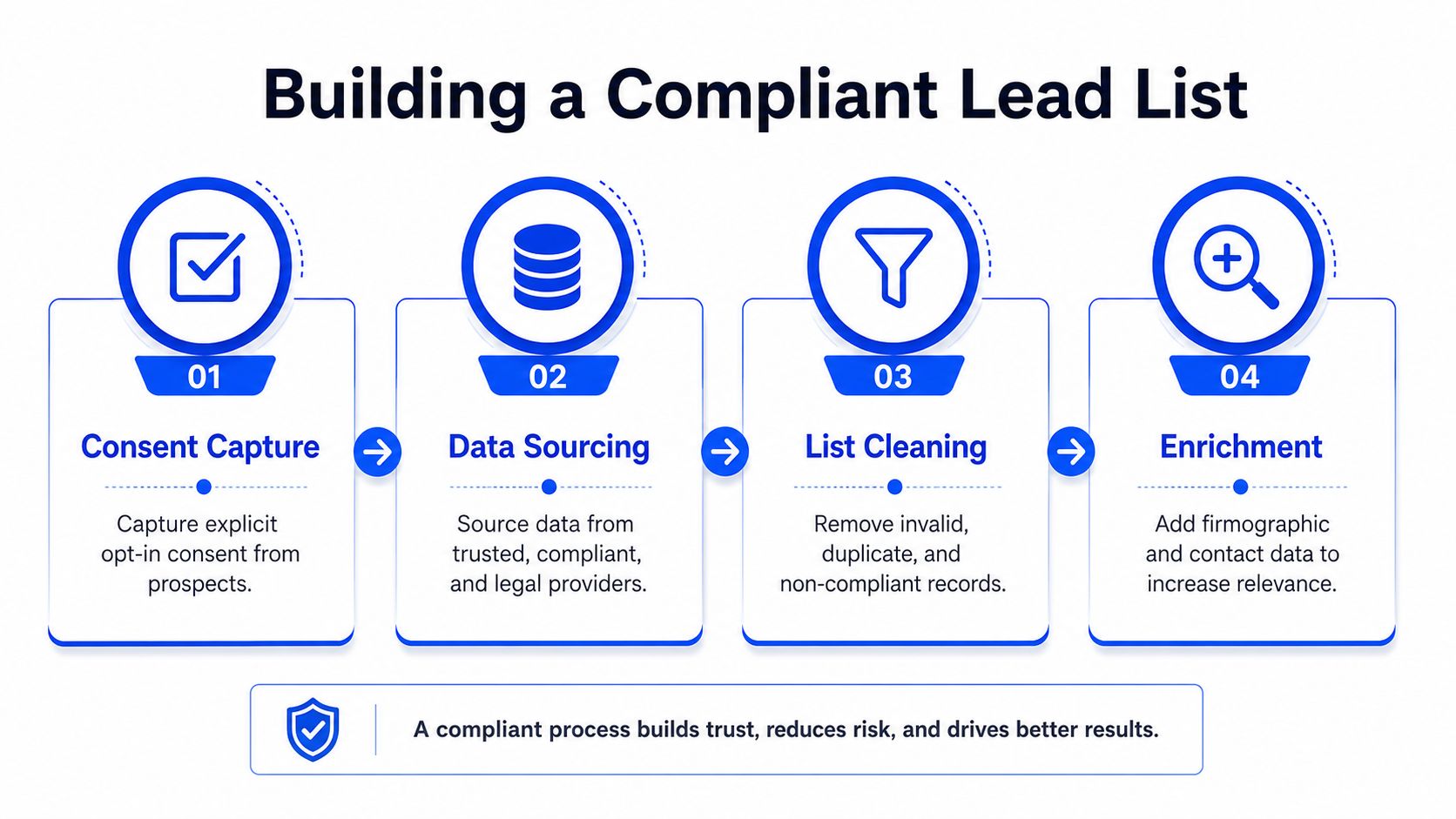
The strongest lists also segment by product fit and geography. A home policy fit in one state can be a bad fit in another if licensing or regulatory rules change the call path. Commercial, auto, life, and home should never live in one undifferentiated queue.
Operational standard: refresh every 30 to 60 days, suppress on every delivery, and keep consent documentation on every record that gets dialed.
The simplest way to cut waste is to disqualify harder. A list of 2,000 that filters to 350 call-ready prospects beats 10,000 records nobody trusts. That same discipline is why our clean an email list guidance matters to outbound teams dealing with any regulated data flow.
Mapping ICP, segmenting, and writing scripts that actually convert
A clean list still fails if the script and the ICP don't match. The rep needs a written ICP for each product line, then a call path that matches the segment's intent and risk profile. Without that, you get generic openings, weak discovery, and a lot of “send me something” calls that never turn into quotes.
Write the ICP first, then route the call
For each insurance line, define the fit in plain language. Who is the target, what triggers urgency, what makes the conversation worth a live dial, and what should cause an immediate disqualify. Put those rules into routing fields so the system assigns the right lead to the right rep, not whoever happens to be available.
The actual call opening should prove legitimate research, respect time, and make the purpose obvious. That's the same principle behind the ICP framework, because segmentation only works when the team agrees on what “fit” means before the dial starts.
Keep the script tight and compliant
The best scripts don't sound like scripts. They sound like a rep who knows the record, states the purpose, and earns permission to continue. Identity disclosure, consent verification, and opt-out language are not stylistic choices. They're mandatory.
A practical template looks like this, with the exact wording adjusted for state and product rules:
Opening: confirm who you are, why you're calling, and why the prospect is in the queue.
Discovery: ask two or three qualifying questions tied to product fit.
Objections: address price, coverage amount, timing, and prior claims without rushing.
Soft close: set the next step in a way that fits the product cycle.
If you want a useful external comparator for opener structure, the DialNexa Labs cold calling advice is worth reviewing because it treats the first few seconds as a permission problem, not a pitch contest. That mindset fits insurance better than a hard sell.
Here's the part most teams miss. The script should map the result back into CRM stage, or the lead rating becomes a memory exercise instead of a system.
Call outcome | CRM stage | Next action | Follow-up cadence |
|---|---|---|---|
Connected, qualified | Active opportunity | Book quote or transfer | Immediate |
Connected, not ready | Nurture | Recycle with date trigger | Scheduled |
Connected, wrong fit | Disqualified | Record reason and suppress | None |
No answer | Working | Re-attempt with sequence | Same week |
The rep should never wonder what happens after the call. If they do, the process is already too loose.
The real qualification funnel and where insurance telemarketing pipelines leak
A single close rate hides the actual problem. Insurance telemarketing is a sequence of smaller conversions, and each one breaks for a different reason. If you only watch the end result, you'll keep buying more leads instead of fixing the leak.
Read the funnel stage by stage
The benchmark funnel is clear. Connect rates run roughly 15% to 25% for commercial prospects and 20% to 35% for personal prospects, qualification rates land at 10% to 20% of conversations, appointment-to-quote rates sit at 50% to 70%, and quote-to-bind rates are 25% to 40% according to the insurance telemarketing benchmark data (telemarketing is a game changer for insurance brokers).
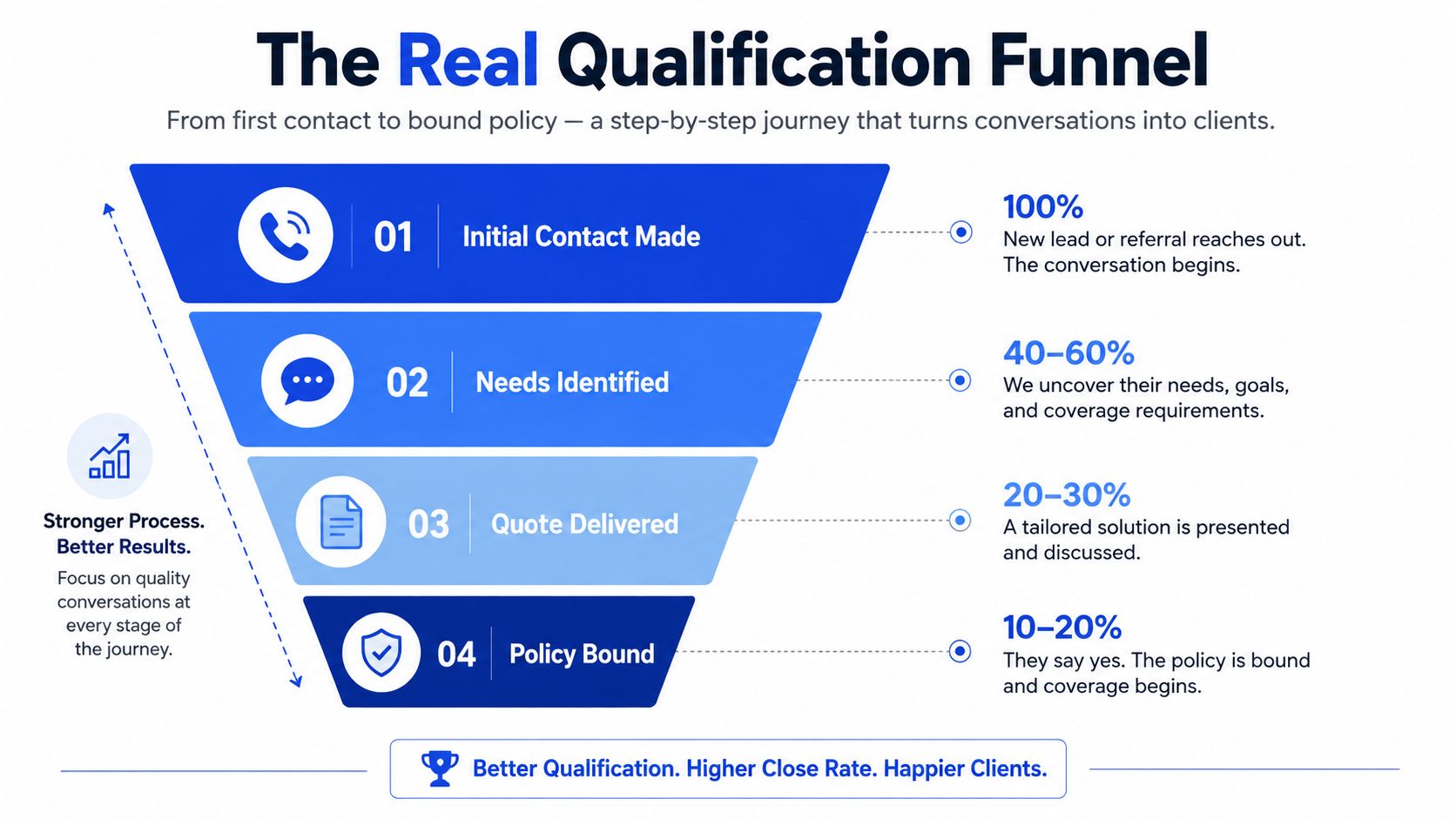
The leak points are usually earlier than leadership expects. One benchmark notes that only about 650 of 1000 leads are contacted, and another reports that 50% of leads are never called more than once, even though 80% of sales require 5+ contact attempts (telemarketing is a game changer for insurance brokers). That's not a persuasion problem. That's a persistence problem.
Fix attempts before buying more leads
If reps stop after one or two tries, your funnel will underperform no matter how good the list is. The faster move is to tighten list hygiene and raise follow-up discipline before the budget goes into more acquisition. That usually beats adding more volume to a leaky process.
The first diagnostic should be boring and ruthless. Pull the last 30 days and answer these questions:
Were all records called at least five times?
Were call attempts made in the first 24 hours?
Did the team log why each lead was disqualified?
Did quote requests get a next action?
For a more formal breakdown of stage-by-stage performance, the lead qualification process framework is a clean reference point. It reinforces the same principle, measure the funnel, not the finish line.
The fastest lift usually comes from more disciplined follow-up, not more inventory.
The video below is useful if your managers need to explain the funnel visually to reps who still think in single-close-rate terms.
Routing, sequence testing, and the optimization loop
Even good leads die when routing is sloppy. The call has to move from source to queue to rep to CRM without delays or manual handoffs that break timing. If one team owns intake, another owns dialing, and a third owns follow-up, the program needs routing rules that keep the handoff clean.
Build the routing rules before you scale
Use round-robin for equal territory coverage, weighted routing when rep performance differs, and automatic recycling when a lead goes untouched too long. HubSpot can handle the routing logic, while the dialer handles queue execution and the sequence tool handles follow-up timing. The stack matters less than the rule clarity.
For teams mapping this in systems terms, the lead routing automation concept is the right model. It keeps the lead from becoming a floating object that everyone claims after the fact.
Test one variable, not five
A lot of teams change the opener, the call window, the follow-up cadence, and the enrichment fields in the same week. Then nobody knows what helped. Pick one variable, hold the rest constant, and review the funnel stage that variable affects.
A practical stack looks like this:
HubSpot for routing and stage control
Smartlead or Instantly for email touches
Lemlist for sequenced follow-up
HeyReach for LinkedIn support
Aircall or Orum for call execution
If you're layering phone with digital, keep TCPA and opt-out handling intact. Use branded calling or verified caller ID where possible, because unknown numbers still depress pickup quality in real buyer behavior. The point is simple, phone works better when the prospect recognizes the caller.
A two-week sprint should be enough to learn something useful:
Week 1: test call window and routing rules
Week 2: test opener and follow-up cadence
Daily: review contacts, connects, and outcomes
End of sprint: choose one change to keep, one to drop
You don't need a giant system to learn. You need a disciplined one.
Kpis, dashboards, and the weekly review that keeps the program honest
If leadership doesn't review the right numbers, the program will drift. Teams start protecting activity instead of truth, and compliance issues get buried under vanity metrics. A strong insurance telemarketing dashboard should make pipeline health and risk visible in the same place.
Track the right layers
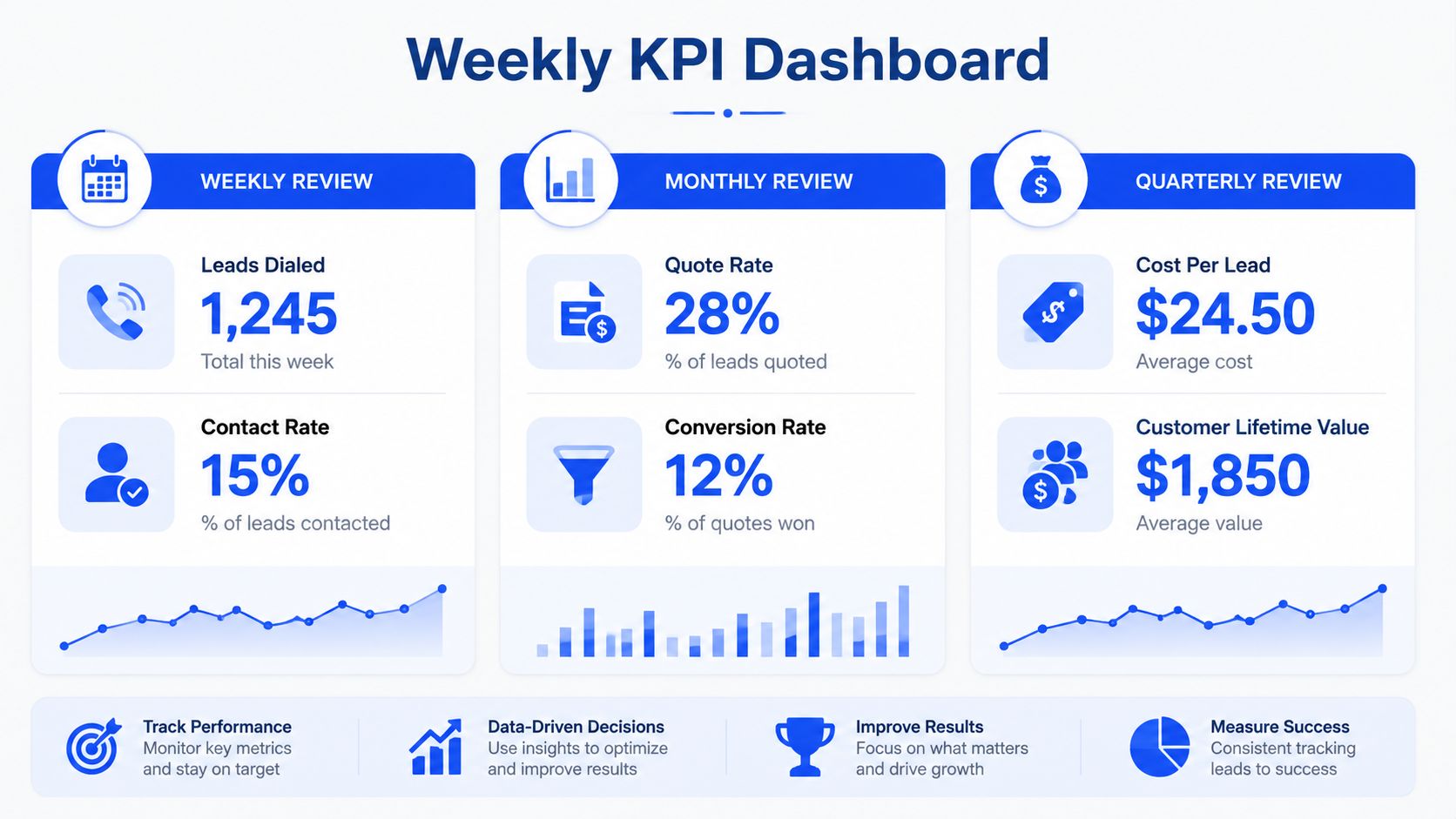
Weekly reporting should show qualified leads delivered, contact rate, qualification rate, cost per qualified appointment, and cost per bind. Diagnostic views should add attempts per lead, average time to first dial, opt-out rate, and DNC scrub failures. Quarterly reporting should include lagging signals like 90-day bind rate, retention, and premium per policy.
The dashboard needs three views. Reps need daily activity. Managers need funnel health. Executives need pipeline and compliance exposure in one glance. Anything less creates blind spots.
Run a fixed 30-minute review
The weekly meeting should never drift. Keep the agenda locked:
What the funnel did this week
What tests ran
What the next test will be
What the compliance log says
That cadence forces the team to act on evidence instead of opinions. It also gives RevOps a clean place to flag routing errors, scrub failures, or lead source issues before they become quota excuses.
If the compliance log is empty, it usually means nobody is looking closely enough.
The point of the review is not to praise effort. It's to decide what to change next. A mature program doesn't celebrate activity without asking what it produced.
Your next 7 days and answers to the questions leaders actually ask
Pull the last 30 days of insurance telemarketing lead deliveries this week. Score each source on connect rate and qualification rate, then choose one source to scale and one to drop. If you can't make that decision, the program has too many uncontrolled variables.
When does phone beat digital
Phone wins when the product is complex, the buyer needs clarification, or the lead has enough intent to justify live follow-up. It loses when the target prefers asynchronous contact or the list lacks enough trust to support a call. In practice, phone works best when it sits beside email, LinkedIn, or SMS instead of pretending those channels don't exist.
Which signals justify live dialing
Use live dialing when the prospect shows a renewal window, a life-event signal, a coverage gap, or a clearly defined need that maps to one product. Don't dial just because the record exists. Dial because the timing and fit make a live conversation worth the compliance overhead.
What consent documentation actually needs to include
Keep the source of consent, the language used, the channel covered by that consent, and the date the record entered your system. Also keep suppression history and any opt-out action tied to the record. If your team can't produce that quickly, the documentation process is too loose.
How often should the list be refreshed
Refresh on every delivery and do a full list refresh on a regular cycle, not when someone complains about bad connects. The benchmark guidance already points to fast follow-up and list freshness as core value drivers, so stale data is usually self-inflicted. Once a lead ages out, the economics change fast.
GROU has built and run multi-channel outbound programs across SaaS, iGaming, manufacturing, IT services, legal tech, and cybersecurity. The method here combines operator experience with the cited benchmarks, so the focus stays on structure, compliance, and pipeline truth.
If you want a tighter insurance outbound system, visit Grou and have us map your lead sources, routing, and qualification rules into one operating rhythm. We'll show you where the pipeline is leaking and what to fix first, without turning the program into a script library.
Your insurance telemarketing leads are probably getting killed in the wrong place. The list may be fine, but the compliance file is thin, the first call comes too late, or the CRM routing leaves good prospects sitting in limbo until they go cold. Treat the channel like a dialer problem and you'll keep buying the same disappointment.
Start with compliance, not volume. Every record needs a clear consent trail, DNC hygiene, and calling rules you can defend.
Choose buy, build, or hybrid based on control. Exclusive leads buy speed, in-house lists buy freshness, hybrids win when teams need both.
Run the funnel, not a close rate. Contact, qualification, quote, and bind each leak for different reasons.
Test one variable at a time. Routing, opener, call window, and enrichment all change results, but only if you isolate them.
Table of Contents
The buyer vs builder decision for insurance telemarketing leads
Mapping ICP, segmenting, and writing scripts that actually convert
The real qualification funnel and where insurance telemarketing pipelines leak
Kpis, dashboards, and the weekly review that keeps the program honest
Your next 7 days and answers to the questions leaders actually ask
The buyer vs builder decision for insurance telemarketing leads
Every insurance telemarketing lead has to clear a compliance floor before it earns one second of agent time. If the consent trail is messy, the DNC scrub is stale, or the calling window is off for the target state, the lead is already damaged. The team then blames dialing, when the failure happened upstream.
Buy when speed matters more than control
Buying exclusive leads makes sense when you need faster time to first dial and don't want your reps waiting on list assembly. That works best for teams with a tight launch window, a clear product focus, and enough CRM discipline to route and disposition quickly. It also works when your internal data is weak and you need outside volume now.
Shared or recycled inventory is a bad bet unless your team has a very short-cycle offer and very aggressive follow-up. The market data shows live transfers now represent 28% of total lead volume in 2026, up from 22% in 2023, while exclusive web leads fell from 35% to 32% in the same period, and live transfers carry the highest-performing benchmark profile, with 95%+ contact rates and 15% to 25% close rates according to the 2026 insurance lead industry report (insurance lead industry report 2026). That's why the buying decision is really a speed and performance decision.
Build when freshness and control matter more than speed
Building in-house gives you better list freshness control and tighter integration with your CRM and dialer workflow. It also lets you document consent in the same system you use for routing, sequencing, and suppression. That matters when you want one source of truth instead of three vendor spreadsheets and a cleanup disaster.
A good middle ground is to build your core database and buy selective overlays for time-sensitive segments. That's the model most mid-market teams should consider, because it avoids total dependence on a vendor and keeps the pipeline from stalling when one source dries up. If you already run outsourced lead gen motion for other markets, this is the same control question the team should ask in a different vertical, which is why our outsourcing lead generation framework is a useful parallel.
Practical rule: if the list will be called inside a week, buy. If it needs repeated enrichment, compliance review, and CRM stitching, build.
For teams that want to add phone into a broader outbound system, a useful reference is how some operators increase inbound calls with AI. The point isn't to chase novelty, it's to see how phone workflows fit into a larger intake system.
Sourcing path | Cost per qualified lead | Speed to first dial | List freshness control | Compliance burden | Best for |
|---|---|---|---|---|---|
Exclusive vendor leads | Higher | Fast | Medium | Medium | Teams needing immediate volume |
In-house built lists | Lower over time | Slower | High | High | Teams with data ops and compliance maturity |
Hybrid model | Balanced | Fast enough | High | High | Mid-market teams with multi-product routing |
If I were advising a head of sales, I'd start hybrid for most teams. Buy the first wave, build the data layer underneath it, and switch the highest-performing segments to in-house once the team knows what converts. That keeps the program from becoming vendor-dependent.
Sourcing and enriching compliant insurance lead lists
Once the sourcing path is set, the whole game becomes record quality. A list that looks large but lacks consent, freshness, or routing fields is just an expensive way to create bad activity. The better move is to define what a dial-ready record must contain before the first import.
Read the data card like a compliance document
Ask the vendor where the lead came from, what the opt-in language said, and whether the consent was tied to phone, email, or both. You want proof that the caller can use the record without scrambling after the fact. If the vendor won't explain the opt-in source, the record probably won't survive a real audit.
The clean-up step matters just as much. One practical standard is to scrub the list before every delivery and suppress anything that conflicts with prior outreach or do-not-call rules. That aligns with the broader point in the insurance lead quality brief, where deliverability, consent hygiene, and verified identity now shape whether a lead is usable at all (insurance lead industry report 2026).
Enrich for fit, not vanity
Use Apollo, Clay, or ZoomInfo to append the fields that change call priority. For insurance, that means age band, household composition, prior coverage clues, and renewal timing signals. You're not enriching to make the record prettier, you're enriching so the rep knows who gets called first.
The strongest lists also segment by product fit and geography. A home policy fit in one state can be a bad fit in another if licensing or regulatory rules change the call path. Commercial, auto, life, and home should never live in one undifferentiated queue.
Operational standard: refresh every 30 to 60 days, suppress on every delivery, and keep consent documentation on every record that gets dialed.
The simplest way to cut waste is to disqualify harder. A list of 2,000 that filters to 350 call-ready prospects beats 10,000 records nobody trusts. That same discipline is why our clean an email list guidance matters to outbound teams dealing with any regulated data flow.
Mapping ICP, segmenting, and writing scripts that actually convert
A clean list still fails if the script and the ICP don't match. The rep needs a written ICP for each product line, then a call path that matches the segment's intent and risk profile. Without that, you get generic openings, weak discovery, and a lot of “send me something” calls that never turn into quotes.
Write the ICP first, then route the call
For each insurance line, define the fit in plain language. Who is the target, what triggers urgency, what makes the conversation worth a live dial, and what should cause an immediate disqualify. Put those rules into routing fields so the system assigns the right lead to the right rep, not whoever happens to be available.
The actual call opening should prove legitimate research, respect time, and make the purpose obvious. That's the same principle behind the ICP framework, because segmentation only works when the team agrees on what “fit” means before the dial starts.
Keep the script tight and compliant
The best scripts don't sound like scripts. They sound like a rep who knows the record, states the purpose, and earns permission to continue. Identity disclosure, consent verification, and opt-out language are not stylistic choices. They're mandatory.
A practical template looks like this, with the exact wording adjusted for state and product rules:
Opening: confirm who you are, why you're calling, and why the prospect is in the queue.
Discovery: ask two or three qualifying questions tied to product fit.
Objections: address price, coverage amount, timing, and prior claims without rushing.
Soft close: set the next step in a way that fits the product cycle.
If you want a useful external comparator for opener structure, the DialNexa Labs cold calling advice is worth reviewing because it treats the first few seconds as a permission problem, not a pitch contest. That mindset fits insurance better than a hard sell.
Here's the part most teams miss. The script should map the result back into CRM stage, or the lead rating becomes a memory exercise instead of a system.
Call outcome | CRM stage | Next action | Follow-up cadence |
|---|---|---|---|
Connected, qualified | Active opportunity | Book quote or transfer | Immediate |
Connected, not ready | Nurture | Recycle with date trigger | Scheduled |
Connected, wrong fit | Disqualified | Record reason and suppress | None |
No answer | Working | Re-attempt with sequence | Same week |
The rep should never wonder what happens after the call. If they do, the process is already too loose.
The real qualification funnel and where insurance telemarketing pipelines leak
A single close rate hides the actual problem. Insurance telemarketing is a sequence of smaller conversions, and each one breaks for a different reason. If you only watch the end result, you'll keep buying more leads instead of fixing the leak.
Read the funnel stage by stage
The benchmark funnel is clear. Connect rates run roughly 15% to 25% for commercial prospects and 20% to 35% for personal prospects, qualification rates land at 10% to 20% of conversations, appointment-to-quote rates sit at 50% to 70%, and quote-to-bind rates are 25% to 40% according to the insurance telemarketing benchmark data (telemarketing is a game changer for insurance brokers).
The leak points are usually earlier than leadership expects. One benchmark notes that only about 650 of 1000 leads are contacted, and another reports that 50% of leads are never called more than once, even though 80% of sales require 5+ contact attempts (telemarketing is a game changer for insurance brokers). That's not a persuasion problem. That's a persistence problem.
Fix attempts before buying more leads
If reps stop after one or two tries, your funnel will underperform no matter how good the list is. The faster move is to tighten list hygiene and raise follow-up discipline before the budget goes into more acquisition. That usually beats adding more volume to a leaky process.
The first diagnostic should be boring and ruthless. Pull the last 30 days and answer these questions:
Were all records called at least five times?
Were call attempts made in the first 24 hours?
Did the team log why each lead was disqualified?
Did quote requests get a next action?
For a more formal breakdown of stage-by-stage performance, the lead qualification process framework is a clean reference point. It reinforces the same principle, measure the funnel, not the finish line.
The fastest lift usually comes from more disciplined follow-up, not more inventory.
The video below is useful if your managers need to explain the funnel visually to reps who still think in single-close-rate terms.
Routing, sequence testing, and the optimization loop
Even good leads die when routing is sloppy. The call has to move from source to queue to rep to CRM without delays or manual handoffs that break timing. If one team owns intake, another owns dialing, and a third owns follow-up, the program needs routing rules that keep the handoff clean.
Build the routing rules before you scale
Use round-robin for equal territory coverage, weighted routing when rep performance differs, and automatic recycling when a lead goes untouched too long. HubSpot can handle the routing logic, while the dialer handles queue execution and the sequence tool handles follow-up timing. The stack matters less than the rule clarity.
For teams mapping this in systems terms, the lead routing automation concept is the right model. It keeps the lead from becoming a floating object that everyone claims after the fact.
Test one variable, not five
A lot of teams change the opener, the call window, the follow-up cadence, and the enrichment fields in the same week. Then nobody knows what helped. Pick one variable, hold the rest constant, and review the funnel stage that variable affects.
A practical stack looks like this:
HubSpot for routing and stage control
Smartlead or Instantly for email touches
Lemlist for sequenced follow-up
HeyReach for LinkedIn support
Aircall or Orum for call execution
If you're layering phone with digital, keep TCPA and opt-out handling intact. Use branded calling or verified caller ID where possible, because unknown numbers still depress pickup quality in real buyer behavior. The point is simple, phone works better when the prospect recognizes the caller.
A two-week sprint should be enough to learn something useful:
Week 1: test call window and routing rules
Week 2: test opener and follow-up cadence
Daily: review contacts, connects, and outcomes
End of sprint: choose one change to keep, one to drop
You don't need a giant system to learn. You need a disciplined one.
Kpis, dashboards, and the weekly review that keeps the program honest
If leadership doesn't review the right numbers, the program will drift. Teams start protecting activity instead of truth, and compliance issues get buried under vanity metrics. A strong insurance telemarketing dashboard should make pipeline health and risk visible in the same place.
Track the right layers
Weekly reporting should show qualified leads delivered, contact rate, qualification rate, cost per qualified appointment, and cost per bind. Diagnostic views should add attempts per lead, average time to first dial, opt-out rate, and DNC scrub failures. Quarterly reporting should include lagging signals like 90-day bind rate, retention, and premium per policy.
The dashboard needs three views. Reps need daily activity. Managers need funnel health. Executives need pipeline and compliance exposure in one glance. Anything less creates blind spots.
Run a fixed 30-minute review
The weekly meeting should never drift. Keep the agenda locked:
What the funnel did this week
What tests ran
What the next test will be
What the compliance log says
That cadence forces the team to act on evidence instead of opinions. It also gives RevOps a clean place to flag routing errors, scrub failures, or lead source issues before they become quota excuses.
If the compliance log is empty, it usually means nobody is looking closely enough.
The point of the review is not to praise effort. It's to decide what to change next. A mature program doesn't celebrate activity without asking what it produced.
Your next 7 days and answers to the questions leaders actually ask
Pull the last 30 days of insurance telemarketing lead deliveries this week. Score each source on connect rate and qualification rate, then choose one source to scale and one to drop. If you can't make that decision, the program has too many uncontrolled variables.
When does phone beat digital
Phone wins when the product is complex, the buyer needs clarification, or the lead has enough intent to justify live follow-up. It loses when the target prefers asynchronous contact or the list lacks enough trust to support a call. In practice, phone works best when it sits beside email, LinkedIn, or SMS instead of pretending those channels don't exist.
Which signals justify live dialing
Use live dialing when the prospect shows a renewal window, a life-event signal, a coverage gap, or a clearly defined need that maps to one product. Don't dial just because the record exists. Dial because the timing and fit make a live conversation worth the compliance overhead.
What consent documentation actually needs to include
Keep the source of consent, the language used, the channel covered by that consent, and the date the record entered your system. Also keep suppression history and any opt-out action tied to the record. If your team can't produce that quickly, the documentation process is too loose.
How often should the list be refreshed
Refresh on every delivery and do a full list refresh on a regular cycle, not when someone complains about bad connects. The benchmark guidance already points to fast follow-up and list freshness as core value drivers, so stale data is usually self-inflicted. Once a lead ages out, the economics change fast.
GROU has built and run multi-channel outbound programs across SaaS, iGaming, manufacturing, IT services, legal tech, and cybersecurity. The method here combines operator experience with the cited benchmarks, so the focus stays on structure, compliance, and pipeline truth.
If you want a tighter insurance outbound system, visit Grou and have us map your lead sources, routing, and qualification rules into one operating rhythm. We'll show you where the pipeline is leaking and what to fix first, without turning the program into a script library.
Your insurance telemarketing leads are probably getting killed in the wrong place. The list may be fine, but the compliance file is thin, the first call comes too late, or the CRM routing leaves good prospects sitting in limbo until they go cold. Treat the channel like a dialer problem and you'll keep buying the same disappointment.
Start with compliance, not volume. Every record needs a clear consent trail, DNC hygiene, and calling rules you can defend.
Choose buy, build, or hybrid based on control. Exclusive leads buy speed, in-house lists buy freshness, hybrids win when teams need both.
Run the funnel, not a close rate. Contact, qualification, quote, and bind each leak for different reasons.
Test one variable at a time. Routing, opener, call window, and enrichment all change results, but only if you isolate them.
Table of Contents
The buyer vs builder decision for insurance telemarketing leads
Mapping ICP, segmenting, and writing scripts that actually convert
The real qualification funnel and where insurance telemarketing pipelines leak
Kpis, dashboards, and the weekly review that keeps the program honest
Your next 7 days and answers to the questions leaders actually ask
The buyer vs builder decision for insurance telemarketing leads
Every insurance telemarketing lead has to clear a compliance floor before it earns one second of agent time. If the consent trail is messy, the DNC scrub is stale, or the calling window is off for the target state, the lead is already damaged. The team then blames dialing, when the failure happened upstream.
Buy when speed matters more than control
Buying exclusive leads makes sense when you need faster time to first dial and don't want your reps waiting on list assembly. That works best for teams with a tight launch window, a clear product focus, and enough CRM discipline to route and disposition quickly. It also works when your internal data is weak and you need outside volume now.
Shared or recycled inventory is a bad bet unless your team has a very short-cycle offer and very aggressive follow-up. The market data shows live transfers now represent 28% of total lead volume in 2026, up from 22% in 2023, while exclusive web leads fell from 35% to 32% in the same period, and live transfers carry the highest-performing benchmark profile, with 95%+ contact rates and 15% to 25% close rates according to the 2026 insurance lead industry report (insurance lead industry report 2026). That's why the buying decision is really a speed and performance decision.
Build when freshness and control matter more than speed
Building in-house gives you better list freshness control and tighter integration with your CRM and dialer workflow. It also lets you document consent in the same system you use for routing, sequencing, and suppression. That matters when you want one source of truth instead of three vendor spreadsheets and a cleanup disaster.
A good middle ground is to build your core database and buy selective overlays for time-sensitive segments. That's the model most mid-market teams should consider, because it avoids total dependence on a vendor and keeps the pipeline from stalling when one source dries up. If you already run outsourced lead gen motion for other markets, this is the same control question the team should ask in a different vertical, which is why our outsourcing lead generation framework is a useful parallel.
Practical rule: if the list will be called inside a week, buy. If it needs repeated enrichment, compliance review, and CRM stitching, build.
For teams that want to add phone into a broader outbound system, a useful reference is how some operators increase inbound calls with AI. The point isn't to chase novelty, it's to see how phone workflows fit into a larger intake system.
Sourcing path | Cost per qualified lead | Speed to first dial | List freshness control | Compliance burden | Best for |
|---|---|---|---|---|---|
Exclusive vendor leads | Higher | Fast | Medium | Medium | Teams needing immediate volume |
In-house built lists | Lower over time | Slower | High | High | Teams with data ops and compliance maturity |
Hybrid model | Balanced | Fast enough | High | High | Mid-market teams with multi-product routing |
If I were advising a head of sales, I'd start hybrid for most teams. Buy the first wave, build the data layer underneath it, and switch the highest-performing segments to in-house once the team knows what converts. That keeps the program from becoming vendor-dependent.
Sourcing and enriching compliant insurance lead lists
Once the sourcing path is set, the whole game becomes record quality. A list that looks large but lacks consent, freshness, or routing fields is just an expensive way to create bad activity. The better move is to define what a dial-ready record must contain before the first import.
Read the data card like a compliance document
Ask the vendor where the lead came from, what the opt-in language said, and whether the consent was tied to phone, email, or both. You want proof that the caller can use the record without scrambling after the fact. If the vendor won't explain the opt-in source, the record probably won't survive a real audit.
The clean-up step matters just as much. One practical standard is to scrub the list before every delivery and suppress anything that conflicts with prior outreach or do-not-call rules. That aligns with the broader point in the insurance lead quality brief, where deliverability, consent hygiene, and verified identity now shape whether a lead is usable at all (insurance lead industry report 2026).
Enrich for fit, not vanity
Use Apollo, Clay, or ZoomInfo to append the fields that change call priority. For insurance, that means age band, household composition, prior coverage clues, and renewal timing signals. You're not enriching to make the record prettier, you're enriching so the rep knows who gets called first.
The strongest lists also segment by product fit and geography. A home policy fit in one state can be a bad fit in another if licensing or regulatory rules change the call path. Commercial, auto, life, and home should never live in one undifferentiated queue.
Operational standard: refresh every 30 to 60 days, suppress on every delivery, and keep consent documentation on every record that gets dialed.
The simplest way to cut waste is to disqualify harder. A list of 2,000 that filters to 350 call-ready prospects beats 10,000 records nobody trusts. That same discipline is why our clean an email list guidance matters to outbound teams dealing with any regulated data flow.
Mapping ICP, segmenting, and writing scripts that actually convert
A clean list still fails if the script and the ICP don't match. The rep needs a written ICP for each product line, then a call path that matches the segment's intent and risk profile. Without that, you get generic openings, weak discovery, and a lot of “send me something” calls that never turn into quotes.
Write the ICP first, then route the call
For each insurance line, define the fit in plain language. Who is the target, what triggers urgency, what makes the conversation worth a live dial, and what should cause an immediate disqualify. Put those rules into routing fields so the system assigns the right lead to the right rep, not whoever happens to be available.
The actual call opening should prove legitimate research, respect time, and make the purpose obvious. That's the same principle behind the ICP framework, because segmentation only works when the team agrees on what “fit” means before the dial starts.
Keep the script tight and compliant
The best scripts don't sound like scripts. They sound like a rep who knows the record, states the purpose, and earns permission to continue. Identity disclosure, consent verification, and opt-out language are not stylistic choices. They're mandatory.
A practical template looks like this, with the exact wording adjusted for state and product rules:
Opening: confirm who you are, why you're calling, and why the prospect is in the queue.
Discovery: ask two or three qualifying questions tied to product fit.
Objections: address price, coverage amount, timing, and prior claims without rushing.
Soft close: set the next step in a way that fits the product cycle.
If you want a useful external comparator for opener structure, the DialNexa Labs cold calling advice is worth reviewing because it treats the first few seconds as a permission problem, not a pitch contest. That mindset fits insurance better than a hard sell.
Here's the part most teams miss. The script should map the result back into CRM stage, or the lead rating becomes a memory exercise instead of a system.
Call outcome | CRM stage | Next action | Follow-up cadence |
|---|---|---|---|
Connected, qualified | Active opportunity | Book quote or transfer | Immediate |
Connected, not ready | Nurture | Recycle with date trigger | Scheduled |
Connected, wrong fit | Disqualified | Record reason and suppress | None |
No answer | Working | Re-attempt with sequence | Same week |
The rep should never wonder what happens after the call. If they do, the process is already too loose.
The real qualification funnel and where insurance telemarketing pipelines leak
A single close rate hides the actual problem. Insurance telemarketing is a sequence of smaller conversions, and each one breaks for a different reason. If you only watch the end result, you'll keep buying more leads instead of fixing the leak.
Read the funnel stage by stage
The benchmark funnel is clear. Connect rates run roughly 15% to 25% for commercial prospects and 20% to 35% for personal prospects, qualification rates land at 10% to 20% of conversations, appointment-to-quote rates sit at 50% to 70%, and quote-to-bind rates are 25% to 40% according to the insurance telemarketing benchmark data (telemarketing is a game changer for insurance brokers).
The leak points are usually earlier than leadership expects. One benchmark notes that only about 650 of 1000 leads are contacted, and another reports that 50% of leads are never called more than once, even though 80% of sales require 5+ contact attempts (telemarketing is a game changer for insurance brokers). That's not a persuasion problem. That's a persistence problem.
Fix attempts before buying more leads
If reps stop after one or two tries, your funnel will underperform no matter how good the list is. The faster move is to tighten list hygiene and raise follow-up discipline before the budget goes into more acquisition. That usually beats adding more volume to a leaky process.
The first diagnostic should be boring and ruthless. Pull the last 30 days and answer these questions:
Were all records called at least five times?
Were call attempts made in the first 24 hours?
Did the team log why each lead was disqualified?
Did quote requests get a next action?
For a more formal breakdown of stage-by-stage performance, the lead qualification process framework is a clean reference point. It reinforces the same principle, measure the funnel, not the finish line.
The fastest lift usually comes from more disciplined follow-up, not more inventory.
The video below is useful if your managers need to explain the funnel visually to reps who still think in single-close-rate terms.
Routing, sequence testing, and the optimization loop
Even good leads die when routing is sloppy. The call has to move from source to queue to rep to CRM without delays or manual handoffs that break timing. If one team owns intake, another owns dialing, and a third owns follow-up, the program needs routing rules that keep the handoff clean.
Build the routing rules before you scale
Use round-robin for equal territory coverage, weighted routing when rep performance differs, and automatic recycling when a lead goes untouched too long. HubSpot can handle the routing logic, while the dialer handles queue execution and the sequence tool handles follow-up timing. The stack matters less than the rule clarity.
For teams mapping this in systems terms, the lead routing automation concept is the right model. It keeps the lead from becoming a floating object that everyone claims after the fact.
Test one variable, not five
A lot of teams change the opener, the call window, the follow-up cadence, and the enrichment fields in the same week. Then nobody knows what helped. Pick one variable, hold the rest constant, and review the funnel stage that variable affects.
A practical stack looks like this:
HubSpot for routing and stage control
Smartlead or Instantly for email touches
Lemlist for sequenced follow-up
HeyReach for LinkedIn support
Aircall or Orum for call execution
If you're layering phone with digital, keep TCPA and opt-out handling intact. Use branded calling or verified caller ID where possible, because unknown numbers still depress pickup quality in real buyer behavior. The point is simple, phone works better when the prospect recognizes the caller.
A two-week sprint should be enough to learn something useful:
Week 1: test call window and routing rules
Week 2: test opener and follow-up cadence
Daily: review contacts, connects, and outcomes
End of sprint: choose one change to keep, one to drop
You don't need a giant system to learn. You need a disciplined one.
Kpis, dashboards, and the weekly review that keeps the program honest
If leadership doesn't review the right numbers, the program will drift. Teams start protecting activity instead of truth, and compliance issues get buried under vanity metrics. A strong insurance telemarketing dashboard should make pipeline health and risk visible in the same place.
Track the right layers
Weekly reporting should show qualified leads delivered, contact rate, qualification rate, cost per qualified appointment, and cost per bind. Diagnostic views should add attempts per lead, average time to first dial, opt-out rate, and DNC scrub failures. Quarterly reporting should include lagging signals like 90-day bind rate, retention, and premium per policy.
The dashboard needs three views. Reps need daily activity. Managers need funnel health. Executives need pipeline and compliance exposure in one glance. Anything less creates blind spots.
Run a fixed 30-minute review
The weekly meeting should never drift. Keep the agenda locked:
What the funnel did this week
What tests ran
What the next test will be
What the compliance log says
That cadence forces the team to act on evidence instead of opinions. It also gives RevOps a clean place to flag routing errors, scrub failures, or lead source issues before they become quota excuses.
If the compliance log is empty, it usually means nobody is looking closely enough.
The point of the review is not to praise effort. It's to decide what to change next. A mature program doesn't celebrate activity without asking what it produced.
Your next 7 days and answers to the questions leaders actually ask
Pull the last 30 days of insurance telemarketing lead deliveries this week. Score each source on connect rate and qualification rate, then choose one source to scale and one to drop. If you can't make that decision, the program has too many uncontrolled variables.
When does phone beat digital
Phone wins when the product is complex, the buyer needs clarification, or the lead has enough intent to justify live follow-up. It loses when the target prefers asynchronous contact or the list lacks enough trust to support a call. In practice, phone works best when it sits beside email, LinkedIn, or SMS instead of pretending those channels don't exist.
Which signals justify live dialing
Use live dialing when the prospect shows a renewal window, a life-event signal, a coverage gap, or a clearly defined need that maps to one product. Don't dial just because the record exists. Dial because the timing and fit make a live conversation worth the compliance overhead.
What consent documentation actually needs to include
Keep the source of consent, the language used, the channel covered by that consent, and the date the record entered your system. Also keep suppression history and any opt-out action tied to the record. If your team can't produce that quickly, the documentation process is too loose.
How often should the list be refreshed
Refresh on every delivery and do a full list refresh on a regular cycle, not when someone complains about bad connects. The benchmark guidance already points to fast follow-up and list freshness as core value drivers, so stale data is usually self-inflicted. Once a lead ages out, the economics change fast.
GROU has built and run multi-channel outbound programs across SaaS, iGaming, manufacturing, IT services, legal tech, and cybersecurity. The method here combines operator experience with the cited benchmarks, so the focus stays on structure, compliance, and pipeline truth.
If you want a tighter insurance outbound system, visit Grou and have us map your lead sources, routing, and qualification rules into one operating rhythm. We'll show you where the pipeline is leaking and what to fix first, without turning the program into a script library.
Pipeline OS Newsletter
Build qualified pipeline
Get weekly tactics to generate demand, improve lead quality, and book more meetings.







Trusted by industry leaders
Trusted by industry leaders
Trusted by industry leaders
Ready to build qualified pipeline?
Ready to build qualified pipeline?
Ready to build qualified pipeline?
Book a call to see if we're the right fit, or take the 2-minute quiz to get a clear starting point.
Book a call to see if we're the right fit, or take the 2-minute quiz to get a clear starting point.
Book a call to see if we're the right fit, or take the 2-minute quiz to get a clear starting point.
" height="30.21639343089746px" id="hfGbXmQR2" width="30.216393430897455px"/></svg>)
Copyright © 2026 – All Right Reserved
Copyright © 2026 – All Right Reserved
Copyright © 2026 – All Right Reserved