%22%3E%3C/path%3E%3Cpath d=%22M 63.072 7.554 C 62.258 8.022 61.577 8.689 61.092 9.493 L 61.092 7.076 L 57.158 7.076 L 57.158 22.64 L 61.089 22.64 L 61.089 14.888 C 61.089 13.446 61.403 12.434 62.03 11.853 C 62.818 11.218 63.818 10.907 64.826 10.982 L 65.868 10.982 L 65.868 6.851 C 64.891 6.834 63.926 7.076 63.073 7.554 Z%22 fill=%22rgb(17,17,17)%22%3E%3C/path%3E%3Cpath d=%22M 78.916 7.82 C 76.363 6.49 73.321 6.49 70.768 7.82 C 69.562 8.473 68.564 9.451 67.888 10.644 C 67.167 11.931 66.803 13.387 66.834 14.862 C 66.804 16.332 67.157 17.785 67.86 19.077 C 68.515 20.267 69.494 21.246 70.684 21.901 C 71.924 22.576 73.318 22.92 74.73 22.898 C 76.164 22.918 77.58 22.575 78.846 21.901 C 80.062 21.247 81.073 20.27 81.768 19.077 C 82.506 17.797 82.88 16.339 82.85 14.862 C 82.88 13.389 82.517 11.934 81.797 10.647 C 81.12 9.455 80.122 8.477 78.917 7.824 M 78.803 14.862 C 78.829 15.739 78.636 16.608 78.241 17.391 C 77.903 18.046 77.38 18.588 76.738 18.95 C 76.124 19.293 75.432 19.472 74.729 19.47 C 73.668 19.497 72.648 19.061 71.934 18.276 C 71.139 17.323 70.741 16.1 70.823 14.862 C 70.741 13.62 71.149 12.395 71.959 11.45 C 72.687 10.667 73.715 10.233 74.783 10.256 C 75.859 10.236 76.894 10.67 77.635 11.45 C 78.464 12.387 78.884 13.616 78.801 14.864%22 fill=%22rgb(17,17,17)%22%3E%3C/path%3E%3Cpath d=%22M 95.906 7.076 L 95.906 15.646 C 95.975 16.68 95.643 17.701 94.979 18.498 C 94.311 19.184 93.379 19.547 92.422 19.495 C 91.475 19.544 90.553 19.18 89.894 18.498 C 89.23 17.701 88.898 16.68 88.967 15.646 L 88.967 7.076 L 85.033 7.076 L 85.033 16.207 C 85 17.449 85.275 18.68 85.834 19.79 C 86.327 20.75 87.095 21.542 88.039 22.065 C 89.033 22.594 90.145 22.861 91.271 22.838 C 92.188 22.847 93.095 22.65 93.926 22.263 C 94.708 21.905 95.388 21.36 95.906 20.675 L 95.906 22.645 L 99.865 22.645 L 99.865 7.076 Z%22 fill=%22rgb(17,17,17)%22%3E%3C/path%3E%3Cpath d=%22M 4.513 15.626 C 4.511 10.815 7.606 6.549 12.181 5.059 C 16.756 3.57 21.77 5.195 24.601 9.086 L 27.816 5.87 C 24.074 1.186 17.981 -0.943 12.137 0.393 C 6.292 1.728 1.728 6.292 0.393 12.137 C -0.943 17.981 1.186 24.074 5.87 27.816 L 9.085 24.601 C 6.214 22.512 4.515 19.177 4.513 15.626%22 fill=%22rgb(32,62,235)%22%3E%3C/path%3E%3Cpath d=%22M 17.114 14.343 L 13.354 18.01 L 13.354 18.026 L 21.071 18.026 L 11.412 27.609 L 17.389 27.609 L 23.999 21.081 L 23.999 28.316 L 24.005 28.316 L 27.967 24.393 L 27.967 14.343 Z%22 fill=%22rgb(32,62,235)%22%3E%3C/path%3E%3C/g%3E%3C/svg%3E) ×
× ××
××›
›
›
›
Enterprise account management 2026: how to grow key accounts
Enterprise account management 2026: how to grow key accounts
Enterprise account management 2026: how to grow key accounts
Enterprise account management 2026: how to grow key accounts
Enterprise account management 2026: how to grow key accounts
Enterprise account management 2026: how to grow key accounts

Author
Aljaz Peklaj

Q2 pipeline review is full of familiar names, but the same enterprise opportunities keep sliding into next quarter. Outbound volume is rising, content is publishing, and stage three is crowded, yet nobody can explain which buying-group member is blocking progress.
Single-threaded relationships hide approval risk.
Content and outbound often work from different account lists.
Qualification records activity instead of verified buying progress.
CRM data makes weak coverage look like healthy pipeline.
Enterprise account management fixes the leak by joining strategy, coverage, process, tooling, and reporting into one operating system. The recommendation is straightforward: manage the account as a network of people and approval paths, not as one logo with one champion.
Table of Contents
Why enterprise accounts stall in your pipeline right now
The stalled account usually looks healthy in the CRM. A champion attended a meeting, downloaded a technical document, and introduced the vendor to a colleague. The opportunity moved forward because someone was engaged. Then security asks for evidence, procurement challenges the commercial case, or finance questions the payback, and the forecast moves right.
The problem is rarely a shortage of activity. It's a failure to connect activity to the buying process.
Practical rule: A meeting is evidence of interest. It isn't evidence that the account can buy.
A single champion can't represent every approval dependency. Enterprise buying groups commonly include business ownership, IT, security, finance, procurement, legal, and end-user operations. Forrester research cited in industry analysis places the average B2B buying group at 13 people, while the same analysis reports that IT and security raise the largest objections in 38% of deals, and finance and procurement do so in 30%. The buying-committee analysis shows why a late-stage forecast can remain exposed even when the primary contact is enthusiastic.
The second leak appears when marketing and sales work from separate lists. Marketing promotes a broad category message while outbound approaches a different set of accounts with a different pain hypothesis. The buyer receives activity, but the internal team has no shared account narrative. The sales pipeline management framework is useful here because it treats list ownership, qualification, stage movement, and reporting as connected operating decisions.
The third leak is weak recovery. A stalled opportunity needs a documented next action, a clear owner, and a reason for the pause. Some teams use an external workflow for sales recovery using AI coworkers to help surface follow-ups and organize dormant-deal actions, but automation can't compensate for an account record that lacks stakeholder roles or a verified business case.
Enterprise account management closes these gaps by giving every named account one target-list record, one message per segment, one coverage model, and one reporting line. That structure helps the team separate early engagement from genuine committee progress.
What enterprise account management actually is in 2026
Enterprise account management is the formal discipline of selecting, winning, growing, and protecting a finite list of strategically important accounts. It includes dedicated ownership, cross-functional planning, relationship governance, performance measurement, and joint value creation. A 2023 systematic review of 104 academic studies covering KAM research from 1990 to 2022 shows that the discipline has developed across more than three decades, rather than appearing as a recent label for senior sales work. The systematic review of KAM research also supports treating the model as relevant across sectors and markets.
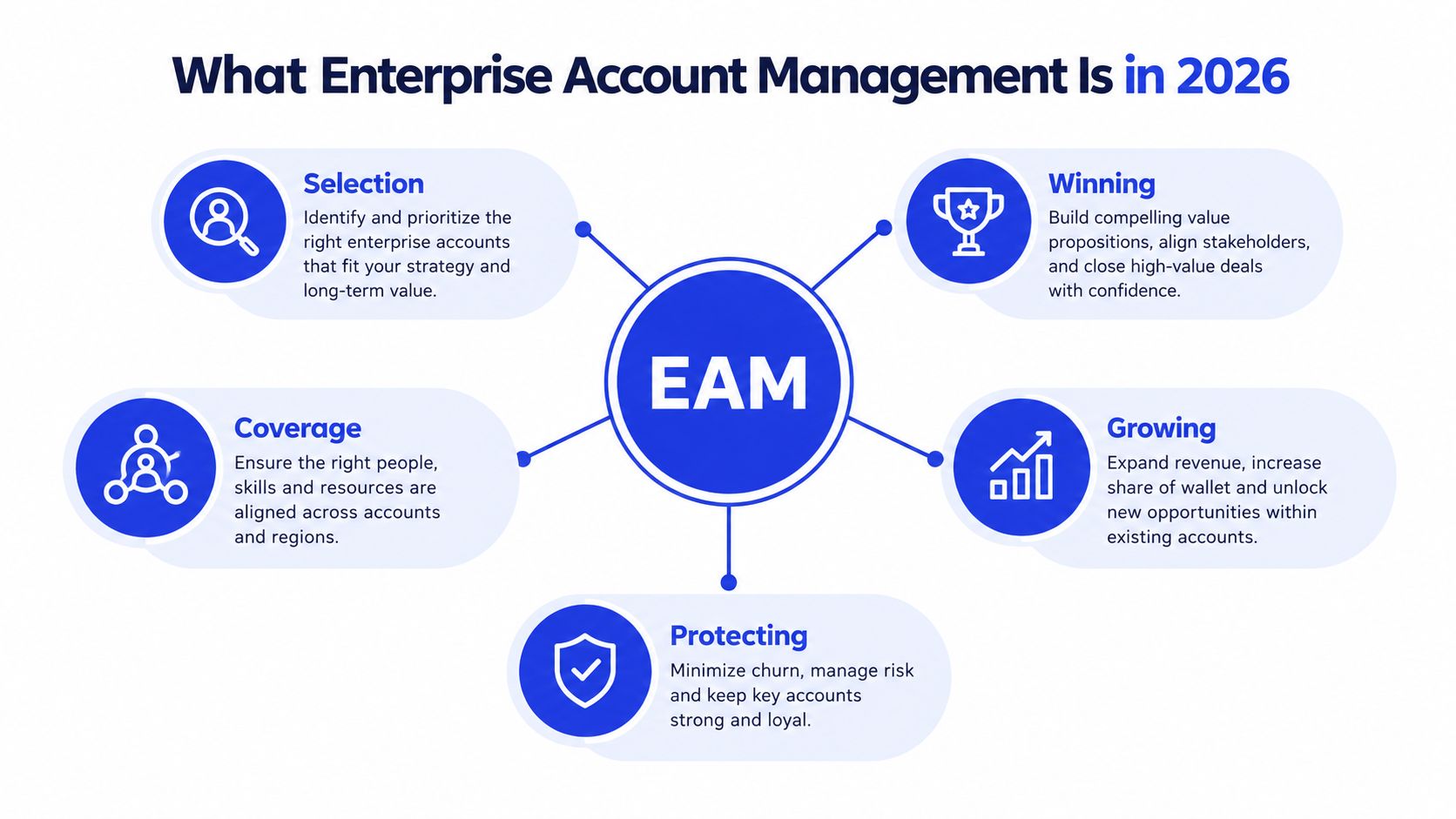
The term creates confusion because teams use it for several different motions.
It isn't just a senior sales role
A senior seller can own a large opportunity without running an enterprise account program. Account management adds account selection, tiering, role coverage, customer-specific planning, and a shared view of commercial and delivery risk.
It also isn't identical to ABM. ABM can supply the campaign motion, but enterprise account management decides which accounts deserve coordinated attention, which stakeholders need coverage, and how engagement becomes a qualified opportunity. A standalone ABM campaign that never feeds the same CRM account list creates activity without operational continuity.
Nor is it a CRM label. Adding an “enterprise” field to an account record doesn't create governance. The team needs explicit ownership, decision criteria, next actions, and review points.
What belongs inside the system
A working program includes:
→ Named-account selection based on fit, potential, timing, and service economics
→ Segmentation by buying role, market, language, and urgency
→ Multi-threaded stakeholder coverage across approval functions
→ Joint plays between SDRs, account executives, marketing, solutions engineering, and customer success
→ Account-level reporting that distinguishes engagement from verified buying progress
→ Renewal and expansion signals tied to the same account history
Raw outbound without named accounts sits outside the model. MQL chasing without account context sits outside it too. Content that isn't connected to the target list, message, and sales follow-up also fails the test.
The international KAM research covered companies across the UK, North America, Northern Europe, Southern Europe, the Middle East and North Africa, and Australasia, with representation from services, professional and financial services, industrial and engineering, and manufacturing. That spread supports a practical conclusion: enterprise account management is an operating model for complex B2B relationships, not a niche motion for one geography.
The four-layer framework behind every enterprise program
GROU runs enterprise programs through four connected layers. The names matter less than the dependency between them. A precise account strategy still fails if the team structure creates handoff gaps. A good process still fails when the CRM contains duplicate accounts and stale contacts.

Strategy decides where attention goes
Start with a named account list. Define the ICP score, account tiers, market boundaries, buying triggers, and revenue objective before anyone scales outreach. Store the logic in Salesforce or HubSpot, not in a planning document that never reaches the people sending messages.
The account list should show why each company belongs. Company size alone tells you very little about what an enterprise buyer cares about. Fit, buying role, market, and timing produce a more useful segmentation decision.
Org structure decides who acts
Assign an account owner, SDR coverage, account executive responsibility, customer success involvement, and content ownership. Each person should work from the same account record and understand the current message, open objection, and next mutual action.
A shared Slack channel can support rapid feedback, but it isn't a substitute for CRM ownership. If a reply arrives from a technical evaluator, the team needs a routing rule that preserves context instead of restarting discovery.
Processes decide how work moves
Use a weekly standup to review account movement, a bi-weekly sprint review to assess quality, and a qualification framework such as BANT or MEDDIC. The qualification method matters less than the evidence standard. A late-stage opportunity needs proof of business value, stakeholder access, technical validation, and a commercial path.
Content-to-outbound sequencing can sit in Lemlist, Artisan, or a comparable workflow. The sequence should reflect the account segment and buying role. A technical evaluator shouldn't receive the same first message as an executive sponsor.
Tooling and metrics expose the leaks
Enrich records through Apollo or ZoomInfo, capture engagement in 6sense where available, and roll performance into Looker or Metabase. HubSpot and Salesforce can hold the operational truth, but only if ownership, timestamps, role fields, and stage definitions are enforced.
A data team building research workflows can use this account research playbook for data teams as a reference point for agent-assisted account investigation. The principle is simple: inferred information should remain distinguishable from verified information.
The sales process automation framework belongs underneath this structure, not above it. Automation should execute a defined process. It shouldn't decide what the process means.
Segmentation rules that fit, role, market and timing
GROU segments accounts in a fixed order: fit, buying role, market, and timing. That order prevents a tempting trigger from pulling a poor-fit company into an expensive enterprise motion.
Start with fit
Set the fit rules before list building. Relevant filters may include employee count, revenue band, technology presence, funding stage, operating geography, and a hard ICP score. The score should be disqualifying when the account lacks the pain, buying environment, or commercial potential required by the program.
An iGaming operator might fit the category but still fail the first screen if its operating model, license footprint, or product stack falls outside the serviceable segment. A SaaS company can look attractive by employee count while lacking the technical complexity that creates urgency.
For teams refining their criteria, the ICP framework should become a CRM rule, not a slogan used during campaign reviews.
Add the buying role
Map the economic buyer, technical evaluator, end user, procurement owner, security stakeholder, and executive sponsor. Titles vary by industry, so build a title-to-function map before launch.
A cybersecurity vendor may need separate messaging for a CEO, COO, CIO, and IT decision-maker. A manufacturing program may prioritize engineering, plant leadership, operations, and procurement. The contact record should capture the concern each person owns, not just the person's title.
Layer in market conditions
Market filters explain why the same message can work in one segment and fail in another. Consider regulatory pressure, replacement activity, expansion geography, language, and category maturity.
For pharma, compliance and validation may shape the first conversation. In legal tech, risk, data handling, and departmental adoption can matter more than a feature comparison. In iGaming, operator type and market exposure often determine the commercial context.
Finish with timing
Timing signals include hiring activity, earnings language, leadership changes, product launches, event attendance, and intent data. Timing should refine a good account list, not rescue a weak one.
Segmentation input | Question to answer | iGaming example | Cybersecurity example | Manufacturing example |
|---|---|---|---|---|
Fit | Does the account match the ICP and service model? | Operator with the required product and market profile | Vendor serving the intended regulated customer base | Manufacturer with the right production complexity |
Buying role | Who can approve, block, implement, or use the purchase? | Operator leadership, gaming floor, and procurement | CISO, CIO, IT operations, and finance | Engineering, plant leadership, operations, and procurement |
Market | Which external conditions shape the message? | License environment and expansion geography | NIST adoption, regulatory pressure, and replacement activity | Market saturation and regional production demand |
Timing | Why should this account act now? | License renewal window or market entry | CISO turnover, hiring, or security program change | Plant expansion announcement or trade-show timing |
The output is one target list, one message per segment, and one reporting line. Content and outbound should reinforce the same account hypothesis instead of competing for attention.
Multi-threading the buying group instead of the champion
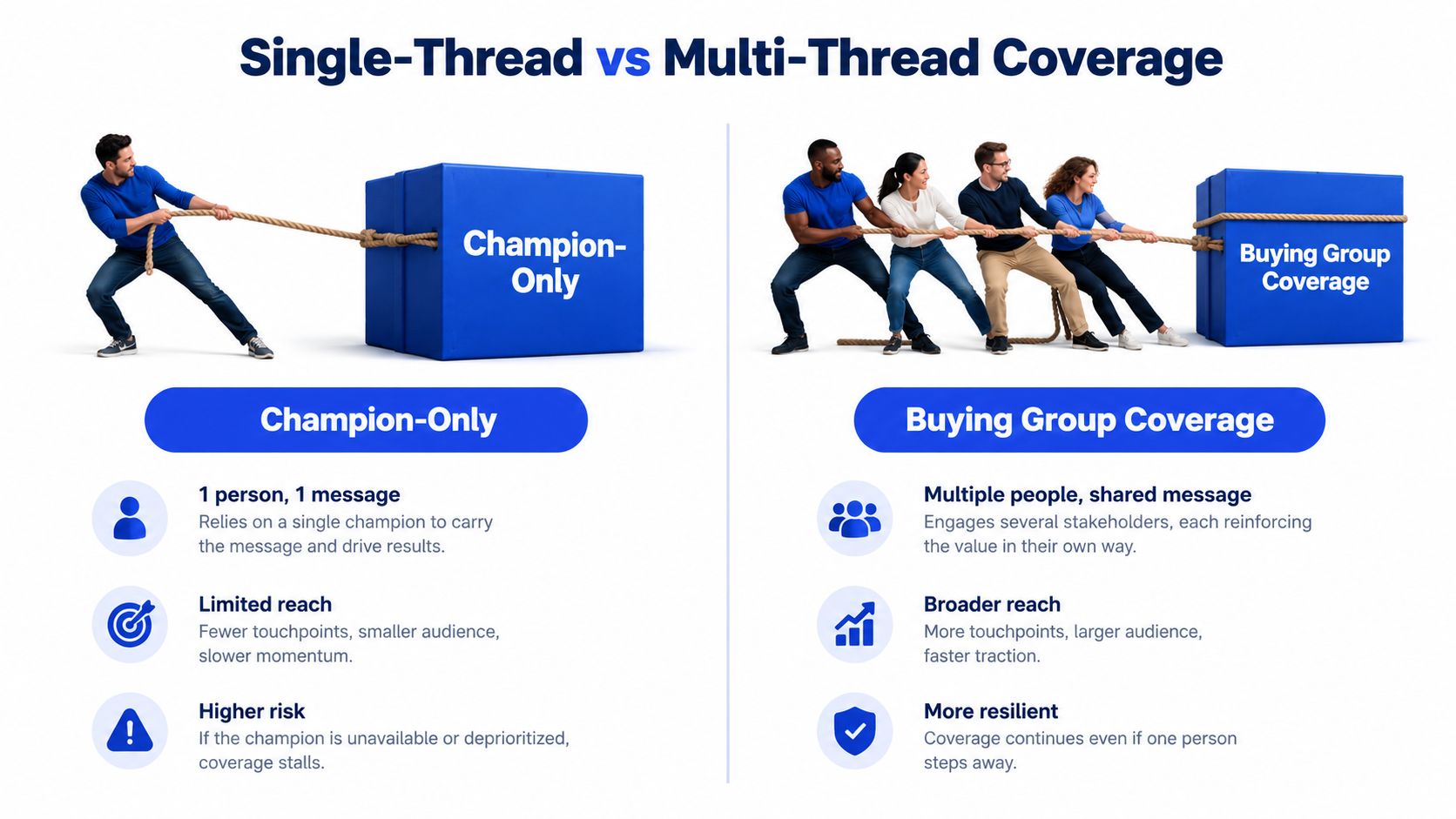
The champion is useful, but champion access is not committee coverage. A deal that depends on one person carries hidden risk when security, procurement, legal, or finance enters the process.
Research cited in a B2B buying-committee study found that enterprise sellers plan for an average of 6.0 stakeholders per opportunity. Among companies with 1,000 or more employees, 58.2% identify four or more decision-maker titles, while 20.7% target six to eight stakeholders and 14.2% target nine or more. The buying-committee study supports a coverage model built around roles rather than contact volume.
Set a minimum standard of three engaged contacts spanning the economic buyer, technical evaluator, and end user. Add a coach who can explain the internal politics and tell the account team where the proposal is vulnerable. More contacts aren't automatically better. The required coverage depends on the approval path.
Prove coverage in the CRM
Track distinct stakeholders engaged, mapped decision roles, the last meaningful interaction for each role, the next action per stakeholder, stated success criteria, unresolved objections, and committee alignment. A contact's job title and email address don't prove influence.
Role-specific content helps fill the map. Send implementation evidence to technical evaluators, financial justification to economic buyers, workflow proof to end users, and risk documentation to security or legal. LinkedIn content, outbound sequences, webinars, and event follow-up should all use the same role map.
A single-thread report might show one reply, two meetings, and a late-stage opportunity. A multi-thread report shows the champion's status, executive access, technical validation, procurement entry, security position, and the next action for each role. The second report is less flattering, but it gives leadership something they can act on.
The stakeholder engagement framework is useful when the account team needs to move from contact activity to relationship coverage.
Forecast rule: No enterprise opportunity moves to commit without evidence that the required buying roles are covered.
Dashboards, metrics and the bi-weekly sprint rhythm
An enterprise dashboard should answer one question: did the target accounts move closer to a defensible buying decision? Sends, connection requests, and booked meetings can provide context, but they shouldn't lead the review.
Use HubSpot or Salesforce as the source for account, contact, opportunity, activity, and attribution fields. A reporting layer such as Looker or Metabase can present the account view without changing the underlying definitions. Teams that need a ready-made reporting layer can review Flowkon reporting features, then map the output to their own CRM fields.
Metric | Formula | CRM source | Target band | Sprint action if missed |
|---|---|---|---|---|
Tier-one accounts | Count of accounts in the highest-priority tier | Account tier | Defined before launch | Recheck tier rules and ownership |
Full committee coverage | Accounts with all required roles engaged ÷ tier-one accounts | Contact roles and meaningful activity | Set by segment | Run a coverage blitz |
Qualified opportunities created | Opportunities meeting qualification criteria during the period | Opportunity stage and qualification fields | Baseline by segment | Review qualification evidence |
Pipeline value by segment | Sum of qualified opportunity value grouped by segment | Opportunity amount and segment | Revenue plan range | Reallocate account attention |
Average deal cycle by tier | Time from qualified stage entry to closed outcome ÷ completed opportunities | Stage history and close date | Historical baseline | Inspect blocked approval paths |
Multi-thread ratio | Opportunities with required stakeholder coverage ÷ active enterprise opportunities | Opportunity stakeholder fields | Minimum coverage threshold | Add role-specific outreach |
Content-influenced opportunities | Qualified opportunities with recorded content interaction ÷ qualified opportunities | Campaign influence and opportunity records | Attribution baseline | Align content with open objections |
Outbound reply rate by role | Replies from a role ÷ delivered messages to that role | Sequence activity and contact role | Segment baseline | Rework the message or targeting |
The cadence keeps the numbers honest. Monday's pipeline standup confirms account movement and ownership. Wednesday's mid-sprint checkpoint reviews coverage gaps, replies, objections, and stalled approvals. Friday's retro records what changed, what failed, and what the next sprint will test.
If the multi-thread ratio drops, the next sprint runs a coverage blitz. If reply rate falls for one role, the team changes that role's message rather than increasing volume across the entire list. If pipeline value rises while qualification quality falls, leadership reviews acceptance and stage evidence.
The sales performance measurement framework can help connect these account-level measures to broader revenue reporting. Review the dashboard every two weeks, or the program starts drifting behind the reporting cycle.
Three short case examples from real enterprise programs
These cases show how enterprise account management works as one pipeline system. Content, outbound, qualification, and reporting use the same target list, with one message for each defined segment. The available evidence is stronger on operating discipline than on attributed revenue, so the examples distinguish measured activity from commercial impact.
Fazi and segmentation
Fazi is an iGaming example of coordinated market expansion. The program combined LinkedIn strategy, newsletter publishing, and paid media across LinkedIn, Google, and RichAds for LATAM and EMEA. The working tiering rule was market first, then channel and audience concern. That kept content planning, paid distribution, and follow-up attached to the same segment rather than treating each channel as a separate campaign.
The public output was a larger owned audience, an active newsletter, and qualified-lead support. It does not establish a quantified upsell or expansion result. The useful operational lesson is to define the market tier before assigning content and outreach, then record commercial signals against the account record used by every channel.
T-2 and org structure
T-2 shows how buying-role segmentation changes execution. Cybersecurity outreach separated CEOs, COOs, CIOs, and IT decision-makers instead of placing every senior contact in one sequence. The reported average reply rate was 11.8%, while the IT segment reached 19.2%, as reported in the verified program context.
The routing rule was role-based. A response from an IT contact went to the account owner with SDR coverage and technical support visible, rather than being treated as an unassigned positive reply. That allowed the team to compare message fit by role and direct the next action to the people who could qualify the signal. The result is a usable buying-group record, not just a higher activity count.
Precision Resource and timing
Precision Resource illustrates the timing problem in manufacturing outreach. Trade-show schedules and market saturation affected how engineering buyers responded across European markets, so the program staged markets instead of launching every region at once.
The verification step was to confirm the market or event context before treating a signal as actionable. The team could then record the market, timing, engineering relevance, and follow-up owner in one account view. The same control applies to plant expansion announcements, provided the announcement is verified and the next action is documented. The public case does not provide an attributed revenue figure, so the defensible result is improved sequencing and traceability.
Case | Industry | Framework layer | Action taken | Measured result |
|---|---|---|---|---|
Fazi | iGaming | Strategy and segmentation | Tiered LATAM and EMEA audiences, then connected LinkedIn content, newsletter activity, and paid campaign support | Publicly described audience and qualified-lead outcomes, without a published expansion figure |
T-2 | Cybersecurity | Org structure | Routed outreach and follow-up by executive and IT buying role | 11.8% average reply rate and 19.2% for the IT segment |
Precision Resource | Manufacturing | Timing and process | Verified market and event context before sequencing regional outreach | Market response was evaluated by sequence and timing, without an attributed revenue figure |
Across all three, the operating pattern is consistent: one target list, one message per segment, and one account record connecting activity to qualification. That structure makes gaps visible, while keeping claims about pipeline impact proportional to the evidence available.
Two failure modes and one specific action to take this week
The first failure mode is single-threading disguised as a relationship. A champion replies quickly, joins every meeting, and sounds positive, so the team assumes the account is covered. Then a reorganization changes that person's remit, or a hidden approver appears late, and the opportunity loses its internal path.
The second is unverified CRM data. Stale titles, duplicate accounts, phantom phone numbers, incorrect ownership, and missing subsidiaries corrupt routing and attribution at the same time. A 2026 report summarizing a Forrester study commissioned by Validity states that enterprises with more than 2,000 employees lose an average of $12.9 million annually from poor CRM data quality, including missed revenue opportunities, wasted outreach, and employee productivity loss. The CRM data-quality report provides the financial context for treating data as a revenue-control variable.
AI makes the problem harder when teams automate prioritization before they establish data standards. A 2025 CRM data-management survey of 602 users found that 76% said less than half of their organization's CRM data was accurate and complete, while 45% said their CRM wasn't prepared for AI. The survey summary supports a cautious sequence: verify the record, mark confidence, then automate.
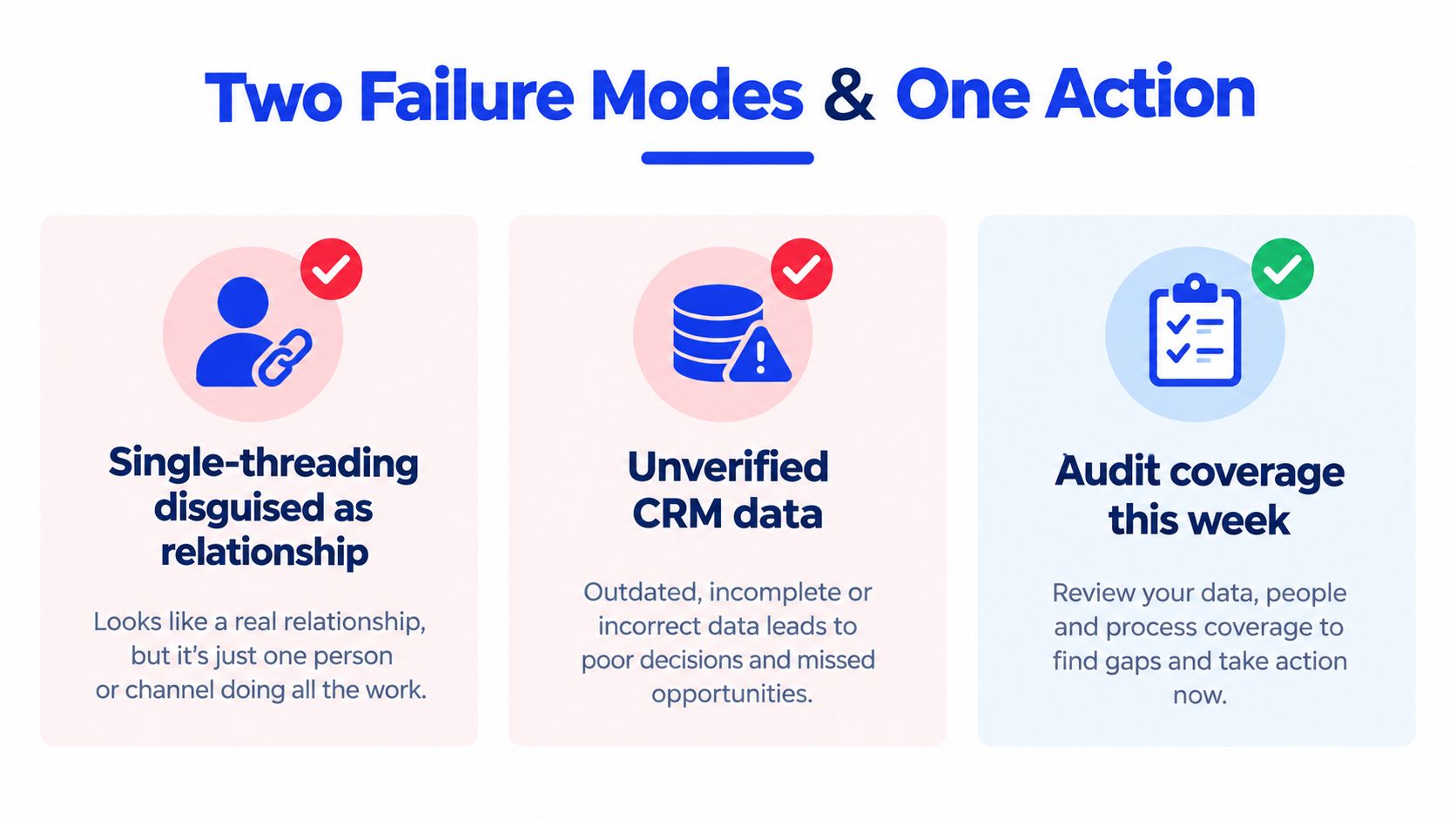
Take one action before Monday. Pull the top 20 accounts by ARR from your CRM, open each contact record, and confirm the title, seniority, last meaningful interaction, and next step for every stakeholder tied to the account. Reject the record if any required field is empty, then assign an owner to resolve it.
That thirty-minute audit won't repair the entire database. It will show whether your forecast is based on committee coverage or on one familiar name.
GROU builds B2B pipeline programs that connect LinkedIn content, lead generation, outbound, qualification, and reporting around one target list. Visit Grou to review how its bi-weekly sprint model can map enterprise accounts, coordinate role-specific messaging, and make pipeline quality visible.
Q2 pipeline review is full of familiar names, but the same enterprise opportunities keep sliding into next quarter. Outbound volume is rising, content is publishing, and stage three is crowded, yet nobody can explain which buying-group member is blocking progress.
Single-threaded relationships hide approval risk.
Content and outbound often work from different account lists.
Qualification records activity instead of verified buying progress.
CRM data makes weak coverage look like healthy pipeline.
Enterprise account management fixes the leak by joining strategy, coverage, process, tooling, and reporting into one operating system. The recommendation is straightforward: manage the account as a network of people and approval paths, not as one logo with one champion.
Table of Contents
Why enterprise accounts stall in your pipeline right now
The stalled account usually looks healthy in the CRM. A champion attended a meeting, downloaded a technical document, and introduced the vendor to a colleague. The opportunity moved forward because someone was engaged. Then security asks for evidence, procurement challenges the commercial case, or finance questions the payback, and the forecast moves right.
The problem is rarely a shortage of activity. It's a failure to connect activity to the buying process.
Practical rule: A meeting is evidence of interest. It isn't evidence that the account can buy.
A single champion can't represent every approval dependency. Enterprise buying groups commonly include business ownership, IT, security, finance, procurement, legal, and end-user operations. Forrester research cited in industry analysis places the average B2B buying group at 13 people, while the same analysis reports that IT and security raise the largest objections in 38% of deals, and finance and procurement do so in 30%. The buying-committee analysis shows why a late-stage forecast can remain exposed even when the primary contact is enthusiastic.
The second leak appears when marketing and sales work from separate lists. Marketing promotes a broad category message while outbound approaches a different set of accounts with a different pain hypothesis. The buyer receives activity, but the internal team has no shared account narrative. The sales pipeline management framework is useful here because it treats list ownership, qualification, stage movement, and reporting as connected operating decisions.
The third leak is weak recovery. A stalled opportunity needs a documented next action, a clear owner, and a reason for the pause. Some teams use an external workflow for sales recovery using AI coworkers to help surface follow-ups and organize dormant-deal actions, but automation can't compensate for an account record that lacks stakeholder roles or a verified business case.
Enterprise account management closes these gaps by giving every named account one target-list record, one message per segment, one coverage model, and one reporting line. That structure helps the team separate early engagement from genuine committee progress.
What enterprise account management actually is in 2026
Enterprise account management is the formal discipline of selecting, winning, growing, and protecting a finite list of strategically important accounts. It includes dedicated ownership, cross-functional planning, relationship governance, performance measurement, and joint value creation. A 2023 systematic review of 104 academic studies covering KAM research from 1990 to 2022 shows that the discipline has developed across more than three decades, rather than appearing as a recent label for senior sales work. The systematic review of KAM research also supports treating the model as relevant across sectors and markets.
The term creates confusion because teams use it for several different motions.
It isn't just a senior sales role
A senior seller can own a large opportunity without running an enterprise account program. Account management adds account selection, tiering, role coverage, customer-specific planning, and a shared view of commercial and delivery risk.
It also isn't identical to ABM. ABM can supply the campaign motion, but enterprise account management decides which accounts deserve coordinated attention, which stakeholders need coverage, and how engagement becomes a qualified opportunity. A standalone ABM campaign that never feeds the same CRM account list creates activity without operational continuity.
Nor is it a CRM label. Adding an “enterprise” field to an account record doesn't create governance. The team needs explicit ownership, decision criteria, next actions, and review points.
What belongs inside the system
A working program includes:
→ Named-account selection based on fit, potential, timing, and service economics
→ Segmentation by buying role, market, language, and urgency
→ Multi-threaded stakeholder coverage across approval functions
→ Joint plays between SDRs, account executives, marketing, solutions engineering, and customer success
→ Account-level reporting that distinguishes engagement from verified buying progress
→ Renewal and expansion signals tied to the same account history
Raw outbound without named accounts sits outside the model. MQL chasing without account context sits outside it too. Content that isn't connected to the target list, message, and sales follow-up also fails the test.
The international KAM research covered companies across the UK, North America, Northern Europe, Southern Europe, the Middle East and North Africa, and Australasia, with representation from services, professional and financial services, industrial and engineering, and manufacturing. That spread supports a practical conclusion: enterprise account management is an operating model for complex B2B relationships, not a niche motion for one geography.
The four-layer framework behind every enterprise program
GROU runs enterprise programs through four connected layers. The names matter less than the dependency between them. A precise account strategy still fails if the team structure creates handoff gaps. A good process still fails when the CRM contains duplicate accounts and stale contacts.
Strategy decides where attention goes
Start with a named account list. Define the ICP score, account tiers, market boundaries, buying triggers, and revenue objective before anyone scales outreach. Store the logic in Salesforce or HubSpot, not in a planning document that never reaches the people sending messages.
The account list should show why each company belongs. Company size alone tells you very little about what an enterprise buyer cares about. Fit, buying role, market, and timing produce a more useful segmentation decision.
Org structure decides who acts
Assign an account owner, SDR coverage, account executive responsibility, customer success involvement, and content ownership. Each person should work from the same account record and understand the current message, open objection, and next mutual action.
A shared Slack channel can support rapid feedback, but it isn't a substitute for CRM ownership. If a reply arrives from a technical evaluator, the team needs a routing rule that preserves context instead of restarting discovery.
Processes decide how work moves
Use a weekly standup to review account movement, a bi-weekly sprint review to assess quality, and a qualification framework such as BANT or MEDDIC. The qualification method matters less than the evidence standard. A late-stage opportunity needs proof of business value, stakeholder access, technical validation, and a commercial path.
Content-to-outbound sequencing can sit in Lemlist, Artisan, or a comparable workflow. The sequence should reflect the account segment and buying role. A technical evaluator shouldn't receive the same first message as an executive sponsor.
Tooling and metrics expose the leaks
Enrich records through Apollo or ZoomInfo, capture engagement in 6sense where available, and roll performance into Looker or Metabase. HubSpot and Salesforce can hold the operational truth, but only if ownership, timestamps, role fields, and stage definitions are enforced.
A data team building research workflows can use this account research playbook for data teams as a reference point for agent-assisted account investigation. The principle is simple: inferred information should remain distinguishable from verified information.
The sales process automation framework belongs underneath this structure, not above it. Automation should execute a defined process. It shouldn't decide what the process means.
Segmentation rules that fit, role, market and timing
GROU segments accounts in a fixed order: fit, buying role, market, and timing. That order prevents a tempting trigger from pulling a poor-fit company into an expensive enterprise motion.
Start with fit
Set the fit rules before list building. Relevant filters may include employee count, revenue band, technology presence, funding stage, operating geography, and a hard ICP score. The score should be disqualifying when the account lacks the pain, buying environment, or commercial potential required by the program.
An iGaming operator might fit the category but still fail the first screen if its operating model, license footprint, or product stack falls outside the serviceable segment. A SaaS company can look attractive by employee count while lacking the technical complexity that creates urgency.
For teams refining their criteria, the ICP framework should become a CRM rule, not a slogan used during campaign reviews.
Add the buying role
Map the economic buyer, technical evaluator, end user, procurement owner, security stakeholder, and executive sponsor. Titles vary by industry, so build a title-to-function map before launch.
A cybersecurity vendor may need separate messaging for a CEO, COO, CIO, and IT decision-maker. A manufacturing program may prioritize engineering, plant leadership, operations, and procurement. The contact record should capture the concern each person owns, not just the person's title.
Layer in market conditions
Market filters explain why the same message can work in one segment and fail in another. Consider regulatory pressure, replacement activity, expansion geography, language, and category maturity.
For pharma, compliance and validation may shape the first conversation. In legal tech, risk, data handling, and departmental adoption can matter more than a feature comparison. In iGaming, operator type and market exposure often determine the commercial context.
Finish with timing
Timing signals include hiring activity, earnings language, leadership changes, product launches, event attendance, and intent data. Timing should refine a good account list, not rescue a weak one.
Segmentation input | Question to answer | iGaming example | Cybersecurity example | Manufacturing example |
|---|---|---|---|---|
Fit | Does the account match the ICP and service model? | Operator with the required product and market profile | Vendor serving the intended regulated customer base | Manufacturer with the right production complexity |
Buying role | Who can approve, block, implement, or use the purchase? | Operator leadership, gaming floor, and procurement | CISO, CIO, IT operations, and finance | Engineering, plant leadership, operations, and procurement |
Market | Which external conditions shape the message? | License environment and expansion geography | NIST adoption, regulatory pressure, and replacement activity | Market saturation and regional production demand |
Timing | Why should this account act now? | License renewal window or market entry | CISO turnover, hiring, or security program change | Plant expansion announcement or trade-show timing |
The output is one target list, one message per segment, and one reporting line. Content and outbound should reinforce the same account hypothesis instead of competing for attention.
Multi-threading the buying group instead of the champion
The champion is useful, but champion access is not committee coverage. A deal that depends on one person carries hidden risk when security, procurement, legal, or finance enters the process.
Research cited in a B2B buying-committee study found that enterprise sellers plan for an average of 6.0 stakeholders per opportunity. Among companies with 1,000 or more employees, 58.2% identify four or more decision-maker titles, while 20.7% target six to eight stakeholders and 14.2% target nine or more. The buying-committee study supports a coverage model built around roles rather than contact volume.
Set a minimum standard of three engaged contacts spanning the economic buyer, technical evaluator, and end user. Add a coach who can explain the internal politics and tell the account team where the proposal is vulnerable. More contacts aren't automatically better. The required coverage depends on the approval path.
Prove coverage in the CRM
Track distinct stakeholders engaged, mapped decision roles, the last meaningful interaction for each role, the next action per stakeholder, stated success criteria, unresolved objections, and committee alignment. A contact's job title and email address don't prove influence.
Role-specific content helps fill the map. Send implementation evidence to technical evaluators, financial justification to economic buyers, workflow proof to end users, and risk documentation to security or legal. LinkedIn content, outbound sequences, webinars, and event follow-up should all use the same role map.
A single-thread report might show one reply, two meetings, and a late-stage opportunity. A multi-thread report shows the champion's status, executive access, technical validation, procurement entry, security position, and the next action for each role. The second report is less flattering, but it gives leadership something they can act on.
The stakeholder engagement framework is useful when the account team needs to move from contact activity to relationship coverage.
Forecast rule: No enterprise opportunity moves to commit without evidence that the required buying roles are covered.
Dashboards, metrics and the bi-weekly sprint rhythm
An enterprise dashboard should answer one question: did the target accounts move closer to a defensible buying decision? Sends, connection requests, and booked meetings can provide context, but they shouldn't lead the review.
Use HubSpot or Salesforce as the source for account, contact, opportunity, activity, and attribution fields. A reporting layer such as Looker or Metabase can present the account view without changing the underlying definitions. Teams that need a ready-made reporting layer can review Flowkon reporting features, then map the output to their own CRM fields.
Metric | Formula | CRM source | Target band | Sprint action if missed |
|---|---|---|---|---|
Tier-one accounts | Count of accounts in the highest-priority tier | Account tier | Defined before launch | Recheck tier rules and ownership |
Full committee coverage | Accounts with all required roles engaged ÷ tier-one accounts | Contact roles and meaningful activity | Set by segment | Run a coverage blitz |
Qualified opportunities created | Opportunities meeting qualification criteria during the period | Opportunity stage and qualification fields | Baseline by segment | Review qualification evidence |
Pipeline value by segment | Sum of qualified opportunity value grouped by segment | Opportunity amount and segment | Revenue plan range | Reallocate account attention |
Average deal cycle by tier | Time from qualified stage entry to closed outcome ÷ completed opportunities | Stage history and close date | Historical baseline | Inspect blocked approval paths |
Multi-thread ratio | Opportunities with required stakeholder coverage ÷ active enterprise opportunities | Opportunity stakeholder fields | Minimum coverage threshold | Add role-specific outreach |
Content-influenced opportunities | Qualified opportunities with recorded content interaction ÷ qualified opportunities | Campaign influence and opportunity records | Attribution baseline | Align content with open objections |
Outbound reply rate by role | Replies from a role ÷ delivered messages to that role | Sequence activity and contact role | Segment baseline | Rework the message or targeting |
The cadence keeps the numbers honest. Monday's pipeline standup confirms account movement and ownership. Wednesday's mid-sprint checkpoint reviews coverage gaps, replies, objections, and stalled approvals. Friday's retro records what changed, what failed, and what the next sprint will test.
If the multi-thread ratio drops, the next sprint runs a coverage blitz. If reply rate falls for one role, the team changes that role's message rather than increasing volume across the entire list. If pipeline value rises while qualification quality falls, leadership reviews acceptance and stage evidence.
The sales performance measurement framework can help connect these account-level measures to broader revenue reporting. Review the dashboard every two weeks, or the program starts drifting behind the reporting cycle.
Three short case examples from real enterprise programs
These cases show how enterprise account management works as one pipeline system. Content, outbound, qualification, and reporting use the same target list, with one message for each defined segment. The available evidence is stronger on operating discipline than on attributed revenue, so the examples distinguish measured activity from commercial impact.
Fazi and segmentation
Fazi is an iGaming example of coordinated market expansion. The program combined LinkedIn strategy, newsletter publishing, and paid media across LinkedIn, Google, and RichAds for LATAM and EMEA. The working tiering rule was market first, then channel and audience concern. That kept content planning, paid distribution, and follow-up attached to the same segment rather than treating each channel as a separate campaign.
The public output was a larger owned audience, an active newsletter, and qualified-lead support. It does not establish a quantified upsell or expansion result. The useful operational lesson is to define the market tier before assigning content and outreach, then record commercial signals against the account record used by every channel.
T-2 and org structure
T-2 shows how buying-role segmentation changes execution. Cybersecurity outreach separated CEOs, COOs, CIOs, and IT decision-makers instead of placing every senior contact in one sequence. The reported average reply rate was 11.8%, while the IT segment reached 19.2%, as reported in the verified program context.
The routing rule was role-based. A response from an IT contact went to the account owner with SDR coverage and technical support visible, rather than being treated as an unassigned positive reply. That allowed the team to compare message fit by role and direct the next action to the people who could qualify the signal. The result is a usable buying-group record, not just a higher activity count.
Precision Resource and timing
Precision Resource illustrates the timing problem in manufacturing outreach. Trade-show schedules and market saturation affected how engineering buyers responded across European markets, so the program staged markets instead of launching every region at once.
The verification step was to confirm the market or event context before treating a signal as actionable. The team could then record the market, timing, engineering relevance, and follow-up owner in one account view. The same control applies to plant expansion announcements, provided the announcement is verified and the next action is documented. The public case does not provide an attributed revenue figure, so the defensible result is improved sequencing and traceability.
Case | Industry | Framework layer | Action taken | Measured result |
|---|---|---|---|---|
Fazi | iGaming | Strategy and segmentation | Tiered LATAM and EMEA audiences, then connected LinkedIn content, newsletter activity, and paid campaign support | Publicly described audience and qualified-lead outcomes, without a published expansion figure |
T-2 | Cybersecurity | Org structure | Routed outreach and follow-up by executive and IT buying role | 11.8% average reply rate and 19.2% for the IT segment |
Precision Resource | Manufacturing | Timing and process | Verified market and event context before sequencing regional outreach | Market response was evaluated by sequence and timing, without an attributed revenue figure |
Across all three, the operating pattern is consistent: one target list, one message per segment, and one account record connecting activity to qualification. That structure makes gaps visible, while keeping claims about pipeline impact proportional to the evidence available.
Two failure modes and one specific action to take this week
The first failure mode is single-threading disguised as a relationship. A champion replies quickly, joins every meeting, and sounds positive, so the team assumes the account is covered. Then a reorganization changes that person's remit, or a hidden approver appears late, and the opportunity loses its internal path.
The second is unverified CRM data. Stale titles, duplicate accounts, phantom phone numbers, incorrect ownership, and missing subsidiaries corrupt routing and attribution at the same time. A 2026 report summarizing a Forrester study commissioned by Validity states that enterprises with more than 2,000 employees lose an average of $12.9 million annually from poor CRM data quality, including missed revenue opportunities, wasted outreach, and employee productivity loss. The CRM data-quality report provides the financial context for treating data as a revenue-control variable.
AI makes the problem harder when teams automate prioritization before they establish data standards. A 2025 CRM data-management survey of 602 users found that 76% said less than half of their organization's CRM data was accurate and complete, while 45% said their CRM wasn't prepared for AI. The survey summary supports a cautious sequence: verify the record, mark confidence, then automate.
Take one action before Monday. Pull the top 20 accounts by ARR from your CRM, open each contact record, and confirm the title, seniority, last meaningful interaction, and next step for every stakeholder tied to the account. Reject the record if any required field is empty, then assign an owner to resolve it.
That thirty-minute audit won't repair the entire database. It will show whether your forecast is based on committee coverage or on one familiar name.
GROU builds B2B pipeline programs that connect LinkedIn content, lead generation, outbound, qualification, and reporting around one target list. Visit Grou to review how its bi-weekly sprint model can map enterprise accounts, coordinate role-specific messaging, and make pipeline quality visible.
Q2 pipeline review is full of familiar names, but the same enterprise opportunities keep sliding into next quarter. Outbound volume is rising, content is publishing, and stage three is crowded, yet nobody can explain which buying-group member is blocking progress.
Single-threaded relationships hide approval risk.
Content and outbound often work from different account lists.
Qualification records activity instead of verified buying progress.
CRM data makes weak coverage look like healthy pipeline.
Enterprise account management fixes the leak by joining strategy, coverage, process, tooling, and reporting into one operating system. The recommendation is straightforward: manage the account as a network of people and approval paths, not as one logo with one champion.
Table of Contents
Why enterprise accounts stall in your pipeline right now
The stalled account usually looks healthy in the CRM. A champion attended a meeting, downloaded a technical document, and introduced the vendor to a colleague. The opportunity moved forward because someone was engaged. Then security asks for evidence, procurement challenges the commercial case, or finance questions the payback, and the forecast moves right.
The problem is rarely a shortage of activity. It's a failure to connect activity to the buying process.
Practical rule: A meeting is evidence of interest. It isn't evidence that the account can buy.
A single champion can't represent every approval dependency. Enterprise buying groups commonly include business ownership, IT, security, finance, procurement, legal, and end-user operations. Forrester research cited in industry analysis places the average B2B buying group at 13 people, while the same analysis reports that IT and security raise the largest objections in 38% of deals, and finance and procurement do so in 30%. The buying-committee analysis shows why a late-stage forecast can remain exposed even when the primary contact is enthusiastic.
The second leak appears when marketing and sales work from separate lists. Marketing promotes a broad category message while outbound approaches a different set of accounts with a different pain hypothesis. The buyer receives activity, but the internal team has no shared account narrative. The sales pipeline management framework is useful here because it treats list ownership, qualification, stage movement, and reporting as connected operating decisions.
The third leak is weak recovery. A stalled opportunity needs a documented next action, a clear owner, and a reason for the pause. Some teams use an external workflow for sales recovery using AI coworkers to help surface follow-ups and organize dormant-deal actions, but automation can't compensate for an account record that lacks stakeholder roles or a verified business case.
Enterprise account management closes these gaps by giving every named account one target-list record, one message per segment, one coverage model, and one reporting line. That structure helps the team separate early engagement from genuine committee progress.
What enterprise account management actually is in 2026
Enterprise account management is the formal discipline of selecting, winning, growing, and protecting a finite list of strategically important accounts. It includes dedicated ownership, cross-functional planning, relationship governance, performance measurement, and joint value creation. A 2023 systematic review of 104 academic studies covering KAM research from 1990 to 2022 shows that the discipline has developed across more than three decades, rather than appearing as a recent label for senior sales work. The systematic review of KAM research also supports treating the model as relevant across sectors and markets.
The term creates confusion because teams use it for several different motions.
It isn't just a senior sales role
A senior seller can own a large opportunity without running an enterprise account program. Account management adds account selection, tiering, role coverage, customer-specific planning, and a shared view of commercial and delivery risk.
It also isn't identical to ABM. ABM can supply the campaign motion, but enterprise account management decides which accounts deserve coordinated attention, which stakeholders need coverage, and how engagement becomes a qualified opportunity. A standalone ABM campaign that never feeds the same CRM account list creates activity without operational continuity.
Nor is it a CRM label. Adding an “enterprise” field to an account record doesn't create governance. The team needs explicit ownership, decision criteria, next actions, and review points.
What belongs inside the system
A working program includes:
→ Named-account selection based on fit, potential, timing, and service economics
→ Segmentation by buying role, market, language, and urgency
→ Multi-threaded stakeholder coverage across approval functions
→ Joint plays between SDRs, account executives, marketing, solutions engineering, and customer success
→ Account-level reporting that distinguishes engagement from verified buying progress
→ Renewal and expansion signals tied to the same account history
Raw outbound without named accounts sits outside the model. MQL chasing without account context sits outside it too. Content that isn't connected to the target list, message, and sales follow-up also fails the test.
The international KAM research covered companies across the UK, North America, Northern Europe, Southern Europe, the Middle East and North Africa, and Australasia, with representation from services, professional and financial services, industrial and engineering, and manufacturing. That spread supports a practical conclusion: enterprise account management is an operating model for complex B2B relationships, not a niche motion for one geography.
The four-layer framework behind every enterprise program
GROU runs enterprise programs through four connected layers. The names matter less than the dependency between them. A precise account strategy still fails if the team structure creates handoff gaps. A good process still fails when the CRM contains duplicate accounts and stale contacts.
Strategy decides where attention goes
Start with a named account list. Define the ICP score, account tiers, market boundaries, buying triggers, and revenue objective before anyone scales outreach. Store the logic in Salesforce or HubSpot, not in a planning document that never reaches the people sending messages.
The account list should show why each company belongs. Company size alone tells you very little about what an enterprise buyer cares about. Fit, buying role, market, and timing produce a more useful segmentation decision.
Org structure decides who acts
Assign an account owner, SDR coverage, account executive responsibility, customer success involvement, and content ownership. Each person should work from the same account record and understand the current message, open objection, and next mutual action.
A shared Slack channel can support rapid feedback, but it isn't a substitute for CRM ownership. If a reply arrives from a technical evaluator, the team needs a routing rule that preserves context instead of restarting discovery.
Processes decide how work moves
Use a weekly standup to review account movement, a bi-weekly sprint review to assess quality, and a qualification framework such as BANT or MEDDIC. The qualification method matters less than the evidence standard. A late-stage opportunity needs proof of business value, stakeholder access, technical validation, and a commercial path.
Content-to-outbound sequencing can sit in Lemlist, Artisan, or a comparable workflow. The sequence should reflect the account segment and buying role. A technical evaluator shouldn't receive the same first message as an executive sponsor.
Tooling and metrics expose the leaks
Enrich records through Apollo or ZoomInfo, capture engagement in 6sense where available, and roll performance into Looker or Metabase. HubSpot and Salesforce can hold the operational truth, but only if ownership, timestamps, role fields, and stage definitions are enforced.
A data team building research workflows can use this account research playbook for data teams as a reference point for agent-assisted account investigation. The principle is simple: inferred information should remain distinguishable from verified information.
The sales process automation framework belongs underneath this structure, not above it. Automation should execute a defined process. It shouldn't decide what the process means.
Segmentation rules that fit, role, market and timing
GROU segments accounts in a fixed order: fit, buying role, market, and timing. That order prevents a tempting trigger from pulling a poor-fit company into an expensive enterprise motion.
Start with fit
Set the fit rules before list building. Relevant filters may include employee count, revenue band, technology presence, funding stage, operating geography, and a hard ICP score. The score should be disqualifying when the account lacks the pain, buying environment, or commercial potential required by the program.
An iGaming operator might fit the category but still fail the first screen if its operating model, license footprint, or product stack falls outside the serviceable segment. A SaaS company can look attractive by employee count while lacking the technical complexity that creates urgency.
For teams refining their criteria, the ICP framework should become a CRM rule, not a slogan used during campaign reviews.
Add the buying role
Map the economic buyer, technical evaluator, end user, procurement owner, security stakeholder, and executive sponsor. Titles vary by industry, so build a title-to-function map before launch.
A cybersecurity vendor may need separate messaging for a CEO, COO, CIO, and IT decision-maker. A manufacturing program may prioritize engineering, plant leadership, operations, and procurement. The contact record should capture the concern each person owns, not just the person's title.
Layer in market conditions
Market filters explain why the same message can work in one segment and fail in another. Consider regulatory pressure, replacement activity, expansion geography, language, and category maturity.
For pharma, compliance and validation may shape the first conversation. In legal tech, risk, data handling, and departmental adoption can matter more than a feature comparison. In iGaming, operator type and market exposure often determine the commercial context.
Finish with timing
Timing signals include hiring activity, earnings language, leadership changes, product launches, event attendance, and intent data. Timing should refine a good account list, not rescue a weak one.
Segmentation input | Question to answer | iGaming example | Cybersecurity example | Manufacturing example |
|---|---|---|---|---|
Fit | Does the account match the ICP and service model? | Operator with the required product and market profile | Vendor serving the intended regulated customer base | Manufacturer with the right production complexity |
Buying role | Who can approve, block, implement, or use the purchase? | Operator leadership, gaming floor, and procurement | CISO, CIO, IT operations, and finance | Engineering, plant leadership, operations, and procurement |
Market | Which external conditions shape the message? | License environment and expansion geography | NIST adoption, regulatory pressure, and replacement activity | Market saturation and regional production demand |
Timing | Why should this account act now? | License renewal window or market entry | CISO turnover, hiring, or security program change | Plant expansion announcement or trade-show timing |
The output is one target list, one message per segment, and one reporting line. Content and outbound should reinforce the same account hypothesis instead of competing for attention.
Multi-threading the buying group instead of the champion
The champion is useful, but champion access is not committee coverage. A deal that depends on one person carries hidden risk when security, procurement, legal, or finance enters the process.
Research cited in a B2B buying-committee study found that enterprise sellers plan for an average of 6.0 stakeholders per opportunity. Among companies with 1,000 or more employees, 58.2% identify four or more decision-maker titles, while 20.7% target six to eight stakeholders and 14.2% target nine or more. The buying-committee study supports a coverage model built around roles rather than contact volume.
Set a minimum standard of three engaged contacts spanning the economic buyer, technical evaluator, and end user. Add a coach who can explain the internal politics and tell the account team where the proposal is vulnerable. More contacts aren't automatically better. The required coverage depends on the approval path.
Prove coverage in the CRM
Track distinct stakeholders engaged, mapped decision roles, the last meaningful interaction for each role, the next action per stakeholder, stated success criteria, unresolved objections, and committee alignment. A contact's job title and email address don't prove influence.
Role-specific content helps fill the map. Send implementation evidence to technical evaluators, financial justification to economic buyers, workflow proof to end users, and risk documentation to security or legal. LinkedIn content, outbound sequences, webinars, and event follow-up should all use the same role map.
A single-thread report might show one reply, two meetings, and a late-stage opportunity. A multi-thread report shows the champion's status, executive access, technical validation, procurement entry, security position, and the next action for each role. The second report is less flattering, but it gives leadership something they can act on.
The stakeholder engagement framework is useful when the account team needs to move from contact activity to relationship coverage.
Forecast rule: No enterprise opportunity moves to commit without evidence that the required buying roles are covered.
Dashboards, metrics and the bi-weekly sprint rhythm
An enterprise dashboard should answer one question: did the target accounts move closer to a defensible buying decision? Sends, connection requests, and booked meetings can provide context, but they shouldn't lead the review.
Use HubSpot or Salesforce as the source for account, contact, opportunity, activity, and attribution fields. A reporting layer such as Looker or Metabase can present the account view without changing the underlying definitions. Teams that need a ready-made reporting layer can review Flowkon reporting features, then map the output to their own CRM fields.
Metric | Formula | CRM source | Target band | Sprint action if missed |
|---|---|---|---|---|
Tier-one accounts | Count of accounts in the highest-priority tier | Account tier | Defined before launch | Recheck tier rules and ownership |
Full committee coverage | Accounts with all required roles engaged ÷ tier-one accounts | Contact roles and meaningful activity | Set by segment | Run a coverage blitz |
Qualified opportunities created | Opportunities meeting qualification criteria during the period | Opportunity stage and qualification fields | Baseline by segment | Review qualification evidence |
Pipeline value by segment | Sum of qualified opportunity value grouped by segment | Opportunity amount and segment | Revenue plan range | Reallocate account attention |
Average deal cycle by tier | Time from qualified stage entry to closed outcome ÷ completed opportunities | Stage history and close date | Historical baseline | Inspect blocked approval paths |
Multi-thread ratio | Opportunities with required stakeholder coverage ÷ active enterprise opportunities | Opportunity stakeholder fields | Minimum coverage threshold | Add role-specific outreach |
Content-influenced opportunities | Qualified opportunities with recorded content interaction ÷ qualified opportunities | Campaign influence and opportunity records | Attribution baseline | Align content with open objections |
Outbound reply rate by role | Replies from a role ÷ delivered messages to that role | Sequence activity and contact role | Segment baseline | Rework the message or targeting |
The cadence keeps the numbers honest. Monday's pipeline standup confirms account movement and ownership. Wednesday's mid-sprint checkpoint reviews coverage gaps, replies, objections, and stalled approvals. Friday's retro records what changed, what failed, and what the next sprint will test.
If the multi-thread ratio drops, the next sprint runs a coverage blitz. If reply rate falls for one role, the team changes that role's message rather than increasing volume across the entire list. If pipeline value rises while qualification quality falls, leadership reviews acceptance and stage evidence.
The sales performance measurement framework can help connect these account-level measures to broader revenue reporting. Review the dashboard every two weeks, or the program starts drifting behind the reporting cycle.
Three short case examples from real enterprise programs
These cases show how enterprise account management works as one pipeline system. Content, outbound, qualification, and reporting use the same target list, with one message for each defined segment. The available evidence is stronger on operating discipline than on attributed revenue, so the examples distinguish measured activity from commercial impact.
Fazi and segmentation
Fazi is an iGaming example of coordinated market expansion. The program combined LinkedIn strategy, newsletter publishing, and paid media across LinkedIn, Google, and RichAds for LATAM and EMEA. The working tiering rule was market first, then channel and audience concern. That kept content planning, paid distribution, and follow-up attached to the same segment rather than treating each channel as a separate campaign.
The public output was a larger owned audience, an active newsletter, and qualified-lead support. It does not establish a quantified upsell or expansion result. The useful operational lesson is to define the market tier before assigning content and outreach, then record commercial signals against the account record used by every channel.
T-2 and org structure
T-2 shows how buying-role segmentation changes execution. Cybersecurity outreach separated CEOs, COOs, CIOs, and IT decision-makers instead of placing every senior contact in one sequence. The reported average reply rate was 11.8%, while the IT segment reached 19.2%, as reported in the verified program context.
The routing rule was role-based. A response from an IT contact went to the account owner with SDR coverage and technical support visible, rather than being treated as an unassigned positive reply. That allowed the team to compare message fit by role and direct the next action to the people who could qualify the signal. The result is a usable buying-group record, not just a higher activity count.
Precision Resource and timing
Precision Resource illustrates the timing problem in manufacturing outreach. Trade-show schedules and market saturation affected how engineering buyers responded across European markets, so the program staged markets instead of launching every region at once.
The verification step was to confirm the market or event context before treating a signal as actionable. The team could then record the market, timing, engineering relevance, and follow-up owner in one account view. The same control applies to plant expansion announcements, provided the announcement is verified and the next action is documented. The public case does not provide an attributed revenue figure, so the defensible result is improved sequencing and traceability.
Case | Industry | Framework layer | Action taken | Measured result |
|---|---|---|---|---|
Fazi | iGaming | Strategy and segmentation | Tiered LATAM and EMEA audiences, then connected LinkedIn content, newsletter activity, and paid campaign support | Publicly described audience and qualified-lead outcomes, without a published expansion figure |
T-2 | Cybersecurity | Org structure | Routed outreach and follow-up by executive and IT buying role | 11.8% average reply rate and 19.2% for the IT segment |
Precision Resource | Manufacturing | Timing and process | Verified market and event context before sequencing regional outreach | Market response was evaluated by sequence and timing, without an attributed revenue figure |
Across all three, the operating pattern is consistent: one target list, one message per segment, and one account record connecting activity to qualification. That structure makes gaps visible, while keeping claims about pipeline impact proportional to the evidence available.
Two failure modes and one specific action to take this week
The first failure mode is single-threading disguised as a relationship. A champion replies quickly, joins every meeting, and sounds positive, so the team assumes the account is covered. Then a reorganization changes that person's remit, or a hidden approver appears late, and the opportunity loses its internal path.
The second is unverified CRM data. Stale titles, duplicate accounts, phantom phone numbers, incorrect ownership, and missing subsidiaries corrupt routing and attribution at the same time. A 2026 report summarizing a Forrester study commissioned by Validity states that enterprises with more than 2,000 employees lose an average of $12.9 million annually from poor CRM data quality, including missed revenue opportunities, wasted outreach, and employee productivity loss. The CRM data-quality report provides the financial context for treating data as a revenue-control variable.
AI makes the problem harder when teams automate prioritization before they establish data standards. A 2025 CRM data-management survey of 602 users found that 76% said less than half of their organization's CRM data was accurate and complete, while 45% said their CRM wasn't prepared for AI. The survey summary supports a cautious sequence: verify the record, mark confidence, then automate.
Take one action before Monday. Pull the top 20 accounts by ARR from your CRM, open each contact record, and confirm the title, seniority, last meaningful interaction, and next step for every stakeholder tied to the account. Reject the record if any required field is empty, then assign an owner to resolve it.
That thirty-minute audit won't repair the entire database. It will show whether your forecast is based on committee coverage or on one familiar name.
GROU builds B2B pipeline programs that connect LinkedIn content, lead generation, outbound, qualification, and reporting around one target list. Visit Grou to review how its bi-weekly sprint model can map enterprise accounts, coordinate role-specific messaging, and make pipeline quality visible.
Pipeline OS Newsletter
Build qualified pipeline
Get weekly tactics to generate demand, improve lead quality, and book more meetings.





Trusted by industry leaders
Trusted by industry leaders
Trusted by industry leaders
Ready to build qualified pipeline?
Ready to build qualified pipeline?
Ready to build qualified pipeline?
Book a call to see if we're the right fit, or take the 2-minute quiz to get a clear starting point.
Book a call to see if we're the right fit, or take the 2-minute quiz to get a clear starting point.
Book a call to see if we're the right fit, or take the 2-minute quiz to get a clear starting point.
" height="30.21639343089746px" id="hfGbXmQR2" width="30.216393430897455px"/></svg>)
Copyright © 2026 – All Right Reserved
Copyright © 2026 – All Right Reserved
Copyright © 2026 – All Right Reserved