NEW WEBINAR: Learn how to fill your B2B webinar seatsHow to fill your B2B webinar seatsSave your seat
%22%3E%3C/path%3E%3Cpath d=%22M 63.072 7.554 C 62.258 8.022 61.577 8.689 61.092 9.493 L 61.092 7.076 L 57.158 7.076 L 57.158 22.64 L 61.089 22.64 L 61.089 14.888 C 61.089 13.446 61.403 12.434 62.03 11.853 C 62.818 11.218 63.818 10.907 64.826 10.982 L 65.868 10.982 L 65.868 6.851 C 64.891 6.834 63.926 7.076 63.073 7.554 Z%22 fill=%22rgb(17,17,17)%22%3E%3C/path%3E%3Cpath d=%22M 78.916 7.82 C 76.363 6.49 73.321 6.49 70.768 7.82 C 69.562 8.473 68.564 9.451 67.888 10.644 C 67.167 11.931 66.803 13.387 66.834 14.862 C 66.804 16.332 67.157 17.785 67.86 19.077 C 68.515 20.267 69.494 21.246 70.684 21.901 C 71.924 22.576 73.318 22.92 74.73 22.898 C 76.164 22.918 77.58 22.575 78.846 21.901 C 80.062 21.247 81.073 20.27 81.768 19.077 C 82.506 17.797 82.88 16.339 82.85 14.862 C 82.88 13.389 82.517 11.934 81.797 10.647 C 81.12 9.455 80.122 8.477 78.917 7.824 M 78.803 14.862 C 78.829 15.739 78.636 16.608 78.241 17.391 C 77.903 18.046 77.38 18.588 76.738 18.95 C 76.124 19.293 75.432 19.472 74.729 19.47 C 73.668 19.497 72.648 19.061 71.934 18.276 C 71.139 17.323 70.741 16.1 70.823 14.862 C 70.741 13.62 71.149 12.395 71.959 11.45 C 72.687 10.667 73.715 10.233 74.783 10.256 C 75.859 10.236 76.894 10.67 77.635 11.45 C 78.464 12.387 78.884 13.616 78.801 14.864%22 fill=%22rgb(17,17,17)%22%3E%3C/path%3E%3Cpath d=%22M 95.906 7.076 L 95.906 15.646 C 95.975 16.68 95.643 17.701 94.979 18.498 C 94.311 19.184 93.379 19.547 92.422 19.495 C 91.475 19.544 90.553 19.18 89.894 18.498 C 89.23 17.701 88.898 16.68 88.967 15.646 L 88.967 7.076 L 85.033 7.076 L 85.033 16.207 C 85 17.449 85.275 18.68 85.834 19.79 C 86.327 20.75 87.095 21.542 88.039 22.065 C 89.033 22.594 90.145 22.861 91.271 22.838 C 92.188 22.847 93.095 22.65 93.926 22.263 C 94.708 21.905 95.388 21.36 95.906 20.675 L 95.906 22.645 L 99.865 22.645 L 99.865 7.076 Z%22 fill=%22rgb(17,17,17)%22%3E%3C/path%3E%3Cpath d=%22M 4.513 15.626 C 4.511 10.815 7.606 6.549 12.181 5.059 C 16.756 3.57 21.77 5.195 24.601 9.086 L 27.816 5.87 C 24.074 1.186 17.981 -0.943 12.137 0.393 C 6.292 1.728 1.728 6.292 0.393 12.137 C -0.943 17.981 1.186 24.074 5.87 27.816 L 9.085 24.601 C 6.214 22.512 4.515 19.177 4.513 15.626%22 fill=%22rgb(32,62,235)%22%3E%3C/path%3E%3Cpath d=%22M 17.114 14.343 L 13.354 18.01 L 13.354 18.026 L 21.071 18.026 L 11.412 27.609 L 17.389 27.609 L 23.999 21.081 L 23.999 28.316 L 24.005 28.316 L 27.967 24.393 L 27.967 14.343 Z%22 fill=%22rgb(32,62,235)%22%3E%3C/path%3E%3C/g%3E%3C/svg%3E) ×
×
NEW WEBINAR: Learn how to fill your B2B webinar seatsHow to fill your B2B webinar seatsSave your seat
×NEW WEBINAR: Learn how to fill your B2B webinar seatsHow to fill your B2B webinar seatsSave your seat
×›
›
›
›
Unlock Growth: ICP Ideal Customer Profile Guide
Unlock Growth: ICP Ideal Customer Profile Guide
Unlock Growth: ICP Ideal Customer Profile Guide
Unlock Growth: ICP Ideal Customer Profile Guide
Unlock Growth: ICP Ideal Customer Profile Guide
Unlock Growth: ICP Ideal Customer Profile Guide

Author
Aljaz Peklaj

Your team is active, but the numbers that matter feel stuck. Forms are coming in, outbound sequences are running, LinkedIn posts are getting views, and the CRM looks busy. Then you check meetings, deal quality, and progression, and the whole thing thins out.
That usually isn't a volume problem. It's a targeting problem. When the icp ideal customer profile is vague, every channel fills with low-fit accounts, and the system mistakes motion for pipeline.
A sharp ICP fixes that by acting as the company-level filter behind list building, content angles, outbound copy, qualification, and reporting. If you want a cleaner view of where that targeting gap shows up, this breakdown of lead to meeting conversion is a useful companion.
Table of Contents
Your pipeline is full but your calendar is empty
Key takeaways
An ICP is a filter, not a persona
Where teams mix this up
What belongs inside the filter
How to build an ICP with a three-layer framework
Layer 1, firmographic fit
Layer 2, technographic fit
Layer 3, behavioral timing
How to validate your ICP in two weeks, not two quarters
Run a tight outbound test
Read the market signals correctly
The three mistakes that make your ICP useless
Mistake 1, too many inputs
Mistake 2, a frozen ICP
Mistake 3, functional drift
How to operationalize your ICP for predictable pipeline
Turn the profile into workflow rules
Build one reporting line
Your pipeline is full but your calendar is empty
This is the familiar failure pattern. Marketing says lead flow looks healthy. Sales says the leads aren't ready. RevOps sees a bloated pipeline full of accounts that never should've entered active motion in the first place.
The cost isn't just wasted outreach. It shows up in rep time, messy attribution, noisy dashboards, weaker messaging, and forecast debates that shouldn't exist. Teams start arguing about channel performance when the actual issue is account selection.
A useful icp ideal customer profile strips that noise out. It tells your system which companies deserve content attention, outbound attention, and human attention. Without it, Apollo imports get wider, Clay enrichments get heavier, and HubSpot gets dirtier.
Key takeaways
Company filter first: An ICP is about which companies belong in your motion, not which individuals to message first.
Use three layers: Build with firmographic, technographic, and behavioral data, not opinion alone.
Validate fast: Test an ICP with a small outbound sample before you roll it into every campaign.
Operationalize it: If the profile doesn't shape lists, content, messaging, and reporting, it isn't doing any work.
Keep it tight: More inputs don't automatically make the ICP better. In practice, they often blur it.
Practical rule: If your SDRs can describe your ICP in five different ways, you don't have an ICP. You have a debate.
An ICP is a filter, not a persona
The biggest mistake teams make is mixing up the account and the buyer. The ideal customer profile defines the type of company that should enter your go-to-market motion. The buyer persona defines the people inside that company who influence the deal.
Those aren't interchangeable. If the company is wrong, better persona work won't save it. You can write great copy for a VP of Operations, but if the company has no budget, no urgency, no fit, and no path to value, you're still wasting sequence volume.

If you want a simple external explainer that aligns with this distinction, Orbit AI's piece on ideal customer profile is a solid reference point. For the people layer, keep that separate from your buyer persona framework.
Where teams mix this up
Marketing often starts with role-level pain points because content is written for people. Sales often starts with titles because sequences need contacts. Product may define fit by usage patterns. Customer success may define fit by retention or expansion potential.
All of that matters, but only after the company clears the gate.
Here is the clean split:
ICP asks: What kind of company tends to buy, retain, expand, and get value?
Persona asks: Who inside that company feels the pain, owns the budget, blocks the deal, or signs the contract?
Messaging asks: Which problem do we lead with for each stakeholder once the account qualifies?
What belongs inside the filter
An ICP should contain mandatory company attributes. Not nice-to-haves. Not broad aspirations. Actual criteria that qualify or disqualify an account.
That usually includes items like these:
Industry fit: Specific verticals where your offer lands cleanly.
Company scale: Headcount bands, revenue bands, business model, or operating complexity.
Environment: Geography, compliance pressure, market maturity, or procurement reality.
Technical fit: The systems they already use and the stack assumptions behind your product or service.
Commercial fit: Buying capacity, internal ownership, and the likelihood that your offer solves an active business problem.
A buyer persona helps you write the email. The ICP decides whether the account should receive one.
When teams get this right, qualification gets faster. Reps stop trying to force weak accounts forward. Content gets narrower and stronger. Pipeline reviews stop turning into arguments over anecdotal exceptions.
How to build an ICP with a three-layer framework
Most ICP work fails because teams either make it too abstract or too academic. The practical version is simpler. Start with your best current accounts, look for patterns, and build the profile in layers.
Research from HG Insights says the predictive power of ideal customer profiles increases exponentially when firmographics are layered with behavioral and environmental data points, and that buying triggers such as leadership changes, rapid headcount growth, or regulatory shifts can create windows where conversion probability increases by 40-60% in the cited context of ICP development and trigger detection (HG Insights on creating an ICP).

If you're building this inside a live prospecting workflow, an ICP market intelligence stack helps you connect enrichment, filtering, and list creation without turning the process into spreadsheet archaeology. For adjacent thinking on scoring acquisition inputs, HubSpot Lead Scoring Tool's acquisition insights are also worth reviewing.
Layer 1, firmographic fit
This is the base layer. It tells you whether the company structurally resembles customers who succeed with your offer.
Pull these from HubSpot, Salesforce, Apollo, Clay, company sites, and LinkedIn:
Industry and sub-vertical: SaaS is too broad. Legal tech, pharma software, B2B manufacturing software, or iGaming infrastructure is usable.
Size band: Headcount and revenue range both matter because one often lies when the other doesn't.
Geography: Region can change sales motion, language, compliance, and implementation assumptions.
Growth context: Hiring pace, expansion activity, and market posture often separate static accounts from active buyers.
Layer 2, technographic fit
Often, teams remain too shallow. The company can look right on paper and still be wrong in practice because the stack doesn't support the problem you solve.
Use tools like Apollo, BuiltWith, Sales Navigator, and Clay enrichments to look for:
Current CRM or automation stack
Signals of operational maturity
Integration dependencies
Stack incompatibilities
Existing tooling that creates urgency, redundancy, or migration opportunity
A legal tech company using HubSpot, a modern sales engagement tool, and structured workflow automation is a different prospect from one still operating from inboxes and disconnected spreadsheets. Same industry, different readiness.
Layer 3, behavioral timing
This is the layer most directly tied to pipeline. It tells you whether the account might buy now, not just someday.
Good signals include leadership changes, new hiring around the problem you solve, visible go-to-market expansion, funding activity, public product launches, and topic engagement on LinkedIn. In manufacturing and pharma, regulatory movement can matter. In SaaS, a new VP Revenue or Head of Demand Gen often matters more.
If a company matches the slide deck but shows no buying motion, it belongs in monitoring, not active outreach.
A simple working rule inside modern tools is this:
Layer | What you check | Where you usually find it |
|---|---|---|
Firmographic | Industry, size, geography, growth context | CRM, Apollo, LinkedIn, company site |
Technographic | CRM, sales tools, automation stack, install clues | BuiltWith, Apollo, Clay |
Behavioral | Hiring, leadership changes, content engagement, market triggers | LinkedIn, Sales Navigator, Clay, news monitoring |
How to validate your ICP in two weeks, not two quarters
An ICP on a Notion page is a theory. The market decides whether it's real. The fastest way to test it is controlled outbound against a narrow list, with clear qualification rules and fast feedback loops.

That matters because M1-Project notes that outbound sales activity is the strongest signal for ICP accuracy. Once validated that way, organizations report four common indicators: significant conversion rate increases, increased prospect enthusiasm, stronger urgency in decision-making, and "the nod," a qualitative signal of genuine fit (M1-Project on identifying an ICP).
Run a tight outbound test
Don't test with broad campaign logic. Test one ICP hypothesis at a time.
Build a focused list in Apollo or Clay. Keep the company criteria strict. Then route contacts from Sales Navigator, Apollo, or your CRM based on role relevance, not title obsession.
A practical two-week workflow looks like this:
Define one hypothesis: Example, mid-market manufacturing firms with a modern CRM and visible hiring in operations.
Build a clean list: Keep only accounts that meet the full threshold. Don't pad it.
Write one core message: Lead with the business problem, not your product tour.
Use low-friction CTA: Offer a short working session, teardown, audit, or point-of-view exchange instead of "book a demo."
Track reply quality daily: Separate positive interest from confused replies, irrelevant replies, and polite deferrals.
Adjust once, not constantly: Change the ICP or message based on pattern, not single-thread anecdotes.
The whole point is speed. A defined sprint cadence keeps the test honest because it forces a review window before the team wanders into random edits.
Read the market signals correctly
Focusing solely on booked meetings is too late and too narrow. Early signal quality tells you whether the ICP is close before the calendar catches up.
Watch for these positive signs:
Fast comprehension: Prospects immediately understand the problem statement.
Language match: Replies mirror your framing rather than asking basic clarifying questions.
Internal forwarding behavior: Contacts pull in colleagues quickly.
Urgency cues: The issue is attached to a live initiative, not background curiosity.
Bad signs are just as useful:
Not relevant: The account looked right, but the problem doesn't exist there.
Wrong owner: You reached the right title but in the wrong type of company.
Low energy replies: They understand the pitch but don't care enough to continue.
Qualification mismatch: Meetings happen, but the deals stall because the account lacks fit.
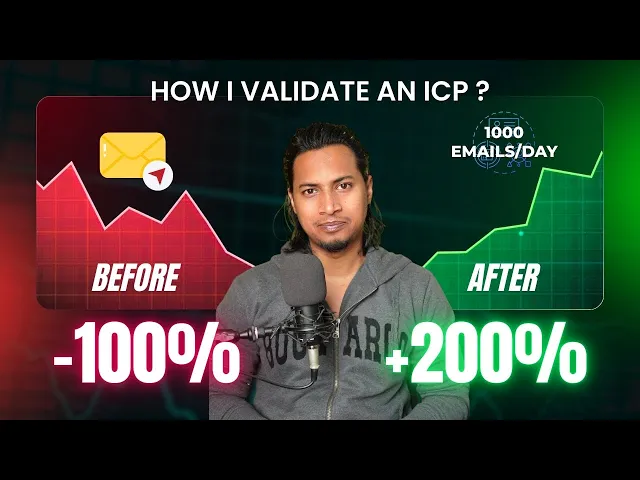
A quick visual can help align the team on what a valid test looks like.
Don't protect the hypothesis. Stress it. A weak ICP exposed in week two is cheaper than a weak quarter.
The three mistakes that make your ICP useless
Most bad ICPs don't fail because the team ignored the idea. They fail because the team built something that looks thoughtful and behaves like sludge.
Mistake 1, too many inputs
This one is counterintuitive. Teams assume more data sources create more accuracy. In practice, they often create compromise.
Riverside research found a strong inverse correlation between the number of data sources used to define an ICP and GRR and NRR outcomes, with top-tier companies typically using a smaller number of sources and weighting a few relevant functions, rather than trying to synthesize input from 10 or more places (Riverside on how high-performing companies approach ICP strategy). The practical takeaway is simple. If sales, customer success, product, investor opinion, market reports, and advisory boards all get equal weight, the profile loses edge.
What works better is selective input. Existing customer data, sales observations, and product usage patterns usually tell you more than broad committee consensus.
Mistake 2, a frozen ICP
A lot of teams treat the ICP like a one-time workshop output. Then the market shifts, the offer evolves, buyers change, and the profile sits untouched while conversion quality fades.
Current ICP guidance still leaves a major operational gap around dynamic decay and real-time validation, especially around leading indicators such as conversion rate decay, sales cycle elongation, win rate compression, audit cadence, and A/B testing of competing ICPs (Coppett Hill on the ideal customer profile gap). If you don't review those signals, drift hides in plain sight.
Field note: The first sign of ICP decay usually isn't fewer leads. It's more activity against worse opportunities.
Mistake 3, functional drift
Sales wants fast-moving accounts. Marketing wants scalable segments. Product wants strategic fit. Customer success wants accounts that retain. None of those are wrong. But if each team implicitly uses a different ICP, the pipeline breaks at every handoff.
This is another documented gap in current ICP content. Cross-functional misalignment is widely acknowledged, but the literature rarely gives a quantified revenue impact, practical diagnostics, or a framework for resolving conflicts between function-specific definitions (New Breed on ideal customer profile misalignment).
A simple template helps teams stop arguing in abstractions:
Criterion | Description | Data Source |
|---|---|---|
Industry | B2B manufacturing software vendors selling into regulated operations | CRM closed-won analysis, sales notes |
Company size | Mid-market companies with enough operational complexity to feel the problem | CRM, Apollo |
Geography | Regions your team can sell and support without friction | CRM, territory rules |
Stack fit | Uses systems your process can integrate with or work alongside | Apollo, BuiltWith, discovery |
Trigger event | Hiring, leadership changes, process expansion, or market pressure | LinkedIn, Clay, news monitoring |
Retention fit | Account pattern associated with stable adoption and expansion | Customer success notes, product usage |
If your team can't agree on the rows in that table, don't launch more campaigns. Fix the definition first.
How to operationalize your ICP for predictable pipeline
A validated ICP is only useful when it changes day-to-day execution. Many organizations stall at this stage. They build the profile, nod in the workshop, and then go back to broad targeting because no tool or process was updated.

Turn the profile into workflow rules
The ICP should show up in four places immediately.
Content targeting: LinkedIn posts should speak to the actual operating problems of ICP-fit accounts, not broad industry chatter.
List building: Sales Navigator, Apollo, and Clay filters should mirror your essential criteria and trigger signals.
Outbound messaging: Lemlist, Instantly, or HeyReach sequences should reflect the language, timing, and commercial reality of that specific segment.
Qualification routing: HubSpot should separate raw response volume from ICP-fit opportunities so the team doesn't celebrate noise.
Structure turns attention into pipeline. One target list, one message architecture, one qualification logic, one reporting line.
Build one reporting line
If marketing reports on leads, sales reports on meetings, and leadership reports on revenue without a shared ICP-fit lens, you'll keep getting false positives. A campaign can look productive while feeding bad accounts into the system.
The cleaner setup is to track progression through an ICP-fit account list, then inspect where friction appears. That usually means account-level properties in HubSpot, list tags from Apollo or Clay, outbound source tracking, and meeting outcomes tied back to fit quality.
For teams that want that model implemented as an operating system, Grou is one option alongside your existing stack. The practical angle is straightforward: it unifies LinkedIn content, prospect list building, outbound execution, and reporting around one ICP and one target account list, so the team can judge channels by pipeline quality instead of isolated activity.
Good ICP work doesn't make your funnel bigger. It makes the funnel cleaner.
The next step is simple. Pull your last set of closed-won, closed-lost, and stalled opportunities. Build a draft ICP from the accounts that fit, pressure-test it with a two-week outbound slice, and then hard-code the result into your list rules, content themes, messaging, and dashboard filters.
If your team has activity but not enough qualified conversations, Grou can help you turn a loose target market into an operational ICP system. The useful starting point isn't a generic audit. It's a working target account model tied to content, outbound, and reporting so you can see which accounts deserve attention and which ones are draining it.
Your team is active, but the numbers that matter feel stuck. Forms are coming in, outbound sequences are running, LinkedIn posts are getting views, and the CRM looks busy. Then you check meetings, deal quality, and progression, and the whole thing thins out.
That usually isn't a volume problem. It's a targeting problem. When the icp ideal customer profile is vague, every channel fills with low-fit accounts, and the system mistakes motion for pipeline.
A sharp ICP fixes that by acting as the company-level filter behind list building, content angles, outbound copy, qualification, and reporting. If you want a cleaner view of where that targeting gap shows up, this breakdown of lead to meeting conversion is a useful companion.
Table of Contents
Your pipeline is full but your calendar is empty
Key takeaways
An ICP is a filter, not a persona
Where teams mix this up
What belongs inside the filter
How to build an ICP with a three-layer framework
Layer 1, firmographic fit
Layer 2, technographic fit
Layer 3, behavioral timing
How to validate your ICP in two weeks, not two quarters
Run a tight outbound test
Read the market signals correctly
The three mistakes that make your ICP useless
Mistake 1, too many inputs
Mistake 2, a frozen ICP
Mistake 3, functional drift
How to operationalize your ICP for predictable pipeline
Turn the profile into workflow rules
Build one reporting line
Your pipeline is full but your calendar is empty
This is the familiar failure pattern. Marketing says lead flow looks healthy. Sales says the leads aren't ready. RevOps sees a bloated pipeline full of accounts that never should've entered active motion in the first place.
The cost isn't just wasted outreach. It shows up in rep time, messy attribution, noisy dashboards, weaker messaging, and forecast debates that shouldn't exist. Teams start arguing about channel performance when the actual issue is account selection.
A useful icp ideal customer profile strips that noise out. It tells your system which companies deserve content attention, outbound attention, and human attention. Without it, Apollo imports get wider, Clay enrichments get heavier, and HubSpot gets dirtier.
Key takeaways
Company filter first: An ICP is about which companies belong in your motion, not which individuals to message first.
Use three layers: Build with firmographic, technographic, and behavioral data, not opinion alone.
Validate fast: Test an ICP with a small outbound sample before you roll it into every campaign.
Operationalize it: If the profile doesn't shape lists, content, messaging, and reporting, it isn't doing any work.
Keep it tight: More inputs don't automatically make the ICP better. In practice, they often blur it.
Practical rule: If your SDRs can describe your ICP in five different ways, you don't have an ICP. You have a debate.
An ICP is a filter, not a persona
The biggest mistake teams make is mixing up the account and the buyer. The ideal customer profile defines the type of company that should enter your go-to-market motion. The buyer persona defines the people inside that company who influence the deal.
Those aren't interchangeable. If the company is wrong, better persona work won't save it. You can write great copy for a VP of Operations, but if the company has no budget, no urgency, no fit, and no path to value, you're still wasting sequence volume.
If you want a simple external explainer that aligns with this distinction, Orbit AI's piece on ideal customer profile is a solid reference point. For the people layer, keep that separate from your buyer persona framework.
Where teams mix this up
Marketing often starts with role-level pain points because content is written for people. Sales often starts with titles because sequences need contacts. Product may define fit by usage patterns. Customer success may define fit by retention or expansion potential.
All of that matters, but only after the company clears the gate.
Here is the clean split:
ICP asks: What kind of company tends to buy, retain, expand, and get value?
Persona asks: Who inside that company feels the pain, owns the budget, blocks the deal, or signs the contract?
Messaging asks: Which problem do we lead with for each stakeholder once the account qualifies?
What belongs inside the filter
An ICP should contain mandatory company attributes. Not nice-to-haves. Not broad aspirations. Actual criteria that qualify or disqualify an account.
That usually includes items like these:
Industry fit: Specific verticals where your offer lands cleanly.
Company scale: Headcount bands, revenue bands, business model, or operating complexity.
Environment: Geography, compliance pressure, market maturity, or procurement reality.
Technical fit: The systems they already use and the stack assumptions behind your product or service.
Commercial fit: Buying capacity, internal ownership, and the likelihood that your offer solves an active business problem.
A buyer persona helps you write the email. The ICP decides whether the account should receive one.
When teams get this right, qualification gets faster. Reps stop trying to force weak accounts forward. Content gets narrower and stronger. Pipeline reviews stop turning into arguments over anecdotal exceptions.
How to build an ICP with a three-layer framework
Most ICP work fails because teams either make it too abstract or too academic. The practical version is simpler. Start with your best current accounts, look for patterns, and build the profile in layers.
Research from HG Insights says the predictive power of ideal customer profiles increases exponentially when firmographics are layered with behavioral and environmental data points, and that buying triggers such as leadership changes, rapid headcount growth, or regulatory shifts can create windows where conversion probability increases by 40-60% in the cited context of ICP development and trigger detection (HG Insights on creating an ICP).
If you're building this inside a live prospecting workflow, an ICP market intelligence stack helps you connect enrichment, filtering, and list creation without turning the process into spreadsheet archaeology. For adjacent thinking on scoring acquisition inputs, HubSpot Lead Scoring Tool's acquisition insights are also worth reviewing.
Layer 1, firmographic fit
This is the base layer. It tells you whether the company structurally resembles customers who succeed with your offer.
Pull these from HubSpot, Salesforce, Apollo, Clay, company sites, and LinkedIn:
Industry and sub-vertical: SaaS is too broad. Legal tech, pharma software, B2B manufacturing software, or iGaming infrastructure is usable.
Size band: Headcount and revenue range both matter because one often lies when the other doesn't.
Geography: Region can change sales motion, language, compliance, and implementation assumptions.
Growth context: Hiring pace, expansion activity, and market posture often separate static accounts from active buyers.
Layer 2, technographic fit
Often, teams remain too shallow. The company can look right on paper and still be wrong in practice because the stack doesn't support the problem you solve.
Use tools like Apollo, BuiltWith, Sales Navigator, and Clay enrichments to look for:
Current CRM or automation stack
Signals of operational maturity
Integration dependencies
Stack incompatibilities
Existing tooling that creates urgency, redundancy, or migration opportunity
A legal tech company using HubSpot, a modern sales engagement tool, and structured workflow automation is a different prospect from one still operating from inboxes and disconnected spreadsheets. Same industry, different readiness.
Layer 3, behavioral timing
This is the layer most directly tied to pipeline. It tells you whether the account might buy now, not just someday.
Good signals include leadership changes, new hiring around the problem you solve, visible go-to-market expansion, funding activity, public product launches, and topic engagement on LinkedIn. In manufacturing and pharma, regulatory movement can matter. In SaaS, a new VP Revenue or Head of Demand Gen often matters more.
If a company matches the slide deck but shows no buying motion, it belongs in monitoring, not active outreach.
A simple working rule inside modern tools is this:
Layer | What you check | Where you usually find it |
|---|---|---|
Firmographic | Industry, size, geography, growth context | CRM, Apollo, LinkedIn, company site |
Technographic | CRM, sales tools, automation stack, install clues | BuiltWith, Apollo, Clay |
Behavioral | Hiring, leadership changes, content engagement, market triggers | LinkedIn, Sales Navigator, Clay, news monitoring |
How to validate your ICP in two weeks, not two quarters
An ICP on a Notion page is a theory. The market decides whether it's real. The fastest way to test it is controlled outbound against a narrow list, with clear qualification rules and fast feedback loops.
That matters because M1-Project notes that outbound sales activity is the strongest signal for ICP accuracy. Once validated that way, organizations report four common indicators: significant conversion rate increases, increased prospect enthusiasm, stronger urgency in decision-making, and "the nod," a qualitative signal of genuine fit (M1-Project on identifying an ICP).
Run a tight outbound test
Don't test with broad campaign logic. Test one ICP hypothesis at a time.
Build a focused list in Apollo or Clay. Keep the company criteria strict. Then route contacts from Sales Navigator, Apollo, or your CRM based on role relevance, not title obsession.
A practical two-week workflow looks like this:
Define one hypothesis: Example, mid-market manufacturing firms with a modern CRM and visible hiring in operations.
Build a clean list: Keep only accounts that meet the full threshold. Don't pad it.
Write one core message: Lead with the business problem, not your product tour.
Use low-friction CTA: Offer a short working session, teardown, audit, or point-of-view exchange instead of "book a demo."
Track reply quality daily: Separate positive interest from confused replies, irrelevant replies, and polite deferrals.
Adjust once, not constantly: Change the ICP or message based on pattern, not single-thread anecdotes.
The whole point is speed. A defined sprint cadence keeps the test honest because it forces a review window before the team wanders into random edits.
Read the market signals correctly
Focusing solely on booked meetings is too late and too narrow. Early signal quality tells you whether the ICP is close before the calendar catches up.
Watch for these positive signs:
Fast comprehension: Prospects immediately understand the problem statement.
Language match: Replies mirror your framing rather than asking basic clarifying questions.
Internal forwarding behavior: Contacts pull in colleagues quickly.
Urgency cues: The issue is attached to a live initiative, not background curiosity.
Bad signs are just as useful:
Not relevant: The account looked right, but the problem doesn't exist there.
Wrong owner: You reached the right title but in the wrong type of company.
Low energy replies: They understand the pitch but don't care enough to continue.
Qualification mismatch: Meetings happen, but the deals stall because the account lacks fit.
A quick visual can help align the team on what a valid test looks like.
Don't protect the hypothesis. Stress it. A weak ICP exposed in week two is cheaper than a weak quarter.
The three mistakes that make your ICP useless
Most bad ICPs don't fail because the team ignored the idea. They fail because the team built something that looks thoughtful and behaves like sludge.
Mistake 1, too many inputs
This one is counterintuitive. Teams assume more data sources create more accuracy. In practice, they often create compromise.
Riverside research found a strong inverse correlation between the number of data sources used to define an ICP and GRR and NRR outcomes, with top-tier companies typically using a smaller number of sources and weighting a few relevant functions, rather than trying to synthesize input from 10 or more places (Riverside on how high-performing companies approach ICP strategy). The practical takeaway is simple. If sales, customer success, product, investor opinion, market reports, and advisory boards all get equal weight, the profile loses edge.
What works better is selective input. Existing customer data, sales observations, and product usage patterns usually tell you more than broad committee consensus.
Mistake 2, a frozen ICP
A lot of teams treat the ICP like a one-time workshop output. Then the market shifts, the offer evolves, buyers change, and the profile sits untouched while conversion quality fades.
Current ICP guidance still leaves a major operational gap around dynamic decay and real-time validation, especially around leading indicators such as conversion rate decay, sales cycle elongation, win rate compression, audit cadence, and A/B testing of competing ICPs (Coppett Hill on the ideal customer profile gap). If you don't review those signals, drift hides in plain sight.
Field note: The first sign of ICP decay usually isn't fewer leads. It's more activity against worse opportunities.
Mistake 3, functional drift
Sales wants fast-moving accounts. Marketing wants scalable segments. Product wants strategic fit. Customer success wants accounts that retain. None of those are wrong. But if each team implicitly uses a different ICP, the pipeline breaks at every handoff.
This is another documented gap in current ICP content. Cross-functional misalignment is widely acknowledged, but the literature rarely gives a quantified revenue impact, practical diagnostics, or a framework for resolving conflicts between function-specific definitions (New Breed on ideal customer profile misalignment).
A simple template helps teams stop arguing in abstractions:
Criterion | Description | Data Source |
|---|---|---|
Industry | B2B manufacturing software vendors selling into regulated operations | CRM closed-won analysis, sales notes |
Company size | Mid-market companies with enough operational complexity to feel the problem | CRM, Apollo |
Geography | Regions your team can sell and support without friction | CRM, territory rules |
Stack fit | Uses systems your process can integrate with or work alongside | Apollo, BuiltWith, discovery |
Trigger event | Hiring, leadership changes, process expansion, or market pressure | LinkedIn, Clay, news monitoring |
Retention fit | Account pattern associated with stable adoption and expansion | Customer success notes, product usage |
If your team can't agree on the rows in that table, don't launch more campaigns. Fix the definition first.
How to operationalize your ICP for predictable pipeline
A validated ICP is only useful when it changes day-to-day execution. Many organizations stall at this stage. They build the profile, nod in the workshop, and then go back to broad targeting because no tool or process was updated.
Turn the profile into workflow rules
The ICP should show up in four places immediately.
Content targeting: LinkedIn posts should speak to the actual operating problems of ICP-fit accounts, not broad industry chatter.
List building: Sales Navigator, Apollo, and Clay filters should mirror your essential criteria and trigger signals.
Outbound messaging: Lemlist, Instantly, or HeyReach sequences should reflect the language, timing, and commercial reality of that specific segment.
Qualification routing: HubSpot should separate raw response volume from ICP-fit opportunities so the team doesn't celebrate noise.
Structure turns attention into pipeline. One target list, one message architecture, one qualification logic, one reporting line.
Build one reporting line
If marketing reports on leads, sales reports on meetings, and leadership reports on revenue without a shared ICP-fit lens, you'll keep getting false positives. A campaign can look productive while feeding bad accounts into the system.
The cleaner setup is to track progression through an ICP-fit account list, then inspect where friction appears. That usually means account-level properties in HubSpot, list tags from Apollo or Clay, outbound source tracking, and meeting outcomes tied back to fit quality.
For teams that want that model implemented as an operating system, Grou is one option alongside your existing stack. The practical angle is straightforward: it unifies LinkedIn content, prospect list building, outbound execution, and reporting around one ICP and one target account list, so the team can judge channels by pipeline quality instead of isolated activity.
Good ICP work doesn't make your funnel bigger. It makes the funnel cleaner.
The next step is simple. Pull your last set of closed-won, closed-lost, and stalled opportunities. Build a draft ICP from the accounts that fit, pressure-test it with a two-week outbound slice, and then hard-code the result into your list rules, content themes, messaging, and dashboard filters.
If your team has activity but not enough qualified conversations, Grou can help you turn a loose target market into an operational ICP system. The useful starting point isn't a generic audit. It's a working target account model tied to content, outbound, and reporting so you can see which accounts deserve attention and which ones are draining it.
Your team is active, but the numbers that matter feel stuck. Forms are coming in, outbound sequences are running, LinkedIn posts are getting views, and the CRM looks busy. Then you check meetings, deal quality, and progression, and the whole thing thins out.
That usually isn't a volume problem. It's a targeting problem. When the icp ideal customer profile is vague, every channel fills with low-fit accounts, and the system mistakes motion for pipeline.
A sharp ICP fixes that by acting as the company-level filter behind list building, content angles, outbound copy, qualification, and reporting. If you want a cleaner view of where that targeting gap shows up, this breakdown of lead to meeting conversion is a useful companion.
Table of Contents
Your pipeline is full but your calendar is empty
Key takeaways
An ICP is a filter, not a persona
Where teams mix this up
What belongs inside the filter
How to build an ICP with a three-layer framework
Layer 1, firmographic fit
Layer 2, technographic fit
Layer 3, behavioral timing
How to validate your ICP in two weeks, not two quarters
Run a tight outbound test
Read the market signals correctly
The three mistakes that make your ICP useless
Mistake 1, too many inputs
Mistake 2, a frozen ICP
Mistake 3, functional drift
How to operationalize your ICP for predictable pipeline
Turn the profile into workflow rules
Build one reporting line
Your pipeline is full but your calendar is empty
This is the familiar failure pattern. Marketing says lead flow looks healthy. Sales says the leads aren't ready. RevOps sees a bloated pipeline full of accounts that never should've entered active motion in the first place.
The cost isn't just wasted outreach. It shows up in rep time, messy attribution, noisy dashboards, weaker messaging, and forecast debates that shouldn't exist. Teams start arguing about channel performance when the actual issue is account selection.
A useful icp ideal customer profile strips that noise out. It tells your system which companies deserve content attention, outbound attention, and human attention. Without it, Apollo imports get wider, Clay enrichments get heavier, and HubSpot gets dirtier.
Key takeaways
Company filter first: An ICP is about which companies belong in your motion, not which individuals to message first.
Use three layers: Build with firmographic, technographic, and behavioral data, not opinion alone.
Validate fast: Test an ICP with a small outbound sample before you roll it into every campaign.
Operationalize it: If the profile doesn't shape lists, content, messaging, and reporting, it isn't doing any work.
Keep it tight: More inputs don't automatically make the ICP better. In practice, they often blur it.
Practical rule: If your SDRs can describe your ICP in five different ways, you don't have an ICP. You have a debate.
An ICP is a filter, not a persona
The biggest mistake teams make is mixing up the account and the buyer. The ideal customer profile defines the type of company that should enter your go-to-market motion. The buyer persona defines the people inside that company who influence the deal.
Those aren't interchangeable. If the company is wrong, better persona work won't save it. You can write great copy for a VP of Operations, but if the company has no budget, no urgency, no fit, and no path to value, you're still wasting sequence volume.
If you want a simple external explainer that aligns with this distinction, Orbit AI's piece on ideal customer profile is a solid reference point. For the people layer, keep that separate from your buyer persona framework.
Where teams mix this up
Marketing often starts with role-level pain points because content is written for people. Sales often starts with titles because sequences need contacts. Product may define fit by usage patterns. Customer success may define fit by retention or expansion potential.
All of that matters, but only after the company clears the gate.
Here is the clean split:
ICP asks: What kind of company tends to buy, retain, expand, and get value?
Persona asks: Who inside that company feels the pain, owns the budget, blocks the deal, or signs the contract?
Messaging asks: Which problem do we lead with for each stakeholder once the account qualifies?
What belongs inside the filter
An ICP should contain mandatory company attributes. Not nice-to-haves. Not broad aspirations. Actual criteria that qualify or disqualify an account.
That usually includes items like these:
Industry fit: Specific verticals where your offer lands cleanly.
Company scale: Headcount bands, revenue bands, business model, or operating complexity.
Environment: Geography, compliance pressure, market maturity, or procurement reality.
Technical fit: The systems they already use and the stack assumptions behind your product or service.
Commercial fit: Buying capacity, internal ownership, and the likelihood that your offer solves an active business problem.
A buyer persona helps you write the email. The ICP decides whether the account should receive one.
When teams get this right, qualification gets faster. Reps stop trying to force weak accounts forward. Content gets narrower and stronger. Pipeline reviews stop turning into arguments over anecdotal exceptions.
How to build an ICP with a three-layer framework
Most ICP work fails because teams either make it too abstract or too academic. The practical version is simpler. Start with your best current accounts, look for patterns, and build the profile in layers.
Research from HG Insights says the predictive power of ideal customer profiles increases exponentially when firmographics are layered with behavioral and environmental data points, and that buying triggers such as leadership changes, rapid headcount growth, or regulatory shifts can create windows where conversion probability increases by 40-60% in the cited context of ICP development and trigger detection (HG Insights on creating an ICP).
If you're building this inside a live prospecting workflow, an ICP market intelligence stack helps you connect enrichment, filtering, and list creation without turning the process into spreadsheet archaeology. For adjacent thinking on scoring acquisition inputs, HubSpot Lead Scoring Tool's acquisition insights are also worth reviewing.
Layer 1, firmographic fit
This is the base layer. It tells you whether the company structurally resembles customers who succeed with your offer.
Pull these from HubSpot, Salesforce, Apollo, Clay, company sites, and LinkedIn:
Industry and sub-vertical: SaaS is too broad. Legal tech, pharma software, B2B manufacturing software, or iGaming infrastructure is usable.
Size band: Headcount and revenue range both matter because one often lies when the other doesn't.
Geography: Region can change sales motion, language, compliance, and implementation assumptions.
Growth context: Hiring pace, expansion activity, and market posture often separate static accounts from active buyers.
Layer 2, technographic fit
Often, teams remain too shallow. The company can look right on paper and still be wrong in practice because the stack doesn't support the problem you solve.
Use tools like Apollo, BuiltWith, Sales Navigator, and Clay enrichments to look for:
Current CRM or automation stack
Signals of operational maturity
Integration dependencies
Stack incompatibilities
Existing tooling that creates urgency, redundancy, or migration opportunity
A legal tech company using HubSpot, a modern sales engagement tool, and structured workflow automation is a different prospect from one still operating from inboxes and disconnected spreadsheets. Same industry, different readiness.
Layer 3, behavioral timing
This is the layer most directly tied to pipeline. It tells you whether the account might buy now, not just someday.
Good signals include leadership changes, new hiring around the problem you solve, visible go-to-market expansion, funding activity, public product launches, and topic engagement on LinkedIn. In manufacturing and pharma, regulatory movement can matter. In SaaS, a new VP Revenue or Head of Demand Gen often matters more.
If a company matches the slide deck but shows no buying motion, it belongs in monitoring, not active outreach.
A simple working rule inside modern tools is this:
Layer | What you check | Where you usually find it |
|---|---|---|
Firmographic | Industry, size, geography, growth context | CRM, Apollo, LinkedIn, company site |
Technographic | CRM, sales tools, automation stack, install clues | BuiltWith, Apollo, Clay |
Behavioral | Hiring, leadership changes, content engagement, market triggers | LinkedIn, Sales Navigator, Clay, news monitoring |
How to validate your ICP in two weeks, not two quarters
An ICP on a Notion page is a theory. The market decides whether it's real. The fastest way to test it is controlled outbound against a narrow list, with clear qualification rules and fast feedback loops.
That matters because M1-Project notes that outbound sales activity is the strongest signal for ICP accuracy. Once validated that way, organizations report four common indicators: significant conversion rate increases, increased prospect enthusiasm, stronger urgency in decision-making, and "the nod," a qualitative signal of genuine fit (M1-Project on identifying an ICP).
Run a tight outbound test
Don't test with broad campaign logic. Test one ICP hypothesis at a time.
Build a focused list in Apollo or Clay. Keep the company criteria strict. Then route contacts from Sales Navigator, Apollo, or your CRM based on role relevance, not title obsession.
A practical two-week workflow looks like this:
Define one hypothesis: Example, mid-market manufacturing firms with a modern CRM and visible hiring in operations.
Build a clean list: Keep only accounts that meet the full threshold. Don't pad it.
Write one core message: Lead with the business problem, not your product tour.
Use low-friction CTA: Offer a short working session, teardown, audit, or point-of-view exchange instead of "book a demo."
Track reply quality daily: Separate positive interest from confused replies, irrelevant replies, and polite deferrals.
Adjust once, not constantly: Change the ICP or message based on pattern, not single-thread anecdotes.
The whole point is speed. A defined sprint cadence keeps the test honest because it forces a review window before the team wanders into random edits.
Read the market signals correctly
Focusing solely on booked meetings is too late and too narrow. Early signal quality tells you whether the ICP is close before the calendar catches up.
Watch for these positive signs:
Fast comprehension: Prospects immediately understand the problem statement.
Language match: Replies mirror your framing rather than asking basic clarifying questions.
Internal forwarding behavior: Contacts pull in colleagues quickly.
Urgency cues: The issue is attached to a live initiative, not background curiosity.
Bad signs are just as useful:
Not relevant: The account looked right, but the problem doesn't exist there.
Wrong owner: You reached the right title but in the wrong type of company.
Low energy replies: They understand the pitch but don't care enough to continue.
Qualification mismatch: Meetings happen, but the deals stall because the account lacks fit.
A quick visual can help align the team on what a valid test looks like.
Don't protect the hypothesis. Stress it. A weak ICP exposed in week two is cheaper than a weak quarter.
The three mistakes that make your ICP useless
Most bad ICPs don't fail because the team ignored the idea. They fail because the team built something that looks thoughtful and behaves like sludge.
Mistake 1, too many inputs
This one is counterintuitive. Teams assume more data sources create more accuracy. In practice, they often create compromise.
Riverside research found a strong inverse correlation between the number of data sources used to define an ICP and GRR and NRR outcomes, with top-tier companies typically using a smaller number of sources and weighting a few relevant functions, rather than trying to synthesize input from 10 or more places (Riverside on how high-performing companies approach ICP strategy). The practical takeaway is simple. If sales, customer success, product, investor opinion, market reports, and advisory boards all get equal weight, the profile loses edge.
What works better is selective input. Existing customer data, sales observations, and product usage patterns usually tell you more than broad committee consensus.
Mistake 2, a frozen ICP
A lot of teams treat the ICP like a one-time workshop output. Then the market shifts, the offer evolves, buyers change, and the profile sits untouched while conversion quality fades.
Current ICP guidance still leaves a major operational gap around dynamic decay and real-time validation, especially around leading indicators such as conversion rate decay, sales cycle elongation, win rate compression, audit cadence, and A/B testing of competing ICPs (Coppett Hill on the ideal customer profile gap). If you don't review those signals, drift hides in plain sight.
Field note: The first sign of ICP decay usually isn't fewer leads. It's more activity against worse opportunities.
Mistake 3, functional drift
Sales wants fast-moving accounts. Marketing wants scalable segments. Product wants strategic fit. Customer success wants accounts that retain. None of those are wrong. But if each team implicitly uses a different ICP, the pipeline breaks at every handoff.
This is another documented gap in current ICP content. Cross-functional misalignment is widely acknowledged, but the literature rarely gives a quantified revenue impact, practical diagnostics, or a framework for resolving conflicts between function-specific definitions (New Breed on ideal customer profile misalignment).
A simple template helps teams stop arguing in abstractions:
Criterion | Description | Data Source |
|---|---|---|
Industry | B2B manufacturing software vendors selling into regulated operations | CRM closed-won analysis, sales notes |
Company size | Mid-market companies with enough operational complexity to feel the problem | CRM, Apollo |
Geography | Regions your team can sell and support without friction | CRM, territory rules |
Stack fit | Uses systems your process can integrate with or work alongside | Apollo, BuiltWith, discovery |
Trigger event | Hiring, leadership changes, process expansion, or market pressure | LinkedIn, Clay, news monitoring |
Retention fit | Account pattern associated with stable adoption and expansion | Customer success notes, product usage |
If your team can't agree on the rows in that table, don't launch more campaigns. Fix the definition first.
How to operationalize your ICP for predictable pipeline
A validated ICP is only useful when it changes day-to-day execution. Many organizations stall at this stage. They build the profile, nod in the workshop, and then go back to broad targeting because no tool or process was updated.
Turn the profile into workflow rules
The ICP should show up in four places immediately.
Content targeting: LinkedIn posts should speak to the actual operating problems of ICP-fit accounts, not broad industry chatter.
List building: Sales Navigator, Apollo, and Clay filters should mirror your essential criteria and trigger signals.
Outbound messaging: Lemlist, Instantly, or HeyReach sequences should reflect the language, timing, and commercial reality of that specific segment.
Qualification routing: HubSpot should separate raw response volume from ICP-fit opportunities so the team doesn't celebrate noise.
Structure turns attention into pipeline. One target list, one message architecture, one qualification logic, one reporting line.
Build one reporting line
If marketing reports on leads, sales reports on meetings, and leadership reports on revenue without a shared ICP-fit lens, you'll keep getting false positives. A campaign can look productive while feeding bad accounts into the system.
The cleaner setup is to track progression through an ICP-fit account list, then inspect where friction appears. That usually means account-level properties in HubSpot, list tags from Apollo or Clay, outbound source tracking, and meeting outcomes tied back to fit quality.
For teams that want that model implemented as an operating system, Grou is one option alongside your existing stack. The practical angle is straightforward: it unifies LinkedIn content, prospect list building, outbound execution, and reporting around one ICP and one target account list, so the team can judge channels by pipeline quality instead of isolated activity.
Good ICP work doesn't make your funnel bigger. It makes the funnel cleaner.
The next step is simple. Pull your last set of closed-won, closed-lost, and stalled opportunities. Build a draft ICP from the accounts that fit, pressure-test it with a two-week outbound slice, and then hard-code the result into your list rules, content themes, messaging, and dashboard filters.
If your team has activity but not enough qualified conversations, Grou can help you turn a loose target market into an operational ICP system. The useful starting point isn't a generic audit. It's a working target account model tied to content, outbound, and reporting so you can see which accounts deserve attention and which ones are draining it.
Pipeline OS Newsletter
Build qualified pipeline
Get weekly tactics to generate demand, improve lead quality, and book more meetings.





Trusted by industry leaders
Trusted by industry leaders
Trusted by industry leaders
Ready to build qualified pipeline?
Ready to build qualified pipeline?
Ready to build qualified pipeline?
Book a call to see if we're the right fit, or take the 2-minute quiz to get a clear starting point.
Book a call to see if we're the right fit, or take the 2-minute quiz to get a clear starting point.
Book a call to see if we're the right fit, or take the 2-minute quiz to get a clear starting point.
" height="30.21639343089746px" id="hfGbXmQR2" width="30.216393430897455px"/></svg>)
Copyright © 2026 – All Right Reserved
Copyright © 2026 – All Right Reserved
Copyright © 2026 – All Right Reserved