%22%3E%3C/path%3E%3Cpath d=%22M 63.072 7.554 C 62.258 8.022 61.577 8.689 61.092 9.493 L 61.092 7.076 L 57.158 7.076 L 57.158 22.64 L 61.089 22.64 L 61.089 14.888 C 61.089 13.446 61.403 12.434 62.03 11.853 C 62.818 11.218 63.818 10.907 64.826 10.982 L 65.868 10.982 L 65.868 6.851 C 64.891 6.834 63.926 7.076 63.073 7.554 Z%22 fill=%22rgb(17,17,17)%22%3E%3C/path%3E%3Cpath d=%22M 78.916 7.82 C 76.363 6.49 73.321 6.49 70.768 7.82 C 69.562 8.473 68.564 9.451 67.888 10.644 C 67.167 11.931 66.803 13.387 66.834 14.862 C 66.804 16.332 67.157 17.785 67.86 19.077 C 68.515 20.267 69.494 21.246 70.684 21.901 C 71.924 22.576 73.318 22.92 74.73 22.898 C 76.164 22.918 77.58 22.575 78.846 21.901 C 80.062 21.247 81.073 20.27 81.768 19.077 C 82.506 17.797 82.88 16.339 82.85 14.862 C 82.88 13.389 82.517 11.934 81.797 10.647 C 81.12 9.455 80.122 8.477 78.917 7.824 M 78.803 14.862 C 78.829 15.739 78.636 16.608 78.241 17.391 C 77.903 18.046 77.38 18.588 76.738 18.95 C 76.124 19.293 75.432 19.472 74.729 19.47 C 73.668 19.497 72.648 19.061 71.934 18.276 C 71.139 17.323 70.741 16.1 70.823 14.862 C 70.741 13.62 71.149 12.395 71.959 11.45 C 72.687 10.667 73.715 10.233 74.783 10.256 C 75.859 10.236 76.894 10.67 77.635 11.45 C 78.464 12.387 78.884 13.616 78.801 14.864%22 fill=%22rgb(17,17,17)%22%3E%3C/path%3E%3Cpath d=%22M 95.906 7.076 L 95.906 15.646 C 95.975 16.68 95.643 17.701 94.979 18.498 C 94.311 19.184 93.379 19.547 92.422 19.495 C 91.475 19.544 90.553 19.18 89.894 18.498 C 89.23 17.701 88.898 16.68 88.967 15.646 L 88.967 7.076 L 85.033 7.076 L 85.033 16.207 C 85 17.449 85.275 18.68 85.834 19.79 C 86.327 20.75 87.095 21.542 88.039 22.065 C 89.033 22.594 90.145 22.861 91.271 22.838 C 92.188 22.847 93.095 22.65 93.926 22.263 C 94.708 21.905 95.388 21.36 95.906 20.675 L 95.906 22.645 L 99.865 22.645 L 99.865 7.076 Z%22 fill=%22rgb(17,17,17)%22%3E%3C/path%3E%3Cpath d=%22M 4.513 15.626 C 4.511 10.815 7.606 6.549 12.181 5.059 C 16.756 3.57 21.77 5.195 24.601 9.086 L 27.816 5.87 C 24.074 1.186 17.981 -0.943 12.137 0.393 C 6.292 1.728 1.728 6.292 0.393 12.137 C -0.943 17.981 1.186 24.074 5.87 27.816 L 9.085 24.601 C 6.214 22.512 4.515 19.177 4.513 15.626%22 fill=%22rgb(32,62,235)%22%3E%3C/path%3E%3Cpath d=%22M 17.114 14.343 L 13.354 18.01 L 13.354 18.026 L 21.071 18.026 L 11.412 27.609 L 17.389 27.609 L 23.999 21.081 L 23.999 28.316 L 24.005 28.316 L 27.967 24.393 L 27.967 14.343 Z%22 fill=%22rgb(32,62,235)%22%3E%3C/path%3E%3C/g%3E%3C/svg%3E) ×
× ××
××›
›
›
›
Taplio vs AuthoredUp: which LinkedIn content tool should you actually use?
Taplio vs AuthoredUp: which LinkedIn content tool should you actually use?
Taplio vs AuthoredUp: which LinkedIn content tool should you actually use?
Taplio vs AuthoredUp: which LinkedIn content tool should you actually use?
Taplio vs AuthoredUp: which LinkedIn content tool should you actually use?
Taplio vs AuthoredUp: which LinkedIn content tool should you actually use?

Author
Aljaz Peklaj
Why trust this review
We are GROU, a B2B pipeline agency that runs lead generation, outbound, and LinkedIn content for clients across manufacturing, fintech, iGaming, software, and professional services. We have shipped LinkedIn content programmes on both Taplio and AuthoredUp for clients over the last 18 months. The verdict below is from operators who write, schedule, and analyse LinkedIn content every day, not from a vendor pitch.
→ Methodology: This comparison combines our own client deployment data, both vendors' published pricing pages, third-party reviews from CheckThat, SocialRails, Supergrow, ConnectSafely, and live G2 review data. We refresh this article quarterly.
→ Affiliate disclosure: Some links in this article are affiliate links to Taplio and AuthoredUp. We earn a small commission if you sign up through them, at no extra cost to you. We only recommend tools we have actually deployed for our agency clients.
TL;DR
Taplio and AuthoredUp solve adjacent jobs in the LinkedIn content stack, not the same one. Taplio is a standalone web app that does AI content generation, scheduling, analytics, and (at the Pro tier) lead generation with auto-DMs and a lead database. AuthoredUp is a Chrome extension that lives inside LinkedIn, focused on composition, formatting, post previews, and the 200+ hook library that makes posts actually perform.
The pricing philosophy is opposite. Taplio scales from $29 to $149 per user per month (annual) and bundles AI + scheduling + leads. AuthoredUp is $19.95 per user per month flat for individuals (or $14.95 for teams of 3+), and deliberately ships no AI generation. The right tool depends on whether you want AI to write for you or whether you write your own posts and want the best formatting and preview experience.
For most serious operators, this is not an either-or. Taplio handles the scheduling, AI scaffolding, and analytics. AuthoredUp handles the moment of writing inside LinkedIn. Stacked, they cost ~$70 per user per month and produce content that ships faster with higher post-quality than either tool alone.
Score breakdown at a glance
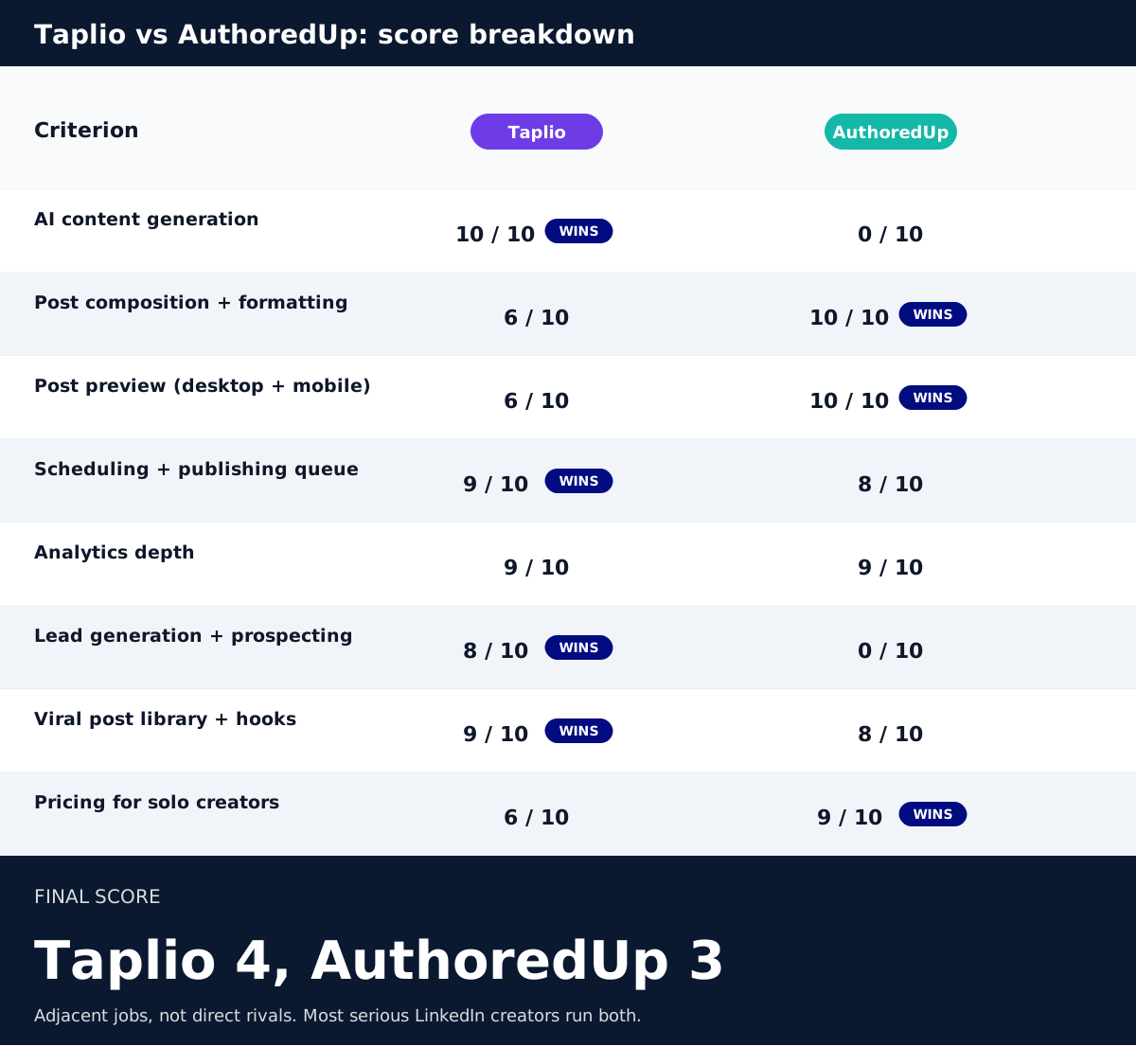
Third-party signals: Taplio on G2 rating around 4.7 / 5 across 100+ reviews (praised for AI-assisted scaling, criticised when users at the Starter tier discover no AI is included). AuthoredUp on G2 rating around 4.8 / 5 across 400+ reviews (praised for the post preview and formatting experience that no other tool ships).
Table of contents
Why trust this review
TL;DR
Quick comparison
The case for Taplio
The case for AuthoredUp
How much does each cost?
Which has better content creation?
Which has better scheduling and analytics?
Which is better for agencies and ghostwriters?
When to pick Taplio
When to pick AuthoredUp
When to use both (the GROU stack)
Honest dealbreakers
Alternatives worth considering
FAQ
Bottom line
Quick comparison
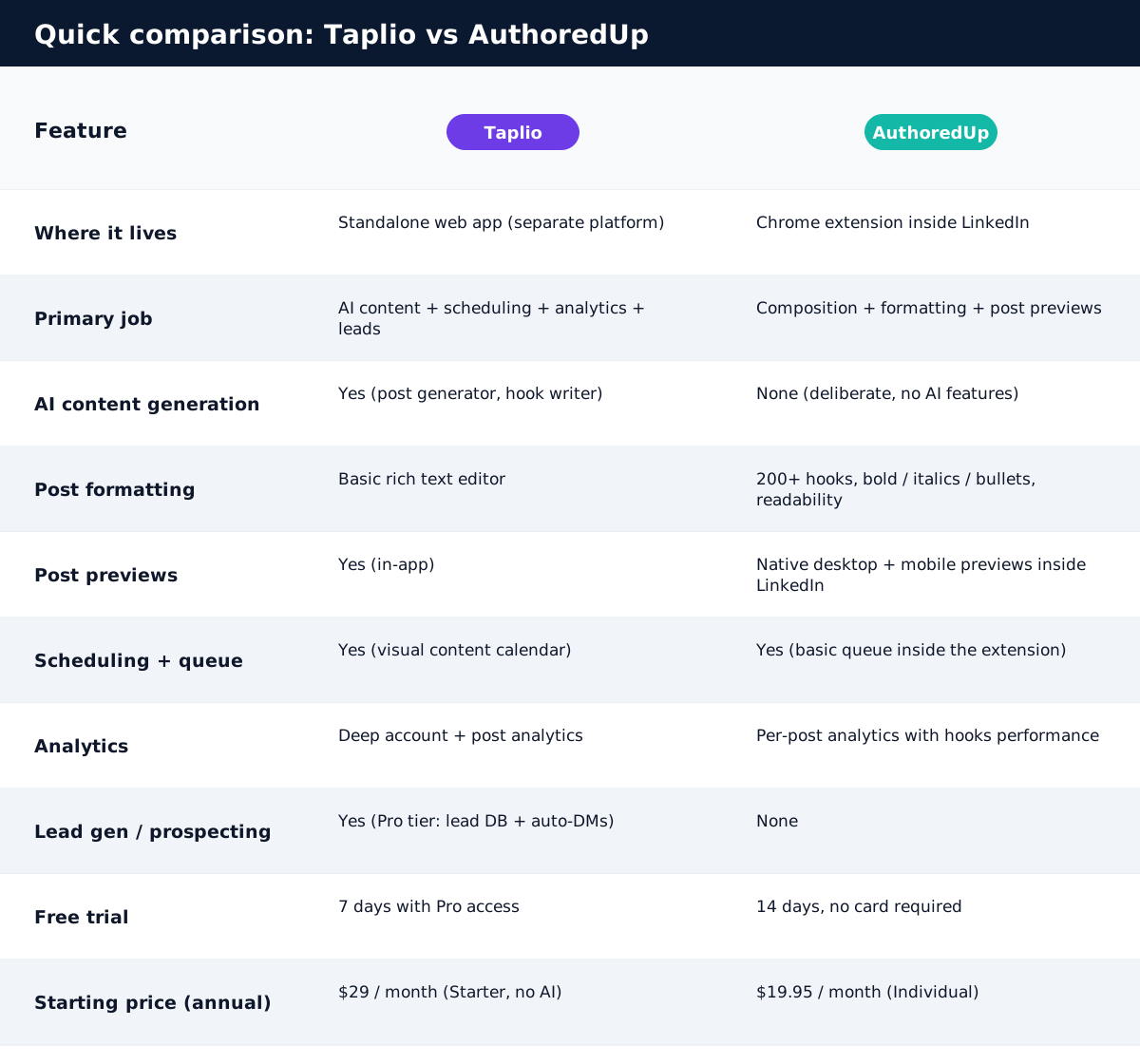
The case for Taplio
Taplio is the all-in-one LinkedIn content suite. The wedge is three-pronged: AI content generation, deep scheduling and analytics, and (at the Pro tier) prospecting features that turn LinkedIn content into a lead funnel.
The AI features are the headline. The post generator drafts full LinkedIn posts from a topic prompt, the hook writer surfaces opening lines tested on viral content, and the carousel generator builds image carousels from outline text. For solo creators trying to ship daily content without writing every word from scratch, the AI scaffolding is the unlock. Important nuance: the Starter tier at $29 per month (annual) ships zero AI credits, which surprises a lot of buyers. The AI features start at the Growth tier ($49 per month annually).
The viral post library is the second wedge. Taplio indexes thousands of high-performing LinkedIn posts by topic, hook style, and engagement metrics. Filter by industry, and you have a starting template for the next 30 posts. The library is genuinely useful for finding hooks that have already worked in your niche, not just for inspiration-style scrolling.
The Pro tier ($149 per month annually) adds the lead generation layer: a lead database with LinkedIn profile filters, auto-DMs (with conservative LinkedIn limits), auto-connection requests, and mass messaging tools. For founders or agencies turning LinkedIn content into a pipeline (rather than just brand awareness), this tier is where Taplio justifies its premium positioning.
The downsides are real. The post composition experience is mid-tier. The in-app editor is a basic rich-text box, not the deep formatting + preview environment AuthoredUp ships. The AI output sounds AI-generic without significant editing, especially on the Starter tier, where you do not have AI credits anyway. And the per-seat pricing scales hard for teams: a 3-person Growth setup is $1,764 per year, vs $538 per year for AuthoredUp Team at the same headcount.
→ Best for: solo creators who want AI to draft posts, founders running LinkedIn content as a pipeline channel (Pro tier), agencies that want a single platform for content + scheduling + analytics + lead gen, and anyone who values workflow consolidation over composition depth.
The case for AuthoredUp
AuthoredUp is the focused composition tool that lives inside LinkedIn. The wedge is two-pronged: the formatting and preview experience that no other tool ships, and the deliberate decision to exclude AI generation so writers keep authorship.
The composition experience is the headline. AuthoredUp installs as a Chrome extension that overlays LinkedIn directly. You write your post in LinkedIn (no context switching, no copy-paste), with AuthoredUp adding bold, italic, bullet formatting, character count, readability grading, and a 200+ hook and ending template library. The post preview shows you exactly how the post will render on desktop and mobile, including the "see more" truncation point that decides whether anyone reads past the hook. No other tool ships this level of in-line composition support.
The hooks library is the second wedge. 200+ tested opening and closing patterns, organised by post type (story, list, question, contrarian take). This is not a generic copy library; it is hooks that have actually performed on LinkedIn, with usage data. For a writer who wants to ship better content without using AI, this library is the highest-leverage feature in the LinkedIn content category.
The deliberate AI exclusion is a philosophical choice that lands well with one buyer and badly with another. AuthoredUp's position: AI-generated LinkedIn content is increasingly easy to spot, increasingly punished by the algorithm, and erodes the writer's voice over time. The tool gives you formatting, preview, hooks, and analytics; you write the content. For ghostwriters, founders with a strong voice, and writers who want to grow on the strength of their own thinking, this is the right tool. For creators who want AI to draft for them, this is the wrong tool.
The pricing is honest. $19.95 per user per month for individuals (annual). $14.95 per user per month for teams of 3+. Managers and ghostwriters do not count toward the seat limit, which is a meaningful agency-friendly nuance. There is no permanent free plan; the 14-day trial covers evaluation.
The downsides are real. No AI generation (by design, but it is a real gap for some buyers). No prospecting features (no auto-DMs, no lead database, no auto-connect). The scheduling is functional but less polished than Taplio's content calendar. Analytics are per-post focused, not full account-level dashboards.
→ Best for: writers with a strong voice who want to ship better content, ghostwriters writing for executive clients, founders who care about composition quality and post-performance over scale, agencies running content programmes where authorship matters.
How much does each cost?
Side-by-side breakdown of base pricing. For live pricing, check Taplio and AuthoredUp directly.
Taplio pricing
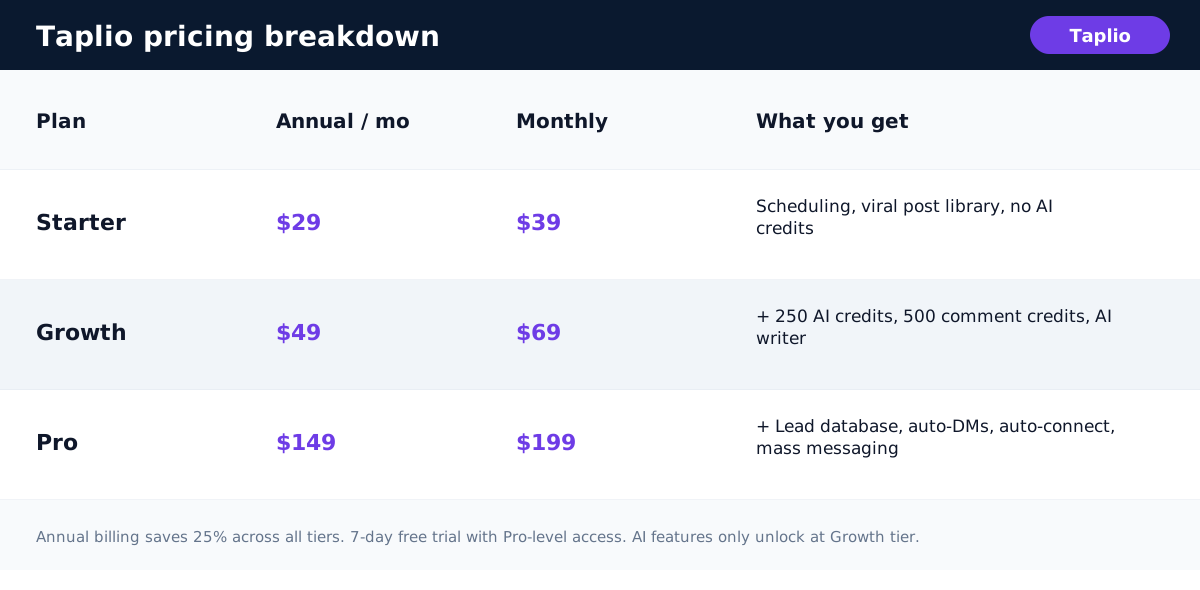
Taplio's pricing is per user, scaled by feature depth. The Starter tier at $29 per month (annual) covers scheduling and the viral post library but ships zero AI credits. The Growth tier at $49 per month is where the AI features Taplio markets actually live: 250 AI credits, 500 comment credits, full post generator and hook writer access.
The Pro tier at $149 per month is the agency/lead gen tier. Adds the lead database, auto-DMs, auto-connection requests, and mass messaging tools. For solo creators not using the prospecting layer, the Pro tier is overkill. For founders monetising LinkedIn content as a pipeline channel, the Pro tier is the actual product.
Hidden cost watch-outs: AI credit consumption is faster than most users expect. Heavy users on Growth will exhaust the 250 monthly credits in the first two weeks. Top-up credits are available but priced at a premium. If AI content generation is your primary use case, budget for the higher tier.
AuthoredUp pricing
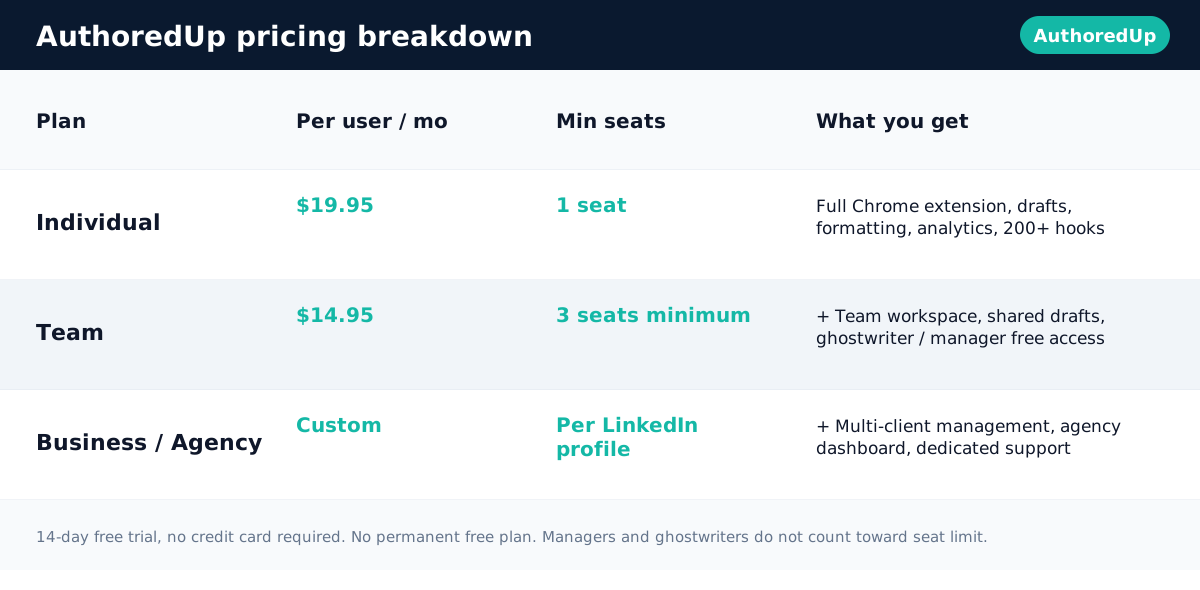
AuthoredUp's pricing is per active user. An individual at $19.95 per month is the right tier for solo creators. Team at $14.95 per user per month (minimum 3 seats) is the right tier for in-house content teams or agencies with a writer + reviewer setup.
The agency-friendly nuance: managers and ghostwriters do not count toward the seat limit if they are not actively using the extension. A founder + ghostwriter setup needs 1 seat (the founder posts, the ghostwriter writes via the founder's profile). A 5-client agency with 1 ghostwriter posting on each client's profile needs 5 seats.
Hidden cost watch-outs: there is no permanent free plan, only a 14-day trial. If you stop using the extension, you lose access to your drafts (export them first).
Annual cost compared
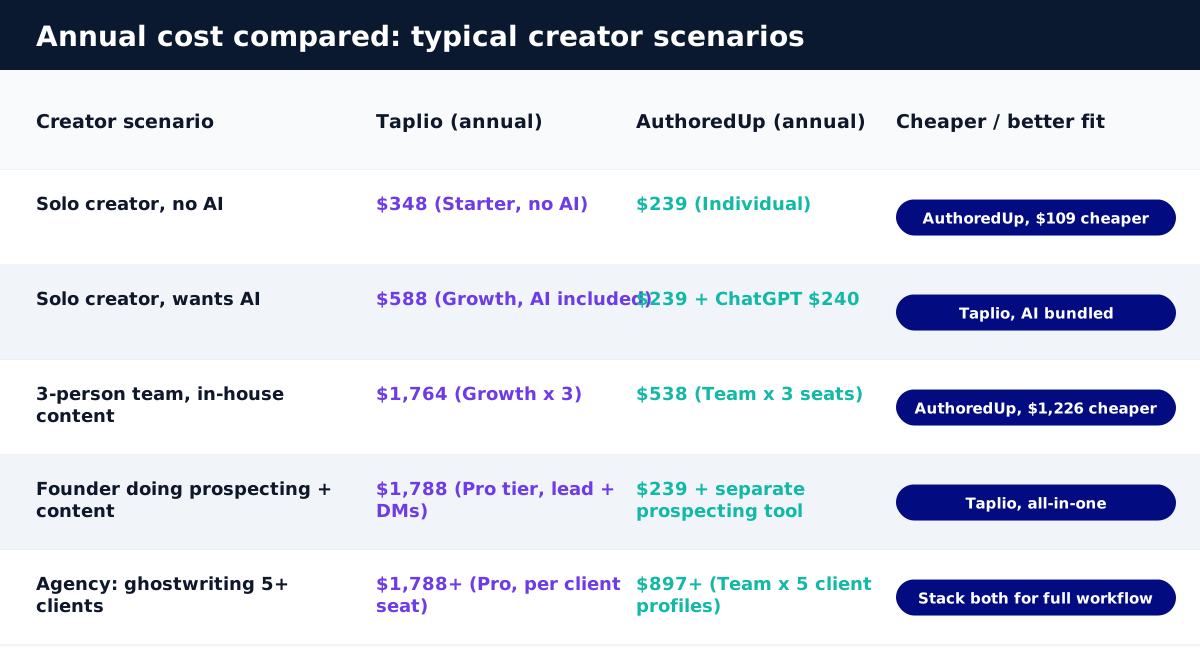
AuthoredUp wins on raw price at every scenario except where Taplio's bundled AI or Pro-tier prospecting features substitute for separate tools. For agencies running ghostwriting for multiple clients, the stacked cost (AuthoredUp for composition + Taplio for AI scaffolding and scheduling) lands at roughly $70 per user per month, the price of running a serious content programme that ships without compromise.
Which has better content creation?
Depends on whether you write your posts or want AI to write them.
For human-written content, AuthoredUp wins, clearly. The in-line composition experience inside LinkedIn (no context switching), the 200+ hooks library, the desktop and mobile previews, and the readability grading are unmatched. Writers ship faster and ship better content with AuthoredUp than with any other tool.
For AI-assisted content, Taplio wins by default because AuthoredUp ships no AI features. Taplio's post generator and hook writer are competent at producing first drafts from a topic prompt. Quality plateaus after the first 10 to 20 generations as the AI converges on a recognisable style, which is why most Taplio power users use the AI for scaffolding rather than final copy.
The real workflow we see in client deployments: use Taplio's AI to generate a rough draft and topic ideas, then move to LinkedIn (with AuthoredUp open) to edit, format, and preview the actual post before scheduling. This stacks the two tools and gets the best of both.
Verdict: AuthoredUp for writers, Taplio for AI-first creators, both stacked for serious content operators.
Which has better scheduling and analytics?
Taplio for scheduling depth, AuthoredUp for per-post analytics depth.
Taplio's visual content calendar shows the next month of scheduled posts across all connected accounts. Drag-and-drop reordering, time slot optimisation, and queue management. For a daily content programme across multiple accounts or clients, Taplio's scheduling is materially better.
AuthoredUp's scheduling is functional. Schedule a post from the composition view, see the queue, and edit before publishing. Good for solo creators, less ideal for agency workflows managing multiple accounts.
Analytics is the opposite. Taplio surfaces account-level dashboards (follower growth, post performance trends, engagement rate over time). AuthoredUp surfaces per-post depth (which hook performed, how long the post was, what time it was posted, mobile vs desktop engagement split). Both are useful, with different focuses.
Verdict: Taplio for scheduling at scale, AuthoredUp for understanding why individual posts performed.
Which is better for agencies and ghostwriters?
AuthoredUp, by a meaningful margin, for the writing workflow. Taplio, by a meaningful margin, for the prospecting layer if you offer LinkedIn-led lead gen as a service.
AuthoredUp's ghostwriter-friendly model is unusually clean. The ghostwriter writes posts on the client's LinkedIn profile, and the client reviews and posts. Both can access AuthoredUp's drafts and formatting. Only the active user (typically the ghostwriter) consumes a seat. For an agency running 10 client LinkedIn profiles with 2 ghostwriters, AuthoredUp Team at $14.95 per seat covers it cleanly.
Taplio's agency model is per-user-per-client. 10 clients on Taplio Pro means 10 × $149 = $1,490 per month, which gets you the full content + scheduling + lead gen stack but costs ~10x more than AuthoredUp for the writing workflow alone.
The hybrid: AuthoredUp for the writing layer across all clients, Taplio for the 1 or 2 clients running aggressive LinkedIn lead gen with auto-DMs and the lead database. We have seen this exact pattern at 3 different LinkedIn content agencies.
Verdict: AuthoredUp for ghostwriting at scale, Taplio for the 20 per cent of clients monetising LinkedIn as a pipeline channel.
When to pick Taplio
You want AI to draft your LinkedIn posts, and you can absorb the Growth tier price.
You run LinkedIn content as a lead generation channel (Pro tier: auto-DMs, lead database).
You manage scheduling across multiple accounts and need a visual content calendar.
You value workflow consolidation: AI + scheduling + analytics + leads in one tool.
You want account-level analytics dashboards (follower growth, engagement trends).
Your motion is scale-led, not depth-led: shipping more content matters more than each post being perfect.
When to pick AuthoredUp
You write your own LinkedIn content and want the best composition experience.
You ghostwrite for clients and need a tool that lives inside LinkedIn (no context switching).
You care about post quality: hooks, formatting, previews, and readability.
You are price sensitive, and AuthoredUp's flat pricing fits.
You want per-post analytics (hook performance, mobile vs desktop, post length impact).
You believe AI-generated LinkedIn content erodes voice, and you want to keep authorship.
When to use both (the GROU stack)
Most serious LinkedIn content operators converge on the same pattern within 3 to 6 months: use both for different parts of the workflow.
Taplio handles the scaffolding layer. AI-generated first drafts from topic prompts, the viral post library for hook inspiration, account-level analytics for tracking follower growth over time, and scheduling across multiple accounts. For founders running LinkedIn as a pipeline channel, the Pro tier's lead gen features layer on top.
AuthoredUp handles the writing layer. Take the AI draft from Taplio, paste it into LinkedIn, use AuthoredUp's hook library to refine the opening, format the post properly, preview on desktop and mobile, and ship.
The handoff is manual but fast. The stacked cost (Taplio Growth $49 + AuthoredUp Individual $20) is ~$69 per user per month, less than Taplio Pro alone. For agencies running content for clients, the math changes: Taplio Growth at the agency level + AuthoredUp Team ($15 per ghostwriter seat) scales cleanly.
This is what GROU runs for client LinkedIn programmes. It is what we recommend without hesitation for any operator past the solo-account, hobby-level stage.
Honest dealbreakers
Taplio dealbreakers:
The Starter tier at $29 per month sounds cheap until you realise it ships zero AI credits. If you want AI, the real price is Growth at $49 per month.
Per-seat scaling makes Taplio expensive for agencies running 5+ ghostwriter seats.
The post composition experience is mid-tier vs AuthoredUp's depth.
AI output quality plateaus fast; you will still need to edit every post if you care about voice.
AuthoredUp dealbreakers:
No AI generation. By design, but a real gap if you want AI to draft posts.
No lead generation features (no auto-DMs, no lead database, no auto-connect). LinkedIn outreach lives elsewhere (Heyreach, Expandi).
Scheduling is functional but less polished than Taplio's content calendar.
Account-level analytics dashboards are not the design priority; per-post depth is.
Alternatives worth considering
Heyreach for LinkedIn outreach automation at agency scale (multi-account, whitelabel). Pairs with either content tool. See our Heyreach vs Expandi comparison.
Expandi for LinkedIn outreach with single-account safety and personalisation depth.
Shield Analytics for LinkedIn analytics depth (account + post + competitor tracking). Pairs with AuthoredUp for writers who need deeper analytics than AuthoredUp ships natively.
Supergrow for a newer AI-first LinkedIn content tool, direct Taplio competitor with a slightly different AI approach.
Kleo for Chrome-extension content composition (AuthoredUp competitor).
We have full comparison articles on related tools. See Heyreach vs Expandi for the LinkedIn outreach side of the stack.
FAQ
Is Taplio worth the Starter tier price if I do not get AI credits?
Probably not. The Starter tier at $29 per month (annual) is positioned as the entry point but ships zero AI credits, which is the feature most buyers come to Taplio for. If you want scheduling and the viral library without AI, AuthoredUp Individual at $19.95 covers most of the same workflow with better composition tools. The Starter tier only makes sense if you specifically need Taplio's scheduling calendar across multiple accounts.
Does AuthoredUp actually have no AI features?
Correct. AuthoredUp deliberately excludes AI content generation. The position is that AI content erodes the writer's voice and is increasingly easy for the LinkedIn algorithm to detect. The tool gives you formatting, hooks, previews, analytics, and templates; you write the content. For some buyers this is the wedge, for others it is the dealbreaker.
Can I run Taplio and AuthoredUp at the same time?
Yes, this is the standard mature operator stack. Taplio for AI scaffolding, viral library, scheduling, and analytics. AuthoredUp for the moment of writing inside LinkedIn (formatting, hooks, previews). The handoff is manual (paste the draft from Taplio into LinkedIn, refine with AuthoredUp) but fast. Combined cost ~$70 per user per month.
Will Taplio's AI features get me banned from LinkedIn?
No, the AI features generate text that you then post manually or via Taplio's scheduling. LinkedIn does not detect AI-written text reliably. The auto-DM and auto-connect features on the Pro tier carry the usual LinkedIn automation risk, which Taplio mitigates with conservative daily limits and randomised timing. Stay under 100 DMs per week per account to keep ban risk low.
Does AuthoredUp work on the LinkedIn mobile app?
No. AuthoredUp is a Chrome extension, so it only works in the LinkedIn web app on desktop. The post preview shows you exactly how the post will render on mobile, but the composition itself happens on desktop.
Can I use Taplio for lead gen alone without using the AI features?
Yes. The Pro tier ($149 per month annual) is the lead gen tier: lead database, auto-DMs, auto-connect, mass messaging. You can subscribe at Pro without using the AI content features, although you are paying for them implicitly. For pure LinkedIn lead generation, dedicated tools like Heyreach are usually a better fit at the same price.
Which one has better customer support?
Both have responsive support via chat (Taplio: in-app, AuthoredUp: in-extension and email). AuthoredUp's response times are typically faster (under 4 hours), reflecting the smaller user base. Taplio's responses are reliable but can run longer at peak times.
Can I write posts in AuthoredUp and schedule them in Taplio?
Yes, but the workflow is clunky. AuthoredUp's drafts live inside LinkedIn. To schedule via Taplio, you would have to copy the formatted post from AuthoredUp, paste into Taplio's scheduler, and lose some of the formatting nuance. Most operators who stack both either schedule via LinkedIn natively (using AuthoredUp's scheduler) or accept the small formatting loss when going through Taplio.
Does AuthoredUp have a permanent free plan?
No. There is a 14-day free trial (no credit card required) but no permanent free plan. The pricing model assumes you commit after the trial.
Bottom line
Taplio is the right call for solo creators who want AI to draft posts and founders running LinkedIn content as a lead generation channel. The all-in-one suite (AI + scheduling + analytics + leads at the Pro tier) consolidates a workflow that would otherwise need 3 or 4 tools. The price (Growth at $49 per month, Pro at $149 per month) is real, but justified if you are using the bundled features.
AuthoredUp is the right call for writers, ghostwriters, and founders who care about post quality over scale. The in-line composition experience inside LinkedIn, the 200+ hooks library, the desktop and mobile previews, and the deliberate no-AI position are the best content creation experience in the LinkedIn tool category. The flat pricing ($19.95 individual, $14.95 per seat for teams) makes it materially cheaper than Taplio at every team size.
For most serious LinkedIn content operators, the answer is both. Taplio for scaffolding, scheduling, and analytics. AuthoredUp for the writing layer inside LinkedIn. This is the GROU stack and the pattern we see most clients converge on.
If you want help designing a LinkedIn content programme (or planning the migration if you are on one tool today and adding the other), book a working session with GROU. We have shipped this stack for clients across SaaS, fintech, and professional services. We can do the same for you.
→ Try Taplio free (7-day trial with Pro-level access).
→ Try AuthoredUp free (14-day trial, no card required).
Why trust this review
We are GROU, a B2B pipeline agency that runs lead generation, outbound, and LinkedIn content for clients across manufacturing, fintech, iGaming, software, and professional services. We have shipped LinkedIn content programmes on both Taplio and AuthoredUp for clients over the last 18 months. The verdict below is from operators who write, schedule, and analyse LinkedIn content every day, not from a vendor pitch.
→ Methodology: This comparison combines our own client deployment data, both vendors' published pricing pages, third-party reviews from CheckThat, SocialRails, Supergrow, ConnectSafely, and live G2 review data. We refresh this article quarterly.
→ Affiliate disclosure: Some links in this article are affiliate links to Taplio and AuthoredUp. We earn a small commission if you sign up through them, at no extra cost to you. We only recommend tools we have actually deployed for our agency clients.
TL;DR
Taplio and AuthoredUp solve adjacent jobs in the LinkedIn content stack, not the same one. Taplio is a standalone web app that does AI content generation, scheduling, analytics, and (at the Pro tier) lead generation with auto-DMs and a lead database. AuthoredUp is a Chrome extension that lives inside LinkedIn, focused on composition, formatting, post previews, and the 200+ hook library that makes posts actually perform.
The pricing philosophy is opposite. Taplio scales from $29 to $149 per user per month (annual) and bundles AI + scheduling + leads. AuthoredUp is $19.95 per user per month flat for individuals (or $14.95 for teams of 3+), and deliberately ships no AI generation. The right tool depends on whether you want AI to write for you or whether you write your own posts and want the best formatting and preview experience.
For most serious operators, this is not an either-or. Taplio handles the scheduling, AI scaffolding, and analytics. AuthoredUp handles the moment of writing inside LinkedIn. Stacked, they cost ~$70 per user per month and produce content that ships faster with higher post-quality than either tool alone.
Score breakdown at a glance
Third-party signals: Taplio on G2 rating around 4.7 / 5 across 100+ reviews (praised for AI-assisted scaling, criticised when users at the Starter tier discover no AI is included). AuthoredUp on G2 rating around 4.8 / 5 across 400+ reviews (praised for the post preview and formatting experience that no other tool ships).
Table of contents
Why trust this review
TL;DR
Quick comparison
The case for Taplio
The case for AuthoredUp
How much does each cost?
Which has better content creation?
Which has better scheduling and analytics?
Which is better for agencies and ghostwriters?
When to pick Taplio
When to pick AuthoredUp
When to use both (the GROU stack)
Honest dealbreakers
Alternatives worth considering
FAQ
Bottom line
Quick comparison
The case for Taplio
Taplio is the all-in-one LinkedIn content suite. The wedge is three-pronged: AI content generation, deep scheduling and analytics, and (at the Pro tier) prospecting features that turn LinkedIn content into a lead funnel.
The AI features are the headline. The post generator drafts full LinkedIn posts from a topic prompt, the hook writer surfaces opening lines tested on viral content, and the carousel generator builds image carousels from outline text. For solo creators trying to ship daily content without writing every word from scratch, the AI scaffolding is the unlock. Important nuance: the Starter tier at $29 per month (annual) ships zero AI credits, which surprises a lot of buyers. The AI features start at the Growth tier ($49 per month annually).
The viral post library is the second wedge. Taplio indexes thousands of high-performing LinkedIn posts by topic, hook style, and engagement metrics. Filter by industry, and you have a starting template for the next 30 posts. The library is genuinely useful for finding hooks that have already worked in your niche, not just for inspiration-style scrolling.
The Pro tier ($149 per month annually) adds the lead generation layer: a lead database with LinkedIn profile filters, auto-DMs (with conservative LinkedIn limits), auto-connection requests, and mass messaging tools. For founders or agencies turning LinkedIn content into a pipeline (rather than just brand awareness), this tier is where Taplio justifies its premium positioning.
The downsides are real. The post composition experience is mid-tier. The in-app editor is a basic rich-text box, not the deep formatting + preview environment AuthoredUp ships. The AI output sounds AI-generic without significant editing, especially on the Starter tier, where you do not have AI credits anyway. And the per-seat pricing scales hard for teams: a 3-person Growth setup is $1,764 per year, vs $538 per year for AuthoredUp Team at the same headcount.
→ Best for: solo creators who want AI to draft posts, founders running LinkedIn content as a pipeline channel (Pro tier), agencies that want a single platform for content + scheduling + analytics + lead gen, and anyone who values workflow consolidation over composition depth.
The case for AuthoredUp
AuthoredUp is the focused composition tool that lives inside LinkedIn. The wedge is two-pronged: the formatting and preview experience that no other tool ships, and the deliberate decision to exclude AI generation so writers keep authorship.
The composition experience is the headline. AuthoredUp installs as a Chrome extension that overlays LinkedIn directly. You write your post in LinkedIn (no context switching, no copy-paste), with AuthoredUp adding bold, italic, bullet formatting, character count, readability grading, and a 200+ hook and ending template library. The post preview shows you exactly how the post will render on desktop and mobile, including the "see more" truncation point that decides whether anyone reads past the hook. No other tool ships this level of in-line composition support.
The hooks library is the second wedge. 200+ tested opening and closing patterns, organised by post type (story, list, question, contrarian take). This is not a generic copy library; it is hooks that have actually performed on LinkedIn, with usage data. For a writer who wants to ship better content without using AI, this library is the highest-leverage feature in the LinkedIn content category.
The deliberate AI exclusion is a philosophical choice that lands well with one buyer and badly with another. AuthoredUp's position: AI-generated LinkedIn content is increasingly easy to spot, increasingly punished by the algorithm, and erodes the writer's voice over time. The tool gives you formatting, preview, hooks, and analytics; you write the content. For ghostwriters, founders with a strong voice, and writers who want to grow on the strength of their own thinking, this is the right tool. For creators who want AI to draft for them, this is the wrong tool.
The pricing is honest. $19.95 per user per month for individuals (annual). $14.95 per user per month for teams of 3+. Managers and ghostwriters do not count toward the seat limit, which is a meaningful agency-friendly nuance. There is no permanent free plan; the 14-day trial covers evaluation.
The downsides are real. No AI generation (by design, but it is a real gap for some buyers). No prospecting features (no auto-DMs, no lead database, no auto-connect). The scheduling is functional but less polished than Taplio's content calendar. Analytics are per-post focused, not full account-level dashboards.
→ Best for: writers with a strong voice who want to ship better content, ghostwriters writing for executive clients, founders who care about composition quality and post-performance over scale, agencies running content programmes where authorship matters.
How much does each cost?
Side-by-side breakdown of base pricing. For live pricing, check Taplio and AuthoredUp directly.
Taplio pricing
Taplio's pricing is per user, scaled by feature depth. The Starter tier at $29 per month (annual) covers scheduling and the viral post library but ships zero AI credits. The Growth tier at $49 per month is where the AI features Taplio markets actually live: 250 AI credits, 500 comment credits, full post generator and hook writer access.
The Pro tier at $149 per month is the agency/lead gen tier. Adds the lead database, auto-DMs, auto-connection requests, and mass messaging tools. For solo creators not using the prospecting layer, the Pro tier is overkill. For founders monetising LinkedIn content as a pipeline channel, the Pro tier is the actual product.
Hidden cost watch-outs: AI credit consumption is faster than most users expect. Heavy users on Growth will exhaust the 250 monthly credits in the first two weeks. Top-up credits are available but priced at a premium. If AI content generation is your primary use case, budget for the higher tier.
AuthoredUp pricing
AuthoredUp's pricing is per active user. An individual at $19.95 per month is the right tier for solo creators. Team at $14.95 per user per month (minimum 3 seats) is the right tier for in-house content teams or agencies with a writer + reviewer setup.
The agency-friendly nuance: managers and ghostwriters do not count toward the seat limit if they are not actively using the extension. A founder + ghostwriter setup needs 1 seat (the founder posts, the ghostwriter writes via the founder's profile). A 5-client agency with 1 ghostwriter posting on each client's profile needs 5 seats.
Hidden cost watch-outs: there is no permanent free plan, only a 14-day trial. If you stop using the extension, you lose access to your drafts (export them first).
Annual cost compared
AuthoredUp wins on raw price at every scenario except where Taplio's bundled AI or Pro-tier prospecting features substitute for separate tools. For agencies running ghostwriting for multiple clients, the stacked cost (AuthoredUp for composition + Taplio for AI scaffolding and scheduling) lands at roughly $70 per user per month, the price of running a serious content programme that ships without compromise.
Which has better content creation?
Depends on whether you write your posts or want AI to write them.
For human-written content, AuthoredUp wins, clearly. The in-line composition experience inside LinkedIn (no context switching), the 200+ hooks library, the desktop and mobile previews, and the readability grading are unmatched. Writers ship faster and ship better content with AuthoredUp than with any other tool.
For AI-assisted content, Taplio wins by default because AuthoredUp ships no AI features. Taplio's post generator and hook writer are competent at producing first drafts from a topic prompt. Quality plateaus after the first 10 to 20 generations as the AI converges on a recognisable style, which is why most Taplio power users use the AI for scaffolding rather than final copy.
The real workflow we see in client deployments: use Taplio's AI to generate a rough draft and topic ideas, then move to LinkedIn (with AuthoredUp open) to edit, format, and preview the actual post before scheduling. This stacks the two tools and gets the best of both.
Verdict: AuthoredUp for writers, Taplio for AI-first creators, both stacked for serious content operators.
Which has better scheduling and analytics?
Taplio for scheduling depth, AuthoredUp for per-post analytics depth.
Taplio's visual content calendar shows the next month of scheduled posts across all connected accounts. Drag-and-drop reordering, time slot optimisation, and queue management. For a daily content programme across multiple accounts or clients, Taplio's scheduling is materially better.
AuthoredUp's scheduling is functional. Schedule a post from the composition view, see the queue, and edit before publishing. Good for solo creators, less ideal for agency workflows managing multiple accounts.
Analytics is the opposite. Taplio surfaces account-level dashboards (follower growth, post performance trends, engagement rate over time). AuthoredUp surfaces per-post depth (which hook performed, how long the post was, what time it was posted, mobile vs desktop engagement split). Both are useful, with different focuses.
Verdict: Taplio for scheduling at scale, AuthoredUp for understanding why individual posts performed.
Which is better for agencies and ghostwriters?
AuthoredUp, by a meaningful margin, for the writing workflow. Taplio, by a meaningful margin, for the prospecting layer if you offer LinkedIn-led lead gen as a service.
AuthoredUp's ghostwriter-friendly model is unusually clean. The ghostwriter writes posts on the client's LinkedIn profile, and the client reviews and posts. Both can access AuthoredUp's drafts and formatting. Only the active user (typically the ghostwriter) consumes a seat. For an agency running 10 client LinkedIn profiles with 2 ghostwriters, AuthoredUp Team at $14.95 per seat covers it cleanly.
Taplio's agency model is per-user-per-client. 10 clients on Taplio Pro means 10 × $149 = $1,490 per month, which gets you the full content + scheduling + lead gen stack but costs ~10x more than AuthoredUp for the writing workflow alone.
The hybrid: AuthoredUp for the writing layer across all clients, Taplio for the 1 or 2 clients running aggressive LinkedIn lead gen with auto-DMs and the lead database. We have seen this exact pattern at 3 different LinkedIn content agencies.
Verdict: AuthoredUp for ghostwriting at scale, Taplio for the 20 per cent of clients monetising LinkedIn as a pipeline channel.
When to pick Taplio
You want AI to draft your LinkedIn posts, and you can absorb the Growth tier price.
You run LinkedIn content as a lead generation channel (Pro tier: auto-DMs, lead database).
You manage scheduling across multiple accounts and need a visual content calendar.
You value workflow consolidation: AI + scheduling + analytics + leads in one tool.
You want account-level analytics dashboards (follower growth, engagement trends).
Your motion is scale-led, not depth-led: shipping more content matters more than each post being perfect.
When to pick AuthoredUp
You write your own LinkedIn content and want the best composition experience.
You ghostwrite for clients and need a tool that lives inside LinkedIn (no context switching).
You care about post quality: hooks, formatting, previews, and readability.
You are price sensitive, and AuthoredUp's flat pricing fits.
You want per-post analytics (hook performance, mobile vs desktop, post length impact).
You believe AI-generated LinkedIn content erodes voice, and you want to keep authorship.
When to use both (the GROU stack)
Most serious LinkedIn content operators converge on the same pattern within 3 to 6 months: use both for different parts of the workflow.
Taplio handles the scaffolding layer. AI-generated first drafts from topic prompts, the viral post library for hook inspiration, account-level analytics for tracking follower growth over time, and scheduling across multiple accounts. For founders running LinkedIn as a pipeline channel, the Pro tier's lead gen features layer on top.
AuthoredUp handles the writing layer. Take the AI draft from Taplio, paste it into LinkedIn, use AuthoredUp's hook library to refine the opening, format the post properly, preview on desktop and mobile, and ship.
The handoff is manual but fast. The stacked cost (Taplio Growth $49 + AuthoredUp Individual $20) is ~$69 per user per month, less than Taplio Pro alone. For agencies running content for clients, the math changes: Taplio Growth at the agency level + AuthoredUp Team ($15 per ghostwriter seat) scales cleanly.
This is what GROU runs for client LinkedIn programmes. It is what we recommend without hesitation for any operator past the solo-account, hobby-level stage.
Honest dealbreakers
Taplio dealbreakers:
The Starter tier at $29 per month sounds cheap until you realise it ships zero AI credits. If you want AI, the real price is Growth at $49 per month.
Per-seat scaling makes Taplio expensive for agencies running 5+ ghostwriter seats.
The post composition experience is mid-tier vs AuthoredUp's depth.
AI output quality plateaus fast; you will still need to edit every post if you care about voice.
AuthoredUp dealbreakers:
No AI generation. By design, but a real gap if you want AI to draft posts.
No lead generation features (no auto-DMs, no lead database, no auto-connect). LinkedIn outreach lives elsewhere (Heyreach, Expandi).
Scheduling is functional but less polished than Taplio's content calendar.
Account-level analytics dashboards are not the design priority; per-post depth is.
Alternatives worth considering
Heyreach for LinkedIn outreach automation at agency scale (multi-account, whitelabel). Pairs with either content tool. See our Heyreach vs Expandi comparison.
Expandi for LinkedIn outreach with single-account safety and personalisation depth.
Shield Analytics for LinkedIn analytics depth (account + post + competitor tracking). Pairs with AuthoredUp for writers who need deeper analytics than AuthoredUp ships natively.
Supergrow for a newer AI-first LinkedIn content tool, direct Taplio competitor with a slightly different AI approach.
Kleo for Chrome-extension content composition (AuthoredUp competitor).
We have full comparison articles on related tools. See Heyreach vs Expandi for the LinkedIn outreach side of the stack.
FAQ
Is Taplio worth the Starter tier price if I do not get AI credits?
Probably not. The Starter tier at $29 per month (annual) is positioned as the entry point but ships zero AI credits, which is the feature most buyers come to Taplio for. If you want scheduling and the viral library without AI, AuthoredUp Individual at $19.95 covers most of the same workflow with better composition tools. The Starter tier only makes sense if you specifically need Taplio's scheduling calendar across multiple accounts.
Does AuthoredUp actually have no AI features?
Correct. AuthoredUp deliberately excludes AI content generation. The position is that AI content erodes the writer's voice and is increasingly easy for the LinkedIn algorithm to detect. The tool gives you formatting, hooks, previews, analytics, and templates; you write the content. For some buyers this is the wedge, for others it is the dealbreaker.
Can I run Taplio and AuthoredUp at the same time?
Yes, this is the standard mature operator stack. Taplio for AI scaffolding, viral library, scheduling, and analytics. AuthoredUp for the moment of writing inside LinkedIn (formatting, hooks, previews). The handoff is manual (paste the draft from Taplio into LinkedIn, refine with AuthoredUp) but fast. Combined cost ~$70 per user per month.
Will Taplio's AI features get me banned from LinkedIn?
No, the AI features generate text that you then post manually or via Taplio's scheduling. LinkedIn does not detect AI-written text reliably. The auto-DM and auto-connect features on the Pro tier carry the usual LinkedIn automation risk, which Taplio mitigates with conservative daily limits and randomised timing. Stay under 100 DMs per week per account to keep ban risk low.
Does AuthoredUp work on the LinkedIn mobile app?
No. AuthoredUp is a Chrome extension, so it only works in the LinkedIn web app on desktop. The post preview shows you exactly how the post will render on mobile, but the composition itself happens on desktop.
Can I use Taplio for lead gen alone without using the AI features?
Yes. The Pro tier ($149 per month annual) is the lead gen tier: lead database, auto-DMs, auto-connect, mass messaging. You can subscribe at Pro without using the AI content features, although you are paying for them implicitly. For pure LinkedIn lead generation, dedicated tools like Heyreach are usually a better fit at the same price.
Which one has better customer support?
Both have responsive support via chat (Taplio: in-app, AuthoredUp: in-extension and email). AuthoredUp's response times are typically faster (under 4 hours), reflecting the smaller user base. Taplio's responses are reliable but can run longer at peak times.
Can I write posts in AuthoredUp and schedule them in Taplio?
Yes, but the workflow is clunky. AuthoredUp's drafts live inside LinkedIn. To schedule via Taplio, you would have to copy the formatted post from AuthoredUp, paste into Taplio's scheduler, and lose some of the formatting nuance. Most operators who stack both either schedule via LinkedIn natively (using AuthoredUp's scheduler) or accept the small formatting loss when going through Taplio.
Does AuthoredUp have a permanent free plan?
No. There is a 14-day free trial (no credit card required) but no permanent free plan. The pricing model assumes you commit after the trial.
Bottom line
Taplio is the right call for solo creators who want AI to draft posts and founders running LinkedIn content as a lead generation channel. The all-in-one suite (AI + scheduling + analytics + leads at the Pro tier) consolidates a workflow that would otherwise need 3 or 4 tools. The price (Growth at $49 per month, Pro at $149 per month) is real, but justified if you are using the bundled features.
AuthoredUp is the right call for writers, ghostwriters, and founders who care about post quality over scale. The in-line composition experience inside LinkedIn, the 200+ hooks library, the desktop and mobile previews, and the deliberate no-AI position are the best content creation experience in the LinkedIn tool category. The flat pricing ($19.95 individual, $14.95 per seat for teams) makes it materially cheaper than Taplio at every team size.
For most serious LinkedIn content operators, the answer is both. Taplio for scaffolding, scheduling, and analytics. AuthoredUp for the writing layer inside LinkedIn. This is the GROU stack and the pattern we see most clients converge on.
If you want help designing a LinkedIn content programme (or planning the migration if you are on one tool today and adding the other), book a working session with GROU. We have shipped this stack for clients across SaaS, fintech, and professional services. We can do the same for you.
→ Try Taplio free (7-day trial with Pro-level access).
→ Try AuthoredUp free (14-day trial, no card required).
Why trust this review
We are GROU, a B2B pipeline agency that runs lead generation, outbound, and LinkedIn content for clients across manufacturing, fintech, iGaming, software, and professional services. We have shipped LinkedIn content programmes on both Taplio and AuthoredUp for clients over the last 18 months. The verdict below is from operators who write, schedule, and analyse LinkedIn content every day, not from a vendor pitch.
→ Methodology: This comparison combines our own client deployment data, both vendors' published pricing pages, third-party reviews from CheckThat, SocialRails, Supergrow, ConnectSafely, and live G2 review data. We refresh this article quarterly.
→ Affiliate disclosure: Some links in this article are affiliate links to Taplio and AuthoredUp. We earn a small commission if you sign up through them, at no extra cost to you. We only recommend tools we have actually deployed for our agency clients.
TL;DR
Taplio and AuthoredUp solve adjacent jobs in the LinkedIn content stack, not the same one. Taplio is a standalone web app that does AI content generation, scheduling, analytics, and (at the Pro tier) lead generation with auto-DMs and a lead database. AuthoredUp is a Chrome extension that lives inside LinkedIn, focused on composition, formatting, post previews, and the 200+ hook library that makes posts actually perform.
The pricing philosophy is opposite. Taplio scales from $29 to $149 per user per month (annual) and bundles AI + scheduling + leads. AuthoredUp is $19.95 per user per month flat for individuals (or $14.95 for teams of 3+), and deliberately ships no AI generation. The right tool depends on whether you want AI to write for you or whether you write your own posts and want the best formatting and preview experience.
For most serious operators, this is not an either-or. Taplio handles the scheduling, AI scaffolding, and analytics. AuthoredUp handles the moment of writing inside LinkedIn. Stacked, they cost ~$70 per user per month and produce content that ships faster with higher post-quality than either tool alone.
Score breakdown at a glance
Third-party signals: Taplio on G2 rating around 4.7 / 5 across 100+ reviews (praised for AI-assisted scaling, criticised when users at the Starter tier discover no AI is included). AuthoredUp on G2 rating around 4.8 / 5 across 400+ reviews (praised for the post preview and formatting experience that no other tool ships).
Table of contents
Why trust this review
TL;DR
Quick comparison
The case for Taplio
The case for AuthoredUp
How much does each cost?
Which has better content creation?
Which has better scheduling and analytics?
Which is better for agencies and ghostwriters?
When to pick Taplio
When to pick AuthoredUp
When to use both (the GROU stack)
Honest dealbreakers
Alternatives worth considering
FAQ
Bottom line
Quick comparison
The case for Taplio
Taplio is the all-in-one LinkedIn content suite. The wedge is three-pronged: AI content generation, deep scheduling and analytics, and (at the Pro tier) prospecting features that turn LinkedIn content into a lead funnel.
The AI features are the headline. The post generator drafts full LinkedIn posts from a topic prompt, the hook writer surfaces opening lines tested on viral content, and the carousel generator builds image carousels from outline text. For solo creators trying to ship daily content without writing every word from scratch, the AI scaffolding is the unlock. Important nuance: the Starter tier at $29 per month (annual) ships zero AI credits, which surprises a lot of buyers. The AI features start at the Growth tier ($49 per month annually).
The viral post library is the second wedge. Taplio indexes thousands of high-performing LinkedIn posts by topic, hook style, and engagement metrics. Filter by industry, and you have a starting template for the next 30 posts. The library is genuinely useful for finding hooks that have already worked in your niche, not just for inspiration-style scrolling.
The Pro tier ($149 per month annually) adds the lead generation layer: a lead database with LinkedIn profile filters, auto-DMs (with conservative LinkedIn limits), auto-connection requests, and mass messaging tools. For founders or agencies turning LinkedIn content into a pipeline (rather than just brand awareness), this tier is where Taplio justifies its premium positioning.
The downsides are real. The post composition experience is mid-tier. The in-app editor is a basic rich-text box, not the deep formatting + preview environment AuthoredUp ships. The AI output sounds AI-generic without significant editing, especially on the Starter tier, where you do not have AI credits anyway. And the per-seat pricing scales hard for teams: a 3-person Growth setup is $1,764 per year, vs $538 per year for AuthoredUp Team at the same headcount.
→ Best for: solo creators who want AI to draft posts, founders running LinkedIn content as a pipeline channel (Pro tier), agencies that want a single platform for content + scheduling + analytics + lead gen, and anyone who values workflow consolidation over composition depth.
The case for AuthoredUp
AuthoredUp is the focused composition tool that lives inside LinkedIn. The wedge is two-pronged: the formatting and preview experience that no other tool ships, and the deliberate decision to exclude AI generation so writers keep authorship.
The composition experience is the headline. AuthoredUp installs as a Chrome extension that overlays LinkedIn directly. You write your post in LinkedIn (no context switching, no copy-paste), with AuthoredUp adding bold, italic, bullet formatting, character count, readability grading, and a 200+ hook and ending template library. The post preview shows you exactly how the post will render on desktop and mobile, including the "see more" truncation point that decides whether anyone reads past the hook. No other tool ships this level of in-line composition support.
The hooks library is the second wedge. 200+ tested opening and closing patterns, organised by post type (story, list, question, contrarian take). This is not a generic copy library; it is hooks that have actually performed on LinkedIn, with usage data. For a writer who wants to ship better content without using AI, this library is the highest-leverage feature in the LinkedIn content category.
The deliberate AI exclusion is a philosophical choice that lands well with one buyer and badly with another. AuthoredUp's position: AI-generated LinkedIn content is increasingly easy to spot, increasingly punished by the algorithm, and erodes the writer's voice over time. The tool gives you formatting, preview, hooks, and analytics; you write the content. For ghostwriters, founders with a strong voice, and writers who want to grow on the strength of their own thinking, this is the right tool. For creators who want AI to draft for them, this is the wrong tool.
The pricing is honest. $19.95 per user per month for individuals (annual). $14.95 per user per month for teams of 3+. Managers and ghostwriters do not count toward the seat limit, which is a meaningful agency-friendly nuance. There is no permanent free plan; the 14-day trial covers evaluation.
The downsides are real. No AI generation (by design, but it is a real gap for some buyers). No prospecting features (no auto-DMs, no lead database, no auto-connect). The scheduling is functional but less polished than Taplio's content calendar. Analytics are per-post focused, not full account-level dashboards.
→ Best for: writers with a strong voice who want to ship better content, ghostwriters writing for executive clients, founders who care about composition quality and post-performance over scale, agencies running content programmes where authorship matters.
How much does each cost?
Side-by-side breakdown of base pricing. For live pricing, check Taplio and AuthoredUp directly.
Taplio pricing
Taplio's pricing is per user, scaled by feature depth. The Starter tier at $29 per month (annual) covers scheduling and the viral post library but ships zero AI credits. The Growth tier at $49 per month is where the AI features Taplio markets actually live: 250 AI credits, 500 comment credits, full post generator and hook writer access.
The Pro tier at $149 per month is the agency/lead gen tier. Adds the lead database, auto-DMs, auto-connection requests, and mass messaging tools. For solo creators not using the prospecting layer, the Pro tier is overkill. For founders monetising LinkedIn content as a pipeline channel, the Pro tier is the actual product.
Hidden cost watch-outs: AI credit consumption is faster than most users expect. Heavy users on Growth will exhaust the 250 monthly credits in the first two weeks. Top-up credits are available but priced at a premium. If AI content generation is your primary use case, budget for the higher tier.
AuthoredUp pricing
AuthoredUp's pricing is per active user. An individual at $19.95 per month is the right tier for solo creators. Team at $14.95 per user per month (minimum 3 seats) is the right tier for in-house content teams or agencies with a writer + reviewer setup.
The agency-friendly nuance: managers and ghostwriters do not count toward the seat limit if they are not actively using the extension. A founder + ghostwriter setup needs 1 seat (the founder posts, the ghostwriter writes via the founder's profile). A 5-client agency with 1 ghostwriter posting on each client's profile needs 5 seats.
Hidden cost watch-outs: there is no permanent free plan, only a 14-day trial. If you stop using the extension, you lose access to your drafts (export them first).
Annual cost compared
AuthoredUp wins on raw price at every scenario except where Taplio's bundled AI or Pro-tier prospecting features substitute for separate tools. For agencies running ghostwriting for multiple clients, the stacked cost (AuthoredUp for composition + Taplio for AI scaffolding and scheduling) lands at roughly $70 per user per month, the price of running a serious content programme that ships without compromise.
Which has better content creation?
Depends on whether you write your posts or want AI to write them.
For human-written content, AuthoredUp wins, clearly. The in-line composition experience inside LinkedIn (no context switching), the 200+ hooks library, the desktop and mobile previews, and the readability grading are unmatched. Writers ship faster and ship better content with AuthoredUp than with any other tool.
For AI-assisted content, Taplio wins by default because AuthoredUp ships no AI features. Taplio's post generator and hook writer are competent at producing first drafts from a topic prompt. Quality plateaus after the first 10 to 20 generations as the AI converges on a recognisable style, which is why most Taplio power users use the AI for scaffolding rather than final copy.
The real workflow we see in client deployments: use Taplio's AI to generate a rough draft and topic ideas, then move to LinkedIn (with AuthoredUp open) to edit, format, and preview the actual post before scheduling. This stacks the two tools and gets the best of both.
Verdict: AuthoredUp for writers, Taplio for AI-first creators, both stacked for serious content operators.
Which has better scheduling and analytics?
Taplio for scheduling depth, AuthoredUp for per-post analytics depth.
Taplio's visual content calendar shows the next month of scheduled posts across all connected accounts. Drag-and-drop reordering, time slot optimisation, and queue management. For a daily content programme across multiple accounts or clients, Taplio's scheduling is materially better.
AuthoredUp's scheduling is functional. Schedule a post from the composition view, see the queue, and edit before publishing. Good for solo creators, less ideal for agency workflows managing multiple accounts.
Analytics is the opposite. Taplio surfaces account-level dashboards (follower growth, post performance trends, engagement rate over time). AuthoredUp surfaces per-post depth (which hook performed, how long the post was, what time it was posted, mobile vs desktop engagement split). Both are useful, with different focuses.
Verdict: Taplio for scheduling at scale, AuthoredUp for understanding why individual posts performed.
Which is better for agencies and ghostwriters?
AuthoredUp, by a meaningful margin, for the writing workflow. Taplio, by a meaningful margin, for the prospecting layer if you offer LinkedIn-led lead gen as a service.
AuthoredUp's ghostwriter-friendly model is unusually clean. The ghostwriter writes posts on the client's LinkedIn profile, and the client reviews and posts. Both can access AuthoredUp's drafts and formatting. Only the active user (typically the ghostwriter) consumes a seat. For an agency running 10 client LinkedIn profiles with 2 ghostwriters, AuthoredUp Team at $14.95 per seat covers it cleanly.
Taplio's agency model is per-user-per-client. 10 clients on Taplio Pro means 10 × $149 = $1,490 per month, which gets you the full content + scheduling + lead gen stack but costs ~10x more than AuthoredUp for the writing workflow alone.
The hybrid: AuthoredUp for the writing layer across all clients, Taplio for the 1 or 2 clients running aggressive LinkedIn lead gen with auto-DMs and the lead database. We have seen this exact pattern at 3 different LinkedIn content agencies.
Verdict: AuthoredUp for ghostwriting at scale, Taplio for the 20 per cent of clients monetising LinkedIn as a pipeline channel.
When to pick Taplio
You want AI to draft your LinkedIn posts, and you can absorb the Growth tier price.
You run LinkedIn content as a lead generation channel (Pro tier: auto-DMs, lead database).
You manage scheduling across multiple accounts and need a visual content calendar.
You value workflow consolidation: AI + scheduling + analytics + leads in one tool.
You want account-level analytics dashboards (follower growth, engagement trends).
Your motion is scale-led, not depth-led: shipping more content matters more than each post being perfect.
When to pick AuthoredUp
You write your own LinkedIn content and want the best composition experience.
You ghostwrite for clients and need a tool that lives inside LinkedIn (no context switching).
You care about post quality: hooks, formatting, previews, and readability.
You are price sensitive, and AuthoredUp's flat pricing fits.
You want per-post analytics (hook performance, mobile vs desktop, post length impact).
You believe AI-generated LinkedIn content erodes voice, and you want to keep authorship.
When to use both (the GROU stack)
Most serious LinkedIn content operators converge on the same pattern within 3 to 6 months: use both for different parts of the workflow.
Taplio handles the scaffolding layer. AI-generated first drafts from topic prompts, the viral post library for hook inspiration, account-level analytics for tracking follower growth over time, and scheduling across multiple accounts. For founders running LinkedIn as a pipeline channel, the Pro tier's lead gen features layer on top.
AuthoredUp handles the writing layer. Take the AI draft from Taplio, paste it into LinkedIn, use AuthoredUp's hook library to refine the opening, format the post properly, preview on desktop and mobile, and ship.
The handoff is manual but fast. The stacked cost (Taplio Growth $49 + AuthoredUp Individual $20) is ~$69 per user per month, less than Taplio Pro alone. For agencies running content for clients, the math changes: Taplio Growth at the agency level + AuthoredUp Team ($15 per ghostwriter seat) scales cleanly.
This is what GROU runs for client LinkedIn programmes. It is what we recommend without hesitation for any operator past the solo-account, hobby-level stage.
Honest dealbreakers
Taplio dealbreakers:
The Starter tier at $29 per month sounds cheap until you realise it ships zero AI credits. If you want AI, the real price is Growth at $49 per month.
Per-seat scaling makes Taplio expensive for agencies running 5+ ghostwriter seats.
The post composition experience is mid-tier vs AuthoredUp's depth.
AI output quality plateaus fast; you will still need to edit every post if you care about voice.
AuthoredUp dealbreakers:
No AI generation. By design, but a real gap if you want AI to draft posts.
No lead generation features (no auto-DMs, no lead database, no auto-connect). LinkedIn outreach lives elsewhere (Heyreach, Expandi).
Scheduling is functional but less polished than Taplio's content calendar.
Account-level analytics dashboards are not the design priority; per-post depth is.
Alternatives worth considering
Heyreach for LinkedIn outreach automation at agency scale (multi-account, whitelabel). Pairs with either content tool. See our Heyreach vs Expandi comparison.
Expandi for LinkedIn outreach with single-account safety and personalisation depth.
Shield Analytics for LinkedIn analytics depth (account + post + competitor tracking). Pairs with AuthoredUp for writers who need deeper analytics than AuthoredUp ships natively.
Supergrow for a newer AI-first LinkedIn content tool, direct Taplio competitor with a slightly different AI approach.
Kleo for Chrome-extension content composition (AuthoredUp competitor).
We have full comparison articles on related tools. See Heyreach vs Expandi for the LinkedIn outreach side of the stack.
FAQ
Is Taplio worth the Starter tier price if I do not get AI credits?
Probably not. The Starter tier at $29 per month (annual) is positioned as the entry point but ships zero AI credits, which is the feature most buyers come to Taplio for. If you want scheduling and the viral library without AI, AuthoredUp Individual at $19.95 covers most of the same workflow with better composition tools. The Starter tier only makes sense if you specifically need Taplio's scheduling calendar across multiple accounts.
Does AuthoredUp actually have no AI features?
Correct. AuthoredUp deliberately excludes AI content generation. The position is that AI content erodes the writer's voice and is increasingly easy for the LinkedIn algorithm to detect. The tool gives you formatting, hooks, previews, analytics, and templates; you write the content. For some buyers this is the wedge, for others it is the dealbreaker.
Can I run Taplio and AuthoredUp at the same time?
Yes, this is the standard mature operator stack. Taplio for AI scaffolding, viral library, scheduling, and analytics. AuthoredUp for the moment of writing inside LinkedIn (formatting, hooks, previews). The handoff is manual (paste the draft from Taplio into LinkedIn, refine with AuthoredUp) but fast. Combined cost ~$70 per user per month.
Will Taplio's AI features get me banned from LinkedIn?
No, the AI features generate text that you then post manually or via Taplio's scheduling. LinkedIn does not detect AI-written text reliably. The auto-DM and auto-connect features on the Pro tier carry the usual LinkedIn automation risk, which Taplio mitigates with conservative daily limits and randomised timing. Stay under 100 DMs per week per account to keep ban risk low.
Does AuthoredUp work on the LinkedIn mobile app?
No. AuthoredUp is a Chrome extension, so it only works in the LinkedIn web app on desktop. The post preview shows you exactly how the post will render on mobile, but the composition itself happens on desktop.
Can I use Taplio for lead gen alone without using the AI features?
Yes. The Pro tier ($149 per month annual) is the lead gen tier: lead database, auto-DMs, auto-connect, mass messaging. You can subscribe at Pro without using the AI content features, although you are paying for them implicitly. For pure LinkedIn lead generation, dedicated tools like Heyreach are usually a better fit at the same price.
Which one has better customer support?
Both have responsive support via chat (Taplio: in-app, AuthoredUp: in-extension and email). AuthoredUp's response times are typically faster (under 4 hours), reflecting the smaller user base. Taplio's responses are reliable but can run longer at peak times.
Can I write posts in AuthoredUp and schedule them in Taplio?
Yes, but the workflow is clunky. AuthoredUp's drafts live inside LinkedIn. To schedule via Taplio, you would have to copy the formatted post from AuthoredUp, paste into Taplio's scheduler, and lose some of the formatting nuance. Most operators who stack both either schedule via LinkedIn natively (using AuthoredUp's scheduler) or accept the small formatting loss when going through Taplio.
Does AuthoredUp have a permanent free plan?
No. There is a 14-day free trial (no credit card required) but no permanent free plan. The pricing model assumes you commit after the trial.
Bottom line
Taplio is the right call for solo creators who want AI to draft posts and founders running LinkedIn content as a lead generation channel. The all-in-one suite (AI + scheduling + analytics + leads at the Pro tier) consolidates a workflow that would otherwise need 3 or 4 tools. The price (Growth at $49 per month, Pro at $149 per month) is real, but justified if you are using the bundled features.
AuthoredUp is the right call for writers, ghostwriters, and founders who care about post quality over scale. The in-line composition experience inside LinkedIn, the 200+ hooks library, the desktop and mobile previews, and the deliberate no-AI position are the best content creation experience in the LinkedIn tool category. The flat pricing ($19.95 individual, $14.95 per seat for teams) makes it materially cheaper than Taplio at every team size.
For most serious LinkedIn content operators, the answer is both. Taplio for scaffolding, scheduling, and analytics. AuthoredUp for the writing layer inside LinkedIn. This is the GROU stack and the pattern we see most clients converge on.
If you want help designing a LinkedIn content programme (or planning the migration if you are on one tool today and adding the other), book a working session with GROU. We have shipped this stack for clients across SaaS, fintech, and professional services. We can do the same for you.
→ Try Taplio free (7-day trial with Pro-level access).
→ Try AuthoredUp free (14-day trial, no card required).

Pipeline OS Newsletter
Build qualified pipeline
Get weekly tactics to generate demand, improve lead quality, and book more meetings.







Trusted by industry leaders
Trusted by industry leaders
Trusted by industry leaders
Ready to build qualified pipeline?
Ready to build qualified pipeline?
Ready to build qualified pipeline?
Book a call to see if we're the right fit, or take the 2-minute quiz to get a clear starting point.
Book a call to see if we're the right fit, or take the 2-minute quiz to get a clear starting point.
Book a call to see if we're the right fit, or take the 2-minute quiz to get a clear starting point.
" height="30.21639343089746px" id="hfGbXmQR2" width="30.216393430897455px"/></svg>)
Copyright © 2026 – All Right Reserved
Copyright © 2026 – All Right Reserved
Copyright © 2026 – All Right Reserved