%22%3E%3C/path%3E%3Cpath d=%22M 63.072 7.554 C 62.258 8.022 61.577 8.689 61.092 9.493 L 61.092 7.076 L 57.158 7.076 L 57.158 22.64 L 61.089 22.64 L 61.089 14.888 C 61.089 13.446 61.403 12.434 62.03 11.853 C 62.818 11.218 63.818 10.907 64.826 10.982 L 65.868 10.982 L 65.868 6.851 C 64.891 6.834 63.926 7.076 63.073 7.554 Z%22 fill=%22rgb(17,17,17)%22%3E%3C/path%3E%3Cpath d=%22M 78.916 7.82 C 76.363 6.49 73.321 6.49 70.768 7.82 C 69.562 8.473 68.564 9.451 67.888 10.644 C 67.167 11.931 66.803 13.387 66.834 14.862 C 66.804 16.332 67.157 17.785 67.86 19.077 C 68.515 20.267 69.494 21.246 70.684 21.901 C 71.924 22.576 73.318 22.92 74.73 22.898 C 76.164 22.918 77.58 22.575 78.846 21.901 C 80.062 21.247 81.073 20.27 81.768 19.077 C 82.506 17.797 82.88 16.339 82.85 14.862 C 82.88 13.389 82.517 11.934 81.797 10.647 C 81.12 9.455 80.122 8.477 78.917 7.824 M 78.803 14.862 C 78.829 15.739 78.636 16.608 78.241 17.391 C 77.903 18.046 77.38 18.588 76.738 18.95 C 76.124 19.293 75.432 19.472 74.729 19.47 C 73.668 19.497 72.648 19.061 71.934 18.276 C 71.139 17.323 70.741 16.1 70.823 14.862 C 70.741 13.62 71.149 12.395 71.959 11.45 C 72.687 10.667 73.715 10.233 74.783 10.256 C 75.859 10.236 76.894 10.67 77.635 11.45 C 78.464 12.387 78.884 13.616 78.801 14.864%22 fill=%22rgb(17,17,17)%22%3E%3C/path%3E%3Cpath d=%22M 95.906 7.076 L 95.906 15.646 C 95.975 16.68 95.643 17.701 94.979 18.498 C 94.311 19.184 93.379 19.547 92.422 19.495 C 91.475 19.544 90.553 19.18 89.894 18.498 C 89.23 17.701 88.898 16.68 88.967 15.646 L 88.967 7.076 L 85.033 7.076 L 85.033 16.207 C 85 17.449 85.275 18.68 85.834 19.79 C 86.327 20.75 87.095 21.542 88.039 22.065 C 89.033 22.594 90.145 22.861 91.271 22.838 C 92.188 22.847 93.095 22.65 93.926 22.263 C 94.708 21.905 95.388 21.36 95.906 20.675 L 95.906 22.645 L 99.865 22.645 L 99.865 7.076 Z%22 fill=%22rgb(17,17,17)%22%3E%3C/path%3E%3Cpath d=%22M 4.513 15.626 C 4.511 10.815 7.606 6.549 12.181 5.059 C 16.756 3.57 21.77 5.195 24.601 9.086 L 27.816 5.87 C 24.074 1.186 17.981 -0.943 12.137 0.393 C 6.292 1.728 1.728 6.292 0.393 12.137 C -0.943 17.981 1.186 24.074 5.87 27.816 L 9.085 24.601 C 6.214 22.512 4.515 19.177 4.513 15.626%22 fill=%22rgb(32,62,235)%22%3E%3C/path%3E%3Cpath d=%22M 17.114 14.343 L 13.354 18.01 L 13.354 18.026 L 21.071 18.026 L 11.412 27.609 L 17.389 27.609 L 23.999 21.081 L 23.999 28.316 L 24.005 28.316 L 27.967 24.393 L 27.967 14.343 Z%22 fill=%22rgb(32,62,235)%22%3E%3C/path%3E%3C/g%3E%3C/svg%3E) ×
× ××
××›
›
›
›
Clay vs Cognism 2026: data, GDPR and pricing compared
Clay vs Cognism 2026: data, GDPR and pricing compared
Clay vs Cognism 2026: data, GDPR and pricing compared
Clay vs Cognism 2026: data, GDPR and pricing compared
Clay vs Cognism 2026: data, GDPR and pricing compared
Clay vs Cognism 2026: data, GDPR and pricing compared

Author
Aljaz Peklaj
TL;DR
Clay and Cognism are not direct competitors. They solve different jobs in the EU outbound stack and most mature operators run both.
Cognism is a compliance-first B2B contact database. The wedge is GDPR-grade EU and UK contact data, Diamond Data (phone-verified mobile numbers, 10m+ globally), and the cleanest legal posture in the category for European outbound. It is a data source, not a workflow engine.
Clay is a workflow + enrichment engine that pulls data from 100+ sources (including Cognism) and runs it through AI, scoring logic, and waterfall coverage. It is a workflow tool, not a data source.
The practical question is which one belongs in your stack first. For EU and UK SDR teams running dialer-heavy outbound, Cognism delivers the data layer that nothing else matches. For operators running complex multi-source enrichment, signal-based campaigns, or AI workflows, Clay is the engine that makes the data usable. For serious EU operators, the answer is both: Cognism for the data, Clay for the workflow.
Clay vs Cognism is a data source against a workflow engine. Cognism sells compliance-first B2B contact data, strongest on EU and UK contacts and phone-verified mobile numbers. Clay owns no database: it orchestrates 150+ data providers, AI and scoring logic, and can call Cognism as one of them. Below we compare EU and UK data, GDPR-strict outbound and pricing, then which tool fits SDR teams and agencies.
What's the difference between Clay and Cognism?
Cognism is a B2B contact database: it owns its data, built EU-first since 2015, with the deepest GDPR-compliant coverage of EU and UK personas in the category. Clay does not own a database: it is a workflow and enrichment engine that calls third-party sources in a waterfall, runs AI and scoring on the result, and pushes it to your CRM or sender. Cognism gives you search, filter, export and CRM push; Clay adds workflow, AI and multi-source orchestration on top. That is why most mature EU operators stack them, with Cognism as the first source inside a Clay waterfall, rather than choosing one.
Score breakdown at a glance

Third-party signals: Clay on G2 rating around 4.9 / 5 (praised for workflow flexibility and AI). Cognism on G2 rating around 4.5 / 5 (praised for data quality and GDPR posture). Both top-quartile, different praise: Clay for "we built things we never could before", Cognism for "the only EU data source we trust".
Table of contents
TL;DR
What's the difference between Clay and Cognism?
Quick comparison
The case for Clay
The case for Cognism
How much does each cost?
Which has better EU and UK contact data?
Which has deeper workflow flexibility?
Which is better for GDPR-strict outbound?
Clay vs Cognism for SDR teams
Clay vs Cognism for agencies
When to pick Clay (and only Clay)
When to pick Cognism (and only Cognism)
When to use both (the GROU EU stack)
Honest dealbreakers
Alternatives worth considering
FAQ
Bottom line
About this comparison
Quick comparison
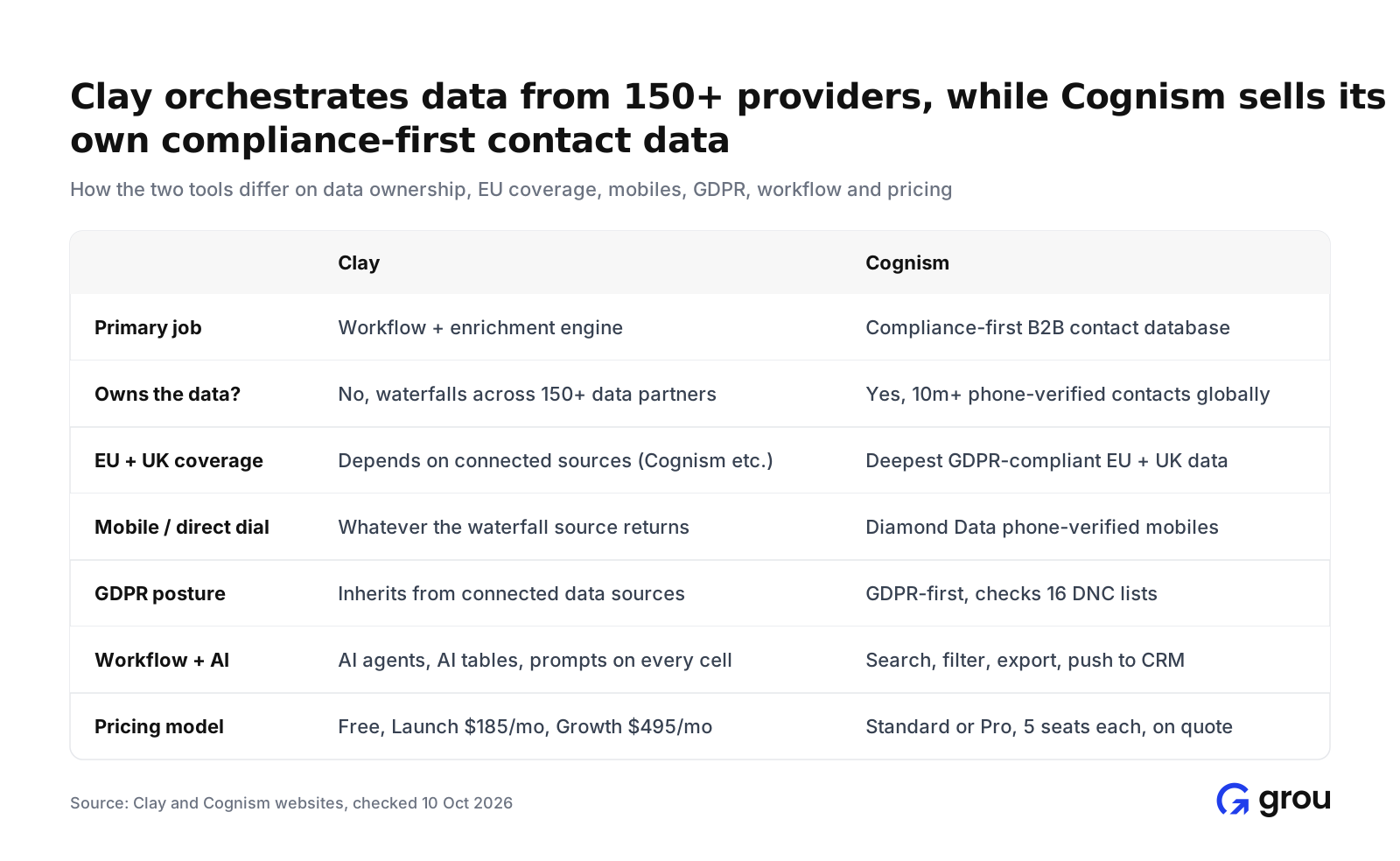
Clay and Cognism compared on job, data ownership, EU coverage, mobiles, GDPR, workflow and pricing.
The case for Clay
Clay is the most flexible data tool we have ever used. The wedge is the workflow builder. Think of a spreadsheet where every cell can call an API, run a prompt through an AI agent, fetch from Cognism or Apollo or ZoomInfo, score the result, branch the logic, and push the output to your CRM or email sender.
For EU operators, Clay's wedge becomes structural. The waterfall enrichment pattern lets you call Cognism first (highest accuracy on EU + UK contacts), fall back to Apollo if Cognism missed, then RocketReach, then a custom AI agent that searches the open web. Coverage typically beats any single source by 15 to 30 percent. Cost per enriched contact drops because you only pay Cognism for the contacts Cognism actually finds.
The AI features are the second wedge. Clay's AI Research Agents can take a list of companies and return per-account intel (recent funding, hiring signals, tech stack changes, executive churn) without you writing a single prompt. AI tables let you run prompts on every row of a table. The new AI Brand Kit keeps the AI-generated output on brand. For RevOps teams or agencies running signal-based campaigns at scale, this is the highest-leverage data tool on the market.
The downsides for EU motions are real. Clay does not own a contact database. You bring contacts in from Cognism, Apollo, or another source, or you burn data credits to enrich on demand. For very high-volume EU sourcing (10,000+ contacts per week), Clay's per-credit economics get expensive vs running Cognism's database directly.
The other downside: Clay's free tier is generous (100 data credits + 500 actions per month) but the real value lives at Launch ($185/mo) and Growth ($495/mo). Most operators outgrow Free within a month.
→ Best for: RevOps and growth teams, EU agencies running multi-source enrichment, operators who want signal-based campaigns, anyone who needs to combine Cognism's data with other sources via waterfall, teams that want AI agents on top of their enrichment.
The case for Cognism
Cognism is built for one specific buyer: the EU, UK, DACH, or APAC B2B revenue team that needs compliance-grade data and accurate direct dials. The wedge is two-pronged. GDPR compliance baked into the product, and Diamond Data, Cognism's phone-verified mobile numbers, which a team of researchers validates by calling them.
The compliance posture matters more than most US operators realise. Cognism checks every record against EU Do-Not-Call registries, runs notification protocols where the local jurisdiction requires it, and maintains opt-out workflows tied to the consent layer in your CRM. For an EU-based SDR team, this removes the legal-risk overhead that running a US-built database (Apollo, ZoomInfo) for EU contacts requires you to build yourself.
The Diamond Data product is the second wedge. Where most B2B data providers source mobile numbers via scraping and inference (which produces 50 to 65 percent accuracy in our testing), Cognism phone-verifies its mobiles and says they deliver an average 3x connect rate, or one target contact per 8 dials (Cognism Diamond Data). For dialer-heavy EU SDR motions, that delta decides how many of your dials turn into conversations.
Coverage is meaningful. Cognism counts 10m+ phone-verified contacts globally and its data is deepest on EU and UK personas. Native two-way sync with Salesforce, HubSpot, Outreach and Salesloft. For a typical 5-person EU SDR team, Cognism's data and sync are enough to run a complete outbound motion without bolting on additional data tools.
The downsides are real. Cognism does not publish prices. Prospecting is sold as two packages, Standard and Pro, each with 5 seats included and priced on quote through sales (Cognism pricing). There is no self-serve plan; the way to test the data first is Cognism's free data sample.
The other downside: Cognism is a data product, not a workflow engine. The search, filter, export, and CRM push are competent but linear. For complex multi-source enrichment, AI-driven scoring, or signal-based routing, you need a workflow tool on top (Clay, often).
→ Best for: EU, UK, DACH and APAC B2B revenue teams, compliance-first organisations, sales orgs that live on the dialer, teams where Diamond Data's hit-rate uplift on EU mobiles pays for the platform fee on its own.
How much does each cost?
Side-by-side breakdown of base pricing. For live pricing, check Clay and Cognism directly.
Clay pricing
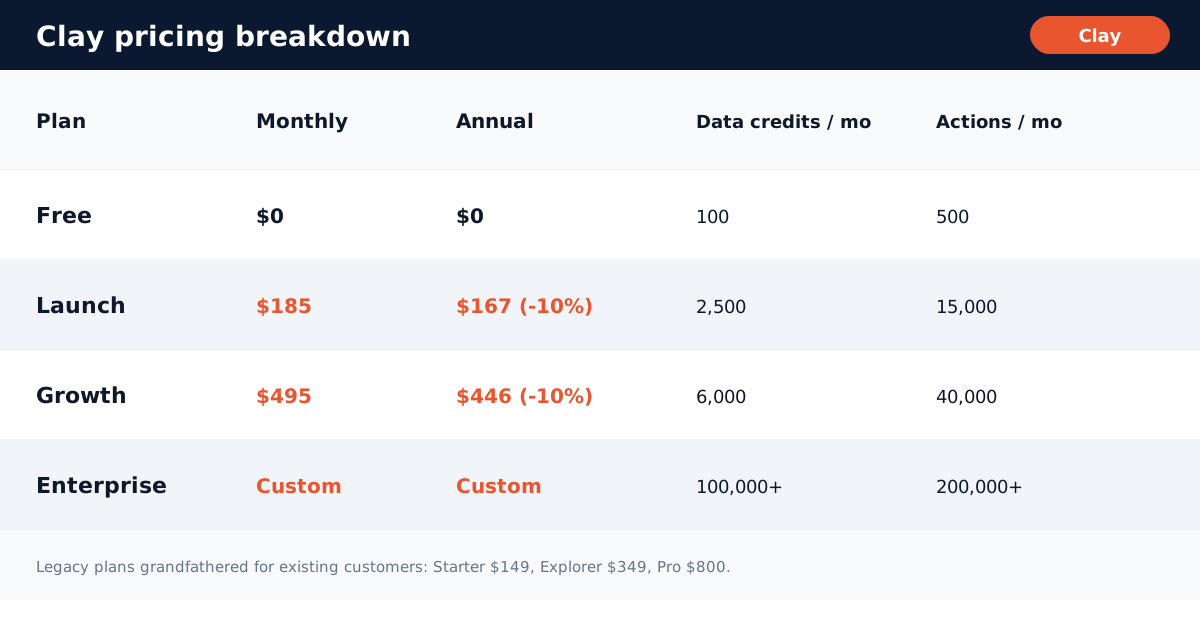
Clay's March 2026 repricing matters. Clay split its old three-plan structure into two new self-serve plans (Launch and Growth) and consolidated features. The dual Data Credits + Actions system is new: data credits cover enrichment calls (Cognism lookup, LinkedIn scrape), Actions cover automation runs. Most operators burn through Actions faster than Credits.
Legacy Starter at $149/mo is grandfathered for existing customers but closed to new signups. If you are on Starter today, do not let it lapse.
The free tier is genuinely useful for evaluation. 100 data credits and 500 actions per month is enough to test a workflow before committing. Most operators outgrow Free within a month and graduate to Launch.
Cognism pricing
Cognism prices on quote. Sales prospecting comes in two packages, and pricing is tailored to the product, your team setup and how you plan to use the platform:
Standard: core prospecting for teams that need reliable contact and company data. 5 seats included, plus MCP and API access, firmographic, technographic and signal filters, AI account research, and CSV export and enrichment.
Pro: everything in Standard plus higher-quality mobile data, on-demand mobile verification and intent data. 5 seats included.
Credits are used to reveal, enrich or export a contact: 1 credit is 1 revealed contact, viewing a contact you already revealed is free, and the same credits work across the platform, Enrich and the API. Each seat includes a credit allocation and you can buy more at any point. CRM Enrichment is a separate add-on or standalone product. Ask for the Pro quote if premium mobile data and intent are why you are buying Cognism.
Annual cost compared
The pricing model gap is structural. Clay publishes its prices and scales from $0 (Free) to $185 a month (Launch) and $495 a month (Growth), or $167 and $446 a month billed annually, for a workspace with unlimited seats (Clay pricing). Cognism is quote-based with 5 seats per package, so the only way to compare totals is to get a quote. For solo operators evaluating, Clay's free tier wins. For EU SDR teams running dialer-heavy outbound, Cognism's phone-verified mobiles are what the quote buys. For agencies running complex enrichment alongside dialer outbound, stacking both is the most capable EU outbound data setup, and the most expensive.
Which has better EU and UK contact data?
Cognism, by a large margin (on its own).
Cognism's database was built EU-first since 2015, with the deepest GDPR-compliant coverage of EU and UK personas in the category. It counts 10m+ phone-verified contacts globally, checks its data against 16 Do Not Call lists, and says its phone-verified mobiles connect 3x more often on average (Cognism Diamond Data).
Clay does not own a database. Its EU coverage depends entirely on which data sources you connect via waterfall. The typical pattern: Cognism first (cleanest EU coverage), then Apollo if Cognism missed (broader but lower accuracy), then a custom AI agent for the long tail. Coverage typically beats Cognism standalone by 5 to 15 percent on niche personas, at higher cost per enriched contact.
The practical pattern: if you use Cognism alone, your EU contact database is Cognism's database. If you use Cognism inside a Clay waterfall, your effective database is Cognism + everything else Clay can pull from. Most serious EU operators do the second.
Verdict: Cognism for raw EU data depth. Clay-with-Cognism-in-the-waterfall for the broadest effective coverage.
Which has deeper workflow flexibility?
Clay, no contest.
Clay's workflow builder is in a class of its own. Build a table, add columns that call APIs, run AI prompts on each row, branch logic based on results, push output to your CRM or email sender. The full pattern unlocks campaigns that no other tool can run:
Pull EU companies that hired a VP of Sales in the last 30 days, enrich each with the new VP's email via Cognism waterfall, score the company on revenue fit, push the qualified accounts to Outreach for sequencing.
Take a CSV of website visitors from RB2B, enrich each with Cognism for GDPR-compliant EU records, dedupe against existing CRM, and only push net-new high-fit accounts to outbound.
Build a "competitor switching" segment: scrape G2 reviews mentioning a competitor's EU compliance complaints, find the reviewer's company on Cognism, enrich the buying committee, push to a tailored sequence.
None of these are buildable in Cognism alone. Cognism gives you search + filter + export + push. Clay gives you the same plus workflow + AI + multi-source orchestration.
Verdict: Clay, structurally. Cognism is a data source, Clay is a workflow engine. Different categories.
Which is better for GDPR-strict outbound?
Cognism owns the compliance posture. Clay can use Cognism inside compliant workflows.
Cognism's product was built EU-first. GDPR-compliant consent flows, automatic DNC checks across EU countries, notification protocols in jurisdictions that require them, and a privacy posture that aligns with how EU buyers actually want to be contacted. For an EU-based SDR team, this removes the legal-risk overhead that other data providers leave on your plate.
Clay's GDPR posture depends on which data sources you connect. Use Cognism as your primary source via waterfall, and Clay's output is as GDPR-clean as Cognism's. Use Apollo or ZoomInfo as primary sources, and you inherit the looser US-built compliance posture. The choice is yours, with all the responsibility that implies.
For pure compliance-grade EU outbound, Cognism alone is the cleanest answer. For compliance-grade EU outbound with workflow + AI on top, Cognism inside a Clay waterfall is the operator pattern.
Verdict: Cognism for the cleanest compliance posture. Clay-with-Cognism for compliance + workflow.
Clay vs Cognism for SDR teams
For SDR teams the deciding question is how much of the motion runs on the phone.
Dialer-heavy EU or UK teams: Cognism. Its phone-verified mobiles are the reason to buy. In our testing, hit rates ran around 90 to 95 percent on EU mobiles, against 50 to 65 percent for scraped or inferred mobile data, and that gap decides how many of your dials connect.
Linear outbound: Cognism alone. If the workflow is search personas, push to CRM and sequence in Outreach or Salesloft, Cognism's native sync with Salesforce and HubSpot covers it without a second data tool.
Team size: Cognism's prospecting packages (Standard and Pro) each include 5 seats and are priced on quote (Cognism pricing), so the per-seat economics suit an established SDR team more than a single rep.
Signal-based campaigns: add Clay. Hiring, funding and tech stack triggers, AI research and scoring before outbound all live in Clay, not in Cognism.
Speed to first call: a one-person EU SDR team that has to prospect in the next 48 hours should start on Cognism and add Clay later.
Clay vs Cognism for agencies
For agencies, Clay is the layer that scales across clients and Cognism is the data you feed into it.
Clay is the workspace: Clay plans include unlimited seats, start at $185 a month (Launch) and $495 a month (Growth) (Clay pricing), and Growth adds CRM auto-sync, HTTP API and webhooks for multi-client workflows.
Cognism goes first in the waterfall: put Cognism at the top of a Clay waterfall for EU and UK contacts, then fall back to other sources for the long tail. If Cognism returns a verified result, Clay does not call the next source, so you only spend Cognism credits on contacts Cognism finds.
Few Cognism seats: because Clay does the orchestration, the Cognism seats only handle the data pulls. Note that Cognism's prospecting packages now include 5 seats.
Regulated clients: if a client sells into highly regulated EU industries, do not let its data inherit the compliance posture of secondary waterfall sources. Run that client on Cognism alone.
Cost: see "How much does each cost?" above and "When to use both" below for the stacked budget.
When to pick Clay (and only Clay)
You are a solo operator or small team evaluating workflow tools.
You already have an EU data source (Cognism, Apollo, ZoomInfo) and need the workflow layer.
Your motion lives in US / global outbound where EU compliance is not the priority.
You want to test signal-based campaigns or AI agents before committing to enterprise data spend.
You want public, self-serve pricing you can start this week; Cognism is sold on quote through sales.
When to pick Cognism (and only Cognism)
You are an EU / UK SDR team running dialer-heavy outbound where Diamond Data's mobile accuracy is the unlock.
You need GDPR-grade compliance baked into the product, not bolted on.
Your motion is linear: search for personas, push to CRM, sequence in Outreach / Salesloft.
You do not need complex multi-source enrichment, AI workflows, or signal-based routing.
You have budget for a quote-based enterprise data contract.
Your EU SDR team can use the 5 seats included in a Cognism package.
When to use both (the GROU EU stack)
This is the pattern we see most mature EU operators converge on within 6 to 12 months.
Cognism sits at the data layer. Pro package (it adds intent data and on-demand mobile verification), with its 5 included seats for the SDR team. Used as the primary contact source for EU + UK personas, the dialer hit-rate floor, and the GDPR compliance baseline.
Clay sits at the workflow + AI layer. Growth tier (for the credit + Actions volume needed to run multi-account enrichment). Used for waterfall enrichment (Cognism first, fallback sources for the long tail), AI Research Agents for per-account intel, signal-based campaigns (hiring + funding + tech stack signals), pre-outbound scoring and routing.
The handoff: Clay enriches and scores contacts (pulling Cognism's data via the integration), then pushes the highest-fit prospects to Outreach, Salesloft, Apollo, or Smartlead for sequencing. Cognism handles the data source role. Clay handles the brain role.
Total cost: Clay Growth is $446 a month billed annually (about $5,350 a year). Cognism's Pro package is quote-based, so add your quote plus the sender of choice to get the full EU outbound data stack cost.
Honest dealbreakers
Clay dealbreakers:
You sell into highly regulated EU industries and cannot afford to inherit the compliance posture of secondary waterfall sources (Apollo, scraped sources). Use Cognism alone.
You need a turnkey data source. Clay requires you to bring contacts in from somewhere.
You are a 1-person EU SDR team prospecting in the next 48 hours. Buy Cognism, come back to Clay later.
Cognism dealbreakers:
You need workflow flexibility beyond search + filter + export. Cognism is a data product, not a workflow engine.
You need AI Research Agents or AI prompts on every row of your data. Cognism's AI Search is narrower than Clay's AI tables.
You sell primarily into the US and need the deepest US contact database. ZoomInfo's coverage is 2 to 3x deeper there.
You need a self-serve or month-to-month plan. Cognism is sold on quote through sales.
Alternatives worth considering
Apollo for SMB / mid-market prospecting at SDR-friendly pricing ($49 to $119 per user per month). Bundles a 275M contact database with a sequencer. See our Apollo vs ZoomInfo comparison and Clay vs Apollo comparison.
ZoomInfo for the deepest US contact database. Heavier than Cognism on price, deeper on US coverage. See our ZoomInfo vs Cognism comparison.
Lusha for fast direct dial enrichment on smaller team sizes.
Snov.io for cheap email + dial enrichment as a Clay waterfall source.
RocketReach for individual contact lookups outside of a full database subscription.
We have full comparison articles on most of these. See Apollo vs ZoomInfo, ZoomInfo vs Cognism, and Clay vs Apollo for the full data tooling picture.
FAQ
Are Clay and Cognism actually competing for the same buyer?
Not really. Cognism is a B2B contact database, primarily for EU and UK personas, with the cleanest GDPR posture in the category. Clay is a workflow + enrichment engine that uses Cognism (and other sources) as inputs. They are complementary tools, not direct competitors. Most operators evaluating Clay vs Cognism are actually evaluating whether to use Clay alone, Cognism alone, or both.
Can I use Clay without Cognism?
Yes. Clay integrates with 100+ data providers. You can run waterfall enrichment with Apollo, ZoomInfo, Hunter, Snov, RocketReach, and others. Cognism is one input source among many, not a requirement.
Can I use Cognism without Clay?
Absolutely. Cognism is a complete data product. For 60 to 80 percent of EU SDR teams running linear outbound (search personas, push to CRM, sequence), Cognism alone is enough. Clay layers on top when you need workflow + AI.
How does Clay's waterfall enrichment work with Cognism?
Clay connects to Cognism via API. In a Clay table, you configure a column that calls "find email" or "find mobile" and lists Cognism as the first source, with fallback sources behind it. For each contact, Clay calls Cognism first. If Cognism returns a verified result, Clay uses it and does not call the next source. If Cognism misses, Clay falls back to the next source (Apollo, RocketReach, etc.). You only pay Cognism credits for the contacts Cognism actually finds.
Which one is cheaper at agency scale?
Clay is the only one with public prices: Growth is $495 a month, or $446 a month billed annually (about $5,350 a year), for a workspace with unlimited seats. Cognism prices on quote, with 5 seats included in each package. For an EU agency, Clay is the workflow layer and the Cognism seats only handle the data pulls, so get a Cognism quote before you compare totals.
How accurate is Cognism's Diamond Data?
In our testing, hit rates run around 90 to 95% on EU mobiles and 85 to 92% on US mobiles, materially higher than scraped or inferred mobile databases (which run 50 to 65% in third-party tests). Cognism itself now cites an average 3x connect rate for its phone-verified mobiles rather than a percentage accuracy figure.
What about Clay's Anthropic / Claude integration?
Clay added native Claude integration in 2025, with model selection at the AI table and Research Agent level. The Claude integration is materially better than the older OpenAI-only AI features for tasks where output quality matters (per-account research, personalised messaging hooks, structured data extraction). For Clay heavy users, this is a meaningful upgrade.
Will Clay always need a separate data source for EU compliance?
Probably yes. Clay's positioning is workflow + enrichment, not GDPR-grade EU data. Building a compliant EU contact database from scratch would be a years-long project and would commoditise Clay's value vs Cognism. We do not expect Clay to ship a native EU contact database in 2026 or 2027.
Which integrates better with HubSpot / Salesforce?
Cognism, slightly. Cognism's HubSpot and Salesforce integrations are mature and battle-tested. Clay's CRM integrations work but require more setup, especially for complex bidirectional sync. For a HubSpot-heavy EU revenue stack, Cognism is the path of least resistance.
Bottom line
Cognism is the right call if you are an EU, UK, DACH, or APAC B2B revenue team running dialer-heavy outbound where compliance matters and Diamond Data's phone-verified mobiles are the unlock. The quote-based packages are enterprise-grade, but the data quality and GDPR posture justify the cost for any serious EU SDR motion.
Clay is the right call if you need workflow + enrichment + AI on top of a data source (Cognism or otherwise). The free tier evaluates well, the Launch tier ($185/mo) covers most agencies, and the Growth tier ($495/mo) handles complex multi-source enrichment at scale. The AI Research Agents and AI tables are the highest-leverage features in B2B data right now.
For most mature EU operators, the answer is both. Cognism for the data source (Pro package), Clay for the workflow layer on top (Growth tier). It is the most expensive but most capable EU outbound data foundation you can build.
If you are still deciding, the math is simple. Need just data for an EU SDR team running dialer-heavy outbound? Cognism alone. Need workflow + AI on top of existing data? Clay alone. Need both? Stack them, that is what we run.
If you want help designing the Clay workflows on top of Cognism (or planning the migration from a US-built data source to a compliant EU stack), book a working session with GROU.
→ Try Clay free (100 credits + 500 actions per month, no card required).
→ Request Cognism's free data sample.
About this comparison
We are GROU, a B2B pipeline agency that runs lead generation, outbound and LinkedIn content for B2B companies. This comparison combines our own production use of both tools with both vendors' published pricing pages (including Clay's March 2026 repricing) and live G2 review data, and we refresh it quarterly.
Some links in this article are affiliate. We may earn a small commission at no extra cost to you.
TL;DR
Clay and Cognism are not direct competitors. They solve different jobs in the EU outbound stack and most mature operators run both.
Cognism is a compliance-first B2B contact database. The wedge is GDPR-grade EU and UK contact data, Diamond Data (phone-verified mobile numbers, 10m+ globally), and the cleanest legal posture in the category for European outbound. It is a data source, not a workflow engine.
Clay is a workflow + enrichment engine that pulls data from 100+ sources (including Cognism) and runs it through AI, scoring logic, and waterfall coverage. It is a workflow tool, not a data source.
The practical question is which one belongs in your stack first. For EU and UK SDR teams running dialer-heavy outbound, Cognism delivers the data layer that nothing else matches. For operators running complex multi-source enrichment, signal-based campaigns, or AI workflows, Clay is the engine that makes the data usable. For serious EU operators, the answer is both: Cognism for the data, Clay for the workflow.
Clay vs Cognism is a data source against a workflow engine. Cognism sells compliance-first B2B contact data, strongest on EU and UK contacts and phone-verified mobile numbers. Clay owns no database: it orchestrates 150+ data providers, AI and scoring logic, and can call Cognism as one of them. Below we compare EU and UK data, GDPR-strict outbound and pricing, then which tool fits SDR teams and agencies.
What's the difference between Clay and Cognism?
Cognism is a B2B contact database: it owns its data, built EU-first since 2015, with the deepest GDPR-compliant coverage of EU and UK personas in the category. Clay does not own a database: it is a workflow and enrichment engine that calls third-party sources in a waterfall, runs AI and scoring on the result, and pushes it to your CRM or sender. Cognism gives you search, filter, export and CRM push; Clay adds workflow, AI and multi-source orchestration on top. That is why most mature EU operators stack them, with Cognism as the first source inside a Clay waterfall, rather than choosing one.
Score breakdown at a glance
Third-party signals: Clay on G2 rating around 4.9 / 5 (praised for workflow flexibility and AI). Cognism on G2 rating around 4.5 / 5 (praised for data quality and GDPR posture). Both top-quartile, different praise: Clay for "we built things we never could before", Cognism for "the only EU data source we trust".
Table of contents
TL;DR
What's the difference between Clay and Cognism?
Quick comparison
The case for Clay
The case for Cognism
How much does each cost?
Which has better EU and UK contact data?
Which has deeper workflow flexibility?
Which is better for GDPR-strict outbound?
Clay vs Cognism for SDR teams
Clay vs Cognism for agencies
When to pick Clay (and only Clay)
When to pick Cognism (and only Cognism)
When to use both (the GROU EU stack)
Honest dealbreakers
Alternatives worth considering
FAQ
Bottom line
About this comparison
Quick comparison
Clay and Cognism compared on job, data ownership, EU coverage, mobiles, GDPR, workflow and pricing.
The case for Clay
Clay is the most flexible data tool we have ever used. The wedge is the workflow builder. Think of a spreadsheet where every cell can call an API, run a prompt through an AI agent, fetch from Cognism or Apollo or ZoomInfo, score the result, branch the logic, and push the output to your CRM or email sender.
For EU operators, Clay's wedge becomes structural. The waterfall enrichment pattern lets you call Cognism first (highest accuracy on EU + UK contacts), fall back to Apollo if Cognism missed, then RocketReach, then a custom AI agent that searches the open web. Coverage typically beats any single source by 15 to 30 percent. Cost per enriched contact drops because you only pay Cognism for the contacts Cognism actually finds.
The AI features are the second wedge. Clay's AI Research Agents can take a list of companies and return per-account intel (recent funding, hiring signals, tech stack changes, executive churn) without you writing a single prompt. AI tables let you run prompts on every row of a table. The new AI Brand Kit keeps the AI-generated output on brand. For RevOps teams or agencies running signal-based campaigns at scale, this is the highest-leverage data tool on the market.
The downsides for EU motions are real. Clay does not own a contact database. You bring contacts in from Cognism, Apollo, or another source, or you burn data credits to enrich on demand. For very high-volume EU sourcing (10,000+ contacts per week), Clay's per-credit economics get expensive vs running Cognism's database directly.
The other downside: Clay's free tier is generous (100 data credits + 500 actions per month) but the real value lives at Launch ($185/mo) and Growth ($495/mo). Most operators outgrow Free within a month.
→ Best for: RevOps and growth teams, EU agencies running multi-source enrichment, operators who want signal-based campaigns, anyone who needs to combine Cognism's data with other sources via waterfall, teams that want AI agents on top of their enrichment.
The case for Cognism
Cognism is built for one specific buyer: the EU, UK, DACH, or APAC B2B revenue team that needs compliance-grade data and accurate direct dials. The wedge is two-pronged. GDPR compliance baked into the product, and Diamond Data, Cognism's phone-verified mobile numbers, which a team of researchers validates by calling them.
The compliance posture matters more than most US operators realise. Cognism checks every record against EU Do-Not-Call registries, runs notification protocols where the local jurisdiction requires it, and maintains opt-out workflows tied to the consent layer in your CRM. For an EU-based SDR team, this removes the legal-risk overhead that running a US-built database (Apollo, ZoomInfo) for EU contacts requires you to build yourself.
The Diamond Data product is the second wedge. Where most B2B data providers source mobile numbers via scraping and inference (which produces 50 to 65 percent accuracy in our testing), Cognism phone-verifies its mobiles and says they deliver an average 3x connect rate, or one target contact per 8 dials (Cognism Diamond Data). For dialer-heavy EU SDR motions, that delta decides how many of your dials turn into conversations.
Coverage is meaningful. Cognism counts 10m+ phone-verified contacts globally and its data is deepest on EU and UK personas. Native two-way sync with Salesforce, HubSpot, Outreach and Salesloft. For a typical 5-person EU SDR team, Cognism's data and sync are enough to run a complete outbound motion without bolting on additional data tools.
The downsides are real. Cognism does not publish prices. Prospecting is sold as two packages, Standard and Pro, each with 5 seats included and priced on quote through sales (Cognism pricing). There is no self-serve plan; the way to test the data first is Cognism's free data sample.
The other downside: Cognism is a data product, not a workflow engine. The search, filter, export, and CRM push are competent but linear. For complex multi-source enrichment, AI-driven scoring, or signal-based routing, you need a workflow tool on top (Clay, often).
→ Best for: EU, UK, DACH and APAC B2B revenue teams, compliance-first organisations, sales orgs that live on the dialer, teams where Diamond Data's hit-rate uplift on EU mobiles pays for the platform fee on its own.
How much does each cost?
Side-by-side breakdown of base pricing. For live pricing, check Clay and Cognism directly.
Clay pricing
Clay's March 2026 repricing matters. Clay split its old three-plan structure into two new self-serve plans (Launch and Growth) and consolidated features. The dual Data Credits + Actions system is new: data credits cover enrichment calls (Cognism lookup, LinkedIn scrape), Actions cover automation runs. Most operators burn through Actions faster than Credits.
Legacy Starter at $149/mo is grandfathered for existing customers but closed to new signups. If you are on Starter today, do not let it lapse.
The free tier is genuinely useful for evaluation. 100 data credits and 500 actions per month is enough to test a workflow before committing. Most operators outgrow Free within a month and graduate to Launch.
Cognism pricing
Cognism prices on quote. Sales prospecting comes in two packages, and pricing is tailored to the product, your team setup and how you plan to use the platform:
Standard: core prospecting for teams that need reliable contact and company data. 5 seats included, plus MCP and API access, firmographic, technographic and signal filters, AI account research, and CSV export and enrichment.
Pro: everything in Standard plus higher-quality mobile data, on-demand mobile verification and intent data. 5 seats included.
Credits are used to reveal, enrich or export a contact: 1 credit is 1 revealed contact, viewing a contact you already revealed is free, and the same credits work across the platform, Enrich and the API. Each seat includes a credit allocation and you can buy more at any point. CRM Enrichment is a separate add-on or standalone product. Ask for the Pro quote if premium mobile data and intent are why you are buying Cognism.
Annual cost compared
The pricing model gap is structural. Clay publishes its prices and scales from $0 (Free) to $185 a month (Launch) and $495 a month (Growth), or $167 and $446 a month billed annually, for a workspace with unlimited seats (Clay pricing). Cognism is quote-based with 5 seats per package, so the only way to compare totals is to get a quote. For solo operators evaluating, Clay's free tier wins. For EU SDR teams running dialer-heavy outbound, Cognism's phone-verified mobiles are what the quote buys. For agencies running complex enrichment alongside dialer outbound, stacking both is the most capable EU outbound data setup, and the most expensive.
Which has better EU and UK contact data?
Cognism, by a large margin (on its own).
Cognism's database was built EU-first since 2015, with the deepest GDPR-compliant coverage of EU and UK personas in the category. It counts 10m+ phone-verified contacts globally, checks its data against 16 Do Not Call lists, and says its phone-verified mobiles connect 3x more often on average (Cognism Diamond Data).
Clay does not own a database. Its EU coverage depends entirely on which data sources you connect via waterfall. The typical pattern: Cognism first (cleanest EU coverage), then Apollo if Cognism missed (broader but lower accuracy), then a custom AI agent for the long tail. Coverage typically beats Cognism standalone by 5 to 15 percent on niche personas, at higher cost per enriched contact.
The practical pattern: if you use Cognism alone, your EU contact database is Cognism's database. If you use Cognism inside a Clay waterfall, your effective database is Cognism + everything else Clay can pull from. Most serious EU operators do the second.
Verdict: Cognism for raw EU data depth. Clay-with-Cognism-in-the-waterfall for the broadest effective coverage.
Which has deeper workflow flexibility?
Clay, no contest.
Clay's workflow builder is in a class of its own. Build a table, add columns that call APIs, run AI prompts on each row, branch logic based on results, push output to your CRM or email sender. The full pattern unlocks campaigns that no other tool can run:
Pull EU companies that hired a VP of Sales in the last 30 days, enrich each with the new VP's email via Cognism waterfall, score the company on revenue fit, push the qualified accounts to Outreach for sequencing.
Take a CSV of website visitors from RB2B, enrich each with Cognism for GDPR-compliant EU records, dedupe against existing CRM, and only push net-new high-fit accounts to outbound.
Build a "competitor switching" segment: scrape G2 reviews mentioning a competitor's EU compliance complaints, find the reviewer's company on Cognism, enrich the buying committee, push to a tailored sequence.
None of these are buildable in Cognism alone. Cognism gives you search + filter + export + push. Clay gives you the same plus workflow + AI + multi-source orchestration.
Verdict: Clay, structurally. Cognism is a data source, Clay is a workflow engine. Different categories.
Which is better for GDPR-strict outbound?
Cognism owns the compliance posture. Clay can use Cognism inside compliant workflows.
Cognism's product was built EU-first. GDPR-compliant consent flows, automatic DNC checks across EU countries, notification protocols in jurisdictions that require them, and a privacy posture that aligns with how EU buyers actually want to be contacted. For an EU-based SDR team, this removes the legal-risk overhead that other data providers leave on your plate.
Clay's GDPR posture depends on which data sources you connect. Use Cognism as your primary source via waterfall, and Clay's output is as GDPR-clean as Cognism's. Use Apollo or ZoomInfo as primary sources, and you inherit the looser US-built compliance posture. The choice is yours, with all the responsibility that implies.
For pure compliance-grade EU outbound, Cognism alone is the cleanest answer. For compliance-grade EU outbound with workflow + AI on top, Cognism inside a Clay waterfall is the operator pattern.
Verdict: Cognism for the cleanest compliance posture. Clay-with-Cognism for compliance + workflow.
Clay vs Cognism for SDR teams
For SDR teams the deciding question is how much of the motion runs on the phone.
Dialer-heavy EU or UK teams: Cognism. Its phone-verified mobiles are the reason to buy. In our testing, hit rates ran around 90 to 95 percent on EU mobiles, against 50 to 65 percent for scraped or inferred mobile data, and that gap decides how many of your dials connect.
Linear outbound: Cognism alone. If the workflow is search personas, push to CRM and sequence in Outreach or Salesloft, Cognism's native sync with Salesforce and HubSpot covers it without a second data tool.
Team size: Cognism's prospecting packages (Standard and Pro) each include 5 seats and are priced on quote (Cognism pricing), so the per-seat economics suit an established SDR team more than a single rep.
Signal-based campaigns: add Clay. Hiring, funding and tech stack triggers, AI research and scoring before outbound all live in Clay, not in Cognism.
Speed to first call: a one-person EU SDR team that has to prospect in the next 48 hours should start on Cognism and add Clay later.
Clay vs Cognism for agencies
For agencies, Clay is the layer that scales across clients and Cognism is the data you feed into it.
Clay is the workspace: Clay plans include unlimited seats, start at $185 a month (Launch) and $495 a month (Growth) (Clay pricing), and Growth adds CRM auto-sync, HTTP API and webhooks for multi-client workflows.
Cognism goes first in the waterfall: put Cognism at the top of a Clay waterfall for EU and UK contacts, then fall back to other sources for the long tail. If Cognism returns a verified result, Clay does not call the next source, so you only spend Cognism credits on contacts Cognism finds.
Few Cognism seats: because Clay does the orchestration, the Cognism seats only handle the data pulls. Note that Cognism's prospecting packages now include 5 seats.
Regulated clients: if a client sells into highly regulated EU industries, do not let its data inherit the compliance posture of secondary waterfall sources. Run that client on Cognism alone.
Cost: see "How much does each cost?" above and "When to use both" below for the stacked budget.
When to pick Clay (and only Clay)
You are a solo operator or small team evaluating workflow tools.
You already have an EU data source (Cognism, Apollo, ZoomInfo) and need the workflow layer.
Your motion lives in US / global outbound where EU compliance is not the priority.
You want to test signal-based campaigns or AI agents before committing to enterprise data spend.
You want public, self-serve pricing you can start this week; Cognism is sold on quote through sales.
When to pick Cognism (and only Cognism)
You are an EU / UK SDR team running dialer-heavy outbound where Diamond Data's mobile accuracy is the unlock.
You need GDPR-grade compliance baked into the product, not bolted on.
Your motion is linear: search for personas, push to CRM, sequence in Outreach / Salesloft.
You do not need complex multi-source enrichment, AI workflows, or signal-based routing.
You have budget for a quote-based enterprise data contract.
Your EU SDR team can use the 5 seats included in a Cognism package.
When to use both (the GROU EU stack)
This is the pattern we see most mature EU operators converge on within 6 to 12 months.
Cognism sits at the data layer. Pro package (it adds intent data and on-demand mobile verification), with its 5 included seats for the SDR team. Used as the primary contact source for EU + UK personas, the dialer hit-rate floor, and the GDPR compliance baseline.
Clay sits at the workflow + AI layer. Growth tier (for the credit + Actions volume needed to run multi-account enrichment). Used for waterfall enrichment (Cognism first, fallback sources for the long tail), AI Research Agents for per-account intel, signal-based campaigns (hiring + funding + tech stack signals), pre-outbound scoring and routing.
The handoff: Clay enriches and scores contacts (pulling Cognism's data via the integration), then pushes the highest-fit prospects to Outreach, Salesloft, Apollo, or Smartlead for sequencing. Cognism handles the data source role. Clay handles the brain role.
Total cost: Clay Growth is $446 a month billed annually (about $5,350 a year). Cognism's Pro package is quote-based, so add your quote plus the sender of choice to get the full EU outbound data stack cost.
Honest dealbreakers
Clay dealbreakers:
You sell into highly regulated EU industries and cannot afford to inherit the compliance posture of secondary waterfall sources (Apollo, scraped sources). Use Cognism alone.
You need a turnkey data source. Clay requires you to bring contacts in from somewhere.
You are a 1-person EU SDR team prospecting in the next 48 hours. Buy Cognism, come back to Clay later.
Cognism dealbreakers:
You need workflow flexibility beyond search + filter + export. Cognism is a data product, not a workflow engine.
You need AI Research Agents or AI prompts on every row of your data. Cognism's AI Search is narrower than Clay's AI tables.
You sell primarily into the US and need the deepest US contact database. ZoomInfo's coverage is 2 to 3x deeper there.
You need a self-serve or month-to-month plan. Cognism is sold on quote through sales.
Alternatives worth considering
Apollo for SMB / mid-market prospecting at SDR-friendly pricing ($49 to $119 per user per month). Bundles a 275M contact database with a sequencer. See our Apollo vs ZoomInfo comparison and Clay vs Apollo comparison.
ZoomInfo for the deepest US contact database. Heavier than Cognism on price, deeper on US coverage. See our ZoomInfo vs Cognism comparison.
Lusha for fast direct dial enrichment on smaller team sizes.
Snov.io for cheap email + dial enrichment as a Clay waterfall source.
RocketReach for individual contact lookups outside of a full database subscription.
We have full comparison articles on most of these. See Apollo vs ZoomInfo, ZoomInfo vs Cognism, and Clay vs Apollo for the full data tooling picture.
FAQ
Are Clay and Cognism actually competing for the same buyer?
Not really. Cognism is a B2B contact database, primarily for EU and UK personas, with the cleanest GDPR posture in the category. Clay is a workflow + enrichment engine that uses Cognism (and other sources) as inputs. They are complementary tools, not direct competitors. Most operators evaluating Clay vs Cognism are actually evaluating whether to use Clay alone, Cognism alone, or both.
Can I use Clay without Cognism?
Yes. Clay integrates with 100+ data providers. You can run waterfall enrichment with Apollo, ZoomInfo, Hunter, Snov, RocketReach, and others. Cognism is one input source among many, not a requirement.
Can I use Cognism without Clay?
Absolutely. Cognism is a complete data product. For 60 to 80 percent of EU SDR teams running linear outbound (search personas, push to CRM, sequence), Cognism alone is enough. Clay layers on top when you need workflow + AI.
How does Clay's waterfall enrichment work with Cognism?
Clay connects to Cognism via API. In a Clay table, you configure a column that calls "find email" or "find mobile" and lists Cognism as the first source, with fallback sources behind it. For each contact, Clay calls Cognism first. If Cognism returns a verified result, Clay uses it and does not call the next source. If Cognism misses, Clay falls back to the next source (Apollo, RocketReach, etc.). You only pay Cognism credits for the contacts Cognism actually finds.
Which one is cheaper at agency scale?
Clay is the only one with public prices: Growth is $495 a month, or $446 a month billed annually (about $5,350 a year), for a workspace with unlimited seats. Cognism prices on quote, with 5 seats included in each package. For an EU agency, Clay is the workflow layer and the Cognism seats only handle the data pulls, so get a Cognism quote before you compare totals.
How accurate is Cognism's Diamond Data?
In our testing, hit rates run around 90 to 95% on EU mobiles and 85 to 92% on US mobiles, materially higher than scraped or inferred mobile databases (which run 50 to 65% in third-party tests). Cognism itself now cites an average 3x connect rate for its phone-verified mobiles rather than a percentage accuracy figure.
What about Clay's Anthropic / Claude integration?
Clay added native Claude integration in 2025, with model selection at the AI table and Research Agent level. The Claude integration is materially better than the older OpenAI-only AI features for tasks where output quality matters (per-account research, personalised messaging hooks, structured data extraction). For Clay heavy users, this is a meaningful upgrade.
Will Clay always need a separate data source for EU compliance?
Probably yes. Clay's positioning is workflow + enrichment, not GDPR-grade EU data. Building a compliant EU contact database from scratch would be a years-long project and would commoditise Clay's value vs Cognism. We do not expect Clay to ship a native EU contact database in 2026 or 2027.
Which integrates better with HubSpot / Salesforce?
Cognism, slightly. Cognism's HubSpot and Salesforce integrations are mature and battle-tested. Clay's CRM integrations work but require more setup, especially for complex bidirectional sync. For a HubSpot-heavy EU revenue stack, Cognism is the path of least resistance.
Bottom line
Cognism is the right call if you are an EU, UK, DACH, or APAC B2B revenue team running dialer-heavy outbound where compliance matters and Diamond Data's phone-verified mobiles are the unlock. The quote-based packages are enterprise-grade, but the data quality and GDPR posture justify the cost for any serious EU SDR motion.
Clay is the right call if you need workflow + enrichment + AI on top of a data source (Cognism or otherwise). The free tier evaluates well, the Launch tier ($185/mo) covers most agencies, and the Growth tier ($495/mo) handles complex multi-source enrichment at scale. The AI Research Agents and AI tables are the highest-leverage features in B2B data right now.
For most mature EU operators, the answer is both. Cognism for the data source (Pro package), Clay for the workflow layer on top (Growth tier). It is the most expensive but most capable EU outbound data foundation you can build.
If you are still deciding, the math is simple. Need just data for an EU SDR team running dialer-heavy outbound? Cognism alone. Need workflow + AI on top of existing data? Clay alone. Need both? Stack them, that is what we run.
If you want help designing the Clay workflows on top of Cognism (or planning the migration from a US-built data source to a compliant EU stack), book a working session with GROU.
→ Try Clay free (100 credits + 500 actions per month, no card required).
→ Request Cognism's free data sample.
About this comparison
We are GROU, a B2B pipeline agency that runs lead generation, outbound and LinkedIn content for B2B companies. This comparison combines our own production use of both tools with both vendors' published pricing pages (including Clay's March 2026 repricing) and live G2 review data, and we refresh it quarterly.
Some links in this article are affiliate. We may earn a small commission at no extra cost to you.
TL;DR
Clay and Cognism are not direct competitors. They solve different jobs in the EU outbound stack and most mature operators run both.
Cognism is a compliance-first B2B contact database. The wedge is GDPR-grade EU and UK contact data, Diamond Data (phone-verified mobile numbers, 10m+ globally), and the cleanest legal posture in the category for European outbound. It is a data source, not a workflow engine.
Clay is a workflow + enrichment engine that pulls data from 100+ sources (including Cognism) and runs it through AI, scoring logic, and waterfall coverage. It is a workflow tool, not a data source.
The practical question is which one belongs in your stack first. For EU and UK SDR teams running dialer-heavy outbound, Cognism delivers the data layer that nothing else matches. For operators running complex multi-source enrichment, signal-based campaigns, or AI workflows, Clay is the engine that makes the data usable. For serious EU operators, the answer is both: Cognism for the data, Clay for the workflow.
Clay vs Cognism is a data source against a workflow engine. Cognism sells compliance-first B2B contact data, strongest on EU and UK contacts and phone-verified mobile numbers. Clay owns no database: it orchestrates 150+ data providers, AI and scoring logic, and can call Cognism as one of them. Below we compare EU and UK data, GDPR-strict outbound and pricing, then which tool fits SDR teams and agencies.
What's the difference between Clay and Cognism?
Cognism is a B2B contact database: it owns its data, built EU-first since 2015, with the deepest GDPR-compliant coverage of EU and UK personas in the category. Clay does not own a database: it is a workflow and enrichment engine that calls third-party sources in a waterfall, runs AI and scoring on the result, and pushes it to your CRM or sender. Cognism gives you search, filter, export and CRM push; Clay adds workflow, AI and multi-source orchestration on top. That is why most mature EU operators stack them, with Cognism as the first source inside a Clay waterfall, rather than choosing one.
Score breakdown at a glance
Third-party signals: Clay on G2 rating around 4.9 / 5 (praised for workflow flexibility and AI). Cognism on G2 rating around 4.5 / 5 (praised for data quality and GDPR posture). Both top-quartile, different praise: Clay for "we built things we never could before", Cognism for "the only EU data source we trust".
Table of contents
TL;DR
What's the difference between Clay and Cognism?
Quick comparison
The case for Clay
The case for Cognism
How much does each cost?
Which has better EU and UK contact data?
Which has deeper workflow flexibility?
Which is better for GDPR-strict outbound?
Clay vs Cognism for SDR teams
Clay vs Cognism for agencies
When to pick Clay (and only Clay)
When to pick Cognism (and only Cognism)
When to use both (the GROU EU stack)
Honest dealbreakers
Alternatives worth considering
FAQ
Bottom line
About this comparison
Quick comparison
Clay and Cognism compared on job, data ownership, EU coverage, mobiles, GDPR, workflow and pricing.
The case for Clay
Clay is the most flexible data tool we have ever used. The wedge is the workflow builder. Think of a spreadsheet where every cell can call an API, run a prompt through an AI agent, fetch from Cognism or Apollo or ZoomInfo, score the result, branch the logic, and push the output to your CRM or email sender.
For EU operators, Clay's wedge becomes structural. The waterfall enrichment pattern lets you call Cognism first (highest accuracy on EU + UK contacts), fall back to Apollo if Cognism missed, then RocketReach, then a custom AI agent that searches the open web. Coverage typically beats any single source by 15 to 30 percent. Cost per enriched contact drops because you only pay Cognism for the contacts Cognism actually finds.
The AI features are the second wedge. Clay's AI Research Agents can take a list of companies and return per-account intel (recent funding, hiring signals, tech stack changes, executive churn) without you writing a single prompt. AI tables let you run prompts on every row of a table. The new AI Brand Kit keeps the AI-generated output on brand. For RevOps teams or agencies running signal-based campaigns at scale, this is the highest-leverage data tool on the market.
The downsides for EU motions are real. Clay does not own a contact database. You bring contacts in from Cognism, Apollo, or another source, or you burn data credits to enrich on demand. For very high-volume EU sourcing (10,000+ contacts per week), Clay's per-credit economics get expensive vs running Cognism's database directly.
The other downside: Clay's free tier is generous (100 data credits + 500 actions per month) but the real value lives at Launch ($185/mo) and Growth ($495/mo). Most operators outgrow Free within a month.
→ Best for: RevOps and growth teams, EU agencies running multi-source enrichment, operators who want signal-based campaigns, anyone who needs to combine Cognism's data with other sources via waterfall, teams that want AI agents on top of their enrichment.
The case for Cognism
Cognism is built for one specific buyer: the EU, UK, DACH, or APAC B2B revenue team that needs compliance-grade data and accurate direct dials. The wedge is two-pronged. GDPR compliance baked into the product, and Diamond Data, Cognism's phone-verified mobile numbers, which a team of researchers validates by calling them.
The compliance posture matters more than most US operators realise. Cognism checks every record against EU Do-Not-Call registries, runs notification protocols where the local jurisdiction requires it, and maintains opt-out workflows tied to the consent layer in your CRM. For an EU-based SDR team, this removes the legal-risk overhead that running a US-built database (Apollo, ZoomInfo) for EU contacts requires you to build yourself.
The Diamond Data product is the second wedge. Where most B2B data providers source mobile numbers via scraping and inference (which produces 50 to 65 percent accuracy in our testing), Cognism phone-verifies its mobiles and says they deliver an average 3x connect rate, or one target contact per 8 dials (Cognism Diamond Data). For dialer-heavy EU SDR motions, that delta decides how many of your dials turn into conversations.
Coverage is meaningful. Cognism counts 10m+ phone-verified contacts globally and its data is deepest on EU and UK personas. Native two-way sync with Salesforce, HubSpot, Outreach and Salesloft. For a typical 5-person EU SDR team, Cognism's data and sync are enough to run a complete outbound motion without bolting on additional data tools.
The downsides are real. Cognism does not publish prices. Prospecting is sold as two packages, Standard and Pro, each with 5 seats included and priced on quote through sales (Cognism pricing). There is no self-serve plan; the way to test the data first is Cognism's free data sample.
The other downside: Cognism is a data product, not a workflow engine. The search, filter, export, and CRM push are competent but linear. For complex multi-source enrichment, AI-driven scoring, or signal-based routing, you need a workflow tool on top (Clay, often).
→ Best for: EU, UK, DACH and APAC B2B revenue teams, compliance-first organisations, sales orgs that live on the dialer, teams where Diamond Data's hit-rate uplift on EU mobiles pays for the platform fee on its own.
How much does each cost?
Side-by-side breakdown of base pricing. For live pricing, check Clay and Cognism directly.
Clay pricing
Clay's March 2026 repricing matters. Clay split its old three-plan structure into two new self-serve plans (Launch and Growth) and consolidated features. The dual Data Credits + Actions system is new: data credits cover enrichment calls (Cognism lookup, LinkedIn scrape), Actions cover automation runs. Most operators burn through Actions faster than Credits.
Legacy Starter at $149/mo is grandfathered for existing customers but closed to new signups. If you are on Starter today, do not let it lapse.
The free tier is genuinely useful for evaluation. 100 data credits and 500 actions per month is enough to test a workflow before committing. Most operators outgrow Free within a month and graduate to Launch.
Cognism pricing
Cognism prices on quote. Sales prospecting comes in two packages, and pricing is tailored to the product, your team setup and how you plan to use the platform:
Standard: core prospecting for teams that need reliable contact and company data. 5 seats included, plus MCP and API access, firmographic, technographic and signal filters, AI account research, and CSV export and enrichment.
Pro: everything in Standard plus higher-quality mobile data, on-demand mobile verification and intent data. 5 seats included.
Credits are used to reveal, enrich or export a contact: 1 credit is 1 revealed contact, viewing a contact you already revealed is free, and the same credits work across the platform, Enrich and the API. Each seat includes a credit allocation and you can buy more at any point. CRM Enrichment is a separate add-on or standalone product. Ask for the Pro quote if premium mobile data and intent are why you are buying Cognism.
Annual cost compared
The pricing model gap is structural. Clay publishes its prices and scales from $0 (Free) to $185 a month (Launch) and $495 a month (Growth), or $167 and $446 a month billed annually, for a workspace with unlimited seats (Clay pricing). Cognism is quote-based with 5 seats per package, so the only way to compare totals is to get a quote. For solo operators evaluating, Clay's free tier wins. For EU SDR teams running dialer-heavy outbound, Cognism's phone-verified mobiles are what the quote buys. For agencies running complex enrichment alongside dialer outbound, stacking both is the most capable EU outbound data setup, and the most expensive.
Which has better EU and UK contact data?
Cognism, by a large margin (on its own).
Cognism's database was built EU-first since 2015, with the deepest GDPR-compliant coverage of EU and UK personas in the category. It counts 10m+ phone-verified contacts globally, checks its data against 16 Do Not Call lists, and says its phone-verified mobiles connect 3x more often on average (Cognism Diamond Data).
Clay does not own a database. Its EU coverage depends entirely on which data sources you connect via waterfall. The typical pattern: Cognism first (cleanest EU coverage), then Apollo if Cognism missed (broader but lower accuracy), then a custom AI agent for the long tail. Coverage typically beats Cognism standalone by 5 to 15 percent on niche personas, at higher cost per enriched contact.
The practical pattern: if you use Cognism alone, your EU contact database is Cognism's database. If you use Cognism inside a Clay waterfall, your effective database is Cognism + everything else Clay can pull from. Most serious EU operators do the second.
Verdict: Cognism for raw EU data depth. Clay-with-Cognism-in-the-waterfall for the broadest effective coverage.
Which has deeper workflow flexibility?
Clay, no contest.
Clay's workflow builder is in a class of its own. Build a table, add columns that call APIs, run AI prompts on each row, branch logic based on results, push output to your CRM or email sender. The full pattern unlocks campaigns that no other tool can run:
Pull EU companies that hired a VP of Sales in the last 30 days, enrich each with the new VP's email via Cognism waterfall, score the company on revenue fit, push the qualified accounts to Outreach for sequencing.
Take a CSV of website visitors from RB2B, enrich each with Cognism for GDPR-compliant EU records, dedupe against existing CRM, and only push net-new high-fit accounts to outbound.
Build a "competitor switching" segment: scrape G2 reviews mentioning a competitor's EU compliance complaints, find the reviewer's company on Cognism, enrich the buying committee, push to a tailored sequence.
None of these are buildable in Cognism alone. Cognism gives you search + filter + export + push. Clay gives you the same plus workflow + AI + multi-source orchestration.
Verdict: Clay, structurally. Cognism is a data source, Clay is a workflow engine. Different categories.
Which is better for GDPR-strict outbound?
Cognism owns the compliance posture. Clay can use Cognism inside compliant workflows.
Cognism's product was built EU-first. GDPR-compliant consent flows, automatic DNC checks across EU countries, notification protocols in jurisdictions that require them, and a privacy posture that aligns with how EU buyers actually want to be contacted. For an EU-based SDR team, this removes the legal-risk overhead that other data providers leave on your plate.
Clay's GDPR posture depends on which data sources you connect. Use Cognism as your primary source via waterfall, and Clay's output is as GDPR-clean as Cognism's. Use Apollo or ZoomInfo as primary sources, and you inherit the looser US-built compliance posture. The choice is yours, with all the responsibility that implies.
For pure compliance-grade EU outbound, Cognism alone is the cleanest answer. For compliance-grade EU outbound with workflow + AI on top, Cognism inside a Clay waterfall is the operator pattern.
Verdict: Cognism for the cleanest compliance posture. Clay-with-Cognism for compliance + workflow.
Clay vs Cognism for SDR teams
For SDR teams the deciding question is how much of the motion runs on the phone.
Dialer-heavy EU or UK teams: Cognism. Its phone-verified mobiles are the reason to buy. In our testing, hit rates ran around 90 to 95 percent on EU mobiles, against 50 to 65 percent for scraped or inferred mobile data, and that gap decides how many of your dials connect.
Linear outbound: Cognism alone. If the workflow is search personas, push to CRM and sequence in Outreach or Salesloft, Cognism's native sync with Salesforce and HubSpot covers it without a second data tool.
Team size: Cognism's prospecting packages (Standard and Pro) each include 5 seats and are priced on quote (Cognism pricing), so the per-seat economics suit an established SDR team more than a single rep.
Signal-based campaigns: add Clay. Hiring, funding and tech stack triggers, AI research and scoring before outbound all live in Clay, not in Cognism.
Speed to first call: a one-person EU SDR team that has to prospect in the next 48 hours should start on Cognism and add Clay later.
Clay vs Cognism for agencies
For agencies, Clay is the layer that scales across clients and Cognism is the data you feed into it.
Clay is the workspace: Clay plans include unlimited seats, start at $185 a month (Launch) and $495 a month (Growth) (Clay pricing), and Growth adds CRM auto-sync, HTTP API and webhooks for multi-client workflows.
Cognism goes first in the waterfall: put Cognism at the top of a Clay waterfall for EU and UK contacts, then fall back to other sources for the long tail. If Cognism returns a verified result, Clay does not call the next source, so you only spend Cognism credits on contacts Cognism finds.
Few Cognism seats: because Clay does the orchestration, the Cognism seats only handle the data pulls. Note that Cognism's prospecting packages now include 5 seats.
Regulated clients: if a client sells into highly regulated EU industries, do not let its data inherit the compliance posture of secondary waterfall sources. Run that client on Cognism alone.
Cost: see "How much does each cost?" above and "When to use both" below for the stacked budget.
When to pick Clay (and only Clay)
You are a solo operator or small team evaluating workflow tools.
You already have an EU data source (Cognism, Apollo, ZoomInfo) and need the workflow layer.
Your motion lives in US / global outbound where EU compliance is not the priority.
You want to test signal-based campaigns or AI agents before committing to enterprise data spend.
You want public, self-serve pricing you can start this week; Cognism is sold on quote through sales.
When to pick Cognism (and only Cognism)
You are an EU / UK SDR team running dialer-heavy outbound where Diamond Data's mobile accuracy is the unlock.
You need GDPR-grade compliance baked into the product, not bolted on.
Your motion is linear: search for personas, push to CRM, sequence in Outreach / Salesloft.
You do not need complex multi-source enrichment, AI workflows, or signal-based routing.
You have budget for a quote-based enterprise data contract.
Your EU SDR team can use the 5 seats included in a Cognism package.
When to use both (the GROU EU stack)
This is the pattern we see most mature EU operators converge on within 6 to 12 months.
Cognism sits at the data layer. Pro package (it adds intent data and on-demand mobile verification), with its 5 included seats for the SDR team. Used as the primary contact source for EU + UK personas, the dialer hit-rate floor, and the GDPR compliance baseline.
Clay sits at the workflow + AI layer. Growth tier (for the credit + Actions volume needed to run multi-account enrichment). Used for waterfall enrichment (Cognism first, fallback sources for the long tail), AI Research Agents for per-account intel, signal-based campaigns (hiring + funding + tech stack signals), pre-outbound scoring and routing.
The handoff: Clay enriches and scores contacts (pulling Cognism's data via the integration), then pushes the highest-fit prospects to Outreach, Salesloft, Apollo, or Smartlead for sequencing. Cognism handles the data source role. Clay handles the brain role.
Total cost: Clay Growth is $446 a month billed annually (about $5,350 a year). Cognism's Pro package is quote-based, so add your quote plus the sender of choice to get the full EU outbound data stack cost.
Honest dealbreakers
Clay dealbreakers:
You sell into highly regulated EU industries and cannot afford to inherit the compliance posture of secondary waterfall sources (Apollo, scraped sources). Use Cognism alone.
You need a turnkey data source. Clay requires you to bring contacts in from somewhere.
You are a 1-person EU SDR team prospecting in the next 48 hours. Buy Cognism, come back to Clay later.
Cognism dealbreakers:
You need workflow flexibility beyond search + filter + export. Cognism is a data product, not a workflow engine.
You need AI Research Agents or AI prompts on every row of your data. Cognism's AI Search is narrower than Clay's AI tables.
You sell primarily into the US and need the deepest US contact database. ZoomInfo's coverage is 2 to 3x deeper there.
You need a self-serve or month-to-month plan. Cognism is sold on quote through sales.
Alternatives worth considering
Apollo for SMB / mid-market prospecting at SDR-friendly pricing ($49 to $119 per user per month). Bundles a 275M contact database with a sequencer. See our Apollo vs ZoomInfo comparison and Clay vs Apollo comparison.
ZoomInfo for the deepest US contact database. Heavier than Cognism on price, deeper on US coverage. See our ZoomInfo vs Cognism comparison.
Lusha for fast direct dial enrichment on smaller team sizes.
Snov.io for cheap email + dial enrichment as a Clay waterfall source.
RocketReach for individual contact lookups outside of a full database subscription.
We have full comparison articles on most of these. See Apollo vs ZoomInfo, ZoomInfo vs Cognism, and Clay vs Apollo for the full data tooling picture.
FAQ
Are Clay and Cognism actually competing for the same buyer?
Not really. Cognism is a B2B contact database, primarily for EU and UK personas, with the cleanest GDPR posture in the category. Clay is a workflow + enrichment engine that uses Cognism (and other sources) as inputs. They are complementary tools, not direct competitors. Most operators evaluating Clay vs Cognism are actually evaluating whether to use Clay alone, Cognism alone, or both.
Can I use Clay without Cognism?
Yes. Clay integrates with 100+ data providers. You can run waterfall enrichment with Apollo, ZoomInfo, Hunter, Snov, RocketReach, and others. Cognism is one input source among many, not a requirement.
Can I use Cognism without Clay?
Absolutely. Cognism is a complete data product. For 60 to 80 percent of EU SDR teams running linear outbound (search personas, push to CRM, sequence), Cognism alone is enough. Clay layers on top when you need workflow + AI.
How does Clay's waterfall enrichment work with Cognism?
Clay connects to Cognism via API. In a Clay table, you configure a column that calls "find email" or "find mobile" and lists Cognism as the first source, with fallback sources behind it. For each contact, Clay calls Cognism first. If Cognism returns a verified result, Clay uses it and does not call the next source. If Cognism misses, Clay falls back to the next source (Apollo, RocketReach, etc.). You only pay Cognism credits for the contacts Cognism actually finds.
Which one is cheaper at agency scale?
Clay is the only one with public prices: Growth is $495 a month, or $446 a month billed annually (about $5,350 a year), for a workspace with unlimited seats. Cognism prices on quote, with 5 seats included in each package. For an EU agency, Clay is the workflow layer and the Cognism seats only handle the data pulls, so get a Cognism quote before you compare totals.
How accurate is Cognism's Diamond Data?
In our testing, hit rates run around 90 to 95% on EU mobiles and 85 to 92% on US mobiles, materially higher than scraped or inferred mobile databases (which run 50 to 65% in third-party tests). Cognism itself now cites an average 3x connect rate for its phone-verified mobiles rather than a percentage accuracy figure.
What about Clay's Anthropic / Claude integration?
Clay added native Claude integration in 2025, with model selection at the AI table and Research Agent level. The Claude integration is materially better than the older OpenAI-only AI features for tasks where output quality matters (per-account research, personalised messaging hooks, structured data extraction). For Clay heavy users, this is a meaningful upgrade.
Will Clay always need a separate data source for EU compliance?
Probably yes. Clay's positioning is workflow + enrichment, not GDPR-grade EU data. Building a compliant EU contact database from scratch would be a years-long project and would commoditise Clay's value vs Cognism. We do not expect Clay to ship a native EU contact database in 2026 or 2027.
Which integrates better with HubSpot / Salesforce?
Cognism, slightly. Cognism's HubSpot and Salesforce integrations are mature and battle-tested. Clay's CRM integrations work but require more setup, especially for complex bidirectional sync. For a HubSpot-heavy EU revenue stack, Cognism is the path of least resistance.
Bottom line
Cognism is the right call if you are an EU, UK, DACH, or APAC B2B revenue team running dialer-heavy outbound where compliance matters and Diamond Data's phone-verified mobiles are the unlock. The quote-based packages are enterprise-grade, but the data quality and GDPR posture justify the cost for any serious EU SDR motion.
Clay is the right call if you need workflow + enrichment + AI on top of a data source (Cognism or otherwise). The free tier evaluates well, the Launch tier ($185/mo) covers most agencies, and the Growth tier ($495/mo) handles complex multi-source enrichment at scale. The AI Research Agents and AI tables are the highest-leverage features in B2B data right now.
For most mature EU operators, the answer is both. Cognism for the data source (Pro package), Clay for the workflow layer on top (Growth tier). It is the most expensive but most capable EU outbound data foundation you can build.
If you are still deciding, the math is simple. Need just data for an EU SDR team running dialer-heavy outbound? Cognism alone. Need workflow + AI on top of existing data? Clay alone. Need both? Stack them, that is what we run.
If you want help designing the Clay workflows on top of Cognism (or planning the migration from a US-built data source to a compliant EU stack), book a working session with GROU.
→ Try Clay free (100 credits + 500 actions per month, no card required).
→ Request Cognism's free data sample.
About this comparison
We are GROU, a B2B pipeline agency that runs lead generation, outbound and LinkedIn content for B2B companies. This comparison combines our own production use of both tools with both vendors' published pricing pages (including Clay's March 2026 repricing) and live G2 review data, and we refresh it quarterly.
Some links in this article are affiliate. We may earn a small commission at no extra cost to you.
Pipeline OS Newsletter
Build qualified pipeline
Get weekly tactics to generate demand, improve lead quality, and book more meetings.




Trusted by industry leaders
Trusted by industry leaders
Trusted by industry leaders
Ready to build qualified pipeline?
Ready to build qualified pipeline?
Ready to build qualified pipeline?
Book a call to see if we're the right fit, or take the 2-minute quiz to get a clear starting point.
Book a call to see if we're the right fit, or take the 2-minute quiz to get a clear starting point.
Book a call to see if we're the right fit, or take the 2-minute quiz to get a clear starting point.
" height="30.21639343089746px" id="hfGbXmQR2" width="30.216393430897455px"/></svg>)
Copyright © 2026 – All Right Reserved
Copyright © 2026 – All Right Reserved
Copyright © 2026 – All Right Reserved