%22%3E%3C/path%3E%3Cpath d=%22M 63.072 7.554 C 62.258 8.022 61.577 8.689 61.092 9.493 L 61.092 7.076 L 57.158 7.076 L 57.158 22.64 L 61.089 22.64 L 61.089 14.888 C 61.089 13.446 61.403 12.434 62.03 11.853 C 62.818 11.218 63.818 10.907 64.826 10.982 L 65.868 10.982 L 65.868 6.851 C 64.891 6.834 63.926 7.076 63.073 7.554 Z%22 fill=%22rgb(17,17,17)%22%3E%3C/path%3E%3Cpath d=%22M 78.916 7.82 C 76.363 6.49 73.321 6.49 70.768 7.82 C 69.562 8.473 68.564 9.451 67.888 10.644 C 67.167 11.931 66.803 13.387 66.834 14.862 C 66.804 16.332 67.157 17.785 67.86 19.077 C 68.515 20.267 69.494 21.246 70.684 21.901 C 71.924 22.576 73.318 22.92 74.73 22.898 C 76.164 22.918 77.58 22.575 78.846 21.901 C 80.062 21.247 81.073 20.27 81.768 19.077 C 82.506 17.797 82.88 16.339 82.85 14.862 C 82.88 13.389 82.517 11.934 81.797 10.647 C 81.12 9.455 80.122 8.477 78.917 7.824 M 78.803 14.862 C 78.829 15.739 78.636 16.608 78.241 17.391 C 77.903 18.046 77.38 18.588 76.738 18.95 C 76.124 19.293 75.432 19.472 74.729 19.47 C 73.668 19.497 72.648 19.061 71.934 18.276 C 71.139 17.323 70.741 16.1 70.823 14.862 C 70.741 13.62 71.149 12.395 71.959 11.45 C 72.687 10.667 73.715 10.233 74.783 10.256 C 75.859 10.236 76.894 10.67 77.635 11.45 C 78.464 12.387 78.884 13.616 78.801 14.864%22 fill=%22rgb(17,17,17)%22%3E%3C/path%3E%3Cpath d=%22M 95.906 7.076 L 95.906 15.646 C 95.975 16.68 95.643 17.701 94.979 18.498 C 94.311 19.184 93.379 19.547 92.422 19.495 C 91.475 19.544 90.553 19.18 89.894 18.498 C 89.23 17.701 88.898 16.68 88.967 15.646 L 88.967 7.076 L 85.033 7.076 L 85.033 16.207 C 85 17.449 85.275 18.68 85.834 19.79 C 86.327 20.75 87.095 21.542 88.039 22.065 C 89.033 22.594 90.145 22.861 91.271 22.838 C 92.188 22.847 93.095 22.65 93.926 22.263 C 94.708 21.905 95.388 21.36 95.906 20.675 L 95.906 22.645 L 99.865 22.645 L 99.865 7.076 Z%22 fill=%22rgb(17,17,17)%22%3E%3C/path%3E%3Cpath d=%22M 4.513 15.626 C 4.511 10.815 7.606 6.549 12.181 5.059 C 16.756 3.57 21.77 5.195 24.601 9.086 L 27.816 5.87 C 24.074 1.186 17.981 -0.943 12.137 0.393 C 6.292 1.728 1.728 6.292 0.393 12.137 C -0.943 17.981 1.186 24.074 5.87 27.816 L 9.085 24.601 C 6.214 22.512 4.515 19.177 4.513 15.626%22 fill=%22rgb(32,62,235)%22%3E%3C/path%3E%3Cpath d=%22M 17.114 14.343 L 13.354 18.01 L 13.354 18.026 L 21.071 18.026 L 11.412 27.609 L 17.389 27.609 L 23.999 21.081 L 23.999 28.316 L 24.005 28.316 L 27.967 24.393 L 27.967 14.343 Z%22 fill=%22rgb(32,62,235)%22%3E%3C/path%3E%3C/g%3E%3C/svg%3E) ×
× ××
××›
›
›
›
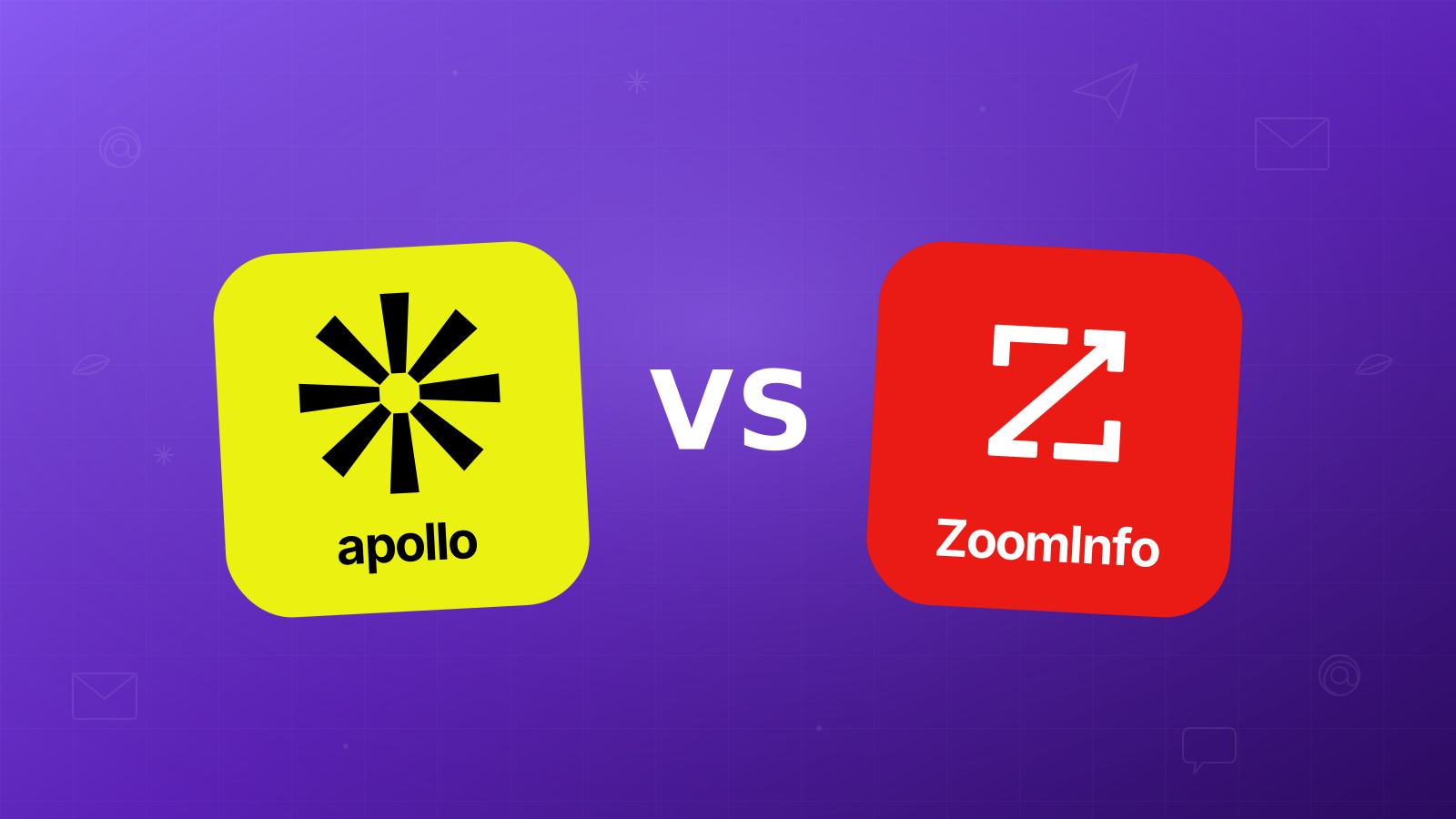
Apollo vs ZoomInfo: which is better for B2B sales?
Apollo vs ZoomInfo: which is better for B2B sales?
Apollo vs ZoomInfo: which is better for B2B sales?
Apollo vs ZoomInfo: which is better for B2B sales?
Apollo vs ZoomInfo: which is better for B2B sales?
Apollo vs ZoomInfo: which is better for B2B sales?

Author
Aljaz Peklaj
Why trust this review
We are GROU, a B2B pipeline agency that runs lead generation, outbound, and LinkedIn content for clients across manufacturing, fintech, iGaming, software, and professional services. We have used both Apollo and ZoomInfo in production over 18+ months across multiple client deployments. We have run cold email campaigns at sub-$5M ARR companies on Apollo and at mid-market enterprise on ZoomInfo. The verdict below is from operators who run both, not from a vendor pitch and not from a single round of testing.
→ Methodology: Comparison data combines our own client campaign results, both vendors' published documentation, third-party benchmark testing (Cleanlist, Sparkle, Cognism comparison reports), and the most recent public pricing from each vendor's site. We refresh this article quarterly.
→ Affiliate disclosure: Some links in this article are affiliate links. We earn a small commission if you sign up through them, at no extra cost to you. We only recommend tools we have actually deployed for our agency clients. The verdict below would not change if these were plain links.
TL;DR
Apollo wins for SMB and growth-stage teams that value transparent pricing and an all-in-one workflow. ZoomInfo wins for enterprise teams selling into the US, running heavy cold-call outbound, or operating in regulated industries. For most readers of this blog, Apollo is the right call. For enterprise GTM with a $25k-plus annual data budget, ZoomInfo earns the premium.
Score breakdown at a glance

Higher score in each row highlighted in GROU brand blue. Third-party signals: Apollo on G2 rating ~4.5/5. ZoomInfo on G2 rating ~4.4/5.
Table of contents
→ Why trust this review
→ Quick comparison
→ The case for Apollo
→ The case for ZoomInfo
→ How much does each cost?
→ Which has better data accuracy?
→ Which has better US mobile phone coverage?
→ How do the integrations compare?
→ Which has better intent data and ABM?
→ Which is easier to onboard and support?
→ Which has stronger compliance posture?
→ When to pick Apollo
→ When to pick ZoomInfo
→ Honest dealbreakers
→ Alternatives worth considering
→ FAQ
→ Bottom line
Quick comparison

Consolidating the Modern Sales Stack
A primary advantage of Apollo.io is its ability to unify disparate sales functions into a single, cohesive workflow. While traditional outbound strategies often require manual data transfers between a lead database, a sequencer, and a CRM, Apollo integrates these into one platform. This unification allows for seamless transitions from lead discovery—leveraging 65+ search filters and buyer intent data—directly into automated, multi-channel outreach sequences. By eliminating the technical friction of syncing multiple tools, teams can maintain better data hygiene and significantly lower their total cost of ownership. It is a powerful solution for growth-stage companies looking to scale their prospecting efforts without the overhead of complex integrations.
The case for Apollo
Apollo's wedge is not “cheap data”. It is a complete outbound workflow under one login. You can build a list, write a sequence, dial a phone number, and sync replies to your CRM without leaving the tool. For a 1- to 10-person team, that consolidation is worth more than the data accuracy gap to ZoomInfo.
The Chrome extension on LinkedIn Sales Navigator is the best in the category. Hover, save, sequence, all in one click. Reps trained on Apollo are productive within a week.
The free tier (10,000 email credits per month for new accounts; check current terms on the Apollo pricing page before assuming) is enough to run a real campaign before you commit. No sales call. No 6-week procurement. You can be sending in 15 minutes.
→ Best for: B2B founders running outbound for one company, growth-stage SaaS teams under 10 reps, agency operators serving SMB and mid-market clients, anyone whose data budget is under $10k per year.
The case for ZoomInfo
ZoomInfo's wedge is depth. 500 million plus contacts, 105 million plus verified US mobile numbers, proprietary intent signals, and an integrated engagement platform that handles enterprise-scale ABM. Nothing else in the category has the same coverage in the US.
The data quality difference is real. In independent testing (Cleanlist, Sparkle), ZoomInfo achieved 92 percent email deliverability and a 34 percent phone connect rate. Apollo achieved 88 percent and 22 percent respectively. For a campaign of 10,000 sends, that is roughly 400 fewer bounces and a meaningfully better sender reputation.
For enterprise sellers, regulated industries, and teams whose deals depend on talking to the right person on the phone, ZoomInfo earns the price premium.
→ Best for: enterprise sales orgs (50+ reps), US-focused mid-market and enterprise GTM, regulated industries, ABM-led sales motions, teams with dedicated sales ops.
How much does each cost?
Side-by-side tier breakdown. For full live pricing, check the Apollo pricing page and request a ZoomInfo quote directly.
Apollo pricing tiers

ZoomInfo pricing tiers
ZoomInfo does not publish prices. Typical ranges based on agency-side observation:

Hidden costs to watch: intent data, additional regions, conversation intelligence, and ABM modules are usually priced separately. The headline number is rarely the all-in cost.
Annual cost at common team sizes

Verdict on pricing: ZoomInfo is 6 to 16x more expensive at every team size. The premium is justified only if data accuracy, US mobile depth, or enterprise compliance are genuine deal-makers in your motion.
Want to know what activity volume your revenue target actually requires before you pick a data tool? Run our free Reverse Pipeline Calculator. 60 seconds. No signup. Or take the Pipeline Score Quiz to audit your full GTM motion.
Which has better data accuracy?
ZoomInfo, by 4 to 7 percentage points. 92 to 95 percent email deliverability versus Apollo's 80 to 88 percent in independent testing.
Why the gap exists: Apollo's database is largely crowdsourced. ZoomInfo runs 300-plus human researchers plus ML verification.
For SMB campaigns, Apollo's accuracy is good enough when paired with an email verification step (Hunter, NeverBounce). For enterprise campaigns where sender reputation is everything, the gap is meaningful. ZoomInfo wins this criterion clearly.
For teams that want prospecting data and outreach execution in one place, Apollo combines a database of 240M+ contacts and 30M+ companies with targeting, enrichment, and automated multichannel campaigns. Its 65+ search filters and buyer-intent signals can help reps prioritize in-market accounts, while verified emails and built-in deliverability guardrails support more focused outreach. That connection between finding the right prospects and acting on them is where Apollo can reduce manual research without adding another disconnected tool.
Which has better US mobile phone coverage?
ZoomInfo, decisively.
ZoomInfo has 105 million plus verified US mobile numbers with a 61 percent direct-dial hit rate and 34 percent connect rate.
Apollo has phone numbers but coverage is shallower. Hit rate is 43 percent direct-dial and 22 percent connect rate.
For cold-calling-heavy motions, ZoomInfo is the practical default.
How do the integrations compare?
Tied, with different sweet spots.
Both have native bidirectional integrations with HubSpot, Salesforce, Pipedrive, and the major engagement platforms (Outreach, Salesloft). See our Outreach vs Salesloft comparison.
Apollo's integrations are more current. Sequence sync, bidirectional enrichment, Chrome extension all work out of the box.
ZoomInfo's integrations are more enterprise-grade. Complex custom object syncs, high-volume writes, enterprise SSO/SCIM. But more setup time.
For SMB and standard mid-market setups, Apollo wins on speed-to-value. For enterprise customisation, ZoomInfo wins on robustness.
Which has better intent data and ABM?
ZoomInfo, clearly.
ZoomInfo owns its proprietary intent signal (StreetSearch) plus a Bombora partnership. Coverage is the deepest in the category. ABM features are enterprise-grade.
Apollo has intent data and basic ABM features, but they are noticeably thinner. See our account-based marketing examples.
If your sales motion is ABM-led, ZoomInfo is the right call. If you are running broader-funnel outbound, Apollo's intent is good enough.
Which is easier to onboard and support?
Apollo wins on onboarding. ZoomInfo wins on enterprise support.
Apollo: self-serve, free tier, no procurement friction. New users productive within a week.
ZoomInfo: dedicated account managers, professional services. Implementation typically takes 2 to 4 weeks for a 20-person team.
For a 5-person team standing up outbound this quarter, Apollo. For a 50-person enterprise sales org with custom CRM, ZoomInfo.
Which has stronger compliance posture?
ZoomInfo.
Both meet baseline (SOC 2, GDPR, CCPA). ZoomInfo's posture is more mature: SOC 2 Type II, granular data residency, enterprise audit logs.
For most SMB and mid-market teams, Apollo's compliance is sufficient. For regulated industries, ZoomInfo is often the procurement floor. EU-headquartered companies with strict GDPR procurement should look at Cognism instead — see ZoomInfo vs Cognism.
When to pick Apollo
→ You are a startup, SMB, or growth-stage team under 10 reps
→ Your sales motion is high-volume email plus selective calling
→ Your buyers are SMB or mid-market
→ Your data budget is under $10,000 per year
→ You value speed-to-launch over absolute data quality
→ Your team prefers self-serve workflows
→ You are running outbound for the first time and want to test before committing
→ Sign up: start a free Apollo account
When to pick ZoomInfo
→ You sell into enterprise (10,000-plus employee accounts)
→ Your sales motion depends on direct mobile outreach and cold calling
→ Your buyers are concentrated in the US
→ You run ABM at scale
→ Your industry has strict compliance requirements
→ Your annual data budget is $25,000 or more
→ Your team has dedicated sales ops
→ Request a demo: contact ZoomInfo sales
The case for TitanX
While Apollo and ZoomInfo battle over data volume and coverage, TitanX optimizes for the "atomic unit" of sales: the conversation. It addresses the industry's cratering connect rates by identifying prospects with high Phone Intent: those most likely to answer the phone. They use behavioral signals that show which prospects have a demonstrated propensity to pick up. In any given market, only about 20% of a contact list will ever pick up a cold call.
So instead of taking a volume approach, buying more data, hiring more reps, making more dials , or burning through contact lists with parallel dialers, TitanX shows reps which of their contacts fall into that 20%, pushing connect rates upwards of 25% (industry baselines are around 3-5%).
For teams where phone outbound is the primary driver but efficiency has stalled, TitanX Phone Intent offers a way to scale revenue without simply adding more bodies or dials.
→ Best for: US-based outbound teams that have outgrown the "volume playbook" and need to increase connect rates to justify their phone motion.
Honest dealbreakers
Apollo dealbreakers
→ Data accuracy varies by industry. Manufacturing, public sector EU, and Asia-Pacific are noticeably weaker than US tech.
→ Free tier was reduced from 10,000 monthly credits to 720 in early 2025 for new sign-ups (legacy grandfathered). Check current terms on the Apollo pricing page.
→ Customer support response times are slow on lower tiers. Deliverability incidents on Basic tier can sit unanswered for 12 to 48 hours.
→ Mobile credits run out faster than you expect on calling-heavy workflows.
ZoomInfo dealbreakers
→ Custom pricing means every quote requires a sales call. Procurement can take weeks.
→ Mid-market and enterprise contracts often include aggressive auto-renewal clauses. Read carefully.
→ The platform UI is dated relative to newer competitors. New SDRs take 2 to 3 weeks to onboard.
→ EU mobile data is functional but not the wedge. For EMEA-heavy motions, Cognism is the better call.
Alternatives worth considering
→ Cognism: best for teams selling into EU and UK. GDPR-compliant, verified European mobile numbers (“Diamond Data”), 13 European DNC list coverage. See ZoomInfo vs Cognism and Clay vs Cognism.
→ Clay: best for teams that want enrichment quality without committing to a single vendor. Waterfall enrichment from 150+ providers. See Clay vs Apollo.
→ Hunter.io: best for specialist email-finding workflows. No phone numbers but verified data quality is industry-leading. See Apollo vs Hunter.
→ For a broader view, see our B2B lead generation playbook and top lead generation tools roundup.
FAQ
Is Apollo or ZoomInfo better for cold email?
Both produce viable cold email lists. Apollo wins on price and speed-to-launch. ZoomInfo wins on email accuracy (4 percentage points better in independent testing). For SMB campaigns, Apollo. For enterprise campaigns where deliverability is everything, ZoomInfo.
Does Apollo or ZoomInfo have better US mobile phone numbers?
ZoomInfo, by a wide margin. 105 million plus verified US mobiles, 61 percent direct-dial hit rate, 34 percent connect rate. Apollo's mobile coverage is shallower with 43 percent direct-dial and 22 percent connect. For US cold-calling-heavy motions, ZoomInfo is the only choice between these two.
Can I use Apollo and ZoomInfo together?
Yes. Some enterprise teams split by segment: ZoomInfo for highest-value enterprise accounts, Apollo for the broader mid-market and SMB list. Doubles the cost, rare in practice. Most teams pick one.
Which one integrates better with HubSpot or Salesforce?
Both have native bidirectional integrations. Apollo's HubSpot integration is more current. ZoomInfo's integration is more enterprise-grade but requires more setup. For standard setups, Apollo. For complex custom-object syncs, ZoomInfo.
How accurate is Apollo's data really?
Apollo reports 80 to 85 percent email deliverability. Independent testing confirms 80 to 88 percent depending on industry. The gap to ZoomInfo's 92 to 95 percent is real but manageable with email verification tools.
Is ZoomInfo worth the 8x price premium?
Only if you sell into US enterprise, run cold-calling-heavy motions, need enterprise-grade ABM, or operate in regulated industries. For SMB and growth-stage teams running mostly email-based outbound, no. Apollo plus an email verification tool delivers 90 percent of the value at 12 percent of the cost.
Which one is better for European companies?
Neither, ideally. ZoomInfo's EU coverage is functional but not the wedge. Apollo's EU data quality is uneven. For EMEA-focused teams, Cognism is the operator default. See ZoomInfo vs Cognism.
Bottom line
Apollo and ZoomInfo are not the same product. Apollo is the operator's data tool: cheap, fast, all-in-one, and good enough for 80 percent of B2B sales motions. ZoomInfo is the enterprise data platform: expensive, deep, compliant, and necessary if your buyers, regions, or compliance requirements demand it.
For most readers of this blog, Apollo is the right answer. If you find yourself wondering whether you actually need ZoomInfo, you probably do not. If you know you need ZoomInfo, the price is the price.
The data is one input. The list quality, the deliverability, the copy, and the reply handling that runs on top determine whether the campaign produces pipeline. Most teams underestimate that operational layer.
Before you commit to either tool, run our reverse pipeline calculator to see what daily activity volume your revenue target requires, take the pipeline score quiz to audit your full motion, or book a 30-minute call to walk through whether build-or-hire makes sense for your setup.
About the author
Aljaz Peklaj is the founder of GROU, a B2B pipeline agency running LinkedIn content, lead generation, and outbound for clients across manufacturing, fintech, iGaming, software, and professional services.
→ Connect on LinkedIn: linkedin.com/in/aljazpeklaj
→ Read more: grouglobal.com/blog
→ Browse the GROU tools directory
→ Book a 30-minute pipeline call
Why trust this review
We are GROU, a B2B pipeline agency that runs lead generation, outbound, and LinkedIn content for clients across manufacturing, fintech, iGaming, software, and professional services. We have used both Apollo and ZoomInfo in production over 18+ months across multiple client deployments. We have run cold email campaigns at sub-$5M ARR companies on Apollo and at mid-market enterprise on ZoomInfo. The verdict below is from operators who run both, not from a vendor pitch and not from a single round of testing.
→ Methodology: Comparison data combines our own client campaign results, both vendors' published documentation, third-party benchmark testing (Cleanlist, Sparkle, Cognism comparison reports), and the most recent public pricing from each vendor's site. We refresh this article quarterly.
→ Affiliate disclosure: Some links in this article are affiliate links. We earn a small commission if you sign up through them, at no extra cost to you. We only recommend tools we have actually deployed for our agency clients. The verdict below would not change if these were plain links.
TL;DR
Apollo wins for SMB and growth-stage teams that value transparent pricing and an all-in-one workflow. ZoomInfo wins for enterprise teams selling into the US, running heavy cold-call outbound, or operating in regulated industries. For most readers of this blog, Apollo is the right call. For enterprise GTM with a $25k-plus annual data budget, ZoomInfo earns the premium.
Score breakdown at a glance
Higher score in each row highlighted in GROU brand blue. Third-party signals: Apollo on G2 rating ~4.5/5. ZoomInfo on G2 rating ~4.4/5.
Table of contents
→ Why trust this review
→ Quick comparison
→ The case for Apollo
→ The case for ZoomInfo
→ How much does each cost?
→ Which has better data accuracy?
→ Which has better US mobile phone coverage?
→ How do the integrations compare?
→ Which has better intent data and ABM?
→ Which is easier to onboard and support?
→ Which has stronger compliance posture?
→ When to pick Apollo
→ When to pick ZoomInfo
→ Honest dealbreakers
→ Alternatives worth considering
→ FAQ
→ Bottom line
Quick comparison
Consolidating the Modern Sales Stack
A primary advantage of Apollo.io is its ability to unify disparate sales functions into a single, cohesive workflow. While traditional outbound strategies often require manual data transfers between a lead database, a sequencer, and a CRM, Apollo integrates these into one platform. This unification allows for seamless transitions from lead discovery—leveraging 65+ search filters and buyer intent data—directly into automated, multi-channel outreach sequences. By eliminating the technical friction of syncing multiple tools, teams can maintain better data hygiene and significantly lower their total cost of ownership. It is a powerful solution for growth-stage companies looking to scale their prospecting efforts without the overhead of complex integrations.
The case for Apollo
Apollo's wedge is not “cheap data”. It is a complete outbound workflow under one login. You can build a list, write a sequence, dial a phone number, and sync replies to your CRM without leaving the tool. For a 1- to 10-person team, that consolidation is worth more than the data accuracy gap to ZoomInfo.
The Chrome extension on LinkedIn Sales Navigator is the best in the category. Hover, save, sequence, all in one click. Reps trained on Apollo are productive within a week.
The free tier (10,000 email credits per month for new accounts; check current terms on the Apollo pricing page before assuming) is enough to run a real campaign before you commit. No sales call. No 6-week procurement. You can be sending in 15 minutes.
→ Best for: B2B founders running outbound for one company, growth-stage SaaS teams under 10 reps, agency operators serving SMB and mid-market clients, anyone whose data budget is under $10k per year.
The case for ZoomInfo
ZoomInfo's wedge is depth. 500 million plus contacts, 105 million plus verified US mobile numbers, proprietary intent signals, and an integrated engagement platform that handles enterprise-scale ABM. Nothing else in the category has the same coverage in the US.
The data quality difference is real. In independent testing (Cleanlist, Sparkle), ZoomInfo achieved 92 percent email deliverability and a 34 percent phone connect rate. Apollo achieved 88 percent and 22 percent respectively. For a campaign of 10,000 sends, that is roughly 400 fewer bounces and a meaningfully better sender reputation.
For enterprise sellers, regulated industries, and teams whose deals depend on talking to the right person on the phone, ZoomInfo earns the price premium.
→ Best for: enterprise sales orgs (50+ reps), US-focused mid-market and enterprise GTM, regulated industries, ABM-led sales motions, teams with dedicated sales ops.
How much does each cost?
Side-by-side tier breakdown. For full live pricing, check the Apollo pricing page and request a ZoomInfo quote directly.
Apollo pricing tiers
ZoomInfo pricing tiers
ZoomInfo does not publish prices. Typical ranges based on agency-side observation:
Hidden costs to watch: intent data, additional regions, conversation intelligence, and ABM modules are usually priced separately. The headline number is rarely the all-in cost.
Annual cost at common team sizes
Verdict on pricing: ZoomInfo is 6 to 16x more expensive at every team size. The premium is justified only if data accuracy, US mobile depth, or enterprise compliance are genuine deal-makers in your motion.
Want to know what activity volume your revenue target actually requires before you pick a data tool? Run our free Reverse Pipeline Calculator. 60 seconds. No signup. Or take the Pipeline Score Quiz to audit your full GTM motion.
Which has better data accuracy?
ZoomInfo, by 4 to 7 percentage points. 92 to 95 percent email deliverability versus Apollo's 80 to 88 percent in independent testing.
Why the gap exists: Apollo's database is largely crowdsourced. ZoomInfo runs 300-plus human researchers plus ML verification.
For SMB campaigns, Apollo's accuracy is good enough when paired with an email verification step (Hunter, NeverBounce). For enterprise campaigns where sender reputation is everything, the gap is meaningful. ZoomInfo wins this criterion clearly.
For teams that want prospecting data and outreach execution in one place, Apollo combines a database of 240M+ contacts and 30M+ companies with targeting, enrichment, and automated multichannel campaigns. Its 65+ search filters and buyer-intent signals can help reps prioritize in-market accounts, while verified emails and built-in deliverability guardrails support more focused outreach. That connection between finding the right prospects and acting on them is where Apollo can reduce manual research without adding another disconnected tool.
Which has better US mobile phone coverage?
ZoomInfo, decisively.
ZoomInfo has 105 million plus verified US mobile numbers with a 61 percent direct-dial hit rate and 34 percent connect rate.
Apollo has phone numbers but coverage is shallower. Hit rate is 43 percent direct-dial and 22 percent connect rate.
For cold-calling-heavy motions, ZoomInfo is the practical default.
How do the integrations compare?
Tied, with different sweet spots.
Both have native bidirectional integrations with HubSpot, Salesforce, Pipedrive, and the major engagement platforms (Outreach, Salesloft). See our Outreach vs Salesloft comparison.
Apollo's integrations are more current. Sequence sync, bidirectional enrichment, Chrome extension all work out of the box.
ZoomInfo's integrations are more enterprise-grade. Complex custom object syncs, high-volume writes, enterprise SSO/SCIM. But more setup time.
For SMB and standard mid-market setups, Apollo wins on speed-to-value. For enterprise customisation, ZoomInfo wins on robustness.
Which has better intent data and ABM?
ZoomInfo, clearly.
ZoomInfo owns its proprietary intent signal (StreetSearch) plus a Bombora partnership. Coverage is the deepest in the category. ABM features are enterprise-grade.
Apollo has intent data and basic ABM features, but they are noticeably thinner. See our account-based marketing examples.
If your sales motion is ABM-led, ZoomInfo is the right call. If you are running broader-funnel outbound, Apollo's intent is good enough.
Which is easier to onboard and support?
Apollo wins on onboarding. ZoomInfo wins on enterprise support.
Apollo: self-serve, free tier, no procurement friction. New users productive within a week.
ZoomInfo: dedicated account managers, professional services. Implementation typically takes 2 to 4 weeks for a 20-person team.
For a 5-person team standing up outbound this quarter, Apollo. For a 50-person enterprise sales org with custom CRM, ZoomInfo.
Which has stronger compliance posture?
ZoomInfo.
Both meet baseline (SOC 2, GDPR, CCPA). ZoomInfo's posture is more mature: SOC 2 Type II, granular data residency, enterprise audit logs.
For most SMB and mid-market teams, Apollo's compliance is sufficient. For regulated industries, ZoomInfo is often the procurement floor. EU-headquartered companies with strict GDPR procurement should look at Cognism instead — see ZoomInfo vs Cognism.
When to pick Apollo
→ You are a startup, SMB, or growth-stage team under 10 reps
→ Your sales motion is high-volume email plus selective calling
→ Your buyers are SMB or mid-market
→ Your data budget is under $10,000 per year
→ You value speed-to-launch over absolute data quality
→ Your team prefers self-serve workflows
→ You are running outbound for the first time and want to test before committing
→ Sign up: start a free Apollo account
When to pick ZoomInfo
→ You sell into enterprise (10,000-plus employee accounts)
→ Your sales motion depends on direct mobile outreach and cold calling
→ Your buyers are concentrated in the US
→ You run ABM at scale
→ Your industry has strict compliance requirements
→ Your annual data budget is $25,000 or more
→ Your team has dedicated sales ops
→ Request a demo: contact ZoomInfo sales
The case for TitanX
While Apollo and ZoomInfo battle over data volume and coverage, TitanX optimizes for the "atomic unit" of sales: the conversation. It addresses the industry's cratering connect rates by identifying prospects with high Phone Intent: those most likely to answer the phone. They use behavioral signals that show which prospects have a demonstrated propensity to pick up. In any given market, only about 20% of a contact list will ever pick up a cold call.
So instead of taking a volume approach, buying more data, hiring more reps, making more dials , or burning through contact lists with parallel dialers, TitanX shows reps which of their contacts fall into that 20%, pushing connect rates upwards of 25% (industry baselines are around 3-5%).
For teams where phone outbound is the primary driver but efficiency has stalled, TitanX Phone Intent offers a way to scale revenue without simply adding more bodies or dials.
→ Best for: US-based outbound teams that have outgrown the "volume playbook" and need to increase connect rates to justify their phone motion.
Honest dealbreakers
Apollo dealbreakers
→ Data accuracy varies by industry. Manufacturing, public sector EU, and Asia-Pacific are noticeably weaker than US tech.
→ Free tier was reduced from 10,000 monthly credits to 720 in early 2025 for new sign-ups (legacy grandfathered). Check current terms on the Apollo pricing page.
→ Customer support response times are slow on lower tiers. Deliverability incidents on Basic tier can sit unanswered for 12 to 48 hours.
→ Mobile credits run out faster than you expect on calling-heavy workflows.
ZoomInfo dealbreakers
→ Custom pricing means every quote requires a sales call. Procurement can take weeks.
→ Mid-market and enterprise contracts often include aggressive auto-renewal clauses. Read carefully.
→ The platform UI is dated relative to newer competitors. New SDRs take 2 to 3 weeks to onboard.
→ EU mobile data is functional but not the wedge. For EMEA-heavy motions, Cognism is the better call.
Alternatives worth considering
→ Cognism: best for teams selling into EU and UK. GDPR-compliant, verified European mobile numbers (“Diamond Data”), 13 European DNC list coverage. See ZoomInfo vs Cognism and Clay vs Cognism.
→ Clay: best for teams that want enrichment quality without committing to a single vendor. Waterfall enrichment from 150+ providers. See Clay vs Apollo.
→ Hunter.io: best for specialist email-finding workflows. No phone numbers but verified data quality is industry-leading. See Apollo vs Hunter.
→ For a broader view, see our B2B lead generation playbook and top lead generation tools roundup.
FAQ
Is Apollo or ZoomInfo better for cold email?
Both produce viable cold email lists. Apollo wins on price and speed-to-launch. ZoomInfo wins on email accuracy (4 percentage points better in independent testing). For SMB campaigns, Apollo. For enterprise campaigns where deliverability is everything, ZoomInfo.
Does Apollo or ZoomInfo have better US mobile phone numbers?
ZoomInfo, by a wide margin. 105 million plus verified US mobiles, 61 percent direct-dial hit rate, 34 percent connect rate. Apollo's mobile coverage is shallower with 43 percent direct-dial and 22 percent connect. For US cold-calling-heavy motions, ZoomInfo is the only choice between these two.
Can I use Apollo and ZoomInfo together?
Yes. Some enterprise teams split by segment: ZoomInfo for highest-value enterprise accounts, Apollo for the broader mid-market and SMB list. Doubles the cost, rare in practice. Most teams pick one.
Which one integrates better with HubSpot or Salesforce?
Both have native bidirectional integrations. Apollo's HubSpot integration is more current. ZoomInfo's integration is more enterprise-grade but requires more setup. For standard setups, Apollo. For complex custom-object syncs, ZoomInfo.
How accurate is Apollo's data really?
Apollo reports 80 to 85 percent email deliverability. Independent testing confirms 80 to 88 percent depending on industry. The gap to ZoomInfo's 92 to 95 percent is real but manageable with email verification tools.
Is ZoomInfo worth the 8x price premium?
Only if you sell into US enterprise, run cold-calling-heavy motions, need enterprise-grade ABM, or operate in regulated industries. For SMB and growth-stage teams running mostly email-based outbound, no. Apollo plus an email verification tool delivers 90 percent of the value at 12 percent of the cost.
Which one is better for European companies?
Neither, ideally. ZoomInfo's EU coverage is functional but not the wedge. Apollo's EU data quality is uneven. For EMEA-focused teams, Cognism is the operator default. See ZoomInfo vs Cognism.
Bottom line
Apollo and ZoomInfo are not the same product. Apollo is the operator's data tool: cheap, fast, all-in-one, and good enough for 80 percent of B2B sales motions. ZoomInfo is the enterprise data platform: expensive, deep, compliant, and necessary if your buyers, regions, or compliance requirements demand it.
For most readers of this blog, Apollo is the right answer. If you find yourself wondering whether you actually need ZoomInfo, you probably do not. If you know you need ZoomInfo, the price is the price.
The data is one input. The list quality, the deliverability, the copy, and the reply handling that runs on top determine whether the campaign produces pipeline. Most teams underestimate that operational layer.
Before you commit to either tool, run our reverse pipeline calculator to see what daily activity volume your revenue target requires, take the pipeline score quiz to audit your full motion, or book a 30-minute call to walk through whether build-or-hire makes sense for your setup.
About the author
Aljaz Peklaj is the founder of GROU, a B2B pipeline agency running LinkedIn content, lead generation, and outbound for clients across manufacturing, fintech, iGaming, software, and professional services.
→ Connect on LinkedIn: linkedin.com/in/aljazpeklaj
→ Read more: grouglobal.com/blog
→ Browse the GROU tools directory
→ Book a 30-minute pipeline call
Why trust this review
We are GROU, a B2B pipeline agency that runs lead generation, outbound, and LinkedIn content for clients across manufacturing, fintech, iGaming, software, and professional services. We have used both Apollo and ZoomInfo in production over 18+ months across multiple client deployments. We have run cold email campaigns at sub-$5M ARR companies on Apollo and at mid-market enterprise on ZoomInfo. The verdict below is from operators who run both, not from a vendor pitch and not from a single round of testing.
→ Methodology: Comparison data combines our own client campaign results, both vendors' published documentation, third-party benchmark testing (Cleanlist, Sparkle, Cognism comparison reports), and the most recent public pricing from each vendor's site. We refresh this article quarterly.
→ Affiliate disclosure: Some links in this article are affiliate links. We earn a small commission if you sign up through them, at no extra cost to you. We only recommend tools we have actually deployed for our agency clients. The verdict below would not change if these were plain links.
TL;DR
Apollo wins for SMB and growth-stage teams that value transparent pricing and an all-in-one workflow. ZoomInfo wins for enterprise teams selling into the US, running heavy cold-call outbound, or operating in regulated industries. For most readers of this blog, Apollo is the right call. For enterprise GTM with a $25k-plus annual data budget, ZoomInfo earns the premium.
Score breakdown at a glance
Higher score in each row highlighted in GROU brand blue. Third-party signals: Apollo on G2 rating ~4.5/5. ZoomInfo on G2 rating ~4.4/5.
Table of contents
→ Why trust this review
→ Quick comparison
→ The case for Apollo
→ The case for ZoomInfo
→ How much does each cost?
→ Which has better data accuracy?
→ Which has better US mobile phone coverage?
→ How do the integrations compare?
→ Which has better intent data and ABM?
→ Which is easier to onboard and support?
→ Which has stronger compliance posture?
→ When to pick Apollo
→ When to pick ZoomInfo
→ Honest dealbreakers
→ Alternatives worth considering
→ FAQ
→ Bottom line
Quick comparison
Consolidating the Modern Sales Stack
A primary advantage of Apollo.io is its ability to unify disparate sales functions into a single, cohesive workflow. While traditional outbound strategies often require manual data transfers between a lead database, a sequencer, and a CRM, Apollo integrates these into one platform. This unification allows for seamless transitions from lead discovery—leveraging 65+ search filters and buyer intent data—directly into automated, multi-channel outreach sequences. By eliminating the technical friction of syncing multiple tools, teams can maintain better data hygiene and significantly lower their total cost of ownership. It is a powerful solution for growth-stage companies looking to scale their prospecting efforts without the overhead of complex integrations.
The case for Apollo
Apollo's wedge is not “cheap data”. It is a complete outbound workflow under one login. You can build a list, write a sequence, dial a phone number, and sync replies to your CRM without leaving the tool. For a 1- to 10-person team, that consolidation is worth more than the data accuracy gap to ZoomInfo.
The Chrome extension on LinkedIn Sales Navigator is the best in the category. Hover, save, sequence, all in one click. Reps trained on Apollo are productive within a week.
The free tier (10,000 email credits per month for new accounts; check current terms on the Apollo pricing page before assuming) is enough to run a real campaign before you commit. No sales call. No 6-week procurement. You can be sending in 15 minutes.
→ Best for: B2B founders running outbound for one company, growth-stage SaaS teams under 10 reps, agency operators serving SMB and mid-market clients, anyone whose data budget is under $10k per year.
The case for ZoomInfo
ZoomInfo's wedge is depth. 500 million plus contacts, 105 million plus verified US mobile numbers, proprietary intent signals, and an integrated engagement platform that handles enterprise-scale ABM. Nothing else in the category has the same coverage in the US.
The data quality difference is real. In independent testing (Cleanlist, Sparkle), ZoomInfo achieved 92 percent email deliverability and a 34 percent phone connect rate. Apollo achieved 88 percent and 22 percent respectively. For a campaign of 10,000 sends, that is roughly 400 fewer bounces and a meaningfully better sender reputation.
For enterprise sellers, regulated industries, and teams whose deals depend on talking to the right person on the phone, ZoomInfo earns the price premium.
→ Best for: enterprise sales orgs (50+ reps), US-focused mid-market and enterprise GTM, regulated industries, ABM-led sales motions, teams with dedicated sales ops.
How much does each cost?
Side-by-side tier breakdown. For full live pricing, check the Apollo pricing page and request a ZoomInfo quote directly.
Apollo pricing tiers
ZoomInfo pricing tiers
ZoomInfo does not publish prices. Typical ranges based on agency-side observation:
Hidden costs to watch: intent data, additional regions, conversation intelligence, and ABM modules are usually priced separately. The headline number is rarely the all-in cost.
Annual cost at common team sizes
Verdict on pricing: ZoomInfo is 6 to 16x more expensive at every team size. The premium is justified only if data accuracy, US mobile depth, or enterprise compliance are genuine deal-makers in your motion.
Want to know what activity volume your revenue target actually requires before you pick a data tool? Run our free Reverse Pipeline Calculator. 60 seconds. No signup. Or take the Pipeline Score Quiz to audit your full GTM motion.
Which has better data accuracy?
ZoomInfo, by 4 to 7 percentage points. 92 to 95 percent email deliverability versus Apollo's 80 to 88 percent in independent testing.
Why the gap exists: Apollo's database is largely crowdsourced. ZoomInfo runs 300-plus human researchers plus ML verification.
For SMB campaigns, Apollo's accuracy is good enough when paired with an email verification step (Hunter, NeverBounce). For enterprise campaigns where sender reputation is everything, the gap is meaningful. ZoomInfo wins this criterion clearly.
For teams that want prospecting data and outreach execution in one place, Apollo combines a database of 240M+ contacts and 30M+ companies with targeting, enrichment, and automated multichannel campaigns. Its 65+ search filters and buyer-intent signals can help reps prioritize in-market accounts, while verified emails and built-in deliverability guardrails support more focused outreach. That connection between finding the right prospects and acting on them is where Apollo can reduce manual research without adding another disconnected tool.
Which has better US mobile phone coverage?
ZoomInfo, decisively.
ZoomInfo has 105 million plus verified US mobile numbers with a 61 percent direct-dial hit rate and 34 percent connect rate.
Apollo has phone numbers but coverage is shallower. Hit rate is 43 percent direct-dial and 22 percent connect rate.
For cold-calling-heavy motions, ZoomInfo is the practical default.
How do the integrations compare?
Tied, with different sweet spots.
Both have native bidirectional integrations with HubSpot, Salesforce, Pipedrive, and the major engagement platforms (Outreach, Salesloft). See our Outreach vs Salesloft comparison.
Apollo's integrations are more current. Sequence sync, bidirectional enrichment, Chrome extension all work out of the box.
ZoomInfo's integrations are more enterprise-grade. Complex custom object syncs, high-volume writes, enterprise SSO/SCIM. But more setup time.
For SMB and standard mid-market setups, Apollo wins on speed-to-value. For enterprise customisation, ZoomInfo wins on robustness.
Which has better intent data and ABM?
ZoomInfo, clearly.
ZoomInfo owns its proprietary intent signal (StreetSearch) plus a Bombora partnership. Coverage is the deepest in the category. ABM features are enterprise-grade.
Apollo has intent data and basic ABM features, but they are noticeably thinner. See our account-based marketing examples.
If your sales motion is ABM-led, ZoomInfo is the right call. If you are running broader-funnel outbound, Apollo's intent is good enough.
Which is easier to onboard and support?
Apollo wins on onboarding. ZoomInfo wins on enterprise support.
Apollo: self-serve, free tier, no procurement friction. New users productive within a week.
ZoomInfo: dedicated account managers, professional services. Implementation typically takes 2 to 4 weeks for a 20-person team.
For a 5-person team standing up outbound this quarter, Apollo. For a 50-person enterprise sales org with custom CRM, ZoomInfo.
Which has stronger compliance posture?
ZoomInfo.
Both meet baseline (SOC 2, GDPR, CCPA). ZoomInfo's posture is more mature: SOC 2 Type II, granular data residency, enterprise audit logs.
For most SMB and mid-market teams, Apollo's compliance is sufficient. For regulated industries, ZoomInfo is often the procurement floor. EU-headquartered companies with strict GDPR procurement should look at Cognism instead — see ZoomInfo vs Cognism.
When to pick Apollo
→ You are a startup, SMB, or growth-stage team under 10 reps
→ Your sales motion is high-volume email plus selective calling
→ Your buyers are SMB or mid-market
→ Your data budget is under $10,000 per year
→ You value speed-to-launch over absolute data quality
→ Your team prefers self-serve workflows
→ You are running outbound for the first time and want to test before committing
→ Sign up: start a free Apollo account
When to pick ZoomInfo
→ You sell into enterprise (10,000-plus employee accounts)
→ Your sales motion depends on direct mobile outreach and cold calling
→ Your buyers are concentrated in the US
→ You run ABM at scale
→ Your industry has strict compliance requirements
→ Your annual data budget is $25,000 or more
→ Your team has dedicated sales ops
→ Request a demo: contact ZoomInfo sales
The case for TitanX
While Apollo and ZoomInfo battle over data volume and coverage, TitanX optimizes for the "atomic unit" of sales: the conversation. It addresses the industry's cratering connect rates by identifying prospects with high Phone Intent: those most likely to answer the phone. They use behavioral signals that show which prospects have a demonstrated propensity to pick up. In any given market, only about 20% of a contact list will ever pick up a cold call.
So instead of taking a volume approach, buying more data, hiring more reps, making more dials , or burning through contact lists with parallel dialers, TitanX shows reps which of their contacts fall into that 20%, pushing connect rates upwards of 25% (industry baselines are around 3-5%).
For teams where phone outbound is the primary driver but efficiency has stalled, TitanX Phone Intent offers a way to scale revenue without simply adding more bodies or dials.
→ Best for: US-based outbound teams that have outgrown the "volume playbook" and need to increase connect rates to justify their phone motion.
Honest dealbreakers
Apollo dealbreakers
→ Data accuracy varies by industry. Manufacturing, public sector EU, and Asia-Pacific are noticeably weaker than US tech.
→ Free tier was reduced from 10,000 monthly credits to 720 in early 2025 for new sign-ups (legacy grandfathered). Check current terms on the Apollo pricing page.
→ Customer support response times are slow on lower tiers. Deliverability incidents on Basic tier can sit unanswered for 12 to 48 hours.
→ Mobile credits run out faster than you expect on calling-heavy workflows.
ZoomInfo dealbreakers
→ Custom pricing means every quote requires a sales call. Procurement can take weeks.
→ Mid-market and enterprise contracts often include aggressive auto-renewal clauses. Read carefully.
→ The platform UI is dated relative to newer competitors. New SDRs take 2 to 3 weeks to onboard.
→ EU mobile data is functional but not the wedge. For EMEA-heavy motions, Cognism is the better call.
Alternatives worth considering
→ Cognism: best for teams selling into EU and UK. GDPR-compliant, verified European mobile numbers (“Diamond Data”), 13 European DNC list coverage. See ZoomInfo vs Cognism and Clay vs Cognism.
→ Clay: best for teams that want enrichment quality without committing to a single vendor. Waterfall enrichment from 150+ providers. See Clay vs Apollo.
→ Hunter.io: best for specialist email-finding workflows. No phone numbers but verified data quality is industry-leading. See Apollo vs Hunter.
→ For a broader view, see our B2B lead generation playbook and top lead generation tools roundup.
FAQ
Is Apollo or ZoomInfo better for cold email?
Both produce viable cold email lists. Apollo wins on price and speed-to-launch. ZoomInfo wins on email accuracy (4 percentage points better in independent testing). For SMB campaigns, Apollo. For enterprise campaigns where deliverability is everything, ZoomInfo.
Does Apollo or ZoomInfo have better US mobile phone numbers?
ZoomInfo, by a wide margin. 105 million plus verified US mobiles, 61 percent direct-dial hit rate, 34 percent connect rate. Apollo's mobile coverage is shallower with 43 percent direct-dial and 22 percent connect. For US cold-calling-heavy motions, ZoomInfo is the only choice between these two.
Can I use Apollo and ZoomInfo together?
Yes. Some enterprise teams split by segment: ZoomInfo for highest-value enterprise accounts, Apollo for the broader mid-market and SMB list. Doubles the cost, rare in practice. Most teams pick one.
Which one integrates better with HubSpot or Salesforce?
Both have native bidirectional integrations. Apollo's HubSpot integration is more current. ZoomInfo's integration is more enterprise-grade but requires more setup. For standard setups, Apollo. For complex custom-object syncs, ZoomInfo.
How accurate is Apollo's data really?
Apollo reports 80 to 85 percent email deliverability. Independent testing confirms 80 to 88 percent depending on industry. The gap to ZoomInfo's 92 to 95 percent is real but manageable with email verification tools.
Is ZoomInfo worth the 8x price premium?
Only if you sell into US enterprise, run cold-calling-heavy motions, need enterprise-grade ABM, or operate in regulated industries. For SMB and growth-stage teams running mostly email-based outbound, no. Apollo plus an email verification tool delivers 90 percent of the value at 12 percent of the cost.
Which one is better for European companies?
Neither, ideally. ZoomInfo's EU coverage is functional but not the wedge. Apollo's EU data quality is uneven. For EMEA-focused teams, Cognism is the operator default. See ZoomInfo vs Cognism.
Bottom line
Apollo and ZoomInfo are not the same product. Apollo is the operator's data tool: cheap, fast, all-in-one, and good enough for 80 percent of B2B sales motions. ZoomInfo is the enterprise data platform: expensive, deep, compliant, and necessary if your buyers, regions, or compliance requirements demand it.
For most readers of this blog, Apollo is the right answer. If you find yourself wondering whether you actually need ZoomInfo, you probably do not. If you know you need ZoomInfo, the price is the price.
The data is one input. The list quality, the deliverability, the copy, and the reply handling that runs on top determine whether the campaign produces pipeline. Most teams underestimate that operational layer.
Before you commit to either tool, run our reverse pipeline calculator to see what daily activity volume your revenue target requires, take the pipeline score quiz to audit your full motion, or book a 30-minute call to walk through whether build-or-hire makes sense for your setup.
About the author
Aljaz Peklaj is the founder of GROU, a B2B pipeline agency running LinkedIn content, lead generation, and outbound for clients across manufacturing, fintech, iGaming, software, and professional services.
→ Connect on LinkedIn: linkedin.com/in/aljazpeklaj
→ Read more: grouglobal.com/blog
→ Browse the GROU tools directory
→ Book a 30-minute pipeline call

Pipeline OS Newsletter
Build qualified pipeline
Get weekly tactics to generate demand, improve lead quality, and book more meetings.




Trusted by industry leaders
Trusted by industry leaders
Trusted by industry leaders
Ready to build qualified pipeline?
Ready to build qualified pipeline?
Ready to build qualified pipeline?
Book a call to see if we're the right fit, or take the 2-minute quiz to get a clear starting point.
Book a call to see if we're the right fit, or take the 2-minute quiz to get a clear starting point.
Book a call to see if we're the right fit, or take the 2-minute quiz to get a clear starting point.
" height="30.21639343089746px" id="hfGbXmQR2" width="30.216393430897455px"/></svg>)
Copyright © 2026 – All Right Reserved
Copyright © 2026 – All Right Reserved
Copyright © 2026 – All Right Reserved