%22%3E%3C/path%3E%3Cpath d=%22M 63.072 7.554 C 62.258 8.022 61.577 8.689 61.092 9.493 L 61.092 7.076 L 57.158 7.076 L 57.158 22.64 L 61.089 22.64 L 61.089 14.888 C 61.089 13.446 61.403 12.434 62.03 11.853 C 62.818 11.218 63.818 10.907 64.826 10.982 L 65.868 10.982 L 65.868 6.851 C 64.891 6.834 63.926 7.076 63.073 7.554 Z%22 fill=%22rgb(17,17,17)%22%3E%3C/path%3E%3Cpath d=%22M 78.916 7.82 C 76.363 6.49 73.321 6.49 70.768 7.82 C 69.562 8.473 68.564 9.451 67.888 10.644 C 67.167 11.931 66.803 13.387 66.834 14.862 C 66.804 16.332 67.157 17.785 67.86 19.077 C 68.515 20.267 69.494 21.246 70.684 21.901 C 71.924 22.576 73.318 22.92 74.73 22.898 C 76.164 22.918 77.58 22.575 78.846 21.901 C 80.062 21.247 81.073 20.27 81.768 19.077 C 82.506 17.797 82.88 16.339 82.85 14.862 C 82.88 13.389 82.517 11.934 81.797 10.647 C 81.12 9.455 80.122 8.477 78.917 7.824 M 78.803 14.862 C 78.829 15.739 78.636 16.608 78.241 17.391 C 77.903 18.046 77.38 18.588 76.738 18.95 C 76.124 19.293 75.432 19.472 74.729 19.47 C 73.668 19.497 72.648 19.061 71.934 18.276 C 71.139 17.323 70.741 16.1 70.823 14.862 C 70.741 13.62 71.149 12.395 71.959 11.45 C 72.687 10.667 73.715 10.233 74.783 10.256 C 75.859 10.236 76.894 10.67 77.635 11.45 C 78.464 12.387 78.884 13.616 78.801 14.864%22 fill=%22rgb(17,17,17)%22%3E%3C/path%3E%3Cpath d=%22M 95.906 7.076 L 95.906 15.646 C 95.975 16.68 95.643 17.701 94.979 18.498 C 94.311 19.184 93.379 19.547 92.422 19.495 C 91.475 19.544 90.553 19.18 89.894 18.498 C 89.23 17.701 88.898 16.68 88.967 15.646 L 88.967 7.076 L 85.033 7.076 L 85.033 16.207 C 85 17.449 85.275 18.68 85.834 19.79 C 86.327 20.75 87.095 21.542 88.039 22.065 C 89.033 22.594 90.145 22.861 91.271 22.838 C 92.188 22.847 93.095 22.65 93.926 22.263 C 94.708 21.905 95.388 21.36 95.906 20.675 L 95.906 22.645 L 99.865 22.645 L 99.865 7.076 Z%22 fill=%22rgb(17,17,17)%22%3E%3C/path%3E%3Cpath d=%22M 4.513 15.626 C 4.511 10.815 7.606 6.549 12.181 5.059 C 16.756 3.57 21.77 5.195 24.601 9.086 L 27.816 5.87 C 24.074 1.186 17.981 -0.943 12.137 0.393 C 6.292 1.728 1.728 6.292 0.393 12.137 C -0.943 17.981 1.186 24.074 5.87 27.816 L 9.085 24.601 C 6.214 22.512 4.515 19.177 4.513 15.626%22 fill=%22rgb(32,62,235)%22%3E%3C/path%3E%3Cpath d=%22M 17.114 14.343 L 13.354 18.01 L 13.354 18.026 L 21.071 18.026 L 11.412 27.609 L 17.389 27.609 L 23.999 21.081 L 23.999 28.316 L 24.005 28.316 L 27.967 24.393 L 27.967 14.343 Z%22 fill=%22rgb(32,62,235)%22%3E%3C/path%3E%3C/g%3E%3C/svg%3E) ×
× ××
××›
›
›
›
Apollo vs Smartlead: which one wins for cold outbound in 2026?
Apollo vs Smartlead: which one wins for cold outbound in 2026?
Apollo vs Smartlead: which one wins for cold outbound in 2026?
Apollo vs Smartlead: which one wins for cold outbound in 2026?
Apollo vs Smartlead: which one wins for cold outbound in 2026?
Apollo vs Smartlead: which one wins for cold outbound in 2026?

Author
Aljaz Peklaj
Why trust this comparison
We are GROU, a B2B pipeline agency that runs lead generation, outbound, and LinkedIn content for clients across manufacturing, fintech, iGaming, software, and professional services. We have shipped real client campaigns on both Apollo and Smartlead in the last 24 months. The verdict below is from operators who have run Apollo as a bundled prospecting + sequencer stack and Smartlead as the cold infrastructure layer of an agency stack, not from a vendor pitch.
→ Methodology: This comparison combines our own client deployment data, both vendors' published pricing pages, third-party reviews from Lagrowthmachine, Puzzle Inbox, and Landbase, and live G2 review data for Apollo and Smartlead. We refresh this article quarterly.
→ Affiliate disclosure: Some links in this article are affiliate links to Apollo and Smartlead. We earn a small commission if you sign up through them, at no extra cost to you. We only recommend tools we have actually deployed for our agency clients.
TL;DR
Apollo and Smartlead sit on opposite sides of the cold outbound stack. Apollo is a bundled prospecting database + sequencer: 275 million contacts, native email sequencer, dialer, meeting scheduler, AI assistant, sold per user per month. Smartlead is pure cold email infrastructure: unlimited mailboxes, native warmup, inbox rotation, master inbox, sold per workspace per month with no bundled data.
The decision is usually about whether you need a contact database bundled in. If you have no separate prospecting tool and you want one purchase to cover data + sequencing, Apollo. If you have your own data sources (Clay waterfalls, scraped lists, ICP-specific providers like Cognism for EU) and you want the cheapest possible high-deliverability infrastructure, Smartlead.
For most B2B agencies running outbound across 5+ clients, Smartlead's flat workspace pricing crushes Apollo's per-user economics. For most solo founders running outbound for one ICP under 10K emails per month, Apollo's bundled database is the unit-economics winner. We use both, on different tiers of the stack.
Score breakdown at a glance

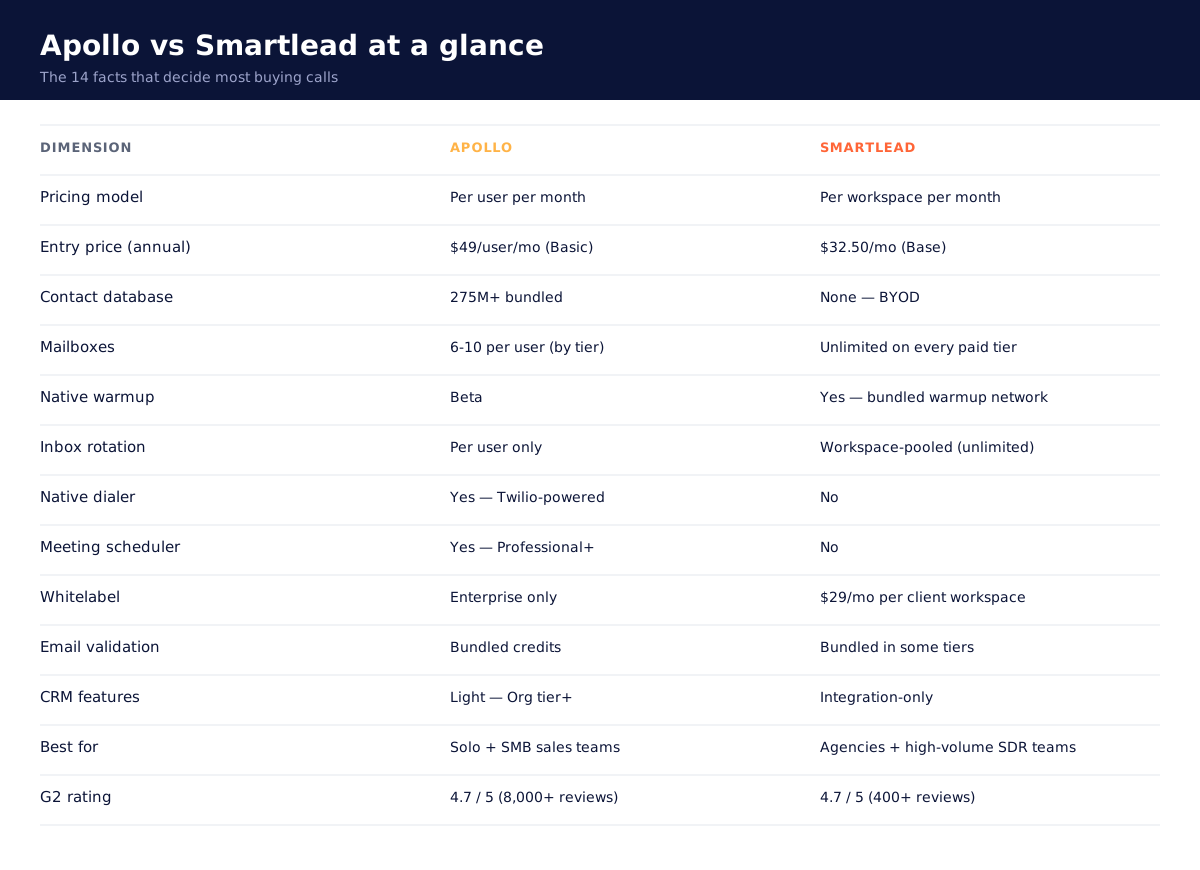
Third-party signals: Apollo on G2 rating around 4.7 / 5 across 8,000+ reviews (praised for the bundled database and ease of use). Smartlead on G2 rating around 4.7 / 5 across 400+ reviews (praised for deliverability and unlimited inbox model).
Table of contents
Why trust this comparison
TL;DR
Quick comparison
The case for Apollo
The case for Smartlead
How much does each cost?
Which has better deliverability?
Which has better contact data?
Which is better for agencies?
Which is easier to onboard?
When to pick Apollo
When to pick Smartlead
When to use both (the GROU stack)
Honest dealbreakers
Alternatives worth considering
FAQ
Bottom line
Quick comparison
The case for Apollo
Apollo is a bundled go-to-market platform built around its proprietary 275M+ contact database. The wedge is the database, paired with a native sequencer, dialer, meeting scheduler, AI writing assistant, and CRM-light all in one tool. For solo founders, early-stage SaaS, and SMB sales teams, the bundle is the value: one purchase covers prospecting and sequencing where competitors require Clay or ZoomInfo plus a separate sequencer.
The data is the headline feature. Apollo's 275M contacts cover 60M+ companies globally with email and mobile coverage that lands around 91 percent valid emails per their published numbers, real-world testing puts it closer to 75 to 85 percent depending on the ICP. The contact database refreshes continuously with crowd-sourced and scraped signals. For US mid-market and SMB ICPs, Apollo's data quality is competitive with paid alternatives at 5x the cost.
The sequencer is the second wedge. Multi-step email sequences with conditional logic, automatic reply detection, A/B testing, and AI-assisted copywriting. Native dialer (Twilio-powered) for cold calls integrated into the same workflow. Meeting scheduler with calendar sync. For solo operators where one tool covering email + calls + meetings is the productivity unlock, Apollo is the natural pick.
The price is the third wedge for early-stage teams. Apollo's free tier ships 60 emails per month plus 200 monthly credits, enough to test the platform. The Basic tier at $49 per user per month annual (12K emails/year, 900 credits/year per user) covers founder-led outbound comfortably. Professional at $79 per user per month adds meeting workflows, advanced sequences, and 1,500 credits per year. Organization at $119 per user per month adds advanced reporting, custom fields, and 2,400 credits per year.
The downsides are real. Per-user pricing scales hard. A 5-person agency on Apollo Professional costs $4,740 per year. The same 5-person agency on Smartlead Pro costs $940 per year. Mailbox limits are tighter than Smartlead (6 mailboxes per user on Professional vs unlimited on Smartlead). Native warmup is now available but in beta-status; for high-volume agency sending, Smartlead's warmup network is more proven. EU contact data is materially weaker than US data; for European outbound, pair Apollo with Cognism or a dedicated EU source.
→ Best for: solo founders running their own outbound, early-stage SaaS scaling from 0 to PMF, US-focused SMB and mid-market sales teams, operators who want database + sequencer in one purchase, teams under 5 reps running 5K to 25K emails per month per user.
The case for Smartlead
Smartlead is the most cost-effective cold email infrastructure tool on the market. The wedge is structural: unlimited email accounts on every paid plan, native warmup, native inbox rotation, and flat workspace pricing instead of per-seat. No bundled database (BYOD), no native CRM, no dialer. Pure infrastructure.
The unlimited mailboxes feature is the entire unlock. Where Apollo gives you 6 sending addresses per user on Professional, Smartlead lets you connect 50, 100, 500 mailboxes to a single workspace at no extra cost. Combined with native rotation, this is the only viable architecture for high-volume cold outbound. A typical agency Smartlead setup: 50 to 200 secondary mailboxes, sending 20 to 40 emails per mailbox per day, rotating automatically through the rotation pool. Deliverability stays north of 90 percent inboxing for senders who follow the warmup playbook.
The native warmup network is the second wedge. Smartlead's warmup rotates emails between accounts to build sender reputation. Standard practice is 60 to 90 days of warmup per fresh mailbox before pushing real volume. The warmup runs in the background at no extra cost.
The flat workspace pricing is the third wedge. Adding a team member costs nothing on Smartlead. Adding a client workspace costs nothing on the base subscription (whitelabel add-on is $29 per client workspace, the only per-client fee). For agencies running outbound for 5 to 20 clients, the cost-per-send economics are not close.
The whitelabel add-on at $29 per month per client workspace is the fourth wedge. For agencies offering cold email as a service to clients, this lets you deliver the platform under your own brand for a marginal cost. Apollo's whitelabel is Enterprise-only.
The downsides are real. No bundled database. You bring your own contacts via Clay, Cognism, Apollo (yes, some teams use Apollo just for the database and Smartlead for sending), or scraped sources. For solo founders without a separate prospecting tool, this is a structural barrier vs Apollo's all-in-one bundle.
No native dialer or meeting scheduler. Smartlead is email-only. For cold calling and meeting workflows, you bolt on Aircall and Cal.com / Calendly. For a multichannel motion where email + call must run in one cadence, the integration overhead matters.
→ Best for: B2B agencies running outbound for multiple clients, high-volume in-house SDR teams (30K to 250K+ emails per month per workspace), operators who care about deliverability and cost-per-send more than bundled features, anyone with their own data sources and a need for unlimited inboxes on a flat workspace fee.
How much does each cost?
Side-by-side breakdown of base pricing. For live pricing, check Apollo and Smartlead directly.
Apollo pricing
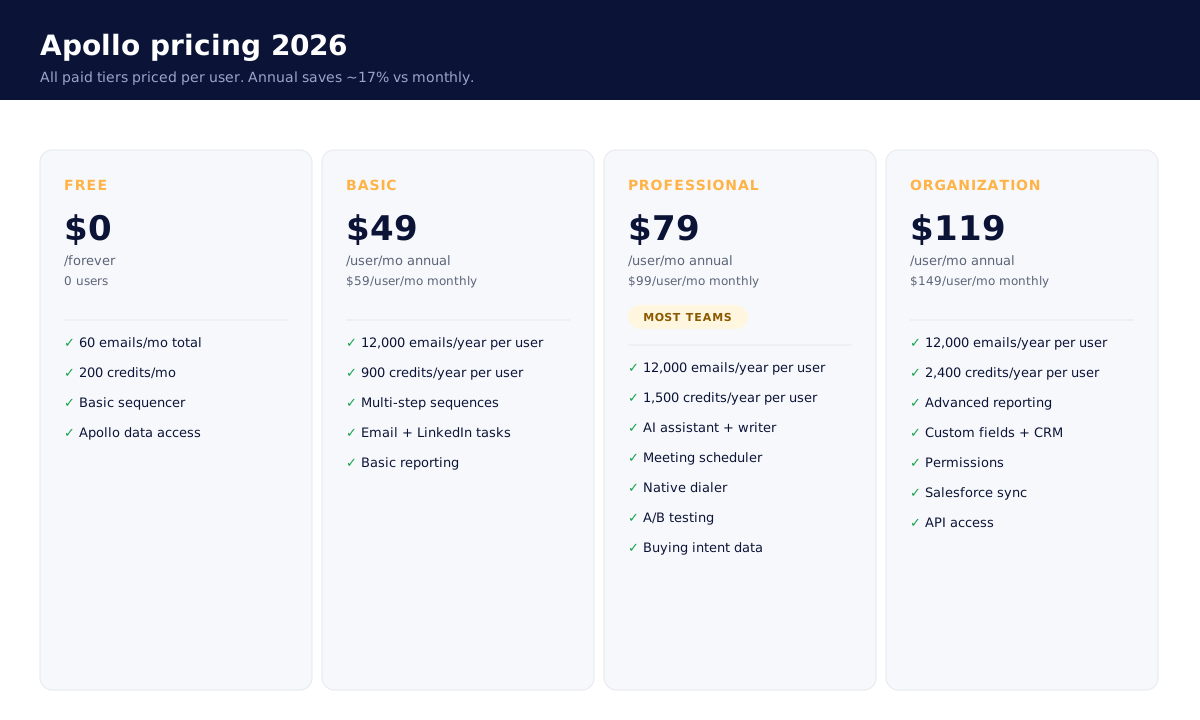
Apollo publishes a free tier (60 emails/mo, 200 credits/mo) and three paid tiers: Basic ($49/user/mo annual), Professional ($79/user/mo annual), Organization ($119/user/mo annual). Custom Enterprise pricing for 5+ seats with advanced security and CRM features. Annual billing saves around 17 percent vs monthly.
The Professional tier is where most solo operators and small teams land. 12,000 emails per month per user, 900 monthly credits, meeting scheduler, sequence A/B testing, native dialer. For one to three reps, this tier covers a focused outbound motion comfortably.
Hidden cost watch-outs: credits run out fast on high-volume prospecting. The 900 credits per user per month on Professional sounds generous but converts to roughly 900 enriched contacts per month (less if you also export). Top-up credits cost extra. Mailbox limit is 6 per user on Professional, 10 per user on Organization; cap arrives faster than expected at scale.
Smartlead pricing
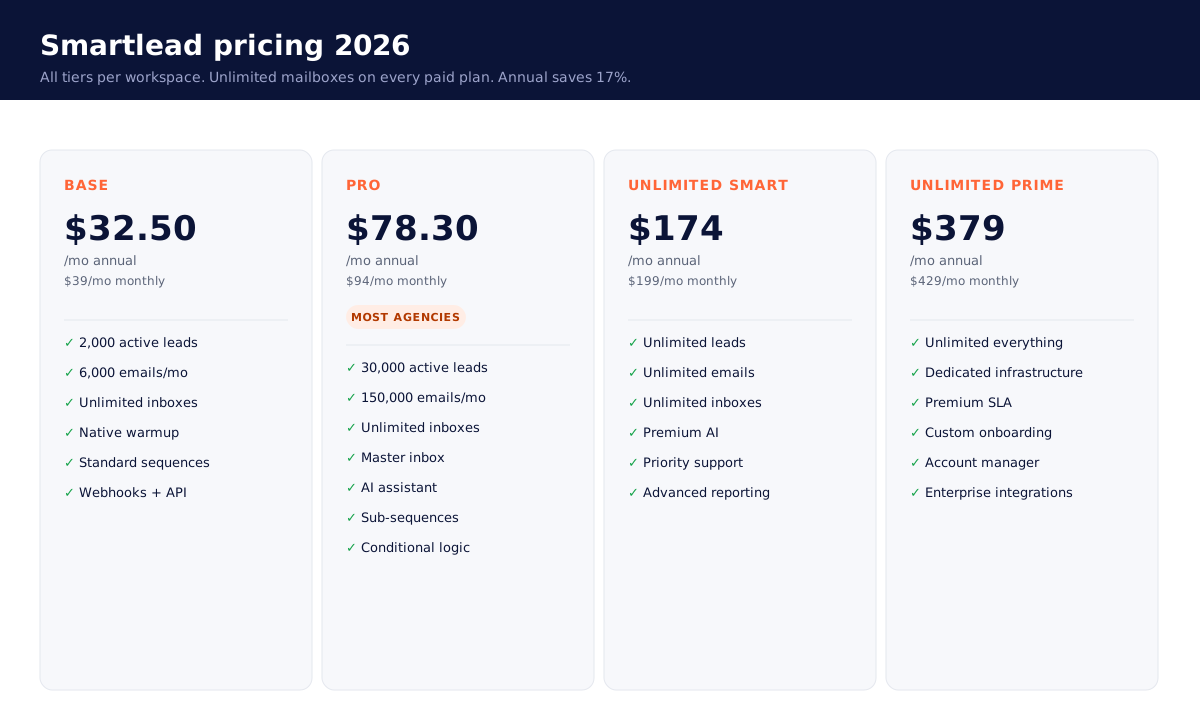
Smartlead's pricing is per workspace, not per user. Annual billing saves 17 percent vs monthly. The Base tier at $32.50 per month (annual) covers solo operators and early agencies (2,000 leads, 6,000 emails per month, unlimited inboxes). The Pro tier at $78.30 per month is where most agencies land, jumping to 30,000 leads and 150,000 emails per month for under $1k per year.
The Unlimited Smart tier at $174 per month adds unlimited leads + emails and the master inbox feature for managing replies across all connected mailboxes. Unlimited Prime at $379 per month adds premium support and dedicated infrastructure for high-volume operations.
Hidden cost watch-outs: the whitelabel add-on at $29 per month per client workspace stacks if you onboard multiple clients with their own branding. Email validation is bundled in some tiers but separate in others.
Annual cost compared
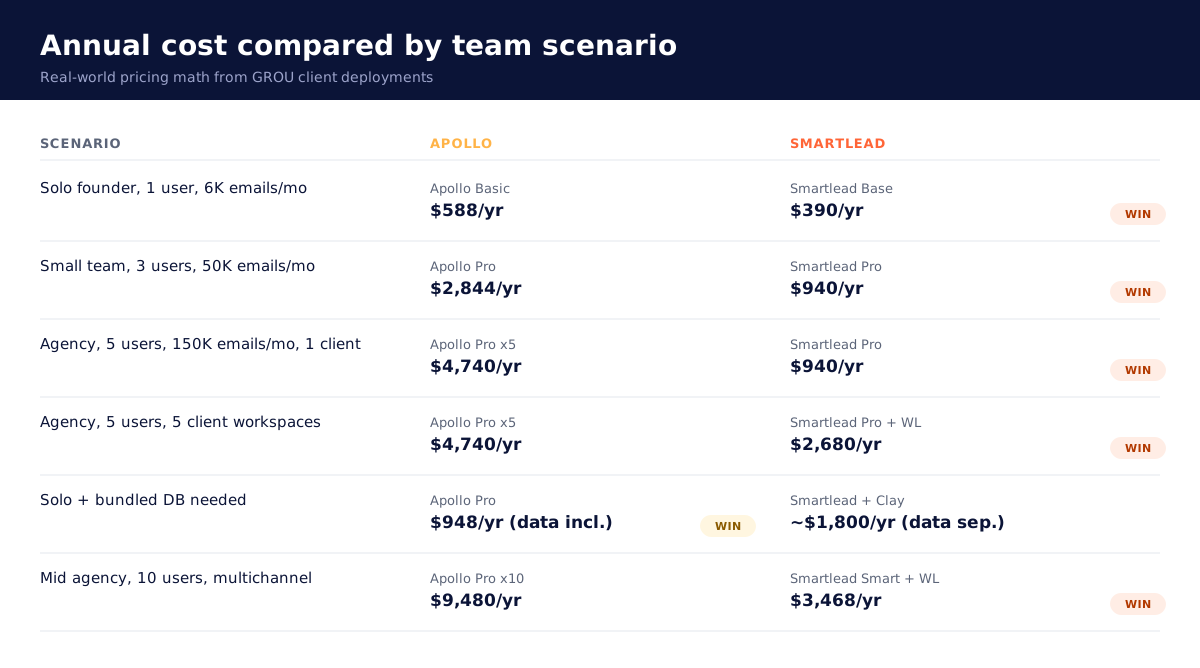
Smartlead wins on raw infrastructure cost at agency scale. The cost gap compounds: a 5-person agency on Apollo Professional pays $4,740 per year vs $940 per year on Smartlead Pro. Apollo wins on bundle math for solo founders: $588 per year for Basic covers prospecting + sequencing, where Smartlead requires a separate data source.
The right pick depends on what you already have. If your data sourcing is solved (Clay, in-house scraping, Cognism for EU), Smartlead is the cheaper and more capable infrastructure. If you have nothing and want one purchase to cover data + sending, Apollo's bundle pencils out faster for solo and SMB.
Which has better deliverability?
Smartlead, materially.
Smartlead was built deliverability-first. The wedge features:
Unlimited inbox rotation: connect 50, 100, 500 mailboxes and let Smartlead distribute sends evenly across the pool. No single mailbox burns reputation.
Native warmup network: every mailbox can warm up in the background for 60 to 90 days before pushing real volume. The network rotates inbound emails to build the IP and domain reputation that survive cold outreach.
Master inbox (Unlimited tier): unified reply management across all connected mailboxes, so you do not miss a positive reply because it landed on inbox #47 of 200.
Mailbox health monitoring: warns you when an inbox is starting to underperform, so you can rotate it out before it gets blacklisted.
In our testing on client accounts, well-warmed Smartlead workspaces consistently land in the 90 to 95 percent inboxing range on real cold campaigns. That is best-in-class for any cold sender on the market.
Apollo's deliverability is mid-tier. The platform now ships native warmup (in beta on most tiers in 2026), but the rotation logic is per-user rather than workspace-pooled. Inbox limits at 6 per user on Professional cap throughput before deliverability becomes the bottleneck. Apollo deliverability lands in the 75 to 90 percent inboxing range in our testing, depending on warmup discipline and per-user volume.
Verdict: Smartlead. For any operator running 30+ sends per mailbox per day across multiple inboxes, the deliverability gap is the difference between a viable cold motion and an inbox-graveyard.
Which has better contact data?
Apollo, by structural advantage.
Apollo ships a 275M+ contact database covering 60M+ companies with continuous refresh from crowd-sourced and scraped signals. Email coverage runs around 75 to 85 percent valid for US mid-market ICPs in real-world testing. Mobile coverage is real but variable. Filters cover the standard firmographic and technographic axes (industry, employee count, revenue, tech stack, funding stage).
Smartlead ships zero contact data. The platform is BYOD (bring your own database). You source contacts from Clay waterfalls, Cognism (EU/GDPR-compliant), Apollo (yes, this is a real workflow: use Apollo's data, send through Smartlead's infrastructure), ZoomInfo, scraped lists, or referrals.
For solo founders without a separate prospecting tool, this is the largest structural difference. Apollo is "buy the bundle, ship outbound this week." Smartlead is "buy the infrastructure, then solve your data sourcing separately."
For agencies and operators with existing data workflows, the gap disappears. Most of our clients use Clay waterfalls (best data quality + lowest cost per verified contact) feeding into Smartlead for sending. The combined cost is still materially less than Apollo at agency scale, and the data quality is materially better than Apollo's stock database.
Verdict: Apollo for solo and SMB without a separate data source. Smartlead + Clay (or Smartlead + Cognism for EU) for any operator with a real data sourcing budget.
Which is better for agencies?
Smartlead, by a wide margin.
The agency-specific features on Smartlead:
Flat workspace pricing: adding team members costs nothing, adding clients costs nothing on base subscription.
Whitelabel at $29 per month per client workspace: deliver the platform under your own brand for marginal cost.
Master inbox at the Unlimited tier: manage reply workflows across all client campaigns from one view.
Unlimited mailboxes per client workspace: scale each client to 50, 100, 200 mailboxes without re-platforming.
API + webhooks on every paid tier: easy integration with client CRMs and reporting.
The agency-specific features on Apollo:
Per-user pricing that scales hard with team size. A 10-rep agency on Professional pays $9,480 per year vs $940 on Smartlead Pro.
Whitelabel is Enterprise-only with custom pricing typically $30k+ per year.
Bundled database is a feature for solo operators but redundant for agencies that already source data through Clay or Cognism.
For agencies running outbound for multiple clients, Smartlead's cost structure is a structural advantage that no per-user platform matches at the price point.
Verdict: Smartlead. Agencies should default here unless they have a specific reason to absorb Apollo's per-seat economics.
Which is easier to onboard?
Apollo for solo founders. Smartlead for agencies running infrastructure setups.
Apollo's onboarding takes 30 minutes. Sign up, import contacts from the bundled database, build a sequence with the AI assistant, connect one mailbox, send. The all-in-one UX is genuinely beginner-friendly. For a solo founder who has never run cold outbound, Apollo is the fastest path to a sent email.
Smartlead's platform setup is fast (sign up, connect mailboxes, schedule sequence, send within hour two), but the prerequisite is mailbox infrastructure that you may not have yet. New users need to provision sending domains (typically 5 to 20 per workspace), buy mailboxes (Google Workspace, Microsoft, or specialised providers like Maildoso), set up DNS records (SPF, DKIM, DMARC, MX), and start the 60 to 90 day warmup window. For agencies that have this stack, Smartlead is fast. For first-time outbound operators, the infrastructure setup is the slow part.
For an agency standing up cold infrastructure for the first time, Smartlead is faster end-to-end once the infrastructure decisions are made. For a solo founder writing their first cold email today, Apollo is materially faster to first send.
Verdict: Apollo for solo founder motions. Smartlead for agency motions.
When to pick Apollo
You are a solo founder running your own outbound and you have no separate data source.
You are an early-stage SaaS scaling from 0 to PMF and you want one tool for prospecting + sequencing.
You are a US-focused SMB or mid-market sales team running 5K to 25K emails per user per month.
You need a native dialer for cold calls integrated into your sequencer.
You sell into ICPs where Apollo's contact data is well-covered (US tech, SaaS, manufacturing, services).
You can absorb per-user pricing economics on a small team.
When to pick Smartlead
You are an agency running outbound for multiple clients out of one workspace.
You have your own data sourcing (Clay, Cognism, ZoomInfo, scraped lists, referrals).
You need unlimited email accounts and inbox rotation at scale.
Your motion is volume-led (30K to 250K+ emails per month per workspace).
You want a flat workspace fee, not per-seat pricing.
You sell cold email as a service to clients and need cheap whitelabel branding.
You are price sensitive and the cost-per-send economics matter.
When to use both (the GROU stack)
A pattern we see at agencies and high-touch sales teams: use both, for different tiers of the motion.
Apollo handles the data sourcing tier. The 275M contact database with continuous refresh covers a meaningful portion of US mid-market and SMB ICPs at a lower per-contact cost than Clay waterfalls for that segment. Use Apollo's filters to build target lists, export to CSV.
Smartlead handles the cold infrastructure tier. Unlimited mailboxes, warmup, high-volume sequences for the lists exported from Apollo. Typical setup: 50 to 100 secondary mailboxes per client workspace, sending 20 to 30 emails per mailbox per day across 5,000 to 10,000 cold contacts per month per client.
The handoff: export from Apollo, validate the list (NeverBounce, ZeroBounce, MillionVerifier), import to Smartlead, run the sequence. Positive replies route to your CRM (HubSpot, Pipedrive, Close) via Smartlead's webhook integration.
Cost: roughly $129 per month for both at typical solo agency scale ($79 Apollo Professional for one seat + $50 Smartlead Base for one client workspace). At 5 clients on Smartlead Pro: $158 per month ($79 Apollo + $78.30 Smartlead Pro). The stack pencils out under $2k per year for a small agency with one Apollo seat and Smartlead Pro covering 5 client workspaces.
Honest dealbreakers
Apollo dealbreakers:
You need to send 30K+ emails per month per workspace. Apollo's per-user inbox limits will cap you.
Your team is 5+ reps and per-seat economics start to crush vs Smartlead's flat workspace fee.
You sell into European ICPs where Apollo's data is materially weaker than US coverage.
You are running an agency and per-user pricing kills the unit economics.
You need a whitelabelled platform for client delivery (Apollo whitelabel is Enterprise-only).
Smartlead dealbreakers:
You have no separate data source and you want a contact database bundled in.
You need a native dialer for cold calling integrated into your sequencer.
You need a meeting scheduler in the same tool as your sequences.
You are a solo founder who wants the simplest possible all-in-one outbound tool.
You sell into ICPs where high-quality email + mobile data is the bottleneck and you do not have time to set up Clay waterfalls.
Alternatives worth considering
Instantly for cold email infrastructure with a built-in Lead Finder bundle. Direct Smartlead alternative with a similar feature set plus 275M+ bundled contacts on growth tiers. See our Smartlead vs Instantly comparison.
Lemlist for personalisation-led multichannel outbound. 5 to 10x more expensive per workspace at agency scale, but reply rate uplift on high-ACV motions pays back fast. See our Lemlist vs Smartlead comparison.
Clay for enrichment workflows that feed Smartlead or Apollo via waterfall sourcing. Best data quality per verified contact in the market, more setup overhead than Apollo's bundled DB. See our Clay vs Apollo comparison.
ZoomInfo or Cognism for enterprise-grade data at 5 to 10x Apollo's cost. Better data quality for ABM and EU/GDPR-compliant outbound.
Outreach or Salesloft for enterprise sales engagement at 10x the price of either Apollo or Smartlead. Right tier for 50+ rep enterprise inside-sales teams.
We have full comparison articles on most of these. See Smartlead vs Instantly, Lemlist vs Smartlead, Clay vs Apollo, Apollo vs ZoomInfo, and Apollo vs Lemlist.
FAQ
Is Apollo or Smartlead better for cold email in 2026?
Both are best-in-class at what they do, the question is what you actually need. Apollo wins on the bundle (data + sequencer in one), best for solo founders and SMB without a separate data source. Smartlead wins on the infrastructure (unlimited inboxes, warmup, deliverability), best for agencies and high-volume in-house SDR teams with their own data sourcing.
Can I use Apollo and Smartlead together?
Yes, this is a common pattern. Use Apollo's database for sourcing contacts (filter by ICP, export to CSV), use Smartlead's infrastructure for sending. The split makes the unit economics work: Apollo gives you data, Smartlead gives you deliverability at scale, neither bills you for the other's job.
Which has better deliverability long-term?
Smartlead, by a meaningful margin. The unlimited inbox rotation + native warmup network is the structural advantage. Well-warmed Smartlead workspaces consistently land 90 to 95 percent inboxing on cold campaigns. Apollo's deliverability is fine for solo and SMB motions but caps at 75 to 90 percent in our testing due to per-user inbox limits.
Does Apollo's free tier actually work for cold outbound?
For testing the platform, yes. For real outbound at scale, no. 60 emails per month is not enough to validate a cold motion. The Basic tier at $49 per user per month is the realistic entry point.
How much does cold email actually cost on each platform at agency scale?
A 5-person agency running outbound for 5 clients with 100K emails per month: Apollo Professional at $79 per user x 5 users = $395 per month, plus a separate sequencing infrastructure if you need more inbox capacity. Smartlead Pro at $78.30 + 5 whitelabel workspaces at $29 each = $223 per month, no per-user fees. The structural cost gap is real at agency scale.
Which one is better for European outbound?
Smartlead, because you can pair it with a GDPR-compliant data source (Cognism, Apollo's EU data, scraped sources with proper opt-in compliance). Apollo's EU contact data is materially weaker than US coverage and the per-user pricing economics make it expensive for European SDR teams. For EU outbound: Cognism for data + Smartlead for sending.
Can I migrate from Apollo to Smartlead (or vice versa)?
Contacts migrate cleanly via CSV export and import. Sequences do not migrate cleanly (each platform has different sequence logic). What you can migrate: contact lists and message templates (manually rebuild the top 5 templates). Plan on 1 to 2 days of rebuild work per active campaign template.
Does Smartlead have a database I can add as a feature?
No native database. The closest equivalent: Smartlead has integration partners that feed contacts in via API (Clay, Apollo via Zapier, custom integrations). Smartlead itself stays pure infrastructure.
Does Apollo work as a CRM?
Lightweight, yes. The Organization tier ($119 per user per month) and Enterprise tiers add CRM-level features (deal stages, pipeline reporting, custom fields). For dedicated CRM workflows, most operators still pair Apollo with HubSpot, Pipedrive, Close, or Salesforce.
Which one ships product updates faster?
Both ship monthly. Apollo's recent focus has been on AI features (AI conversations, AI signal scoring, AI personalisation). Smartlead's recent focus has been on sub-sequences, conditional branching, and reply categorisation. Both teams are credible product engines.
What about Apollo's dialer for cold calls?
It works. Twilio-powered native dialer integrated into the sequencer. Click-to-call from any contact record. Call recording and notes sync to the contact. For solo operators running cold call follow-ups, the bundled dialer is a real productivity advantage over building Aircall + Smartlead.
Bottom line
Apollo is the right call for any solo founder, early-stage SaaS, or SMB sales team that wants one tool covering prospecting + sequencing + dialer + meeting scheduler. The bundled 275M database removes the data sourcing problem. Per-user pricing keeps the entry cost low for small teams. For US-focused outbound at under 25K emails per user per month, Apollo is the natural pick.
Smartlead is the right call for any agency or in-house team running volume-led outbound where deliverability and cost-per-send matter more than bundled features. Unlimited mailboxes, native warmup, master inbox, flat workspace pricing, and cheap whitelabel branding produce structural cost and deliverability advantages that no per-user platform matches.
If you are still deciding, the cleanest test is: do you already have a data source? If yes, Smartlead. If no, Apollo. If you grow into needing both, stack them. We do, our clients do, and the unit economics work as long as the tiers are properly segmented.
If you want help designing the right cold infrastructure for your motion (Apollo, Smartlead, or both), book a working session with GROU. We have shipped 100+ client campaigns on both platforms in the last 24 months. We can do the same for you.
→ Try Apollo free (free tier, no card required).
→ Try Smartlead free (14-day trial, no card required).
Why trust this comparison
We are GROU, a B2B pipeline agency that runs lead generation, outbound, and LinkedIn content for clients across manufacturing, fintech, iGaming, software, and professional services. We have shipped real client campaigns on both Apollo and Smartlead in the last 24 months. The verdict below is from operators who have run Apollo as a bundled prospecting + sequencer stack and Smartlead as the cold infrastructure layer of an agency stack, not from a vendor pitch.
→ Methodology: This comparison combines our own client deployment data, both vendors' published pricing pages, third-party reviews from Lagrowthmachine, Puzzle Inbox, and Landbase, and live G2 review data for Apollo and Smartlead. We refresh this article quarterly.
→ Affiliate disclosure: Some links in this article are affiliate links to Apollo and Smartlead. We earn a small commission if you sign up through them, at no extra cost to you. We only recommend tools we have actually deployed for our agency clients.
TL;DR
Apollo and Smartlead sit on opposite sides of the cold outbound stack. Apollo is a bundled prospecting database + sequencer: 275 million contacts, native email sequencer, dialer, meeting scheduler, AI assistant, sold per user per month. Smartlead is pure cold email infrastructure: unlimited mailboxes, native warmup, inbox rotation, master inbox, sold per workspace per month with no bundled data.
The decision is usually about whether you need a contact database bundled in. If you have no separate prospecting tool and you want one purchase to cover data + sequencing, Apollo. If you have your own data sources (Clay waterfalls, scraped lists, ICP-specific providers like Cognism for EU) and you want the cheapest possible high-deliverability infrastructure, Smartlead.
For most B2B agencies running outbound across 5+ clients, Smartlead's flat workspace pricing crushes Apollo's per-user economics. For most solo founders running outbound for one ICP under 10K emails per month, Apollo's bundled database is the unit-economics winner. We use both, on different tiers of the stack.
Score breakdown at a glance
Third-party signals: Apollo on G2 rating around 4.7 / 5 across 8,000+ reviews (praised for the bundled database and ease of use). Smartlead on G2 rating around 4.7 / 5 across 400+ reviews (praised for deliverability and unlimited inbox model).
Table of contents
Why trust this comparison
TL;DR
Quick comparison
The case for Apollo
The case for Smartlead
How much does each cost?
Which has better deliverability?
Which has better contact data?
Which is better for agencies?
Which is easier to onboard?
When to pick Apollo
When to pick Smartlead
When to use both (the GROU stack)
Honest dealbreakers
Alternatives worth considering
FAQ
Bottom line
Quick comparison
The case for Apollo
Apollo is a bundled go-to-market platform built around its proprietary 275M+ contact database. The wedge is the database, paired with a native sequencer, dialer, meeting scheduler, AI writing assistant, and CRM-light all in one tool. For solo founders, early-stage SaaS, and SMB sales teams, the bundle is the value: one purchase covers prospecting and sequencing where competitors require Clay or ZoomInfo plus a separate sequencer.
The data is the headline feature. Apollo's 275M contacts cover 60M+ companies globally with email and mobile coverage that lands around 91 percent valid emails per their published numbers, real-world testing puts it closer to 75 to 85 percent depending on the ICP. The contact database refreshes continuously with crowd-sourced and scraped signals. For US mid-market and SMB ICPs, Apollo's data quality is competitive with paid alternatives at 5x the cost.
The sequencer is the second wedge. Multi-step email sequences with conditional logic, automatic reply detection, A/B testing, and AI-assisted copywriting. Native dialer (Twilio-powered) for cold calls integrated into the same workflow. Meeting scheduler with calendar sync. For solo operators where one tool covering email + calls + meetings is the productivity unlock, Apollo is the natural pick.
The price is the third wedge for early-stage teams. Apollo's free tier ships 60 emails per month plus 200 monthly credits, enough to test the platform. The Basic tier at $49 per user per month annual (12K emails/year, 900 credits/year per user) covers founder-led outbound comfortably. Professional at $79 per user per month adds meeting workflows, advanced sequences, and 1,500 credits per year. Organization at $119 per user per month adds advanced reporting, custom fields, and 2,400 credits per year.
The downsides are real. Per-user pricing scales hard. A 5-person agency on Apollo Professional costs $4,740 per year. The same 5-person agency on Smartlead Pro costs $940 per year. Mailbox limits are tighter than Smartlead (6 mailboxes per user on Professional vs unlimited on Smartlead). Native warmup is now available but in beta-status; for high-volume agency sending, Smartlead's warmup network is more proven. EU contact data is materially weaker than US data; for European outbound, pair Apollo with Cognism or a dedicated EU source.
→ Best for: solo founders running their own outbound, early-stage SaaS scaling from 0 to PMF, US-focused SMB and mid-market sales teams, operators who want database + sequencer in one purchase, teams under 5 reps running 5K to 25K emails per month per user.
The case for Smartlead
Smartlead is the most cost-effective cold email infrastructure tool on the market. The wedge is structural: unlimited email accounts on every paid plan, native warmup, native inbox rotation, and flat workspace pricing instead of per-seat. No bundled database (BYOD), no native CRM, no dialer. Pure infrastructure.
The unlimited mailboxes feature is the entire unlock. Where Apollo gives you 6 sending addresses per user on Professional, Smartlead lets you connect 50, 100, 500 mailboxes to a single workspace at no extra cost. Combined with native rotation, this is the only viable architecture for high-volume cold outbound. A typical agency Smartlead setup: 50 to 200 secondary mailboxes, sending 20 to 40 emails per mailbox per day, rotating automatically through the rotation pool. Deliverability stays north of 90 percent inboxing for senders who follow the warmup playbook.
The native warmup network is the second wedge. Smartlead's warmup rotates emails between accounts to build sender reputation. Standard practice is 60 to 90 days of warmup per fresh mailbox before pushing real volume. The warmup runs in the background at no extra cost.
The flat workspace pricing is the third wedge. Adding a team member costs nothing on Smartlead. Adding a client workspace costs nothing on the base subscription (whitelabel add-on is $29 per client workspace, the only per-client fee). For agencies running outbound for 5 to 20 clients, the cost-per-send economics are not close.
The whitelabel add-on at $29 per month per client workspace is the fourth wedge. For agencies offering cold email as a service to clients, this lets you deliver the platform under your own brand for a marginal cost. Apollo's whitelabel is Enterprise-only.
The downsides are real. No bundled database. You bring your own contacts via Clay, Cognism, Apollo (yes, some teams use Apollo just for the database and Smartlead for sending), or scraped sources. For solo founders without a separate prospecting tool, this is a structural barrier vs Apollo's all-in-one bundle.
No native dialer or meeting scheduler. Smartlead is email-only. For cold calling and meeting workflows, you bolt on Aircall and Cal.com / Calendly. For a multichannel motion where email + call must run in one cadence, the integration overhead matters.
→ Best for: B2B agencies running outbound for multiple clients, high-volume in-house SDR teams (30K to 250K+ emails per month per workspace), operators who care about deliverability and cost-per-send more than bundled features, anyone with their own data sources and a need for unlimited inboxes on a flat workspace fee.
How much does each cost?
Side-by-side breakdown of base pricing. For live pricing, check Apollo and Smartlead directly.
Apollo pricing
Apollo publishes a free tier (60 emails/mo, 200 credits/mo) and three paid tiers: Basic ($49/user/mo annual), Professional ($79/user/mo annual), Organization ($119/user/mo annual). Custom Enterprise pricing for 5+ seats with advanced security and CRM features. Annual billing saves around 17 percent vs monthly.
The Professional tier is where most solo operators and small teams land. 12,000 emails per month per user, 900 monthly credits, meeting scheduler, sequence A/B testing, native dialer. For one to three reps, this tier covers a focused outbound motion comfortably.
Hidden cost watch-outs: credits run out fast on high-volume prospecting. The 900 credits per user per month on Professional sounds generous but converts to roughly 900 enriched contacts per month (less if you also export). Top-up credits cost extra. Mailbox limit is 6 per user on Professional, 10 per user on Organization; cap arrives faster than expected at scale.
Smartlead pricing
Smartlead's pricing is per workspace, not per user. Annual billing saves 17 percent vs monthly. The Base tier at $32.50 per month (annual) covers solo operators and early agencies (2,000 leads, 6,000 emails per month, unlimited inboxes). The Pro tier at $78.30 per month is where most agencies land, jumping to 30,000 leads and 150,000 emails per month for under $1k per year.
The Unlimited Smart tier at $174 per month adds unlimited leads + emails and the master inbox feature for managing replies across all connected mailboxes. Unlimited Prime at $379 per month adds premium support and dedicated infrastructure for high-volume operations.
Hidden cost watch-outs: the whitelabel add-on at $29 per month per client workspace stacks if you onboard multiple clients with their own branding. Email validation is bundled in some tiers but separate in others.
Annual cost compared
Smartlead wins on raw infrastructure cost at agency scale. The cost gap compounds: a 5-person agency on Apollo Professional pays $4,740 per year vs $940 per year on Smartlead Pro. Apollo wins on bundle math for solo founders: $588 per year for Basic covers prospecting + sequencing, where Smartlead requires a separate data source.
The right pick depends on what you already have. If your data sourcing is solved (Clay, in-house scraping, Cognism for EU), Smartlead is the cheaper and more capable infrastructure. If you have nothing and want one purchase to cover data + sending, Apollo's bundle pencils out faster for solo and SMB.
Which has better deliverability?
Smartlead, materially.
Smartlead was built deliverability-first. The wedge features:
Unlimited inbox rotation: connect 50, 100, 500 mailboxes and let Smartlead distribute sends evenly across the pool. No single mailbox burns reputation.
Native warmup network: every mailbox can warm up in the background for 60 to 90 days before pushing real volume. The network rotates inbound emails to build the IP and domain reputation that survive cold outreach.
Master inbox (Unlimited tier): unified reply management across all connected mailboxes, so you do not miss a positive reply because it landed on inbox #47 of 200.
Mailbox health monitoring: warns you when an inbox is starting to underperform, so you can rotate it out before it gets blacklisted.
In our testing on client accounts, well-warmed Smartlead workspaces consistently land in the 90 to 95 percent inboxing range on real cold campaigns. That is best-in-class for any cold sender on the market.
Apollo's deliverability is mid-tier. The platform now ships native warmup (in beta on most tiers in 2026), but the rotation logic is per-user rather than workspace-pooled. Inbox limits at 6 per user on Professional cap throughput before deliverability becomes the bottleneck. Apollo deliverability lands in the 75 to 90 percent inboxing range in our testing, depending on warmup discipline and per-user volume.
Verdict: Smartlead. For any operator running 30+ sends per mailbox per day across multiple inboxes, the deliverability gap is the difference between a viable cold motion and an inbox-graveyard.
Which has better contact data?
Apollo, by structural advantage.
Apollo ships a 275M+ contact database covering 60M+ companies with continuous refresh from crowd-sourced and scraped signals. Email coverage runs around 75 to 85 percent valid for US mid-market ICPs in real-world testing. Mobile coverage is real but variable. Filters cover the standard firmographic and technographic axes (industry, employee count, revenue, tech stack, funding stage).
Smartlead ships zero contact data. The platform is BYOD (bring your own database). You source contacts from Clay waterfalls, Cognism (EU/GDPR-compliant), Apollo (yes, this is a real workflow: use Apollo's data, send through Smartlead's infrastructure), ZoomInfo, scraped lists, or referrals.
For solo founders without a separate prospecting tool, this is the largest structural difference. Apollo is "buy the bundle, ship outbound this week." Smartlead is "buy the infrastructure, then solve your data sourcing separately."
For agencies and operators with existing data workflows, the gap disappears. Most of our clients use Clay waterfalls (best data quality + lowest cost per verified contact) feeding into Smartlead for sending. The combined cost is still materially less than Apollo at agency scale, and the data quality is materially better than Apollo's stock database.
Verdict: Apollo for solo and SMB without a separate data source. Smartlead + Clay (or Smartlead + Cognism for EU) for any operator with a real data sourcing budget.
Which is better for agencies?
Smartlead, by a wide margin.
The agency-specific features on Smartlead:
Flat workspace pricing: adding team members costs nothing, adding clients costs nothing on base subscription.
Whitelabel at $29 per month per client workspace: deliver the platform under your own brand for marginal cost.
Master inbox at the Unlimited tier: manage reply workflows across all client campaigns from one view.
Unlimited mailboxes per client workspace: scale each client to 50, 100, 200 mailboxes without re-platforming.
API + webhooks on every paid tier: easy integration with client CRMs and reporting.
The agency-specific features on Apollo:
Per-user pricing that scales hard with team size. A 10-rep agency on Professional pays $9,480 per year vs $940 on Smartlead Pro.
Whitelabel is Enterprise-only with custom pricing typically $30k+ per year.
Bundled database is a feature for solo operators but redundant for agencies that already source data through Clay or Cognism.
For agencies running outbound for multiple clients, Smartlead's cost structure is a structural advantage that no per-user platform matches at the price point.
Verdict: Smartlead. Agencies should default here unless they have a specific reason to absorb Apollo's per-seat economics.
Which is easier to onboard?
Apollo for solo founders. Smartlead for agencies running infrastructure setups.
Apollo's onboarding takes 30 minutes. Sign up, import contacts from the bundled database, build a sequence with the AI assistant, connect one mailbox, send. The all-in-one UX is genuinely beginner-friendly. For a solo founder who has never run cold outbound, Apollo is the fastest path to a sent email.
Smartlead's platform setup is fast (sign up, connect mailboxes, schedule sequence, send within hour two), but the prerequisite is mailbox infrastructure that you may not have yet. New users need to provision sending domains (typically 5 to 20 per workspace), buy mailboxes (Google Workspace, Microsoft, or specialised providers like Maildoso), set up DNS records (SPF, DKIM, DMARC, MX), and start the 60 to 90 day warmup window. For agencies that have this stack, Smartlead is fast. For first-time outbound operators, the infrastructure setup is the slow part.
For an agency standing up cold infrastructure for the first time, Smartlead is faster end-to-end once the infrastructure decisions are made. For a solo founder writing their first cold email today, Apollo is materially faster to first send.
Verdict: Apollo for solo founder motions. Smartlead for agency motions.
When to pick Apollo
You are a solo founder running your own outbound and you have no separate data source.
You are an early-stage SaaS scaling from 0 to PMF and you want one tool for prospecting + sequencing.
You are a US-focused SMB or mid-market sales team running 5K to 25K emails per user per month.
You need a native dialer for cold calls integrated into your sequencer.
You sell into ICPs where Apollo's contact data is well-covered (US tech, SaaS, manufacturing, services).
You can absorb per-user pricing economics on a small team.
When to pick Smartlead
You are an agency running outbound for multiple clients out of one workspace.
You have your own data sourcing (Clay, Cognism, ZoomInfo, scraped lists, referrals).
You need unlimited email accounts and inbox rotation at scale.
Your motion is volume-led (30K to 250K+ emails per month per workspace).
You want a flat workspace fee, not per-seat pricing.
You sell cold email as a service to clients and need cheap whitelabel branding.
You are price sensitive and the cost-per-send economics matter.
When to use both (the GROU stack)
A pattern we see at agencies and high-touch sales teams: use both, for different tiers of the motion.
Apollo handles the data sourcing tier. The 275M contact database with continuous refresh covers a meaningful portion of US mid-market and SMB ICPs at a lower per-contact cost than Clay waterfalls for that segment. Use Apollo's filters to build target lists, export to CSV.
Smartlead handles the cold infrastructure tier. Unlimited mailboxes, warmup, high-volume sequences for the lists exported from Apollo. Typical setup: 50 to 100 secondary mailboxes per client workspace, sending 20 to 30 emails per mailbox per day across 5,000 to 10,000 cold contacts per month per client.
The handoff: export from Apollo, validate the list (NeverBounce, ZeroBounce, MillionVerifier), import to Smartlead, run the sequence. Positive replies route to your CRM (HubSpot, Pipedrive, Close) via Smartlead's webhook integration.
Cost: roughly $129 per month for both at typical solo agency scale ($79 Apollo Professional for one seat + $50 Smartlead Base for one client workspace). At 5 clients on Smartlead Pro: $158 per month ($79 Apollo + $78.30 Smartlead Pro). The stack pencils out under $2k per year for a small agency with one Apollo seat and Smartlead Pro covering 5 client workspaces.
Honest dealbreakers
Apollo dealbreakers:
You need to send 30K+ emails per month per workspace. Apollo's per-user inbox limits will cap you.
Your team is 5+ reps and per-seat economics start to crush vs Smartlead's flat workspace fee.
You sell into European ICPs where Apollo's data is materially weaker than US coverage.
You are running an agency and per-user pricing kills the unit economics.
You need a whitelabelled platform for client delivery (Apollo whitelabel is Enterprise-only).
Smartlead dealbreakers:
You have no separate data source and you want a contact database bundled in.
You need a native dialer for cold calling integrated into your sequencer.
You need a meeting scheduler in the same tool as your sequences.
You are a solo founder who wants the simplest possible all-in-one outbound tool.
You sell into ICPs where high-quality email + mobile data is the bottleneck and you do not have time to set up Clay waterfalls.
Alternatives worth considering
Instantly for cold email infrastructure with a built-in Lead Finder bundle. Direct Smartlead alternative with a similar feature set plus 275M+ bundled contacts on growth tiers. See our Smartlead vs Instantly comparison.
Lemlist for personalisation-led multichannel outbound. 5 to 10x more expensive per workspace at agency scale, but reply rate uplift on high-ACV motions pays back fast. See our Lemlist vs Smartlead comparison.
Clay for enrichment workflows that feed Smartlead or Apollo via waterfall sourcing. Best data quality per verified contact in the market, more setup overhead than Apollo's bundled DB. See our Clay vs Apollo comparison.
ZoomInfo or Cognism for enterprise-grade data at 5 to 10x Apollo's cost. Better data quality for ABM and EU/GDPR-compliant outbound.
Outreach or Salesloft for enterprise sales engagement at 10x the price of either Apollo or Smartlead. Right tier for 50+ rep enterprise inside-sales teams.
We have full comparison articles on most of these. See Smartlead vs Instantly, Lemlist vs Smartlead, Clay vs Apollo, Apollo vs ZoomInfo, and Apollo vs Lemlist.
FAQ
Is Apollo or Smartlead better for cold email in 2026?
Both are best-in-class at what they do, the question is what you actually need. Apollo wins on the bundle (data + sequencer in one), best for solo founders and SMB without a separate data source. Smartlead wins on the infrastructure (unlimited inboxes, warmup, deliverability), best for agencies and high-volume in-house SDR teams with their own data sourcing.
Can I use Apollo and Smartlead together?
Yes, this is a common pattern. Use Apollo's database for sourcing contacts (filter by ICP, export to CSV), use Smartlead's infrastructure for sending. The split makes the unit economics work: Apollo gives you data, Smartlead gives you deliverability at scale, neither bills you for the other's job.
Which has better deliverability long-term?
Smartlead, by a meaningful margin. The unlimited inbox rotation + native warmup network is the structural advantage. Well-warmed Smartlead workspaces consistently land 90 to 95 percent inboxing on cold campaigns. Apollo's deliverability is fine for solo and SMB motions but caps at 75 to 90 percent in our testing due to per-user inbox limits.
Does Apollo's free tier actually work for cold outbound?
For testing the platform, yes. For real outbound at scale, no. 60 emails per month is not enough to validate a cold motion. The Basic tier at $49 per user per month is the realistic entry point.
How much does cold email actually cost on each platform at agency scale?
A 5-person agency running outbound for 5 clients with 100K emails per month: Apollo Professional at $79 per user x 5 users = $395 per month, plus a separate sequencing infrastructure if you need more inbox capacity. Smartlead Pro at $78.30 + 5 whitelabel workspaces at $29 each = $223 per month, no per-user fees. The structural cost gap is real at agency scale.
Which one is better for European outbound?
Smartlead, because you can pair it with a GDPR-compliant data source (Cognism, Apollo's EU data, scraped sources with proper opt-in compliance). Apollo's EU contact data is materially weaker than US coverage and the per-user pricing economics make it expensive for European SDR teams. For EU outbound: Cognism for data + Smartlead for sending.
Can I migrate from Apollo to Smartlead (or vice versa)?
Contacts migrate cleanly via CSV export and import. Sequences do not migrate cleanly (each platform has different sequence logic). What you can migrate: contact lists and message templates (manually rebuild the top 5 templates). Plan on 1 to 2 days of rebuild work per active campaign template.
Does Smartlead have a database I can add as a feature?
No native database. The closest equivalent: Smartlead has integration partners that feed contacts in via API (Clay, Apollo via Zapier, custom integrations). Smartlead itself stays pure infrastructure.
Does Apollo work as a CRM?
Lightweight, yes. The Organization tier ($119 per user per month) and Enterprise tiers add CRM-level features (deal stages, pipeline reporting, custom fields). For dedicated CRM workflows, most operators still pair Apollo with HubSpot, Pipedrive, Close, or Salesforce.
Which one ships product updates faster?
Both ship monthly. Apollo's recent focus has been on AI features (AI conversations, AI signal scoring, AI personalisation). Smartlead's recent focus has been on sub-sequences, conditional branching, and reply categorisation. Both teams are credible product engines.
What about Apollo's dialer for cold calls?
It works. Twilio-powered native dialer integrated into the sequencer. Click-to-call from any contact record. Call recording and notes sync to the contact. For solo operators running cold call follow-ups, the bundled dialer is a real productivity advantage over building Aircall + Smartlead.
Bottom line
Apollo is the right call for any solo founder, early-stage SaaS, or SMB sales team that wants one tool covering prospecting + sequencing + dialer + meeting scheduler. The bundled 275M database removes the data sourcing problem. Per-user pricing keeps the entry cost low for small teams. For US-focused outbound at under 25K emails per user per month, Apollo is the natural pick.
Smartlead is the right call for any agency or in-house team running volume-led outbound where deliverability and cost-per-send matter more than bundled features. Unlimited mailboxes, native warmup, master inbox, flat workspace pricing, and cheap whitelabel branding produce structural cost and deliverability advantages that no per-user platform matches.
If you are still deciding, the cleanest test is: do you already have a data source? If yes, Smartlead. If no, Apollo. If you grow into needing both, stack them. We do, our clients do, and the unit economics work as long as the tiers are properly segmented.
If you want help designing the right cold infrastructure for your motion (Apollo, Smartlead, or both), book a working session with GROU. We have shipped 100+ client campaigns on both platforms in the last 24 months. We can do the same for you.
→ Try Apollo free (free tier, no card required).
→ Try Smartlead free (14-day trial, no card required).
Why trust this comparison
We are GROU, a B2B pipeline agency that runs lead generation, outbound, and LinkedIn content for clients across manufacturing, fintech, iGaming, software, and professional services. We have shipped real client campaigns on both Apollo and Smartlead in the last 24 months. The verdict below is from operators who have run Apollo as a bundled prospecting + sequencer stack and Smartlead as the cold infrastructure layer of an agency stack, not from a vendor pitch.
→ Methodology: This comparison combines our own client deployment data, both vendors' published pricing pages, third-party reviews from Lagrowthmachine, Puzzle Inbox, and Landbase, and live G2 review data for Apollo and Smartlead. We refresh this article quarterly.
→ Affiliate disclosure: Some links in this article are affiliate links to Apollo and Smartlead. We earn a small commission if you sign up through them, at no extra cost to you. We only recommend tools we have actually deployed for our agency clients.
TL;DR
Apollo and Smartlead sit on opposite sides of the cold outbound stack. Apollo is a bundled prospecting database + sequencer: 275 million contacts, native email sequencer, dialer, meeting scheduler, AI assistant, sold per user per month. Smartlead is pure cold email infrastructure: unlimited mailboxes, native warmup, inbox rotation, master inbox, sold per workspace per month with no bundled data.
The decision is usually about whether you need a contact database bundled in. If you have no separate prospecting tool and you want one purchase to cover data + sequencing, Apollo. If you have your own data sources (Clay waterfalls, scraped lists, ICP-specific providers like Cognism for EU) and you want the cheapest possible high-deliverability infrastructure, Smartlead.
For most B2B agencies running outbound across 5+ clients, Smartlead's flat workspace pricing crushes Apollo's per-user economics. For most solo founders running outbound for one ICP under 10K emails per month, Apollo's bundled database is the unit-economics winner. We use both, on different tiers of the stack.
Score breakdown at a glance
Third-party signals: Apollo on G2 rating around 4.7 / 5 across 8,000+ reviews (praised for the bundled database and ease of use). Smartlead on G2 rating around 4.7 / 5 across 400+ reviews (praised for deliverability and unlimited inbox model).
Table of contents
Why trust this comparison
TL;DR
Quick comparison
The case for Apollo
The case for Smartlead
How much does each cost?
Which has better deliverability?
Which has better contact data?
Which is better for agencies?
Which is easier to onboard?
When to pick Apollo
When to pick Smartlead
When to use both (the GROU stack)
Honest dealbreakers
Alternatives worth considering
FAQ
Bottom line
Quick comparison
The case for Apollo
Apollo is a bundled go-to-market platform built around its proprietary 275M+ contact database. The wedge is the database, paired with a native sequencer, dialer, meeting scheduler, AI writing assistant, and CRM-light all in one tool. For solo founders, early-stage SaaS, and SMB sales teams, the bundle is the value: one purchase covers prospecting and sequencing where competitors require Clay or ZoomInfo plus a separate sequencer.
The data is the headline feature. Apollo's 275M contacts cover 60M+ companies globally with email and mobile coverage that lands around 91 percent valid emails per their published numbers, real-world testing puts it closer to 75 to 85 percent depending on the ICP. The contact database refreshes continuously with crowd-sourced and scraped signals. For US mid-market and SMB ICPs, Apollo's data quality is competitive with paid alternatives at 5x the cost.
The sequencer is the second wedge. Multi-step email sequences with conditional logic, automatic reply detection, A/B testing, and AI-assisted copywriting. Native dialer (Twilio-powered) for cold calls integrated into the same workflow. Meeting scheduler with calendar sync. For solo operators where one tool covering email + calls + meetings is the productivity unlock, Apollo is the natural pick.
The price is the third wedge for early-stage teams. Apollo's free tier ships 60 emails per month plus 200 monthly credits, enough to test the platform. The Basic tier at $49 per user per month annual (12K emails/year, 900 credits/year per user) covers founder-led outbound comfortably. Professional at $79 per user per month adds meeting workflows, advanced sequences, and 1,500 credits per year. Organization at $119 per user per month adds advanced reporting, custom fields, and 2,400 credits per year.
The downsides are real. Per-user pricing scales hard. A 5-person agency on Apollo Professional costs $4,740 per year. The same 5-person agency on Smartlead Pro costs $940 per year. Mailbox limits are tighter than Smartlead (6 mailboxes per user on Professional vs unlimited on Smartlead). Native warmup is now available but in beta-status; for high-volume agency sending, Smartlead's warmup network is more proven. EU contact data is materially weaker than US data; for European outbound, pair Apollo with Cognism or a dedicated EU source.
→ Best for: solo founders running their own outbound, early-stage SaaS scaling from 0 to PMF, US-focused SMB and mid-market sales teams, operators who want database + sequencer in one purchase, teams under 5 reps running 5K to 25K emails per month per user.
The case for Smartlead
Smartlead is the most cost-effective cold email infrastructure tool on the market. The wedge is structural: unlimited email accounts on every paid plan, native warmup, native inbox rotation, and flat workspace pricing instead of per-seat. No bundled database (BYOD), no native CRM, no dialer. Pure infrastructure.
The unlimited mailboxes feature is the entire unlock. Where Apollo gives you 6 sending addresses per user on Professional, Smartlead lets you connect 50, 100, 500 mailboxes to a single workspace at no extra cost. Combined with native rotation, this is the only viable architecture for high-volume cold outbound. A typical agency Smartlead setup: 50 to 200 secondary mailboxes, sending 20 to 40 emails per mailbox per day, rotating automatically through the rotation pool. Deliverability stays north of 90 percent inboxing for senders who follow the warmup playbook.
The native warmup network is the second wedge. Smartlead's warmup rotates emails between accounts to build sender reputation. Standard practice is 60 to 90 days of warmup per fresh mailbox before pushing real volume. The warmup runs in the background at no extra cost.
The flat workspace pricing is the third wedge. Adding a team member costs nothing on Smartlead. Adding a client workspace costs nothing on the base subscription (whitelabel add-on is $29 per client workspace, the only per-client fee). For agencies running outbound for 5 to 20 clients, the cost-per-send economics are not close.
The whitelabel add-on at $29 per month per client workspace is the fourth wedge. For agencies offering cold email as a service to clients, this lets you deliver the platform under your own brand for a marginal cost. Apollo's whitelabel is Enterprise-only.
The downsides are real. No bundled database. You bring your own contacts via Clay, Cognism, Apollo (yes, some teams use Apollo just for the database and Smartlead for sending), or scraped sources. For solo founders without a separate prospecting tool, this is a structural barrier vs Apollo's all-in-one bundle.
No native dialer or meeting scheduler. Smartlead is email-only. For cold calling and meeting workflows, you bolt on Aircall and Cal.com / Calendly. For a multichannel motion where email + call must run in one cadence, the integration overhead matters.
→ Best for: B2B agencies running outbound for multiple clients, high-volume in-house SDR teams (30K to 250K+ emails per month per workspace), operators who care about deliverability and cost-per-send more than bundled features, anyone with their own data sources and a need for unlimited inboxes on a flat workspace fee.
How much does each cost?
Side-by-side breakdown of base pricing. For live pricing, check Apollo and Smartlead directly.
Apollo pricing
Apollo publishes a free tier (60 emails/mo, 200 credits/mo) and three paid tiers: Basic ($49/user/mo annual), Professional ($79/user/mo annual), Organization ($119/user/mo annual). Custom Enterprise pricing for 5+ seats with advanced security and CRM features. Annual billing saves around 17 percent vs monthly.
The Professional tier is where most solo operators and small teams land. 12,000 emails per month per user, 900 monthly credits, meeting scheduler, sequence A/B testing, native dialer. For one to three reps, this tier covers a focused outbound motion comfortably.
Hidden cost watch-outs: credits run out fast on high-volume prospecting. The 900 credits per user per month on Professional sounds generous but converts to roughly 900 enriched contacts per month (less if you also export). Top-up credits cost extra. Mailbox limit is 6 per user on Professional, 10 per user on Organization; cap arrives faster than expected at scale.
Smartlead pricing
Smartlead's pricing is per workspace, not per user. Annual billing saves 17 percent vs monthly. The Base tier at $32.50 per month (annual) covers solo operators and early agencies (2,000 leads, 6,000 emails per month, unlimited inboxes). The Pro tier at $78.30 per month is where most agencies land, jumping to 30,000 leads and 150,000 emails per month for under $1k per year.
The Unlimited Smart tier at $174 per month adds unlimited leads + emails and the master inbox feature for managing replies across all connected mailboxes. Unlimited Prime at $379 per month adds premium support and dedicated infrastructure for high-volume operations.
Hidden cost watch-outs: the whitelabel add-on at $29 per month per client workspace stacks if you onboard multiple clients with their own branding. Email validation is bundled in some tiers but separate in others.
Annual cost compared
Smartlead wins on raw infrastructure cost at agency scale. The cost gap compounds: a 5-person agency on Apollo Professional pays $4,740 per year vs $940 per year on Smartlead Pro. Apollo wins on bundle math for solo founders: $588 per year for Basic covers prospecting + sequencing, where Smartlead requires a separate data source.
The right pick depends on what you already have. If your data sourcing is solved (Clay, in-house scraping, Cognism for EU), Smartlead is the cheaper and more capable infrastructure. If you have nothing and want one purchase to cover data + sending, Apollo's bundle pencils out faster for solo and SMB.
Which has better deliverability?
Smartlead, materially.
Smartlead was built deliverability-first. The wedge features:
Unlimited inbox rotation: connect 50, 100, 500 mailboxes and let Smartlead distribute sends evenly across the pool. No single mailbox burns reputation.
Native warmup network: every mailbox can warm up in the background for 60 to 90 days before pushing real volume. The network rotates inbound emails to build the IP and domain reputation that survive cold outreach.
Master inbox (Unlimited tier): unified reply management across all connected mailboxes, so you do not miss a positive reply because it landed on inbox #47 of 200.
Mailbox health monitoring: warns you when an inbox is starting to underperform, so you can rotate it out before it gets blacklisted.
In our testing on client accounts, well-warmed Smartlead workspaces consistently land in the 90 to 95 percent inboxing range on real cold campaigns. That is best-in-class for any cold sender on the market.
Apollo's deliverability is mid-tier. The platform now ships native warmup (in beta on most tiers in 2026), but the rotation logic is per-user rather than workspace-pooled. Inbox limits at 6 per user on Professional cap throughput before deliverability becomes the bottleneck. Apollo deliverability lands in the 75 to 90 percent inboxing range in our testing, depending on warmup discipline and per-user volume.
Verdict: Smartlead. For any operator running 30+ sends per mailbox per day across multiple inboxes, the deliverability gap is the difference between a viable cold motion and an inbox-graveyard.
Which has better contact data?
Apollo, by structural advantage.
Apollo ships a 275M+ contact database covering 60M+ companies with continuous refresh from crowd-sourced and scraped signals. Email coverage runs around 75 to 85 percent valid for US mid-market ICPs in real-world testing. Mobile coverage is real but variable. Filters cover the standard firmographic and technographic axes (industry, employee count, revenue, tech stack, funding stage).
Smartlead ships zero contact data. The platform is BYOD (bring your own database). You source contacts from Clay waterfalls, Cognism (EU/GDPR-compliant), Apollo (yes, this is a real workflow: use Apollo's data, send through Smartlead's infrastructure), ZoomInfo, scraped lists, or referrals.
For solo founders without a separate prospecting tool, this is the largest structural difference. Apollo is "buy the bundle, ship outbound this week." Smartlead is "buy the infrastructure, then solve your data sourcing separately."
For agencies and operators with existing data workflows, the gap disappears. Most of our clients use Clay waterfalls (best data quality + lowest cost per verified contact) feeding into Smartlead for sending. The combined cost is still materially less than Apollo at agency scale, and the data quality is materially better than Apollo's stock database.
Verdict: Apollo for solo and SMB without a separate data source. Smartlead + Clay (or Smartlead + Cognism for EU) for any operator with a real data sourcing budget.
Which is better for agencies?
Smartlead, by a wide margin.
The agency-specific features on Smartlead:
Flat workspace pricing: adding team members costs nothing, adding clients costs nothing on base subscription.
Whitelabel at $29 per month per client workspace: deliver the platform under your own brand for marginal cost.
Master inbox at the Unlimited tier: manage reply workflows across all client campaigns from one view.
Unlimited mailboxes per client workspace: scale each client to 50, 100, 200 mailboxes without re-platforming.
API + webhooks on every paid tier: easy integration with client CRMs and reporting.
The agency-specific features on Apollo:
Per-user pricing that scales hard with team size. A 10-rep agency on Professional pays $9,480 per year vs $940 on Smartlead Pro.
Whitelabel is Enterprise-only with custom pricing typically $30k+ per year.
Bundled database is a feature for solo operators but redundant for agencies that already source data through Clay or Cognism.
For agencies running outbound for multiple clients, Smartlead's cost structure is a structural advantage that no per-user platform matches at the price point.
Verdict: Smartlead. Agencies should default here unless they have a specific reason to absorb Apollo's per-seat economics.
Which is easier to onboard?
Apollo for solo founders. Smartlead for agencies running infrastructure setups.
Apollo's onboarding takes 30 minutes. Sign up, import contacts from the bundled database, build a sequence with the AI assistant, connect one mailbox, send. The all-in-one UX is genuinely beginner-friendly. For a solo founder who has never run cold outbound, Apollo is the fastest path to a sent email.
Smartlead's platform setup is fast (sign up, connect mailboxes, schedule sequence, send within hour two), but the prerequisite is mailbox infrastructure that you may not have yet. New users need to provision sending domains (typically 5 to 20 per workspace), buy mailboxes (Google Workspace, Microsoft, or specialised providers like Maildoso), set up DNS records (SPF, DKIM, DMARC, MX), and start the 60 to 90 day warmup window. For agencies that have this stack, Smartlead is fast. For first-time outbound operators, the infrastructure setup is the slow part.
For an agency standing up cold infrastructure for the first time, Smartlead is faster end-to-end once the infrastructure decisions are made. For a solo founder writing their first cold email today, Apollo is materially faster to first send.
Verdict: Apollo for solo founder motions. Smartlead for agency motions.
When to pick Apollo
You are a solo founder running your own outbound and you have no separate data source.
You are an early-stage SaaS scaling from 0 to PMF and you want one tool for prospecting + sequencing.
You are a US-focused SMB or mid-market sales team running 5K to 25K emails per user per month.
You need a native dialer for cold calls integrated into your sequencer.
You sell into ICPs where Apollo's contact data is well-covered (US tech, SaaS, manufacturing, services).
You can absorb per-user pricing economics on a small team.
When to pick Smartlead
You are an agency running outbound for multiple clients out of one workspace.
You have your own data sourcing (Clay, Cognism, ZoomInfo, scraped lists, referrals).
You need unlimited email accounts and inbox rotation at scale.
Your motion is volume-led (30K to 250K+ emails per month per workspace).
You want a flat workspace fee, not per-seat pricing.
You sell cold email as a service to clients and need cheap whitelabel branding.
You are price sensitive and the cost-per-send economics matter.
When to use both (the GROU stack)
A pattern we see at agencies and high-touch sales teams: use both, for different tiers of the motion.
Apollo handles the data sourcing tier. The 275M contact database with continuous refresh covers a meaningful portion of US mid-market and SMB ICPs at a lower per-contact cost than Clay waterfalls for that segment. Use Apollo's filters to build target lists, export to CSV.
Smartlead handles the cold infrastructure tier. Unlimited mailboxes, warmup, high-volume sequences for the lists exported from Apollo. Typical setup: 50 to 100 secondary mailboxes per client workspace, sending 20 to 30 emails per mailbox per day across 5,000 to 10,000 cold contacts per month per client.
The handoff: export from Apollo, validate the list (NeverBounce, ZeroBounce, MillionVerifier), import to Smartlead, run the sequence. Positive replies route to your CRM (HubSpot, Pipedrive, Close) via Smartlead's webhook integration.
Cost: roughly $129 per month for both at typical solo agency scale ($79 Apollo Professional for one seat + $50 Smartlead Base for one client workspace). At 5 clients on Smartlead Pro: $158 per month ($79 Apollo + $78.30 Smartlead Pro). The stack pencils out under $2k per year for a small agency with one Apollo seat and Smartlead Pro covering 5 client workspaces.
Honest dealbreakers
Apollo dealbreakers:
You need to send 30K+ emails per month per workspace. Apollo's per-user inbox limits will cap you.
Your team is 5+ reps and per-seat economics start to crush vs Smartlead's flat workspace fee.
You sell into European ICPs where Apollo's data is materially weaker than US coverage.
You are running an agency and per-user pricing kills the unit economics.
You need a whitelabelled platform for client delivery (Apollo whitelabel is Enterprise-only).
Smartlead dealbreakers:
You have no separate data source and you want a contact database bundled in.
You need a native dialer for cold calling integrated into your sequencer.
You need a meeting scheduler in the same tool as your sequences.
You are a solo founder who wants the simplest possible all-in-one outbound tool.
You sell into ICPs where high-quality email + mobile data is the bottleneck and you do not have time to set up Clay waterfalls.
Alternatives worth considering
Instantly for cold email infrastructure with a built-in Lead Finder bundle. Direct Smartlead alternative with a similar feature set plus 275M+ bundled contacts on growth tiers. See our Smartlead vs Instantly comparison.
Lemlist for personalisation-led multichannel outbound. 5 to 10x more expensive per workspace at agency scale, but reply rate uplift on high-ACV motions pays back fast. See our Lemlist vs Smartlead comparison.
Clay for enrichment workflows that feed Smartlead or Apollo via waterfall sourcing. Best data quality per verified contact in the market, more setup overhead than Apollo's bundled DB. See our Clay vs Apollo comparison.
ZoomInfo or Cognism for enterprise-grade data at 5 to 10x Apollo's cost. Better data quality for ABM and EU/GDPR-compliant outbound.
Outreach or Salesloft for enterprise sales engagement at 10x the price of either Apollo or Smartlead. Right tier for 50+ rep enterprise inside-sales teams.
We have full comparison articles on most of these. See Smartlead vs Instantly, Lemlist vs Smartlead, Clay vs Apollo, Apollo vs ZoomInfo, and Apollo vs Lemlist.
FAQ
Is Apollo or Smartlead better for cold email in 2026?
Both are best-in-class at what they do, the question is what you actually need. Apollo wins on the bundle (data + sequencer in one), best for solo founders and SMB without a separate data source. Smartlead wins on the infrastructure (unlimited inboxes, warmup, deliverability), best for agencies and high-volume in-house SDR teams with their own data sourcing.
Can I use Apollo and Smartlead together?
Yes, this is a common pattern. Use Apollo's database for sourcing contacts (filter by ICP, export to CSV), use Smartlead's infrastructure for sending. The split makes the unit economics work: Apollo gives you data, Smartlead gives you deliverability at scale, neither bills you for the other's job.
Which has better deliverability long-term?
Smartlead, by a meaningful margin. The unlimited inbox rotation + native warmup network is the structural advantage. Well-warmed Smartlead workspaces consistently land 90 to 95 percent inboxing on cold campaigns. Apollo's deliverability is fine for solo and SMB motions but caps at 75 to 90 percent in our testing due to per-user inbox limits.
Does Apollo's free tier actually work for cold outbound?
For testing the platform, yes. For real outbound at scale, no. 60 emails per month is not enough to validate a cold motion. The Basic tier at $49 per user per month is the realistic entry point.
How much does cold email actually cost on each platform at agency scale?
A 5-person agency running outbound for 5 clients with 100K emails per month: Apollo Professional at $79 per user x 5 users = $395 per month, plus a separate sequencing infrastructure if you need more inbox capacity. Smartlead Pro at $78.30 + 5 whitelabel workspaces at $29 each = $223 per month, no per-user fees. The structural cost gap is real at agency scale.
Which one is better for European outbound?
Smartlead, because you can pair it with a GDPR-compliant data source (Cognism, Apollo's EU data, scraped sources with proper opt-in compliance). Apollo's EU contact data is materially weaker than US coverage and the per-user pricing economics make it expensive for European SDR teams. For EU outbound: Cognism for data + Smartlead for sending.
Can I migrate from Apollo to Smartlead (or vice versa)?
Contacts migrate cleanly via CSV export and import. Sequences do not migrate cleanly (each platform has different sequence logic). What you can migrate: contact lists and message templates (manually rebuild the top 5 templates). Plan on 1 to 2 days of rebuild work per active campaign template.
Does Smartlead have a database I can add as a feature?
No native database. The closest equivalent: Smartlead has integration partners that feed contacts in via API (Clay, Apollo via Zapier, custom integrations). Smartlead itself stays pure infrastructure.
Does Apollo work as a CRM?
Lightweight, yes. The Organization tier ($119 per user per month) and Enterprise tiers add CRM-level features (deal stages, pipeline reporting, custom fields). For dedicated CRM workflows, most operators still pair Apollo with HubSpot, Pipedrive, Close, or Salesforce.
Which one ships product updates faster?
Both ship monthly. Apollo's recent focus has been on AI features (AI conversations, AI signal scoring, AI personalisation). Smartlead's recent focus has been on sub-sequences, conditional branching, and reply categorisation. Both teams are credible product engines.
What about Apollo's dialer for cold calls?
It works. Twilio-powered native dialer integrated into the sequencer. Click-to-call from any contact record. Call recording and notes sync to the contact. For solo operators running cold call follow-ups, the bundled dialer is a real productivity advantage over building Aircall + Smartlead.
Bottom line
Apollo is the right call for any solo founder, early-stage SaaS, or SMB sales team that wants one tool covering prospecting + sequencing + dialer + meeting scheduler. The bundled 275M database removes the data sourcing problem. Per-user pricing keeps the entry cost low for small teams. For US-focused outbound at under 25K emails per user per month, Apollo is the natural pick.
Smartlead is the right call for any agency or in-house team running volume-led outbound where deliverability and cost-per-send matter more than bundled features. Unlimited mailboxes, native warmup, master inbox, flat workspace pricing, and cheap whitelabel branding produce structural cost and deliverability advantages that no per-user platform matches.
If you are still deciding, the cleanest test is: do you already have a data source? If yes, Smartlead. If no, Apollo. If you grow into needing both, stack them. We do, our clients do, and the unit economics work as long as the tiers are properly segmented.
If you want help designing the right cold infrastructure for your motion (Apollo, Smartlead, or both), book a working session with GROU. We have shipped 100+ client campaigns on both platforms in the last 24 months. We can do the same for you.
→ Try Apollo free (free tier, no card required).
→ Try Smartlead free (14-day trial, no card required).

Pipeline OS Newsletter
Build qualified pipeline
Get weekly tactics to generate demand, improve lead quality, and book more meetings.





Trusted by industry leaders
Trusted by industry leaders
Trusted by industry leaders
Ready to build qualified pipeline?
Ready to build qualified pipeline?
Ready to build qualified pipeline?
Book a call to see if we're the right fit, or take the 2-minute quiz to get a clear starting point.
Book a call to see if we're the right fit, or take the 2-minute quiz to get a clear starting point.
Book a call to see if we're the right fit, or take the 2-minute quiz to get a clear starting point.
" height="30.21639343089746px" id="hfGbXmQR2" width="30.216393430897455px"/></svg>)
Copyright © 2026 – All Right Reserved
Copyright © 2026 – All Right Reserved
Copyright © 2026 – All Right Reserved