%22%3E%3C/path%3E%3Cpath d=%22M 63.072 7.554 C 62.258 8.022 61.577 8.689 61.092 9.493 L 61.092 7.076 L 57.158 7.076 L 57.158 22.64 L 61.089 22.64 L 61.089 14.888 C 61.089 13.446 61.403 12.434 62.03 11.853 C 62.818 11.218 63.818 10.907 64.826 10.982 L 65.868 10.982 L 65.868 6.851 C 64.891 6.834 63.926 7.076 63.073 7.554 Z%22 fill=%22rgb(17,17,17)%22%3E%3C/path%3E%3Cpath d=%22M 78.916 7.82 C 76.363 6.49 73.321 6.49 70.768 7.82 C 69.562 8.473 68.564 9.451 67.888 10.644 C 67.167 11.931 66.803 13.387 66.834 14.862 C 66.804 16.332 67.157 17.785 67.86 19.077 C 68.515 20.267 69.494 21.246 70.684 21.901 C 71.924 22.576 73.318 22.92 74.73 22.898 C 76.164 22.918 77.58 22.575 78.846 21.901 C 80.062 21.247 81.073 20.27 81.768 19.077 C 82.506 17.797 82.88 16.339 82.85 14.862 C 82.88 13.389 82.517 11.934 81.797 10.647 C 81.12 9.455 80.122 8.477 78.917 7.824 M 78.803 14.862 C 78.829 15.739 78.636 16.608 78.241 17.391 C 77.903 18.046 77.38 18.588 76.738 18.95 C 76.124 19.293 75.432 19.472 74.729 19.47 C 73.668 19.497 72.648 19.061 71.934 18.276 C 71.139 17.323 70.741 16.1 70.823 14.862 C 70.741 13.62 71.149 12.395 71.959 11.45 C 72.687 10.667 73.715 10.233 74.783 10.256 C 75.859 10.236 76.894 10.67 77.635 11.45 C 78.464 12.387 78.884 13.616 78.801 14.864%22 fill=%22rgb(17,17,17)%22%3E%3C/path%3E%3Cpath d=%22M 95.906 7.076 L 95.906 15.646 C 95.975 16.68 95.643 17.701 94.979 18.498 C 94.311 19.184 93.379 19.547 92.422 19.495 C 91.475 19.544 90.553 19.18 89.894 18.498 C 89.23 17.701 88.898 16.68 88.967 15.646 L 88.967 7.076 L 85.033 7.076 L 85.033 16.207 C 85 17.449 85.275 18.68 85.834 19.79 C 86.327 20.75 87.095 21.542 88.039 22.065 C 89.033 22.594 90.145 22.861 91.271 22.838 C 92.188 22.847 93.095 22.65 93.926 22.263 C 94.708 21.905 95.388 21.36 95.906 20.675 L 95.906 22.645 L 99.865 22.645 L 99.865 7.076 Z%22 fill=%22rgb(17,17,17)%22%3E%3C/path%3E%3Cpath d=%22M 4.513 15.626 C 4.511 10.815 7.606 6.549 12.181 5.059 C 16.756 3.57 21.77 5.195 24.601 9.086 L 27.816 5.87 C 24.074 1.186 17.981 -0.943 12.137 0.393 C 6.292 1.728 1.728 6.292 0.393 12.137 C -0.943 17.981 1.186 24.074 5.87 27.816 L 9.085 24.601 C 6.214 22.512 4.515 19.177 4.513 15.626%22 fill=%22rgb(32,62,235)%22%3E%3C/path%3E%3Cpath d=%22M 17.114 14.343 L 13.354 18.01 L 13.354 18.026 L 21.071 18.026 L 11.412 27.609 L 17.389 27.609 L 23.999 21.081 L 23.999 28.316 L 24.005 28.316 L 27.967 24.393 L 27.967 14.343 Z%22 fill=%22rgb(32,62,235)%22%3E%3C/path%3E%3C/g%3E%3C/svg%3E) ×
× ××
××›
›
›
›
Apollo vs Lemlist: which cold outbound tool should you actually pay for?
Apollo vs Lemlist: which cold outbound tool should you actually pay for?
Apollo vs Lemlist: which cold outbound tool should you actually pay for?
Apollo vs Lemlist: which cold outbound tool should you actually pay for?
Apollo vs Lemlist: which cold outbound tool should you actually pay for?
Apollo vs Lemlist: which cold outbound tool should you actually pay for?

Author
Aljaz Peklaj
Why trust this review
We are GROU, a B2B pipeline agency that runs lead generation, outbound, and LinkedIn content for clients across manufacturing, fintech, iGaming, software, and professional services. We have shipped client campaigns on both Apollo and Lemlist in the last 18 months. The verdict below is from operators who have run real outbound on both platforms, not from a vendor pitch.
→ Methodology: This comparison combines our own client deployment data, both vendors' published pricing pages, third-party reviews from Lagrowthmachine, Costbench, and Landbase, and live G2 review data. We refresh this article quarterly.
→ Affiliate disclosure: Some links in this article are affiliate links to Apollo and Lemlist. We earn a small commission if you sign up through them, at no extra cost to you. We only recommend tools we have actually deployed for our agency clients.
TL;DR
Apollo is the right call for SDR teams. The bundle of 275M+ contacts, native email finder, sequencer, and dialer in one tool, at $49 to $119 per user per month, is unbeatable for any team that just needs to find prospects and email them. The wedge is volume and breadth.
Lemlist is the right call for solo founders, agencies, and anyone running deep multichannel personalisation. Custom images, video, dynamic landing pages, native LinkedIn automation, and in-app calling in one sequence push reply rates 2 to 4x above generic email blasts. The wedge is the reply rate and channel coverage.
For most operators, the decision is about motion, not price. Email-heavy SDR motion: Apollo. Multichannel founder-led or agency motion: Lemlist. Both at $50 to $90 per user per month, the cost gap is small. The reply rate gap is not.
Score breakdown at a glance
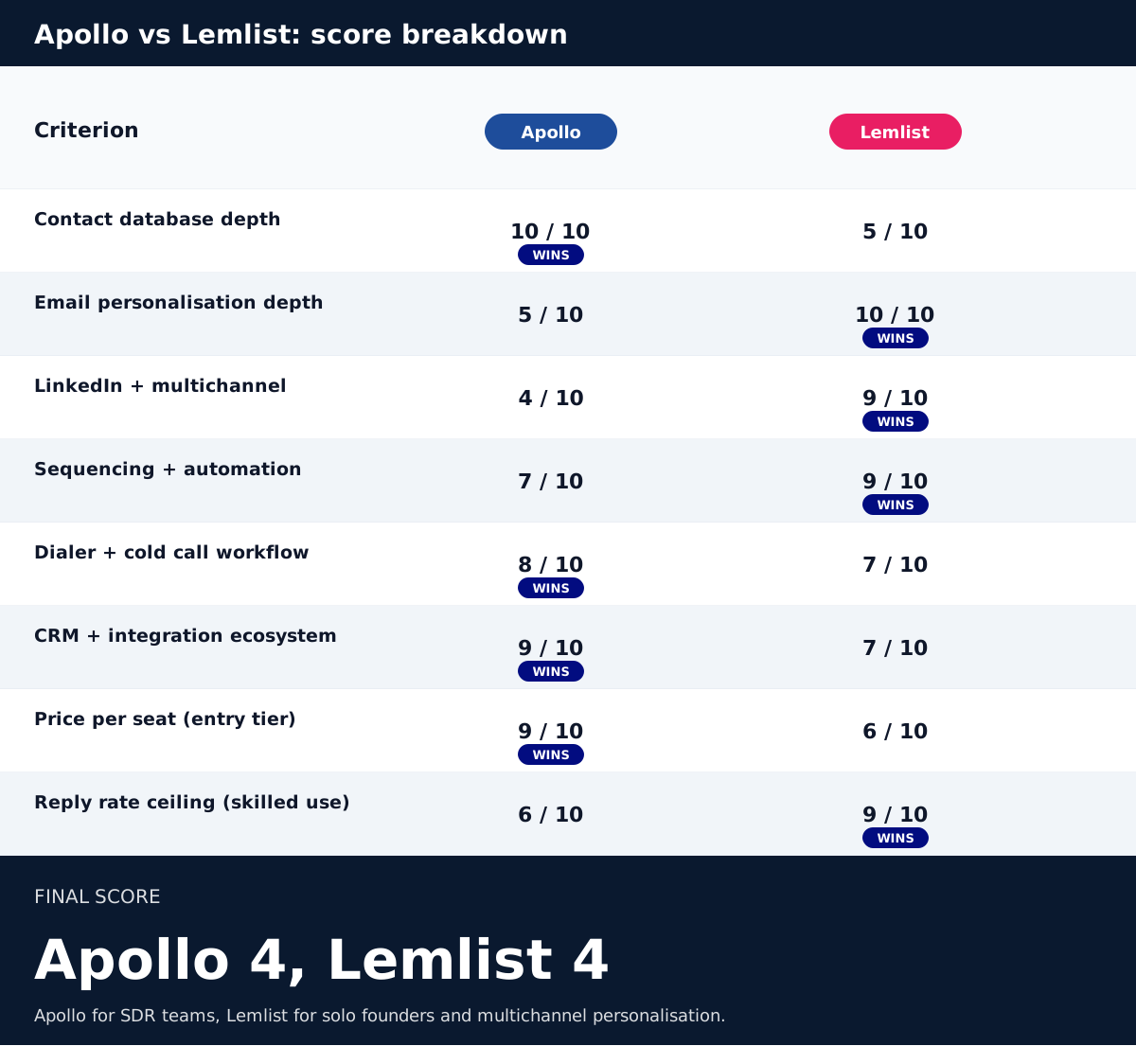
Third-party signals: Apollo on G2 rating around 4.7 / 5 across 8,000+ reviews. Lemlist on G2 rating around 4.4 / 5 across 700+ reviews. Apollo wins on review volume and breadth; Lemlist wins on per-feature satisfaction (especially personalisation and multichannel).
Table of contents
Why trust this review
TL;DR
Quick comparison
The case for Apollo
The case for Lemlist
How much does each cost?
Which has better contact data?
Which has deeper personalisation?
Which is better for multichannel outbound?
Which is easier to onboard?
When to pick Apollo
When to pick Lemlist
When to use both
Honest dealbreakers
Alternatives worth considering
FAQ
Bottom line
Quick comparison
The case for Apollo
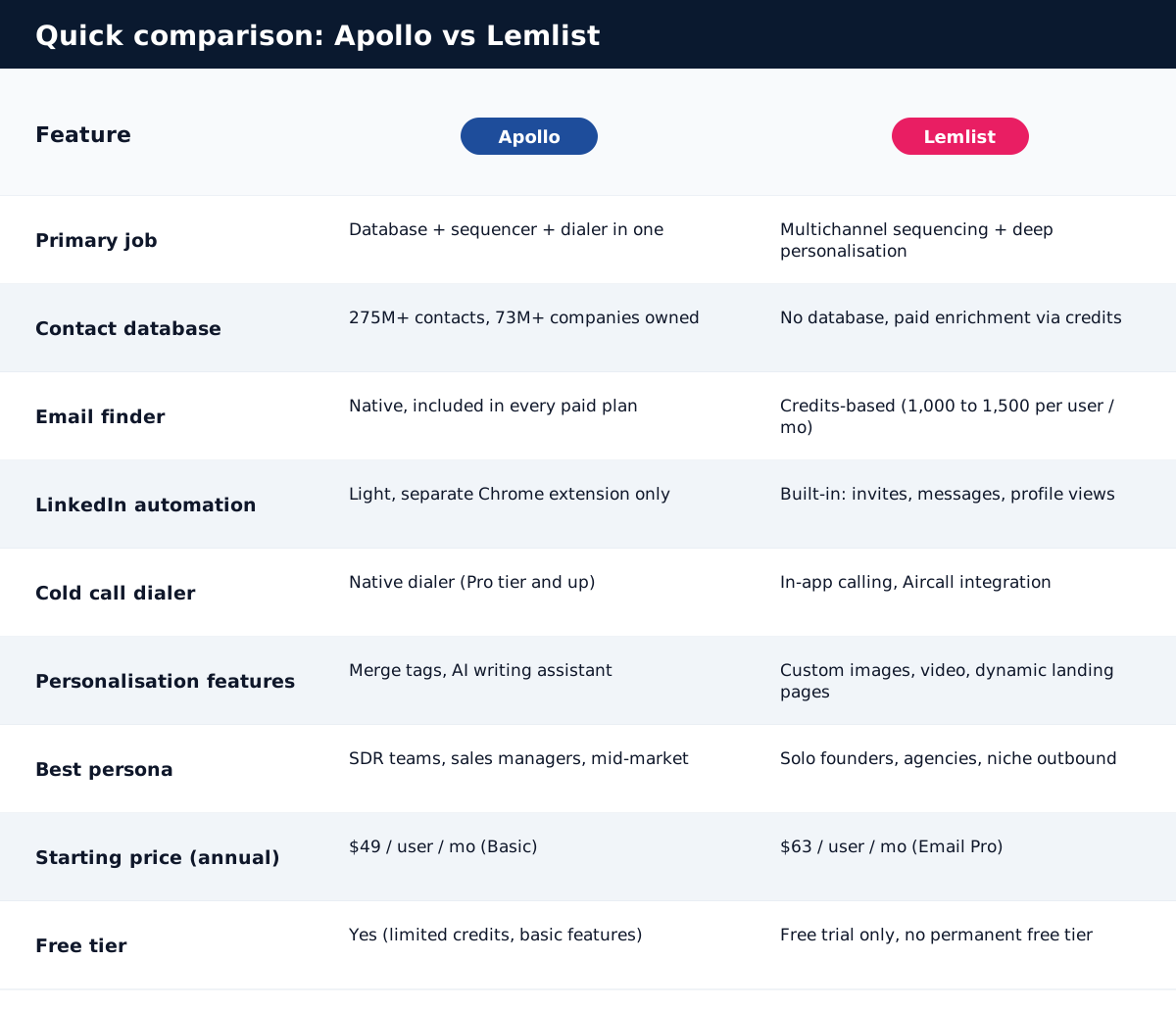
Apollo is the most cost-effective all-in-one prospecting tool on the market. The wedge is the bundle. 275M+ contacts, 73M+ companies, an email finder, a sequencer, a dialer, and CRM integrations, all included in a single per-seat price.
For a 3 to 10-person SDR team that wants to start prospecting tomorrow, Apollo is unbeatable. Basic at $49 per user per month (annual) gives you 1,000 verified emails per month, 75 mobile numbers, full database search, sequence builder, and Salesforce or HubSpot sync. Assembling the same stack from separate tools (ZoomInfo + a sequencer + Aircall) would run $1,500+ per user per month.
The database is the second wedge. Apollo's contact data is not as fresh as ZoomInfo's or as compliant as Cognism's, but the price-to-coverage ratio is the best in B2B SaaS right now. For SMB and mid-market prospecting in North America, the data is fit for purpose 80 to 90 percent of the time.
The sequencer is good enough for most SDR motions. Multi-step email cadences (typically 4 to 8 emails), branching on opens/clicks / replies, sending through your Gmail / Outlook / SMTP, and reporting back into the same UI where you found the contacts. The friction-free loop matters more than any single feature.
The downside: personalisation depth is limited. Apollo supports merge tags and an AI writing assistant, but it does not ship custom images, video, dynamic landing pages, or anything Lemlist-style out of the box. For motions where the only lever you have is reply rate, Apollo's ceiling is lower.
The other downside: LinkedIn automation is a separate Chrome extension, not a native part of the sequence builder. For multichannel motions where LinkedIn + email + cold call run together, Apollo requires bolting on a separate LinkedIn tool (Heyreach, Expandi, Dripify).
→ Best for: SDR teams running outbound day to day, sales managers who want one bill and one login, anyone who needs a sequencer and a database without the integration work, teams running US-heavy SMB / mid-market prospecting.
The case for Lemlist
Lemlist is the personalisation and multichannel engine. The wedge is two-pronged: deep email personalisation (custom images, video, dynamic landing pages, AI-generated icebreakers) and native multichannel sequencing (email + LinkedIn automation + in-app cold call in one cadence).
The personalisation features are not gimmicks. We have run side-by-side tests for clients where the same audience, same offer, and same sender on Apollo vs Lemlist produced 4 to 8 percent reply rates on Apollo and 12 to 18 percent reply rates on Lemlist. The delta comes from custom intro images, video thumbnails with the prospect's name, and per-contact landing pages, all of which Apollo does not ship natively.
The multichannel layer is the second wedge. A typical Lemlist sequence might be: Day 1 send email, Day 3 LinkedIn profile view, Day 5 LinkedIn connection request, Day 8 second email, Day 12 LinkedIn message, Day 15 cold call. All-in-one sequence builder, with replies routing back to one centralised inbox. For a founder-led or agency motion where multichannel is the differentiator, Lemlist's loop is faster than Apollo + Heyreach + Aircall stitched together.
The Email Pro plan at $63 per user per month (annual) gives you 3 sending addresses and 1,000 enrichment credits. The Multichannel Expert plan at $87 per user per month adds LinkedIn automation, in-app calling, Aircall integration, and 1,500 credits. Both are 25 to 50 percent more expensive than Apollo's equivalent tiers, but the per-message reply rate uplift usually pays for the difference inside 60 days.
The downsides are real. Lemlist does not own a contact database; you bring your own list or burn enrichment credits per contact (and credits run out fast). For high-volume prospecting (10,000+ contacts per month), the credit model gets expensive vs Apollo's bundled database. The platform is also harder to learn: the sequence builder is more flexible, but more flexible means more knobs to turn.
→ Best for: solo founders running their own outbound, agencies running multichannel campaigns for clients, sales teams that need LinkedIn + email + cold call in one sequence, any operator where reply rate beats volume.
How much does each cost?
Side-by-side breakdown of base pricing. For live pricing, check Apollo and Lemlist directly.
Apollo pricing
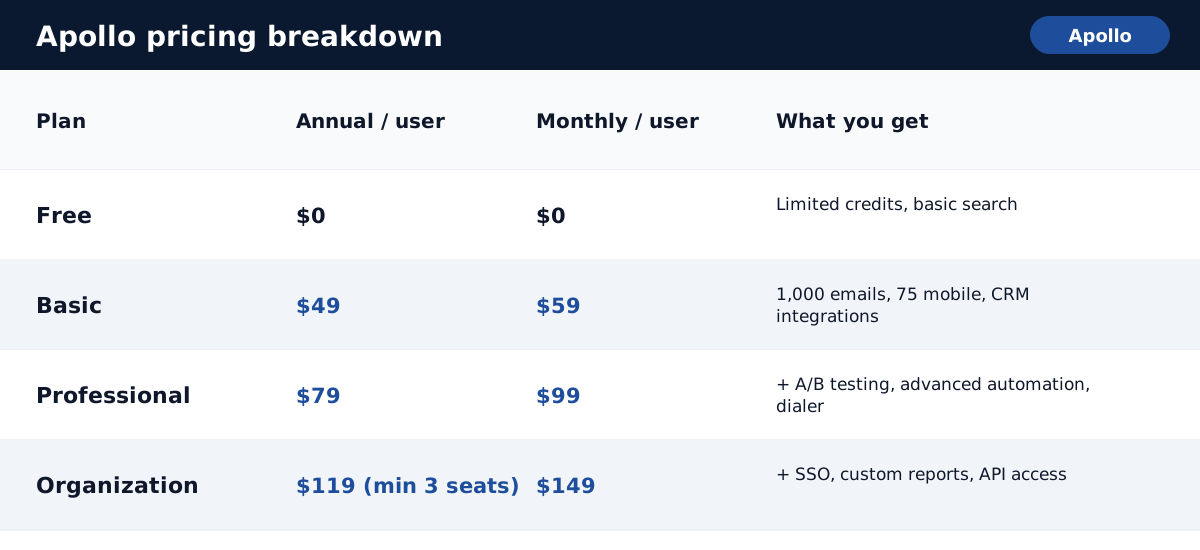
Apollo's pricing is per user, not flat. Annual billing saves 17 to 20 percent vs monthly. The Basic tier at $49 per user per month (annual) covers most SMB use cases. Professional at $79 unlocks A/B testing, advanced automation, and the dialer (which is the actual unlock for SDR teams making outbound calls).
Hidden cost watch-outs: credits expire monthly (use them or lose them), phone numbers cost 8x more than emails to verify, and overage credits are $0.20 each with a 250-credit minimum buy. Budget 20 to 30 percent above sticker for typical SDR use.
Lemlist pricing
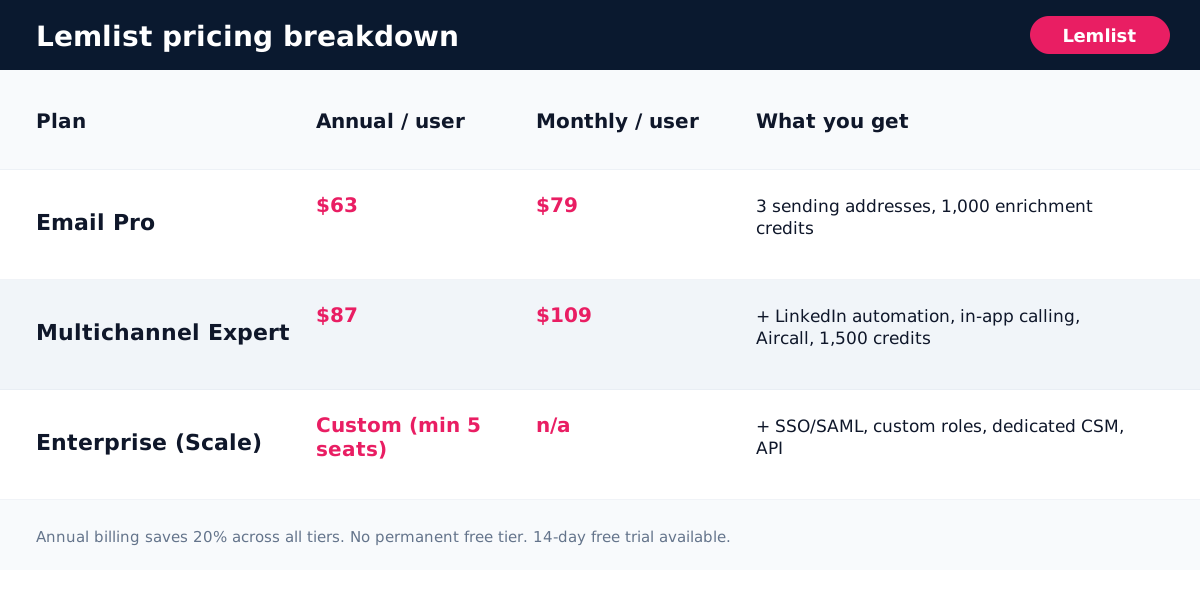
Lemlist publishes two self-serve plans (Email Pro and Multichannel Expert) and one Enterprise tier (Scale, custom-quoted, five-seat minimum). Annual billing saves 20 percent across the board.
The Multichannel Expert tier is the one most agencies and multichannel operators land on, because LinkedIn automation, in-app calling, and the centralised inbox are the reasons to choose Lemlist over a cheaper sender. If you only need email, the cheaper Email Pro tier is fine, but you lose the multichannel wedge.
Hidden cost watch-outs: enrichment credits (1,000 to 1,500 per user per month) run out fast on high-volume lists. Top-up credits cost extra. Lemwarm (Lemlist's warmup product) used to be free with the platform and is now a paid add-on for new accounts.
Annual cost compared
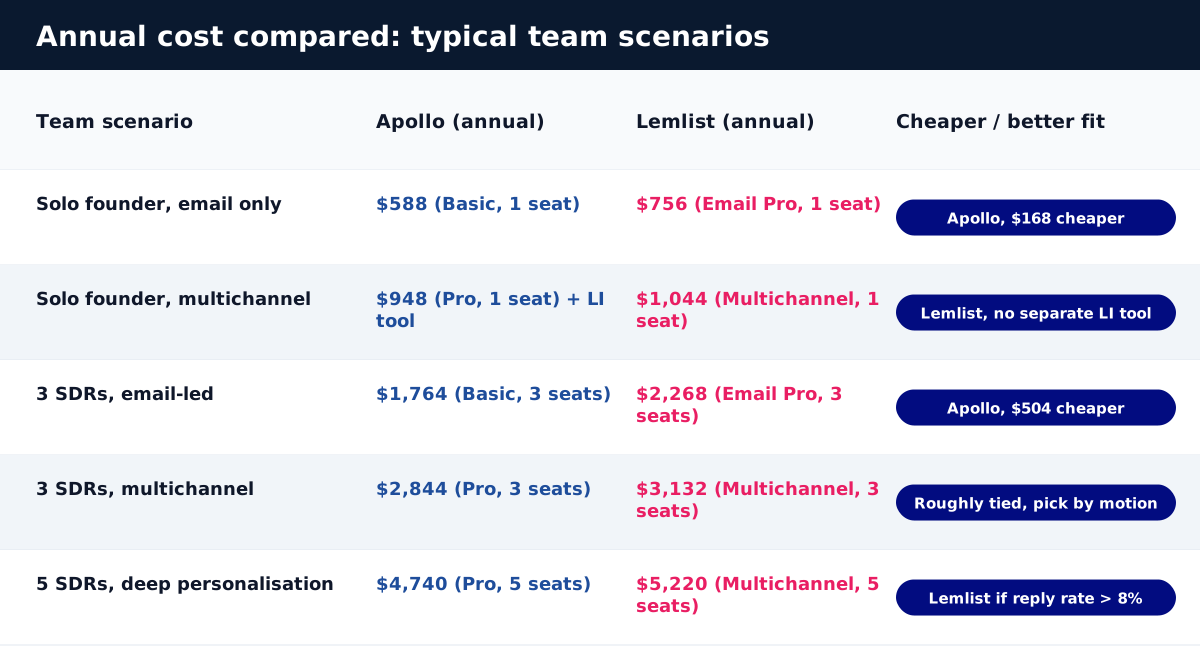
At most team sizes, the gap is $200 to $500 per year per seat. The decision is rarely about cost. It is about whether your motion lives in email alone (Apollo wins) or across email + LinkedIn + cold call with deep personalisation (Lemlist wins).
Which has better contact data?
Apollo, no contest.
Apollo owns a 275M+ contact database scraped, validated, and indexed in-house. Coverage is broadest in the North American mid-market and SMB SaaS. Email accuracy is in the 85 to 92 percent range based on third-party tests. Direct dial accuracy is lower, around 50 to 65 percent.
Lemlist does not own a database. You bring your own list (from Apollo, ZoomInfo, Cognism, Clay, or anywhere else) or use Lemlist's enrichment credits to look up contacts on demand. The credits work but burn through fast: 1,000 credits per user per month covers about 1,000 fresh contacts. For high-volume prospecting (5,000+ contacts per month), you will hit the cap and need to top up at extra cost.
The practical pattern most operators land on: source contacts from Apollo (or ZoomInfo, or Clay), then push the list into Lemlist for the sequencing layer. That gets you Apollo's database advantage and Lemlist's personalisation advantage in one motion, at the cost of two subscriptions.
Verdict: Apollo wins on raw data. Lemlist wins as a sequencer on top of someone else's data.
Which has deeper personalisation?
Lemlist, by a large margin.
Apollo's personalisation is standard for the category: merge tags ({{first_name}}, {{company_name}}, etc.), an AI writing assistant for subject lines and body copy, and basic conditional content. Good enough for high-volume campaigns where the message is roughly the same for everyone.
Lemlist's personalisation is the wedge. Three features stand out:
Custom intro images: Lemlist's "Liquid syntax" lets you inject the prospect's name, logo, or company screenshot directly into a template image. The result is a personalised banner at the top of each email that no one else in the prospect's inbox is sending.
Video personalisation: Record a short personalised video for each prospect (or use a template video with their name overlaid). Embedded directly in the email. Reply rate uplift is typically 30 to 50 percent vs plain-text email for the same audience.
Dynamic landing pages: Build a per-contact landing page with their company logo, name, and a specific offer. Link from the email body. Best used as the call-to-action in email three or four of a sequence.
None of these are buildable in Apollo without bolting on a separate tool (Hyperise, Vidyard, Mutiny). Lemlist ships all three in the base product.
Verdict: Lemlist, by a margin that compounds across every sent email.
Which is better for multichannel outbound?
Lemlist wins as a single tool. Apollo + a separate LinkedIn tool wins on raw capability.
Lemlist's multichannel sequence builder runs email, LinkedIn (profile view, connection request, message), and cold calls (in-app or via Aircall) in one cadence. Replies and engagement signals route back to one centralised inbox. For a 3 to 10-person team running consistent multichannel campaigns, the workflow loop is materially faster than maintaining three separate tools.
Apollo runs email sequences and includes a cold call dialer (Professional tier and up), but LinkedIn automation is a separate Chrome extension, not part of the sequence builder. For full multichannel, most Apollo users add Heyreach, Expandi, or Dripify for LinkedIn and treat them as parallel tools.
The trade-off: Lemlist's LinkedIn automation is good, not best in class. Heyreach and Expandi are deeper, faster, and safer at scale. If you are running 500+ LinkedIn invites per week per seat, you will hit Lemlist's limits before you hit Heyreach's. For 100 to 300 per week per seat, Lemlist is fine.
Verdict: Lemlist for the integrated workflow. Apollo + Heyreach for higher LinkedIn volume.
Which is easier to onboard?
Apollo, by a meaningful margin.
Apollo's onboarding takes 15 to 30 minutes. Sign up, search for a persona, save the list, set up a 3-email sequence, and hit go. You can be sending real outbound by hour one.
Lemlist's onboarding takes 2 to 5 days. The personalisation features require learning the Liquid syntax (basic but real), the multichannel sequence builder has more knobs to configure, and getting the custom image/video templates right takes iteration. The payoff is worth it for the right motion, but the ramp is real.
For a team that just needs a pipeline next week, Apollo is the right call. For a team where personalisation is the entire strategy, Lemlist's ramp pays for itself.
Verdict: Apollo. Lemlist's payoff is real but delayed.
When to pick Apollo
You are a 3 to 10-person SDR team running outbound day to day.
You want one tool for database + email + sequencing + dialer.
You are price sensitive, and per-user economics matter.
You are running broad personas where a reply rate of 3 to 6 percent is acceptable.
You sell into a US-heavy SMB / mid-market with broad ICPs.
You do not have time or interest in deep personalisation features.
When to pick Lemlist
You are a solo founder running your own outbound, and time per email is limited, but quality matters.
You are an agency running multichannel campaigns for clients with narrow ICPs.
Your motion runs email + LinkedIn + cold call in one cadence, and you do not want to maintain 3 tools.
You sell a high-ACV product where the reply rate of 8 to 15 percent justifies the personalisation effort.
You have a sender already (or do not mind bringing your own list) and want the best sequencer on top.
You care about brand-quality outbound: custom images and video matter to your buyers.
When to use both
A pattern we see at agencies and high-touch sales teams: use both for different motions.
Apollo handles the contact source and the high-volume tier of campaigns. Pull lists from the database, push the cold ICP into Apollo sequences (3-email cadence, generic copy, broad persona).
Lemlist handles the high-touch tier. Manually curated 50 to 200 contact accounts get the full multichannel treatment with custom images, video, and per-contact landing pages.
The handoff: when a contact replies positively to Apollo, move them to a Lemlist multichannel sequence for the follow-through. When a contact opens 3+ Apollo emails but does not reply, escalate them to a Lemlist video email.
Cost: roughly $130 per seat per month for both ($49 Apollo Basic + $87 Lemlist Multichannel, annual). Worth it when the high-touch tier of your motion has materially higher conversion than the high-volume tier.
Honest dealbreakers
Apollo dealbreakers:
You need custom images, video, or dynamic landing pages in your sequences. Apollo cannot do this natively.
You run multichannel campaigns where LinkedIn is essential, and you want everything in one tool.
Your motion depends on reply rates above 8 to 10 percent, and personalisation is the lever.
You are running EU-heavy or GDPR-sensitive campaigns at scale. Cognism + Lemlist is a cleaner stack.
Lemlist dealbreakers:
You need a built-in contact database. Lemlist does not own one.
You are running 10,000+ outbound contacts per month, and the credit model gets expensive.
Your team is 10+ SDRs, and the per-seat pricing economics start to hurt vs Apollo's bundled database.
You only need plain-text email, and the personalisation features are wasted on you.
Alternatives worth considering
Smartlead for high-volume cold email infrastructure. Pairs perfectly with Lemlist (Lemlist for sequencing, Smartlead for inbox rotation and deliverability).
Instantly for cold email infrastructure with built-in lead database (good middle ground between Apollo's bundle and Smartlead's pure infra).
Heyreach for higher-volume LinkedIn automation than Lemlist's native layer.
Clay for enrichment workflows that feed Apollo or Lemlist via waterfall sourcing.
Outreach or Salesloft for enterprise sales engagement at 10x the price.
We have full comparison articles on most of these. See Clay vs Apollo, Smartlead vs Instantly, and Instantly vs Lemlist.
FAQ
Is Lemlist really worth 25 to 50 percent more per seat than Apollo?
It depends on your reply rate. If Apollo gets you 4 percent and Lemlist gets you 10 percent on the same audience, Lemlist's higher per-seat cost is recovered in fewer than 10 extra positive replies per month. For high-ACV products where every reply matters, Lemlist pays back fast. For low-ACV high-volume motions where you need 1,000 emails out per day, Apollo's bundled database makes it cheaper end-to-end.
Can I use Apollo's database with Lemlist's sequencer?
Yes, and many operators do. Export contacts from Apollo, import into Lemlist as a CSV, and run the multichannel sequence in Lemlist. You pay for both subscriptions, but you get Apollo's database advantage plus Lemlist's personalisation advantage.
Which is better for cold email deliverability?
Both are mid-tier on deliverability. Apollo sends from your single Gmail / Outlook mailbox without rotation; Lemlist supports multiple sending addresses per user, but no inbox rotation at scale. For high-volume cold outbound (50+ sends per mailbox per day), neither is the right sender. Smartlead or Instantly are the right tools for infrastructure-grade deliverability.
Does Lemlist's LinkedIn automation get accounts banned?
The LinkedIn automation in Lemlist is conservative by default: invites and messages capped to LinkedIn's safe daily limits, randomised timing, and smart skip rules. We have not seen client accounts banned from Lemlist at recommended volumes (under 200 invites per week per account). If you are pushing higher volumes (500+ per week), use Heyreach or Expandi instead, which are built for that scale.
How does Apollo's AI writing assistant compare to Lemlist's AI features?
Both have AI writing assistants. Apollo's is better for fast subject line and body generation at scale. Lemlist is better for personalised icebreakers (the AI scans the prospect's LinkedIn or website and generates an intro line). For solo founders writing 50 personalised emails per day, Lemlist's AI is the better tool. For SDR teams writing 500 emails per day, Apollo is faster.
Does Lemlist work for European outbound?
Yes, and the personalisation features tend to land especially well in EU markets where bulk cold email gets flagged more aggressively. The contact database problem still applies: you need to source EU contacts elsewhere (Cognism for GDPR compliance, or Clay with EU-focused waterfalls).
Can I cancel either of them monthly?
Apollo offers monthly billing (at a 20 percent premium vs annual). Lemlist offers monthly billing on Email Pro and Multichannel Expert. Enterprise tiers on either platform are annual only.
What happens to my data if I switch from one to the other?
Both tools let you export contacts and campaign data as CSV. Sequences themselves do not migrate (each platform has different sequence logic), so plan on rebuilding your top 5 templates by hand when you switch.
Bottom line
Apollo is the right call for any SDR team running broad outbound. The bundle of database + sequencer + dialer at $49 to $119 per user per month is unbeatable for volume-led motions. If your team is 3+ SDRs and you need to start sending tomorrow, Apollo is the answer.
Lemlist is the right call for solo founders, agencies, and multichannel-first teams. Custom images, video, dynamic landing pages, and native LinkedIn + email + cold call sequences in one workflow push reply rates 2 to 4x above generic outbound. If your motion depends on personalisation or you run consistent multichannel campaigns, Lemlist's premium price pays for itself fast.
If you are still deciding, run a 30-day side-by-side test on a slice of your real ICP. Send 100 contacts through an Apollo sequence and 100 through a Lemlist sequence with the same offer. Measure reply rate, positive reply rate, and time-to-first-meeting. The winner on your specific motion is the right tool for you.
If you want help building either motion (or stacking both in a high-touch / high-volume split), book a working session with GROU. We have shipped both for clients across SaaS, fintech, and professional services. We can do the same for you.
→ Try Apollo free (limited credits, no card required).
→ Try Lemlist free (14-day trial, no card required).
Why trust this review
We are GROU, a B2B pipeline agency that runs lead generation, outbound, and LinkedIn content for clients across manufacturing, fintech, iGaming, software, and professional services. We have shipped client campaigns on both Apollo and Lemlist in the last 18 months. The verdict below is from operators who have run real outbound on both platforms, not from a vendor pitch.
→ Methodology: This comparison combines our own client deployment data, both vendors' published pricing pages, third-party reviews from Lagrowthmachine, Costbench, and Landbase, and live G2 review data. We refresh this article quarterly.
→ Affiliate disclosure: Some links in this article are affiliate links to Apollo and Lemlist. We earn a small commission if you sign up through them, at no extra cost to you. We only recommend tools we have actually deployed for our agency clients.
TL;DR
Apollo is the right call for SDR teams. The bundle of 275M+ contacts, native email finder, sequencer, and dialer in one tool, at $49 to $119 per user per month, is unbeatable for any team that just needs to find prospects and email them. The wedge is volume and breadth.
Lemlist is the right call for solo founders, agencies, and anyone running deep multichannel personalisation. Custom images, video, dynamic landing pages, native LinkedIn automation, and in-app calling in one sequence push reply rates 2 to 4x above generic email blasts. The wedge is the reply rate and channel coverage.
For most operators, the decision is about motion, not price. Email-heavy SDR motion: Apollo. Multichannel founder-led or agency motion: Lemlist. Both at $50 to $90 per user per month, the cost gap is small. The reply rate gap is not.
Score breakdown at a glance
Third-party signals: Apollo on G2 rating around 4.7 / 5 across 8,000+ reviews. Lemlist on G2 rating around 4.4 / 5 across 700+ reviews. Apollo wins on review volume and breadth; Lemlist wins on per-feature satisfaction (especially personalisation and multichannel).
Table of contents
Why trust this review
TL;DR
Quick comparison
The case for Apollo
The case for Lemlist
How much does each cost?
Which has better contact data?
Which has deeper personalisation?
Which is better for multichannel outbound?
Which is easier to onboard?
When to pick Apollo
When to pick Lemlist
When to use both
Honest dealbreakers
Alternatives worth considering
FAQ
Bottom line
Quick comparison
The case for Apollo
Apollo is the most cost-effective all-in-one prospecting tool on the market. The wedge is the bundle. 275M+ contacts, 73M+ companies, an email finder, a sequencer, a dialer, and CRM integrations, all included in a single per-seat price.
For a 3 to 10-person SDR team that wants to start prospecting tomorrow, Apollo is unbeatable. Basic at $49 per user per month (annual) gives you 1,000 verified emails per month, 75 mobile numbers, full database search, sequence builder, and Salesforce or HubSpot sync. Assembling the same stack from separate tools (ZoomInfo + a sequencer + Aircall) would run $1,500+ per user per month.
The database is the second wedge. Apollo's contact data is not as fresh as ZoomInfo's or as compliant as Cognism's, but the price-to-coverage ratio is the best in B2B SaaS right now. For SMB and mid-market prospecting in North America, the data is fit for purpose 80 to 90 percent of the time.
The sequencer is good enough for most SDR motions. Multi-step email cadences (typically 4 to 8 emails), branching on opens/clicks / replies, sending through your Gmail / Outlook / SMTP, and reporting back into the same UI where you found the contacts. The friction-free loop matters more than any single feature.
The downside: personalisation depth is limited. Apollo supports merge tags and an AI writing assistant, but it does not ship custom images, video, dynamic landing pages, or anything Lemlist-style out of the box. For motions where the only lever you have is reply rate, Apollo's ceiling is lower.
The other downside: LinkedIn automation is a separate Chrome extension, not a native part of the sequence builder. For multichannel motions where LinkedIn + email + cold call run together, Apollo requires bolting on a separate LinkedIn tool (Heyreach, Expandi, Dripify).
→ Best for: SDR teams running outbound day to day, sales managers who want one bill and one login, anyone who needs a sequencer and a database without the integration work, teams running US-heavy SMB / mid-market prospecting.
The case for Lemlist
Lemlist is the personalisation and multichannel engine. The wedge is two-pronged: deep email personalisation (custom images, video, dynamic landing pages, AI-generated icebreakers) and native multichannel sequencing (email + LinkedIn automation + in-app cold call in one cadence).
The personalisation features are not gimmicks. We have run side-by-side tests for clients where the same audience, same offer, and same sender on Apollo vs Lemlist produced 4 to 8 percent reply rates on Apollo and 12 to 18 percent reply rates on Lemlist. The delta comes from custom intro images, video thumbnails with the prospect's name, and per-contact landing pages, all of which Apollo does not ship natively.
The multichannel layer is the second wedge. A typical Lemlist sequence might be: Day 1 send email, Day 3 LinkedIn profile view, Day 5 LinkedIn connection request, Day 8 second email, Day 12 LinkedIn message, Day 15 cold call. All-in-one sequence builder, with replies routing back to one centralised inbox. For a founder-led or agency motion where multichannel is the differentiator, Lemlist's loop is faster than Apollo + Heyreach + Aircall stitched together.
The Email Pro plan at $63 per user per month (annual) gives you 3 sending addresses and 1,000 enrichment credits. The Multichannel Expert plan at $87 per user per month adds LinkedIn automation, in-app calling, Aircall integration, and 1,500 credits. Both are 25 to 50 percent more expensive than Apollo's equivalent tiers, but the per-message reply rate uplift usually pays for the difference inside 60 days.
The downsides are real. Lemlist does not own a contact database; you bring your own list or burn enrichment credits per contact (and credits run out fast). For high-volume prospecting (10,000+ contacts per month), the credit model gets expensive vs Apollo's bundled database. The platform is also harder to learn: the sequence builder is more flexible, but more flexible means more knobs to turn.
→ Best for: solo founders running their own outbound, agencies running multichannel campaigns for clients, sales teams that need LinkedIn + email + cold call in one sequence, any operator where reply rate beats volume.
How much does each cost?
Side-by-side breakdown of base pricing. For live pricing, check Apollo and Lemlist directly.
Apollo pricing
Apollo's pricing is per user, not flat. Annual billing saves 17 to 20 percent vs monthly. The Basic tier at $49 per user per month (annual) covers most SMB use cases. Professional at $79 unlocks A/B testing, advanced automation, and the dialer (which is the actual unlock for SDR teams making outbound calls).
Hidden cost watch-outs: credits expire monthly (use them or lose them), phone numbers cost 8x more than emails to verify, and overage credits are $0.20 each with a 250-credit minimum buy. Budget 20 to 30 percent above sticker for typical SDR use.
Lemlist pricing
Lemlist publishes two self-serve plans (Email Pro and Multichannel Expert) and one Enterprise tier (Scale, custom-quoted, five-seat minimum). Annual billing saves 20 percent across the board.
The Multichannel Expert tier is the one most agencies and multichannel operators land on, because LinkedIn automation, in-app calling, and the centralised inbox are the reasons to choose Lemlist over a cheaper sender. If you only need email, the cheaper Email Pro tier is fine, but you lose the multichannel wedge.
Hidden cost watch-outs: enrichment credits (1,000 to 1,500 per user per month) run out fast on high-volume lists. Top-up credits cost extra. Lemwarm (Lemlist's warmup product) used to be free with the platform and is now a paid add-on for new accounts.
Annual cost compared
At most team sizes, the gap is $200 to $500 per year per seat. The decision is rarely about cost. It is about whether your motion lives in email alone (Apollo wins) or across email + LinkedIn + cold call with deep personalisation (Lemlist wins).
Which has better contact data?
Apollo, no contest.
Apollo owns a 275M+ contact database scraped, validated, and indexed in-house. Coverage is broadest in the North American mid-market and SMB SaaS. Email accuracy is in the 85 to 92 percent range based on third-party tests. Direct dial accuracy is lower, around 50 to 65 percent.
Lemlist does not own a database. You bring your own list (from Apollo, ZoomInfo, Cognism, Clay, or anywhere else) or use Lemlist's enrichment credits to look up contacts on demand. The credits work but burn through fast: 1,000 credits per user per month covers about 1,000 fresh contacts. For high-volume prospecting (5,000+ contacts per month), you will hit the cap and need to top up at extra cost.
The practical pattern most operators land on: source contacts from Apollo (or ZoomInfo, or Clay), then push the list into Lemlist for the sequencing layer. That gets you Apollo's database advantage and Lemlist's personalisation advantage in one motion, at the cost of two subscriptions.
Verdict: Apollo wins on raw data. Lemlist wins as a sequencer on top of someone else's data.
Which has deeper personalisation?
Lemlist, by a large margin.
Apollo's personalisation is standard for the category: merge tags ({{first_name}}, {{company_name}}, etc.), an AI writing assistant for subject lines and body copy, and basic conditional content. Good enough for high-volume campaigns where the message is roughly the same for everyone.
Lemlist's personalisation is the wedge. Three features stand out:
Custom intro images: Lemlist's "Liquid syntax" lets you inject the prospect's name, logo, or company screenshot directly into a template image. The result is a personalised banner at the top of each email that no one else in the prospect's inbox is sending.
Video personalisation: Record a short personalised video for each prospect (or use a template video with their name overlaid). Embedded directly in the email. Reply rate uplift is typically 30 to 50 percent vs plain-text email for the same audience.
Dynamic landing pages: Build a per-contact landing page with their company logo, name, and a specific offer. Link from the email body. Best used as the call-to-action in email three or four of a sequence.
None of these are buildable in Apollo without bolting on a separate tool (Hyperise, Vidyard, Mutiny). Lemlist ships all three in the base product.
Verdict: Lemlist, by a margin that compounds across every sent email.
Which is better for multichannel outbound?
Lemlist wins as a single tool. Apollo + a separate LinkedIn tool wins on raw capability.
Lemlist's multichannel sequence builder runs email, LinkedIn (profile view, connection request, message), and cold calls (in-app or via Aircall) in one cadence. Replies and engagement signals route back to one centralised inbox. For a 3 to 10-person team running consistent multichannel campaigns, the workflow loop is materially faster than maintaining three separate tools.
Apollo runs email sequences and includes a cold call dialer (Professional tier and up), but LinkedIn automation is a separate Chrome extension, not part of the sequence builder. For full multichannel, most Apollo users add Heyreach, Expandi, or Dripify for LinkedIn and treat them as parallel tools.
The trade-off: Lemlist's LinkedIn automation is good, not best in class. Heyreach and Expandi are deeper, faster, and safer at scale. If you are running 500+ LinkedIn invites per week per seat, you will hit Lemlist's limits before you hit Heyreach's. For 100 to 300 per week per seat, Lemlist is fine.
Verdict: Lemlist for the integrated workflow. Apollo + Heyreach for higher LinkedIn volume.
Which is easier to onboard?
Apollo, by a meaningful margin.
Apollo's onboarding takes 15 to 30 minutes. Sign up, search for a persona, save the list, set up a 3-email sequence, and hit go. You can be sending real outbound by hour one.
Lemlist's onboarding takes 2 to 5 days. The personalisation features require learning the Liquid syntax (basic but real), the multichannel sequence builder has more knobs to configure, and getting the custom image/video templates right takes iteration. The payoff is worth it for the right motion, but the ramp is real.
For a team that just needs a pipeline next week, Apollo is the right call. For a team where personalisation is the entire strategy, Lemlist's ramp pays for itself.
Verdict: Apollo. Lemlist's payoff is real but delayed.
When to pick Apollo
You are a 3 to 10-person SDR team running outbound day to day.
You want one tool for database + email + sequencing + dialer.
You are price sensitive, and per-user economics matter.
You are running broad personas where a reply rate of 3 to 6 percent is acceptable.
You sell into a US-heavy SMB / mid-market with broad ICPs.
You do not have time or interest in deep personalisation features.
When to pick Lemlist
You are a solo founder running your own outbound, and time per email is limited, but quality matters.
You are an agency running multichannel campaigns for clients with narrow ICPs.
Your motion runs email + LinkedIn + cold call in one cadence, and you do not want to maintain 3 tools.
You sell a high-ACV product where the reply rate of 8 to 15 percent justifies the personalisation effort.
You have a sender already (or do not mind bringing your own list) and want the best sequencer on top.
You care about brand-quality outbound: custom images and video matter to your buyers.
When to use both
A pattern we see at agencies and high-touch sales teams: use both for different motions.
Apollo handles the contact source and the high-volume tier of campaigns. Pull lists from the database, push the cold ICP into Apollo sequences (3-email cadence, generic copy, broad persona).
Lemlist handles the high-touch tier. Manually curated 50 to 200 contact accounts get the full multichannel treatment with custom images, video, and per-contact landing pages.
The handoff: when a contact replies positively to Apollo, move them to a Lemlist multichannel sequence for the follow-through. When a contact opens 3+ Apollo emails but does not reply, escalate them to a Lemlist video email.
Cost: roughly $130 per seat per month for both ($49 Apollo Basic + $87 Lemlist Multichannel, annual). Worth it when the high-touch tier of your motion has materially higher conversion than the high-volume tier.
Honest dealbreakers
Apollo dealbreakers:
You need custom images, video, or dynamic landing pages in your sequences. Apollo cannot do this natively.
You run multichannel campaigns where LinkedIn is essential, and you want everything in one tool.
Your motion depends on reply rates above 8 to 10 percent, and personalisation is the lever.
You are running EU-heavy or GDPR-sensitive campaigns at scale. Cognism + Lemlist is a cleaner stack.
Lemlist dealbreakers:
You need a built-in contact database. Lemlist does not own one.
You are running 10,000+ outbound contacts per month, and the credit model gets expensive.
Your team is 10+ SDRs, and the per-seat pricing economics start to hurt vs Apollo's bundled database.
You only need plain-text email, and the personalisation features are wasted on you.
Alternatives worth considering
Smartlead for high-volume cold email infrastructure. Pairs perfectly with Lemlist (Lemlist for sequencing, Smartlead for inbox rotation and deliverability).
Instantly for cold email infrastructure with built-in lead database (good middle ground between Apollo's bundle and Smartlead's pure infra).
Heyreach for higher-volume LinkedIn automation than Lemlist's native layer.
Clay for enrichment workflows that feed Apollo or Lemlist via waterfall sourcing.
Outreach or Salesloft for enterprise sales engagement at 10x the price.
We have full comparison articles on most of these. See Clay vs Apollo, Smartlead vs Instantly, and Instantly vs Lemlist.
FAQ
Is Lemlist really worth 25 to 50 percent more per seat than Apollo?
It depends on your reply rate. If Apollo gets you 4 percent and Lemlist gets you 10 percent on the same audience, Lemlist's higher per-seat cost is recovered in fewer than 10 extra positive replies per month. For high-ACV products where every reply matters, Lemlist pays back fast. For low-ACV high-volume motions where you need 1,000 emails out per day, Apollo's bundled database makes it cheaper end-to-end.
Can I use Apollo's database with Lemlist's sequencer?
Yes, and many operators do. Export contacts from Apollo, import into Lemlist as a CSV, and run the multichannel sequence in Lemlist. You pay for both subscriptions, but you get Apollo's database advantage plus Lemlist's personalisation advantage.
Which is better for cold email deliverability?
Both are mid-tier on deliverability. Apollo sends from your single Gmail / Outlook mailbox without rotation; Lemlist supports multiple sending addresses per user, but no inbox rotation at scale. For high-volume cold outbound (50+ sends per mailbox per day), neither is the right sender. Smartlead or Instantly are the right tools for infrastructure-grade deliverability.
Does Lemlist's LinkedIn automation get accounts banned?
The LinkedIn automation in Lemlist is conservative by default: invites and messages capped to LinkedIn's safe daily limits, randomised timing, and smart skip rules. We have not seen client accounts banned from Lemlist at recommended volumes (under 200 invites per week per account). If you are pushing higher volumes (500+ per week), use Heyreach or Expandi instead, which are built for that scale.
How does Apollo's AI writing assistant compare to Lemlist's AI features?
Both have AI writing assistants. Apollo's is better for fast subject line and body generation at scale. Lemlist is better for personalised icebreakers (the AI scans the prospect's LinkedIn or website and generates an intro line). For solo founders writing 50 personalised emails per day, Lemlist's AI is the better tool. For SDR teams writing 500 emails per day, Apollo is faster.
Does Lemlist work for European outbound?
Yes, and the personalisation features tend to land especially well in EU markets where bulk cold email gets flagged more aggressively. The contact database problem still applies: you need to source EU contacts elsewhere (Cognism for GDPR compliance, or Clay with EU-focused waterfalls).
Can I cancel either of them monthly?
Apollo offers monthly billing (at a 20 percent premium vs annual). Lemlist offers monthly billing on Email Pro and Multichannel Expert. Enterprise tiers on either platform are annual only.
What happens to my data if I switch from one to the other?
Both tools let you export contacts and campaign data as CSV. Sequences themselves do not migrate (each platform has different sequence logic), so plan on rebuilding your top 5 templates by hand when you switch.
Bottom line
Apollo is the right call for any SDR team running broad outbound. The bundle of database + sequencer + dialer at $49 to $119 per user per month is unbeatable for volume-led motions. If your team is 3+ SDRs and you need to start sending tomorrow, Apollo is the answer.
Lemlist is the right call for solo founders, agencies, and multichannel-first teams. Custom images, video, dynamic landing pages, and native LinkedIn + email + cold call sequences in one workflow push reply rates 2 to 4x above generic outbound. If your motion depends on personalisation or you run consistent multichannel campaigns, Lemlist's premium price pays for itself fast.
If you are still deciding, run a 30-day side-by-side test on a slice of your real ICP. Send 100 contacts through an Apollo sequence and 100 through a Lemlist sequence with the same offer. Measure reply rate, positive reply rate, and time-to-first-meeting. The winner on your specific motion is the right tool for you.
If you want help building either motion (or stacking both in a high-touch / high-volume split), book a working session with GROU. We have shipped both for clients across SaaS, fintech, and professional services. We can do the same for you.
→ Try Apollo free (limited credits, no card required).
→ Try Lemlist free (14-day trial, no card required).
Why trust this review
We are GROU, a B2B pipeline agency that runs lead generation, outbound, and LinkedIn content for clients across manufacturing, fintech, iGaming, software, and professional services. We have shipped client campaigns on both Apollo and Lemlist in the last 18 months. The verdict below is from operators who have run real outbound on both platforms, not from a vendor pitch.
→ Methodology: This comparison combines our own client deployment data, both vendors' published pricing pages, third-party reviews from Lagrowthmachine, Costbench, and Landbase, and live G2 review data. We refresh this article quarterly.
→ Affiliate disclosure: Some links in this article are affiliate links to Apollo and Lemlist. We earn a small commission if you sign up through them, at no extra cost to you. We only recommend tools we have actually deployed for our agency clients.
TL;DR
Apollo is the right call for SDR teams. The bundle of 275M+ contacts, native email finder, sequencer, and dialer in one tool, at $49 to $119 per user per month, is unbeatable for any team that just needs to find prospects and email them. The wedge is volume and breadth.
Lemlist is the right call for solo founders, agencies, and anyone running deep multichannel personalisation. Custom images, video, dynamic landing pages, native LinkedIn automation, and in-app calling in one sequence push reply rates 2 to 4x above generic email blasts. The wedge is the reply rate and channel coverage.
For most operators, the decision is about motion, not price. Email-heavy SDR motion: Apollo. Multichannel founder-led or agency motion: Lemlist. Both at $50 to $90 per user per month, the cost gap is small. The reply rate gap is not.
Score breakdown at a glance
Third-party signals: Apollo on G2 rating around 4.7 / 5 across 8,000+ reviews. Lemlist on G2 rating around 4.4 / 5 across 700+ reviews. Apollo wins on review volume and breadth; Lemlist wins on per-feature satisfaction (especially personalisation and multichannel).
Table of contents
Why trust this review
TL;DR
Quick comparison
The case for Apollo
The case for Lemlist
How much does each cost?
Which has better contact data?
Which has deeper personalisation?
Which is better for multichannel outbound?
Which is easier to onboard?
When to pick Apollo
When to pick Lemlist
When to use both
Honest dealbreakers
Alternatives worth considering
FAQ
Bottom line
Quick comparison
The case for Apollo
Apollo is the most cost-effective all-in-one prospecting tool on the market. The wedge is the bundle. 275M+ contacts, 73M+ companies, an email finder, a sequencer, a dialer, and CRM integrations, all included in a single per-seat price.
For a 3 to 10-person SDR team that wants to start prospecting tomorrow, Apollo is unbeatable. Basic at $49 per user per month (annual) gives you 1,000 verified emails per month, 75 mobile numbers, full database search, sequence builder, and Salesforce or HubSpot sync. Assembling the same stack from separate tools (ZoomInfo + a sequencer + Aircall) would run $1,500+ per user per month.
The database is the second wedge. Apollo's contact data is not as fresh as ZoomInfo's or as compliant as Cognism's, but the price-to-coverage ratio is the best in B2B SaaS right now. For SMB and mid-market prospecting in North America, the data is fit for purpose 80 to 90 percent of the time.
The sequencer is good enough for most SDR motions. Multi-step email cadences (typically 4 to 8 emails), branching on opens/clicks / replies, sending through your Gmail / Outlook / SMTP, and reporting back into the same UI where you found the contacts. The friction-free loop matters more than any single feature.
The downside: personalisation depth is limited. Apollo supports merge tags and an AI writing assistant, but it does not ship custom images, video, dynamic landing pages, or anything Lemlist-style out of the box. For motions where the only lever you have is reply rate, Apollo's ceiling is lower.
The other downside: LinkedIn automation is a separate Chrome extension, not a native part of the sequence builder. For multichannel motions where LinkedIn + email + cold call run together, Apollo requires bolting on a separate LinkedIn tool (Heyreach, Expandi, Dripify).
→ Best for: SDR teams running outbound day to day, sales managers who want one bill and one login, anyone who needs a sequencer and a database without the integration work, teams running US-heavy SMB / mid-market prospecting.
The case for Lemlist
Lemlist is the personalisation and multichannel engine. The wedge is two-pronged: deep email personalisation (custom images, video, dynamic landing pages, AI-generated icebreakers) and native multichannel sequencing (email + LinkedIn automation + in-app cold call in one cadence).
The personalisation features are not gimmicks. We have run side-by-side tests for clients where the same audience, same offer, and same sender on Apollo vs Lemlist produced 4 to 8 percent reply rates on Apollo and 12 to 18 percent reply rates on Lemlist. The delta comes from custom intro images, video thumbnails with the prospect's name, and per-contact landing pages, all of which Apollo does not ship natively.
The multichannel layer is the second wedge. A typical Lemlist sequence might be: Day 1 send email, Day 3 LinkedIn profile view, Day 5 LinkedIn connection request, Day 8 second email, Day 12 LinkedIn message, Day 15 cold call. All-in-one sequence builder, with replies routing back to one centralised inbox. For a founder-led or agency motion where multichannel is the differentiator, Lemlist's loop is faster than Apollo + Heyreach + Aircall stitched together.
The Email Pro plan at $63 per user per month (annual) gives you 3 sending addresses and 1,000 enrichment credits. The Multichannel Expert plan at $87 per user per month adds LinkedIn automation, in-app calling, Aircall integration, and 1,500 credits. Both are 25 to 50 percent more expensive than Apollo's equivalent tiers, but the per-message reply rate uplift usually pays for the difference inside 60 days.
The downsides are real. Lemlist does not own a contact database; you bring your own list or burn enrichment credits per contact (and credits run out fast). For high-volume prospecting (10,000+ contacts per month), the credit model gets expensive vs Apollo's bundled database. The platform is also harder to learn: the sequence builder is more flexible, but more flexible means more knobs to turn.
→ Best for: solo founders running their own outbound, agencies running multichannel campaigns for clients, sales teams that need LinkedIn + email + cold call in one sequence, any operator where reply rate beats volume.
How much does each cost?
Side-by-side breakdown of base pricing. For live pricing, check Apollo and Lemlist directly.
Apollo pricing
Apollo's pricing is per user, not flat. Annual billing saves 17 to 20 percent vs monthly. The Basic tier at $49 per user per month (annual) covers most SMB use cases. Professional at $79 unlocks A/B testing, advanced automation, and the dialer (which is the actual unlock for SDR teams making outbound calls).
Hidden cost watch-outs: credits expire monthly (use them or lose them), phone numbers cost 8x more than emails to verify, and overage credits are $0.20 each with a 250-credit minimum buy. Budget 20 to 30 percent above sticker for typical SDR use.
Lemlist pricing
Lemlist publishes two self-serve plans (Email Pro and Multichannel Expert) and one Enterprise tier (Scale, custom-quoted, five-seat minimum). Annual billing saves 20 percent across the board.
The Multichannel Expert tier is the one most agencies and multichannel operators land on, because LinkedIn automation, in-app calling, and the centralised inbox are the reasons to choose Lemlist over a cheaper sender. If you only need email, the cheaper Email Pro tier is fine, but you lose the multichannel wedge.
Hidden cost watch-outs: enrichment credits (1,000 to 1,500 per user per month) run out fast on high-volume lists. Top-up credits cost extra. Lemwarm (Lemlist's warmup product) used to be free with the platform and is now a paid add-on for new accounts.
Annual cost compared
At most team sizes, the gap is $200 to $500 per year per seat. The decision is rarely about cost. It is about whether your motion lives in email alone (Apollo wins) or across email + LinkedIn + cold call with deep personalisation (Lemlist wins).
Which has better contact data?
Apollo, no contest.
Apollo owns a 275M+ contact database scraped, validated, and indexed in-house. Coverage is broadest in the North American mid-market and SMB SaaS. Email accuracy is in the 85 to 92 percent range based on third-party tests. Direct dial accuracy is lower, around 50 to 65 percent.
Lemlist does not own a database. You bring your own list (from Apollo, ZoomInfo, Cognism, Clay, or anywhere else) or use Lemlist's enrichment credits to look up contacts on demand. The credits work but burn through fast: 1,000 credits per user per month covers about 1,000 fresh contacts. For high-volume prospecting (5,000+ contacts per month), you will hit the cap and need to top up at extra cost.
The practical pattern most operators land on: source contacts from Apollo (or ZoomInfo, or Clay), then push the list into Lemlist for the sequencing layer. That gets you Apollo's database advantage and Lemlist's personalisation advantage in one motion, at the cost of two subscriptions.
Verdict: Apollo wins on raw data. Lemlist wins as a sequencer on top of someone else's data.
Which has deeper personalisation?
Lemlist, by a large margin.
Apollo's personalisation is standard for the category: merge tags ({{first_name}}, {{company_name}}, etc.), an AI writing assistant for subject lines and body copy, and basic conditional content. Good enough for high-volume campaigns where the message is roughly the same for everyone.
Lemlist's personalisation is the wedge. Three features stand out:
Custom intro images: Lemlist's "Liquid syntax" lets you inject the prospect's name, logo, or company screenshot directly into a template image. The result is a personalised banner at the top of each email that no one else in the prospect's inbox is sending.
Video personalisation: Record a short personalised video for each prospect (or use a template video with their name overlaid). Embedded directly in the email. Reply rate uplift is typically 30 to 50 percent vs plain-text email for the same audience.
Dynamic landing pages: Build a per-contact landing page with their company logo, name, and a specific offer. Link from the email body. Best used as the call-to-action in email three or four of a sequence.
None of these are buildable in Apollo without bolting on a separate tool (Hyperise, Vidyard, Mutiny). Lemlist ships all three in the base product.
Verdict: Lemlist, by a margin that compounds across every sent email.
Which is better for multichannel outbound?
Lemlist wins as a single tool. Apollo + a separate LinkedIn tool wins on raw capability.
Lemlist's multichannel sequence builder runs email, LinkedIn (profile view, connection request, message), and cold calls (in-app or via Aircall) in one cadence. Replies and engagement signals route back to one centralised inbox. For a 3 to 10-person team running consistent multichannel campaigns, the workflow loop is materially faster than maintaining three separate tools.
Apollo runs email sequences and includes a cold call dialer (Professional tier and up), but LinkedIn automation is a separate Chrome extension, not part of the sequence builder. For full multichannel, most Apollo users add Heyreach, Expandi, or Dripify for LinkedIn and treat them as parallel tools.
The trade-off: Lemlist's LinkedIn automation is good, not best in class. Heyreach and Expandi are deeper, faster, and safer at scale. If you are running 500+ LinkedIn invites per week per seat, you will hit Lemlist's limits before you hit Heyreach's. For 100 to 300 per week per seat, Lemlist is fine.
Verdict: Lemlist for the integrated workflow. Apollo + Heyreach for higher LinkedIn volume.
Which is easier to onboard?
Apollo, by a meaningful margin.
Apollo's onboarding takes 15 to 30 minutes. Sign up, search for a persona, save the list, set up a 3-email sequence, and hit go. You can be sending real outbound by hour one.
Lemlist's onboarding takes 2 to 5 days. The personalisation features require learning the Liquid syntax (basic but real), the multichannel sequence builder has more knobs to configure, and getting the custom image/video templates right takes iteration. The payoff is worth it for the right motion, but the ramp is real.
For a team that just needs a pipeline next week, Apollo is the right call. For a team where personalisation is the entire strategy, Lemlist's ramp pays for itself.
Verdict: Apollo. Lemlist's payoff is real but delayed.
When to pick Apollo
You are a 3 to 10-person SDR team running outbound day to day.
You want one tool for database + email + sequencing + dialer.
You are price sensitive, and per-user economics matter.
You are running broad personas where a reply rate of 3 to 6 percent is acceptable.
You sell into a US-heavy SMB / mid-market with broad ICPs.
You do not have time or interest in deep personalisation features.
When to pick Lemlist
You are a solo founder running your own outbound, and time per email is limited, but quality matters.
You are an agency running multichannel campaigns for clients with narrow ICPs.
Your motion runs email + LinkedIn + cold call in one cadence, and you do not want to maintain 3 tools.
You sell a high-ACV product where the reply rate of 8 to 15 percent justifies the personalisation effort.
You have a sender already (or do not mind bringing your own list) and want the best sequencer on top.
You care about brand-quality outbound: custom images and video matter to your buyers.
When to use both
A pattern we see at agencies and high-touch sales teams: use both for different motions.
Apollo handles the contact source and the high-volume tier of campaigns. Pull lists from the database, push the cold ICP into Apollo sequences (3-email cadence, generic copy, broad persona).
Lemlist handles the high-touch tier. Manually curated 50 to 200 contact accounts get the full multichannel treatment with custom images, video, and per-contact landing pages.
The handoff: when a contact replies positively to Apollo, move them to a Lemlist multichannel sequence for the follow-through. When a contact opens 3+ Apollo emails but does not reply, escalate them to a Lemlist video email.
Cost: roughly $130 per seat per month for both ($49 Apollo Basic + $87 Lemlist Multichannel, annual). Worth it when the high-touch tier of your motion has materially higher conversion than the high-volume tier.
Honest dealbreakers
Apollo dealbreakers:
You need custom images, video, or dynamic landing pages in your sequences. Apollo cannot do this natively.
You run multichannel campaigns where LinkedIn is essential, and you want everything in one tool.
Your motion depends on reply rates above 8 to 10 percent, and personalisation is the lever.
You are running EU-heavy or GDPR-sensitive campaigns at scale. Cognism + Lemlist is a cleaner stack.
Lemlist dealbreakers:
You need a built-in contact database. Lemlist does not own one.
You are running 10,000+ outbound contacts per month, and the credit model gets expensive.
Your team is 10+ SDRs, and the per-seat pricing economics start to hurt vs Apollo's bundled database.
You only need plain-text email, and the personalisation features are wasted on you.
Alternatives worth considering
Smartlead for high-volume cold email infrastructure. Pairs perfectly with Lemlist (Lemlist for sequencing, Smartlead for inbox rotation and deliverability).
Instantly for cold email infrastructure with built-in lead database (good middle ground between Apollo's bundle and Smartlead's pure infra).
Heyreach for higher-volume LinkedIn automation than Lemlist's native layer.
Clay for enrichment workflows that feed Apollo or Lemlist via waterfall sourcing.
Outreach or Salesloft for enterprise sales engagement at 10x the price.
We have full comparison articles on most of these. See Clay vs Apollo, Smartlead vs Instantly, and Instantly vs Lemlist.
FAQ
Is Lemlist really worth 25 to 50 percent more per seat than Apollo?
It depends on your reply rate. If Apollo gets you 4 percent and Lemlist gets you 10 percent on the same audience, Lemlist's higher per-seat cost is recovered in fewer than 10 extra positive replies per month. For high-ACV products where every reply matters, Lemlist pays back fast. For low-ACV high-volume motions where you need 1,000 emails out per day, Apollo's bundled database makes it cheaper end-to-end.
Can I use Apollo's database with Lemlist's sequencer?
Yes, and many operators do. Export contacts from Apollo, import into Lemlist as a CSV, and run the multichannel sequence in Lemlist. You pay for both subscriptions, but you get Apollo's database advantage plus Lemlist's personalisation advantage.
Which is better for cold email deliverability?
Both are mid-tier on deliverability. Apollo sends from your single Gmail / Outlook mailbox without rotation; Lemlist supports multiple sending addresses per user, but no inbox rotation at scale. For high-volume cold outbound (50+ sends per mailbox per day), neither is the right sender. Smartlead or Instantly are the right tools for infrastructure-grade deliverability.
Does Lemlist's LinkedIn automation get accounts banned?
The LinkedIn automation in Lemlist is conservative by default: invites and messages capped to LinkedIn's safe daily limits, randomised timing, and smart skip rules. We have not seen client accounts banned from Lemlist at recommended volumes (under 200 invites per week per account). If you are pushing higher volumes (500+ per week), use Heyreach or Expandi instead, which are built for that scale.
How does Apollo's AI writing assistant compare to Lemlist's AI features?
Both have AI writing assistants. Apollo's is better for fast subject line and body generation at scale. Lemlist is better for personalised icebreakers (the AI scans the prospect's LinkedIn or website and generates an intro line). For solo founders writing 50 personalised emails per day, Lemlist's AI is the better tool. For SDR teams writing 500 emails per day, Apollo is faster.
Does Lemlist work for European outbound?
Yes, and the personalisation features tend to land especially well in EU markets where bulk cold email gets flagged more aggressively. The contact database problem still applies: you need to source EU contacts elsewhere (Cognism for GDPR compliance, or Clay with EU-focused waterfalls).
Can I cancel either of them monthly?
Apollo offers monthly billing (at a 20 percent premium vs annual). Lemlist offers monthly billing on Email Pro and Multichannel Expert. Enterprise tiers on either platform are annual only.
What happens to my data if I switch from one to the other?
Both tools let you export contacts and campaign data as CSV. Sequences themselves do not migrate (each platform has different sequence logic), so plan on rebuilding your top 5 templates by hand when you switch.
Bottom line
Apollo is the right call for any SDR team running broad outbound. The bundle of database + sequencer + dialer at $49 to $119 per user per month is unbeatable for volume-led motions. If your team is 3+ SDRs and you need to start sending tomorrow, Apollo is the answer.
Lemlist is the right call for solo founders, agencies, and multichannel-first teams. Custom images, video, dynamic landing pages, and native LinkedIn + email + cold call sequences in one workflow push reply rates 2 to 4x above generic outbound. If your motion depends on personalisation or you run consistent multichannel campaigns, Lemlist's premium price pays for itself fast.
If you are still deciding, run a 30-day side-by-side test on a slice of your real ICP. Send 100 contacts through an Apollo sequence and 100 through a Lemlist sequence with the same offer. Measure reply rate, positive reply rate, and time-to-first-meeting. The winner on your specific motion is the right tool for you.
If you want help building either motion (or stacking both in a high-touch / high-volume split), book a working session with GROU. We have shipped both for clients across SaaS, fintech, and professional services. We can do the same for you.
→ Try Apollo free (limited credits, no card required).
→ Try Lemlist free (14-day trial, no card required).

Pipeline OS Newsletter
Build qualified pipeline
Get weekly tactics to generate demand, improve lead quality, and book more meetings.





Trusted by industry leaders
Trusted by industry leaders
Trusted by industry leaders
Ready to build qualified pipeline?
Ready to build qualified pipeline?
Ready to build qualified pipeline?
Book a call to see if we're the right fit, or take the 2-minute quiz to get a clear starting point.
Book a call to see if we're the right fit, or take the 2-minute quiz to get a clear starting point.
Book a call to see if we're the right fit, or take the 2-minute quiz to get a clear starting point.
" height="30.21639343089746px" id="hfGbXmQR2" width="30.216393430897455px"/></svg>)
Copyright © 2026 – All Right Reserved
Copyright © 2026 – All Right Reserved
Copyright © 2026 – All Right Reserved