%22%3E%3C/path%3E%3Cpath d=%22M 63.072 7.554 C 62.258 8.022 61.577 8.689 61.092 9.493 L 61.092 7.076 L 57.158 7.076 L 57.158 22.64 L 61.089 22.64 L 61.089 14.888 C 61.089 13.446 61.403 12.434 62.03 11.853 C 62.818 11.218 63.818 10.907 64.826 10.982 L 65.868 10.982 L 65.868 6.851 C 64.891 6.834 63.926 7.076 63.073 7.554 Z%22 fill=%22rgb(17,17,17)%22%3E%3C/path%3E%3Cpath d=%22M 78.916 7.82 C 76.363 6.49 73.321 6.49 70.768 7.82 C 69.562 8.473 68.564 9.451 67.888 10.644 C 67.167 11.931 66.803 13.387 66.834 14.862 C 66.804 16.332 67.157 17.785 67.86 19.077 C 68.515 20.267 69.494 21.246 70.684 21.901 C 71.924 22.576 73.318 22.92 74.73 22.898 C 76.164 22.918 77.58 22.575 78.846 21.901 C 80.062 21.247 81.073 20.27 81.768 19.077 C 82.506 17.797 82.88 16.339 82.85 14.862 C 82.88 13.389 82.517 11.934 81.797 10.647 C 81.12 9.455 80.122 8.477 78.917 7.824 M 78.803 14.862 C 78.829 15.739 78.636 16.608 78.241 17.391 C 77.903 18.046 77.38 18.588 76.738 18.95 C 76.124 19.293 75.432 19.472 74.729 19.47 C 73.668 19.497 72.648 19.061 71.934 18.276 C 71.139 17.323 70.741 16.1 70.823 14.862 C 70.741 13.62 71.149 12.395 71.959 11.45 C 72.687 10.667 73.715 10.233 74.783 10.256 C 75.859 10.236 76.894 10.67 77.635 11.45 C 78.464 12.387 78.884 13.616 78.801 14.864%22 fill=%22rgb(17,17,17)%22%3E%3C/path%3E%3Cpath d=%22M 95.906 7.076 L 95.906 15.646 C 95.975 16.68 95.643 17.701 94.979 18.498 C 94.311 19.184 93.379 19.547 92.422 19.495 C 91.475 19.544 90.553 19.18 89.894 18.498 C 89.23 17.701 88.898 16.68 88.967 15.646 L 88.967 7.076 L 85.033 7.076 L 85.033 16.207 C 85 17.449 85.275 18.68 85.834 19.79 C 86.327 20.75 87.095 21.542 88.039 22.065 C 89.033 22.594 90.145 22.861 91.271 22.838 C 92.188 22.847 93.095 22.65 93.926 22.263 C 94.708 21.905 95.388 21.36 95.906 20.675 L 95.906 22.645 L 99.865 22.645 L 99.865 7.076 Z%22 fill=%22rgb(17,17,17)%22%3E%3C/path%3E%3Cpath d=%22M 4.513 15.626 C 4.511 10.815 7.606 6.549 12.181 5.059 C 16.756 3.57 21.77 5.195 24.601 9.086 L 27.816 5.87 C 24.074 1.186 17.981 -0.943 12.137 0.393 C 6.292 1.728 1.728 6.292 0.393 12.137 C -0.943 17.981 1.186 24.074 5.87 27.816 L 9.085 24.601 C 6.214 22.512 4.515 19.177 4.513 15.626%22 fill=%22rgb(32,62,235)%22%3E%3C/path%3E%3Cpath d=%22M 17.114 14.343 L 13.354 18.01 L 13.354 18.026 L 21.071 18.026 L 11.412 27.609 L 17.389 27.609 L 23.999 21.081 L 23.999 28.316 L 24.005 28.316 L 27.967 24.393 L 27.967 14.343 Z%22 fill=%22rgb(32,62,235)%22%3E%3C/path%3E%3C/g%3E%3C/svg%3E) ×
× ××
××›
›
›
›
Smartlead vs Instantly: which is better for cold email?
Smartlead vs Instantly: which is better for cold email?
Smartlead vs Instantly: which is better for cold email?
Smartlead vs Instantly: which is better for cold email?
Smartlead vs Instantly: which is better for cold email?
Smartlead vs Instantly: which is better for cold email?

Author
Aljaz Peklaj
Why trust this review
We are GROU, a B2B pipeline agency that runs lead generation, outbound, and LinkedIn content for clients across manufacturing, fintech, iGaming, software, and professional services. We have used both Smartlead and Instantly in production for 18+ months across multiple client deployments, sometimes on the same campaign through different mailbox pools.
→ Methodology: Comparison data combines our own client campaign results, both vendors' published documentation, third-party deliverability benchmarks (Sparkle, Saleshandy), and live G2 review data. We refresh this article quarterly.
→ Affiliate disclosure: Some links in this article are affiliate links. We earn a small commission if you sign up through them, at no extra cost to you. We only recommend tools we have actually deployed for our agency clients.
TL;DR
Pick Smartlead if you are an agency, an in-house team running 10+ inboxes, or anyone who needs serious deliverability infrastructure. Pick Instantly if you are a founder or small team (1-3 people) that wants an integrated lead database and a cleaner UI. If you cannot decide, default to Smartlead.
Score breakdown at a glance

Third-party signals: Smartlead on G2 rating around 4.7 / 5. Instantly on G2 rating around 4.8 / 5. Both highly rated.
Table of contents
→ Why trust this review
→ Quick comparison
→ The case for Smartlead
→ The case for Instantly
→ How much does each cost?
→ Which has better deliverability?
→ Which has better AI and automation?
→ Which is better for agencies?
→ Which has better lead data?
→ How does support compare?
→ When to pick Smartlead
→ When to pick Instantly
→ Honest dealbreakers
→ Alternatives worth considering
→ FAQ
→ Bottom line
Quick comparison

The case for Smartlead
Smartlead's wedge is agency-grade infrastructure. Founded in 2022 by founders who ran outbound agencies and wanted infrastructure that did not break at scale. The product centres on unlimited mailbox rotation, native warmup, and an API that agency operators actually use.
The unlimited inboxes from Pro tier is the single biggest advantage at scale. An agency running 100+ mailboxes does not pay per-inbox uplift. Master inbox lets you reply from one centralised view across all mailboxes. Saves an SDR roughly 30-60 minutes a day at scale.
White-label is available on Custom. Agencies can resell under their own brand. Instantly does not offer this.
→ Best for: agencies running outbound for clients, in-house sales teams with 3+ SDRs, anyone whose volume crosses 50,000 emails per month, multi-client operations needing white-label.
The case for Instantly
Instantly's wedge is consolidation. Launched in 2021, made its name on aggressive deliverability infrastructure (sender identity segregation, IP rotation, the largest private warmup network at 4.2M accounts) and a clean UI built for solo operators.
In 2024-2025 it added a built-in B2B lead database (SuperSearch, 160M+ contacts) and an AI Sales Agent that finds leads, writes outreach, and handles replies. The product positioning: everything for outbound under one login.
The UI is the cleanest in the category. Reps onboard in days, not weeks. The free trial (100 credits) is enough to validate.
→ Best for: B2B founders running outbound for one company, solo SDRs, small teams (1-3 reps), anyone who wants tool consolidation and minimal procurement friction.
How much does each cost?
Side-by-side tier breakdown. For full live pricing, check Smartlead and Instantly directly.
Smartlead pricing tiers

Instantly pricing tiers

Annual cost at common team sizes (5 inboxes, 5,000 emails / mo)

Hidden costs both: domain and mailbox infrastructure ($4 - $7 per inbox / month at Mailforge or similar).
Want to know what daily send volume your revenue target actually requires? Run our free Reverse Pipeline Calculator or take the Pipeline Score Quiz.
Which has better deliverability?
Tied at the top, with different strengths.
Instantly's 4.2 million account warmup network is the largest in the category. SISR (Sender Identity Segregation and Rotation) plus LightSpeed IP blocks isolate risk across rotating IP pools. In a published 1,104-lead benchmark, Instantly hit 77% open rate and 4.4% reply rate.
Smartlead has more aggressive deliverability features (sender rotation, daily send-rate ramping, blacklist monitoring) and a longer track record with cold-email agencies who report deliverability metrics publicly. In the same benchmark, Smartlead hit 45.9% open rate and 0.96% reply rate.
Take the published numbers with grain of salt (single test, variable lists). In our client campaigns, both deliver functional inbox placement at 80 - 88% on warm-up-completed campaigns. The difference is operational: Instantly is more turnkey, Smartlead is more controllable.
For our outbound deployments at scale, we lean Smartlead. For solo founder campaigns, we lean Instantly.
Which has better AI and automation?
Instantly, by a meaningful margin.
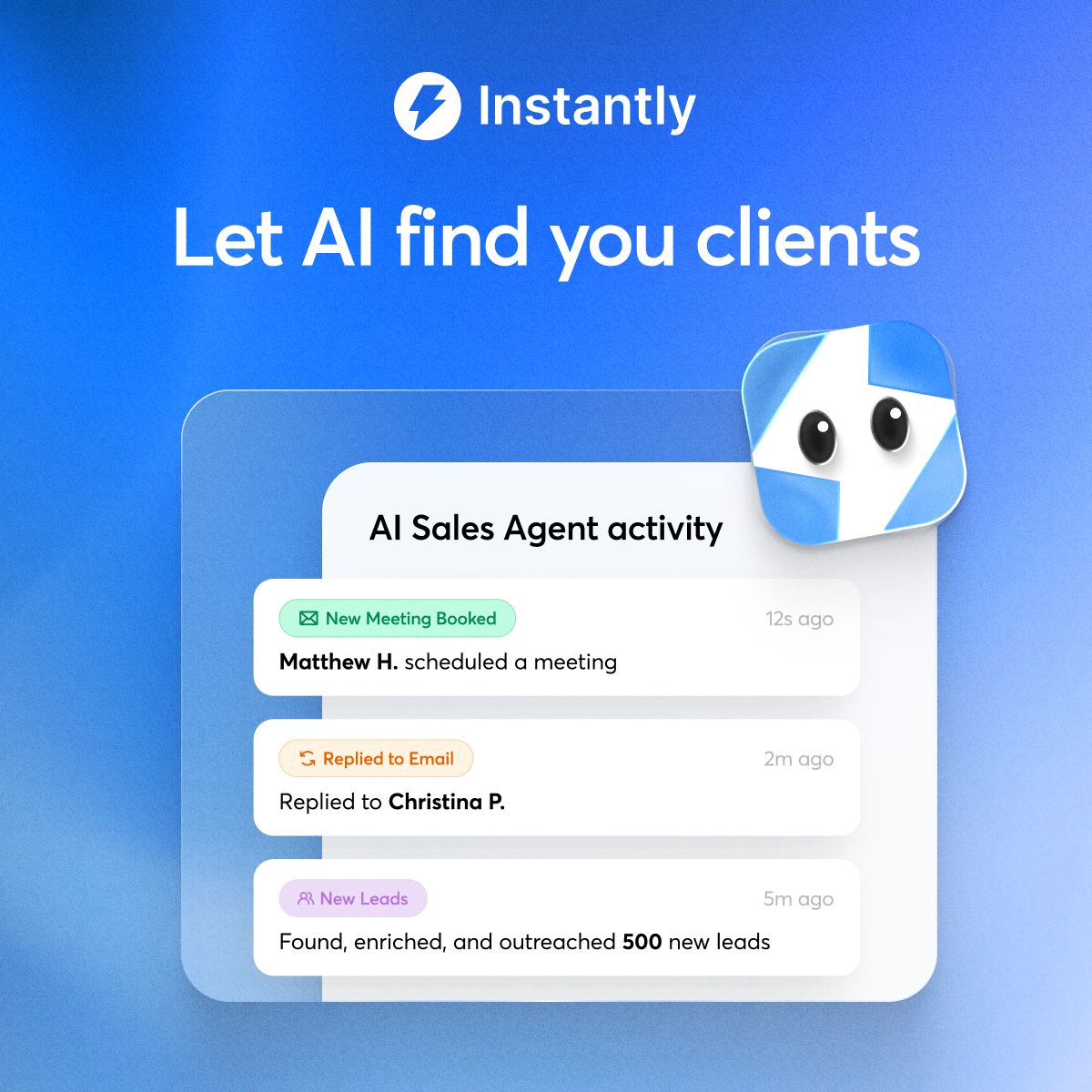
Instantly's AI Sales Agent finds leads matching your ICP, enriches them, writes personalised outreach, sends follow-ups, and turns replies into booked meetings via Calendly. Each generated lead costs 5 credits. It is the most automated end-to-end AI workflow in the category.
Smartlead has SmartAI Bot for categorising leads and creating persona-specific copy. Useful but more basic than Instantly's full AI agent.
For solo operators who want to outsource the entire workflow to AI, Instantly. For agency operators who want AI for personalisation but maintain human control of the campaign, Smartlead.
Which is better for agencies?
Smartlead, clearly.
Unlimited inboxes from Pro tier (Instantly caps at 5 / 25 / unlimited across tiers). White-label option on Custom. Master inbox for unified reply management. Per-client workspaces are native and operationally cleaner.
Instantly works for agencies on higher tiers (Light Speed) but the per-client cost adds up faster.
For any agency running outbound for 5+ clients, Smartlead is the operator default.
Which has better lead data?
Instantly, by default. Both can pair with Apollo or Clay.
Instantly's built-in SuperSearch has 160M+ contacts and is well-integrated into the sending workflow. For solo operators, this saves a $99 / mo Apollo subscription.
Smartlead has no built-in lead database. You pair it with Apollo, Clay, or any verified-email source. Some agencies prefer this separation (different teams own data vs sending). See Apollo vs ZoomInfo and Clay vs Apollo for the data layer.
Data quality on Instantly SuperSearch is uneven across regions. For specialised industries (manufacturing, public sector EU), most agencies still pair Instantly with Apollo or Clay regardless.
How does support compare?
Instantly wins at small scale. Smartlead wins at enterprise scale.
Instantly: faster initial response (within hours on lower tiers). UI is cleaner so support tickets are less common.
Smartlead: slower on Basic tier (6 - 24 hour response). Better on Pro+ with dedicated account managers. Stronger documentation and operator community for deliverability deep-dives.
When to pick Smartlead
→ You are an agency running outbound for clients
→ In-house team with 3+ SDRs
→ Sending volume crosses 50,000 emails per month
→ Need white-label or multi-client workspaces
→ Want unlimited inboxes from a single plan
→ Plan to use Apollo or Clay for data anyway
→ Start a trial: start with Smartlead
When to pick Instantly
→ You are a B2B founder running outbound for one company
→ Solo SDR or small team (1 - 3 people)
→ Sending 3,000 - 8,000 emails per month from 3 - 5 inboxes
→ Want the lead database bundled (saves Apollo subscription)
→ Want AI automation handling more of the workflow
→ Value tool consolidation over infrastructure quality at agency scale
→ Start a trial: start with Instantly
Honest dealbreakers
Smartlead dealbreakers
→ UI is functional but dated. Operators from Apollo or Lemlist spend 2 - 3 days getting comfortable.
→ Customer support replies are slow on Basic. Deliverability incidents can sit 6 - 24 hours.
→ No built-in lead database. You will pair with Apollo, Clay, or similar.
Instantly dealbreakers
→ The free tier was reduced from 10,000 monthly credits to 100 credits trial in early 2025. Read current terms.
→ Inbox limits at lower tiers force upgrades earlier than expected. Growth (5 inboxes) to Hypergrowth (25) jump is common within 3 months.
→ Lead database quality is uneven outside US tech.
→ Agency operations are functional but less mature than Smartlead.
Alternatives worth considering
→ Lemlist: best for teams that prioritise creative personalisation (images, videos, LinkedIn steps). More expensive per inbox but stronger reply rates on ABM-style campaigns.
→ Saleshandy: best for teams optimising on price. Roughly 40% cheaper than Smartlead at comparable volume, weaker infrastructure.
→ Apollo: best for teams that want sequencing plus data in one tool. See Apollo vs Lemlist.
FAQ
Can Smartlead replace Apollo for lead data?
No. Smartlead is a sending platform. You pair it with Apollo, Clay, or any verified-email source. Instantly has a built-in database (160M+) but most agencies still pair it with Apollo for higher data quality.
Which has better deliverability in 2026?
Both have functional warmup and inbox rotation. Instantly's 4.2M warmup network is the largest. Smartlead has more aggressive sender rotation and a longer track record with agencies who report metrics publicly. For agency scale, Smartlead. For solo operators, Instantly.
Can I switch from Instantly to Smartlead mid-campaign?
Technically yes, but expect 1 - 2 days of disruption per 10 inboxes. New inboxes need re-warming. Plan the switch between campaign cycles.
Does either handle LinkedIn outreach?
Neither runs LinkedIn outreach natively at the level of Heyreach or Expandi. Instantly has light integrations. Smartlead requires a separate LinkedIn tool. For email + LinkedIn under one roof, look at Reply.io or run Smartlead + Heyreach.
Is the AI in Instantly actually usable?
Instantly's AI Sales Agent is the most automated end-to-end workflow in the category. It produces personalisation that reads as human when paired with a tight ICP. Smartlead's AI is more basic but works well for first-line variables.
Is Smartlead cheaper than Instantly at agency scale?
Yes, significantly. At 100+ inboxes, Smartlead Pro ($94 / mo) vs Instantly Light Speed ($358+ / mo) is roughly 3.8x in Smartlead's favour.
What does it cost to run a 50-inbox setup?
Software: Smartlead Pro at $94 / mo OR Instantly Hypergrowth at $77 - $97 / mo. Infrastructure (domains + mailboxes at Mailforge): $200 - $350 / mo for 50 inboxes. List data (Apollo or Clay): $99 - $300 / mo. Total: roughly $400 - $800 / mo software + infrastructure.
Bottom line
Both are good tools. They have drifted in different directions: Smartlead toward infrastructure depth and agency operations, Instantly toward solo-operator convenience and bundled lead data.
Pick based on team size and growth trajectory, not on price (they are close at small scale). If you are an agency or growing past 5 reps, Smartlead. If you are a founder running outbound for one company and want consolidation, Instantly.
If you are evaluating either tool, you are likely also asking whether running outbound in-house is actually cheaper than hiring an agency. The tool is 20 percent of the operation. The other 80 percent is list quality, copy, deliverability monitoring, and reply handling. Run our reverse pipeline calculator to see the math, take the pipeline score quiz, or book a call and we will walk through build-or-hire for your setup.
About the author
Aljaz Peklaj is the founder of GROU, a B2B pipeline agency running LinkedIn content, lead generation, and outbound for clients across manufacturing, fintech, iGaming, software, and professional services.
→ Connect on LinkedIn: linkedin.com/in/aljazpeklaj
→ Read more: grouglobal.com/blog
→ Browse the GROU tools directory
→ Book a 30-minute pipeline call
Why trust this review
We are GROU, a B2B pipeline agency that runs lead generation, outbound, and LinkedIn content for clients across manufacturing, fintech, iGaming, software, and professional services. We have used both Smartlead and Instantly in production for 18+ months across multiple client deployments, sometimes on the same campaign through different mailbox pools.
→ Methodology: Comparison data combines our own client campaign results, both vendors' published documentation, third-party deliverability benchmarks (Sparkle, Saleshandy), and live G2 review data. We refresh this article quarterly.
→ Affiliate disclosure: Some links in this article are affiliate links. We earn a small commission if you sign up through them, at no extra cost to you. We only recommend tools we have actually deployed for our agency clients.
TL;DR
Pick Smartlead if you are an agency, an in-house team running 10+ inboxes, or anyone who needs serious deliverability infrastructure. Pick Instantly if you are a founder or small team (1-3 people) that wants an integrated lead database and a cleaner UI. If you cannot decide, default to Smartlead.
Score breakdown at a glance
Third-party signals: Smartlead on G2 rating around 4.7 / 5. Instantly on G2 rating around 4.8 / 5. Both highly rated.
Table of contents
→ Why trust this review
→ Quick comparison
→ The case for Smartlead
→ The case for Instantly
→ How much does each cost?
→ Which has better deliverability?
→ Which has better AI and automation?
→ Which is better for agencies?
→ Which has better lead data?
→ How does support compare?
→ When to pick Smartlead
→ When to pick Instantly
→ Honest dealbreakers
→ Alternatives worth considering
→ FAQ
→ Bottom line
Quick comparison
The case for Smartlead
Smartlead's wedge is agency-grade infrastructure. Founded in 2022 by founders who ran outbound agencies and wanted infrastructure that did not break at scale. The product centres on unlimited mailbox rotation, native warmup, and an API that agency operators actually use.
The unlimited inboxes from Pro tier is the single biggest advantage at scale. An agency running 100+ mailboxes does not pay per-inbox uplift. Master inbox lets you reply from one centralised view across all mailboxes. Saves an SDR roughly 30-60 minutes a day at scale.
White-label is available on Custom. Agencies can resell under their own brand. Instantly does not offer this.
→ Best for: agencies running outbound for clients, in-house sales teams with 3+ SDRs, anyone whose volume crosses 50,000 emails per month, multi-client operations needing white-label.
The case for Instantly
Instantly's wedge is consolidation. Launched in 2021, made its name on aggressive deliverability infrastructure (sender identity segregation, IP rotation, the largest private warmup network at 4.2M accounts) and a clean UI built for solo operators.
In 2024-2025 it added a built-in B2B lead database (SuperSearch, 160M+ contacts) and an AI Sales Agent that finds leads, writes outreach, and handles replies. The product positioning: everything for outbound under one login.
The UI is the cleanest in the category. Reps onboard in days, not weeks. The free trial (100 credits) is enough to validate.
→ Best for: B2B founders running outbound for one company, solo SDRs, small teams (1-3 reps), anyone who wants tool consolidation and minimal procurement friction.
How much does each cost?
Side-by-side tier breakdown. For full live pricing, check Smartlead and Instantly directly.
Smartlead pricing tiers
Instantly pricing tiers
Annual cost at common team sizes (5 inboxes, 5,000 emails / mo)
Hidden costs both: domain and mailbox infrastructure ($4 - $7 per inbox / month at Mailforge or similar).
Want to know what daily send volume your revenue target actually requires? Run our free Reverse Pipeline Calculator or take the Pipeline Score Quiz.
Which has better deliverability?
Tied at the top, with different strengths.
Instantly's 4.2 million account warmup network is the largest in the category. SISR (Sender Identity Segregation and Rotation) plus LightSpeed IP blocks isolate risk across rotating IP pools. In a published 1,104-lead benchmark, Instantly hit 77% open rate and 4.4% reply rate.
Smartlead has more aggressive deliverability features (sender rotation, daily send-rate ramping, blacklist monitoring) and a longer track record with cold-email agencies who report deliverability metrics publicly. In the same benchmark, Smartlead hit 45.9% open rate and 0.96% reply rate.
Take the published numbers with grain of salt (single test, variable lists). In our client campaigns, both deliver functional inbox placement at 80 - 88% on warm-up-completed campaigns. The difference is operational: Instantly is more turnkey, Smartlead is more controllable.
For our outbound deployments at scale, we lean Smartlead. For solo founder campaigns, we lean Instantly.
Which has better AI and automation?
Instantly, by a meaningful margin.
Instantly's AI Sales Agent finds leads matching your ICP, enriches them, writes personalised outreach, sends follow-ups, and turns replies into booked meetings via Calendly. Each generated lead costs 5 credits. It is the most automated end-to-end AI workflow in the category.
Smartlead has SmartAI Bot for categorising leads and creating persona-specific copy. Useful but more basic than Instantly's full AI agent.
For solo operators who want to outsource the entire workflow to AI, Instantly. For agency operators who want AI for personalisation but maintain human control of the campaign, Smartlead.
Which is better for agencies?
Smartlead, clearly.
Unlimited inboxes from Pro tier (Instantly caps at 5 / 25 / unlimited across tiers). White-label option on Custom. Master inbox for unified reply management. Per-client workspaces are native and operationally cleaner.
Instantly works for agencies on higher tiers (Light Speed) but the per-client cost adds up faster.
For any agency running outbound for 5+ clients, Smartlead is the operator default.
Which has better lead data?
Instantly, by default. Both can pair with Apollo or Clay.
Instantly's built-in SuperSearch has 160M+ contacts and is well-integrated into the sending workflow. For solo operators, this saves a $99 / mo Apollo subscription.
Smartlead has no built-in lead database. You pair it with Apollo, Clay, or any verified-email source. Some agencies prefer this separation (different teams own data vs sending). See Apollo vs ZoomInfo and Clay vs Apollo for the data layer.
Data quality on Instantly SuperSearch is uneven across regions. For specialised industries (manufacturing, public sector EU), most agencies still pair Instantly with Apollo or Clay regardless.
How does support compare?
Instantly wins at small scale. Smartlead wins at enterprise scale.
Instantly: faster initial response (within hours on lower tiers). UI is cleaner so support tickets are less common.
Smartlead: slower on Basic tier (6 - 24 hour response). Better on Pro+ with dedicated account managers. Stronger documentation and operator community for deliverability deep-dives.
When to pick Smartlead
→ You are an agency running outbound for clients
→ In-house team with 3+ SDRs
→ Sending volume crosses 50,000 emails per month
→ Need white-label or multi-client workspaces
→ Want unlimited inboxes from a single plan
→ Plan to use Apollo or Clay for data anyway
→ Start a trial: start with Smartlead
When to pick Instantly
→ You are a B2B founder running outbound for one company
→ Solo SDR or small team (1 - 3 people)
→ Sending 3,000 - 8,000 emails per month from 3 - 5 inboxes
→ Want the lead database bundled (saves Apollo subscription)
→ Want AI automation handling more of the workflow
→ Value tool consolidation over infrastructure quality at agency scale
→ Start a trial: start with Instantly
Honest dealbreakers
Smartlead dealbreakers
→ UI is functional but dated. Operators from Apollo or Lemlist spend 2 - 3 days getting comfortable.
→ Customer support replies are slow on Basic. Deliverability incidents can sit 6 - 24 hours.
→ No built-in lead database. You will pair with Apollo, Clay, or similar.
Instantly dealbreakers
→ The free tier was reduced from 10,000 monthly credits to 100 credits trial in early 2025. Read current terms.
→ Inbox limits at lower tiers force upgrades earlier than expected. Growth (5 inboxes) to Hypergrowth (25) jump is common within 3 months.
→ Lead database quality is uneven outside US tech.
→ Agency operations are functional but less mature than Smartlead.
Alternatives worth considering
→ Lemlist: best for teams that prioritise creative personalisation (images, videos, LinkedIn steps). More expensive per inbox but stronger reply rates on ABM-style campaigns.
→ Saleshandy: best for teams optimising on price. Roughly 40% cheaper than Smartlead at comparable volume, weaker infrastructure.
→ Apollo: best for teams that want sequencing plus data in one tool. See Apollo vs Lemlist.
FAQ
Can Smartlead replace Apollo for lead data?
No. Smartlead is a sending platform. You pair it with Apollo, Clay, or any verified-email source. Instantly has a built-in database (160M+) but most agencies still pair it with Apollo for higher data quality.
Which has better deliverability in 2026?
Both have functional warmup and inbox rotation. Instantly's 4.2M warmup network is the largest. Smartlead has more aggressive sender rotation and a longer track record with agencies who report metrics publicly. For agency scale, Smartlead. For solo operators, Instantly.
Can I switch from Instantly to Smartlead mid-campaign?
Technically yes, but expect 1 - 2 days of disruption per 10 inboxes. New inboxes need re-warming. Plan the switch between campaign cycles.
Does either handle LinkedIn outreach?
Neither runs LinkedIn outreach natively at the level of Heyreach or Expandi. Instantly has light integrations. Smartlead requires a separate LinkedIn tool. For email + LinkedIn under one roof, look at Reply.io or run Smartlead + Heyreach.
Is the AI in Instantly actually usable?
Instantly's AI Sales Agent is the most automated end-to-end workflow in the category. It produces personalisation that reads as human when paired with a tight ICP. Smartlead's AI is more basic but works well for first-line variables.
Is Smartlead cheaper than Instantly at agency scale?
Yes, significantly. At 100+ inboxes, Smartlead Pro ($94 / mo) vs Instantly Light Speed ($358+ / mo) is roughly 3.8x in Smartlead's favour.
What does it cost to run a 50-inbox setup?
Software: Smartlead Pro at $94 / mo OR Instantly Hypergrowth at $77 - $97 / mo. Infrastructure (domains + mailboxes at Mailforge): $200 - $350 / mo for 50 inboxes. List data (Apollo or Clay): $99 - $300 / mo. Total: roughly $400 - $800 / mo software + infrastructure.
Bottom line
Both are good tools. They have drifted in different directions: Smartlead toward infrastructure depth and agency operations, Instantly toward solo-operator convenience and bundled lead data.
Pick based on team size and growth trajectory, not on price (they are close at small scale). If you are an agency or growing past 5 reps, Smartlead. If you are a founder running outbound for one company and want consolidation, Instantly.
If you are evaluating either tool, you are likely also asking whether running outbound in-house is actually cheaper than hiring an agency. The tool is 20 percent of the operation. The other 80 percent is list quality, copy, deliverability monitoring, and reply handling. Run our reverse pipeline calculator to see the math, take the pipeline score quiz, or book a call and we will walk through build-or-hire for your setup.
About the author
Aljaz Peklaj is the founder of GROU, a B2B pipeline agency running LinkedIn content, lead generation, and outbound for clients across manufacturing, fintech, iGaming, software, and professional services.
→ Connect on LinkedIn: linkedin.com/in/aljazpeklaj
→ Read more: grouglobal.com/blog
→ Browse the GROU tools directory
→ Book a 30-minute pipeline call
Why trust this review
We are GROU, a B2B pipeline agency that runs lead generation, outbound, and LinkedIn content for clients across manufacturing, fintech, iGaming, software, and professional services. We have used both Smartlead and Instantly in production for 18+ months across multiple client deployments, sometimes on the same campaign through different mailbox pools.
→ Methodology: Comparison data combines our own client campaign results, both vendors' published documentation, third-party deliverability benchmarks (Sparkle, Saleshandy), and live G2 review data. We refresh this article quarterly.
→ Affiliate disclosure: Some links in this article are affiliate links. We earn a small commission if you sign up through them, at no extra cost to you. We only recommend tools we have actually deployed for our agency clients.
TL;DR
Pick Smartlead if you are an agency, an in-house team running 10+ inboxes, or anyone who needs serious deliverability infrastructure. Pick Instantly if you are a founder or small team (1-3 people) that wants an integrated lead database and a cleaner UI. If you cannot decide, default to Smartlead.
Score breakdown at a glance
Third-party signals: Smartlead on G2 rating around 4.7 / 5. Instantly on G2 rating around 4.8 / 5. Both highly rated.
Table of contents
→ Why trust this review
→ Quick comparison
→ The case for Smartlead
→ The case for Instantly
→ How much does each cost?
→ Which has better deliverability?
→ Which has better AI and automation?
→ Which is better for agencies?
→ Which has better lead data?
→ How does support compare?
→ When to pick Smartlead
→ When to pick Instantly
→ Honest dealbreakers
→ Alternatives worth considering
→ FAQ
→ Bottom line
Quick comparison
The case for Smartlead
Smartlead's wedge is agency-grade infrastructure. Founded in 2022 by founders who ran outbound agencies and wanted infrastructure that did not break at scale. The product centres on unlimited mailbox rotation, native warmup, and an API that agency operators actually use.
The unlimited inboxes from Pro tier is the single biggest advantage at scale. An agency running 100+ mailboxes does not pay per-inbox uplift. Master inbox lets you reply from one centralised view across all mailboxes. Saves an SDR roughly 30-60 minutes a day at scale.
White-label is available on Custom. Agencies can resell under their own brand. Instantly does not offer this.
→ Best for: agencies running outbound for clients, in-house sales teams with 3+ SDRs, anyone whose volume crosses 50,000 emails per month, multi-client operations needing white-label.
The case for Instantly
Instantly's wedge is consolidation. Launched in 2021, made its name on aggressive deliverability infrastructure (sender identity segregation, IP rotation, the largest private warmup network at 4.2M accounts) and a clean UI built for solo operators.
In 2024-2025 it added a built-in B2B lead database (SuperSearch, 160M+ contacts) and an AI Sales Agent that finds leads, writes outreach, and handles replies. The product positioning: everything for outbound under one login.
The UI is the cleanest in the category. Reps onboard in days, not weeks. The free trial (100 credits) is enough to validate.
→ Best for: B2B founders running outbound for one company, solo SDRs, small teams (1-3 reps), anyone who wants tool consolidation and minimal procurement friction.
How much does each cost?
Side-by-side tier breakdown. For full live pricing, check Smartlead and Instantly directly.
Smartlead pricing tiers
Instantly pricing tiers
Annual cost at common team sizes (5 inboxes, 5,000 emails / mo)
Hidden costs both: domain and mailbox infrastructure ($4 - $7 per inbox / month at Mailforge or similar).
Want to know what daily send volume your revenue target actually requires? Run our free Reverse Pipeline Calculator or take the Pipeline Score Quiz.
Which has better deliverability?
Tied at the top, with different strengths.
Instantly's 4.2 million account warmup network is the largest in the category. SISR (Sender Identity Segregation and Rotation) plus LightSpeed IP blocks isolate risk across rotating IP pools. In a published 1,104-lead benchmark, Instantly hit 77% open rate and 4.4% reply rate.
Smartlead has more aggressive deliverability features (sender rotation, daily send-rate ramping, blacklist monitoring) and a longer track record with cold-email agencies who report deliverability metrics publicly. In the same benchmark, Smartlead hit 45.9% open rate and 0.96% reply rate.
Take the published numbers with grain of salt (single test, variable lists). In our client campaigns, both deliver functional inbox placement at 80 - 88% on warm-up-completed campaigns. The difference is operational: Instantly is more turnkey, Smartlead is more controllable.
For our outbound deployments at scale, we lean Smartlead. For solo founder campaigns, we lean Instantly.
Which has better AI and automation?
Instantly, by a meaningful margin.
Instantly's AI Sales Agent finds leads matching your ICP, enriches them, writes personalised outreach, sends follow-ups, and turns replies into booked meetings via Calendly. Each generated lead costs 5 credits. It is the most automated end-to-end AI workflow in the category.
Smartlead has SmartAI Bot for categorising leads and creating persona-specific copy. Useful but more basic than Instantly's full AI agent.
For solo operators who want to outsource the entire workflow to AI, Instantly. For agency operators who want AI for personalisation but maintain human control of the campaign, Smartlead.
Which is better for agencies?
Smartlead, clearly.
Unlimited inboxes from Pro tier (Instantly caps at 5 / 25 / unlimited across tiers). White-label option on Custom. Master inbox for unified reply management. Per-client workspaces are native and operationally cleaner.
Instantly works for agencies on higher tiers (Light Speed) but the per-client cost adds up faster.
For any agency running outbound for 5+ clients, Smartlead is the operator default.
Which has better lead data?
Instantly, by default. Both can pair with Apollo or Clay.
Instantly's built-in SuperSearch has 160M+ contacts and is well-integrated into the sending workflow. For solo operators, this saves a $99 / mo Apollo subscription.
Smartlead has no built-in lead database. You pair it with Apollo, Clay, or any verified-email source. Some agencies prefer this separation (different teams own data vs sending). See Apollo vs ZoomInfo and Clay vs Apollo for the data layer.
Data quality on Instantly SuperSearch is uneven across regions. For specialised industries (manufacturing, public sector EU), most agencies still pair Instantly with Apollo or Clay regardless.
How does support compare?
Instantly wins at small scale. Smartlead wins at enterprise scale.
Instantly: faster initial response (within hours on lower tiers). UI is cleaner so support tickets are less common.
Smartlead: slower on Basic tier (6 - 24 hour response). Better on Pro+ with dedicated account managers. Stronger documentation and operator community for deliverability deep-dives.
When to pick Smartlead
→ You are an agency running outbound for clients
→ In-house team with 3+ SDRs
→ Sending volume crosses 50,000 emails per month
→ Need white-label or multi-client workspaces
→ Want unlimited inboxes from a single plan
→ Plan to use Apollo or Clay for data anyway
→ Start a trial: start with Smartlead
When to pick Instantly
→ You are a B2B founder running outbound for one company
→ Solo SDR or small team (1 - 3 people)
→ Sending 3,000 - 8,000 emails per month from 3 - 5 inboxes
→ Want the lead database bundled (saves Apollo subscription)
→ Want AI automation handling more of the workflow
→ Value tool consolidation over infrastructure quality at agency scale
→ Start a trial: start with Instantly
Honest dealbreakers
Smartlead dealbreakers
→ UI is functional but dated. Operators from Apollo or Lemlist spend 2 - 3 days getting comfortable.
→ Customer support replies are slow on Basic. Deliverability incidents can sit 6 - 24 hours.
→ No built-in lead database. You will pair with Apollo, Clay, or similar.
Instantly dealbreakers
→ The free tier was reduced from 10,000 monthly credits to 100 credits trial in early 2025. Read current terms.
→ Inbox limits at lower tiers force upgrades earlier than expected. Growth (5 inboxes) to Hypergrowth (25) jump is common within 3 months.
→ Lead database quality is uneven outside US tech.
→ Agency operations are functional but less mature than Smartlead.
Alternatives worth considering
→ Lemlist: best for teams that prioritise creative personalisation (images, videos, LinkedIn steps). More expensive per inbox but stronger reply rates on ABM-style campaigns.
→ Saleshandy: best for teams optimising on price. Roughly 40% cheaper than Smartlead at comparable volume, weaker infrastructure.
→ Apollo: best for teams that want sequencing plus data in one tool. See Apollo vs Lemlist.
FAQ
Can Smartlead replace Apollo for lead data?
No. Smartlead is a sending platform. You pair it with Apollo, Clay, or any verified-email source. Instantly has a built-in database (160M+) but most agencies still pair it with Apollo for higher data quality.
Which has better deliverability in 2026?
Both have functional warmup and inbox rotation. Instantly's 4.2M warmup network is the largest. Smartlead has more aggressive sender rotation and a longer track record with agencies who report metrics publicly. For agency scale, Smartlead. For solo operators, Instantly.
Can I switch from Instantly to Smartlead mid-campaign?
Technically yes, but expect 1 - 2 days of disruption per 10 inboxes. New inboxes need re-warming. Plan the switch between campaign cycles.
Does either handle LinkedIn outreach?
Neither runs LinkedIn outreach natively at the level of Heyreach or Expandi. Instantly has light integrations. Smartlead requires a separate LinkedIn tool. For email + LinkedIn under one roof, look at Reply.io or run Smartlead + Heyreach.
Is the AI in Instantly actually usable?
Instantly's AI Sales Agent is the most automated end-to-end workflow in the category. It produces personalisation that reads as human when paired with a tight ICP. Smartlead's AI is more basic but works well for first-line variables.
Is Smartlead cheaper than Instantly at agency scale?
Yes, significantly. At 100+ inboxes, Smartlead Pro ($94 / mo) vs Instantly Light Speed ($358+ / mo) is roughly 3.8x in Smartlead's favour.
What does it cost to run a 50-inbox setup?
Software: Smartlead Pro at $94 / mo OR Instantly Hypergrowth at $77 - $97 / mo. Infrastructure (domains + mailboxes at Mailforge): $200 - $350 / mo for 50 inboxes. List data (Apollo or Clay): $99 - $300 / mo. Total: roughly $400 - $800 / mo software + infrastructure.
Bottom line
Both are good tools. They have drifted in different directions: Smartlead toward infrastructure depth and agency operations, Instantly toward solo-operator convenience and bundled lead data.
Pick based on team size and growth trajectory, not on price (they are close at small scale). If you are an agency or growing past 5 reps, Smartlead. If you are a founder running outbound for one company and want consolidation, Instantly.
If you are evaluating either tool, you are likely also asking whether running outbound in-house is actually cheaper than hiring an agency. The tool is 20 percent of the operation. The other 80 percent is list quality, copy, deliverability monitoring, and reply handling. Run our reverse pipeline calculator to see the math, take the pipeline score quiz, or book a call and we will walk through build-or-hire for your setup.
About the author
Aljaz Peklaj is the founder of GROU, a B2B pipeline agency running LinkedIn content, lead generation, and outbound for clients across manufacturing, fintech, iGaming, software, and professional services.
→ Connect on LinkedIn: linkedin.com/in/aljazpeklaj
→ Read more: grouglobal.com/blog
→ Browse the GROU tools directory
→ Book a 30-minute pipeline call
Pipeline OS Newsletter
Build qualified pipeline
Get weekly tactics to generate demand, improve lead quality, and book more meetings.





Trusted by industry leaders
Trusted by industry leaders
Trusted by industry leaders
Ready to build qualified pipeline?
Ready to build qualified pipeline?
Ready to build qualified pipeline?
Book a call to see if we're the right fit, or take the 2-minute quiz to get a clear starting point.
Book a call to see if we're the right fit, or take the 2-minute quiz to get a clear starting point.
Book a call to see if we're the right fit, or take the 2-minute quiz to get a clear starting point.
" height="30.21639343089746px" id="hfGbXmQR2" width="30.216393430897455px"/></svg>)
Copyright © 2026 – All Right Reserved
Copyright © 2026 – All Right Reserved
Copyright © 2026 – All Right Reserved