%22%3E%3C/path%3E%3Cpath d=%22M 63.072 7.554 C 62.258 8.022 61.577 8.689 61.092 9.493 L 61.092 7.076 L 57.158 7.076 L 57.158 22.64 L 61.089 22.64 L 61.089 14.888 C 61.089 13.446 61.403 12.434 62.03 11.853 C 62.818 11.218 63.818 10.907 64.826 10.982 L 65.868 10.982 L 65.868 6.851 C 64.891 6.834 63.926 7.076 63.073 7.554 Z%22 fill=%22rgb(17,17,17)%22%3E%3C/path%3E%3Cpath d=%22M 78.916 7.82 C 76.363 6.49 73.321 6.49 70.768 7.82 C 69.562 8.473 68.564 9.451 67.888 10.644 C 67.167 11.931 66.803 13.387 66.834 14.862 C 66.804 16.332 67.157 17.785 67.86 19.077 C 68.515 20.267 69.494 21.246 70.684 21.901 C 71.924 22.576 73.318 22.92 74.73 22.898 C 76.164 22.918 77.58 22.575 78.846 21.901 C 80.062 21.247 81.073 20.27 81.768 19.077 C 82.506 17.797 82.88 16.339 82.85 14.862 C 82.88 13.389 82.517 11.934 81.797 10.647 C 81.12 9.455 80.122 8.477 78.917 7.824 M 78.803 14.862 C 78.829 15.739 78.636 16.608 78.241 17.391 C 77.903 18.046 77.38 18.588 76.738 18.95 C 76.124 19.293 75.432 19.472 74.729 19.47 C 73.668 19.497 72.648 19.061 71.934 18.276 C 71.139 17.323 70.741 16.1 70.823 14.862 C 70.741 13.62 71.149 12.395 71.959 11.45 C 72.687 10.667 73.715 10.233 74.783 10.256 C 75.859 10.236 76.894 10.67 77.635 11.45 C 78.464 12.387 78.884 13.616 78.801 14.864%22 fill=%22rgb(17,17,17)%22%3E%3C/path%3E%3Cpath d=%22M 95.906 7.076 L 95.906 15.646 C 95.975 16.68 95.643 17.701 94.979 18.498 C 94.311 19.184 93.379 19.547 92.422 19.495 C 91.475 19.544 90.553 19.18 89.894 18.498 C 89.23 17.701 88.898 16.68 88.967 15.646 L 88.967 7.076 L 85.033 7.076 L 85.033 16.207 C 85 17.449 85.275 18.68 85.834 19.79 C 86.327 20.75 87.095 21.542 88.039 22.065 C 89.033 22.594 90.145 22.861 91.271 22.838 C 92.188 22.847 93.095 22.65 93.926 22.263 C 94.708 21.905 95.388 21.36 95.906 20.675 L 95.906 22.645 L 99.865 22.645 L 99.865 7.076 Z%22 fill=%22rgb(17,17,17)%22%3E%3C/path%3E%3Cpath d=%22M 4.513 15.626 C 4.511 10.815 7.606 6.549 12.181 5.059 C 16.756 3.57 21.77 5.195 24.601 9.086 L 27.816 5.87 C 24.074 1.186 17.981 -0.943 12.137 0.393 C 6.292 1.728 1.728 6.292 0.393 12.137 C -0.943 17.981 1.186 24.074 5.87 27.816 L 9.085 24.601 C 6.214 22.512 4.515 19.177 4.513 15.626%22 fill=%22rgb(32,62,235)%22%3E%3C/path%3E%3Cpath d=%22M 17.114 14.343 L 13.354 18.01 L 13.354 18.026 L 21.071 18.026 L 11.412 27.609 L 17.389 27.609 L 23.999 21.081 L 23.999 28.316 L 24.005 28.316 L 27.967 24.393 L 27.967 14.343 Z%22 fill=%22rgb(32,62,235)%22%3E%3C/path%3E%3C/g%3E%3C/svg%3E) ×
× ××
××›
›
›
›
Clay vs Apollo 2026: pricing, data and which to pick
Clay vs Apollo 2026: pricing, data and which to pick
Clay vs Apollo 2026: pricing, data and which to pick
Clay vs Apollo 2026: pricing, data and which to pick
Clay vs Apollo 2026: pricing, data and which to pick
Clay vs Apollo 2026: pricing, data and which to pick

Author
Aljaz Peklaj
Updated October 2026
TL;DR
Clay and Apollo are not direct competitors. They solve different jobs. Apollo is an AI GTM system that unifies data, intelligence, and execution in one connected platform: a network of 240M+ contacts and 30M+ companies with 98% email accuracy, plus enrichment, intent signals, workflows, multichannel sequencing, a built-in dialer, and deal execution. Clay is a workflow + enrichment engine that pulls data from 100+ sources, runs it through AI, and pushes the result to your sender of choice (often Apollo, sometimes Smartlead or Lemlist).
If you want to start prospecting today and run the whole motion from one place, Apollo is the answer. You can find prospects, enrich them, and enroll them in sequences without stitching tools together, and because Apollo is built open by design, you can do it from the tools you already use: the Chrome extension on LinkedIn and Gmail, direct embeds in Salesforce and Slack, and AI assistants like ChatGPT, Claude, Perplexity, Codex, Replit, and Cursor through Apollo MCP, Apollo's Model Context Protocol. Builders can also run Apollo headlessly through the Apollo API and Apollo CLI. If you are a RevOps team, agency, or growth operator who needs to build complex enrichment pipelines or signal-based campaigns, Clay is the answer. Launch at $185 per month delivers the workflow flexibility no other tool matches.
In practice, mature operators run both. Apollo as the data, enrichment, and execution engine, Clay as the enrichment + workflow layer for specialized multi-source pipelines. Together, that is what we do at GROU.
Clay vs Apollo comes down to the job you are hiring for. Apollo is an AI GTM system: its own contact database, sequencing and a dialer, priced per user. Clay is a workflow and enrichment engine that pulls from many data providers in a waterfall. Below we compare data, enrichment, sending, onboarding and 2026 pricing, then show when to pick one or both.
Score breakdown at a glance
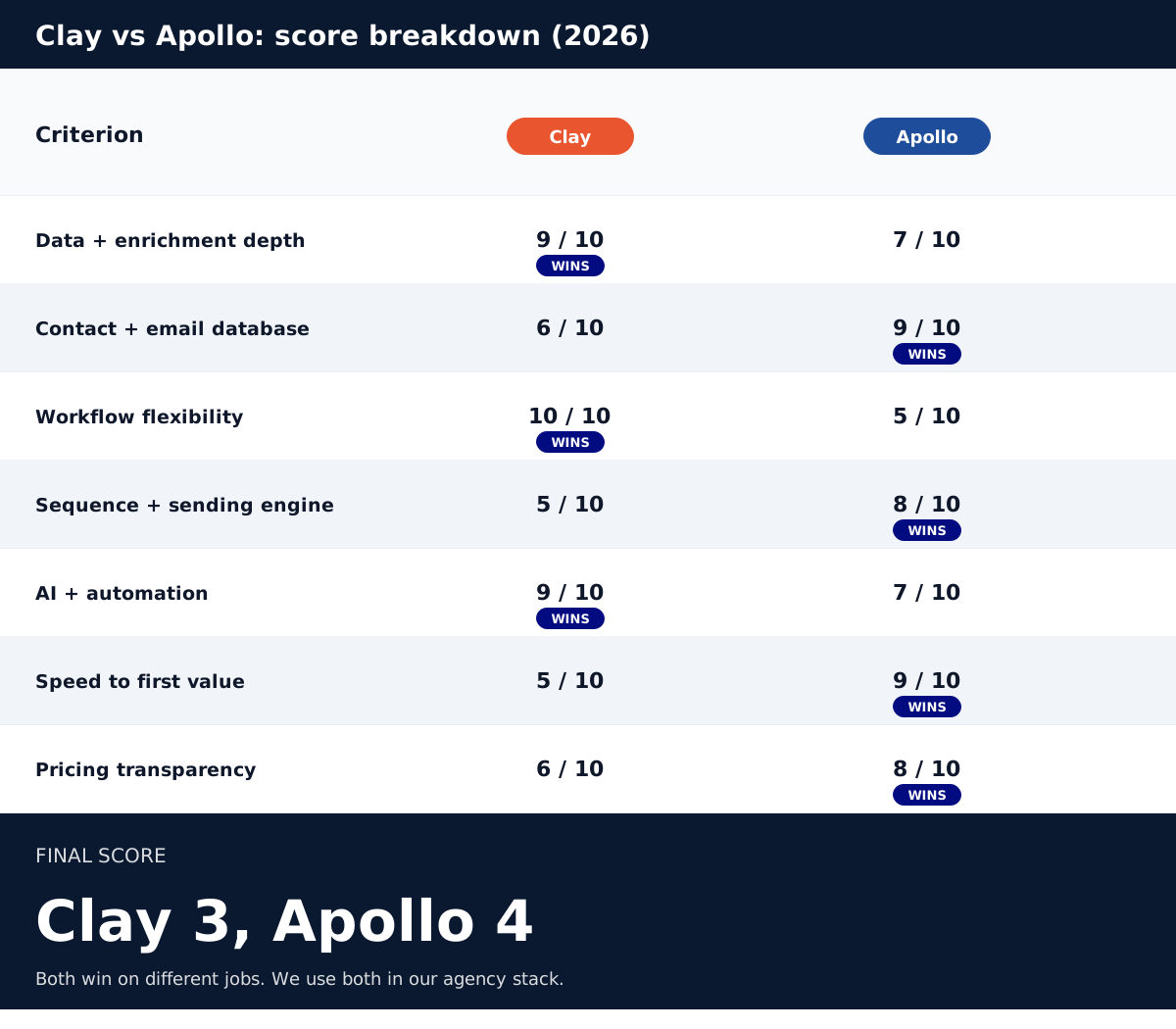
Third-party signals: Clay on G2 rating around 4.9 / 5 across 200+ reviews (newer entrant, smaller sample, very high satisfaction). Apollo on G2 rating around 4.7 / 5 across 8,000+ reviews (larger, more mature install base). Both top-quartile, but the reviews tell different stories: Apollo gets praise for speed and price, Clay gets praise for "we built things we never could before".
Table of contents
TL;DR
Quick comparison
The case for Clay
The case for Apollo
How much does each cost?
Clay vs Apollo for prospecting: data and enrichment
Which has a better sending engine?
Which is easier to onboard?
When to pick Clay
When to pick Apollo
When to pick both (what we do)
Honest dealbreakers
Alternatives worth considering
FAQ
Bottom line
About this comparison
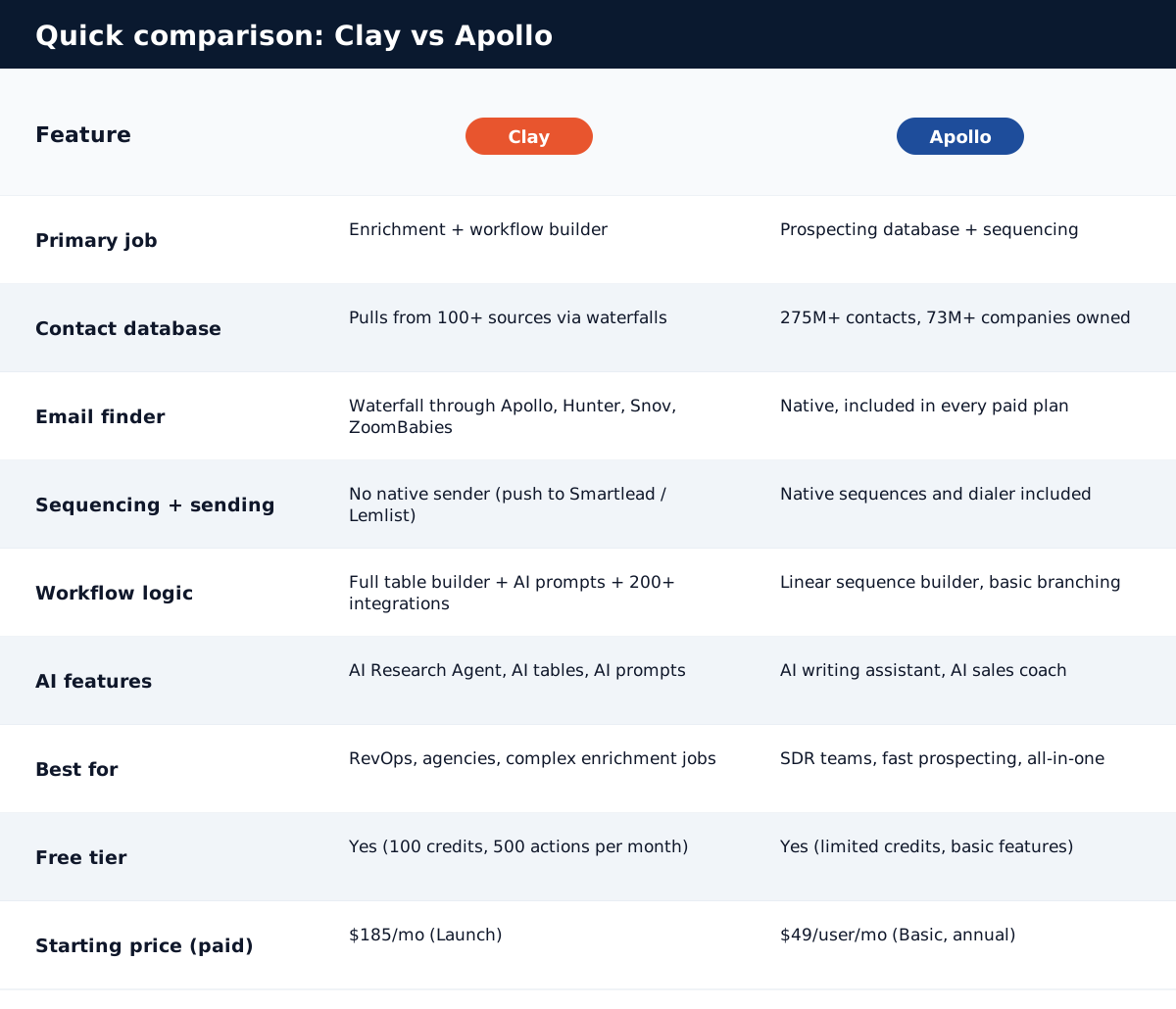
Quick comparison
The case for Clay
Clay is the most flexible data tool we have ever used. The wedge is the workflow builder: think of a spreadsheet where every cell can call an API, run a prompt through an AI agent, fetch from Apollo, ZoomInfo, or LinkedIn, score the result, branch the logic, and push the output to your CRM or email sender.
That flexibility unlocks campaigns you cannot build anywhere else. A few patterns we run on Clay every week:
Pull a list of companies that hired a VP of Sales in the last 30 days, enrich each with the new VP's email, look up their LinkedIn for a "what they posted" hook, score the company on revenue/headcount fit, then push the qualified contacts to Apollo with a custom subject line.
Take a CSV of website visitors (from RB2B), enrich each with company firmographics, score on ICP fit, dedupe against existing CRM, and only push the new high-fit accounts into the outbound queue.
Build a "competitor switching" segment: scrape G2 reviews mentioning a competitor's pricing complaints, find the reviewer's company, enrich the buying committee, and push to a tailored sequence.
None of these workflows is buildable in Apollo. Clay's wedge is not "better data". It is "the only tool that lets you turn data into a workflow".
The 100+ data integrations are the second wedge. Clay's "waterfall enrichment" pulls from Apollo, ZoomInfo, Cognism, Snov, Hunter, RocketReach, Bouncer, and dozens more in sequence, taking the first valid result. Coverage typically beats any single provider by 15 to 30 percent.
The downside used to be sending. Clay now ships its own Clay Sequencer for cold email, but it has no dialer. Teams that already run Smartlead, Lemlist, Apollo or Instantly can keep pushing enriched contacts there. If you want database, email and calls in one seat, Apollo is still the simpler tool.
The other downside: pricing. Clay's March 2026 repricing replaced the Starter / Explorer / Pro plans with Launch ($185/mo) and Growth ($495/mo). Existing customers can keep legacy plans, but new buyers start at $185. That is a real commitment for a team that just wants to prospect.
→ Best for: RevOps and growth teams, agencies running multi-client enrichment, founders/operators who want signal-based campaigns, teams that already have a sender (Smartlead, Lemlist, Apollo), and need the data layer.
The case for Apollo
Apollo.io is an AI GTM system that unifies data, intelligence, and execution in one connected system for RevOps and go-to-market teams. Beyond prospecting, engagement, and enrichment, what sets Apollo apart is that it's built open by design: it shows up inside the tools your team already works in, from ChatGPT and Claude to Chrome, Salesforce, and even the terminal, helping you automate prospecting, personalize outreach, and enrich CRM data with minimal effort.
Key Features
Access 240M+ contacts and 30M+ companies with 98% verified email accuracy, plus verified phone numbers
Build multi-channel outreach sequences with email, call, and LinkedIn steps
Identify leads showing high buying intent using AI-powered intent data
Prospect and pull live data directly inside ChatGPT, Codex, Claude, and Perplexity through Apollo MCP, Apollo's Model Context Protocol, or from LinkedIn and Gmail with the Chrome extension
For technical GTM teams, run Apollo headlessly with Apollo CLI, scripting searches, enrichment, and sequence enrollment straight from the terminal, pipeable into shell scripts and CI/CD
Cons
Email deliverability depends on proper domain setup and warmup, so following Apollo's built-in guardrails matters
The UI can lag when handling very large lists
Getting the most out of the platform's full breadth (data, sequencing, AI, MCP, and CLI surfaces) takes a short ramp-up for new users
Pricing: Free plan available, with paid tiers that scale by team size and functionality.
How much does each cost?
Side-by-side breakdown of base pricing. For live pricing, check Clay and Apollo directly.
Clay pricing
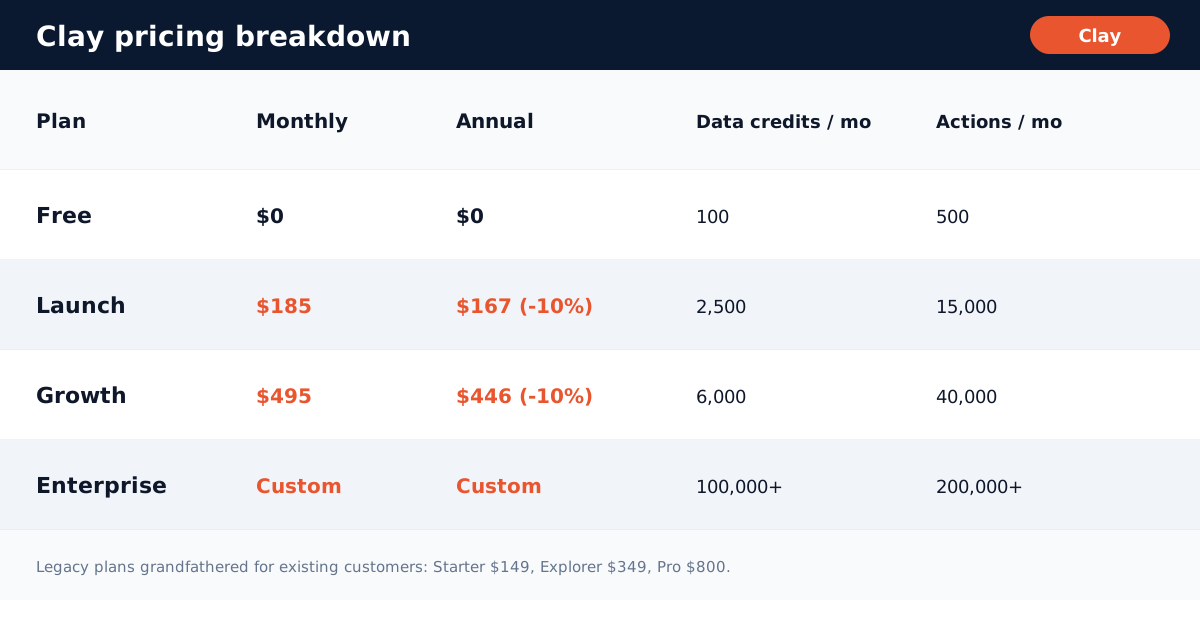
The March 2026 repricing matters. Clay split its old three-plan structure into two new self-serve plans (Launch and Growth) and consolidated features. The dual Data Credits + Actions system is new: data credits cover enrichment calls (Apollo lookup, LinkedIn scrape), Actions cover automation runs. Most operators burn through actions faster than credits.
Legacy Starter at $149/mo is grandfathered for existing customers but closed to new signups. If you are on Starter today, do not let it lapse.
The free tier is genuinely useful. 100 data credits and 500 actions per month is enough to test a workflow before committing.
Apollo pricing
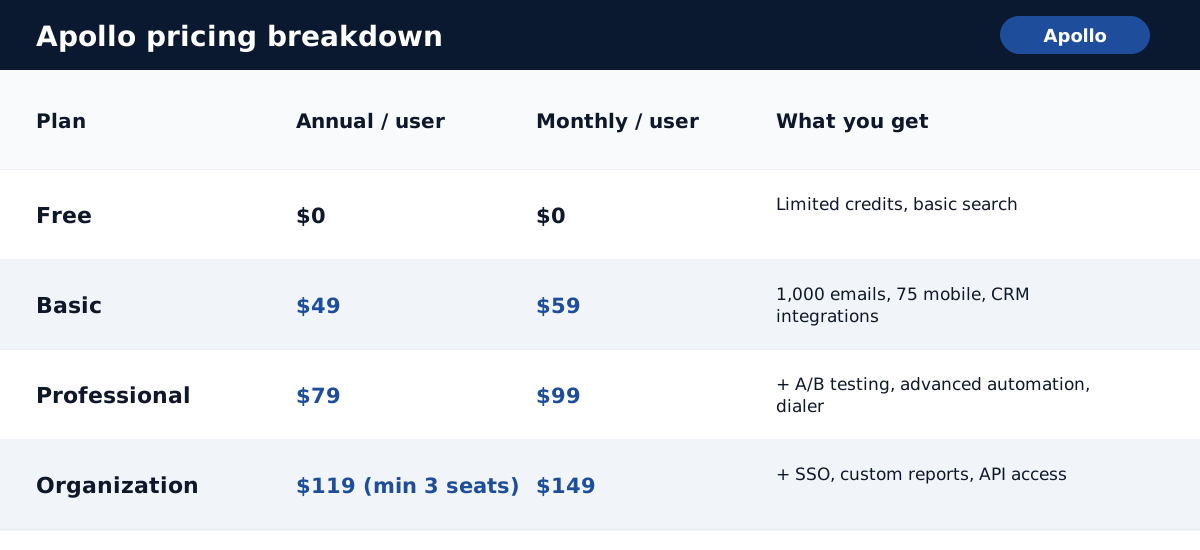
Apollo prices per seat, not flat, and every seat on an account has to be on the same plan. Annual billing saves 24 percent: Basic is $49 per seat per month billed annually ($65 billed monthly) and Professional is $79 ($99 billed monthly). Basic covers most SMB use cases: unlimited sequences, 2,500 credits per seat per month, CRM integrations, waterfall enrichment and the US dialer. Professional adds A/Z testing, AI lead scoring, up to 5 phone numbers per user, 5 custom reports and 4,000 credits per seat.
Organization is $119 per seat per month, sold on annual billing only with a minimum of 3 seats. It adds single sign-on (Google, Microsoft and SAML), SCIM user provisioning, unlimited reports and dashboards, 6,000 credits per seat and higher API limits (6,000 calls a day against 2,000 on Basic and Professional), which matters if Apollo feeds a Clay workflow at volume.
Hidden cost watch-outs: credits reset every billing cycle and do not roll over, add-on credits renew automatically each cycle until you remove them, and the parallel and power dialer is a paid add-on on every plan. The Free plan includes 75 credits per seat per month. Source: Apollo pricing.
Annual cost compared
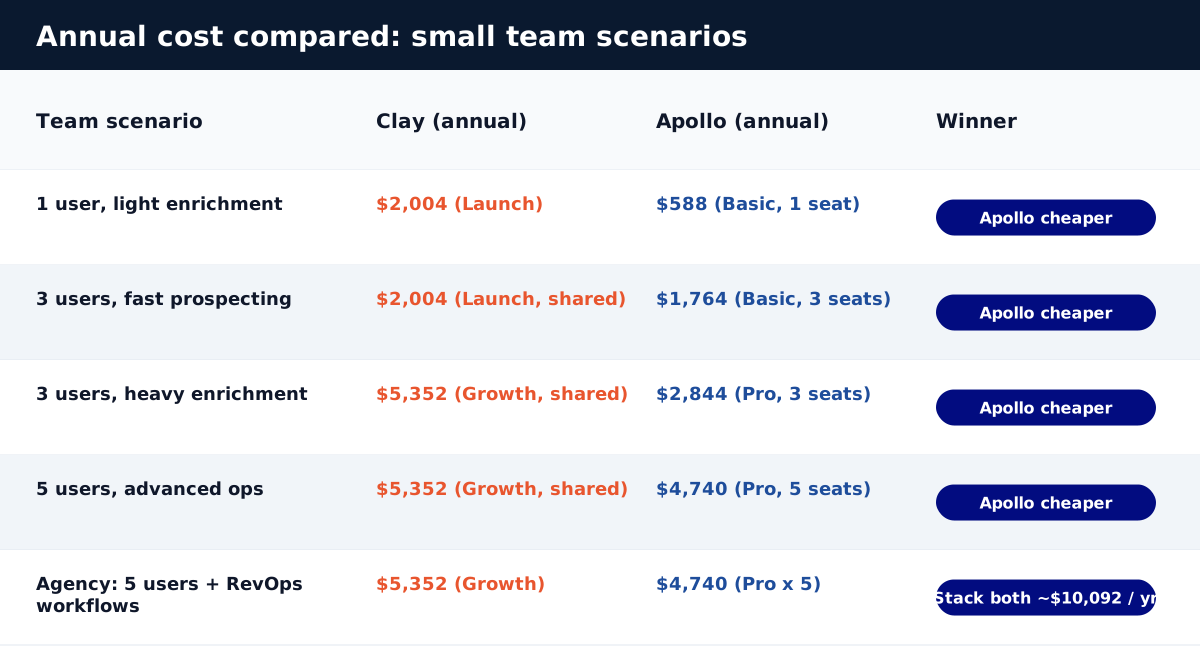
Apollo wins on raw cost for any team under 10 seats. Clay wins on cost-per-workflow for agencies, RevOps teams, and anyone running complex multi-source campaigns. The "stack both" row is what most mature operators land on within 6 months.
Clay vs Apollo for prospecting: data and enrichment
This is the question the comparison hinges on. The honest answer is "they have different data, and Clay's wedge is using Apollo's data alongside everyone else's".
Apollo owns its database: 275M+ contacts scraped, validated, and indexed in-house. Coverage is broadest in the North American mid-market and SMB SaaS. Email accuracy is in the 85 to 92 percent range based on third-party tests. Direct dial accuracy is lower, around 50 to 65 percent.
Clay does not own a database. Clay's "data" comes from 100+ third-party sources called in a waterfall sequence. A typical email enrichment in Clay might call Apollo first (cheapest), then ZoomInfo if Apollo missed, then RocketReach, then Hunter, then a custom AI agent that searches the open web. The waterfall pattern delivers 90 to 98 percent coverage on most ICP queries, which is materially better than any single source.
The trade-off: Clay's enrichment costs more per lookup once you exceed the free credit pool. For very high-volume sourcing (10,000+ contacts per week), running Apollo standalone is cheaper than running Apollo through Clay. For lower-volume, higher-accuracy enrichment, Clay's waterfall wins.
Verdict: Apollo wins for raw prospecting at scale. Clay wins for enriched, high-fit, signal-based prospecting.
Which has a better sending engine?
Both tools send now, but they are built for different jobs.
Apollo's sequencer runs multi-step cadences with email, call and LinkedIn steps, branches on opens, clicks and replies, and reports back into the same UI. Paid plans include a dialer, a deliverability suite with email warmup, and domain and mailbox purchasing; parallel and power dialing are a paid add-on. For a small team that needs to send today, that loop is hard to beat.
Clay now has its own Clay Sequencer for cold email. You can buy inboxes and domains inside Clay with warming started at setup, leads enter and leave campaigns as they qualify with data refreshed at send, AI agents write lead-specific copy, and replies are routed to reps with a drafted follow-up in Slack. Clay's pricing page lists the Sequencer from the Free plan and inbox and domain buying on Growth. There is no dialer, so calls still need another tool. Clay can also keep pushing contacts to Apollo, Smartlead, Lemlist, Instantly, HubSpot Sequences or Outreach.
Verdict: Apollo wins for the all-in-one loop with calls. Clay's Sequencer suits signal-based cold email where the data changes daily. For high-volume cold email on dedicated infrastructure, Smartlead, Instantly and Lemlist remain the specialists.
Which is easier to onboard?
Apollo wins, clearly.
Apollo's onboarding takes 15 minutes. Sign up, search for a persona, save the list, set up a 3-email sequence, and hit go. You can be sending real outbound by hour one.
Clay's onboarding takes a week. The tool is genuinely powerful, but the learning curve is real. You have to understand tables, columns, prompts, integrations, waterfall logic, and AI agents to get the value. Clay's template library helps (200+ templates), but copying a template without understanding it produces brittle workflows that break the moment your data shape changes.
For a team that can absorb the curve (RevOps, agencies, growth operators), Clay is the highest-leverage tool you can buy. For a team that just needs a pipeline next week, Apollo is the right call.
Verdict: Apollo. Clay's payoff is real but delayed.
When to pick Clay
You are a RevOps team, agency, or growth operator running multi-source enrichment workflows.
You already have a sender (Smartlead, Lemlist, Instantly, Apollo) and need the data layer.
You want signal-based campaigns: hiring signals, funding signals, tech stack signals, intent data, and competitor switching.
You need to dedupe, score, or route data through complex logic before it hits outbound.
You are running >5 different campaign types per month, and the workflow flexibility pays for itself.
You want AI Research Agents and AI tables in the same tool as your enrichment.
When to pick Apollo
You are a 1-to-10-person SDR team running outbound day to day.
You want one tool that handles database + email + sequencing + dialer.
You are in the early stages and need to start prospecting tomorrow, not next month.
You are price sensitive, and the per-user economics work for your team size.
You are an SMB / mid-market sales motion with broad personas (not narrow signal-based).
You do not have the bandwidth to learn a workflow builder.
When to pick both (what we do)
This is the GROU stack and the pattern we see most mature operators converge on within 6 to 12 months.
Apollo sits at the contact/sequence layer. Pro tier, 3 to 5 seats. Used for: contact source, fast persona search, native sequencing for warm and inbound follow-ups, dialer for cadence calls, CRM sync.
Clay sits at the enrichment/workflow layer. Launch tier, sometimes Growth, depending on the month. Used for: enrichment waterfalls (using Apollo + ZoomInfo + others), AI research on accounts, signal-based campaigns (hiring + funding + tech stack), pre-outbound scoring and routing.
The handoff: Clay enriches and scores contacts, then pushes the highest-fit prospects to Apollo (for sequencing) or to Smartlead (for high-volume cold outbound). Apollo handles the human-loop work. Smartlead handles the infrastructure work. Clay is the brain in the middle.
Total cost at our agency scale: roughly $5,350 a year for Clay (Growth, $446 a month billed annually) plus $4,740 a year for Apollo (Professional at $79 x 5 seats). That is less than $1,000 a month for the full B2B data and outreach stack.
Honest dealbreakers
Clay dealbreakers:
You need calls in the same tool. Clay's Sequencer handles cold email, but there is no dialer.
You cannot absorb a 1 to 2 week learning curve. The tool is hard.
You are a 1-person team prospecting in the next 48 hours. Use Apollo, come back to Clay later.
Your budget is under $100/mo. The free tier is generous but limited; paid starts at $185/mo.
Apollo dealbreakers:
You need workflow flexibility beyond linear sequences. Apollo cannot branch deeply on enrichment logic.
You are running EU-heavy or GDPR-sensitive campaigns. Cognism or Apollo paired with strict consent flows is safer.
Your team is 20+ SDRs, and per-seat economics start to hurt. Outreach or Salesloft might be cheaper at that scale.
You need 90+ percent contact accuracy on niche personas. Clay's waterfall or ZoomInfo is more reliable.
Alternatives worth considering
Smartlead for cold email sending at scale. Pairs perfectly with Clay (Clay enriches, Smartlead sends).
Lemlist for multi-channel outbound (email + LinkedIn + cold call). Lighter than Apollo, heavier than a pure sender.
If you need a dedicated B2B data and intelligence layer rather than an all-in-one sequencer, ZoomInfo is another option to consider. Its go-to-market platform combines business contact data, intent signals, account intelligence, and sales automation to help teams identify high-fit accounts, reach decision-makers, and keep CRM records enriched.
Cognism for EU / UK / APAC compliance-first outbound.
Instantly for cold email infrastructure (similar to Smartlead).
We have written full comparison articles on most of these. See Apollo vs ZoomInfo, ZoomInfo vs Cognism, and Smartlead vs Instantly.
FAQ
Are Clay and Apollo actually competing for the same buyer?
Not really. Apollo is built for SDR teams who want to find prospects and email them. Clay is built for operators who want to enrich, score, and route data into whichever sender they prefer. The overlap exists because both tools can technically "do outbound", but their wedges are different.
Can I use Clay without Apollo?
Yes. Clay integrates with 100+ data providers. You can run waterfall enrichment with ZoomInfo, Hunter, Snov, RocketReach, and others. Apollo is one input source among many, not a requirement.
Can I use Apollo without Clay?
Absolutely. Apollo is fully usable as a standalone tool for any 1 to 10 person SDR team. Most users never need Clay until their campaigns get complex enough that linear sequences break down.
Clay or Apollo for outbound prospecting?
For most outbound prospecting, start with Apollo. It bundles the contact database, sequences and a dialer, so a 1 to 10 person SDR team can go from persona search to sent email in about an hour. Pick Clay when your outbound runs on signals (hiring, funding, tech stack) or needs multi-source waterfall enrichment, which reaches 90 to 98 percent coverage on most ICP queries. Mature teams often run both: Clay enriches and scores, Apollo sequences and dials.
Is Clay or Apollo cheaper for prospecting?
Apollo is cheaper per seat: Basic is $49 per seat per month billed annually, or $65 billed monthly (Apollo pricing). Clay's Launch plan starts at $185 a month and includes 2,500 data credits and 15,000 actions (Clay pricing). For teams under 10 seats, or sourcing 10,000+ contacts a week, Apollo standalone costs less. For agencies and RevOps teams running complex multi-source campaigns, Clay wins on cost per workflow.
What does Clay's March 2026 repricing mean for me?
If you are an existing customer, your legacy plan (Starter $149, Explorer $349, Pro $800) is grandfathered indefinitely. The window to switch between legacy tiers closed April 10, 2026. New customers start on Launch ($185/mo) or Growth ($495/mo). The new plans have better unit economics on data marketplace lookups (50 to 90 percent cheaper) but a higher entry price.
Which one has better AI features?
Clay, materially. AI Research Agents, AI tables, custom prompts on every cell, the new AI Brand Kit, and a steady cadence of new AI features shipped monthly. Apollo's AI features are more conservative: AI writing assistant for emails, AI sales coach for objection handling. Useful but narrower.
Is Clay's free tier enough to evaluate it?
Yes for a single workflow. The 100 data credits + 500 actions per month covers about one mid-sized enrichment run. Use it to test a single template (try the "find decision makers at companies that just raised funding" template) before committing.
Does Apollo's email database work for European buyers?
It works, but coverage and accuracy are noticeably lower than for North American buyers. For EU-heavy or GDPR-strict campaigns, we usually recommend Cognism or Clay-with-Cognism-via-waterfall over Apollo standalone.
Which one integrates better with HubSpot / Salesforce?
Apollo. Native two-way sync with both, in production for years. Clay can push to either via API or via a Zapier-style integration, but the depth is lower. For a HubSpot-heavy revenue stack, Apollo wins.
Does Clay have a built-in email sender?
Yes. Clay now ships the Clay Sequencer for cold email: inboxes and domains bought inside Clay, AI-written copy per lead, leads that enter and leave campaigns as they qualify, and replies routed to reps through Slack. It has no dialer, so call-heavy teams still pair Clay with Apollo or another dialer.
Bottom line
Apollo is the right first purchase for any SDR team running outbound. Fastest time to first sent email, best per-seat price in the category, and the bundled database + sequencer + dialer covers 80 percent of SMB and mid-market outbound use cases.
Clay is the right second purchase for any team that has outgrown linear sequences. The workflow builder + 100+ data integrations + AI tables unlock campaigns that no other tool can run. The price is real, the learning curve is real, but the ceiling is higher than any other tool in B2B data right now.
If you are forced to pick one, pick by team profile. SDR team: Apollo. RevOps / agency / growth operator: Clay. If you can pick both, do that. The combined stack is what our agency and most of our peers actually run.
If you want help designing the Clay workflows or scaling the Apollo motion, book a working session with GROU. We do this for a living.
→ Try Clay free (100 credits, 500 actions per month, no card required).
→ Try Apollo free (limited credits, no card required).
About this comparison
We are GROU, a B2B pipeline agency that runs lead generation, outbound and LinkedIn content for B2B companies. We pay for and use both tools every week, and this comparison combines that production use with both vendors' published pricing pages (including Clay's March 2026 repricing) and live G2 review data, refreshed quarterly.
Some links in this article are affiliate. We may earn a small commission at no extra cost to you.
Updated October 2026
TL;DR
Clay and Apollo are not direct competitors. They solve different jobs. Apollo is an AI GTM system that unifies data, intelligence, and execution in one connected platform: a network of 240M+ contacts and 30M+ companies with 98% email accuracy, plus enrichment, intent signals, workflows, multichannel sequencing, a built-in dialer, and deal execution. Clay is a workflow + enrichment engine that pulls data from 100+ sources, runs it through AI, and pushes the result to your sender of choice (often Apollo, sometimes Smartlead or Lemlist).
If you want to start prospecting today and run the whole motion from one place, Apollo is the answer. You can find prospects, enrich them, and enroll them in sequences without stitching tools together, and because Apollo is built open by design, you can do it from the tools you already use: the Chrome extension on LinkedIn and Gmail, direct embeds in Salesforce and Slack, and AI assistants like ChatGPT, Claude, Perplexity, Codex, Replit, and Cursor through Apollo MCP, Apollo's Model Context Protocol. Builders can also run Apollo headlessly through the Apollo API and Apollo CLI. If you are a RevOps team, agency, or growth operator who needs to build complex enrichment pipelines or signal-based campaigns, Clay is the answer. Launch at $185 per month delivers the workflow flexibility no other tool matches.
In practice, mature operators run both. Apollo as the data, enrichment, and execution engine, Clay as the enrichment + workflow layer for specialized multi-source pipelines. Together, that is what we do at GROU.
Clay vs Apollo comes down to the job you are hiring for. Apollo is an AI GTM system: its own contact database, sequencing and a dialer, priced per user. Clay is a workflow and enrichment engine that pulls from many data providers in a waterfall. Below we compare data, enrichment, sending, onboarding and 2026 pricing, then show when to pick one or both.
Score breakdown at a glance
Third-party signals: Clay on G2 rating around 4.9 / 5 across 200+ reviews (newer entrant, smaller sample, very high satisfaction). Apollo on G2 rating around 4.7 / 5 across 8,000+ reviews (larger, more mature install base). Both top-quartile, but the reviews tell different stories: Apollo gets praise for speed and price, Clay gets praise for "we built things we never could before".
Table of contents
TL;DR
Quick comparison
The case for Clay
The case for Apollo
How much does each cost?
Clay vs Apollo for prospecting: data and enrichment
Which has a better sending engine?
Which is easier to onboard?
When to pick Clay
When to pick Apollo
When to pick both (what we do)
Honest dealbreakers
Alternatives worth considering
FAQ
Bottom line
About this comparison
Quick comparison
The case for Clay
Clay is the most flexible data tool we have ever used. The wedge is the workflow builder: think of a spreadsheet where every cell can call an API, run a prompt through an AI agent, fetch from Apollo, ZoomInfo, or LinkedIn, score the result, branch the logic, and push the output to your CRM or email sender.
That flexibility unlocks campaigns you cannot build anywhere else. A few patterns we run on Clay every week:
Pull a list of companies that hired a VP of Sales in the last 30 days, enrich each with the new VP's email, look up their LinkedIn for a "what they posted" hook, score the company on revenue/headcount fit, then push the qualified contacts to Apollo with a custom subject line.
Take a CSV of website visitors (from RB2B), enrich each with company firmographics, score on ICP fit, dedupe against existing CRM, and only push the new high-fit accounts into the outbound queue.
Build a "competitor switching" segment: scrape G2 reviews mentioning a competitor's pricing complaints, find the reviewer's company, enrich the buying committee, and push to a tailored sequence.
None of these workflows is buildable in Apollo. Clay's wedge is not "better data". It is "the only tool that lets you turn data into a workflow".
The 100+ data integrations are the second wedge. Clay's "waterfall enrichment" pulls from Apollo, ZoomInfo, Cognism, Snov, Hunter, RocketReach, Bouncer, and dozens more in sequence, taking the first valid result. Coverage typically beats any single provider by 15 to 30 percent.
The downside used to be sending. Clay now ships its own Clay Sequencer for cold email, but it has no dialer. Teams that already run Smartlead, Lemlist, Apollo or Instantly can keep pushing enriched contacts there. If you want database, email and calls in one seat, Apollo is still the simpler tool.
The other downside: pricing. Clay's March 2026 repricing replaced the Starter / Explorer / Pro plans with Launch ($185/mo) and Growth ($495/mo). Existing customers can keep legacy plans, but new buyers start at $185. That is a real commitment for a team that just wants to prospect.
→ Best for: RevOps and growth teams, agencies running multi-client enrichment, founders/operators who want signal-based campaigns, teams that already have a sender (Smartlead, Lemlist, Apollo), and need the data layer.
The case for Apollo
Apollo.io is an AI GTM system that unifies data, intelligence, and execution in one connected system for RevOps and go-to-market teams. Beyond prospecting, engagement, and enrichment, what sets Apollo apart is that it's built open by design: it shows up inside the tools your team already works in, from ChatGPT and Claude to Chrome, Salesforce, and even the terminal, helping you automate prospecting, personalize outreach, and enrich CRM data with minimal effort.
Key Features
Access 240M+ contacts and 30M+ companies with 98% verified email accuracy, plus verified phone numbers
Build multi-channel outreach sequences with email, call, and LinkedIn steps
Identify leads showing high buying intent using AI-powered intent data
Prospect and pull live data directly inside ChatGPT, Codex, Claude, and Perplexity through Apollo MCP, Apollo's Model Context Protocol, or from LinkedIn and Gmail with the Chrome extension
For technical GTM teams, run Apollo headlessly with Apollo CLI, scripting searches, enrichment, and sequence enrollment straight from the terminal, pipeable into shell scripts and CI/CD
Cons
Email deliverability depends on proper domain setup and warmup, so following Apollo's built-in guardrails matters
The UI can lag when handling very large lists
Getting the most out of the platform's full breadth (data, sequencing, AI, MCP, and CLI surfaces) takes a short ramp-up for new users
Pricing: Free plan available, with paid tiers that scale by team size and functionality.
How much does each cost?
Side-by-side breakdown of base pricing. For live pricing, check Clay and Apollo directly.
Clay pricing
The March 2026 repricing matters. Clay split its old three-plan structure into two new self-serve plans (Launch and Growth) and consolidated features. The dual Data Credits + Actions system is new: data credits cover enrichment calls (Apollo lookup, LinkedIn scrape), Actions cover automation runs. Most operators burn through actions faster than credits.
Legacy Starter at $149/mo is grandfathered for existing customers but closed to new signups. If you are on Starter today, do not let it lapse.
The free tier is genuinely useful. 100 data credits and 500 actions per month is enough to test a workflow before committing.
Apollo pricing
Apollo prices per seat, not flat, and every seat on an account has to be on the same plan. Annual billing saves 24 percent: Basic is $49 per seat per month billed annually ($65 billed monthly) and Professional is $79 ($99 billed monthly). Basic covers most SMB use cases: unlimited sequences, 2,500 credits per seat per month, CRM integrations, waterfall enrichment and the US dialer. Professional adds A/Z testing, AI lead scoring, up to 5 phone numbers per user, 5 custom reports and 4,000 credits per seat.
Organization is $119 per seat per month, sold on annual billing only with a minimum of 3 seats. It adds single sign-on (Google, Microsoft and SAML), SCIM user provisioning, unlimited reports and dashboards, 6,000 credits per seat and higher API limits (6,000 calls a day against 2,000 on Basic and Professional), which matters if Apollo feeds a Clay workflow at volume.
Hidden cost watch-outs: credits reset every billing cycle and do not roll over, add-on credits renew automatically each cycle until you remove them, and the parallel and power dialer is a paid add-on on every plan. The Free plan includes 75 credits per seat per month. Source: Apollo pricing.
Annual cost compared
Apollo wins on raw cost for any team under 10 seats. Clay wins on cost-per-workflow for agencies, RevOps teams, and anyone running complex multi-source campaigns. The "stack both" row is what most mature operators land on within 6 months.
Clay vs Apollo for prospecting: data and enrichment
This is the question the comparison hinges on. The honest answer is "they have different data, and Clay's wedge is using Apollo's data alongside everyone else's".
Apollo owns its database: 275M+ contacts scraped, validated, and indexed in-house. Coverage is broadest in the North American mid-market and SMB SaaS. Email accuracy is in the 85 to 92 percent range based on third-party tests. Direct dial accuracy is lower, around 50 to 65 percent.
Clay does not own a database. Clay's "data" comes from 100+ third-party sources called in a waterfall sequence. A typical email enrichment in Clay might call Apollo first (cheapest), then ZoomInfo if Apollo missed, then RocketReach, then Hunter, then a custom AI agent that searches the open web. The waterfall pattern delivers 90 to 98 percent coverage on most ICP queries, which is materially better than any single source.
The trade-off: Clay's enrichment costs more per lookup once you exceed the free credit pool. For very high-volume sourcing (10,000+ contacts per week), running Apollo standalone is cheaper than running Apollo through Clay. For lower-volume, higher-accuracy enrichment, Clay's waterfall wins.
Verdict: Apollo wins for raw prospecting at scale. Clay wins for enriched, high-fit, signal-based prospecting.
Which has a better sending engine?
Both tools send now, but they are built for different jobs.
Apollo's sequencer runs multi-step cadences with email, call and LinkedIn steps, branches on opens, clicks and replies, and reports back into the same UI. Paid plans include a dialer, a deliverability suite with email warmup, and domain and mailbox purchasing; parallel and power dialing are a paid add-on. For a small team that needs to send today, that loop is hard to beat.
Clay now has its own Clay Sequencer for cold email. You can buy inboxes and domains inside Clay with warming started at setup, leads enter and leave campaigns as they qualify with data refreshed at send, AI agents write lead-specific copy, and replies are routed to reps with a drafted follow-up in Slack. Clay's pricing page lists the Sequencer from the Free plan and inbox and domain buying on Growth. There is no dialer, so calls still need another tool. Clay can also keep pushing contacts to Apollo, Smartlead, Lemlist, Instantly, HubSpot Sequences or Outreach.
Verdict: Apollo wins for the all-in-one loop with calls. Clay's Sequencer suits signal-based cold email where the data changes daily. For high-volume cold email on dedicated infrastructure, Smartlead, Instantly and Lemlist remain the specialists.
Which is easier to onboard?
Apollo wins, clearly.
Apollo's onboarding takes 15 minutes. Sign up, search for a persona, save the list, set up a 3-email sequence, and hit go. You can be sending real outbound by hour one.
Clay's onboarding takes a week. The tool is genuinely powerful, but the learning curve is real. You have to understand tables, columns, prompts, integrations, waterfall logic, and AI agents to get the value. Clay's template library helps (200+ templates), but copying a template without understanding it produces brittle workflows that break the moment your data shape changes.
For a team that can absorb the curve (RevOps, agencies, growth operators), Clay is the highest-leverage tool you can buy. For a team that just needs a pipeline next week, Apollo is the right call.
Verdict: Apollo. Clay's payoff is real but delayed.
When to pick Clay
You are a RevOps team, agency, or growth operator running multi-source enrichment workflows.
You already have a sender (Smartlead, Lemlist, Instantly, Apollo) and need the data layer.
You want signal-based campaigns: hiring signals, funding signals, tech stack signals, intent data, and competitor switching.
You need to dedupe, score, or route data through complex logic before it hits outbound.
You are running >5 different campaign types per month, and the workflow flexibility pays for itself.
You want AI Research Agents and AI tables in the same tool as your enrichment.
When to pick Apollo
You are a 1-to-10-person SDR team running outbound day to day.
You want one tool that handles database + email + sequencing + dialer.
You are in the early stages and need to start prospecting tomorrow, not next month.
You are price sensitive, and the per-user economics work for your team size.
You are an SMB / mid-market sales motion with broad personas (not narrow signal-based).
You do not have the bandwidth to learn a workflow builder.
When to pick both (what we do)
This is the GROU stack and the pattern we see most mature operators converge on within 6 to 12 months.
Apollo sits at the contact/sequence layer. Pro tier, 3 to 5 seats. Used for: contact source, fast persona search, native sequencing for warm and inbound follow-ups, dialer for cadence calls, CRM sync.
Clay sits at the enrichment/workflow layer. Launch tier, sometimes Growth, depending on the month. Used for: enrichment waterfalls (using Apollo + ZoomInfo + others), AI research on accounts, signal-based campaigns (hiring + funding + tech stack), pre-outbound scoring and routing.
The handoff: Clay enriches and scores contacts, then pushes the highest-fit prospects to Apollo (for sequencing) or to Smartlead (for high-volume cold outbound). Apollo handles the human-loop work. Smartlead handles the infrastructure work. Clay is the brain in the middle.
Total cost at our agency scale: roughly $5,350 a year for Clay (Growth, $446 a month billed annually) plus $4,740 a year for Apollo (Professional at $79 x 5 seats). That is less than $1,000 a month for the full B2B data and outreach stack.
Honest dealbreakers
Clay dealbreakers:
You need calls in the same tool. Clay's Sequencer handles cold email, but there is no dialer.
You cannot absorb a 1 to 2 week learning curve. The tool is hard.
You are a 1-person team prospecting in the next 48 hours. Use Apollo, come back to Clay later.
Your budget is under $100/mo. The free tier is generous but limited; paid starts at $185/mo.
Apollo dealbreakers:
You need workflow flexibility beyond linear sequences. Apollo cannot branch deeply on enrichment logic.
You are running EU-heavy or GDPR-sensitive campaigns. Cognism or Apollo paired with strict consent flows is safer.
Your team is 20+ SDRs, and per-seat economics start to hurt. Outreach or Salesloft might be cheaper at that scale.
You need 90+ percent contact accuracy on niche personas. Clay's waterfall or ZoomInfo is more reliable.
Alternatives worth considering
Smartlead for cold email sending at scale. Pairs perfectly with Clay (Clay enriches, Smartlead sends).
Lemlist for multi-channel outbound (email + LinkedIn + cold call). Lighter than Apollo, heavier than a pure sender.
If you need a dedicated B2B data and intelligence layer rather than an all-in-one sequencer, ZoomInfo is another option to consider. Its go-to-market platform combines business contact data, intent signals, account intelligence, and sales automation to help teams identify high-fit accounts, reach decision-makers, and keep CRM records enriched.
Cognism for EU / UK / APAC compliance-first outbound.
Instantly for cold email infrastructure (similar to Smartlead).
We have written full comparison articles on most of these. See Apollo vs ZoomInfo, ZoomInfo vs Cognism, and Smartlead vs Instantly.
FAQ
Are Clay and Apollo actually competing for the same buyer?
Not really. Apollo is built for SDR teams who want to find prospects and email them. Clay is built for operators who want to enrich, score, and route data into whichever sender they prefer. The overlap exists because both tools can technically "do outbound", but their wedges are different.
Can I use Clay without Apollo?
Yes. Clay integrates with 100+ data providers. You can run waterfall enrichment with ZoomInfo, Hunter, Snov, RocketReach, and others. Apollo is one input source among many, not a requirement.
Can I use Apollo without Clay?
Absolutely. Apollo is fully usable as a standalone tool for any 1 to 10 person SDR team. Most users never need Clay until their campaigns get complex enough that linear sequences break down.
Clay or Apollo for outbound prospecting?
For most outbound prospecting, start with Apollo. It bundles the contact database, sequences and a dialer, so a 1 to 10 person SDR team can go from persona search to sent email in about an hour. Pick Clay when your outbound runs on signals (hiring, funding, tech stack) or needs multi-source waterfall enrichment, which reaches 90 to 98 percent coverage on most ICP queries. Mature teams often run both: Clay enriches and scores, Apollo sequences and dials.
Is Clay or Apollo cheaper for prospecting?
Apollo is cheaper per seat: Basic is $49 per seat per month billed annually, or $65 billed monthly (Apollo pricing). Clay's Launch plan starts at $185 a month and includes 2,500 data credits and 15,000 actions (Clay pricing). For teams under 10 seats, or sourcing 10,000+ contacts a week, Apollo standalone costs less. For agencies and RevOps teams running complex multi-source campaigns, Clay wins on cost per workflow.
What does Clay's March 2026 repricing mean for me?
If you are an existing customer, your legacy plan (Starter $149, Explorer $349, Pro $800) is grandfathered indefinitely. The window to switch between legacy tiers closed April 10, 2026. New customers start on Launch ($185/mo) or Growth ($495/mo). The new plans have better unit economics on data marketplace lookups (50 to 90 percent cheaper) but a higher entry price.
Which one has better AI features?
Clay, materially. AI Research Agents, AI tables, custom prompts on every cell, the new AI Brand Kit, and a steady cadence of new AI features shipped monthly. Apollo's AI features are more conservative: AI writing assistant for emails, AI sales coach for objection handling. Useful but narrower.
Is Clay's free tier enough to evaluate it?
Yes for a single workflow. The 100 data credits + 500 actions per month covers about one mid-sized enrichment run. Use it to test a single template (try the "find decision makers at companies that just raised funding" template) before committing.
Does Apollo's email database work for European buyers?
It works, but coverage and accuracy are noticeably lower than for North American buyers. For EU-heavy or GDPR-strict campaigns, we usually recommend Cognism or Clay-with-Cognism-via-waterfall over Apollo standalone.
Which one integrates better with HubSpot / Salesforce?
Apollo. Native two-way sync with both, in production for years. Clay can push to either via API or via a Zapier-style integration, but the depth is lower. For a HubSpot-heavy revenue stack, Apollo wins.
Does Clay have a built-in email sender?
Yes. Clay now ships the Clay Sequencer for cold email: inboxes and domains bought inside Clay, AI-written copy per lead, leads that enter and leave campaigns as they qualify, and replies routed to reps through Slack. It has no dialer, so call-heavy teams still pair Clay with Apollo or another dialer.
Bottom line
Apollo is the right first purchase for any SDR team running outbound. Fastest time to first sent email, best per-seat price in the category, and the bundled database + sequencer + dialer covers 80 percent of SMB and mid-market outbound use cases.
Clay is the right second purchase for any team that has outgrown linear sequences. The workflow builder + 100+ data integrations + AI tables unlock campaigns that no other tool can run. The price is real, the learning curve is real, but the ceiling is higher than any other tool in B2B data right now.
If you are forced to pick one, pick by team profile. SDR team: Apollo. RevOps / agency / growth operator: Clay. If you can pick both, do that. The combined stack is what our agency and most of our peers actually run.
If you want help designing the Clay workflows or scaling the Apollo motion, book a working session with GROU. We do this for a living.
→ Try Clay free (100 credits, 500 actions per month, no card required).
→ Try Apollo free (limited credits, no card required).
About this comparison
We are GROU, a B2B pipeline agency that runs lead generation, outbound and LinkedIn content for B2B companies. We pay for and use both tools every week, and this comparison combines that production use with both vendors' published pricing pages (including Clay's March 2026 repricing) and live G2 review data, refreshed quarterly.
Some links in this article are affiliate. We may earn a small commission at no extra cost to you.
Updated October 2026
TL;DR
Clay and Apollo are not direct competitors. They solve different jobs. Apollo is an AI GTM system that unifies data, intelligence, and execution in one connected platform: a network of 240M+ contacts and 30M+ companies with 98% email accuracy, plus enrichment, intent signals, workflows, multichannel sequencing, a built-in dialer, and deal execution. Clay is a workflow + enrichment engine that pulls data from 100+ sources, runs it through AI, and pushes the result to your sender of choice (often Apollo, sometimes Smartlead or Lemlist).
If you want to start prospecting today and run the whole motion from one place, Apollo is the answer. You can find prospects, enrich them, and enroll them in sequences without stitching tools together, and because Apollo is built open by design, you can do it from the tools you already use: the Chrome extension on LinkedIn and Gmail, direct embeds in Salesforce and Slack, and AI assistants like ChatGPT, Claude, Perplexity, Codex, Replit, and Cursor through Apollo MCP, Apollo's Model Context Protocol. Builders can also run Apollo headlessly through the Apollo API and Apollo CLI. If you are a RevOps team, agency, or growth operator who needs to build complex enrichment pipelines or signal-based campaigns, Clay is the answer. Launch at $185 per month delivers the workflow flexibility no other tool matches.
In practice, mature operators run both. Apollo as the data, enrichment, and execution engine, Clay as the enrichment + workflow layer for specialized multi-source pipelines. Together, that is what we do at GROU.
Clay vs Apollo comes down to the job you are hiring for. Apollo is an AI GTM system: its own contact database, sequencing and a dialer, priced per user. Clay is a workflow and enrichment engine that pulls from many data providers in a waterfall. Below we compare data, enrichment, sending, onboarding and 2026 pricing, then show when to pick one or both.
Score breakdown at a glance
Third-party signals: Clay on G2 rating around 4.9 / 5 across 200+ reviews (newer entrant, smaller sample, very high satisfaction). Apollo on G2 rating around 4.7 / 5 across 8,000+ reviews (larger, more mature install base). Both top-quartile, but the reviews tell different stories: Apollo gets praise for speed and price, Clay gets praise for "we built things we never could before".
Table of contents
TL;DR
Quick comparison
The case for Clay
The case for Apollo
How much does each cost?
Clay vs Apollo for prospecting: data and enrichment
Which has a better sending engine?
Which is easier to onboard?
When to pick Clay
When to pick Apollo
When to pick both (what we do)
Honest dealbreakers
Alternatives worth considering
FAQ
Bottom line
About this comparison
Quick comparison
The case for Clay
Clay is the most flexible data tool we have ever used. The wedge is the workflow builder: think of a spreadsheet where every cell can call an API, run a prompt through an AI agent, fetch from Apollo, ZoomInfo, or LinkedIn, score the result, branch the logic, and push the output to your CRM or email sender.
That flexibility unlocks campaigns you cannot build anywhere else. A few patterns we run on Clay every week:
Pull a list of companies that hired a VP of Sales in the last 30 days, enrich each with the new VP's email, look up their LinkedIn for a "what they posted" hook, score the company on revenue/headcount fit, then push the qualified contacts to Apollo with a custom subject line.
Take a CSV of website visitors (from RB2B), enrich each with company firmographics, score on ICP fit, dedupe against existing CRM, and only push the new high-fit accounts into the outbound queue.
Build a "competitor switching" segment: scrape G2 reviews mentioning a competitor's pricing complaints, find the reviewer's company, enrich the buying committee, and push to a tailored sequence.
None of these workflows is buildable in Apollo. Clay's wedge is not "better data". It is "the only tool that lets you turn data into a workflow".
The 100+ data integrations are the second wedge. Clay's "waterfall enrichment" pulls from Apollo, ZoomInfo, Cognism, Snov, Hunter, RocketReach, Bouncer, and dozens more in sequence, taking the first valid result. Coverage typically beats any single provider by 15 to 30 percent.
The downside used to be sending. Clay now ships its own Clay Sequencer for cold email, but it has no dialer. Teams that already run Smartlead, Lemlist, Apollo or Instantly can keep pushing enriched contacts there. If you want database, email and calls in one seat, Apollo is still the simpler tool.
The other downside: pricing. Clay's March 2026 repricing replaced the Starter / Explorer / Pro plans with Launch ($185/mo) and Growth ($495/mo). Existing customers can keep legacy plans, but new buyers start at $185. That is a real commitment for a team that just wants to prospect.
→ Best for: RevOps and growth teams, agencies running multi-client enrichment, founders/operators who want signal-based campaigns, teams that already have a sender (Smartlead, Lemlist, Apollo), and need the data layer.
The case for Apollo
Apollo.io is an AI GTM system that unifies data, intelligence, and execution in one connected system for RevOps and go-to-market teams. Beyond prospecting, engagement, and enrichment, what sets Apollo apart is that it's built open by design: it shows up inside the tools your team already works in, from ChatGPT and Claude to Chrome, Salesforce, and even the terminal, helping you automate prospecting, personalize outreach, and enrich CRM data with minimal effort.
Key Features
Access 240M+ contacts and 30M+ companies with 98% verified email accuracy, plus verified phone numbers
Build multi-channel outreach sequences with email, call, and LinkedIn steps
Identify leads showing high buying intent using AI-powered intent data
Prospect and pull live data directly inside ChatGPT, Codex, Claude, and Perplexity through Apollo MCP, Apollo's Model Context Protocol, or from LinkedIn and Gmail with the Chrome extension
For technical GTM teams, run Apollo headlessly with Apollo CLI, scripting searches, enrichment, and sequence enrollment straight from the terminal, pipeable into shell scripts and CI/CD
Cons
Email deliverability depends on proper domain setup and warmup, so following Apollo's built-in guardrails matters
The UI can lag when handling very large lists
Getting the most out of the platform's full breadth (data, sequencing, AI, MCP, and CLI surfaces) takes a short ramp-up for new users
Pricing: Free plan available, with paid tiers that scale by team size and functionality.
How much does each cost?
Side-by-side breakdown of base pricing. For live pricing, check Clay and Apollo directly.
Clay pricing
The March 2026 repricing matters. Clay split its old three-plan structure into two new self-serve plans (Launch and Growth) and consolidated features. The dual Data Credits + Actions system is new: data credits cover enrichment calls (Apollo lookup, LinkedIn scrape), Actions cover automation runs. Most operators burn through actions faster than credits.
Legacy Starter at $149/mo is grandfathered for existing customers but closed to new signups. If you are on Starter today, do not let it lapse.
The free tier is genuinely useful. 100 data credits and 500 actions per month is enough to test a workflow before committing.
Apollo pricing
Apollo prices per seat, not flat, and every seat on an account has to be on the same plan. Annual billing saves 24 percent: Basic is $49 per seat per month billed annually ($65 billed monthly) and Professional is $79 ($99 billed monthly). Basic covers most SMB use cases: unlimited sequences, 2,500 credits per seat per month, CRM integrations, waterfall enrichment and the US dialer. Professional adds A/Z testing, AI lead scoring, up to 5 phone numbers per user, 5 custom reports and 4,000 credits per seat.
Organization is $119 per seat per month, sold on annual billing only with a minimum of 3 seats. It adds single sign-on (Google, Microsoft and SAML), SCIM user provisioning, unlimited reports and dashboards, 6,000 credits per seat and higher API limits (6,000 calls a day against 2,000 on Basic and Professional), which matters if Apollo feeds a Clay workflow at volume.
Hidden cost watch-outs: credits reset every billing cycle and do not roll over, add-on credits renew automatically each cycle until you remove them, and the parallel and power dialer is a paid add-on on every plan. The Free plan includes 75 credits per seat per month. Source: Apollo pricing.
Annual cost compared
Apollo wins on raw cost for any team under 10 seats. Clay wins on cost-per-workflow for agencies, RevOps teams, and anyone running complex multi-source campaigns. The "stack both" row is what most mature operators land on within 6 months.
Clay vs Apollo for prospecting: data and enrichment
This is the question the comparison hinges on. The honest answer is "they have different data, and Clay's wedge is using Apollo's data alongside everyone else's".
Apollo owns its database: 275M+ contacts scraped, validated, and indexed in-house. Coverage is broadest in the North American mid-market and SMB SaaS. Email accuracy is in the 85 to 92 percent range based on third-party tests. Direct dial accuracy is lower, around 50 to 65 percent.
Clay does not own a database. Clay's "data" comes from 100+ third-party sources called in a waterfall sequence. A typical email enrichment in Clay might call Apollo first (cheapest), then ZoomInfo if Apollo missed, then RocketReach, then Hunter, then a custom AI agent that searches the open web. The waterfall pattern delivers 90 to 98 percent coverage on most ICP queries, which is materially better than any single source.
The trade-off: Clay's enrichment costs more per lookup once you exceed the free credit pool. For very high-volume sourcing (10,000+ contacts per week), running Apollo standalone is cheaper than running Apollo through Clay. For lower-volume, higher-accuracy enrichment, Clay's waterfall wins.
Verdict: Apollo wins for raw prospecting at scale. Clay wins for enriched, high-fit, signal-based prospecting.
Which has a better sending engine?
Both tools send now, but they are built for different jobs.
Apollo's sequencer runs multi-step cadences with email, call and LinkedIn steps, branches on opens, clicks and replies, and reports back into the same UI. Paid plans include a dialer, a deliverability suite with email warmup, and domain and mailbox purchasing; parallel and power dialing are a paid add-on. For a small team that needs to send today, that loop is hard to beat.
Clay now has its own Clay Sequencer for cold email. You can buy inboxes and domains inside Clay with warming started at setup, leads enter and leave campaigns as they qualify with data refreshed at send, AI agents write lead-specific copy, and replies are routed to reps with a drafted follow-up in Slack. Clay's pricing page lists the Sequencer from the Free plan and inbox and domain buying on Growth. There is no dialer, so calls still need another tool. Clay can also keep pushing contacts to Apollo, Smartlead, Lemlist, Instantly, HubSpot Sequences or Outreach.
Verdict: Apollo wins for the all-in-one loop with calls. Clay's Sequencer suits signal-based cold email where the data changes daily. For high-volume cold email on dedicated infrastructure, Smartlead, Instantly and Lemlist remain the specialists.
Which is easier to onboard?
Apollo wins, clearly.
Apollo's onboarding takes 15 minutes. Sign up, search for a persona, save the list, set up a 3-email sequence, and hit go. You can be sending real outbound by hour one.
Clay's onboarding takes a week. The tool is genuinely powerful, but the learning curve is real. You have to understand tables, columns, prompts, integrations, waterfall logic, and AI agents to get the value. Clay's template library helps (200+ templates), but copying a template without understanding it produces brittle workflows that break the moment your data shape changes.
For a team that can absorb the curve (RevOps, agencies, growth operators), Clay is the highest-leverage tool you can buy. For a team that just needs a pipeline next week, Apollo is the right call.
Verdict: Apollo. Clay's payoff is real but delayed.
When to pick Clay
You are a RevOps team, agency, or growth operator running multi-source enrichment workflows.
You already have a sender (Smartlead, Lemlist, Instantly, Apollo) and need the data layer.
You want signal-based campaigns: hiring signals, funding signals, tech stack signals, intent data, and competitor switching.
You need to dedupe, score, or route data through complex logic before it hits outbound.
You are running >5 different campaign types per month, and the workflow flexibility pays for itself.
You want AI Research Agents and AI tables in the same tool as your enrichment.
When to pick Apollo
You are a 1-to-10-person SDR team running outbound day to day.
You want one tool that handles database + email + sequencing + dialer.
You are in the early stages and need to start prospecting tomorrow, not next month.
You are price sensitive, and the per-user economics work for your team size.
You are an SMB / mid-market sales motion with broad personas (not narrow signal-based).
You do not have the bandwidth to learn a workflow builder.
When to pick both (what we do)
This is the GROU stack and the pattern we see most mature operators converge on within 6 to 12 months.
Apollo sits at the contact/sequence layer. Pro tier, 3 to 5 seats. Used for: contact source, fast persona search, native sequencing for warm and inbound follow-ups, dialer for cadence calls, CRM sync.
Clay sits at the enrichment/workflow layer. Launch tier, sometimes Growth, depending on the month. Used for: enrichment waterfalls (using Apollo + ZoomInfo + others), AI research on accounts, signal-based campaigns (hiring + funding + tech stack), pre-outbound scoring and routing.
The handoff: Clay enriches and scores contacts, then pushes the highest-fit prospects to Apollo (for sequencing) or to Smartlead (for high-volume cold outbound). Apollo handles the human-loop work. Smartlead handles the infrastructure work. Clay is the brain in the middle.
Total cost at our agency scale: roughly $5,350 a year for Clay (Growth, $446 a month billed annually) plus $4,740 a year for Apollo (Professional at $79 x 5 seats). That is less than $1,000 a month for the full B2B data and outreach stack.
Honest dealbreakers
Clay dealbreakers:
You need calls in the same tool. Clay's Sequencer handles cold email, but there is no dialer.
You cannot absorb a 1 to 2 week learning curve. The tool is hard.
You are a 1-person team prospecting in the next 48 hours. Use Apollo, come back to Clay later.
Your budget is under $100/mo. The free tier is generous but limited; paid starts at $185/mo.
Apollo dealbreakers:
You need workflow flexibility beyond linear sequences. Apollo cannot branch deeply on enrichment logic.
You are running EU-heavy or GDPR-sensitive campaigns. Cognism or Apollo paired with strict consent flows is safer.
Your team is 20+ SDRs, and per-seat economics start to hurt. Outreach or Salesloft might be cheaper at that scale.
You need 90+ percent contact accuracy on niche personas. Clay's waterfall or ZoomInfo is more reliable.
Alternatives worth considering
Smartlead for cold email sending at scale. Pairs perfectly with Clay (Clay enriches, Smartlead sends).
Lemlist for multi-channel outbound (email + LinkedIn + cold call). Lighter than Apollo, heavier than a pure sender.
If you need a dedicated B2B data and intelligence layer rather than an all-in-one sequencer, ZoomInfo is another option to consider. Its go-to-market platform combines business contact data, intent signals, account intelligence, and sales automation to help teams identify high-fit accounts, reach decision-makers, and keep CRM records enriched.
Cognism for EU / UK / APAC compliance-first outbound.
Instantly for cold email infrastructure (similar to Smartlead).
We have written full comparison articles on most of these. See Apollo vs ZoomInfo, ZoomInfo vs Cognism, and Smartlead vs Instantly.
FAQ
Are Clay and Apollo actually competing for the same buyer?
Not really. Apollo is built for SDR teams who want to find prospects and email them. Clay is built for operators who want to enrich, score, and route data into whichever sender they prefer. The overlap exists because both tools can technically "do outbound", but their wedges are different.
Can I use Clay without Apollo?
Yes. Clay integrates with 100+ data providers. You can run waterfall enrichment with ZoomInfo, Hunter, Snov, RocketReach, and others. Apollo is one input source among many, not a requirement.
Can I use Apollo without Clay?
Absolutely. Apollo is fully usable as a standalone tool for any 1 to 10 person SDR team. Most users never need Clay until their campaigns get complex enough that linear sequences break down.
Clay or Apollo for outbound prospecting?
For most outbound prospecting, start with Apollo. It bundles the contact database, sequences and a dialer, so a 1 to 10 person SDR team can go from persona search to sent email in about an hour. Pick Clay when your outbound runs on signals (hiring, funding, tech stack) or needs multi-source waterfall enrichment, which reaches 90 to 98 percent coverage on most ICP queries. Mature teams often run both: Clay enriches and scores, Apollo sequences and dials.
Is Clay or Apollo cheaper for prospecting?
Apollo is cheaper per seat: Basic is $49 per seat per month billed annually, or $65 billed monthly (Apollo pricing). Clay's Launch plan starts at $185 a month and includes 2,500 data credits and 15,000 actions (Clay pricing). For teams under 10 seats, or sourcing 10,000+ contacts a week, Apollo standalone costs less. For agencies and RevOps teams running complex multi-source campaigns, Clay wins on cost per workflow.
What does Clay's March 2026 repricing mean for me?
If you are an existing customer, your legacy plan (Starter $149, Explorer $349, Pro $800) is grandfathered indefinitely. The window to switch between legacy tiers closed April 10, 2026. New customers start on Launch ($185/mo) or Growth ($495/mo). The new plans have better unit economics on data marketplace lookups (50 to 90 percent cheaper) but a higher entry price.
Which one has better AI features?
Clay, materially. AI Research Agents, AI tables, custom prompts on every cell, the new AI Brand Kit, and a steady cadence of new AI features shipped monthly. Apollo's AI features are more conservative: AI writing assistant for emails, AI sales coach for objection handling. Useful but narrower.
Is Clay's free tier enough to evaluate it?
Yes for a single workflow. The 100 data credits + 500 actions per month covers about one mid-sized enrichment run. Use it to test a single template (try the "find decision makers at companies that just raised funding" template) before committing.
Does Apollo's email database work for European buyers?
It works, but coverage and accuracy are noticeably lower than for North American buyers. For EU-heavy or GDPR-strict campaigns, we usually recommend Cognism or Clay-with-Cognism-via-waterfall over Apollo standalone.
Which one integrates better with HubSpot / Salesforce?
Apollo. Native two-way sync with both, in production for years. Clay can push to either via API or via a Zapier-style integration, but the depth is lower. For a HubSpot-heavy revenue stack, Apollo wins.
Does Clay have a built-in email sender?
Yes. Clay now ships the Clay Sequencer for cold email: inboxes and domains bought inside Clay, AI-written copy per lead, leads that enter and leave campaigns as they qualify, and replies routed to reps through Slack. It has no dialer, so call-heavy teams still pair Clay with Apollo or another dialer.
Bottom line
Apollo is the right first purchase for any SDR team running outbound. Fastest time to first sent email, best per-seat price in the category, and the bundled database + sequencer + dialer covers 80 percent of SMB and mid-market outbound use cases.
Clay is the right second purchase for any team that has outgrown linear sequences. The workflow builder + 100+ data integrations + AI tables unlock campaigns that no other tool can run. The price is real, the learning curve is real, but the ceiling is higher than any other tool in B2B data right now.
If you are forced to pick one, pick by team profile. SDR team: Apollo. RevOps / agency / growth operator: Clay. If you can pick both, do that. The combined stack is what our agency and most of our peers actually run.
If you want help designing the Clay workflows or scaling the Apollo motion, book a working session with GROU. We do this for a living.
→ Try Clay free (100 credits, 500 actions per month, no card required).
→ Try Apollo free (limited credits, no card required).
About this comparison
We are GROU, a B2B pipeline agency that runs lead generation, outbound and LinkedIn content for B2B companies. We pay for and use both tools every week, and this comparison combines that production use with both vendors' published pricing pages (including Clay's March 2026 repricing) and live G2 review data, refreshed quarterly.
Some links in this article are affiliate. We may earn a small commission at no extra cost to you.
Pipeline OS Newsletter
Build qualified pipeline
Get weekly tactics to generate demand, improve lead quality, and book more meetings.





Trusted by industry leaders
Trusted by industry leaders
Trusted by industry leaders
Ready to build qualified pipeline?
Ready to build qualified pipeline?
Ready to build qualified pipeline?
Book a call to see if we're the right fit, or take the 2-minute quiz to get a clear starting point.
Book a call to see if we're the right fit, or take the 2-minute quiz to get a clear starting point.
Book a call to see if we're the right fit, or take the 2-minute quiz to get a clear starting point.
" height="30.21639343089746px" id="hfGbXmQR2" width="30.216393430897455px"/></svg>)
Copyright © 2026 – All Right Reserved
Copyright © 2026 – All Right Reserved
Copyright © 2026 – All Right Reserved