%22%3E%3C/path%3E%3Cpath d=%22M 63.072 7.554 C 62.258 8.022 61.577 8.689 61.092 9.493 L 61.092 7.076 L 57.158 7.076 L 57.158 22.64 L 61.089 22.64 L 61.089 14.888 C 61.089 13.446 61.403 12.434 62.03 11.853 C 62.818 11.218 63.818 10.907 64.826 10.982 L 65.868 10.982 L 65.868 6.851 C 64.891 6.834 63.926 7.076 63.073 7.554 Z%22 fill=%22rgb(17,17,17)%22%3E%3C/path%3E%3Cpath d=%22M 78.916 7.82 C 76.363 6.49 73.321 6.49 70.768 7.82 C 69.562 8.473 68.564 9.451 67.888 10.644 C 67.167 11.931 66.803 13.387 66.834 14.862 C 66.804 16.332 67.157 17.785 67.86 19.077 C 68.515 20.267 69.494 21.246 70.684 21.901 C 71.924 22.576 73.318 22.92 74.73 22.898 C 76.164 22.918 77.58 22.575 78.846 21.901 C 80.062 21.247 81.073 20.27 81.768 19.077 C 82.506 17.797 82.88 16.339 82.85 14.862 C 82.88 13.389 82.517 11.934 81.797 10.647 C 81.12 9.455 80.122 8.477 78.917 7.824 M 78.803 14.862 C 78.829 15.739 78.636 16.608 78.241 17.391 C 77.903 18.046 77.38 18.588 76.738 18.95 C 76.124 19.293 75.432 19.472 74.729 19.47 C 73.668 19.497 72.648 19.061 71.934 18.276 C 71.139 17.323 70.741 16.1 70.823 14.862 C 70.741 13.62 71.149 12.395 71.959 11.45 C 72.687 10.667 73.715 10.233 74.783 10.256 C 75.859 10.236 76.894 10.67 77.635 11.45 C 78.464 12.387 78.884 13.616 78.801 14.864%22 fill=%22rgb(17,17,17)%22%3E%3C/path%3E%3Cpath d=%22M 95.906 7.076 L 95.906 15.646 C 95.975 16.68 95.643 17.701 94.979 18.498 C 94.311 19.184 93.379 19.547 92.422 19.495 C 91.475 19.544 90.553 19.18 89.894 18.498 C 89.23 17.701 88.898 16.68 88.967 15.646 L 88.967 7.076 L 85.033 7.076 L 85.033 16.207 C 85 17.449 85.275 18.68 85.834 19.79 C 86.327 20.75 87.095 21.542 88.039 22.065 C 89.033 22.594 90.145 22.861 91.271 22.838 C 92.188 22.847 93.095 22.65 93.926 22.263 C 94.708 21.905 95.388 21.36 95.906 20.675 L 95.906 22.645 L 99.865 22.645 L 99.865 7.076 Z%22 fill=%22rgb(17,17,17)%22%3E%3C/path%3E%3Cpath d=%22M 4.513 15.626 C 4.511 10.815 7.606 6.549 12.181 5.059 C 16.756 3.57 21.77 5.195 24.601 9.086 L 27.816 5.87 C 24.074 1.186 17.981 -0.943 12.137 0.393 C 6.292 1.728 1.728 6.292 0.393 12.137 C -0.943 17.981 1.186 24.074 5.87 27.816 L 9.085 24.601 C 6.214 22.512 4.515 19.177 4.513 15.626%22 fill=%22rgb(32,62,235)%22%3E%3C/path%3E%3Cpath d=%22M 17.114 14.343 L 13.354 18.01 L 13.354 18.026 L 21.071 18.026 L 11.412 27.609 L 17.389 27.609 L 23.999 21.081 L 23.999 28.316 L 24.005 28.316 L 27.967 24.393 L 27.967 14.343 Z%22 fill=%22rgb(32,62,235)%22%3E%3C/path%3E%3C/g%3E%3C/svg%3E) ×
× ××
××›
›
›
›
Instantly pricing 2026: plans, add-ons and real costs
Instantly pricing 2026: plans, add-ons and real costs
Instantly pricing 2026: plans, add-ons and real costs
Instantly pricing 2026: plans, add-ons and real costs
Instantly pricing 2026: plans, add-ons and real costs
Instantly pricing 2026: plans, add-ons and real costs

Author
Aljaz Peklaj

Instantly prices its sending plans at $37, $97, and $358 per month on annual billing in 2026, all with unlimited email accounts and unlimited warmup. The catch is not the sending price, it is the contact caps and the add-on stack: leads database, CRM, and AI credits are separate subscriptions, and most teams land at $200-400 a month all-in. Here is the full math before you commit.
Every plan, every add-on, the caps that actually bite, and which tier fits your sending volume.
TL;DR
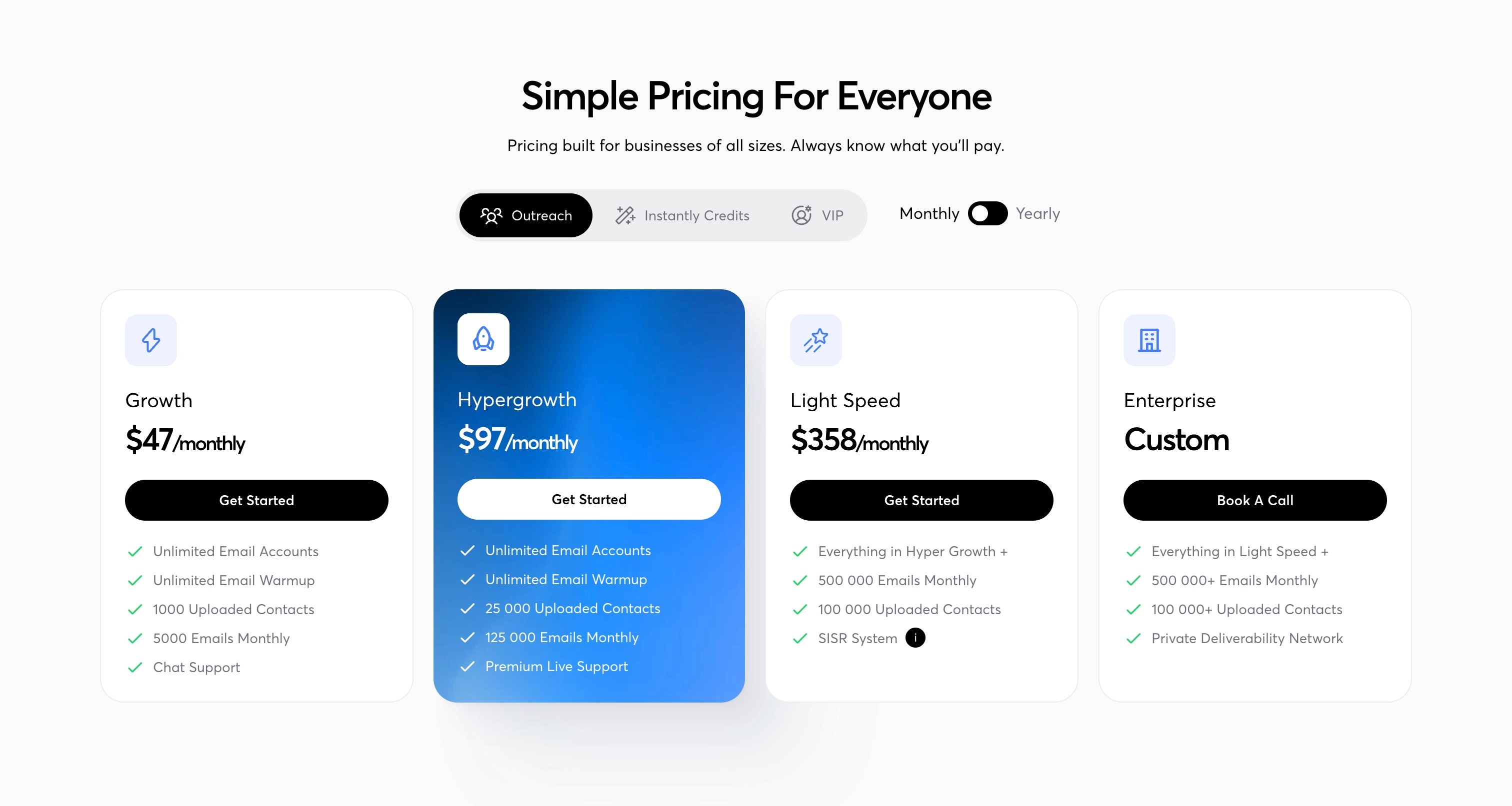
Instantly's sending plans cost $37/mo (Growth, 5,000 emails, 1,000 contacts), $97/mo (Hypergrowth, 100,000 emails, 25,000 contacts), and $358/mo (Light Speed, 500,000 emails, 100,000 contacts) on annual billing; monthly billing runs $47 and $120 on the first two tiers. Unlimited mailboxes and unlimited warmup are included everywhere, which is the category's best headline deal. The real invoice grows through add-ons: Leads database from $47/mo, CRM from $47/mo, and AI credits from $9/mo, so a typical production team spends $200-400 monthly, plus sending infrastructure (domains and inboxes) on top. Start on Growth annual, upgrade the week you hit the 1,000-contact cap, which for most real campaigns is week one.
Context: our best Smartlead alternatives ranking (Instantly is our lead pick) and the Smartlead vs Instantly head-to-head.
The three sending plans
Sending is what Instantly is famous for, and the pricing page undersells how unusual the structure is: every tier, including the cheapest, ships unlimited connected email accounts and unlimited warmup. Rivals meter exactly those two things. Prices below confirmed against Instantly's pricing page this month.

Growth ($37/mo annual, $47 monthly). 5,000 emails and 1,000 uploaded contacts a month. The contact cap is the real ceiling: 1,000 contacts is one week of a modest campaign. Treat Growth as the evaluation tier.
Hypergrowth ($97/mo annual, $120 monthly). 100,000 emails and 25,000 contacts. The production tier for most teams: 20x the email volume for less than 3x the price, which is where Instantly's per-send economics beat nearly everything in the category.
Light Speed ($358/mo annual). 500,000 emails and 100,000 contacts. Agency and aggregator scale. At this volume the constraint stops being the platform and becomes your domain infrastructure and list quality.
Enterprise (custom). Custom limits, SSO, and support SLAs. Only relevant past Light Speed volume.
The add-on stack is the real invoice
The sending plan is a third of the bill. Instantly monetizes the rest of the workflow through three separate subscriptions, and production teams typically run at least two of them.
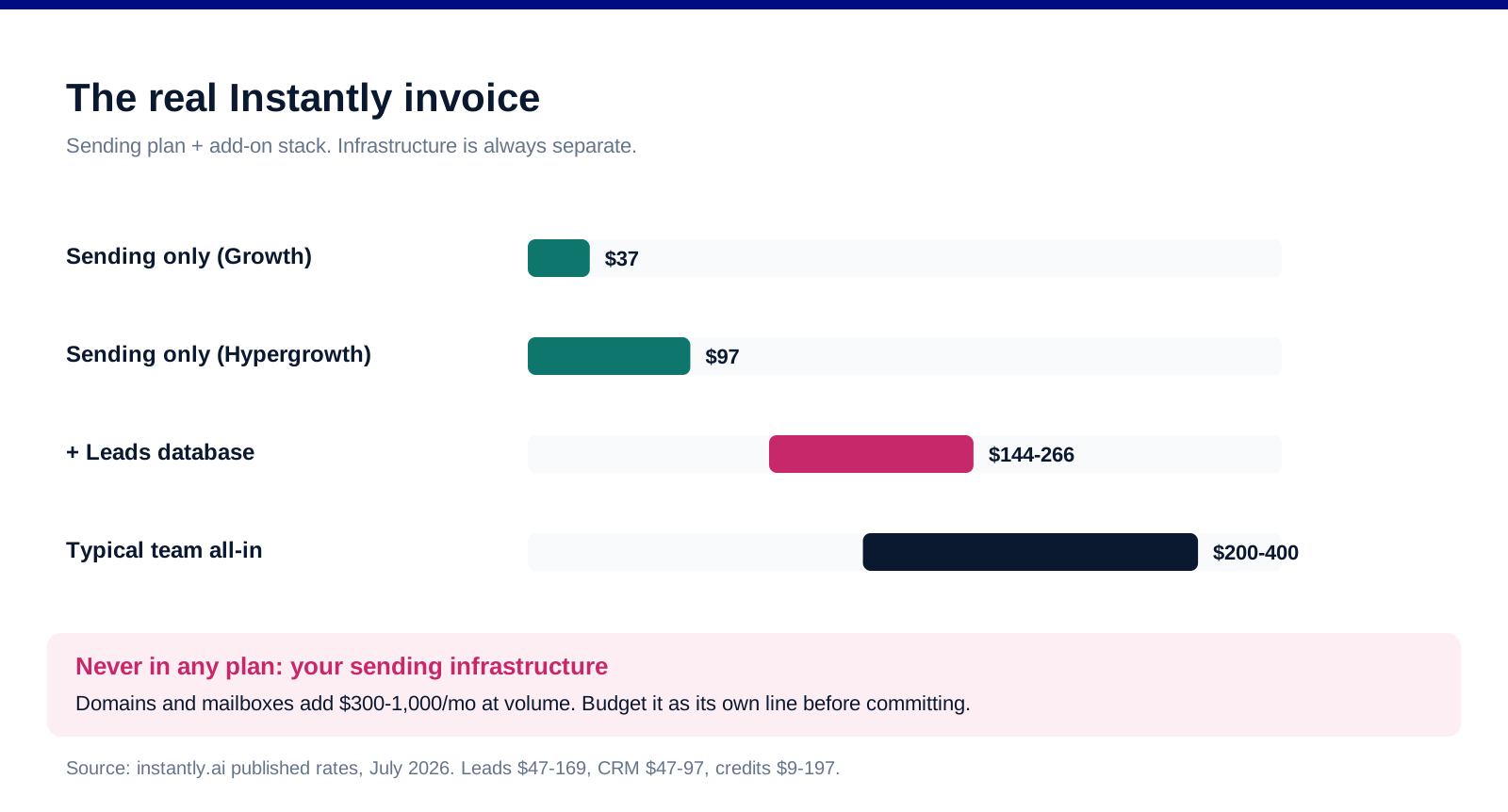
Leads database: $47-169/mo. Growth Leads at $47 (1,000 verified leads), Supersonic at $96 (4,500), Hyperleads at $169 (10,000). Verified-on-delivery leads, priced per lead roughly between dedicated databases and cheap scraped lists. If you already run Apollo or Clay for data, skip it; the math is in our Apollo pricing breakdown.
CRM: $47-97/mo. Unibox-style reply management and pipeline views. Worth it for teams running everything inside Instantly; redundant if HubSpot or Pipedrive already owns your pipeline.
AI + verification credits: $9-197/mo. Powers AI writing, list verification, and enrichment. The $9 Nano pack covers light use; heavy verification burns toward HyperCredits fast.
What is never in the bill: your infrastructure. Domains and mailboxes live outside every plan, typically $300-1,000 a month at volume, and Google and Microsoft's bulk-sender rules apply regardless of tool, per Google's sender guidelines. Budget it as a separate line.
Which plan fits your motion
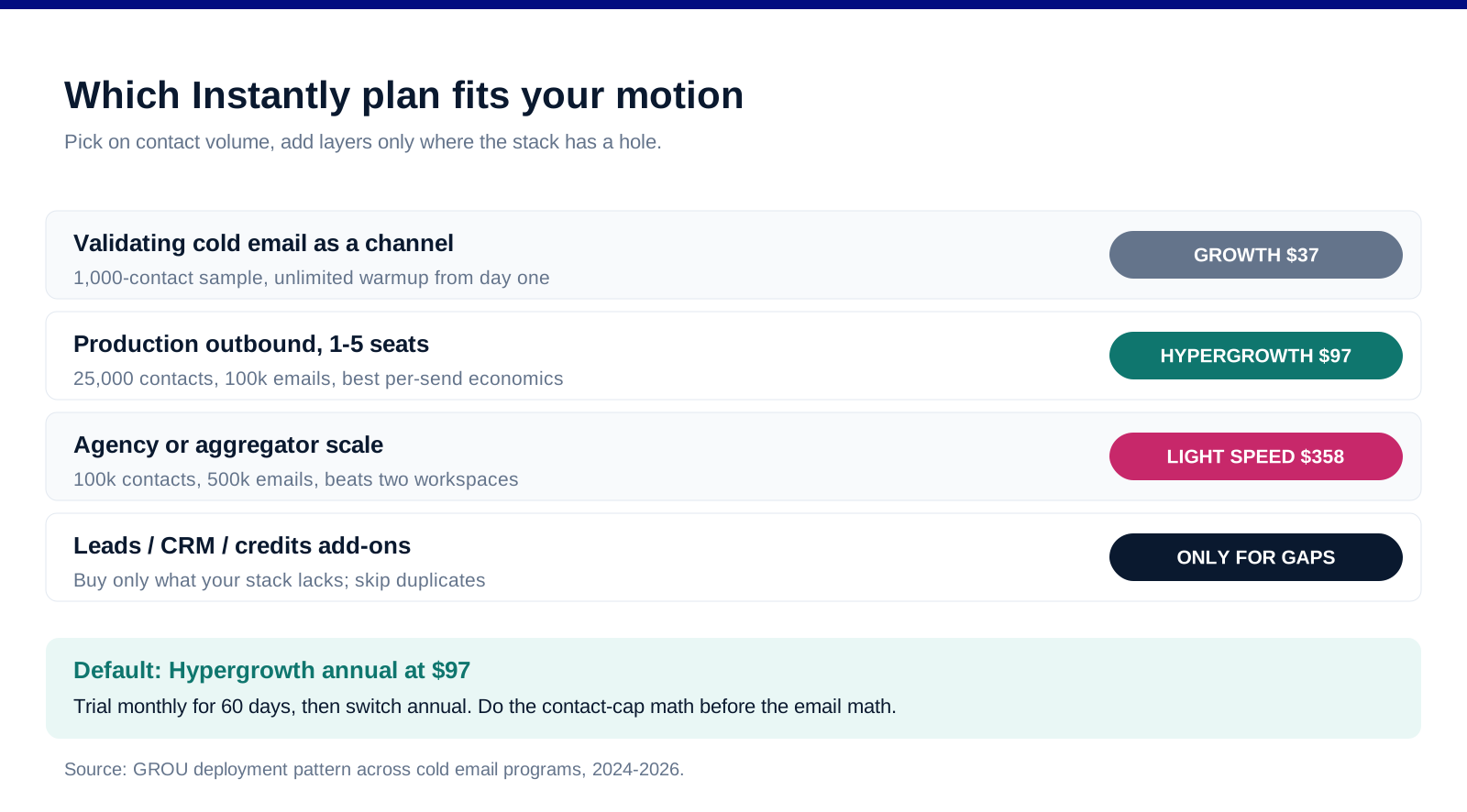
Validating cold email as a channel: Growth annual at $37. Two or three campaigns, a 1,000-contact sample, unlimited warmup running from day one. Decide within a month.
Production outbound, 1-5 seats: Hypergrowth annual at $97. The default recommendation. 25,000 contacts covers a serious monthly motion, and per-send cost drops an order of magnitude versus Growth.
Agency or high-volume aggregator: Light Speed at $358. Cheaper than two Hypergrowth workspaces and lifts the contact cap to 100,000.
Add-on rule of thumb. Buy Leads only if you have no data tool, CRM only if you have no CRM, and start credits at $9. Every add-on duplicated elsewhere in your stack is margin handed back.
On the 2026 market, Instantly's pricing is the benchmark the rest of the category gets measured against: see how the seven main rivals price in our best Smartlead alternatives table, and how 8,000+ G2 reviewers rate the platform's value for money.
The mistakes that inflate an Instantly bill
Mistake 1: judging plans by email limits instead of contact caps. Growth's 5,000 emails sounds workable until the 1,000-contact cap stops your upload in week one. Size the plan on contacts, not sends.
Mistake 2: buying the whole suite on day one. Sending + Leads + CRM + credits from the start triples the bill before the channel is validated. Prove the sending motion first, add layers when a gap actually appears.
Mistake 3: paying monthly past month two. Annual saves 21-24% on the sending tiers ($120 to $97 on Hypergrowth alone is $276 a year). Once volume is stable, the annual switch is free money.
Mistake 4: treating unlimited warmup as a license to skip ramp-up. Warmup being free does not make new domains send-ready faster. Fresh domains still need 2-3 weeks before campaign volume, or placement pays for it.
FAQ
How much does Instantly cost per month in 2026?
$37 (Growth), $97 (Hypergrowth), or $358 (Light Speed) on annual billing for the sending plans; Growth and Hypergrowth run $47 and $120 billed monthly. Add-ons are separate: Leads from $47, CRM from $47, credits from $9.
What does Instantly really cost for a production team?
$200-400 a month is the typical all-in for teams running sending plus one or two add-ons, before infrastructure. Domains and mailboxes add $300-1,000 a month at volume and are never included in any plan.
Are Instantly's email accounts really unlimited?
Yes, on every paid tier, including Growth, and warmup is unlimited too. The caps that meter usage are monthly emails sent (5,000 / 100,000 / 500,000) and uploaded contacts (1,000 / 25,000 / 100,000).
Is Instantly cheaper than Smartlead?
At entry, they are close ($37-39). At production volume Instantly's Hypergrowth ($97 for 100k emails) beats Smartlead's Pro ($94 for a 30k-email, 30k-lead shape) on raw sending capacity, and Smartlead no longer offers some of the agency advantages that once justified a premium. The full comparison: Smartlead vs Instantly.
Is the Instantly Leads database worth it?
Only if you have no dedicated data tool. At $47 per 1,000 verified leads it prices between premium databases and scraped lists, and verification-on-delivery is real. Teams already paying for Apollo, Clay, or a finder should skip it and keep one source of truth.
Should I buy Instantly annual or monthly?
Monthly for the first 60 days while you validate deliverability and fit, then annual: the discount is 21-24% and the plans auto-renew. Never commit annual to a tier whose contact cap you have not tested against a real campaign month.
Bottom line
Instantly's genius is making the two scariest cold email costs, mailboxes and warmup, free at every tier, and charging instead for volume and workflow. Read the plans through that lens: Growth at $37 to validate, Hypergrowth at $97 to run production, Light Speed at $358 for agency scale, and add-ons only where your stack has an actual hole. Do the contact-cap math before the email math and the invoice stays boring.
Want the whole outbound engine, infrastructure included, run for you? Book a call with GROU. We deploy Instantly-based sending systems across B2B programs every month.
We are GROU, a B2B pipeline agency that runs lead generation, outbound, and LinkedIn content for clients across manufacturing, fintech, iGaming, software, and professional services. Pricing reflects Instantly's published 2026 rates cross-checked against live vendor pages and our deployment invoices, refreshed at publish time.
Some links in this article are affiliate. We may earn a small commission at no extra cost to you. We only recommend tools we've deployed for clients.
Instantly prices its sending plans at $37, $97, and $358 per month on annual billing in 2026, all with unlimited email accounts and unlimited warmup. The catch is not the sending price, it is the contact caps and the add-on stack: leads database, CRM, and AI credits are separate subscriptions, and most teams land at $200-400 a month all-in. Here is the full math before you commit.
Every plan, every add-on, the caps that actually bite, and which tier fits your sending volume.
TL;DR
Instantly's sending plans cost $37/mo (Growth, 5,000 emails, 1,000 contacts), $97/mo (Hypergrowth, 100,000 emails, 25,000 contacts), and $358/mo (Light Speed, 500,000 emails, 100,000 contacts) on annual billing; monthly billing runs $47 and $120 on the first two tiers. Unlimited mailboxes and unlimited warmup are included everywhere, which is the category's best headline deal. The real invoice grows through add-ons: Leads database from $47/mo, CRM from $47/mo, and AI credits from $9/mo, so a typical production team spends $200-400 monthly, plus sending infrastructure (domains and inboxes) on top. Start on Growth annual, upgrade the week you hit the 1,000-contact cap, which for most real campaigns is week one.
Context: our best Smartlead alternatives ranking (Instantly is our lead pick) and the Smartlead vs Instantly head-to-head.
The three sending plans
Sending is what Instantly is famous for, and the pricing page undersells how unusual the structure is: every tier, including the cheapest, ships unlimited connected email accounts and unlimited warmup. Rivals meter exactly those two things. Prices below confirmed against Instantly's pricing page this month.
Growth ($37/mo annual, $47 monthly). 5,000 emails and 1,000 uploaded contacts a month. The contact cap is the real ceiling: 1,000 contacts is one week of a modest campaign. Treat Growth as the evaluation tier.
Hypergrowth ($97/mo annual, $120 monthly). 100,000 emails and 25,000 contacts. The production tier for most teams: 20x the email volume for less than 3x the price, which is where Instantly's per-send economics beat nearly everything in the category.
Light Speed ($358/mo annual). 500,000 emails and 100,000 contacts. Agency and aggregator scale. At this volume the constraint stops being the platform and becomes your domain infrastructure and list quality.
Enterprise (custom). Custom limits, SSO, and support SLAs. Only relevant past Light Speed volume.
The add-on stack is the real invoice
The sending plan is a third of the bill. Instantly monetizes the rest of the workflow through three separate subscriptions, and production teams typically run at least two of them.
Leads database: $47-169/mo. Growth Leads at $47 (1,000 verified leads), Supersonic at $96 (4,500), Hyperleads at $169 (10,000). Verified-on-delivery leads, priced per lead roughly between dedicated databases and cheap scraped lists. If you already run Apollo or Clay for data, skip it; the math is in our Apollo pricing breakdown.
CRM: $47-97/mo. Unibox-style reply management and pipeline views. Worth it for teams running everything inside Instantly; redundant if HubSpot or Pipedrive already owns your pipeline.
AI + verification credits: $9-197/mo. Powers AI writing, list verification, and enrichment. The $9 Nano pack covers light use; heavy verification burns toward HyperCredits fast.
What is never in the bill: your infrastructure. Domains and mailboxes live outside every plan, typically $300-1,000 a month at volume, and Google and Microsoft's bulk-sender rules apply regardless of tool, per Google's sender guidelines. Budget it as a separate line.
Which plan fits your motion
Validating cold email as a channel: Growth annual at $37. Two or three campaigns, a 1,000-contact sample, unlimited warmup running from day one. Decide within a month.
Production outbound, 1-5 seats: Hypergrowth annual at $97. The default recommendation. 25,000 contacts covers a serious monthly motion, and per-send cost drops an order of magnitude versus Growth.
Agency or high-volume aggregator: Light Speed at $358. Cheaper than two Hypergrowth workspaces and lifts the contact cap to 100,000.
Add-on rule of thumb. Buy Leads only if you have no data tool, CRM only if you have no CRM, and start credits at $9. Every add-on duplicated elsewhere in your stack is margin handed back.
On the 2026 market, Instantly's pricing is the benchmark the rest of the category gets measured against: see how the seven main rivals price in our best Smartlead alternatives table, and how 8,000+ G2 reviewers rate the platform's value for money.
The mistakes that inflate an Instantly bill
Mistake 1: judging plans by email limits instead of contact caps. Growth's 5,000 emails sounds workable until the 1,000-contact cap stops your upload in week one. Size the plan on contacts, not sends.
Mistake 2: buying the whole suite on day one. Sending + Leads + CRM + credits from the start triples the bill before the channel is validated. Prove the sending motion first, add layers when a gap actually appears.
Mistake 3: paying monthly past month two. Annual saves 21-24% on the sending tiers ($120 to $97 on Hypergrowth alone is $276 a year). Once volume is stable, the annual switch is free money.
Mistake 4: treating unlimited warmup as a license to skip ramp-up. Warmup being free does not make new domains send-ready faster. Fresh domains still need 2-3 weeks before campaign volume, or placement pays for it.
FAQ
How much does Instantly cost per month in 2026?
$37 (Growth), $97 (Hypergrowth), or $358 (Light Speed) on annual billing for the sending plans; Growth and Hypergrowth run $47 and $120 billed monthly. Add-ons are separate: Leads from $47, CRM from $47, credits from $9.
What does Instantly really cost for a production team?
$200-400 a month is the typical all-in for teams running sending plus one or two add-ons, before infrastructure. Domains and mailboxes add $300-1,000 a month at volume and are never included in any plan.
Are Instantly's email accounts really unlimited?
Yes, on every paid tier, including Growth, and warmup is unlimited too. The caps that meter usage are monthly emails sent (5,000 / 100,000 / 500,000) and uploaded contacts (1,000 / 25,000 / 100,000).
Is Instantly cheaper than Smartlead?
At entry, they are close ($37-39). At production volume Instantly's Hypergrowth ($97 for 100k emails) beats Smartlead's Pro ($94 for a 30k-email, 30k-lead shape) on raw sending capacity, and Smartlead no longer offers some of the agency advantages that once justified a premium. The full comparison: Smartlead vs Instantly.
Is the Instantly Leads database worth it?
Only if you have no dedicated data tool. At $47 per 1,000 verified leads it prices between premium databases and scraped lists, and verification-on-delivery is real. Teams already paying for Apollo, Clay, or a finder should skip it and keep one source of truth.
Should I buy Instantly annual or monthly?
Monthly for the first 60 days while you validate deliverability and fit, then annual: the discount is 21-24% and the plans auto-renew. Never commit annual to a tier whose contact cap you have not tested against a real campaign month.
Bottom line
Instantly's genius is making the two scariest cold email costs, mailboxes and warmup, free at every tier, and charging instead for volume and workflow. Read the plans through that lens: Growth at $37 to validate, Hypergrowth at $97 to run production, Light Speed at $358 for agency scale, and add-ons only where your stack has an actual hole. Do the contact-cap math before the email math and the invoice stays boring.
Want the whole outbound engine, infrastructure included, run for you? Book a call with GROU. We deploy Instantly-based sending systems across B2B programs every month.
We are GROU, a B2B pipeline agency that runs lead generation, outbound, and LinkedIn content for clients across manufacturing, fintech, iGaming, software, and professional services. Pricing reflects Instantly's published 2026 rates cross-checked against live vendor pages and our deployment invoices, refreshed at publish time.
Some links in this article are affiliate. We may earn a small commission at no extra cost to you. We only recommend tools we've deployed for clients.
Instantly prices its sending plans at $37, $97, and $358 per month on annual billing in 2026, all with unlimited email accounts and unlimited warmup. The catch is not the sending price, it is the contact caps and the add-on stack: leads database, CRM, and AI credits are separate subscriptions, and most teams land at $200-400 a month all-in. Here is the full math before you commit.
Every plan, every add-on, the caps that actually bite, and which tier fits your sending volume.
TL;DR
Instantly's sending plans cost $37/mo (Growth, 5,000 emails, 1,000 contacts), $97/mo (Hypergrowth, 100,000 emails, 25,000 contacts), and $358/mo (Light Speed, 500,000 emails, 100,000 contacts) on annual billing; monthly billing runs $47 and $120 on the first two tiers. Unlimited mailboxes and unlimited warmup are included everywhere, which is the category's best headline deal. The real invoice grows through add-ons: Leads database from $47/mo, CRM from $47/mo, and AI credits from $9/mo, so a typical production team spends $200-400 monthly, plus sending infrastructure (domains and inboxes) on top. Start on Growth annual, upgrade the week you hit the 1,000-contact cap, which for most real campaigns is week one.
Context: our best Smartlead alternatives ranking (Instantly is our lead pick) and the Smartlead vs Instantly head-to-head.
The three sending plans
Sending is what Instantly is famous for, and the pricing page undersells how unusual the structure is: every tier, including the cheapest, ships unlimited connected email accounts and unlimited warmup. Rivals meter exactly those two things. Prices below confirmed against Instantly's pricing page this month.
Growth ($37/mo annual, $47 monthly). 5,000 emails and 1,000 uploaded contacts a month. The contact cap is the real ceiling: 1,000 contacts is one week of a modest campaign. Treat Growth as the evaluation tier.
Hypergrowth ($97/mo annual, $120 monthly). 100,000 emails and 25,000 contacts. The production tier for most teams: 20x the email volume for less than 3x the price, which is where Instantly's per-send economics beat nearly everything in the category.
Light Speed ($358/mo annual). 500,000 emails and 100,000 contacts. Agency and aggregator scale. At this volume the constraint stops being the platform and becomes your domain infrastructure and list quality.
Enterprise (custom). Custom limits, SSO, and support SLAs. Only relevant past Light Speed volume.
The add-on stack is the real invoice
The sending plan is a third of the bill. Instantly monetizes the rest of the workflow through three separate subscriptions, and production teams typically run at least two of them.
Leads database: $47-169/mo. Growth Leads at $47 (1,000 verified leads), Supersonic at $96 (4,500), Hyperleads at $169 (10,000). Verified-on-delivery leads, priced per lead roughly between dedicated databases and cheap scraped lists. If you already run Apollo or Clay for data, skip it; the math is in our Apollo pricing breakdown.
CRM: $47-97/mo. Unibox-style reply management and pipeline views. Worth it for teams running everything inside Instantly; redundant if HubSpot or Pipedrive already owns your pipeline.
AI + verification credits: $9-197/mo. Powers AI writing, list verification, and enrichment. The $9 Nano pack covers light use; heavy verification burns toward HyperCredits fast.
What is never in the bill: your infrastructure. Domains and mailboxes live outside every plan, typically $300-1,000 a month at volume, and Google and Microsoft's bulk-sender rules apply regardless of tool, per Google's sender guidelines. Budget it as a separate line.
Which plan fits your motion
Validating cold email as a channel: Growth annual at $37. Two or three campaigns, a 1,000-contact sample, unlimited warmup running from day one. Decide within a month.
Production outbound, 1-5 seats: Hypergrowth annual at $97. The default recommendation. 25,000 contacts covers a serious monthly motion, and per-send cost drops an order of magnitude versus Growth.
Agency or high-volume aggregator: Light Speed at $358. Cheaper than two Hypergrowth workspaces and lifts the contact cap to 100,000.
Add-on rule of thumb. Buy Leads only if you have no data tool, CRM only if you have no CRM, and start credits at $9. Every add-on duplicated elsewhere in your stack is margin handed back.
On the 2026 market, Instantly's pricing is the benchmark the rest of the category gets measured against: see how the seven main rivals price in our best Smartlead alternatives table, and how 8,000+ G2 reviewers rate the platform's value for money.
The mistakes that inflate an Instantly bill
Mistake 1: judging plans by email limits instead of contact caps. Growth's 5,000 emails sounds workable until the 1,000-contact cap stops your upload in week one. Size the plan on contacts, not sends.
Mistake 2: buying the whole suite on day one. Sending + Leads + CRM + credits from the start triples the bill before the channel is validated. Prove the sending motion first, add layers when a gap actually appears.
Mistake 3: paying monthly past month two. Annual saves 21-24% on the sending tiers ($120 to $97 on Hypergrowth alone is $276 a year). Once volume is stable, the annual switch is free money.
Mistake 4: treating unlimited warmup as a license to skip ramp-up. Warmup being free does not make new domains send-ready faster. Fresh domains still need 2-3 weeks before campaign volume, or placement pays for it.
FAQ
How much does Instantly cost per month in 2026?
$37 (Growth), $97 (Hypergrowth), or $358 (Light Speed) on annual billing for the sending plans; Growth and Hypergrowth run $47 and $120 billed monthly. Add-ons are separate: Leads from $47, CRM from $47, credits from $9.
What does Instantly really cost for a production team?
$200-400 a month is the typical all-in for teams running sending plus one or two add-ons, before infrastructure. Domains and mailboxes add $300-1,000 a month at volume and are never included in any plan.
Are Instantly's email accounts really unlimited?
Yes, on every paid tier, including Growth, and warmup is unlimited too. The caps that meter usage are monthly emails sent (5,000 / 100,000 / 500,000) and uploaded contacts (1,000 / 25,000 / 100,000).
Is Instantly cheaper than Smartlead?
At entry, they are close ($37-39). At production volume Instantly's Hypergrowth ($97 for 100k emails) beats Smartlead's Pro ($94 for a 30k-email, 30k-lead shape) on raw sending capacity, and Smartlead no longer offers some of the agency advantages that once justified a premium. The full comparison: Smartlead vs Instantly.
Is the Instantly Leads database worth it?
Only if you have no dedicated data tool. At $47 per 1,000 verified leads it prices between premium databases and scraped lists, and verification-on-delivery is real. Teams already paying for Apollo, Clay, or a finder should skip it and keep one source of truth.
Should I buy Instantly annual or monthly?
Monthly for the first 60 days while you validate deliverability and fit, then annual: the discount is 21-24% and the plans auto-renew. Never commit annual to a tier whose contact cap you have not tested against a real campaign month.
Bottom line
Instantly's genius is making the two scariest cold email costs, mailboxes and warmup, free at every tier, and charging instead for volume and workflow. Read the plans through that lens: Growth at $37 to validate, Hypergrowth at $97 to run production, Light Speed at $358 for agency scale, and add-ons only where your stack has an actual hole. Do the contact-cap math before the email math and the invoice stays boring.
Want the whole outbound engine, infrastructure included, run for you? Book a call with GROU. We deploy Instantly-based sending systems across B2B programs every month.
We are GROU, a B2B pipeline agency that runs lead generation, outbound, and LinkedIn content for clients across manufacturing, fintech, iGaming, software, and professional services. Pricing reflects Instantly's published 2026 rates cross-checked against live vendor pages and our deployment invoices, refreshed at publish time.
Some links in this article are affiliate. We may earn a small commission at no extra cost to you. We only recommend tools we've deployed for clients.

Pipeline OS Newsletter
Build qualified pipeline
Get weekly tactics to generate demand, improve lead quality, and book more meetings.





Trusted by industry leaders
Trusted by industry leaders
Trusted by industry leaders
Ready to build qualified pipeline?
Ready to build qualified pipeline?
Ready to build qualified pipeline?
Book a call to see if we're the right fit, or take the 2-minute quiz to get a clear starting point.
Book a call to see if we're the right fit, or take the 2-minute quiz to get a clear starting point.
Book a call to see if we're the right fit, or take the 2-minute quiz to get a clear starting point.
" height="30.21639343089746px" id="hfGbXmQR2" width="30.216393430897455px"/></svg>)
Copyright © 2026 – All Right Reserved
Copyright © 2026 – All Right Reserved
Copyright © 2026 – All Right Reserved