%22%3E%3C/path%3E%3Cpath d=%22M 63.072 7.554 C 62.258 8.022 61.577 8.689 61.092 9.493 L 61.092 7.076 L 57.158 7.076 L 57.158 22.64 L 61.089 22.64 L 61.089 14.888 C 61.089 13.446 61.403 12.434 62.03 11.853 C 62.818 11.218 63.818 10.907 64.826 10.982 L 65.868 10.982 L 65.868 6.851 C 64.891 6.834 63.926 7.076 63.073 7.554 Z%22 fill=%22rgb(17,17,17)%22%3E%3C/path%3E%3Cpath d=%22M 78.916 7.82 C 76.363 6.49 73.321 6.49 70.768 7.82 C 69.562 8.473 68.564 9.451 67.888 10.644 C 67.167 11.931 66.803 13.387 66.834 14.862 C 66.804 16.332 67.157 17.785 67.86 19.077 C 68.515 20.267 69.494 21.246 70.684 21.901 C 71.924 22.576 73.318 22.92 74.73 22.898 C 76.164 22.918 77.58 22.575 78.846 21.901 C 80.062 21.247 81.073 20.27 81.768 19.077 C 82.506 17.797 82.88 16.339 82.85 14.862 C 82.88 13.389 82.517 11.934 81.797 10.647 C 81.12 9.455 80.122 8.477 78.917 7.824 M 78.803 14.862 C 78.829 15.739 78.636 16.608 78.241 17.391 C 77.903 18.046 77.38 18.588 76.738 18.95 C 76.124 19.293 75.432 19.472 74.729 19.47 C 73.668 19.497 72.648 19.061 71.934 18.276 C 71.139 17.323 70.741 16.1 70.823 14.862 C 70.741 13.62 71.149 12.395 71.959 11.45 C 72.687 10.667 73.715 10.233 74.783 10.256 C 75.859 10.236 76.894 10.67 77.635 11.45 C 78.464 12.387 78.884 13.616 78.801 14.864%22 fill=%22rgb(17,17,17)%22%3E%3C/path%3E%3Cpath d=%22M 95.906 7.076 L 95.906 15.646 C 95.975 16.68 95.643 17.701 94.979 18.498 C 94.311 19.184 93.379 19.547 92.422 19.495 C 91.475 19.544 90.553 19.18 89.894 18.498 C 89.23 17.701 88.898 16.68 88.967 15.646 L 88.967 7.076 L 85.033 7.076 L 85.033 16.207 C 85 17.449 85.275 18.68 85.834 19.79 C 86.327 20.75 87.095 21.542 88.039 22.065 C 89.033 22.594 90.145 22.861 91.271 22.838 C 92.188 22.847 93.095 22.65 93.926 22.263 C 94.708 21.905 95.388 21.36 95.906 20.675 L 95.906 22.645 L 99.865 22.645 L 99.865 7.076 Z%22 fill=%22rgb(17,17,17)%22%3E%3C/path%3E%3Cpath d=%22M 4.513 15.626 C 4.511 10.815 7.606 6.549 12.181 5.059 C 16.756 3.57 21.77 5.195 24.601 9.086 L 27.816 5.87 C 24.074 1.186 17.981 -0.943 12.137 0.393 C 6.292 1.728 1.728 6.292 0.393 12.137 C -0.943 17.981 1.186 24.074 5.87 27.816 L 9.085 24.601 C 6.214 22.512 4.515 19.177 4.513 15.626%22 fill=%22rgb(32,62,235)%22%3E%3C/path%3E%3Cpath d=%22M 17.114 14.343 L 13.354 18.01 L 13.354 18.026 L 21.071 18.026 L 11.412 27.609 L 17.389 27.609 L 23.999 21.081 L 23.999 28.316 L 24.005 28.316 L 27.967 24.393 L 27.967 14.343 Z%22 fill=%22rgb(32,62,235)%22%3E%3C/path%3E%3C/g%3E%3C/svg%3E) ×
× ××
××›
›
›
›
Lead Gen B2B: A Playbook for Predictable Pipeline
Lead Gen B2B: A Playbook for Predictable Pipeline
Lead Gen B2B: A Playbook for Predictable Pipeline
Lead Gen B2B: A Playbook for Predictable Pipeline
Lead Gen B2B: A Playbook for Predictable Pipeline
Lead Gen B2B: A Playbook for Predictable Pipeline

Author
Aljaz Peklaj

Your team is active, but the pipeline still feels random. Marketing is posting on LinkedIn, SDRs are sending sequences, HubSpot is logging activity, and the dashboard looks busy. Then sales reviews the booked meetings and half of them were never real opportunities.
That is the core lead gen B2B problem. It isn't a lack of tactics. It is a lack of one connected system that turns a defined market, a clear message, and disciplined execution into qualified conversations.
The fix is structure. One 2025 roundup says 91% of marketers rank lead generation as their top priority, while 58% say generating high-quality leads is their biggest challenge. The same source reports that 76% of B2B marketers use content marketing as their primary lead-generation strategy and 73% of B2B buyers engage with content before making a purchasing decision, which is exactly why disconnected outbound and disconnected content underperform 2025 B2B lead generation statistics and trends.
Table of Contents
The B2B lead gen problem isn't volume, it's predictability
Many teams don't have an activity problem. They have a conversion chain problem.
Email gets sent. LinkedIn posts go live. Replies come in. A few meetings book. But nobody can confidently say which segment, message, trigger, or channel is creating qualified pipeline. That is why a team can stay busy for a full quarter and still miss revenue targets.
TLDR for operators
Your ICP and offer need to fit into one sentence. If sales and marketing describe them differently, the engine drifts.
List building is layered. Apollo or Sales Navigator for the boundary, Clay for enrichment, signal monitoring for priority, HubSpot for state.
LinkedIn and outbound should share the same message map. Content shouldn't be a separate department project.
Segmented reply rate matters more than blended reply rate. Blended numbers hide what to cut.
The fastest gains usually come from subtraction. Pause weak segments early and move volume to the combinations that already work.
Why busy teams still miss pipeline
A lot of lead gen B2B programs fail because they optimize for top-of-funnel motion instead of pipeline proof. That usually shows up as channel reports full of opens, clicks, comments, and form fills, with almost no clean answer to which touchpoints created the opportunity.
The better question isn't how to generate more leads. It's how to prove which channels actually create qualified pipeline.
That is why we track qualification and pipeline before we celebrate activity. If you want a clean starting point, this breakdown of lead generation KPIs is the right place to pressure-test your reporting model.
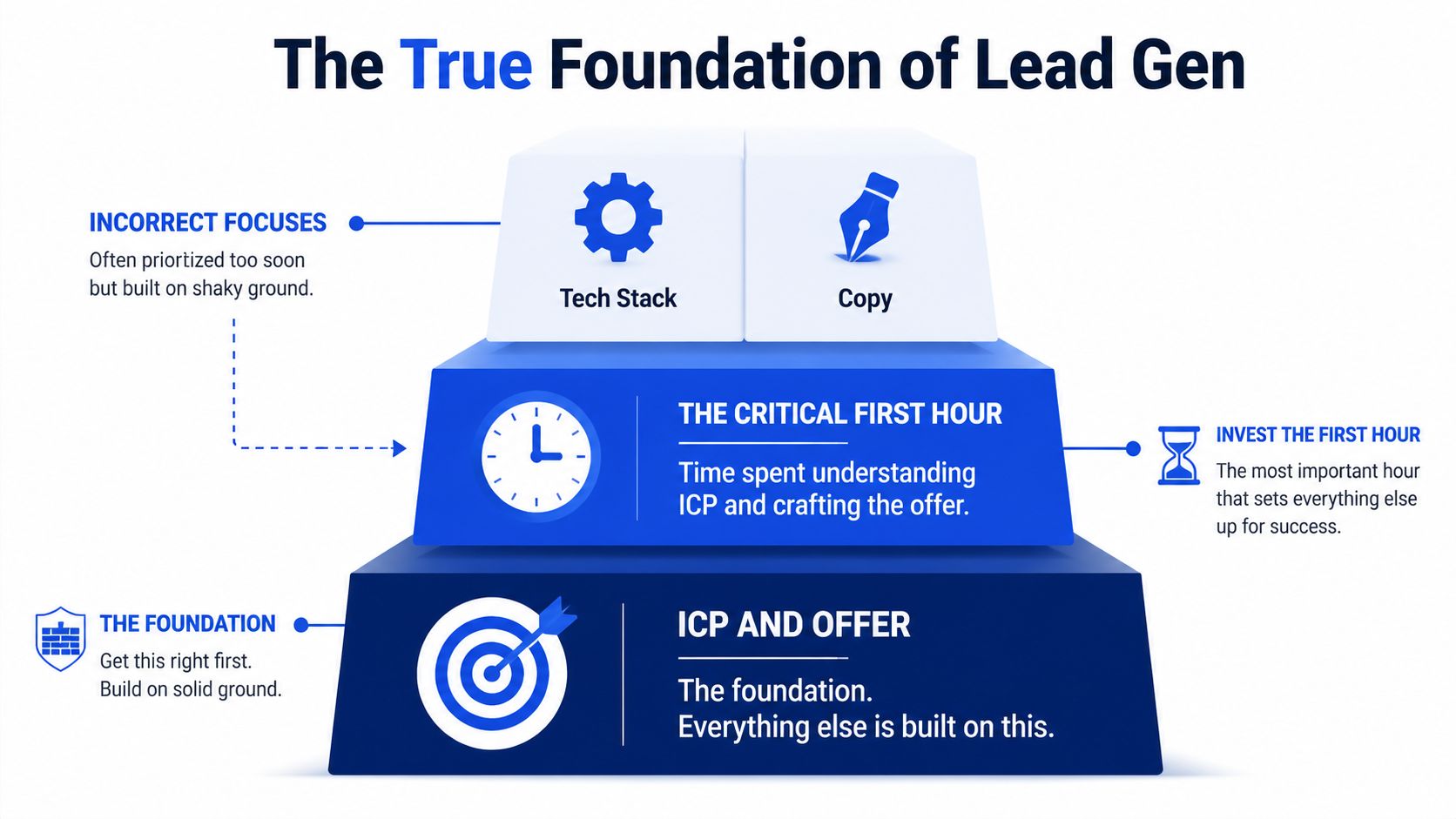
The foundation: your ICP and offer in one sentence
The first hour decides whether the next ninety days work.
Most weak campaigns don't fail because Lemlist was set up poorly or because the copy needed one more subject line test. They fail because nobody forced the company to define exactly who the offer is for, what problem it solves, and what trigger makes that buyer care now.
What that sentence must include
A usable ICP sentence needs five parts. If one is missing, the targeting gets loose and the downstream work starts compensating for bad inputs.
Industry
Not "B2B companies". Say SaaS, legal tech, manufacturing, pharma, iGaming.Company size
Team size changes buying behavior, budget, urgency, and process. A founder-led company and a department-led company don't buy the same way.Geography
This affects language, compliance, sales motion, and the references that will feel credible.Role
The person who feels the pain isn't always the person who signs. Pick the role your first sequence is built for.Trigger This is a frequently overlooked aspect. Recent hiring, funding, leadership change, tech stack move, or a visible operational shift gives you a reason for now.
A real example of an ICP sentence looks like this, a head of sales at a 50 to 250 employee B2B SaaS company in English-speaking markets that has hired SDRs recently or raised capital. The offer sentence then states what you do, for whom, and why now.
Practical rule: If sales, marketing, and leadership can't recite the same ICP and offer sentence from memory, the campaign isn't ready to launch.
The reason this matters goes beyond targeting. One widely cited guide on attribution makes the point plainly, higher lead volume can be a liability if it obscures which message or account drives conversion qualified pipeline over form fills.
If your team needs a sharper way to define this, start with a clean Ideal Customer Profile framework.
What changed when the ICP got smaller
One inherited campaign came in with a broad target, "mid-market companies". The previous agency had spread effort across SaaS, fintech, e-commerce, and professional services in the US, UK, and EU. The contact pool was around 8,000 names, and outbound was producing roughly 4 qualified meetings a month.
We cut the target down to B2B SaaS only, 50 to 250 employees, English-speaking markets, and a buyer at head of sales or revenue level with a recent hiring or funding trigger. The market dropped to roughly 800 accounts.
The result over the following 90 days was 17 qualified meetings per month. Same offer. Same sales team. Same channels.
That is the operating principle. Lead gen B2B works better as a precision instrument than a volume machine.
How to assemble and enrich your target account list
A static CSV is already stale when you export it.
People move roles. Companies hire into new functions. Intent changes weekly. If your list is just a spreadsheet from Apollo with no enrichment and no prioritization layer, you will book meetings that disqualify in the first few minutes and then blame the SDRs for bad discovery.
The four-layer build
The build we use has four layers, in order.
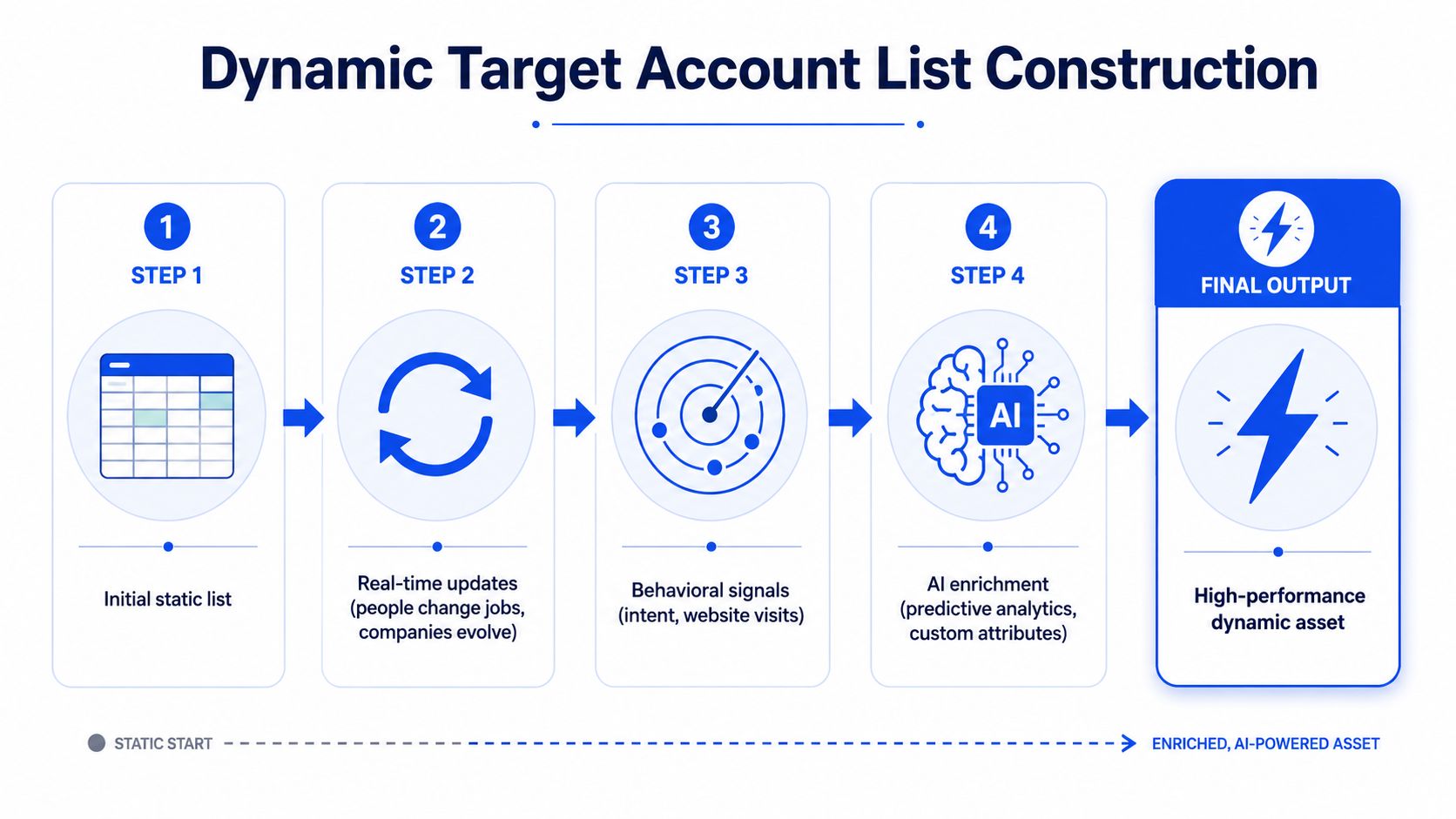
The fixed universe
Apollo and Sales Navigator define the outer boundary. This isn't your active sequence list yet. It is the full market of accounts and contacts that match the ICP guardrails.The enrichment pass
Clay handles the waterfall. We enrich for verified email, current role, company fit, and any custom attributes that matter to qualification. In one client rebuild, waterfall enrichment surfaced that 18% of the prior list had role mismatches because contacts had changed jobs or responsibilities.The signal overlay The list becomes useful through ranking accounts by active trigger, recent funding, hiring, leadership changes, technology shifts, or public statements that map to the problem the offer solves.
The engagement state
Every contact belongs in the CRM with a live state. Cold, engaged, in conversation, stalled, closed. If that status only exists in an SDR's head or in separate spreadsheets, routing breaks.
This is also why multichannel matters. One lead-gen benchmark notes that 88% of businesses use email for lead generation, LinkedIn is used by 97% of B2B marketers who use social media for lead generation, and companies using at least three lead-generation channels achieve 18.96% higher engagement rates in that benchmark set multichannel lead generation benchmarks.
If you want a useful companion resource for the enrichment layer, this guide to CRM data enrichment methods and tools is worth keeping near your RevOps playbook.
A quick walkthrough helps here:
What the list should look like in your CRM
The handoff standard matters more than the export. A good target account list is a living operating asset, not a one-time prospecting file. We want the CRM record to answer four questions immediately.
Field | What it should tell you |
|---|---|
Fit | Does this account still match the ICP boundary |
Trigger | Why contact this account now |
Owner | Who follows up, and how fast |
State | Cold, engaged, qualified, stalled, or closed |
One client came in with 4,500 contacts and only 22% qualification on booked meetings. We tightened the ICP, reduced the list to 2,100 contacts, added signal gating so the active queue stayed around 300 to 400 contacts, and qualification moved to 71% after 90 days.
That is the main point. Qualification improves upstream, before discovery calls, not during them.
For definitions and handoff language, it helps to keep a shared target account list glossary entry inside the team.
Wiring LinkedIn content to outbound sequences
Most companies treat content as brand work and outbound as sales work. That split sounds tidy, but it wastes relevance.
The content team writes for impressions. The SDR team writes for replies. Buyers experience both from the same company, so if the message isn't coordinated, the brand feels fragmented.
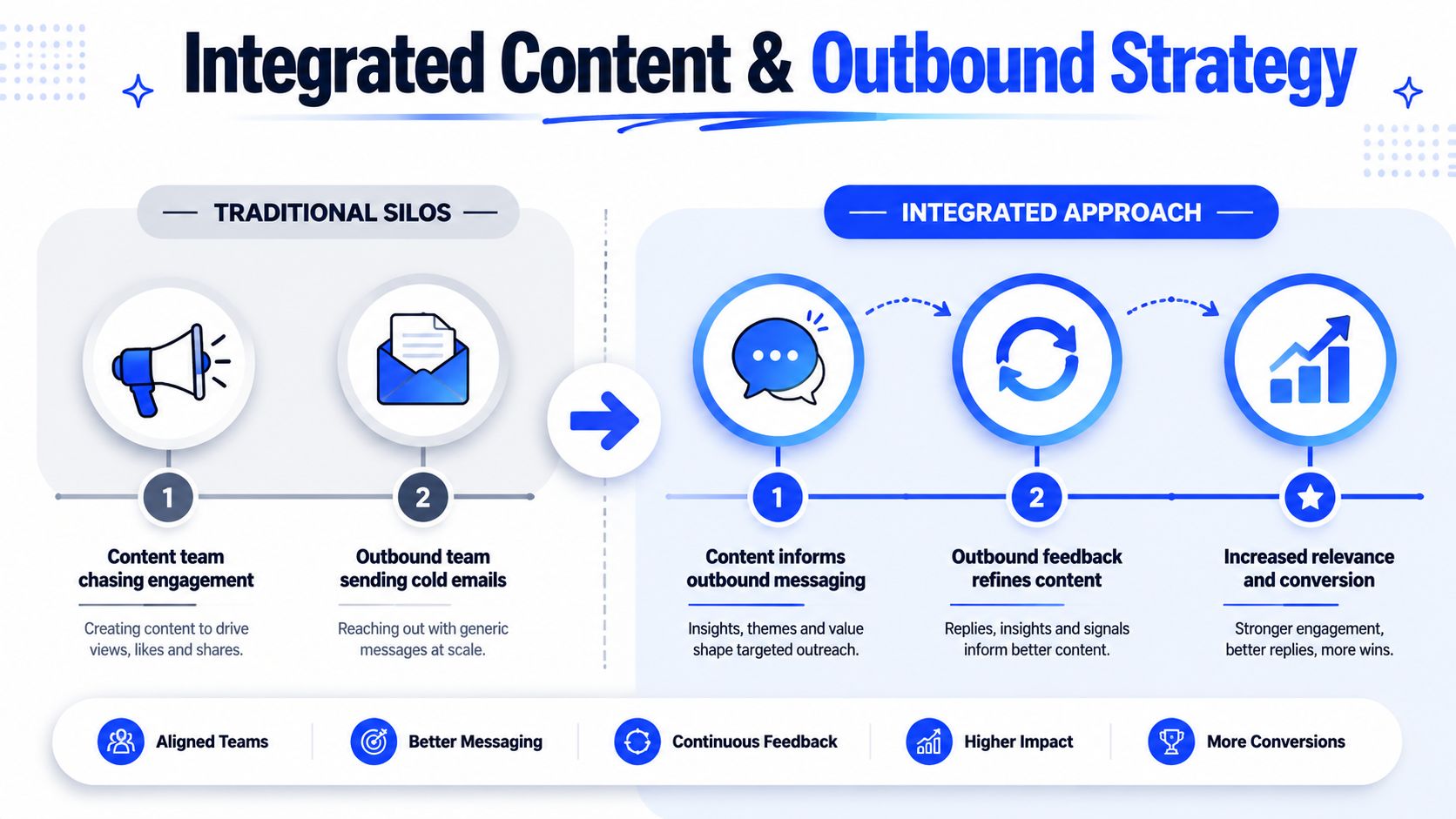
What structural alignment actually means
Structural alignment means the post theme, the email opener, the LinkedIn DM, and the call talk track all come from the same weekly message map.
We keep that message map very tight, usually 3 core pain points and 3 proof points shared across marketing and sales. Nobody improvises a new angle mid-week because that breaks the test conditions.
Content should warm the room. Outbound should convert the warmed attention into replies.
This matters even more when outbound is being used aggressively. The operating rule from sales-side market guidance is clear, outbound works when it is anchored to intent signals, strong ICP definition, and personalized messaging, otherwise it creates activity instead of pipeline when outbound works in B2B lead generation.
If your team needs better creative formats for this layer, this guide on mastering B2B LinkedIn content is useful because it turns positioning into assets SDRs can reference.
The weekly workflow that makes it work
Here is the weekly operating rhythm we use.
Monday post theme
Publish a point-of-view post tied to a live market pain, not a generic tip. Strong posts usually name a mistake, a trade-off, or an operational failure.Tuesday prospect warm-up
Send connection requests and leave one thoughtful comment where relevant. This is not spam liking. The rep is creating familiarity before the email lands.Wednesday email launch
The opener references the Monday post or the same underlying trigger. The prospect sees continuity, not a random cold email.Thursday feedback loop
Replies, comments, and DMs flow back into the account priority queue. If a vertical starts engaging, next week's outbound shifts toward it.
One campaign targeted heads of sales at scaling SaaS companies. The Monday post described a client firing a previous agency for sending generic volume-based outbound. The outbound email that followed opened by referencing that exact post and why it had been written.
The result was an 11.4% reply rate, versus the 4% to 6% the client had been seeing the prior month. 38% of replies directly referenced the post.
That is the compounding effect often left on the table. If you want the content layer built into the outbound engine rather than running beside it, a documented LinkedIn content strategy is where that discipline starts.
Anatomy of a high-performing outbound sequence
A strong outbound sequence doesn't feel like automation, even though it is systemized.
The difference is that the data does the heavy lifting. The sequence should know why this account is being contacted, why this person is relevant, and what signal makes the message timely. If it doesn't, the prospect gets another generic "just checking in" sequence and your domain burns credibility for no gain.
The sequence structure we actually run
The tool stack is usually straightforward, Instantly or Lemlist for email, HeyReach for LinkedIn, Clay for enrichment, HubSpot for routing and status. Sometimes a client uses Salesloft or Outreach instead. The tool is not the hard part. The workflow is.
A typical outbound system for a signal-qualified segment runs like this:
Pre-sequence warm-up
Connection request on LinkedIn, then one relevant comment if the prospect has posted recently.Email one
Reference the trigger, the role, or a content asset tied to the same pain point.LinkedIn follow-up
Short note, low-friction, no calendar push unless the prospect has already shown intent.Email two
Sharpen the problem statement. Use one piece of proof, not three.Email three or LinkedIn DM
Clarify the trade-off, usually what happens if they keep the current setup.Final close-the-loop message
End the thread cleanly. Don't fake politeness with endless nudges.
The benchmark logic behind this is sound. A practical operating model for B2B lead generation is to run segmented, multi-touch cadences, and benchmark data puts lead-to-opportunity conversion rates at 10% to 30%, while lead-to-customer conversion rates are typically 2% to 5% segmented multi-touch lead generation model. That is why sequence quality and qualification matter more than sheer volume.
What personalization should pull from
Personalization is not "noticed you're doing great things at Company X." That is spam with variables.
Useful personalization usually comes from one of these inputs:
Hiring signal
New SDR hires, a new VP Sales, or open GTM roles.Operational shift
Recent funding, expansion into a new market, product launch, or leadership change.Tech signal
A tool added or replaced that changes workflow or reveals maturity.Content signal
A founder post, interview, webinar appearance, or complaint about a process gap.
The opener should prove relevance in one line. It doesn't need to prove your entire company.
One caution. Don't over-personalize every touch. The first message should earn the right to continue. Later touches can get shorter and cleaner. If your team needs a stronger baseline structure for messaging and follow-ups, keep a practical cold email outreach guide next to the sequence library.
For teams that want this whole layer run as one connected motion, agencies and systems can sit on top of the stack too. For example, Grou combines LinkedIn content, list building, and outbound into one shared operating system so message testing and reply routing happen in the same sprint cycle.
How to iterate and scale with 30-day sprints
Teams often track the wrong number first.
They look at blended reply rate, decide whether it feels healthy, and keep pushing volume. That headline metric is useful for reporting upward, but it is weak for decision-making. A blended rate can hide one segment that is carrying the campaign and five that are wasting the month.
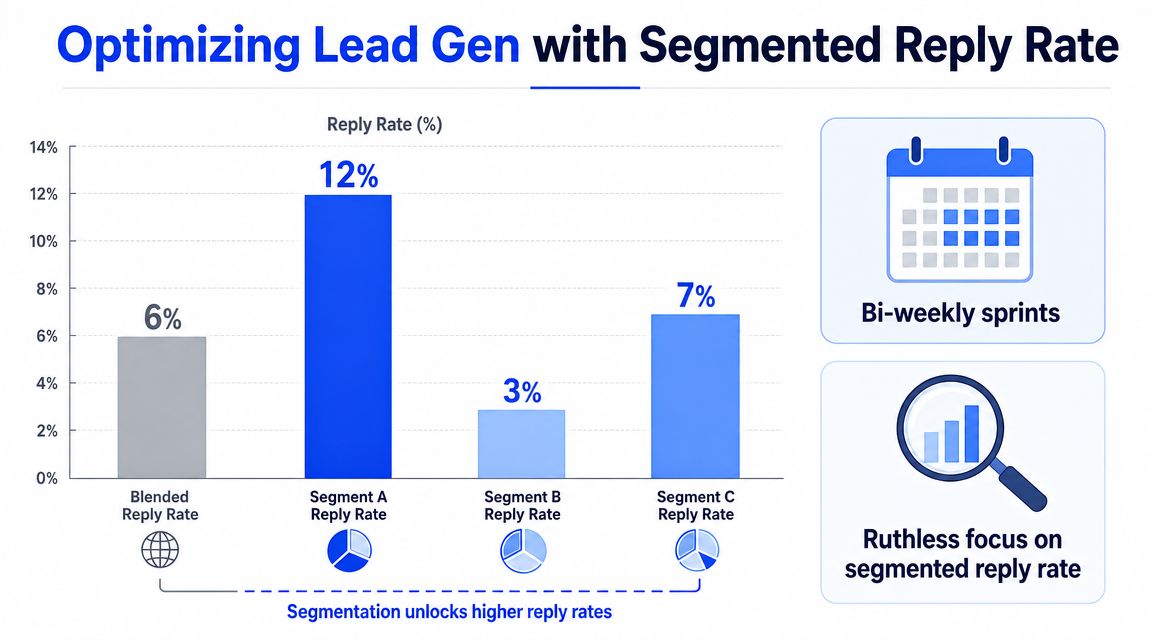
Stop tracking blended reply rate first
One client came in running a campaign across 2,400 contacts with a 5.2% blended reply rate. That number had been accepted as normal.
Once we split the results by sub-segment, the picture changed:
Mid-market SaaS, heads of sales, hiring trigger → 13.1%
Mid-market SaaS, heads of marketing, hiring trigger → 8.7%
Mid-market SaaS, heads of sales, funding trigger → 11.2%
Enterprise SaaS, VP level, no specific trigger → 1.4%
Early-stage SaaS, founder, generic → 0.9%
The weak groups were consuming roughly 55% of the contact volume and producing roughly 8% of replies. We cut them in week two and shifted volume to the combinations already proving they could convert.
By day 30, blended reply rate moved from 5.2% to 11.6%, and qualified meetings in the second half of the month tripled.
The first month usually rewards subtraction, not creativity.
That same sprint logic should be tied to the whole funnel, not just replies. Performance guidance from RevOps-oriented teams recommends measuring at four levels, volume, quality, cost, and pipeline, and replacing last-touch with multi-touch models so the team can see what creates revenue four-level lead generation measurement.
The sprint review questions that matter
At the end of each two-week sprint, the review should answer a small set of hard questions.
Question | Why it matters |
|---|---|
Which segment replied most | Tells you where to concentrate volume |
Which trigger converted best | Shows what timing signal deserves priority |
Which persona booked qualified meetings | Separates interest from actual fit |
Which channel assisted the meeting | Keeps LinkedIn, email, and content from being judged in isolation |
Notice what is not first on that table. Open rate. Post impressions. Raw send volume.
If you run lead gen B2B with clean sprint discipline, the campaign gets simpler over time. The audience narrows. The message sharpens. Routing gets faster. Sales wastes less calendar time on poor-fit calls.
Your next step: run a 30-day validation sprint
Don't rebuild the whole revenue engine at once. Pick one segment and validate it properly.
A clean validation sprint is small enough to learn fast and strict enough to remove excuses. One ICP. One offer. One signal layer. One sequence. One reporting sheet.
A practical 4-week sprint
Week 1
Lock the ICP and offer into one sentence. Build a list of 200 to 300 signal-qualified contacts. Write one 8-touch sequence across email and LinkedIn.Week 2
Warm the first half of the list on LinkedIn. Launch the first email touches. Route replies inside one workflow, not across inboxes and spreadsheets.Week 3
Keep the sequence running. Start qualifying replies aggressively. Track reply rate by segment, persona, and trigger, not just as one campaign-wide number.Week 4
Review the data and make a hard decision on the segment, kill it, keep it, or scale it. Don't let weak segments survive because they were in the original plan.
If you do this well, you'll learn more in one month than is typically learned over two quarters of broad, messy activity. That is how lead gen B2B becomes predictable. Not by adding more channels, but by forcing one segment to prove itself end to end.
If you want a second set of eyes on that sprint design, Grou works with B2B teams to build the exact operating layer most companies are missing, one message map, one target list, one reporting line, and one sprint cadence that ties LinkedIn content, outbound, and qualification into a single pipeline system.
Your team is active, but the pipeline still feels random. Marketing is posting on LinkedIn, SDRs are sending sequences, HubSpot is logging activity, and the dashboard looks busy. Then sales reviews the booked meetings and half of them were never real opportunities.
That is the core lead gen B2B problem. It isn't a lack of tactics. It is a lack of one connected system that turns a defined market, a clear message, and disciplined execution into qualified conversations.
The fix is structure. One 2025 roundup says 91% of marketers rank lead generation as their top priority, while 58% say generating high-quality leads is their biggest challenge. The same source reports that 76% of B2B marketers use content marketing as their primary lead-generation strategy and 73% of B2B buyers engage with content before making a purchasing decision, which is exactly why disconnected outbound and disconnected content underperform 2025 B2B lead generation statistics and trends.
Table of Contents
The B2B lead gen problem isn't volume, it's predictability
Many teams don't have an activity problem. They have a conversion chain problem.
Email gets sent. LinkedIn posts go live. Replies come in. A few meetings book. But nobody can confidently say which segment, message, trigger, or channel is creating qualified pipeline. That is why a team can stay busy for a full quarter and still miss revenue targets.
TLDR for operators
Your ICP and offer need to fit into one sentence. If sales and marketing describe them differently, the engine drifts.
List building is layered. Apollo or Sales Navigator for the boundary, Clay for enrichment, signal monitoring for priority, HubSpot for state.
LinkedIn and outbound should share the same message map. Content shouldn't be a separate department project.
Segmented reply rate matters more than blended reply rate. Blended numbers hide what to cut.
The fastest gains usually come from subtraction. Pause weak segments early and move volume to the combinations that already work.
Why busy teams still miss pipeline
A lot of lead gen B2B programs fail because they optimize for top-of-funnel motion instead of pipeline proof. That usually shows up as channel reports full of opens, clicks, comments, and form fills, with almost no clean answer to which touchpoints created the opportunity.
The better question isn't how to generate more leads. It's how to prove which channels actually create qualified pipeline.
That is why we track qualification and pipeline before we celebrate activity. If you want a clean starting point, this breakdown of lead generation KPIs is the right place to pressure-test your reporting model.
The foundation: your ICP and offer in one sentence
The first hour decides whether the next ninety days work.
Most weak campaigns don't fail because Lemlist was set up poorly or because the copy needed one more subject line test. They fail because nobody forced the company to define exactly who the offer is for, what problem it solves, and what trigger makes that buyer care now.
What that sentence must include
A usable ICP sentence needs five parts. If one is missing, the targeting gets loose and the downstream work starts compensating for bad inputs.
Industry
Not "B2B companies". Say SaaS, legal tech, manufacturing, pharma, iGaming.Company size
Team size changes buying behavior, budget, urgency, and process. A founder-led company and a department-led company don't buy the same way.Geography
This affects language, compliance, sales motion, and the references that will feel credible.Role
The person who feels the pain isn't always the person who signs. Pick the role your first sequence is built for.Trigger This is a frequently overlooked aspect. Recent hiring, funding, leadership change, tech stack move, or a visible operational shift gives you a reason for now.
A real example of an ICP sentence looks like this, a head of sales at a 50 to 250 employee B2B SaaS company in English-speaking markets that has hired SDRs recently or raised capital. The offer sentence then states what you do, for whom, and why now.
Practical rule: If sales, marketing, and leadership can't recite the same ICP and offer sentence from memory, the campaign isn't ready to launch.
The reason this matters goes beyond targeting. One widely cited guide on attribution makes the point plainly, higher lead volume can be a liability if it obscures which message or account drives conversion qualified pipeline over form fills.
If your team needs a sharper way to define this, start with a clean Ideal Customer Profile framework.
What changed when the ICP got smaller
One inherited campaign came in with a broad target, "mid-market companies". The previous agency had spread effort across SaaS, fintech, e-commerce, and professional services in the US, UK, and EU. The contact pool was around 8,000 names, and outbound was producing roughly 4 qualified meetings a month.
We cut the target down to B2B SaaS only, 50 to 250 employees, English-speaking markets, and a buyer at head of sales or revenue level with a recent hiring or funding trigger. The market dropped to roughly 800 accounts.
The result over the following 90 days was 17 qualified meetings per month. Same offer. Same sales team. Same channels.
That is the operating principle. Lead gen B2B works better as a precision instrument than a volume machine.
How to assemble and enrich your target account list
A static CSV is already stale when you export it.
People move roles. Companies hire into new functions. Intent changes weekly. If your list is just a spreadsheet from Apollo with no enrichment and no prioritization layer, you will book meetings that disqualify in the first few minutes and then blame the SDRs for bad discovery.
The four-layer build
The build we use has four layers, in order.
The fixed universe
Apollo and Sales Navigator define the outer boundary. This isn't your active sequence list yet. It is the full market of accounts and contacts that match the ICP guardrails.The enrichment pass
Clay handles the waterfall. We enrich for verified email, current role, company fit, and any custom attributes that matter to qualification. In one client rebuild, waterfall enrichment surfaced that 18% of the prior list had role mismatches because contacts had changed jobs or responsibilities.The signal overlay The list becomes useful through ranking accounts by active trigger, recent funding, hiring, leadership changes, technology shifts, or public statements that map to the problem the offer solves.
The engagement state
Every contact belongs in the CRM with a live state. Cold, engaged, in conversation, stalled, closed. If that status only exists in an SDR's head or in separate spreadsheets, routing breaks.
This is also why multichannel matters. One lead-gen benchmark notes that 88% of businesses use email for lead generation, LinkedIn is used by 97% of B2B marketers who use social media for lead generation, and companies using at least three lead-generation channels achieve 18.96% higher engagement rates in that benchmark set multichannel lead generation benchmarks.
If you want a useful companion resource for the enrichment layer, this guide to CRM data enrichment methods and tools is worth keeping near your RevOps playbook.
A quick walkthrough helps here:
What the list should look like in your CRM
The handoff standard matters more than the export. A good target account list is a living operating asset, not a one-time prospecting file. We want the CRM record to answer four questions immediately.
Field | What it should tell you |
|---|---|
Fit | Does this account still match the ICP boundary |
Trigger | Why contact this account now |
Owner | Who follows up, and how fast |
State | Cold, engaged, qualified, stalled, or closed |
One client came in with 4,500 contacts and only 22% qualification on booked meetings. We tightened the ICP, reduced the list to 2,100 contacts, added signal gating so the active queue stayed around 300 to 400 contacts, and qualification moved to 71% after 90 days.
That is the main point. Qualification improves upstream, before discovery calls, not during them.
For definitions and handoff language, it helps to keep a shared target account list glossary entry inside the team.
Wiring LinkedIn content to outbound sequences
Most companies treat content as brand work and outbound as sales work. That split sounds tidy, but it wastes relevance.
The content team writes for impressions. The SDR team writes for replies. Buyers experience both from the same company, so if the message isn't coordinated, the brand feels fragmented.
What structural alignment actually means
Structural alignment means the post theme, the email opener, the LinkedIn DM, and the call talk track all come from the same weekly message map.
We keep that message map very tight, usually 3 core pain points and 3 proof points shared across marketing and sales. Nobody improvises a new angle mid-week because that breaks the test conditions.
Content should warm the room. Outbound should convert the warmed attention into replies.
This matters even more when outbound is being used aggressively. The operating rule from sales-side market guidance is clear, outbound works when it is anchored to intent signals, strong ICP definition, and personalized messaging, otherwise it creates activity instead of pipeline when outbound works in B2B lead generation.
If your team needs better creative formats for this layer, this guide on mastering B2B LinkedIn content is useful because it turns positioning into assets SDRs can reference.
The weekly workflow that makes it work
Here is the weekly operating rhythm we use.
Monday post theme
Publish a point-of-view post tied to a live market pain, not a generic tip. Strong posts usually name a mistake, a trade-off, or an operational failure.Tuesday prospect warm-up
Send connection requests and leave one thoughtful comment where relevant. This is not spam liking. The rep is creating familiarity before the email lands.Wednesday email launch
The opener references the Monday post or the same underlying trigger. The prospect sees continuity, not a random cold email.Thursday feedback loop
Replies, comments, and DMs flow back into the account priority queue. If a vertical starts engaging, next week's outbound shifts toward it.
One campaign targeted heads of sales at scaling SaaS companies. The Monday post described a client firing a previous agency for sending generic volume-based outbound. The outbound email that followed opened by referencing that exact post and why it had been written.
The result was an 11.4% reply rate, versus the 4% to 6% the client had been seeing the prior month. 38% of replies directly referenced the post.
That is the compounding effect often left on the table. If you want the content layer built into the outbound engine rather than running beside it, a documented LinkedIn content strategy is where that discipline starts.
Anatomy of a high-performing outbound sequence
A strong outbound sequence doesn't feel like automation, even though it is systemized.
The difference is that the data does the heavy lifting. The sequence should know why this account is being contacted, why this person is relevant, and what signal makes the message timely. If it doesn't, the prospect gets another generic "just checking in" sequence and your domain burns credibility for no gain.
The sequence structure we actually run
The tool stack is usually straightforward, Instantly or Lemlist for email, HeyReach for LinkedIn, Clay for enrichment, HubSpot for routing and status. Sometimes a client uses Salesloft or Outreach instead. The tool is not the hard part. The workflow is.
A typical outbound system for a signal-qualified segment runs like this:
Pre-sequence warm-up
Connection request on LinkedIn, then one relevant comment if the prospect has posted recently.Email one
Reference the trigger, the role, or a content asset tied to the same pain point.LinkedIn follow-up
Short note, low-friction, no calendar push unless the prospect has already shown intent.Email two
Sharpen the problem statement. Use one piece of proof, not three.Email three or LinkedIn DM
Clarify the trade-off, usually what happens if they keep the current setup.Final close-the-loop message
End the thread cleanly. Don't fake politeness with endless nudges.
The benchmark logic behind this is sound. A practical operating model for B2B lead generation is to run segmented, multi-touch cadences, and benchmark data puts lead-to-opportunity conversion rates at 10% to 30%, while lead-to-customer conversion rates are typically 2% to 5% segmented multi-touch lead generation model. That is why sequence quality and qualification matter more than sheer volume.
What personalization should pull from
Personalization is not "noticed you're doing great things at Company X." That is spam with variables.
Useful personalization usually comes from one of these inputs:
Hiring signal
New SDR hires, a new VP Sales, or open GTM roles.Operational shift
Recent funding, expansion into a new market, product launch, or leadership change.Tech signal
A tool added or replaced that changes workflow or reveals maturity.Content signal
A founder post, interview, webinar appearance, or complaint about a process gap.
The opener should prove relevance in one line. It doesn't need to prove your entire company.
One caution. Don't over-personalize every touch. The first message should earn the right to continue. Later touches can get shorter and cleaner. If your team needs a stronger baseline structure for messaging and follow-ups, keep a practical cold email outreach guide next to the sequence library.
For teams that want this whole layer run as one connected motion, agencies and systems can sit on top of the stack too. For example, Grou combines LinkedIn content, list building, and outbound into one shared operating system so message testing and reply routing happen in the same sprint cycle.
How to iterate and scale with 30-day sprints
Teams often track the wrong number first.
They look at blended reply rate, decide whether it feels healthy, and keep pushing volume. That headline metric is useful for reporting upward, but it is weak for decision-making. A blended rate can hide one segment that is carrying the campaign and five that are wasting the month.
Stop tracking blended reply rate first
One client came in running a campaign across 2,400 contacts with a 5.2% blended reply rate. That number had been accepted as normal.
Once we split the results by sub-segment, the picture changed:
Mid-market SaaS, heads of sales, hiring trigger → 13.1%
Mid-market SaaS, heads of marketing, hiring trigger → 8.7%
Mid-market SaaS, heads of sales, funding trigger → 11.2%
Enterprise SaaS, VP level, no specific trigger → 1.4%
Early-stage SaaS, founder, generic → 0.9%
The weak groups were consuming roughly 55% of the contact volume and producing roughly 8% of replies. We cut them in week two and shifted volume to the combinations already proving they could convert.
By day 30, blended reply rate moved from 5.2% to 11.6%, and qualified meetings in the second half of the month tripled.
The first month usually rewards subtraction, not creativity.
That same sprint logic should be tied to the whole funnel, not just replies. Performance guidance from RevOps-oriented teams recommends measuring at four levels, volume, quality, cost, and pipeline, and replacing last-touch with multi-touch models so the team can see what creates revenue four-level lead generation measurement.
The sprint review questions that matter
At the end of each two-week sprint, the review should answer a small set of hard questions.
Question | Why it matters |
|---|---|
Which segment replied most | Tells you where to concentrate volume |
Which trigger converted best | Shows what timing signal deserves priority |
Which persona booked qualified meetings | Separates interest from actual fit |
Which channel assisted the meeting | Keeps LinkedIn, email, and content from being judged in isolation |
Notice what is not first on that table. Open rate. Post impressions. Raw send volume.
If you run lead gen B2B with clean sprint discipline, the campaign gets simpler over time. The audience narrows. The message sharpens. Routing gets faster. Sales wastes less calendar time on poor-fit calls.
Your next step: run a 30-day validation sprint
Don't rebuild the whole revenue engine at once. Pick one segment and validate it properly.
A clean validation sprint is small enough to learn fast and strict enough to remove excuses. One ICP. One offer. One signal layer. One sequence. One reporting sheet.
A practical 4-week sprint
Week 1
Lock the ICP and offer into one sentence. Build a list of 200 to 300 signal-qualified contacts. Write one 8-touch sequence across email and LinkedIn.Week 2
Warm the first half of the list on LinkedIn. Launch the first email touches. Route replies inside one workflow, not across inboxes and spreadsheets.Week 3
Keep the sequence running. Start qualifying replies aggressively. Track reply rate by segment, persona, and trigger, not just as one campaign-wide number.Week 4
Review the data and make a hard decision on the segment, kill it, keep it, or scale it. Don't let weak segments survive because they were in the original plan.
If you do this well, you'll learn more in one month than is typically learned over two quarters of broad, messy activity. That is how lead gen B2B becomes predictable. Not by adding more channels, but by forcing one segment to prove itself end to end.
If you want a second set of eyes on that sprint design, Grou works with B2B teams to build the exact operating layer most companies are missing, one message map, one target list, one reporting line, and one sprint cadence that ties LinkedIn content, outbound, and qualification into a single pipeline system.
Your team is active, but the pipeline still feels random. Marketing is posting on LinkedIn, SDRs are sending sequences, HubSpot is logging activity, and the dashboard looks busy. Then sales reviews the booked meetings and half of them were never real opportunities.
That is the core lead gen B2B problem. It isn't a lack of tactics. It is a lack of one connected system that turns a defined market, a clear message, and disciplined execution into qualified conversations.
The fix is structure. One 2025 roundup says 91% of marketers rank lead generation as their top priority, while 58% say generating high-quality leads is their biggest challenge. The same source reports that 76% of B2B marketers use content marketing as their primary lead-generation strategy and 73% of B2B buyers engage with content before making a purchasing decision, which is exactly why disconnected outbound and disconnected content underperform 2025 B2B lead generation statistics and trends.
Table of Contents
The B2B lead gen problem isn't volume, it's predictability
Many teams don't have an activity problem. They have a conversion chain problem.
Email gets sent. LinkedIn posts go live. Replies come in. A few meetings book. But nobody can confidently say which segment, message, trigger, or channel is creating qualified pipeline. That is why a team can stay busy for a full quarter and still miss revenue targets.
TLDR for operators
Your ICP and offer need to fit into one sentence. If sales and marketing describe them differently, the engine drifts.
List building is layered. Apollo or Sales Navigator for the boundary, Clay for enrichment, signal monitoring for priority, HubSpot for state.
LinkedIn and outbound should share the same message map. Content shouldn't be a separate department project.
Segmented reply rate matters more than blended reply rate. Blended numbers hide what to cut.
The fastest gains usually come from subtraction. Pause weak segments early and move volume to the combinations that already work.
Why busy teams still miss pipeline
A lot of lead gen B2B programs fail because they optimize for top-of-funnel motion instead of pipeline proof. That usually shows up as channel reports full of opens, clicks, comments, and form fills, with almost no clean answer to which touchpoints created the opportunity.
The better question isn't how to generate more leads. It's how to prove which channels actually create qualified pipeline.
That is why we track qualification and pipeline before we celebrate activity. If you want a clean starting point, this breakdown of lead generation KPIs is the right place to pressure-test your reporting model.
The foundation: your ICP and offer in one sentence
The first hour decides whether the next ninety days work.
Most weak campaigns don't fail because Lemlist was set up poorly or because the copy needed one more subject line test. They fail because nobody forced the company to define exactly who the offer is for, what problem it solves, and what trigger makes that buyer care now.
What that sentence must include
A usable ICP sentence needs five parts. If one is missing, the targeting gets loose and the downstream work starts compensating for bad inputs.
Industry
Not "B2B companies". Say SaaS, legal tech, manufacturing, pharma, iGaming.Company size
Team size changes buying behavior, budget, urgency, and process. A founder-led company and a department-led company don't buy the same way.Geography
This affects language, compliance, sales motion, and the references that will feel credible.Role
The person who feels the pain isn't always the person who signs. Pick the role your first sequence is built for.Trigger This is a frequently overlooked aspect. Recent hiring, funding, leadership change, tech stack move, or a visible operational shift gives you a reason for now.
A real example of an ICP sentence looks like this, a head of sales at a 50 to 250 employee B2B SaaS company in English-speaking markets that has hired SDRs recently or raised capital. The offer sentence then states what you do, for whom, and why now.
Practical rule: If sales, marketing, and leadership can't recite the same ICP and offer sentence from memory, the campaign isn't ready to launch.
The reason this matters goes beyond targeting. One widely cited guide on attribution makes the point plainly, higher lead volume can be a liability if it obscures which message or account drives conversion qualified pipeline over form fills.
If your team needs a sharper way to define this, start with a clean Ideal Customer Profile framework.
What changed when the ICP got smaller
One inherited campaign came in with a broad target, "mid-market companies". The previous agency had spread effort across SaaS, fintech, e-commerce, and professional services in the US, UK, and EU. The contact pool was around 8,000 names, and outbound was producing roughly 4 qualified meetings a month.
We cut the target down to B2B SaaS only, 50 to 250 employees, English-speaking markets, and a buyer at head of sales or revenue level with a recent hiring or funding trigger. The market dropped to roughly 800 accounts.
The result over the following 90 days was 17 qualified meetings per month. Same offer. Same sales team. Same channels.
That is the operating principle. Lead gen B2B works better as a precision instrument than a volume machine.
How to assemble and enrich your target account list
A static CSV is already stale when you export it.
People move roles. Companies hire into new functions. Intent changes weekly. If your list is just a spreadsheet from Apollo with no enrichment and no prioritization layer, you will book meetings that disqualify in the first few minutes and then blame the SDRs for bad discovery.
The four-layer build
The build we use has four layers, in order.
The fixed universe
Apollo and Sales Navigator define the outer boundary. This isn't your active sequence list yet. It is the full market of accounts and contacts that match the ICP guardrails.The enrichment pass
Clay handles the waterfall. We enrich for verified email, current role, company fit, and any custom attributes that matter to qualification. In one client rebuild, waterfall enrichment surfaced that 18% of the prior list had role mismatches because contacts had changed jobs or responsibilities.The signal overlay The list becomes useful through ranking accounts by active trigger, recent funding, hiring, leadership changes, technology shifts, or public statements that map to the problem the offer solves.
The engagement state
Every contact belongs in the CRM with a live state. Cold, engaged, in conversation, stalled, closed. If that status only exists in an SDR's head or in separate spreadsheets, routing breaks.
This is also why multichannel matters. One lead-gen benchmark notes that 88% of businesses use email for lead generation, LinkedIn is used by 97% of B2B marketers who use social media for lead generation, and companies using at least three lead-generation channels achieve 18.96% higher engagement rates in that benchmark set multichannel lead generation benchmarks.
If you want a useful companion resource for the enrichment layer, this guide to CRM data enrichment methods and tools is worth keeping near your RevOps playbook.
A quick walkthrough helps here:
What the list should look like in your CRM
The handoff standard matters more than the export. A good target account list is a living operating asset, not a one-time prospecting file. We want the CRM record to answer four questions immediately.
Field | What it should tell you |
|---|---|
Fit | Does this account still match the ICP boundary |
Trigger | Why contact this account now |
Owner | Who follows up, and how fast |
State | Cold, engaged, qualified, stalled, or closed |
One client came in with 4,500 contacts and only 22% qualification on booked meetings. We tightened the ICP, reduced the list to 2,100 contacts, added signal gating so the active queue stayed around 300 to 400 contacts, and qualification moved to 71% after 90 days.
That is the main point. Qualification improves upstream, before discovery calls, not during them.
For definitions and handoff language, it helps to keep a shared target account list glossary entry inside the team.
Wiring LinkedIn content to outbound sequences
Most companies treat content as brand work and outbound as sales work. That split sounds tidy, but it wastes relevance.
The content team writes for impressions. The SDR team writes for replies. Buyers experience both from the same company, so if the message isn't coordinated, the brand feels fragmented.
What structural alignment actually means
Structural alignment means the post theme, the email opener, the LinkedIn DM, and the call talk track all come from the same weekly message map.
We keep that message map very tight, usually 3 core pain points and 3 proof points shared across marketing and sales. Nobody improvises a new angle mid-week because that breaks the test conditions.
Content should warm the room. Outbound should convert the warmed attention into replies.
This matters even more when outbound is being used aggressively. The operating rule from sales-side market guidance is clear, outbound works when it is anchored to intent signals, strong ICP definition, and personalized messaging, otherwise it creates activity instead of pipeline when outbound works in B2B lead generation.
If your team needs better creative formats for this layer, this guide on mastering B2B LinkedIn content is useful because it turns positioning into assets SDRs can reference.
The weekly workflow that makes it work
Here is the weekly operating rhythm we use.
Monday post theme
Publish a point-of-view post tied to a live market pain, not a generic tip. Strong posts usually name a mistake, a trade-off, or an operational failure.Tuesday prospect warm-up
Send connection requests and leave one thoughtful comment where relevant. This is not spam liking. The rep is creating familiarity before the email lands.Wednesday email launch
The opener references the Monday post or the same underlying trigger. The prospect sees continuity, not a random cold email.Thursday feedback loop
Replies, comments, and DMs flow back into the account priority queue. If a vertical starts engaging, next week's outbound shifts toward it.
One campaign targeted heads of sales at scaling SaaS companies. The Monday post described a client firing a previous agency for sending generic volume-based outbound. The outbound email that followed opened by referencing that exact post and why it had been written.
The result was an 11.4% reply rate, versus the 4% to 6% the client had been seeing the prior month. 38% of replies directly referenced the post.
That is the compounding effect often left on the table. If you want the content layer built into the outbound engine rather than running beside it, a documented LinkedIn content strategy is where that discipline starts.
Anatomy of a high-performing outbound sequence
A strong outbound sequence doesn't feel like automation, even though it is systemized.
The difference is that the data does the heavy lifting. The sequence should know why this account is being contacted, why this person is relevant, and what signal makes the message timely. If it doesn't, the prospect gets another generic "just checking in" sequence and your domain burns credibility for no gain.
The sequence structure we actually run
The tool stack is usually straightforward, Instantly or Lemlist for email, HeyReach for LinkedIn, Clay for enrichment, HubSpot for routing and status. Sometimes a client uses Salesloft or Outreach instead. The tool is not the hard part. The workflow is.
A typical outbound system for a signal-qualified segment runs like this:
Pre-sequence warm-up
Connection request on LinkedIn, then one relevant comment if the prospect has posted recently.Email one
Reference the trigger, the role, or a content asset tied to the same pain point.LinkedIn follow-up
Short note, low-friction, no calendar push unless the prospect has already shown intent.Email two
Sharpen the problem statement. Use one piece of proof, not three.Email three or LinkedIn DM
Clarify the trade-off, usually what happens if they keep the current setup.Final close-the-loop message
End the thread cleanly. Don't fake politeness with endless nudges.
The benchmark logic behind this is sound. A practical operating model for B2B lead generation is to run segmented, multi-touch cadences, and benchmark data puts lead-to-opportunity conversion rates at 10% to 30%, while lead-to-customer conversion rates are typically 2% to 5% segmented multi-touch lead generation model. That is why sequence quality and qualification matter more than sheer volume.
What personalization should pull from
Personalization is not "noticed you're doing great things at Company X." That is spam with variables.
Useful personalization usually comes from one of these inputs:
Hiring signal
New SDR hires, a new VP Sales, or open GTM roles.Operational shift
Recent funding, expansion into a new market, product launch, or leadership change.Tech signal
A tool added or replaced that changes workflow or reveals maturity.Content signal
A founder post, interview, webinar appearance, or complaint about a process gap.
The opener should prove relevance in one line. It doesn't need to prove your entire company.
One caution. Don't over-personalize every touch. The first message should earn the right to continue. Later touches can get shorter and cleaner. If your team needs a stronger baseline structure for messaging and follow-ups, keep a practical cold email outreach guide next to the sequence library.
For teams that want this whole layer run as one connected motion, agencies and systems can sit on top of the stack too. For example, Grou combines LinkedIn content, list building, and outbound into one shared operating system so message testing and reply routing happen in the same sprint cycle.
How to iterate and scale with 30-day sprints
Teams often track the wrong number first.
They look at blended reply rate, decide whether it feels healthy, and keep pushing volume. That headline metric is useful for reporting upward, but it is weak for decision-making. A blended rate can hide one segment that is carrying the campaign and five that are wasting the month.
Stop tracking blended reply rate first
One client came in running a campaign across 2,400 contacts with a 5.2% blended reply rate. That number had been accepted as normal.
Once we split the results by sub-segment, the picture changed:
Mid-market SaaS, heads of sales, hiring trigger → 13.1%
Mid-market SaaS, heads of marketing, hiring trigger → 8.7%
Mid-market SaaS, heads of sales, funding trigger → 11.2%
Enterprise SaaS, VP level, no specific trigger → 1.4%
Early-stage SaaS, founder, generic → 0.9%
The weak groups were consuming roughly 55% of the contact volume and producing roughly 8% of replies. We cut them in week two and shifted volume to the combinations already proving they could convert.
By day 30, blended reply rate moved from 5.2% to 11.6%, and qualified meetings in the second half of the month tripled.
The first month usually rewards subtraction, not creativity.
That same sprint logic should be tied to the whole funnel, not just replies. Performance guidance from RevOps-oriented teams recommends measuring at four levels, volume, quality, cost, and pipeline, and replacing last-touch with multi-touch models so the team can see what creates revenue four-level lead generation measurement.
The sprint review questions that matter
At the end of each two-week sprint, the review should answer a small set of hard questions.
Question | Why it matters |
|---|---|
Which segment replied most | Tells you where to concentrate volume |
Which trigger converted best | Shows what timing signal deserves priority |
Which persona booked qualified meetings | Separates interest from actual fit |
Which channel assisted the meeting | Keeps LinkedIn, email, and content from being judged in isolation |
Notice what is not first on that table. Open rate. Post impressions. Raw send volume.
If you run lead gen B2B with clean sprint discipline, the campaign gets simpler over time. The audience narrows. The message sharpens. Routing gets faster. Sales wastes less calendar time on poor-fit calls.
Your next step: run a 30-day validation sprint
Don't rebuild the whole revenue engine at once. Pick one segment and validate it properly.
A clean validation sprint is small enough to learn fast and strict enough to remove excuses. One ICP. One offer. One signal layer. One sequence. One reporting sheet.
A practical 4-week sprint
Week 1
Lock the ICP and offer into one sentence. Build a list of 200 to 300 signal-qualified contacts. Write one 8-touch sequence across email and LinkedIn.Week 2
Warm the first half of the list on LinkedIn. Launch the first email touches. Route replies inside one workflow, not across inboxes and spreadsheets.Week 3
Keep the sequence running. Start qualifying replies aggressively. Track reply rate by segment, persona, and trigger, not just as one campaign-wide number.Week 4
Review the data and make a hard decision on the segment, kill it, keep it, or scale it. Don't let weak segments survive because they were in the original plan.
If you do this well, you'll learn more in one month than is typically learned over two quarters of broad, messy activity. That is how lead gen B2B becomes predictable. Not by adding more channels, but by forcing one segment to prove itself end to end.
If you want a second set of eyes on that sprint design, Grou works with B2B teams to build the exact operating layer most companies are missing, one message map, one target list, one reporting line, and one sprint cadence that ties LinkedIn content, outbound, and qualification into a single pipeline system.
Pipeline OS Newsletter
Build qualified pipeline
Get weekly tactics to generate demand, improve lead quality, and book more meetings.





Trusted by industry leaders
Trusted by industry leaders
Trusted by industry leaders
Ready to build qualified pipeline?
Ready to build qualified pipeline?
Ready to build qualified pipeline?
Book a call to see if we're the right fit, or take the 2-minute quiz to get a clear starting point.
Book a call to see if we're the right fit, or take the 2-minute quiz to get a clear starting point.
Book a call to see if we're the right fit, or take the 2-minute quiz to get a clear starting point.
" height="30.21639343089746px" id="hfGbXmQR2" width="30.216393430897455px"/></svg>)
Copyright © 2026 – All Right Reserved
Copyright © 2026 – All Right Reserved
Copyright © 2026 – All Right Reserved