NEW WEBINAR: Learn how to fill your B2B webinar seatsHow to fill your B2B webinar seatsSave your seat
%22%3E%3C/path%3E%3Cpath d=%22M 63.072 7.554 C 62.258 8.022 61.577 8.689 61.092 9.493 L 61.092 7.076 L 57.158 7.076 L 57.158 22.64 L 61.089 22.64 L 61.089 14.888 C 61.089 13.446 61.403 12.434 62.03 11.853 C 62.818 11.218 63.818 10.907 64.826 10.982 L 65.868 10.982 L 65.868 6.851 C 64.891 6.834 63.926 7.076 63.073 7.554 Z%22 fill=%22rgb(17,17,17)%22%3E%3C/path%3E%3Cpath d=%22M 78.916 7.82 C 76.363 6.49 73.321 6.49 70.768 7.82 C 69.562 8.473 68.564 9.451 67.888 10.644 C 67.167 11.931 66.803 13.387 66.834 14.862 C 66.804 16.332 67.157 17.785 67.86 19.077 C 68.515 20.267 69.494 21.246 70.684 21.901 C 71.924 22.576 73.318 22.92 74.73 22.898 C 76.164 22.918 77.58 22.575 78.846 21.901 C 80.062 21.247 81.073 20.27 81.768 19.077 C 82.506 17.797 82.88 16.339 82.85 14.862 C 82.88 13.389 82.517 11.934 81.797 10.647 C 81.12 9.455 80.122 8.477 78.917 7.824 M 78.803 14.862 C 78.829 15.739 78.636 16.608 78.241 17.391 C 77.903 18.046 77.38 18.588 76.738 18.95 C 76.124 19.293 75.432 19.472 74.729 19.47 C 73.668 19.497 72.648 19.061 71.934 18.276 C 71.139 17.323 70.741 16.1 70.823 14.862 C 70.741 13.62 71.149 12.395 71.959 11.45 C 72.687 10.667 73.715 10.233 74.783 10.256 C 75.859 10.236 76.894 10.67 77.635 11.45 C 78.464 12.387 78.884 13.616 78.801 14.864%22 fill=%22rgb(17,17,17)%22%3E%3C/path%3E%3Cpath d=%22M 95.906 7.076 L 95.906 15.646 C 95.975 16.68 95.643 17.701 94.979 18.498 C 94.311 19.184 93.379 19.547 92.422 19.495 C 91.475 19.544 90.553 19.18 89.894 18.498 C 89.23 17.701 88.898 16.68 88.967 15.646 L 88.967 7.076 L 85.033 7.076 L 85.033 16.207 C 85 17.449 85.275 18.68 85.834 19.79 C 86.327 20.75 87.095 21.542 88.039 22.065 C 89.033 22.594 90.145 22.861 91.271 22.838 C 92.188 22.847 93.095 22.65 93.926 22.263 C 94.708 21.905 95.388 21.36 95.906 20.675 L 95.906 22.645 L 99.865 22.645 L 99.865 7.076 Z%22 fill=%22rgb(17,17,17)%22%3E%3C/path%3E%3Cpath d=%22M 4.513 15.626 C 4.511 10.815 7.606 6.549 12.181 5.059 C 16.756 3.57 21.77 5.195 24.601 9.086 L 27.816 5.87 C 24.074 1.186 17.981 -0.943 12.137 0.393 C 6.292 1.728 1.728 6.292 0.393 12.137 C -0.943 17.981 1.186 24.074 5.87 27.816 L 9.085 24.601 C 6.214 22.512 4.515 19.177 4.513 15.626%22 fill=%22rgb(32,62,235)%22%3E%3C/path%3E%3Cpath d=%22M 17.114 14.343 L 13.354 18.01 L 13.354 18.026 L 21.071 18.026 L 11.412 27.609 L 17.389 27.609 L 23.999 21.081 L 23.999 28.316 L 24.005 28.316 L 27.967 24.393 L 27.967 14.343 Z%22 fill=%22rgb(32,62,235)%22%3E%3C/path%3E%3C/g%3E%3C/svg%3E) ×
×
NEW WEBINAR: Learn how to fill your B2B webinar seatsHow to fill your B2B webinar seatsSave your seat
×NEW WEBINAR: Learn how to fill your B2B webinar seatsHow to fill your B2B webinar seatsSave your seat
×›
›
›
›
Mastering LinkedIn Content Strategy for B2B Growth
Mastering LinkedIn Content Strategy for B2B Growth
Mastering LinkedIn Content Strategy for B2B Growth
Mastering LinkedIn Content Strategy for B2B Growth
Mastering LinkedIn Content Strategy for B2B Growth
Mastering LinkedIn Content Strategy for B2B Growth

Author
Aljaz Peklaj

Most LinkedIn programs stall in the same place. The team is publishing, the founder is posting, impressions bounce around, and nobody can say which activity turned into a real meeting.
That usually happens because content is being run as a brand exercise while outbound is being run as a sales exercise. Different inputs, different language, different reporting. The result is noise, not pipeline.
A workable linkedin content strategy starts with one rule. Every post should either sharpen positioning, start a qualified conversation, or create a signal the sales team can act on. If it does none of those, it's content theater.
Table of Contents
Key takeaways
Define your pipeline-led pillars and audience
Stop building for a generic ICP
Use signal mining before you write
Set three to five pillars and keep them stable
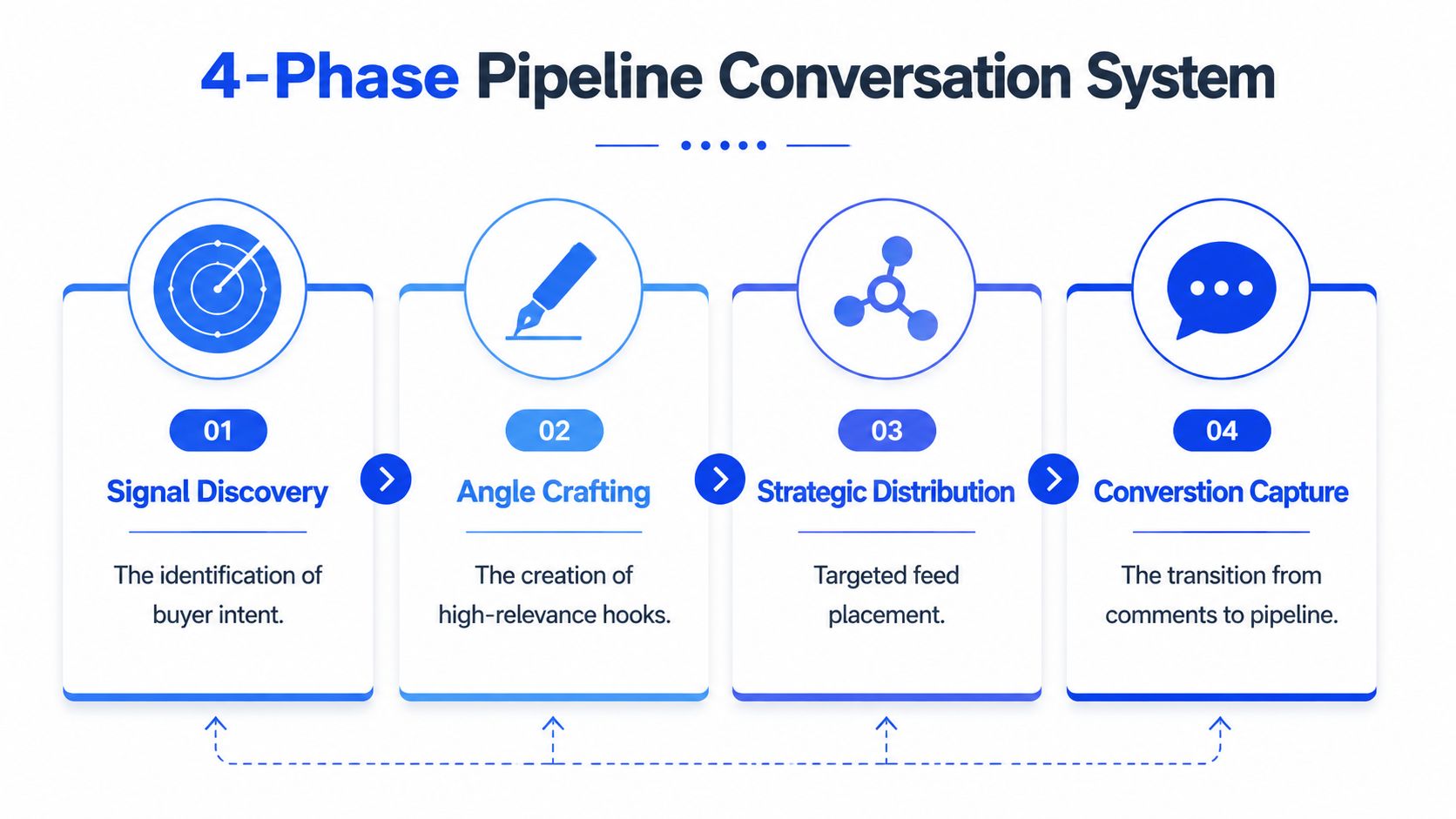
A 4-phase system for posts that generate conversations
Phase 1 and phase 2
Phase 3 and phase 4
What this looks like in a real weekly workflow
Integrate content with outbound for a single pipeline motion
Build one message map
Warm the account before outreach lands
Create a reverse signal loop
Measure what matters for pipeline, not vanity
The three numbers worth tracking internally
Use a review cadence that stops bad pivots
What to ignore
Anatomy of a post that generated 11 qualified DMs
Why that post worked
What to copy and what not to copy
Your next step to a predictable LinkedIn pipeline
Key takeaways
Start with buyer signals, not topic ideas → use sales call questions, recent wins and losses, and competitor posts getting traction
Build around a small set of pillars → focused publishing matters because LinkedIn has about 1.2 billion members, yet only about 1% post weekly, and that group drives 9 billion impressions per week, according to Evergreen Feed's LinkedIn content strategy breakdown
Write text-first posts well → 51% of LinkedIn users say they're most likely to interact with text posts from brands, based on Sprout Social's LinkedIn statistics roundup
Run content and outbound as one motion → comments, profile visits, and DMs should feed your Apollo, HubSpot, or Sales Navigator workflow
Measure pipeline signals, not vanity → track ICP-fit DMs, comment quality, and post-to-meeting conversion
Define your pipeline-led pillars and audience
Strategic planning often begins with a calendar. That's backward.
The better starting point is buyer behavior. What buyers ask on calls, what they object to in deals, what they react to in the feed, and what language they use when a problem is already painful enough to solve.

Stop building for a generic ICP
A standard ICP document is useful, but it isn't enough for content. Job title, company size, region, and revenue band don't tell you what makes someone stop scrolling.
For linkedin content strategy, you need a pipeline audience. That means the same firmographic fit, plus psychographic triggers like urgency, skepticism, buying friction, and channel preference. If you need a refresher on shaping that foundation, this guide on building an ideal customer profile is the right place to tighten it.
A practical way to frame it is this:
Layer | What you need |
|---|---|
Firmographic fit | Industry, size, geography, team shape |
Buying trigger | Stalled pipeline, low reply rates, weak positioning, poor list quality |
Belief pattern | What they currently think is working, but isn't |
Watering holes | Which creators, topics, and discussions they already pay attention to |
Practical rule: If your audience definition can't explain why a buyer comments, saves, or DMs, it isn't ready for content.
Use signal mining before you write
We use three inputs before drafting anything. Not twenty. Three.
Recent wins and losses
Pull call notes, close notes, and churn notes from HubSpot. Look for repeated moments where the buyer either trusted the process or rejected it.Recurring questions from sales calls
Check Gong notes, Slack handoff threads, or AE summaries. The best posts often come from questions your team is tired of answering.Competitor posts getting traction
Save five to ten posts from adjacent firms or founders. Don't copy the topic. Study the buyer tension underneath it.
This is also where a practical resource like the Publer blog on LinkedIn growth can help. Not for generic posting tips, but for getting a clearer picture of how to turn platform activity into a repeatable publishing habit.
Set three to five pillars and keep them stable
Once you've mined signals, group them into three to five pillars. That's enough repetition to build recognition, but not so much that the feed becomes stale.
A B2B agency or operator usually lands on something like this:
ICP pain points → stalled outbound, low meeting quality, weak market entry, poor attribution
Methods and frameworks → qualification rules, sequencing logic, targeting workflows, reporting structure
Proof and lessons → what changed after a process fix, what failed, what you'd refuse to do again
Behind the scenes → operating decisions, trade-offs, why the team runs one system instead of siloed channels
Keep the pillars stable for long enough that buyers associate you with them. Focus matters because LinkedIn is large, but publishing is concentrated. As noted earlier, only a small share of users post weekly, and those active creators capture a disproportionate amount of visibility.
A 4-phase system for posts that generate conversations
A founder posts on Tuesday morning. By Wednesday, the post has decent reach, a few compliments, and zero buyer follow-up. Friday comes, sales has no idea who engaged, and the next outbound sequence goes out as if the post never existed.
That is a content process problem, not a writing problem.
The post needs to do a job inside the pipeline. It should create recognizable buyer tension, give sales a reason to follow up, and leave a trail your team can act on in the CRM.
Phase 1 and phase 2
Phase 1 is signal selection.
Your pillars are already set. The operational work is choosing one live signal that sales can use this week. Pull it from Gong call notes, HubSpot deal comments, lost-deal reasons, customer emails, or a pattern your SDR team keeps hearing on cold calls.
Good signals are specific and expensive. A vague topic gets likes. A costly mistake gets replies from the right accounts.
Use prompts like these:
What objection showed up three times this week?
What process are prospects still running that slows buying down?
What belief is causing poor-fit accounts to self-select in?
What did a client fix that changed meeting quality or conversion?
Phase 2 is angle and hook.
The same signal can produce three different posts. One will attract the right conversation. Two will drift into generic engagement.
We test hooks in three categories:
Contrarian → challenge a bad default process
Proof-led → open with a result, observation, or before-and-after
Scenario-led → start with a concrete moment from sales, delivery, or reporting
Text usually carries the post. The practical trade-off is simple. Fancy design can improve stop rate, but weak diagnosis kills response quality. If you want to speed up production from call recordings, webinars, or founder clips, tools that repurpose video into social content can help your team create drafts faster. The draft still needs a human pass so it sounds like an operator with judgment, not an auto-generated transcript.
Buyers respond to clear diagnosis, a point of view they can test, and proof that the advice came from real delivery work.
Phase 3 and phase 4
Phase 3 is build the post around action.
A useful post usually follows a simple structure:
Problem → name the operational issue in plain language
Method → show the change in process, sequencing, targeting, or reporting
Proof → include a real outcome, a repeated pattern, or a lesson from execution
Prompt → ask for a specific response that helps qualify interest
The prompt matters more than teams expect. “Thoughts?” produces weak comments. “If your team is seeing this in outbound, reply with the blocker” produces better signals for follow-up.
Keep the body tight. One idea per paragraph. Short lines. Clear wording that still makes sense when a rep copies it into a DM or email opener. If you want the operational version of that workflow, Grou's LinkedIn content service follows the same text-first, pipeline-led approach.
Phase 4 is capture and handoff.
This step is where many B2B teams fail. They publish, answer a few comments, and lose the buying signals inside the feed.
Handle post-distribution like sales ops:
Reply fast in the first hour
Keep the thread active and ask follow-up questions that reveal context.Log engaged ICP accounts
Pull commenters, profile visitors, and relevant reactors into Sales Navigator lists or your CRM.Send context to the owner
Route notable engagement to the SDR, AE, or founder handling that segment.Follow up after interest has had time to settle
Day two to day five usually works better than an immediate pitch, especially for cold or lightly aware accounts.
What this looks like in a real weekly workflow
Simple beats elaborate here. One operator with a clean process will outperform a bloated editorial calendar that never reaches sales.
Day | Action |
|---|---|
Monday | Review call notes, objections, and CRM updates to pick one signal |
Tuesday | Draft two or three hooks, write the post, get sales input on wording |
Wednesday | Publish, reply quickly, flag engaged ICP accounts |
Thursday | Send soft follow-ups, connection requests, or outbound touches tied to the post |
Friday | Review conversation quality, hand-raisers, meetings created, and angle performance |
From the outside, this looks repetitive. Inside the pipeline, that repetition is the advantage. The same signals show up in posts, comments, DMs, and outbound, so buyers hear one argument instead of four disconnected ones.
Integrate content with outbound for a single pipeline motion
If content and outbound sit in different silos, you'll get activity without momentum.
Content warms the market. Outbound converts attention into meetings. Run them separately and the buyer sees mixed messages. Run them together and every touch compounds.

Build one message map
Start with a shared message map across sales and content. One document, one source of truth.
That document should define three things only:
Core pain points → the operational problems you want to be known for solving
Proof points → the evidence your team can repeat without stretching the truth
Disqualifiers → the work you won't take, the fit you don't chase, and the bad process you reject
Then sync your motions weekly. A Monday post should influence a Wednesday email opener. The same language should show up in a LinkedIn comment, a cold email, and a follow-up call.
Warm the account before outreach lands
This part is mechanical, and it matters.
Use Sales Navigator to track target accounts, Apollo or Clay to enrich them, and HubSpot to hold the engagement history. Before a sequence starts, have the rep or founder engage with the account on LinkedIn in a way that adds value. Not “great post.” A real observation, a useful question, a concrete reaction.
That approach lines up with how LinkedIn rewards engagement. The platform appears to value comments far more than likes, with some analyses suggesting comments can provide a 4x reach boost, and one cited case showed a 305% increase in impressions through strategic commenting, according to Supergrow's LinkedIn content strategy analysis.
A practical walkthrough sits below.
A useful comment does two jobs. It expands the post's conversation and signals to the account owner that you understand their problem without rushing into a pitch.
If your team needs the outbound side built into the same workflow, this outbound service overview shows the kind of integration to aim for, with one message map and one reporting line rather than disconnected campaigns.
Create a reverse signal loop
The best content teams don't just push content into market. They pull signals back into targeting.
Here's the loop:
Capture engagement from the right accounts
Comments, reactions, profile visits, connection accepts, and DMs matter if they come from ICP-fit buyers.Tag by segment
Industry, region, company size, and problem theme should all flow back into your CRM or spreadsheet.Adjust outbound priorities
If a theme starts drawing responses from legal tech founders or manufacturing revenue leaders, that segment gets more attention in the next outbound sprint.Feed objections back into content
If outbound replies keep pushing the same objection, turn it into a post.
That's the fundamental difference between posting for awareness and running a pipeline system. One creates activity. The other creates coordinated pressure.
Measure what matters for pipeline, not vanity
A lot of LinkedIn reporting is dressed up noise.
You can have a post with broad reach, positive comments, and a nice screenshot for Slack, while pipeline stays flat. If your team can't connect content activity to qualified conversations, the reporting model is broken.

The three numbers worth tracking internally
The first metric is DMs per week from ICP-fit buyers. Not all DMs. Not peers, recruiters, vendors, or students. Buyers.
The second is comment quality. Are peers and buyers adding real context, asking specific follow-ups, or disagreeing intelligently? Or are you getting low-signal agreement from people outside the market?
The third is post-to-meeting conversion rate. That means a clear path from post interaction to conversation, then from conversation to booked meeting. You won't get this from LinkedIn alone. You need a simple attribution model across LinkedIn activity and your CRM.
That gap is common. 70% of B2B marketers struggle with linking social media activity to closed revenue, according to MRR Unlocked's founder-led LinkedIn guide. That's why vanity reporting keeps winning. It's easier to count likes than connect content to pipeline.
If your team still treats reach and likes as the main scoreboard, this explainer on what vanity metrics hide in B2B reporting is worth using internally.
Use a review cadence that stops bad pivots
A stable review rhythm prevents overreaction.
Use this cadence:
Weekly check → inspect ICP-fit DMs, comment quality, and handoff opportunities for outbound
Monthly adjustment → sharpen angle, hook style, or offer language inside existing pillars
Quarterly review → decide whether a pillar needs to be reduced, expanded, or replaced
The key trade-off is patience versus drift. If you pivot themes after every weak post, you train the market to forget what you stand for. If you never review anything, stale messaging lingers too long.
What to ignore
A few metrics still have diagnostic value, but they shouldn't run the strategy.
Metric | Use it for | Don't use it for |
|---|---|---|
Likes | Fast read on surface resonance | Deciding pipeline contribution |
Impressions | Distribution checks | Judging buyer fit |
Follower growth | Trend awareness | Forecasting revenue |
Clicks | Offer interest | Measuring trust on their own |
Operator test: If a metric can't help sales choose who to contact, how to message, or what objection to address, it belongs in the background.
The healthiest linkedin content strategy reports look more like RevOps than social media.
Anatomy of a post that generated 11 qualified DMs
One of the strongest posts we've seen wasn't educational and wasn't promotional. It was a plain-language story about firing a client mid-retainer.
The client wanted high-volume outbound to a generic list. We refused, returned the budget, and walked away. The post explained what happened, why the request was wrong, and what that decision taught us about fit, quality, and saying no.
That post generated 11 inbound DMs from ICP-fit prospects within 72 hours. It also outperformed the previous best post by a wide margin. Not because it chased reach, but because it signaled standards.
Why that post worked
First, specificity beat positivity. “We fired a client” is more concrete than “lessons from agency life.” Buyers notice conflict and consequence.
Second, the post that converts rarely looks like a sales post. It didn't pitch anything. It showed values. The right buyers recognized themselves in the problem and opened a conversation.
Third, vulnerability built more trust than expertise content usually does. Not fake vulnerability. Just a clear account of a hard call and the rule it created.
The best-performing post is often the one that tells buyers what you refuse to do, not the one that lists what you do.
What to copy and what not to copy
Copy the mechanism, not the storyline.
Use this checklist when you want a post to create qualified DMs:
Choose a real decision → a client boundary, pricing call, failed experiment, or internal process change
State the tension early → what happened, what pressure existed, what was at stake
Explain the rule created by that experience → what you now do differently
Leave room for buyer self-selection → let the right prospect think, “That's exactly the issue we have”
Don't copy it by manufacturing drama. Buyers can spot forced controversy immediately.
If you want to see how this kind of positioning compounds in a niche market, this LinkedIn growth and content case study for an iGaming technology company shows the broader operating pattern.
Your next step to a predictable LinkedIn pipeline
A predictable LinkedIn pipeline usually breaks in one of two places. The content gets attention, but sales cannot use it. Or sales runs outbound in parallel, with no link between what prospects saw in the feed and what reps say in follow-up.
Start by auditing the last 30 days with one question: which posts produced signals your sales team could act on?
Pull every post into a sheet or Airtable and tag four fields beside each one: source signal, hook type, proof type, and sales outcome. Sales outcome should stay narrow. ICP-fit DM, reply from a target account, booked meeting, or influenced opportunity. Then compare those posts against the same period in your CRM. If you use HubSpot or Salesforce, the gaps become obvious. You can see which topics create comments from peers, and which ones create conversations with buyers.
That gives you something to operate from.
If your distribution breaks after the post goes live, the Cloud Present content distribution guide is a useful complement. It covers how to extend one strong idea across channels so the feed is part of a pipeline motion, not a one-off publishing event.
Applying this system takes discipline across content, targeting, and outbound. If you want a partner to build and run that motion with one reporting loop, Grou is one option to study. The point is straightforward: attention turns into pipeline when content, lead generation, and outreach run on the same system.
Most LinkedIn programs stall in the same place. The team is publishing, the founder is posting, impressions bounce around, and nobody can say which activity turned into a real meeting.
That usually happens because content is being run as a brand exercise while outbound is being run as a sales exercise. Different inputs, different language, different reporting. The result is noise, not pipeline.
A workable linkedin content strategy starts with one rule. Every post should either sharpen positioning, start a qualified conversation, or create a signal the sales team can act on. If it does none of those, it's content theater.
Table of Contents
Key takeaways
Define your pipeline-led pillars and audience
Stop building for a generic ICP
Use signal mining before you write
Set three to five pillars and keep them stable
A 4-phase system for posts that generate conversations
Phase 1 and phase 2
Phase 3 and phase 4
What this looks like in a real weekly workflow
Integrate content with outbound for a single pipeline motion
Build one message map
Warm the account before outreach lands
Create a reverse signal loop
Measure what matters for pipeline, not vanity
The three numbers worth tracking internally
Use a review cadence that stops bad pivots
What to ignore
Anatomy of a post that generated 11 qualified DMs
Why that post worked
What to copy and what not to copy
Your next step to a predictable LinkedIn pipeline
Key takeaways
Start with buyer signals, not topic ideas → use sales call questions, recent wins and losses, and competitor posts getting traction
Build around a small set of pillars → focused publishing matters because LinkedIn has about 1.2 billion members, yet only about 1% post weekly, and that group drives 9 billion impressions per week, according to Evergreen Feed's LinkedIn content strategy breakdown
Write text-first posts well → 51% of LinkedIn users say they're most likely to interact with text posts from brands, based on Sprout Social's LinkedIn statistics roundup
Run content and outbound as one motion → comments, profile visits, and DMs should feed your Apollo, HubSpot, or Sales Navigator workflow
Measure pipeline signals, not vanity → track ICP-fit DMs, comment quality, and post-to-meeting conversion
Define your pipeline-led pillars and audience
Strategic planning often begins with a calendar. That's backward.
The better starting point is buyer behavior. What buyers ask on calls, what they object to in deals, what they react to in the feed, and what language they use when a problem is already painful enough to solve.
Stop building for a generic ICP
A standard ICP document is useful, but it isn't enough for content. Job title, company size, region, and revenue band don't tell you what makes someone stop scrolling.
For linkedin content strategy, you need a pipeline audience. That means the same firmographic fit, plus psychographic triggers like urgency, skepticism, buying friction, and channel preference. If you need a refresher on shaping that foundation, this guide on building an ideal customer profile is the right place to tighten it.
A practical way to frame it is this:
Layer | What you need |
|---|---|
Firmographic fit | Industry, size, geography, team shape |
Buying trigger | Stalled pipeline, low reply rates, weak positioning, poor list quality |
Belief pattern | What they currently think is working, but isn't |
Watering holes | Which creators, topics, and discussions they already pay attention to |
Practical rule: If your audience definition can't explain why a buyer comments, saves, or DMs, it isn't ready for content.
Use signal mining before you write
We use three inputs before drafting anything. Not twenty. Three.
Recent wins and losses
Pull call notes, close notes, and churn notes from HubSpot. Look for repeated moments where the buyer either trusted the process or rejected it.Recurring questions from sales calls
Check Gong notes, Slack handoff threads, or AE summaries. The best posts often come from questions your team is tired of answering.Competitor posts getting traction
Save five to ten posts from adjacent firms or founders. Don't copy the topic. Study the buyer tension underneath it.
This is also where a practical resource like the Publer blog on LinkedIn growth can help. Not for generic posting tips, but for getting a clearer picture of how to turn platform activity into a repeatable publishing habit.
Set three to five pillars and keep them stable
Once you've mined signals, group them into three to five pillars. That's enough repetition to build recognition, but not so much that the feed becomes stale.
A B2B agency or operator usually lands on something like this:
ICP pain points → stalled outbound, low meeting quality, weak market entry, poor attribution
Methods and frameworks → qualification rules, sequencing logic, targeting workflows, reporting structure
Proof and lessons → what changed after a process fix, what failed, what you'd refuse to do again
Behind the scenes → operating decisions, trade-offs, why the team runs one system instead of siloed channels
Keep the pillars stable for long enough that buyers associate you with them. Focus matters because LinkedIn is large, but publishing is concentrated. As noted earlier, only a small share of users post weekly, and those active creators capture a disproportionate amount of visibility.
A 4-phase system for posts that generate conversations
A founder posts on Tuesday morning. By Wednesday, the post has decent reach, a few compliments, and zero buyer follow-up. Friday comes, sales has no idea who engaged, and the next outbound sequence goes out as if the post never existed.
That is a content process problem, not a writing problem.
The post needs to do a job inside the pipeline. It should create recognizable buyer tension, give sales a reason to follow up, and leave a trail your team can act on in the CRM.
Phase 1 and phase 2
Phase 1 is signal selection.
Your pillars are already set. The operational work is choosing one live signal that sales can use this week. Pull it from Gong call notes, HubSpot deal comments, lost-deal reasons, customer emails, or a pattern your SDR team keeps hearing on cold calls.
Good signals are specific and expensive. A vague topic gets likes. A costly mistake gets replies from the right accounts.
Use prompts like these:
What objection showed up three times this week?
What process are prospects still running that slows buying down?
What belief is causing poor-fit accounts to self-select in?
What did a client fix that changed meeting quality or conversion?
Phase 2 is angle and hook.
The same signal can produce three different posts. One will attract the right conversation. Two will drift into generic engagement.
We test hooks in three categories:
Contrarian → challenge a bad default process
Proof-led → open with a result, observation, or before-and-after
Scenario-led → start with a concrete moment from sales, delivery, or reporting
Text usually carries the post. The practical trade-off is simple. Fancy design can improve stop rate, but weak diagnosis kills response quality. If you want to speed up production from call recordings, webinars, or founder clips, tools that repurpose video into social content can help your team create drafts faster. The draft still needs a human pass so it sounds like an operator with judgment, not an auto-generated transcript.
Buyers respond to clear diagnosis, a point of view they can test, and proof that the advice came from real delivery work.
Phase 3 and phase 4
Phase 3 is build the post around action.
A useful post usually follows a simple structure:
Problem → name the operational issue in plain language
Method → show the change in process, sequencing, targeting, or reporting
Proof → include a real outcome, a repeated pattern, or a lesson from execution
Prompt → ask for a specific response that helps qualify interest
The prompt matters more than teams expect. “Thoughts?” produces weak comments. “If your team is seeing this in outbound, reply with the blocker” produces better signals for follow-up.
Keep the body tight. One idea per paragraph. Short lines. Clear wording that still makes sense when a rep copies it into a DM or email opener. If you want the operational version of that workflow, Grou's LinkedIn content service follows the same text-first, pipeline-led approach.
Phase 4 is capture and handoff.
This step is where many B2B teams fail. They publish, answer a few comments, and lose the buying signals inside the feed.
Handle post-distribution like sales ops:
Reply fast in the first hour
Keep the thread active and ask follow-up questions that reveal context.Log engaged ICP accounts
Pull commenters, profile visitors, and relevant reactors into Sales Navigator lists or your CRM.Send context to the owner
Route notable engagement to the SDR, AE, or founder handling that segment.Follow up after interest has had time to settle
Day two to day five usually works better than an immediate pitch, especially for cold or lightly aware accounts.
What this looks like in a real weekly workflow
Simple beats elaborate here. One operator with a clean process will outperform a bloated editorial calendar that never reaches sales.
Day | Action |
|---|---|
Monday | Review call notes, objections, and CRM updates to pick one signal |
Tuesday | Draft two or three hooks, write the post, get sales input on wording |
Wednesday | Publish, reply quickly, flag engaged ICP accounts |
Thursday | Send soft follow-ups, connection requests, or outbound touches tied to the post |
Friday | Review conversation quality, hand-raisers, meetings created, and angle performance |
From the outside, this looks repetitive. Inside the pipeline, that repetition is the advantage. The same signals show up in posts, comments, DMs, and outbound, so buyers hear one argument instead of four disconnected ones.
Integrate content with outbound for a single pipeline motion
If content and outbound sit in different silos, you'll get activity without momentum.
Content warms the market. Outbound converts attention into meetings. Run them separately and the buyer sees mixed messages. Run them together and every touch compounds.
Build one message map
Start with a shared message map across sales and content. One document, one source of truth.
That document should define three things only:
Core pain points → the operational problems you want to be known for solving
Proof points → the evidence your team can repeat without stretching the truth
Disqualifiers → the work you won't take, the fit you don't chase, and the bad process you reject
Then sync your motions weekly. A Monday post should influence a Wednesday email opener. The same language should show up in a LinkedIn comment, a cold email, and a follow-up call.
Warm the account before outreach lands
This part is mechanical, and it matters.
Use Sales Navigator to track target accounts, Apollo or Clay to enrich them, and HubSpot to hold the engagement history. Before a sequence starts, have the rep or founder engage with the account on LinkedIn in a way that adds value. Not “great post.” A real observation, a useful question, a concrete reaction.
That approach lines up with how LinkedIn rewards engagement. The platform appears to value comments far more than likes, with some analyses suggesting comments can provide a 4x reach boost, and one cited case showed a 305% increase in impressions through strategic commenting, according to Supergrow's LinkedIn content strategy analysis.
A practical walkthrough sits below.
A useful comment does two jobs. It expands the post's conversation and signals to the account owner that you understand their problem without rushing into a pitch.
If your team needs the outbound side built into the same workflow, this outbound service overview shows the kind of integration to aim for, with one message map and one reporting line rather than disconnected campaigns.
Create a reverse signal loop
The best content teams don't just push content into market. They pull signals back into targeting.
Here's the loop:
Capture engagement from the right accounts
Comments, reactions, profile visits, connection accepts, and DMs matter if they come from ICP-fit buyers.Tag by segment
Industry, region, company size, and problem theme should all flow back into your CRM or spreadsheet.Adjust outbound priorities
If a theme starts drawing responses from legal tech founders or manufacturing revenue leaders, that segment gets more attention in the next outbound sprint.Feed objections back into content
If outbound replies keep pushing the same objection, turn it into a post.
That's the fundamental difference between posting for awareness and running a pipeline system. One creates activity. The other creates coordinated pressure.
Measure what matters for pipeline, not vanity
A lot of LinkedIn reporting is dressed up noise.
You can have a post with broad reach, positive comments, and a nice screenshot for Slack, while pipeline stays flat. If your team can't connect content activity to qualified conversations, the reporting model is broken.
The three numbers worth tracking internally
The first metric is DMs per week from ICP-fit buyers. Not all DMs. Not peers, recruiters, vendors, or students. Buyers.
The second is comment quality. Are peers and buyers adding real context, asking specific follow-ups, or disagreeing intelligently? Or are you getting low-signal agreement from people outside the market?
The third is post-to-meeting conversion rate. That means a clear path from post interaction to conversation, then from conversation to booked meeting. You won't get this from LinkedIn alone. You need a simple attribution model across LinkedIn activity and your CRM.
That gap is common. 70% of B2B marketers struggle with linking social media activity to closed revenue, according to MRR Unlocked's founder-led LinkedIn guide. That's why vanity reporting keeps winning. It's easier to count likes than connect content to pipeline.
If your team still treats reach and likes as the main scoreboard, this explainer on what vanity metrics hide in B2B reporting is worth using internally.
Use a review cadence that stops bad pivots
A stable review rhythm prevents overreaction.
Use this cadence:
Weekly check → inspect ICP-fit DMs, comment quality, and handoff opportunities for outbound
Monthly adjustment → sharpen angle, hook style, or offer language inside existing pillars
Quarterly review → decide whether a pillar needs to be reduced, expanded, or replaced
The key trade-off is patience versus drift. If you pivot themes after every weak post, you train the market to forget what you stand for. If you never review anything, stale messaging lingers too long.
What to ignore
A few metrics still have diagnostic value, but they shouldn't run the strategy.
Metric | Use it for | Don't use it for |
|---|---|---|
Likes | Fast read on surface resonance | Deciding pipeline contribution |
Impressions | Distribution checks | Judging buyer fit |
Follower growth | Trend awareness | Forecasting revenue |
Clicks | Offer interest | Measuring trust on their own |
Operator test: If a metric can't help sales choose who to contact, how to message, or what objection to address, it belongs in the background.
The healthiest linkedin content strategy reports look more like RevOps than social media.
Anatomy of a post that generated 11 qualified DMs
One of the strongest posts we've seen wasn't educational and wasn't promotional. It was a plain-language story about firing a client mid-retainer.
The client wanted high-volume outbound to a generic list. We refused, returned the budget, and walked away. The post explained what happened, why the request was wrong, and what that decision taught us about fit, quality, and saying no.
That post generated 11 inbound DMs from ICP-fit prospects within 72 hours. It also outperformed the previous best post by a wide margin. Not because it chased reach, but because it signaled standards.
Why that post worked
First, specificity beat positivity. “We fired a client” is more concrete than “lessons from agency life.” Buyers notice conflict and consequence.
Second, the post that converts rarely looks like a sales post. It didn't pitch anything. It showed values. The right buyers recognized themselves in the problem and opened a conversation.
Third, vulnerability built more trust than expertise content usually does. Not fake vulnerability. Just a clear account of a hard call and the rule it created.
The best-performing post is often the one that tells buyers what you refuse to do, not the one that lists what you do.
What to copy and what not to copy
Copy the mechanism, not the storyline.
Use this checklist when you want a post to create qualified DMs:
Choose a real decision → a client boundary, pricing call, failed experiment, or internal process change
State the tension early → what happened, what pressure existed, what was at stake
Explain the rule created by that experience → what you now do differently
Leave room for buyer self-selection → let the right prospect think, “That's exactly the issue we have”
Don't copy it by manufacturing drama. Buyers can spot forced controversy immediately.
If you want to see how this kind of positioning compounds in a niche market, this LinkedIn growth and content case study for an iGaming technology company shows the broader operating pattern.
Your next step to a predictable LinkedIn pipeline
A predictable LinkedIn pipeline usually breaks in one of two places. The content gets attention, but sales cannot use it. Or sales runs outbound in parallel, with no link between what prospects saw in the feed and what reps say in follow-up.
Start by auditing the last 30 days with one question: which posts produced signals your sales team could act on?
Pull every post into a sheet or Airtable and tag four fields beside each one: source signal, hook type, proof type, and sales outcome. Sales outcome should stay narrow. ICP-fit DM, reply from a target account, booked meeting, or influenced opportunity. Then compare those posts against the same period in your CRM. If you use HubSpot or Salesforce, the gaps become obvious. You can see which topics create comments from peers, and which ones create conversations with buyers.
That gives you something to operate from.
If your distribution breaks after the post goes live, the Cloud Present content distribution guide is a useful complement. It covers how to extend one strong idea across channels so the feed is part of a pipeline motion, not a one-off publishing event.
Applying this system takes discipline across content, targeting, and outbound. If you want a partner to build and run that motion with one reporting loop, Grou is one option to study. The point is straightforward: attention turns into pipeline when content, lead generation, and outreach run on the same system.
Most LinkedIn programs stall in the same place. The team is publishing, the founder is posting, impressions bounce around, and nobody can say which activity turned into a real meeting.
That usually happens because content is being run as a brand exercise while outbound is being run as a sales exercise. Different inputs, different language, different reporting. The result is noise, not pipeline.
A workable linkedin content strategy starts with one rule. Every post should either sharpen positioning, start a qualified conversation, or create a signal the sales team can act on. If it does none of those, it's content theater.
Table of Contents
Key takeaways
Define your pipeline-led pillars and audience
Stop building for a generic ICP
Use signal mining before you write
Set three to five pillars and keep them stable
A 4-phase system for posts that generate conversations
Phase 1 and phase 2
Phase 3 and phase 4
What this looks like in a real weekly workflow
Integrate content with outbound for a single pipeline motion
Build one message map
Warm the account before outreach lands
Create a reverse signal loop
Measure what matters for pipeline, not vanity
The three numbers worth tracking internally
Use a review cadence that stops bad pivots
What to ignore
Anatomy of a post that generated 11 qualified DMs
Why that post worked
What to copy and what not to copy
Your next step to a predictable LinkedIn pipeline
Key takeaways
Start with buyer signals, not topic ideas → use sales call questions, recent wins and losses, and competitor posts getting traction
Build around a small set of pillars → focused publishing matters because LinkedIn has about 1.2 billion members, yet only about 1% post weekly, and that group drives 9 billion impressions per week, according to Evergreen Feed's LinkedIn content strategy breakdown
Write text-first posts well → 51% of LinkedIn users say they're most likely to interact with text posts from brands, based on Sprout Social's LinkedIn statistics roundup
Run content and outbound as one motion → comments, profile visits, and DMs should feed your Apollo, HubSpot, or Sales Navigator workflow
Measure pipeline signals, not vanity → track ICP-fit DMs, comment quality, and post-to-meeting conversion
Define your pipeline-led pillars and audience
Strategic planning often begins with a calendar. That's backward.
The better starting point is buyer behavior. What buyers ask on calls, what they object to in deals, what they react to in the feed, and what language they use when a problem is already painful enough to solve.
Stop building for a generic ICP
A standard ICP document is useful, but it isn't enough for content. Job title, company size, region, and revenue band don't tell you what makes someone stop scrolling.
For linkedin content strategy, you need a pipeline audience. That means the same firmographic fit, plus psychographic triggers like urgency, skepticism, buying friction, and channel preference. If you need a refresher on shaping that foundation, this guide on building an ideal customer profile is the right place to tighten it.
A practical way to frame it is this:
Layer | What you need |
|---|---|
Firmographic fit | Industry, size, geography, team shape |
Buying trigger | Stalled pipeline, low reply rates, weak positioning, poor list quality |
Belief pattern | What they currently think is working, but isn't |
Watering holes | Which creators, topics, and discussions they already pay attention to |
Practical rule: If your audience definition can't explain why a buyer comments, saves, or DMs, it isn't ready for content.
Use signal mining before you write
We use three inputs before drafting anything. Not twenty. Three.
Recent wins and losses
Pull call notes, close notes, and churn notes from HubSpot. Look for repeated moments where the buyer either trusted the process or rejected it.Recurring questions from sales calls
Check Gong notes, Slack handoff threads, or AE summaries. The best posts often come from questions your team is tired of answering.Competitor posts getting traction
Save five to ten posts from adjacent firms or founders. Don't copy the topic. Study the buyer tension underneath it.
This is also where a practical resource like the Publer blog on LinkedIn growth can help. Not for generic posting tips, but for getting a clearer picture of how to turn platform activity into a repeatable publishing habit.
Set three to five pillars and keep them stable
Once you've mined signals, group them into three to five pillars. That's enough repetition to build recognition, but not so much that the feed becomes stale.
A B2B agency or operator usually lands on something like this:
ICP pain points → stalled outbound, low meeting quality, weak market entry, poor attribution
Methods and frameworks → qualification rules, sequencing logic, targeting workflows, reporting structure
Proof and lessons → what changed after a process fix, what failed, what you'd refuse to do again
Behind the scenes → operating decisions, trade-offs, why the team runs one system instead of siloed channels
Keep the pillars stable for long enough that buyers associate you with them. Focus matters because LinkedIn is large, but publishing is concentrated. As noted earlier, only a small share of users post weekly, and those active creators capture a disproportionate amount of visibility.
A 4-phase system for posts that generate conversations
A founder posts on Tuesday morning. By Wednesday, the post has decent reach, a few compliments, and zero buyer follow-up. Friday comes, sales has no idea who engaged, and the next outbound sequence goes out as if the post never existed.
That is a content process problem, not a writing problem.
The post needs to do a job inside the pipeline. It should create recognizable buyer tension, give sales a reason to follow up, and leave a trail your team can act on in the CRM.
Phase 1 and phase 2
Phase 1 is signal selection.
Your pillars are already set. The operational work is choosing one live signal that sales can use this week. Pull it from Gong call notes, HubSpot deal comments, lost-deal reasons, customer emails, or a pattern your SDR team keeps hearing on cold calls.
Good signals are specific and expensive. A vague topic gets likes. A costly mistake gets replies from the right accounts.
Use prompts like these:
What objection showed up three times this week?
What process are prospects still running that slows buying down?
What belief is causing poor-fit accounts to self-select in?
What did a client fix that changed meeting quality or conversion?
Phase 2 is angle and hook.
The same signal can produce three different posts. One will attract the right conversation. Two will drift into generic engagement.
We test hooks in three categories:
Contrarian → challenge a bad default process
Proof-led → open with a result, observation, or before-and-after
Scenario-led → start with a concrete moment from sales, delivery, or reporting
Text usually carries the post. The practical trade-off is simple. Fancy design can improve stop rate, but weak diagnosis kills response quality. If you want to speed up production from call recordings, webinars, or founder clips, tools that repurpose video into social content can help your team create drafts faster. The draft still needs a human pass so it sounds like an operator with judgment, not an auto-generated transcript.
Buyers respond to clear diagnosis, a point of view they can test, and proof that the advice came from real delivery work.
Phase 3 and phase 4
Phase 3 is build the post around action.
A useful post usually follows a simple structure:
Problem → name the operational issue in plain language
Method → show the change in process, sequencing, targeting, or reporting
Proof → include a real outcome, a repeated pattern, or a lesson from execution
Prompt → ask for a specific response that helps qualify interest
The prompt matters more than teams expect. “Thoughts?” produces weak comments. “If your team is seeing this in outbound, reply with the blocker” produces better signals for follow-up.
Keep the body tight. One idea per paragraph. Short lines. Clear wording that still makes sense when a rep copies it into a DM or email opener. If you want the operational version of that workflow, Grou's LinkedIn content service follows the same text-first, pipeline-led approach.
Phase 4 is capture and handoff.
This step is where many B2B teams fail. They publish, answer a few comments, and lose the buying signals inside the feed.
Handle post-distribution like sales ops:
Reply fast in the first hour
Keep the thread active and ask follow-up questions that reveal context.Log engaged ICP accounts
Pull commenters, profile visitors, and relevant reactors into Sales Navigator lists or your CRM.Send context to the owner
Route notable engagement to the SDR, AE, or founder handling that segment.Follow up after interest has had time to settle
Day two to day five usually works better than an immediate pitch, especially for cold or lightly aware accounts.
What this looks like in a real weekly workflow
Simple beats elaborate here. One operator with a clean process will outperform a bloated editorial calendar that never reaches sales.
Day | Action |
|---|---|
Monday | Review call notes, objections, and CRM updates to pick one signal |
Tuesday | Draft two or three hooks, write the post, get sales input on wording |
Wednesday | Publish, reply quickly, flag engaged ICP accounts |
Thursday | Send soft follow-ups, connection requests, or outbound touches tied to the post |
Friday | Review conversation quality, hand-raisers, meetings created, and angle performance |
From the outside, this looks repetitive. Inside the pipeline, that repetition is the advantage. The same signals show up in posts, comments, DMs, and outbound, so buyers hear one argument instead of four disconnected ones.
Integrate content with outbound for a single pipeline motion
If content and outbound sit in different silos, you'll get activity without momentum.
Content warms the market. Outbound converts attention into meetings. Run them separately and the buyer sees mixed messages. Run them together and every touch compounds.
Build one message map
Start with a shared message map across sales and content. One document, one source of truth.
That document should define three things only:
Core pain points → the operational problems you want to be known for solving
Proof points → the evidence your team can repeat without stretching the truth
Disqualifiers → the work you won't take, the fit you don't chase, and the bad process you reject
Then sync your motions weekly. A Monday post should influence a Wednesday email opener. The same language should show up in a LinkedIn comment, a cold email, and a follow-up call.
Warm the account before outreach lands
This part is mechanical, and it matters.
Use Sales Navigator to track target accounts, Apollo or Clay to enrich them, and HubSpot to hold the engagement history. Before a sequence starts, have the rep or founder engage with the account on LinkedIn in a way that adds value. Not “great post.” A real observation, a useful question, a concrete reaction.
That approach lines up with how LinkedIn rewards engagement. The platform appears to value comments far more than likes, with some analyses suggesting comments can provide a 4x reach boost, and one cited case showed a 305% increase in impressions through strategic commenting, according to Supergrow's LinkedIn content strategy analysis.
A practical walkthrough sits below.
A useful comment does two jobs. It expands the post's conversation and signals to the account owner that you understand their problem without rushing into a pitch.
If your team needs the outbound side built into the same workflow, this outbound service overview shows the kind of integration to aim for, with one message map and one reporting line rather than disconnected campaigns.
Create a reverse signal loop
The best content teams don't just push content into market. They pull signals back into targeting.
Here's the loop:
Capture engagement from the right accounts
Comments, reactions, profile visits, connection accepts, and DMs matter if they come from ICP-fit buyers.Tag by segment
Industry, region, company size, and problem theme should all flow back into your CRM or spreadsheet.Adjust outbound priorities
If a theme starts drawing responses from legal tech founders or manufacturing revenue leaders, that segment gets more attention in the next outbound sprint.Feed objections back into content
If outbound replies keep pushing the same objection, turn it into a post.
That's the fundamental difference between posting for awareness and running a pipeline system. One creates activity. The other creates coordinated pressure.
Measure what matters for pipeline, not vanity
A lot of LinkedIn reporting is dressed up noise.
You can have a post with broad reach, positive comments, and a nice screenshot for Slack, while pipeline stays flat. If your team can't connect content activity to qualified conversations, the reporting model is broken.
The three numbers worth tracking internally
The first metric is DMs per week from ICP-fit buyers. Not all DMs. Not peers, recruiters, vendors, or students. Buyers.
The second is comment quality. Are peers and buyers adding real context, asking specific follow-ups, or disagreeing intelligently? Or are you getting low-signal agreement from people outside the market?
The third is post-to-meeting conversion rate. That means a clear path from post interaction to conversation, then from conversation to booked meeting. You won't get this from LinkedIn alone. You need a simple attribution model across LinkedIn activity and your CRM.
That gap is common. 70% of B2B marketers struggle with linking social media activity to closed revenue, according to MRR Unlocked's founder-led LinkedIn guide. That's why vanity reporting keeps winning. It's easier to count likes than connect content to pipeline.
If your team still treats reach and likes as the main scoreboard, this explainer on what vanity metrics hide in B2B reporting is worth using internally.
Use a review cadence that stops bad pivots
A stable review rhythm prevents overreaction.
Use this cadence:
Weekly check → inspect ICP-fit DMs, comment quality, and handoff opportunities for outbound
Monthly adjustment → sharpen angle, hook style, or offer language inside existing pillars
Quarterly review → decide whether a pillar needs to be reduced, expanded, or replaced
The key trade-off is patience versus drift. If you pivot themes after every weak post, you train the market to forget what you stand for. If you never review anything, stale messaging lingers too long.
What to ignore
A few metrics still have diagnostic value, but they shouldn't run the strategy.
Metric | Use it for | Don't use it for |
|---|---|---|
Likes | Fast read on surface resonance | Deciding pipeline contribution |
Impressions | Distribution checks | Judging buyer fit |
Follower growth | Trend awareness | Forecasting revenue |
Clicks | Offer interest | Measuring trust on their own |
Operator test: If a metric can't help sales choose who to contact, how to message, or what objection to address, it belongs in the background.
The healthiest linkedin content strategy reports look more like RevOps than social media.
Anatomy of a post that generated 11 qualified DMs
One of the strongest posts we've seen wasn't educational and wasn't promotional. It was a plain-language story about firing a client mid-retainer.
The client wanted high-volume outbound to a generic list. We refused, returned the budget, and walked away. The post explained what happened, why the request was wrong, and what that decision taught us about fit, quality, and saying no.
That post generated 11 inbound DMs from ICP-fit prospects within 72 hours. It also outperformed the previous best post by a wide margin. Not because it chased reach, but because it signaled standards.
Why that post worked
First, specificity beat positivity. “We fired a client” is more concrete than “lessons from agency life.” Buyers notice conflict and consequence.
Second, the post that converts rarely looks like a sales post. It didn't pitch anything. It showed values. The right buyers recognized themselves in the problem and opened a conversation.
Third, vulnerability built more trust than expertise content usually does. Not fake vulnerability. Just a clear account of a hard call and the rule it created.
The best-performing post is often the one that tells buyers what you refuse to do, not the one that lists what you do.
What to copy and what not to copy
Copy the mechanism, not the storyline.
Use this checklist when you want a post to create qualified DMs:
Choose a real decision → a client boundary, pricing call, failed experiment, or internal process change
State the tension early → what happened, what pressure existed, what was at stake
Explain the rule created by that experience → what you now do differently
Leave room for buyer self-selection → let the right prospect think, “That's exactly the issue we have”
Don't copy it by manufacturing drama. Buyers can spot forced controversy immediately.
If you want to see how this kind of positioning compounds in a niche market, this LinkedIn growth and content case study for an iGaming technology company shows the broader operating pattern.
Your next step to a predictable LinkedIn pipeline
A predictable LinkedIn pipeline usually breaks in one of two places. The content gets attention, but sales cannot use it. Or sales runs outbound in parallel, with no link between what prospects saw in the feed and what reps say in follow-up.
Start by auditing the last 30 days with one question: which posts produced signals your sales team could act on?
Pull every post into a sheet or Airtable and tag four fields beside each one: source signal, hook type, proof type, and sales outcome. Sales outcome should stay narrow. ICP-fit DM, reply from a target account, booked meeting, or influenced opportunity. Then compare those posts against the same period in your CRM. If you use HubSpot or Salesforce, the gaps become obvious. You can see which topics create comments from peers, and which ones create conversations with buyers.
That gives you something to operate from.
If your distribution breaks after the post goes live, the Cloud Present content distribution guide is a useful complement. It covers how to extend one strong idea across channels so the feed is part of a pipeline motion, not a one-off publishing event.
Applying this system takes discipline across content, targeting, and outbound. If you want a partner to build and run that motion with one reporting loop, Grou is one option to study. The point is straightforward: attention turns into pipeline when content, lead generation, and outreach run on the same system.
Pipeline OS Newsletter
Build qualified pipeline
Get weekly tactics to generate demand, improve lead quality, and book more meetings.






Trusted by industry leaders
Trusted by industry leaders
Trusted by industry leaders
Ready to build qualified pipeline?
Ready to build qualified pipeline?
Ready to build qualified pipeline?
Book a call to see if we're the right fit, or take the 2-minute quiz to get a clear starting point.
Book a call to see if we're the right fit, or take the 2-minute quiz to get a clear starting point.
Book a call to see if we're the right fit, or take the 2-minute quiz to get a clear starting point.
" height="30.21639343089746px" id="hfGbXmQR2" width="30.216393430897455px"/></svg>)
Copyright © 2026 – All Right Reserved
Copyright © 2026 – All Right Reserved
Copyright © 2026 – All Right Reserved