%22%3E%3C/path%3E%3Cpath d=%22M 63.072 7.554 C 62.258 8.022 61.577 8.689 61.092 9.493 L 61.092 7.076 L 57.158 7.076 L 57.158 22.64 L 61.089 22.64 L 61.089 14.888 C 61.089 13.446 61.403 12.434 62.03 11.853 C 62.818 11.218 63.818 10.907 64.826 10.982 L 65.868 10.982 L 65.868 6.851 C 64.891 6.834 63.926 7.076 63.073 7.554 Z%22 fill=%22rgb(17,17,17)%22%3E%3C/path%3E%3Cpath d=%22M 78.916 7.82 C 76.363 6.49 73.321 6.49 70.768 7.82 C 69.562 8.473 68.564 9.451 67.888 10.644 C 67.167 11.931 66.803 13.387 66.834 14.862 C 66.804 16.332 67.157 17.785 67.86 19.077 C 68.515 20.267 69.494 21.246 70.684 21.901 C 71.924 22.576 73.318 22.92 74.73 22.898 C 76.164 22.918 77.58 22.575 78.846 21.901 C 80.062 21.247 81.073 20.27 81.768 19.077 C 82.506 17.797 82.88 16.339 82.85 14.862 C 82.88 13.389 82.517 11.934 81.797 10.647 C 81.12 9.455 80.122 8.477 78.917 7.824 M 78.803 14.862 C 78.829 15.739 78.636 16.608 78.241 17.391 C 77.903 18.046 77.38 18.588 76.738 18.95 C 76.124 19.293 75.432 19.472 74.729 19.47 C 73.668 19.497 72.648 19.061 71.934 18.276 C 71.139 17.323 70.741 16.1 70.823 14.862 C 70.741 13.62 71.149 12.395 71.959 11.45 C 72.687 10.667 73.715 10.233 74.783 10.256 C 75.859 10.236 76.894 10.67 77.635 11.45 C 78.464 12.387 78.884 13.616 78.801 14.864%22 fill=%22rgb(17,17,17)%22%3E%3C/path%3E%3Cpath d=%22M 95.906 7.076 L 95.906 15.646 C 95.975 16.68 95.643 17.701 94.979 18.498 C 94.311 19.184 93.379 19.547 92.422 19.495 C 91.475 19.544 90.553 19.18 89.894 18.498 C 89.23 17.701 88.898 16.68 88.967 15.646 L 88.967 7.076 L 85.033 7.076 L 85.033 16.207 C 85 17.449 85.275 18.68 85.834 19.79 C 86.327 20.75 87.095 21.542 88.039 22.065 C 89.033 22.594 90.145 22.861 91.271 22.838 C 92.188 22.847 93.095 22.65 93.926 22.263 C 94.708 21.905 95.388 21.36 95.906 20.675 L 95.906 22.645 L 99.865 22.645 L 99.865 7.076 Z%22 fill=%22rgb(17,17,17)%22%3E%3C/path%3E%3Cpath d=%22M 4.513 15.626 C 4.511 10.815 7.606 6.549 12.181 5.059 C 16.756 3.57 21.77 5.195 24.601 9.086 L 27.816 5.87 C 24.074 1.186 17.981 -0.943 12.137 0.393 C 6.292 1.728 1.728 6.292 0.393 12.137 C -0.943 17.981 1.186 24.074 5.87 27.816 L 9.085 24.601 C 6.214 22.512 4.515 19.177 4.513 15.626%22 fill=%22rgb(32,62,235)%22%3E%3C/path%3E%3Cpath d=%22M 17.114 14.343 L 13.354 18.01 L 13.354 18.026 L 21.071 18.026 L 11.412 27.609 L 17.389 27.609 L 23.999 21.081 L 23.999 28.316 L 24.005 28.316 L 27.967 24.393 L 27.967 14.343 Z%22 fill=%22rgb(32,62,235)%22%3E%3C/path%3E%3C/g%3E%3C/svg%3E) ×
× ××
××›
›
›
›
10 LinkedIn Marketing Agencies for B2B Pipeline (2026)
10 LinkedIn Marketing Agencies for B2B Pipeline (2026)
10 LinkedIn Marketing Agencies for B2B Pipeline (2026)
10 LinkedIn Marketing Agencies for B2B Pipeline (2026)
10 LinkedIn Marketing Agencies for B2B Pipeline (2026)
10 LinkedIn Marketing Agencies for B2B Pipeline (2026)

Author
Aljaz Peklaj

Most LinkedIn agency roundups fail for one reason. They rank vendors by visible activity, not by revenue impact.
You are not buying posts. You are buying a system that should create qualified conversations, support outbound, and show up in pipeline. Yet many agencies still sell content calendars, follower growth, and engagement screenshots as if attention alone closes deals.
LinkedIn deserves a tougher standard. It is one of the few B2B channels where identity, company data, and buyer context sit in the same place. That makes it valuable, but it also makes the category noisy. A lot of agencies know how to generate motion. Far fewer know how to turn that motion into meetings, opportunities, and closed revenue.
That is the filter used in this list.
The goal is not to find the agency with the slickest pitch or the prettiest case study. The goal is to judge whether an agency has a working pipeline system. That means content tied to distribution, profiles built to convert, outbound connected to audience signals, and reporting that shows sales impact. If you need a benchmark for what that operating model looks like, this LinkedIn content strategy for B2B pipeline is the right reference point.
Key takeaways
Pipeline over vanity: Judge agencies on qualified conversations, opportunity creation, and sales-cycle influence. Impressions are supporting data, not the goal.
System over deliverables: Posts alone do not produce consistent ROI. The mechanics around them do. Profile conversion, outbound coordination, reply handling, and CRM tracking decide whether LinkedIn becomes a channel or a distraction.
Connected execution beats siloed work: Content without outbound support leaves demand uncaptured. Outreach without content trust lowers reply quality. Strong agencies connect both.
Process reveals the truth: Check the founder's own LinkedIn presence, ask for reachable references, and review the actual client report before you buy the pitch.
The 5-point checklist for evaluating any LinkedIn agency
Their own founder's LinkedIn presence: If they cannot build authority and inbound on their own profile, they will not do it for you.
Named clients with reachable references: Ask for a customer you can contact and ask about pipeline contribution, not audience growth.
A churned client reference: Every agency has one. The honest firms will explain where fit broke down and why.
A sample of real, recent client content: Ask for the last 10 posts from a current client, not the one post that got a spike in reach.
A sample client report: If page one shows impressions and reactions, they optimize for activity. If it shows conversation quality, qualification rate, and downstream pipeline, they optimize for outcomes.
If your broader stack is messy, this is also a good time to transform your marketing with an automation agency.
Table of Contents
1. Grou
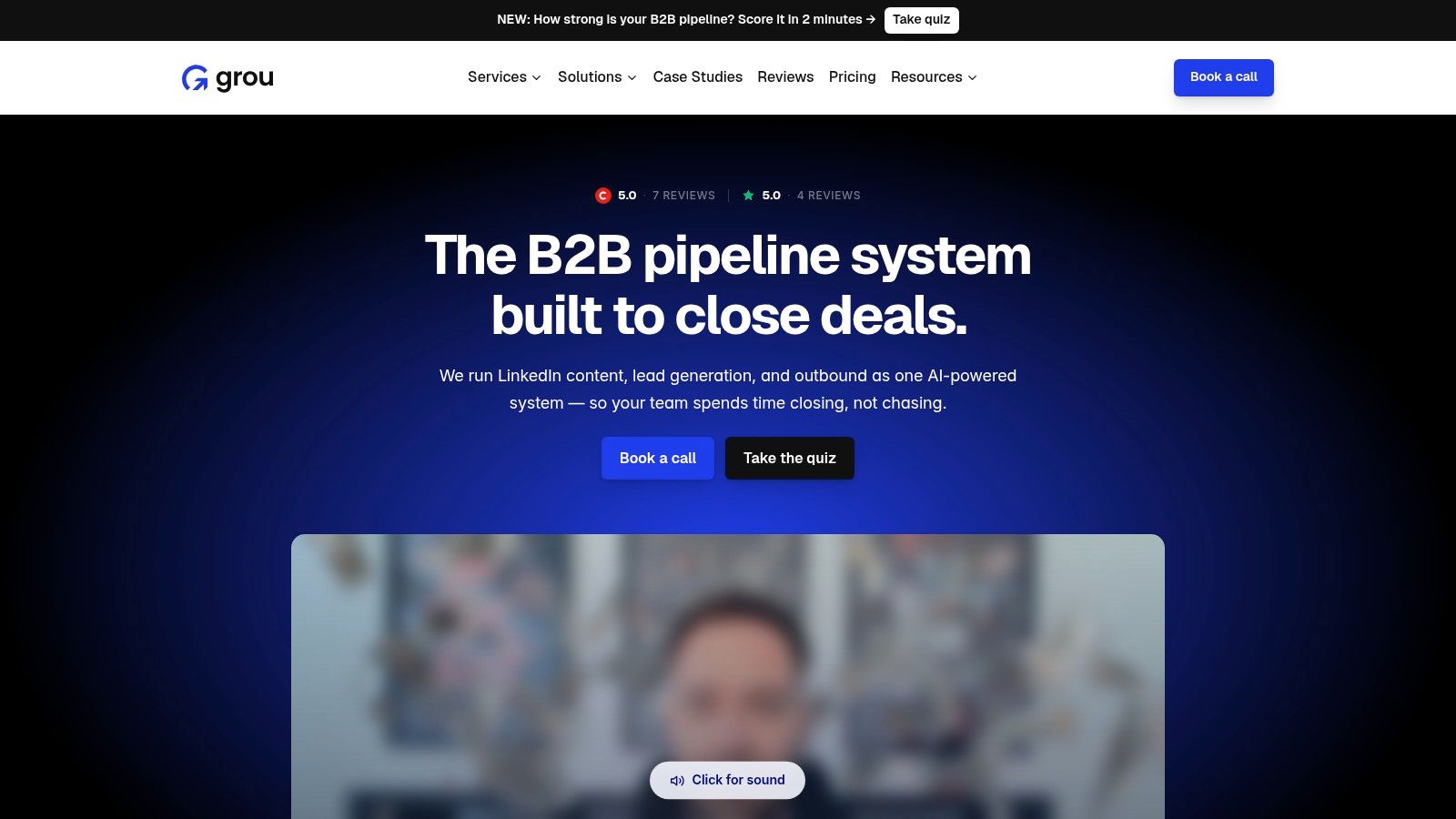
If you want one recommendation, this is it. GROU isn't built like a content shop. It's built like a pipeline system that happens to use LinkedIn as one of its main surfaces.
Most LinkedIn marketing agencies split the work across silos, content team writes posts, outbound team runs Apollo or Instantly, RevOps cleans up attribution later. GROU removes that handoff problem. One message, one target list, one reporting line.
Why Grou is the best fit for pipeline-first teams
The strongest part of the model is integration. GROU combines ICP list building, credibility-first LinkedIn content, and managed outbound into bi-weekly operating sprints, with fast feedback loops in a shared Slack channel. That matters if you're running a real revenue motion across SaaS, iGaming, manufacturing, legal tech, or pharma, because misalignment usually kills response quality before sales ever sees the lead.
The agency position is the right one. LinkedIn content isn't the product. Pipeline is.
Practical rule: If an agency can't explain how a post creates a warmer outbound touch, they don't understand the job.
The operating stack is familiar to serious teams, Sales Navigator for targeting, CRM-connected reporting, outbound infrastructure, and founder-led content that supports trust before a rep or founder reaches out. You can pair this kind of setup with Apollo, Clay, Lemlist, Instantly, or HeyReach, but the value is the orchestration, not the software list.
Best for
GROU is best for teams that want structure, not freelancers managing disconnected tasks.
Best fit: Founders and revenue leaders who need LinkedIn content, list building, and outbound to work as one system
Why it works: Shared qualification rules reduce wasted sales time and make reporting cleaner
Trade-off: Pricing isn't public, so you need a real fit conversation
Watch-out: This isn't a passive vendor setup. It works best when your sales and marketing leaders can engage in the sprint cadence
If your team is tired of choosing between "brand" and "lead gen," GROU's site is the one to review first.
2. B2Linked
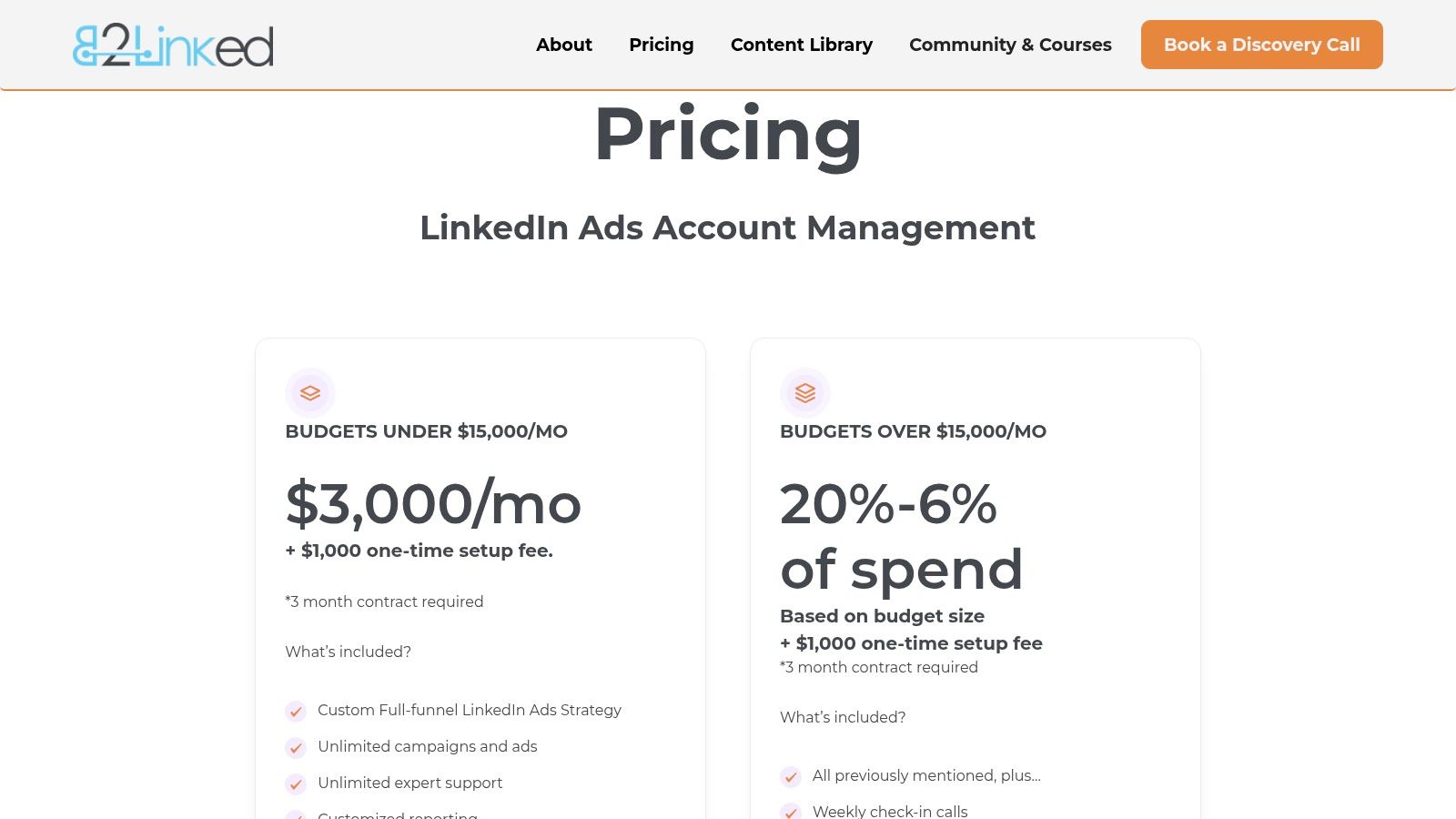
B2Linked is the specialist pick if your problem is LinkedIn Ads performance, not founder content or outbound coordination. They stay narrow, and that focus is useful.
For paid social buyers, LinkedIn can justify premium media economics when conversion quality is the goal. Transmission Agency's LinkedIn marketing numbers cite an average LinkedIn lead conversion rate of 2.74 percent and note that LinkedIn-focused agency retainers commonly sit in the $2,000 to $10,000+ monthly range. That's the environment B2Linked operates in, specialist channel, specialist pricing, and usually a buyer who already knows they want qualified B2B demand rather than cheap traffic.
Where B2Linked wins
Their strength is hands-on LinkedIn Ads management, audits, consulting, and training. If your internal team already owns positioning, landing pages, and CRM flow, a deep paid-media partner can be enough.
They're not the right choice if you need the full content-to-outbound loop. They're the right choice if your media team needs sharper segmentation, cleaner account structure, and someone who lives inside Campaign Manager all day.
Paid LinkedIn only works when the offer, audience, and follow-up path are already tight. B2Linked is for teams that understand that.
You should also think about how ad traffic connects to your organic trust layer. If that's underdeveloped, tighten the message first with a LinkedIn content strategy framework.
For a paid-media-led engagement, B2Linked is a strong shortlist option.
3. Impactable
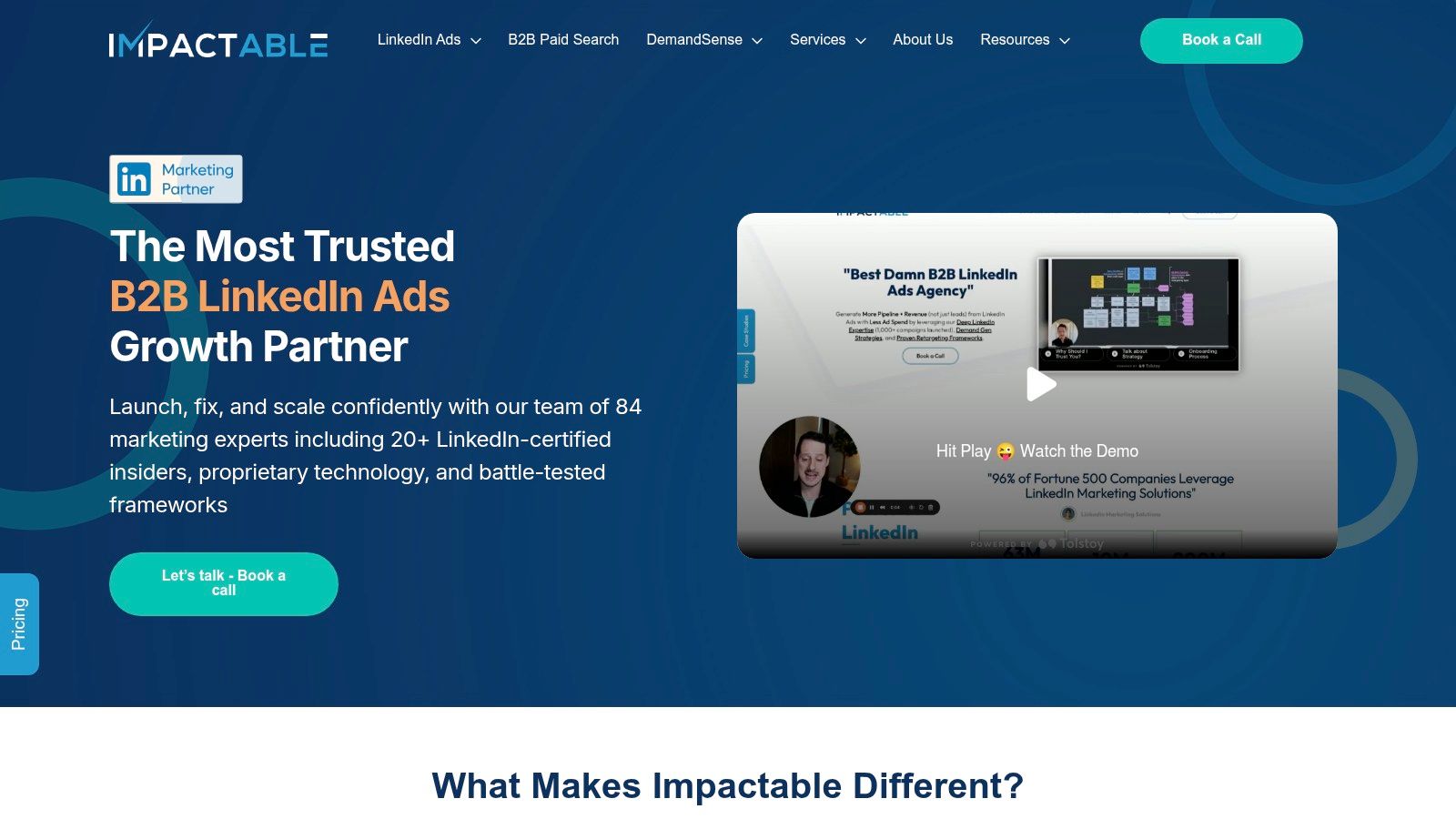
Impactable sits in the middle ground between pure ad management and a broader LinkedIn growth program. That's useful if you want a LinkedIn-first agency with more technical opinion on campaign tuning and reporting.
Their differentiation is operational, not aesthetic. They focus on LinkedIn Ads, thought-leadership content, nurture mechanics, and proprietary tooling that extends what teams can do inside the platform.
Why Impactable stands out
The best reason to consider Impactable is control over paid execution. SQ Magazine's LinkedIn advertising statistics roundup says some market analyses put LinkedIn B2B lead-gen cost about 28 percent lower than paid search on a cost-per-qualified-lead basis, despite a higher CPC benchmark of roughly $6.20. That trade-off favors agencies that know how to tighten targeting, suppress weak audiences, and hold the line on qualification.
Impactable appears built for that kind of work. If your KPI is downstream pipeline quality rather than top-of-funnel volume, that matters more than polished dashboards.
A fair caution, though. The model is still LinkedIn-first. If your market requires coordinated search, paid social outside LinkedIn, outbound sequencing, and CRM-led routing in one program, you may outgrow a channel-centric setup.
Best fit: B2B teams that want stronger LinkedIn ad controls and cleaner revenue-influence reporting
Good sign: Public pricing tiers and clear minimum-spend expectations
Limitation: Budget-percentage pricing can rise quickly as spend scales
If your growth plan is anchored in LinkedIn paid media, Impactable deserves a look.
4. Cleverly
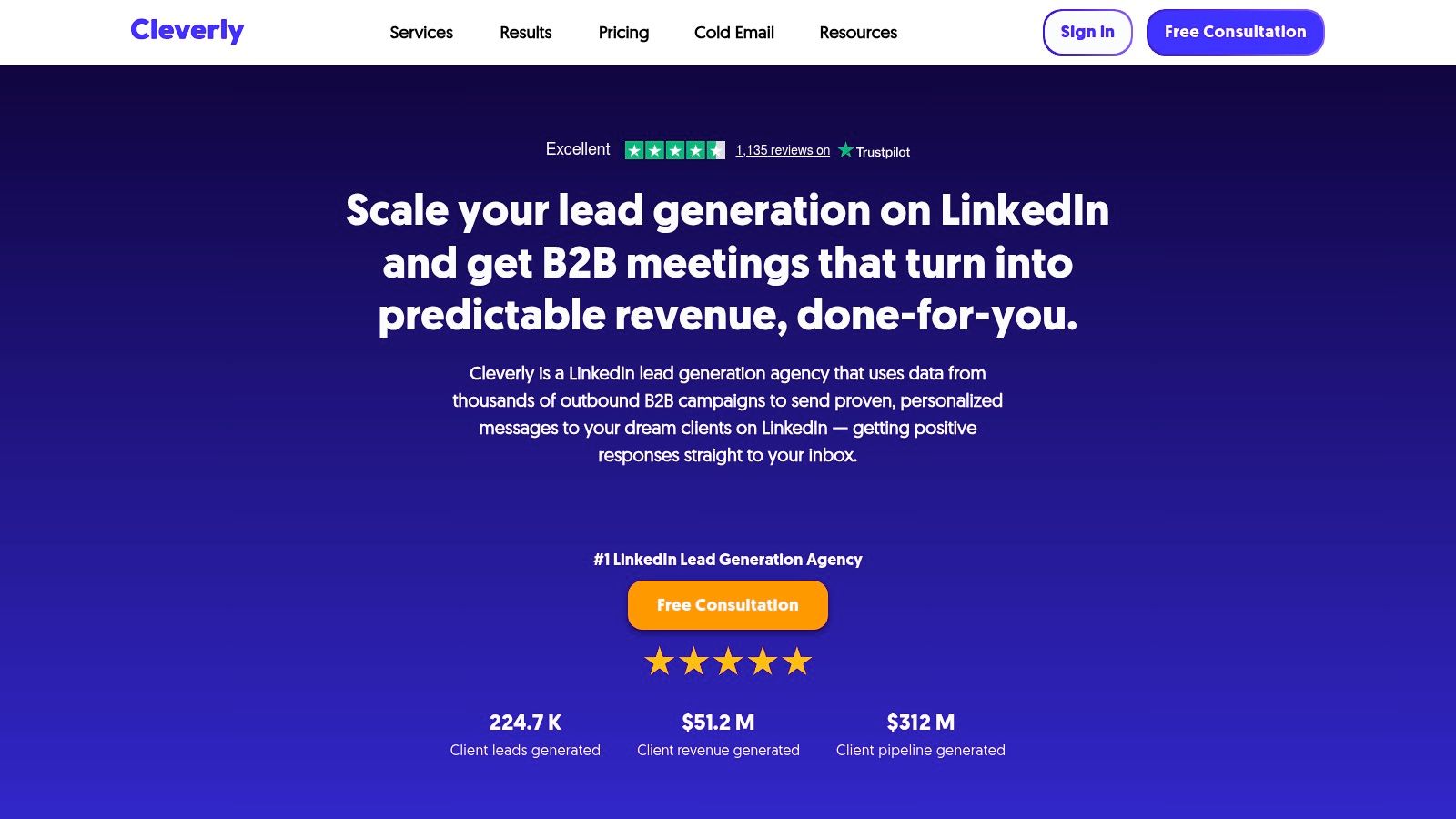
Cleverly is the high-volume outreach option. If you want managed LinkedIn prospecting with a relatively straightforward setup, they fit that lane.
This isn't a nuanced recommendation. Cleverly is useful when speed matters more than precision and your offer is already simple enough to survive a templated motion.
Where Cleverly fits, and where it doesn't
For lower-complexity outbound, there's value in a service that handles list building, messaging, inbox workflows, and dashboard visibility. Teams that sell straightforward offers into a clearly defined ICP can get traction from that.
The risk is generic outreach. Enterprise buyers, regulated categories, and long-cycle deals don't respond well to messages that feel interchangeable.
Operator note: If your average deal needs trust, multiple stakeholders, or a founder-led point of view, pure scale outreach will underperform.
That doesn't make Cleverly bad. It means you should buy it for the right use case. If you need help judging where a volume-first agency fits your motion, use this guide on how to hire a lead generation agency.
Cleverly is one of the easier agencies to price and understand up front. For simple outreach programs, Cleverly is a practical option.
5. Lead Cookie
Lead Cookie has a better positioning than most outreach shops because it doesn't sound obsessed with volume. That's a good sign.
For teams that want LinkedIn and email working together without turning the whole motion into automation theater, Lead Cookie is worth considering. The appeal is restraint, narrower targeting, more customized messaging, and managed conversation flow.
What Lead Cookie does well
The agency sits closer to a boutique outbound partner than a content-led LinkedIn shop. That means you shouldn't expect paid media strategy or deep founder-brand work. You should expect targeted prospecting, multichannel sequences, and a steadier hand on personalization.
That can be exactly right for a company that already has market credibility but needs more conversations. It can also pair well with a stronger organic credibility layer, especially if your founder profile is part of the funnel. If that's the missing piece, start with a LinkedIn content service built for B2B trust.
Lead Cookie makes sense when your outbound motion needs to feel human without forcing your internal team to run every step. Lead Cookie is a sensible pick for that middle ground.
6. BAMF
BAMF is for founder-led organic visibility. If your bet is that executive presence on LinkedIn will create trust and inbound demand, BAMF is built for that lane.
That makes BAMF directionally useful, but only if you understand the limitation. Organic content alone rarely closes the loop.
Where BAMF is useful
The agency offers ghostwriting, profile optimization, and founder-focused programs. That's valuable when the founder already has strong opinions, real customer insight, and enough access to fuel good content.
The weak version of this category is obvious, every client sounds the same, every post opens with the same fake-contrarian hook, and none of it connects to sales motion. The stronger version produces content that sounds native to the founder and turns the profile into a conversion asset.
If you need the basics on profile mechanics and platform behavior, GROU's LinkedIn glossary entry is a useful reference.
Good fit: Founder brands, executive visibility, organic authority building
Not ideal: Teams that need paid acquisition, SDR workflow, or multichannel orchestration from the same vendor
For founder-centric organic LinkedIn work, BAMF is a valid shortlist option.
7. Sculpt
Sculpt is a stronger fit for mid-market and enterprise teams that want LinkedIn handled inside a larger B2B social program. They understand the corporate side of social execution, executive advocacy, paid support, and creative production.
That positioning matters if your real problem is coordination across stakeholders. A lot of internal teams don't need another freelancer. They need a social partner who can manage process.
Why teams hire Sculpt
Sculpt's edge is integrated B2B social, organic executive programs, employee advocacy, and paid LinkedIn campaign support. If your brand already has established demand gen and sales infrastructure, that can slot in cleanly.
The caution is the same one I'd apply to most social agencies. Social output is not the same as pipeline creation. If nobody owns the handoff from engagement to sales action, the program becomes expensive branding.
That's why teams with more aggressive revenue goals should pressure-test how social activity connects to actual meeting generation and account progression. This broader B2B sales lead generation framework is a better lens than social reporting alone.
For enterprise-friendly B2B social execution with a real LinkedIn competency, Sculpt belongs on the list.
8. Directive
Directive is not a LinkedIn-only agency, and that's exactly why some teams should prefer it. If LinkedIn is one channel inside a larger pipeline system, a broader performance partner can be the smarter buy.
This is especially true in SaaS and more mature B2B motions where search, paid social, remarketing, content, and RevOps all need to line up. Channel specialists can hit a ceiling there.
Where Directive makes sense
Directive makes sense when you're managing pipeline across multiple surfaces and need LinkedIn to support a bigger revenue model. Their orientation is closer to demand generation and performance accountability than social publishing.
That said, if your immediate problem is a weak founder profile, no signal capture from engagement, or no outbound integration, Directive may be too broad. Buy them when the challenge is system-level acquisition, not just LinkedIn execution.
One reason the channel still deserves dedicated attention is lead quality. Brenton Way's LinkedIn marketing statistics cite that 80 percent of B2B social-media leads come from LinkedIn, with a visitor-to-lead conversion rate of about 2.74 percent, ahead of Facebook and X. In a cross-channel system, that makes LinkedIn too important to treat as an afterthought.
For teams building a multi-channel demand engine, Directive is a serious option.
9. Ironpaper
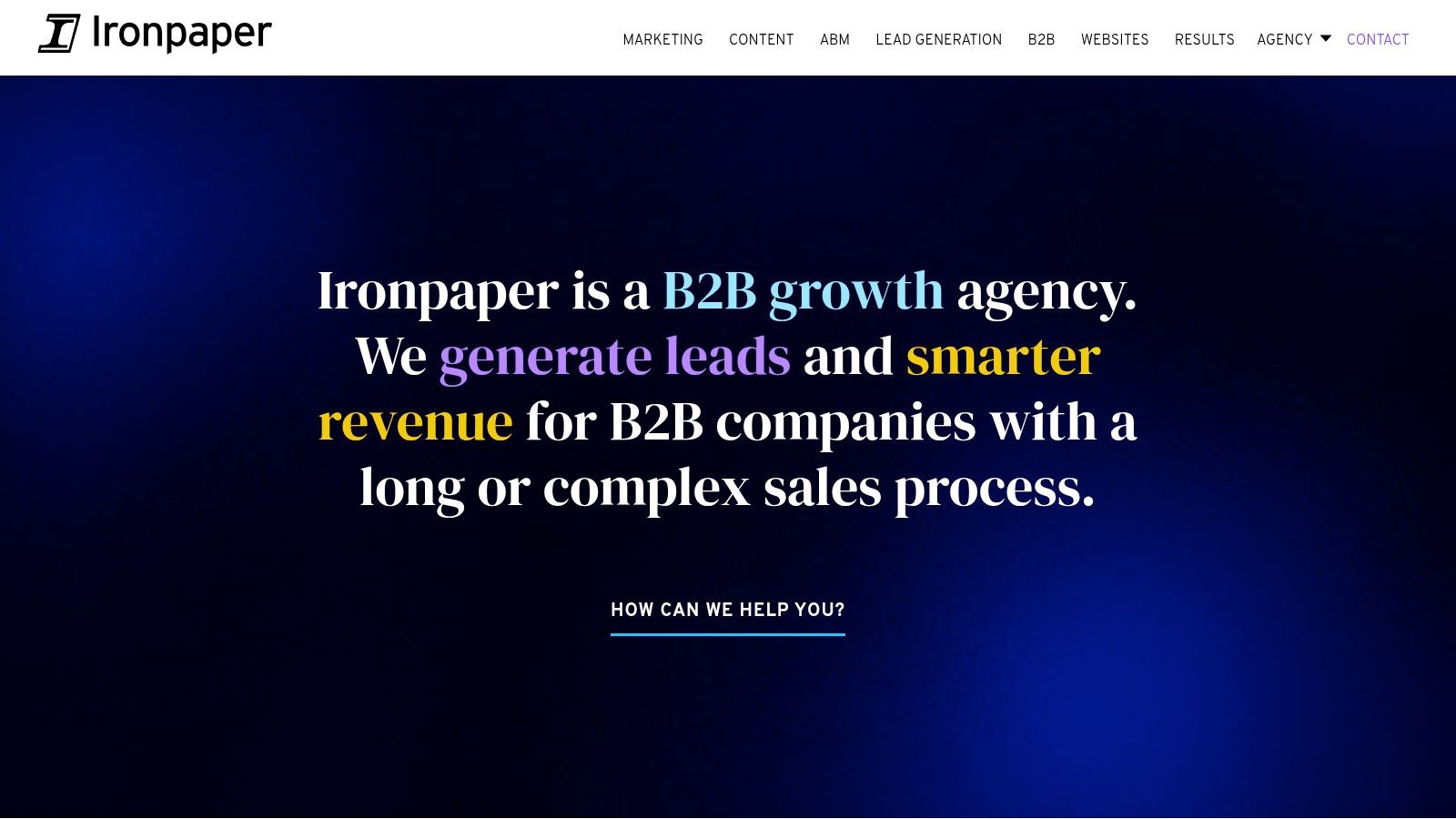
Ironpaper is the ABM-oriented choice on this list. If you sell into defined buying committees and need LinkedIn used as part of account-based programs, that framing is valuable.
A lot of LinkedIn marketing agencies talk about leads in the abstract. Ironpaper is more relevant when your real world looks like target accounts, multiple contacts, sales enablement, and conversion-focused content.
Why Ironpaper makes the list
Their position is strongest for mid-market and enterprise B2B firms that need strategy, content, paid media, and sales enablement connected. That suits manufacturing, legal tech, pharma, and complex SaaS better than a pure outreach shop does.
The trade-off is focus. If all you want is outbound support through Sales Navigator and message sequencing, this is probably too much agency. If you need ABM and demand generation infrastructure around LinkedIn, it's closer to the right level.
There's another reason this approach matters now. Platform measurement is getting messier, and serious buyers should care how agencies adapt. This discussion on LinkedIn signal changes and measurement constraints highlights a key gap in the market, many agencies still don't explain how they redesign dashboards, attribution, and qualification rules as native engagement signals change.
If you need LinkedIn inside an ABM and sales-enablement model, Ironpaper is worth review.
10. Belkins
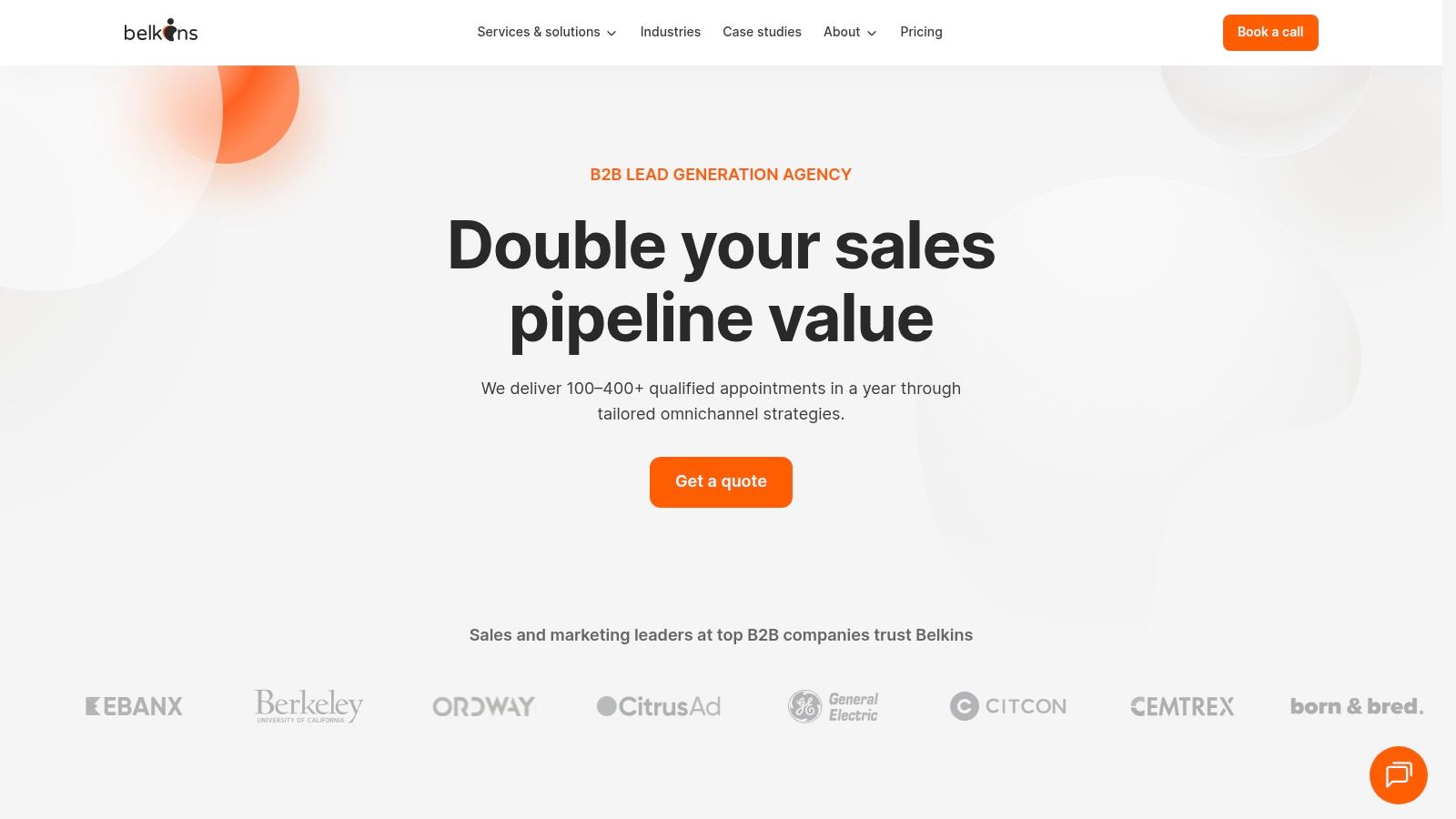
Belkins fits teams that need meetings now and have the sales process to convert them. Their value is not LinkedIn content quality or category authority. It is managed appointment setting across LinkedIn, email, and related outbound work, with enough operational structure to keep volume consistent.
That distinction matters.
A lot of agencies in this category sell activity dressed up as strategy. Belkins is more useful if you judge them by system design. How they source accounts, how they segment lists, how they write sequences, how they qualify meetings, and how they report outcomes back to sales. If your goal is pipeline, those are the questions that matter more than connection rates or reply totals.
Where Belkins earns a seat
Belkins makes sense for B2B teams with a defined ICP, a tested offer, and clear meeting qualification rules. If your reps know what a good opportunity looks like and your follow-up process is tight, an agency like this can add capacity fast without forcing you to build the outbound machine internally.
The trade-off is straightforward. Belkins is a better fit for demand capture than demand creation. If your market does not recognize your brand, your positioning is weak, or your executive profiles undercut trust, outsourced appointment setting will hit a ceiling. Agencies that connect LinkedIn content, outbound, and sales messaging usually outperform pure meeting-booking shops in those cases because they build familiarity before the ask.
LinkedIn still matters here, as noted earlier. The practical question is whether the agency uses it as one touch in a coordinated outreach system or treats it like a standalone trick. Belkins is stronger in the first model.
For multichannel appointment setting with LinkedIn as a core channel, Belkins is a reasonable pick.
Top 10 LinkedIn Marketing Agencies Comparison
Service / Core offering | Unique selling points (✨) | Target audience (👥) | Pricing & value (💰) | Quality / Outcomes (★) |
|---|---|---|---|---|
Grou 🏆 | ✨ Unified AI revenue engine: LinkedIn content + ICP list + outbound; fast launch (14d) | 👥 B2B revenue & marketing teams (SaaS, iGaming, manufacturing, professional services) | 💰 Custom pricing (quote/quiz), quality-over-volume | ★★★★★ • Proven: 350 leads, 10x followers, $20M+ deals |
B2Linked | ✨ Founder-led LinkedIn Ads expertise, audits & training | 👥 B2B teams needing deep LinkedIn Ads management | 💰 Public pricing; short commitments (min fees apply) | ★★★★ • Strong LinkedIn Ads reputation |
Impactable | ✨ Proprietary DemandSense (dayparting, exclusions) + revenue tracking | 👥 Teams wanting tech-driven LinkedIn ads & advanced reporting | 💰 Public tiers; fee tied to ad spend | ★★★★ • LinkedIn-certified; advanced optimisations |
Cleverly | ✨ Fast setup, templated outreach, AI-assisted inbox & dashboards | 👥 Budget-conscious teams wanting high-volume outreach | 💰 Public entry pricing; scale with add-ons | ★★★ • Quick results but volume-focused (may trade quality) |
Lead Cookie | ✨ Multi-channel (LinkedIn + email) with heavy personalization | 👥 Teams seeking lower-noise, ICP-focused outreach | 💰 Quote-based retainers (no public pricing) | ★★★★ • Boutique, personalized outbound |
BAMF | ✨ Founder ghostwriting: 20 posts/mo, profile redesign, voice profiling | 👥 Founders & execs building personal LinkedIn brands | 💰 Transparent month-to-month plans | ★★★★ • Strong at founder-led organic pipeline |
Sculpt | ✨ Integrated LinkedIn organic + paid + advocacy; content-unit scoping | 👥 Mid-market & enterprise social teams | 💰 Proposal-based; some transparent ranges | ★★★★ • B2B social focus; case-backed |
Directive | ✨ Cross-channel paid + RevOps alignment with pipeline benchmarks | 👥 Enterprise / SaaS demand-gen leaders | 💰 Custom enterprise proposals | ★★★★★ • Enterprise-grade pipeline accountability |
Ironpaper | ✨ ABM-first with LinkedIn, content & sales enablement integration | 👥 Companies seeking ABM + sales-aligned demand programs | 💰 Quote-based, mid-market/enterprise retainers | ★★★★ • Full-funnel ABM orientation |
Belkins | ✨ End-to-end appointment setting: LinkedIn + email + calling + validation | 👥 Teams prioritizing meeting volume & pipeline coverage | 💰 Public plan structure; confirm per-meeting fees/add-ons | ★★★ • Good breadth; performance depends on ICP clarity |
Your next step
The right agency doesn't just sell a service. They build a system.
Before you book calls with anyone on this list, audit your own motion first. Many teams already know LinkedIn matters. The issue is that they can't see where the pipeline leaks are, so they buy the wrong kind of agency.
Start with the profile. If your founder or executive profile still reads like a resume, fix that before you approve another month of content. Content drives profile visits. If the profile doesn't convert, every post sends traffic into a dead end.
Then look at signal capture. When ICP-fit people like, comment, view, or connect, what happens next? The strongest LinkedIn programs treat engagement as a routing event. Someone on the team checks the signal, qualifies the account, and pushes the contact into the right follow-up path, outbound, founder DM, AE outreach, or nurture.
The post is not the product. The conversation is the product.
After that, inspect your stack. Most B2B teams already have enough tools, Apollo for data, Clay for enrichment, Sales Navigator for account targeting, Lemlist or Instantly for outreach, HubSpot for reporting. The problem usually isn't missing software. It's that each tool runs in isolation, so nobody owns the full path from attention to meeting.
Use this simple four-step audit:
Check conversion surfaces: Founder profile, company page, featured section, CTA path.
Check signal flow: Who captures engagement, how fast they act, where names get routed.
Check outbound alignment: Are content themes reflected in LinkedIn DMs and email copy.
Check reporting: Are you measuring conversations, qualified opportunities, and sales-cycle influence, or just engagement.
If you do that thoughtfully, you'll know what kind of agency to hire.
Choose GROU if you want LinkedIn content, outbound, and qualification tied together in one operating model. Choose B2Linked or Impactable if paid LinkedIn is the main issue. Choose BAMF if founder authority is the missing piece. Choose Belkins, Cleverly, or Lead Cookie if outreach execution is the bottleneck. Choose Directive or Ironpaper if LinkedIn sits inside a larger demand gen or ABM system. Choose Sculpt if executive social and B2B brand execution need operational help.
Just don't buy a calendar when you need pipeline.
If you want the shortest path to a LinkedIn program that creates qualified conversations, start with Grou. GROU is built for B2B teams that need one message, one target list, and one reporting line across LinkedIn content, outbound, and pipeline measurement.
Most LinkedIn agency roundups fail for one reason. They rank vendors by visible activity, not by revenue impact.
You are not buying posts. You are buying a system that should create qualified conversations, support outbound, and show up in pipeline. Yet many agencies still sell content calendars, follower growth, and engagement screenshots as if attention alone closes deals.
LinkedIn deserves a tougher standard. It is one of the few B2B channels where identity, company data, and buyer context sit in the same place. That makes it valuable, but it also makes the category noisy. A lot of agencies know how to generate motion. Far fewer know how to turn that motion into meetings, opportunities, and closed revenue.
That is the filter used in this list.
The goal is not to find the agency with the slickest pitch or the prettiest case study. The goal is to judge whether an agency has a working pipeline system. That means content tied to distribution, profiles built to convert, outbound connected to audience signals, and reporting that shows sales impact. If you need a benchmark for what that operating model looks like, this LinkedIn content strategy for B2B pipeline is the right reference point.
Key takeaways
Pipeline over vanity: Judge agencies on qualified conversations, opportunity creation, and sales-cycle influence. Impressions are supporting data, not the goal.
System over deliverables: Posts alone do not produce consistent ROI. The mechanics around them do. Profile conversion, outbound coordination, reply handling, and CRM tracking decide whether LinkedIn becomes a channel or a distraction.
Connected execution beats siloed work: Content without outbound support leaves demand uncaptured. Outreach without content trust lowers reply quality. Strong agencies connect both.
Process reveals the truth: Check the founder's own LinkedIn presence, ask for reachable references, and review the actual client report before you buy the pitch.
The 5-point checklist for evaluating any LinkedIn agency
Their own founder's LinkedIn presence: If they cannot build authority and inbound on their own profile, they will not do it for you.
Named clients with reachable references: Ask for a customer you can contact and ask about pipeline contribution, not audience growth.
A churned client reference: Every agency has one. The honest firms will explain where fit broke down and why.
A sample of real, recent client content: Ask for the last 10 posts from a current client, not the one post that got a spike in reach.
A sample client report: If page one shows impressions and reactions, they optimize for activity. If it shows conversation quality, qualification rate, and downstream pipeline, they optimize for outcomes.
If your broader stack is messy, this is also a good time to transform your marketing with an automation agency.
Table of Contents
1. Grou
If you want one recommendation, this is it. GROU isn't built like a content shop. It's built like a pipeline system that happens to use LinkedIn as one of its main surfaces.
Most LinkedIn marketing agencies split the work across silos, content team writes posts, outbound team runs Apollo or Instantly, RevOps cleans up attribution later. GROU removes that handoff problem. One message, one target list, one reporting line.
Why Grou is the best fit for pipeline-first teams
The strongest part of the model is integration. GROU combines ICP list building, credibility-first LinkedIn content, and managed outbound into bi-weekly operating sprints, with fast feedback loops in a shared Slack channel. That matters if you're running a real revenue motion across SaaS, iGaming, manufacturing, legal tech, or pharma, because misalignment usually kills response quality before sales ever sees the lead.
The agency position is the right one. LinkedIn content isn't the product. Pipeline is.
Practical rule: If an agency can't explain how a post creates a warmer outbound touch, they don't understand the job.
The operating stack is familiar to serious teams, Sales Navigator for targeting, CRM-connected reporting, outbound infrastructure, and founder-led content that supports trust before a rep or founder reaches out. You can pair this kind of setup with Apollo, Clay, Lemlist, Instantly, or HeyReach, but the value is the orchestration, not the software list.
Best for
GROU is best for teams that want structure, not freelancers managing disconnected tasks.
Best fit: Founders and revenue leaders who need LinkedIn content, list building, and outbound to work as one system
Why it works: Shared qualification rules reduce wasted sales time and make reporting cleaner
Trade-off: Pricing isn't public, so you need a real fit conversation
Watch-out: This isn't a passive vendor setup. It works best when your sales and marketing leaders can engage in the sprint cadence
If your team is tired of choosing between "brand" and "lead gen," GROU's site is the one to review first.
2. B2Linked
B2Linked is the specialist pick if your problem is LinkedIn Ads performance, not founder content or outbound coordination. They stay narrow, and that focus is useful.
For paid social buyers, LinkedIn can justify premium media economics when conversion quality is the goal. Transmission Agency's LinkedIn marketing numbers cite an average LinkedIn lead conversion rate of 2.74 percent and note that LinkedIn-focused agency retainers commonly sit in the $2,000 to $10,000+ monthly range. That's the environment B2Linked operates in, specialist channel, specialist pricing, and usually a buyer who already knows they want qualified B2B demand rather than cheap traffic.
Where B2Linked wins
Their strength is hands-on LinkedIn Ads management, audits, consulting, and training. If your internal team already owns positioning, landing pages, and CRM flow, a deep paid-media partner can be enough.
They're not the right choice if you need the full content-to-outbound loop. They're the right choice if your media team needs sharper segmentation, cleaner account structure, and someone who lives inside Campaign Manager all day.
Paid LinkedIn only works when the offer, audience, and follow-up path are already tight. B2Linked is for teams that understand that.
You should also think about how ad traffic connects to your organic trust layer. If that's underdeveloped, tighten the message first with a LinkedIn content strategy framework.
For a paid-media-led engagement, B2Linked is a strong shortlist option.
3. Impactable
Impactable sits in the middle ground between pure ad management and a broader LinkedIn growth program. That's useful if you want a LinkedIn-first agency with more technical opinion on campaign tuning and reporting.
Their differentiation is operational, not aesthetic. They focus on LinkedIn Ads, thought-leadership content, nurture mechanics, and proprietary tooling that extends what teams can do inside the platform.
Why Impactable stands out
The best reason to consider Impactable is control over paid execution. SQ Magazine's LinkedIn advertising statistics roundup says some market analyses put LinkedIn B2B lead-gen cost about 28 percent lower than paid search on a cost-per-qualified-lead basis, despite a higher CPC benchmark of roughly $6.20. That trade-off favors agencies that know how to tighten targeting, suppress weak audiences, and hold the line on qualification.
Impactable appears built for that kind of work. If your KPI is downstream pipeline quality rather than top-of-funnel volume, that matters more than polished dashboards.
A fair caution, though. The model is still LinkedIn-first. If your market requires coordinated search, paid social outside LinkedIn, outbound sequencing, and CRM-led routing in one program, you may outgrow a channel-centric setup.
Best fit: B2B teams that want stronger LinkedIn ad controls and cleaner revenue-influence reporting
Good sign: Public pricing tiers and clear minimum-spend expectations
Limitation: Budget-percentage pricing can rise quickly as spend scales
If your growth plan is anchored in LinkedIn paid media, Impactable deserves a look.
4. Cleverly
Cleverly is the high-volume outreach option. If you want managed LinkedIn prospecting with a relatively straightforward setup, they fit that lane.
This isn't a nuanced recommendation. Cleverly is useful when speed matters more than precision and your offer is already simple enough to survive a templated motion.
Where Cleverly fits, and where it doesn't
For lower-complexity outbound, there's value in a service that handles list building, messaging, inbox workflows, and dashboard visibility. Teams that sell straightforward offers into a clearly defined ICP can get traction from that.
The risk is generic outreach. Enterprise buyers, regulated categories, and long-cycle deals don't respond well to messages that feel interchangeable.
Operator note: If your average deal needs trust, multiple stakeholders, or a founder-led point of view, pure scale outreach will underperform.
That doesn't make Cleverly bad. It means you should buy it for the right use case. If you need help judging where a volume-first agency fits your motion, use this guide on how to hire a lead generation agency.
Cleverly is one of the easier agencies to price and understand up front. For simple outreach programs, Cleverly is a practical option.
5. Lead Cookie
Lead Cookie has a better positioning than most outreach shops because it doesn't sound obsessed with volume. That's a good sign.
For teams that want LinkedIn and email working together without turning the whole motion into automation theater, Lead Cookie is worth considering. The appeal is restraint, narrower targeting, more customized messaging, and managed conversation flow.
What Lead Cookie does well
The agency sits closer to a boutique outbound partner than a content-led LinkedIn shop. That means you shouldn't expect paid media strategy or deep founder-brand work. You should expect targeted prospecting, multichannel sequences, and a steadier hand on personalization.
That can be exactly right for a company that already has market credibility but needs more conversations. It can also pair well with a stronger organic credibility layer, especially if your founder profile is part of the funnel. If that's the missing piece, start with a LinkedIn content service built for B2B trust.
Lead Cookie makes sense when your outbound motion needs to feel human without forcing your internal team to run every step. Lead Cookie is a sensible pick for that middle ground.
6. BAMF
BAMF is for founder-led organic visibility. If your bet is that executive presence on LinkedIn will create trust and inbound demand, BAMF is built for that lane.
That makes BAMF directionally useful, but only if you understand the limitation. Organic content alone rarely closes the loop.
Where BAMF is useful
The agency offers ghostwriting, profile optimization, and founder-focused programs. That's valuable when the founder already has strong opinions, real customer insight, and enough access to fuel good content.
The weak version of this category is obvious, every client sounds the same, every post opens with the same fake-contrarian hook, and none of it connects to sales motion. The stronger version produces content that sounds native to the founder and turns the profile into a conversion asset.
If you need the basics on profile mechanics and platform behavior, GROU's LinkedIn glossary entry is a useful reference.
Good fit: Founder brands, executive visibility, organic authority building
Not ideal: Teams that need paid acquisition, SDR workflow, or multichannel orchestration from the same vendor
For founder-centric organic LinkedIn work, BAMF is a valid shortlist option.
7. Sculpt
Sculpt is a stronger fit for mid-market and enterprise teams that want LinkedIn handled inside a larger B2B social program. They understand the corporate side of social execution, executive advocacy, paid support, and creative production.
That positioning matters if your real problem is coordination across stakeholders. A lot of internal teams don't need another freelancer. They need a social partner who can manage process.
Why teams hire Sculpt
Sculpt's edge is integrated B2B social, organic executive programs, employee advocacy, and paid LinkedIn campaign support. If your brand already has established demand gen and sales infrastructure, that can slot in cleanly.
The caution is the same one I'd apply to most social agencies. Social output is not the same as pipeline creation. If nobody owns the handoff from engagement to sales action, the program becomes expensive branding.
That's why teams with more aggressive revenue goals should pressure-test how social activity connects to actual meeting generation and account progression. This broader B2B sales lead generation framework is a better lens than social reporting alone.
For enterprise-friendly B2B social execution with a real LinkedIn competency, Sculpt belongs on the list.
8. Directive
Directive is not a LinkedIn-only agency, and that's exactly why some teams should prefer it. If LinkedIn is one channel inside a larger pipeline system, a broader performance partner can be the smarter buy.
This is especially true in SaaS and more mature B2B motions where search, paid social, remarketing, content, and RevOps all need to line up. Channel specialists can hit a ceiling there.
Where Directive makes sense
Directive makes sense when you're managing pipeline across multiple surfaces and need LinkedIn to support a bigger revenue model. Their orientation is closer to demand generation and performance accountability than social publishing.
That said, if your immediate problem is a weak founder profile, no signal capture from engagement, or no outbound integration, Directive may be too broad. Buy them when the challenge is system-level acquisition, not just LinkedIn execution.
One reason the channel still deserves dedicated attention is lead quality. Brenton Way's LinkedIn marketing statistics cite that 80 percent of B2B social-media leads come from LinkedIn, with a visitor-to-lead conversion rate of about 2.74 percent, ahead of Facebook and X. In a cross-channel system, that makes LinkedIn too important to treat as an afterthought.
For teams building a multi-channel demand engine, Directive is a serious option.
9. Ironpaper
Ironpaper is the ABM-oriented choice on this list. If you sell into defined buying committees and need LinkedIn used as part of account-based programs, that framing is valuable.
A lot of LinkedIn marketing agencies talk about leads in the abstract. Ironpaper is more relevant when your real world looks like target accounts, multiple contacts, sales enablement, and conversion-focused content.
Why Ironpaper makes the list
Their position is strongest for mid-market and enterprise B2B firms that need strategy, content, paid media, and sales enablement connected. That suits manufacturing, legal tech, pharma, and complex SaaS better than a pure outreach shop does.
The trade-off is focus. If all you want is outbound support through Sales Navigator and message sequencing, this is probably too much agency. If you need ABM and demand generation infrastructure around LinkedIn, it's closer to the right level.
There's another reason this approach matters now. Platform measurement is getting messier, and serious buyers should care how agencies adapt. This discussion on LinkedIn signal changes and measurement constraints highlights a key gap in the market, many agencies still don't explain how they redesign dashboards, attribution, and qualification rules as native engagement signals change.
If you need LinkedIn inside an ABM and sales-enablement model, Ironpaper is worth review.
10. Belkins
Belkins fits teams that need meetings now and have the sales process to convert them. Their value is not LinkedIn content quality or category authority. It is managed appointment setting across LinkedIn, email, and related outbound work, with enough operational structure to keep volume consistent.
That distinction matters.
A lot of agencies in this category sell activity dressed up as strategy. Belkins is more useful if you judge them by system design. How they source accounts, how they segment lists, how they write sequences, how they qualify meetings, and how they report outcomes back to sales. If your goal is pipeline, those are the questions that matter more than connection rates or reply totals.
Where Belkins earns a seat
Belkins makes sense for B2B teams with a defined ICP, a tested offer, and clear meeting qualification rules. If your reps know what a good opportunity looks like and your follow-up process is tight, an agency like this can add capacity fast without forcing you to build the outbound machine internally.
The trade-off is straightforward. Belkins is a better fit for demand capture than demand creation. If your market does not recognize your brand, your positioning is weak, or your executive profiles undercut trust, outsourced appointment setting will hit a ceiling. Agencies that connect LinkedIn content, outbound, and sales messaging usually outperform pure meeting-booking shops in those cases because they build familiarity before the ask.
LinkedIn still matters here, as noted earlier. The practical question is whether the agency uses it as one touch in a coordinated outreach system or treats it like a standalone trick. Belkins is stronger in the first model.
For multichannel appointment setting with LinkedIn as a core channel, Belkins is a reasonable pick.
Top 10 LinkedIn Marketing Agencies Comparison
Service / Core offering | Unique selling points (✨) | Target audience (👥) | Pricing & value (💰) | Quality / Outcomes (★) |
|---|---|---|---|---|
Grou 🏆 | ✨ Unified AI revenue engine: LinkedIn content + ICP list + outbound; fast launch (14d) | 👥 B2B revenue & marketing teams (SaaS, iGaming, manufacturing, professional services) | 💰 Custom pricing (quote/quiz), quality-over-volume | ★★★★★ • Proven: 350 leads, 10x followers, $20M+ deals |
B2Linked | ✨ Founder-led LinkedIn Ads expertise, audits & training | 👥 B2B teams needing deep LinkedIn Ads management | 💰 Public pricing; short commitments (min fees apply) | ★★★★ • Strong LinkedIn Ads reputation |
Impactable | ✨ Proprietary DemandSense (dayparting, exclusions) + revenue tracking | 👥 Teams wanting tech-driven LinkedIn ads & advanced reporting | 💰 Public tiers; fee tied to ad spend | ★★★★ • LinkedIn-certified; advanced optimisations |
Cleverly | ✨ Fast setup, templated outreach, AI-assisted inbox & dashboards | 👥 Budget-conscious teams wanting high-volume outreach | 💰 Public entry pricing; scale with add-ons | ★★★ • Quick results but volume-focused (may trade quality) |
Lead Cookie | ✨ Multi-channel (LinkedIn + email) with heavy personalization | 👥 Teams seeking lower-noise, ICP-focused outreach | 💰 Quote-based retainers (no public pricing) | ★★★★ • Boutique, personalized outbound |
BAMF | ✨ Founder ghostwriting: 20 posts/mo, profile redesign, voice profiling | 👥 Founders & execs building personal LinkedIn brands | 💰 Transparent month-to-month plans | ★★★★ • Strong at founder-led organic pipeline |
Sculpt | ✨ Integrated LinkedIn organic + paid + advocacy; content-unit scoping | 👥 Mid-market & enterprise social teams | 💰 Proposal-based; some transparent ranges | ★★★★ • B2B social focus; case-backed |
Directive | ✨ Cross-channel paid + RevOps alignment with pipeline benchmarks | 👥 Enterprise / SaaS demand-gen leaders | 💰 Custom enterprise proposals | ★★★★★ • Enterprise-grade pipeline accountability |
Ironpaper | ✨ ABM-first with LinkedIn, content & sales enablement integration | 👥 Companies seeking ABM + sales-aligned demand programs | 💰 Quote-based, mid-market/enterprise retainers | ★★★★ • Full-funnel ABM orientation |
Belkins | ✨ End-to-end appointment setting: LinkedIn + email + calling + validation | 👥 Teams prioritizing meeting volume & pipeline coverage | 💰 Public plan structure; confirm per-meeting fees/add-ons | ★★★ • Good breadth; performance depends on ICP clarity |
Your next step
The right agency doesn't just sell a service. They build a system.
Before you book calls with anyone on this list, audit your own motion first. Many teams already know LinkedIn matters. The issue is that they can't see where the pipeline leaks are, so they buy the wrong kind of agency.
Start with the profile. If your founder or executive profile still reads like a resume, fix that before you approve another month of content. Content drives profile visits. If the profile doesn't convert, every post sends traffic into a dead end.
Then look at signal capture. When ICP-fit people like, comment, view, or connect, what happens next? The strongest LinkedIn programs treat engagement as a routing event. Someone on the team checks the signal, qualifies the account, and pushes the contact into the right follow-up path, outbound, founder DM, AE outreach, or nurture.
The post is not the product. The conversation is the product.
After that, inspect your stack. Most B2B teams already have enough tools, Apollo for data, Clay for enrichment, Sales Navigator for account targeting, Lemlist or Instantly for outreach, HubSpot for reporting. The problem usually isn't missing software. It's that each tool runs in isolation, so nobody owns the full path from attention to meeting.
Use this simple four-step audit:
Check conversion surfaces: Founder profile, company page, featured section, CTA path.
Check signal flow: Who captures engagement, how fast they act, where names get routed.
Check outbound alignment: Are content themes reflected in LinkedIn DMs and email copy.
Check reporting: Are you measuring conversations, qualified opportunities, and sales-cycle influence, or just engagement.
If you do that thoughtfully, you'll know what kind of agency to hire.
Choose GROU if you want LinkedIn content, outbound, and qualification tied together in one operating model. Choose B2Linked or Impactable if paid LinkedIn is the main issue. Choose BAMF if founder authority is the missing piece. Choose Belkins, Cleverly, or Lead Cookie if outreach execution is the bottleneck. Choose Directive or Ironpaper if LinkedIn sits inside a larger demand gen or ABM system. Choose Sculpt if executive social and B2B brand execution need operational help.
Just don't buy a calendar when you need pipeline.
If you want the shortest path to a LinkedIn program that creates qualified conversations, start with Grou. GROU is built for B2B teams that need one message, one target list, and one reporting line across LinkedIn content, outbound, and pipeline measurement.
Most LinkedIn agency roundups fail for one reason. They rank vendors by visible activity, not by revenue impact.
You are not buying posts. You are buying a system that should create qualified conversations, support outbound, and show up in pipeline. Yet many agencies still sell content calendars, follower growth, and engagement screenshots as if attention alone closes deals.
LinkedIn deserves a tougher standard. It is one of the few B2B channels where identity, company data, and buyer context sit in the same place. That makes it valuable, but it also makes the category noisy. A lot of agencies know how to generate motion. Far fewer know how to turn that motion into meetings, opportunities, and closed revenue.
That is the filter used in this list.
The goal is not to find the agency with the slickest pitch or the prettiest case study. The goal is to judge whether an agency has a working pipeline system. That means content tied to distribution, profiles built to convert, outbound connected to audience signals, and reporting that shows sales impact. If you need a benchmark for what that operating model looks like, this LinkedIn content strategy for B2B pipeline is the right reference point.
Key takeaways
Pipeline over vanity: Judge agencies on qualified conversations, opportunity creation, and sales-cycle influence. Impressions are supporting data, not the goal.
System over deliverables: Posts alone do not produce consistent ROI. The mechanics around them do. Profile conversion, outbound coordination, reply handling, and CRM tracking decide whether LinkedIn becomes a channel or a distraction.
Connected execution beats siloed work: Content without outbound support leaves demand uncaptured. Outreach without content trust lowers reply quality. Strong agencies connect both.
Process reveals the truth: Check the founder's own LinkedIn presence, ask for reachable references, and review the actual client report before you buy the pitch.
The 5-point checklist for evaluating any LinkedIn agency
Their own founder's LinkedIn presence: If they cannot build authority and inbound on their own profile, they will not do it for you.
Named clients with reachable references: Ask for a customer you can contact and ask about pipeline contribution, not audience growth.
A churned client reference: Every agency has one. The honest firms will explain where fit broke down and why.
A sample of real, recent client content: Ask for the last 10 posts from a current client, not the one post that got a spike in reach.
A sample client report: If page one shows impressions and reactions, they optimize for activity. If it shows conversation quality, qualification rate, and downstream pipeline, they optimize for outcomes.
If your broader stack is messy, this is also a good time to transform your marketing with an automation agency.
Table of Contents
1. Grou
If you want one recommendation, this is it. GROU isn't built like a content shop. It's built like a pipeline system that happens to use LinkedIn as one of its main surfaces.
Most LinkedIn marketing agencies split the work across silos, content team writes posts, outbound team runs Apollo or Instantly, RevOps cleans up attribution later. GROU removes that handoff problem. One message, one target list, one reporting line.
Why Grou is the best fit for pipeline-first teams
The strongest part of the model is integration. GROU combines ICP list building, credibility-first LinkedIn content, and managed outbound into bi-weekly operating sprints, with fast feedback loops in a shared Slack channel. That matters if you're running a real revenue motion across SaaS, iGaming, manufacturing, legal tech, or pharma, because misalignment usually kills response quality before sales ever sees the lead.
The agency position is the right one. LinkedIn content isn't the product. Pipeline is.
Practical rule: If an agency can't explain how a post creates a warmer outbound touch, they don't understand the job.
The operating stack is familiar to serious teams, Sales Navigator for targeting, CRM-connected reporting, outbound infrastructure, and founder-led content that supports trust before a rep or founder reaches out. You can pair this kind of setup with Apollo, Clay, Lemlist, Instantly, or HeyReach, but the value is the orchestration, not the software list.
Best for
GROU is best for teams that want structure, not freelancers managing disconnected tasks.
Best fit: Founders and revenue leaders who need LinkedIn content, list building, and outbound to work as one system
Why it works: Shared qualification rules reduce wasted sales time and make reporting cleaner
Trade-off: Pricing isn't public, so you need a real fit conversation
Watch-out: This isn't a passive vendor setup. It works best when your sales and marketing leaders can engage in the sprint cadence
If your team is tired of choosing between "brand" and "lead gen," GROU's site is the one to review first.
2. B2Linked
B2Linked is the specialist pick if your problem is LinkedIn Ads performance, not founder content or outbound coordination. They stay narrow, and that focus is useful.
For paid social buyers, LinkedIn can justify premium media economics when conversion quality is the goal. Transmission Agency's LinkedIn marketing numbers cite an average LinkedIn lead conversion rate of 2.74 percent and note that LinkedIn-focused agency retainers commonly sit in the $2,000 to $10,000+ monthly range. That's the environment B2Linked operates in, specialist channel, specialist pricing, and usually a buyer who already knows they want qualified B2B demand rather than cheap traffic.
Where B2Linked wins
Their strength is hands-on LinkedIn Ads management, audits, consulting, and training. If your internal team already owns positioning, landing pages, and CRM flow, a deep paid-media partner can be enough.
They're not the right choice if you need the full content-to-outbound loop. They're the right choice if your media team needs sharper segmentation, cleaner account structure, and someone who lives inside Campaign Manager all day.
Paid LinkedIn only works when the offer, audience, and follow-up path are already tight. B2Linked is for teams that understand that.
You should also think about how ad traffic connects to your organic trust layer. If that's underdeveloped, tighten the message first with a LinkedIn content strategy framework.
For a paid-media-led engagement, B2Linked is a strong shortlist option.
3. Impactable
Impactable sits in the middle ground between pure ad management and a broader LinkedIn growth program. That's useful if you want a LinkedIn-first agency with more technical opinion on campaign tuning and reporting.
Their differentiation is operational, not aesthetic. They focus on LinkedIn Ads, thought-leadership content, nurture mechanics, and proprietary tooling that extends what teams can do inside the platform.
Why Impactable stands out
The best reason to consider Impactable is control over paid execution. SQ Magazine's LinkedIn advertising statistics roundup says some market analyses put LinkedIn B2B lead-gen cost about 28 percent lower than paid search on a cost-per-qualified-lead basis, despite a higher CPC benchmark of roughly $6.20. That trade-off favors agencies that know how to tighten targeting, suppress weak audiences, and hold the line on qualification.
Impactable appears built for that kind of work. If your KPI is downstream pipeline quality rather than top-of-funnel volume, that matters more than polished dashboards.
A fair caution, though. The model is still LinkedIn-first. If your market requires coordinated search, paid social outside LinkedIn, outbound sequencing, and CRM-led routing in one program, you may outgrow a channel-centric setup.
Best fit: B2B teams that want stronger LinkedIn ad controls and cleaner revenue-influence reporting
Good sign: Public pricing tiers and clear minimum-spend expectations
Limitation: Budget-percentage pricing can rise quickly as spend scales
If your growth plan is anchored in LinkedIn paid media, Impactable deserves a look.
4. Cleverly
Cleverly is the high-volume outreach option. If you want managed LinkedIn prospecting with a relatively straightforward setup, they fit that lane.
This isn't a nuanced recommendation. Cleverly is useful when speed matters more than precision and your offer is already simple enough to survive a templated motion.
Where Cleverly fits, and where it doesn't
For lower-complexity outbound, there's value in a service that handles list building, messaging, inbox workflows, and dashboard visibility. Teams that sell straightforward offers into a clearly defined ICP can get traction from that.
The risk is generic outreach. Enterprise buyers, regulated categories, and long-cycle deals don't respond well to messages that feel interchangeable.
Operator note: If your average deal needs trust, multiple stakeholders, or a founder-led point of view, pure scale outreach will underperform.
That doesn't make Cleverly bad. It means you should buy it for the right use case. If you need help judging where a volume-first agency fits your motion, use this guide on how to hire a lead generation agency.
Cleverly is one of the easier agencies to price and understand up front. For simple outreach programs, Cleverly is a practical option.
5. Lead Cookie
Lead Cookie has a better positioning than most outreach shops because it doesn't sound obsessed with volume. That's a good sign.
For teams that want LinkedIn and email working together without turning the whole motion into automation theater, Lead Cookie is worth considering. The appeal is restraint, narrower targeting, more customized messaging, and managed conversation flow.
What Lead Cookie does well
The agency sits closer to a boutique outbound partner than a content-led LinkedIn shop. That means you shouldn't expect paid media strategy or deep founder-brand work. You should expect targeted prospecting, multichannel sequences, and a steadier hand on personalization.
That can be exactly right for a company that already has market credibility but needs more conversations. It can also pair well with a stronger organic credibility layer, especially if your founder profile is part of the funnel. If that's the missing piece, start with a LinkedIn content service built for B2B trust.
Lead Cookie makes sense when your outbound motion needs to feel human without forcing your internal team to run every step. Lead Cookie is a sensible pick for that middle ground.
6. BAMF
BAMF is for founder-led organic visibility. If your bet is that executive presence on LinkedIn will create trust and inbound demand, BAMF is built for that lane.
That makes BAMF directionally useful, but only if you understand the limitation. Organic content alone rarely closes the loop.
Where BAMF is useful
The agency offers ghostwriting, profile optimization, and founder-focused programs. That's valuable when the founder already has strong opinions, real customer insight, and enough access to fuel good content.
The weak version of this category is obvious, every client sounds the same, every post opens with the same fake-contrarian hook, and none of it connects to sales motion. The stronger version produces content that sounds native to the founder and turns the profile into a conversion asset.
If you need the basics on profile mechanics and platform behavior, GROU's LinkedIn glossary entry is a useful reference.
Good fit: Founder brands, executive visibility, organic authority building
Not ideal: Teams that need paid acquisition, SDR workflow, or multichannel orchestration from the same vendor
For founder-centric organic LinkedIn work, BAMF is a valid shortlist option.
7. Sculpt
Sculpt is a stronger fit for mid-market and enterprise teams that want LinkedIn handled inside a larger B2B social program. They understand the corporate side of social execution, executive advocacy, paid support, and creative production.
That positioning matters if your real problem is coordination across stakeholders. A lot of internal teams don't need another freelancer. They need a social partner who can manage process.
Why teams hire Sculpt
Sculpt's edge is integrated B2B social, organic executive programs, employee advocacy, and paid LinkedIn campaign support. If your brand already has established demand gen and sales infrastructure, that can slot in cleanly.
The caution is the same one I'd apply to most social agencies. Social output is not the same as pipeline creation. If nobody owns the handoff from engagement to sales action, the program becomes expensive branding.
That's why teams with more aggressive revenue goals should pressure-test how social activity connects to actual meeting generation and account progression. This broader B2B sales lead generation framework is a better lens than social reporting alone.
For enterprise-friendly B2B social execution with a real LinkedIn competency, Sculpt belongs on the list.
8. Directive
Directive is not a LinkedIn-only agency, and that's exactly why some teams should prefer it. If LinkedIn is one channel inside a larger pipeline system, a broader performance partner can be the smarter buy.
This is especially true in SaaS and more mature B2B motions where search, paid social, remarketing, content, and RevOps all need to line up. Channel specialists can hit a ceiling there.
Where Directive makes sense
Directive makes sense when you're managing pipeline across multiple surfaces and need LinkedIn to support a bigger revenue model. Their orientation is closer to demand generation and performance accountability than social publishing.
That said, if your immediate problem is a weak founder profile, no signal capture from engagement, or no outbound integration, Directive may be too broad. Buy them when the challenge is system-level acquisition, not just LinkedIn execution.
One reason the channel still deserves dedicated attention is lead quality. Brenton Way's LinkedIn marketing statistics cite that 80 percent of B2B social-media leads come from LinkedIn, with a visitor-to-lead conversion rate of about 2.74 percent, ahead of Facebook and X. In a cross-channel system, that makes LinkedIn too important to treat as an afterthought.
For teams building a multi-channel demand engine, Directive is a serious option.
9. Ironpaper
Ironpaper is the ABM-oriented choice on this list. If you sell into defined buying committees and need LinkedIn used as part of account-based programs, that framing is valuable.
A lot of LinkedIn marketing agencies talk about leads in the abstract. Ironpaper is more relevant when your real world looks like target accounts, multiple contacts, sales enablement, and conversion-focused content.
Why Ironpaper makes the list
Their position is strongest for mid-market and enterprise B2B firms that need strategy, content, paid media, and sales enablement connected. That suits manufacturing, legal tech, pharma, and complex SaaS better than a pure outreach shop does.
The trade-off is focus. If all you want is outbound support through Sales Navigator and message sequencing, this is probably too much agency. If you need ABM and demand generation infrastructure around LinkedIn, it's closer to the right level.
There's another reason this approach matters now. Platform measurement is getting messier, and serious buyers should care how agencies adapt. This discussion on LinkedIn signal changes and measurement constraints highlights a key gap in the market, many agencies still don't explain how they redesign dashboards, attribution, and qualification rules as native engagement signals change.
If you need LinkedIn inside an ABM and sales-enablement model, Ironpaper is worth review.
10. Belkins
Belkins fits teams that need meetings now and have the sales process to convert them. Their value is not LinkedIn content quality or category authority. It is managed appointment setting across LinkedIn, email, and related outbound work, with enough operational structure to keep volume consistent.
That distinction matters.
A lot of agencies in this category sell activity dressed up as strategy. Belkins is more useful if you judge them by system design. How they source accounts, how they segment lists, how they write sequences, how they qualify meetings, and how they report outcomes back to sales. If your goal is pipeline, those are the questions that matter more than connection rates or reply totals.
Where Belkins earns a seat
Belkins makes sense for B2B teams with a defined ICP, a tested offer, and clear meeting qualification rules. If your reps know what a good opportunity looks like and your follow-up process is tight, an agency like this can add capacity fast without forcing you to build the outbound machine internally.
The trade-off is straightforward. Belkins is a better fit for demand capture than demand creation. If your market does not recognize your brand, your positioning is weak, or your executive profiles undercut trust, outsourced appointment setting will hit a ceiling. Agencies that connect LinkedIn content, outbound, and sales messaging usually outperform pure meeting-booking shops in those cases because they build familiarity before the ask.
LinkedIn still matters here, as noted earlier. The practical question is whether the agency uses it as one touch in a coordinated outreach system or treats it like a standalone trick. Belkins is stronger in the first model.
For multichannel appointment setting with LinkedIn as a core channel, Belkins is a reasonable pick.
Top 10 LinkedIn Marketing Agencies Comparison
Service / Core offering | Unique selling points (✨) | Target audience (👥) | Pricing & value (💰) | Quality / Outcomes (★) |
|---|---|---|---|---|
Grou 🏆 | ✨ Unified AI revenue engine: LinkedIn content + ICP list + outbound; fast launch (14d) | 👥 B2B revenue & marketing teams (SaaS, iGaming, manufacturing, professional services) | 💰 Custom pricing (quote/quiz), quality-over-volume | ★★★★★ • Proven: 350 leads, 10x followers, $20M+ deals |
B2Linked | ✨ Founder-led LinkedIn Ads expertise, audits & training | 👥 B2B teams needing deep LinkedIn Ads management | 💰 Public pricing; short commitments (min fees apply) | ★★★★ • Strong LinkedIn Ads reputation |
Impactable | ✨ Proprietary DemandSense (dayparting, exclusions) + revenue tracking | 👥 Teams wanting tech-driven LinkedIn ads & advanced reporting | 💰 Public tiers; fee tied to ad spend | ★★★★ • LinkedIn-certified; advanced optimisations |
Cleverly | ✨ Fast setup, templated outreach, AI-assisted inbox & dashboards | 👥 Budget-conscious teams wanting high-volume outreach | 💰 Public entry pricing; scale with add-ons | ★★★ • Quick results but volume-focused (may trade quality) |
Lead Cookie | ✨ Multi-channel (LinkedIn + email) with heavy personalization | 👥 Teams seeking lower-noise, ICP-focused outreach | 💰 Quote-based retainers (no public pricing) | ★★★★ • Boutique, personalized outbound |
BAMF | ✨ Founder ghostwriting: 20 posts/mo, profile redesign, voice profiling | 👥 Founders & execs building personal LinkedIn brands | 💰 Transparent month-to-month plans | ★★★★ • Strong at founder-led organic pipeline |
Sculpt | ✨ Integrated LinkedIn organic + paid + advocacy; content-unit scoping | 👥 Mid-market & enterprise social teams | 💰 Proposal-based; some transparent ranges | ★★★★ • B2B social focus; case-backed |
Directive | ✨ Cross-channel paid + RevOps alignment with pipeline benchmarks | 👥 Enterprise / SaaS demand-gen leaders | 💰 Custom enterprise proposals | ★★★★★ • Enterprise-grade pipeline accountability |
Ironpaper | ✨ ABM-first with LinkedIn, content & sales enablement integration | 👥 Companies seeking ABM + sales-aligned demand programs | 💰 Quote-based, mid-market/enterprise retainers | ★★★★ • Full-funnel ABM orientation |
Belkins | ✨ End-to-end appointment setting: LinkedIn + email + calling + validation | 👥 Teams prioritizing meeting volume & pipeline coverage | 💰 Public plan structure; confirm per-meeting fees/add-ons | ★★★ • Good breadth; performance depends on ICP clarity |
Your next step
The right agency doesn't just sell a service. They build a system.
Before you book calls with anyone on this list, audit your own motion first. Many teams already know LinkedIn matters. The issue is that they can't see where the pipeline leaks are, so they buy the wrong kind of agency.
Start with the profile. If your founder or executive profile still reads like a resume, fix that before you approve another month of content. Content drives profile visits. If the profile doesn't convert, every post sends traffic into a dead end.
Then look at signal capture. When ICP-fit people like, comment, view, or connect, what happens next? The strongest LinkedIn programs treat engagement as a routing event. Someone on the team checks the signal, qualifies the account, and pushes the contact into the right follow-up path, outbound, founder DM, AE outreach, or nurture.
The post is not the product. The conversation is the product.
After that, inspect your stack. Most B2B teams already have enough tools, Apollo for data, Clay for enrichment, Sales Navigator for account targeting, Lemlist or Instantly for outreach, HubSpot for reporting. The problem usually isn't missing software. It's that each tool runs in isolation, so nobody owns the full path from attention to meeting.
Use this simple four-step audit:
Check conversion surfaces: Founder profile, company page, featured section, CTA path.
Check signal flow: Who captures engagement, how fast they act, where names get routed.
Check outbound alignment: Are content themes reflected in LinkedIn DMs and email copy.
Check reporting: Are you measuring conversations, qualified opportunities, and sales-cycle influence, or just engagement.
If you do that thoughtfully, you'll know what kind of agency to hire.
Choose GROU if you want LinkedIn content, outbound, and qualification tied together in one operating model. Choose B2Linked or Impactable if paid LinkedIn is the main issue. Choose BAMF if founder authority is the missing piece. Choose Belkins, Cleverly, or Lead Cookie if outreach execution is the bottleneck. Choose Directive or Ironpaper if LinkedIn sits inside a larger demand gen or ABM system. Choose Sculpt if executive social and B2B brand execution need operational help.
Just don't buy a calendar when you need pipeline.
If you want the shortest path to a LinkedIn program that creates qualified conversations, start with Grou. GROU is built for B2B teams that need one message, one target list, and one reporting line across LinkedIn content, outbound, and pipeline measurement.
Pipeline OS Newsletter
Build qualified pipeline
Get weekly tactics to generate demand, improve lead quality, and book more meetings.





Trusted by industry leaders
Trusted by industry leaders
Trusted by industry leaders
Ready to build qualified pipeline?
Ready to build qualified pipeline?
Ready to build qualified pipeline?
Book a call to see if we're the right fit, or take the 2-minute quiz to get a clear starting point.
Book a call to see if we're the right fit, or take the 2-minute quiz to get a clear starting point.
Book a call to see if we're the right fit, or take the 2-minute quiz to get a clear starting point.
" height="30.21639343089746px" id="hfGbXmQR2" width="30.216393430897455px"/></svg>)
Copyright © 2026 – All Right Reserved
Copyright © 2026 – All Right Reserved
Copyright © 2026 – All Right Reserved