%22%3E%3C/path%3E%3Cpath d=%22M 63.072 7.554 C 62.258 8.022 61.577 8.689 61.092 9.493 L 61.092 7.076 L 57.158 7.076 L 57.158 22.64 L 61.089 22.64 L 61.089 14.888 C 61.089 13.446 61.403 12.434 62.03 11.853 C 62.818 11.218 63.818 10.907 64.826 10.982 L 65.868 10.982 L 65.868 6.851 C 64.891 6.834 63.926 7.076 63.073 7.554 Z%22 fill=%22rgb(17,17,17)%22%3E%3C/path%3E%3Cpath d=%22M 78.916 7.82 C 76.363 6.49 73.321 6.49 70.768 7.82 C 69.562 8.473 68.564 9.451 67.888 10.644 C 67.167 11.931 66.803 13.387 66.834 14.862 C 66.804 16.332 67.157 17.785 67.86 19.077 C 68.515 20.267 69.494 21.246 70.684 21.901 C 71.924 22.576 73.318 22.92 74.73 22.898 C 76.164 22.918 77.58 22.575 78.846 21.901 C 80.062 21.247 81.073 20.27 81.768 19.077 C 82.506 17.797 82.88 16.339 82.85 14.862 C 82.88 13.389 82.517 11.934 81.797 10.647 C 81.12 9.455 80.122 8.477 78.917 7.824 M 78.803 14.862 C 78.829 15.739 78.636 16.608 78.241 17.391 C 77.903 18.046 77.38 18.588 76.738 18.95 C 76.124 19.293 75.432 19.472 74.729 19.47 C 73.668 19.497 72.648 19.061 71.934 18.276 C 71.139 17.323 70.741 16.1 70.823 14.862 C 70.741 13.62 71.149 12.395 71.959 11.45 C 72.687 10.667 73.715 10.233 74.783 10.256 C 75.859 10.236 76.894 10.67 77.635 11.45 C 78.464 12.387 78.884 13.616 78.801 14.864%22 fill=%22rgb(17,17,17)%22%3E%3C/path%3E%3Cpath d=%22M 95.906 7.076 L 95.906 15.646 C 95.975 16.68 95.643 17.701 94.979 18.498 C 94.311 19.184 93.379 19.547 92.422 19.495 C 91.475 19.544 90.553 19.18 89.894 18.498 C 89.23 17.701 88.898 16.68 88.967 15.646 L 88.967 7.076 L 85.033 7.076 L 85.033 16.207 C 85 17.449 85.275 18.68 85.834 19.79 C 86.327 20.75 87.095 21.542 88.039 22.065 C 89.033 22.594 90.145 22.861 91.271 22.838 C 92.188 22.847 93.095 22.65 93.926 22.263 C 94.708 21.905 95.388 21.36 95.906 20.675 L 95.906 22.645 L 99.865 22.645 L 99.865 7.076 Z%22 fill=%22rgb(17,17,17)%22%3E%3C/path%3E%3Cpath d=%22M 4.513 15.626 C 4.511 10.815 7.606 6.549 12.181 5.059 C 16.756 3.57 21.77 5.195 24.601 9.086 L 27.816 5.87 C 24.074 1.186 17.981 -0.943 12.137 0.393 C 6.292 1.728 1.728 6.292 0.393 12.137 C -0.943 17.981 1.186 24.074 5.87 27.816 L 9.085 24.601 C 6.214 22.512 4.515 19.177 4.513 15.626%22 fill=%22rgb(32,62,235)%22%3E%3C/path%3E%3Cpath d=%22M 17.114 14.343 L 13.354 18.01 L 13.354 18.026 L 21.071 18.026 L 11.412 27.609 L 17.389 27.609 L 23.999 21.081 L 23.999 28.316 L 24.005 28.316 L 27.967 24.393 L 27.967 14.343 Z%22 fill=%22rgb(32,62,235)%22%3E%3C/path%3E%3C/g%3E%3C/svg%3E) ×
× ××
××›
›
›
›
Influencers on LinkedIn: the B2B pipeline playbook for 2026
Influencers on LinkedIn: the B2B pipeline playbook for 2026
Influencers on LinkedIn: the B2B pipeline playbook for 2026
Influencers on LinkedIn: the B2B pipeline playbook for 2026
Influencers on LinkedIn: the B2B pipeline playbook for 2026
Influencers on LinkedIn: the B2B pipeline playbook for 2026

Author
Aljaz Peklaj

You've got creators posting on LinkedIn, some with big follower counts, some with sharp niche audiences, and the pipeline still isn't showing up in CRM. That usually means the program is built around attention, not structure, so the post gets reach while RevOps gets nothing clean to attribute.
Follower count is a weak selection signal, because LinkedIn engagement is heavily concentrated at the low end, with 71.36% of influencer profiles sitting between 0% and 1% engagement, and only 2.05% reaching 5%+ engagement, according to an analysis cited in the LinkedIn influencer guide from The Influencer Marketing Factory, LinkedIn influencer guide and engagement distribution.
Audience fit beats raw scale, because LinkedIn now has over 1.3 billion registered members worldwide and users engage with 1.5 million pieces of content every minute, which makes the platform large enough for niche B2B creators to matter when their audience is aligned to your ICP, LinkedIn statistics and platform scale.
The key selection question is engagement composition, not vanity reach, and that's why a smaller creator with buyer-heavy comment sections often outperforms a larger account with mixed or peripheral engagement.
Measurement has to land on cost per qualified opportunity, not likes, screenshots, or last-click reporting, or the program will always look busier than it is.
The operational answer is a system, one target list, one reporting line, one message, and one qualification rule, the same way we run linked creator work at GROU.
Table of Contents
Why most LinkedIn influencer programs stall before they start
A real collaboration that moved cost per qualified opportunity
Why most LinkedIn influencer programs stall before they start
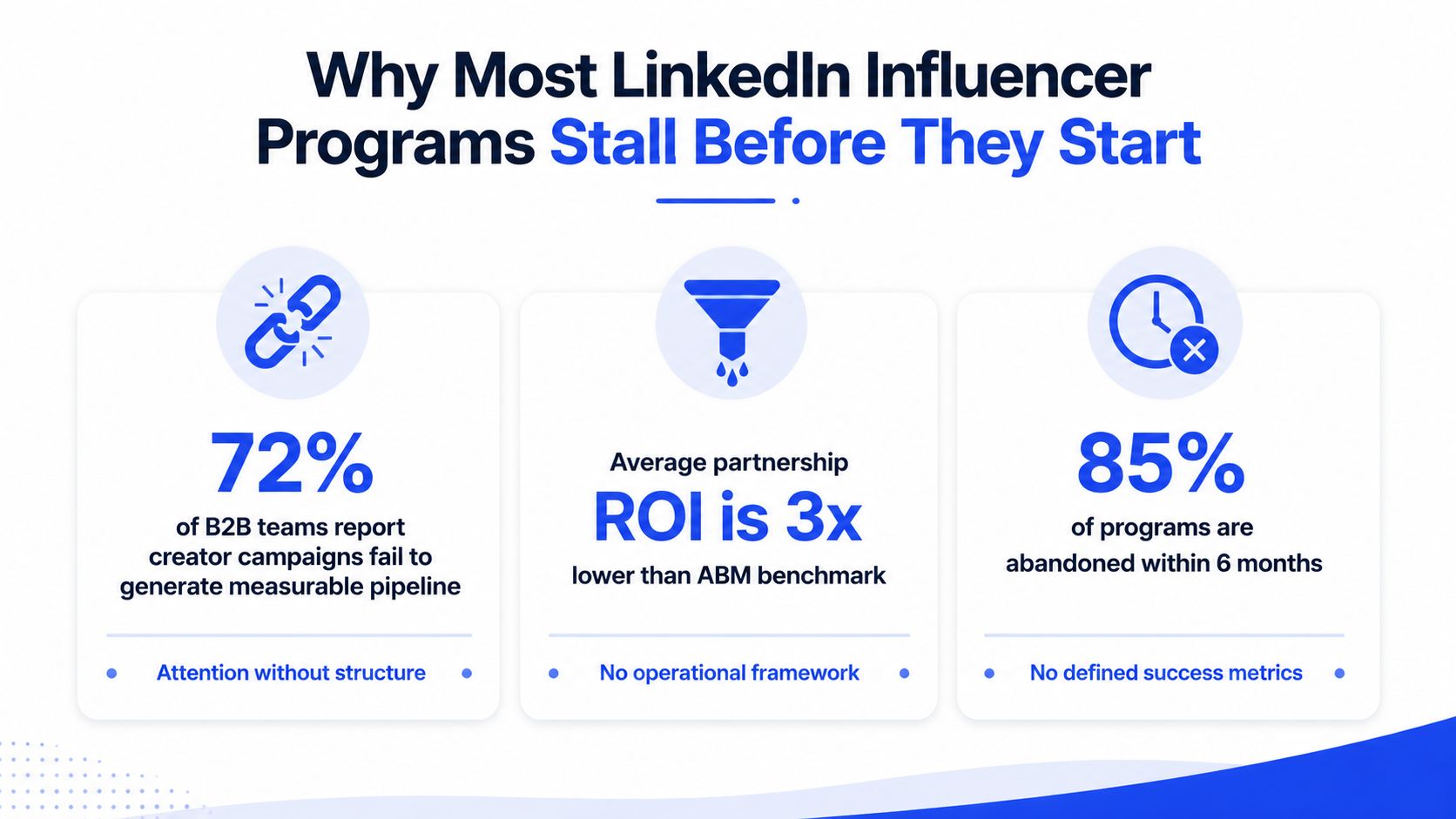
A program usually stalls before the first post goes live. The team picks creators the same way it would buy ads, by reach, then expects CRM activity to follow. That is a process problem, not a creator problem.
LinkedIn gives B2B teams enough scale to matter, but scale alone does not make a creator useful. The platform has over 1.3 billion registered members worldwide and sees 1.5 million pieces of content every minute. Microsoft's LinkedIn segment also generated $17.8 billion in revenue in 2025, which shows the channel sits inside a serious business attention market, not a casual social feed.
Practical rule: if the creator's audience does not map to the buying committee, the post may still get attention, but it will not earn pipeline.
Teams accustomed to paid media often treat creators as a top-of-funnel awareness box, then ask RevOps to patch attribution after the fact. That breaks the link between content, audience, and downstream conversion.
A tighter operating model starts with the same discipline used in strong thought leadership programs. Define one target audience, one content angle, one conversion path, and one reporting line, then keep the system narrow enough to measure. If you need a tactical reference for creator-led positioning, the step-by-step LinkedIn playbook is a useful companion, while our thought leadership guide covers the business framing.
The failure modes are consistent. Misaligned audiences produce comments from peers, not buyers. Transactional outreach produces one-off posts with no relationship depth. Vanity measurement produces screenshots, not qualified opportunities.
The selection problem why follower count misleads B2B teams
Follower count feels safe because it's visible. It's also the least useful thing to anchor on when the goal is pipeline. In B2B, the audience that matters is usually smaller, more specific, and much easier to misread from the outside.
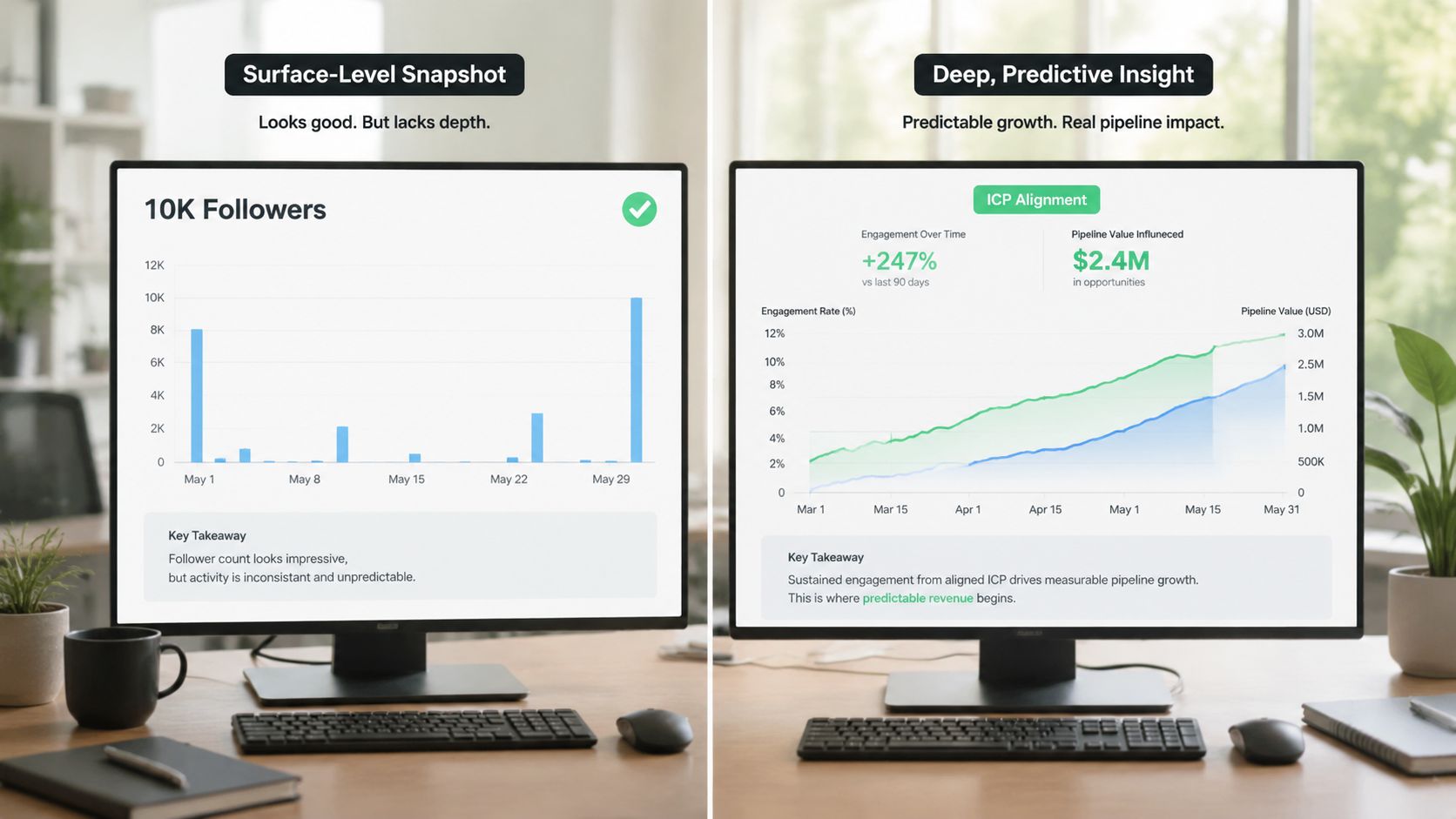
That's why a creator with 22k followers and 68% engagement-ICP match can outwork a 65k-follower account with 12% engagement-ICP match. The second account looks stronger on paper, but the comment section tells a different story, one dominated by marketing agencies and other creators instead of buyers. That gap is the entire argument.
What most teams miss
Vanity metrics are attractive because they're simple to report upward. They also collapse too many audience types into one number. Our vanity metrics guide covers the broader problem, but the short version is this, scale without buyer concentration is usually noise.
The better signal is engagement composition. Who comments, who reposts, who asks questions, and whether those people look like your ICP. Comment volume matters less than comment substance, because a short emoji reaction from a peer doesn't tell you much about commercial intent.
Decision rule: if the audience is full of other creators, agencies, and generic marketers, the creator may be influential in a social sense but weak in a pipeline sense.
The clearest internal defense is simple. A smaller creator with buyer-heavy engagement, recurring comment depth, and consistent audience fit is a better bet than a broader account whose audience drifts every time the topic changes. That's why we always ask which accounts consistently reach the right people, not who has the biggest number on the profile.
LinkedIn's scale makes this more important, not less. The platform can support tens of millions of followers at the top end, and Bill Gates is the most followed person on LinkedIn in 2026 with over 38.9 million followers, according to OutX.ai's 2026 ranking, most followed person on LinkedIn in 2026. The lesson for B2B isn't to chase celebrity scale, it's to find the creator whose audience overlaps with the buying committee you sell to.
How to evaluate a creator's audience in 6 steps
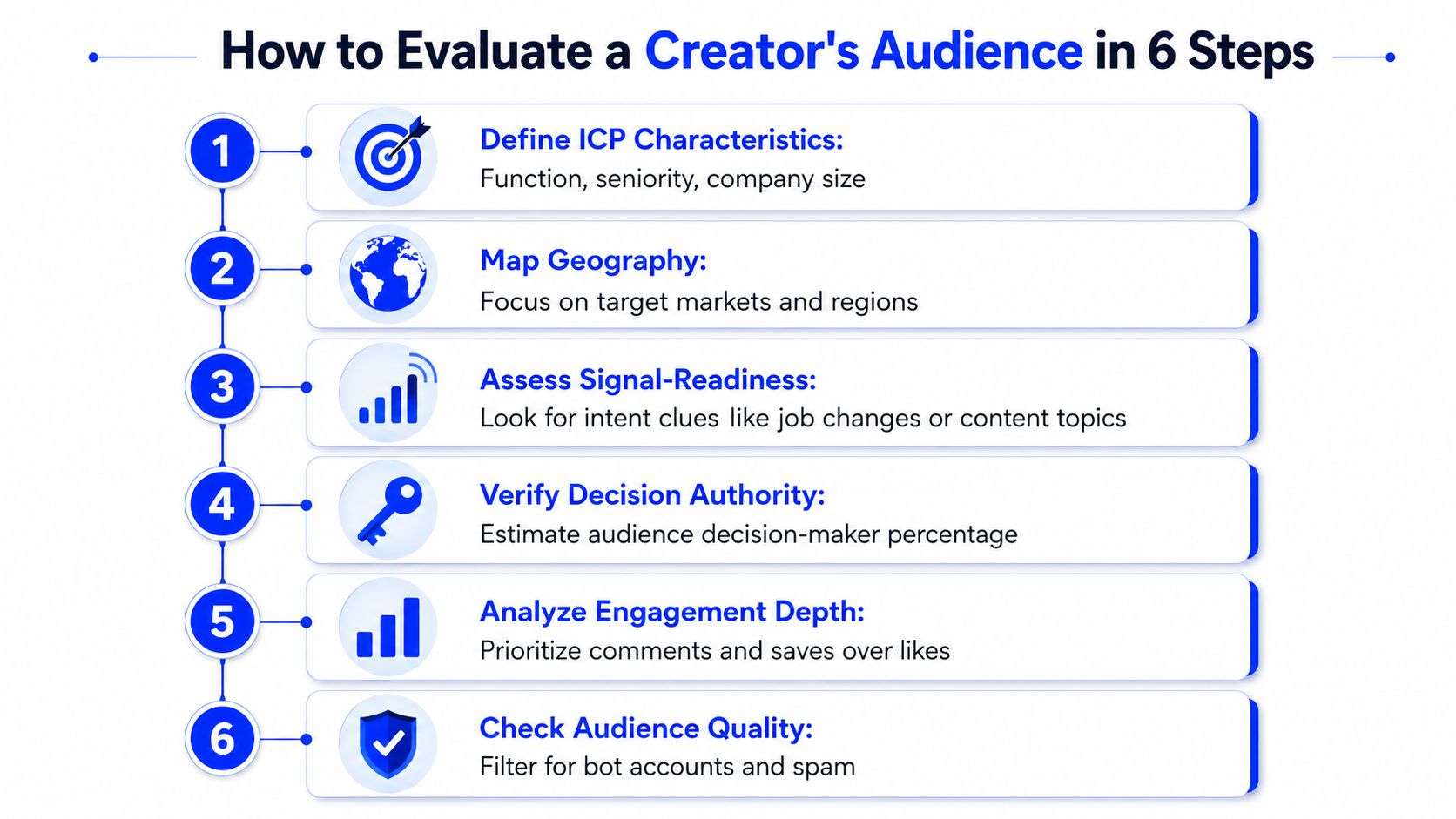
The audit starts with specificity. Define the creator audience you need in terms of function, seniority, company size, geography, signal-readiness, and decision authority. If you can't name those variables cleanly, you're not ready to judge fit.
Pull the creator's follower list, or engagement list where possible, into LinkedIn Sales Navigator and compare it against your ICP. Then score concentration patterns, not just total matches. We often use Clay to systematize this when reviewing several creators at once, with a custom scoring sheet for side-by-side comparison, while HypeAuditor can help with audience quality checks when the fit looks suspicious.
The six checks that matter
Define ICP characteristics. Don't stop at industry and role. Add company size, geography, tenure pattern, and buying authority.
Map audience composition. Use Sales Navigator to inspect who is present, then look for concentration in the right accounts.
Study recent engagement. Review the last 15 to 20 posts and compare commenters and sharers against your ICP, because engagers often differ from passive followers.
Sample active engagers. Manually inspect 20 to 30 of the most active recent engagers for seniority, role, and likely purchasing power.
Read comment substance. Look for strategic questions and buyer language, not quick applause from peripheral audiences.
Verify growth patterns. Check whether audience growth looks organic or artificially inflated, since sudden spikes can mean bought followers or pod behavior.
One practical source on this broader workflow is practical LinkedIn growth strategy, but the essential work is still manual. Tooling helps, judgment decides.
For qualification thresholds, we use a simple bar. Direct partnership starts at 40% audience-ICP match and 50% engagement-ICP match. Multi-post partnership needs 55% and 65%. Premium partnership starts around 65% audience match and 75% engagement match, with evidence that comments include actual buying-decision influence.
That's how the revenue ops case gets resolved. A 65k-follower creator with 24% audience match and 12% engagement match gets passed over, while the smaller 22k creator with 51% audience match and 68% engagement match gets selected. The second creator won because the audience was closer to the buying committee and the comment section proved it.
The outreach system 7 steps from cold to signed
The outreach motion has to feel like relationship building, not prospecting spray. Creators get pitched constantly, so generic DMs die fast. The process that works is slower at the front and cleaner at the back.
From recognition to proposal
Start with 4 to 8 weeks of genuine engagement before any formal ask. Comment with actual substance, share posts when they're relevant, and let the creator recognize your name before you ask for time. That warm context matters because cold outreach from strangers gets ignored.
Then check for a mutual path. A warm introduction from a client, colleague, or network contact will usually outperform direct outreach. If you need a tactical contact-finding step during this stage, search for accounts using email can help support the research flow without turning the exchange into spam.
Here's the DM shape that gets replies.
Message skeleton: specific reference to their recent post, one relevant insight from your side, a small partnership idea, compensation clarity, and explicit editorial autonomy.
A usable version reads like this, “Hi [name], your recent piece on [specific topic] matched what we're seeing in [context]. Would you be open to a partnership where we contribute similar data points to a post series in your voice? Compensation would be [range], and you'd keep full editorial control. If that's of interest, I'll send a short proposal.”
The seven-step sequence
Value-based engagement. Comment and share for weeks before the pitch.
Warm introduction search. Use mutual connections if they exist.
Direct DM if needed. Keep it specific, brief, and low-friction.
Written proposal. Include post count, themes, timeline, compensation, attribution, editorial process, and deliverables.
Negotiation. Protect autonomy, but be ready to clarify timing, exclusivity, and payment structure.
Contract and kickoff. Put scope, compensation, IP, and timeline in writing.
Ongoing relationship management. Brief before each post, share performance quickly, and keep the creator looped in.
The response-rate difference is real. Cold generic outreach tends to sit around 15% to 25%, cold with specific value around 25% to 35%, warm outreach with substantive prior engagement around 50% to 65%, and warm through mutual introduction around 65% to 80%. For creators in the 20k to 80k follower band, single-post rates commonly land between €2,500 and €8,000, while multi-post arrangements often sit between €4,000 and €18,000 for 3 to 6 posts over 60 to 90 days.
We've seen a full cycle from first engagement to first post take about 10 weeks. That's not friction, that's the cost of building a partner, not renting a slot. The LinkedIn connection message guide pairs well with this stage if your team needs tighter outreach language.
Which content format actually moves qualified pipeline
Long-form analytical text posts win on lead quality. Live video can win on per-interaction quality, but it rarely gives you the volume you need. Polls and short engagement posts usually create noise first and pipeline later, if at all.
Format | Meeting-to-opportunity | Closed-deal conversion | Deal size vs avg | Volume |
|---|---|---|---|---|
Long-form analytical text posts | Typically 60 to 75% | Typically 30 to 45% | Typically 15 to 25% higher | Moderate |
Live video or webinar content | Typically 65 to 80% | Typically 35 to 50% | At or above average | Low |
LinkedIn articles or newsletters | Typically 55 to 70% | Typically 30 to 40% | Typically 10 to 20% higher | Lower |
Carousel decks | Typically 40 to 55% | Typically 20 to 30% | At or below average | High |
Short engagement posts | Typically 30 to 45% | Typically 18 to 25% | At or below average | Variable |
Polls | Typically 25 to 40% | Typically 12 to 20% | Typically 10 to 20% below average | High |
The reason is simple. Substantive content filters for serious buyers. A 200 to 400 word analytical post with specific data and a contrarian observation forces the reader to pay attention, which means the DM that follows usually comes from someone who already understands the point.
That's why we push creator partners toward analytical posts first. Polls are fine for awareness, and carousels can help with reach, but neither tends to produce the same quality of inbound. If you're choosing one format for pipeline, choose the one that makes the buyer think, not the one that makes them tap fastest.
Long-form also creates stronger comment-section signals. Buyers ask better questions when the post takes a position they're evaluating. That gives sales a cleaner conversation start and shortens the distance from curiosity to meeting.
Operational rule: use long-form analytical posts as the core, layer polls or short posts only as support, and reserve live video for premium partnerships where the audience depth justifies the lower volume.
A real collaboration that moved cost per qualified opportunity
The cleanest example we've run was a customer success platform partnership. The creator had roughly 34k followers and focused on customer success operations and CS leadership. The arrangement was 4 posts over 90 days with €7,200 total investment.
The structure mattered more than the sponsor label. The client supplied data and observations, the creator wrote in their own voice, and editorial control stayed with the creator. That combination made the content feel like a real point of view, not a paid insertion.
What the four posts did
Post 1: 2,400 substantive engagements in 14 days, 8 substantive DMs from ICP-fit prospects.
Post 2: 1,800 substantive engagements, 6 substantive DMs.
Post 3: 2,900 substantive engagements, 11 substantive DMs.
Post 4: 2,200 substantive engagements, 7 substantive DMs.
Across the four posts, the collaboration generated 32 substantive inbound DMs, 22 meetings, 14 qualified opportunities, and 3 closed deals worth €118k. The cost per qualified opportunity came out at €514, compared with €680 for the broader campaign, a 24% reduction. The partnership also produced 16.4x ROI on the €7,200 investment.
The outcome didn't come from raw reach. It came from strong audience fit, co-created analytical content, and a multi-post structure that built familiarity before the ask. The creator's audience already trusted the voice, so the client's data transferred credibility quickly.
A legal tech collaboration followed a similar pattern, with 2 closed deals worth €76k and 15.8x ROI. A cybersecurity example produced 1 deal worth €82k and 15.2x ROI, though the attribution confidence was lower because the journey was more diffuse. The pattern is consistent, strong fit plus substantive content beats one-off sponsorship.
Measuring attributing and operationalizing creator pipeline
Last-click attribution will lie to you on creator programs. The buyer sees the post, comes back through outbound, and closes after a founder touch, so the final click doesn't tell the full story. Use UTMs, dedicated landing pages, and CRM source fields, then treat the creator as one node in a multi-touch path.
That's where the internal operating rhythm matters. Run creator partnerships in bi-weekly sprints, keep a shared Slack channel open, and report transparently on cost per qualified opportunity, meeting-to-opportunity rate, time-to-meeting, and pipeline created vs partner investment. The compounding effect is real, but only if you capture the interactions cleanly.
Our multi-touch attribution guide covers the measurement logic in more depth. In practice, the point is to avoid pretending creator content works alone. It compounds with outbound and founder content, and that's enough as long as the reporting is honest.
Audit your last three creator partnerships against the audience thresholds in the audience section, then compare the result to the meetings and opportunities those partners produced. If the fit looks weak on paper, the low conversion probably wasn't a surprise; it was a selection error.
GROU works with B2B teams across SaaS, iGaming, manufacturing, legal tech, pharma, and professional services to turn creator attention into qualified conversations. We use one message, one target list, and one reporting line, then run the work in bi-weekly sprints with transparent measurement and fast feedback.
Audit your last 10 creator posts this Friday, score each one against audience-ICP match and engagement-ICP match, then kill anything that can't defend qualified opportunity creation. A CTA for Grou.
You've got creators posting on LinkedIn, some with big follower counts, some with sharp niche audiences, and the pipeline still isn't showing up in CRM. That usually means the program is built around attention, not structure, so the post gets reach while RevOps gets nothing clean to attribute.
Follower count is a weak selection signal, because LinkedIn engagement is heavily concentrated at the low end, with 71.36% of influencer profiles sitting between 0% and 1% engagement, and only 2.05% reaching 5%+ engagement, according to an analysis cited in the LinkedIn influencer guide from The Influencer Marketing Factory, LinkedIn influencer guide and engagement distribution.
Audience fit beats raw scale, because LinkedIn now has over 1.3 billion registered members worldwide and users engage with 1.5 million pieces of content every minute, which makes the platform large enough for niche B2B creators to matter when their audience is aligned to your ICP, LinkedIn statistics and platform scale.
The key selection question is engagement composition, not vanity reach, and that's why a smaller creator with buyer-heavy comment sections often outperforms a larger account with mixed or peripheral engagement.
Measurement has to land on cost per qualified opportunity, not likes, screenshots, or last-click reporting, or the program will always look busier than it is.
The operational answer is a system, one target list, one reporting line, one message, and one qualification rule, the same way we run linked creator work at GROU.
Table of Contents
Why most LinkedIn influencer programs stall before they start
A real collaboration that moved cost per qualified opportunity
Why most LinkedIn influencer programs stall before they start
A program usually stalls before the first post goes live. The team picks creators the same way it would buy ads, by reach, then expects CRM activity to follow. That is a process problem, not a creator problem.
LinkedIn gives B2B teams enough scale to matter, but scale alone does not make a creator useful. The platform has over 1.3 billion registered members worldwide and sees 1.5 million pieces of content every minute. Microsoft's LinkedIn segment also generated $17.8 billion in revenue in 2025, which shows the channel sits inside a serious business attention market, not a casual social feed.
Practical rule: if the creator's audience does not map to the buying committee, the post may still get attention, but it will not earn pipeline.
Teams accustomed to paid media often treat creators as a top-of-funnel awareness box, then ask RevOps to patch attribution after the fact. That breaks the link between content, audience, and downstream conversion.
A tighter operating model starts with the same discipline used in strong thought leadership programs. Define one target audience, one content angle, one conversion path, and one reporting line, then keep the system narrow enough to measure. If you need a tactical reference for creator-led positioning, the step-by-step LinkedIn playbook is a useful companion, while our thought leadership guide covers the business framing.
The failure modes are consistent. Misaligned audiences produce comments from peers, not buyers. Transactional outreach produces one-off posts with no relationship depth. Vanity measurement produces screenshots, not qualified opportunities.
The selection problem why follower count misleads B2B teams
Follower count feels safe because it's visible. It's also the least useful thing to anchor on when the goal is pipeline. In B2B, the audience that matters is usually smaller, more specific, and much easier to misread from the outside.
That's why a creator with 22k followers and 68% engagement-ICP match can outwork a 65k-follower account with 12% engagement-ICP match. The second account looks stronger on paper, but the comment section tells a different story, one dominated by marketing agencies and other creators instead of buyers. That gap is the entire argument.
What most teams miss
Vanity metrics are attractive because they're simple to report upward. They also collapse too many audience types into one number. Our vanity metrics guide covers the broader problem, but the short version is this, scale without buyer concentration is usually noise.
The better signal is engagement composition. Who comments, who reposts, who asks questions, and whether those people look like your ICP. Comment volume matters less than comment substance, because a short emoji reaction from a peer doesn't tell you much about commercial intent.
Decision rule: if the audience is full of other creators, agencies, and generic marketers, the creator may be influential in a social sense but weak in a pipeline sense.
The clearest internal defense is simple. A smaller creator with buyer-heavy engagement, recurring comment depth, and consistent audience fit is a better bet than a broader account whose audience drifts every time the topic changes. That's why we always ask which accounts consistently reach the right people, not who has the biggest number on the profile.
LinkedIn's scale makes this more important, not less. The platform can support tens of millions of followers at the top end, and Bill Gates is the most followed person on LinkedIn in 2026 with over 38.9 million followers, according to OutX.ai's 2026 ranking, most followed person on LinkedIn in 2026. The lesson for B2B isn't to chase celebrity scale, it's to find the creator whose audience overlaps with the buying committee you sell to.
How to evaluate a creator's audience in 6 steps
The audit starts with specificity. Define the creator audience you need in terms of function, seniority, company size, geography, signal-readiness, and decision authority. If you can't name those variables cleanly, you're not ready to judge fit.
Pull the creator's follower list, or engagement list where possible, into LinkedIn Sales Navigator and compare it against your ICP. Then score concentration patterns, not just total matches. We often use Clay to systematize this when reviewing several creators at once, with a custom scoring sheet for side-by-side comparison, while HypeAuditor can help with audience quality checks when the fit looks suspicious.
The six checks that matter
Define ICP characteristics. Don't stop at industry and role. Add company size, geography, tenure pattern, and buying authority.
Map audience composition. Use Sales Navigator to inspect who is present, then look for concentration in the right accounts.
Study recent engagement. Review the last 15 to 20 posts and compare commenters and sharers against your ICP, because engagers often differ from passive followers.
Sample active engagers. Manually inspect 20 to 30 of the most active recent engagers for seniority, role, and likely purchasing power.
Read comment substance. Look for strategic questions and buyer language, not quick applause from peripheral audiences.
Verify growth patterns. Check whether audience growth looks organic or artificially inflated, since sudden spikes can mean bought followers or pod behavior.
One practical source on this broader workflow is practical LinkedIn growth strategy, but the essential work is still manual. Tooling helps, judgment decides.
For qualification thresholds, we use a simple bar. Direct partnership starts at 40% audience-ICP match and 50% engagement-ICP match. Multi-post partnership needs 55% and 65%. Premium partnership starts around 65% audience match and 75% engagement match, with evidence that comments include actual buying-decision influence.
That's how the revenue ops case gets resolved. A 65k-follower creator with 24% audience match and 12% engagement match gets passed over, while the smaller 22k creator with 51% audience match and 68% engagement match gets selected. The second creator won because the audience was closer to the buying committee and the comment section proved it.
The outreach system 7 steps from cold to signed
The outreach motion has to feel like relationship building, not prospecting spray. Creators get pitched constantly, so generic DMs die fast. The process that works is slower at the front and cleaner at the back.
From recognition to proposal
Start with 4 to 8 weeks of genuine engagement before any formal ask. Comment with actual substance, share posts when they're relevant, and let the creator recognize your name before you ask for time. That warm context matters because cold outreach from strangers gets ignored.
Then check for a mutual path. A warm introduction from a client, colleague, or network contact will usually outperform direct outreach. If you need a tactical contact-finding step during this stage, search for accounts using email can help support the research flow without turning the exchange into spam.
Here's the DM shape that gets replies.
Message skeleton: specific reference to their recent post, one relevant insight from your side, a small partnership idea, compensation clarity, and explicit editorial autonomy.
A usable version reads like this, “Hi [name], your recent piece on [specific topic] matched what we're seeing in [context]. Would you be open to a partnership where we contribute similar data points to a post series in your voice? Compensation would be [range], and you'd keep full editorial control. If that's of interest, I'll send a short proposal.”
The seven-step sequence
Value-based engagement. Comment and share for weeks before the pitch.
Warm introduction search. Use mutual connections if they exist.
Direct DM if needed. Keep it specific, brief, and low-friction.
Written proposal. Include post count, themes, timeline, compensation, attribution, editorial process, and deliverables.
Negotiation. Protect autonomy, but be ready to clarify timing, exclusivity, and payment structure.
Contract and kickoff. Put scope, compensation, IP, and timeline in writing.
Ongoing relationship management. Brief before each post, share performance quickly, and keep the creator looped in.
The response-rate difference is real. Cold generic outreach tends to sit around 15% to 25%, cold with specific value around 25% to 35%, warm outreach with substantive prior engagement around 50% to 65%, and warm through mutual introduction around 65% to 80%. For creators in the 20k to 80k follower band, single-post rates commonly land between €2,500 and €8,000, while multi-post arrangements often sit between €4,000 and €18,000 for 3 to 6 posts over 60 to 90 days.
We've seen a full cycle from first engagement to first post take about 10 weeks. That's not friction, that's the cost of building a partner, not renting a slot. The LinkedIn connection message guide pairs well with this stage if your team needs tighter outreach language.
Which content format actually moves qualified pipeline
Long-form analytical text posts win on lead quality. Live video can win on per-interaction quality, but it rarely gives you the volume you need. Polls and short engagement posts usually create noise first and pipeline later, if at all.
Format | Meeting-to-opportunity | Closed-deal conversion | Deal size vs avg | Volume |
|---|---|---|---|---|
Long-form analytical text posts | Typically 60 to 75% | Typically 30 to 45% | Typically 15 to 25% higher | Moderate |
Live video or webinar content | Typically 65 to 80% | Typically 35 to 50% | At or above average | Low |
LinkedIn articles or newsletters | Typically 55 to 70% | Typically 30 to 40% | Typically 10 to 20% higher | Lower |
Carousel decks | Typically 40 to 55% | Typically 20 to 30% | At or below average | High |
Short engagement posts | Typically 30 to 45% | Typically 18 to 25% | At or below average | Variable |
Polls | Typically 25 to 40% | Typically 12 to 20% | Typically 10 to 20% below average | High |
The reason is simple. Substantive content filters for serious buyers. A 200 to 400 word analytical post with specific data and a contrarian observation forces the reader to pay attention, which means the DM that follows usually comes from someone who already understands the point.
That's why we push creator partners toward analytical posts first. Polls are fine for awareness, and carousels can help with reach, but neither tends to produce the same quality of inbound. If you're choosing one format for pipeline, choose the one that makes the buyer think, not the one that makes them tap fastest.
Long-form also creates stronger comment-section signals. Buyers ask better questions when the post takes a position they're evaluating. That gives sales a cleaner conversation start and shortens the distance from curiosity to meeting.
Operational rule: use long-form analytical posts as the core, layer polls or short posts only as support, and reserve live video for premium partnerships where the audience depth justifies the lower volume.
A real collaboration that moved cost per qualified opportunity
The cleanest example we've run was a customer success platform partnership. The creator had roughly 34k followers and focused on customer success operations and CS leadership. The arrangement was 4 posts over 90 days with €7,200 total investment.
The structure mattered more than the sponsor label. The client supplied data and observations, the creator wrote in their own voice, and editorial control stayed with the creator. That combination made the content feel like a real point of view, not a paid insertion.
What the four posts did
Post 1: 2,400 substantive engagements in 14 days, 8 substantive DMs from ICP-fit prospects.
Post 2: 1,800 substantive engagements, 6 substantive DMs.
Post 3: 2,900 substantive engagements, 11 substantive DMs.
Post 4: 2,200 substantive engagements, 7 substantive DMs.
Across the four posts, the collaboration generated 32 substantive inbound DMs, 22 meetings, 14 qualified opportunities, and 3 closed deals worth €118k. The cost per qualified opportunity came out at €514, compared with €680 for the broader campaign, a 24% reduction. The partnership also produced 16.4x ROI on the €7,200 investment.
The outcome didn't come from raw reach. It came from strong audience fit, co-created analytical content, and a multi-post structure that built familiarity before the ask. The creator's audience already trusted the voice, so the client's data transferred credibility quickly.
A legal tech collaboration followed a similar pattern, with 2 closed deals worth €76k and 15.8x ROI. A cybersecurity example produced 1 deal worth €82k and 15.2x ROI, though the attribution confidence was lower because the journey was more diffuse. The pattern is consistent, strong fit plus substantive content beats one-off sponsorship.
Measuring attributing and operationalizing creator pipeline
Last-click attribution will lie to you on creator programs. The buyer sees the post, comes back through outbound, and closes after a founder touch, so the final click doesn't tell the full story. Use UTMs, dedicated landing pages, and CRM source fields, then treat the creator as one node in a multi-touch path.
That's where the internal operating rhythm matters. Run creator partnerships in bi-weekly sprints, keep a shared Slack channel open, and report transparently on cost per qualified opportunity, meeting-to-opportunity rate, time-to-meeting, and pipeline created vs partner investment. The compounding effect is real, but only if you capture the interactions cleanly.
Our multi-touch attribution guide covers the measurement logic in more depth. In practice, the point is to avoid pretending creator content works alone. It compounds with outbound and founder content, and that's enough as long as the reporting is honest.
Audit your last three creator partnerships against the audience thresholds in the audience section, then compare the result to the meetings and opportunities those partners produced. If the fit looks weak on paper, the low conversion probably wasn't a surprise; it was a selection error.
GROU works with B2B teams across SaaS, iGaming, manufacturing, legal tech, pharma, and professional services to turn creator attention into qualified conversations. We use one message, one target list, and one reporting line, then run the work in bi-weekly sprints with transparent measurement and fast feedback.
Audit your last 10 creator posts this Friday, score each one against audience-ICP match and engagement-ICP match, then kill anything that can't defend qualified opportunity creation. A CTA for Grou.
You've got creators posting on LinkedIn, some with big follower counts, some with sharp niche audiences, and the pipeline still isn't showing up in CRM. That usually means the program is built around attention, not structure, so the post gets reach while RevOps gets nothing clean to attribute.
Follower count is a weak selection signal, because LinkedIn engagement is heavily concentrated at the low end, with 71.36% of influencer profiles sitting between 0% and 1% engagement, and only 2.05% reaching 5%+ engagement, according to an analysis cited in the LinkedIn influencer guide from The Influencer Marketing Factory, LinkedIn influencer guide and engagement distribution.
Audience fit beats raw scale, because LinkedIn now has over 1.3 billion registered members worldwide and users engage with 1.5 million pieces of content every minute, which makes the platform large enough for niche B2B creators to matter when their audience is aligned to your ICP, LinkedIn statistics and platform scale.
The key selection question is engagement composition, not vanity reach, and that's why a smaller creator with buyer-heavy comment sections often outperforms a larger account with mixed or peripheral engagement.
Measurement has to land on cost per qualified opportunity, not likes, screenshots, or last-click reporting, or the program will always look busier than it is.
The operational answer is a system, one target list, one reporting line, one message, and one qualification rule, the same way we run linked creator work at GROU.
Table of Contents
Why most LinkedIn influencer programs stall before they start
A real collaboration that moved cost per qualified opportunity
Why most LinkedIn influencer programs stall before they start
A program usually stalls before the first post goes live. The team picks creators the same way it would buy ads, by reach, then expects CRM activity to follow. That is a process problem, not a creator problem.
LinkedIn gives B2B teams enough scale to matter, but scale alone does not make a creator useful. The platform has over 1.3 billion registered members worldwide and sees 1.5 million pieces of content every minute. Microsoft's LinkedIn segment also generated $17.8 billion in revenue in 2025, which shows the channel sits inside a serious business attention market, not a casual social feed.
Practical rule: if the creator's audience does not map to the buying committee, the post may still get attention, but it will not earn pipeline.
Teams accustomed to paid media often treat creators as a top-of-funnel awareness box, then ask RevOps to patch attribution after the fact. That breaks the link between content, audience, and downstream conversion.
A tighter operating model starts with the same discipline used in strong thought leadership programs. Define one target audience, one content angle, one conversion path, and one reporting line, then keep the system narrow enough to measure. If you need a tactical reference for creator-led positioning, the step-by-step LinkedIn playbook is a useful companion, while our thought leadership guide covers the business framing.
The failure modes are consistent. Misaligned audiences produce comments from peers, not buyers. Transactional outreach produces one-off posts with no relationship depth. Vanity measurement produces screenshots, not qualified opportunities.
The selection problem why follower count misleads B2B teams
Follower count feels safe because it's visible. It's also the least useful thing to anchor on when the goal is pipeline. In B2B, the audience that matters is usually smaller, more specific, and much easier to misread from the outside.
That's why a creator with 22k followers and 68% engagement-ICP match can outwork a 65k-follower account with 12% engagement-ICP match. The second account looks stronger on paper, but the comment section tells a different story, one dominated by marketing agencies and other creators instead of buyers. That gap is the entire argument.
What most teams miss
Vanity metrics are attractive because they're simple to report upward. They also collapse too many audience types into one number. Our vanity metrics guide covers the broader problem, but the short version is this, scale without buyer concentration is usually noise.
The better signal is engagement composition. Who comments, who reposts, who asks questions, and whether those people look like your ICP. Comment volume matters less than comment substance, because a short emoji reaction from a peer doesn't tell you much about commercial intent.
Decision rule: if the audience is full of other creators, agencies, and generic marketers, the creator may be influential in a social sense but weak in a pipeline sense.
The clearest internal defense is simple. A smaller creator with buyer-heavy engagement, recurring comment depth, and consistent audience fit is a better bet than a broader account whose audience drifts every time the topic changes. That's why we always ask which accounts consistently reach the right people, not who has the biggest number on the profile.
LinkedIn's scale makes this more important, not less. The platform can support tens of millions of followers at the top end, and Bill Gates is the most followed person on LinkedIn in 2026 with over 38.9 million followers, according to OutX.ai's 2026 ranking, most followed person on LinkedIn in 2026. The lesson for B2B isn't to chase celebrity scale, it's to find the creator whose audience overlaps with the buying committee you sell to.
How to evaluate a creator's audience in 6 steps
The audit starts with specificity. Define the creator audience you need in terms of function, seniority, company size, geography, signal-readiness, and decision authority. If you can't name those variables cleanly, you're not ready to judge fit.
Pull the creator's follower list, or engagement list where possible, into LinkedIn Sales Navigator and compare it against your ICP. Then score concentration patterns, not just total matches. We often use Clay to systematize this when reviewing several creators at once, with a custom scoring sheet for side-by-side comparison, while HypeAuditor can help with audience quality checks when the fit looks suspicious.
The six checks that matter
Define ICP characteristics. Don't stop at industry and role. Add company size, geography, tenure pattern, and buying authority.
Map audience composition. Use Sales Navigator to inspect who is present, then look for concentration in the right accounts.
Study recent engagement. Review the last 15 to 20 posts and compare commenters and sharers against your ICP, because engagers often differ from passive followers.
Sample active engagers. Manually inspect 20 to 30 of the most active recent engagers for seniority, role, and likely purchasing power.
Read comment substance. Look for strategic questions and buyer language, not quick applause from peripheral audiences.
Verify growth patterns. Check whether audience growth looks organic or artificially inflated, since sudden spikes can mean bought followers or pod behavior.
One practical source on this broader workflow is practical LinkedIn growth strategy, but the essential work is still manual. Tooling helps, judgment decides.
For qualification thresholds, we use a simple bar. Direct partnership starts at 40% audience-ICP match and 50% engagement-ICP match. Multi-post partnership needs 55% and 65%. Premium partnership starts around 65% audience match and 75% engagement match, with evidence that comments include actual buying-decision influence.
That's how the revenue ops case gets resolved. A 65k-follower creator with 24% audience match and 12% engagement match gets passed over, while the smaller 22k creator with 51% audience match and 68% engagement match gets selected. The second creator won because the audience was closer to the buying committee and the comment section proved it.
The outreach system 7 steps from cold to signed
The outreach motion has to feel like relationship building, not prospecting spray. Creators get pitched constantly, so generic DMs die fast. The process that works is slower at the front and cleaner at the back.
From recognition to proposal
Start with 4 to 8 weeks of genuine engagement before any formal ask. Comment with actual substance, share posts when they're relevant, and let the creator recognize your name before you ask for time. That warm context matters because cold outreach from strangers gets ignored.
Then check for a mutual path. A warm introduction from a client, colleague, or network contact will usually outperform direct outreach. If you need a tactical contact-finding step during this stage, search for accounts using email can help support the research flow without turning the exchange into spam.
Here's the DM shape that gets replies.
Message skeleton: specific reference to their recent post, one relevant insight from your side, a small partnership idea, compensation clarity, and explicit editorial autonomy.
A usable version reads like this, “Hi [name], your recent piece on [specific topic] matched what we're seeing in [context]. Would you be open to a partnership where we contribute similar data points to a post series in your voice? Compensation would be [range], and you'd keep full editorial control. If that's of interest, I'll send a short proposal.”
The seven-step sequence
Value-based engagement. Comment and share for weeks before the pitch.
Warm introduction search. Use mutual connections if they exist.
Direct DM if needed. Keep it specific, brief, and low-friction.
Written proposal. Include post count, themes, timeline, compensation, attribution, editorial process, and deliverables.
Negotiation. Protect autonomy, but be ready to clarify timing, exclusivity, and payment structure.
Contract and kickoff. Put scope, compensation, IP, and timeline in writing.
Ongoing relationship management. Brief before each post, share performance quickly, and keep the creator looped in.
The response-rate difference is real. Cold generic outreach tends to sit around 15% to 25%, cold with specific value around 25% to 35%, warm outreach with substantive prior engagement around 50% to 65%, and warm through mutual introduction around 65% to 80%. For creators in the 20k to 80k follower band, single-post rates commonly land between €2,500 and €8,000, while multi-post arrangements often sit between €4,000 and €18,000 for 3 to 6 posts over 60 to 90 days.
We've seen a full cycle from first engagement to first post take about 10 weeks. That's not friction, that's the cost of building a partner, not renting a slot. The LinkedIn connection message guide pairs well with this stage if your team needs tighter outreach language.
Which content format actually moves qualified pipeline
Long-form analytical text posts win on lead quality. Live video can win on per-interaction quality, but it rarely gives you the volume you need. Polls and short engagement posts usually create noise first and pipeline later, if at all.
Format | Meeting-to-opportunity | Closed-deal conversion | Deal size vs avg | Volume |
|---|---|---|---|---|
Long-form analytical text posts | Typically 60 to 75% | Typically 30 to 45% | Typically 15 to 25% higher | Moderate |
Live video or webinar content | Typically 65 to 80% | Typically 35 to 50% | At or above average | Low |
LinkedIn articles or newsletters | Typically 55 to 70% | Typically 30 to 40% | Typically 10 to 20% higher | Lower |
Carousel decks | Typically 40 to 55% | Typically 20 to 30% | At or below average | High |
Short engagement posts | Typically 30 to 45% | Typically 18 to 25% | At or below average | Variable |
Polls | Typically 25 to 40% | Typically 12 to 20% | Typically 10 to 20% below average | High |
The reason is simple. Substantive content filters for serious buyers. A 200 to 400 word analytical post with specific data and a contrarian observation forces the reader to pay attention, which means the DM that follows usually comes from someone who already understands the point.
That's why we push creator partners toward analytical posts first. Polls are fine for awareness, and carousels can help with reach, but neither tends to produce the same quality of inbound. If you're choosing one format for pipeline, choose the one that makes the buyer think, not the one that makes them tap fastest.
Long-form also creates stronger comment-section signals. Buyers ask better questions when the post takes a position they're evaluating. That gives sales a cleaner conversation start and shortens the distance from curiosity to meeting.
Operational rule: use long-form analytical posts as the core, layer polls or short posts only as support, and reserve live video for premium partnerships where the audience depth justifies the lower volume.
A real collaboration that moved cost per qualified opportunity
The cleanest example we've run was a customer success platform partnership. The creator had roughly 34k followers and focused on customer success operations and CS leadership. The arrangement was 4 posts over 90 days with €7,200 total investment.
The structure mattered more than the sponsor label. The client supplied data and observations, the creator wrote in their own voice, and editorial control stayed with the creator. That combination made the content feel like a real point of view, not a paid insertion.
What the four posts did
Post 1: 2,400 substantive engagements in 14 days, 8 substantive DMs from ICP-fit prospects.
Post 2: 1,800 substantive engagements, 6 substantive DMs.
Post 3: 2,900 substantive engagements, 11 substantive DMs.
Post 4: 2,200 substantive engagements, 7 substantive DMs.
Across the four posts, the collaboration generated 32 substantive inbound DMs, 22 meetings, 14 qualified opportunities, and 3 closed deals worth €118k. The cost per qualified opportunity came out at €514, compared with €680 for the broader campaign, a 24% reduction. The partnership also produced 16.4x ROI on the €7,200 investment.
The outcome didn't come from raw reach. It came from strong audience fit, co-created analytical content, and a multi-post structure that built familiarity before the ask. The creator's audience already trusted the voice, so the client's data transferred credibility quickly.
A legal tech collaboration followed a similar pattern, with 2 closed deals worth €76k and 15.8x ROI. A cybersecurity example produced 1 deal worth €82k and 15.2x ROI, though the attribution confidence was lower because the journey was more diffuse. The pattern is consistent, strong fit plus substantive content beats one-off sponsorship.
Measuring attributing and operationalizing creator pipeline
Last-click attribution will lie to you on creator programs. The buyer sees the post, comes back through outbound, and closes after a founder touch, so the final click doesn't tell the full story. Use UTMs, dedicated landing pages, and CRM source fields, then treat the creator as one node in a multi-touch path.
That's where the internal operating rhythm matters. Run creator partnerships in bi-weekly sprints, keep a shared Slack channel open, and report transparently on cost per qualified opportunity, meeting-to-opportunity rate, time-to-meeting, and pipeline created vs partner investment. The compounding effect is real, but only if you capture the interactions cleanly.
Our multi-touch attribution guide covers the measurement logic in more depth. In practice, the point is to avoid pretending creator content works alone. It compounds with outbound and founder content, and that's enough as long as the reporting is honest.
Audit your last three creator partnerships against the audience thresholds in the audience section, then compare the result to the meetings and opportunities those partners produced. If the fit looks weak on paper, the low conversion probably wasn't a surprise; it was a selection error.
GROU works with B2B teams across SaaS, iGaming, manufacturing, legal tech, pharma, and professional services to turn creator attention into qualified conversations. We use one message, one target list, and one reporting line, then run the work in bi-weekly sprints with transparent measurement and fast feedback.
Audit your last 10 creator posts this Friday, score each one against audience-ICP match and engagement-ICP match, then kill anything that can't defend qualified opportunity creation. A CTA for Grou.
Pipeline OS Newsletter
Build qualified pipeline
Get weekly tactics to generate demand, improve lead quality, and book more meetings.





Trusted by industry leaders
Trusted by industry leaders
Trusted by industry leaders
Ready to build qualified pipeline?
Ready to build qualified pipeline?
Ready to build qualified pipeline?
Book a call to see if we're the right fit, or take the 2-minute quiz to get a clear starting point.
Book a call to see if we're the right fit, or take the 2-minute quiz to get a clear starting point.
Book a call to see if we're the right fit, or take the 2-minute quiz to get a clear starting point.
" height="30.21639343089746px" id="hfGbXmQR2" width="30.216393430897455px"/></svg>)
Copyright © 2026 – All Right Reserved
Copyright © 2026 – All Right Reserved
Copyright © 2026 – All Right Reserved