%22%3E%3C/path%3E%3Cpath d=%22M 63.072 7.554 C 62.258 8.022 61.577 8.689 61.092 9.493 L 61.092 7.076 L 57.158 7.076 L 57.158 22.64 L 61.089 22.64 L 61.089 14.888 C 61.089 13.446 61.403 12.434 62.03 11.853 C 62.818 11.218 63.818 10.907 64.826 10.982 L 65.868 10.982 L 65.868 6.851 C 64.891 6.834 63.926 7.076 63.073 7.554 Z%22 fill=%22rgb(17,17,17)%22%3E%3C/path%3E%3Cpath d=%22M 78.916 7.82 C 76.363 6.49 73.321 6.49 70.768 7.82 C 69.562 8.473 68.564 9.451 67.888 10.644 C 67.167 11.931 66.803 13.387 66.834 14.862 C 66.804 16.332 67.157 17.785 67.86 19.077 C 68.515 20.267 69.494 21.246 70.684 21.901 C 71.924 22.576 73.318 22.92 74.73 22.898 C 76.164 22.918 77.58 22.575 78.846 21.901 C 80.062 21.247 81.073 20.27 81.768 19.077 C 82.506 17.797 82.88 16.339 82.85 14.862 C 82.88 13.389 82.517 11.934 81.797 10.647 C 81.12 9.455 80.122 8.477 78.917 7.824 M 78.803 14.862 C 78.829 15.739 78.636 16.608 78.241 17.391 C 77.903 18.046 77.38 18.588 76.738 18.95 C 76.124 19.293 75.432 19.472 74.729 19.47 C 73.668 19.497 72.648 19.061 71.934 18.276 C 71.139 17.323 70.741 16.1 70.823 14.862 C 70.741 13.62 71.149 12.395 71.959 11.45 C 72.687 10.667 73.715 10.233 74.783 10.256 C 75.859 10.236 76.894 10.67 77.635 11.45 C 78.464 12.387 78.884 13.616 78.801 14.864%22 fill=%22rgb(17,17,17)%22%3E%3C/path%3E%3Cpath d=%22M 95.906 7.076 L 95.906 15.646 C 95.975 16.68 95.643 17.701 94.979 18.498 C 94.311 19.184 93.379 19.547 92.422 19.495 C 91.475 19.544 90.553 19.18 89.894 18.498 C 89.23 17.701 88.898 16.68 88.967 15.646 L 88.967 7.076 L 85.033 7.076 L 85.033 16.207 C 85 17.449 85.275 18.68 85.834 19.79 C 86.327 20.75 87.095 21.542 88.039 22.065 C 89.033 22.594 90.145 22.861 91.271 22.838 C 92.188 22.847 93.095 22.65 93.926 22.263 C 94.708 21.905 95.388 21.36 95.906 20.675 L 95.906 22.645 L 99.865 22.645 L 99.865 7.076 Z%22 fill=%22rgb(17,17,17)%22%3E%3C/path%3E%3Cpath d=%22M 4.513 15.626 C 4.511 10.815 7.606 6.549 12.181 5.059 C 16.756 3.57 21.77 5.195 24.601 9.086 L 27.816 5.87 C 24.074 1.186 17.981 -0.943 12.137 0.393 C 6.292 1.728 1.728 6.292 0.393 12.137 C -0.943 17.981 1.186 24.074 5.87 27.816 L 9.085 24.601 C 6.214 22.512 4.515 19.177 4.513 15.626%22 fill=%22rgb(32,62,235)%22%3E%3C/path%3E%3Cpath d=%22M 17.114 14.343 L 13.354 18.01 L 13.354 18.026 L 21.071 18.026 L 11.412 27.609 L 17.389 27.609 L 23.999 21.081 L 23.999 28.316 L 24.005 28.316 L 27.967 24.393 L 27.967 14.343 Z%22 fill=%22rgb(32,62,235)%22%3E%3C/path%3E%3C/g%3E%3C/svg%3E) ×
× ××
××›
›
›
›
Multi Touch Attribution: B2B Guide for 2026
Multi Touch Attribution: B2B Guide for 2026
Multi Touch Attribution: B2B Guide for 2026
Multi Touch Attribution: B2B Guide for 2026
Multi Touch Attribution: B2B Guide for 2026
Multi Touch Attribution: B2B Guide for 2026

Author
Aljaz Peklaj

A deal closes, and three teams claim credit. Paid social points to LinkedIn engagement. SDRs point to the outbound sequence that got the first reply. Finance looks at Salesforce and sees revenue, but no channel story it trusts enough to use for planning.
That is the B2B attribution problem. It is not about assigning tidy credit to anonymous website visits. It is about tying high-value touches across LinkedIn, outbound, CRM activity, and opportunity progression back to revenue in a way RevOps can defend in a forecast call.
For B2B teams trying to define marketing attribution in practical terms, multi-touch attribution only becomes useful when it includes the touches that shape pipeline before a form fill or after the first meeting. LinkedIn ad engagement, SDR email replies, booked meetings, contact-to-account association, and opportunity creation all matter. If the model cannot reconcile credit back to real opportunity and closed revenue, it is not attribution. It is theater.
Time-decay is usually the best starting point for B2B. It is easier to explain than custom weighting, and it maps better to long sales cycles where influence builds over weeks or months instead of in one click. Teams that need a primer can understand attribution models, but the hard part is not model selection. The hard part is identity resolution, account stitching, and getting LinkedIn plus outbound signals into one reporting layer that sales, marketing, and finance all use.
Table of Contents
Introduction
A common B2B reporting fight starts the same way. Paid social says LinkedIn sourced the pipeline. Sales says the deal came from outbound. RevOps pulls a dashboard, sees three website visits and one form fill, then realizes the touches that moved the account were a sponsored post, two SDR emails, a booked meeting, and a long gap before the opportunity opened.
That is why so many attribution projects break early. The model is rarely the first problem. The underlying problem is that teams try to assign revenue credit from incomplete activity data, usually over-weighting web sessions and undercounting the touches that matter in B2B buying cycles.
Multi-touch attribution is only useful if it changes operating decisions. It should help marketing decide where to keep spending, help sales leaders see which sequences create real pipeline, and help RevOps connect person-level activity to account and opportunity outcomes. If it cannot influence budget, follow-up, or headcount allocation, it turns into reporting overhead.
For B2B teams, the hard part is not defining attribution. It is capturing the right events and tying them to revenue in a way people trust. A quick reference from GROU's B2B attribution glossary is useful for aligning terminology, especially once marketing, SDR, and sales ops start debating what should count as an attributable touch. If your team needs a clean primer before you rebuild reporting logic, Trackingplan has a solid piece to understand attribution models.
My standard here is simple. Count the touches that influence deals, not just the ones that are easy to collect.
In practice, that means giving proper weight to LinkedIn ad engagement, organic social touches tied to known accounts, outbound email activity, meeting creation, and opportunity progression. Website clicks still matter, but they are only one slice of the journey in high-value B2B sales. Teams that miss this usually end up with attribution reports that look precise and still point budget in the wrong direction.
Introduction
Choosing the right attribution model for B2B
A familiar B2B reporting problem looks like this: LinkedIn drove the first engagement, an outbound sequence got the reply, paid search captured the branded revisit, and a sales call created the opportunity. Then the board deck gives 100% credit to the last form fill.
That is why model choice matters. In B2B, the job is not to explain website conversions in isolation. It is to assign defensible credit across the touches that influence pipeline and closed-won revenue, including outbound activity and off-site engagement that never shows up in a clean click path.
For most B2B teams, time-decay is the best starting model. It reflects how deals tend to progress, gives more weight to touches near opportunity creation or close, and stays explainable enough for finance, sales, and marketing to use in the same meeting.
My recommendation
Buyer journeys are multi-touch by default. Roivenue's overview of multi-touch attribution models is useful if your team needs a shared reference point on how the common models work. In practice, B2B journeys are even messier than the standard examples once you include organic LinkedIn posts, sponsored content, outbound emails, SDR conversations, demo follow-up, and return visits from multiple stakeholders at the same account.
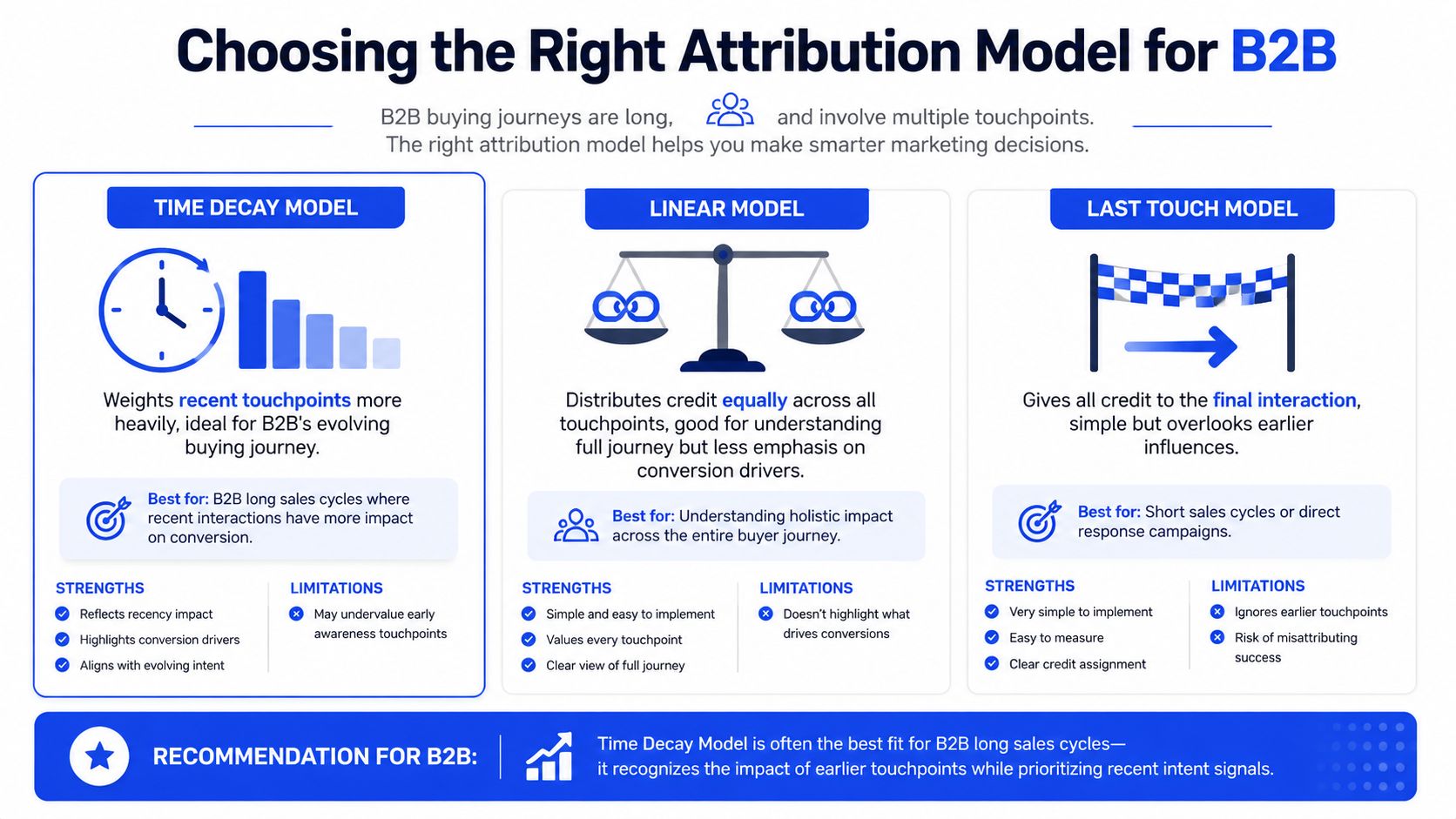
Time-decay fits that reality better than the usual alternatives. It acknowledges that late-stage activity often has stronger buying intent, but it still preserves the influence of earlier demand creation. That matters when LinkedIn warms the account months before an outbound rep gets a response.
If your team needs standard terminology for internal docs or stakeholder alignment, GROU's attribution model glossary is a useful reference.
Where each model breaks
Model | How it Works | Best For | Biggest Flaw for B2B |
|---|---|---|---|
Linear | Splits credit evenly across touches | Early-stage reporting maturity | Treats weak and strong touches as equally important |
Time-decay | Gives more credit to touches closer to conversion | Long sales cycles with repeated engagement | Can under-credit early demand creation if the decay curve is too aggressive |
U-shaped or position-based | Heavily weights first and last touch, then spreads the rest | Teams that care about awareness plus conversion moments | Mid-funnel influence gets flattened |
Algorithmic | Assigns credit from observed patterns in your data | Mature teams with clean data and internal data support | Hard to defend when identity resolution and touch capture are incomplete |
Linear attribution is easy to explain and easy to over-trust. If one account saw a LinkedIn ad, opened five outbound emails, attended a webinar, and then converted on a branded search visit, equal weighting hides what changed buying intent versus what occurred along the way.
U-shaped models are useful when first touch and conversion touch are clearly the most important events. That is common in simple demand gen funnels. It is less reliable in complex B2B motions where the middle carries a lot of the commercial weight. A high-intent email reply, a booked meeting from an outbound sequence, a second visit to the pricing page, or a champion sharing your deck internally often matters more than the first anonymous click.
Algorithmic attribution can outperform rules-based models. I have seen it work well in companies with disciplined CRM stages, clean campaign naming, and normalized event streams across paid, web, and outbound systems. I have also seen it produce polished nonsense because LinkedIn clicks were tagged inconsistently, sales engagement data was trapped inside Apollo or Salesloft, and account-contact matching was unreliable.
A model should match the sales motion you run, not the one your reporting tool makes easiest to show.
For many organizations, this is the right sequence:
Start with time-decay in HubSpot, Salesforce reporting, your BI layer, or a dedicated attribution tool.
Compare it against linear on a limited opportunity set so stakeholders can see what changes.
Review a small sample of won deals by hand each month to check whether the weighting matches how the account progressed.
Move to algorithmic only after your touch data is consistent across CRM, website, paid media, LinkedIn activity, and outbound platforms.
The tool trade-offs matter here. HubSpot and Salesforce are usually the right systems to anchor lifecycle stages, opportunity timestamps, and revenue outcomes. Outbound tools like Apollo, Instantly, Smartlead, HeyReach, Outreach, or Salesloft are execution systems. They are useful sources of engagement events, but they should not own revenue credit on their own. Pull those events into your reporting layer, normalize campaign and sequence naming, and connect them back to account and opportunity records. If your team is still sorting out cross-system event flow, this data integration guide for AI platforms covers the discipline needed to keep source data usable once it leaves the original tool.
The data and instrumentation you actually need
An attribution model with bad inputs gives you polished nonsense. The core work is data design.
A sound setup depends on identity resolution. The system needs unified inputs from the CRM, marketing automation, ad platforms, and website so it can connect events into a single buyer journey. In practice, that usually means collecting first-party event data through JavaScript, UTMs, and APIs, then normalizing it inside one reporting layer (Twilio).
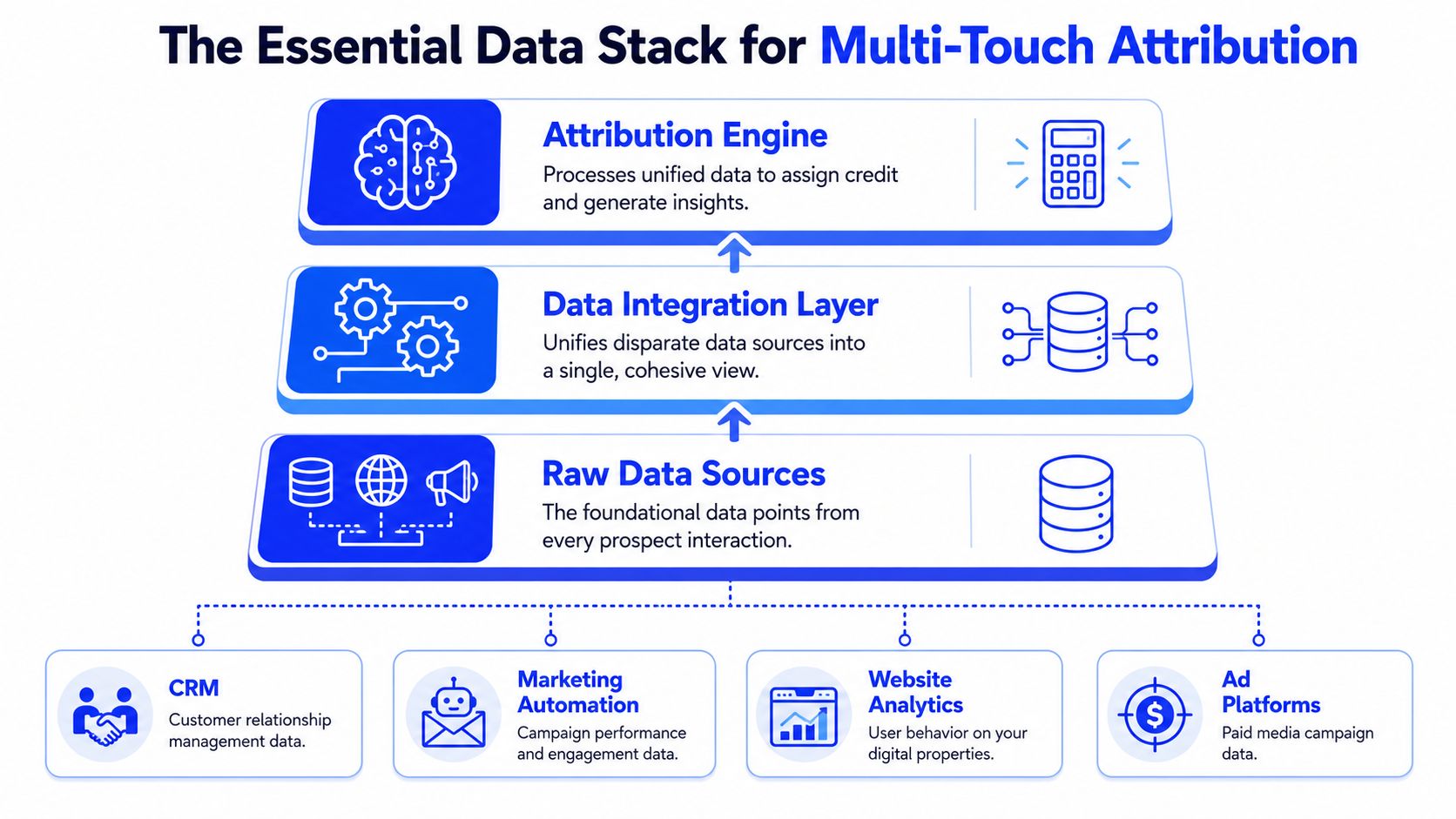
Your source of truth
If you're running B2B, the CRM has to win every argument. Usually that's HubSpot or Salesforce. Everything else feeds it or gets modeled around it.
The minimum objects and timestamps you need are:
Account records → domain, company name normalization, owner, segment, ICP flag
Contact records → email, LinkedIn URL when available, lifecycle stage, source fields
Opportunity records → created date, stage changes, amount, closed-won date
Touchpoint events → source, medium, campaign, timestamp, event type, record association
If you don't already have warehouse discipline, this guide to trusted SaaS metrics is a useful framing piece for getting reporting definitions under control before attribution starts drifting.
For event definitions and naming, keep them close to your conversion governance. A short conversion tracking reference also helps teams stop mixing lead capture events with revenue events.
What to capture from LinkedIn and outbound
Most B2B stacks often break at this point: They track site forms well enough, then miss the touches that created intent.
You need to capture at least these categories:
LinkedIn paid touches → campaign, ad, click timestamp, landing page, form submit if native lead gen is used
LinkedIn organic touches → post engagement tied back to identifiable contacts only when you have a legitimate path to identity, usually via inbound response or site visit with matching records
Outbound email touches → send, open where reliable, click, reply, positive reply classification, meeting booked
Sequencing state → sequence name, step number, last engagement date
Sales touches → call logged, meeting held, next-step booked, opportunity creation
I don't give much decision weight to opens anymore. Replies, meetings, and opportunity progression matter more. For LinkedIn, content view counts may help a social manager feel good, but they don't belong in revenue attribution unless you can tie them to a real account journey.
How the stack should connect
The practical stack usually looks like this:
CRM as source of truth, usually HubSpot
MAP or enrichment layer for contact sync and campaign membership
Ad platforms like Google Ads and LinkedIn Ads
Outbound tools like Apollo, Smartlead, Instantly, Lemlist, or HeyReach
Integration layer like Make or native APIs
Reporting layer in HubSpot reports, Looker Studio, Power BI, or a warehouse-backed BI tool
One useful pattern is to push outbound and social engagement into custom touchpoint objects or custom events, then associate them to contact, account, and opportunity. That gives RevOps a single timeline to inspect when a deal closes.
If a touchpoint can't be tied to an account and a timestamp, keep it out of the revenue model.
This is also the section where teams sometimes want an all-in-one vendor to solve everything. Sometimes that works. Sometimes a lighter assembly works better. Options range from warehouse-first stacks to packaged attribution tools, and service-led setups like GROU, which combines LinkedIn content, outbound, and reporting in one pipeline system. The right choice depends less on logo preference and more on whether the stack can preserve event fidelity from first engagement to closed revenue.
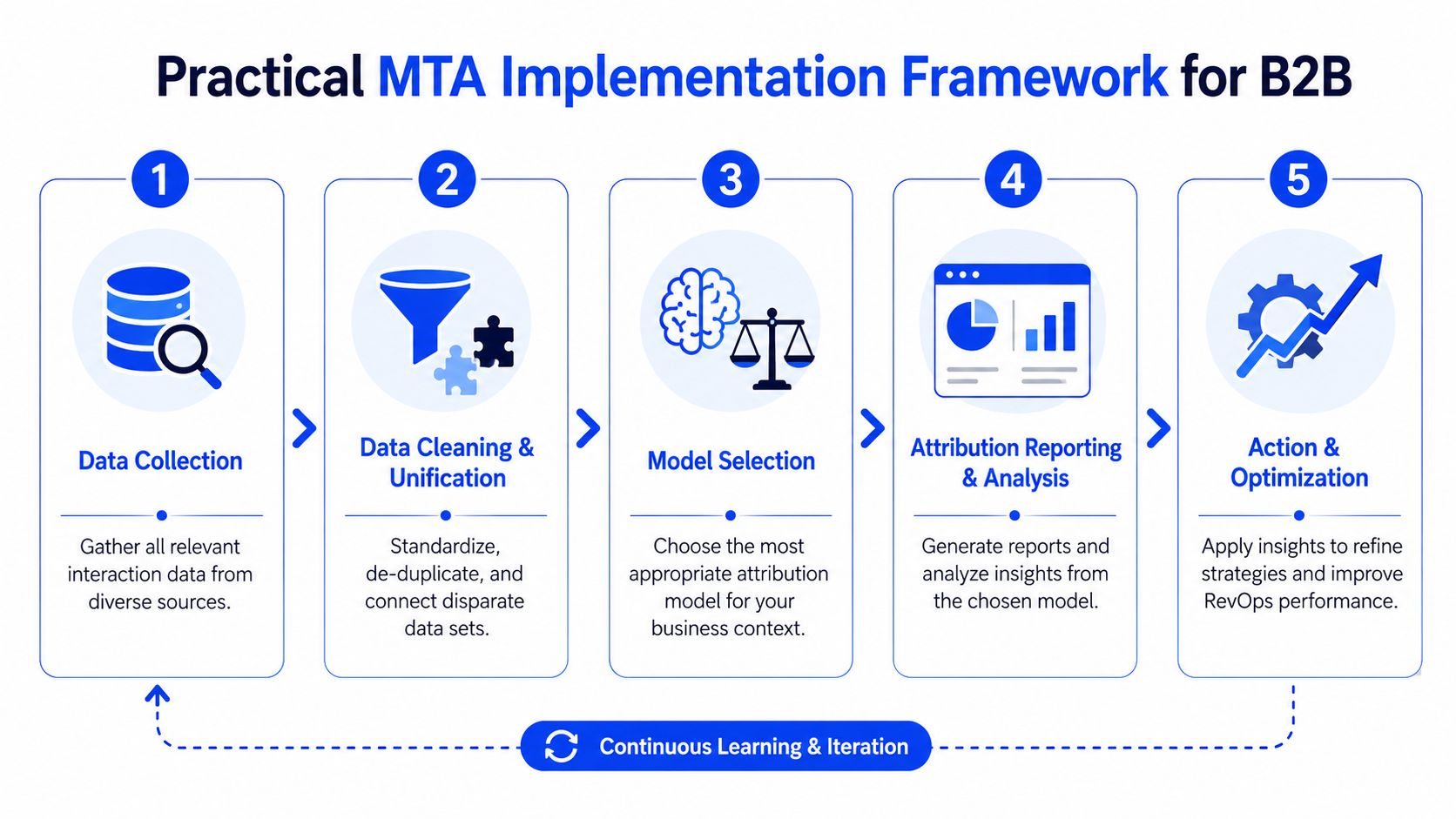
A practical implementation framework for B2B
Teams often overbuild attribution in month one and abandon it in month three. The fix is to start narrower than your ambition.
The challenge isn't choosing between linear and time-decay. It's whether your identity layer is trustworthy enough to support any model at all, especially when consent is limited and deterministic matching is incomplete. SegmentStream's framing on privacy-constrained attribution is useful because it shifts the conversation back to signal quality instead of model preference (SegmentStream).
Teams building event pipelines across several systems may also find this data integration guide for AI platforms helpful. The principles apply just as well to attribution data as they do to AI workflows. If you're evaluating software, GROU keeps a live category page for revenue attribution tools that can shorten the shortlist process.
Step 1 through step 3
Step 1, clean the core records first.
Fix lifecycle stages, close duplicate companies, standardize source fields, and make sure opportunities are associated to the right accounts and contacts. If the CRM is messy, stop there and clean it.
Step 2, define only the touches that matter.
Don't start with every possible event. Start with meaningful ones. In B2B that usually means first known touch, inbound conversion, outbound positive reply, meeting booked, SQL created, opportunity created, and closed-won.
Step 3, configure one model and one window.
Use time-decay first. Keep the attribution window aligned with how your deals usually progress. You can expand later, but don't begin with six competing views and a board deck full of contradictions.
Step 4 and step 5
Step 4, build reports that answer operating questions.
The first dashboard should answer these:
Which channels influence created opportunities
Which touches appear before SQL creation
Which outbound sequences lead to meetings that become pipeline
Which accounts show multiple stakeholder engagement before close
Don't obsess over channel vanity. Build tables that sales, marketing, and finance can all inspect without interpretation gymnastics.
Step 5, review and correct the model on a schedule. Every month, pull a sample of recent closed-won and closed-lost deals. Compare the attributed path against the actual account history in CRM, LinkedIn, and outbound tools. Such comparisons quickly reveal bad mappings.
Attribution should be audited like revenue recognition. If the sums don't reconcile, trust drops immediately.
One more hard truth. You will have blind spots. Some LinkedIn influence won't be attributable at person level. Some outbound touches will never map cleanly. That's normal. The job is not perfect surveillance. The job is credible decision support.
Common pitfalls that invalidate B2B attribution
The fastest way to ruin attribution is to treat a B2B deal like a single-user ecommerce checkout. That assumption keeps showing up in software defaults, campaign reporting, and even in otherwise decent RevOps stacks.
One B2B attribution source makes the point clearly. True attribution has to account for all stakeholders in a buying team, not just individual contacts, and it has to reconcile credited revenue back to actual deal size (HockeyStack). If your model rewards the contact who filled the form and ignores the economic buyer who attended the late-stage call, you're not measuring influence. You're rewarding whoever happened to be easiest to track.
The person-level trap
A lot of teams still ask, "Which lead source created this deal?" That's often the wrong question. In manufacturing, legal tech, pharma, and enterprise SaaS, a deal usually moves through multiple stakeholders with different touch histories.
What works better is an account-level view with person-level detail underneath it.
Account-level credit should decide budget and channel allocation.
Person-level assists should help sales understand who engaged and when.
Deal-level reconciliation should make sure the sum of credited revenue matches the opportunity amount.
This matters most when outbound starts the conversation with one contact, LinkedIn content warms a second stakeholder, and a third person books the meeting. Single-contact attribution will almost always over-credit the last visible person.
The signal loss trap
Privacy limits and identity gaps don't just create noise. They can systematically bias the model toward the touches you capture best, not the touches that mattered most.
That usually means:
Website form submissions get overrepresented
Logged sales activities look stronger than unlogged ones
Paid media with good native reporting can dominate the story
Organic influence and dark social get under-credited
The fix isn't to pretend you can see everything. The fix is to score source reliability internally. Some teams tag touch classes as high-confidence, medium-confidence, or directional. That's smarter than mixing all touchpoints into one flat table and acting as if they carry equal evidentiary weight.
When signal quality drops, confidence should drop with it. Mature teams show both the attribution output and the reliability of the data behind it.
The reporting trap
Another common failure is reporting on channels without tying them to a revenue stage. A report that says LinkedIn influenced pipeline can be useful. A report that shows whether LinkedIn appears before MQL, SQL, opportunity creation, or closed-won is far more useful.
Day-to-day decisions improve. For example, RevOps can spot accounts where outbound is generating meetings but not opportunity creation. Marketing can see whether content touches are clustered early or spread through the cycle. Sales leaders can inspect whether reps are engaging multi-threaded accounts or relying on a single champion.
And one practical note. Don't let attribution become a monthly ceremony that nobody uses. If the model doesn't help you cut waste, defend a channel, or coach a rep, it's still invalid even if the spreadsheet balances.
How to integrate attribution into your RevOps workflow
Attribution should sit inside operating cadence, not in a side project owned by one analyst. Once the data is stable enough, your team should use it every week.
Oracle's view is directionally right here. B2B attribution gets stronger when credit aligns to revenue stages, not just clicks. Meaningful touchpoints often include first touch, MQL creation, SQL creation, opportunity creation, and final purchase, and Oracle describes stage-aware weighting approaches that can assign 22.5% credit to key touches in the path (Oracle). That is much closer to how real pipeline moves than channel-only reporting.

If your team still treats RevOps as CRM hygiene plus routing rules, this RevOps glossary reference is useful shorthand for aligning sales, marketing, and operations around one operating model.
Weekly operating rhythm
In a weekly RevOps meeting, attribution should answer active questions, not historical trivia.
A strong weekly review usually includes:
Opportunity creation by influenced channel → not just source of the converted lead
Touchpoint path before meetings held → useful for outbound timing and sequence review
Accounts with multi-stakeholder engagement → especially helpful for enterprise reps
Stage conversion by touch pattern → for example, whether LinkedIn plus outbound combinations show up before SQL more often than isolated touches
Tools offer practical applications. In HubSpot, create account and opportunity reports that show associated campaign activity, meetings, and touch chronology. In Apollo or Instantly, inspect sequences that generated replies but stalled before meetings. In HeyReach or LinkedIn workflows, compare accounts that engaged with content before replying to outbound against accounts that did not.
Monthly budget and funnel decisions
Monthly reviews should be less granular and more directional. In this context, attribution changes spend, headcount, and campaign structure.
A few examples:
LinkedIn content budget gets defended when account-level paths show repeated early-stage influence before meetings and pipeline creation.
Outbound sequence timing gets adjusted when positive replies happen but opportunity creation lags, which usually points to weak follow-up or poor handoff.
Paid search budget gets trimmed when it closes demand efficiently but rarely appears earlier in journeys, meaning it may be harvesting intent created elsewhere.
Sales coaching gets more precise when closed-won accounts show strong multithreading and closed-lost accounts don't.
I also like one dashboard that every revenue leader can read in under five minutes. It should show influenced opportunity creation, influenced closed-won revenue, average touch depth by deal stage, and top recurring touch combinations before pipeline creation. That's enough to guide action without drowning everyone in event logs.
The key is consistency. If marketing uses one attribution view, sales uses another, and finance trusts neither, the project collapses. Put one governed model into the cadence and keep the debate focused on decisions.
Conclusion
The next step isn't buying another platform. It's proving whether your current data can support attribution at all.
This Friday, take your last three closed-won deals and map every touchpoint manually. Pull the CRM timeline. Check LinkedIn conversations. Review outbound replies, meetings, and opportunity stage changes. Mark what is visible, what is inferred, and what is missing.
That exercise will show you where the problem sits. Usually it's not the model. It's the gaps.
GROU helps B2B teams connect LinkedIn, outbound, and CRM data into one revenue view so attribution can inform pipeline decisions instead of sitting in a slide deck. The methodology is simple, structure every touchpoint around the same accounts, the same message, and the same reporting line, then audit the path back to real opportunities and closed revenue.
A deal closes, and three teams claim credit. Paid social points to LinkedIn engagement. SDRs point to the outbound sequence that got the first reply. Finance looks at Salesforce and sees revenue, but no channel story it trusts enough to use for planning.
That is the B2B attribution problem. It is not about assigning tidy credit to anonymous website visits. It is about tying high-value touches across LinkedIn, outbound, CRM activity, and opportunity progression back to revenue in a way RevOps can defend in a forecast call.
For B2B teams trying to define marketing attribution in practical terms, multi-touch attribution only becomes useful when it includes the touches that shape pipeline before a form fill or after the first meeting. LinkedIn ad engagement, SDR email replies, booked meetings, contact-to-account association, and opportunity creation all matter. If the model cannot reconcile credit back to real opportunity and closed revenue, it is not attribution. It is theater.
Time-decay is usually the best starting point for B2B. It is easier to explain than custom weighting, and it maps better to long sales cycles where influence builds over weeks or months instead of in one click. Teams that need a primer can understand attribution models, but the hard part is not model selection. The hard part is identity resolution, account stitching, and getting LinkedIn plus outbound signals into one reporting layer that sales, marketing, and finance all use.
Table of Contents
Introduction
A common B2B reporting fight starts the same way. Paid social says LinkedIn sourced the pipeline. Sales says the deal came from outbound. RevOps pulls a dashboard, sees three website visits and one form fill, then realizes the touches that moved the account were a sponsored post, two SDR emails, a booked meeting, and a long gap before the opportunity opened.
That is why so many attribution projects break early. The model is rarely the first problem. The underlying problem is that teams try to assign revenue credit from incomplete activity data, usually over-weighting web sessions and undercounting the touches that matter in B2B buying cycles.
Multi-touch attribution is only useful if it changes operating decisions. It should help marketing decide where to keep spending, help sales leaders see which sequences create real pipeline, and help RevOps connect person-level activity to account and opportunity outcomes. If it cannot influence budget, follow-up, or headcount allocation, it turns into reporting overhead.
For B2B teams, the hard part is not defining attribution. It is capturing the right events and tying them to revenue in a way people trust. A quick reference from GROU's B2B attribution glossary is useful for aligning terminology, especially once marketing, SDR, and sales ops start debating what should count as an attributable touch. If your team needs a clean primer before you rebuild reporting logic, Trackingplan has a solid piece to understand attribution models.
My standard here is simple. Count the touches that influence deals, not just the ones that are easy to collect.
In practice, that means giving proper weight to LinkedIn ad engagement, organic social touches tied to known accounts, outbound email activity, meeting creation, and opportunity progression. Website clicks still matter, but they are only one slice of the journey in high-value B2B sales. Teams that miss this usually end up with attribution reports that look precise and still point budget in the wrong direction.
Introduction
Choosing the right attribution model for B2B
A familiar B2B reporting problem looks like this: LinkedIn drove the first engagement, an outbound sequence got the reply, paid search captured the branded revisit, and a sales call created the opportunity. Then the board deck gives 100% credit to the last form fill.
That is why model choice matters. In B2B, the job is not to explain website conversions in isolation. It is to assign defensible credit across the touches that influence pipeline and closed-won revenue, including outbound activity and off-site engagement that never shows up in a clean click path.
For most B2B teams, time-decay is the best starting model. It reflects how deals tend to progress, gives more weight to touches near opportunity creation or close, and stays explainable enough for finance, sales, and marketing to use in the same meeting.
My recommendation
Buyer journeys are multi-touch by default. Roivenue's overview of multi-touch attribution models is useful if your team needs a shared reference point on how the common models work. In practice, B2B journeys are even messier than the standard examples once you include organic LinkedIn posts, sponsored content, outbound emails, SDR conversations, demo follow-up, and return visits from multiple stakeholders at the same account.
Time-decay fits that reality better than the usual alternatives. It acknowledges that late-stage activity often has stronger buying intent, but it still preserves the influence of earlier demand creation. That matters when LinkedIn warms the account months before an outbound rep gets a response.
If your team needs standard terminology for internal docs or stakeholder alignment, GROU's attribution model glossary is a useful reference.
Where each model breaks
Model | How it Works | Best For | Biggest Flaw for B2B |
|---|---|---|---|
Linear | Splits credit evenly across touches | Early-stage reporting maturity | Treats weak and strong touches as equally important |
Time-decay | Gives more credit to touches closer to conversion | Long sales cycles with repeated engagement | Can under-credit early demand creation if the decay curve is too aggressive |
U-shaped or position-based | Heavily weights first and last touch, then spreads the rest | Teams that care about awareness plus conversion moments | Mid-funnel influence gets flattened |
Algorithmic | Assigns credit from observed patterns in your data | Mature teams with clean data and internal data support | Hard to defend when identity resolution and touch capture are incomplete |
Linear attribution is easy to explain and easy to over-trust. If one account saw a LinkedIn ad, opened five outbound emails, attended a webinar, and then converted on a branded search visit, equal weighting hides what changed buying intent versus what occurred along the way.
U-shaped models are useful when first touch and conversion touch are clearly the most important events. That is common in simple demand gen funnels. It is less reliable in complex B2B motions where the middle carries a lot of the commercial weight. A high-intent email reply, a booked meeting from an outbound sequence, a second visit to the pricing page, or a champion sharing your deck internally often matters more than the first anonymous click.
Algorithmic attribution can outperform rules-based models. I have seen it work well in companies with disciplined CRM stages, clean campaign naming, and normalized event streams across paid, web, and outbound systems. I have also seen it produce polished nonsense because LinkedIn clicks were tagged inconsistently, sales engagement data was trapped inside Apollo or Salesloft, and account-contact matching was unreliable.
A model should match the sales motion you run, not the one your reporting tool makes easiest to show.
For many organizations, this is the right sequence:
Start with time-decay in HubSpot, Salesforce reporting, your BI layer, or a dedicated attribution tool.
Compare it against linear on a limited opportunity set so stakeholders can see what changes.
Review a small sample of won deals by hand each month to check whether the weighting matches how the account progressed.
Move to algorithmic only after your touch data is consistent across CRM, website, paid media, LinkedIn activity, and outbound platforms.
The tool trade-offs matter here. HubSpot and Salesforce are usually the right systems to anchor lifecycle stages, opportunity timestamps, and revenue outcomes. Outbound tools like Apollo, Instantly, Smartlead, HeyReach, Outreach, or Salesloft are execution systems. They are useful sources of engagement events, but they should not own revenue credit on their own. Pull those events into your reporting layer, normalize campaign and sequence naming, and connect them back to account and opportunity records. If your team is still sorting out cross-system event flow, this data integration guide for AI platforms covers the discipline needed to keep source data usable once it leaves the original tool.
The data and instrumentation you actually need
An attribution model with bad inputs gives you polished nonsense. The core work is data design.
A sound setup depends on identity resolution. The system needs unified inputs from the CRM, marketing automation, ad platforms, and website so it can connect events into a single buyer journey. In practice, that usually means collecting first-party event data through JavaScript, UTMs, and APIs, then normalizing it inside one reporting layer (Twilio).
Your source of truth
If you're running B2B, the CRM has to win every argument. Usually that's HubSpot or Salesforce. Everything else feeds it or gets modeled around it.
The minimum objects and timestamps you need are:
Account records → domain, company name normalization, owner, segment, ICP flag
Contact records → email, LinkedIn URL when available, lifecycle stage, source fields
Opportunity records → created date, stage changes, amount, closed-won date
Touchpoint events → source, medium, campaign, timestamp, event type, record association
If you don't already have warehouse discipline, this guide to trusted SaaS metrics is a useful framing piece for getting reporting definitions under control before attribution starts drifting.
For event definitions and naming, keep them close to your conversion governance. A short conversion tracking reference also helps teams stop mixing lead capture events with revenue events.
What to capture from LinkedIn and outbound
Most B2B stacks often break at this point: They track site forms well enough, then miss the touches that created intent.
You need to capture at least these categories:
LinkedIn paid touches → campaign, ad, click timestamp, landing page, form submit if native lead gen is used
LinkedIn organic touches → post engagement tied back to identifiable contacts only when you have a legitimate path to identity, usually via inbound response or site visit with matching records
Outbound email touches → send, open where reliable, click, reply, positive reply classification, meeting booked
Sequencing state → sequence name, step number, last engagement date
Sales touches → call logged, meeting held, next-step booked, opportunity creation
I don't give much decision weight to opens anymore. Replies, meetings, and opportunity progression matter more. For LinkedIn, content view counts may help a social manager feel good, but they don't belong in revenue attribution unless you can tie them to a real account journey.
How the stack should connect
The practical stack usually looks like this:
CRM as source of truth, usually HubSpot
MAP or enrichment layer for contact sync and campaign membership
Ad platforms like Google Ads and LinkedIn Ads
Outbound tools like Apollo, Smartlead, Instantly, Lemlist, or HeyReach
Integration layer like Make or native APIs
Reporting layer in HubSpot reports, Looker Studio, Power BI, or a warehouse-backed BI tool
One useful pattern is to push outbound and social engagement into custom touchpoint objects or custom events, then associate them to contact, account, and opportunity. That gives RevOps a single timeline to inspect when a deal closes.
If a touchpoint can't be tied to an account and a timestamp, keep it out of the revenue model.
This is also the section where teams sometimes want an all-in-one vendor to solve everything. Sometimes that works. Sometimes a lighter assembly works better. Options range from warehouse-first stacks to packaged attribution tools, and service-led setups like GROU, which combines LinkedIn content, outbound, and reporting in one pipeline system. The right choice depends less on logo preference and more on whether the stack can preserve event fidelity from first engagement to closed revenue.
A practical implementation framework for B2B
Teams often overbuild attribution in month one and abandon it in month three. The fix is to start narrower than your ambition.
The challenge isn't choosing between linear and time-decay. It's whether your identity layer is trustworthy enough to support any model at all, especially when consent is limited and deterministic matching is incomplete. SegmentStream's framing on privacy-constrained attribution is useful because it shifts the conversation back to signal quality instead of model preference (SegmentStream).
Teams building event pipelines across several systems may also find this data integration guide for AI platforms helpful. The principles apply just as well to attribution data as they do to AI workflows. If you're evaluating software, GROU keeps a live category page for revenue attribution tools that can shorten the shortlist process.
Step 1 through step 3
Step 1, clean the core records first.
Fix lifecycle stages, close duplicate companies, standardize source fields, and make sure opportunities are associated to the right accounts and contacts. If the CRM is messy, stop there and clean it.
Step 2, define only the touches that matter.
Don't start with every possible event. Start with meaningful ones. In B2B that usually means first known touch, inbound conversion, outbound positive reply, meeting booked, SQL created, opportunity created, and closed-won.
Step 3, configure one model and one window.
Use time-decay first. Keep the attribution window aligned with how your deals usually progress. You can expand later, but don't begin with six competing views and a board deck full of contradictions.
Step 4 and step 5
Step 4, build reports that answer operating questions.
The first dashboard should answer these:
Which channels influence created opportunities
Which touches appear before SQL creation
Which outbound sequences lead to meetings that become pipeline
Which accounts show multiple stakeholder engagement before close
Don't obsess over channel vanity. Build tables that sales, marketing, and finance can all inspect without interpretation gymnastics.
Step 5, review and correct the model on a schedule. Every month, pull a sample of recent closed-won and closed-lost deals. Compare the attributed path against the actual account history in CRM, LinkedIn, and outbound tools. Such comparisons quickly reveal bad mappings.
Attribution should be audited like revenue recognition. If the sums don't reconcile, trust drops immediately.
One more hard truth. You will have blind spots. Some LinkedIn influence won't be attributable at person level. Some outbound touches will never map cleanly. That's normal. The job is not perfect surveillance. The job is credible decision support.
Common pitfalls that invalidate B2B attribution
The fastest way to ruin attribution is to treat a B2B deal like a single-user ecommerce checkout. That assumption keeps showing up in software defaults, campaign reporting, and even in otherwise decent RevOps stacks.
One B2B attribution source makes the point clearly. True attribution has to account for all stakeholders in a buying team, not just individual contacts, and it has to reconcile credited revenue back to actual deal size (HockeyStack). If your model rewards the contact who filled the form and ignores the economic buyer who attended the late-stage call, you're not measuring influence. You're rewarding whoever happened to be easiest to track.
The person-level trap
A lot of teams still ask, "Which lead source created this deal?" That's often the wrong question. In manufacturing, legal tech, pharma, and enterprise SaaS, a deal usually moves through multiple stakeholders with different touch histories.
What works better is an account-level view with person-level detail underneath it.
Account-level credit should decide budget and channel allocation.
Person-level assists should help sales understand who engaged and when.
Deal-level reconciliation should make sure the sum of credited revenue matches the opportunity amount.
This matters most when outbound starts the conversation with one contact, LinkedIn content warms a second stakeholder, and a third person books the meeting. Single-contact attribution will almost always over-credit the last visible person.
The signal loss trap
Privacy limits and identity gaps don't just create noise. They can systematically bias the model toward the touches you capture best, not the touches that mattered most.
That usually means:
Website form submissions get overrepresented
Logged sales activities look stronger than unlogged ones
Paid media with good native reporting can dominate the story
Organic influence and dark social get under-credited
The fix isn't to pretend you can see everything. The fix is to score source reliability internally. Some teams tag touch classes as high-confidence, medium-confidence, or directional. That's smarter than mixing all touchpoints into one flat table and acting as if they carry equal evidentiary weight.
When signal quality drops, confidence should drop with it. Mature teams show both the attribution output and the reliability of the data behind it.
The reporting trap
Another common failure is reporting on channels without tying them to a revenue stage. A report that says LinkedIn influenced pipeline can be useful. A report that shows whether LinkedIn appears before MQL, SQL, opportunity creation, or closed-won is far more useful.
Day-to-day decisions improve. For example, RevOps can spot accounts where outbound is generating meetings but not opportunity creation. Marketing can see whether content touches are clustered early or spread through the cycle. Sales leaders can inspect whether reps are engaging multi-threaded accounts or relying on a single champion.
And one practical note. Don't let attribution become a monthly ceremony that nobody uses. If the model doesn't help you cut waste, defend a channel, or coach a rep, it's still invalid even if the spreadsheet balances.
How to integrate attribution into your RevOps workflow
Attribution should sit inside operating cadence, not in a side project owned by one analyst. Once the data is stable enough, your team should use it every week.
Oracle's view is directionally right here. B2B attribution gets stronger when credit aligns to revenue stages, not just clicks. Meaningful touchpoints often include first touch, MQL creation, SQL creation, opportunity creation, and final purchase, and Oracle describes stage-aware weighting approaches that can assign 22.5% credit to key touches in the path (Oracle). That is much closer to how real pipeline moves than channel-only reporting.
If your team still treats RevOps as CRM hygiene plus routing rules, this RevOps glossary reference is useful shorthand for aligning sales, marketing, and operations around one operating model.
Weekly operating rhythm
In a weekly RevOps meeting, attribution should answer active questions, not historical trivia.
A strong weekly review usually includes:
Opportunity creation by influenced channel → not just source of the converted lead
Touchpoint path before meetings held → useful for outbound timing and sequence review
Accounts with multi-stakeholder engagement → especially helpful for enterprise reps
Stage conversion by touch pattern → for example, whether LinkedIn plus outbound combinations show up before SQL more often than isolated touches
Tools offer practical applications. In HubSpot, create account and opportunity reports that show associated campaign activity, meetings, and touch chronology. In Apollo or Instantly, inspect sequences that generated replies but stalled before meetings. In HeyReach or LinkedIn workflows, compare accounts that engaged with content before replying to outbound against accounts that did not.
Monthly budget and funnel decisions
Monthly reviews should be less granular and more directional. In this context, attribution changes spend, headcount, and campaign structure.
A few examples:
LinkedIn content budget gets defended when account-level paths show repeated early-stage influence before meetings and pipeline creation.
Outbound sequence timing gets adjusted when positive replies happen but opportunity creation lags, which usually points to weak follow-up or poor handoff.
Paid search budget gets trimmed when it closes demand efficiently but rarely appears earlier in journeys, meaning it may be harvesting intent created elsewhere.
Sales coaching gets more precise when closed-won accounts show strong multithreading and closed-lost accounts don't.
I also like one dashboard that every revenue leader can read in under five minutes. It should show influenced opportunity creation, influenced closed-won revenue, average touch depth by deal stage, and top recurring touch combinations before pipeline creation. That's enough to guide action without drowning everyone in event logs.
The key is consistency. If marketing uses one attribution view, sales uses another, and finance trusts neither, the project collapses. Put one governed model into the cadence and keep the debate focused on decisions.
Conclusion
The next step isn't buying another platform. It's proving whether your current data can support attribution at all.
This Friday, take your last three closed-won deals and map every touchpoint manually. Pull the CRM timeline. Check LinkedIn conversations. Review outbound replies, meetings, and opportunity stage changes. Mark what is visible, what is inferred, and what is missing.
That exercise will show you where the problem sits. Usually it's not the model. It's the gaps.
GROU helps B2B teams connect LinkedIn, outbound, and CRM data into one revenue view so attribution can inform pipeline decisions instead of sitting in a slide deck. The methodology is simple, structure every touchpoint around the same accounts, the same message, and the same reporting line, then audit the path back to real opportunities and closed revenue.
A deal closes, and three teams claim credit. Paid social points to LinkedIn engagement. SDRs point to the outbound sequence that got the first reply. Finance looks at Salesforce and sees revenue, but no channel story it trusts enough to use for planning.
That is the B2B attribution problem. It is not about assigning tidy credit to anonymous website visits. It is about tying high-value touches across LinkedIn, outbound, CRM activity, and opportunity progression back to revenue in a way RevOps can defend in a forecast call.
For B2B teams trying to define marketing attribution in practical terms, multi-touch attribution only becomes useful when it includes the touches that shape pipeline before a form fill or after the first meeting. LinkedIn ad engagement, SDR email replies, booked meetings, contact-to-account association, and opportunity creation all matter. If the model cannot reconcile credit back to real opportunity and closed revenue, it is not attribution. It is theater.
Time-decay is usually the best starting point for B2B. It is easier to explain than custom weighting, and it maps better to long sales cycles where influence builds over weeks or months instead of in one click. Teams that need a primer can understand attribution models, but the hard part is not model selection. The hard part is identity resolution, account stitching, and getting LinkedIn plus outbound signals into one reporting layer that sales, marketing, and finance all use.
Table of Contents
Introduction
A common B2B reporting fight starts the same way. Paid social says LinkedIn sourced the pipeline. Sales says the deal came from outbound. RevOps pulls a dashboard, sees three website visits and one form fill, then realizes the touches that moved the account were a sponsored post, two SDR emails, a booked meeting, and a long gap before the opportunity opened.
That is why so many attribution projects break early. The model is rarely the first problem. The underlying problem is that teams try to assign revenue credit from incomplete activity data, usually over-weighting web sessions and undercounting the touches that matter in B2B buying cycles.
Multi-touch attribution is only useful if it changes operating decisions. It should help marketing decide where to keep spending, help sales leaders see which sequences create real pipeline, and help RevOps connect person-level activity to account and opportunity outcomes. If it cannot influence budget, follow-up, or headcount allocation, it turns into reporting overhead.
For B2B teams, the hard part is not defining attribution. It is capturing the right events and tying them to revenue in a way people trust. A quick reference from GROU's B2B attribution glossary is useful for aligning terminology, especially once marketing, SDR, and sales ops start debating what should count as an attributable touch. If your team needs a clean primer before you rebuild reporting logic, Trackingplan has a solid piece to understand attribution models.
My standard here is simple. Count the touches that influence deals, not just the ones that are easy to collect.
In practice, that means giving proper weight to LinkedIn ad engagement, organic social touches tied to known accounts, outbound email activity, meeting creation, and opportunity progression. Website clicks still matter, but they are only one slice of the journey in high-value B2B sales. Teams that miss this usually end up with attribution reports that look precise and still point budget in the wrong direction.
Introduction
Choosing the right attribution model for B2B
A familiar B2B reporting problem looks like this: LinkedIn drove the first engagement, an outbound sequence got the reply, paid search captured the branded revisit, and a sales call created the opportunity. Then the board deck gives 100% credit to the last form fill.
That is why model choice matters. In B2B, the job is not to explain website conversions in isolation. It is to assign defensible credit across the touches that influence pipeline and closed-won revenue, including outbound activity and off-site engagement that never shows up in a clean click path.
For most B2B teams, time-decay is the best starting model. It reflects how deals tend to progress, gives more weight to touches near opportunity creation or close, and stays explainable enough for finance, sales, and marketing to use in the same meeting.
My recommendation
Buyer journeys are multi-touch by default. Roivenue's overview of multi-touch attribution models is useful if your team needs a shared reference point on how the common models work. In practice, B2B journeys are even messier than the standard examples once you include organic LinkedIn posts, sponsored content, outbound emails, SDR conversations, demo follow-up, and return visits from multiple stakeholders at the same account.
Time-decay fits that reality better than the usual alternatives. It acknowledges that late-stage activity often has stronger buying intent, but it still preserves the influence of earlier demand creation. That matters when LinkedIn warms the account months before an outbound rep gets a response.
If your team needs standard terminology for internal docs or stakeholder alignment, GROU's attribution model glossary is a useful reference.
Where each model breaks
Model | How it Works | Best For | Biggest Flaw for B2B |
|---|---|---|---|
Linear | Splits credit evenly across touches | Early-stage reporting maturity | Treats weak and strong touches as equally important |
Time-decay | Gives more credit to touches closer to conversion | Long sales cycles with repeated engagement | Can under-credit early demand creation if the decay curve is too aggressive |
U-shaped or position-based | Heavily weights first and last touch, then spreads the rest | Teams that care about awareness plus conversion moments | Mid-funnel influence gets flattened |
Algorithmic | Assigns credit from observed patterns in your data | Mature teams with clean data and internal data support | Hard to defend when identity resolution and touch capture are incomplete |
Linear attribution is easy to explain and easy to over-trust. If one account saw a LinkedIn ad, opened five outbound emails, attended a webinar, and then converted on a branded search visit, equal weighting hides what changed buying intent versus what occurred along the way.
U-shaped models are useful when first touch and conversion touch are clearly the most important events. That is common in simple demand gen funnels. It is less reliable in complex B2B motions where the middle carries a lot of the commercial weight. A high-intent email reply, a booked meeting from an outbound sequence, a second visit to the pricing page, or a champion sharing your deck internally often matters more than the first anonymous click.
Algorithmic attribution can outperform rules-based models. I have seen it work well in companies with disciplined CRM stages, clean campaign naming, and normalized event streams across paid, web, and outbound systems. I have also seen it produce polished nonsense because LinkedIn clicks were tagged inconsistently, sales engagement data was trapped inside Apollo or Salesloft, and account-contact matching was unreliable.
A model should match the sales motion you run, not the one your reporting tool makes easiest to show.
For many organizations, this is the right sequence:
Start with time-decay in HubSpot, Salesforce reporting, your BI layer, or a dedicated attribution tool.
Compare it against linear on a limited opportunity set so stakeholders can see what changes.
Review a small sample of won deals by hand each month to check whether the weighting matches how the account progressed.
Move to algorithmic only after your touch data is consistent across CRM, website, paid media, LinkedIn activity, and outbound platforms.
The tool trade-offs matter here. HubSpot and Salesforce are usually the right systems to anchor lifecycle stages, opportunity timestamps, and revenue outcomes. Outbound tools like Apollo, Instantly, Smartlead, HeyReach, Outreach, or Salesloft are execution systems. They are useful sources of engagement events, but they should not own revenue credit on their own. Pull those events into your reporting layer, normalize campaign and sequence naming, and connect them back to account and opportunity records. If your team is still sorting out cross-system event flow, this data integration guide for AI platforms covers the discipline needed to keep source data usable once it leaves the original tool.
The data and instrumentation you actually need
An attribution model with bad inputs gives you polished nonsense. The core work is data design.
A sound setup depends on identity resolution. The system needs unified inputs from the CRM, marketing automation, ad platforms, and website so it can connect events into a single buyer journey. In practice, that usually means collecting first-party event data through JavaScript, UTMs, and APIs, then normalizing it inside one reporting layer (Twilio).
Your source of truth
If you're running B2B, the CRM has to win every argument. Usually that's HubSpot or Salesforce. Everything else feeds it or gets modeled around it.
The minimum objects and timestamps you need are:
Account records → domain, company name normalization, owner, segment, ICP flag
Contact records → email, LinkedIn URL when available, lifecycle stage, source fields
Opportunity records → created date, stage changes, amount, closed-won date
Touchpoint events → source, medium, campaign, timestamp, event type, record association
If you don't already have warehouse discipline, this guide to trusted SaaS metrics is a useful framing piece for getting reporting definitions under control before attribution starts drifting.
For event definitions and naming, keep them close to your conversion governance. A short conversion tracking reference also helps teams stop mixing lead capture events with revenue events.
What to capture from LinkedIn and outbound
Most B2B stacks often break at this point: They track site forms well enough, then miss the touches that created intent.
You need to capture at least these categories:
LinkedIn paid touches → campaign, ad, click timestamp, landing page, form submit if native lead gen is used
LinkedIn organic touches → post engagement tied back to identifiable contacts only when you have a legitimate path to identity, usually via inbound response or site visit with matching records
Outbound email touches → send, open where reliable, click, reply, positive reply classification, meeting booked
Sequencing state → sequence name, step number, last engagement date
Sales touches → call logged, meeting held, next-step booked, opportunity creation
I don't give much decision weight to opens anymore. Replies, meetings, and opportunity progression matter more. For LinkedIn, content view counts may help a social manager feel good, but they don't belong in revenue attribution unless you can tie them to a real account journey.
How the stack should connect
The practical stack usually looks like this:
CRM as source of truth, usually HubSpot
MAP or enrichment layer for contact sync and campaign membership
Ad platforms like Google Ads and LinkedIn Ads
Outbound tools like Apollo, Smartlead, Instantly, Lemlist, or HeyReach
Integration layer like Make or native APIs
Reporting layer in HubSpot reports, Looker Studio, Power BI, or a warehouse-backed BI tool
One useful pattern is to push outbound and social engagement into custom touchpoint objects or custom events, then associate them to contact, account, and opportunity. That gives RevOps a single timeline to inspect when a deal closes.
If a touchpoint can't be tied to an account and a timestamp, keep it out of the revenue model.
This is also the section where teams sometimes want an all-in-one vendor to solve everything. Sometimes that works. Sometimes a lighter assembly works better. Options range from warehouse-first stacks to packaged attribution tools, and service-led setups like GROU, which combines LinkedIn content, outbound, and reporting in one pipeline system. The right choice depends less on logo preference and more on whether the stack can preserve event fidelity from first engagement to closed revenue.
A practical implementation framework for B2B
Teams often overbuild attribution in month one and abandon it in month three. The fix is to start narrower than your ambition.
The challenge isn't choosing between linear and time-decay. It's whether your identity layer is trustworthy enough to support any model at all, especially when consent is limited and deterministic matching is incomplete. SegmentStream's framing on privacy-constrained attribution is useful because it shifts the conversation back to signal quality instead of model preference (SegmentStream).
Teams building event pipelines across several systems may also find this data integration guide for AI platforms helpful. The principles apply just as well to attribution data as they do to AI workflows. If you're evaluating software, GROU keeps a live category page for revenue attribution tools that can shorten the shortlist process.
Step 1 through step 3
Step 1, clean the core records first.
Fix lifecycle stages, close duplicate companies, standardize source fields, and make sure opportunities are associated to the right accounts and contacts. If the CRM is messy, stop there and clean it.
Step 2, define only the touches that matter.
Don't start with every possible event. Start with meaningful ones. In B2B that usually means first known touch, inbound conversion, outbound positive reply, meeting booked, SQL created, opportunity created, and closed-won.
Step 3, configure one model and one window.
Use time-decay first. Keep the attribution window aligned with how your deals usually progress. You can expand later, but don't begin with six competing views and a board deck full of contradictions.
Step 4 and step 5
Step 4, build reports that answer operating questions.
The first dashboard should answer these:
Which channels influence created opportunities
Which touches appear before SQL creation
Which outbound sequences lead to meetings that become pipeline
Which accounts show multiple stakeholder engagement before close
Don't obsess over channel vanity. Build tables that sales, marketing, and finance can all inspect without interpretation gymnastics.
Step 5, review and correct the model on a schedule. Every month, pull a sample of recent closed-won and closed-lost deals. Compare the attributed path against the actual account history in CRM, LinkedIn, and outbound tools. Such comparisons quickly reveal bad mappings.
Attribution should be audited like revenue recognition. If the sums don't reconcile, trust drops immediately.
One more hard truth. You will have blind spots. Some LinkedIn influence won't be attributable at person level. Some outbound touches will never map cleanly. That's normal. The job is not perfect surveillance. The job is credible decision support.
Common pitfalls that invalidate B2B attribution
The fastest way to ruin attribution is to treat a B2B deal like a single-user ecommerce checkout. That assumption keeps showing up in software defaults, campaign reporting, and even in otherwise decent RevOps stacks.
One B2B attribution source makes the point clearly. True attribution has to account for all stakeholders in a buying team, not just individual contacts, and it has to reconcile credited revenue back to actual deal size (HockeyStack). If your model rewards the contact who filled the form and ignores the economic buyer who attended the late-stage call, you're not measuring influence. You're rewarding whoever happened to be easiest to track.
The person-level trap
A lot of teams still ask, "Which lead source created this deal?" That's often the wrong question. In manufacturing, legal tech, pharma, and enterprise SaaS, a deal usually moves through multiple stakeholders with different touch histories.
What works better is an account-level view with person-level detail underneath it.
Account-level credit should decide budget and channel allocation.
Person-level assists should help sales understand who engaged and when.
Deal-level reconciliation should make sure the sum of credited revenue matches the opportunity amount.
This matters most when outbound starts the conversation with one contact, LinkedIn content warms a second stakeholder, and a third person books the meeting. Single-contact attribution will almost always over-credit the last visible person.
The signal loss trap
Privacy limits and identity gaps don't just create noise. They can systematically bias the model toward the touches you capture best, not the touches that mattered most.
That usually means:
Website form submissions get overrepresented
Logged sales activities look stronger than unlogged ones
Paid media with good native reporting can dominate the story
Organic influence and dark social get under-credited
The fix isn't to pretend you can see everything. The fix is to score source reliability internally. Some teams tag touch classes as high-confidence, medium-confidence, or directional. That's smarter than mixing all touchpoints into one flat table and acting as if they carry equal evidentiary weight.
When signal quality drops, confidence should drop with it. Mature teams show both the attribution output and the reliability of the data behind it.
The reporting trap
Another common failure is reporting on channels without tying them to a revenue stage. A report that says LinkedIn influenced pipeline can be useful. A report that shows whether LinkedIn appears before MQL, SQL, opportunity creation, or closed-won is far more useful.
Day-to-day decisions improve. For example, RevOps can spot accounts where outbound is generating meetings but not opportunity creation. Marketing can see whether content touches are clustered early or spread through the cycle. Sales leaders can inspect whether reps are engaging multi-threaded accounts or relying on a single champion.
And one practical note. Don't let attribution become a monthly ceremony that nobody uses. If the model doesn't help you cut waste, defend a channel, or coach a rep, it's still invalid even if the spreadsheet balances.
How to integrate attribution into your RevOps workflow
Attribution should sit inside operating cadence, not in a side project owned by one analyst. Once the data is stable enough, your team should use it every week.
Oracle's view is directionally right here. B2B attribution gets stronger when credit aligns to revenue stages, not just clicks. Meaningful touchpoints often include first touch, MQL creation, SQL creation, opportunity creation, and final purchase, and Oracle describes stage-aware weighting approaches that can assign 22.5% credit to key touches in the path (Oracle). That is much closer to how real pipeline moves than channel-only reporting.
If your team still treats RevOps as CRM hygiene plus routing rules, this RevOps glossary reference is useful shorthand for aligning sales, marketing, and operations around one operating model.
Weekly operating rhythm
In a weekly RevOps meeting, attribution should answer active questions, not historical trivia.
A strong weekly review usually includes:
Opportunity creation by influenced channel → not just source of the converted lead
Touchpoint path before meetings held → useful for outbound timing and sequence review
Accounts with multi-stakeholder engagement → especially helpful for enterprise reps
Stage conversion by touch pattern → for example, whether LinkedIn plus outbound combinations show up before SQL more often than isolated touches
Tools offer practical applications. In HubSpot, create account and opportunity reports that show associated campaign activity, meetings, and touch chronology. In Apollo or Instantly, inspect sequences that generated replies but stalled before meetings. In HeyReach or LinkedIn workflows, compare accounts that engaged with content before replying to outbound against accounts that did not.
Monthly budget and funnel decisions
Monthly reviews should be less granular and more directional. In this context, attribution changes spend, headcount, and campaign structure.
A few examples:
LinkedIn content budget gets defended when account-level paths show repeated early-stage influence before meetings and pipeline creation.
Outbound sequence timing gets adjusted when positive replies happen but opportunity creation lags, which usually points to weak follow-up or poor handoff.
Paid search budget gets trimmed when it closes demand efficiently but rarely appears earlier in journeys, meaning it may be harvesting intent created elsewhere.
Sales coaching gets more precise when closed-won accounts show strong multithreading and closed-lost accounts don't.
I also like one dashboard that every revenue leader can read in under five minutes. It should show influenced opportunity creation, influenced closed-won revenue, average touch depth by deal stage, and top recurring touch combinations before pipeline creation. That's enough to guide action without drowning everyone in event logs.
The key is consistency. If marketing uses one attribution view, sales uses another, and finance trusts neither, the project collapses. Put one governed model into the cadence and keep the debate focused on decisions.
Conclusion
The next step isn't buying another platform. It's proving whether your current data can support attribution at all.
This Friday, take your last three closed-won deals and map every touchpoint manually. Pull the CRM timeline. Check LinkedIn conversations. Review outbound replies, meetings, and opportunity stage changes. Mark what is visible, what is inferred, and what is missing.
That exercise will show you where the problem sits. Usually it's not the model. It's the gaps.
GROU helps B2B teams connect LinkedIn, outbound, and CRM data into one revenue view so attribution can inform pipeline decisions instead of sitting in a slide deck. The methodology is simple, structure every touchpoint around the same accounts, the same message, and the same reporting line, then audit the path back to real opportunities and closed revenue.

Pipeline OS Newsletter
Build qualified pipeline
Get weekly tactics to generate demand, improve lead quality, and book more meetings.







Trusted by industry leaders
Trusted by industry leaders
Trusted by industry leaders
Ready to build qualified pipeline?
Ready to build qualified pipeline?
Ready to build qualified pipeline?
Book a call to see if we're the right fit, or take the 2-minute quiz to get a clear starting point.
Book a call to see if we're the right fit, or take the 2-minute quiz to get a clear starting point.
Book a call to see if we're the right fit, or take the 2-minute quiz to get a clear starting point.
" height="30.21639343089746px" id="hfGbXmQR2" width="30.216393430897455px"/></svg>)
Copyright © 2026 – All Right Reserved
Copyright © 2026 – All Right Reserved
Copyright © 2026 – All Right Reserved