%22%3E%3C/path%3E%3Cpath d=%22M 63.072 7.554 C 62.258 8.022 61.577 8.689 61.092 9.493 L 61.092 7.076 L 57.158 7.076 L 57.158 22.64 L 61.089 22.64 L 61.089 14.888 C 61.089 13.446 61.403 12.434 62.03 11.853 C 62.818 11.218 63.818 10.907 64.826 10.982 L 65.868 10.982 L 65.868 6.851 C 64.891 6.834 63.926 7.076 63.073 7.554 Z%22 fill=%22rgb(17,17,17)%22%3E%3C/path%3E%3Cpath d=%22M 78.916 7.82 C 76.363 6.49 73.321 6.49 70.768 7.82 C 69.562 8.473 68.564 9.451 67.888 10.644 C 67.167 11.931 66.803 13.387 66.834 14.862 C 66.804 16.332 67.157 17.785 67.86 19.077 C 68.515 20.267 69.494 21.246 70.684 21.901 C 71.924 22.576 73.318 22.92 74.73 22.898 C 76.164 22.918 77.58 22.575 78.846 21.901 C 80.062 21.247 81.073 20.27 81.768 19.077 C 82.506 17.797 82.88 16.339 82.85 14.862 C 82.88 13.389 82.517 11.934 81.797 10.647 C 81.12 9.455 80.122 8.477 78.917 7.824 M 78.803 14.862 C 78.829 15.739 78.636 16.608 78.241 17.391 C 77.903 18.046 77.38 18.588 76.738 18.95 C 76.124 19.293 75.432 19.472 74.729 19.47 C 73.668 19.497 72.648 19.061 71.934 18.276 C 71.139 17.323 70.741 16.1 70.823 14.862 C 70.741 13.62 71.149 12.395 71.959 11.45 C 72.687 10.667 73.715 10.233 74.783 10.256 C 75.859 10.236 76.894 10.67 77.635 11.45 C 78.464 12.387 78.884 13.616 78.801 14.864%22 fill=%22rgb(17,17,17)%22%3E%3C/path%3E%3Cpath d=%22M 95.906 7.076 L 95.906 15.646 C 95.975 16.68 95.643 17.701 94.979 18.498 C 94.311 19.184 93.379 19.547 92.422 19.495 C 91.475 19.544 90.553 19.18 89.894 18.498 C 89.23 17.701 88.898 16.68 88.967 15.646 L 88.967 7.076 L 85.033 7.076 L 85.033 16.207 C 85 17.449 85.275 18.68 85.834 19.79 C 86.327 20.75 87.095 21.542 88.039 22.065 C 89.033 22.594 90.145 22.861 91.271 22.838 C 92.188 22.847 93.095 22.65 93.926 22.263 C 94.708 21.905 95.388 21.36 95.906 20.675 L 95.906 22.645 L 99.865 22.645 L 99.865 7.076 Z%22 fill=%22rgb(17,17,17)%22%3E%3C/path%3E%3Cpath d=%22M 4.513 15.626 C 4.511 10.815 7.606 6.549 12.181 5.059 C 16.756 3.57 21.77 5.195 24.601 9.086 L 27.816 5.87 C 24.074 1.186 17.981 -0.943 12.137 0.393 C 6.292 1.728 1.728 6.292 0.393 12.137 C -0.943 17.981 1.186 24.074 5.87 27.816 L 9.085 24.601 C 6.214 22.512 4.515 19.177 4.513 15.626%22 fill=%22rgb(32,62,235)%22%3E%3C/path%3E%3Cpath d=%22M 17.114 14.343 L 13.354 18.01 L 13.354 18.026 L 21.071 18.026 L 11.412 27.609 L 17.389 27.609 L 23.999 21.081 L 23.999 28.316 L 24.005 28.316 L 27.967 24.393 L 27.967 14.343 Z%22 fill=%22rgb(32,62,235)%22%3E%3C/path%3E%3C/g%3E%3C/svg%3E) ×
× ××
××›
›
›
›
Search engine optimization for B2B: the 2026 pipeline guide
Search engine optimization for B2B: the 2026 pipeline guide
Search engine optimization for B2B: the 2026 pipeline guide
Search engine optimization for B2B: the 2026 pipeline guide
Search engine optimization for B2B: the 2026 pipeline guide
Search engine optimization for B2B: the 2026 pipeline guide

Author
Aljaz Peklaj

Your organic report looks healthy. Sessions are up, several pages rank well, and the content calendar is full. Sales still can't point to a meaningful increase in qualified conversations, pipeline, or closed revenue. That gap usually isn't caused by a lack of publishing. It comes from a weak connection between search intent, commercial pages, CRM attribution, and account-level follow-up.
Treat search engine optimization for B2B as a demand capture system, not a traffic project.
Build keyword plans around buying committee roles, account fit, and commercial intent.
Connect pillar content to proof assets, technical pages, CRM stages, and outbound workflows.
Measure organic search by qualified pipeline contribution, not sessions alone.
Account for AI Overviews, where visibility may matter even when clicks decline.
Table of Contents
The pipeline gap in standard organic search
Most B2B teams still judge SEO through a traffic dashboard. They watch impressions, sessions, rankings, and form submissions, then hand the results to sales as if attention automatically becomes opportunity. It doesn't. A manufacturing article can attract students, competitors, and researchers while a high-intent integration page remains buried and unseen by the accounts that could buy.
Organic search deserves more serious treatment because it has a direct relationship with B2B demand. Industry summaries report that organic search drives 53% of B2B inbound leads, while other summaries place it at roughly 44.6% of B2B revenue. Those figures are reported in this B2B SEO statistics overview, and they explain why search visibility can affect growth forecasts, funnel efficiency, and CAC payback.
The practical issue is allocation. A team that publishes broad educational content may create reach without creating buying momentum. A team that builds pages around named use cases, industry constraints, integrations, procurement questions, and evidence gives sales something more valuable than another visitor. It creates a reason for the right account to continue the conversation.
Practical rule: A page earns priority when you can name the account type, buying role, problem, and next sales action it supports.
B2B search also has a structural history that still matters. Google's original PageRank model, developed by Larry Page and Sergey Brin at Stanford in 1998, used hyperlinks as votes for authority. The historical context is covered in this account of B2B SEO and PageRank. For a modern revenue team, the lesson is straightforward. Credible references, useful depth, and a clear internal link structure help search engines and buyers understand which pages deserve attention.
GROU's position is simple: structure turns attention into pipeline. That means organic content should hand readers toward a relevant solution page, proof asset, qualification path, or sales conversation. A useful external reference on this operating model is Surnex's pipeline-focused content marketing guide, particularly for teams trying to connect content production with commercial outcomes.
Account-aligned keyword research for buying committees
Keyword tools are useful for discovering language. They're poor substitutes for knowing who buys. If a tool pushes your team toward a broad term because it has attractive volume, ask whether the searcher could plausibly become an account in your pipeline. If the answer is unclear, the phrase belongs in research, not at the center of your SEO plan.
Google research is repeatedly cited as showing that 71% of B2B buyers start with a generic search query, as described in this B2B organic growth framework. That makes problem-led and category-led pages essential, especially for SaaS, pharma, legal tech, manufacturing, and iGaming companies that sell to several stakeholders.
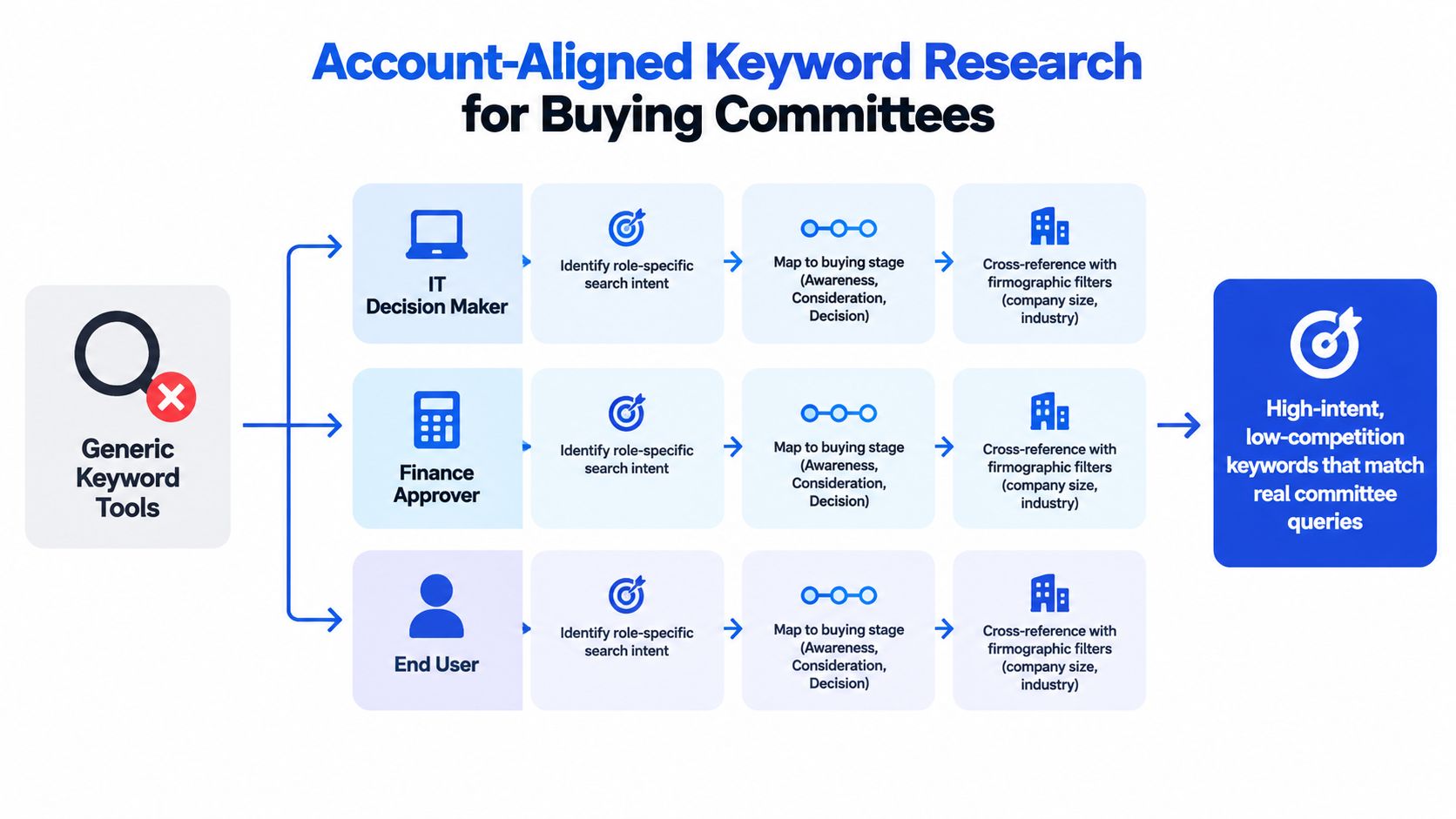
Start with accounts, not keyword volume
Use a four-step workflow:
Define the account problem. Pull language from lost-deal notes, discovery calls, support tickets, Sales Navigator conversations, and CRM fields. Capture the operational problem, the trigger, and the consequence of inaction.
Separate committee language. The IT decision maker may search for deployment, security, architecture, or integrations. Finance may look for business cases, payback, pricing structure, or procurement risk. The end user may search for workflows, implementation guidance, and product capability.
Map each query to buying stage. Awareness pages answer problem questions. Consideration pages compare approaches and vendors. Decision pages remove friction through technical documentation, proof, implementation detail, and clear conversion paths.
Validate against real accounts. Use Apollo and Sales Navigator to check whether the companies and roles behind the query exist in your ICP. A low-volume query with direct relevance to named accounts can deserve more attention than a broad phrase with no clear buyer.
The final list should include the target phrase, role, stage, account segment, page type, proof requirement, and next action. That gives writers and salespeople the same operating brief.
For a deeper treatment of the research process, use GROU's B2B SEO keyword research framework. The point isn't to produce a larger spreadsheet. It's to remove phrases that can't produce a credible path to a qualified conversation.
Score intent through sales usefulness
A query becomes commercially useful when it reveals a problem your product solves, a context your team serves, or a decision the buyer is preparing to make. “What is workflow automation” may support awareness. “Workflow automation for regulated pharma teams” gives you a clearer audience and a more specific content obligation.
Don't force every keyword into a product page. Some queries need an educational article. Others need a comparison, implementation guide, integration page, or calculator. The right format depends on what the buyer must believe before progressing.
Pillar strategy and proof assets for complex cycles
Disconnected blog posts create a content library that looks busy but behaves like a collection of loose files. Each post may answer a narrow question, yet none gives the reader a logical route toward evaluation. That structure is especially costly in complex SaaS, manufacturing, pharma, and legal tech markets, where buyers need evidence from several angles before they involve procurement or senior leadership.
Search performance is concentrated. One industry source reports that 90% of online B2B content receives no organic traffic, while another says the top three organic results capture 75% of clicks. These figures appear together in this B2B SEO statistics analysis. The operational takeaway is clear. A large archive of isolated posts won't compensate for weak topic selection, poor internal linking, or thin commercial proof.
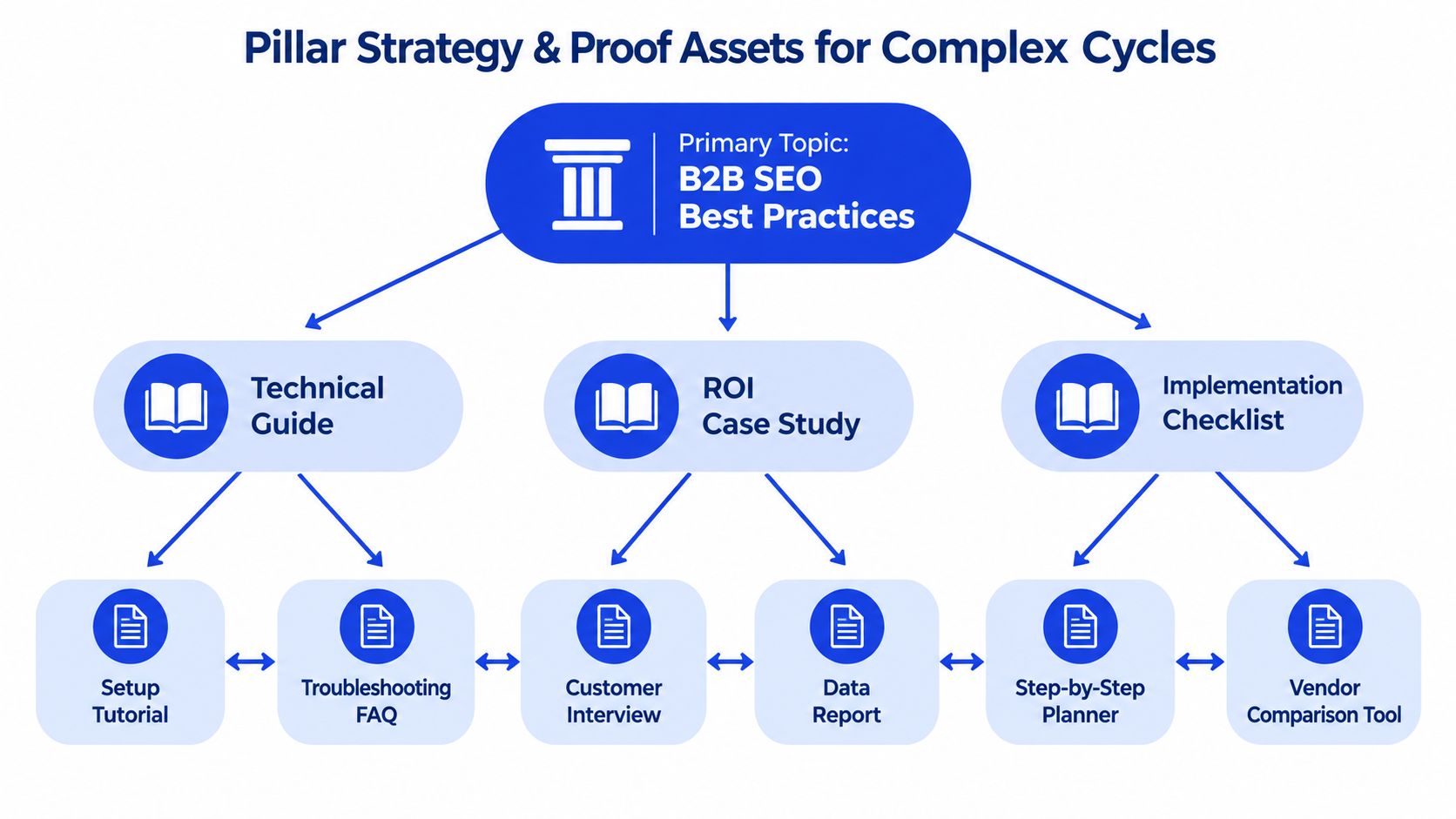
Build the cluster around a buying decision
A pillar should define the category or operating problem. Supporting pages should answer the questions that arise as a buyer evaluates the solution:
Educational pillar: Explain the problem, terminology, market context, and strategic implications.
Technical guide: Address architecture, integrations, security, deployment, compliance, or implementation.
Proof asset: Show evidence through a case study, customer interview, data report, or technical teardown.
Decision page: Help the account compare vendors, approaches, packages, or implementation paths.
Conversion asset: Offer a diagnostic, consultation, demo, assessment, or qualification route.
Every supporting page needs a deliberate internal link to a commercially relevant next step. A technical guide can link to an integration page. A comparison can link to a product or services page. A proof asset can link to a qualification form that asks about company type, use case, and timing.
This is the distinction covered in GROU's comparison of content clusters and hub-and-spoke structures. Architecture matters because it determines whether attention flows toward the pages sales needs.
Match proof to stakeholder risk
A CFO doesn't need the same evidence as an implementation lead. The legal team may care about data handling and contractual exposure. Operations may care about adoption and workflow disruption. Your cluster should make those concerns easy to find without forcing every stakeholder through the same article.
A useful production brief includes the primary role, secondary roles, decision stage, objection, evidence format, internal links, and CRM event. That last field keeps content connected to revenue operations. It tells the team what to track after publication, not just what to write.
Companies with active blogs are reported to generate 67% more leads monthly than companies without them, according to this B2B SEO benchmark article. The number doesn't justify publishing without a plan. It supports a more disciplined conclusion: consistent production works when it builds depth around a coherent commercial theme.
For enterprise teams dealing with multiple regions, products, and stakeholder groups, Keyword Kick's next era enterprise SEO guide offers useful context on managing that complexity without losing architectural control.
Technical priorities for B2B demand capture
Technical SEO should be judged by whether commercially valuable pages can be found, loaded, interpreted, indexed, and connected to the rest of the site. A technically clean site can still fail if the pages that matter to revenue sit behind weak navigation, duplicate variants, or a dense layer of low-value filters.
The core benchmark is practical. Key pages should be within three clicks of the homepage, with internal links from frequently crawled pages pointing toward priority destinations, as described in this B2B technical SEO guide.

Run the three-set URL audit
Compare these URL sets:
Crawled URLs: What your crawler can reach and parse.
Indexed URLs: What Google Search Console reports as indexed.
Impression-earning URLs: What appears in search data.
When the sets diverge, inspect duplicate URL variants, robots.txt blocks, soft 404s, incorrect canonical tags, and thin pages excluded as duplicates. This B2B technical SEO audit checklist describes the comparison and the common causes behind indexation waste.
The fix order should follow commercial impact. Start with revenue pages, solution pages, high-intent industry pages, and proof assets. Then clean supporting templates, filters, archives, and legacy resources. Don't spend a week polishing metadata on a page Google can't reliably access.
Enforce architecture rules
Use Screaming Frog or Sitebulb to inspect click depth, internal links, canonicals, status codes, and indexability. Review the following during each audit:
Priority access: Keep commercial pages within three clicks and link to them from relevant high-traffic content.
Canonical control: Ensure each priority page points to the intended canonical URL and that sitemap entries match.
Soft 404 removal: Replace empty templates with useful pages, redirect obsolete URLs where appropriate, or remove them from indexation.
Internal link hygiene: Repair links that point to redirects, blocked URLs, or canonicalized variants.
Template QA: Check forms, calls to action, structured data, and mobile usability on every commercial template.
A lean architecture doesn't mean a small website. It means search engines spend their attention on pages that can support demand capture, while buyers find those pages without hunting through the navigation.
For teams with technical products and complex site structures, GROU's SEO guidance for tech companies provides a useful reference point for connecting technical health with commercial visibility.
Measuring attribution and tying search to revenue
Search Console tells you where visibility changes. Your CRM tells you whether those changes reached accounts, created conversations, influenced opportunities, or contributed to closed business. Neither system is sufficient on its own.
Start by assigning every organic landing page a funnel stage, committee role, ICP segment, and intended conversion. HubSpot can then associate contacts, companies, lifecycle stages, deals, and content interactions. The attribution model should reflect how your sales motion works. First touch can show discovery. Lead creation can show capture. Deal influence can show how search supported an opportunity that entered through another channel.
Replace dashboard vanity with pipeline signals
Vanity Metric | Pipeline Metric | CRM Integration |
|---|---|---|
Organic sessions | ICP sessions and engaged target accounts | Connect analytics data with company records |
Keyword rankings | Commercial visibility for priority pages | Map pages to account segments and opportunities |
Form fills | Qualified conversations and held meetings | Store source page, role, use case, and qualification |
Return visits | Opportunity progression after organic exposure | Track contact and company activity across lifecycle stages |
Click-through rate | Pipeline created or influenced | Associate landing pages with contacts and deals |
The model needs clean fields. Capture the first organic landing page, converting page, account, role, campaign, meeting status, opportunity stage, and revenue outcome. If sales creates a deal without these fields, the reporting layer will always understate search's contribution.
A practical multi-touch attribution framework from GROU can help teams decide which interactions deserve credit without pretending that one channel caused every outcome. Attribution is a decision aid, not a substitute for judgment.
Build a content-to-CRM feedback loop
Review the report with sales, not only marketing. If a page attracts qualified accounts but produces weak meetings, inspect the offer, qualification form, proof, and follow-up speed. If a page produces meetings that stall in security or procurement, create the missing technical or commercial asset.
The best content teams don't ask only which page got traffic. They ask which page helped an account move, what objection appeared next, and whether sales had the material needed to answer it.
Integrating organic search with outbound and LinkedIn
Organic search and outbound should carry the same commercial message. Search captures an existing question. Outbound can create a reason to discuss that question. LinkedIn reinforces the point of view and gives buyers another place to validate the team behind the offer.
The weak version is easy to spot. Marketing publishes a broad article, SDRs send a generic sequence, and executives post unrelated opinions. Each channel may perform in isolation, but the account experiences a disconnected brand. A stronger system assigns one problem to one target segment, then adapts the evidence for each channel.
Turn search behavior into account action
When a known account visits a high-intent page, route that signal into the account workflow. Clay can enrich the company and identify relevant contacts. Sales Navigator can help confirm role and organizational context. Smartlead, Instantly, Lemlist, or HeyReach can then support the appropriate outbound motion, provided the message reflects the page the account viewed and the problem it signals.
Don't treat one page visit as proof of buying intent. Use it as a prioritization signal alongside account fit, role, repeat engagement, open opportunity status, and known business triggers. HubSpot should record the source and follow-up outcome so the team can distinguish useful intent from incidental browsing.
Operator's view: Search can warm the account. Outbound creates the conversation. Sales still has to earn the decision.
Align the LinkedIn layer
Build LinkedIn content from the same pillar and proof assets that support organic search. A technical article can become a practitioner post. A comparison page can become a point of view about evaluation criteria. A customer proof asset can become a short lesson for finance, operations, or IT.
The channel roles should remain distinct. SEO pages need durable depth and clear internal paths. LinkedIn posts need a sharp opening and a reason to continue. Outbound messages need relevance at account level. Reusing the core insight is efficient. Copying the same asset into every channel is lazy.
Use GROU's LinkedIn lead generation guidance when you're connecting LinkedIn activity to prospecting rather than treating content as a separate brand exercise. Grou can also sit alongside tools such as Clay, Smartlead, Sales Navigator, and HubSpot when a team needs one operating layer across list building, content, outbound, and reporting.
The 30-day B2B SEO quick-win roadmap
A new SEO engagement should produce operational clarity before it produces a large publishing queue. The first month is for finding structural leaks, selecting commercial priorities, and connecting search activity to sales follow-up.
Days one through seven
Export crawl data, Search Console data, sitemap URLs, and CRM landing-page data. Compare crawled, indexed, and impression-earning URLs. Mark priority pages, duplicate variants, soft 404s, blocked resources, canonical conflicts, and pages that sit beyond the three-click rule.
Give sales a short questionnaire. Ask which problems create qualified conversations, which roles enter the deal, which objections stall opportunities, and which competitors appear in active evaluations.
Days eight through fourteen
Build the account-aligned keyword map. Assign each phrase to an ICP segment, committee role, buying stage, page type, proof requirement, and conversion event. Select the first cluster around a commercial topic instead of spreading effort across unrelated terms.
Fix the highest-impact technical issues. Improve internal links to priority pages, clean sitemap entries, repair canonical signals, and remove indexation paths that add no business value.
Days fifteen through twenty-one
Refresh the strongest existing commercial and supporting pages before commissioning a large set of new articles. Add comparison criteria, implementation detail, industry context, proof, qualification questions, and clear next actions. Create a CRM field for organic landing page and a report that connects it to meetings and opportunities.
Days twenty-two through thirty
Publish or update the first cluster assets. Adapt each core idea into LinkedIn content and a sales sequence. Route qualified account signals through Clay, Sales Navigator, HubSpot, and your chosen outbound tools. Review replies, meetings, and objections with sales before planning the next production sprint.
This Friday, audit your top ten organic landing pages by commercial intent. Add columns for target account, committee role, next action, meeting status, opportunity stage, and revenue outcome. If those fields are empty, your SEO program isn't ready for a budget conversation.
GROU is a global B2B pipeline agency trusted by more than 50 companies across iGaming, SaaS, manufacturing, and professional services, with reported outcomes including 350 qualified leads in the Adriatic region, 10x LinkedIn follower growth, and enterprise deals exceeding $20M. Its methodology combines ICP-aligned list building, LinkedIn content, outbound sequences, qualification rules, shared Slack feedback, and pipeline reporting in a unified system.
Grou helps B2B teams connect search intent with LinkedIn content, outbound execution, CRM attribution, and qualified conversations through one pipeline system. Visit Grou to assess your current organic-to-revenue workflow and identify the first technical, content, and sales integration fixes to make.
Your organic report looks healthy. Sessions are up, several pages rank well, and the content calendar is full. Sales still can't point to a meaningful increase in qualified conversations, pipeline, or closed revenue. That gap usually isn't caused by a lack of publishing. It comes from a weak connection between search intent, commercial pages, CRM attribution, and account-level follow-up.
Treat search engine optimization for B2B as a demand capture system, not a traffic project.
Build keyword plans around buying committee roles, account fit, and commercial intent.
Connect pillar content to proof assets, technical pages, CRM stages, and outbound workflows.
Measure organic search by qualified pipeline contribution, not sessions alone.
Account for AI Overviews, where visibility may matter even when clicks decline.
Table of Contents
The pipeline gap in standard organic search
Most B2B teams still judge SEO through a traffic dashboard. They watch impressions, sessions, rankings, and form submissions, then hand the results to sales as if attention automatically becomes opportunity. It doesn't. A manufacturing article can attract students, competitors, and researchers while a high-intent integration page remains buried and unseen by the accounts that could buy.
Organic search deserves more serious treatment because it has a direct relationship with B2B demand. Industry summaries report that organic search drives 53% of B2B inbound leads, while other summaries place it at roughly 44.6% of B2B revenue. Those figures are reported in this B2B SEO statistics overview, and they explain why search visibility can affect growth forecasts, funnel efficiency, and CAC payback.
The practical issue is allocation. A team that publishes broad educational content may create reach without creating buying momentum. A team that builds pages around named use cases, industry constraints, integrations, procurement questions, and evidence gives sales something more valuable than another visitor. It creates a reason for the right account to continue the conversation.
Practical rule: A page earns priority when you can name the account type, buying role, problem, and next sales action it supports.
B2B search also has a structural history that still matters. Google's original PageRank model, developed by Larry Page and Sergey Brin at Stanford in 1998, used hyperlinks as votes for authority. The historical context is covered in this account of B2B SEO and PageRank. For a modern revenue team, the lesson is straightforward. Credible references, useful depth, and a clear internal link structure help search engines and buyers understand which pages deserve attention.
GROU's position is simple: structure turns attention into pipeline. That means organic content should hand readers toward a relevant solution page, proof asset, qualification path, or sales conversation. A useful external reference on this operating model is Surnex's pipeline-focused content marketing guide, particularly for teams trying to connect content production with commercial outcomes.
Account-aligned keyword research for buying committees
Keyword tools are useful for discovering language. They're poor substitutes for knowing who buys. If a tool pushes your team toward a broad term because it has attractive volume, ask whether the searcher could plausibly become an account in your pipeline. If the answer is unclear, the phrase belongs in research, not at the center of your SEO plan.
Google research is repeatedly cited as showing that 71% of B2B buyers start with a generic search query, as described in this B2B organic growth framework. That makes problem-led and category-led pages essential, especially for SaaS, pharma, legal tech, manufacturing, and iGaming companies that sell to several stakeholders.
Start with accounts, not keyword volume
Use a four-step workflow:
Define the account problem. Pull language from lost-deal notes, discovery calls, support tickets, Sales Navigator conversations, and CRM fields. Capture the operational problem, the trigger, and the consequence of inaction.
Separate committee language. The IT decision maker may search for deployment, security, architecture, or integrations. Finance may look for business cases, payback, pricing structure, or procurement risk. The end user may search for workflows, implementation guidance, and product capability.
Map each query to buying stage. Awareness pages answer problem questions. Consideration pages compare approaches and vendors. Decision pages remove friction through technical documentation, proof, implementation detail, and clear conversion paths.
Validate against real accounts. Use Apollo and Sales Navigator to check whether the companies and roles behind the query exist in your ICP. A low-volume query with direct relevance to named accounts can deserve more attention than a broad phrase with no clear buyer.
The final list should include the target phrase, role, stage, account segment, page type, proof requirement, and next action. That gives writers and salespeople the same operating brief.
For a deeper treatment of the research process, use GROU's B2B SEO keyword research framework. The point isn't to produce a larger spreadsheet. It's to remove phrases that can't produce a credible path to a qualified conversation.
Score intent through sales usefulness
A query becomes commercially useful when it reveals a problem your product solves, a context your team serves, or a decision the buyer is preparing to make. “What is workflow automation” may support awareness. “Workflow automation for regulated pharma teams” gives you a clearer audience and a more specific content obligation.
Don't force every keyword into a product page. Some queries need an educational article. Others need a comparison, implementation guide, integration page, or calculator. The right format depends on what the buyer must believe before progressing.
Pillar strategy and proof assets for complex cycles
Disconnected blog posts create a content library that looks busy but behaves like a collection of loose files. Each post may answer a narrow question, yet none gives the reader a logical route toward evaluation. That structure is especially costly in complex SaaS, manufacturing, pharma, and legal tech markets, where buyers need evidence from several angles before they involve procurement or senior leadership.
Search performance is concentrated. One industry source reports that 90% of online B2B content receives no organic traffic, while another says the top three organic results capture 75% of clicks. These figures appear together in this B2B SEO statistics analysis. The operational takeaway is clear. A large archive of isolated posts won't compensate for weak topic selection, poor internal linking, or thin commercial proof.
Build the cluster around a buying decision
A pillar should define the category or operating problem. Supporting pages should answer the questions that arise as a buyer evaluates the solution:
Educational pillar: Explain the problem, terminology, market context, and strategic implications.
Technical guide: Address architecture, integrations, security, deployment, compliance, or implementation.
Proof asset: Show evidence through a case study, customer interview, data report, or technical teardown.
Decision page: Help the account compare vendors, approaches, packages, or implementation paths.
Conversion asset: Offer a diagnostic, consultation, demo, assessment, or qualification route.
Every supporting page needs a deliberate internal link to a commercially relevant next step. A technical guide can link to an integration page. A comparison can link to a product or services page. A proof asset can link to a qualification form that asks about company type, use case, and timing.
This is the distinction covered in GROU's comparison of content clusters and hub-and-spoke structures. Architecture matters because it determines whether attention flows toward the pages sales needs.
Match proof to stakeholder risk
A CFO doesn't need the same evidence as an implementation lead. The legal team may care about data handling and contractual exposure. Operations may care about adoption and workflow disruption. Your cluster should make those concerns easy to find without forcing every stakeholder through the same article.
A useful production brief includes the primary role, secondary roles, decision stage, objection, evidence format, internal links, and CRM event. That last field keeps content connected to revenue operations. It tells the team what to track after publication, not just what to write.
Companies with active blogs are reported to generate 67% more leads monthly than companies without them, according to this B2B SEO benchmark article. The number doesn't justify publishing without a plan. It supports a more disciplined conclusion: consistent production works when it builds depth around a coherent commercial theme.
For enterprise teams dealing with multiple regions, products, and stakeholder groups, Keyword Kick's next era enterprise SEO guide offers useful context on managing that complexity without losing architectural control.
Technical priorities for B2B demand capture
Technical SEO should be judged by whether commercially valuable pages can be found, loaded, interpreted, indexed, and connected to the rest of the site. A technically clean site can still fail if the pages that matter to revenue sit behind weak navigation, duplicate variants, or a dense layer of low-value filters.
The core benchmark is practical. Key pages should be within three clicks of the homepage, with internal links from frequently crawled pages pointing toward priority destinations, as described in this B2B technical SEO guide.
Run the three-set URL audit
Compare these URL sets:
Crawled URLs: What your crawler can reach and parse.
Indexed URLs: What Google Search Console reports as indexed.
Impression-earning URLs: What appears in search data.
When the sets diverge, inspect duplicate URL variants, robots.txt blocks, soft 404s, incorrect canonical tags, and thin pages excluded as duplicates. This B2B technical SEO audit checklist describes the comparison and the common causes behind indexation waste.
The fix order should follow commercial impact. Start with revenue pages, solution pages, high-intent industry pages, and proof assets. Then clean supporting templates, filters, archives, and legacy resources. Don't spend a week polishing metadata on a page Google can't reliably access.
Enforce architecture rules
Use Screaming Frog or Sitebulb to inspect click depth, internal links, canonicals, status codes, and indexability. Review the following during each audit:
Priority access: Keep commercial pages within three clicks and link to them from relevant high-traffic content.
Canonical control: Ensure each priority page points to the intended canonical URL and that sitemap entries match.
Soft 404 removal: Replace empty templates with useful pages, redirect obsolete URLs where appropriate, or remove them from indexation.
Internal link hygiene: Repair links that point to redirects, blocked URLs, or canonicalized variants.
Template QA: Check forms, calls to action, structured data, and mobile usability on every commercial template.
A lean architecture doesn't mean a small website. It means search engines spend their attention on pages that can support demand capture, while buyers find those pages without hunting through the navigation.
For teams with technical products and complex site structures, GROU's SEO guidance for tech companies provides a useful reference point for connecting technical health with commercial visibility.
Measuring attribution and tying search to revenue
Search Console tells you where visibility changes. Your CRM tells you whether those changes reached accounts, created conversations, influenced opportunities, or contributed to closed business. Neither system is sufficient on its own.
Start by assigning every organic landing page a funnel stage, committee role, ICP segment, and intended conversion. HubSpot can then associate contacts, companies, lifecycle stages, deals, and content interactions. The attribution model should reflect how your sales motion works. First touch can show discovery. Lead creation can show capture. Deal influence can show how search supported an opportunity that entered through another channel.
Replace dashboard vanity with pipeline signals
Vanity Metric | Pipeline Metric | CRM Integration |
|---|---|---|
Organic sessions | ICP sessions and engaged target accounts | Connect analytics data with company records |
Keyword rankings | Commercial visibility for priority pages | Map pages to account segments and opportunities |
Form fills | Qualified conversations and held meetings | Store source page, role, use case, and qualification |
Return visits | Opportunity progression after organic exposure | Track contact and company activity across lifecycle stages |
Click-through rate | Pipeline created or influenced | Associate landing pages with contacts and deals |
The model needs clean fields. Capture the first organic landing page, converting page, account, role, campaign, meeting status, opportunity stage, and revenue outcome. If sales creates a deal without these fields, the reporting layer will always understate search's contribution.
A practical multi-touch attribution framework from GROU can help teams decide which interactions deserve credit without pretending that one channel caused every outcome. Attribution is a decision aid, not a substitute for judgment.
Build a content-to-CRM feedback loop
Review the report with sales, not only marketing. If a page attracts qualified accounts but produces weak meetings, inspect the offer, qualification form, proof, and follow-up speed. If a page produces meetings that stall in security or procurement, create the missing technical or commercial asset.
The best content teams don't ask only which page got traffic. They ask which page helped an account move, what objection appeared next, and whether sales had the material needed to answer it.
Integrating organic search with outbound and LinkedIn
Organic search and outbound should carry the same commercial message. Search captures an existing question. Outbound can create a reason to discuss that question. LinkedIn reinforces the point of view and gives buyers another place to validate the team behind the offer.
The weak version is easy to spot. Marketing publishes a broad article, SDRs send a generic sequence, and executives post unrelated opinions. Each channel may perform in isolation, but the account experiences a disconnected brand. A stronger system assigns one problem to one target segment, then adapts the evidence for each channel.
Turn search behavior into account action
When a known account visits a high-intent page, route that signal into the account workflow. Clay can enrich the company and identify relevant contacts. Sales Navigator can help confirm role and organizational context. Smartlead, Instantly, Lemlist, or HeyReach can then support the appropriate outbound motion, provided the message reflects the page the account viewed and the problem it signals.
Don't treat one page visit as proof of buying intent. Use it as a prioritization signal alongside account fit, role, repeat engagement, open opportunity status, and known business triggers. HubSpot should record the source and follow-up outcome so the team can distinguish useful intent from incidental browsing.
Operator's view: Search can warm the account. Outbound creates the conversation. Sales still has to earn the decision.
Align the LinkedIn layer
Build LinkedIn content from the same pillar and proof assets that support organic search. A technical article can become a practitioner post. A comparison page can become a point of view about evaluation criteria. A customer proof asset can become a short lesson for finance, operations, or IT.
The channel roles should remain distinct. SEO pages need durable depth and clear internal paths. LinkedIn posts need a sharp opening and a reason to continue. Outbound messages need relevance at account level. Reusing the core insight is efficient. Copying the same asset into every channel is lazy.
Use GROU's LinkedIn lead generation guidance when you're connecting LinkedIn activity to prospecting rather than treating content as a separate brand exercise. Grou can also sit alongside tools such as Clay, Smartlead, Sales Navigator, and HubSpot when a team needs one operating layer across list building, content, outbound, and reporting.
The 30-day B2B SEO quick-win roadmap
A new SEO engagement should produce operational clarity before it produces a large publishing queue. The first month is for finding structural leaks, selecting commercial priorities, and connecting search activity to sales follow-up.
Days one through seven
Export crawl data, Search Console data, sitemap URLs, and CRM landing-page data. Compare crawled, indexed, and impression-earning URLs. Mark priority pages, duplicate variants, soft 404s, blocked resources, canonical conflicts, and pages that sit beyond the three-click rule.
Give sales a short questionnaire. Ask which problems create qualified conversations, which roles enter the deal, which objections stall opportunities, and which competitors appear in active evaluations.
Days eight through fourteen
Build the account-aligned keyword map. Assign each phrase to an ICP segment, committee role, buying stage, page type, proof requirement, and conversion event. Select the first cluster around a commercial topic instead of spreading effort across unrelated terms.
Fix the highest-impact technical issues. Improve internal links to priority pages, clean sitemap entries, repair canonical signals, and remove indexation paths that add no business value.
Days fifteen through twenty-one
Refresh the strongest existing commercial and supporting pages before commissioning a large set of new articles. Add comparison criteria, implementation detail, industry context, proof, qualification questions, and clear next actions. Create a CRM field for organic landing page and a report that connects it to meetings and opportunities.
Days twenty-two through thirty
Publish or update the first cluster assets. Adapt each core idea into LinkedIn content and a sales sequence. Route qualified account signals through Clay, Sales Navigator, HubSpot, and your chosen outbound tools. Review replies, meetings, and objections with sales before planning the next production sprint.
This Friday, audit your top ten organic landing pages by commercial intent. Add columns for target account, committee role, next action, meeting status, opportunity stage, and revenue outcome. If those fields are empty, your SEO program isn't ready for a budget conversation.
GROU is a global B2B pipeline agency trusted by more than 50 companies across iGaming, SaaS, manufacturing, and professional services, with reported outcomes including 350 qualified leads in the Adriatic region, 10x LinkedIn follower growth, and enterprise deals exceeding $20M. Its methodology combines ICP-aligned list building, LinkedIn content, outbound sequences, qualification rules, shared Slack feedback, and pipeline reporting in a unified system.
Grou helps B2B teams connect search intent with LinkedIn content, outbound execution, CRM attribution, and qualified conversations through one pipeline system. Visit Grou to assess your current organic-to-revenue workflow and identify the first technical, content, and sales integration fixes to make.
Your organic report looks healthy. Sessions are up, several pages rank well, and the content calendar is full. Sales still can't point to a meaningful increase in qualified conversations, pipeline, or closed revenue. That gap usually isn't caused by a lack of publishing. It comes from a weak connection between search intent, commercial pages, CRM attribution, and account-level follow-up.
Treat search engine optimization for B2B as a demand capture system, not a traffic project.
Build keyword plans around buying committee roles, account fit, and commercial intent.
Connect pillar content to proof assets, technical pages, CRM stages, and outbound workflows.
Measure organic search by qualified pipeline contribution, not sessions alone.
Account for AI Overviews, where visibility may matter even when clicks decline.
Table of Contents
The pipeline gap in standard organic search
Most B2B teams still judge SEO through a traffic dashboard. They watch impressions, sessions, rankings, and form submissions, then hand the results to sales as if attention automatically becomes opportunity. It doesn't. A manufacturing article can attract students, competitors, and researchers while a high-intent integration page remains buried and unseen by the accounts that could buy.
Organic search deserves more serious treatment because it has a direct relationship with B2B demand. Industry summaries report that organic search drives 53% of B2B inbound leads, while other summaries place it at roughly 44.6% of B2B revenue. Those figures are reported in this B2B SEO statistics overview, and they explain why search visibility can affect growth forecasts, funnel efficiency, and CAC payback.
The practical issue is allocation. A team that publishes broad educational content may create reach without creating buying momentum. A team that builds pages around named use cases, industry constraints, integrations, procurement questions, and evidence gives sales something more valuable than another visitor. It creates a reason for the right account to continue the conversation.
Practical rule: A page earns priority when you can name the account type, buying role, problem, and next sales action it supports.
B2B search also has a structural history that still matters. Google's original PageRank model, developed by Larry Page and Sergey Brin at Stanford in 1998, used hyperlinks as votes for authority. The historical context is covered in this account of B2B SEO and PageRank. For a modern revenue team, the lesson is straightforward. Credible references, useful depth, and a clear internal link structure help search engines and buyers understand which pages deserve attention.
GROU's position is simple: structure turns attention into pipeline. That means organic content should hand readers toward a relevant solution page, proof asset, qualification path, or sales conversation. A useful external reference on this operating model is Surnex's pipeline-focused content marketing guide, particularly for teams trying to connect content production with commercial outcomes.
Account-aligned keyword research for buying committees
Keyword tools are useful for discovering language. They're poor substitutes for knowing who buys. If a tool pushes your team toward a broad term because it has attractive volume, ask whether the searcher could plausibly become an account in your pipeline. If the answer is unclear, the phrase belongs in research, not at the center of your SEO plan.
Google research is repeatedly cited as showing that 71% of B2B buyers start with a generic search query, as described in this B2B organic growth framework. That makes problem-led and category-led pages essential, especially for SaaS, pharma, legal tech, manufacturing, and iGaming companies that sell to several stakeholders.
Start with accounts, not keyword volume
Use a four-step workflow:
Define the account problem. Pull language from lost-deal notes, discovery calls, support tickets, Sales Navigator conversations, and CRM fields. Capture the operational problem, the trigger, and the consequence of inaction.
Separate committee language. The IT decision maker may search for deployment, security, architecture, or integrations. Finance may look for business cases, payback, pricing structure, or procurement risk. The end user may search for workflows, implementation guidance, and product capability.
Map each query to buying stage. Awareness pages answer problem questions. Consideration pages compare approaches and vendors. Decision pages remove friction through technical documentation, proof, implementation detail, and clear conversion paths.
Validate against real accounts. Use Apollo and Sales Navigator to check whether the companies and roles behind the query exist in your ICP. A low-volume query with direct relevance to named accounts can deserve more attention than a broad phrase with no clear buyer.
The final list should include the target phrase, role, stage, account segment, page type, proof requirement, and next action. That gives writers and salespeople the same operating brief.
For a deeper treatment of the research process, use GROU's B2B SEO keyword research framework. The point isn't to produce a larger spreadsheet. It's to remove phrases that can't produce a credible path to a qualified conversation.
Score intent through sales usefulness
A query becomes commercially useful when it reveals a problem your product solves, a context your team serves, or a decision the buyer is preparing to make. “What is workflow automation” may support awareness. “Workflow automation for regulated pharma teams” gives you a clearer audience and a more specific content obligation.
Don't force every keyword into a product page. Some queries need an educational article. Others need a comparison, implementation guide, integration page, or calculator. The right format depends on what the buyer must believe before progressing.
Pillar strategy and proof assets for complex cycles
Disconnected blog posts create a content library that looks busy but behaves like a collection of loose files. Each post may answer a narrow question, yet none gives the reader a logical route toward evaluation. That structure is especially costly in complex SaaS, manufacturing, pharma, and legal tech markets, where buyers need evidence from several angles before they involve procurement or senior leadership.
Search performance is concentrated. One industry source reports that 90% of online B2B content receives no organic traffic, while another says the top three organic results capture 75% of clicks. These figures appear together in this B2B SEO statistics analysis. The operational takeaway is clear. A large archive of isolated posts won't compensate for weak topic selection, poor internal linking, or thin commercial proof.
Build the cluster around a buying decision
A pillar should define the category or operating problem. Supporting pages should answer the questions that arise as a buyer evaluates the solution:
Educational pillar: Explain the problem, terminology, market context, and strategic implications.
Technical guide: Address architecture, integrations, security, deployment, compliance, or implementation.
Proof asset: Show evidence through a case study, customer interview, data report, or technical teardown.
Decision page: Help the account compare vendors, approaches, packages, or implementation paths.
Conversion asset: Offer a diagnostic, consultation, demo, assessment, or qualification route.
Every supporting page needs a deliberate internal link to a commercially relevant next step. A technical guide can link to an integration page. A comparison can link to a product or services page. A proof asset can link to a qualification form that asks about company type, use case, and timing.
This is the distinction covered in GROU's comparison of content clusters and hub-and-spoke structures. Architecture matters because it determines whether attention flows toward the pages sales needs.
Match proof to stakeholder risk
A CFO doesn't need the same evidence as an implementation lead. The legal team may care about data handling and contractual exposure. Operations may care about adoption and workflow disruption. Your cluster should make those concerns easy to find without forcing every stakeholder through the same article.
A useful production brief includes the primary role, secondary roles, decision stage, objection, evidence format, internal links, and CRM event. That last field keeps content connected to revenue operations. It tells the team what to track after publication, not just what to write.
Companies with active blogs are reported to generate 67% more leads monthly than companies without them, according to this B2B SEO benchmark article. The number doesn't justify publishing without a plan. It supports a more disciplined conclusion: consistent production works when it builds depth around a coherent commercial theme.
For enterprise teams dealing with multiple regions, products, and stakeholder groups, Keyword Kick's next era enterprise SEO guide offers useful context on managing that complexity without losing architectural control.
Technical priorities for B2B demand capture
Technical SEO should be judged by whether commercially valuable pages can be found, loaded, interpreted, indexed, and connected to the rest of the site. A technically clean site can still fail if the pages that matter to revenue sit behind weak navigation, duplicate variants, or a dense layer of low-value filters.
The core benchmark is practical. Key pages should be within three clicks of the homepage, with internal links from frequently crawled pages pointing toward priority destinations, as described in this B2B technical SEO guide.
Run the three-set URL audit
Compare these URL sets:
Crawled URLs: What your crawler can reach and parse.
Indexed URLs: What Google Search Console reports as indexed.
Impression-earning URLs: What appears in search data.
When the sets diverge, inspect duplicate URL variants, robots.txt blocks, soft 404s, incorrect canonical tags, and thin pages excluded as duplicates. This B2B technical SEO audit checklist describes the comparison and the common causes behind indexation waste.
The fix order should follow commercial impact. Start with revenue pages, solution pages, high-intent industry pages, and proof assets. Then clean supporting templates, filters, archives, and legacy resources. Don't spend a week polishing metadata on a page Google can't reliably access.
Enforce architecture rules
Use Screaming Frog or Sitebulb to inspect click depth, internal links, canonicals, status codes, and indexability. Review the following during each audit:
Priority access: Keep commercial pages within three clicks and link to them from relevant high-traffic content.
Canonical control: Ensure each priority page points to the intended canonical URL and that sitemap entries match.
Soft 404 removal: Replace empty templates with useful pages, redirect obsolete URLs where appropriate, or remove them from indexation.
Internal link hygiene: Repair links that point to redirects, blocked URLs, or canonicalized variants.
Template QA: Check forms, calls to action, structured data, and mobile usability on every commercial template.
A lean architecture doesn't mean a small website. It means search engines spend their attention on pages that can support demand capture, while buyers find those pages without hunting through the navigation.
For teams with technical products and complex site structures, GROU's SEO guidance for tech companies provides a useful reference point for connecting technical health with commercial visibility.
Measuring attribution and tying search to revenue
Search Console tells you where visibility changes. Your CRM tells you whether those changes reached accounts, created conversations, influenced opportunities, or contributed to closed business. Neither system is sufficient on its own.
Start by assigning every organic landing page a funnel stage, committee role, ICP segment, and intended conversion. HubSpot can then associate contacts, companies, lifecycle stages, deals, and content interactions. The attribution model should reflect how your sales motion works. First touch can show discovery. Lead creation can show capture. Deal influence can show how search supported an opportunity that entered through another channel.
Replace dashboard vanity with pipeline signals
Vanity Metric | Pipeline Metric | CRM Integration |
|---|---|---|
Organic sessions | ICP sessions and engaged target accounts | Connect analytics data with company records |
Keyword rankings | Commercial visibility for priority pages | Map pages to account segments and opportunities |
Form fills | Qualified conversations and held meetings | Store source page, role, use case, and qualification |
Return visits | Opportunity progression after organic exposure | Track contact and company activity across lifecycle stages |
Click-through rate | Pipeline created or influenced | Associate landing pages with contacts and deals |
The model needs clean fields. Capture the first organic landing page, converting page, account, role, campaign, meeting status, opportunity stage, and revenue outcome. If sales creates a deal without these fields, the reporting layer will always understate search's contribution.
A practical multi-touch attribution framework from GROU can help teams decide which interactions deserve credit without pretending that one channel caused every outcome. Attribution is a decision aid, not a substitute for judgment.
Build a content-to-CRM feedback loop
Review the report with sales, not only marketing. If a page attracts qualified accounts but produces weak meetings, inspect the offer, qualification form, proof, and follow-up speed. If a page produces meetings that stall in security or procurement, create the missing technical or commercial asset.
The best content teams don't ask only which page got traffic. They ask which page helped an account move, what objection appeared next, and whether sales had the material needed to answer it.
Integrating organic search with outbound and LinkedIn
Organic search and outbound should carry the same commercial message. Search captures an existing question. Outbound can create a reason to discuss that question. LinkedIn reinforces the point of view and gives buyers another place to validate the team behind the offer.
The weak version is easy to spot. Marketing publishes a broad article, SDRs send a generic sequence, and executives post unrelated opinions. Each channel may perform in isolation, but the account experiences a disconnected brand. A stronger system assigns one problem to one target segment, then adapts the evidence for each channel.
Turn search behavior into account action
When a known account visits a high-intent page, route that signal into the account workflow. Clay can enrich the company and identify relevant contacts. Sales Navigator can help confirm role and organizational context. Smartlead, Instantly, Lemlist, or HeyReach can then support the appropriate outbound motion, provided the message reflects the page the account viewed and the problem it signals.
Don't treat one page visit as proof of buying intent. Use it as a prioritization signal alongside account fit, role, repeat engagement, open opportunity status, and known business triggers. HubSpot should record the source and follow-up outcome so the team can distinguish useful intent from incidental browsing.
Operator's view: Search can warm the account. Outbound creates the conversation. Sales still has to earn the decision.
Align the LinkedIn layer
Build LinkedIn content from the same pillar and proof assets that support organic search. A technical article can become a practitioner post. A comparison page can become a point of view about evaluation criteria. A customer proof asset can become a short lesson for finance, operations, or IT.
The channel roles should remain distinct. SEO pages need durable depth and clear internal paths. LinkedIn posts need a sharp opening and a reason to continue. Outbound messages need relevance at account level. Reusing the core insight is efficient. Copying the same asset into every channel is lazy.
Use GROU's LinkedIn lead generation guidance when you're connecting LinkedIn activity to prospecting rather than treating content as a separate brand exercise. Grou can also sit alongside tools such as Clay, Smartlead, Sales Navigator, and HubSpot when a team needs one operating layer across list building, content, outbound, and reporting.
The 30-day B2B SEO quick-win roadmap
A new SEO engagement should produce operational clarity before it produces a large publishing queue. The first month is for finding structural leaks, selecting commercial priorities, and connecting search activity to sales follow-up.
Days one through seven
Export crawl data, Search Console data, sitemap URLs, and CRM landing-page data. Compare crawled, indexed, and impression-earning URLs. Mark priority pages, duplicate variants, soft 404s, blocked resources, canonical conflicts, and pages that sit beyond the three-click rule.
Give sales a short questionnaire. Ask which problems create qualified conversations, which roles enter the deal, which objections stall opportunities, and which competitors appear in active evaluations.
Days eight through fourteen
Build the account-aligned keyword map. Assign each phrase to an ICP segment, committee role, buying stage, page type, proof requirement, and conversion event. Select the first cluster around a commercial topic instead of spreading effort across unrelated terms.
Fix the highest-impact technical issues. Improve internal links to priority pages, clean sitemap entries, repair canonical signals, and remove indexation paths that add no business value.
Days fifteen through twenty-one
Refresh the strongest existing commercial and supporting pages before commissioning a large set of new articles. Add comparison criteria, implementation detail, industry context, proof, qualification questions, and clear next actions. Create a CRM field for organic landing page and a report that connects it to meetings and opportunities.
Days twenty-two through thirty
Publish or update the first cluster assets. Adapt each core idea into LinkedIn content and a sales sequence. Route qualified account signals through Clay, Sales Navigator, HubSpot, and your chosen outbound tools. Review replies, meetings, and objections with sales before planning the next production sprint.
This Friday, audit your top ten organic landing pages by commercial intent. Add columns for target account, committee role, next action, meeting status, opportunity stage, and revenue outcome. If those fields are empty, your SEO program isn't ready for a budget conversation.
GROU is a global B2B pipeline agency trusted by more than 50 companies across iGaming, SaaS, manufacturing, and professional services, with reported outcomes including 350 qualified leads in the Adriatic region, 10x LinkedIn follower growth, and enterprise deals exceeding $20M. Its methodology combines ICP-aligned list building, LinkedIn content, outbound sequences, qualification rules, shared Slack feedback, and pipeline reporting in a unified system.
Grou helps B2B teams connect search intent with LinkedIn content, outbound execution, CRM attribution, and qualified conversations through one pipeline system. Visit Grou to assess your current organic-to-revenue workflow and identify the first technical, content, and sales integration fixes to make.

Pipeline OS Newsletter
Build qualified pipeline
Get weekly tactics to generate demand, improve lead quality, and book more meetings.





Trusted by industry leaders
Trusted by industry leaders
Trusted by industry leaders
Ready to build qualified pipeline?
Ready to build qualified pipeline?
Ready to build qualified pipeline?
Book a call to see if we're the right fit, or take the 2-minute quiz to get a clear starting point.
Book a call to see if we're the right fit, or take the 2-minute quiz to get a clear starting point.
Book a call to see if we're the right fit, or take the 2-minute quiz to get a clear starting point.
" height="30.21639343089746px" id="hfGbXmQR2" width="30.216393430897455px"/></svg>)
Copyright © 2026 – All Right Reserved
Copyright © 2026 – All Right Reserved
Copyright © 2026 – All Right Reserved