%22%3E%3C/path%3E%3Cpath d=%22M 63.072 7.554 C 62.258 8.022 61.577 8.689 61.092 9.493 L 61.092 7.076 L 57.158 7.076 L 57.158 22.64 L 61.089 22.64 L 61.089 14.888 C 61.089 13.446 61.403 12.434 62.03 11.853 C 62.818 11.218 63.818 10.907 64.826 10.982 L 65.868 10.982 L 65.868 6.851 C 64.891 6.834 63.926 7.076 63.073 7.554 Z%22 fill=%22rgb(17,17,17)%22%3E%3C/path%3E%3Cpath d=%22M 78.916 7.82 C 76.363 6.49 73.321 6.49 70.768 7.82 C 69.562 8.473 68.564 9.451 67.888 10.644 C 67.167 11.931 66.803 13.387 66.834 14.862 C 66.804 16.332 67.157 17.785 67.86 19.077 C 68.515 20.267 69.494 21.246 70.684 21.901 C 71.924 22.576 73.318 22.92 74.73 22.898 C 76.164 22.918 77.58 22.575 78.846 21.901 C 80.062 21.247 81.073 20.27 81.768 19.077 C 82.506 17.797 82.88 16.339 82.85 14.862 C 82.88 13.389 82.517 11.934 81.797 10.647 C 81.12 9.455 80.122 8.477 78.917 7.824 M 78.803 14.862 C 78.829 15.739 78.636 16.608 78.241 17.391 C 77.903 18.046 77.38 18.588 76.738 18.95 C 76.124 19.293 75.432 19.472 74.729 19.47 C 73.668 19.497 72.648 19.061 71.934 18.276 C 71.139 17.323 70.741 16.1 70.823 14.862 C 70.741 13.62 71.149 12.395 71.959 11.45 C 72.687 10.667 73.715 10.233 74.783 10.256 C 75.859 10.236 76.894 10.67 77.635 11.45 C 78.464 12.387 78.884 13.616 78.801 14.864%22 fill=%22rgb(17,17,17)%22%3E%3C/path%3E%3Cpath d=%22M 95.906 7.076 L 95.906 15.646 C 95.975 16.68 95.643 17.701 94.979 18.498 C 94.311 19.184 93.379 19.547 92.422 19.495 C 91.475 19.544 90.553 19.18 89.894 18.498 C 89.23 17.701 88.898 16.68 88.967 15.646 L 88.967 7.076 L 85.033 7.076 L 85.033 16.207 C 85 17.449 85.275 18.68 85.834 19.79 C 86.327 20.75 87.095 21.542 88.039 22.065 C 89.033 22.594 90.145 22.861 91.271 22.838 C 92.188 22.847 93.095 22.65 93.926 22.263 C 94.708 21.905 95.388 21.36 95.906 20.675 L 95.906 22.645 L 99.865 22.645 L 99.865 7.076 Z%22 fill=%22rgb(17,17,17)%22%3E%3C/path%3E%3Cpath d=%22M 4.513 15.626 C 4.511 10.815 7.606 6.549 12.181 5.059 C 16.756 3.57 21.77 5.195 24.601 9.086 L 27.816 5.87 C 24.074 1.186 17.981 -0.943 12.137 0.393 C 6.292 1.728 1.728 6.292 0.393 12.137 C -0.943 17.981 1.186 24.074 5.87 27.816 L 9.085 24.601 C 6.214 22.512 4.515 19.177 4.513 15.626%22 fill=%22rgb(32,62,235)%22%3E%3C/path%3E%3Cpath d=%22M 17.114 14.343 L 13.354 18.01 L 13.354 18.026 L 21.071 18.026 L 11.412 27.609 L 17.389 27.609 L 23.999 21.081 L 23.999 28.316 L 24.005 28.316 L 27.967 24.393 L 27.967 14.343 Z%22 fill=%22rgb(32,62,235)%22%3E%3C/path%3E%3C/g%3E%3C/svg%3E) ×
× ××
××›
›
›
›
Stakeholder engagement 2026: how to win the buying committee
Stakeholder engagement 2026: how to win the buying committee
Stakeholder engagement 2026: how to win the buying committee
Stakeholder engagement 2026: how to win the buying committee
Stakeholder engagement 2026: how to win the buying committee
Stakeholder engagement 2026: how to win the buying committee

Author
Aljaz Peklaj

You're staring at a forecast that looked fine on Monday and has gone soft by Friday. The deck says the deal is alive, but the buyer side has gone quiet, the champion is dodging, and procurement suddenly has opinions no one modeled. That's not a governance problem. It's a pipeline problem wearing a stakeholder label.
Map influence early, or late-stage objections will ambush the close.
Treat stakeholder engagement as a revenue system, with named owners, tracked touchpoints, and clear handoffs.
Use LinkedIn, outbound, and content together, because one channel rarely carries a buying committee.
Measure engagement through pipeline outcomes, not activity theater.
For a clean lens on why this matters, the gap between dashboard confidence and real deal visibility is exactly what understanding pipeline data is about. And if you still separate funnel thinking from account motion, this sales pipeline vs sales funnel breakdown is the right internal reference point.
Table of Contents
Internal versus external stakeholders and who moves pipeline
The four phase engagement system that turns attention into pipeline
Your 30 day stakeholder engagement sprint and the checklist to run it
The pipeline problem hiding behind the word stakeholder
A RevOps lead at a 60-person SaaS company can lose a $1.4M quarter without any single email going wrong. The buying committee was never fully mapped, so the first real pushback came from the people with veto power. In the last three weeks of the deal, procurement surfaced redlines, the VP of IT reopened technical concerns, and a skeptical finance director asked for another review.
The AE logged activity. The CRM looked busy. The account still slipped.
That is why “stakeholder” is too soft a word for most revenue teams. It hides a failure mode that sales and RevOps can measure, unmodeled buyer influence inside the account. The team may know the champion, but not the blocker. They may know the meeting held, but not who sat silent in the room and later killed momentum.
Practical rule: If you cannot name who can say no, you do not have stakeholder engagement. You have account guessing.
The right lens starts with pipeline structure. If you are diagnosing the next gap in your pipeline, use GROU's pipeline and funnel framing to separate account motion from simple activity. That matters because attention only turns into pipeline when the account is structured enough to hold it.
For a clean read on why this matters, the gap between dashboard confidence and real deal visibility is exactly what understanding pipeline data is about.
The rest of the article is the operating manual, covering internal alignment, buyer-side mapping, channel coordination, and reporting that sales leadership will use. Structure turns attention into pipeline.
What stakeholder engagement means in a B2B revenue context
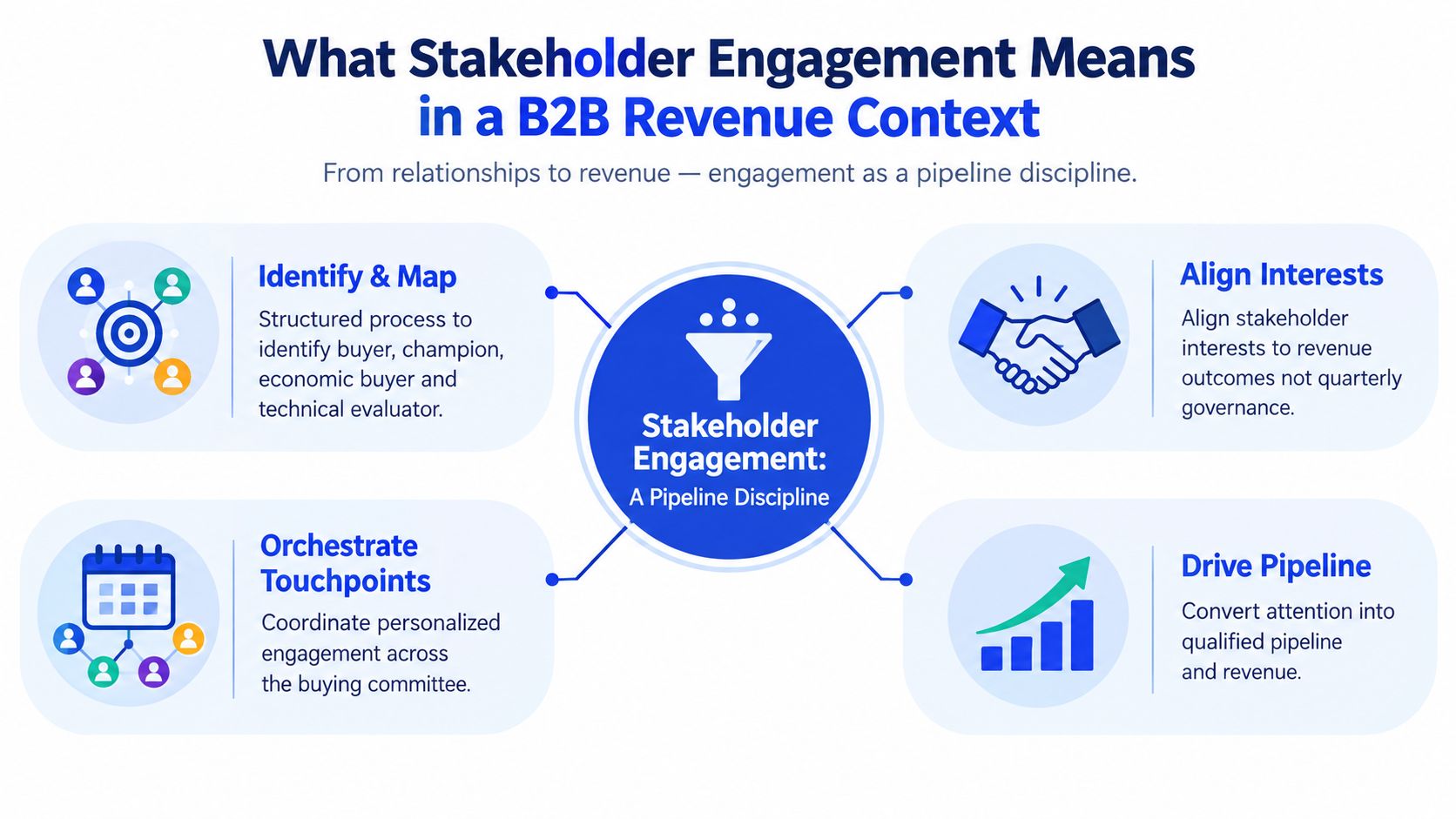
In a revenue context, stakeholder engagement is the structured process of identifying, mapping, activating, and measuring influence among the people who accelerate or block a B2B deal. It's not a quarterly governance exercise. It's the load planning behind the shipment.
Without it, capacity looks fine on paper, but nothing arrives on time. That's what happens when a CRM has contacts, but no view of influence, sequence, or decision power.
What real engagement looks like
Real engagement has three signals. First, named roles. You know who the economic buyer is, who's technical, who's championing, and who's skeptical.
Second, tracked interactions. Not just “touched,” but who got what, when, and through which channel. Third, pipeline impact. The work shows up in meetings held, opportunities opened, and deals that keep moving.
Tools matter because process alone won't hold. Apollo gives you contact data. Clay makes enrichment usable. HubSpot makes the workflow visible enough for RevOps to audit.
The cost of treating engagement as soft work is real. Gartner's 2024 benchmark, as cited in the source brief, ties weak engagement to 27% longer sales cycles and 31% lower win rates. That's why the revenue team should own it, not just marketing or leadership.
If you need a founder-facing content angle to support that structure, ProdShort guides for startup founders are a useful example of how educational assets can support buyer trust without turning into fluff.
Engagement works when every touchpoint has a job. If it doesn't change who replies, who shows up, or who advances, it's just activity.
The best teams use that same logic across account-based motions, content, and outbound. GROU's buyer journey framing fits here because the buying committee isn't linear, and your engagement system shouldn't be either.
Internal versus external stakeholders and who moves pipeline
Internal stakeholders are the people inside your company who shape deal execution. External stakeholders are the people inside the buyer's company who can move the deal forward or stop it. If you do not map both, you are only seeing half the account.
Internal stakeholders
An AE owns the thread and the close plan. An SDR creates the first movement and keeps dormant accounts warm. A CSM can validate outcomes for expansion or rescue a shaky renewal.
A SE blocks false optimism by pressure-testing feasibility. Marketing ops controls the data quality that decides whether engagement is even trackable. Product marketing sharpens the value message when the buyer's language changes.
An exec sponsor helps reopen stalled conversations. Legal can shorten the distance to signature, or stretch it. RevOps decides whether the account view is clean enough to trust.
External stakeholders
On the buyer side, the economic buyer controls budget. The technical evaluator controls fit. The end user controls adoption risk.
The champion keeps the account moving when the AE is not in the room. Procurement introduces process friction. IT security can delay, even when the commercial case is solid.
Legal can be a quiet blocker. The hidden influencer, an executive assistant, chief of staff, or a respected peer, often shapes access before the formal decision makers ever speak.
For a practical structure, use stakeholder mapping to keep these roles in one account view.
Stakeholder Group | Key Roles | Pipeline Impact | Common Failure Mode |
|---|---|---|---|
Internal | AE, SDR, CSM, SE, marketing ops, product marketing, exec sponsor, legal, RevOps | Shapes speed, message quality, routing, and close discipline | Teams work from separate account views |
External | Economic buyer, technical evaluator, end user, champion, procurement, IT security, legal, hidden influencer | Controls budget, trust, risk, and approval flow | Teams mistake the champion for the decision |
MEDDIC gives you the commercial lenses. Power-Interest and Power-Influence grids give you the relational one. Used together, they stop the team from over-rotating on title and under-rotating on real control.
Pipeline moves when internal and external maps live in one account view.
The four phase engagement system that turns attention into pipeline
The system works in four phases, Map, Activate, Engage, Convert. If one phase is weak, the next one leaks.
Map and activate the account
Use Apollo and Bombora to build the account list, then enrich with Clay so you're not guessing at titles or intent. The entry criteria are clear, ICP fit, buying role, and a live trigger worth acting on.
The owner here is RevOps or demand gen. The exit artifact is an account sheet that names the buyer, champion, economic buyer, and technical evaluator, plus the signal that justified outreach. That artifact is what sales works from, not the raw export.
Engage the committee
The channels start working together. HeyReach handles LinkedIn connection workflows, Sales Navigator helps verify the target path, and Lemlist, Instantly, or Smartlead run the parallel email motion. The handoff artifact is a live account timeline in HubSpot, with every stakeholder tagged.
Use a simple internal rhythm. Weekly deal rooms, Slack digests, and shared MEDDPICC fields keep SDRs, AEs, CSMs, and PMs on one page. The owner is the account AE, but the system belongs to RevOps.
Convert and audit
Booked meetings should route cleanly into the AE queue with lead source, lifecycle stage, and call recording attached. Gong or Chorus can capture the proof point, but the important part is the stage rule. If the buyer committee doesn't advance, the deal doesn't move.
The gate from engage to convert is specific, a real meeting, a confirmed fit, and a documented next step. When RevOps can audit that handoff, the motion stops being anecdotal.
Here's the operational reminder that matters most, especially when the account is large and the committee is messy. GROU's lead generation system is built around that same routing logic, qualified attention first, then handoff, then measurement.

LinkedIn, content, and outbound tactics that compound
For teams under fifty reps, the mix that works is 60/30/10. Put sixty percent of effort into LinkedIn, thirty percent into outbound email, and ten percent into founder or AE content that seeds the feed your buyers already read.
That split works because the channels compound when they're sequenced, not when they're run in isolation. A Clay-enriched trigger event can fire a LinkedIn connect the same day, an email lands on day three, and a comment on the prospect's post lands on day seven.
The workflow that holds
Start in Sales Navigator. Build a list from your ICP, then push it to Clay for enrichment and trigger handling. From there, HeyReach sends a personalized connection request from the right rep, not the generic company page.
The first line should reference the trigger, not your product. “Saw your team just hired two platform engineers, figured this would be worth reaching out on.” That opener earns a look because it shows the work was done.
For email, use Instantly or Smartlead for warmup and sequencing. Use Lemlist when you need one-to-one video merges or tighter personalization. One clean workflow is enough, connect on LinkedIn, send a short email two days later, then reference the prospect's own post or hiring signal in a follow-up comment.
Trade-off: LinkedIn caps daily actions, warmup domains need time, and content takes longer to seed than early-stage SaaS teams want to wait. Sequence launches have to come before the content calendar, not after it.
That matters in SaaS, iGaming, and manufacturing alike. I've seen teams wait on content until “the brand voice is ready,” then lose the quarter because the outbound motion never had enough fuel. GROU's LinkedIn content strategy is relevant here because the content only helps if it sits next to a live sequence.
Channel | Allocation | Primary tool | Weeks to first meeting |
|---|---|---|---|
60 percent | HeyReach, Sales Navigator | Varies by list quality and trigger strength | |
Outbound email | 30 percent | Clay, Instantly, Smartlead, Lemlist | Varies by domain health and message fit |
Founder or AE content | 10 percent | LinkedIn native posting | Longer runway, supports the other two channels |
One more practical point. Don't send three different messages from three different reps to the same account without a routing rule. Multi-threading only works when the account view is unified.
KPIs and reporting that prove engagement is working
The metric tree has to connect activity to pipeline without forcing leaders to read too much into vanity metrics. Leading indicators tell you whether attention is moving. Lagging indicators tell you whether the buyer committee advanced.
What to watch every week
Keep an eye on profile views from target accounts, connection acceptance above 35 percent, reply rate above 8 percent on cold sequences, meetings booked per rep per week, and qualified meetings per dollar of tooling spend. Those numbers tell you whether the message, target, and channel mix are healthy.
Use HubSpot or Looker for the weekly view, with source attribution across LinkedIn, email, and content. The dashboard should show which stakeholder roles responded, not just which contacts opened.
What to show monthly
The board view needs pipeline contribution, not activity volume. Show opportunity creation from engaged accounts, cycle time movement versus your control cohort, pipeline coverage above three times target, and influenced ARR.
The reporting discipline matters because metrics age out. After ninety days, retire temporary diagnostics like raw content engagement rates if they've stopped informing decisions. Keep the always-on views that connect engagement to meetings, opportunities, and revenue.
KPI | Type | Source / Tool | Predicts |
|---|---|---|---|
Profile views from target accounts | Leading | Early account attention | |
Connection acceptance rate above 35 percent | Leading | LinkedIn, HeyReach | Message-market fit |
Reply rate above 8 percent | Leading | Instantly, Smartlead, Lemlist | Sequence quality |
Meetings booked per rep per week | Leading | HubSpot | Near-term pipeline creation |
Qualified meetings per tooling spend | Leading | HubSpot, finance view | Efficiency of engagement motion |
Opportunity creation from engaged accounts | Lagging | HubSpot | Revenue-ready demand |
Cycle time versus control cohort | Lagging | HubSpot, Looker | Deal acceleration |
Pipeline coverage above 3x target | Lagging | HubSpot | Forecast resilience |
Influenced ARR | Lagging | CRM attribution | Revenue contribution |
The key is that sales and RevOps should see one story. Not content clicks here, outbound replies there, and pipeline somewhere else.
Two engagement programs that produced measurable pipeline
A Series B SaaS company targeting VP Engineering and CISO roles at mid-market fintechs ran the motion with a Clay-enriched account list and LinkedIn signal posts from named executives. SDRs sent connection requests through HeyReach referencing hiring signals, then HubSpot sequences triggered on a second-degree reply.
They paired that with a curated roundup email, not a generic nurture blast. The trade-off was clear, less volume, more context. In 21 days, the team booked 14 meetings at a 6.2% reply-to-meeting rate, and the win was not just meetings. It was the speed at which technical evaluators re-entered stalled deals.
An iGaming platform supplier took a different route. They scraped event attendee lists from industry conferences, enriched the contacts, and used Lemlist personalized video touches that referenced jurisdiction updates. SDRs and an AE alternated on the same account so the buyer saw continuity, not handoff chaos.
That team also ran a closed-lost revival path. One quarter later, the motion recovered $420K ARR. The trade-off there was obvious, more manual work per account, but much better relevance in a regulated market where generic outreach dies fast.
Program | Accounts Touched | Primary Channels | Reply Rate | Meetings Booked | Pipeline or Revenue |
|---|---|---|---|---|---|
Series B SaaS to fintech | Target accounts built from enriched signals | LinkedIn, HubSpot sequences, curated email | 6.2% reply-to-meeting rate | 14 | More meetings and revived technical conversations |
iGaming platform supplier | Event-sourced target accounts | Lemlist, LinkedIn, AE and SDR alternation | Qualitative, account-specific response | Not specified | $420K ARR recovered in one quarter |
The pattern is consistent. Personalization works best when it's attached to a route, a sequence, and a handoff rule. Without that structure, the channel mix just creates busier inboxes.
Your 30 day stakeholder engagement sprint and the checklist to run it
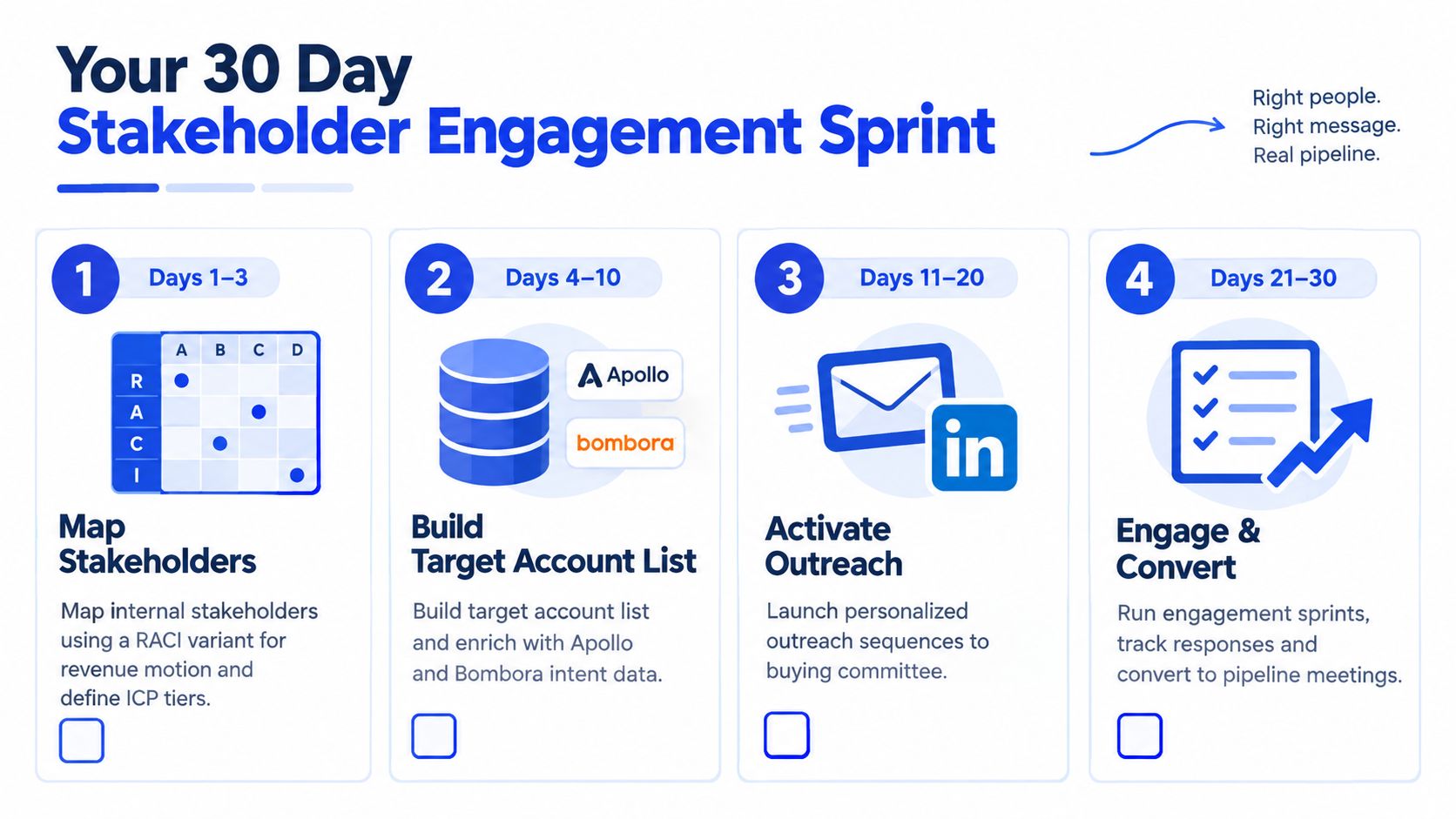
Days one through three, map internal stakeholders with a RACI variant for the revenue motion and define the ICP tier list. Days four through eight, build the LinkedIn signal map and draft two posts per week from named executives. Days nine through fourteen, stand up Apollo or Clay lists, write three Lemlist or Instantly sequence variants, and assign an AE rotation rule.
Days fifteen through twenty-one, launch, monitor reply sentiment, and route replies into HubSpot with explicit lifecycle stages. Days twenty-two through thirty, run a stakeholder retrospective, retire the weak sequences, and brief leadership on pipeline contribution. If you can't show movement by then, the system needs a new map, not more volume.
Copy this checklist into your working doc this week.
Data refresh cadence: Rebuild target account inputs weekly, refresh trigger data before every launch, and archive dead contacts fast.
Message QA: Check every first line against the trigger, role, and channel before it ships.
ABM alert wiring: Send high-intent alerts to Slack and the AE owner the same day.
Weekly reporting: Track replies, meetings, and stage movement in one dashboard.
Handoff rules: Confirm the exact lifecycle stage before a lead reaches sales.
Sequence hygiene: Pause anything with weak sentiment before it burns more reputation.
Executive content: Keep the founder or AE publishing cadence tied to account signals, not random topics.
GROU runs this kind of RevOps-led engagement work across SaaS, iGaming, and manufacturing, with one account view, one message, and one reporting line. The method is simple, structure turns attention into pipeline, and the teams that respect that usually see it in the calendar first.
If your current motion still treats stakeholder engagement as a soft process, fix the structure this Friday. Add internal and external stakeholder columns to your CRM, then run your last ten sequences against the map and see which accounts were never really covered. If you want help building the system around that, visit Grou and start with the account view, not the content calendar.
You're staring at a forecast that looked fine on Monday and has gone soft by Friday. The deck says the deal is alive, but the buyer side has gone quiet, the champion is dodging, and procurement suddenly has opinions no one modeled. That's not a governance problem. It's a pipeline problem wearing a stakeholder label.
Map influence early, or late-stage objections will ambush the close.
Treat stakeholder engagement as a revenue system, with named owners, tracked touchpoints, and clear handoffs.
Use LinkedIn, outbound, and content together, because one channel rarely carries a buying committee.
Measure engagement through pipeline outcomes, not activity theater.
For a clean lens on why this matters, the gap between dashboard confidence and real deal visibility is exactly what understanding pipeline data is about. And if you still separate funnel thinking from account motion, this sales pipeline vs sales funnel breakdown is the right internal reference point.
Table of Contents
Internal versus external stakeholders and who moves pipeline
The four phase engagement system that turns attention into pipeline
Your 30 day stakeholder engagement sprint and the checklist to run it
The pipeline problem hiding behind the word stakeholder
A RevOps lead at a 60-person SaaS company can lose a $1.4M quarter without any single email going wrong. The buying committee was never fully mapped, so the first real pushback came from the people with veto power. In the last three weeks of the deal, procurement surfaced redlines, the VP of IT reopened technical concerns, and a skeptical finance director asked for another review.
The AE logged activity. The CRM looked busy. The account still slipped.
That is why “stakeholder” is too soft a word for most revenue teams. It hides a failure mode that sales and RevOps can measure, unmodeled buyer influence inside the account. The team may know the champion, but not the blocker. They may know the meeting held, but not who sat silent in the room and later killed momentum.
Practical rule: If you cannot name who can say no, you do not have stakeholder engagement. You have account guessing.
The right lens starts with pipeline structure. If you are diagnosing the next gap in your pipeline, use GROU's pipeline and funnel framing to separate account motion from simple activity. That matters because attention only turns into pipeline when the account is structured enough to hold it.
For a clean read on why this matters, the gap between dashboard confidence and real deal visibility is exactly what understanding pipeline data is about.
The rest of the article is the operating manual, covering internal alignment, buyer-side mapping, channel coordination, and reporting that sales leadership will use. Structure turns attention into pipeline.
What stakeholder engagement means in a B2B revenue context
In a revenue context, stakeholder engagement is the structured process of identifying, mapping, activating, and measuring influence among the people who accelerate or block a B2B deal. It's not a quarterly governance exercise. It's the load planning behind the shipment.
Without it, capacity looks fine on paper, but nothing arrives on time. That's what happens when a CRM has contacts, but no view of influence, sequence, or decision power.
What real engagement looks like
Real engagement has three signals. First, named roles. You know who the economic buyer is, who's technical, who's championing, and who's skeptical.
Second, tracked interactions. Not just “touched,” but who got what, when, and through which channel. Third, pipeline impact. The work shows up in meetings held, opportunities opened, and deals that keep moving.
Tools matter because process alone won't hold. Apollo gives you contact data. Clay makes enrichment usable. HubSpot makes the workflow visible enough for RevOps to audit.
The cost of treating engagement as soft work is real. Gartner's 2024 benchmark, as cited in the source brief, ties weak engagement to 27% longer sales cycles and 31% lower win rates. That's why the revenue team should own it, not just marketing or leadership.
If you need a founder-facing content angle to support that structure, ProdShort guides for startup founders are a useful example of how educational assets can support buyer trust without turning into fluff.
Engagement works when every touchpoint has a job. If it doesn't change who replies, who shows up, or who advances, it's just activity.
The best teams use that same logic across account-based motions, content, and outbound. GROU's buyer journey framing fits here because the buying committee isn't linear, and your engagement system shouldn't be either.
Internal versus external stakeholders and who moves pipeline
Internal stakeholders are the people inside your company who shape deal execution. External stakeholders are the people inside the buyer's company who can move the deal forward or stop it. If you do not map both, you are only seeing half the account.
Internal stakeholders
An AE owns the thread and the close plan. An SDR creates the first movement and keeps dormant accounts warm. A CSM can validate outcomes for expansion or rescue a shaky renewal.
A SE blocks false optimism by pressure-testing feasibility. Marketing ops controls the data quality that decides whether engagement is even trackable. Product marketing sharpens the value message when the buyer's language changes.
An exec sponsor helps reopen stalled conversations. Legal can shorten the distance to signature, or stretch it. RevOps decides whether the account view is clean enough to trust.
External stakeholders
On the buyer side, the economic buyer controls budget. The technical evaluator controls fit. The end user controls adoption risk.
The champion keeps the account moving when the AE is not in the room. Procurement introduces process friction. IT security can delay, even when the commercial case is solid.
Legal can be a quiet blocker. The hidden influencer, an executive assistant, chief of staff, or a respected peer, often shapes access before the formal decision makers ever speak.
For a practical structure, use stakeholder mapping to keep these roles in one account view.
Stakeholder Group | Key Roles | Pipeline Impact | Common Failure Mode |
|---|---|---|---|
Internal | AE, SDR, CSM, SE, marketing ops, product marketing, exec sponsor, legal, RevOps | Shapes speed, message quality, routing, and close discipline | Teams work from separate account views |
External | Economic buyer, technical evaluator, end user, champion, procurement, IT security, legal, hidden influencer | Controls budget, trust, risk, and approval flow | Teams mistake the champion for the decision |
MEDDIC gives you the commercial lenses. Power-Interest and Power-Influence grids give you the relational one. Used together, they stop the team from over-rotating on title and under-rotating on real control.
Pipeline moves when internal and external maps live in one account view.
The four phase engagement system that turns attention into pipeline
The system works in four phases, Map, Activate, Engage, Convert. If one phase is weak, the next one leaks.
Map and activate the account
Use Apollo and Bombora to build the account list, then enrich with Clay so you're not guessing at titles or intent. The entry criteria are clear, ICP fit, buying role, and a live trigger worth acting on.
The owner here is RevOps or demand gen. The exit artifact is an account sheet that names the buyer, champion, economic buyer, and technical evaluator, plus the signal that justified outreach. That artifact is what sales works from, not the raw export.
Engage the committee
The channels start working together. HeyReach handles LinkedIn connection workflows, Sales Navigator helps verify the target path, and Lemlist, Instantly, or Smartlead run the parallel email motion. The handoff artifact is a live account timeline in HubSpot, with every stakeholder tagged.
Use a simple internal rhythm. Weekly deal rooms, Slack digests, and shared MEDDPICC fields keep SDRs, AEs, CSMs, and PMs on one page. The owner is the account AE, but the system belongs to RevOps.
Convert and audit
Booked meetings should route cleanly into the AE queue with lead source, lifecycle stage, and call recording attached. Gong or Chorus can capture the proof point, but the important part is the stage rule. If the buyer committee doesn't advance, the deal doesn't move.
The gate from engage to convert is specific, a real meeting, a confirmed fit, and a documented next step. When RevOps can audit that handoff, the motion stops being anecdotal.
Here's the operational reminder that matters most, especially when the account is large and the committee is messy. GROU's lead generation system is built around that same routing logic, qualified attention first, then handoff, then measurement.
LinkedIn, content, and outbound tactics that compound
For teams under fifty reps, the mix that works is 60/30/10. Put sixty percent of effort into LinkedIn, thirty percent into outbound email, and ten percent into founder or AE content that seeds the feed your buyers already read.
That split works because the channels compound when they're sequenced, not when they're run in isolation. A Clay-enriched trigger event can fire a LinkedIn connect the same day, an email lands on day three, and a comment on the prospect's post lands on day seven.
The workflow that holds
Start in Sales Navigator. Build a list from your ICP, then push it to Clay for enrichment and trigger handling. From there, HeyReach sends a personalized connection request from the right rep, not the generic company page.
The first line should reference the trigger, not your product. “Saw your team just hired two platform engineers, figured this would be worth reaching out on.” That opener earns a look because it shows the work was done.
For email, use Instantly or Smartlead for warmup and sequencing. Use Lemlist when you need one-to-one video merges or tighter personalization. One clean workflow is enough, connect on LinkedIn, send a short email two days later, then reference the prospect's own post or hiring signal in a follow-up comment.
Trade-off: LinkedIn caps daily actions, warmup domains need time, and content takes longer to seed than early-stage SaaS teams want to wait. Sequence launches have to come before the content calendar, not after it.
That matters in SaaS, iGaming, and manufacturing alike. I've seen teams wait on content until “the brand voice is ready,” then lose the quarter because the outbound motion never had enough fuel. GROU's LinkedIn content strategy is relevant here because the content only helps if it sits next to a live sequence.
Channel | Allocation | Primary tool | Weeks to first meeting |
|---|---|---|---|
60 percent | HeyReach, Sales Navigator | Varies by list quality and trigger strength | |
Outbound email | 30 percent | Clay, Instantly, Smartlead, Lemlist | Varies by domain health and message fit |
Founder or AE content | 10 percent | LinkedIn native posting | Longer runway, supports the other two channels |
One more practical point. Don't send three different messages from three different reps to the same account without a routing rule. Multi-threading only works when the account view is unified.
KPIs and reporting that prove engagement is working
The metric tree has to connect activity to pipeline without forcing leaders to read too much into vanity metrics. Leading indicators tell you whether attention is moving. Lagging indicators tell you whether the buyer committee advanced.
What to watch every week
Keep an eye on profile views from target accounts, connection acceptance above 35 percent, reply rate above 8 percent on cold sequences, meetings booked per rep per week, and qualified meetings per dollar of tooling spend. Those numbers tell you whether the message, target, and channel mix are healthy.
Use HubSpot or Looker for the weekly view, with source attribution across LinkedIn, email, and content. The dashboard should show which stakeholder roles responded, not just which contacts opened.
What to show monthly
The board view needs pipeline contribution, not activity volume. Show opportunity creation from engaged accounts, cycle time movement versus your control cohort, pipeline coverage above three times target, and influenced ARR.
The reporting discipline matters because metrics age out. After ninety days, retire temporary diagnostics like raw content engagement rates if they've stopped informing decisions. Keep the always-on views that connect engagement to meetings, opportunities, and revenue.
KPI | Type | Source / Tool | Predicts |
|---|---|---|---|
Profile views from target accounts | Leading | Early account attention | |
Connection acceptance rate above 35 percent | Leading | LinkedIn, HeyReach | Message-market fit |
Reply rate above 8 percent | Leading | Instantly, Smartlead, Lemlist | Sequence quality |
Meetings booked per rep per week | Leading | HubSpot | Near-term pipeline creation |
Qualified meetings per tooling spend | Leading | HubSpot, finance view | Efficiency of engagement motion |
Opportunity creation from engaged accounts | Lagging | HubSpot | Revenue-ready demand |
Cycle time versus control cohort | Lagging | HubSpot, Looker | Deal acceleration |
Pipeline coverage above 3x target | Lagging | HubSpot | Forecast resilience |
Influenced ARR | Lagging | CRM attribution | Revenue contribution |
The key is that sales and RevOps should see one story. Not content clicks here, outbound replies there, and pipeline somewhere else.
Two engagement programs that produced measurable pipeline
A Series B SaaS company targeting VP Engineering and CISO roles at mid-market fintechs ran the motion with a Clay-enriched account list and LinkedIn signal posts from named executives. SDRs sent connection requests through HeyReach referencing hiring signals, then HubSpot sequences triggered on a second-degree reply.
They paired that with a curated roundup email, not a generic nurture blast. The trade-off was clear, less volume, more context. In 21 days, the team booked 14 meetings at a 6.2% reply-to-meeting rate, and the win was not just meetings. It was the speed at which technical evaluators re-entered stalled deals.
An iGaming platform supplier took a different route. They scraped event attendee lists from industry conferences, enriched the contacts, and used Lemlist personalized video touches that referenced jurisdiction updates. SDRs and an AE alternated on the same account so the buyer saw continuity, not handoff chaos.
That team also ran a closed-lost revival path. One quarter later, the motion recovered $420K ARR. The trade-off there was obvious, more manual work per account, but much better relevance in a regulated market where generic outreach dies fast.
Program | Accounts Touched | Primary Channels | Reply Rate | Meetings Booked | Pipeline or Revenue |
|---|---|---|---|---|---|
Series B SaaS to fintech | Target accounts built from enriched signals | LinkedIn, HubSpot sequences, curated email | 6.2% reply-to-meeting rate | 14 | More meetings and revived technical conversations |
iGaming platform supplier | Event-sourced target accounts | Lemlist, LinkedIn, AE and SDR alternation | Qualitative, account-specific response | Not specified | $420K ARR recovered in one quarter |
The pattern is consistent. Personalization works best when it's attached to a route, a sequence, and a handoff rule. Without that structure, the channel mix just creates busier inboxes.
Your 30 day stakeholder engagement sprint and the checklist to run it
Days one through three, map internal stakeholders with a RACI variant for the revenue motion and define the ICP tier list. Days four through eight, build the LinkedIn signal map and draft two posts per week from named executives. Days nine through fourteen, stand up Apollo or Clay lists, write three Lemlist or Instantly sequence variants, and assign an AE rotation rule.
Days fifteen through twenty-one, launch, monitor reply sentiment, and route replies into HubSpot with explicit lifecycle stages. Days twenty-two through thirty, run a stakeholder retrospective, retire the weak sequences, and brief leadership on pipeline contribution. If you can't show movement by then, the system needs a new map, not more volume.
Copy this checklist into your working doc this week.
Data refresh cadence: Rebuild target account inputs weekly, refresh trigger data before every launch, and archive dead contacts fast.
Message QA: Check every first line against the trigger, role, and channel before it ships.
ABM alert wiring: Send high-intent alerts to Slack and the AE owner the same day.
Weekly reporting: Track replies, meetings, and stage movement in one dashboard.
Handoff rules: Confirm the exact lifecycle stage before a lead reaches sales.
Sequence hygiene: Pause anything with weak sentiment before it burns more reputation.
Executive content: Keep the founder or AE publishing cadence tied to account signals, not random topics.
GROU runs this kind of RevOps-led engagement work across SaaS, iGaming, and manufacturing, with one account view, one message, and one reporting line. The method is simple, structure turns attention into pipeline, and the teams that respect that usually see it in the calendar first.
If your current motion still treats stakeholder engagement as a soft process, fix the structure this Friday. Add internal and external stakeholder columns to your CRM, then run your last ten sequences against the map and see which accounts were never really covered. If you want help building the system around that, visit Grou and start with the account view, not the content calendar.
You're staring at a forecast that looked fine on Monday and has gone soft by Friday. The deck says the deal is alive, but the buyer side has gone quiet, the champion is dodging, and procurement suddenly has opinions no one modeled. That's not a governance problem. It's a pipeline problem wearing a stakeholder label.
Map influence early, or late-stage objections will ambush the close.
Treat stakeholder engagement as a revenue system, with named owners, tracked touchpoints, and clear handoffs.
Use LinkedIn, outbound, and content together, because one channel rarely carries a buying committee.
Measure engagement through pipeline outcomes, not activity theater.
For a clean lens on why this matters, the gap between dashboard confidence and real deal visibility is exactly what understanding pipeline data is about. And if you still separate funnel thinking from account motion, this sales pipeline vs sales funnel breakdown is the right internal reference point.
Table of Contents
Internal versus external stakeholders and who moves pipeline
The four phase engagement system that turns attention into pipeline
Your 30 day stakeholder engagement sprint and the checklist to run it
The pipeline problem hiding behind the word stakeholder
A RevOps lead at a 60-person SaaS company can lose a $1.4M quarter without any single email going wrong. The buying committee was never fully mapped, so the first real pushback came from the people with veto power. In the last three weeks of the deal, procurement surfaced redlines, the VP of IT reopened technical concerns, and a skeptical finance director asked for another review.
The AE logged activity. The CRM looked busy. The account still slipped.
That is why “stakeholder” is too soft a word for most revenue teams. It hides a failure mode that sales and RevOps can measure, unmodeled buyer influence inside the account. The team may know the champion, but not the blocker. They may know the meeting held, but not who sat silent in the room and later killed momentum.
Practical rule: If you cannot name who can say no, you do not have stakeholder engagement. You have account guessing.
The right lens starts with pipeline structure. If you are diagnosing the next gap in your pipeline, use GROU's pipeline and funnel framing to separate account motion from simple activity. That matters because attention only turns into pipeline when the account is structured enough to hold it.
For a clean read on why this matters, the gap between dashboard confidence and real deal visibility is exactly what understanding pipeline data is about.
The rest of the article is the operating manual, covering internal alignment, buyer-side mapping, channel coordination, and reporting that sales leadership will use. Structure turns attention into pipeline.
What stakeholder engagement means in a B2B revenue context
In a revenue context, stakeholder engagement is the structured process of identifying, mapping, activating, and measuring influence among the people who accelerate or block a B2B deal. It's not a quarterly governance exercise. It's the load planning behind the shipment.
Without it, capacity looks fine on paper, but nothing arrives on time. That's what happens when a CRM has contacts, but no view of influence, sequence, or decision power.
What real engagement looks like
Real engagement has three signals. First, named roles. You know who the economic buyer is, who's technical, who's championing, and who's skeptical.
Second, tracked interactions. Not just “touched,” but who got what, when, and through which channel. Third, pipeline impact. The work shows up in meetings held, opportunities opened, and deals that keep moving.
Tools matter because process alone won't hold. Apollo gives you contact data. Clay makes enrichment usable. HubSpot makes the workflow visible enough for RevOps to audit.
The cost of treating engagement as soft work is real. Gartner's 2024 benchmark, as cited in the source brief, ties weak engagement to 27% longer sales cycles and 31% lower win rates. That's why the revenue team should own it, not just marketing or leadership.
If you need a founder-facing content angle to support that structure, ProdShort guides for startup founders are a useful example of how educational assets can support buyer trust without turning into fluff.
Engagement works when every touchpoint has a job. If it doesn't change who replies, who shows up, or who advances, it's just activity.
The best teams use that same logic across account-based motions, content, and outbound. GROU's buyer journey framing fits here because the buying committee isn't linear, and your engagement system shouldn't be either.
Internal versus external stakeholders and who moves pipeline
Internal stakeholders are the people inside your company who shape deal execution. External stakeholders are the people inside the buyer's company who can move the deal forward or stop it. If you do not map both, you are only seeing half the account.
Internal stakeholders
An AE owns the thread and the close plan. An SDR creates the first movement and keeps dormant accounts warm. A CSM can validate outcomes for expansion or rescue a shaky renewal.
A SE blocks false optimism by pressure-testing feasibility. Marketing ops controls the data quality that decides whether engagement is even trackable. Product marketing sharpens the value message when the buyer's language changes.
An exec sponsor helps reopen stalled conversations. Legal can shorten the distance to signature, or stretch it. RevOps decides whether the account view is clean enough to trust.
External stakeholders
On the buyer side, the economic buyer controls budget. The technical evaluator controls fit. The end user controls adoption risk.
The champion keeps the account moving when the AE is not in the room. Procurement introduces process friction. IT security can delay, even when the commercial case is solid.
Legal can be a quiet blocker. The hidden influencer, an executive assistant, chief of staff, or a respected peer, often shapes access before the formal decision makers ever speak.
For a practical structure, use stakeholder mapping to keep these roles in one account view.
Stakeholder Group | Key Roles | Pipeline Impact | Common Failure Mode |
|---|---|---|---|
Internal | AE, SDR, CSM, SE, marketing ops, product marketing, exec sponsor, legal, RevOps | Shapes speed, message quality, routing, and close discipline | Teams work from separate account views |
External | Economic buyer, technical evaluator, end user, champion, procurement, IT security, legal, hidden influencer | Controls budget, trust, risk, and approval flow | Teams mistake the champion for the decision |
MEDDIC gives you the commercial lenses. Power-Interest and Power-Influence grids give you the relational one. Used together, they stop the team from over-rotating on title and under-rotating on real control.
Pipeline moves when internal and external maps live in one account view.
The four phase engagement system that turns attention into pipeline
The system works in four phases, Map, Activate, Engage, Convert. If one phase is weak, the next one leaks.
Map and activate the account
Use Apollo and Bombora to build the account list, then enrich with Clay so you're not guessing at titles or intent. The entry criteria are clear, ICP fit, buying role, and a live trigger worth acting on.
The owner here is RevOps or demand gen. The exit artifact is an account sheet that names the buyer, champion, economic buyer, and technical evaluator, plus the signal that justified outreach. That artifact is what sales works from, not the raw export.
Engage the committee
The channels start working together. HeyReach handles LinkedIn connection workflows, Sales Navigator helps verify the target path, and Lemlist, Instantly, or Smartlead run the parallel email motion. The handoff artifact is a live account timeline in HubSpot, with every stakeholder tagged.
Use a simple internal rhythm. Weekly deal rooms, Slack digests, and shared MEDDPICC fields keep SDRs, AEs, CSMs, and PMs on one page. The owner is the account AE, but the system belongs to RevOps.
Convert and audit
Booked meetings should route cleanly into the AE queue with lead source, lifecycle stage, and call recording attached. Gong or Chorus can capture the proof point, but the important part is the stage rule. If the buyer committee doesn't advance, the deal doesn't move.
The gate from engage to convert is specific, a real meeting, a confirmed fit, and a documented next step. When RevOps can audit that handoff, the motion stops being anecdotal.
Here's the operational reminder that matters most, especially when the account is large and the committee is messy. GROU's lead generation system is built around that same routing logic, qualified attention first, then handoff, then measurement.
LinkedIn, content, and outbound tactics that compound
For teams under fifty reps, the mix that works is 60/30/10. Put sixty percent of effort into LinkedIn, thirty percent into outbound email, and ten percent into founder or AE content that seeds the feed your buyers already read.
That split works because the channels compound when they're sequenced, not when they're run in isolation. A Clay-enriched trigger event can fire a LinkedIn connect the same day, an email lands on day three, and a comment on the prospect's post lands on day seven.
The workflow that holds
Start in Sales Navigator. Build a list from your ICP, then push it to Clay for enrichment and trigger handling. From there, HeyReach sends a personalized connection request from the right rep, not the generic company page.
The first line should reference the trigger, not your product. “Saw your team just hired two platform engineers, figured this would be worth reaching out on.” That opener earns a look because it shows the work was done.
For email, use Instantly or Smartlead for warmup and sequencing. Use Lemlist when you need one-to-one video merges or tighter personalization. One clean workflow is enough, connect on LinkedIn, send a short email two days later, then reference the prospect's own post or hiring signal in a follow-up comment.
Trade-off: LinkedIn caps daily actions, warmup domains need time, and content takes longer to seed than early-stage SaaS teams want to wait. Sequence launches have to come before the content calendar, not after it.
That matters in SaaS, iGaming, and manufacturing alike. I've seen teams wait on content until “the brand voice is ready,” then lose the quarter because the outbound motion never had enough fuel. GROU's LinkedIn content strategy is relevant here because the content only helps if it sits next to a live sequence.
Channel | Allocation | Primary tool | Weeks to first meeting |
|---|---|---|---|
60 percent | HeyReach, Sales Navigator | Varies by list quality and trigger strength | |
Outbound email | 30 percent | Clay, Instantly, Smartlead, Lemlist | Varies by domain health and message fit |
Founder or AE content | 10 percent | LinkedIn native posting | Longer runway, supports the other two channels |
One more practical point. Don't send three different messages from three different reps to the same account without a routing rule. Multi-threading only works when the account view is unified.
KPIs and reporting that prove engagement is working
The metric tree has to connect activity to pipeline without forcing leaders to read too much into vanity metrics. Leading indicators tell you whether attention is moving. Lagging indicators tell you whether the buyer committee advanced.
What to watch every week
Keep an eye on profile views from target accounts, connection acceptance above 35 percent, reply rate above 8 percent on cold sequences, meetings booked per rep per week, and qualified meetings per dollar of tooling spend. Those numbers tell you whether the message, target, and channel mix are healthy.
Use HubSpot or Looker for the weekly view, with source attribution across LinkedIn, email, and content. The dashboard should show which stakeholder roles responded, not just which contacts opened.
What to show monthly
The board view needs pipeline contribution, not activity volume. Show opportunity creation from engaged accounts, cycle time movement versus your control cohort, pipeline coverage above three times target, and influenced ARR.
The reporting discipline matters because metrics age out. After ninety days, retire temporary diagnostics like raw content engagement rates if they've stopped informing decisions. Keep the always-on views that connect engagement to meetings, opportunities, and revenue.
KPI | Type | Source / Tool | Predicts |
|---|---|---|---|
Profile views from target accounts | Leading | Early account attention | |
Connection acceptance rate above 35 percent | Leading | LinkedIn, HeyReach | Message-market fit |
Reply rate above 8 percent | Leading | Instantly, Smartlead, Lemlist | Sequence quality |
Meetings booked per rep per week | Leading | HubSpot | Near-term pipeline creation |
Qualified meetings per tooling spend | Leading | HubSpot, finance view | Efficiency of engagement motion |
Opportunity creation from engaged accounts | Lagging | HubSpot | Revenue-ready demand |
Cycle time versus control cohort | Lagging | HubSpot, Looker | Deal acceleration |
Pipeline coverage above 3x target | Lagging | HubSpot | Forecast resilience |
Influenced ARR | Lagging | CRM attribution | Revenue contribution |
The key is that sales and RevOps should see one story. Not content clicks here, outbound replies there, and pipeline somewhere else.
Two engagement programs that produced measurable pipeline
A Series B SaaS company targeting VP Engineering and CISO roles at mid-market fintechs ran the motion with a Clay-enriched account list and LinkedIn signal posts from named executives. SDRs sent connection requests through HeyReach referencing hiring signals, then HubSpot sequences triggered on a second-degree reply.
They paired that with a curated roundup email, not a generic nurture blast. The trade-off was clear, less volume, more context. In 21 days, the team booked 14 meetings at a 6.2% reply-to-meeting rate, and the win was not just meetings. It was the speed at which technical evaluators re-entered stalled deals.
An iGaming platform supplier took a different route. They scraped event attendee lists from industry conferences, enriched the contacts, and used Lemlist personalized video touches that referenced jurisdiction updates. SDRs and an AE alternated on the same account so the buyer saw continuity, not handoff chaos.
That team also ran a closed-lost revival path. One quarter later, the motion recovered $420K ARR. The trade-off there was obvious, more manual work per account, but much better relevance in a regulated market where generic outreach dies fast.
Program | Accounts Touched | Primary Channels | Reply Rate | Meetings Booked | Pipeline or Revenue |
|---|---|---|---|---|---|
Series B SaaS to fintech | Target accounts built from enriched signals | LinkedIn, HubSpot sequences, curated email | 6.2% reply-to-meeting rate | 14 | More meetings and revived technical conversations |
iGaming platform supplier | Event-sourced target accounts | Lemlist, LinkedIn, AE and SDR alternation | Qualitative, account-specific response | Not specified | $420K ARR recovered in one quarter |
The pattern is consistent. Personalization works best when it's attached to a route, a sequence, and a handoff rule. Without that structure, the channel mix just creates busier inboxes.
Your 30 day stakeholder engagement sprint and the checklist to run it
Days one through three, map internal stakeholders with a RACI variant for the revenue motion and define the ICP tier list. Days four through eight, build the LinkedIn signal map and draft two posts per week from named executives. Days nine through fourteen, stand up Apollo or Clay lists, write three Lemlist or Instantly sequence variants, and assign an AE rotation rule.
Days fifteen through twenty-one, launch, monitor reply sentiment, and route replies into HubSpot with explicit lifecycle stages. Days twenty-two through thirty, run a stakeholder retrospective, retire the weak sequences, and brief leadership on pipeline contribution. If you can't show movement by then, the system needs a new map, not more volume.
Copy this checklist into your working doc this week.
Data refresh cadence: Rebuild target account inputs weekly, refresh trigger data before every launch, and archive dead contacts fast.
Message QA: Check every first line against the trigger, role, and channel before it ships.
ABM alert wiring: Send high-intent alerts to Slack and the AE owner the same day.
Weekly reporting: Track replies, meetings, and stage movement in one dashboard.
Handoff rules: Confirm the exact lifecycle stage before a lead reaches sales.
Sequence hygiene: Pause anything with weak sentiment before it burns more reputation.
Executive content: Keep the founder or AE publishing cadence tied to account signals, not random topics.
GROU runs this kind of RevOps-led engagement work across SaaS, iGaming, and manufacturing, with one account view, one message, and one reporting line. The method is simple, structure turns attention into pipeline, and the teams that respect that usually see it in the calendar first.
If your current motion still treats stakeholder engagement as a soft process, fix the structure this Friday. Add internal and external stakeholder columns to your CRM, then run your last ten sequences against the map and see which accounts were never really covered. If you want help building the system around that, visit Grou and start with the account view, not the content calendar.

Pipeline OS Newsletter
Build qualified pipeline
Get weekly tactics to generate demand, improve lead quality, and book more meetings.






Trusted by industry leaders
Trusted by industry leaders
Trusted by industry leaders
Ready to build qualified pipeline?
Ready to build qualified pipeline?
Ready to build qualified pipeline?
Book a call to see if we're the right fit, or take the 2-minute quiz to get a clear starting point.
Book a call to see if we're the right fit, or take the 2-minute quiz to get a clear starting point.
Book a call to see if we're the right fit, or take the 2-minute quiz to get a clear starting point.
" height="30.21639343089746px" id="hfGbXmQR2" width="30.216393430897455px"/></svg>)
Copyright © 2026 – All Right Reserved
Copyright © 2026 – All Right Reserved
Copyright © 2026 – All Right Reserved