%22%3E%3C/path%3E%3Cpath d=%22M 63.072 7.554 C 62.258 8.022 61.577 8.689 61.092 9.493 L 61.092 7.076 L 57.158 7.076 L 57.158 22.64 L 61.089 22.64 L 61.089 14.888 C 61.089 13.446 61.403 12.434 62.03 11.853 C 62.818 11.218 63.818 10.907 64.826 10.982 L 65.868 10.982 L 65.868 6.851 C 64.891 6.834 63.926 7.076 63.073 7.554 Z%22 fill=%22rgb(17,17,17)%22%3E%3C/path%3E%3Cpath d=%22M 78.916 7.82 C 76.363 6.49 73.321 6.49 70.768 7.82 C 69.562 8.473 68.564 9.451 67.888 10.644 C 67.167 11.931 66.803 13.387 66.834 14.862 C 66.804 16.332 67.157 17.785 67.86 19.077 C 68.515 20.267 69.494 21.246 70.684 21.901 C 71.924 22.576 73.318 22.92 74.73 22.898 C 76.164 22.918 77.58 22.575 78.846 21.901 C 80.062 21.247 81.073 20.27 81.768 19.077 C 82.506 17.797 82.88 16.339 82.85 14.862 C 82.88 13.389 82.517 11.934 81.797 10.647 C 81.12 9.455 80.122 8.477 78.917 7.824 M 78.803 14.862 C 78.829 15.739 78.636 16.608 78.241 17.391 C 77.903 18.046 77.38 18.588 76.738 18.95 C 76.124 19.293 75.432 19.472 74.729 19.47 C 73.668 19.497 72.648 19.061 71.934 18.276 C 71.139 17.323 70.741 16.1 70.823 14.862 C 70.741 13.62 71.149 12.395 71.959 11.45 C 72.687 10.667 73.715 10.233 74.783 10.256 C 75.859 10.236 76.894 10.67 77.635 11.45 C 78.464 12.387 78.884 13.616 78.801 14.864%22 fill=%22rgb(17,17,17)%22%3E%3C/path%3E%3Cpath d=%22M 95.906 7.076 L 95.906 15.646 C 95.975 16.68 95.643 17.701 94.979 18.498 C 94.311 19.184 93.379 19.547 92.422 19.495 C 91.475 19.544 90.553 19.18 89.894 18.498 C 89.23 17.701 88.898 16.68 88.967 15.646 L 88.967 7.076 L 85.033 7.076 L 85.033 16.207 C 85 17.449 85.275 18.68 85.834 19.79 C 86.327 20.75 87.095 21.542 88.039 22.065 C 89.033 22.594 90.145 22.861 91.271 22.838 C 92.188 22.847 93.095 22.65 93.926 22.263 C 94.708 21.905 95.388 21.36 95.906 20.675 L 95.906 22.645 L 99.865 22.645 L 99.865 7.076 Z%22 fill=%22rgb(17,17,17)%22%3E%3C/path%3E%3Cpath d=%22M 4.513 15.626 C 4.511 10.815 7.606 6.549 12.181 5.059 C 16.756 3.57 21.77 5.195 24.601 9.086 L 27.816 5.87 C 24.074 1.186 17.981 -0.943 12.137 0.393 C 6.292 1.728 1.728 6.292 0.393 12.137 C -0.943 17.981 1.186 24.074 5.87 27.816 L 9.085 24.601 C 6.214 22.512 4.515 19.177 4.513 15.626%22 fill=%22rgb(32,62,235)%22%3E%3C/path%3E%3Cpath d=%22M 17.114 14.343 L 13.354 18.01 L 13.354 18.026 L 21.071 18.026 L 11.412 27.609 L 17.389 27.609 L 23.999 21.081 L 23.999 28.316 L 24.005 28.316 L 27.967 24.393 L 27.967 14.343 Z%22 fill=%22rgb(32,62,235)%22%3E%3C/path%3E%3C/g%3E%3C/svg%3E) ×
× ××
××›
›
›
›
9 bounce back email templates that get replies in 2026
9 bounce back email templates that get replies in 2026
9 bounce back email templates that get replies in 2026
9 bounce back email templates that get replies in 2026
9 bounce back email templates that get replies in 2026
9 bounce back email templates that get replies in 2026

Author
Aljaz Peklaj

The plain bump is the default bounce back email template. Use it on day 3, then give later touches a different job, because around 30% of replies land on touch two and around 60% arrive on touches two to four.
Nine templates, one job map. Each touch should do one thing, from simple bump to breakup.
Subject lines matter, but only inside the sequence. Keep them short, lowercase, and human.
Personalization beats decoration. Specific observations and real triggers outperform generic filler.
Reply rate is the main measure. Opens are directional, and Apple Mail Privacy Protection distorts them.
A four-touch cadence is enough. More touches without a reason start to hurt reputation.
If your first email gets silence, the mistake is usually not the wording of the reminder. It's that the team sends one weak nudge, then gives up before the sequence has done its job. That leaves qualified conversations sitting in the inbox, unclaimed.
Table of Contents
1. Plain bump
Use the plain bump as the default follow-up in a four-touch, 14-day B2B sequence. Its job is narrow: return the original message to the top of the inbox, repeat the relevant pain, and make replying easy. It adds no new pitch, so it works best when the first email already reached the right buyer with a clear reason to respond.
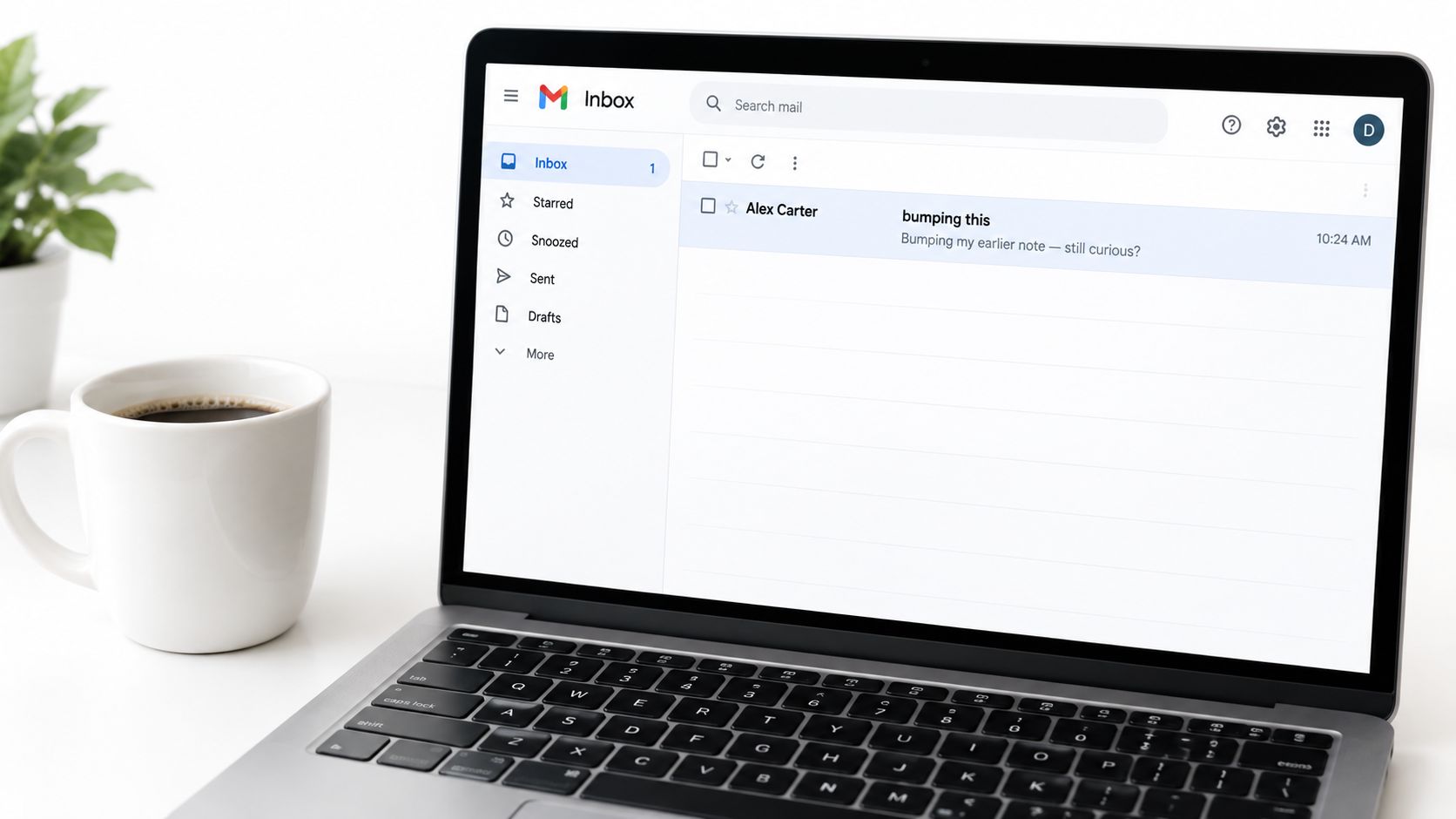
Subject lines such as bumping this, re: yesterday's note, and yes or no? sound like a colleague checking in rather than an automated sequence demanding attention. Keep them short and lowercase. Use re: only when the recipient has an actual earlier note to reference. The subject can improve recognition, but it cannot compensate for a weak list or vague opener.
Practical rule: keep the subject to 3 to 5 words, keep it lowercase, and only use re: when there was actually a note to reply to.
Hi {{first_name}},
Bumping my earlier note in case it slid past you.
Still curious if {{specific_pain}} is a current pain at {{company}}.
Aljaz
Send this on day 3, then give later touches different jobs, such as adding evidence, testing a sharper question, or closing the thread. The template fits the sequence described by Grou and pairs with reminder email structures that support simple follow-ups when the opening email already named a specific business problem.
Measure reply volume separately from positive-reply quality. A plain bump can produce a response from a relevant prospect, but it rarely creates new interest on its own. If the first message missed the buyer, repeating it only repeats the miss. Use this touch to test whether the original message deserves another chance, not to rescue poor targeting.
2. Forwarding bump
The forwarding bump works when you have genuine uncertainty about the right contact. It lowers pressure by implying that you might be talking to the wrong person, which is useful in manufacturing, pharma, and any account where buying decisions move across several stakeholders.
Subject lines like wrong person? feel light because they invite redirection instead of forcing a yes. That matters when the original email landed on someone adjacent to the buying committee, not the final owner. A short ask for the right contact can pull a cleaner response than another push for a meeting.
Hi {{first_name}},
Got a bounce on my earlier note.
Is {{specific_pain}} a concern for your team, or should I talk to someone else?
Aljaz
Use this only when the uncertainty is real. Fake confusion reads as a tactic, and prospects notice when the sender is pretending not to know the org chart. Real uncertainty earns a reply, fake uncertainty burns trust.
Keep the copy tight and let the redirect do the work. If they hand you another contact, the follow-up should shift to personalized outreach, not another generic bump. That's where tools like cold email systems matter, because routing the conversation to the right owner is part of the sequence, not a separate task.
Don't use this as a disguise for laziness. If you already know the buyer, say so. If you don't, ask once and move on.
3. Reframe bump
The reframe bump gives the next touch a new job: connect a verified change at the account to the pain in your original email. It belongs in a four-touch, 14-day sequence when the prospect's situation has materially shifted, not as a routine reminder.
Use a funding round, key hire, product launch, or regulatory change as the reason to reopen the thread. In legal tech, a new regulation or settlement can change the urgency. In SaaS, a larger product team or entry into a new market can make the same problem more relevant.
Subject lines such as re: my earlier note and {{trigger_event}} changes things tie the old conversation to the present moment.
Hi {{first_name}},
Saw {{company}} just {{trigger_event}} last week.
That likely makes {{specific_pain}} more pressing right now. Still worth 15 minutes?
Aljaz
Accuracy determines whether this touch improves reply quality or damages trust. Confirm the trigger through LinkedIn, company news, or the prospect's own announcement, then explain its direct connection to the original pain. A weak connection produces curiosity at best, not a qualified reply.
Send it a few days after the first bump, when the sequence needs a different reason to respond. If the trigger is fresh, act quickly. If it is stale, use the plain bump instead and reserve this effort for a stronger event. Structured first-line personalization can help teams keep the opening specific without making the entire email long. Finish with one clear meeting question, then measure positive replies separately from total replies.
4. Short question bump
The short question bump is the cleanest way to force a binary reply. It removes most of the framing and asks one question the prospect can answer without thinking too hard. That helps when the original message was specific, but the thread still stalled.
Subject lines like 1 question work because they promise low effort. If you add the prospect's name to the subject, you often get a little more attention, but only if the rest of the message stays spare. The body should make one ask, not two.
Hi {{first_name}},
Is {{specific_pain}} blocking growth at {{company}} right now?
Aljaz
This is a good fit for iGaming teams asking about CAC pressure, or SaaS teams looking at ramp time. It also works when the answer is either yes, no, or one metric. Anything longer makes the reply harder to send, and longer replies are exactly what you're trying to avoid at this stage.
If the cold open underperformed, send this on day 5 or 6. That gives you a different reply shape before the sequence gets too repetitive. The next touch should already be scheduled, because a stalled thread needs momentum, not a pause.
The best short questions don't ask for explanation. They ask for confirmation.
5. Value-add bump with case study
The value-add bump changes the job of the follow-up. Instead of asking for attention again, it gives the prospect something new, a case study, a teardown, or a relevant data point that ties back to their pain. That's why this touch often draws more positive replies than the plain bump.
If you've already used a simple reminder on day 3, this is the best candidate for day 7. The case study should match on a few real dimensions, industry, company size, and problem type, otherwise the relevance drops fast. A SaaS team doesn't care about a random enterprise success story if the operating model looks nothing like theirs.
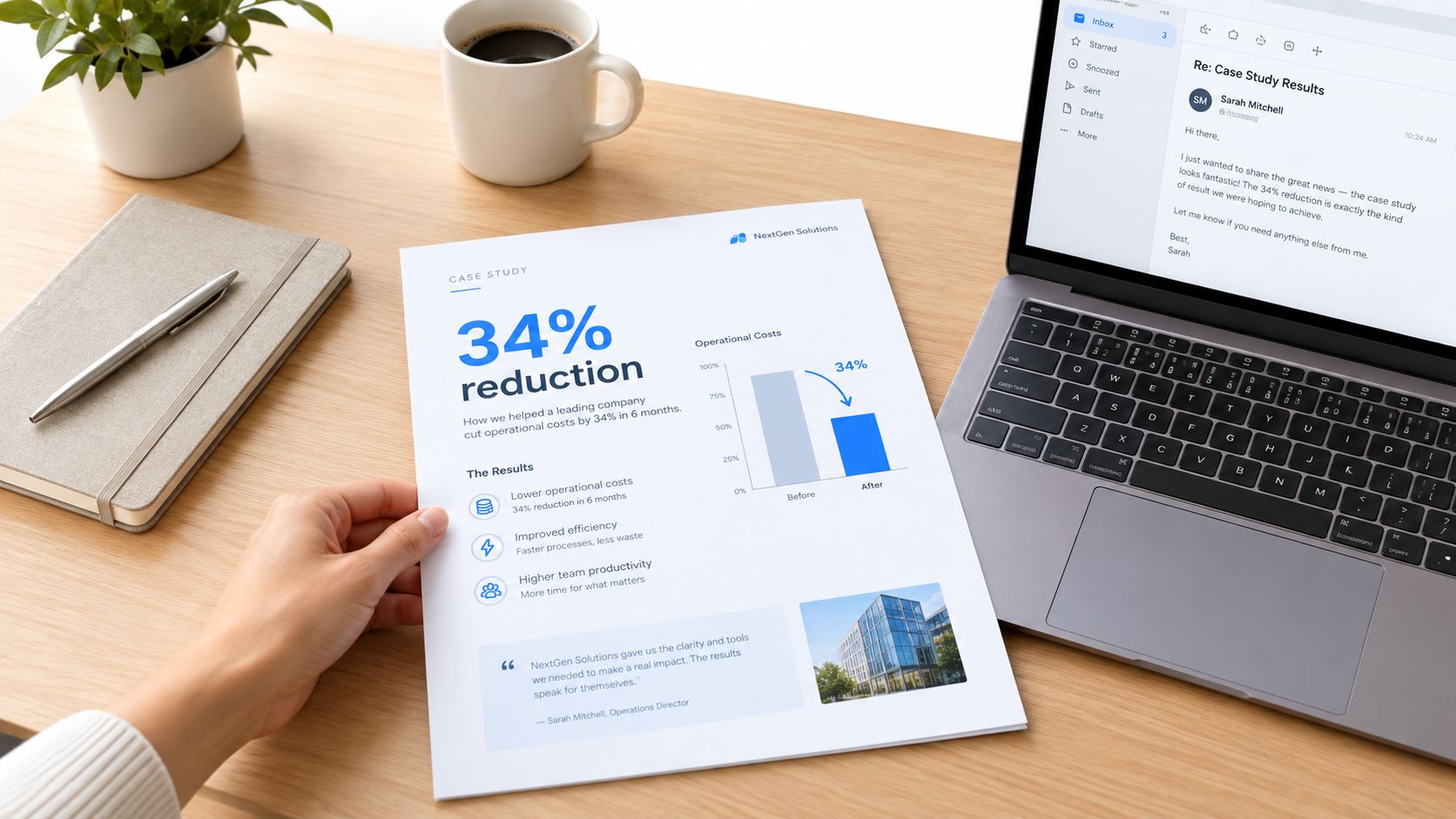
Subject: case study, {{company}} reduced {{metric}} by 34%
Hi {{first_name}},
Found this case study on how {{similar_company}} tackled {{specific_pain}}.
Their situation looked like yours. Worth a look?
Aljaz
The strongest version uses a concrete outcome and a link the prospect can scan quickly, not a buried attachment or a vague “thought you'd find this useful.” If you want a source of reference points for this kind of follow-up, Grou's case studies are a good model for how to keep the ask simple and the proof visible.
A value-add bump works because it changes the reason for opening. It no longer says, “reply to me.” It says, “this may help you decide.” That shift tends to improve positive-reply quality, which is what matters when you're trying to turn attention into pipeline.
6. Breakup bump
The breakup bump is the fourth and final touch in the 14-day sequence. Its job is to close the loop, not create another reason to chase a silent prospect. Ask for a clear decision, then state what happens if the answer is no.
Subject lines such as yes or no? remove ambiguity. Keep the body equally direct so the prospect can reply without writing a detailed explanation.
Hi {{first_name}},
Is {{specific_pain}} a current priority at {{company}}, yes or no?
I will move on if no.
Aljaz
Send this 11 days after the day 3 touch. That timing gives the prospect space to respond while keeping the sequence within its planned 14-day window. If there is no positive signal by then, stop. Adding another reminder usually produces weaker attention and less useful pipeline signal.
The cutoff also supports clean list management. Commercial email should identify the sender and offer a clear, accessible way to opt out. Grou's own re-engagement email playbook keeps this endpoint clean by treating disengagement as a reason to stop, not an invitation to extend the sequence.
Track the yes and no replies separately from positive-reply quality. A high no rate points to list selection, targeting, or problem fit. A healthy yes rate with few meetings suggests an issue with qualification, the offer, or the handoff after reply. This touch may generate fewer total replies than a value-add message, but its clear cutoff produces cleaner intent data and protects the quality of future outreach.
7. Specific observation bump
The specific observation bump earns a place when a generic reminder has failed and the account merits extra research. A current detail from the prospect's website, LinkedIn profile, or recent announcement gives the touch a concrete reason to exist, but it costs more sending time.
Subject: saw your {{specific_event}} announcement
Hi {{first_name}},
Saw your recent {{specific_observation}} on LinkedIn.
That's why I think {{specific_pain}} is probably a priority right now. Worth 15 minutes?
Aljaz
Send this on day 7, after the cold open and earlier bump have failed to produce a reply. Keep the observation to one accurate sentence. An enterprise tier, new engineering hire, or EMEA expansion can support the message. A guess damages credibility faster than a generic follow-up.
Use first-line personalization in the opening line, where the relevance signal is easiest to notice. This touch suits smaller, higher-value account lists, where research can improve positive-reply quality. The plain bump remains the default for reply volume. Use this version when the account value justifies the time within the four-touch, 14-day sequence.
Specificity is the point. The rest of the email can stay template-driven.
Track whether the added research produces better conversations, not just more replies. If it does not, return to the simpler bump.
8. Mutual contact referral bump
The mutual contact referral bump is the fastest way to reopen a stalled thread when the relationship is real. A genuine shared contact gives you borrowed trust, which changes the tone before the prospect even reads the ask. It works only when the connection is actually mutual.
Subject: {{mutual_contact}} mentioned we should connect
Hi {{first_name}},
{{mutual_contact}} suggested I reach out on {{specific_pain}}.
He mentioned you're navigating this right now. Worth a conversation?
Aljaz
The referral has to be true, and the mutual contact should know you're using their name. If the contact recently interacted with both sides, even better. If they didn't, don't force it.
This template can sit in the day 5 slot after a plain bump gets no reply. It gives the thread a different reason to exist without asking the prospect to re-evaluate the original email from scratch. That's why it often outperforms another generic reminder in accounts where network overlap is real.
A real mutual contact can carry a lot of weight, but a fake one collapses instantly. Teams that lean on phantom referrals lose trust faster than they gain replies. If the referral is genuine, keep the name in the first line, not buried three sentences down.
9. Trigger-based bump with personalization
Use a trigger-based bump as the fourth touch in a 14-day sequence, when the account justifies research and the timing supports a clear reason to reply. It combines a recent event with one specific observation, giving the prospect context and evidence that the message fits.
Subject: {{trigger_event}} changes things
Hi {{first_name}},
Saw {{company}} raised {{trigger_amount}} yesterday.
That may make {{specific_pain}} more urgent. I also noticed {{specific_observation}} on your site, which points to the same issue. Worth 15 minutes?
Aljaz
Send this only when the trigger and observation support one business point. A new UK gaming license, a supply chain reshoring announcement, or a fresh hiring push can justify the touch if it connects directly to the pain. The event explains why you are writing now. The observation confirms why this account belongs in the sequence.
The extra research can improve positive-reply quality, but it usually reduces volume and makes the touch harder to scale. Keep the message short enough to scan, and verify the event before sending. If the trigger is weak or unrelated, use the plain bump instead.
For teams systematizing research, Grou's first-line personalization guidance helps keep the opening specific without turning every follow-up into custom writing. In a four-touch sequence, reserve this template for high-value accounts where a timely signal can change the conversation.
9 Bounce-Back Email Templates Compared
Template | 🔄 Implementation complexity | ⚡ Resource requirements | 📊 Expected outcomes | 💡 Ideal use cases | ⭐ Key advantages |
|---|---|---|---|---|---|
Plain bump | Low, repeatable, formulaic | Very low, single personalization token | ~1.5% reply; ⭐⭐⭐, peer-to-peer feel, low complaints | Day 3 volume follow-up in cold sequences | Scales easily; minimal sales perception |
Forwarding bump | Low, simple framing change | Very low, minimal research | ~1.4% reply; ⭐⭐⭐, prompts redirects and low friction | When contact uncertainty or multi‑stakeholder threads (day 3/7) | Reduces pressure; encourages helpful redirects |
Reframe bump | Medium, requires trigger context | Medium, quick event verification | ~1.3% reply; ⭐⭐⭐, adds timely relevance | After a recent company event or change (3–5 days) | Justifies follow-up with real timing |
Short question bump | Low, minimal copy | Very low, fast to send at scale | ~1.1% reply; ⭐⭐, fastest reads, lowest volume | Time‑sensitive prospects or late sequence quick asks (day 5–6) | Extremely concise; easy one‑line reply |
Value‑add bump with case study | Medium, craft & match case | Medium–High, content and targeting needs | 0.6–1.0% reply; ⭐⭐–⭐⭐⭐, lower volume, higher quality replies | Later sequence rescue (day 7) or skeptical prospects | Builds credibility with social proof; improves positive replies |
Breakup bump | Low, formulaic final nudge | Very low, template with binary ask | Variable final lift; ⭐⭐⭐–⭐⭐⭐, elicits yes/no, closes loop | Final touch to end sequence (day 14) | Clears pipeline respectfully; reduces unnecessary follow-ups |
Specific observation bump | Medium, manual verification needed | Medium, 2–5 min per prospect, low scale | High opens; ~3.6% reply when used from start; ⭐⭐⭐⭐ | High‑value targets or day 7 value add with small lists | High relevance; strong positive reply quality |
Mutual contact referral bump | Medium, validation & permission required | Medium, requires a genuine shared connection | ~9.4% reply (genuine); ⭐⭐⭐⭐⭐, highest reply and trust | Warm intros or accounts with real mutual contacts | Dramatically increases trust and reply rate |
Trigger‑based bump with personalization | High, combines trigger + observation | High, 5–10 min per prospect, daily monitoring | Trigger baseline 3.1% + observation boost; ⭐⭐⭐⭐, high intent | Target accounts worth manual effort; stalled opportunities (day 7–10) | Timely and deeply personalized; strong positive replies |
Turn four touches into a measurable system
Use the plain bump on day 3. Add a relevant value-add or research-based touch on day 7. Send the breakup on day 14. That sequence gives each touch a job, instead of making every reminder do the same work.
For high-volume senders, rotate three to five subject lines every 4 to 6 weeks so the thread doesn't get pattern-matched. Test one variable on the same list and at the same send time for at least 7 days, because some prospects reply later in the week. Judge the sequence by reply rate, positive-reply share, meeting quality, complaint rate, and sender reputation, not opens alone.
The bigger lever is the structure of the sequence, not the wording of any single line. In our test set, the follow-up category explains about 60% of reply-rate variance, while copy explains about 40%. That's why a good plain bump often beats a clever bad one, and why the wrong touch at the wrong time still underperforms.
Audit your last 10 sequences this Friday. Label each touch by job, then add a positive-reply column to the CRM by Monday. Once that's in place, you'll see where replies are coming from and which touches are just creating noise.
GROU is a global B2B pipeline agency that connects LinkedIn content, lead generation, and outbound for teams across iGaming, SaaS, manufacturing, legal tech, and pharma. Its method uses one ICP-aligned target list, one message, structured sequences, fast reply routing, and a single reporting line refined through bi-weekly sprints.
If your outbound follow-up is stuck on generic reminders, Grou can help you turn the sequence into a system that routes replies into pipeline. Visit Grou to see how we build structured outbound around one message, one list, and fast reply handling.
The plain bump is the default bounce back email template. Use it on day 3, then give later touches a different job, because around 30% of replies land on touch two and around 60% arrive on touches two to four.
Nine templates, one job map. Each touch should do one thing, from simple bump to breakup.
Subject lines matter, but only inside the sequence. Keep them short, lowercase, and human.
Personalization beats decoration. Specific observations and real triggers outperform generic filler.
Reply rate is the main measure. Opens are directional, and Apple Mail Privacy Protection distorts them.
A four-touch cadence is enough. More touches without a reason start to hurt reputation.
If your first email gets silence, the mistake is usually not the wording of the reminder. It's that the team sends one weak nudge, then gives up before the sequence has done its job. That leaves qualified conversations sitting in the inbox, unclaimed.
Table of Contents
1. Plain bump
Use the plain bump as the default follow-up in a four-touch, 14-day B2B sequence. Its job is narrow: return the original message to the top of the inbox, repeat the relevant pain, and make replying easy. It adds no new pitch, so it works best when the first email already reached the right buyer with a clear reason to respond.
Subject lines such as bumping this, re: yesterday's note, and yes or no? sound like a colleague checking in rather than an automated sequence demanding attention. Keep them short and lowercase. Use re: only when the recipient has an actual earlier note to reference. The subject can improve recognition, but it cannot compensate for a weak list or vague opener.
Practical rule: keep the subject to 3 to 5 words, keep it lowercase, and only use re: when there was actually a note to reply to.
Hi {{first_name}},
Bumping my earlier note in case it slid past you.
Still curious if {{specific_pain}} is a current pain at {{company}}.
Aljaz
Send this on day 3, then give later touches different jobs, such as adding evidence, testing a sharper question, or closing the thread. The template fits the sequence described by Grou and pairs with reminder email structures that support simple follow-ups when the opening email already named a specific business problem.
Measure reply volume separately from positive-reply quality. A plain bump can produce a response from a relevant prospect, but it rarely creates new interest on its own. If the first message missed the buyer, repeating it only repeats the miss. Use this touch to test whether the original message deserves another chance, not to rescue poor targeting.
2. Forwarding bump
The forwarding bump works when you have genuine uncertainty about the right contact. It lowers pressure by implying that you might be talking to the wrong person, which is useful in manufacturing, pharma, and any account where buying decisions move across several stakeholders.
Subject lines like wrong person? feel light because they invite redirection instead of forcing a yes. That matters when the original email landed on someone adjacent to the buying committee, not the final owner. A short ask for the right contact can pull a cleaner response than another push for a meeting.
Hi {{first_name}},
Got a bounce on my earlier note.
Is {{specific_pain}} a concern for your team, or should I talk to someone else?
Aljaz
Use this only when the uncertainty is real. Fake confusion reads as a tactic, and prospects notice when the sender is pretending not to know the org chart. Real uncertainty earns a reply, fake uncertainty burns trust.
Keep the copy tight and let the redirect do the work. If they hand you another contact, the follow-up should shift to personalized outreach, not another generic bump. That's where tools like cold email systems matter, because routing the conversation to the right owner is part of the sequence, not a separate task.
Don't use this as a disguise for laziness. If you already know the buyer, say so. If you don't, ask once and move on.
3. Reframe bump
The reframe bump gives the next touch a new job: connect a verified change at the account to the pain in your original email. It belongs in a four-touch, 14-day sequence when the prospect's situation has materially shifted, not as a routine reminder.
Use a funding round, key hire, product launch, or regulatory change as the reason to reopen the thread. In legal tech, a new regulation or settlement can change the urgency. In SaaS, a larger product team or entry into a new market can make the same problem more relevant.
Subject lines such as re: my earlier note and {{trigger_event}} changes things tie the old conversation to the present moment.
Hi {{first_name}},
Saw {{company}} just {{trigger_event}} last week.
That likely makes {{specific_pain}} more pressing right now. Still worth 15 minutes?
Aljaz
Accuracy determines whether this touch improves reply quality or damages trust. Confirm the trigger through LinkedIn, company news, or the prospect's own announcement, then explain its direct connection to the original pain. A weak connection produces curiosity at best, not a qualified reply.
Send it a few days after the first bump, when the sequence needs a different reason to respond. If the trigger is fresh, act quickly. If it is stale, use the plain bump instead and reserve this effort for a stronger event. Structured first-line personalization can help teams keep the opening specific without making the entire email long. Finish with one clear meeting question, then measure positive replies separately from total replies.
4. Short question bump
The short question bump is the cleanest way to force a binary reply. It removes most of the framing and asks one question the prospect can answer without thinking too hard. That helps when the original message was specific, but the thread still stalled.
Subject lines like 1 question work because they promise low effort. If you add the prospect's name to the subject, you often get a little more attention, but only if the rest of the message stays spare. The body should make one ask, not two.
Hi {{first_name}},
Is {{specific_pain}} blocking growth at {{company}} right now?
Aljaz
This is a good fit for iGaming teams asking about CAC pressure, or SaaS teams looking at ramp time. It also works when the answer is either yes, no, or one metric. Anything longer makes the reply harder to send, and longer replies are exactly what you're trying to avoid at this stage.
If the cold open underperformed, send this on day 5 or 6. That gives you a different reply shape before the sequence gets too repetitive. The next touch should already be scheduled, because a stalled thread needs momentum, not a pause.
The best short questions don't ask for explanation. They ask for confirmation.
5. Value-add bump with case study
The value-add bump changes the job of the follow-up. Instead of asking for attention again, it gives the prospect something new, a case study, a teardown, or a relevant data point that ties back to their pain. That's why this touch often draws more positive replies than the plain bump.
If you've already used a simple reminder on day 3, this is the best candidate for day 7. The case study should match on a few real dimensions, industry, company size, and problem type, otherwise the relevance drops fast. A SaaS team doesn't care about a random enterprise success story if the operating model looks nothing like theirs.
Subject: case study, {{company}} reduced {{metric}} by 34%
Hi {{first_name}},
Found this case study on how {{similar_company}} tackled {{specific_pain}}.
Their situation looked like yours. Worth a look?
Aljaz
The strongest version uses a concrete outcome and a link the prospect can scan quickly, not a buried attachment or a vague “thought you'd find this useful.” If you want a source of reference points for this kind of follow-up, Grou's case studies are a good model for how to keep the ask simple and the proof visible.
A value-add bump works because it changes the reason for opening. It no longer says, “reply to me.” It says, “this may help you decide.” That shift tends to improve positive-reply quality, which is what matters when you're trying to turn attention into pipeline.
6. Breakup bump
The breakup bump is the fourth and final touch in the 14-day sequence. Its job is to close the loop, not create another reason to chase a silent prospect. Ask for a clear decision, then state what happens if the answer is no.
Subject lines such as yes or no? remove ambiguity. Keep the body equally direct so the prospect can reply without writing a detailed explanation.
Hi {{first_name}},
Is {{specific_pain}} a current priority at {{company}}, yes or no?
I will move on if no.
Aljaz
Send this 11 days after the day 3 touch. That timing gives the prospect space to respond while keeping the sequence within its planned 14-day window. If there is no positive signal by then, stop. Adding another reminder usually produces weaker attention and less useful pipeline signal.
The cutoff also supports clean list management. Commercial email should identify the sender and offer a clear, accessible way to opt out. Grou's own re-engagement email playbook keeps this endpoint clean by treating disengagement as a reason to stop, not an invitation to extend the sequence.
Track the yes and no replies separately from positive-reply quality. A high no rate points to list selection, targeting, or problem fit. A healthy yes rate with few meetings suggests an issue with qualification, the offer, or the handoff after reply. This touch may generate fewer total replies than a value-add message, but its clear cutoff produces cleaner intent data and protects the quality of future outreach.
7. Specific observation bump
The specific observation bump earns a place when a generic reminder has failed and the account merits extra research. A current detail from the prospect's website, LinkedIn profile, or recent announcement gives the touch a concrete reason to exist, but it costs more sending time.
Subject: saw your {{specific_event}} announcement
Hi {{first_name}},
Saw your recent {{specific_observation}} on LinkedIn.
That's why I think {{specific_pain}} is probably a priority right now. Worth 15 minutes?
Aljaz
Send this on day 7, after the cold open and earlier bump have failed to produce a reply. Keep the observation to one accurate sentence. An enterprise tier, new engineering hire, or EMEA expansion can support the message. A guess damages credibility faster than a generic follow-up.
Use first-line personalization in the opening line, where the relevance signal is easiest to notice. This touch suits smaller, higher-value account lists, where research can improve positive-reply quality. The plain bump remains the default for reply volume. Use this version when the account value justifies the time within the four-touch, 14-day sequence.
Specificity is the point. The rest of the email can stay template-driven.
Track whether the added research produces better conversations, not just more replies. If it does not, return to the simpler bump.
8. Mutual contact referral bump
The mutual contact referral bump is the fastest way to reopen a stalled thread when the relationship is real. A genuine shared contact gives you borrowed trust, which changes the tone before the prospect even reads the ask. It works only when the connection is actually mutual.
Subject: {{mutual_contact}} mentioned we should connect
Hi {{first_name}},
{{mutual_contact}} suggested I reach out on {{specific_pain}}.
He mentioned you're navigating this right now. Worth a conversation?
Aljaz
The referral has to be true, and the mutual contact should know you're using their name. If the contact recently interacted with both sides, even better. If they didn't, don't force it.
This template can sit in the day 5 slot after a plain bump gets no reply. It gives the thread a different reason to exist without asking the prospect to re-evaluate the original email from scratch. That's why it often outperforms another generic reminder in accounts where network overlap is real.
A real mutual contact can carry a lot of weight, but a fake one collapses instantly. Teams that lean on phantom referrals lose trust faster than they gain replies. If the referral is genuine, keep the name in the first line, not buried three sentences down.
9. Trigger-based bump with personalization
Use a trigger-based bump as the fourth touch in a 14-day sequence, when the account justifies research and the timing supports a clear reason to reply. It combines a recent event with one specific observation, giving the prospect context and evidence that the message fits.
Subject: {{trigger_event}} changes things
Hi {{first_name}},
Saw {{company}} raised {{trigger_amount}} yesterday.
That may make {{specific_pain}} more urgent. I also noticed {{specific_observation}} on your site, which points to the same issue. Worth 15 minutes?
Aljaz
Send this only when the trigger and observation support one business point. A new UK gaming license, a supply chain reshoring announcement, or a fresh hiring push can justify the touch if it connects directly to the pain. The event explains why you are writing now. The observation confirms why this account belongs in the sequence.
The extra research can improve positive-reply quality, but it usually reduces volume and makes the touch harder to scale. Keep the message short enough to scan, and verify the event before sending. If the trigger is weak or unrelated, use the plain bump instead.
For teams systematizing research, Grou's first-line personalization guidance helps keep the opening specific without turning every follow-up into custom writing. In a four-touch sequence, reserve this template for high-value accounts where a timely signal can change the conversation.
9 Bounce-Back Email Templates Compared
Template | 🔄 Implementation complexity | ⚡ Resource requirements | 📊 Expected outcomes | 💡 Ideal use cases | ⭐ Key advantages |
|---|---|---|---|---|---|
Plain bump | Low, repeatable, formulaic | Very low, single personalization token | ~1.5% reply; ⭐⭐⭐, peer-to-peer feel, low complaints | Day 3 volume follow-up in cold sequences | Scales easily; minimal sales perception |
Forwarding bump | Low, simple framing change | Very low, minimal research | ~1.4% reply; ⭐⭐⭐, prompts redirects and low friction | When contact uncertainty or multi‑stakeholder threads (day 3/7) | Reduces pressure; encourages helpful redirects |
Reframe bump | Medium, requires trigger context | Medium, quick event verification | ~1.3% reply; ⭐⭐⭐, adds timely relevance | After a recent company event or change (3–5 days) | Justifies follow-up with real timing |
Short question bump | Low, minimal copy | Very low, fast to send at scale | ~1.1% reply; ⭐⭐, fastest reads, lowest volume | Time‑sensitive prospects or late sequence quick asks (day 5–6) | Extremely concise; easy one‑line reply |
Value‑add bump with case study | Medium, craft & match case | Medium–High, content and targeting needs | 0.6–1.0% reply; ⭐⭐–⭐⭐⭐, lower volume, higher quality replies | Later sequence rescue (day 7) or skeptical prospects | Builds credibility with social proof; improves positive replies |
Breakup bump | Low, formulaic final nudge | Very low, template with binary ask | Variable final lift; ⭐⭐⭐–⭐⭐⭐, elicits yes/no, closes loop | Final touch to end sequence (day 14) | Clears pipeline respectfully; reduces unnecessary follow-ups |
Specific observation bump | Medium, manual verification needed | Medium, 2–5 min per prospect, low scale | High opens; ~3.6% reply when used from start; ⭐⭐⭐⭐ | High‑value targets or day 7 value add with small lists | High relevance; strong positive reply quality |
Mutual contact referral bump | Medium, validation & permission required | Medium, requires a genuine shared connection | ~9.4% reply (genuine); ⭐⭐⭐⭐⭐, highest reply and trust | Warm intros or accounts with real mutual contacts | Dramatically increases trust and reply rate |
Trigger‑based bump with personalization | High, combines trigger + observation | High, 5–10 min per prospect, daily monitoring | Trigger baseline 3.1% + observation boost; ⭐⭐⭐⭐, high intent | Target accounts worth manual effort; stalled opportunities (day 7–10) | Timely and deeply personalized; strong positive replies |
Turn four touches into a measurable system
Use the plain bump on day 3. Add a relevant value-add or research-based touch on day 7. Send the breakup on day 14. That sequence gives each touch a job, instead of making every reminder do the same work.
For high-volume senders, rotate three to five subject lines every 4 to 6 weeks so the thread doesn't get pattern-matched. Test one variable on the same list and at the same send time for at least 7 days, because some prospects reply later in the week. Judge the sequence by reply rate, positive-reply share, meeting quality, complaint rate, and sender reputation, not opens alone.
The bigger lever is the structure of the sequence, not the wording of any single line. In our test set, the follow-up category explains about 60% of reply-rate variance, while copy explains about 40%. That's why a good plain bump often beats a clever bad one, and why the wrong touch at the wrong time still underperforms.
Audit your last 10 sequences this Friday. Label each touch by job, then add a positive-reply column to the CRM by Monday. Once that's in place, you'll see where replies are coming from and which touches are just creating noise.
GROU is a global B2B pipeline agency that connects LinkedIn content, lead generation, and outbound for teams across iGaming, SaaS, manufacturing, legal tech, and pharma. Its method uses one ICP-aligned target list, one message, structured sequences, fast reply routing, and a single reporting line refined through bi-weekly sprints.
If your outbound follow-up is stuck on generic reminders, Grou can help you turn the sequence into a system that routes replies into pipeline. Visit Grou to see how we build structured outbound around one message, one list, and fast reply handling.
The plain bump is the default bounce back email template. Use it on day 3, then give later touches a different job, because around 30% of replies land on touch two and around 60% arrive on touches two to four.
Nine templates, one job map. Each touch should do one thing, from simple bump to breakup.
Subject lines matter, but only inside the sequence. Keep them short, lowercase, and human.
Personalization beats decoration. Specific observations and real triggers outperform generic filler.
Reply rate is the main measure. Opens are directional, and Apple Mail Privacy Protection distorts them.
A four-touch cadence is enough. More touches without a reason start to hurt reputation.
If your first email gets silence, the mistake is usually not the wording of the reminder. It's that the team sends one weak nudge, then gives up before the sequence has done its job. That leaves qualified conversations sitting in the inbox, unclaimed.
Table of Contents
1. Plain bump
Use the plain bump as the default follow-up in a four-touch, 14-day B2B sequence. Its job is narrow: return the original message to the top of the inbox, repeat the relevant pain, and make replying easy. It adds no new pitch, so it works best when the first email already reached the right buyer with a clear reason to respond.
Subject lines such as bumping this, re: yesterday's note, and yes or no? sound like a colleague checking in rather than an automated sequence demanding attention. Keep them short and lowercase. Use re: only when the recipient has an actual earlier note to reference. The subject can improve recognition, but it cannot compensate for a weak list or vague opener.
Practical rule: keep the subject to 3 to 5 words, keep it lowercase, and only use re: when there was actually a note to reply to.
Hi {{first_name}},
Bumping my earlier note in case it slid past you.
Still curious if {{specific_pain}} is a current pain at {{company}}.
Aljaz
Send this on day 3, then give later touches different jobs, such as adding evidence, testing a sharper question, or closing the thread. The template fits the sequence described by Grou and pairs with reminder email structures that support simple follow-ups when the opening email already named a specific business problem.
Measure reply volume separately from positive-reply quality. A plain bump can produce a response from a relevant prospect, but it rarely creates new interest on its own. If the first message missed the buyer, repeating it only repeats the miss. Use this touch to test whether the original message deserves another chance, not to rescue poor targeting.
2. Forwarding bump
The forwarding bump works when you have genuine uncertainty about the right contact. It lowers pressure by implying that you might be talking to the wrong person, which is useful in manufacturing, pharma, and any account where buying decisions move across several stakeholders.
Subject lines like wrong person? feel light because they invite redirection instead of forcing a yes. That matters when the original email landed on someone adjacent to the buying committee, not the final owner. A short ask for the right contact can pull a cleaner response than another push for a meeting.
Hi {{first_name}},
Got a bounce on my earlier note.
Is {{specific_pain}} a concern for your team, or should I talk to someone else?
Aljaz
Use this only when the uncertainty is real. Fake confusion reads as a tactic, and prospects notice when the sender is pretending not to know the org chart. Real uncertainty earns a reply, fake uncertainty burns trust.
Keep the copy tight and let the redirect do the work. If they hand you another contact, the follow-up should shift to personalized outreach, not another generic bump. That's where tools like cold email systems matter, because routing the conversation to the right owner is part of the sequence, not a separate task.
Don't use this as a disguise for laziness. If you already know the buyer, say so. If you don't, ask once and move on.
3. Reframe bump
The reframe bump gives the next touch a new job: connect a verified change at the account to the pain in your original email. It belongs in a four-touch, 14-day sequence when the prospect's situation has materially shifted, not as a routine reminder.
Use a funding round, key hire, product launch, or regulatory change as the reason to reopen the thread. In legal tech, a new regulation or settlement can change the urgency. In SaaS, a larger product team or entry into a new market can make the same problem more relevant.
Subject lines such as re: my earlier note and {{trigger_event}} changes things tie the old conversation to the present moment.
Hi {{first_name}},
Saw {{company}} just {{trigger_event}} last week.
That likely makes {{specific_pain}} more pressing right now. Still worth 15 minutes?
Aljaz
Accuracy determines whether this touch improves reply quality or damages trust. Confirm the trigger through LinkedIn, company news, or the prospect's own announcement, then explain its direct connection to the original pain. A weak connection produces curiosity at best, not a qualified reply.
Send it a few days after the first bump, when the sequence needs a different reason to respond. If the trigger is fresh, act quickly. If it is stale, use the plain bump instead and reserve this effort for a stronger event. Structured first-line personalization can help teams keep the opening specific without making the entire email long. Finish with one clear meeting question, then measure positive replies separately from total replies.
4. Short question bump
The short question bump is the cleanest way to force a binary reply. It removes most of the framing and asks one question the prospect can answer without thinking too hard. That helps when the original message was specific, but the thread still stalled.
Subject lines like 1 question work because they promise low effort. If you add the prospect's name to the subject, you often get a little more attention, but only if the rest of the message stays spare. The body should make one ask, not two.
Hi {{first_name}},
Is {{specific_pain}} blocking growth at {{company}} right now?
Aljaz
This is a good fit for iGaming teams asking about CAC pressure, or SaaS teams looking at ramp time. It also works when the answer is either yes, no, or one metric. Anything longer makes the reply harder to send, and longer replies are exactly what you're trying to avoid at this stage.
If the cold open underperformed, send this on day 5 or 6. That gives you a different reply shape before the sequence gets too repetitive. The next touch should already be scheduled, because a stalled thread needs momentum, not a pause.
The best short questions don't ask for explanation. They ask for confirmation.
5. Value-add bump with case study
The value-add bump changes the job of the follow-up. Instead of asking for attention again, it gives the prospect something new, a case study, a teardown, or a relevant data point that ties back to their pain. That's why this touch often draws more positive replies than the plain bump.
If you've already used a simple reminder on day 3, this is the best candidate for day 7. The case study should match on a few real dimensions, industry, company size, and problem type, otherwise the relevance drops fast. A SaaS team doesn't care about a random enterprise success story if the operating model looks nothing like theirs.
Subject: case study, {{company}} reduced {{metric}} by 34%
Hi {{first_name}},
Found this case study on how {{similar_company}} tackled {{specific_pain}}.
Their situation looked like yours. Worth a look?
Aljaz
The strongest version uses a concrete outcome and a link the prospect can scan quickly, not a buried attachment or a vague “thought you'd find this useful.” If you want a source of reference points for this kind of follow-up, Grou's case studies are a good model for how to keep the ask simple and the proof visible.
A value-add bump works because it changes the reason for opening. It no longer says, “reply to me.” It says, “this may help you decide.” That shift tends to improve positive-reply quality, which is what matters when you're trying to turn attention into pipeline.
6. Breakup bump
The breakup bump is the fourth and final touch in the 14-day sequence. Its job is to close the loop, not create another reason to chase a silent prospect. Ask for a clear decision, then state what happens if the answer is no.
Subject lines such as yes or no? remove ambiguity. Keep the body equally direct so the prospect can reply without writing a detailed explanation.
Hi {{first_name}},
Is {{specific_pain}} a current priority at {{company}}, yes or no?
I will move on if no.
Aljaz
Send this 11 days after the day 3 touch. That timing gives the prospect space to respond while keeping the sequence within its planned 14-day window. If there is no positive signal by then, stop. Adding another reminder usually produces weaker attention and less useful pipeline signal.
The cutoff also supports clean list management. Commercial email should identify the sender and offer a clear, accessible way to opt out. Grou's own re-engagement email playbook keeps this endpoint clean by treating disengagement as a reason to stop, not an invitation to extend the sequence.
Track the yes and no replies separately from positive-reply quality. A high no rate points to list selection, targeting, or problem fit. A healthy yes rate with few meetings suggests an issue with qualification, the offer, or the handoff after reply. This touch may generate fewer total replies than a value-add message, but its clear cutoff produces cleaner intent data and protects the quality of future outreach.
7. Specific observation bump
The specific observation bump earns a place when a generic reminder has failed and the account merits extra research. A current detail from the prospect's website, LinkedIn profile, or recent announcement gives the touch a concrete reason to exist, but it costs more sending time.
Subject: saw your {{specific_event}} announcement
Hi {{first_name}},
Saw your recent {{specific_observation}} on LinkedIn.
That's why I think {{specific_pain}} is probably a priority right now. Worth 15 minutes?
Aljaz
Send this on day 7, after the cold open and earlier bump have failed to produce a reply. Keep the observation to one accurate sentence. An enterprise tier, new engineering hire, or EMEA expansion can support the message. A guess damages credibility faster than a generic follow-up.
Use first-line personalization in the opening line, where the relevance signal is easiest to notice. This touch suits smaller, higher-value account lists, where research can improve positive-reply quality. The plain bump remains the default for reply volume. Use this version when the account value justifies the time within the four-touch, 14-day sequence.
Specificity is the point. The rest of the email can stay template-driven.
Track whether the added research produces better conversations, not just more replies. If it does not, return to the simpler bump.
8. Mutual contact referral bump
The mutual contact referral bump is the fastest way to reopen a stalled thread when the relationship is real. A genuine shared contact gives you borrowed trust, which changes the tone before the prospect even reads the ask. It works only when the connection is actually mutual.
Subject: {{mutual_contact}} mentioned we should connect
Hi {{first_name}},
{{mutual_contact}} suggested I reach out on {{specific_pain}}.
He mentioned you're navigating this right now. Worth a conversation?
Aljaz
The referral has to be true, and the mutual contact should know you're using their name. If the contact recently interacted with both sides, even better. If they didn't, don't force it.
This template can sit in the day 5 slot after a plain bump gets no reply. It gives the thread a different reason to exist without asking the prospect to re-evaluate the original email from scratch. That's why it often outperforms another generic reminder in accounts where network overlap is real.
A real mutual contact can carry a lot of weight, but a fake one collapses instantly. Teams that lean on phantom referrals lose trust faster than they gain replies. If the referral is genuine, keep the name in the first line, not buried three sentences down.
9. Trigger-based bump with personalization
Use a trigger-based bump as the fourth touch in a 14-day sequence, when the account justifies research and the timing supports a clear reason to reply. It combines a recent event with one specific observation, giving the prospect context and evidence that the message fits.
Subject: {{trigger_event}} changes things
Hi {{first_name}},
Saw {{company}} raised {{trigger_amount}} yesterday.
That may make {{specific_pain}} more urgent. I also noticed {{specific_observation}} on your site, which points to the same issue. Worth 15 minutes?
Aljaz
Send this only when the trigger and observation support one business point. A new UK gaming license, a supply chain reshoring announcement, or a fresh hiring push can justify the touch if it connects directly to the pain. The event explains why you are writing now. The observation confirms why this account belongs in the sequence.
The extra research can improve positive-reply quality, but it usually reduces volume and makes the touch harder to scale. Keep the message short enough to scan, and verify the event before sending. If the trigger is weak or unrelated, use the plain bump instead.
For teams systematizing research, Grou's first-line personalization guidance helps keep the opening specific without turning every follow-up into custom writing. In a four-touch sequence, reserve this template for high-value accounts where a timely signal can change the conversation.
9 Bounce-Back Email Templates Compared
Template | 🔄 Implementation complexity | ⚡ Resource requirements | 📊 Expected outcomes | 💡 Ideal use cases | ⭐ Key advantages |
|---|---|---|---|---|---|
Plain bump | Low, repeatable, formulaic | Very low, single personalization token | ~1.5% reply; ⭐⭐⭐, peer-to-peer feel, low complaints | Day 3 volume follow-up in cold sequences | Scales easily; minimal sales perception |
Forwarding bump | Low, simple framing change | Very low, minimal research | ~1.4% reply; ⭐⭐⭐, prompts redirects and low friction | When contact uncertainty or multi‑stakeholder threads (day 3/7) | Reduces pressure; encourages helpful redirects |
Reframe bump | Medium, requires trigger context | Medium, quick event verification | ~1.3% reply; ⭐⭐⭐, adds timely relevance | After a recent company event or change (3–5 days) | Justifies follow-up with real timing |
Short question bump | Low, minimal copy | Very low, fast to send at scale | ~1.1% reply; ⭐⭐, fastest reads, lowest volume | Time‑sensitive prospects or late sequence quick asks (day 5–6) | Extremely concise; easy one‑line reply |
Value‑add bump with case study | Medium, craft & match case | Medium–High, content and targeting needs | 0.6–1.0% reply; ⭐⭐–⭐⭐⭐, lower volume, higher quality replies | Later sequence rescue (day 7) or skeptical prospects | Builds credibility with social proof; improves positive replies |
Breakup bump | Low, formulaic final nudge | Very low, template with binary ask | Variable final lift; ⭐⭐⭐–⭐⭐⭐, elicits yes/no, closes loop | Final touch to end sequence (day 14) | Clears pipeline respectfully; reduces unnecessary follow-ups |
Specific observation bump | Medium, manual verification needed | Medium, 2–5 min per prospect, low scale | High opens; ~3.6% reply when used from start; ⭐⭐⭐⭐ | High‑value targets or day 7 value add with small lists | High relevance; strong positive reply quality |
Mutual contact referral bump | Medium, validation & permission required | Medium, requires a genuine shared connection | ~9.4% reply (genuine); ⭐⭐⭐⭐⭐, highest reply and trust | Warm intros or accounts with real mutual contacts | Dramatically increases trust and reply rate |
Trigger‑based bump with personalization | High, combines trigger + observation | High, 5–10 min per prospect, daily monitoring | Trigger baseline 3.1% + observation boost; ⭐⭐⭐⭐, high intent | Target accounts worth manual effort; stalled opportunities (day 7–10) | Timely and deeply personalized; strong positive replies |
Turn four touches into a measurable system
Use the plain bump on day 3. Add a relevant value-add or research-based touch on day 7. Send the breakup on day 14. That sequence gives each touch a job, instead of making every reminder do the same work.
For high-volume senders, rotate three to five subject lines every 4 to 6 weeks so the thread doesn't get pattern-matched. Test one variable on the same list and at the same send time for at least 7 days, because some prospects reply later in the week. Judge the sequence by reply rate, positive-reply share, meeting quality, complaint rate, and sender reputation, not opens alone.
The bigger lever is the structure of the sequence, not the wording of any single line. In our test set, the follow-up category explains about 60% of reply-rate variance, while copy explains about 40%. That's why a good plain bump often beats a clever bad one, and why the wrong touch at the wrong time still underperforms.
Audit your last 10 sequences this Friday. Label each touch by job, then add a positive-reply column to the CRM by Monday. Once that's in place, you'll see where replies are coming from and which touches are just creating noise.
GROU is a global B2B pipeline agency that connects LinkedIn content, lead generation, and outbound for teams across iGaming, SaaS, manufacturing, legal tech, and pharma. Its method uses one ICP-aligned target list, one message, structured sequences, fast reply routing, and a single reporting line refined through bi-weekly sprints.
If your outbound follow-up is stuck on generic reminders, Grou can help you turn the sequence into a system that routes replies into pipeline. Visit Grou to see how we build structured outbound around one message, one list, and fast reply handling.

Pipeline OS Newsletter
Build qualified pipeline
Get weekly tactics to generate demand, improve lead quality, and book more meetings.





Trusted by industry leaders
Trusted by industry leaders
Trusted by industry leaders
Ready to build qualified pipeline?
Ready to build qualified pipeline?
Ready to build qualified pipeline?
Book a call to see if we're the right fit, or take the 2-minute quiz to get a clear starting point.
Book a call to see if we're the right fit, or take the 2-minute quiz to get a clear starting point.
Book a call to see if we're the right fit, or take the 2-minute quiz to get a clear starting point.
" height="30.21639343089746px" id="hfGbXmQR2" width="30.216393430897455px"/></svg>)
Copyright © 2026 – All Right Reserved
Copyright © 2026 – All Right Reserved
Copyright © 2026 – All Right Reserved