%22%3E%3C/path%3E%3Cpath d=%22M 63.072 7.554 C 62.258 8.022 61.577 8.689 61.092 9.493 L 61.092 7.076 L 57.158 7.076 L 57.158 22.64 L 61.089 22.64 L 61.089 14.888 C 61.089 13.446 61.403 12.434 62.03 11.853 C 62.818 11.218 63.818 10.907 64.826 10.982 L 65.868 10.982 L 65.868 6.851 C 64.891 6.834 63.926 7.076 63.073 7.554 Z%22 fill=%22rgb(17,17,17)%22%3E%3C/path%3E%3Cpath d=%22M 78.916 7.82 C 76.363 6.49 73.321 6.49 70.768 7.82 C 69.562 8.473 68.564 9.451 67.888 10.644 C 67.167 11.931 66.803 13.387 66.834 14.862 C 66.804 16.332 67.157 17.785 67.86 19.077 C 68.515 20.267 69.494 21.246 70.684 21.901 C 71.924 22.576 73.318 22.92 74.73 22.898 C 76.164 22.918 77.58 22.575 78.846 21.901 C 80.062 21.247 81.073 20.27 81.768 19.077 C 82.506 17.797 82.88 16.339 82.85 14.862 C 82.88 13.389 82.517 11.934 81.797 10.647 C 81.12 9.455 80.122 8.477 78.917 7.824 M 78.803 14.862 C 78.829 15.739 78.636 16.608 78.241 17.391 C 77.903 18.046 77.38 18.588 76.738 18.95 C 76.124 19.293 75.432 19.472 74.729 19.47 C 73.668 19.497 72.648 19.061 71.934 18.276 C 71.139 17.323 70.741 16.1 70.823 14.862 C 70.741 13.62 71.149 12.395 71.959 11.45 C 72.687 10.667 73.715 10.233 74.783 10.256 C 75.859 10.236 76.894 10.67 77.635 11.45 C 78.464 12.387 78.884 13.616 78.801 14.864%22 fill=%22rgb(17,17,17)%22%3E%3C/path%3E%3Cpath d=%22M 95.906 7.076 L 95.906 15.646 C 95.975 16.68 95.643 17.701 94.979 18.498 C 94.311 19.184 93.379 19.547 92.422 19.495 C 91.475 19.544 90.553 19.18 89.894 18.498 C 89.23 17.701 88.898 16.68 88.967 15.646 L 88.967 7.076 L 85.033 7.076 L 85.033 16.207 C 85 17.449 85.275 18.68 85.834 19.79 C 86.327 20.75 87.095 21.542 88.039 22.065 C 89.033 22.594 90.145 22.861 91.271 22.838 C 92.188 22.847 93.095 22.65 93.926 22.263 C 94.708 21.905 95.388 21.36 95.906 20.675 L 95.906 22.645 L 99.865 22.645 L 99.865 7.076 Z%22 fill=%22rgb(17,17,17)%22%3E%3C/path%3E%3Cpath d=%22M 4.513 15.626 C 4.511 10.815 7.606 6.549 12.181 5.059 C 16.756 3.57 21.77 5.195 24.601 9.086 L 27.816 5.87 C 24.074 1.186 17.981 -0.943 12.137 0.393 C 6.292 1.728 1.728 6.292 0.393 12.137 C -0.943 17.981 1.186 24.074 5.87 27.816 L 9.085 24.601 C 6.214 22.512 4.515 19.177 4.513 15.626%22 fill=%22rgb(32,62,235)%22%3E%3C/path%3E%3Cpath d=%22M 17.114 14.343 L 13.354 18.01 L 13.354 18.026 L 21.071 18.026 L 11.412 27.609 L 17.389 27.609 L 23.999 21.081 L 23.999 28.316 L 24.005 28.316 L 27.967 24.393 L 27.967 14.343 Z%22 fill=%22rgb(32,62,235)%22%3E%3C/path%3E%3C/g%3E%3C/svg%3E) ×
× ××
××›
›
›
›
Sales pipeline vs sales funnel: what's the difference and which one matters
Sales pipeline vs sales funnel: what's the difference and which one matters
Sales pipeline vs sales funnel: what's the difference and which one matters
Sales pipeline vs sales funnel: what's the difference and which one matters
Sales pipeline vs sales funnel: what's the difference and which one matters
Sales pipeline vs sales funnel: what's the difference and which one matters

Author
Aljaz Peklaj

Your CRM says pipeline is healthy, but forecasts still slip, AEs complain that “good leads” arrive cold, and marketing can't prove which attention turns into revenue. That problem usually isn't lead volume. It's structure.
Sales pipeline vs sales funnel is not a winner-take-all choice. Funnel diagnoses conversion, pipeline runs execution.
The fix is a unified pipeline that gives sales and marketing one handoff point, one set of stage rules, and one reporting line.
The biggest gains usually come from removing handoff lag, exposing context inside the CRM, and measuring time-in-stage, not just conversion.
When the structure is right, attention turns into named opportunities faster and forecasts stop depending on opinion.
Table of Contents
The verdict for revenue operators
The verdict is simple. Run both, but manage the business through a unified pipeline. The funnel tells you whether your market-facing motion is producing qualified attention. The pipeline tells you whether your team is turning that attention into revenue.
The distinction matters because the two models answer different questions. As Nutshell's explanation of sales pipeline vs funnel puts it, the pipeline tracks the seller's specific actions and deal stages, while the funnel measures the buyer's conversion rates and drop-off points across the journey. That's why one belongs to day-to-day execution and the other belongs to diagnosis.
What fails in practice is the handoff model. Marketing owns MQLs. Sales owns opportunities. Nobody owns the messy space in between, where context gets lost and response times drift. That's why teams with “enough leads” still miss quarter.
Operator rule: If a prospect has shown clear buying intent, routing them back through a marketing status before an AE conversation is usually a process bug.
A unified pipeline fixes that bug. It gives you one place to manage outbound replies, inbound form fills, content-engaged prospects, and partner-sourced conversations under shared stage definitions. Sales still owns execution. Marketing still owns demand. But the handoff becomes operational, not political.
If you want a deeper view on the mechanics of execution inside the CRM, this sales pipeline management breakdown is a useful companion. The point is the same. Structure turns attention into pipeline, and pipeline into forecastable revenue.
Funnel vs pipeline compared by job-to-be-done
Teams confuse these models when they expect one report to do two jobs. It won't. The funnel is a diagnostic tool. The pipeline is an operating system for active deals.
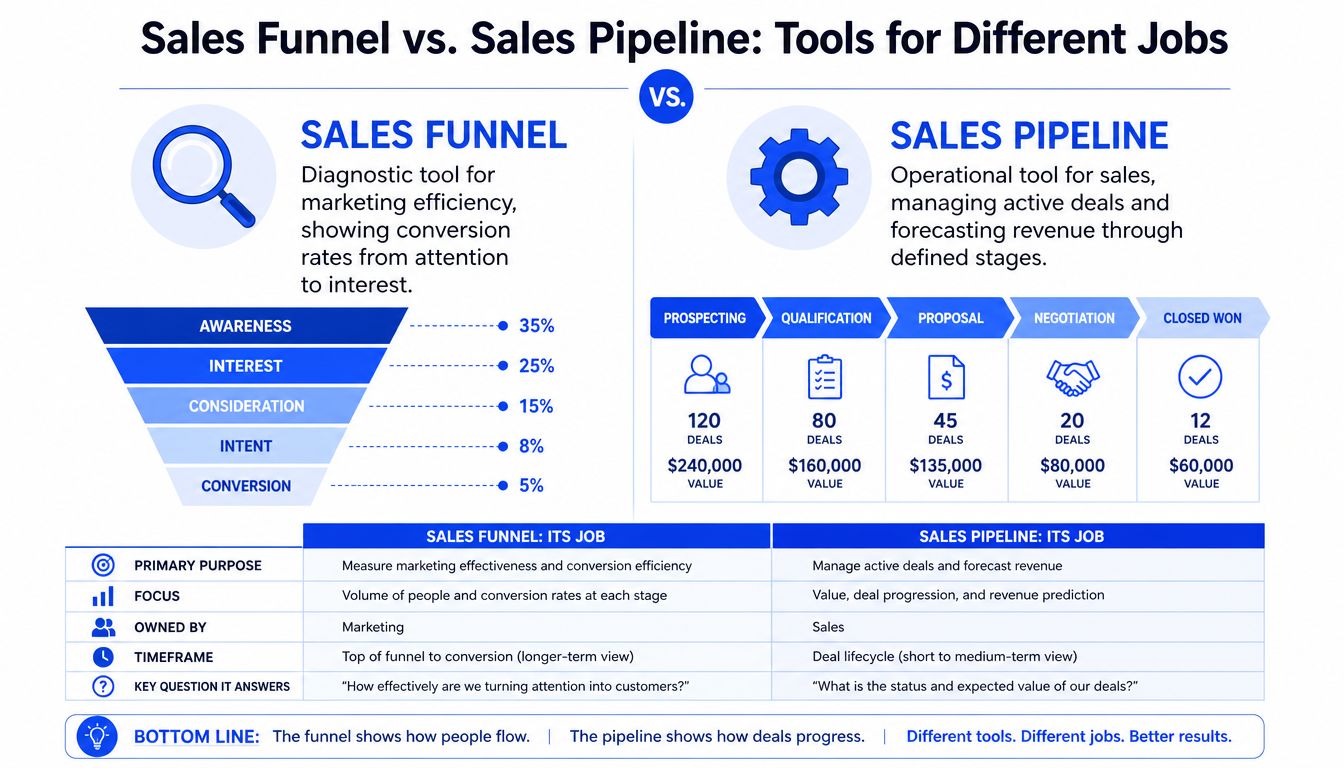
A side-by-side breakdown
A useful way to frame sales pipeline vs sales funnel is through jobs to be done. If your question is “Where are we losing qualified attention?”, you need funnel reporting. If your question is “Which named deals can close, when, and why?”, you need pipeline reporting. That matches Extrovert's perspective on Jobs to be Done, which is a helpful lens for choosing the right system for the right decision.
Dimension | Sales Funnel (The Diagnostic Tool) | Sales Pipeline (The Operational Tool) |
|---|---|---|
Primary job | Diagnose conversion efficiency | Manage active deals and forecast revenue |
Perspective | Buyer-centric | Seller-centric |
Ownership | Marketing, with sales overlap at later stages | Sales and RevOps |
Unit of analysis | Populations, cohorts, stage conversion | Individual deals, stages, deal value |
Core question | Where do prospects drop off? | Where does each deal stand? |
Main metrics | Lead volume, stage conversion, drop-off | Opportunity count, win rate, deal velocity |
Reporting shape | Vertical narrowing model | Horizontal linear workflow |
Actionability | Influence through messaging, targeting, content | Direct control through stage design, routing, follow-up |
The measurement logic is different too. Prospeo's breakdown of pipeline vs funnel metrics defines pipeline through seller-centric operational metrics, including Pipeline Velocity = (# Opportunities × Avg Deal Size × Win Rate) / Sales Cycle Days, while the funnel is defined by buyer-centric conversion metrics that track volume attrition and stage-to-stage drop-off.
For a cleaner glossary version of the funnel side, this definition from Grou's glossary is worth keeping handy for internal alignment.
Where operators get this wrong
The common mistake is asking the funnel to forecast revenue. It can't. A conversion report might tell you that plenty of prospects moved from awareness to interest, but it won't tell your VP Sales whether the legal review on a live opportunity is blocked.
The other mistake is asking the pipeline to explain demand quality by itself. It won't. If meeting-booked volume drops, the CRM may show fewer opportunities, but the underlying issue could be weak targeting, weak content, or poor outreach list quality.
That's why mixed-tool stacks need clean role separation. Apollo, Clay, Lemlist, Instantly, Smartlead, HeyReach, HubSpot, and Sales Navigator can all sit in the same revenue system. But each tool needs a job. Funnel tools show aggregate movement. Pipeline tools track named opportunities, owners, stage criteria, and forecast risk.
A team that mixes diagnostic metrics with execution metrics usually ends up arguing over labels instead of fixing the bottleneck.
How to build a unified pipeline that works
Monday morning, the CRO asks for forecast confidence. Marketing reports high engagement. Sales says half the so-called pipeline is unworked, unqualified, or sitting in the wrong stage. That problem does not come from lead volume. It comes from stage design, routing rules, and weak CRM enforcement.
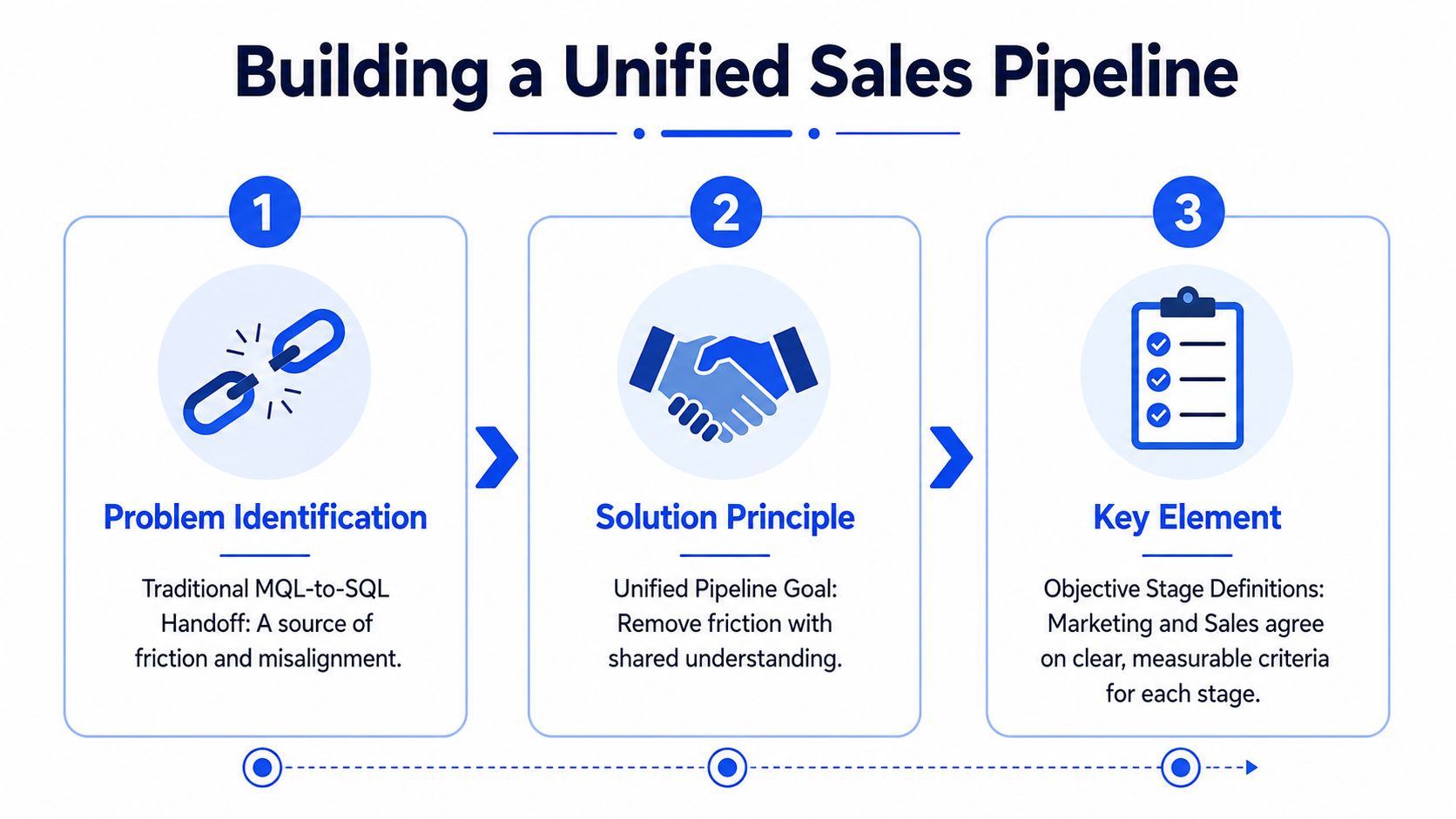
A unified pipeline gives both teams one operating model. Marketing owns inputs and context. Sales owns progression against defined exit criteria. RevOps owns the rules that keep records clean, route intent fast, and make forecast categories credible. If your team is still debating handoff definitions, this guide to aligning sales and marketing is a useful reference for the operating agreement behind the CRM build.
The six stages we use
This is the stage structure I recommend for B2B teams with outbound-led or account-based motions in SaaS, legal tech, manufacturing, pharma, and iGaming. It works because each stage maps to a clear operational change, not a vague level of interest.
Active prospect
The account fits ICP, the contact is valid, and outreach is live. This stage excludes webinar signups, broad imports, and any record with no owner or no sequence activity. If the team is tightening contact quality before records enter the system, a 2026 playbook for email outreach is a practical reference for finding and validating contacts upstream.Engaged prospect
The contact has replied with intent, requested details, or shown buying-level engagement. A generic open or page view is not enough. The point of this stage is to separate signal from noise before calendar time gets consumed.Meeting confirmed
A calendar invite is accepted and owned by the right rep. This stage matters because teams often overstate pipeline by counting tentative interest as a meeting. I do not count soft holds, “send me times,” or internal referrals without a booked slot.Qualified opportunity
The meeting happened. There is a live use case, a credible reason to change, and a defined next step. At this point, the CRM should convert the record into a named deal with an amount range, expected close window, and buying committee notes.Proposal active
Commercial terms, scope, or a formal proposal have been shared. The work here shifts from prospecting to deal control. Response times, objection handling, mutual action plans, and stakeholder coverage start to matter more than top-of-funnel activity.Closed-won or closed-lost
Terminal stages need discipline. If the deal is delayed with no committed next step, goes silent after repeated follow-up, or loses to a competitor, mark it closed-lost and record the reason. Reopening later is cleaner than carrying dead weight in commit calls.
Six stages are often sufficient. More than eight usually creates reporting noise and rep inconsistency. Fewer than five hides meaningful transitions, especially in multi-stakeholder B2B deals.
The operating layer that makes the stages real
Stages on a slide deck do nothing. The gain comes from the controls behind them.
In HubSpot, the build should force the behavior you want:
Required properties on stage change, including source, owner, primary use case, next meeting date, and close reason where relevant.
Time-in-stage tracking, so managers can spot stalled deals without asking reps to clean the CRM before every review.
Source and touchpoint visibility, so the AE can see whether interest came from Lemlist, HeyReach, LinkedIn, a form fill, paid media, or a referral.
Full engagement history in the record, including prior outbound, content consumption, call notes, and sequence status.
Routing automations through tools like Zapier and Slack, so positive replies and hand-raisers reach the right AE fast instead of waiting in shared inboxes.
Written exit criteria for every stage, stored where reps and managers can see them during pipeline review.
Teams either gain control or lose it. I have seen solid demand generation programs underperform because positive replies sat with SDRs for hours, AEs created duplicate deals, and reps advanced opportunities without a confirmed next step. The opposite setup is measurable. In one client environment, the practical change was simple: route qualified engagement fast, attach context from outreach and content activity to the record, and require the fields needed for progression. That operating discipline is what later shortened the sales cycle by 37%, not a new label on the handoff.
The pipeline works when every stage answers three questions: who owns the record, what proof is required to move it, and what automation fires next. If any of those are unclear, the stage is not operational yet.
Case study cutting a 142-day sales cycle by 37%
Theory is useful. Operating proof is better.
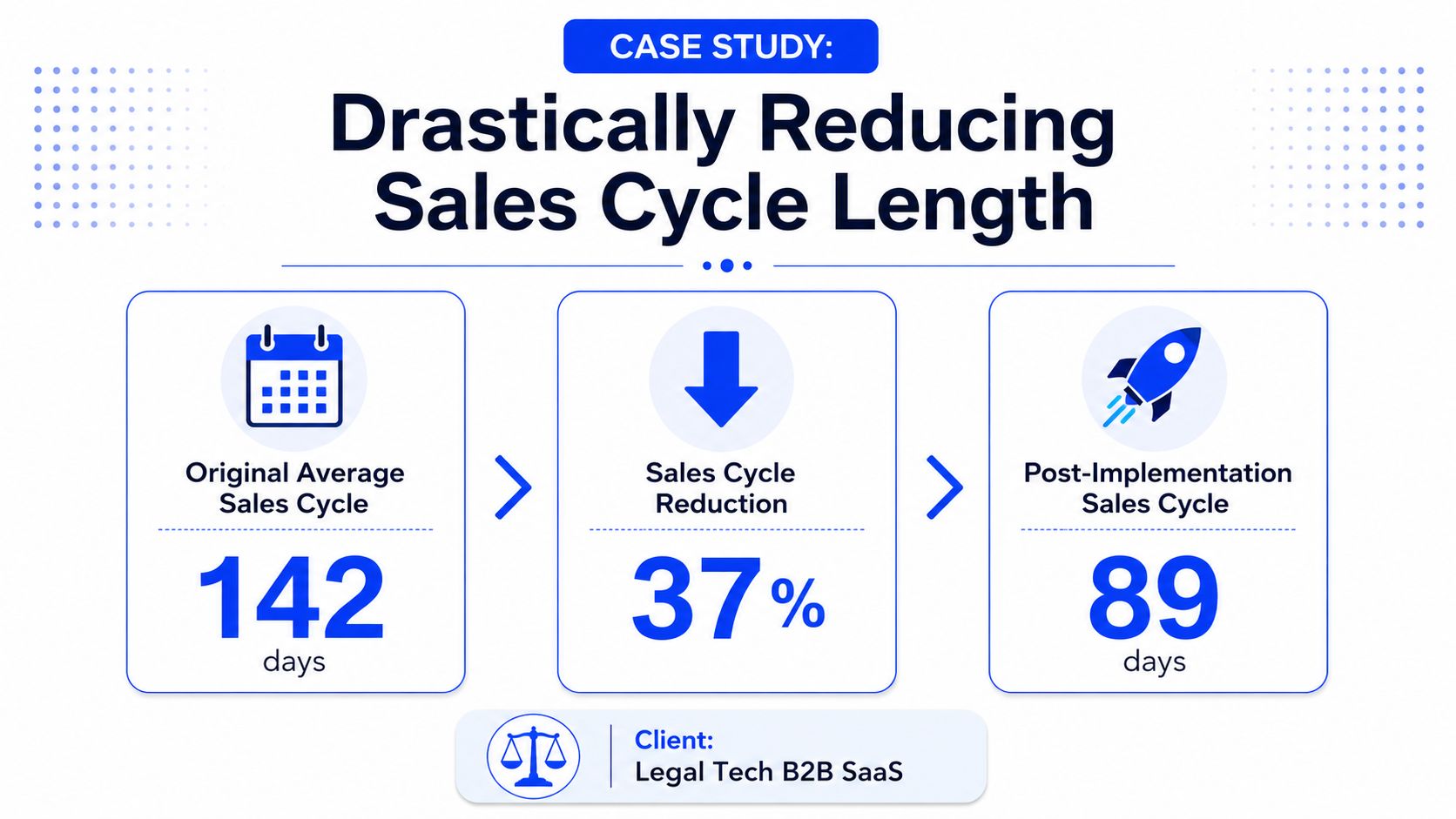
A legal tech SaaS company moved from a traditional MQL-to-SQL setup to a unified pipeline and cut average sales cycle length from 142 days to 89 days, a 37% reduction within 6 months, with the compression driven by routing positive replies to AEs in under 2 minutes and using personalized video at the proposal stage, according to Grou's legal tech pipeline case detail.
What was broken in the old model
The company had around 45 employees and sold into heads of legal operations at companies with 200 to 800 employees. Marketing-generated leads reached AEs with weak context. SDR outbound ran separately. Content engagement sat in one system, outreach history sat in another, and HubSpot stage movement wasn't consistent across reps.
That created friction in four places:
Context loss. A prospect could read substantive content and still arrive to the AE as if they were cold.
Bad routing logic. Interested outbound prospects were pushed back through qualification instead of going straight to the AE.
Weak CRM discipline. Different reps interpreted stages differently, so forecasting quality dropped.
Slow lead response. Form submissions often waited 18 to 24 hours for AE follow-up during business days.
If you want more examples of how these breakdowns show up in real engagements, the Grou case studies collection is the right place to review patterns across teams and motions.
What changed in the new system
The fix wasn't one tactic. It was a coordinated operating model.
First, all demand sources entered a single pipeline structure. Outbound prospects, inbound leads, and content-engaged contacts moved through the same stage definitions. Sales and marketing signed off on progression criteria, which took 4 hours of structured workshop time.
Second, context was surfaced where the AE works. Content engagement history became visible in HubSpot records. Positive replies from Lemlist and HeyReach were pushed to AE Slack channels through Zapier in under 2 minutes.
Practical rule: If reply routing takes longer than the buyer's attention window, you're paying acquisition cost for conversations that go cold before sales even sees them.
Third, the proposal stage got tighter. AEs started sending personalized Loom videos tied to the buyer's use case. That added 15 to 20 minutes of preparation per proposal, and reps resisted it at first. Once cycle compression showed up, resistance disappeared.
The operational effect showed up across the cycle:
Reply to meeting dropped from 4 to 7 days to 1 to 3 days
Meeting to opportunity dropped from 8 to 14 days to 3 to 7 days
Opportunity to proposal dropped from 21 to 35 days to 12 to 20 days
Proposal to close dropped from 28 to 49 days to 14 to 28 days
Over the 6-month engagement, the company closed 11 deals, generated roughly €584k in attributable revenue, and still had roughly €340k in late-stage pipeline active at the end. This wasn't a miracle jump. It was friction removed at every transition.
The metrics that reveal pipeline health
Most leadership dashboards still overweight lead counts and lagging close data. That's why they miss the problem until the quarter is already damaged.

Time-in-stage beats vanity conversion
If I get one metric first, I want time-in-stage, especially from proposal active to close. Conversion rates matter, but they're easier to distort by changing definitions. Time is harder to fake.
In strong B2B systems, the handoff point is specific. Coefficient's explanation of funnel exit and pipeline entry notes that the funnel exit point, a qualified meeting, serves as the pipeline entry trigger, converting a prospect into a named opportunity with a defined dollar value and stage in the CRM. Once that handoff is clean, the next question is speed.
Late-stage delay is expensive because it ties up AE attention and pushes revenue recognition out. In the legal tech example above, proposal-to-close compressed from 28 to 49 days to 14 to 28 days. That's why I care about time more than status labels.
Slow deals don't just hurt forecast accuracy. They crowd out fresh work because reps keep babysitting old proposals instead of creating new qualified opportunities.
For a broader KPI lens around the generation side of the system, these lead generation KPIs are useful, but they should feed the pipeline view, not replace it.
The minimum dashboard I'd expect to see
A practical dashboard for B2B leadership should track a small set of metrics tied to decisions.
Reply-to-meeting timeline
This shows whether buyer intent is being acted on while it's still warm.Meeting confirmed to meeting held
If this slips, the issue may be reminder discipline, AE follow-up, or weak qualification before booking.Meeting held to qualified opportunity Context quality shows up at this stage. Good handoff usually improves the quality of early-stage conversations.
Time-in-stage by owner and stage
If one AE's proposal stage runs longer than the rest, coaching is easier and more objective.Closed-won and closed-lost reasons
These are essential for refining stage criteria, targeting, and proposal quality.
Keep the dashboard tight. If a metric doesn't trigger a decision, it doesn't belong in the leadership review.
The unexpected benefits of a structured pipeline
Cycle compression and forecast quality are the visible wins. The less obvious wins usually matter just as much six months later.
What changes beyond revenue reporting
A structured pipeline changes how people spend time. That matters because a 2025 Gartner study noted that 64% of sales reps waste time on funnel activities they mistakenly treat as pipeline control, leading to a 22% drop in quota attainment, as cited in this discussion of the influence vs control gap. When the line between influence and control gets clearer, teams stop burning hours on activity that looks busy but doesn't advance deals.
The first side effect is AE morale. Reps prefer working qualified opportunities with context over sorting through weak handoffs. Better meetings change how the role feels day to day.
The second is the marketing and sales relationship. Shared stage criteria reduce the old argument about lead quality because both teams can inspect the same transition rules inside the CRM. That doesn't remove tension entirely. It removes the pointless version of it.
There's also a buyer-side effect. Prospects notice when they don't have to repeat the same context across marketing touchpoints, SDR outreach, discovery, and proposal review. The process feels coordinated because it is.
A few operational gains emerge:
Cleaner CRM data because stage transitions require evidence
Better analytics because source, signal, and stage movement are recorded consistently
Less founder firefighting because fewer deals need executive rescue due to process confusion
Tighter team rhythms because Slack routing, HubSpot fields, and AE follow-up run on explicit rules
The strongest pipeline systems don't just improve reporting. They reduce organizational drag.
That's the part many teams miss when they treat sales pipeline vs sales funnel as a terminology debate. The issue isn't vocabulary. It's whether the company has a structure that tells each team what they control, what they can only influence, and how a prospect becomes a deal.
Your next step to fix the handoff
This Friday, audit one metric. Pull your last 20 positive replies from Lemlist, Smartlead, Instantly, or HeyReach and calculate the time between the reply timestamp and a confirmed AE meeting in calendar.
If that gap is more than 24 hours, you've found a real bottleneck. Don't redesign the whole revenue engine yet. Fix the routing first with Slack alerts, Zapier logic, and one owner per reply queue.
If you're also reviewing team capacity, role design, or whether the top of funnel should sit with in-house reps or an external team, this guide on hiring an SDR through LatHire is a practical reference for thinking through the resourcing side.
By Monday, add one CRM column if it doesn't already exist. Reply received at. Then compare it against meeting confirmed at for every engaged prospect going forward.
GROU helps B2B teams build global pipeline systems that connect LinkedIn content, outbound, and CRM execution into one revenue motion. The methodology is simple, structured, and operator-led: one target list, one message, one handoff logic, and one pipeline view that turns attention into qualified conversations and closed revenue.
Your CRM says pipeline is healthy, but forecasts still slip, AEs complain that “good leads” arrive cold, and marketing can't prove which attention turns into revenue. That problem usually isn't lead volume. It's structure.
Sales pipeline vs sales funnel is not a winner-take-all choice. Funnel diagnoses conversion, pipeline runs execution.
The fix is a unified pipeline that gives sales and marketing one handoff point, one set of stage rules, and one reporting line.
The biggest gains usually come from removing handoff lag, exposing context inside the CRM, and measuring time-in-stage, not just conversion.
When the structure is right, attention turns into named opportunities faster and forecasts stop depending on opinion.
Table of Contents
The verdict for revenue operators
The verdict is simple. Run both, but manage the business through a unified pipeline. The funnel tells you whether your market-facing motion is producing qualified attention. The pipeline tells you whether your team is turning that attention into revenue.
The distinction matters because the two models answer different questions. As Nutshell's explanation of sales pipeline vs funnel puts it, the pipeline tracks the seller's specific actions and deal stages, while the funnel measures the buyer's conversion rates and drop-off points across the journey. That's why one belongs to day-to-day execution and the other belongs to diagnosis.
What fails in practice is the handoff model. Marketing owns MQLs. Sales owns opportunities. Nobody owns the messy space in between, where context gets lost and response times drift. That's why teams with “enough leads” still miss quarter.
Operator rule: If a prospect has shown clear buying intent, routing them back through a marketing status before an AE conversation is usually a process bug.
A unified pipeline fixes that bug. It gives you one place to manage outbound replies, inbound form fills, content-engaged prospects, and partner-sourced conversations under shared stage definitions. Sales still owns execution. Marketing still owns demand. But the handoff becomes operational, not political.
If you want a deeper view on the mechanics of execution inside the CRM, this sales pipeline management breakdown is a useful companion. The point is the same. Structure turns attention into pipeline, and pipeline into forecastable revenue.
Funnel vs pipeline compared by job-to-be-done
Teams confuse these models when they expect one report to do two jobs. It won't. The funnel is a diagnostic tool. The pipeline is an operating system for active deals.
A side-by-side breakdown
A useful way to frame sales pipeline vs sales funnel is through jobs to be done. If your question is “Where are we losing qualified attention?”, you need funnel reporting. If your question is “Which named deals can close, when, and why?”, you need pipeline reporting. That matches Extrovert's perspective on Jobs to be Done, which is a helpful lens for choosing the right system for the right decision.
Dimension | Sales Funnel (The Diagnostic Tool) | Sales Pipeline (The Operational Tool) |
|---|---|---|
Primary job | Diagnose conversion efficiency | Manage active deals and forecast revenue |
Perspective | Buyer-centric | Seller-centric |
Ownership | Marketing, with sales overlap at later stages | Sales and RevOps |
Unit of analysis | Populations, cohorts, stage conversion | Individual deals, stages, deal value |
Core question | Where do prospects drop off? | Where does each deal stand? |
Main metrics | Lead volume, stage conversion, drop-off | Opportunity count, win rate, deal velocity |
Reporting shape | Vertical narrowing model | Horizontal linear workflow |
Actionability | Influence through messaging, targeting, content | Direct control through stage design, routing, follow-up |
The measurement logic is different too. Prospeo's breakdown of pipeline vs funnel metrics defines pipeline through seller-centric operational metrics, including Pipeline Velocity = (# Opportunities × Avg Deal Size × Win Rate) / Sales Cycle Days, while the funnel is defined by buyer-centric conversion metrics that track volume attrition and stage-to-stage drop-off.
For a cleaner glossary version of the funnel side, this definition from Grou's glossary is worth keeping handy for internal alignment.
Where operators get this wrong
The common mistake is asking the funnel to forecast revenue. It can't. A conversion report might tell you that plenty of prospects moved from awareness to interest, but it won't tell your VP Sales whether the legal review on a live opportunity is blocked.
The other mistake is asking the pipeline to explain demand quality by itself. It won't. If meeting-booked volume drops, the CRM may show fewer opportunities, but the underlying issue could be weak targeting, weak content, or poor outreach list quality.
That's why mixed-tool stacks need clean role separation. Apollo, Clay, Lemlist, Instantly, Smartlead, HeyReach, HubSpot, and Sales Navigator can all sit in the same revenue system. But each tool needs a job. Funnel tools show aggregate movement. Pipeline tools track named opportunities, owners, stage criteria, and forecast risk.
A team that mixes diagnostic metrics with execution metrics usually ends up arguing over labels instead of fixing the bottleneck.
How to build a unified pipeline that works
Monday morning, the CRO asks for forecast confidence. Marketing reports high engagement. Sales says half the so-called pipeline is unworked, unqualified, or sitting in the wrong stage. That problem does not come from lead volume. It comes from stage design, routing rules, and weak CRM enforcement.
A unified pipeline gives both teams one operating model. Marketing owns inputs and context. Sales owns progression against defined exit criteria. RevOps owns the rules that keep records clean, route intent fast, and make forecast categories credible. If your team is still debating handoff definitions, this guide to aligning sales and marketing is a useful reference for the operating agreement behind the CRM build.
The six stages we use
This is the stage structure I recommend for B2B teams with outbound-led or account-based motions in SaaS, legal tech, manufacturing, pharma, and iGaming. It works because each stage maps to a clear operational change, not a vague level of interest.
Active prospect
The account fits ICP, the contact is valid, and outreach is live. This stage excludes webinar signups, broad imports, and any record with no owner or no sequence activity. If the team is tightening contact quality before records enter the system, a 2026 playbook for email outreach is a practical reference for finding and validating contacts upstream.Engaged prospect
The contact has replied with intent, requested details, or shown buying-level engagement. A generic open or page view is not enough. The point of this stage is to separate signal from noise before calendar time gets consumed.Meeting confirmed
A calendar invite is accepted and owned by the right rep. This stage matters because teams often overstate pipeline by counting tentative interest as a meeting. I do not count soft holds, “send me times,” or internal referrals without a booked slot.Qualified opportunity
The meeting happened. There is a live use case, a credible reason to change, and a defined next step. At this point, the CRM should convert the record into a named deal with an amount range, expected close window, and buying committee notes.Proposal active
Commercial terms, scope, or a formal proposal have been shared. The work here shifts from prospecting to deal control. Response times, objection handling, mutual action plans, and stakeholder coverage start to matter more than top-of-funnel activity.Closed-won or closed-lost
Terminal stages need discipline. If the deal is delayed with no committed next step, goes silent after repeated follow-up, or loses to a competitor, mark it closed-lost and record the reason. Reopening later is cleaner than carrying dead weight in commit calls.
Six stages are often sufficient. More than eight usually creates reporting noise and rep inconsistency. Fewer than five hides meaningful transitions, especially in multi-stakeholder B2B deals.
The operating layer that makes the stages real
Stages on a slide deck do nothing. The gain comes from the controls behind them.
In HubSpot, the build should force the behavior you want:
Required properties on stage change, including source, owner, primary use case, next meeting date, and close reason where relevant.
Time-in-stage tracking, so managers can spot stalled deals without asking reps to clean the CRM before every review.
Source and touchpoint visibility, so the AE can see whether interest came from Lemlist, HeyReach, LinkedIn, a form fill, paid media, or a referral.
Full engagement history in the record, including prior outbound, content consumption, call notes, and sequence status.
Routing automations through tools like Zapier and Slack, so positive replies and hand-raisers reach the right AE fast instead of waiting in shared inboxes.
Written exit criteria for every stage, stored where reps and managers can see them during pipeline review.
Teams either gain control or lose it. I have seen solid demand generation programs underperform because positive replies sat with SDRs for hours, AEs created duplicate deals, and reps advanced opportunities without a confirmed next step. The opposite setup is measurable. In one client environment, the practical change was simple: route qualified engagement fast, attach context from outreach and content activity to the record, and require the fields needed for progression. That operating discipline is what later shortened the sales cycle by 37%, not a new label on the handoff.
The pipeline works when every stage answers three questions: who owns the record, what proof is required to move it, and what automation fires next. If any of those are unclear, the stage is not operational yet.
Case study cutting a 142-day sales cycle by 37%
Theory is useful. Operating proof is better.
A legal tech SaaS company moved from a traditional MQL-to-SQL setup to a unified pipeline and cut average sales cycle length from 142 days to 89 days, a 37% reduction within 6 months, with the compression driven by routing positive replies to AEs in under 2 minutes and using personalized video at the proposal stage, according to Grou's legal tech pipeline case detail.
What was broken in the old model
The company had around 45 employees and sold into heads of legal operations at companies with 200 to 800 employees. Marketing-generated leads reached AEs with weak context. SDR outbound ran separately. Content engagement sat in one system, outreach history sat in another, and HubSpot stage movement wasn't consistent across reps.
That created friction in four places:
Context loss. A prospect could read substantive content and still arrive to the AE as if they were cold.
Bad routing logic. Interested outbound prospects were pushed back through qualification instead of going straight to the AE.
Weak CRM discipline. Different reps interpreted stages differently, so forecasting quality dropped.
Slow lead response. Form submissions often waited 18 to 24 hours for AE follow-up during business days.
If you want more examples of how these breakdowns show up in real engagements, the Grou case studies collection is the right place to review patterns across teams and motions.
What changed in the new system
The fix wasn't one tactic. It was a coordinated operating model.
First, all demand sources entered a single pipeline structure. Outbound prospects, inbound leads, and content-engaged contacts moved through the same stage definitions. Sales and marketing signed off on progression criteria, which took 4 hours of structured workshop time.
Second, context was surfaced where the AE works. Content engagement history became visible in HubSpot records. Positive replies from Lemlist and HeyReach were pushed to AE Slack channels through Zapier in under 2 minutes.
Practical rule: If reply routing takes longer than the buyer's attention window, you're paying acquisition cost for conversations that go cold before sales even sees them.
Third, the proposal stage got tighter. AEs started sending personalized Loom videos tied to the buyer's use case. That added 15 to 20 minutes of preparation per proposal, and reps resisted it at first. Once cycle compression showed up, resistance disappeared.
The operational effect showed up across the cycle:
Reply to meeting dropped from 4 to 7 days to 1 to 3 days
Meeting to opportunity dropped from 8 to 14 days to 3 to 7 days
Opportunity to proposal dropped from 21 to 35 days to 12 to 20 days
Proposal to close dropped from 28 to 49 days to 14 to 28 days
Over the 6-month engagement, the company closed 11 deals, generated roughly €584k in attributable revenue, and still had roughly €340k in late-stage pipeline active at the end. This wasn't a miracle jump. It was friction removed at every transition.
The metrics that reveal pipeline health
Most leadership dashboards still overweight lead counts and lagging close data. That's why they miss the problem until the quarter is already damaged.
Time-in-stage beats vanity conversion
If I get one metric first, I want time-in-stage, especially from proposal active to close. Conversion rates matter, but they're easier to distort by changing definitions. Time is harder to fake.
In strong B2B systems, the handoff point is specific. Coefficient's explanation of funnel exit and pipeline entry notes that the funnel exit point, a qualified meeting, serves as the pipeline entry trigger, converting a prospect into a named opportunity with a defined dollar value and stage in the CRM. Once that handoff is clean, the next question is speed.
Late-stage delay is expensive because it ties up AE attention and pushes revenue recognition out. In the legal tech example above, proposal-to-close compressed from 28 to 49 days to 14 to 28 days. That's why I care about time more than status labels.
Slow deals don't just hurt forecast accuracy. They crowd out fresh work because reps keep babysitting old proposals instead of creating new qualified opportunities.
For a broader KPI lens around the generation side of the system, these lead generation KPIs are useful, but they should feed the pipeline view, not replace it.
The minimum dashboard I'd expect to see
A practical dashboard for B2B leadership should track a small set of metrics tied to decisions.
Reply-to-meeting timeline
This shows whether buyer intent is being acted on while it's still warm.Meeting confirmed to meeting held
If this slips, the issue may be reminder discipline, AE follow-up, or weak qualification before booking.Meeting held to qualified opportunity Context quality shows up at this stage. Good handoff usually improves the quality of early-stage conversations.
Time-in-stage by owner and stage
If one AE's proposal stage runs longer than the rest, coaching is easier and more objective.Closed-won and closed-lost reasons
These are essential for refining stage criteria, targeting, and proposal quality.
Keep the dashboard tight. If a metric doesn't trigger a decision, it doesn't belong in the leadership review.
The unexpected benefits of a structured pipeline
Cycle compression and forecast quality are the visible wins. The less obvious wins usually matter just as much six months later.
What changes beyond revenue reporting
A structured pipeline changes how people spend time. That matters because a 2025 Gartner study noted that 64% of sales reps waste time on funnel activities they mistakenly treat as pipeline control, leading to a 22% drop in quota attainment, as cited in this discussion of the influence vs control gap. When the line between influence and control gets clearer, teams stop burning hours on activity that looks busy but doesn't advance deals.
The first side effect is AE morale. Reps prefer working qualified opportunities with context over sorting through weak handoffs. Better meetings change how the role feels day to day.
The second is the marketing and sales relationship. Shared stage criteria reduce the old argument about lead quality because both teams can inspect the same transition rules inside the CRM. That doesn't remove tension entirely. It removes the pointless version of it.
There's also a buyer-side effect. Prospects notice when they don't have to repeat the same context across marketing touchpoints, SDR outreach, discovery, and proposal review. The process feels coordinated because it is.
A few operational gains emerge:
Cleaner CRM data because stage transitions require evidence
Better analytics because source, signal, and stage movement are recorded consistently
Less founder firefighting because fewer deals need executive rescue due to process confusion
Tighter team rhythms because Slack routing, HubSpot fields, and AE follow-up run on explicit rules
The strongest pipeline systems don't just improve reporting. They reduce organizational drag.
That's the part many teams miss when they treat sales pipeline vs sales funnel as a terminology debate. The issue isn't vocabulary. It's whether the company has a structure that tells each team what they control, what they can only influence, and how a prospect becomes a deal.
Your next step to fix the handoff
This Friday, audit one metric. Pull your last 20 positive replies from Lemlist, Smartlead, Instantly, or HeyReach and calculate the time between the reply timestamp and a confirmed AE meeting in calendar.
If that gap is more than 24 hours, you've found a real bottleneck. Don't redesign the whole revenue engine yet. Fix the routing first with Slack alerts, Zapier logic, and one owner per reply queue.
If you're also reviewing team capacity, role design, or whether the top of funnel should sit with in-house reps or an external team, this guide on hiring an SDR through LatHire is a practical reference for thinking through the resourcing side.
By Monday, add one CRM column if it doesn't already exist. Reply received at. Then compare it against meeting confirmed at for every engaged prospect going forward.
GROU helps B2B teams build global pipeline systems that connect LinkedIn content, outbound, and CRM execution into one revenue motion. The methodology is simple, structured, and operator-led: one target list, one message, one handoff logic, and one pipeline view that turns attention into qualified conversations and closed revenue.
Your CRM says pipeline is healthy, but forecasts still slip, AEs complain that “good leads” arrive cold, and marketing can't prove which attention turns into revenue. That problem usually isn't lead volume. It's structure.
Sales pipeline vs sales funnel is not a winner-take-all choice. Funnel diagnoses conversion, pipeline runs execution.
The fix is a unified pipeline that gives sales and marketing one handoff point, one set of stage rules, and one reporting line.
The biggest gains usually come from removing handoff lag, exposing context inside the CRM, and measuring time-in-stage, not just conversion.
When the structure is right, attention turns into named opportunities faster and forecasts stop depending on opinion.
Table of Contents
The verdict for revenue operators
The verdict is simple. Run both, but manage the business through a unified pipeline. The funnel tells you whether your market-facing motion is producing qualified attention. The pipeline tells you whether your team is turning that attention into revenue.
The distinction matters because the two models answer different questions. As Nutshell's explanation of sales pipeline vs funnel puts it, the pipeline tracks the seller's specific actions and deal stages, while the funnel measures the buyer's conversion rates and drop-off points across the journey. That's why one belongs to day-to-day execution and the other belongs to diagnosis.
What fails in practice is the handoff model. Marketing owns MQLs. Sales owns opportunities. Nobody owns the messy space in between, where context gets lost and response times drift. That's why teams with “enough leads” still miss quarter.
Operator rule: If a prospect has shown clear buying intent, routing them back through a marketing status before an AE conversation is usually a process bug.
A unified pipeline fixes that bug. It gives you one place to manage outbound replies, inbound form fills, content-engaged prospects, and partner-sourced conversations under shared stage definitions. Sales still owns execution. Marketing still owns demand. But the handoff becomes operational, not political.
If you want a deeper view on the mechanics of execution inside the CRM, this sales pipeline management breakdown is a useful companion. The point is the same. Structure turns attention into pipeline, and pipeline into forecastable revenue.
Funnel vs pipeline compared by job-to-be-done
Teams confuse these models when they expect one report to do two jobs. It won't. The funnel is a diagnostic tool. The pipeline is an operating system for active deals.
A side-by-side breakdown
A useful way to frame sales pipeline vs sales funnel is through jobs to be done. If your question is “Where are we losing qualified attention?”, you need funnel reporting. If your question is “Which named deals can close, when, and why?”, you need pipeline reporting. That matches Extrovert's perspective on Jobs to be Done, which is a helpful lens for choosing the right system for the right decision.
Dimension | Sales Funnel (The Diagnostic Tool) | Sales Pipeline (The Operational Tool) |
|---|---|---|
Primary job | Diagnose conversion efficiency | Manage active deals and forecast revenue |
Perspective | Buyer-centric | Seller-centric |
Ownership | Marketing, with sales overlap at later stages | Sales and RevOps |
Unit of analysis | Populations, cohorts, stage conversion | Individual deals, stages, deal value |
Core question | Where do prospects drop off? | Where does each deal stand? |
Main metrics | Lead volume, stage conversion, drop-off | Opportunity count, win rate, deal velocity |
Reporting shape | Vertical narrowing model | Horizontal linear workflow |
Actionability | Influence through messaging, targeting, content | Direct control through stage design, routing, follow-up |
The measurement logic is different too. Prospeo's breakdown of pipeline vs funnel metrics defines pipeline through seller-centric operational metrics, including Pipeline Velocity = (# Opportunities × Avg Deal Size × Win Rate) / Sales Cycle Days, while the funnel is defined by buyer-centric conversion metrics that track volume attrition and stage-to-stage drop-off.
For a cleaner glossary version of the funnel side, this definition from Grou's glossary is worth keeping handy for internal alignment.
Where operators get this wrong
The common mistake is asking the funnel to forecast revenue. It can't. A conversion report might tell you that plenty of prospects moved from awareness to interest, but it won't tell your VP Sales whether the legal review on a live opportunity is blocked.
The other mistake is asking the pipeline to explain demand quality by itself. It won't. If meeting-booked volume drops, the CRM may show fewer opportunities, but the underlying issue could be weak targeting, weak content, or poor outreach list quality.
That's why mixed-tool stacks need clean role separation. Apollo, Clay, Lemlist, Instantly, Smartlead, HeyReach, HubSpot, and Sales Navigator can all sit in the same revenue system. But each tool needs a job. Funnel tools show aggregate movement. Pipeline tools track named opportunities, owners, stage criteria, and forecast risk.
A team that mixes diagnostic metrics with execution metrics usually ends up arguing over labels instead of fixing the bottleneck.
How to build a unified pipeline that works
Monday morning, the CRO asks for forecast confidence. Marketing reports high engagement. Sales says half the so-called pipeline is unworked, unqualified, or sitting in the wrong stage. That problem does not come from lead volume. It comes from stage design, routing rules, and weak CRM enforcement.
A unified pipeline gives both teams one operating model. Marketing owns inputs and context. Sales owns progression against defined exit criteria. RevOps owns the rules that keep records clean, route intent fast, and make forecast categories credible. If your team is still debating handoff definitions, this guide to aligning sales and marketing is a useful reference for the operating agreement behind the CRM build.
The six stages we use
This is the stage structure I recommend for B2B teams with outbound-led or account-based motions in SaaS, legal tech, manufacturing, pharma, and iGaming. It works because each stage maps to a clear operational change, not a vague level of interest.
Active prospect
The account fits ICP, the contact is valid, and outreach is live. This stage excludes webinar signups, broad imports, and any record with no owner or no sequence activity. If the team is tightening contact quality before records enter the system, a 2026 playbook for email outreach is a practical reference for finding and validating contacts upstream.Engaged prospect
The contact has replied with intent, requested details, or shown buying-level engagement. A generic open or page view is not enough. The point of this stage is to separate signal from noise before calendar time gets consumed.Meeting confirmed
A calendar invite is accepted and owned by the right rep. This stage matters because teams often overstate pipeline by counting tentative interest as a meeting. I do not count soft holds, “send me times,” or internal referrals without a booked slot.Qualified opportunity
The meeting happened. There is a live use case, a credible reason to change, and a defined next step. At this point, the CRM should convert the record into a named deal with an amount range, expected close window, and buying committee notes.Proposal active
Commercial terms, scope, or a formal proposal have been shared. The work here shifts from prospecting to deal control. Response times, objection handling, mutual action plans, and stakeholder coverage start to matter more than top-of-funnel activity.Closed-won or closed-lost
Terminal stages need discipline. If the deal is delayed with no committed next step, goes silent after repeated follow-up, or loses to a competitor, mark it closed-lost and record the reason. Reopening later is cleaner than carrying dead weight in commit calls.
Six stages are often sufficient. More than eight usually creates reporting noise and rep inconsistency. Fewer than five hides meaningful transitions, especially in multi-stakeholder B2B deals.
The operating layer that makes the stages real
Stages on a slide deck do nothing. The gain comes from the controls behind them.
In HubSpot, the build should force the behavior you want:
Required properties on stage change, including source, owner, primary use case, next meeting date, and close reason where relevant.
Time-in-stage tracking, so managers can spot stalled deals without asking reps to clean the CRM before every review.
Source and touchpoint visibility, so the AE can see whether interest came from Lemlist, HeyReach, LinkedIn, a form fill, paid media, or a referral.
Full engagement history in the record, including prior outbound, content consumption, call notes, and sequence status.
Routing automations through tools like Zapier and Slack, so positive replies and hand-raisers reach the right AE fast instead of waiting in shared inboxes.
Written exit criteria for every stage, stored where reps and managers can see them during pipeline review.
Teams either gain control or lose it. I have seen solid demand generation programs underperform because positive replies sat with SDRs for hours, AEs created duplicate deals, and reps advanced opportunities without a confirmed next step. The opposite setup is measurable. In one client environment, the practical change was simple: route qualified engagement fast, attach context from outreach and content activity to the record, and require the fields needed for progression. That operating discipline is what later shortened the sales cycle by 37%, not a new label on the handoff.
The pipeline works when every stage answers three questions: who owns the record, what proof is required to move it, and what automation fires next. If any of those are unclear, the stage is not operational yet.
Case study cutting a 142-day sales cycle by 37%
Theory is useful. Operating proof is better.
A legal tech SaaS company moved from a traditional MQL-to-SQL setup to a unified pipeline and cut average sales cycle length from 142 days to 89 days, a 37% reduction within 6 months, with the compression driven by routing positive replies to AEs in under 2 minutes and using personalized video at the proposal stage, according to Grou's legal tech pipeline case detail.
What was broken in the old model
The company had around 45 employees and sold into heads of legal operations at companies with 200 to 800 employees. Marketing-generated leads reached AEs with weak context. SDR outbound ran separately. Content engagement sat in one system, outreach history sat in another, and HubSpot stage movement wasn't consistent across reps.
That created friction in four places:
Context loss. A prospect could read substantive content and still arrive to the AE as if they were cold.
Bad routing logic. Interested outbound prospects were pushed back through qualification instead of going straight to the AE.
Weak CRM discipline. Different reps interpreted stages differently, so forecasting quality dropped.
Slow lead response. Form submissions often waited 18 to 24 hours for AE follow-up during business days.
If you want more examples of how these breakdowns show up in real engagements, the Grou case studies collection is the right place to review patterns across teams and motions.
What changed in the new system
The fix wasn't one tactic. It was a coordinated operating model.
First, all demand sources entered a single pipeline structure. Outbound prospects, inbound leads, and content-engaged contacts moved through the same stage definitions. Sales and marketing signed off on progression criteria, which took 4 hours of structured workshop time.
Second, context was surfaced where the AE works. Content engagement history became visible in HubSpot records. Positive replies from Lemlist and HeyReach were pushed to AE Slack channels through Zapier in under 2 minutes.
Practical rule: If reply routing takes longer than the buyer's attention window, you're paying acquisition cost for conversations that go cold before sales even sees them.
Third, the proposal stage got tighter. AEs started sending personalized Loom videos tied to the buyer's use case. That added 15 to 20 minutes of preparation per proposal, and reps resisted it at first. Once cycle compression showed up, resistance disappeared.
The operational effect showed up across the cycle:
Reply to meeting dropped from 4 to 7 days to 1 to 3 days
Meeting to opportunity dropped from 8 to 14 days to 3 to 7 days
Opportunity to proposal dropped from 21 to 35 days to 12 to 20 days
Proposal to close dropped from 28 to 49 days to 14 to 28 days
Over the 6-month engagement, the company closed 11 deals, generated roughly €584k in attributable revenue, and still had roughly €340k in late-stage pipeline active at the end. This wasn't a miracle jump. It was friction removed at every transition.
The metrics that reveal pipeline health
Most leadership dashboards still overweight lead counts and lagging close data. That's why they miss the problem until the quarter is already damaged.
Time-in-stage beats vanity conversion
If I get one metric first, I want time-in-stage, especially from proposal active to close. Conversion rates matter, but they're easier to distort by changing definitions. Time is harder to fake.
In strong B2B systems, the handoff point is specific. Coefficient's explanation of funnel exit and pipeline entry notes that the funnel exit point, a qualified meeting, serves as the pipeline entry trigger, converting a prospect into a named opportunity with a defined dollar value and stage in the CRM. Once that handoff is clean, the next question is speed.
Late-stage delay is expensive because it ties up AE attention and pushes revenue recognition out. In the legal tech example above, proposal-to-close compressed from 28 to 49 days to 14 to 28 days. That's why I care about time more than status labels.
Slow deals don't just hurt forecast accuracy. They crowd out fresh work because reps keep babysitting old proposals instead of creating new qualified opportunities.
For a broader KPI lens around the generation side of the system, these lead generation KPIs are useful, but they should feed the pipeline view, not replace it.
The minimum dashboard I'd expect to see
A practical dashboard for B2B leadership should track a small set of metrics tied to decisions.
Reply-to-meeting timeline
This shows whether buyer intent is being acted on while it's still warm.Meeting confirmed to meeting held
If this slips, the issue may be reminder discipline, AE follow-up, or weak qualification before booking.Meeting held to qualified opportunity Context quality shows up at this stage. Good handoff usually improves the quality of early-stage conversations.
Time-in-stage by owner and stage
If one AE's proposal stage runs longer than the rest, coaching is easier and more objective.Closed-won and closed-lost reasons
These are essential for refining stage criteria, targeting, and proposal quality.
Keep the dashboard tight. If a metric doesn't trigger a decision, it doesn't belong in the leadership review.
The unexpected benefits of a structured pipeline
Cycle compression and forecast quality are the visible wins. The less obvious wins usually matter just as much six months later.
What changes beyond revenue reporting
A structured pipeline changes how people spend time. That matters because a 2025 Gartner study noted that 64% of sales reps waste time on funnel activities they mistakenly treat as pipeline control, leading to a 22% drop in quota attainment, as cited in this discussion of the influence vs control gap. When the line between influence and control gets clearer, teams stop burning hours on activity that looks busy but doesn't advance deals.
The first side effect is AE morale. Reps prefer working qualified opportunities with context over sorting through weak handoffs. Better meetings change how the role feels day to day.
The second is the marketing and sales relationship. Shared stage criteria reduce the old argument about lead quality because both teams can inspect the same transition rules inside the CRM. That doesn't remove tension entirely. It removes the pointless version of it.
There's also a buyer-side effect. Prospects notice when they don't have to repeat the same context across marketing touchpoints, SDR outreach, discovery, and proposal review. The process feels coordinated because it is.
A few operational gains emerge:
Cleaner CRM data because stage transitions require evidence
Better analytics because source, signal, and stage movement are recorded consistently
Less founder firefighting because fewer deals need executive rescue due to process confusion
Tighter team rhythms because Slack routing, HubSpot fields, and AE follow-up run on explicit rules
The strongest pipeline systems don't just improve reporting. They reduce organizational drag.
That's the part many teams miss when they treat sales pipeline vs sales funnel as a terminology debate. The issue isn't vocabulary. It's whether the company has a structure that tells each team what they control, what they can only influence, and how a prospect becomes a deal.
Your next step to fix the handoff
This Friday, audit one metric. Pull your last 20 positive replies from Lemlist, Smartlead, Instantly, or HeyReach and calculate the time between the reply timestamp and a confirmed AE meeting in calendar.
If that gap is more than 24 hours, you've found a real bottleneck. Don't redesign the whole revenue engine yet. Fix the routing first with Slack alerts, Zapier logic, and one owner per reply queue.
If you're also reviewing team capacity, role design, or whether the top of funnel should sit with in-house reps or an external team, this guide on hiring an SDR through LatHire is a practical reference for thinking through the resourcing side.
By Monday, add one CRM column if it doesn't already exist. Reply received at. Then compare it against meeting confirmed at for every engaged prospect going forward.
GROU helps B2B teams build global pipeline systems that connect LinkedIn content, outbound, and CRM execution into one revenue motion. The methodology is simple, structured, and operator-led: one target list, one message, one handoff logic, and one pipeline view that turns attention into qualified conversations and closed revenue.

Pipeline OS Newsletter
Build qualified pipeline
Get weekly tactics to generate demand, improve lead quality, and book more meetings.





Trusted by industry leaders
Trusted by industry leaders
Trusted by industry leaders
Ready to build qualified pipeline?
Ready to build qualified pipeline?
Ready to build qualified pipeline?
Book a call to see if we're the right fit, or take the 2-minute quiz to get a clear starting point.
Book a call to see if we're the right fit, or take the 2-minute quiz to get a clear starting point.
Book a call to see if we're the right fit, or take the 2-minute quiz to get a clear starting point.
" height="30.21639343089746px" id="hfGbXmQR2" width="30.216393430897455px"/></svg>)
Copyright © 2026 – All Right Reserved
Copyright © 2026 – All Right Reserved
Copyright © 2026 – All Right Reserved