%22%3E%3C/path%3E%3Cpath d=%22M 63.072 7.554 C 62.258 8.022 61.577 8.689 61.092 9.493 L 61.092 7.076 L 57.158 7.076 L 57.158 22.64 L 61.089 22.64 L 61.089 14.888 C 61.089 13.446 61.403 12.434 62.03 11.853 C 62.818 11.218 63.818 10.907 64.826 10.982 L 65.868 10.982 L 65.868 6.851 C 64.891 6.834 63.926 7.076 63.073 7.554 Z%22 fill=%22rgb(17,17,17)%22%3E%3C/path%3E%3Cpath d=%22M 78.916 7.82 C 76.363 6.49 73.321 6.49 70.768 7.82 C 69.562 8.473 68.564 9.451 67.888 10.644 C 67.167 11.931 66.803 13.387 66.834 14.862 C 66.804 16.332 67.157 17.785 67.86 19.077 C 68.515 20.267 69.494 21.246 70.684 21.901 C 71.924 22.576 73.318 22.92 74.73 22.898 C 76.164 22.918 77.58 22.575 78.846 21.901 C 80.062 21.247 81.073 20.27 81.768 19.077 C 82.506 17.797 82.88 16.339 82.85 14.862 C 82.88 13.389 82.517 11.934 81.797 10.647 C 81.12 9.455 80.122 8.477 78.917 7.824 M 78.803 14.862 C 78.829 15.739 78.636 16.608 78.241 17.391 C 77.903 18.046 77.38 18.588 76.738 18.95 C 76.124 19.293 75.432 19.472 74.729 19.47 C 73.668 19.497 72.648 19.061 71.934 18.276 C 71.139 17.323 70.741 16.1 70.823 14.862 C 70.741 13.62 71.149 12.395 71.959 11.45 C 72.687 10.667 73.715 10.233 74.783 10.256 C 75.859 10.236 76.894 10.67 77.635 11.45 C 78.464 12.387 78.884 13.616 78.801 14.864%22 fill=%22rgb(17,17,17)%22%3E%3C/path%3E%3Cpath d=%22M 95.906 7.076 L 95.906 15.646 C 95.975 16.68 95.643 17.701 94.979 18.498 C 94.311 19.184 93.379 19.547 92.422 19.495 C 91.475 19.544 90.553 19.18 89.894 18.498 C 89.23 17.701 88.898 16.68 88.967 15.646 L 88.967 7.076 L 85.033 7.076 L 85.033 16.207 C 85 17.449 85.275 18.68 85.834 19.79 C 86.327 20.75 87.095 21.542 88.039 22.065 C 89.033 22.594 90.145 22.861 91.271 22.838 C 92.188 22.847 93.095 22.65 93.926 22.263 C 94.708 21.905 95.388 21.36 95.906 20.675 L 95.906 22.645 L 99.865 22.645 L 99.865 7.076 Z%22 fill=%22rgb(17,17,17)%22%3E%3C/path%3E%3Cpath d=%22M 4.513 15.626 C 4.511 10.815 7.606 6.549 12.181 5.059 C 16.756 3.57 21.77 5.195 24.601 9.086 L 27.816 5.87 C 24.074 1.186 17.981 -0.943 12.137 0.393 C 6.292 1.728 1.728 6.292 0.393 12.137 C -0.943 17.981 1.186 24.074 5.87 27.816 L 9.085 24.601 C 6.214 22.512 4.515 19.177 4.513 15.626%22 fill=%22rgb(32,62,235)%22%3E%3C/path%3E%3Cpath d=%22M 17.114 14.343 L 13.354 18.01 L 13.354 18.026 L 21.071 18.026 L 11.412 27.609 L 17.389 27.609 L 23.999 21.081 L 23.999 28.316 L 24.005 28.316 L 27.967 24.393 L 27.967 14.343 Z%22 fill=%22rgb(32,62,235)%22%3E%3C/path%3E%3C/g%3E%3C/svg%3E) ×
× ××
××›
›
›
›
LinkedIn lead generation campaign: the 2026 B2B system
LinkedIn lead generation campaign: the 2026 B2B system
LinkedIn lead generation campaign: the 2026 B2B system
LinkedIn lead generation campaign: the 2026 B2B system
LinkedIn lead generation campaign: the 2026 B2B system
LinkedIn lead generation campaign: the 2026 B2B system

Author
Aljaz Peklaj

Your LinkedIn lead generation campaign is producing form fills, but sales still says the leads are weak. Paid content targets one audience, outbound reaches another, and the CRM reports clicks instead of opportunities. That setup creates activity without a dependable pipeline.
Treat LinkedIn ads, organic content, and outbound as one motion built around one target list.
Segment by buying role, industry fit, market, language, and urgency.
Judge performance by qualified meetings, opportunities, and revenue, not CPL alone.
Route replies quickly, test by segment, and give each variant enough time to produce a signal.
Table of Contents
Why most LinkedIn lead generation campaigns fail before they scale
How to segment your audience by buying role and industry fit
Next steps and how to audit your LinkedIn lead generation campaign
Why most LinkedIn lead generation campaigns fail before they scale
In audits of B2B LinkedIn campaigns, the pattern repeats: volume looks healthy in the dashboard while sales rejects the cohort. The failure is a quality-control problem, not a lead-volume problem.
A broad audience downloads a report, LinkedIn records a conversion, and the marketing dashboard turns green. Sales then finds contacts without buying authority, outside the ICP, or facing no active problem. The campaign receives the blame, although the breakdown occurred after the form submission.
A 2025 benchmark dataset covering 138 B2B advertisers reported an average $9.39 CPC, a 0.67% CTR, and a $202 CPL. Native Lead Gen Form campaigns across 97 advertisers averaged $11.93 CPC, 0.61% CTR, and a 6.2% click-to-lead rate. Use those figures for planning, not as proof that contacts can become revenue. (Digital Applied's LinkedIn advertising benchmarks)
The funnel view sales needs
Marketing and sales need explicit gates at every handoff. Reported benchmark ranges indicate that 20% to 30% of leads become MQLs, 40% to 60% of MQLs become SQLs, and 20% to 30% of SQLs progress to opportunities. (LinkedIn funnel benchmark data)
Funnel stage | Average metric |
|---|---|
Click-through rate | 0.44% to 0.65% |
Native Lead Gen Form conversion from clicks | 6% to 10% |
External landing page conversion from clicks | 2% to 5% |
Leads becoming MQLs | 20% to 30% |
MQLs becoming SQLs | 40% to 60% |
SQLs becoming opportunities | 20% to 30% |
Your CRM should distinguish inquiry → MQL → sales-accepted lead → SQL → opportunity. Record disqualification reasons such as wrong geography, wrong company type, no project, student or job seeker, and no authority. These fields show whether the audience, offer, form, or follow-up caused the loss.
Practical rule: A low CPL is acceptable only when the resulting cohort creates qualified pipeline at an acceptable cost.
That standard matters in iGaming and pharma, where a narrow buying committee may be worth more than a large pool of curious contacts. It also applies in SaaS and legal tech, where a content download can show interest without showing urgency. Available 2025 benchmark reporting puts the average B2B buying cycle at about 210 days, with enterprise deals taking almost 50% longer. Campaign cohorts need time to mature before performance decisions are final. (Dreamdata benchmark reporting)
The Hooked resource for performance marketers provides practical context on demand capture mechanics. The operating requirement is straightforward: define quality rules before launch, connect submissions to HubSpot or another CRM, and align content, paid ads, and outbound around the same audience and buying signals. Report performance through opportunity creation, not form activity alone.
How to segment your audience by buying role and industry fit
Company size is a weak first cut. Buying role is stronger. A CEO, COO, CIO, and IT decision-maker may work at the same company, yet each person evaluates risk, urgency, and proof differently.
For T-2's cybersecurity solutions, separate campaigns targeted CEOs, COOs, CIOs, and IT decision-makers. The average reply rate was 11.8%, while the IT segment reached 19.2%. Those figures came from the program's own reported results, so they should guide segment allocation rather than serve as a universal benchmark.
Four layers for campaign segmentation
Buying role: Separate economic buyers, operational owners, technical evaluators, and influencers. A CIO may care about governance and integration, while an IT leader may respond to implementation risk.
Buyer type within the industry: Casino operators, gaming floor managers, and procurement decision-makers need different messages. Spintec required one set of audience logic, while Bullshark Games needed campaigns for operators, aggregators, and platform partners. The industry label stayed similar, but the commercial context changed.
Market and language: Geography isn't only a location field. Language, regulatory context, and local buying habits affect response. EY outreach conducted in Slovenian to a precise invitee list reportedly reached a 62.3% LinkedIn acceptance rate.
Fit and urgency: Lock inclusion and exclusion rules before scaling. In the Joan program, 489 conversations and 57 interested leads exposed where ICP fit and pain urgency needed tightening before more budget was added.
Create separate lists for distinct roles, then carry those lists into Campaign Manager, Sales Navigator, HubSpot, and outbound tools such as HeyReach. Your content calendar should use the same segmentation, so a promoted post doesn't discuss technical risk while the seller opens with procurement savings.
The ICP framework from GROU is a useful reference for documenting fit before audience creation. For adjacent outreach workflows, review these converting email marketing tactics, then decide which channel carries the first message and which one supplies reinforcement.
The same architecture works across SaaS, manufacturing, legal tech, and pharma, but the evidence changes. Use job function and seniority as starting signals, then refine with account lists, business triggers, and the role's place in the buying committee.
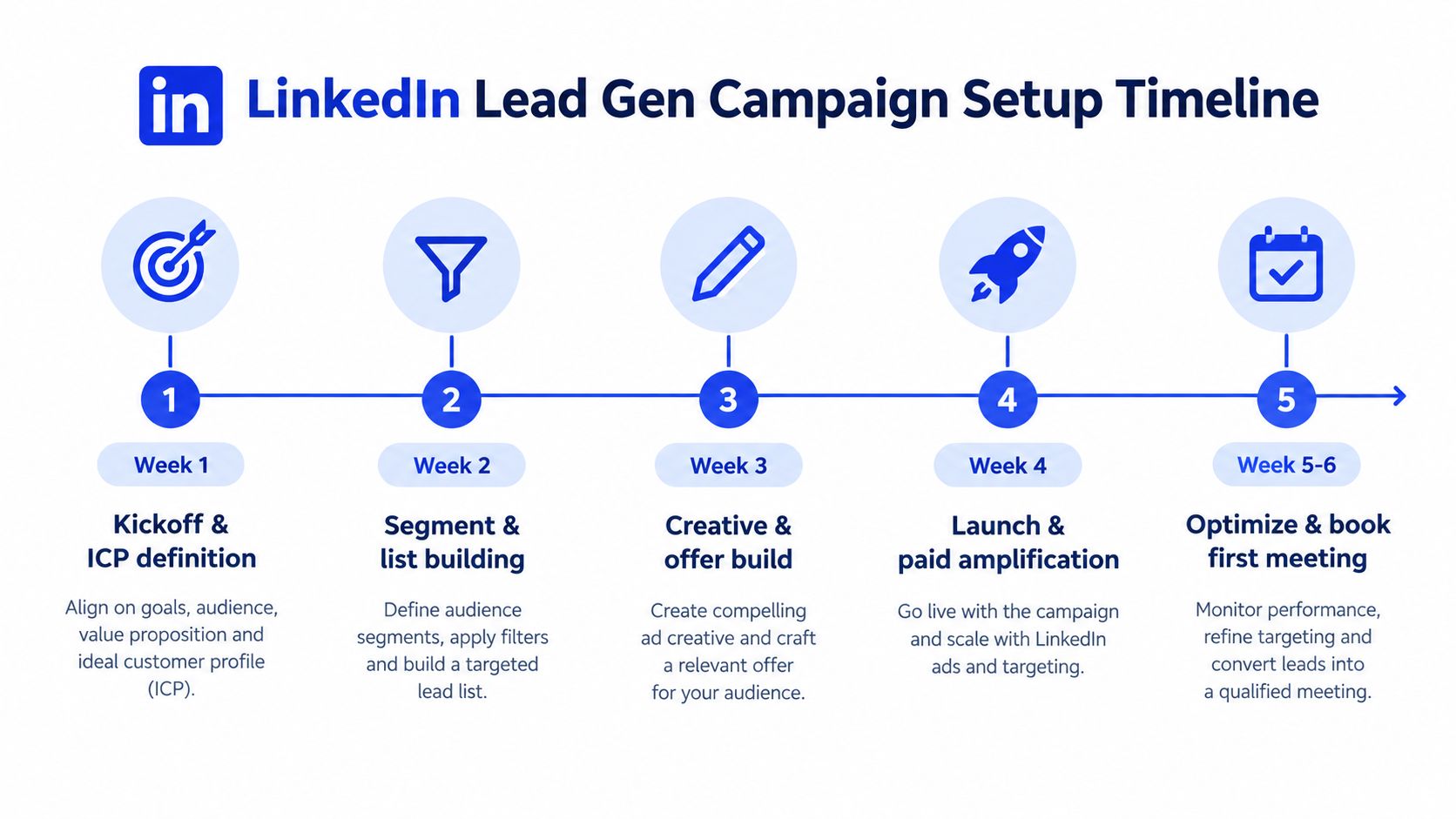
The LinkedIn lead generation campaign setup timeline
A rushed ad launch usually creates a measurement problem. The campaign goes live before the team agrees on the ICP, the form fields, the routing owner, or what counts as qualified. By the time sales objects, the audience has already consumed budget.
The setup should begin with an ICP workshop. Document target accounts, buying roles, exclusions, geographies, languages, urgency signals, offer fit, and the CRM fields required for handoff. Sales should approve the disqualification rules before marketing writes the ads.

From kickoff to the first qualified meeting
Week 1, kickoff and ICP definition. Confirm the audience and commercial problem. Sales, marketing, and RevOps should agree on the qualification gate, not merely the campaign objective.
Week 2, list and infrastructure. Build the account and contact lists, configure Sales Navigator, prepare inbox infrastructure, create landing pages where needed, and map the LinkedIn form to HubSpot. GROU's published setup process completes these elements within 14 days.
Week 3, creative and offer build. Create the content offer, proof points, ad variants, organic posts, connection notes, and follow-up messages. A legal tech audience may need a risk assessment, while a manufacturing audience may respond better to an operational benchmark.
Week 4, launch and paid amplification. Paid content builds familiarity while outbound starts conversations with the same segments. The first 30 days should generate replies, conversations, or clear learning signals, rather than a premature promise of mature pipeline.
Weeks 5 and 6, qualification and iteration. Route positive replies to sales quickly, sometimes before full qualification, so the seller can continue a live conversation. Keep a formal gate for reporting, because booked meetings and qualified meetings aren't interchangeable.
A six-month B2B SaaS program illustrates the ramp: months 1 and 2 produced 5 to 7 meetings each, month 3 produced 9 qualified meetings, month 4 produced 14, and qualified meetings later stabilized at 18 to 22 per month. Those results show why the operating rhythm matters more than a launch-day snapshot.
The GROU guide to running a lead generation pilot provides a useful companion for setting the test boundary. In practice, small changes happen daily from replies and objections. Structural changes, such as a new segment or channel mix, belong in a bi-weekly client sprint. Keep a variant live for at least 7 days before judging it, unless it creates an obvious compliance or deliverability issue.
Outbound message sequences and reply benchmarks
Outbound works when the list gives the message a reason to exist. A verified account list without role research still produces generic outreach, even when the copy sounds personalized.
The sequence should follow a controlled path:
Segment the account list: Group accounts by ICP fit and buying context before loading them into Apollo, Clay, or Sales Navigator.
Review the prospect: Check role, recent activity, company change, and business trigger.
Open without pitching: Send a short connection note that explains relevance rather than asking for a meeting immediately.
Provide one useful proof point: Share a specific resource, observation, or relevant outcome.
Apply the qualification gate: Route the reply when it meets the agreed sales criteria.
Directional benchmark data reports approximately 28.5% connection acceptance, 3.0% connection-note replies, and 10.4% post-connection message replies. B2B SaaS and technology accounts showed roughly 27.8% acceptance and 10.1% message replies in the same cited benchmark. (Traxy LinkedIn outbound benchmarks)
Those numbers shouldn't become quota targets. Market, list quality, sender credibility, and message timing shift the result. Measure acceptance, meaningful reply, qualified conversation, meeting held, opportunity created, and revenue in separate CRM fields.
Keep the sequence operational
Use Sales Navigator for role and account signals, Clay for enrichment and research, then select the sending layer according to your risk and workflow requirements. HeyReach supports LinkedIn-focused execution, while Lemlist, Instantly, Smartlead, and Apollo can support email components where the contact and compliance model allow it.
Tools don't fix a poor handoff. A positive response should create a task, owner, context record, and response expectation in HubSpot. If the sales team receives a reply without the original message, account notes, or qualification status, the sequence has created work rather than pipeline.
For teams assessing automation, a practical guide to AI SDR tools can help frame what should stay automated and what requires seller judgment. The B2B sequence touch-count analysis is also relevant when deciding how many touches your audience can tolerate.
Test by segment, not only by copy. Hold audience size and cadence constant, then compare the CEO segment against the IT segment, or casino operators against platform partners. That design tells you whether the message failed or whether the list was wrong.
How paid and organic follow the same segments
Paid and organic LinkedIn activity often gets split between different owners. Marketing promotes a company post to a broad audience, a founder publishes for peers, and sales contacts a list built from unrelated filters. Each activity may look reasonable in isolation, but the prospect receives disconnected signals.
One target list fixes the coordination problem. For T-2, organic LinkedIn content and promoted posts built trust with the same roles reached through outbound. The paid campaign supplied repeated context, the organic content supplied credibility, and the seller created the direct conversation.
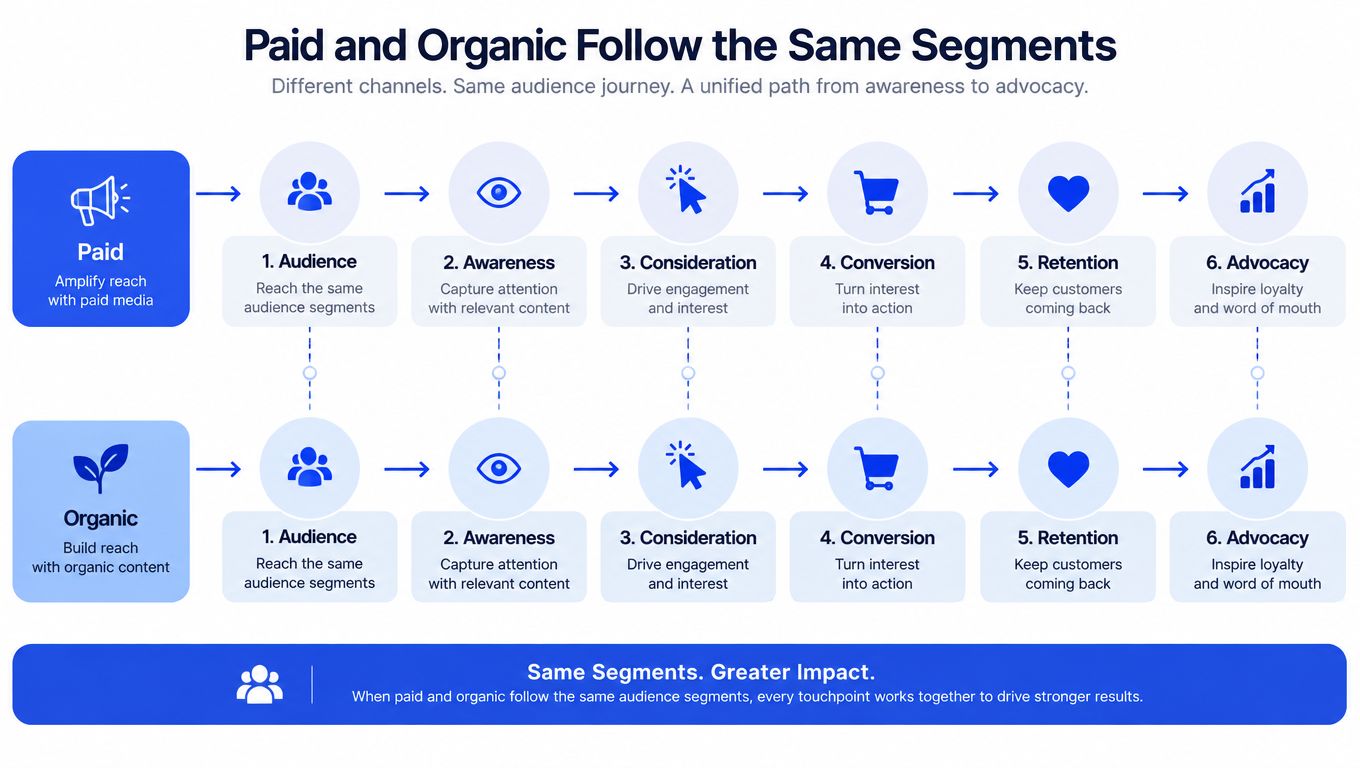
One message architecture, several executions
Start with a segment-specific commercial problem. Then adapt it across channels:
Organic content: Explain the problem through an operator's point of view, customer pattern, or practical diagnosis.
Paid distribution: Put the clearest evidence or resource in front of the selected account and role segment.
Outbound: Reference the same problem in a short, relevant opening message.
Retargeting: Change the ask after engagement, moving from education toward a qualification response or meeting.
Repeated exposure doesn't mean repeating the same ad. A 2025 benchmark summary reported that 78% of conversions occurred after at least three ad impressions, while separate 2025 reporting found thought-leadership ads achieved 2.3 times the CTR of standard ads. Creator video influenced purchasing decisions for 63% of surveyed B2B buyers. These are directional benchmark findings, not guarantees for every market. (Dreamdata LinkedIn benchmark summary)
Frequency needs control. Track assisted conversions, account engagement, response time, negative signals, and repeated exposure alongside last-click leads. A pharma executive may need evidence and internal alignment before responding, while an iGaming operator may react to a market or product trigger more quickly.
Creative also ages. In GROU's outbound data, subject-line open rates decline 8% to 12% per month as audiences become familiar with them, so several variants should remain in rotation and refresh every 4 to 6 weeks. Apply the same discipline to ad creative. When performance weakens, inspect targeting first. A new headline won't repair an audience built around the wrong buying role.
Native Lead Gen Forms versus external landing pages
For a downloadable report or event registration, native Lead Gen Forms usually create the cleaner first conversion. Reserve an external landing page for offers that need education, qualification, or detailed tracking before a prospect can submit.
Native forms remove typing and page-load friction. They suit benchmark reports, checklists, event registrations, and early content offers. LinkedIn's Lead Gen Forms partner guide reports that native forms can convert at up to five times the rate of traditional landing pages and reduce CPL by 40%. Treat those figures as directional, then validate them against accepted leads and meetings in your own segment.

Choose the conversion path based on the job
Connect each submission to HubSpot with the campaign, segment, offer, owner, and qualification fields. Use the same buying-role criteria in paid follow-up and outbound outreach. A finance leader reached through an ad should receive messaging consistent with the sequence sent to that account, not a separate definition of fit.
External pages earn their extra friction when prospects need a product demonstration, service explanation, security documentation, or multi-step qualification. They also give the team more control over page content and tracking. The page must repeat the ad's promise closely, or the added clicks become wasted demand.
As noted earlier, native Lead Gen Forms averaged $11.93 CPC in the benchmark data. Judge that cost against downstream performance: cost per accepted lead, meeting-held rate, opportunity creation, and revenue. A cheaper click is irrelevant if sales cannot identify or progress the contact.
Pipeline test: Compare cost per accepted lead and opportunity by form type. Do not shift budget on CPL alone.
GROU's reported Sportradar program evaluated paid acquisition across LinkedIn, Google, Reddit, RichAds, and 6sense by qualified output, producing 800+ qualified leads at €15 per lead, with 80% qualifying as SQLs. Caleffi's reported program across LinkedIn, Google Ads, and Facebook Ads produced 300 high-qualified leads, 8X traffic growth, and a 7X conversion increase. These client-specific results show why channel reporting should follow qualified pipeline, not isolated ad metrics.
The LinkedIn Lead Gen Forms playbook helps decide which fields belong in the form and which belong in follow-up. Use native forms for low-friction intent, external pages for informed qualification, and keep targeting consistent across ads, content, and outreach.
Next steps and how to audit your LinkedIn lead generation campaign
Audit the campaign from the meeting backward. Start with every LinkedIn-sourced meeting from the last cohort and mark whether it was held, whether the account met ICP rules, whether the buyer had a relevant role, and whether a real opportunity followed.
Then inspect the handoff. A form submission should have a source, campaign, segment, offer, owner, qualification status, and disqualification reason in HubSpot. A reply should preserve the original conversation and trigger a fast seller response. If those fields are missing, the dashboard can't explain performance.
The Friday audit
Use one working session to answer these questions:
Meeting quality: What proportion of booked meetings were held and accepted by sales?
Account fit: Which industries, company types, and account tiers produced accepted conversations?
Role fit: Which buying roles responded, attended, and created opportunities?
Offer fit: Did the content download, assessment, or meeting request attract the right level of intent?
Routing speed: How long did positive replies and form submissions wait before a human response?
Channel consistency: Are paid, organic, and outbound using the same target list and commercial language?
Pipeline view: Which segment produced the lowest cost per qualified opportunity, not just the lowest CPL?
Look for disqualification clusters. If many leads fail on geography, fix targeting. If they fail because they lack authority, split the buying-role campaigns. If they show interest but don't attend meetings, inspect the offer, calendar friction, and sales follow-up.
GROU's operating model uses daily campaign adjustments from replies, objections, and performance data, then larger bi-weekly sprints with the client. Shared Slack channels keep feedback close to execution, while the reporting line connects LinkedIn activity with qualification and pipeline. The agency operates globally across iGaming, SaaS, manufacturing, legal tech, and pharma, combining LinkedIn content, lead generation, and outbound in one system.
The next action doesn't require more budget. Export your last 10 LinkedIn-sourced meetings, add columns for meeting held, ICP fit, buying role, SQL status, opportunity created, and disqualification reason, then review the pattern with sales. After that, tighten the target list before adding spend.
GROU combines LinkedIn content, paid lead generation, and outbound around one ICP-aligned target list so attention has a clear path to qualified conversations. Visit Grou to review how its global team can audit your campaign, connect the CRM handoff, and run daily iteration with bi-weekly pipeline sprints.
Your LinkedIn lead generation campaign is producing form fills, but sales still says the leads are weak. Paid content targets one audience, outbound reaches another, and the CRM reports clicks instead of opportunities. That setup creates activity without a dependable pipeline.
Treat LinkedIn ads, organic content, and outbound as one motion built around one target list.
Segment by buying role, industry fit, market, language, and urgency.
Judge performance by qualified meetings, opportunities, and revenue, not CPL alone.
Route replies quickly, test by segment, and give each variant enough time to produce a signal.
Table of Contents
Why most LinkedIn lead generation campaigns fail before they scale
How to segment your audience by buying role and industry fit
Next steps and how to audit your LinkedIn lead generation campaign
Why most LinkedIn lead generation campaigns fail before they scale
In audits of B2B LinkedIn campaigns, the pattern repeats: volume looks healthy in the dashboard while sales rejects the cohort. The failure is a quality-control problem, not a lead-volume problem.
A broad audience downloads a report, LinkedIn records a conversion, and the marketing dashboard turns green. Sales then finds contacts without buying authority, outside the ICP, or facing no active problem. The campaign receives the blame, although the breakdown occurred after the form submission.
A 2025 benchmark dataset covering 138 B2B advertisers reported an average $9.39 CPC, a 0.67% CTR, and a $202 CPL. Native Lead Gen Form campaigns across 97 advertisers averaged $11.93 CPC, 0.61% CTR, and a 6.2% click-to-lead rate. Use those figures for planning, not as proof that contacts can become revenue. (Digital Applied's LinkedIn advertising benchmarks)
The funnel view sales needs
Marketing and sales need explicit gates at every handoff. Reported benchmark ranges indicate that 20% to 30% of leads become MQLs, 40% to 60% of MQLs become SQLs, and 20% to 30% of SQLs progress to opportunities. (LinkedIn funnel benchmark data)
Funnel stage | Average metric |
|---|---|
Click-through rate | 0.44% to 0.65% |
Native Lead Gen Form conversion from clicks | 6% to 10% |
External landing page conversion from clicks | 2% to 5% |
Leads becoming MQLs | 20% to 30% |
MQLs becoming SQLs | 40% to 60% |
SQLs becoming opportunities | 20% to 30% |
Your CRM should distinguish inquiry → MQL → sales-accepted lead → SQL → opportunity. Record disqualification reasons such as wrong geography, wrong company type, no project, student or job seeker, and no authority. These fields show whether the audience, offer, form, or follow-up caused the loss.
Practical rule: A low CPL is acceptable only when the resulting cohort creates qualified pipeline at an acceptable cost.
That standard matters in iGaming and pharma, where a narrow buying committee may be worth more than a large pool of curious contacts. It also applies in SaaS and legal tech, where a content download can show interest without showing urgency. Available 2025 benchmark reporting puts the average B2B buying cycle at about 210 days, with enterprise deals taking almost 50% longer. Campaign cohorts need time to mature before performance decisions are final. (Dreamdata benchmark reporting)
The Hooked resource for performance marketers provides practical context on demand capture mechanics. The operating requirement is straightforward: define quality rules before launch, connect submissions to HubSpot or another CRM, and align content, paid ads, and outbound around the same audience and buying signals. Report performance through opportunity creation, not form activity alone.
How to segment your audience by buying role and industry fit
Company size is a weak first cut. Buying role is stronger. A CEO, COO, CIO, and IT decision-maker may work at the same company, yet each person evaluates risk, urgency, and proof differently.
For T-2's cybersecurity solutions, separate campaigns targeted CEOs, COOs, CIOs, and IT decision-makers. The average reply rate was 11.8%, while the IT segment reached 19.2%. Those figures came from the program's own reported results, so they should guide segment allocation rather than serve as a universal benchmark.
Four layers for campaign segmentation
Buying role: Separate economic buyers, operational owners, technical evaluators, and influencers. A CIO may care about governance and integration, while an IT leader may respond to implementation risk.
Buyer type within the industry: Casino operators, gaming floor managers, and procurement decision-makers need different messages. Spintec required one set of audience logic, while Bullshark Games needed campaigns for operators, aggregators, and platform partners. The industry label stayed similar, but the commercial context changed.
Market and language: Geography isn't only a location field. Language, regulatory context, and local buying habits affect response. EY outreach conducted in Slovenian to a precise invitee list reportedly reached a 62.3% LinkedIn acceptance rate.
Fit and urgency: Lock inclusion and exclusion rules before scaling. In the Joan program, 489 conversations and 57 interested leads exposed where ICP fit and pain urgency needed tightening before more budget was added.
Create separate lists for distinct roles, then carry those lists into Campaign Manager, Sales Navigator, HubSpot, and outbound tools such as HeyReach. Your content calendar should use the same segmentation, so a promoted post doesn't discuss technical risk while the seller opens with procurement savings.
The ICP framework from GROU is a useful reference for documenting fit before audience creation. For adjacent outreach workflows, review these converting email marketing tactics, then decide which channel carries the first message and which one supplies reinforcement.
The same architecture works across SaaS, manufacturing, legal tech, and pharma, but the evidence changes. Use job function and seniority as starting signals, then refine with account lists, business triggers, and the role's place in the buying committee.
The LinkedIn lead generation campaign setup timeline
A rushed ad launch usually creates a measurement problem. The campaign goes live before the team agrees on the ICP, the form fields, the routing owner, or what counts as qualified. By the time sales objects, the audience has already consumed budget.
The setup should begin with an ICP workshop. Document target accounts, buying roles, exclusions, geographies, languages, urgency signals, offer fit, and the CRM fields required for handoff. Sales should approve the disqualification rules before marketing writes the ads.
From kickoff to the first qualified meeting
Week 1, kickoff and ICP definition. Confirm the audience and commercial problem. Sales, marketing, and RevOps should agree on the qualification gate, not merely the campaign objective.
Week 2, list and infrastructure. Build the account and contact lists, configure Sales Navigator, prepare inbox infrastructure, create landing pages where needed, and map the LinkedIn form to HubSpot. GROU's published setup process completes these elements within 14 days.
Week 3, creative and offer build. Create the content offer, proof points, ad variants, organic posts, connection notes, and follow-up messages. A legal tech audience may need a risk assessment, while a manufacturing audience may respond better to an operational benchmark.
Week 4, launch and paid amplification. Paid content builds familiarity while outbound starts conversations with the same segments. The first 30 days should generate replies, conversations, or clear learning signals, rather than a premature promise of mature pipeline.
Weeks 5 and 6, qualification and iteration. Route positive replies to sales quickly, sometimes before full qualification, so the seller can continue a live conversation. Keep a formal gate for reporting, because booked meetings and qualified meetings aren't interchangeable.
A six-month B2B SaaS program illustrates the ramp: months 1 and 2 produced 5 to 7 meetings each, month 3 produced 9 qualified meetings, month 4 produced 14, and qualified meetings later stabilized at 18 to 22 per month. Those results show why the operating rhythm matters more than a launch-day snapshot.
The GROU guide to running a lead generation pilot provides a useful companion for setting the test boundary. In practice, small changes happen daily from replies and objections. Structural changes, such as a new segment or channel mix, belong in a bi-weekly client sprint. Keep a variant live for at least 7 days before judging it, unless it creates an obvious compliance or deliverability issue.
Outbound message sequences and reply benchmarks
Outbound works when the list gives the message a reason to exist. A verified account list without role research still produces generic outreach, even when the copy sounds personalized.
The sequence should follow a controlled path:
Segment the account list: Group accounts by ICP fit and buying context before loading them into Apollo, Clay, or Sales Navigator.
Review the prospect: Check role, recent activity, company change, and business trigger.
Open without pitching: Send a short connection note that explains relevance rather than asking for a meeting immediately.
Provide one useful proof point: Share a specific resource, observation, or relevant outcome.
Apply the qualification gate: Route the reply when it meets the agreed sales criteria.
Directional benchmark data reports approximately 28.5% connection acceptance, 3.0% connection-note replies, and 10.4% post-connection message replies. B2B SaaS and technology accounts showed roughly 27.8% acceptance and 10.1% message replies in the same cited benchmark. (Traxy LinkedIn outbound benchmarks)
Those numbers shouldn't become quota targets. Market, list quality, sender credibility, and message timing shift the result. Measure acceptance, meaningful reply, qualified conversation, meeting held, opportunity created, and revenue in separate CRM fields.
Keep the sequence operational
Use Sales Navigator for role and account signals, Clay for enrichment and research, then select the sending layer according to your risk and workflow requirements. HeyReach supports LinkedIn-focused execution, while Lemlist, Instantly, Smartlead, and Apollo can support email components where the contact and compliance model allow it.
Tools don't fix a poor handoff. A positive response should create a task, owner, context record, and response expectation in HubSpot. If the sales team receives a reply without the original message, account notes, or qualification status, the sequence has created work rather than pipeline.
For teams assessing automation, a practical guide to AI SDR tools can help frame what should stay automated and what requires seller judgment. The B2B sequence touch-count analysis is also relevant when deciding how many touches your audience can tolerate.
Test by segment, not only by copy. Hold audience size and cadence constant, then compare the CEO segment against the IT segment, or casino operators against platform partners. That design tells you whether the message failed or whether the list was wrong.
How paid and organic follow the same segments
Paid and organic LinkedIn activity often gets split between different owners. Marketing promotes a company post to a broad audience, a founder publishes for peers, and sales contacts a list built from unrelated filters. Each activity may look reasonable in isolation, but the prospect receives disconnected signals.
One target list fixes the coordination problem. For T-2, organic LinkedIn content and promoted posts built trust with the same roles reached through outbound. The paid campaign supplied repeated context, the organic content supplied credibility, and the seller created the direct conversation.
One message architecture, several executions
Start with a segment-specific commercial problem. Then adapt it across channels:
Organic content: Explain the problem through an operator's point of view, customer pattern, or practical diagnosis.
Paid distribution: Put the clearest evidence or resource in front of the selected account and role segment.
Outbound: Reference the same problem in a short, relevant opening message.
Retargeting: Change the ask after engagement, moving from education toward a qualification response or meeting.
Repeated exposure doesn't mean repeating the same ad. A 2025 benchmark summary reported that 78% of conversions occurred after at least three ad impressions, while separate 2025 reporting found thought-leadership ads achieved 2.3 times the CTR of standard ads. Creator video influenced purchasing decisions for 63% of surveyed B2B buyers. These are directional benchmark findings, not guarantees for every market. (Dreamdata LinkedIn benchmark summary)
Frequency needs control. Track assisted conversions, account engagement, response time, negative signals, and repeated exposure alongside last-click leads. A pharma executive may need evidence and internal alignment before responding, while an iGaming operator may react to a market or product trigger more quickly.
Creative also ages. In GROU's outbound data, subject-line open rates decline 8% to 12% per month as audiences become familiar with them, so several variants should remain in rotation and refresh every 4 to 6 weeks. Apply the same discipline to ad creative. When performance weakens, inspect targeting first. A new headline won't repair an audience built around the wrong buying role.
Native Lead Gen Forms versus external landing pages
For a downloadable report or event registration, native Lead Gen Forms usually create the cleaner first conversion. Reserve an external landing page for offers that need education, qualification, or detailed tracking before a prospect can submit.
Native forms remove typing and page-load friction. They suit benchmark reports, checklists, event registrations, and early content offers. LinkedIn's Lead Gen Forms partner guide reports that native forms can convert at up to five times the rate of traditional landing pages and reduce CPL by 40%. Treat those figures as directional, then validate them against accepted leads and meetings in your own segment.
Choose the conversion path based on the job
Connect each submission to HubSpot with the campaign, segment, offer, owner, and qualification fields. Use the same buying-role criteria in paid follow-up and outbound outreach. A finance leader reached through an ad should receive messaging consistent with the sequence sent to that account, not a separate definition of fit.
External pages earn their extra friction when prospects need a product demonstration, service explanation, security documentation, or multi-step qualification. They also give the team more control over page content and tracking. The page must repeat the ad's promise closely, or the added clicks become wasted demand.
As noted earlier, native Lead Gen Forms averaged $11.93 CPC in the benchmark data. Judge that cost against downstream performance: cost per accepted lead, meeting-held rate, opportunity creation, and revenue. A cheaper click is irrelevant if sales cannot identify or progress the contact.
Pipeline test: Compare cost per accepted lead and opportunity by form type. Do not shift budget on CPL alone.
GROU's reported Sportradar program evaluated paid acquisition across LinkedIn, Google, Reddit, RichAds, and 6sense by qualified output, producing 800+ qualified leads at €15 per lead, with 80% qualifying as SQLs. Caleffi's reported program across LinkedIn, Google Ads, and Facebook Ads produced 300 high-qualified leads, 8X traffic growth, and a 7X conversion increase. These client-specific results show why channel reporting should follow qualified pipeline, not isolated ad metrics.
The LinkedIn Lead Gen Forms playbook helps decide which fields belong in the form and which belong in follow-up. Use native forms for low-friction intent, external pages for informed qualification, and keep targeting consistent across ads, content, and outreach.
Next steps and how to audit your LinkedIn lead generation campaign
Audit the campaign from the meeting backward. Start with every LinkedIn-sourced meeting from the last cohort and mark whether it was held, whether the account met ICP rules, whether the buyer had a relevant role, and whether a real opportunity followed.
Then inspect the handoff. A form submission should have a source, campaign, segment, offer, owner, qualification status, and disqualification reason in HubSpot. A reply should preserve the original conversation and trigger a fast seller response. If those fields are missing, the dashboard can't explain performance.
The Friday audit
Use one working session to answer these questions:
Meeting quality: What proportion of booked meetings were held and accepted by sales?
Account fit: Which industries, company types, and account tiers produced accepted conversations?
Role fit: Which buying roles responded, attended, and created opportunities?
Offer fit: Did the content download, assessment, or meeting request attract the right level of intent?
Routing speed: How long did positive replies and form submissions wait before a human response?
Channel consistency: Are paid, organic, and outbound using the same target list and commercial language?
Pipeline view: Which segment produced the lowest cost per qualified opportunity, not just the lowest CPL?
Look for disqualification clusters. If many leads fail on geography, fix targeting. If they fail because they lack authority, split the buying-role campaigns. If they show interest but don't attend meetings, inspect the offer, calendar friction, and sales follow-up.
GROU's operating model uses daily campaign adjustments from replies, objections, and performance data, then larger bi-weekly sprints with the client. Shared Slack channels keep feedback close to execution, while the reporting line connects LinkedIn activity with qualification and pipeline. The agency operates globally across iGaming, SaaS, manufacturing, legal tech, and pharma, combining LinkedIn content, lead generation, and outbound in one system.
The next action doesn't require more budget. Export your last 10 LinkedIn-sourced meetings, add columns for meeting held, ICP fit, buying role, SQL status, opportunity created, and disqualification reason, then review the pattern with sales. After that, tighten the target list before adding spend.
GROU combines LinkedIn content, paid lead generation, and outbound around one ICP-aligned target list so attention has a clear path to qualified conversations. Visit Grou to review how its global team can audit your campaign, connect the CRM handoff, and run daily iteration with bi-weekly pipeline sprints.
Your LinkedIn lead generation campaign is producing form fills, but sales still says the leads are weak. Paid content targets one audience, outbound reaches another, and the CRM reports clicks instead of opportunities. That setup creates activity without a dependable pipeline.
Treat LinkedIn ads, organic content, and outbound as one motion built around one target list.
Segment by buying role, industry fit, market, language, and urgency.
Judge performance by qualified meetings, opportunities, and revenue, not CPL alone.
Route replies quickly, test by segment, and give each variant enough time to produce a signal.
Table of Contents
Why most LinkedIn lead generation campaigns fail before they scale
How to segment your audience by buying role and industry fit
Next steps and how to audit your LinkedIn lead generation campaign
Why most LinkedIn lead generation campaigns fail before they scale
In audits of B2B LinkedIn campaigns, the pattern repeats: volume looks healthy in the dashboard while sales rejects the cohort. The failure is a quality-control problem, not a lead-volume problem.
A broad audience downloads a report, LinkedIn records a conversion, and the marketing dashboard turns green. Sales then finds contacts without buying authority, outside the ICP, or facing no active problem. The campaign receives the blame, although the breakdown occurred after the form submission.
A 2025 benchmark dataset covering 138 B2B advertisers reported an average $9.39 CPC, a 0.67% CTR, and a $202 CPL. Native Lead Gen Form campaigns across 97 advertisers averaged $11.93 CPC, 0.61% CTR, and a 6.2% click-to-lead rate. Use those figures for planning, not as proof that contacts can become revenue. (Digital Applied's LinkedIn advertising benchmarks)
The funnel view sales needs
Marketing and sales need explicit gates at every handoff. Reported benchmark ranges indicate that 20% to 30% of leads become MQLs, 40% to 60% of MQLs become SQLs, and 20% to 30% of SQLs progress to opportunities. (LinkedIn funnel benchmark data)
Funnel stage | Average metric |
|---|---|
Click-through rate | 0.44% to 0.65% |
Native Lead Gen Form conversion from clicks | 6% to 10% |
External landing page conversion from clicks | 2% to 5% |
Leads becoming MQLs | 20% to 30% |
MQLs becoming SQLs | 40% to 60% |
SQLs becoming opportunities | 20% to 30% |
Your CRM should distinguish inquiry → MQL → sales-accepted lead → SQL → opportunity. Record disqualification reasons such as wrong geography, wrong company type, no project, student or job seeker, and no authority. These fields show whether the audience, offer, form, or follow-up caused the loss.
Practical rule: A low CPL is acceptable only when the resulting cohort creates qualified pipeline at an acceptable cost.
That standard matters in iGaming and pharma, where a narrow buying committee may be worth more than a large pool of curious contacts. It also applies in SaaS and legal tech, where a content download can show interest without showing urgency. Available 2025 benchmark reporting puts the average B2B buying cycle at about 210 days, with enterprise deals taking almost 50% longer. Campaign cohorts need time to mature before performance decisions are final. (Dreamdata benchmark reporting)
The Hooked resource for performance marketers provides practical context on demand capture mechanics. The operating requirement is straightforward: define quality rules before launch, connect submissions to HubSpot or another CRM, and align content, paid ads, and outbound around the same audience and buying signals. Report performance through opportunity creation, not form activity alone.
How to segment your audience by buying role and industry fit
Company size is a weak first cut. Buying role is stronger. A CEO, COO, CIO, and IT decision-maker may work at the same company, yet each person evaluates risk, urgency, and proof differently.
For T-2's cybersecurity solutions, separate campaigns targeted CEOs, COOs, CIOs, and IT decision-makers. The average reply rate was 11.8%, while the IT segment reached 19.2%. Those figures came from the program's own reported results, so they should guide segment allocation rather than serve as a universal benchmark.
Four layers for campaign segmentation
Buying role: Separate economic buyers, operational owners, technical evaluators, and influencers. A CIO may care about governance and integration, while an IT leader may respond to implementation risk.
Buyer type within the industry: Casino operators, gaming floor managers, and procurement decision-makers need different messages. Spintec required one set of audience logic, while Bullshark Games needed campaigns for operators, aggregators, and platform partners. The industry label stayed similar, but the commercial context changed.
Market and language: Geography isn't only a location field. Language, regulatory context, and local buying habits affect response. EY outreach conducted in Slovenian to a precise invitee list reportedly reached a 62.3% LinkedIn acceptance rate.
Fit and urgency: Lock inclusion and exclusion rules before scaling. In the Joan program, 489 conversations and 57 interested leads exposed where ICP fit and pain urgency needed tightening before more budget was added.
Create separate lists for distinct roles, then carry those lists into Campaign Manager, Sales Navigator, HubSpot, and outbound tools such as HeyReach. Your content calendar should use the same segmentation, so a promoted post doesn't discuss technical risk while the seller opens with procurement savings.
The ICP framework from GROU is a useful reference for documenting fit before audience creation. For adjacent outreach workflows, review these converting email marketing tactics, then decide which channel carries the first message and which one supplies reinforcement.
The same architecture works across SaaS, manufacturing, legal tech, and pharma, but the evidence changes. Use job function and seniority as starting signals, then refine with account lists, business triggers, and the role's place in the buying committee.
The LinkedIn lead generation campaign setup timeline
A rushed ad launch usually creates a measurement problem. The campaign goes live before the team agrees on the ICP, the form fields, the routing owner, or what counts as qualified. By the time sales objects, the audience has already consumed budget.
The setup should begin with an ICP workshop. Document target accounts, buying roles, exclusions, geographies, languages, urgency signals, offer fit, and the CRM fields required for handoff. Sales should approve the disqualification rules before marketing writes the ads.
From kickoff to the first qualified meeting
Week 1, kickoff and ICP definition. Confirm the audience and commercial problem. Sales, marketing, and RevOps should agree on the qualification gate, not merely the campaign objective.
Week 2, list and infrastructure. Build the account and contact lists, configure Sales Navigator, prepare inbox infrastructure, create landing pages where needed, and map the LinkedIn form to HubSpot. GROU's published setup process completes these elements within 14 days.
Week 3, creative and offer build. Create the content offer, proof points, ad variants, organic posts, connection notes, and follow-up messages. A legal tech audience may need a risk assessment, while a manufacturing audience may respond better to an operational benchmark.
Week 4, launch and paid amplification. Paid content builds familiarity while outbound starts conversations with the same segments. The first 30 days should generate replies, conversations, or clear learning signals, rather than a premature promise of mature pipeline.
Weeks 5 and 6, qualification and iteration. Route positive replies to sales quickly, sometimes before full qualification, so the seller can continue a live conversation. Keep a formal gate for reporting, because booked meetings and qualified meetings aren't interchangeable.
A six-month B2B SaaS program illustrates the ramp: months 1 and 2 produced 5 to 7 meetings each, month 3 produced 9 qualified meetings, month 4 produced 14, and qualified meetings later stabilized at 18 to 22 per month. Those results show why the operating rhythm matters more than a launch-day snapshot.
The GROU guide to running a lead generation pilot provides a useful companion for setting the test boundary. In practice, small changes happen daily from replies and objections. Structural changes, such as a new segment or channel mix, belong in a bi-weekly client sprint. Keep a variant live for at least 7 days before judging it, unless it creates an obvious compliance or deliverability issue.
Outbound message sequences and reply benchmarks
Outbound works when the list gives the message a reason to exist. A verified account list without role research still produces generic outreach, even when the copy sounds personalized.
The sequence should follow a controlled path:
Segment the account list: Group accounts by ICP fit and buying context before loading them into Apollo, Clay, or Sales Navigator.
Review the prospect: Check role, recent activity, company change, and business trigger.
Open without pitching: Send a short connection note that explains relevance rather than asking for a meeting immediately.
Provide one useful proof point: Share a specific resource, observation, or relevant outcome.
Apply the qualification gate: Route the reply when it meets the agreed sales criteria.
Directional benchmark data reports approximately 28.5% connection acceptance, 3.0% connection-note replies, and 10.4% post-connection message replies. B2B SaaS and technology accounts showed roughly 27.8% acceptance and 10.1% message replies in the same cited benchmark. (Traxy LinkedIn outbound benchmarks)
Those numbers shouldn't become quota targets. Market, list quality, sender credibility, and message timing shift the result. Measure acceptance, meaningful reply, qualified conversation, meeting held, opportunity created, and revenue in separate CRM fields.
Keep the sequence operational
Use Sales Navigator for role and account signals, Clay for enrichment and research, then select the sending layer according to your risk and workflow requirements. HeyReach supports LinkedIn-focused execution, while Lemlist, Instantly, Smartlead, and Apollo can support email components where the contact and compliance model allow it.
Tools don't fix a poor handoff. A positive response should create a task, owner, context record, and response expectation in HubSpot. If the sales team receives a reply without the original message, account notes, or qualification status, the sequence has created work rather than pipeline.
For teams assessing automation, a practical guide to AI SDR tools can help frame what should stay automated and what requires seller judgment. The B2B sequence touch-count analysis is also relevant when deciding how many touches your audience can tolerate.
Test by segment, not only by copy. Hold audience size and cadence constant, then compare the CEO segment against the IT segment, or casino operators against platform partners. That design tells you whether the message failed or whether the list was wrong.
How paid and organic follow the same segments
Paid and organic LinkedIn activity often gets split between different owners. Marketing promotes a company post to a broad audience, a founder publishes for peers, and sales contacts a list built from unrelated filters. Each activity may look reasonable in isolation, but the prospect receives disconnected signals.
One target list fixes the coordination problem. For T-2, organic LinkedIn content and promoted posts built trust with the same roles reached through outbound. The paid campaign supplied repeated context, the organic content supplied credibility, and the seller created the direct conversation.
One message architecture, several executions
Start with a segment-specific commercial problem. Then adapt it across channels:
Organic content: Explain the problem through an operator's point of view, customer pattern, or practical diagnosis.
Paid distribution: Put the clearest evidence or resource in front of the selected account and role segment.
Outbound: Reference the same problem in a short, relevant opening message.
Retargeting: Change the ask after engagement, moving from education toward a qualification response or meeting.
Repeated exposure doesn't mean repeating the same ad. A 2025 benchmark summary reported that 78% of conversions occurred after at least three ad impressions, while separate 2025 reporting found thought-leadership ads achieved 2.3 times the CTR of standard ads. Creator video influenced purchasing decisions for 63% of surveyed B2B buyers. These are directional benchmark findings, not guarantees for every market. (Dreamdata LinkedIn benchmark summary)
Frequency needs control. Track assisted conversions, account engagement, response time, negative signals, and repeated exposure alongside last-click leads. A pharma executive may need evidence and internal alignment before responding, while an iGaming operator may react to a market or product trigger more quickly.
Creative also ages. In GROU's outbound data, subject-line open rates decline 8% to 12% per month as audiences become familiar with them, so several variants should remain in rotation and refresh every 4 to 6 weeks. Apply the same discipline to ad creative. When performance weakens, inspect targeting first. A new headline won't repair an audience built around the wrong buying role.
Native Lead Gen Forms versus external landing pages
For a downloadable report or event registration, native Lead Gen Forms usually create the cleaner first conversion. Reserve an external landing page for offers that need education, qualification, or detailed tracking before a prospect can submit.
Native forms remove typing and page-load friction. They suit benchmark reports, checklists, event registrations, and early content offers. LinkedIn's Lead Gen Forms partner guide reports that native forms can convert at up to five times the rate of traditional landing pages and reduce CPL by 40%. Treat those figures as directional, then validate them against accepted leads and meetings in your own segment.
Choose the conversion path based on the job
Connect each submission to HubSpot with the campaign, segment, offer, owner, and qualification fields. Use the same buying-role criteria in paid follow-up and outbound outreach. A finance leader reached through an ad should receive messaging consistent with the sequence sent to that account, not a separate definition of fit.
External pages earn their extra friction when prospects need a product demonstration, service explanation, security documentation, or multi-step qualification. They also give the team more control over page content and tracking. The page must repeat the ad's promise closely, or the added clicks become wasted demand.
As noted earlier, native Lead Gen Forms averaged $11.93 CPC in the benchmark data. Judge that cost against downstream performance: cost per accepted lead, meeting-held rate, opportunity creation, and revenue. A cheaper click is irrelevant if sales cannot identify or progress the contact.
Pipeline test: Compare cost per accepted lead and opportunity by form type. Do not shift budget on CPL alone.
GROU's reported Sportradar program evaluated paid acquisition across LinkedIn, Google, Reddit, RichAds, and 6sense by qualified output, producing 800+ qualified leads at €15 per lead, with 80% qualifying as SQLs. Caleffi's reported program across LinkedIn, Google Ads, and Facebook Ads produced 300 high-qualified leads, 8X traffic growth, and a 7X conversion increase. These client-specific results show why channel reporting should follow qualified pipeline, not isolated ad metrics.
The LinkedIn Lead Gen Forms playbook helps decide which fields belong in the form and which belong in follow-up. Use native forms for low-friction intent, external pages for informed qualification, and keep targeting consistent across ads, content, and outreach.
Next steps and how to audit your LinkedIn lead generation campaign
Audit the campaign from the meeting backward. Start with every LinkedIn-sourced meeting from the last cohort and mark whether it was held, whether the account met ICP rules, whether the buyer had a relevant role, and whether a real opportunity followed.
Then inspect the handoff. A form submission should have a source, campaign, segment, offer, owner, qualification status, and disqualification reason in HubSpot. A reply should preserve the original conversation and trigger a fast seller response. If those fields are missing, the dashboard can't explain performance.
The Friday audit
Use one working session to answer these questions:
Meeting quality: What proportion of booked meetings were held and accepted by sales?
Account fit: Which industries, company types, and account tiers produced accepted conversations?
Role fit: Which buying roles responded, attended, and created opportunities?
Offer fit: Did the content download, assessment, or meeting request attract the right level of intent?
Routing speed: How long did positive replies and form submissions wait before a human response?
Channel consistency: Are paid, organic, and outbound using the same target list and commercial language?
Pipeline view: Which segment produced the lowest cost per qualified opportunity, not just the lowest CPL?
Look for disqualification clusters. If many leads fail on geography, fix targeting. If they fail because they lack authority, split the buying-role campaigns. If they show interest but don't attend meetings, inspect the offer, calendar friction, and sales follow-up.
GROU's operating model uses daily campaign adjustments from replies, objections, and performance data, then larger bi-weekly sprints with the client. Shared Slack channels keep feedback close to execution, while the reporting line connects LinkedIn activity with qualification and pipeline. The agency operates globally across iGaming, SaaS, manufacturing, legal tech, and pharma, combining LinkedIn content, lead generation, and outbound in one system.
The next action doesn't require more budget. Export your last 10 LinkedIn-sourced meetings, add columns for meeting held, ICP fit, buying role, SQL status, opportunity created, and disqualification reason, then review the pattern with sales. After that, tighten the target list before adding spend.
GROU combines LinkedIn content, paid lead generation, and outbound around one ICP-aligned target list so attention has a clear path to qualified conversations. Visit Grou to review how its global team can audit your campaign, connect the CRM handoff, and run daily iteration with bi-weekly pipeline sprints.
Pipeline OS Newsletter
Build qualified pipeline
Get weekly tactics to generate demand, improve lead quality, and book more meetings.





Trusted by industry leaders
Trusted by industry leaders
Trusted by industry leaders
Ready to build qualified pipeline?
Ready to build qualified pipeline?
Ready to build qualified pipeline?
Book a call to see if we're the right fit, or take the 2-minute quiz to get a clear starting point.
Book a call to see if we're the right fit, or take the 2-minute quiz to get a clear starting point.
Book a call to see if we're the right fit, or take the 2-minute quiz to get a clear starting point.
" height="30.21639343089746px" id="hfGbXmQR2" width="30.216393430897455px"/></svg>)
Copyright © 2026 – All Right Reserved
Copyright © 2026 – All Right Reserved
Copyright © 2026 – All Right Reserved