%22%3E%3C/path%3E%3Cpath d=%22M 63.072 7.554 C 62.258 8.022 61.577 8.689 61.092 9.493 L 61.092 7.076 L 57.158 7.076 L 57.158 22.64 L 61.089 22.64 L 61.089 14.888 C 61.089 13.446 61.403 12.434 62.03 11.853 C 62.818 11.218 63.818 10.907 64.826 10.982 L 65.868 10.982 L 65.868 6.851 C 64.891 6.834 63.926 7.076 63.073 7.554 Z%22 fill=%22rgb(17,17,17)%22%3E%3C/path%3E%3Cpath d=%22M 78.916 7.82 C 76.363 6.49 73.321 6.49 70.768 7.82 C 69.562 8.473 68.564 9.451 67.888 10.644 C 67.167 11.931 66.803 13.387 66.834 14.862 C 66.804 16.332 67.157 17.785 67.86 19.077 C 68.515 20.267 69.494 21.246 70.684 21.901 C 71.924 22.576 73.318 22.92 74.73 22.898 C 76.164 22.918 77.58 22.575 78.846 21.901 C 80.062 21.247 81.073 20.27 81.768 19.077 C 82.506 17.797 82.88 16.339 82.85 14.862 C 82.88 13.389 82.517 11.934 81.797 10.647 C 81.12 9.455 80.122 8.477 78.917 7.824 M 78.803 14.862 C 78.829 15.739 78.636 16.608 78.241 17.391 C 77.903 18.046 77.38 18.588 76.738 18.95 C 76.124 19.293 75.432 19.472 74.729 19.47 C 73.668 19.497 72.648 19.061 71.934 18.276 C 71.139 17.323 70.741 16.1 70.823 14.862 C 70.741 13.62 71.149 12.395 71.959 11.45 C 72.687 10.667 73.715 10.233 74.783 10.256 C 75.859 10.236 76.894 10.67 77.635 11.45 C 78.464 12.387 78.884 13.616 78.801 14.864%22 fill=%22rgb(17,17,17)%22%3E%3C/path%3E%3Cpath d=%22M 95.906 7.076 L 95.906 15.646 C 95.975 16.68 95.643 17.701 94.979 18.498 C 94.311 19.184 93.379 19.547 92.422 19.495 C 91.475 19.544 90.553 19.18 89.894 18.498 C 89.23 17.701 88.898 16.68 88.967 15.646 L 88.967 7.076 L 85.033 7.076 L 85.033 16.207 C 85 17.449 85.275 18.68 85.834 19.79 C 86.327 20.75 87.095 21.542 88.039 22.065 C 89.033 22.594 90.145 22.861 91.271 22.838 C 92.188 22.847 93.095 22.65 93.926 22.263 C 94.708 21.905 95.388 21.36 95.906 20.675 L 95.906 22.645 L 99.865 22.645 L 99.865 7.076 Z%22 fill=%22rgb(17,17,17)%22%3E%3C/path%3E%3Cpath d=%22M 4.513 15.626 C 4.511 10.815 7.606 6.549 12.181 5.059 C 16.756 3.57 21.77 5.195 24.601 9.086 L 27.816 5.87 C 24.074 1.186 17.981 -0.943 12.137 0.393 C 6.292 1.728 1.728 6.292 0.393 12.137 C -0.943 17.981 1.186 24.074 5.87 27.816 L 9.085 24.601 C 6.214 22.512 4.515 19.177 4.513 15.626%22 fill=%22rgb(32,62,235)%22%3E%3C/path%3E%3Cpath d=%22M 17.114 14.343 L 13.354 18.01 L 13.354 18.026 L 21.071 18.026 L 11.412 27.609 L 17.389 27.609 L 23.999 21.081 L 23.999 28.316 L 24.005 28.316 L 27.967 24.393 L 27.967 14.343 Z%22 fill=%22rgb(32,62,235)%22%3E%3C/path%3E%3C/g%3E%3C/svg%3E) ×
× ××
××›
›
›
›
How many touches a B2B sequence needs 2026
How many touches a B2B sequence needs 2026
How many touches a B2B sequence needs 2026
How many touches a B2B sequence needs 2026
How many touches a B2B sequence needs 2026
How many touches a B2B sequence needs 2026

Author
Aljaz Peklaj

Nobody can tell you the right number of touches, and the people who quote one are quoting a survey run by a company that sells sequencing software.
What can be established is the ceiling. Your sequence length is capped by arithmetic you can do from published prices and published platform rules, and once you have run that arithmetic the question mostly answers itself.
TL;DR
Start from the constraint rather than the benchmark. On Instantly's published plans, Growth at $47 a month gives 1,000 uploaded contacts and 5,000 emails a month, which is exactly one five-touch sequence to a thousand people, and the contact limit is fixed across all campaigns rather than monthly. Hyper Growth at $97 gives 25,000 contacts and 125,000 emails, which drops the cost per thousand emails from $9.40 to $0.78, a twelvefold reduction. Above that the ladder is linear: Hyper Growth plus three add-ons at $87 each comes to $358 for 500,000 emails and 100,000 contacts, which is precisely the Light Speed plan, so there is no further volume discount to find. On the LinkedIn side HeyReach prices by sender at $79 a month, or $63 on annual billing, so each additional touch stream costs a seat rather than a credit. And Google's sender rules cap the whole thing: anyone sending more than 5,000 messages a day to Gmail must hold spam rates below 0.30%. More touches raise that risk, which is the real reason to stop adding them.
The benchmark you were looking for does not exist
No published, independent figure sets the optimal touch count. Every number in circulation, whether it is five, eight or twelve, traces back to a vendor survey with an undisclosed sample or to an agency describing its own book.
Nor could one exist in a useful form. The right number depends on how well the list is targeted, how many channels you run, how long the buying cycle is, and how good the message is, and no average survives that much variation.
We publish no reply rate, meeting rate or open rate benchmark anywhere in this article. That is not a gap, it is the point.
What is publishable is the arithmetic. Touches multiplied by prospects gives sends. Sends divided by capacity gives days. Capacity has a published price and a published legal ceiling, and both are checkable.
So the useful question changes. Not how many touches work, but how many your list quality, your capacity and your risk tolerance actually allow.
What actually caps the number

The contact limit, which is not what people assume. Instantly's plans documentation states that "The uploaded contact limit is a fixed limit across all campaigns, not per month." On Growth that is 1,000 contacts for the life of the plan, not a thousand a month.
The monthly email allowance, which touches consume linearly. A five-touch sequence to a thousand prospects is five thousand emails, which is Growth's entire monthly allowance. Add three more touches and you need a bigger plan for the same list.
The mailbox count, which sets how fast you can send it. Instantly publishes mailbox costs directly: a pre-warmed Google account at $10 a month, a done-for-you Google account at $5 a month, a done-for-you Airmail account at $4 a month, and domains at $15 a year.
The provider's own daily limit. Google Workspace publishes 2,000 messages a day for standard paid accounts, applied "over a rolling 24-hour period, not a set time of day". Cold sending should sit far below that, but the ceiling is real and it is per mailbox.
The spam rate, which is where extra touches actually cost you. Google's sender guidelines require anyone sending more than 5,000 messages a day to Gmail to hold spam rates in Postmaster Tools "below 0.30%", with SPF, DKIM and DMARC in place and one-click unsubscribe on marketing messages.
And on LinkedIn, the seat. HeyReach's pricing is per sender at "$79/mo", falling to "$63/seat/mo" on yearly billing. Another parallel touch stream is another seat, not another credit.
The arithmetic, on published prices
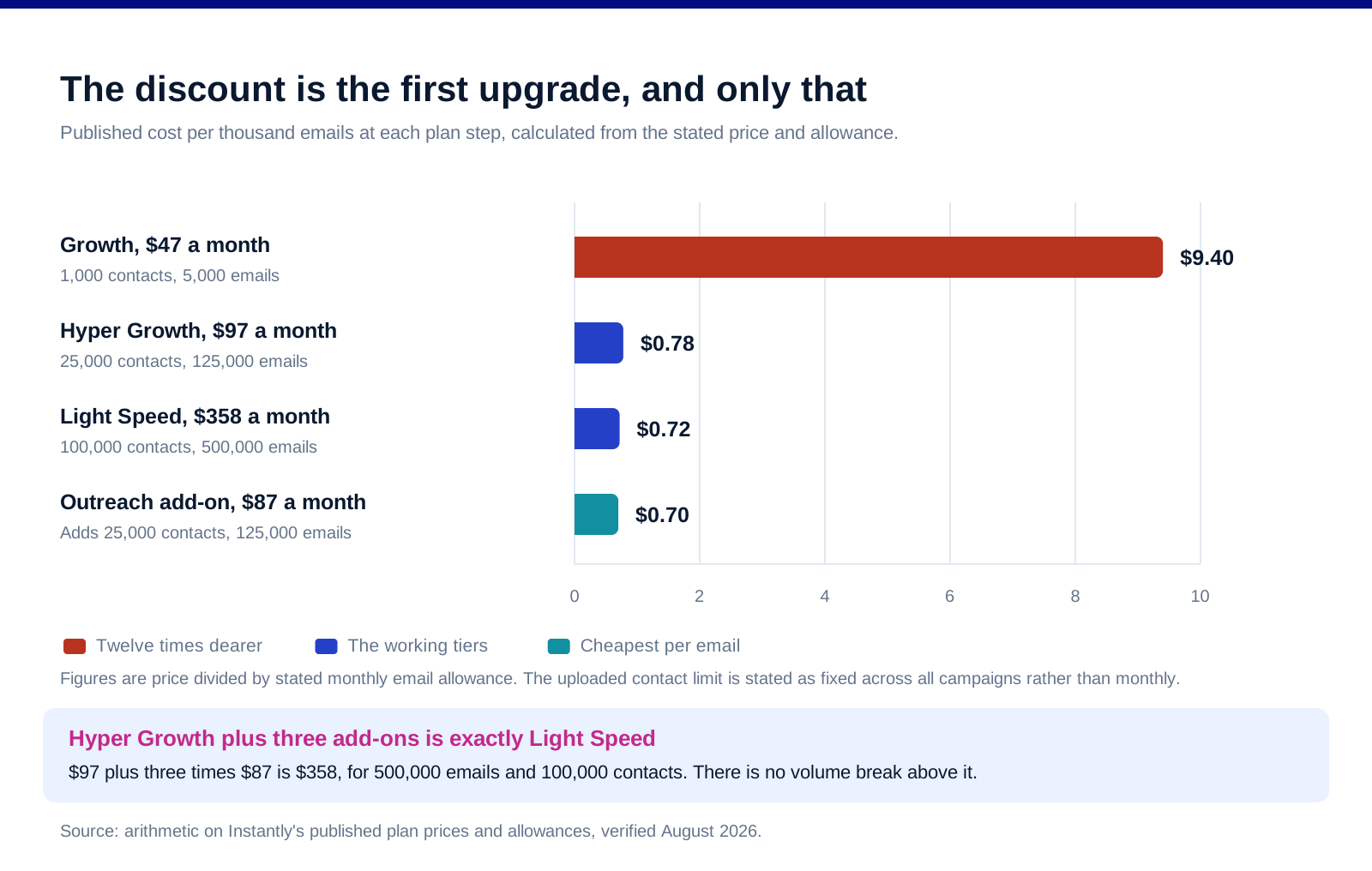
The entry plan is sized for exactly one sequence. Growth at $47 a month carries 1,000 contacts and 5,000 emails. That is five touches to a thousand people, once, and then the fixed contact limit is spent.
The only real discount is the first upgrade. Growth works out at $9.40 per thousand emails. Hyper Growth at $97 for 125,000 emails is $0.78 per thousand. That is roughly a twelvefold reduction for a plan that costs about twice as much.
Above that the ladder is flat, and provably so. Hyper Growth at $97 plus three Email Outreach add-ons at $87 each comes to $358, delivering 500,000 emails and 100,000 contacts. Light Speed is published at $358 for 500,000 emails and 100,000 contacts. The same money buys the same thing, so there is no volume break to negotiate toward.
Which means touch count is cheap and list size is not. Adding a sixth email to a sequence costs a fraction of a cent per prospect at Hyper Growth rates. Adding another ten thousand prospects costs a plan tier.
And it means the real constraint is not money. At $0.78 per thousand emails, nobody stops at four touches for budget reasons. They stop, or should stop, because of deliverability risk and because the marginal touch stopped saying anything.
LinkedIn touches are capped differently
Per-seat, not per-message. HeyReach charges by sender account, so the cost of a LinkedIn sequence scales with how many accounts you run rather than with how many messages you send from each.
The agency tiers show the shape. HeyReach publishes an Agency plan at "$999/mo" for 25 senders and an Unlimited plan at "$2,999/mo", with lower quarterly and yearly rates. That is a fixed-cost model, which is a different economic shape from an email plan metered by volume.
Platform limits sit above all of it. The number of connection requests and messages a LinkedIn account can send in a day is set by LinkedIn, not by the tool, and it changes. No sequencing platform can raise it, and any tool that claims otherwise is describing a risk rather than a feature.
So multichannel touch counts are not additive in cost. Three email touches and two LinkedIn touches is one plan allowance plus one seat, not five of anything.
Which is why sequences drift longer on LinkedIn than they should. The marginal message is free once the seat is paid for, and free is the condition under which people add steps that do not earn their place.
How to decide, given all that
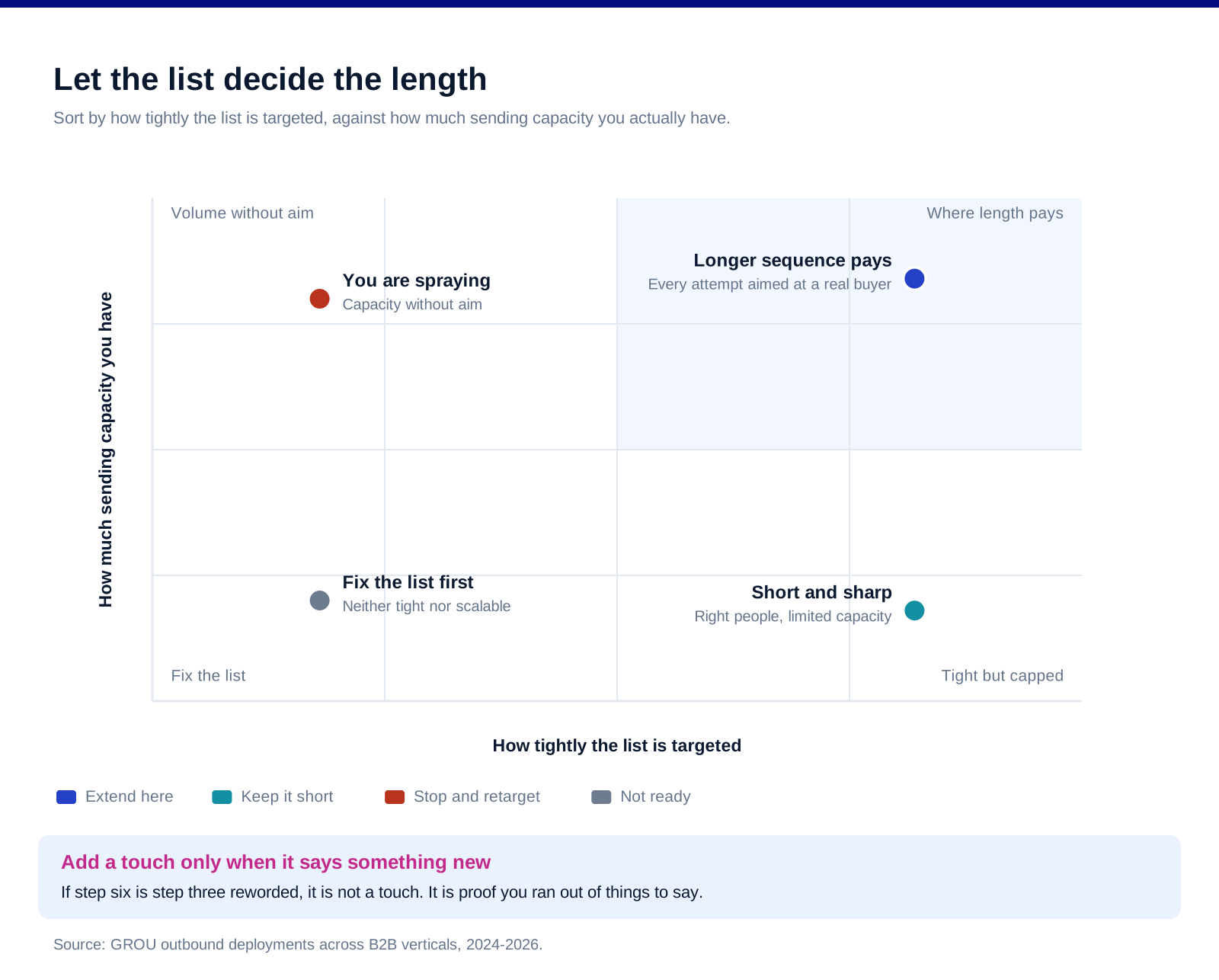
Let list quality set the length. A tightly targeted list of two hundred accounts justifies more touches than a loose list of ten thousand, because on the tight list every additional attempt is aimed at someone who genuinely might buy.
Add a touch only when it says something new. If step six is step three reworded, it is not a touch, it is a reminder that you have nothing else to say. That is the test, and it is more useful than any number.
Count the whole programme, not the sequence. A prospect who gets five emails, two LinkedIn messages and sees three posts has had ten contacts from you. The sequence diagram shows seven.
Watch the spam rate, not the reply rate, when deciding to extend. Reply rate tells you whether the message works. The Postmaster figure tells you whether the extension is safe, and 0.30% is the published line.
And write the exit rule before you write step one. How many non-responses ends the sequence, and what happens to that contact afterwards, matters more than whether the sequence had six steps or eight. Our deliverability guide covers the hygiene underneath all of this.
What nobody publishes
No optimal touch count. Stated above, and worth repeating because the number is quoted so confidently elsewhere.
No current LinkedIn action limits from LinkedIn itself. Its help centre is not readable to us, and figures circulating in tool documentation are those vendors' observations rather than platform statements. We publish none.
No safe daily sending figure per mailbox for cold email. Providers publish account limits, not cold-sending guidance, and any specific number you see is someone's operating practice rather than a rule.
No reply rate by touch position. Every chart of this kind we have seen comes from a sequencing vendor's aggregate data, which is a sample of that vendor's customers rather than of the market.
FAQ
How many touches should a B2B sales sequence have?
There is no published independent answer, and every figure in circulation comes from a vendor survey. Decide from your constraints instead: a five-touch email sequence to a thousand prospects is five thousand emails, which is exactly the monthly allowance on Instantly's $47 Growth plan. Extend only when the additional touch says something the earlier ones did not.
Does adding more touches to a sequence cost much?
Almost nothing in software terms, and that is the trap. At Instantly's Hyper Growth rate of $97 for 125,000 emails a month, a thousand extra emails costs about 78 cents. What extra touches actually cost you is deliverability risk, because Google requires senders above 5,000 messages a day to Gmail to hold spam complaints below 0.30%.
What limits how many emails a sequence can send?
Four published things. The plan's monthly email allowance, the plan's uploaded contact limit, which Instantly states is fixed across all campaigns rather than monthly, the number of mailboxes you have, and your provider's per-mailbox daily limit, which Google Workspace publishes as 2,000 messages a day for standard paid accounts over a rolling 24 hours.
Is Instantly's Light Speed plan better value than Hyper Growth?
Not on published figures. Hyper Growth at $97 plus three Email Outreach add-ons at $87 each is $358 for 500,000 emails and 100,000 contacts, which is identical to Light Speed at $358 for 500,000 emails and 100,000 contacts. The genuine saving is the first upgrade, from Growth at $9.40 per thousand emails to Hyper Growth at $0.78.
How do LinkedIn touches change the count?
They change the economics rather than the arithmetic. HeyReach prices by sender account at $79 a month, or $63 on yearly billing, so a LinkedIn touch stream costs a seat rather than message credits. Because the marginal message is then free, LinkedIn sequences tend to drift longer than they should, and the discipline has to come from the message rather than the bill.
When should you stop adding touches?
When the next one repeats the last one, or when your Postmaster Tools spam rate is moving toward the 0.30% threshold Google publishes. Those are the two signals that are actually about your programme. Adding a step because a benchmark article said eight is a decision made with someone else's data.
Bottom line
Replace the benchmark question with three numbers you can actually get. How many prospects, how many mailboxes, and what your spam rate is doing. The published prices then tell you that touch count is nearly free and list size is not, which is the opposite of how most teams budget. Let list quality decide length, since more attempts at a well-chosen account is a better use of capacity than more attempts at a badly chosen one. Add a step only when it carries something new. And treat the 0.30% spam rate line as the real ceiling on sequence length, because it is the one constraint on this page that is published, binding and outside your control.
Want the sequencing run rather than the touch count debated? Book a call with GROU. We run outbound and lead generation inside B2B revenue engines across verticals. If the question is what an agency should charge to do it, our pricing models piece covers that.
We are GROU, a B2B pipeline agency that runs lead generation, outbound, and LinkedIn content for clients across manufacturing, fintech, iGaming, software, and professional services. Some links in this article are affiliate links, including Instantly and HeyReach. Every price above was read on the vendor's own page, and the arithmetic showing no volume discount above Hyper Growth runs against both.
Nobody can tell you the right number of touches, and the people who quote one are quoting a survey run by a company that sells sequencing software.
What can be established is the ceiling. Your sequence length is capped by arithmetic you can do from published prices and published platform rules, and once you have run that arithmetic the question mostly answers itself.
TL;DR
Start from the constraint rather than the benchmark. On Instantly's published plans, Growth at $47 a month gives 1,000 uploaded contacts and 5,000 emails a month, which is exactly one five-touch sequence to a thousand people, and the contact limit is fixed across all campaigns rather than monthly. Hyper Growth at $97 gives 25,000 contacts and 125,000 emails, which drops the cost per thousand emails from $9.40 to $0.78, a twelvefold reduction. Above that the ladder is linear: Hyper Growth plus three add-ons at $87 each comes to $358 for 500,000 emails and 100,000 contacts, which is precisely the Light Speed plan, so there is no further volume discount to find. On the LinkedIn side HeyReach prices by sender at $79 a month, or $63 on annual billing, so each additional touch stream costs a seat rather than a credit. And Google's sender rules cap the whole thing: anyone sending more than 5,000 messages a day to Gmail must hold spam rates below 0.30%. More touches raise that risk, which is the real reason to stop adding them.
The benchmark you were looking for does not exist
No published, independent figure sets the optimal touch count. Every number in circulation, whether it is five, eight or twelve, traces back to a vendor survey with an undisclosed sample or to an agency describing its own book.
Nor could one exist in a useful form. The right number depends on how well the list is targeted, how many channels you run, how long the buying cycle is, and how good the message is, and no average survives that much variation.
We publish no reply rate, meeting rate or open rate benchmark anywhere in this article. That is not a gap, it is the point.
What is publishable is the arithmetic. Touches multiplied by prospects gives sends. Sends divided by capacity gives days. Capacity has a published price and a published legal ceiling, and both are checkable.
So the useful question changes. Not how many touches work, but how many your list quality, your capacity and your risk tolerance actually allow.
What actually caps the number
The contact limit, which is not what people assume. Instantly's plans documentation states that "The uploaded contact limit is a fixed limit across all campaigns, not per month." On Growth that is 1,000 contacts for the life of the plan, not a thousand a month.
The monthly email allowance, which touches consume linearly. A five-touch sequence to a thousand prospects is five thousand emails, which is Growth's entire monthly allowance. Add three more touches and you need a bigger plan for the same list.
The mailbox count, which sets how fast you can send it. Instantly publishes mailbox costs directly: a pre-warmed Google account at $10 a month, a done-for-you Google account at $5 a month, a done-for-you Airmail account at $4 a month, and domains at $15 a year.
The provider's own daily limit. Google Workspace publishes 2,000 messages a day for standard paid accounts, applied "over a rolling 24-hour period, not a set time of day". Cold sending should sit far below that, but the ceiling is real and it is per mailbox.
The spam rate, which is where extra touches actually cost you. Google's sender guidelines require anyone sending more than 5,000 messages a day to Gmail to hold spam rates in Postmaster Tools "below 0.30%", with SPF, DKIM and DMARC in place and one-click unsubscribe on marketing messages.
And on LinkedIn, the seat. HeyReach's pricing is per sender at "$79/mo", falling to "$63/seat/mo" on yearly billing. Another parallel touch stream is another seat, not another credit.
The arithmetic, on published prices
The entry plan is sized for exactly one sequence. Growth at $47 a month carries 1,000 contacts and 5,000 emails. That is five touches to a thousand people, once, and then the fixed contact limit is spent.
The only real discount is the first upgrade. Growth works out at $9.40 per thousand emails. Hyper Growth at $97 for 125,000 emails is $0.78 per thousand. That is roughly a twelvefold reduction for a plan that costs about twice as much.
Above that the ladder is flat, and provably so. Hyper Growth at $97 plus three Email Outreach add-ons at $87 each comes to $358, delivering 500,000 emails and 100,000 contacts. Light Speed is published at $358 for 500,000 emails and 100,000 contacts. The same money buys the same thing, so there is no volume break to negotiate toward.
Which means touch count is cheap and list size is not. Adding a sixth email to a sequence costs a fraction of a cent per prospect at Hyper Growth rates. Adding another ten thousand prospects costs a plan tier.
And it means the real constraint is not money. At $0.78 per thousand emails, nobody stops at four touches for budget reasons. They stop, or should stop, because of deliverability risk and because the marginal touch stopped saying anything.
LinkedIn touches are capped differently
Per-seat, not per-message. HeyReach charges by sender account, so the cost of a LinkedIn sequence scales with how many accounts you run rather than with how many messages you send from each.
The agency tiers show the shape. HeyReach publishes an Agency plan at "$999/mo" for 25 senders and an Unlimited plan at "$2,999/mo", with lower quarterly and yearly rates. That is a fixed-cost model, which is a different economic shape from an email plan metered by volume.
Platform limits sit above all of it. The number of connection requests and messages a LinkedIn account can send in a day is set by LinkedIn, not by the tool, and it changes. No sequencing platform can raise it, and any tool that claims otherwise is describing a risk rather than a feature.
So multichannel touch counts are not additive in cost. Three email touches and two LinkedIn touches is one plan allowance plus one seat, not five of anything.
Which is why sequences drift longer on LinkedIn than they should. The marginal message is free once the seat is paid for, and free is the condition under which people add steps that do not earn their place.
How to decide, given all that
Let list quality set the length. A tightly targeted list of two hundred accounts justifies more touches than a loose list of ten thousand, because on the tight list every additional attempt is aimed at someone who genuinely might buy.
Add a touch only when it says something new. If step six is step three reworded, it is not a touch, it is a reminder that you have nothing else to say. That is the test, and it is more useful than any number.
Count the whole programme, not the sequence. A prospect who gets five emails, two LinkedIn messages and sees three posts has had ten contacts from you. The sequence diagram shows seven.
Watch the spam rate, not the reply rate, when deciding to extend. Reply rate tells you whether the message works. The Postmaster figure tells you whether the extension is safe, and 0.30% is the published line.
And write the exit rule before you write step one. How many non-responses ends the sequence, and what happens to that contact afterwards, matters more than whether the sequence had six steps or eight. Our deliverability guide covers the hygiene underneath all of this.
What nobody publishes
No optimal touch count. Stated above, and worth repeating because the number is quoted so confidently elsewhere.
No current LinkedIn action limits from LinkedIn itself. Its help centre is not readable to us, and figures circulating in tool documentation are those vendors' observations rather than platform statements. We publish none.
No safe daily sending figure per mailbox for cold email. Providers publish account limits, not cold-sending guidance, and any specific number you see is someone's operating practice rather than a rule.
No reply rate by touch position. Every chart of this kind we have seen comes from a sequencing vendor's aggregate data, which is a sample of that vendor's customers rather than of the market.
FAQ
How many touches should a B2B sales sequence have?
There is no published independent answer, and every figure in circulation comes from a vendor survey. Decide from your constraints instead: a five-touch email sequence to a thousand prospects is five thousand emails, which is exactly the monthly allowance on Instantly's $47 Growth plan. Extend only when the additional touch says something the earlier ones did not.
Does adding more touches to a sequence cost much?
Almost nothing in software terms, and that is the trap. At Instantly's Hyper Growth rate of $97 for 125,000 emails a month, a thousand extra emails costs about 78 cents. What extra touches actually cost you is deliverability risk, because Google requires senders above 5,000 messages a day to Gmail to hold spam complaints below 0.30%.
What limits how many emails a sequence can send?
Four published things. The plan's monthly email allowance, the plan's uploaded contact limit, which Instantly states is fixed across all campaigns rather than monthly, the number of mailboxes you have, and your provider's per-mailbox daily limit, which Google Workspace publishes as 2,000 messages a day for standard paid accounts over a rolling 24 hours.
Is Instantly's Light Speed plan better value than Hyper Growth?
Not on published figures. Hyper Growth at $97 plus three Email Outreach add-ons at $87 each is $358 for 500,000 emails and 100,000 contacts, which is identical to Light Speed at $358 for 500,000 emails and 100,000 contacts. The genuine saving is the first upgrade, from Growth at $9.40 per thousand emails to Hyper Growth at $0.78.
How do LinkedIn touches change the count?
They change the economics rather than the arithmetic. HeyReach prices by sender account at $79 a month, or $63 on yearly billing, so a LinkedIn touch stream costs a seat rather than message credits. Because the marginal message is then free, LinkedIn sequences tend to drift longer than they should, and the discipline has to come from the message rather than the bill.
When should you stop adding touches?
When the next one repeats the last one, or when your Postmaster Tools spam rate is moving toward the 0.30% threshold Google publishes. Those are the two signals that are actually about your programme. Adding a step because a benchmark article said eight is a decision made with someone else's data.
Bottom line
Replace the benchmark question with three numbers you can actually get. How many prospects, how many mailboxes, and what your spam rate is doing. The published prices then tell you that touch count is nearly free and list size is not, which is the opposite of how most teams budget. Let list quality decide length, since more attempts at a well-chosen account is a better use of capacity than more attempts at a badly chosen one. Add a step only when it carries something new. And treat the 0.30% spam rate line as the real ceiling on sequence length, because it is the one constraint on this page that is published, binding and outside your control.
Want the sequencing run rather than the touch count debated? Book a call with GROU. We run outbound and lead generation inside B2B revenue engines across verticals. If the question is what an agency should charge to do it, our pricing models piece covers that.
We are GROU, a B2B pipeline agency that runs lead generation, outbound, and LinkedIn content for clients across manufacturing, fintech, iGaming, software, and professional services. Some links in this article are affiliate links, including Instantly and HeyReach. Every price above was read on the vendor's own page, and the arithmetic showing no volume discount above Hyper Growth runs against both.
Nobody can tell you the right number of touches, and the people who quote one are quoting a survey run by a company that sells sequencing software.
What can be established is the ceiling. Your sequence length is capped by arithmetic you can do from published prices and published platform rules, and once you have run that arithmetic the question mostly answers itself.
TL;DR
Start from the constraint rather than the benchmark. On Instantly's published plans, Growth at $47 a month gives 1,000 uploaded contacts and 5,000 emails a month, which is exactly one five-touch sequence to a thousand people, and the contact limit is fixed across all campaigns rather than monthly. Hyper Growth at $97 gives 25,000 contacts and 125,000 emails, which drops the cost per thousand emails from $9.40 to $0.78, a twelvefold reduction. Above that the ladder is linear: Hyper Growth plus three add-ons at $87 each comes to $358 for 500,000 emails and 100,000 contacts, which is precisely the Light Speed plan, so there is no further volume discount to find. On the LinkedIn side HeyReach prices by sender at $79 a month, or $63 on annual billing, so each additional touch stream costs a seat rather than a credit. And Google's sender rules cap the whole thing: anyone sending more than 5,000 messages a day to Gmail must hold spam rates below 0.30%. More touches raise that risk, which is the real reason to stop adding them.
The benchmark you were looking for does not exist
No published, independent figure sets the optimal touch count. Every number in circulation, whether it is five, eight or twelve, traces back to a vendor survey with an undisclosed sample or to an agency describing its own book.
Nor could one exist in a useful form. The right number depends on how well the list is targeted, how many channels you run, how long the buying cycle is, and how good the message is, and no average survives that much variation.
We publish no reply rate, meeting rate or open rate benchmark anywhere in this article. That is not a gap, it is the point.
What is publishable is the arithmetic. Touches multiplied by prospects gives sends. Sends divided by capacity gives days. Capacity has a published price and a published legal ceiling, and both are checkable.
So the useful question changes. Not how many touches work, but how many your list quality, your capacity and your risk tolerance actually allow.
What actually caps the number
The contact limit, which is not what people assume. Instantly's plans documentation states that "The uploaded contact limit is a fixed limit across all campaigns, not per month." On Growth that is 1,000 contacts for the life of the plan, not a thousand a month.
The monthly email allowance, which touches consume linearly. A five-touch sequence to a thousand prospects is five thousand emails, which is Growth's entire monthly allowance. Add three more touches and you need a bigger plan for the same list.
The mailbox count, which sets how fast you can send it. Instantly publishes mailbox costs directly: a pre-warmed Google account at $10 a month, a done-for-you Google account at $5 a month, a done-for-you Airmail account at $4 a month, and domains at $15 a year.
The provider's own daily limit. Google Workspace publishes 2,000 messages a day for standard paid accounts, applied "over a rolling 24-hour period, not a set time of day". Cold sending should sit far below that, but the ceiling is real and it is per mailbox.
The spam rate, which is where extra touches actually cost you. Google's sender guidelines require anyone sending more than 5,000 messages a day to Gmail to hold spam rates in Postmaster Tools "below 0.30%", with SPF, DKIM and DMARC in place and one-click unsubscribe on marketing messages.
And on LinkedIn, the seat. HeyReach's pricing is per sender at "$79/mo", falling to "$63/seat/mo" on yearly billing. Another parallel touch stream is another seat, not another credit.
The arithmetic, on published prices
The entry plan is sized for exactly one sequence. Growth at $47 a month carries 1,000 contacts and 5,000 emails. That is five touches to a thousand people, once, and then the fixed contact limit is spent.
The only real discount is the first upgrade. Growth works out at $9.40 per thousand emails. Hyper Growth at $97 for 125,000 emails is $0.78 per thousand. That is roughly a twelvefold reduction for a plan that costs about twice as much.
Above that the ladder is flat, and provably so. Hyper Growth at $97 plus three Email Outreach add-ons at $87 each comes to $358, delivering 500,000 emails and 100,000 contacts. Light Speed is published at $358 for 500,000 emails and 100,000 contacts. The same money buys the same thing, so there is no volume break to negotiate toward.
Which means touch count is cheap and list size is not. Adding a sixth email to a sequence costs a fraction of a cent per prospect at Hyper Growth rates. Adding another ten thousand prospects costs a plan tier.
And it means the real constraint is not money. At $0.78 per thousand emails, nobody stops at four touches for budget reasons. They stop, or should stop, because of deliverability risk and because the marginal touch stopped saying anything.
LinkedIn touches are capped differently
Per-seat, not per-message. HeyReach charges by sender account, so the cost of a LinkedIn sequence scales with how many accounts you run rather than with how many messages you send from each.
The agency tiers show the shape. HeyReach publishes an Agency plan at "$999/mo" for 25 senders and an Unlimited plan at "$2,999/mo", with lower quarterly and yearly rates. That is a fixed-cost model, which is a different economic shape from an email plan metered by volume.
Platform limits sit above all of it. The number of connection requests and messages a LinkedIn account can send in a day is set by LinkedIn, not by the tool, and it changes. No sequencing platform can raise it, and any tool that claims otherwise is describing a risk rather than a feature.
So multichannel touch counts are not additive in cost. Three email touches and two LinkedIn touches is one plan allowance plus one seat, not five of anything.
Which is why sequences drift longer on LinkedIn than they should. The marginal message is free once the seat is paid for, and free is the condition under which people add steps that do not earn their place.
How to decide, given all that
Let list quality set the length. A tightly targeted list of two hundred accounts justifies more touches than a loose list of ten thousand, because on the tight list every additional attempt is aimed at someone who genuinely might buy.
Add a touch only when it says something new. If step six is step three reworded, it is not a touch, it is a reminder that you have nothing else to say. That is the test, and it is more useful than any number.
Count the whole programme, not the sequence. A prospect who gets five emails, two LinkedIn messages and sees three posts has had ten contacts from you. The sequence diagram shows seven.
Watch the spam rate, not the reply rate, when deciding to extend. Reply rate tells you whether the message works. The Postmaster figure tells you whether the extension is safe, and 0.30% is the published line.
And write the exit rule before you write step one. How many non-responses ends the sequence, and what happens to that contact afterwards, matters more than whether the sequence had six steps or eight. Our deliverability guide covers the hygiene underneath all of this.
What nobody publishes
No optimal touch count. Stated above, and worth repeating because the number is quoted so confidently elsewhere.
No current LinkedIn action limits from LinkedIn itself. Its help centre is not readable to us, and figures circulating in tool documentation are those vendors' observations rather than platform statements. We publish none.
No safe daily sending figure per mailbox for cold email. Providers publish account limits, not cold-sending guidance, and any specific number you see is someone's operating practice rather than a rule.
No reply rate by touch position. Every chart of this kind we have seen comes from a sequencing vendor's aggregate data, which is a sample of that vendor's customers rather than of the market.
FAQ
How many touches should a B2B sales sequence have?
There is no published independent answer, and every figure in circulation comes from a vendor survey. Decide from your constraints instead: a five-touch email sequence to a thousand prospects is five thousand emails, which is exactly the monthly allowance on Instantly's $47 Growth plan. Extend only when the additional touch says something the earlier ones did not.
Does adding more touches to a sequence cost much?
Almost nothing in software terms, and that is the trap. At Instantly's Hyper Growth rate of $97 for 125,000 emails a month, a thousand extra emails costs about 78 cents. What extra touches actually cost you is deliverability risk, because Google requires senders above 5,000 messages a day to Gmail to hold spam complaints below 0.30%.
What limits how many emails a sequence can send?
Four published things. The plan's monthly email allowance, the plan's uploaded contact limit, which Instantly states is fixed across all campaigns rather than monthly, the number of mailboxes you have, and your provider's per-mailbox daily limit, which Google Workspace publishes as 2,000 messages a day for standard paid accounts over a rolling 24 hours.
Is Instantly's Light Speed plan better value than Hyper Growth?
Not on published figures. Hyper Growth at $97 plus three Email Outreach add-ons at $87 each is $358 for 500,000 emails and 100,000 contacts, which is identical to Light Speed at $358 for 500,000 emails and 100,000 contacts. The genuine saving is the first upgrade, from Growth at $9.40 per thousand emails to Hyper Growth at $0.78.
How do LinkedIn touches change the count?
They change the economics rather than the arithmetic. HeyReach prices by sender account at $79 a month, or $63 on yearly billing, so a LinkedIn touch stream costs a seat rather than message credits. Because the marginal message is then free, LinkedIn sequences tend to drift longer than they should, and the discipline has to come from the message rather than the bill.
When should you stop adding touches?
When the next one repeats the last one, or when your Postmaster Tools spam rate is moving toward the 0.30% threshold Google publishes. Those are the two signals that are actually about your programme. Adding a step because a benchmark article said eight is a decision made with someone else's data.
Bottom line
Replace the benchmark question with three numbers you can actually get. How many prospects, how many mailboxes, and what your spam rate is doing. The published prices then tell you that touch count is nearly free and list size is not, which is the opposite of how most teams budget. Let list quality decide length, since more attempts at a well-chosen account is a better use of capacity than more attempts at a badly chosen one. Add a step only when it carries something new. And treat the 0.30% spam rate line as the real ceiling on sequence length, because it is the one constraint on this page that is published, binding and outside your control.
Want the sequencing run rather than the touch count debated? Book a call with GROU. We run outbound and lead generation inside B2B revenue engines across verticals. If the question is what an agency should charge to do it, our pricing models piece covers that.
We are GROU, a B2B pipeline agency that runs lead generation, outbound, and LinkedIn content for clients across manufacturing, fintech, iGaming, software, and professional services. Some links in this article are affiliate links, including Instantly and HeyReach. Every price above was read on the vendor's own page, and the arithmetic showing no volume discount above Hyper Growth runs against both.

Pipeline OS Newsletter
Build qualified pipeline
Get weekly tactics to generate demand, improve lead quality, and book more meetings.






Trusted by industry leaders
Trusted by industry leaders
Trusted by industry leaders
Ready to build qualified pipeline?
Ready to build qualified pipeline?
Ready to build qualified pipeline?
Book a call to see if we're the right fit, or take the 2-minute quiz to get a clear starting point.
Book a call to see if we're the right fit, or take the 2-minute quiz to get a clear starting point.
Book a call to see if we're the right fit, or take the 2-minute quiz to get a clear starting point.
" height="30.21639343089746px" id="hfGbXmQR2" width="30.216393430897455px"/></svg>)
Copyright © 2026 – All Right Reserved
Copyright © 2026 – All Right Reserved
Copyright © 2026 – All Right Reserved