%22%3E%3C/path%3E%3Cpath d=%22M 63.072 7.554 C 62.258 8.022 61.577 8.689 61.092 9.493 L 61.092 7.076 L 57.158 7.076 L 57.158 22.64 L 61.089 22.64 L 61.089 14.888 C 61.089 13.446 61.403 12.434 62.03 11.853 C 62.818 11.218 63.818 10.907 64.826 10.982 L 65.868 10.982 L 65.868 6.851 C 64.891 6.834 63.926 7.076 63.073 7.554 Z%22 fill=%22rgb(17,17,17)%22%3E%3C/path%3E%3Cpath d=%22M 78.916 7.82 C 76.363 6.49 73.321 6.49 70.768 7.82 C 69.562 8.473 68.564 9.451 67.888 10.644 C 67.167 11.931 66.803 13.387 66.834 14.862 C 66.804 16.332 67.157 17.785 67.86 19.077 C 68.515 20.267 69.494 21.246 70.684 21.901 C 71.924 22.576 73.318 22.92 74.73 22.898 C 76.164 22.918 77.58 22.575 78.846 21.901 C 80.062 21.247 81.073 20.27 81.768 19.077 C 82.506 17.797 82.88 16.339 82.85 14.862 C 82.88 13.389 82.517 11.934 81.797 10.647 C 81.12 9.455 80.122 8.477 78.917 7.824 M 78.803 14.862 C 78.829 15.739 78.636 16.608 78.241 17.391 C 77.903 18.046 77.38 18.588 76.738 18.95 C 76.124 19.293 75.432 19.472 74.729 19.47 C 73.668 19.497 72.648 19.061 71.934 18.276 C 71.139 17.323 70.741 16.1 70.823 14.862 C 70.741 13.62 71.149 12.395 71.959 11.45 C 72.687 10.667 73.715 10.233 74.783 10.256 C 75.859 10.236 76.894 10.67 77.635 11.45 C 78.464 12.387 78.884 13.616 78.801 14.864%22 fill=%22rgb(17,17,17)%22%3E%3C/path%3E%3Cpath d=%22M 95.906 7.076 L 95.906 15.646 C 95.975 16.68 95.643 17.701 94.979 18.498 C 94.311 19.184 93.379 19.547 92.422 19.495 C 91.475 19.544 90.553 19.18 89.894 18.498 C 89.23 17.701 88.898 16.68 88.967 15.646 L 88.967 7.076 L 85.033 7.076 L 85.033 16.207 C 85 17.449 85.275 18.68 85.834 19.79 C 86.327 20.75 87.095 21.542 88.039 22.065 C 89.033 22.594 90.145 22.861 91.271 22.838 C 92.188 22.847 93.095 22.65 93.926 22.263 C 94.708 21.905 95.388 21.36 95.906 20.675 L 95.906 22.645 L 99.865 22.645 L 99.865 7.076 Z%22 fill=%22rgb(17,17,17)%22%3E%3C/path%3E%3Cpath d=%22M 4.513 15.626 C 4.511 10.815 7.606 6.549 12.181 5.059 C 16.756 3.57 21.77 5.195 24.601 9.086 L 27.816 5.87 C 24.074 1.186 17.981 -0.943 12.137 0.393 C 6.292 1.728 1.728 6.292 0.393 12.137 C -0.943 17.981 1.186 24.074 5.87 27.816 L 9.085 24.601 C 6.214 22.512 4.515 19.177 4.513 15.626%22 fill=%22rgb(32,62,235)%22%3E%3C/path%3E%3Cpath d=%22M 17.114 14.343 L 13.354 18.01 L 13.354 18.026 L 21.071 18.026 L 11.412 27.609 L 17.389 27.609 L 23.999 21.081 L 23.999 28.316 L 24.005 28.316 L 27.967 24.393 L 27.967 14.343 Z%22 fill=%22rgb(32,62,235)%22%3E%3C/path%3E%3C/g%3E%3C/svg%3E) ×
× ××
××›
›
›
›
Align Sales and Marketing: B2B Pipeline Playbook 2026
Align Sales and Marketing: B2B Pipeline Playbook 2026
Align Sales and Marketing: B2B Pipeline Playbook 2026
Align Sales and Marketing: B2B Pipeline Playbook 2026
Align Sales and Marketing: B2B Pipeline Playbook 2026
Align Sales and Marketing: B2B Pipeline Playbook 2026

Author
Aljaz Peklaj

Sales says the leads are weak. Marketing says sales sits on them too long. The CRM has three versions of the same account, two lifecycle models, and one dashboard nobody trusts. Pipeline isn't low because either team is lazy. It's low because the operating system between them is broken.
That usually shows up in the same places. Different ICP docs. Different definitions for MQL, SAL, and SQL. Apollo lists that never sync back to HubSpot. Campaign engagement data that marketing sees, but SDRs don't. Reps rejecting leads with a dropdown that says “bad fit” and no usable feedback.
If you want to align sales and marketing, stop treating it as a culture project. Treat it like a systems build. The work is in the definitions, field mappings, sync rules, routing logic, meeting cadence, and escalation path when the market tells you your ICP is off.
Table of Contents
Your sales and marketing teams are working, but not together
The technical contract: lead definitions, slas, and handoff rules
The operating system: coordinating content, campaigns, and tech
Your sales and marketing teams are working, but not together
This is the standoff most B2B teams are in right now. Marketing is producing campaigns, lists, content, and handoffs. Sales is running outbound, demos, follow-ups, and forecasts. Everyone is active, but the motion doesn't compound because the teams are optimizing different parts of the same funnel.
The symptom looks personal. It usually isn't. If sales and marketing use different audience rules, different funnel definitions, and different reporting logic, they will blame each other even when both are doing competent work.
Sales doesn't need more leads if the acceptance criteria are fuzzy. Marketing doesn't need more budget if the follow-up path is broken.
You can see the impact in performance data. In aligned organizations, marketing can drive up to 29% of pipeline, compared with 10% in misaligned ones, and the difference is measurable through shared metrics like MQL-to-SAL conversion, pipeline velocity, win rates, and CAC/CLV, according to Teamgate's sales and marketing alignment analysis.
A lot of high-level writing on this topic gets the diagnosis right and stops there. If you want a founder-level overview of the business case, Optimizing sales and marketing for growth is a useful complement. The mechanics are often the missing piece. Who owns the ICP document. Which fields must sync from Apollo into HubSpot. What starts the SLA timer. Where lead rejection reasons are captured. How often the two teams review handoff quality.
That's the work that turns attention into pipeline. Not another alignment workshop.
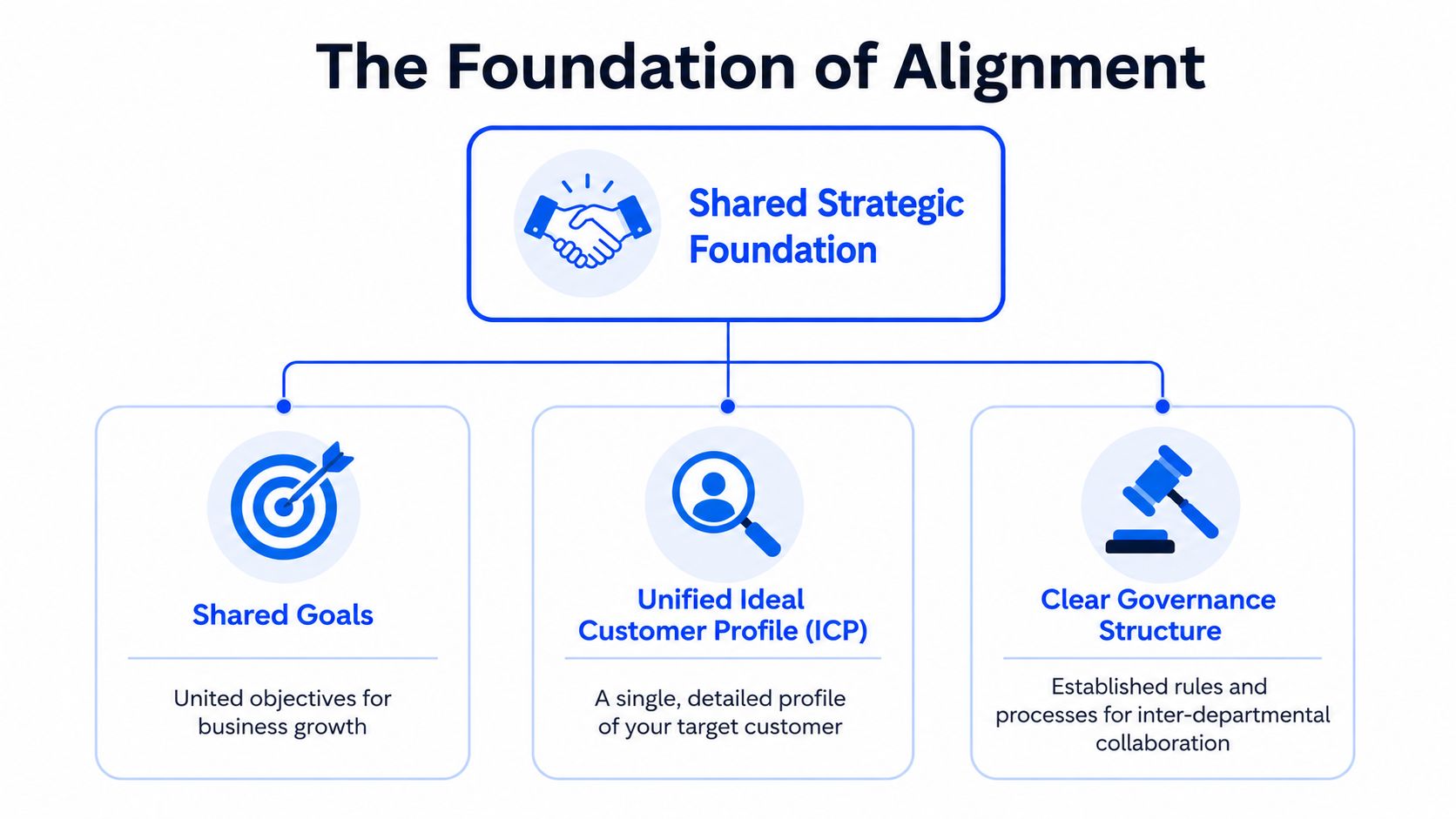
The foundation: shared goals, icp, and governance
Alignment starts before tool setup. If your audience definition, success metric, and meeting structure are split, every automation you build just scales disagreement.
One ICP, not two versions of the market
The fastest way to break pipeline is to let marketing target a broad category while sales focuses on a narrower one. You need one ICP document, one owner for updates, and one review process. Not a positioning deck for marketing and a separate “real target list” sitting in Sales Navigator.
A useful ICP doc has four parts:
Firmographics → industry, company size band, geography, business model
Technographics → key tools in stack, buying environment, integration constraints
Buying context → trigger events, operational pain, urgency pattern
Exclusions → segments that look attractive on paper but don't convert or don't retain
For effective implementation, the cleanest build is a working doc linked to CRM properties. If the ICP says “mid-market legal tech in North America using HubSpot and a modern sales engagement layer,” those attributes need matching fields and picklists in HubSpot, not just words in Notion.
If you need a practical reference for structuring that definition, this guide to an ideal customer profile framework is the right level of detail for turning the concept into routing and targeting rules.
Shared goals that survive contact with reality
If marketing is paid on MQL volume and sales is paid on meetings held, they are not aligned. They are cooperating temporarily.
Outfunnel's alignment guidance is directionally right here. The process should start with a shared ICP, then move into joint OKR setting and unified funnel definitions, and aligned organizations report 36% higher customer retention and 38% better win rates in that model, according to Outfunnel's sales and marketing alignment research.
The practical move is to set one primary shared target and a small set of operating metrics under it.
Layer | Shared metric | Why it matters |
|---|---|---|
Primary | Qualified pipeline created | It forces both teams to care about fit and progression |
Secondary | Pipeline velocity | It catches slow handoffs and stalled stage movement |
Secondary | Stage conversion rates | It shows where quality or process is breaking |
Secondary | Win rate by segment | It exposes whether your ICP is real or aspirational |
Don't let “marketing sourced” and “sales sourced” become separate kingdoms. Both teams should be looking at pipeline created by target account set, segment, and campaign motion.
Governance that keeps the system honest
Governance is just recurring inspection with the right people in the room. If you skip it, definitions drift and local workarounds multiply.
A simple cadence works:
Weekly pipeline council → Head of Sales, Head of Marketing, RevOps, SDR lead, one AE. Review handoff quality, stage movement, rejected leads, follow-up compliance, campaign-to-opportunity progression.
Monthly ICP review → look at accepted leads, disqualified leads, open opportunities, and closed-lost themes by segment.
Quarterly operating reset → update funnel definitions, routing rules, scoring logic, and account tiering.
Practical rule: If a lead is rejected, the rep must choose a structured reason and add one plain-language note. “Bad fit” alone is not feedback.
Without this layer, teams revert to opinion. With it, you get a shared operating memory.
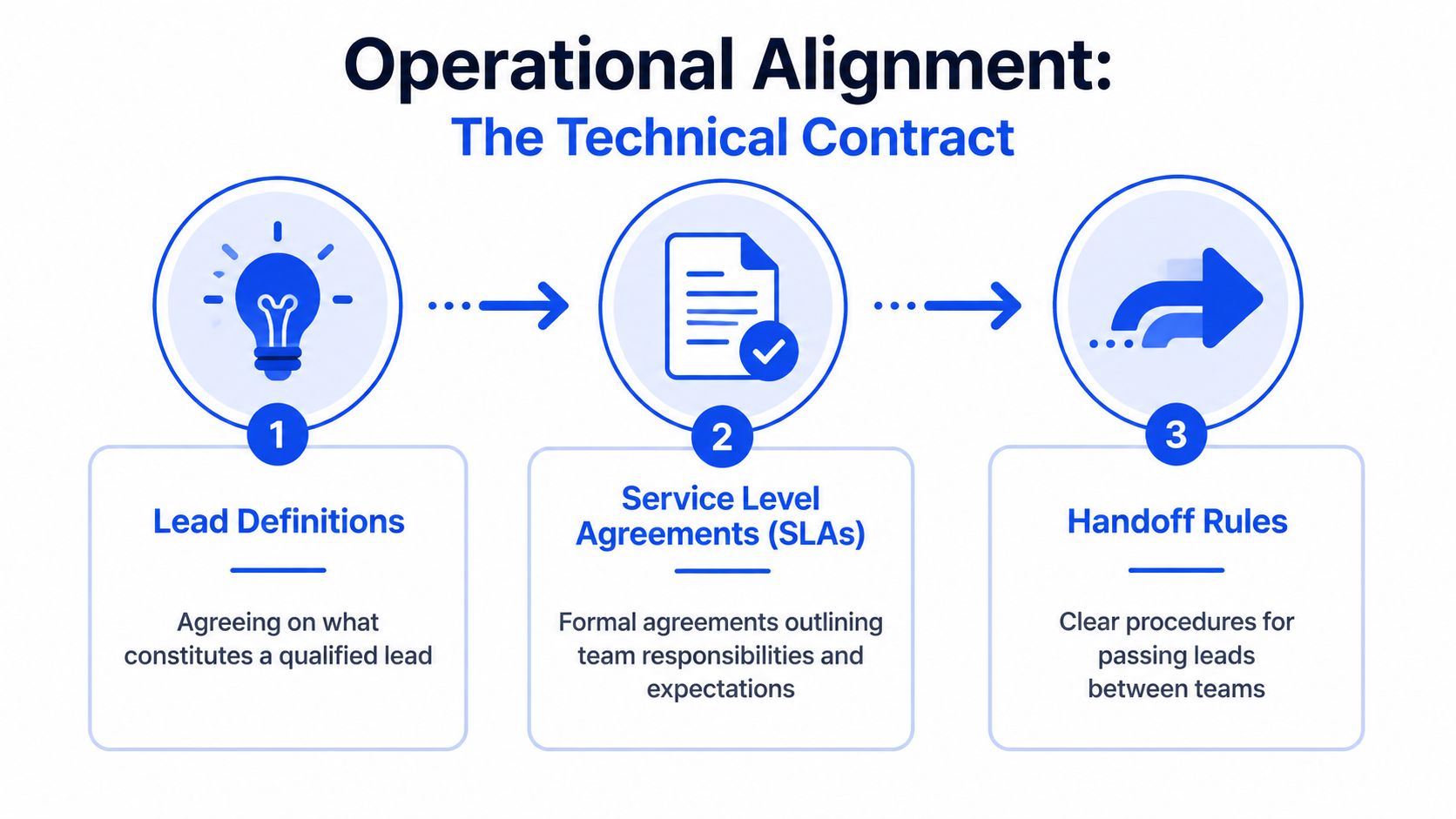
The technical contract: lead definitions, slas, and handoff rules
Most alignment efforts fail at this point. People agree in meetings, then the CRM still routes leads with half-filled records and no clear owner. The fix is simple to say and annoying to implement. Define the contract in fields, workflows, and timers.
Define stages with entry and exit criteria
An MQL isn't “someone marketing likes.” A SAL isn't “someone sales glanced at.” Write exact criteria for each stage and make the lifecycle property reflect those rules.
A workable model looks like this:
MQL
Entry → matched to ICP, minimum required firmographic fields complete, valid contact data, and a qualifying intent or engagement trigger defined by your team.
Exit → accepted by sales, rejected with structured reason, or returned to nurture.SAL
Entry → assigned owner, first action taken, record reviewed for fit.
Exit → converted to SQL, recycled, or disqualified.SQL
Entry → live sales conversation confirms active problem, plausible fit, and a next-step-worthy buying motion.
Exit → opportunity created or disqualified.
If you want a more detailed framework for how qualification criteria should be documented and scored, Grou's guide to a lead qualification process is useful because it maps criteria to operational use, not just theory.
Build the SLA inside the CRM, not in a slide deck
Your SLA should live in HubSpot workflows, task queues, lead status logic, and alerting. If it only exists in onboarding docs, it won't survive the quarter.
Use this checklist:
Lifecycle stages are locked down so reps can't improvise stage meanings.
Assignment logic is automatic by territory, segment, or named account owner.
Response-time timers are visible with task due dates and escalation rules.
Rejection reasons are mandatory before a lead can be recycled.
Re-nurture rules are explicit so marketing knows what comes back and why.
A lot of teams miss the handoff design problem entirely. Influ2 cites that only 11% of companies have successfully aligned their marketing and sales audiences and created an effective handoff process. Those companies can have marketing influence of up to 29% of pipeline and convert 65% more prospects to pipeline when marketing is actively involved in the sales process, according to Influ2's alignment statistics.
For teams tightening the top of funnel before handoff, I like pairing outbound and social demand capture. If that's part of your mix, PostPlanify's lead gen playbook is worth reviewing because it shows how social activity can feed a more structured pipeline motion instead of staying disconnected from sales follow-up.
Here's a useful walkthrough on the sales side of the handoff stack:
The minimum handoff payload
When marketing passes a lead, sales shouldn't have to investigate basic context from scratch. The record should arrive with enough data to act.
At minimum, populate:
Account fields → company name, website, industry, employee band, country
Contact fields → full name, title, LinkedIn URL, email status, phone if available
Acquisition context → source, campaign, ad set or list source, first conversion event
Engagement context → pages viewed, form fills, webinar attendance, email replies, ad engagement if tracked
Routing context → owner, territory, named account flag, SLA start timestamp
If Apollo is your prospecting layer, sync enriched account and contact data into HubSpot before the lead reaches an SDR queue. If Clay is enriching, write the outputs to standard fields, not custom one-offs nobody will maintain later.
The feedback loop: shared dashboards and reporting cadence
Monday, 9:00 a.m. Marketing walks into the pipeline meeting with HubSpot attribution. Sales shows a separate Apollo export and a rep-level spreadsheet. Everyone has numbers. No one has the same answer on what created pipeline, what stalled, or what needs to change this week.

What the dashboard must show
Build one shared dashboard in HubSpot and make it the only reporting surface used in the weekly revenue meeting. Apollo can stay in the workflow for sequencing and contact data, but the scorekeeping needs to land in one system. If the same lead can appear as "worked" in Apollo and "untouched" in HubSpot, fix the sync before debating performance.
The dashboard should answer five operating questions:
Question | Dashboard view |
|---|---|
Are leads moving fast enough? | Pipeline velocity by segment |
Where are we losing them? | Stage-to-stage conversion |
How long does progression take? | Lead-to-close time, or stage aging |
Which sources create actual pipeline? | Opportunity creation and pipeline value by source |
Is handoff quality improving? | MQL-to-SAL and SAL-to-SQL conversion |
A useful setup is one executive view and one operator view. The executive layer tracks sourced pipeline, influenced pipeline, win rate, average sales cycle, and forecast coverage. The operator layer gets more specific: SLA misses, lead aging by owner, recycle reasons, meeting-set rate, no-show rate, and accepted-opportunity rate by campaign. That split keeps leadership out of workflow noise while giving SDR managers and demand gen managers enough detail to act.
For internal benchmark design, keep a documented metric glossary beside the dashboard. "Pipeline created" should mean one thing. "Sales accepted lead" should mean one thing. "Recycled" should have a fixed reason list and a required next step. This guide on measuring sales performance is a useful reference for tightening those definitions across teams.
If reporting is fragmented across agencies, BI tools, and ad platforms, outside support can help. This article on choosing a digital marketing analytics partner is useful because it focuses on decision-ready reporting instead of channel vanity metrics.
The weekly review that actually improves pipeline
Run this meeting once a week for 30 minutes. Demand gen, SDR leadership, sales leadership, and RevOps should all be there. Keep cameras off if needed. Keep the dashboard on screen. The goal is to identify one or two changes to routing, targeting, messaging, or follow-up speed.
Use this agenda:
New pipeline created by segment, source, and owner
Stage conversion changes from the prior two weeks
Rejected and recycled leads by reason code
SLA misses by team, queue, or rep
Campaign-level notes from marketing tied to actual opportunity movement
Call and email feedback from SDRs and AEs tied to objection patterns
One test for next week with owner, metric, and review date
I usually assign the same owner to run the meeting every week, often RevOps or sales ops. That person controls definitions, pulls the dashboard 30 minutes before the meeting, and logs decisions in a simple change log: issue, hypothesis, action, owner, due date, result. Without that discipline, teams repeat the same conversation every Tuesday.
One more trade-off matters here. Full alignment is not always the right call. If marketing is testing a new ICP segment or sales is probing a new objection cluster, let one team run fast for a short window and label it clearly in reporting. Keep the test isolated, time-boxed, and measured against the shared dashboard. Short-term misalignment is useful when it produces market feedback faster than committee consensus.
Ask tighter questions. Which campaign produced accepted opportunities? Which SDR queue is sitting on leads past SLA? Which recycle reasons can marketing fix with audience changes, and which ones point to rep coaching? Those questions turn dashboards into operating tools instead of status updates.
The operating system: coordinating content, campaigns, and tech
Once the contract and reporting are in place, alignment shifts from governance to execution. During this phase, teams frequently either compound gains or fall back into channel silos.
Run coordinated plays, not disconnected activity
A strong operating model uses shared account lists, shared messaging themes, and staggered activation. Marketing creates familiarity. Sales converts attention into conversations.
One play I use often looks like this:
Marketing builds a target account cohort in HubSpot and mirrors it into LinkedIn Matched Audiences.
Content runs around one objection cluster, one use case, or one market problem.
Paid and organic LinkedIn activity gives the account set air cover.
Sales starts outbound after the campaign has established context, using Apollo, Instantly, Lemlist, or HeyReach depending on channel mix.
SDRs reference the same theme the prospect has already seen, not a random cold opener.
All engagement, replies, meetings, and recycling outcomes sync back to HubSpot.
That's how you align sales and marketing in practice. Not with vague “better communication,” but with one list, one message, one timeline.
Marketing should build assets from live objections, not from an abstract content calendar.
The content loop matters just as much. If AEs hear the same objection in calls for two weeks, marketing should turn that into a one-pager, short proof asset, founder post, or landing page variant. Sales then uses the asset in sequence steps and follow-ups. This is faster than asking marketing for a quarterly collateral refresh that arrives after the objection has already changed.
How the stack should connect
The stack doesn't need to be huge. It does need to be coherent.
A clean setup for many B2B teams looks like this:
HubSpot as source of truth for contacts, companies, lifecycle stages, workflows, and reporting
Apollo for list building and outbound execution inputs
Clay for enrichment and normalization before records hit rep queues
Instantly or Lemlist for email sequencing if you need a dedicated outbound layer
HeyReach for LinkedIn outreach coordination
Sales Navigator for account research, buying committee expansion, and signal collection
The rule is simple. External tools can generate or enrich activity, but HubSpot owns stage movement and reporting. If lifecycle logic sits partly in Apollo and partly in spreadsheets, your attribution and SLA reporting will drift.
Monday's guidance on alignment gets the operational side right. The most effective methodology is a closed-loop handoff workflow where both teams map the journey, define exact entry and exit criteria, automate data sharing through the CRM, and review lead quality in weekly working sessions to reduce leakage at the handoff point, according to Monday.com's sales and marketing alignment guide.
If you want a lighter managed layer across outbound, content, and signal routing, Grou's B2B marketing automation approach is one example of how teams centralize those motions into one reporting line instead of running separate programs.
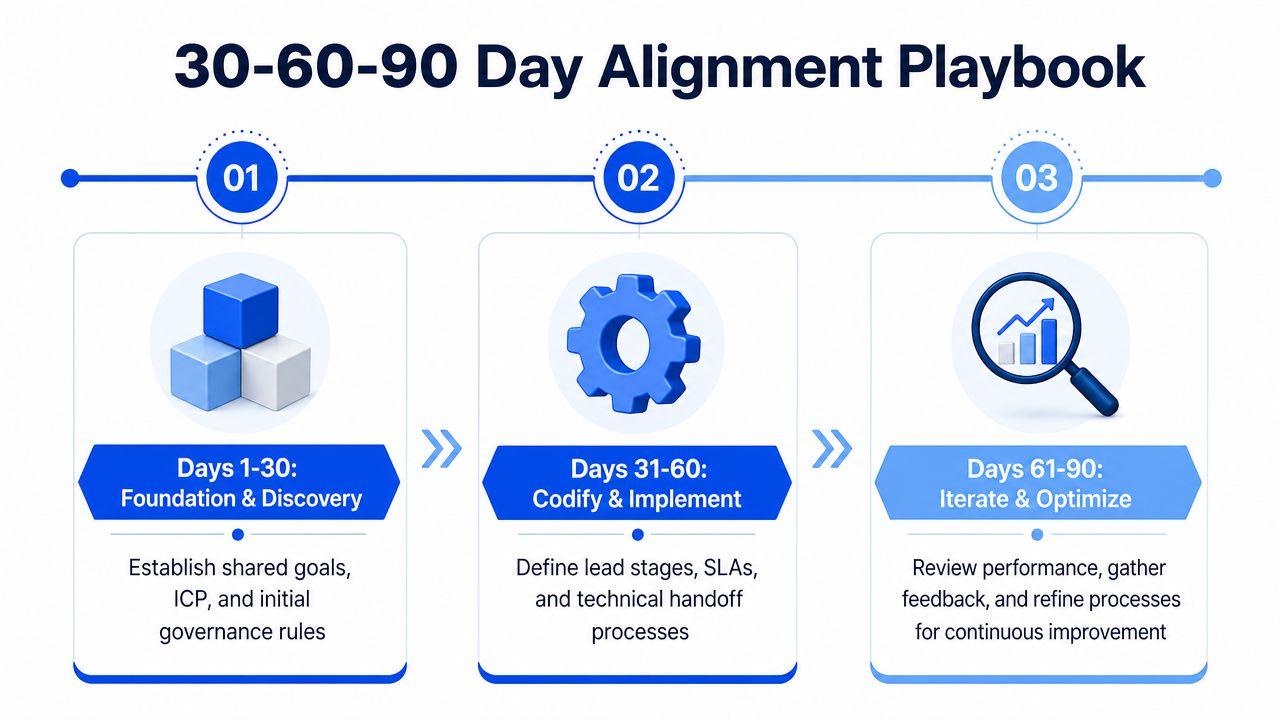
Your 30-60-90 day implementation plan
You don't need a transformation program. You need a build sequence with owners, outputs, and a hard cutoff for V1 decisions.
Days 1-30
The first month is for diagnosis and shared definitions. Don't touch scoring models or automation until you know what's broken.
Start with an audit:
Systems audit → HubSpot properties, lifecycle stages, workflows, forms, list logic, integrations
Process audit → current handoff path, response workflow, rejection handling, recycling rules
Message audit → campaign claims, outbound messaging, call talk tracks, objection handling
Data audit → missing fields, duplicate rates, source inconsistencies, broken ownership rules
Then run one working session with sales, marketing, and RevOps in the same room. The output should be tangible. One ICP draft. One agreed funnel map. One owner for each lifecycle definition. One list of fields that must exist before a lead can hand off.
A practical operating checklist for this phase:
Freeze ad hoc stage changes.
Pick a single source of truth for company and contact records.
Write V1 definitions for MQL, SAL, SQL, recycle, and disqualify.
Decide which rejection reasons are allowed.
Name the weekly pipeline council members.
Days 31-60
Now build the infrastructure. At this stage, teams often go too broad. Keep V1 narrow and usable.
Configure the CRM and connected tools so the contract is executable:
Build item | Owner | Output |
|---|---|---|
Lifecycle property cleanup | RevOps | Clean stage logic |
Lead routing workflows | RevOps | Automatic assignment |
Required handoff fields | Marketing ops | Complete records at transfer |
Task and alert workflows | Sales ops | Visible SLA timers |
Shared dashboard | RevOps | One reporting view |
Use real records to test the flow. Create sample inbound leads, outbound-created contacts, recycled leads, and reactivated accounts. Watch what breaks. Most issues show up in ownership conflicts, duplicate creation, and missing field dependencies.
This is also when training happens. Not a one-hour slide review. Use role-based training.
SDRs need to know acceptance rules, rejection reasons, and response expectations.
Marketing needs to know which fields are mandatory and what happens when data is missing.
AEs need to know how recycled and marketing-influenced activity will appear in the CRM.
Leadership needs to know which dashboard numbers count and which legacy reports are retired.
Days 61-90
The third phase is activation. Launch one coordinated campaign with one clean target segment. Don't test the entire market at once.
A reliable motion is:
Marketing runs LinkedIn content and account-based air cover to a target list
Sales runs outbound against the same list using synchronized messaging
HubSpot captures engagement and handoff status
Weekly council reviews lead quality, stage progression, and rejection reasons
RevOps adjusts routing, scoring, and field requirements based on what the team sees
This phase is where behavior either sticks or slides. Reps will try to bypass fields. Marketers will want to count early engagement as success. Leaders will ask for one-off reports. Hold the line on the shared process until you have enough signal to improve it.
Operator note: V1 doesn't need to be elegant. It needs to be inspectable. If you can see where the lead came from, how it moved, who touched it, and why it stalled, you can improve it.
At the end of this cycle, you should have a working revenue engine. Not perfect. But connected.
Common pitfalls and how to fix them
The failure modes are predictable. That's good news because you can design around them early.
Attribution fights
Symptom → sales says marketing is taking credit for deals reps created. Marketing says sales ignores warming activity.
Cause → channel-based ownership models force teams to defend territory instead of pipeline.
Fix → report on pipeline created first, then use attribution views as secondary context. If the room argues about influence before agreeing on stage definitions and account ownership, you're measuring noise.
Vanity metric relapse
Symptom → the dashboard slowly fills back up with lead volume, email opens, impressions, and meeting counts.
Cause → those numbers are easier to improve than conversion and velocity.
Fix → keep the shared review anchored to progression metrics and handoff quality. If you need a reference set for the right metrics, this list of lead generation KPIs is useful as a filter. Not every KPI deserves executive attention.
When to break alignment on purpose
Rigid alignment can be as damaging as no alignment. If sales is seeing stronger conversion from a narrow slice the ICP doesn't currently prioritize, the answer isn't to reject that signal because it's “off strategy.”
Belkins points to a real gap in standard advice here. Most alignment content doesn't explain how to operationalize rapid ICP re-scoping, which is critical when entering new markets or when sales learns that the highest-converting leads come from a narrower segment than marketing is targeting, according to Belkins' view on sales and marketing alignment gaps.
The fix is a controlled exception process:
Create a test segment with a clear label in the CRM
Route it intentionally to a small rep group
Track it separately in the shared dashboard
Review it weekly until it either earns a place in the ICP or gets closed down
That's how you keep alignment disciplined without making it brittle.
If your sales and marketing teams are still running on separate definitions, separate lists, and separate reporting, the fastest next step is to rebuild the system around one ICP, one handoff contract, and one dashboard. Grou helps B2B teams do that by connecting LinkedIn content, lead generation, and outbound into a single pipeline engine with shared targeting, clear qualification rules, and visible reporting.
Sales says the leads are weak. Marketing says sales sits on them too long. The CRM has three versions of the same account, two lifecycle models, and one dashboard nobody trusts. Pipeline isn't low because either team is lazy. It's low because the operating system between them is broken.
That usually shows up in the same places. Different ICP docs. Different definitions for MQL, SAL, and SQL. Apollo lists that never sync back to HubSpot. Campaign engagement data that marketing sees, but SDRs don't. Reps rejecting leads with a dropdown that says “bad fit” and no usable feedback.
If you want to align sales and marketing, stop treating it as a culture project. Treat it like a systems build. The work is in the definitions, field mappings, sync rules, routing logic, meeting cadence, and escalation path when the market tells you your ICP is off.
Table of Contents
Your sales and marketing teams are working, but not together
The technical contract: lead definitions, slas, and handoff rules
The operating system: coordinating content, campaigns, and tech
Your sales and marketing teams are working, but not together
This is the standoff most B2B teams are in right now. Marketing is producing campaigns, lists, content, and handoffs. Sales is running outbound, demos, follow-ups, and forecasts. Everyone is active, but the motion doesn't compound because the teams are optimizing different parts of the same funnel.
The symptom looks personal. It usually isn't. If sales and marketing use different audience rules, different funnel definitions, and different reporting logic, they will blame each other even when both are doing competent work.
Sales doesn't need more leads if the acceptance criteria are fuzzy. Marketing doesn't need more budget if the follow-up path is broken.
You can see the impact in performance data. In aligned organizations, marketing can drive up to 29% of pipeline, compared with 10% in misaligned ones, and the difference is measurable through shared metrics like MQL-to-SAL conversion, pipeline velocity, win rates, and CAC/CLV, according to Teamgate's sales and marketing alignment analysis.
A lot of high-level writing on this topic gets the diagnosis right and stops there. If you want a founder-level overview of the business case, Optimizing sales and marketing for growth is a useful complement. The mechanics are often the missing piece. Who owns the ICP document. Which fields must sync from Apollo into HubSpot. What starts the SLA timer. Where lead rejection reasons are captured. How often the two teams review handoff quality.
That's the work that turns attention into pipeline. Not another alignment workshop.
The foundation: shared goals, icp, and governance
Alignment starts before tool setup. If your audience definition, success metric, and meeting structure are split, every automation you build just scales disagreement.
One ICP, not two versions of the market
The fastest way to break pipeline is to let marketing target a broad category while sales focuses on a narrower one. You need one ICP document, one owner for updates, and one review process. Not a positioning deck for marketing and a separate “real target list” sitting in Sales Navigator.
A useful ICP doc has four parts:
Firmographics → industry, company size band, geography, business model
Technographics → key tools in stack, buying environment, integration constraints
Buying context → trigger events, operational pain, urgency pattern
Exclusions → segments that look attractive on paper but don't convert or don't retain
For effective implementation, the cleanest build is a working doc linked to CRM properties. If the ICP says “mid-market legal tech in North America using HubSpot and a modern sales engagement layer,” those attributes need matching fields and picklists in HubSpot, not just words in Notion.
If you need a practical reference for structuring that definition, this guide to an ideal customer profile framework is the right level of detail for turning the concept into routing and targeting rules.
Shared goals that survive contact with reality
If marketing is paid on MQL volume and sales is paid on meetings held, they are not aligned. They are cooperating temporarily.
Outfunnel's alignment guidance is directionally right here. The process should start with a shared ICP, then move into joint OKR setting and unified funnel definitions, and aligned organizations report 36% higher customer retention and 38% better win rates in that model, according to Outfunnel's sales and marketing alignment research.
The practical move is to set one primary shared target and a small set of operating metrics under it.
Layer | Shared metric | Why it matters |
|---|---|---|
Primary | Qualified pipeline created | It forces both teams to care about fit and progression |
Secondary | Pipeline velocity | It catches slow handoffs and stalled stage movement |
Secondary | Stage conversion rates | It shows where quality or process is breaking |
Secondary | Win rate by segment | It exposes whether your ICP is real or aspirational |
Don't let “marketing sourced” and “sales sourced” become separate kingdoms. Both teams should be looking at pipeline created by target account set, segment, and campaign motion.
Governance that keeps the system honest
Governance is just recurring inspection with the right people in the room. If you skip it, definitions drift and local workarounds multiply.
A simple cadence works:
Weekly pipeline council → Head of Sales, Head of Marketing, RevOps, SDR lead, one AE. Review handoff quality, stage movement, rejected leads, follow-up compliance, campaign-to-opportunity progression.
Monthly ICP review → look at accepted leads, disqualified leads, open opportunities, and closed-lost themes by segment.
Quarterly operating reset → update funnel definitions, routing rules, scoring logic, and account tiering.
Practical rule: If a lead is rejected, the rep must choose a structured reason and add one plain-language note. “Bad fit” alone is not feedback.
Without this layer, teams revert to opinion. With it, you get a shared operating memory.
The technical contract: lead definitions, slas, and handoff rules
Most alignment efforts fail at this point. People agree in meetings, then the CRM still routes leads with half-filled records and no clear owner. The fix is simple to say and annoying to implement. Define the contract in fields, workflows, and timers.
Define stages with entry and exit criteria
An MQL isn't “someone marketing likes.” A SAL isn't “someone sales glanced at.” Write exact criteria for each stage and make the lifecycle property reflect those rules.
A workable model looks like this:
MQL
Entry → matched to ICP, minimum required firmographic fields complete, valid contact data, and a qualifying intent or engagement trigger defined by your team.
Exit → accepted by sales, rejected with structured reason, or returned to nurture.SAL
Entry → assigned owner, first action taken, record reviewed for fit.
Exit → converted to SQL, recycled, or disqualified.SQL
Entry → live sales conversation confirms active problem, plausible fit, and a next-step-worthy buying motion.
Exit → opportunity created or disqualified.
If you want a more detailed framework for how qualification criteria should be documented and scored, Grou's guide to a lead qualification process is useful because it maps criteria to operational use, not just theory.
Build the SLA inside the CRM, not in a slide deck
Your SLA should live in HubSpot workflows, task queues, lead status logic, and alerting. If it only exists in onboarding docs, it won't survive the quarter.
Use this checklist:
Lifecycle stages are locked down so reps can't improvise stage meanings.
Assignment logic is automatic by territory, segment, or named account owner.
Response-time timers are visible with task due dates and escalation rules.
Rejection reasons are mandatory before a lead can be recycled.
Re-nurture rules are explicit so marketing knows what comes back and why.
A lot of teams miss the handoff design problem entirely. Influ2 cites that only 11% of companies have successfully aligned their marketing and sales audiences and created an effective handoff process. Those companies can have marketing influence of up to 29% of pipeline and convert 65% more prospects to pipeline when marketing is actively involved in the sales process, according to Influ2's alignment statistics.
For teams tightening the top of funnel before handoff, I like pairing outbound and social demand capture. If that's part of your mix, PostPlanify's lead gen playbook is worth reviewing because it shows how social activity can feed a more structured pipeline motion instead of staying disconnected from sales follow-up.
Here's a useful walkthrough on the sales side of the handoff stack:
The minimum handoff payload
When marketing passes a lead, sales shouldn't have to investigate basic context from scratch. The record should arrive with enough data to act.
At minimum, populate:
Account fields → company name, website, industry, employee band, country
Contact fields → full name, title, LinkedIn URL, email status, phone if available
Acquisition context → source, campaign, ad set or list source, first conversion event
Engagement context → pages viewed, form fills, webinar attendance, email replies, ad engagement if tracked
Routing context → owner, territory, named account flag, SLA start timestamp
If Apollo is your prospecting layer, sync enriched account and contact data into HubSpot before the lead reaches an SDR queue. If Clay is enriching, write the outputs to standard fields, not custom one-offs nobody will maintain later.
The feedback loop: shared dashboards and reporting cadence
Monday, 9:00 a.m. Marketing walks into the pipeline meeting with HubSpot attribution. Sales shows a separate Apollo export and a rep-level spreadsheet. Everyone has numbers. No one has the same answer on what created pipeline, what stalled, or what needs to change this week.
What the dashboard must show
Build one shared dashboard in HubSpot and make it the only reporting surface used in the weekly revenue meeting. Apollo can stay in the workflow for sequencing and contact data, but the scorekeeping needs to land in one system. If the same lead can appear as "worked" in Apollo and "untouched" in HubSpot, fix the sync before debating performance.
The dashboard should answer five operating questions:
Question | Dashboard view |
|---|---|
Are leads moving fast enough? | Pipeline velocity by segment |
Where are we losing them? | Stage-to-stage conversion |
How long does progression take? | Lead-to-close time, or stage aging |
Which sources create actual pipeline? | Opportunity creation and pipeline value by source |
Is handoff quality improving? | MQL-to-SAL and SAL-to-SQL conversion |
A useful setup is one executive view and one operator view. The executive layer tracks sourced pipeline, influenced pipeline, win rate, average sales cycle, and forecast coverage. The operator layer gets more specific: SLA misses, lead aging by owner, recycle reasons, meeting-set rate, no-show rate, and accepted-opportunity rate by campaign. That split keeps leadership out of workflow noise while giving SDR managers and demand gen managers enough detail to act.
For internal benchmark design, keep a documented metric glossary beside the dashboard. "Pipeline created" should mean one thing. "Sales accepted lead" should mean one thing. "Recycled" should have a fixed reason list and a required next step. This guide on measuring sales performance is a useful reference for tightening those definitions across teams.
If reporting is fragmented across agencies, BI tools, and ad platforms, outside support can help. This article on choosing a digital marketing analytics partner is useful because it focuses on decision-ready reporting instead of channel vanity metrics.
The weekly review that actually improves pipeline
Run this meeting once a week for 30 minutes. Demand gen, SDR leadership, sales leadership, and RevOps should all be there. Keep cameras off if needed. Keep the dashboard on screen. The goal is to identify one or two changes to routing, targeting, messaging, or follow-up speed.
Use this agenda:
New pipeline created by segment, source, and owner
Stage conversion changes from the prior two weeks
Rejected and recycled leads by reason code
SLA misses by team, queue, or rep
Campaign-level notes from marketing tied to actual opportunity movement
Call and email feedback from SDRs and AEs tied to objection patterns
One test for next week with owner, metric, and review date
I usually assign the same owner to run the meeting every week, often RevOps or sales ops. That person controls definitions, pulls the dashboard 30 minutes before the meeting, and logs decisions in a simple change log: issue, hypothesis, action, owner, due date, result. Without that discipline, teams repeat the same conversation every Tuesday.
One more trade-off matters here. Full alignment is not always the right call. If marketing is testing a new ICP segment or sales is probing a new objection cluster, let one team run fast for a short window and label it clearly in reporting. Keep the test isolated, time-boxed, and measured against the shared dashboard. Short-term misalignment is useful when it produces market feedback faster than committee consensus.
Ask tighter questions. Which campaign produced accepted opportunities? Which SDR queue is sitting on leads past SLA? Which recycle reasons can marketing fix with audience changes, and which ones point to rep coaching? Those questions turn dashboards into operating tools instead of status updates.
The operating system: coordinating content, campaigns, and tech
Once the contract and reporting are in place, alignment shifts from governance to execution. During this phase, teams frequently either compound gains or fall back into channel silos.
Run coordinated plays, not disconnected activity
A strong operating model uses shared account lists, shared messaging themes, and staggered activation. Marketing creates familiarity. Sales converts attention into conversations.
One play I use often looks like this:
Marketing builds a target account cohort in HubSpot and mirrors it into LinkedIn Matched Audiences.
Content runs around one objection cluster, one use case, or one market problem.
Paid and organic LinkedIn activity gives the account set air cover.
Sales starts outbound after the campaign has established context, using Apollo, Instantly, Lemlist, or HeyReach depending on channel mix.
SDRs reference the same theme the prospect has already seen, not a random cold opener.
All engagement, replies, meetings, and recycling outcomes sync back to HubSpot.
That's how you align sales and marketing in practice. Not with vague “better communication,” but with one list, one message, one timeline.
Marketing should build assets from live objections, not from an abstract content calendar.
The content loop matters just as much. If AEs hear the same objection in calls for two weeks, marketing should turn that into a one-pager, short proof asset, founder post, or landing page variant. Sales then uses the asset in sequence steps and follow-ups. This is faster than asking marketing for a quarterly collateral refresh that arrives after the objection has already changed.
How the stack should connect
The stack doesn't need to be huge. It does need to be coherent.
A clean setup for many B2B teams looks like this:
HubSpot as source of truth for contacts, companies, lifecycle stages, workflows, and reporting
Apollo for list building and outbound execution inputs
Clay for enrichment and normalization before records hit rep queues
Instantly or Lemlist for email sequencing if you need a dedicated outbound layer
HeyReach for LinkedIn outreach coordination
Sales Navigator for account research, buying committee expansion, and signal collection
The rule is simple. External tools can generate or enrich activity, but HubSpot owns stage movement and reporting. If lifecycle logic sits partly in Apollo and partly in spreadsheets, your attribution and SLA reporting will drift.
Monday's guidance on alignment gets the operational side right. The most effective methodology is a closed-loop handoff workflow where both teams map the journey, define exact entry and exit criteria, automate data sharing through the CRM, and review lead quality in weekly working sessions to reduce leakage at the handoff point, according to Monday.com's sales and marketing alignment guide.
If you want a lighter managed layer across outbound, content, and signal routing, Grou's B2B marketing automation approach is one example of how teams centralize those motions into one reporting line instead of running separate programs.
Your 30-60-90 day implementation plan
You don't need a transformation program. You need a build sequence with owners, outputs, and a hard cutoff for V1 decisions.
Days 1-30
The first month is for diagnosis and shared definitions. Don't touch scoring models or automation until you know what's broken.
Start with an audit:
Systems audit → HubSpot properties, lifecycle stages, workflows, forms, list logic, integrations
Process audit → current handoff path, response workflow, rejection handling, recycling rules
Message audit → campaign claims, outbound messaging, call talk tracks, objection handling
Data audit → missing fields, duplicate rates, source inconsistencies, broken ownership rules
Then run one working session with sales, marketing, and RevOps in the same room. The output should be tangible. One ICP draft. One agreed funnel map. One owner for each lifecycle definition. One list of fields that must exist before a lead can hand off.
A practical operating checklist for this phase:
Freeze ad hoc stage changes.
Pick a single source of truth for company and contact records.
Write V1 definitions for MQL, SAL, SQL, recycle, and disqualify.
Decide which rejection reasons are allowed.
Name the weekly pipeline council members.
Days 31-60
Now build the infrastructure. At this stage, teams often go too broad. Keep V1 narrow and usable.
Configure the CRM and connected tools so the contract is executable:
Build item | Owner | Output |
|---|---|---|
Lifecycle property cleanup | RevOps | Clean stage logic |
Lead routing workflows | RevOps | Automatic assignment |
Required handoff fields | Marketing ops | Complete records at transfer |
Task and alert workflows | Sales ops | Visible SLA timers |
Shared dashboard | RevOps | One reporting view |
Use real records to test the flow. Create sample inbound leads, outbound-created contacts, recycled leads, and reactivated accounts. Watch what breaks. Most issues show up in ownership conflicts, duplicate creation, and missing field dependencies.
This is also when training happens. Not a one-hour slide review. Use role-based training.
SDRs need to know acceptance rules, rejection reasons, and response expectations.
Marketing needs to know which fields are mandatory and what happens when data is missing.
AEs need to know how recycled and marketing-influenced activity will appear in the CRM.
Leadership needs to know which dashboard numbers count and which legacy reports are retired.
Days 61-90
The third phase is activation. Launch one coordinated campaign with one clean target segment. Don't test the entire market at once.
A reliable motion is:
Marketing runs LinkedIn content and account-based air cover to a target list
Sales runs outbound against the same list using synchronized messaging
HubSpot captures engagement and handoff status
Weekly council reviews lead quality, stage progression, and rejection reasons
RevOps adjusts routing, scoring, and field requirements based on what the team sees
This phase is where behavior either sticks or slides. Reps will try to bypass fields. Marketers will want to count early engagement as success. Leaders will ask for one-off reports. Hold the line on the shared process until you have enough signal to improve it.
Operator note: V1 doesn't need to be elegant. It needs to be inspectable. If you can see where the lead came from, how it moved, who touched it, and why it stalled, you can improve it.
At the end of this cycle, you should have a working revenue engine. Not perfect. But connected.
Common pitfalls and how to fix them
The failure modes are predictable. That's good news because you can design around them early.
Attribution fights
Symptom → sales says marketing is taking credit for deals reps created. Marketing says sales ignores warming activity.
Cause → channel-based ownership models force teams to defend territory instead of pipeline.
Fix → report on pipeline created first, then use attribution views as secondary context. If the room argues about influence before agreeing on stage definitions and account ownership, you're measuring noise.
Vanity metric relapse
Symptom → the dashboard slowly fills back up with lead volume, email opens, impressions, and meeting counts.
Cause → those numbers are easier to improve than conversion and velocity.
Fix → keep the shared review anchored to progression metrics and handoff quality. If you need a reference set for the right metrics, this list of lead generation KPIs is useful as a filter. Not every KPI deserves executive attention.
When to break alignment on purpose
Rigid alignment can be as damaging as no alignment. If sales is seeing stronger conversion from a narrow slice the ICP doesn't currently prioritize, the answer isn't to reject that signal because it's “off strategy.”
Belkins points to a real gap in standard advice here. Most alignment content doesn't explain how to operationalize rapid ICP re-scoping, which is critical when entering new markets or when sales learns that the highest-converting leads come from a narrower segment than marketing is targeting, according to Belkins' view on sales and marketing alignment gaps.
The fix is a controlled exception process:
Create a test segment with a clear label in the CRM
Route it intentionally to a small rep group
Track it separately in the shared dashboard
Review it weekly until it either earns a place in the ICP or gets closed down
That's how you keep alignment disciplined without making it brittle.
If your sales and marketing teams are still running on separate definitions, separate lists, and separate reporting, the fastest next step is to rebuild the system around one ICP, one handoff contract, and one dashboard. Grou helps B2B teams do that by connecting LinkedIn content, lead generation, and outbound into a single pipeline engine with shared targeting, clear qualification rules, and visible reporting.
Sales says the leads are weak. Marketing says sales sits on them too long. The CRM has three versions of the same account, two lifecycle models, and one dashboard nobody trusts. Pipeline isn't low because either team is lazy. It's low because the operating system between them is broken.
That usually shows up in the same places. Different ICP docs. Different definitions for MQL, SAL, and SQL. Apollo lists that never sync back to HubSpot. Campaign engagement data that marketing sees, but SDRs don't. Reps rejecting leads with a dropdown that says “bad fit” and no usable feedback.
If you want to align sales and marketing, stop treating it as a culture project. Treat it like a systems build. The work is in the definitions, field mappings, sync rules, routing logic, meeting cadence, and escalation path when the market tells you your ICP is off.
Table of Contents
Your sales and marketing teams are working, but not together
The technical contract: lead definitions, slas, and handoff rules
The operating system: coordinating content, campaigns, and tech
Your sales and marketing teams are working, but not together
This is the standoff most B2B teams are in right now. Marketing is producing campaigns, lists, content, and handoffs. Sales is running outbound, demos, follow-ups, and forecasts. Everyone is active, but the motion doesn't compound because the teams are optimizing different parts of the same funnel.
The symptom looks personal. It usually isn't. If sales and marketing use different audience rules, different funnel definitions, and different reporting logic, they will blame each other even when both are doing competent work.
Sales doesn't need more leads if the acceptance criteria are fuzzy. Marketing doesn't need more budget if the follow-up path is broken.
You can see the impact in performance data. In aligned organizations, marketing can drive up to 29% of pipeline, compared with 10% in misaligned ones, and the difference is measurable through shared metrics like MQL-to-SAL conversion, pipeline velocity, win rates, and CAC/CLV, according to Teamgate's sales and marketing alignment analysis.
A lot of high-level writing on this topic gets the diagnosis right and stops there. If you want a founder-level overview of the business case, Optimizing sales and marketing for growth is a useful complement. The mechanics are often the missing piece. Who owns the ICP document. Which fields must sync from Apollo into HubSpot. What starts the SLA timer. Where lead rejection reasons are captured. How often the two teams review handoff quality.
That's the work that turns attention into pipeline. Not another alignment workshop.
The foundation: shared goals, icp, and governance
Alignment starts before tool setup. If your audience definition, success metric, and meeting structure are split, every automation you build just scales disagreement.
One ICP, not two versions of the market
The fastest way to break pipeline is to let marketing target a broad category while sales focuses on a narrower one. You need one ICP document, one owner for updates, and one review process. Not a positioning deck for marketing and a separate “real target list” sitting in Sales Navigator.
A useful ICP doc has four parts:
Firmographics → industry, company size band, geography, business model
Technographics → key tools in stack, buying environment, integration constraints
Buying context → trigger events, operational pain, urgency pattern
Exclusions → segments that look attractive on paper but don't convert or don't retain
For effective implementation, the cleanest build is a working doc linked to CRM properties. If the ICP says “mid-market legal tech in North America using HubSpot and a modern sales engagement layer,” those attributes need matching fields and picklists in HubSpot, not just words in Notion.
If you need a practical reference for structuring that definition, this guide to an ideal customer profile framework is the right level of detail for turning the concept into routing and targeting rules.
Shared goals that survive contact with reality
If marketing is paid on MQL volume and sales is paid on meetings held, they are not aligned. They are cooperating temporarily.
Outfunnel's alignment guidance is directionally right here. The process should start with a shared ICP, then move into joint OKR setting and unified funnel definitions, and aligned organizations report 36% higher customer retention and 38% better win rates in that model, according to Outfunnel's sales and marketing alignment research.
The practical move is to set one primary shared target and a small set of operating metrics under it.
Layer | Shared metric | Why it matters |
|---|---|---|
Primary | Qualified pipeline created | It forces both teams to care about fit and progression |
Secondary | Pipeline velocity | It catches slow handoffs and stalled stage movement |
Secondary | Stage conversion rates | It shows where quality or process is breaking |
Secondary | Win rate by segment | It exposes whether your ICP is real or aspirational |
Don't let “marketing sourced” and “sales sourced” become separate kingdoms. Both teams should be looking at pipeline created by target account set, segment, and campaign motion.
Governance that keeps the system honest
Governance is just recurring inspection with the right people in the room. If you skip it, definitions drift and local workarounds multiply.
A simple cadence works:
Weekly pipeline council → Head of Sales, Head of Marketing, RevOps, SDR lead, one AE. Review handoff quality, stage movement, rejected leads, follow-up compliance, campaign-to-opportunity progression.
Monthly ICP review → look at accepted leads, disqualified leads, open opportunities, and closed-lost themes by segment.
Quarterly operating reset → update funnel definitions, routing rules, scoring logic, and account tiering.
Practical rule: If a lead is rejected, the rep must choose a structured reason and add one plain-language note. “Bad fit” alone is not feedback.
Without this layer, teams revert to opinion. With it, you get a shared operating memory.
The technical contract: lead definitions, slas, and handoff rules
Most alignment efforts fail at this point. People agree in meetings, then the CRM still routes leads with half-filled records and no clear owner. The fix is simple to say and annoying to implement. Define the contract in fields, workflows, and timers.
Define stages with entry and exit criteria
An MQL isn't “someone marketing likes.” A SAL isn't “someone sales glanced at.” Write exact criteria for each stage and make the lifecycle property reflect those rules.
A workable model looks like this:
MQL
Entry → matched to ICP, minimum required firmographic fields complete, valid contact data, and a qualifying intent or engagement trigger defined by your team.
Exit → accepted by sales, rejected with structured reason, or returned to nurture.SAL
Entry → assigned owner, first action taken, record reviewed for fit.
Exit → converted to SQL, recycled, or disqualified.SQL
Entry → live sales conversation confirms active problem, plausible fit, and a next-step-worthy buying motion.
Exit → opportunity created or disqualified.
If you want a more detailed framework for how qualification criteria should be documented and scored, Grou's guide to a lead qualification process is useful because it maps criteria to operational use, not just theory.
Build the SLA inside the CRM, not in a slide deck
Your SLA should live in HubSpot workflows, task queues, lead status logic, and alerting. If it only exists in onboarding docs, it won't survive the quarter.
Use this checklist:
Lifecycle stages are locked down so reps can't improvise stage meanings.
Assignment logic is automatic by territory, segment, or named account owner.
Response-time timers are visible with task due dates and escalation rules.
Rejection reasons are mandatory before a lead can be recycled.
Re-nurture rules are explicit so marketing knows what comes back and why.
A lot of teams miss the handoff design problem entirely. Influ2 cites that only 11% of companies have successfully aligned their marketing and sales audiences and created an effective handoff process. Those companies can have marketing influence of up to 29% of pipeline and convert 65% more prospects to pipeline when marketing is actively involved in the sales process, according to Influ2's alignment statistics.
For teams tightening the top of funnel before handoff, I like pairing outbound and social demand capture. If that's part of your mix, PostPlanify's lead gen playbook is worth reviewing because it shows how social activity can feed a more structured pipeline motion instead of staying disconnected from sales follow-up.
Here's a useful walkthrough on the sales side of the handoff stack:
The minimum handoff payload
When marketing passes a lead, sales shouldn't have to investigate basic context from scratch. The record should arrive with enough data to act.
At minimum, populate:
Account fields → company name, website, industry, employee band, country
Contact fields → full name, title, LinkedIn URL, email status, phone if available
Acquisition context → source, campaign, ad set or list source, first conversion event
Engagement context → pages viewed, form fills, webinar attendance, email replies, ad engagement if tracked
Routing context → owner, territory, named account flag, SLA start timestamp
If Apollo is your prospecting layer, sync enriched account and contact data into HubSpot before the lead reaches an SDR queue. If Clay is enriching, write the outputs to standard fields, not custom one-offs nobody will maintain later.
The feedback loop: shared dashboards and reporting cadence
Monday, 9:00 a.m. Marketing walks into the pipeline meeting with HubSpot attribution. Sales shows a separate Apollo export and a rep-level spreadsheet. Everyone has numbers. No one has the same answer on what created pipeline, what stalled, or what needs to change this week.
What the dashboard must show
Build one shared dashboard in HubSpot and make it the only reporting surface used in the weekly revenue meeting. Apollo can stay in the workflow for sequencing and contact data, but the scorekeeping needs to land in one system. If the same lead can appear as "worked" in Apollo and "untouched" in HubSpot, fix the sync before debating performance.
The dashboard should answer five operating questions:
Question | Dashboard view |
|---|---|
Are leads moving fast enough? | Pipeline velocity by segment |
Where are we losing them? | Stage-to-stage conversion |
How long does progression take? | Lead-to-close time, or stage aging |
Which sources create actual pipeline? | Opportunity creation and pipeline value by source |
Is handoff quality improving? | MQL-to-SAL and SAL-to-SQL conversion |
A useful setup is one executive view and one operator view. The executive layer tracks sourced pipeline, influenced pipeline, win rate, average sales cycle, and forecast coverage. The operator layer gets more specific: SLA misses, lead aging by owner, recycle reasons, meeting-set rate, no-show rate, and accepted-opportunity rate by campaign. That split keeps leadership out of workflow noise while giving SDR managers and demand gen managers enough detail to act.
For internal benchmark design, keep a documented metric glossary beside the dashboard. "Pipeline created" should mean one thing. "Sales accepted lead" should mean one thing. "Recycled" should have a fixed reason list and a required next step. This guide on measuring sales performance is a useful reference for tightening those definitions across teams.
If reporting is fragmented across agencies, BI tools, and ad platforms, outside support can help. This article on choosing a digital marketing analytics partner is useful because it focuses on decision-ready reporting instead of channel vanity metrics.
The weekly review that actually improves pipeline
Run this meeting once a week for 30 minutes. Demand gen, SDR leadership, sales leadership, and RevOps should all be there. Keep cameras off if needed. Keep the dashboard on screen. The goal is to identify one or two changes to routing, targeting, messaging, or follow-up speed.
Use this agenda:
New pipeline created by segment, source, and owner
Stage conversion changes from the prior two weeks
Rejected and recycled leads by reason code
SLA misses by team, queue, or rep
Campaign-level notes from marketing tied to actual opportunity movement
Call and email feedback from SDRs and AEs tied to objection patterns
One test for next week with owner, metric, and review date
I usually assign the same owner to run the meeting every week, often RevOps or sales ops. That person controls definitions, pulls the dashboard 30 minutes before the meeting, and logs decisions in a simple change log: issue, hypothesis, action, owner, due date, result. Without that discipline, teams repeat the same conversation every Tuesday.
One more trade-off matters here. Full alignment is not always the right call. If marketing is testing a new ICP segment or sales is probing a new objection cluster, let one team run fast for a short window and label it clearly in reporting. Keep the test isolated, time-boxed, and measured against the shared dashboard. Short-term misalignment is useful when it produces market feedback faster than committee consensus.
Ask tighter questions. Which campaign produced accepted opportunities? Which SDR queue is sitting on leads past SLA? Which recycle reasons can marketing fix with audience changes, and which ones point to rep coaching? Those questions turn dashboards into operating tools instead of status updates.
The operating system: coordinating content, campaigns, and tech
Once the contract and reporting are in place, alignment shifts from governance to execution. During this phase, teams frequently either compound gains or fall back into channel silos.
Run coordinated plays, not disconnected activity
A strong operating model uses shared account lists, shared messaging themes, and staggered activation. Marketing creates familiarity. Sales converts attention into conversations.
One play I use often looks like this:
Marketing builds a target account cohort in HubSpot and mirrors it into LinkedIn Matched Audiences.
Content runs around one objection cluster, one use case, or one market problem.
Paid and organic LinkedIn activity gives the account set air cover.
Sales starts outbound after the campaign has established context, using Apollo, Instantly, Lemlist, or HeyReach depending on channel mix.
SDRs reference the same theme the prospect has already seen, not a random cold opener.
All engagement, replies, meetings, and recycling outcomes sync back to HubSpot.
That's how you align sales and marketing in practice. Not with vague “better communication,” but with one list, one message, one timeline.
Marketing should build assets from live objections, not from an abstract content calendar.
The content loop matters just as much. If AEs hear the same objection in calls for two weeks, marketing should turn that into a one-pager, short proof asset, founder post, or landing page variant. Sales then uses the asset in sequence steps and follow-ups. This is faster than asking marketing for a quarterly collateral refresh that arrives after the objection has already changed.
How the stack should connect
The stack doesn't need to be huge. It does need to be coherent.
A clean setup for many B2B teams looks like this:
HubSpot as source of truth for contacts, companies, lifecycle stages, workflows, and reporting
Apollo for list building and outbound execution inputs
Clay for enrichment and normalization before records hit rep queues
Instantly or Lemlist for email sequencing if you need a dedicated outbound layer
HeyReach for LinkedIn outreach coordination
Sales Navigator for account research, buying committee expansion, and signal collection
The rule is simple. External tools can generate or enrich activity, but HubSpot owns stage movement and reporting. If lifecycle logic sits partly in Apollo and partly in spreadsheets, your attribution and SLA reporting will drift.
Monday's guidance on alignment gets the operational side right. The most effective methodology is a closed-loop handoff workflow where both teams map the journey, define exact entry and exit criteria, automate data sharing through the CRM, and review lead quality in weekly working sessions to reduce leakage at the handoff point, according to Monday.com's sales and marketing alignment guide.
If you want a lighter managed layer across outbound, content, and signal routing, Grou's B2B marketing automation approach is one example of how teams centralize those motions into one reporting line instead of running separate programs.
Your 30-60-90 day implementation plan
You don't need a transformation program. You need a build sequence with owners, outputs, and a hard cutoff for V1 decisions.
Days 1-30
The first month is for diagnosis and shared definitions. Don't touch scoring models or automation until you know what's broken.
Start with an audit:
Systems audit → HubSpot properties, lifecycle stages, workflows, forms, list logic, integrations
Process audit → current handoff path, response workflow, rejection handling, recycling rules
Message audit → campaign claims, outbound messaging, call talk tracks, objection handling
Data audit → missing fields, duplicate rates, source inconsistencies, broken ownership rules
Then run one working session with sales, marketing, and RevOps in the same room. The output should be tangible. One ICP draft. One agreed funnel map. One owner for each lifecycle definition. One list of fields that must exist before a lead can hand off.
A practical operating checklist for this phase:
Freeze ad hoc stage changes.
Pick a single source of truth for company and contact records.
Write V1 definitions for MQL, SAL, SQL, recycle, and disqualify.
Decide which rejection reasons are allowed.
Name the weekly pipeline council members.
Days 31-60
Now build the infrastructure. At this stage, teams often go too broad. Keep V1 narrow and usable.
Configure the CRM and connected tools so the contract is executable:
Build item | Owner | Output |
|---|---|---|
Lifecycle property cleanup | RevOps | Clean stage logic |
Lead routing workflows | RevOps | Automatic assignment |
Required handoff fields | Marketing ops | Complete records at transfer |
Task and alert workflows | Sales ops | Visible SLA timers |
Shared dashboard | RevOps | One reporting view |
Use real records to test the flow. Create sample inbound leads, outbound-created contacts, recycled leads, and reactivated accounts. Watch what breaks. Most issues show up in ownership conflicts, duplicate creation, and missing field dependencies.
This is also when training happens. Not a one-hour slide review. Use role-based training.
SDRs need to know acceptance rules, rejection reasons, and response expectations.
Marketing needs to know which fields are mandatory and what happens when data is missing.
AEs need to know how recycled and marketing-influenced activity will appear in the CRM.
Leadership needs to know which dashboard numbers count and which legacy reports are retired.
Days 61-90
The third phase is activation. Launch one coordinated campaign with one clean target segment. Don't test the entire market at once.
A reliable motion is:
Marketing runs LinkedIn content and account-based air cover to a target list
Sales runs outbound against the same list using synchronized messaging
HubSpot captures engagement and handoff status
Weekly council reviews lead quality, stage progression, and rejection reasons
RevOps adjusts routing, scoring, and field requirements based on what the team sees
This phase is where behavior either sticks or slides. Reps will try to bypass fields. Marketers will want to count early engagement as success. Leaders will ask for one-off reports. Hold the line on the shared process until you have enough signal to improve it.
Operator note: V1 doesn't need to be elegant. It needs to be inspectable. If you can see where the lead came from, how it moved, who touched it, and why it stalled, you can improve it.
At the end of this cycle, you should have a working revenue engine. Not perfect. But connected.
Common pitfalls and how to fix them
The failure modes are predictable. That's good news because you can design around them early.
Attribution fights
Symptom → sales says marketing is taking credit for deals reps created. Marketing says sales ignores warming activity.
Cause → channel-based ownership models force teams to defend territory instead of pipeline.
Fix → report on pipeline created first, then use attribution views as secondary context. If the room argues about influence before agreeing on stage definitions and account ownership, you're measuring noise.
Vanity metric relapse
Symptom → the dashboard slowly fills back up with lead volume, email opens, impressions, and meeting counts.
Cause → those numbers are easier to improve than conversion and velocity.
Fix → keep the shared review anchored to progression metrics and handoff quality. If you need a reference set for the right metrics, this list of lead generation KPIs is useful as a filter. Not every KPI deserves executive attention.
When to break alignment on purpose
Rigid alignment can be as damaging as no alignment. If sales is seeing stronger conversion from a narrow slice the ICP doesn't currently prioritize, the answer isn't to reject that signal because it's “off strategy.”
Belkins points to a real gap in standard advice here. Most alignment content doesn't explain how to operationalize rapid ICP re-scoping, which is critical when entering new markets or when sales learns that the highest-converting leads come from a narrower segment than marketing is targeting, according to Belkins' view on sales and marketing alignment gaps.
The fix is a controlled exception process:
Create a test segment with a clear label in the CRM
Route it intentionally to a small rep group
Track it separately in the shared dashboard
Review it weekly until it either earns a place in the ICP or gets closed down
That's how you keep alignment disciplined without making it brittle.
If your sales and marketing teams are still running on separate definitions, separate lists, and separate reporting, the fastest next step is to rebuild the system around one ICP, one handoff contract, and one dashboard. Grou helps B2B teams do that by connecting LinkedIn content, lead generation, and outbound into a single pipeline engine with shared targeting, clear qualification rules, and visible reporting.

Pipeline OS Newsletter
Build qualified pipeline
Get weekly tactics to generate demand, improve lead quality, and book more meetings.







Trusted by industry leaders
Trusted by industry leaders
Trusted by industry leaders
Ready to build qualified pipeline?
Ready to build qualified pipeline?
Ready to build qualified pipeline?
Book a call to see if we're the right fit, or take the 2-minute quiz to get a clear starting point.
Book a call to see if we're the right fit, or take the 2-minute quiz to get a clear starting point.
Book a call to see if we're the right fit, or take the 2-minute quiz to get a clear starting point.
" height="30.21639343089746px" id="hfGbXmQR2" width="30.216393430897455px"/></svg>)
Copyright © 2026 – All Right Reserved
Copyright © 2026 – All Right Reserved
Copyright © 2026 – All Right Reserved