
NEW WEBINAR: Learn how to fill your B2B webinar seatsHow to fill your B2B webinar seatsSave your seat
%22%3E%3C/path%3E%3Cpath d=%22M 63.072 7.554 C 62.258 8.022 61.577 8.689 61.092 9.493 L 61.092 7.076 L 57.158 7.076 L 57.158 22.64 L 61.089 22.64 L 61.089 14.888 C 61.089 13.446 61.403 12.434 62.03 11.853 C 62.818 11.218 63.818 10.907 64.826 10.982 L 65.868 10.982 L 65.868 6.851 C 64.891 6.834 63.926 7.076 63.073 7.554 Z%22 fill=%22rgb(17,17,17)%22%3E%3C/path%3E%3Cpath d=%22M 78.916 7.82 C 76.363 6.49 73.321 6.49 70.768 7.82 C 69.562 8.473 68.564 9.451 67.888 10.644 C 67.167 11.931 66.803 13.387 66.834 14.862 C 66.804 16.332 67.157 17.785 67.86 19.077 C 68.515 20.267 69.494 21.246 70.684 21.901 C 71.924 22.576 73.318 22.92 74.73 22.898 C 76.164 22.918 77.58 22.575 78.846 21.901 C 80.062 21.247 81.073 20.27 81.768 19.077 C 82.506 17.797 82.88 16.339 82.85 14.862 C 82.88 13.389 82.517 11.934 81.797 10.647 C 81.12 9.455 80.122 8.477 78.917 7.824 M 78.803 14.862 C 78.829 15.739 78.636 16.608 78.241 17.391 C 77.903 18.046 77.38 18.588 76.738 18.95 C 76.124 19.293 75.432 19.472 74.729 19.47 C 73.668 19.497 72.648 19.061 71.934 18.276 C 71.139 17.323 70.741 16.1 70.823 14.862 C 70.741 13.62 71.149 12.395 71.959 11.45 C 72.687 10.667 73.715 10.233 74.783 10.256 C 75.859 10.236 76.894 10.67 77.635 11.45 C 78.464 12.387 78.884 13.616 78.801 14.864%22 fill=%22rgb(17,17,17)%22%3E%3C/path%3E%3Cpath d=%22M 95.906 7.076 L 95.906 15.646 C 95.975 16.68 95.643 17.701 94.979 18.498 C 94.311 19.184 93.379 19.547 92.422 19.495 C 91.475 19.544 90.553 19.18 89.894 18.498 C 89.23 17.701 88.898 16.68 88.967 15.646 L 88.967 7.076 L 85.033 7.076 L 85.033 16.207 C 85 17.449 85.275 18.68 85.834 19.79 C 86.327 20.75 87.095 21.542 88.039 22.065 C 89.033 22.594 90.145 22.861 91.271 22.838 C 92.188 22.847 93.095 22.65 93.926 22.263 C 94.708 21.905 95.388 21.36 95.906 20.675 L 95.906 22.645 L 99.865 22.645 L 99.865 7.076 Z%22 fill=%22rgb(17,17,17)%22%3E%3C/path%3E%3Cpath d=%22M 4.513 15.626 C 4.511 10.815 7.606 6.549 12.181 5.059 C 16.756 3.57 21.77 5.195 24.601 9.086 L 27.816 5.87 C 24.074 1.186 17.981 -0.943 12.137 0.393 C 6.292 1.728 1.728 6.292 0.393 12.137 C -0.943 17.981 1.186 24.074 5.87 27.816 L 9.085 24.601 C 6.214 22.512 4.515 19.177 4.513 15.626%22 fill=%22rgb(32,62,235)%22%3E%3C/path%3E%3Cpath d=%22M 17.114 14.343 L 13.354 18.01 L 13.354 18.026 L 21.071 18.026 L 11.412 27.609 L 17.389 27.609 L 23.999 21.081 L 23.999 28.316 L 24.005 28.316 L 27.967 24.393 L 27.967 14.343 Z%22 fill=%22rgb(32,62,235)%22%3E%3C/path%3E%3C/g%3E%3C/svg%3E) ×
×
NEW WEBINAR: Learn how to fill your B2B webinar seatsHow to fill your B2B webinar seatsSave your seat
×NEW WEBINAR: Learn how to fill your B2B webinar seatsHow to fill your B2B webinar seatsSave your seat
×›
›
›
›
B2B Buyer Journey: A Playbook for Real Pipeline
B2B Buyer Journey: A Playbook for Real Pipeline
B2B Buyer Journey: A Playbook for Real Pipeline
B2B Buyer Journey: A Playbook for Real Pipeline
B2B Buyer Journey: A Playbook for Real Pipeline
B2B Buyer Journey: A Playbook for Real Pipeline

Author
Aljaz Peklaj

You have traffic in HubSpot, replies in Apollo, meetings trickling through Calendly, and still no reliable pipeline. That usually gets blamed on offer, messaging, or lead volume. Most of the time, the underlying problem sits in the middle. Your b2b buyer journey is undocumented, unscored, and badly routed.
That creates a predictable mess. Marketing celebrates engagement, sales complains about quality, and RevOps gets stuck explaining why activity doesn't convert into revenue. Attention is showing up, but there's no operating system turning it into qualified conversations.
Table of Contents
Your buyer journey is broken, not your product
Key takeaways
The Bottleneck Is Journey Design
Why B2B buying is a team sport, not a solo sprint
B2C logic breaks in B2B
What this means for your funnel
Mapping the modern buyer journey stages
The five stages that matter
Where teams usually lose control
A 7-point framework for qualifying real buyers
The qualification checklist
The disqualifier most teams avoid
Matching your content and outbound to the buyer's stage
Generic content kills momentum
Content and outbound tactics by buyer stage
The playbook for an automated pipeline engine
The stack
The routing logic
The handoff that saves the meeting
Your next step is a pipeline audit, not a demo
Your buyer journey is broken, not your product
Monday morning. Your SDR team opens the queue to 46 new leads from paid search, LinkedIn, and a webinar. By Friday, they have booked a handful of calls, disqualified half the list, and left the rest in limbo because nobody agreed on what counts as sales-ready in the first place.
That is not a lead problem. It is a system problem.
Buyers now do a large share of evaluation before they ever reply to a rep, and many prefer to avoid sales conversations until late in the process. If your response to that shift is still "send every form fill to sales," you are feeding calendar activity, not pipeline.
Key takeaways
Set qualification rules before booking rules. A lead should not hit a rep calendar until fit, pain, trigger, and buying context are clear.
Map content to stage. Comparison pages, ROI proof, technical docs, and outbound sequences should be triggered by buyer behavior, not sent in one generic stream.
Route by intent and fit. Use separate paths in HubSpot, Salesforce, or your MAP for high-intent buyers, early-stage researchers, and poor-fit accounts.
Run the b2b buyer journey like an operating system. Stage definitions, scoring, and handoffs decide whether interest becomes meetings or wasted follow-up.
The Bottleneck Is Journey Design
Pipeline usually breaks between first signal and first conversation. Marketing logs activity. Sales sees noise. RevOps tries to patch the gap with more fields and more reports, but the issue sits upstream in journey design.
Here is what broken design looks like in practice. A prospect downloads a guide, gets marked as an MQL, books a call, and shows up with no project, no internal support, and no reason to change now. The rep still takes the meeting because the system allowed it. That is how teams fill the funnel and miss target at the same time.
Rule: if a lead cannot be placed in a clear journey stage and a clear qualification state, it does not belong with sales yet.
Fix the path before you buy more traffic. If your team is seeing high form volume, weak show rates, and low-opportunity conversion, review this breakdown of why your leads aren't converting and how to fix it before you add more top-of-funnel spend.
Why B2B buying is a team sport, not a solo sprint
B2C habits wreck B2B pipeline design. In B2C, one person often identifies the problem, compares options, and buys. In B2B, the person who clicks your ad is rarely the person who signs the agreement.

According to SalesFuel's analysis of the complex buyer journey, the typical B2B decision involves 13 internal stakeholders and 9 external influencers, and buyers use an average of 10+ touchpoints across the journey. That should kill the idea of a clean, single-threaded funnel.
B2C logic breaks in B2B
A B2C funnel asks, “How do I move one buyer from awareness to purchase?” A B2B funnel has to ask, “Which stakeholder is active, what do they care about, and what proof do they need to bring others with them?”
That's a very different job.
The CFO wants payback and downside protection. The end user wants workflow relief. The technical stakeholder wants integrations, access, compliance, and implementation clarity. The commercial lead wants speed and confidence that the vendor won't create internal pain.
If you send the same case study, same pitch deck, and same meeting ask to all of them, your process creates friction instead of momentum.
What this means for your funnel
You need a map built around buying roles, not just lead stages. That starts with understanding the buying committee in practical terms, then assigning messages, proof points, and channels to each role.
Here's the blunt version:
One contact is not one deal. A reply from a manager does not equal internal consensus.
One stage is not universal. The economic buyer may still be problem-aware while a practitioner is already comparing vendors.
One channel is not enough. Buyers move between website pages, LinkedIn posts, email threads, review platforms, and live calls.
Complex deals don't stall because buyers are slow. They stall because vendors push one message into a buying group that needs several.
The old funnel assumes progression. The actual B2B buyer journey is parallel. Several people move at once, each with different standards for what counts as enough proof.
Mapping the modern buyer journey stages
Many organizations map the journey too late. They start at demo request or inbound form fill, which ignores the biggest part of the process. Roughly 70% of the B2B buyer journey is completed before a prospect ever engages with sales, as outlined in Iternal's explanation of self-serve buyer behavior.
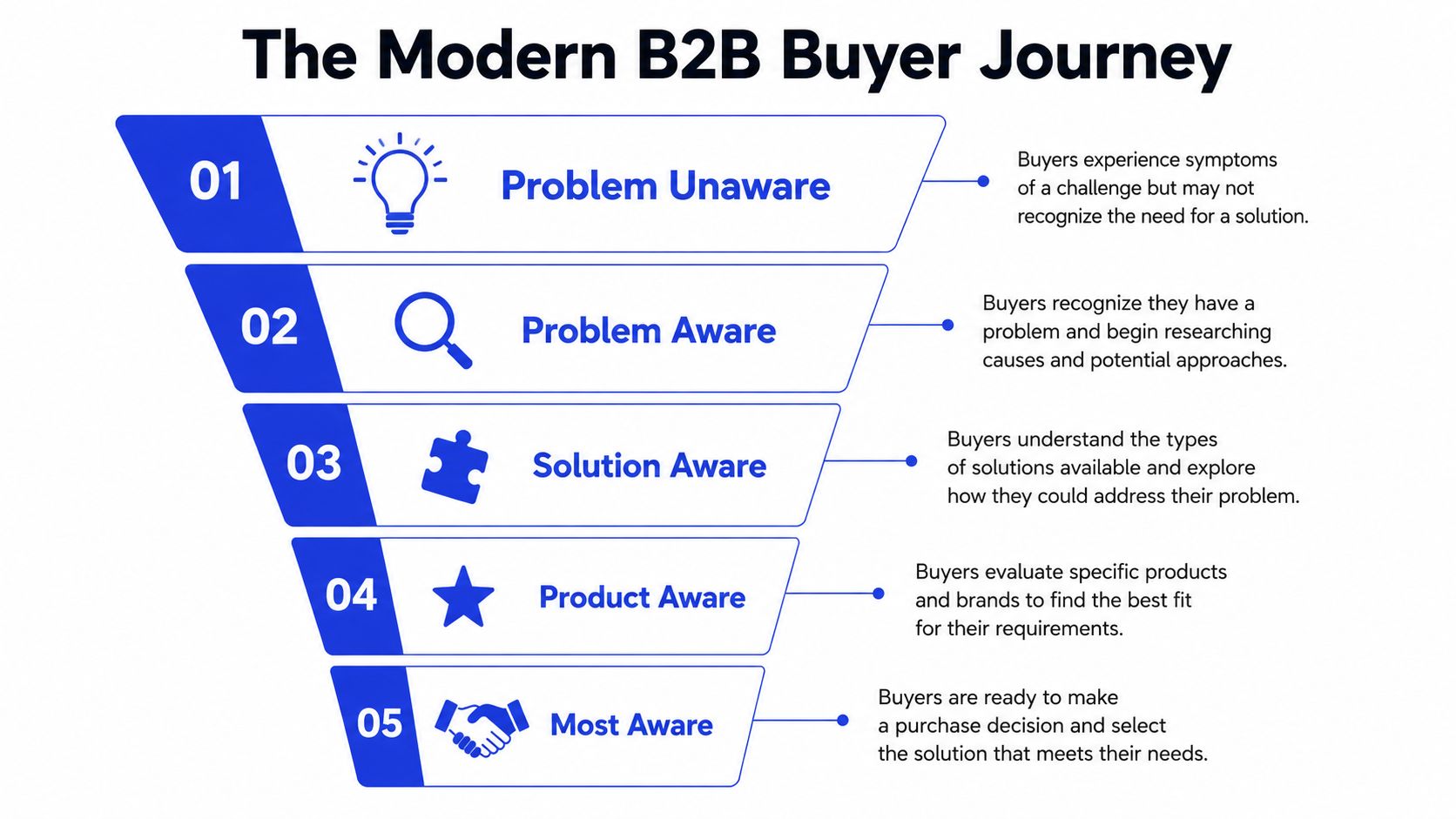
That means your map has to start before the hand-raise. I use a five-stage version because it's simple enough to run in HubSpot and detailed enough to guide content, outbound, and routing.
The five stages that matter
Problem unaware
The account has friction, but they haven't named it yet. They're seeing missed targets, slow ops, wasted ad spend, or manual process drag without tying it to a category.
Your job here is diagnosis. Publish problem-framing LinkedIn posts, category education, and operational breakdowns that help the buyer say, “That's exactly what's happening here.”
Problem aware
Now they know the pain. They're searching for causes, frameworks, and ways to evaluate the issue internally.
Calculators, checklists, benchmark-style assets, and sharp point-of-view content work best at this stage. You're not selling product yet. You're helping them structure the problem.
Solution aware
At this stage, they know the kind of solution they need. They're looking at approaches, delivery models, and implementation tradeoffs.
Use short product walkthroughs, use-case pages, and focused outbound that references the exact problem pattern. Role-specific messaging starts to matter at this stage.
Vendor comparison
The buyer has a shortlist. They're comparing feature depth, support quality, speed, proof, and risk.
Review pages, objection-handling decks, ROI framing, security documents, and customer proof all belong here. This is also where your outbound should stop being “open to a quick chat?” and start being concrete.
Decision
They're resolving internal objections, pricing, procurement, and rollout concerns. The deal can still die here if your champion lacks internal ammo.
That's why decision-stage content should be shareable. One-pagers, implementation plans, stakeholder-specific FAQ docs, and summary decks beat generic follow-up emails every time.
Where teams usually lose control
The biggest failure is poor lifecycle mapping. They classify based on source, not behavior. Someone who came in through paid search gets dumped into the same flow as a referral, even though their intent profile is different.
A proper lifecycle mapping process should track stage movement based on actions like repeat visits to solution pages, replies with business context, asset consumption, and buying committee expansion.
Buyers don't care about your funnel labels. They care whether each next step helps them reduce risk and make a decision.
If the next touch doesn't match the stage, you create drag. That's why journey mapping has to be operational, not decorative.
A 7-point framework for qualifying real buyers
Qualification should happen before rep time gets allocated, not during a call that never should've been booked. If your SDR team is still treating “interested” as enough, you're paying people to discover disqualification live.

This matters even more because 92% of new B2B journeys start with at least one vendor already in mind, and 42% of vendor switches are triggered by growth needs or poor current provider performance, based on Corporate Visions' B2B buying behavior data. If you don't identify the trigger fast, you're already behind.
The qualification checklist
I'd run every lead through these seven checks before a calendar opens.
ICP match
Industry, company size, geography, and business model have to fit your real target account profile. If you sell into SaaS, iGaming, manufacturing, legal tech, or pharma, define that in Clay and HubSpot before outreach starts.Persona match
You need either the decision-maker or a clear path to one. Founder, head of sales, VP marketing, or another owner with influence is fine. Random manager with no buying path is not.Trigger signal
Look for events that explain movement → hiring, funding, leadership changes, tech stack shifts, poor current provider performance, or visible growth pressure. No trigger usually means low urgency.Engagement weight
Don't score all activity equally. A reply with context matters more than an open. A booked meeting matters more than a content click. A referral matters more than both.Pain confirmation
Curiosity isn't pain. They should be able to state the problem in business terms, not just ask for pricing or “more information.”Authority and budget signal
Can they decide, influence, or mobilize consensus? Is the expected spend even close to your delivery model? If not, route out.Timeline
Active buying window beats vague interest. If they're just researching for a future quarter, nurture them. Don't burn rep time now.
For teams tightening scoring rules, this guide to lead scoring for sales teams is useful because it gets practical about weighting signals instead of dumping every interaction into the same score bucket.
The disqualifier most teams avoid
Ask one question early. Why now?
That question exposes the entire deal faster than most discovery decks. Real buyers answer with a trigger. Tire-kickers answer with fog.
Use these follow-ups right after:
What have you tried before and why didn't it work?
What does success look like in 90 days?
Who else is involved in this decision?
Non-negotiable: anything that fails two or more qualification checks goes to nurture, not the calendar.
If your current process doesn't support that level of control, tighten it with a proper lead qualification process before you add another campaign.
Matching your content and outbound to the buyer's stage
Most B2B content underperforms because it treats every buyer as if they're ready for the same ask. They aren't. A problem-aware buyer doesn't want a pricing call. A comparison-stage buyer doesn't need another generic thought-leadership post.
Intent-driven journey mapping fixes that. According to Intent Amplify's breakdown of multi-channel buyer journey scoring, organizations using intent-driven, multi-channel journey mapping reduce cycle times by 20–30% and increase lead-to-opportunity conversion by up to 40% when they trigger stage-aligned content and outreach.
Generic content kills momentum
You need a stage-to-asset matrix. Not a content calendar full of “value posts.” Not one outbound sequence for everyone in Apollo. A matrix.
If you want a strong companion read on this, this resource on how to improve B2B content performance is useful because it pushes past publishing volume and focuses on relevance.
The operating principle is simple. Content should answer the buyer's current question, and outbound should ask for the smallest next commitment that fits that stage.
Content and outbound tactics by buyer stage
Journey stage | Buyer's primary question | Effective content tactic | Effective outbound tactic |
|---|---|---|---|
Problem unaware | What's actually causing this friction? | LinkedIn posts framing the operational problem, founder-led POV content, short diagnostic articles | Low-friction connection request, short email referencing an industry pain pattern |
Problem aware | How do we define and evaluate the problem? | Checklists, benchmark assets, ROI framing, short webinars | Email with one sharp insight and one diagnostic question |
Solution aware | What kind of solution fits our setup? | Use-case pages, technical explainers, short demos, workflow breakdowns | Persona-specific outreach tied to trigger and use case |
Vendor comparison | Which vendor is the safest and best fit? | Comparison pages, proof assets, case studies, stakeholder decks, review-page support | Direct outreach with concrete relevance, proposed call, and tailored proof |
Decision | How do we get internal approval and reduce risk? | Implementation plans, FAQ docs, commercial summary, stakeholder one-pagers | Follow-up built around consensus, timeline, and decision support |
Tools matter at this stage. Use Sales Navigator for role and trigger visibility. Use Clay for enrichment and signal layering. Use Apollo or Instantly for segmented outbound. Use HubSpot to track stage transitions and content engagement.
And keep your content library usable. If your rep can't grab the right asset in under a minute, the library is too messy. A clean B2B content marketing guide should help your team think in terms of distribution and stage fit, not just content production.
The playbook for an automated pipeline engine
A target account hits your pricing page twice, a director downloads a buyer guide, and an SDR still has to guess whether this belongs in sequence, nurture, or an AE calendar. That is a systems problem. Fix the system, and you get more qualified meetings from the demand you already have.
Your pipeline engine should convert buyer behavior into action without waiting on rep judgment. Set up three layers. First, capture fit and intent. Second, score them against clear rules. Third, route the record to the right next step with full context attached.
The stack
Keep the stack boring. Boring scales.
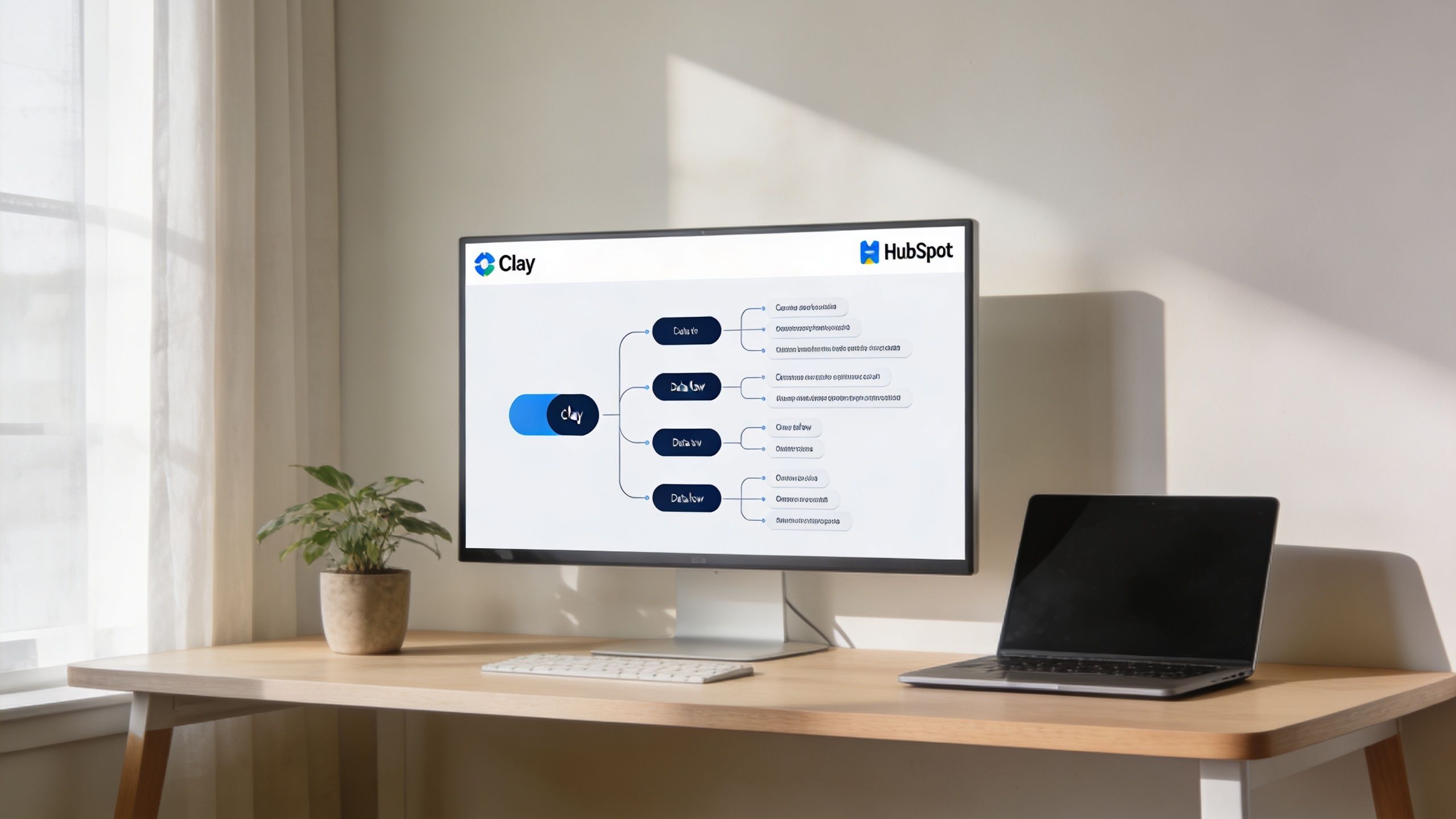
Clay for enrichment, trigger capture, account tagging, and list building
HubSpot for lead scoring, lifecycle stages, workflow automation, and owner assignment
Apollo, Instantly, Lemlist, or HeyReach for outbound by segment
Sales Navigator for role validation and account context
Calendly or Chili Piper for direct booking once a record clears your threshold
Slack for internal alerts and rep handoff
That stack covers the mechanics that theoretical buyer journey guides skip. Clay collects and normalizes signals. HubSpot applies the rules. Your outbound tool handles follow-up by segment. Your scheduler removes delay. If you need channel ideas to feed this engine, this guide on B2B demand generation tactics is useful because it focuses on coordinated programs instead of isolated campaigns.
The routing logic
Start with a scoring model your team can explain in one minute.
Score fit and intent separately
Fit should include company size, industry, geography, tech stack, and role. Intent should include reply status, page depth, high-value page visits, form fills, demo behavior, and recent activity window.Tag every record on entry
Industry, segment, source, persona, territory, and acquisition path should be stamped automatically. Dirty records create bad routing. Clean records create speed.Send qualified intent straight to a calendar
If a lead matches ICP and crosses your intent threshold, offer booking immediately through Calendly or Chili Piper. Manual review slows down good demand and rewards indecision.Place mid-intent leads in short, stage-specific follow-up
Use a tight sequence with one proof asset, one relevant use case, and one CTA. Keep it short. If they engage again, rescore and reroute.Keep poor-fit records out of sales queues
Send them to education, partner routing, or re-engagement. AEs should not spend pipeline time filtering records your system should have filtered upstream.Assign ownership by territory and expertise
Use round robin only inside the right pool. A healthcare account should not land with a rep who sells only to SaaS.
One shared queue is where pipeline discipline goes to die. It hides weak-fit volume, slows response time, and makes marketing think it created opportunity when it only created activity.
The handoff that saves the meeting
Booked meetings fail when the AE starts cold. Fix that with a required handoff packet in Slack and the CRM record.
Include five fields every time:
original source
trigger event
firmographic snapshot
engagement summary
reason the score crossed threshold
Add the last three pages viewed, any email reply text, and the campaign or outbound sequence that drove the conversion. The rep should know why the account surfaced, what problem they likely care about, and which stakeholder engaged first.
Here's a useful visual on how this kind of handoff fits together:
If the rep starts the call by asking questions your system already knows, your handoff failed.
Good RevOps teams do not treat the buyer journey as a content map. They turn it into operating logic. The result is simple. Better routing, cleaner qualification, faster meetings, and fewer wasted AE hours.
Your next step is a pipeline audit, not a demo
Don't start by buying another tool. Don't start by rewriting all your outbound. And don't ask for more leads until you know where the current ones break.
Run an audit on three things. First, where leads stall between first signal and meeting. Second, which qualification rules are missing or too loose. Third, whether your content and routing reflect actual buyer stages or just internal labels.
Use a simple pass-fail test:
Stage clarity → can every active lead be placed in a real journey stage?
Qualification control → can weak-fit leads be stopped before sales?
Routing speed → do high-intent leads reach a calendar fast?
Rep context → does the AE get full background before the call?
If any of those are weak, your pipeline won't become predictable by adding volume. It becomes predictable when attention, qualification, and handoff are structured into one system.
If you want a practical second opinion, start with a pipeline audit from Grou. We'll map your current b2b buyer journey, identify where fit and intent get mixed together, and show you exactly what to fix in scoring, routing, content, and handoffs before you spend another dollar on top-of-funnel.
You have traffic in HubSpot, replies in Apollo, meetings trickling through Calendly, and still no reliable pipeline. That usually gets blamed on offer, messaging, or lead volume. Most of the time, the underlying problem sits in the middle. Your b2b buyer journey is undocumented, unscored, and badly routed.
That creates a predictable mess. Marketing celebrates engagement, sales complains about quality, and RevOps gets stuck explaining why activity doesn't convert into revenue. Attention is showing up, but there's no operating system turning it into qualified conversations.
Table of Contents
Your buyer journey is broken, not your product
Key takeaways
The Bottleneck Is Journey Design
Why B2B buying is a team sport, not a solo sprint
B2C logic breaks in B2B
What this means for your funnel
Mapping the modern buyer journey stages
The five stages that matter
Where teams usually lose control
A 7-point framework for qualifying real buyers
The qualification checklist
The disqualifier most teams avoid
Matching your content and outbound to the buyer's stage
Generic content kills momentum
Content and outbound tactics by buyer stage
The playbook for an automated pipeline engine
The stack
The routing logic
The handoff that saves the meeting
Your next step is a pipeline audit, not a demo
Your buyer journey is broken, not your product
Monday morning. Your SDR team opens the queue to 46 new leads from paid search, LinkedIn, and a webinar. By Friday, they have booked a handful of calls, disqualified half the list, and left the rest in limbo because nobody agreed on what counts as sales-ready in the first place.
That is not a lead problem. It is a system problem.
Buyers now do a large share of evaluation before they ever reply to a rep, and many prefer to avoid sales conversations until late in the process. If your response to that shift is still "send every form fill to sales," you are feeding calendar activity, not pipeline.
Key takeaways
Set qualification rules before booking rules. A lead should not hit a rep calendar until fit, pain, trigger, and buying context are clear.
Map content to stage. Comparison pages, ROI proof, technical docs, and outbound sequences should be triggered by buyer behavior, not sent in one generic stream.
Route by intent and fit. Use separate paths in HubSpot, Salesforce, or your MAP for high-intent buyers, early-stage researchers, and poor-fit accounts.
Run the b2b buyer journey like an operating system. Stage definitions, scoring, and handoffs decide whether interest becomes meetings or wasted follow-up.
The Bottleneck Is Journey Design
Pipeline usually breaks between first signal and first conversation. Marketing logs activity. Sales sees noise. RevOps tries to patch the gap with more fields and more reports, but the issue sits upstream in journey design.
Here is what broken design looks like in practice. A prospect downloads a guide, gets marked as an MQL, books a call, and shows up with no project, no internal support, and no reason to change now. The rep still takes the meeting because the system allowed it. That is how teams fill the funnel and miss target at the same time.
Rule: if a lead cannot be placed in a clear journey stage and a clear qualification state, it does not belong with sales yet.
Fix the path before you buy more traffic. If your team is seeing high form volume, weak show rates, and low-opportunity conversion, review this breakdown of why your leads aren't converting and how to fix it before you add more top-of-funnel spend.
Why B2B buying is a team sport, not a solo sprint
B2C habits wreck B2B pipeline design. In B2C, one person often identifies the problem, compares options, and buys. In B2B, the person who clicks your ad is rarely the person who signs the agreement.
According to SalesFuel's analysis of the complex buyer journey, the typical B2B decision involves 13 internal stakeholders and 9 external influencers, and buyers use an average of 10+ touchpoints across the journey. That should kill the idea of a clean, single-threaded funnel.
B2C logic breaks in B2B
A B2C funnel asks, “How do I move one buyer from awareness to purchase?” A B2B funnel has to ask, “Which stakeholder is active, what do they care about, and what proof do they need to bring others with them?”
That's a very different job.
The CFO wants payback and downside protection. The end user wants workflow relief. The technical stakeholder wants integrations, access, compliance, and implementation clarity. The commercial lead wants speed and confidence that the vendor won't create internal pain.
If you send the same case study, same pitch deck, and same meeting ask to all of them, your process creates friction instead of momentum.
What this means for your funnel
You need a map built around buying roles, not just lead stages. That starts with understanding the buying committee in practical terms, then assigning messages, proof points, and channels to each role.
Here's the blunt version:
One contact is not one deal. A reply from a manager does not equal internal consensus.
One stage is not universal. The economic buyer may still be problem-aware while a practitioner is already comparing vendors.
One channel is not enough. Buyers move between website pages, LinkedIn posts, email threads, review platforms, and live calls.
Complex deals don't stall because buyers are slow. They stall because vendors push one message into a buying group that needs several.
The old funnel assumes progression. The actual B2B buyer journey is parallel. Several people move at once, each with different standards for what counts as enough proof.
Mapping the modern buyer journey stages
Many organizations map the journey too late. They start at demo request or inbound form fill, which ignores the biggest part of the process. Roughly 70% of the B2B buyer journey is completed before a prospect ever engages with sales, as outlined in Iternal's explanation of self-serve buyer behavior.
That means your map has to start before the hand-raise. I use a five-stage version because it's simple enough to run in HubSpot and detailed enough to guide content, outbound, and routing.
The five stages that matter
Problem unaware
The account has friction, but they haven't named it yet. They're seeing missed targets, slow ops, wasted ad spend, or manual process drag without tying it to a category.
Your job here is diagnosis. Publish problem-framing LinkedIn posts, category education, and operational breakdowns that help the buyer say, “That's exactly what's happening here.”
Problem aware
Now they know the pain. They're searching for causes, frameworks, and ways to evaluate the issue internally.
Calculators, checklists, benchmark-style assets, and sharp point-of-view content work best at this stage. You're not selling product yet. You're helping them structure the problem.
Solution aware
At this stage, they know the kind of solution they need. They're looking at approaches, delivery models, and implementation tradeoffs.
Use short product walkthroughs, use-case pages, and focused outbound that references the exact problem pattern. Role-specific messaging starts to matter at this stage.
Vendor comparison
The buyer has a shortlist. They're comparing feature depth, support quality, speed, proof, and risk.
Review pages, objection-handling decks, ROI framing, security documents, and customer proof all belong here. This is also where your outbound should stop being “open to a quick chat?” and start being concrete.
Decision
They're resolving internal objections, pricing, procurement, and rollout concerns. The deal can still die here if your champion lacks internal ammo.
That's why decision-stage content should be shareable. One-pagers, implementation plans, stakeholder-specific FAQ docs, and summary decks beat generic follow-up emails every time.
Where teams usually lose control
The biggest failure is poor lifecycle mapping. They classify based on source, not behavior. Someone who came in through paid search gets dumped into the same flow as a referral, even though their intent profile is different.
A proper lifecycle mapping process should track stage movement based on actions like repeat visits to solution pages, replies with business context, asset consumption, and buying committee expansion.
Buyers don't care about your funnel labels. They care whether each next step helps them reduce risk and make a decision.
If the next touch doesn't match the stage, you create drag. That's why journey mapping has to be operational, not decorative.
A 7-point framework for qualifying real buyers
Qualification should happen before rep time gets allocated, not during a call that never should've been booked. If your SDR team is still treating “interested” as enough, you're paying people to discover disqualification live.
This matters even more because 92% of new B2B journeys start with at least one vendor already in mind, and 42% of vendor switches are triggered by growth needs or poor current provider performance, based on Corporate Visions' B2B buying behavior data. If you don't identify the trigger fast, you're already behind.
The qualification checklist
I'd run every lead through these seven checks before a calendar opens.
ICP match
Industry, company size, geography, and business model have to fit your real target account profile. If you sell into SaaS, iGaming, manufacturing, legal tech, or pharma, define that in Clay and HubSpot before outreach starts.Persona match
You need either the decision-maker or a clear path to one. Founder, head of sales, VP marketing, or another owner with influence is fine. Random manager with no buying path is not.Trigger signal
Look for events that explain movement → hiring, funding, leadership changes, tech stack shifts, poor current provider performance, or visible growth pressure. No trigger usually means low urgency.Engagement weight
Don't score all activity equally. A reply with context matters more than an open. A booked meeting matters more than a content click. A referral matters more than both.Pain confirmation
Curiosity isn't pain. They should be able to state the problem in business terms, not just ask for pricing or “more information.”Authority and budget signal
Can they decide, influence, or mobilize consensus? Is the expected spend even close to your delivery model? If not, route out.Timeline
Active buying window beats vague interest. If they're just researching for a future quarter, nurture them. Don't burn rep time now.
For teams tightening scoring rules, this guide to lead scoring for sales teams is useful because it gets practical about weighting signals instead of dumping every interaction into the same score bucket.
The disqualifier most teams avoid
Ask one question early. Why now?
That question exposes the entire deal faster than most discovery decks. Real buyers answer with a trigger. Tire-kickers answer with fog.
Use these follow-ups right after:
What have you tried before and why didn't it work?
What does success look like in 90 days?
Who else is involved in this decision?
Non-negotiable: anything that fails two or more qualification checks goes to nurture, not the calendar.
If your current process doesn't support that level of control, tighten it with a proper lead qualification process before you add another campaign.
Matching your content and outbound to the buyer's stage
Most B2B content underperforms because it treats every buyer as if they're ready for the same ask. They aren't. A problem-aware buyer doesn't want a pricing call. A comparison-stage buyer doesn't need another generic thought-leadership post.
Intent-driven journey mapping fixes that. According to Intent Amplify's breakdown of multi-channel buyer journey scoring, organizations using intent-driven, multi-channel journey mapping reduce cycle times by 20–30% and increase lead-to-opportunity conversion by up to 40% when they trigger stage-aligned content and outreach.
Generic content kills momentum
You need a stage-to-asset matrix. Not a content calendar full of “value posts.” Not one outbound sequence for everyone in Apollo. A matrix.
If you want a strong companion read on this, this resource on how to improve B2B content performance is useful because it pushes past publishing volume and focuses on relevance.
The operating principle is simple. Content should answer the buyer's current question, and outbound should ask for the smallest next commitment that fits that stage.
Content and outbound tactics by buyer stage
Journey stage | Buyer's primary question | Effective content tactic | Effective outbound tactic |
|---|---|---|---|
Problem unaware | What's actually causing this friction? | LinkedIn posts framing the operational problem, founder-led POV content, short diagnostic articles | Low-friction connection request, short email referencing an industry pain pattern |
Problem aware | How do we define and evaluate the problem? | Checklists, benchmark assets, ROI framing, short webinars | Email with one sharp insight and one diagnostic question |
Solution aware | What kind of solution fits our setup? | Use-case pages, technical explainers, short demos, workflow breakdowns | Persona-specific outreach tied to trigger and use case |
Vendor comparison | Which vendor is the safest and best fit? | Comparison pages, proof assets, case studies, stakeholder decks, review-page support | Direct outreach with concrete relevance, proposed call, and tailored proof |
Decision | How do we get internal approval and reduce risk? | Implementation plans, FAQ docs, commercial summary, stakeholder one-pagers | Follow-up built around consensus, timeline, and decision support |
Tools matter at this stage. Use Sales Navigator for role and trigger visibility. Use Clay for enrichment and signal layering. Use Apollo or Instantly for segmented outbound. Use HubSpot to track stage transitions and content engagement.
And keep your content library usable. If your rep can't grab the right asset in under a minute, the library is too messy. A clean B2B content marketing guide should help your team think in terms of distribution and stage fit, not just content production.
The playbook for an automated pipeline engine
A target account hits your pricing page twice, a director downloads a buyer guide, and an SDR still has to guess whether this belongs in sequence, nurture, or an AE calendar. That is a systems problem. Fix the system, and you get more qualified meetings from the demand you already have.
Your pipeline engine should convert buyer behavior into action without waiting on rep judgment. Set up three layers. First, capture fit and intent. Second, score them against clear rules. Third, route the record to the right next step with full context attached.
The stack
Keep the stack boring. Boring scales.
Clay for enrichment, trigger capture, account tagging, and list building
HubSpot for lead scoring, lifecycle stages, workflow automation, and owner assignment
Apollo, Instantly, Lemlist, or HeyReach for outbound by segment
Sales Navigator for role validation and account context
Calendly or Chili Piper for direct booking once a record clears your threshold
Slack for internal alerts and rep handoff
That stack covers the mechanics that theoretical buyer journey guides skip. Clay collects and normalizes signals. HubSpot applies the rules. Your outbound tool handles follow-up by segment. Your scheduler removes delay. If you need channel ideas to feed this engine, this guide on B2B demand generation tactics is useful because it focuses on coordinated programs instead of isolated campaigns.
The routing logic
Start with a scoring model your team can explain in one minute.
Score fit and intent separately
Fit should include company size, industry, geography, tech stack, and role. Intent should include reply status, page depth, high-value page visits, form fills, demo behavior, and recent activity window.Tag every record on entry
Industry, segment, source, persona, territory, and acquisition path should be stamped automatically. Dirty records create bad routing. Clean records create speed.Send qualified intent straight to a calendar
If a lead matches ICP and crosses your intent threshold, offer booking immediately through Calendly or Chili Piper. Manual review slows down good demand and rewards indecision.Place mid-intent leads in short, stage-specific follow-up
Use a tight sequence with one proof asset, one relevant use case, and one CTA. Keep it short. If they engage again, rescore and reroute.Keep poor-fit records out of sales queues
Send them to education, partner routing, or re-engagement. AEs should not spend pipeline time filtering records your system should have filtered upstream.Assign ownership by territory and expertise
Use round robin only inside the right pool. A healthcare account should not land with a rep who sells only to SaaS.
One shared queue is where pipeline discipline goes to die. It hides weak-fit volume, slows response time, and makes marketing think it created opportunity when it only created activity.
The handoff that saves the meeting
Booked meetings fail when the AE starts cold. Fix that with a required handoff packet in Slack and the CRM record.
Include five fields every time:
original source
trigger event
firmographic snapshot
engagement summary
reason the score crossed threshold
Add the last three pages viewed, any email reply text, and the campaign or outbound sequence that drove the conversion. The rep should know why the account surfaced, what problem they likely care about, and which stakeholder engaged first.
Here's a useful visual on how this kind of handoff fits together:
If the rep starts the call by asking questions your system already knows, your handoff failed.
Good RevOps teams do not treat the buyer journey as a content map. They turn it into operating logic. The result is simple. Better routing, cleaner qualification, faster meetings, and fewer wasted AE hours.
Your next step is a pipeline audit, not a demo
Don't start by buying another tool. Don't start by rewriting all your outbound. And don't ask for more leads until you know where the current ones break.
Run an audit on three things. First, where leads stall between first signal and meeting. Second, which qualification rules are missing or too loose. Third, whether your content and routing reflect actual buyer stages or just internal labels.
Use a simple pass-fail test:
Stage clarity → can every active lead be placed in a real journey stage?
Qualification control → can weak-fit leads be stopped before sales?
Routing speed → do high-intent leads reach a calendar fast?
Rep context → does the AE get full background before the call?
If any of those are weak, your pipeline won't become predictable by adding volume. It becomes predictable when attention, qualification, and handoff are structured into one system.
If you want a practical second opinion, start with a pipeline audit from Grou. We'll map your current b2b buyer journey, identify where fit and intent get mixed together, and show you exactly what to fix in scoring, routing, content, and handoffs before you spend another dollar on top-of-funnel.
You have traffic in HubSpot, replies in Apollo, meetings trickling through Calendly, and still no reliable pipeline. That usually gets blamed on offer, messaging, or lead volume. Most of the time, the underlying problem sits in the middle. Your b2b buyer journey is undocumented, unscored, and badly routed.
That creates a predictable mess. Marketing celebrates engagement, sales complains about quality, and RevOps gets stuck explaining why activity doesn't convert into revenue. Attention is showing up, but there's no operating system turning it into qualified conversations.
Table of Contents
Your buyer journey is broken, not your product
Key takeaways
The Bottleneck Is Journey Design
Why B2B buying is a team sport, not a solo sprint
B2C logic breaks in B2B
What this means for your funnel
Mapping the modern buyer journey stages
The five stages that matter
Where teams usually lose control
A 7-point framework for qualifying real buyers
The qualification checklist
The disqualifier most teams avoid
Matching your content and outbound to the buyer's stage
Generic content kills momentum
Content and outbound tactics by buyer stage
The playbook for an automated pipeline engine
The stack
The routing logic
The handoff that saves the meeting
Your next step is a pipeline audit, not a demo
Your buyer journey is broken, not your product
Monday morning. Your SDR team opens the queue to 46 new leads from paid search, LinkedIn, and a webinar. By Friday, they have booked a handful of calls, disqualified half the list, and left the rest in limbo because nobody agreed on what counts as sales-ready in the first place.
That is not a lead problem. It is a system problem.
Buyers now do a large share of evaluation before they ever reply to a rep, and many prefer to avoid sales conversations until late in the process. If your response to that shift is still "send every form fill to sales," you are feeding calendar activity, not pipeline.
Key takeaways
Set qualification rules before booking rules. A lead should not hit a rep calendar until fit, pain, trigger, and buying context are clear.
Map content to stage. Comparison pages, ROI proof, technical docs, and outbound sequences should be triggered by buyer behavior, not sent in one generic stream.
Route by intent and fit. Use separate paths in HubSpot, Salesforce, or your MAP for high-intent buyers, early-stage researchers, and poor-fit accounts.
Run the b2b buyer journey like an operating system. Stage definitions, scoring, and handoffs decide whether interest becomes meetings or wasted follow-up.
The Bottleneck Is Journey Design
Pipeline usually breaks between first signal and first conversation. Marketing logs activity. Sales sees noise. RevOps tries to patch the gap with more fields and more reports, but the issue sits upstream in journey design.
Here is what broken design looks like in practice. A prospect downloads a guide, gets marked as an MQL, books a call, and shows up with no project, no internal support, and no reason to change now. The rep still takes the meeting because the system allowed it. That is how teams fill the funnel and miss target at the same time.
Rule: if a lead cannot be placed in a clear journey stage and a clear qualification state, it does not belong with sales yet.
Fix the path before you buy more traffic. If your team is seeing high form volume, weak show rates, and low-opportunity conversion, review this breakdown of why your leads aren't converting and how to fix it before you add more top-of-funnel spend.
Why B2B buying is a team sport, not a solo sprint
B2C habits wreck B2B pipeline design. In B2C, one person often identifies the problem, compares options, and buys. In B2B, the person who clicks your ad is rarely the person who signs the agreement.
According to SalesFuel's analysis of the complex buyer journey, the typical B2B decision involves 13 internal stakeholders and 9 external influencers, and buyers use an average of 10+ touchpoints across the journey. That should kill the idea of a clean, single-threaded funnel.
B2C logic breaks in B2B
A B2C funnel asks, “How do I move one buyer from awareness to purchase?” A B2B funnel has to ask, “Which stakeholder is active, what do they care about, and what proof do they need to bring others with them?”
That's a very different job.
The CFO wants payback and downside protection. The end user wants workflow relief. The technical stakeholder wants integrations, access, compliance, and implementation clarity. The commercial lead wants speed and confidence that the vendor won't create internal pain.
If you send the same case study, same pitch deck, and same meeting ask to all of them, your process creates friction instead of momentum.
What this means for your funnel
You need a map built around buying roles, not just lead stages. That starts with understanding the buying committee in practical terms, then assigning messages, proof points, and channels to each role.
Here's the blunt version:
One contact is not one deal. A reply from a manager does not equal internal consensus.
One stage is not universal. The economic buyer may still be problem-aware while a practitioner is already comparing vendors.
One channel is not enough. Buyers move between website pages, LinkedIn posts, email threads, review platforms, and live calls.
Complex deals don't stall because buyers are slow. They stall because vendors push one message into a buying group that needs several.
The old funnel assumes progression. The actual B2B buyer journey is parallel. Several people move at once, each with different standards for what counts as enough proof.
Mapping the modern buyer journey stages
Many organizations map the journey too late. They start at demo request or inbound form fill, which ignores the biggest part of the process. Roughly 70% of the B2B buyer journey is completed before a prospect ever engages with sales, as outlined in Iternal's explanation of self-serve buyer behavior.
That means your map has to start before the hand-raise. I use a five-stage version because it's simple enough to run in HubSpot and detailed enough to guide content, outbound, and routing.
The five stages that matter
Problem unaware
The account has friction, but they haven't named it yet. They're seeing missed targets, slow ops, wasted ad spend, or manual process drag without tying it to a category.
Your job here is diagnosis. Publish problem-framing LinkedIn posts, category education, and operational breakdowns that help the buyer say, “That's exactly what's happening here.”
Problem aware
Now they know the pain. They're searching for causes, frameworks, and ways to evaluate the issue internally.
Calculators, checklists, benchmark-style assets, and sharp point-of-view content work best at this stage. You're not selling product yet. You're helping them structure the problem.
Solution aware
At this stage, they know the kind of solution they need. They're looking at approaches, delivery models, and implementation tradeoffs.
Use short product walkthroughs, use-case pages, and focused outbound that references the exact problem pattern. Role-specific messaging starts to matter at this stage.
Vendor comparison
The buyer has a shortlist. They're comparing feature depth, support quality, speed, proof, and risk.
Review pages, objection-handling decks, ROI framing, security documents, and customer proof all belong here. This is also where your outbound should stop being “open to a quick chat?” and start being concrete.
Decision
They're resolving internal objections, pricing, procurement, and rollout concerns. The deal can still die here if your champion lacks internal ammo.
That's why decision-stage content should be shareable. One-pagers, implementation plans, stakeholder-specific FAQ docs, and summary decks beat generic follow-up emails every time.
Where teams usually lose control
The biggest failure is poor lifecycle mapping. They classify based on source, not behavior. Someone who came in through paid search gets dumped into the same flow as a referral, even though their intent profile is different.
A proper lifecycle mapping process should track stage movement based on actions like repeat visits to solution pages, replies with business context, asset consumption, and buying committee expansion.
Buyers don't care about your funnel labels. They care whether each next step helps them reduce risk and make a decision.
If the next touch doesn't match the stage, you create drag. That's why journey mapping has to be operational, not decorative.
A 7-point framework for qualifying real buyers
Qualification should happen before rep time gets allocated, not during a call that never should've been booked. If your SDR team is still treating “interested” as enough, you're paying people to discover disqualification live.
This matters even more because 92% of new B2B journeys start with at least one vendor already in mind, and 42% of vendor switches are triggered by growth needs or poor current provider performance, based on Corporate Visions' B2B buying behavior data. If you don't identify the trigger fast, you're already behind.
The qualification checklist
I'd run every lead through these seven checks before a calendar opens.
ICP match
Industry, company size, geography, and business model have to fit your real target account profile. If you sell into SaaS, iGaming, manufacturing, legal tech, or pharma, define that in Clay and HubSpot before outreach starts.Persona match
You need either the decision-maker or a clear path to one. Founder, head of sales, VP marketing, or another owner with influence is fine. Random manager with no buying path is not.Trigger signal
Look for events that explain movement → hiring, funding, leadership changes, tech stack shifts, poor current provider performance, or visible growth pressure. No trigger usually means low urgency.Engagement weight
Don't score all activity equally. A reply with context matters more than an open. A booked meeting matters more than a content click. A referral matters more than both.Pain confirmation
Curiosity isn't pain. They should be able to state the problem in business terms, not just ask for pricing or “more information.”Authority and budget signal
Can they decide, influence, or mobilize consensus? Is the expected spend even close to your delivery model? If not, route out.Timeline
Active buying window beats vague interest. If they're just researching for a future quarter, nurture them. Don't burn rep time now.
For teams tightening scoring rules, this guide to lead scoring for sales teams is useful because it gets practical about weighting signals instead of dumping every interaction into the same score bucket.
The disqualifier most teams avoid
Ask one question early. Why now?
That question exposes the entire deal faster than most discovery decks. Real buyers answer with a trigger. Tire-kickers answer with fog.
Use these follow-ups right after:
What have you tried before and why didn't it work?
What does success look like in 90 days?
Who else is involved in this decision?
Non-negotiable: anything that fails two or more qualification checks goes to nurture, not the calendar.
If your current process doesn't support that level of control, tighten it with a proper lead qualification process before you add another campaign.
Matching your content and outbound to the buyer's stage
Most B2B content underperforms because it treats every buyer as if they're ready for the same ask. They aren't. A problem-aware buyer doesn't want a pricing call. A comparison-stage buyer doesn't need another generic thought-leadership post.
Intent-driven journey mapping fixes that. According to Intent Amplify's breakdown of multi-channel buyer journey scoring, organizations using intent-driven, multi-channel journey mapping reduce cycle times by 20–30% and increase lead-to-opportunity conversion by up to 40% when they trigger stage-aligned content and outreach.
Generic content kills momentum
You need a stage-to-asset matrix. Not a content calendar full of “value posts.” Not one outbound sequence for everyone in Apollo. A matrix.
If you want a strong companion read on this, this resource on how to improve B2B content performance is useful because it pushes past publishing volume and focuses on relevance.
The operating principle is simple. Content should answer the buyer's current question, and outbound should ask for the smallest next commitment that fits that stage.
Content and outbound tactics by buyer stage
Journey stage | Buyer's primary question | Effective content tactic | Effective outbound tactic |
|---|---|---|---|
Problem unaware | What's actually causing this friction? | LinkedIn posts framing the operational problem, founder-led POV content, short diagnostic articles | Low-friction connection request, short email referencing an industry pain pattern |
Problem aware | How do we define and evaluate the problem? | Checklists, benchmark assets, ROI framing, short webinars | Email with one sharp insight and one diagnostic question |
Solution aware | What kind of solution fits our setup? | Use-case pages, technical explainers, short demos, workflow breakdowns | Persona-specific outreach tied to trigger and use case |
Vendor comparison | Which vendor is the safest and best fit? | Comparison pages, proof assets, case studies, stakeholder decks, review-page support | Direct outreach with concrete relevance, proposed call, and tailored proof |
Decision | How do we get internal approval and reduce risk? | Implementation plans, FAQ docs, commercial summary, stakeholder one-pagers | Follow-up built around consensus, timeline, and decision support |
Tools matter at this stage. Use Sales Navigator for role and trigger visibility. Use Clay for enrichment and signal layering. Use Apollo or Instantly for segmented outbound. Use HubSpot to track stage transitions and content engagement.
And keep your content library usable. If your rep can't grab the right asset in under a minute, the library is too messy. A clean B2B content marketing guide should help your team think in terms of distribution and stage fit, not just content production.
The playbook for an automated pipeline engine
A target account hits your pricing page twice, a director downloads a buyer guide, and an SDR still has to guess whether this belongs in sequence, nurture, or an AE calendar. That is a systems problem. Fix the system, and you get more qualified meetings from the demand you already have.
Your pipeline engine should convert buyer behavior into action without waiting on rep judgment. Set up three layers. First, capture fit and intent. Second, score them against clear rules. Third, route the record to the right next step with full context attached.
The stack
Keep the stack boring. Boring scales.
Clay for enrichment, trigger capture, account tagging, and list building
HubSpot for lead scoring, lifecycle stages, workflow automation, and owner assignment
Apollo, Instantly, Lemlist, or HeyReach for outbound by segment
Sales Navigator for role validation and account context
Calendly or Chili Piper for direct booking once a record clears your threshold
Slack for internal alerts and rep handoff
That stack covers the mechanics that theoretical buyer journey guides skip. Clay collects and normalizes signals. HubSpot applies the rules. Your outbound tool handles follow-up by segment. Your scheduler removes delay. If you need channel ideas to feed this engine, this guide on B2B demand generation tactics is useful because it focuses on coordinated programs instead of isolated campaigns.
The routing logic
Start with a scoring model your team can explain in one minute.
Score fit and intent separately
Fit should include company size, industry, geography, tech stack, and role. Intent should include reply status, page depth, high-value page visits, form fills, demo behavior, and recent activity window.Tag every record on entry
Industry, segment, source, persona, territory, and acquisition path should be stamped automatically. Dirty records create bad routing. Clean records create speed.Send qualified intent straight to a calendar
If a lead matches ICP and crosses your intent threshold, offer booking immediately through Calendly or Chili Piper. Manual review slows down good demand and rewards indecision.Place mid-intent leads in short, stage-specific follow-up
Use a tight sequence with one proof asset, one relevant use case, and one CTA. Keep it short. If they engage again, rescore and reroute.Keep poor-fit records out of sales queues
Send them to education, partner routing, or re-engagement. AEs should not spend pipeline time filtering records your system should have filtered upstream.Assign ownership by territory and expertise
Use round robin only inside the right pool. A healthcare account should not land with a rep who sells only to SaaS.
One shared queue is where pipeline discipline goes to die. It hides weak-fit volume, slows response time, and makes marketing think it created opportunity when it only created activity.
The handoff that saves the meeting
Booked meetings fail when the AE starts cold. Fix that with a required handoff packet in Slack and the CRM record.
Include five fields every time:
original source
trigger event
firmographic snapshot
engagement summary
reason the score crossed threshold
Add the last three pages viewed, any email reply text, and the campaign or outbound sequence that drove the conversion. The rep should know why the account surfaced, what problem they likely care about, and which stakeholder engaged first.
Here's a useful visual on how this kind of handoff fits together:
If the rep starts the call by asking questions your system already knows, your handoff failed.
Good RevOps teams do not treat the buyer journey as a content map. They turn it into operating logic. The result is simple. Better routing, cleaner qualification, faster meetings, and fewer wasted AE hours.
Your next step is a pipeline audit, not a demo
Don't start by buying another tool. Don't start by rewriting all your outbound. And don't ask for more leads until you know where the current ones break.
Run an audit on three things. First, where leads stall between first signal and meeting. Second, which qualification rules are missing or too loose. Third, whether your content and routing reflect actual buyer stages or just internal labels.
Use a simple pass-fail test:
Stage clarity → can every active lead be placed in a real journey stage?
Qualification control → can weak-fit leads be stopped before sales?
Routing speed → do high-intent leads reach a calendar fast?
Rep context → does the AE get full background before the call?
If any of those are weak, your pipeline won't become predictable by adding volume. It becomes predictable when attention, qualification, and handoff are structured into one system.
If you want a practical second opinion, start with a pipeline audit from Grou. We'll map your current b2b buyer journey, identify where fit and intent get mixed together, and show you exactly what to fix in scoring, routing, content, and handoffs before you spend another dollar on top-of-funnel.
Pipeline OS Newsletter
Build qualified pipeline
Get weekly tactics to generate demand, improve lead quality, and book more meetings.






Trusted by industry leaders
Trusted by industry leaders
Trusted by industry leaders
Ready to build qualified pipeline?
Ready to build qualified pipeline?
Ready to build qualified pipeline?
Book a call to see if we're the right fit, or take the 2-minute quiz to get a clear starting point.
Book a call to see if we're the right fit, or take the 2-minute quiz to get a clear starting point.
Book a call to see if we're the right fit, or take the 2-minute quiz to get a clear starting point.
" height="30.21639343089746px" id="hfGbXmQR2" width="30.216393430897455px"/></svg>)
Copyright © 2026 – All Right Reserved
Copyright © 2026 – All Right Reserved
Copyright © 2026 – All Right Reserved