%22%3E%3C/path%3E%3Cpath d=%22M 63.072 7.554 C 62.258 8.022 61.577 8.689 61.092 9.493 L 61.092 7.076 L 57.158 7.076 L 57.158 22.64 L 61.089 22.64 L 61.089 14.888 C 61.089 13.446 61.403 12.434 62.03 11.853 C 62.818 11.218 63.818 10.907 64.826 10.982 L 65.868 10.982 L 65.868 6.851 C 64.891 6.834 63.926 7.076 63.073 7.554 Z%22 fill=%22rgb(17,17,17)%22%3E%3C/path%3E%3Cpath d=%22M 78.916 7.82 C 76.363 6.49 73.321 6.49 70.768 7.82 C 69.562 8.473 68.564 9.451 67.888 10.644 C 67.167 11.931 66.803 13.387 66.834 14.862 C 66.804 16.332 67.157 17.785 67.86 19.077 C 68.515 20.267 69.494 21.246 70.684 21.901 C 71.924 22.576 73.318 22.92 74.73 22.898 C 76.164 22.918 77.58 22.575 78.846 21.901 C 80.062 21.247 81.073 20.27 81.768 19.077 C 82.506 17.797 82.88 16.339 82.85 14.862 C 82.88 13.389 82.517 11.934 81.797 10.647 C 81.12 9.455 80.122 8.477 78.917 7.824 M 78.803 14.862 C 78.829 15.739 78.636 16.608 78.241 17.391 C 77.903 18.046 77.38 18.588 76.738 18.95 C 76.124 19.293 75.432 19.472 74.729 19.47 C 73.668 19.497 72.648 19.061 71.934 18.276 C 71.139 17.323 70.741 16.1 70.823 14.862 C 70.741 13.62 71.149 12.395 71.959 11.45 C 72.687 10.667 73.715 10.233 74.783 10.256 C 75.859 10.236 76.894 10.67 77.635 11.45 C 78.464 12.387 78.884 13.616 78.801 14.864%22 fill=%22rgb(17,17,17)%22%3E%3C/path%3E%3Cpath d=%22M 95.906 7.076 L 95.906 15.646 C 95.975 16.68 95.643 17.701 94.979 18.498 C 94.311 19.184 93.379 19.547 92.422 19.495 C 91.475 19.544 90.553 19.18 89.894 18.498 C 89.23 17.701 88.898 16.68 88.967 15.646 L 88.967 7.076 L 85.033 7.076 L 85.033 16.207 C 85 17.449 85.275 18.68 85.834 19.79 C 86.327 20.75 87.095 21.542 88.039 22.065 C 89.033 22.594 90.145 22.861 91.271 22.838 C 92.188 22.847 93.095 22.65 93.926 22.263 C 94.708 21.905 95.388 21.36 95.906 20.675 L 95.906 22.645 L 99.865 22.645 L 99.865 7.076 Z%22 fill=%22rgb(17,17,17)%22%3E%3C/path%3E%3Cpath d=%22M 4.513 15.626 C 4.511 10.815 7.606 6.549 12.181 5.059 C 16.756 3.57 21.77 5.195 24.601 9.086 L 27.816 5.87 C 24.074 1.186 17.981 -0.943 12.137 0.393 C 6.292 1.728 1.728 6.292 0.393 12.137 C -0.943 17.981 1.186 24.074 5.87 27.816 L 9.085 24.601 C 6.214 22.512 4.515 19.177 4.513 15.626%22 fill=%22rgb(32,62,235)%22%3E%3C/path%3E%3Cpath d=%22M 17.114 14.343 L 13.354 18.01 L 13.354 18.026 L 21.071 18.026 L 11.412 27.609 L 17.389 27.609 L 23.999 21.081 L 23.999 28.316 L 24.005 28.316 L 27.967 24.393 L 27.967 14.343 Z%22 fill=%22rgb(32,62,235)%22%3E%3C/path%3E%3C/g%3E%3C/svg%3E) ×
× ××
××›
›
›
›
What is sales prospecting? Methods, tools, and tips for 2026
What is sales prospecting? Methods, tools, and tips for 2026
What is sales prospecting? Methods, tools, and tips for 2026
What is sales prospecting? Methods, tools, and tips for 2026
What is sales prospecting? Methods, tools, and tips for 2026
What is sales prospecting? Methods, tools, and tips for 2026

Author
Aljaz Peklaj

You're burning sends, but the pipeline still feels thin. Meetings are getting booked, a few are real, and too many go nowhere. Reply rates sag, SDRs chase bad-fit lists, and the closer keeps getting blamed for an upstream problem.
Prospecting is the first active stage of the sales cycle, where fit, timing, and outreach meet.
Structure turns attention into pipeline, especially when buyers self-research before they reply.
Signal-triggered intake beats static list building when inboxes are crowded and attention is scarce.
Measurement in the first 60 days should focus on deliverability, reply quality, and pipeline economics.
Most failures come from process mistakes, not from the lack of more sends.
Table of Contents
The pipeline problem most teams are stuck on
The pattern is familiar. SDRs send more, inboxes stay quiet, and the few meetings that do land don't hold. By the time revenue misses show up, the core issue is already upstream, in how accounts were chosen, researched, and timed.
That's why this is a prospecting problem before it becomes a closing problem. If the first touch is generic, late, or aimed at weak fit, downstream pipeline quality never recovers. Sales pipeline management only reveals the damage after the fact, which is why the fix has to start earlier, as covered in GROU's sales pipeline management guide.
Prospecting is the place where structure turns attention into pipeline. It's not list-building for its own sake, and it isn't just activity around the edges of the funnel.
Real definition: identifying the right companies and people, then starting relevant conversations.
System, not chaos: ICP, enrichment, signal detection, outreach, qualification, follow-up.
Channels and tactics: email, LinkedIn, calls, and content-triggered outreach.
Measurement: deliverability, reply quality, meeting quality, and cost per qualified meeting.
Common mistakes: volume obsession, weak follow-up, slow routing, and noisy signals.
30-day sequence: lock ICP, build the data waterfall, launch small, then refine fast.
A lot of teams think they have a closing issue when they really have a targeting issue. The closer can only work with the conversations prospecting creates, and if those conversations are weak, the pipeline is weak too.
Practical rule: when meetings book but don't convert, inspect the upstream signal quality before you touch the pitch.
What sales prospecting actually means
The cleanest operator definition is simple. Sales prospecting is finding the specific companies and people who need what you offer right now, then starting relevant conversations at the moment they're most likely to engage.
Each clause changes behavior. Finding means research, not blind sending. Specific companies and people means precision, not volume. Need means fit-based selection. Right now means timing. Relevant conversations means value-first outreach. Most likely to engage means signal-triggered contact, not random cadence.
That framing lines up with the way LinkedIn describes prospecting as the first step in the sales cycle and the work of building a qualified lead base for revenue conversations, not just contacts in a database (LinkedIn prospecting). Salesforce also frames it around identifying an ideal customer profile and understanding pain points before outreach (Salesforce prospecting).
A simple way to teach it to a new rep is this. Prospecting is like fishing in a river where you only get a limited number of casts. You need to know where the fish are, when they're feeding, and what they'll bite.
Random casting wastes scarce effort. Knowledge of location, timing, and bait produces catches. That's why sender reputation matters so much, every touch either builds trust or burns it.

The weak framings you hear in training rooms cause flat results. “Book meetings” puts volume ahead of relevance. “Top-of-funnel activity” turns craft into jargon. Neither explains how a team earns attention from a buyer who already has options.
For a broader lead-gen contrast, see GROU's B2B sales lead generation guide. Prospecting is the part where the work gets specific, or it fails.
Why prospecting sits at the front of an 84-day cycle
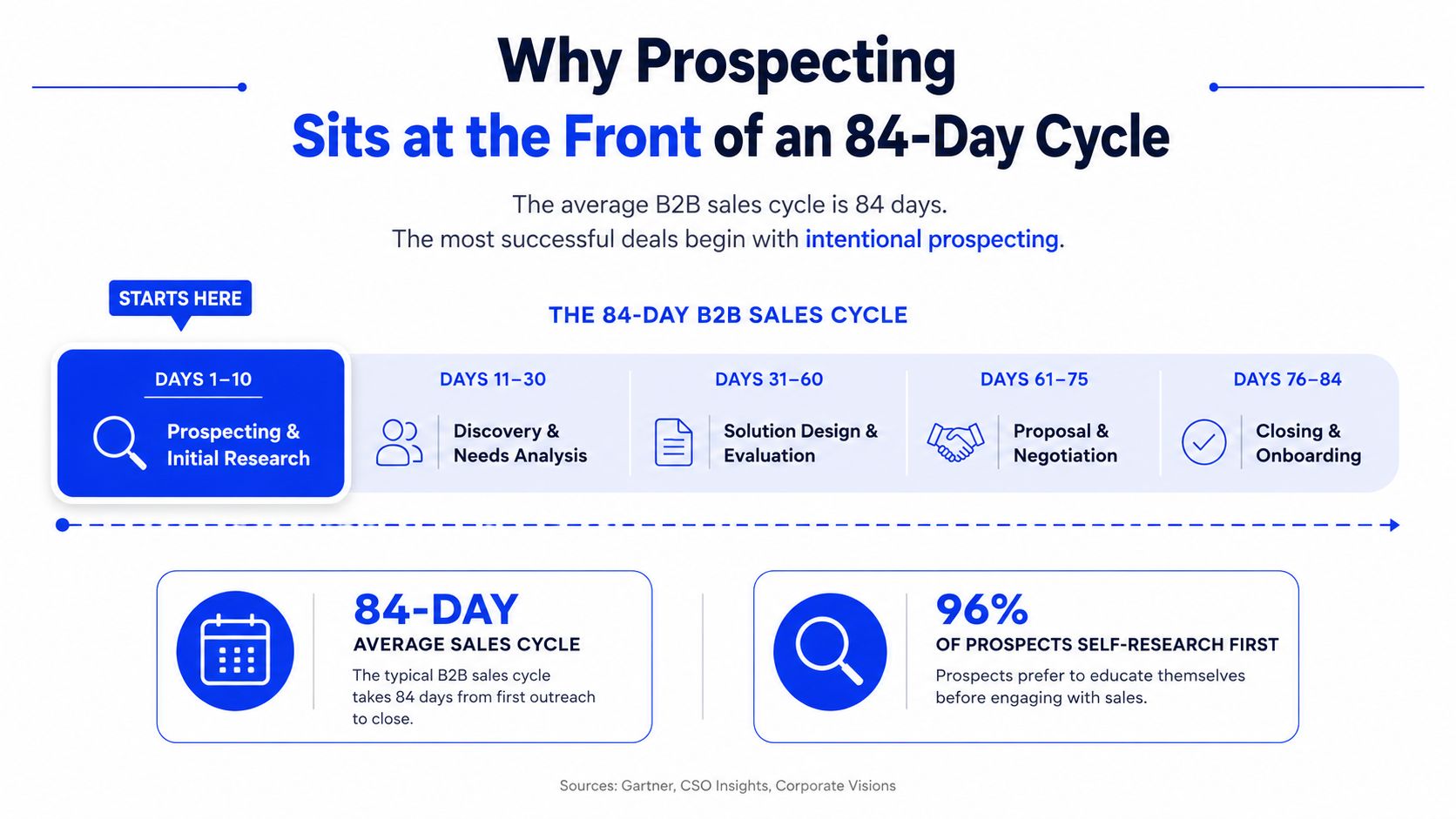
A rep can send a clean first email and still miss the buyer if the timing is off. In a long B2B cycle, the prospect has usually already done the homework, compared vendors, and formed a rough opinion before sales gets involved. That is why prospecting has to sit at the front of the process, not as a spray-and-pray activity, but as the first quality filter in the funnel.
The cycle itself takes time. Research from Zety sales statistics puts the average B2B sales cycle at about 84 days, which leaves little room for weak first touches. Buyers also tend to self-educate before they reply, so the rep is often entering a conversation that has already started in the buyer's head.
That changes the job. Outreach has to reflect what the buyer has already seen, not act like the first introduction to the problem. If the message ignores prior research, active comparisons, or the assumptions a prospect has picked up from peers and competitors, it gets treated like noise.
Email still carries a lot of the load because it matches how buyers want to communicate. The same Zety source notes that 80% of prospects prefer email communication, which is why email remains the most practical channel for scalable outbound. Calls still matter, but they work better after context exists, not before it.
The more useful shift is to stop measuring prospecting by list size alone. In practice, the first input into the pipeline is signal quality, then conversation quality, then meeting quality. A small queue of accounts with a clear trigger will usually outproduce a larger list with no reason to talk now.
For teams that want structured outbound execution, hire bdr is one of the few resources that treats prospecting as operational work instead of generic selling advice.
Why this changes the job
Once buyers are informed, generic openers lose their edge quickly. A subject line, first sentence, or call opener has to earn relevance in seconds, because the prospect already has options and usually a working mental model of the problem.
That is why signal-triggered intake matters more than broad list building. Clay, Apollo, Lemlist, Instantly, HeyReach, and HubSpot can sit in a workflow that routes accounts from research to outreach to tracking without forcing reps to guess. HubSpot then becomes the place to watch whether those signals produce replies, meetings, and actual opportunities, not just activity.
In the first 60 days, measure prospecting in tiers. Track deliverability and reply quality first, then meetings set, then meetings that qualify, and finally pipeline created from signal-based outreach. If the early indicators are weak, the issue is usually the signal, the message, or the handoff between research and send, not the total number of names in the file.
For a clearer view of how those handoffs fit together, see this sales process flow chart. Strong upstream work makes the later stages easier to run, because the conversation starts with context instead of a cold interruption.
The六 operational stages of a prospecting system
A strong prospecting system is a workflow, not a list. It starts with a clear ICP, then moves through research, signal detection, outreach, qualification, and follow-up. Each stage affects the quality of the next one, so weak inputs show up later as poor reply rates or wasted meetings.
Stage one is ICP definition. Strong teams do not freeze the ICP and walk away. They refine it from closed-deal patterns, because the buyers who convert best usually share more than a title.
Stage two is account research. Waterfall enrichment matters here. Apollo, ZoomInfo, and Hunter can sit in a layered workflow so missing fields get filled from backup sources instead of guessed. In practice, that sequencing can push coverage toward 85% to 90% instead of the 60% to 70% teams often get from a single source (ZoomInfo prospecting insights).
Stage three is signal monitoring. Static list building gives way to trigger-based intake. Hiring posts, funding activity, content engagement, and tooling changes should feed a live queue.
Stage four is prioritized outreach. The message has to reference the signal, not just the account. That is the difference between a relevant opener and templated noise.
Field note: if your first sentence could apply to twenty other prospects, it is not prospecting, it is volume.
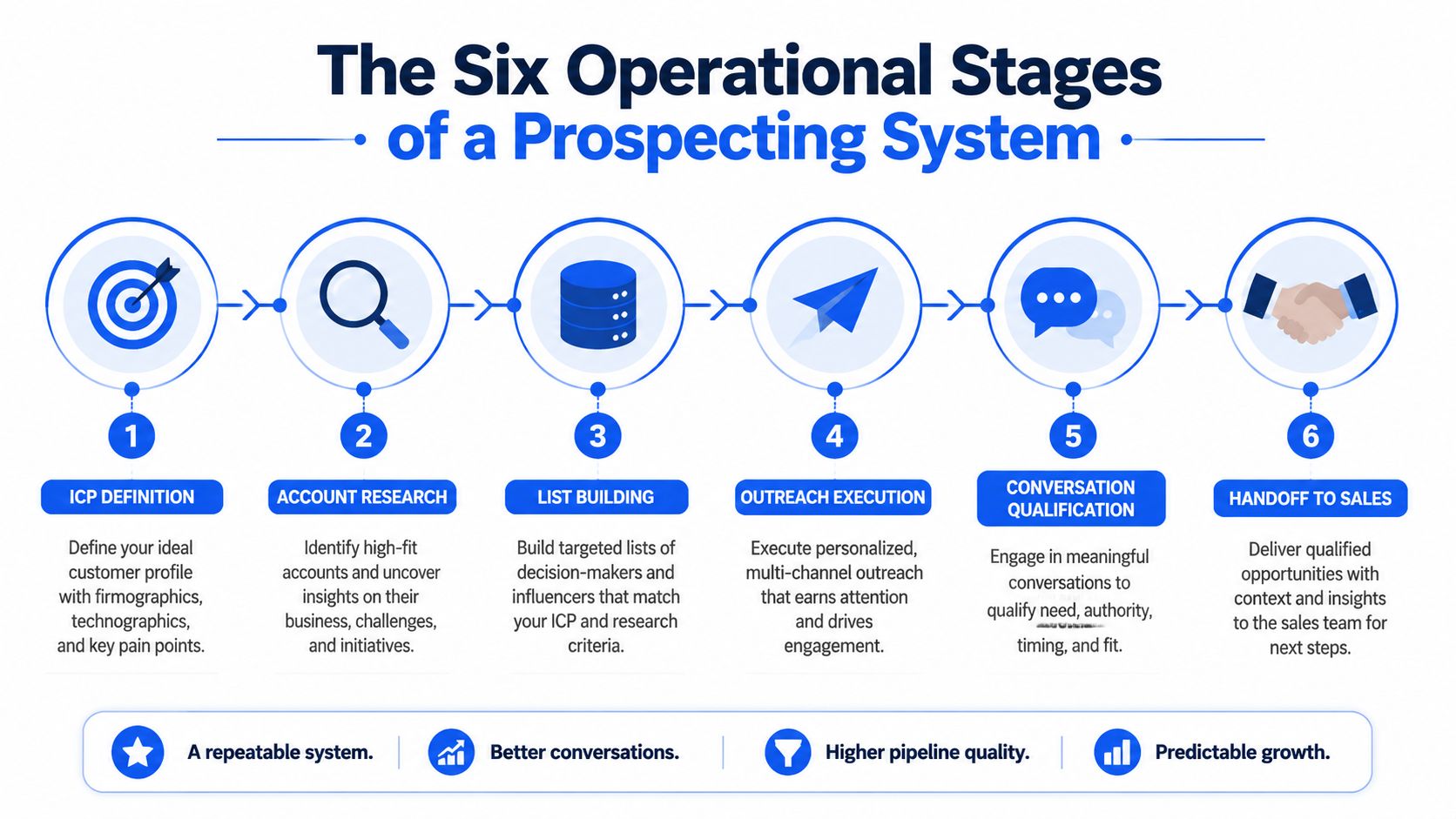
Stage five is qualification through discovery. Form fills do not qualify buyers, conversations do. Fast reply routing matters here, because leads contacted within five minutes are reported to be much more likely to qualify than leads contacted after 30 minutes, according to Resourceful Selling statistics.
Stage six is structured follow-up. Industry summaries point to five or more follow-ups as commonly needed, and some teams run eight to ten touchpoints before moving on. That is not persistence theater, it is the cost of a crowded market, where good prospects often need more than one useful prompt before they reply.
The internal workflow matters too. If you want the process laid out visually, GROU's sales process flow chart is the closest companion to this system.
Channels, sequencing, and where AI changes the math
LinkedIn, email, calls, and content-triggered outreach all pull different weights. LinkedIn is useful for spotting signals and making a first warm connection. Email still carries most of the scale because it is easy to route, personalize, and sequence. Cold calling belongs on higher-value accounts where live contact can change the conversation. Content-driven outreach works best after a prospect has already engaged with founder content, a post, or public commentary.
The channel mix matters less than the order and the relevance of each touch. A call after research, then a personalized email, then a LinkedIn note tied to a fresh signal will usually beat three similar emails sent back to back. Give the prospect space between touches, and make sure each one adds a new reason to reply.
Channel | Primary use | Benchmark | Sequencing role |
|---|---|---|---|
Signal detection and warm connection | Best used when a trigger is visible publicly | Often the first touch or a follow-up after a signal | |
Scalable outreach | Broadly preferred by buyers, as noted earlier | Core channel for most cadences | |
Cold calling | Live contact on higher-value accounts | Lower reply rates than email, but strong for real-time conversations on the right accounts | Works best after research, not before it |
Content-driven outreach | Earned relevance | Uses a prospect's own engagement as the trigger | Strong opener for informed buyers |
AI changes the math because every team can now produce similar sequences at speed. The sequence itself loses power when everyone is using the same five-step pattern. Message uniqueness, timing, and account signals still separate good outbound from noisy outbound.
The practical answer is a stack that supports signal intake, enrichment, sending, and CRM handoff without forcing reps to stitch everything together manually. Clay is the layer that turns signals into a working queue. Apollo can sit in the enrichment waterfall, Lemlist or Instantly can handle sending, HeyReach can run LinkedIn activity at scale, and HubSpot stays as the CRM backbone. For a closer look at how that automation should be configured, see GROU's AI sales automation guide.
How to measure prospecting in the first 60 days
Early measurement should tell you whether the system is healthy before you scale it. Don't wait for revenue to diagnose bad targeting, weak deliverability, or poor routing. That just makes the correction more expensive.
Tier one is days 1 to 14, which is about infrastructure health. Send volume should stay within 90% of plan, bounce rate should sit below 2%, spam complaints below 0.05%, and inbox placement above 85% (GROU measurement framework). If those indicators slip, the campaign is already bleeding before reply data arrives.
Tier two is days 15 to 30, which is about engagement quality. Track reply rate against segment benchmark, with most B2B contexts landing around 8% to 14% in the framework we use. Positive replies should clear 60%, meeting booking should clear 60%, and show rate should clear 80% ([GROU measurement framework](internal operations)).
Tier three is days 30 to 60, which is about pipeline economics. Qualification rate should be above 50%, cost per qualified meeting should stay within €300 to €700, and pipeline value creation should track to plan ([GROU measurement framework](internal operations)). If the meetings are cheap but bad, the economics still fail.
For a useful adjacent KPI lens, GROU's lead generation KPI guide pairs well with this framework.
Diagnostic rule: don't fix a low reply rate by sending more. Fix the root cause first, then rerun the sequence.
Use escalation thresholds, not gut feel. Yellow flags hit when reply rate is below 70% of expected by day 21. Red flags hit at 50% of expected by day 30. A bounce rate above 5% is an emergency, not a minor issue.
Common prospecting mistakes that cap pipeline
A pipeline can look active while the quality of the work stays weak. That usually happens when teams optimize for visible motion, more sends, more touches, more dashboard noise, instead of the parts that create conversations.
Measuring sends instead of outcomes. If reply rate, meeting rate, and cost per qualified meeting are missing, the team is being managed on activity, not revenue progress.
Skipping signal research. If the first touch could go to any account in the ICP, the message will sound generic. Tie each outreach motion to a concrete trigger, then write to that trigger.
Quitting too early. If follow-up ends after two or three touches, the cadence is too shallow for outbound. Keep the sequence structured and give it enough repetition to earn a response.
Routing replies too slowly. If a warm reply sits in a queue, interest cools fast. Put a two-minute response target in writing and make the handoff visible in HubSpot or the system you use for intake.
Ignoring sender reputation. If send volume jumps before hygiene is stable, inbox placement drops and recovery gets harder. Clay, Apollo, Lemlist, Instantly, and HeyReach all help, but none of them fix a bad list or a weak domain.
Using noisy intent platforms as the main signal. If the signal is vague, it creates false urgency. Better-fit triggers from the company, contact, or buying committee are usually more useful than broad intent scores.
Treating automation like strategy. Automation speeds up execution, but it does not choose the right accounts or write the right message. The workflow still needs a clear intake rule, a clear qualification rule, and a clear handoff rule.
The practical fix is simple. Measure what creates conversations, tighten the signal behind each first touch, route replies fast, and cut the noise before it reaches the inbox.
For practitioners building the outbound layer, the lead generation KPI guide is a better companion reference here because it shows how to separate activity from pipeline quality.
Your first 30 days and how GROU runs this in production
Week one is about definition and plumbing. Lock the ICP from closed-deal analysis, stand up the data waterfall, and configure reply routing so no one waits more than two minutes for a response. If the routing layer is broken, nothing else matters.
Week two is where signal design starts. Define three to five trigger types tied to past wins, build the enrichment workflow in Clay, and connect outbound sending to HubSpot. That keeps the system from turning into a list warehouse.
Week three is launch week. Cap daily send volume so sender reputation stays intact, then ramp only if deliverability stays healthy. Don't scale into a broken domain just because the list is big.
Week four is review and correction. Check tier-one and tier-two metrics, diagnose the weakest metric, and adjust message or targeting before expanding volume. That's how structure turns attention into pipeline without wasting a month.
GROU is a global B2B pipeline agency that has driven outcomes such as 350 qualified leads in regional programs and enterprise deals above $20M using the same signal-triggered system. The methodology is signal-led, measurement-led, and built for iGaming, SaaS, manufacturing, and professional services teams that need qualified conversations, not just more sends.
Audit your meeting-held rate this Friday and compare it to your reply rate by segment.
GROU builds prospecting systems that tie signal detection, enrichment, outreach, and routing into one operating model. If you want a cleaner outbound motion, visit Grou and review how the team structures ICPs, signals, and follow-up into one pipeline engine.
You're burning sends, but the pipeline still feels thin. Meetings are getting booked, a few are real, and too many go nowhere. Reply rates sag, SDRs chase bad-fit lists, and the closer keeps getting blamed for an upstream problem.
Prospecting is the first active stage of the sales cycle, where fit, timing, and outreach meet.
Structure turns attention into pipeline, especially when buyers self-research before they reply.
Signal-triggered intake beats static list building when inboxes are crowded and attention is scarce.
Measurement in the first 60 days should focus on deliverability, reply quality, and pipeline economics.
Most failures come from process mistakes, not from the lack of more sends.
Table of Contents
The pipeline problem most teams are stuck on
The pattern is familiar. SDRs send more, inboxes stay quiet, and the few meetings that do land don't hold. By the time revenue misses show up, the core issue is already upstream, in how accounts were chosen, researched, and timed.
That's why this is a prospecting problem before it becomes a closing problem. If the first touch is generic, late, or aimed at weak fit, downstream pipeline quality never recovers. Sales pipeline management only reveals the damage after the fact, which is why the fix has to start earlier, as covered in GROU's sales pipeline management guide.
Prospecting is the place where structure turns attention into pipeline. It's not list-building for its own sake, and it isn't just activity around the edges of the funnel.
Real definition: identifying the right companies and people, then starting relevant conversations.
System, not chaos: ICP, enrichment, signal detection, outreach, qualification, follow-up.
Channels and tactics: email, LinkedIn, calls, and content-triggered outreach.
Measurement: deliverability, reply quality, meeting quality, and cost per qualified meeting.
Common mistakes: volume obsession, weak follow-up, slow routing, and noisy signals.
30-day sequence: lock ICP, build the data waterfall, launch small, then refine fast.
A lot of teams think they have a closing issue when they really have a targeting issue. The closer can only work with the conversations prospecting creates, and if those conversations are weak, the pipeline is weak too.
Practical rule: when meetings book but don't convert, inspect the upstream signal quality before you touch the pitch.
What sales prospecting actually means
The cleanest operator definition is simple. Sales prospecting is finding the specific companies and people who need what you offer right now, then starting relevant conversations at the moment they're most likely to engage.
Each clause changes behavior. Finding means research, not blind sending. Specific companies and people means precision, not volume. Need means fit-based selection. Right now means timing. Relevant conversations means value-first outreach. Most likely to engage means signal-triggered contact, not random cadence.
That framing lines up with the way LinkedIn describes prospecting as the first step in the sales cycle and the work of building a qualified lead base for revenue conversations, not just contacts in a database (LinkedIn prospecting). Salesforce also frames it around identifying an ideal customer profile and understanding pain points before outreach (Salesforce prospecting).
A simple way to teach it to a new rep is this. Prospecting is like fishing in a river where you only get a limited number of casts. You need to know where the fish are, when they're feeding, and what they'll bite.
Random casting wastes scarce effort. Knowledge of location, timing, and bait produces catches. That's why sender reputation matters so much, every touch either builds trust or burns it.
The weak framings you hear in training rooms cause flat results. “Book meetings” puts volume ahead of relevance. “Top-of-funnel activity” turns craft into jargon. Neither explains how a team earns attention from a buyer who already has options.
For a broader lead-gen contrast, see GROU's B2B sales lead generation guide. Prospecting is the part where the work gets specific, or it fails.
Why prospecting sits at the front of an 84-day cycle
A rep can send a clean first email and still miss the buyer if the timing is off. In a long B2B cycle, the prospect has usually already done the homework, compared vendors, and formed a rough opinion before sales gets involved. That is why prospecting has to sit at the front of the process, not as a spray-and-pray activity, but as the first quality filter in the funnel.
The cycle itself takes time. Research from Zety sales statistics puts the average B2B sales cycle at about 84 days, which leaves little room for weak first touches. Buyers also tend to self-educate before they reply, so the rep is often entering a conversation that has already started in the buyer's head.
That changes the job. Outreach has to reflect what the buyer has already seen, not act like the first introduction to the problem. If the message ignores prior research, active comparisons, or the assumptions a prospect has picked up from peers and competitors, it gets treated like noise.
Email still carries a lot of the load because it matches how buyers want to communicate. The same Zety source notes that 80% of prospects prefer email communication, which is why email remains the most practical channel for scalable outbound. Calls still matter, but they work better after context exists, not before it.
The more useful shift is to stop measuring prospecting by list size alone. In practice, the first input into the pipeline is signal quality, then conversation quality, then meeting quality. A small queue of accounts with a clear trigger will usually outproduce a larger list with no reason to talk now.
For teams that want structured outbound execution, hire bdr is one of the few resources that treats prospecting as operational work instead of generic selling advice.
Why this changes the job
Once buyers are informed, generic openers lose their edge quickly. A subject line, first sentence, or call opener has to earn relevance in seconds, because the prospect already has options and usually a working mental model of the problem.
That is why signal-triggered intake matters more than broad list building. Clay, Apollo, Lemlist, Instantly, HeyReach, and HubSpot can sit in a workflow that routes accounts from research to outreach to tracking without forcing reps to guess. HubSpot then becomes the place to watch whether those signals produce replies, meetings, and actual opportunities, not just activity.
In the first 60 days, measure prospecting in tiers. Track deliverability and reply quality first, then meetings set, then meetings that qualify, and finally pipeline created from signal-based outreach. If the early indicators are weak, the issue is usually the signal, the message, or the handoff between research and send, not the total number of names in the file.
For a clearer view of how those handoffs fit together, see this sales process flow chart. Strong upstream work makes the later stages easier to run, because the conversation starts with context instead of a cold interruption.
The六 operational stages of a prospecting system
A strong prospecting system is a workflow, not a list. It starts with a clear ICP, then moves through research, signal detection, outreach, qualification, and follow-up. Each stage affects the quality of the next one, so weak inputs show up later as poor reply rates or wasted meetings.
Stage one is ICP definition. Strong teams do not freeze the ICP and walk away. They refine it from closed-deal patterns, because the buyers who convert best usually share more than a title.
Stage two is account research. Waterfall enrichment matters here. Apollo, ZoomInfo, and Hunter can sit in a layered workflow so missing fields get filled from backup sources instead of guessed. In practice, that sequencing can push coverage toward 85% to 90% instead of the 60% to 70% teams often get from a single source (ZoomInfo prospecting insights).
Stage three is signal monitoring. Static list building gives way to trigger-based intake. Hiring posts, funding activity, content engagement, and tooling changes should feed a live queue.
Stage four is prioritized outreach. The message has to reference the signal, not just the account. That is the difference between a relevant opener and templated noise.
Field note: if your first sentence could apply to twenty other prospects, it is not prospecting, it is volume.
Stage five is qualification through discovery. Form fills do not qualify buyers, conversations do. Fast reply routing matters here, because leads contacted within five minutes are reported to be much more likely to qualify than leads contacted after 30 minutes, according to Resourceful Selling statistics.
Stage six is structured follow-up. Industry summaries point to five or more follow-ups as commonly needed, and some teams run eight to ten touchpoints before moving on. That is not persistence theater, it is the cost of a crowded market, where good prospects often need more than one useful prompt before they reply.
The internal workflow matters too. If you want the process laid out visually, GROU's sales process flow chart is the closest companion to this system.
Channels, sequencing, and where AI changes the math
LinkedIn, email, calls, and content-triggered outreach all pull different weights. LinkedIn is useful for spotting signals and making a first warm connection. Email still carries most of the scale because it is easy to route, personalize, and sequence. Cold calling belongs on higher-value accounts where live contact can change the conversation. Content-driven outreach works best after a prospect has already engaged with founder content, a post, or public commentary.
The channel mix matters less than the order and the relevance of each touch. A call after research, then a personalized email, then a LinkedIn note tied to a fresh signal will usually beat three similar emails sent back to back. Give the prospect space between touches, and make sure each one adds a new reason to reply.
Channel | Primary use | Benchmark | Sequencing role |
|---|---|---|---|
Signal detection and warm connection | Best used when a trigger is visible publicly | Often the first touch or a follow-up after a signal | |
Scalable outreach | Broadly preferred by buyers, as noted earlier | Core channel for most cadences | |
Cold calling | Live contact on higher-value accounts | Lower reply rates than email, but strong for real-time conversations on the right accounts | Works best after research, not before it |
Content-driven outreach | Earned relevance | Uses a prospect's own engagement as the trigger | Strong opener for informed buyers |
AI changes the math because every team can now produce similar sequences at speed. The sequence itself loses power when everyone is using the same five-step pattern. Message uniqueness, timing, and account signals still separate good outbound from noisy outbound.
The practical answer is a stack that supports signal intake, enrichment, sending, and CRM handoff without forcing reps to stitch everything together manually. Clay is the layer that turns signals into a working queue. Apollo can sit in the enrichment waterfall, Lemlist or Instantly can handle sending, HeyReach can run LinkedIn activity at scale, and HubSpot stays as the CRM backbone. For a closer look at how that automation should be configured, see GROU's AI sales automation guide.
How to measure prospecting in the first 60 days
Early measurement should tell you whether the system is healthy before you scale it. Don't wait for revenue to diagnose bad targeting, weak deliverability, or poor routing. That just makes the correction more expensive.
Tier one is days 1 to 14, which is about infrastructure health. Send volume should stay within 90% of plan, bounce rate should sit below 2%, spam complaints below 0.05%, and inbox placement above 85% (GROU measurement framework). If those indicators slip, the campaign is already bleeding before reply data arrives.
Tier two is days 15 to 30, which is about engagement quality. Track reply rate against segment benchmark, with most B2B contexts landing around 8% to 14% in the framework we use. Positive replies should clear 60%, meeting booking should clear 60%, and show rate should clear 80% ([GROU measurement framework](internal operations)).
Tier three is days 30 to 60, which is about pipeline economics. Qualification rate should be above 50%, cost per qualified meeting should stay within €300 to €700, and pipeline value creation should track to plan ([GROU measurement framework](internal operations)). If the meetings are cheap but bad, the economics still fail.
For a useful adjacent KPI lens, GROU's lead generation KPI guide pairs well with this framework.
Diagnostic rule: don't fix a low reply rate by sending more. Fix the root cause first, then rerun the sequence.
Use escalation thresholds, not gut feel. Yellow flags hit when reply rate is below 70% of expected by day 21. Red flags hit at 50% of expected by day 30. A bounce rate above 5% is an emergency, not a minor issue.
Common prospecting mistakes that cap pipeline
A pipeline can look active while the quality of the work stays weak. That usually happens when teams optimize for visible motion, more sends, more touches, more dashboard noise, instead of the parts that create conversations.
Measuring sends instead of outcomes. If reply rate, meeting rate, and cost per qualified meeting are missing, the team is being managed on activity, not revenue progress.
Skipping signal research. If the first touch could go to any account in the ICP, the message will sound generic. Tie each outreach motion to a concrete trigger, then write to that trigger.
Quitting too early. If follow-up ends after two or three touches, the cadence is too shallow for outbound. Keep the sequence structured and give it enough repetition to earn a response.
Routing replies too slowly. If a warm reply sits in a queue, interest cools fast. Put a two-minute response target in writing and make the handoff visible in HubSpot or the system you use for intake.
Ignoring sender reputation. If send volume jumps before hygiene is stable, inbox placement drops and recovery gets harder. Clay, Apollo, Lemlist, Instantly, and HeyReach all help, but none of them fix a bad list or a weak domain.
Using noisy intent platforms as the main signal. If the signal is vague, it creates false urgency. Better-fit triggers from the company, contact, or buying committee are usually more useful than broad intent scores.
Treating automation like strategy. Automation speeds up execution, but it does not choose the right accounts or write the right message. The workflow still needs a clear intake rule, a clear qualification rule, and a clear handoff rule.
The practical fix is simple. Measure what creates conversations, tighten the signal behind each first touch, route replies fast, and cut the noise before it reaches the inbox.
For practitioners building the outbound layer, the lead generation KPI guide is a better companion reference here because it shows how to separate activity from pipeline quality.
Your first 30 days and how GROU runs this in production
Week one is about definition and plumbing. Lock the ICP from closed-deal analysis, stand up the data waterfall, and configure reply routing so no one waits more than two minutes for a response. If the routing layer is broken, nothing else matters.
Week two is where signal design starts. Define three to five trigger types tied to past wins, build the enrichment workflow in Clay, and connect outbound sending to HubSpot. That keeps the system from turning into a list warehouse.
Week three is launch week. Cap daily send volume so sender reputation stays intact, then ramp only if deliverability stays healthy. Don't scale into a broken domain just because the list is big.
Week four is review and correction. Check tier-one and tier-two metrics, diagnose the weakest metric, and adjust message or targeting before expanding volume. That's how structure turns attention into pipeline without wasting a month.
GROU is a global B2B pipeline agency that has driven outcomes such as 350 qualified leads in regional programs and enterprise deals above $20M using the same signal-triggered system. The methodology is signal-led, measurement-led, and built for iGaming, SaaS, manufacturing, and professional services teams that need qualified conversations, not just more sends.
Audit your meeting-held rate this Friday and compare it to your reply rate by segment.
GROU builds prospecting systems that tie signal detection, enrichment, outreach, and routing into one operating model. If you want a cleaner outbound motion, visit Grou and review how the team structures ICPs, signals, and follow-up into one pipeline engine.
You're burning sends, but the pipeline still feels thin. Meetings are getting booked, a few are real, and too many go nowhere. Reply rates sag, SDRs chase bad-fit lists, and the closer keeps getting blamed for an upstream problem.
Prospecting is the first active stage of the sales cycle, where fit, timing, and outreach meet.
Structure turns attention into pipeline, especially when buyers self-research before they reply.
Signal-triggered intake beats static list building when inboxes are crowded and attention is scarce.
Measurement in the first 60 days should focus on deliverability, reply quality, and pipeline economics.
Most failures come from process mistakes, not from the lack of more sends.
Table of Contents
The pipeline problem most teams are stuck on
The pattern is familiar. SDRs send more, inboxes stay quiet, and the few meetings that do land don't hold. By the time revenue misses show up, the core issue is already upstream, in how accounts were chosen, researched, and timed.
That's why this is a prospecting problem before it becomes a closing problem. If the first touch is generic, late, or aimed at weak fit, downstream pipeline quality never recovers. Sales pipeline management only reveals the damage after the fact, which is why the fix has to start earlier, as covered in GROU's sales pipeline management guide.
Prospecting is the place where structure turns attention into pipeline. It's not list-building for its own sake, and it isn't just activity around the edges of the funnel.
Real definition: identifying the right companies and people, then starting relevant conversations.
System, not chaos: ICP, enrichment, signal detection, outreach, qualification, follow-up.
Channels and tactics: email, LinkedIn, calls, and content-triggered outreach.
Measurement: deliverability, reply quality, meeting quality, and cost per qualified meeting.
Common mistakes: volume obsession, weak follow-up, slow routing, and noisy signals.
30-day sequence: lock ICP, build the data waterfall, launch small, then refine fast.
A lot of teams think they have a closing issue when they really have a targeting issue. The closer can only work with the conversations prospecting creates, and if those conversations are weak, the pipeline is weak too.
Practical rule: when meetings book but don't convert, inspect the upstream signal quality before you touch the pitch.
What sales prospecting actually means
The cleanest operator definition is simple. Sales prospecting is finding the specific companies and people who need what you offer right now, then starting relevant conversations at the moment they're most likely to engage.
Each clause changes behavior. Finding means research, not blind sending. Specific companies and people means precision, not volume. Need means fit-based selection. Right now means timing. Relevant conversations means value-first outreach. Most likely to engage means signal-triggered contact, not random cadence.
That framing lines up with the way LinkedIn describes prospecting as the first step in the sales cycle and the work of building a qualified lead base for revenue conversations, not just contacts in a database (LinkedIn prospecting). Salesforce also frames it around identifying an ideal customer profile and understanding pain points before outreach (Salesforce prospecting).
A simple way to teach it to a new rep is this. Prospecting is like fishing in a river where you only get a limited number of casts. You need to know where the fish are, when they're feeding, and what they'll bite.
Random casting wastes scarce effort. Knowledge of location, timing, and bait produces catches. That's why sender reputation matters so much, every touch either builds trust or burns it.
The weak framings you hear in training rooms cause flat results. “Book meetings” puts volume ahead of relevance. “Top-of-funnel activity” turns craft into jargon. Neither explains how a team earns attention from a buyer who already has options.
For a broader lead-gen contrast, see GROU's B2B sales lead generation guide. Prospecting is the part where the work gets specific, or it fails.
Why prospecting sits at the front of an 84-day cycle
A rep can send a clean first email and still miss the buyer if the timing is off. In a long B2B cycle, the prospect has usually already done the homework, compared vendors, and formed a rough opinion before sales gets involved. That is why prospecting has to sit at the front of the process, not as a spray-and-pray activity, but as the first quality filter in the funnel.
The cycle itself takes time. Research from Zety sales statistics puts the average B2B sales cycle at about 84 days, which leaves little room for weak first touches. Buyers also tend to self-educate before they reply, so the rep is often entering a conversation that has already started in the buyer's head.
That changes the job. Outreach has to reflect what the buyer has already seen, not act like the first introduction to the problem. If the message ignores prior research, active comparisons, or the assumptions a prospect has picked up from peers and competitors, it gets treated like noise.
Email still carries a lot of the load because it matches how buyers want to communicate. The same Zety source notes that 80% of prospects prefer email communication, which is why email remains the most practical channel for scalable outbound. Calls still matter, but they work better after context exists, not before it.
The more useful shift is to stop measuring prospecting by list size alone. In practice, the first input into the pipeline is signal quality, then conversation quality, then meeting quality. A small queue of accounts with a clear trigger will usually outproduce a larger list with no reason to talk now.
For teams that want structured outbound execution, hire bdr is one of the few resources that treats prospecting as operational work instead of generic selling advice.
Why this changes the job
Once buyers are informed, generic openers lose their edge quickly. A subject line, first sentence, or call opener has to earn relevance in seconds, because the prospect already has options and usually a working mental model of the problem.
That is why signal-triggered intake matters more than broad list building. Clay, Apollo, Lemlist, Instantly, HeyReach, and HubSpot can sit in a workflow that routes accounts from research to outreach to tracking without forcing reps to guess. HubSpot then becomes the place to watch whether those signals produce replies, meetings, and actual opportunities, not just activity.
In the first 60 days, measure prospecting in tiers. Track deliverability and reply quality first, then meetings set, then meetings that qualify, and finally pipeline created from signal-based outreach. If the early indicators are weak, the issue is usually the signal, the message, or the handoff between research and send, not the total number of names in the file.
For a clearer view of how those handoffs fit together, see this sales process flow chart. Strong upstream work makes the later stages easier to run, because the conversation starts with context instead of a cold interruption.
The六 operational stages of a prospecting system
A strong prospecting system is a workflow, not a list. It starts with a clear ICP, then moves through research, signal detection, outreach, qualification, and follow-up. Each stage affects the quality of the next one, so weak inputs show up later as poor reply rates or wasted meetings.
Stage one is ICP definition. Strong teams do not freeze the ICP and walk away. They refine it from closed-deal patterns, because the buyers who convert best usually share more than a title.
Stage two is account research. Waterfall enrichment matters here. Apollo, ZoomInfo, and Hunter can sit in a layered workflow so missing fields get filled from backup sources instead of guessed. In practice, that sequencing can push coverage toward 85% to 90% instead of the 60% to 70% teams often get from a single source (ZoomInfo prospecting insights).
Stage three is signal monitoring. Static list building gives way to trigger-based intake. Hiring posts, funding activity, content engagement, and tooling changes should feed a live queue.
Stage four is prioritized outreach. The message has to reference the signal, not just the account. That is the difference between a relevant opener and templated noise.
Field note: if your first sentence could apply to twenty other prospects, it is not prospecting, it is volume.
Stage five is qualification through discovery. Form fills do not qualify buyers, conversations do. Fast reply routing matters here, because leads contacted within five minutes are reported to be much more likely to qualify than leads contacted after 30 minutes, according to Resourceful Selling statistics.
Stage six is structured follow-up. Industry summaries point to five or more follow-ups as commonly needed, and some teams run eight to ten touchpoints before moving on. That is not persistence theater, it is the cost of a crowded market, where good prospects often need more than one useful prompt before they reply.
The internal workflow matters too. If you want the process laid out visually, GROU's sales process flow chart is the closest companion to this system.
Channels, sequencing, and where AI changes the math
LinkedIn, email, calls, and content-triggered outreach all pull different weights. LinkedIn is useful for spotting signals and making a first warm connection. Email still carries most of the scale because it is easy to route, personalize, and sequence. Cold calling belongs on higher-value accounts where live contact can change the conversation. Content-driven outreach works best after a prospect has already engaged with founder content, a post, or public commentary.
The channel mix matters less than the order and the relevance of each touch. A call after research, then a personalized email, then a LinkedIn note tied to a fresh signal will usually beat three similar emails sent back to back. Give the prospect space between touches, and make sure each one adds a new reason to reply.
Channel | Primary use | Benchmark | Sequencing role |
|---|---|---|---|
Signal detection and warm connection | Best used when a trigger is visible publicly | Often the first touch or a follow-up after a signal | |
Scalable outreach | Broadly preferred by buyers, as noted earlier | Core channel for most cadences | |
Cold calling | Live contact on higher-value accounts | Lower reply rates than email, but strong for real-time conversations on the right accounts | Works best after research, not before it |
Content-driven outreach | Earned relevance | Uses a prospect's own engagement as the trigger | Strong opener for informed buyers |
AI changes the math because every team can now produce similar sequences at speed. The sequence itself loses power when everyone is using the same five-step pattern. Message uniqueness, timing, and account signals still separate good outbound from noisy outbound.
The practical answer is a stack that supports signal intake, enrichment, sending, and CRM handoff without forcing reps to stitch everything together manually. Clay is the layer that turns signals into a working queue. Apollo can sit in the enrichment waterfall, Lemlist or Instantly can handle sending, HeyReach can run LinkedIn activity at scale, and HubSpot stays as the CRM backbone. For a closer look at how that automation should be configured, see GROU's AI sales automation guide.
How to measure prospecting in the first 60 days
Early measurement should tell you whether the system is healthy before you scale it. Don't wait for revenue to diagnose bad targeting, weak deliverability, or poor routing. That just makes the correction more expensive.
Tier one is days 1 to 14, which is about infrastructure health. Send volume should stay within 90% of plan, bounce rate should sit below 2%, spam complaints below 0.05%, and inbox placement above 85% (GROU measurement framework). If those indicators slip, the campaign is already bleeding before reply data arrives.
Tier two is days 15 to 30, which is about engagement quality. Track reply rate against segment benchmark, with most B2B contexts landing around 8% to 14% in the framework we use. Positive replies should clear 60%, meeting booking should clear 60%, and show rate should clear 80% ([GROU measurement framework](internal operations)).
Tier three is days 30 to 60, which is about pipeline economics. Qualification rate should be above 50%, cost per qualified meeting should stay within €300 to €700, and pipeline value creation should track to plan ([GROU measurement framework](internal operations)). If the meetings are cheap but bad, the economics still fail.
For a useful adjacent KPI lens, GROU's lead generation KPI guide pairs well with this framework.
Diagnostic rule: don't fix a low reply rate by sending more. Fix the root cause first, then rerun the sequence.
Use escalation thresholds, not gut feel. Yellow flags hit when reply rate is below 70% of expected by day 21. Red flags hit at 50% of expected by day 30. A bounce rate above 5% is an emergency, not a minor issue.
Common prospecting mistakes that cap pipeline
A pipeline can look active while the quality of the work stays weak. That usually happens when teams optimize for visible motion, more sends, more touches, more dashboard noise, instead of the parts that create conversations.
Measuring sends instead of outcomes. If reply rate, meeting rate, and cost per qualified meeting are missing, the team is being managed on activity, not revenue progress.
Skipping signal research. If the first touch could go to any account in the ICP, the message will sound generic. Tie each outreach motion to a concrete trigger, then write to that trigger.
Quitting too early. If follow-up ends after two or three touches, the cadence is too shallow for outbound. Keep the sequence structured and give it enough repetition to earn a response.
Routing replies too slowly. If a warm reply sits in a queue, interest cools fast. Put a two-minute response target in writing and make the handoff visible in HubSpot or the system you use for intake.
Ignoring sender reputation. If send volume jumps before hygiene is stable, inbox placement drops and recovery gets harder. Clay, Apollo, Lemlist, Instantly, and HeyReach all help, but none of them fix a bad list or a weak domain.
Using noisy intent platforms as the main signal. If the signal is vague, it creates false urgency. Better-fit triggers from the company, contact, or buying committee are usually more useful than broad intent scores.
Treating automation like strategy. Automation speeds up execution, but it does not choose the right accounts or write the right message. The workflow still needs a clear intake rule, a clear qualification rule, and a clear handoff rule.
The practical fix is simple. Measure what creates conversations, tighten the signal behind each first touch, route replies fast, and cut the noise before it reaches the inbox.
For practitioners building the outbound layer, the lead generation KPI guide is a better companion reference here because it shows how to separate activity from pipeline quality.
Your first 30 days and how GROU runs this in production
Week one is about definition and plumbing. Lock the ICP from closed-deal analysis, stand up the data waterfall, and configure reply routing so no one waits more than two minutes for a response. If the routing layer is broken, nothing else matters.
Week two is where signal design starts. Define three to five trigger types tied to past wins, build the enrichment workflow in Clay, and connect outbound sending to HubSpot. That keeps the system from turning into a list warehouse.
Week three is launch week. Cap daily send volume so sender reputation stays intact, then ramp only if deliverability stays healthy. Don't scale into a broken domain just because the list is big.
Week four is review and correction. Check tier-one and tier-two metrics, diagnose the weakest metric, and adjust message or targeting before expanding volume. That's how structure turns attention into pipeline without wasting a month.
GROU is a global B2B pipeline agency that has driven outcomes such as 350 qualified leads in regional programs and enterprise deals above $20M using the same signal-triggered system. The methodology is signal-led, measurement-led, and built for iGaming, SaaS, manufacturing, and professional services teams that need qualified conversations, not just more sends.
Audit your meeting-held rate this Friday and compare it to your reply rate by segment.
GROU builds prospecting systems that tie signal detection, enrichment, outreach, and routing into one operating model. If you want a cleaner outbound motion, visit Grou and review how the team structures ICPs, signals, and follow-up into one pipeline engine.
Pipeline OS Newsletter
Build qualified pipeline
Get weekly tactics to generate demand, improve lead quality, and book more meetings.






Trusted by industry leaders
Trusted by industry leaders
Trusted by industry leaders
Ready to build qualified pipeline?
Ready to build qualified pipeline?
Ready to build qualified pipeline?
Book a call to see if we're the right fit, or take the 2-minute quiz to get a clear starting point.
Book a call to see if we're the right fit, or take the 2-minute quiz to get a clear starting point.
Book a call to see if we're the right fit, or take the 2-minute quiz to get a clear starting point.
" height="30.21639343089746px" id="hfGbXmQR2" width="30.216393430897455px"/></svg>)
Copyright © 2026 – All Right Reserved
Copyright © 2026 – All Right Reserved
Copyright © 2026 – All Right Reserved