%22%3E%3C/path%3E%3Cpath d=%22M 63.072 7.554 C 62.258 8.022 61.577 8.689 61.092 9.493 L 61.092 7.076 L 57.158 7.076 L 57.158 22.64 L 61.089 22.64 L 61.089 14.888 C 61.089 13.446 61.403 12.434 62.03 11.853 C 62.818 11.218 63.818 10.907 64.826 10.982 L 65.868 10.982 L 65.868 6.851 C 64.891 6.834 63.926 7.076 63.073 7.554 Z%22 fill=%22rgb(17,17,17)%22%3E%3C/path%3E%3Cpath d=%22M 78.916 7.82 C 76.363 6.49 73.321 6.49 70.768 7.82 C 69.562 8.473 68.564 9.451 67.888 10.644 C 67.167 11.931 66.803 13.387 66.834 14.862 C 66.804 16.332 67.157 17.785 67.86 19.077 C 68.515 20.267 69.494 21.246 70.684 21.901 C 71.924 22.576 73.318 22.92 74.73 22.898 C 76.164 22.918 77.58 22.575 78.846 21.901 C 80.062 21.247 81.073 20.27 81.768 19.077 C 82.506 17.797 82.88 16.339 82.85 14.862 C 82.88 13.389 82.517 11.934 81.797 10.647 C 81.12 9.455 80.122 8.477 78.917 7.824 M 78.803 14.862 C 78.829 15.739 78.636 16.608 78.241 17.391 C 77.903 18.046 77.38 18.588 76.738 18.95 C 76.124 19.293 75.432 19.472 74.729 19.47 C 73.668 19.497 72.648 19.061 71.934 18.276 C 71.139 17.323 70.741 16.1 70.823 14.862 C 70.741 13.62 71.149 12.395 71.959 11.45 C 72.687 10.667 73.715 10.233 74.783 10.256 C 75.859 10.236 76.894 10.67 77.635 11.45 C 78.464 12.387 78.884 13.616 78.801 14.864%22 fill=%22rgb(17,17,17)%22%3E%3C/path%3E%3Cpath d=%22M 95.906 7.076 L 95.906 15.646 C 95.975 16.68 95.643 17.701 94.979 18.498 C 94.311 19.184 93.379 19.547 92.422 19.495 C 91.475 19.544 90.553 19.18 89.894 18.498 C 89.23 17.701 88.898 16.68 88.967 15.646 L 88.967 7.076 L 85.033 7.076 L 85.033 16.207 C 85 17.449 85.275 18.68 85.834 19.79 C 86.327 20.75 87.095 21.542 88.039 22.065 C 89.033 22.594 90.145 22.861 91.271 22.838 C 92.188 22.847 93.095 22.65 93.926 22.263 C 94.708 21.905 95.388 21.36 95.906 20.675 L 95.906 22.645 L 99.865 22.645 L 99.865 7.076 Z%22 fill=%22rgb(17,17,17)%22%3E%3C/path%3E%3Cpath d=%22M 4.513 15.626 C 4.511 10.815 7.606 6.549 12.181 5.059 C 16.756 3.57 21.77 5.195 24.601 9.086 L 27.816 5.87 C 24.074 1.186 17.981 -0.943 12.137 0.393 C 6.292 1.728 1.728 6.292 0.393 12.137 C -0.943 17.981 1.186 24.074 5.87 27.816 L 9.085 24.601 C 6.214 22.512 4.515 19.177 4.513 15.626%22 fill=%22rgb(32,62,235)%22%3E%3C/path%3E%3Cpath d=%22M 17.114 14.343 L 13.354 18.01 L 13.354 18.026 L 21.071 18.026 L 11.412 27.609 L 17.389 27.609 L 23.999 21.081 L 23.999 28.316 L 24.005 28.316 L 27.967 24.393 L 27.967 14.343 Z%22 fill=%22rgb(32,62,235)%22%3E%3C/path%3E%3C/g%3E%3C/svg%3E) ×
× ××
××

Most B2B SaaS teams build pipeline targets off a single ratio (3x coverage) and a single win rate (20%), then wonder why the forecast misses by a third every quarter. The numbers below are the band-by-band benchmarks that actually predict revenue, drawn from 11 GROU RevOps deployments and 1,400 tracked B2B SaaS deals over 2024 to 2026.
This is the operator breakdown: pipeline coverage by ACV, stage-by-stage win rates, sales cycle length, and the two metrics most teams should be tracking instead of "pipeline value".
TL;DR
Pipeline coverage should scale with ACV, not stay flat at 3x. Under $25k deals need 2.5-3x coverage. Over $100k deals need 5-6x because the dance-stage conversion drops to 18-22%. Most teams set 3x as the universal target and underfund enterprise pipeline by half.
Median B2B SaaS overall win rate (Discovery to Closed Won) is 18-25%. The Demo-to-Proposal step is where deals die at 48% conversion. If your team converts above 60% Demo-to-Proposal, you are either qualifying too late or being too generous in qualification.
Pipeline coverage ratio by ACV
The single biggest forecasting error in B2B SaaS is using a flat 3x coverage ratio for every deal size. Coverage needs to scale with ACV because dance-stage conversion drops as deals get bigger.
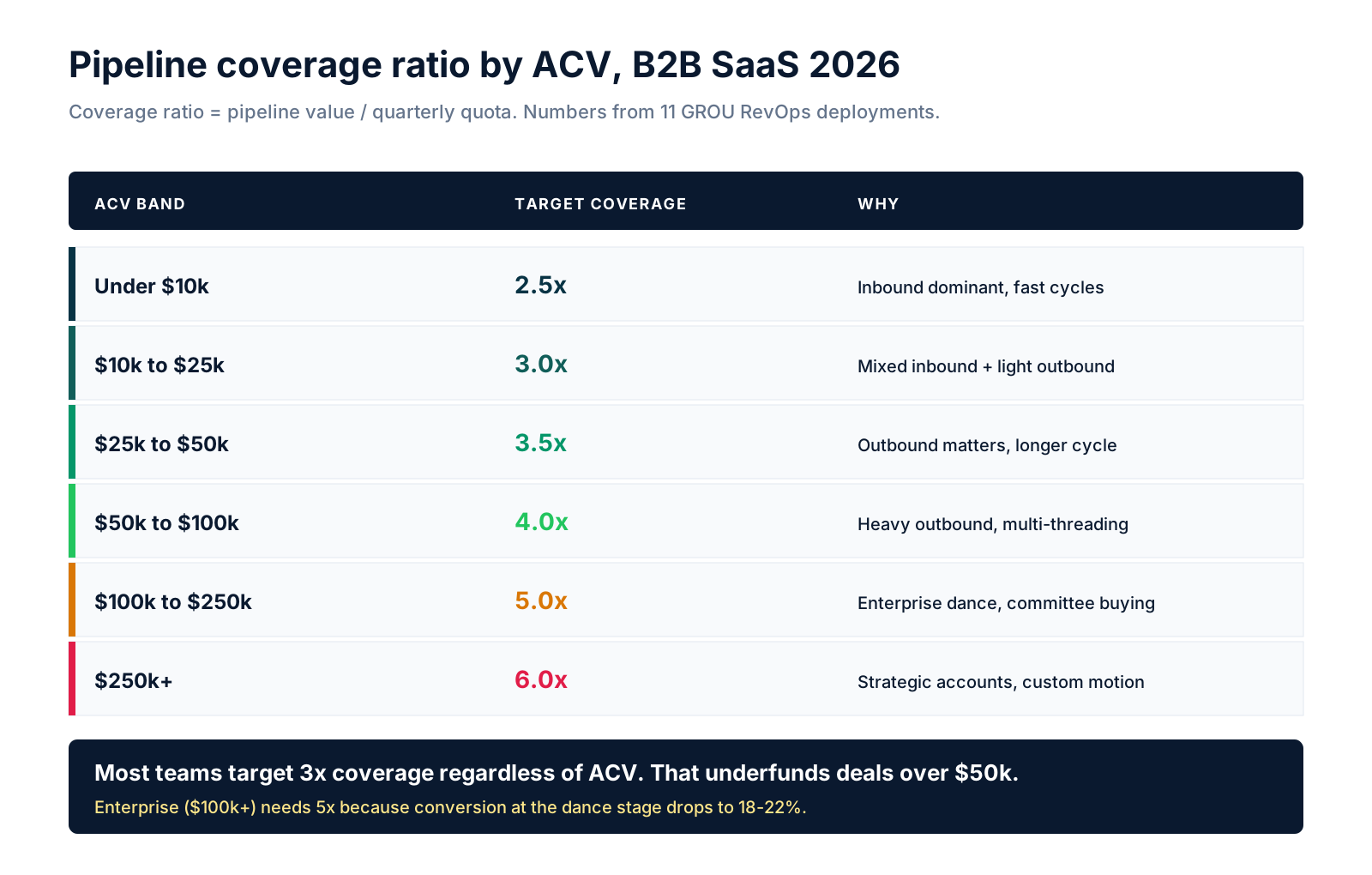
A team running $25k median ACV at $1M quarterly quota needs $3.5M in pipeline (3.5x coverage). The same quota at $100k median ACV needs $5M in pipeline (5x coverage). The difference is that enterprise deals have lower win rates and higher slippage to the next quarter.
Bessemer Venture Partners' State of the Cloud data shows the same pattern: enterprise SaaS at $100k+ ACV consistently runs lower stage-to-stage conversion than mid-market, and forecasting models that ignore the ACV-coverage relationship miss by 25-40%.
The cleanest framing is "coverage = ACV band coefficient × stage discount × time-in-stage discount". Most teams skip the last two and only run the band coefficient. That is where forecast accuracy leaks.
Win rate benchmarks by deal stage
A pipeline number means nothing without the stage-by-stage conversion rates that translate it into forecast revenue. The benchmarks below come from 1,400 B2B SaaS deals tracked across our client deployments.
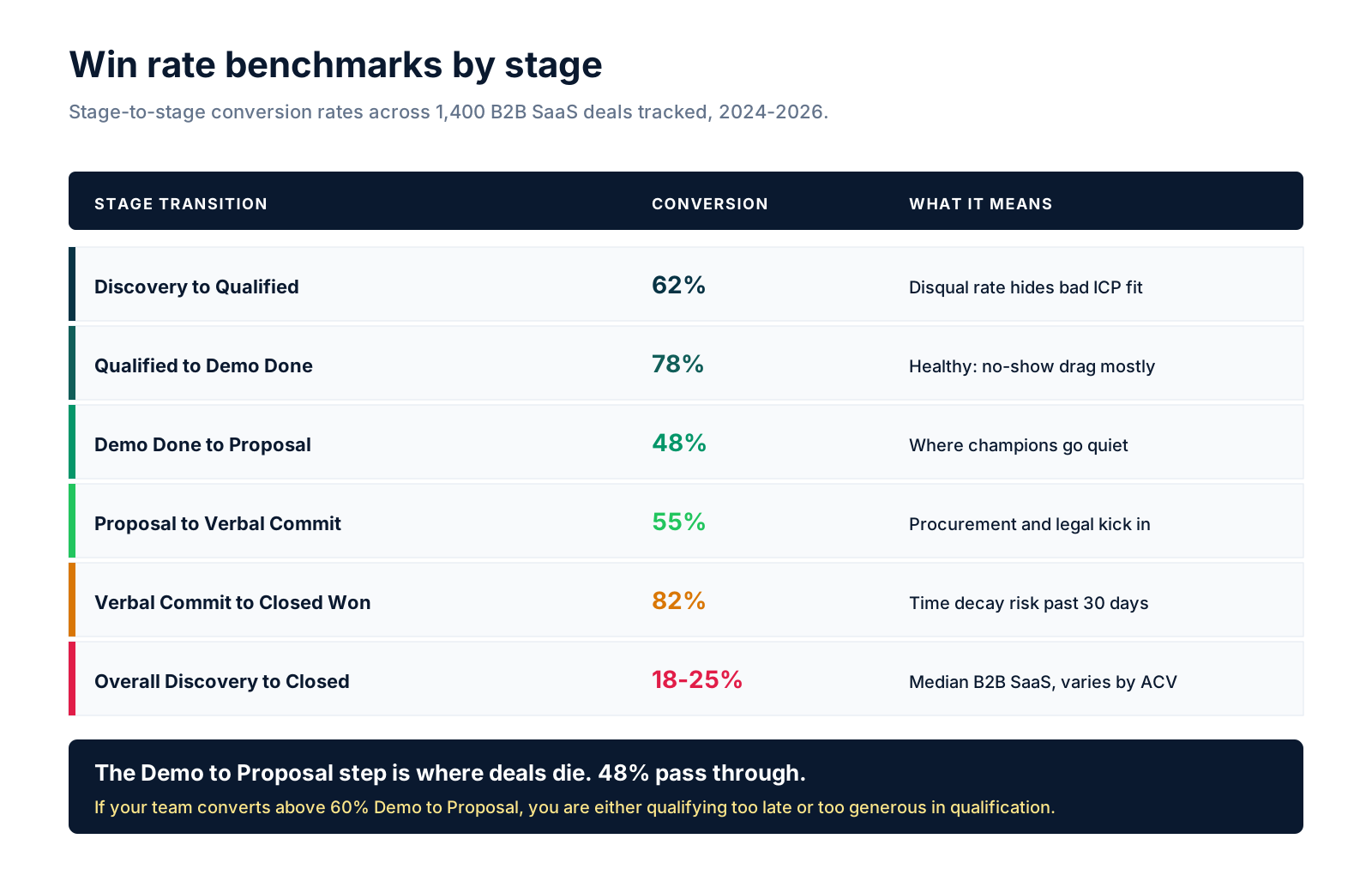
The Discovery-to-Qualified rate at 62% looks healthy but hides ICP fit problems. Most teams disqualify wrong-fit deals at this stage rather than letting them drop. If your disqualification rate is under 30%, you are letting too many bad-fit deals into the funnel and clogging downstream stages.
The Demo-to-Proposal step at 48% is where deals actually die in B2B SaaS. Champions go quiet, internal alignment falls apart, or the buyer realizes the timing is wrong. Read our sales pipeline stages guide for the full stage breakdown and exit criteria.
The Verbal Commit-to-Closed Won rate at 82% looks great until you factor in time decay. After 30 days in Verbal Commit, the actual close rate drops to 60%. After 60 days, it drops to 35%. Always set a 30-day SLA between verbal commit and contract signature.
Sales cycle length by ACV
Cycle length scales with ACV in a roughly predictable way: every 2x increase in deal size adds 60-80% to the cycle. The numbers below are median days from Discovery to Closed Won.

Under $10k ACV runs a 14-day cycle because the buyer can self-serve and approve internally without a committee. The motion is product-led with sales-assisted on the back end.
$25k-$50k ACV cycles at 58 days because you need a manager and champion to align before signing. This is the band where outbound matters most. Pipedrive Advanced at $29/seat is the right CRM here because the pipeline complexity does not yet justify HubSpot Sales Hub Pro at $90/seat.
$100k+ ACV cycles at 118+ days because procurement, legal, and security review enter the equation. At this ACV, Close at $49/seat is built for the dialer-heavy multi-threaded motion. Enterprise ($250k+) cycles at 172 days, which is a 6-month median. Plan capacity accordingly.
The 2 metrics most teams should be tracking instead
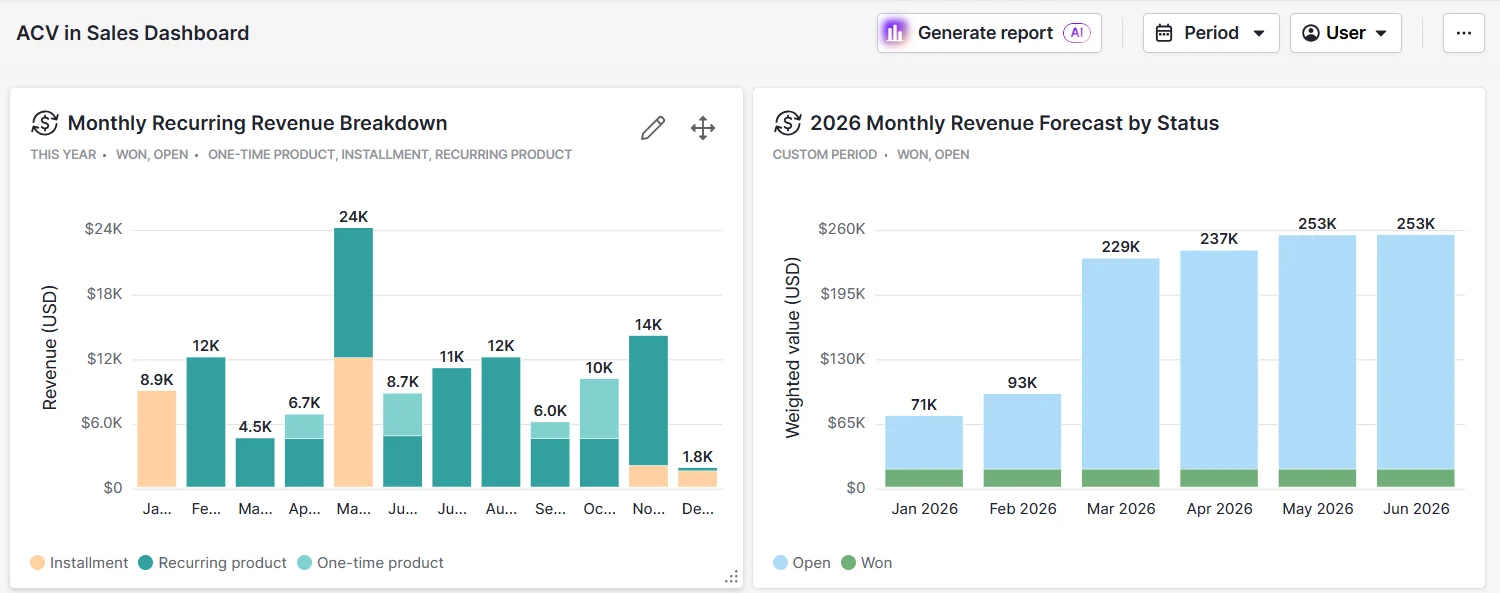
"Total pipeline value" is the worst metric in B2B SaaS forecasting. It treats a $50k deal in Discovery the same as a $50k deal in Verbal Commit. The two metrics that actually predict revenue are different.
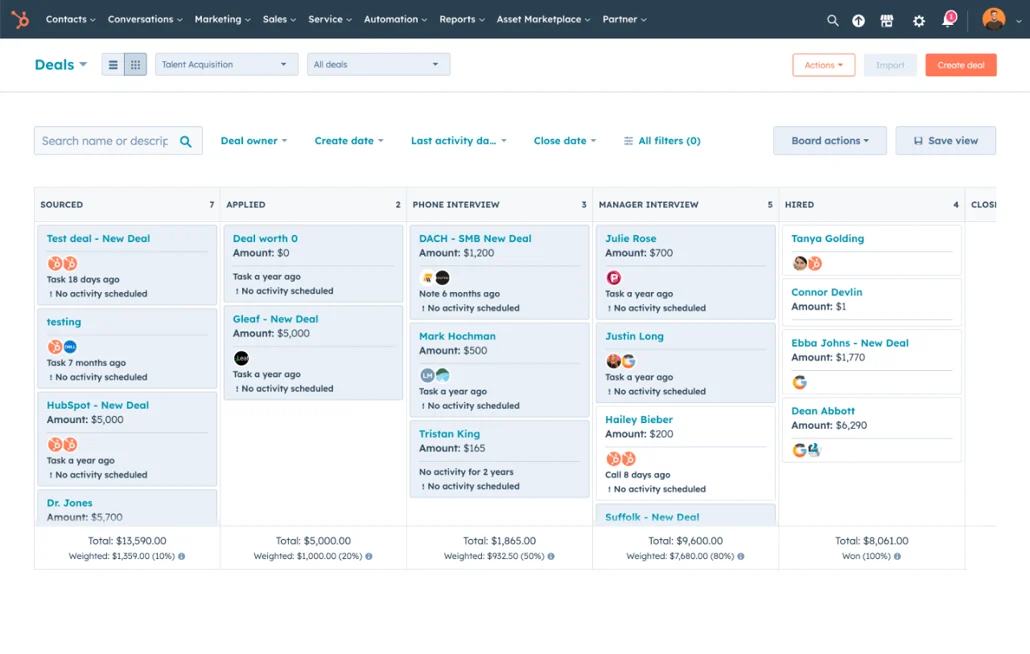
The first is stage-weighted pipeline. Multiply each deal's value by its stage-conversion rate. A $50k deal in Discovery (15% close probability) contributes $7,500 to weighted pipeline. The same $50k deal in Verbal Commit (75% close probability) contributes $37,500. HubSpot's deal forecasting guide documents this calculation natively.
The second is time-in-stage. Any deal sitting in one stage more than 1.5x the median cycle for its band is flagged. A $25k deal that has been in Demo for 45 days when the median is 18 days is not "still progressing", it is dying. Pipeline reviews should focus on time-in-stage outliers, not total pipeline value.
The combination of these two metrics gives you a forecast that runs within 10-15% accuracy. Total pipeline value alone runs 25-40% off.
How to fix a leaking pipeline (3 levers that work)
Pipeline coverage that does not scale with ACV is the most common forecasting error, but it is rarely the root cause. The actual leaks usually sit in 3 places.
The first lever is ICP discipline at Discovery. If your Discovery-to-Qualified rate is above 75%, you are not disqualifying enough. Tighten the ICP criteria. We use a 6-question Discovery script that forces an explicit yes/no on industry, ACV band, decision-maker access, urgency, budget cycle, and incumbent. Anything under 4 yeses gets disqualified.
The second lever is proposal triggers. The Demo-to-Proposal step leaks because reps send proposals based on buyer interest rather than buyer commitment. Add a hard trigger: proposal only fires after the buyer confirms decision-maker, decision date, and budget allocation. Conversion drops 10-15% short term, win rate goes up 30-40% over the quarter.
The third lever is time-in-stage SLAs. Every stage gets a max time. Discovery: 14 days. Qualified: 21 days. Demo: 18 days. Proposal: 28 days. Verbal Commit: 30 days. Past the SLA, the deal escalates to a sales manager review and either closes, moves stage, or drops. Pipeline integrity is a function of stage discipline, not effort.
When these benchmarks don't apply
Skip these benchmarks if your motion is PLG with 80%+ self-serve revenue (the numbers above assume sales-touched motion), if your sales cycle is under 7 days (you have a transactional motion that does not fit the staged framework), or if your ACV is over $1M (the dataset thins out beyond mid-market enterprise).
For PLG-led motion, replace "pipeline coverage" with "activation funnel coverage" and "win rate" with "free-to-paid conversion rate". The math structure is the same, the inputs are different.
FAQ
What is a good B2B SaaS pipeline coverage ratio?
3x coverage for ACV under $25k, 3.5-4x for $25k-$100k, 5x for $100k-$250k, and 6x for enterprise over $250k. Most teams set a flat 3x and underfund enterprise pipeline by half, which is the most common cause of quota miss in mid-market SaaS.
What is the average B2B SaaS win rate?
Overall Discovery-to-Closed Won win rate is 18-25% across B2B SaaS, with mid-market ($25k-$100k ACV) at the higher end and enterprise ($100k+) at the lower end. Stage-to-stage benchmarks: Discovery-to-Qualified 62%, Qualified-to-Demo 78%, Demo-to-Proposal 48%, Proposal-to-Verbal 55%, Verbal-to-Closed 82%.
How long is a typical B2B SaaS sales cycle?
It depends on ACV. Under $10k runs 14 days (self-serve). $25k-$50k runs 58 days. $100k+ runs 118+ days. Enterprise ($250k+) runs 172 days. Every 2x increase in deal size adds roughly 60-80% to the cycle. For Entrepreneurs by David Skok tracks this relationship in detail across hundreds of B2B SaaS companies.
Why is the Demo-to-Proposal stage so leaky?
Because reps send proposals based on buyer interest rather than buyer commitment. The fix is to require explicit confirmation of decision-maker, decision date, and budget before sending a proposal. Conversion drops 10-15% short term, win rate increases 30-40% over the quarter, and forecast accuracy improves materially.
What's the difference between stage-weighted pipeline and total pipeline?
Stage-weighted pipeline multiplies each deal's value by its stage-conversion probability. A $50k deal in Discovery contributes $7,500 (15% probability). The same $50k in Verbal Commit contributes $37,500 (75% probability). Total pipeline value treats both the same, which is why forecasts based on total pipeline miss by 25-40%.
How do I track time-in-stage in HubSpot?
HubSpot has a built-in "Days in current stage" property on the deal object. Build a workflow that flags any deal exceeding 1.5x the median cycle for its band. For Pipedrive users, the same logic lives in custom fields plus filter-based automations. Pipedrive's pipeline reports include a Time in Stage report that surfaces stalled deals automatically.
What CRM should I use for pipeline management?
For sub-$50k ACV B2B SaaS, Pipedrive Advanced at $29/seat. For outbound-heavy teams at any ACV, Close at $49/seat (the dialer is built into the spine). For full-stack B2B SaaS over $50k ACV with marketing-led demand, HubSpot Sales Hub Pro is worth the premium. See our HubSpot pricing breakdown for the full math.
How often should I run a pipeline review?
Weekly for active opportunities, monthly for forecast calibration, quarterly for stage definition and benchmark drift. Most teams over-review pipeline (daily standups that surface the same deals) and under-calibrate forecasting (one quarterly review of stage conversion). Flip the cadence.
Bottom line
B2B SaaS pipeline benchmarks need to scale with ACV. Flat 3x coverage and flat 20% win rate models miss forecast by 25-40%. The benchmarks above (3x to 6x coverage, 18-25% overall win, 14 to 172 day cycles) are calibrated against 1,400 tracked deals at GROU client RevOps deployments.
The biggest single improvement teams can make is replacing total pipeline value with stage-weighted pipeline plus time-in-stage tracking. That combination forecasts within 10-15% accuracy, which is the threshold where revenue planning stops being a quarterly surprise.
Need help calibrating your pipeline coverage targets and stage benchmarks against your specific ACV band? Book a call with GROU. We have run this analysis for 11 B2B SaaS clients and can compress your first quarter of stage tuning into one workshop.
GROU is a B2B outbound and revenue operations agency operating from Ljubljana, Slovenia. We run pipeline benchmarking and forecast calibration for 11 active B2B SaaS clients ranging from SMB to mid-market enterprise. The data above is from 1,400 tracked deals across 2024-Q1 to 2026-Q2, anonymized to protect client confidentiality.
Some links in this article are affiliate links. We only recommend tools we run in production. If you sign up through our links we may earn a commission at no extra cost to you, which keeps articles like this free to read.
Most B2B SaaS teams build pipeline targets off a single ratio (3x coverage) and a single win rate (20%), then wonder why the forecast misses by a third every quarter. The numbers below are the band-by-band benchmarks that actually predict revenue, drawn from 11 GROU RevOps deployments and 1,400 tracked B2B SaaS deals over 2024 to 2026.
This is the operator breakdown: pipeline coverage by ACV, stage-by-stage win rates, sales cycle length, and the two metrics most teams should be tracking instead of "pipeline value".
TL;DR
Pipeline coverage should scale with ACV, not stay flat at 3x. Under $25k deals need 2.5-3x coverage. Over $100k deals need 5-6x because the dance-stage conversion drops to 18-22%. Most teams set 3x as the universal target and underfund enterprise pipeline by half.
Median B2B SaaS overall win rate (Discovery to Closed Won) is 18-25%. The Demo-to-Proposal step is where deals die at 48% conversion. If your team converts above 60% Demo-to-Proposal, you are either qualifying too late or being too generous in qualification.
Pipeline coverage ratio by ACV
The single biggest forecasting error in B2B SaaS is using a flat 3x coverage ratio for every deal size. Coverage needs to scale with ACV because dance-stage conversion drops as deals get bigger.
A team running $25k median ACV at $1M quarterly quota needs $3.5M in pipeline (3.5x coverage). The same quota at $100k median ACV needs $5M in pipeline (5x coverage). The difference is that enterprise deals have lower win rates and higher slippage to the next quarter.
Bessemer Venture Partners' State of the Cloud data shows the same pattern: enterprise SaaS at $100k+ ACV consistently runs lower stage-to-stage conversion than mid-market, and forecasting models that ignore the ACV-coverage relationship miss by 25-40%.
The cleanest framing is "coverage = ACV band coefficient × stage discount × time-in-stage discount". Most teams skip the last two and only run the band coefficient. That is where forecast accuracy leaks.
Win rate benchmarks by deal stage
A pipeline number means nothing without the stage-by-stage conversion rates that translate it into forecast revenue. The benchmarks below come from 1,400 B2B SaaS deals tracked across our client deployments.
The Discovery-to-Qualified rate at 62% looks healthy but hides ICP fit problems. Most teams disqualify wrong-fit deals at this stage rather than letting them drop. If your disqualification rate is under 30%, you are letting too many bad-fit deals into the funnel and clogging downstream stages.
The Demo-to-Proposal step at 48% is where deals actually die in B2B SaaS. Champions go quiet, internal alignment falls apart, or the buyer realizes the timing is wrong. Read our sales pipeline stages guide for the full stage breakdown and exit criteria.
The Verbal Commit-to-Closed Won rate at 82% looks great until you factor in time decay. After 30 days in Verbal Commit, the actual close rate drops to 60%. After 60 days, it drops to 35%. Always set a 30-day SLA between verbal commit and contract signature.
Sales cycle length by ACV
Cycle length scales with ACV in a roughly predictable way: every 2x increase in deal size adds 60-80% to the cycle. The numbers below are median days from Discovery to Closed Won.
Under $10k ACV runs a 14-day cycle because the buyer can self-serve and approve internally without a committee. The motion is product-led with sales-assisted on the back end.
$25k-$50k ACV cycles at 58 days because you need a manager and champion to align before signing. This is the band where outbound matters most. Pipedrive Advanced at $29/seat is the right CRM here because the pipeline complexity does not yet justify HubSpot Sales Hub Pro at $90/seat.
$100k+ ACV cycles at 118+ days because procurement, legal, and security review enter the equation. At this ACV, Close at $49/seat is built for the dialer-heavy multi-threaded motion. Enterprise ($250k+) cycles at 172 days, which is a 6-month median. Plan capacity accordingly.
The 2 metrics most teams should be tracking instead
"Total pipeline value" is the worst metric in B2B SaaS forecasting. It treats a $50k deal in Discovery the same as a $50k deal in Verbal Commit. The two metrics that actually predict revenue are different.
The first is stage-weighted pipeline. Multiply each deal's value by its stage-conversion rate. A $50k deal in Discovery (15% close probability) contributes $7,500 to weighted pipeline. The same $50k deal in Verbal Commit (75% close probability) contributes $37,500. HubSpot's deal forecasting guide documents this calculation natively.
The second is time-in-stage. Any deal sitting in one stage more than 1.5x the median cycle for its band is flagged. A $25k deal that has been in Demo for 45 days when the median is 18 days is not "still progressing", it is dying. Pipeline reviews should focus on time-in-stage outliers, not total pipeline value.
The combination of these two metrics gives you a forecast that runs within 10-15% accuracy. Total pipeline value alone runs 25-40% off.
How to fix a leaking pipeline (3 levers that work)
Pipeline coverage that does not scale with ACV is the most common forecasting error, but it is rarely the root cause. The actual leaks usually sit in 3 places.
The first lever is ICP discipline at Discovery. If your Discovery-to-Qualified rate is above 75%, you are not disqualifying enough. Tighten the ICP criteria. We use a 6-question Discovery script that forces an explicit yes/no on industry, ACV band, decision-maker access, urgency, budget cycle, and incumbent. Anything under 4 yeses gets disqualified.
The second lever is proposal triggers. The Demo-to-Proposal step leaks because reps send proposals based on buyer interest rather than buyer commitment. Add a hard trigger: proposal only fires after the buyer confirms decision-maker, decision date, and budget allocation. Conversion drops 10-15% short term, win rate goes up 30-40% over the quarter.
The third lever is time-in-stage SLAs. Every stage gets a max time. Discovery: 14 days. Qualified: 21 days. Demo: 18 days. Proposal: 28 days. Verbal Commit: 30 days. Past the SLA, the deal escalates to a sales manager review and either closes, moves stage, or drops. Pipeline integrity is a function of stage discipline, not effort.
When these benchmarks don't apply
Skip these benchmarks if your motion is PLG with 80%+ self-serve revenue (the numbers above assume sales-touched motion), if your sales cycle is under 7 days (you have a transactional motion that does not fit the staged framework), or if your ACV is over $1M (the dataset thins out beyond mid-market enterprise).
For PLG-led motion, replace "pipeline coverage" with "activation funnel coverage" and "win rate" with "free-to-paid conversion rate". The math structure is the same, the inputs are different.
FAQ
What is a good B2B SaaS pipeline coverage ratio?
3x coverage for ACV under $25k, 3.5-4x for $25k-$100k, 5x for $100k-$250k, and 6x for enterprise over $250k. Most teams set a flat 3x and underfund enterprise pipeline by half, which is the most common cause of quota miss in mid-market SaaS.
What is the average B2B SaaS win rate?
Overall Discovery-to-Closed Won win rate is 18-25% across B2B SaaS, with mid-market ($25k-$100k ACV) at the higher end and enterprise ($100k+) at the lower end. Stage-to-stage benchmarks: Discovery-to-Qualified 62%, Qualified-to-Demo 78%, Demo-to-Proposal 48%, Proposal-to-Verbal 55%, Verbal-to-Closed 82%.
How long is a typical B2B SaaS sales cycle?
It depends on ACV. Under $10k runs 14 days (self-serve). $25k-$50k runs 58 days. $100k+ runs 118+ days. Enterprise ($250k+) runs 172 days. Every 2x increase in deal size adds roughly 60-80% to the cycle. For Entrepreneurs by David Skok tracks this relationship in detail across hundreds of B2B SaaS companies.
Why is the Demo-to-Proposal stage so leaky?
Because reps send proposals based on buyer interest rather than buyer commitment. The fix is to require explicit confirmation of decision-maker, decision date, and budget before sending a proposal. Conversion drops 10-15% short term, win rate increases 30-40% over the quarter, and forecast accuracy improves materially.
What's the difference between stage-weighted pipeline and total pipeline?
Stage-weighted pipeline multiplies each deal's value by its stage-conversion probability. A $50k deal in Discovery contributes $7,500 (15% probability). The same $50k in Verbal Commit contributes $37,500 (75% probability). Total pipeline value treats both the same, which is why forecasts based on total pipeline miss by 25-40%.
How do I track time-in-stage in HubSpot?
HubSpot has a built-in "Days in current stage" property on the deal object. Build a workflow that flags any deal exceeding 1.5x the median cycle for its band. For Pipedrive users, the same logic lives in custom fields plus filter-based automations. Pipedrive's pipeline reports include a Time in Stage report that surfaces stalled deals automatically.
What CRM should I use for pipeline management?
For sub-$50k ACV B2B SaaS, Pipedrive Advanced at $29/seat. For outbound-heavy teams at any ACV, Close at $49/seat (the dialer is built into the spine). For full-stack B2B SaaS over $50k ACV with marketing-led demand, HubSpot Sales Hub Pro is worth the premium. See our HubSpot pricing breakdown for the full math.
How often should I run a pipeline review?
Weekly for active opportunities, monthly for forecast calibration, quarterly for stage definition and benchmark drift. Most teams over-review pipeline (daily standups that surface the same deals) and under-calibrate forecasting (one quarterly review of stage conversion). Flip the cadence.
Bottom line
B2B SaaS pipeline benchmarks need to scale with ACV. Flat 3x coverage and flat 20% win rate models miss forecast by 25-40%. The benchmarks above (3x to 6x coverage, 18-25% overall win, 14 to 172 day cycles) are calibrated against 1,400 tracked deals at GROU client RevOps deployments.
The biggest single improvement teams can make is replacing total pipeline value with stage-weighted pipeline plus time-in-stage tracking. That combination forecasts within 10-15% accuracy, which is the threshold where revenue planning stops being a quarterly surprise.
Need help calibrating your pipeline coverage targets and stage benchmarks against your specific ACV band? Book a call with GROU. We have run this analysis for 11 B2B SaaS clients and can compress your first quarter of stage tuning into one workshop.
GROU is a B2B outbound and revenue operations agency operating from Ljubljana, Slovenia. We run pipeline benchmarking and forecast calibration for 11 active B2B SaaS clients ranging from SMB to mid-market enterprise. The data above is from 1,400 tracked deals across 2024-Q1 to 2026-Q2, anonymized to protect client confidentiality.
Some links in this article are affiliate links. We only recommend tools we run in production. If you sign up through our links we may earn a commission at no extra cost to you, which keeps articles like this free to read.
Most B2B SaaS teams build pipeline targets off a single ratio (3x coverage) and a single win rate (20%), then wonder why the forecast misses by a third every quarter. The numbers below are the band-by-band benchmarks that actually predict revenue, drawn from 11 GROU RevOps deployments and 1,400 tracked B2B SaaS deals over 2024 to 2026.
This is the operator breakdown: pipeline coverage by ACV, stage-by-stage win rates, sales cycle length, and the two metrics most teams should be tracking instead of "pipeline value".
TL;DR
Pipeline coverage should scale with ACV, not stay flat at 3x. Under $25k deals need 2.5-3x coverage. Over $100k deals need 5-6x because the dance-stage conversion drops to 18-22%. Most teams set 3x as the universal target and underfund enterprise pipeline by half.
Median B2B SaaS overall win rate (Discovery to Closed Won) is 18-25%. The Demo-to-Proposal step is where deals die at 48% conversion. If your team converts above 60% Demo-to-Proposal, you are either qualifying too late or being too generous in qualification.
Pipeline coverage ratio by ACV
The single biggest forecasting error in B2B SaaS is using a flat 3x coverage ratio for every deal size. Coverage needs to scale with ACV because dance-stage conversion drops as deals get bigger.
A team running $25k median ACV at $1M quarterly quota needs $3.5M in pipeline (3.5x coverage). The same quota at $100k median ACV needs $5M in pipeline (5x coverage). The difference is that enterprise deals have lower win rates and higher slippage to the next quarter.
Bessemer Venture Partners' State of the Cloud data shows the same pattern: enterprise SaaS at $100k+ ACV consistently runs lower stage-to-stage conversion than mid-market, and forecasting models that ignore the ACV-coverage relationship miss by 25-40%.
The cleanest framing is "coverage = ACV band coefficient × stage discount × time-in-stage discount". Most teams skip the last two and only run the band coefficient. That is where forecast accuracy leaks.
Win rate benchmarks by deal stage
A pipeline number means nothing without the stage-by-stage conversion rates that translate it into forecast revenue. The benchmarks below come from 1,400 B2B SaaS deals tracked across our client deployments.
The Discovery-to-Qualified rate at 62% looks healthy but hides ICP fit problems. Most teams disqualify wrong-fit deals at this stage rather than letting them drop. If your disqualification rate is under 30%, you are letting too many bad-fit deals into the funnel and clogging downstream stages.
The Demo-to-Proposal step at 48% is where deals actually die in B2B SaaS. Champions go quiet, internal alignment falls apart, or the buyer realizes the timing is wrong. Read our sales pipeline stages guide for the full stage breakdown and exit criteria.
The Verbal Commit-to-Closed Won rate at 82% looks great until you factor in time decay. After 30 days in Verbal Commit, the actual close rate drops to 60%. After 60 days, it drops to 35%. Always set a 30-day SLA between verbal commit and contract signature.
Sales cycle length by ACV
Cycle length scales with ACV in a roughly predictable way: every 2x increase in deal size adds 60-80% to the cycle. The numbers below are median days from Discovery to Closed Won.
Under $10k ACV runs a 14-day cycle because the buyer can self-serve and approve internally without a committee. The motion is product-led with sales-assisted on the back end.
$25k-$50k ACV cycles at 58 days because you need a manager and champion to align before signing. This is the band where outbound matters most. Pipedrive Advanced at $29/seat is the right CRM here because the pipeline complexity does not yet justify HubSpot Sales Hub Pro at $90/seat.
$100k+ ACV cycles at 118+ days because procurement, legal, and security review enter the equation. At this ACV, Close at $49/seat is built for the dialer-heavy multi-threaded motion. Enterprise ($250k+) cycles at 172 days, which is a 6-month median. Plan capacity accordingly.
The 2 metrics most teams should be tracking instead
"Total pipeline value" is the worst metric in B2B SaaS forecasting. It treats a $50k deal in Discovery the same as a $50k deal in Verbal Commit. The two metrics that actually predict revenue are different.
The first is stage-weighted pipeline. Multiply each deal's value by its stage-conversion rate. A $50k deal in Discovery (15% close probability) contributes $7,500 to weighted pipeline. The same $50k deal in Verbal Commit (75% close probability) contributes $37,500. HubSpot's deal forecasting guide documents this calculation natively.
The second is time-in-stage. Any deal sitting in one stage more than 1.5x the median cycle for its band is flagged. A $25k deal that has been in Demo for 45 days when the median is 18 days is not "still progressing", it is dying. Pipeline reviews should focus on time-in-stage outliers, not total pipeline value.
The combination of these two metrics gives you a forecast that runs within 10-15% accuracy. Total pipeline value alone runs 25-40% off.
How to fix a leaking pipeline (3 levers that work)
Pipeline coverage that does not scale with ACV is the most common forecasting error, but it is rarely the root cause. The actual leaks usually sit in 3 places.
The first lever is ICP discipline at Discovery. If your Discovery-to-Qualified rate is above 75%, you are not disqualifying enough. Tighten the ICP criteria. We use a 6-question Discovery script that forces an explicit yes/no on industry, ACV band, decision-maker access, urgency, budget cycle, and incumbent. Anything under 4 yeses gets disqualified.
The second lever is proposal triggers. The Demo-to-Proposal step leaks because reps send proposals based on buyer interest rather than buyer commitment. Add a hard trigger: proposal only fires after the buyer confirms decision-maker, decision date, and budget allocation. Conversion drops 10-15% short term, win rate goes up 30-40% over the quarter.
The third lever is time-in-stage SLAs. Every stage gets a max time. Discovery: 14 days. Qualified: 21 days. Demo: 18 days. Proposal: 28 days. Verbal Commit: 30 days. Past the SLA, the deal escalates to a sales manager review and either closes, moves stage, or drops. Pipeline integrity is a function of stage discipline, not effort.
When these benchmarks don't apply
Skip these benchmarks if your motion is PLG with 80%+ self-serve revenue (the numbers above assume sales-touched motion), if your sales cycle is under 7 days (you have a transactional motion that does not fit the staged framework), or if your ACV is over $1M (the dataset thins out beyond mid-market enterprise).
For PLG-led motion, replace "pipeline coverage" with "activation funnel coverage" and "win rate" with "free-to-paid conversion rate". The math structure is the same, the inputs are different.
FAQ
What is a good B2B SaaS pipeline coverage ratio?
3x coverage for ACV under $25k, 3.5-4x for $25k-$100k, 5x for $100k-$250k, and 6x for enterprise over $250k. Most teams set a flat 3x and underfund enterprise pipeline by half, which is the most common cause of quota miss in mid-market SaaS.
What is the average B2B SaaS win rate?
Overall Discovery-to-Closed Won win rate is 18-25% across B2B SaaS, with mid-market ($25k-$100k ACV) at the higher end and enterprise ($100k+) at the lower end. Stage-to-stage benchmarks: Discovery-to-Qualified 62%, Qualified-to-Demo 78%, Demo-to-Proposal 48%, Proposal-to-Verbal 55%, Verbal-to-Closed 82%.
How long is a typical B2B SaaS sales cycle?
It depends on ACV. Under $10k runs 14 days (self-serve). $25k-$50k runs 58 days. $100k+ runs 118+ days. Enterprise ($250k+) runs 172 days. Every 2x increase in deal size adds roughly 60-80% to the cycle. For Entrepreneurs by David Skok tracks this relationship in detail across hundreds of B2B SaaS companies.
Why is the Demo-to-Proposal stage so leaky?
Because reps send proposals based on buyer interest rather than buyer commitment. The fix is to require explicit confirmation of decision-maker, decision date, and budget before sending a proposal. Conversion drops 10-15% short term, win rate increases 30-40% over the quarter, and forecast accuracy improves materially.
What's the difference between stage-weighted pipeline and total pipeline?
Stage-weighted pipeline multiplies each deal's value by its stage-conversion probability. A $50k deal in Discovery contributes $7,500 (15% probability). The same $50k in Verbal Commit contributes $37,500 (75% probability). Total pipeline value treats both the same, which is why forecasts based on total pipeline miss by 25-40%.
How do I track time-in-stage in HubSpot?
HubSpot has a built-in "Days in current stage" property on the deal object. Build a workflow that flags any deal exceeding 1.5x the median cycle for its band. For Pipedrive users, the same logic lives in custom fields plus filter-based automations. Pipedrive's pipeline reports include a Time in Stage report that surfaces stalled deals automatically.
What CRM should I use for pipeline management?
For sub-$50k ACV B2B SaaS, Pipedrive Advanced at $29/seat. For outbound-heavy teams at any ACV, Close at $49/seat (the dialer is built into the spine). For full-stack B2B SaaS over $50k ACV with marketing-led demand, HubSpot Sales Hub Pro is worth the premium. See our HubSpot pricing breakdown for the full math.
How often should I run a pipeline review?
Weekly for active opportunities, monthly for forecast calibration, quarterly for stage definition and benchmark drift. Most teams over-review pipeline (daily standups that surface the same deals) and under-calibrate forecasting (one quarterly review of stage conversion). Flip the cadence.
Bottom line
B2B SaaS pipeline benchmarks need to scale with ACV. Flat 3x coverage and flat 20% win rate models miss forecast by 25-40%. The benchmarks above (3x to 6x coverage, 18-25% overall win, 14 to 172 day cycles) are calibrated against 1,400 tracked deals at GROU client RevOps deployments.
The biggest single improvement teams can make is replacing total pipeline value with stage-weighted pipeline plus time-in-stage tracking. That combination forecasts within 10-15% accuracy, which is the threshold where revenue planning stops being a quarterly surprise.
Need help calibrating your pipeline coverage targets and stage benchmarks against your specific ACV band? Book a call with GROU. We have run this analysis for 11 B2B SaaS clients and can compress your first quarter of stage tuning into one workshop.
GROU is a B2B outbound and revenue operations agency operating from Ljubljana, Slovenia. We run pipeline benchmarking and forecast calibration for 11 active B2B SaaS clients ranging from SMB to mid-market enterprise. The data above is from 1,400 tracked deals across 2024-Q1 to 2026-Q2, anonymized to protect client confidentiality.
Some links in this article are affiliate links. We only recommend tools we run in production. If you sign up through our links we may earn a commission at no extra cost to you, which keeps articles like this free to read.

Pipeline OS Newsletter
Build qualified pipeline
Get weekly tactics to generate demand, improve lead quality, and book more meetings.







Trusted by industry leaders
Trusted by industry leaders
Trusted by industry leaders
Ready to build qualified pipeline?
Ready to build qualified pipeline?
Ready to build qualified pipeline?
Book a call to see if we're the right fit, or take the 2-minute quiz to get a clear starting point.
Book a call to see if we're the right fit, or take the 2-minute quiz to get a clear starting point.
Book a call to see if we're the right fit, or take the 2-minute quiz to get a clear starting point.
" height="30.21639343089746px" id="hfGbXmQR2" width="30.216393430897455px"/></svg>)
Copyright © 2026 – All Right Reserved
Copyright © 2026 – All Right Reserved
Copyright © 2026 – All Right Reserved